In constitutive modelling of rubber-like materials, the strain-hardening effect at large deformations has traditionally been captured successfully by non-Gaussian statistical molecular-based models involving the inverse Langevin function, as well as the phenomenological limiting chain extensibility models. A new model proposed by Anssari-Benam and Bucchi (Int. J. Non Linear Mech. 2021; 128; 103626. DOI: 10.1016/j.ijnonlinmec.2020.103626), however, has both a direct molecular structural basis and the functional simplicity of the limiting chain extensibility models. Therefore, this model enjoys the benefits of both approaches: mathematical versatility, structural objectivity of the model parameters, and preserving the physical features of the network deformation such as the singularity point. In this paper we present a systematic approach to constructing the general class of this type of model. It will be shown that the response function of this class of models is defined as the [1/1] rational function of , the first principal invariant of the Cauchy–Green deformation tensor. It will be further demonstrated that the model by Anssari-Benam and Bucchi is a special case within this class as a rounded [3/2] Padé approximant in (the chain stretch) of the inverse Langevin function. A similar approach for devising a general term as an adjunct to the part of the model will also be presented, for applications where the addition of an term to the strain energy function improves the fits or is otherwise required. It is concluded that compared with the Gent model, which is a [0/1] rational approximation in and has no direct connection to Padé approximations of any order in , the presented new class of the molecular-based limiting chain extensibility models in general, and the proposed model by Anssari-Benam and Bucchi in specific, are more accurate representations for modelling the strain-hardening behaviour of rubber-like materials in large deformations.
Within the theory of non-linear elasticity, the state of deformation of a material is ascribed to a strain energy function which contains appropriate measures of deformation as well as a set of material parameters. For an isotropic material, the measures of deformation often either include directly the principal stretches or the principal invariants (where 1, 2, 3) of the Cauchy–Green deformation tensor. The material constants are usually a set of elastic moduli (e.g. infinitesimal Young or shear moduli) or other phenomenological parameters reflecting aspects of the physics of the deformation, such as the parameter in the Gent model or stress-like parameters such as in models that embody terms.
However, for accurately capturing the large deformation of rubber-like materials, the functional form of is of critical importance. For example, the theoretical predictions based on the classical models of rubber elasticity such as the neo-Hookean or the Mooney–Rivlin models do not adequately describe the deformation behaviour observed in experiments, particularly at high levels of strain. In addition, the physics of the deformation of rubbers logically dictates that rubber specimens cannot be stretched indefinitely so that a limiting extensibility level exists. To this end, constitutive models have been developed and proposed to better capture the strain-hardening effects at larger deformations while reflecting the limiting extensibility. The literature suggests that two approaches have been employed for developing such constitutive models [1–3]: (i) non-Gaussian statistical molecular-based models and; (ii) phenomenological continuum mechanics models.
The classical non-Gaussian statistical molecular-based model in rubber elasticity is that due to Kuhn and Grün [4] which involves the inverse Langevin function of the molecular chain stretch . See James and Güth [5] for a direct derivation of this function for a 3D network of rubber molecular chains. Note that is the number of Kuhn segments, or links, in a molecular chain and is the chain stretch. While this model exhibits the strain-hardening behaviour of rubbers as the chain stretch approaches the limiting value, i.e. , the inverse Langevin function is not amenable to derivation of straightforward mathematical expressions for the deformation response of rubber-like materials. Therefore, to circumvent this difficulty, various approximations of the Kuhn and Grün model based on the kinematics of deformation of, for example, 4-chain or 8-chain networks, have been introduced. A celebrated example of this type of model is the Arruda–Boyce model [6], developed using an 8-chain network approach and a Taylor series expansion of the original inverse Langevin function of James and Güth. A prior example also includes the 4-chain network model due to Wang and Güth [7]. Beatty [8] subsequently demonstrated that emphasis on the heuristic morphology of the network is superfluous, as he derived the same response function for an amorphous full network of arbitrary oriented molecular chains. However, as noted by Horgan and Saccomandi [2], approximations of the inverse Langevin function based on the Taylor series expansion are ambiguous since the ensuing polynomial functions do not possess the singularity characteristic of the original function. This point, in relation to the deformation of the elastin network in heart valves, has also been discussed in [9].
Phenomenological continuum mechanics models with limiting chain extensibility also similarly exhibit the strain-hardening effects, and while they retain the singularity point in the deformation of the continuum, they possess much simpler mathematical forms than the models involving the original inverse Langevin function . Perhaps the most celebrated model in this class is that of Gent [10], with a simple functional form and two material parameters, namely the infinitesimal shear modulus and the limiting extension parameter . Other models of this family also include that of Puso [8], the Van der Waals strain energy [11] and a restricted elastic model developed by Beatty in [3]. These models, however, in general remain essentially phenomenological. While the structural root and affinity of the Gent model to the non-Gaussian molecular theory of rubber elasticity has been analysed and investigated [2,12,13], no direct connection of the Gent model to a Padé approximant of any order of the inverse Langevin function can be made [2,3,14]. In addition, the Gent model is the simplest of the lowest order rational approximant in [2,3], i.e. of the order [0/1]. These attributes, while prompting the Gent model as a simple and versatile constitutive model, do not render it the most accurate approximate representation of the non-Gaussian statistics molecular model of rubber elasticity.
In a recent study, however, Anssari-Benam and Bucchi put forward a new constitutive model [15] derived from the non-Gaussian statistics of the deformation of molecular chain networks. The proposed model preserves the singularity point of the original inverse Langevin function using a particular rounded Padé approximation of the [3/2] order in due to Cohen [16], resulting in a rational fraction response function of the order [1/1] in . Therefore, the proposed model benefits from advantages of both molecular-based and phenomenological approaches: (i) it has a molecular root and therefore model parameters have structural objectivity and definition; (ii) mathematical simplicity in the functional form of the model with only two model parameters; and (iii) preserving the physical features of the deformation of rubbers such as the strain-hardening effects and the singularity point.
Considering the foregoing advantages of the proposed Anssari-Benam and Bucchi model, and the aforementioned disadvantages of the other molecular-based or phenomenological limiting extensibility modelling approaches recited above, it may prove beneficial to define and devise a general class of models that contain such advantages and are constructed through a simple set of mathematical and continuum mechanics principles, a special case of which reproduces the proposed model by Anssari-Benam and Bucchi. Devising and presenting this new class of models is the purpose of this note. In doing so, the theoretical preliminaries and the definition of terminologies will be cast forth in §2 in unambiguous terms. In §3 the development of the new class of non-Gaussian molecular-based constitutive models with limiting chain extensibility will be presented, and it will be demonstrated that the model by Anssari-Benam and Bucchi is a special case of this class. A brief comparison between the proposed model and that of Gent in terms of the accuracy of the Padé approximant representations of the original non-Gaussian statistics molecular model is presented in §4. Using a similar approach, devising a general term as an adjunct to the part of the model is presented in §5, where the ensuing improvement to the fits will be illustrated via a specific inflation dataset example. Concluding remarks are conferred in §6.
2. Preliminaries and definitions
The (Cauchy) stress for an isotropic incompressible rubber-like material in finite deformation may be given in the form of the second representation theorem for isotropic tensor functions as (see page 202 of [17] and [18]):
where is the left Cauchy–Green deformation tensor and is its inverse, is the arbitrary Lagrange multiplier enforcing the condition of incompressibility, is the identity tensor, and and are the partial derivatives of the strain energy function with respect to the first and second principal invariants of , respectively, which are defined as
with 1 due to incompressibility. Note that are the principal stretches. It is customary in continuum mechanics literature to use the following notation:
Eminently, and are scalar-valued functions and following Beatty [3] are henceforth called the material response functions.
When dealing with non-Gaussian statistical molecular models one is axiomatically inclined to focus on , as appears naturally in deriving the network’s strain energy function under the assumption of an affine deformation. It can be shown that the averaged chain stretch is equal to , leading to the argument of the inverse Langevin function to become . See, for example, [9] and [15] for detailed derivations. This will then result in the limiting value of , say , to be the well-known . Recall that is the number of Kuhn segments, or links, in the idealised molecular chain. However, and in addition, Beatty [3,14] provides an interesting argument as to why may be discarded from the functional form of the non-Gaussian statistical molecular and the limiting chain extensibility models. In analysing the experimental data of Dickie and Smith [19], Gent demonstrates that the limiting extensibility of non-crystallising elastomers is only governed by the value of [20]. Beatty rationally argues that if is to be also included in the model, then an independent limit on will be at odds with the foregoing experimental observations and analyses which point to a single value of limiting extensibility [3,14]. Also see [21] for discussion surrounding the appropriateness of the measure for the limiting extensibility value. There are other studies which also experimentally verify the assumption of neglecting the term in modelling the planar deformation of rubber samples up to strains of 100% [22], or suggest that is generally much greater than and therefore neglecting may only introduce small errors [23]. As noted in [3], however, these arguments do not prove to be irrelevant, particularly since specific examples in relation to torsion [24,25] and simple shear [26,27] deformations have been provided that demonstrate the necessary dependence of the function on . However, for reasons argued by Beatty [3,14] and Gent [20], and the derivations in [9] and [15], we first focus our attention on considering only in advancing our analysis henceforth. We will consider the addition of an term later in §5.
Since we will require using the Padé approximation in the proceeding sections, it may be useful at this point to recapitulate the basics of this approximation method. Original details and representations of the definition of the mathematical theory of Padé approximation can be found in, e.g. [28], and in relation to its application to rubber elasticity in [2] and [3]. For the convenience of the reader, we summarise the preliminaries here.
Because the inverse Langevin function has a singularity point, Taylor series expansion and polynomial approximations are not a meaningful representative of the original function. The singularity point is an important physical attribute of non-Gaussian statistical molecular models, as well as limiting chain extensibility models, as it signifies the physical limit of the deformation of the network. Power series or polynomial expansions, such as the one employed in the functional form of the Arruda–Boyce model, do not reproduce this physical attribute. Therefore, a more useful approximation is obtained if rational functions are used. It has been stipulated [2] that perhaps the first introduction of rational functions for approximating the inverse Langevin function in the framework of rubber elasticity was due to the work of Cohen [16] by using a Padé approximation.
Following [2], an [n/m] Padé approximant of a real function at is a particular rational approximation of the function in the order of . This rational approximation is defined using the ratio of two polynomials of and of the degree and , respectively, such that:
as . The ratio is called the Padé approximant of of the [n/m] order. While we won’t use equation (2.4) to develop or derive the Padé approximants of the function to the various required orders, the definitions presented in the foregoing will have direct implications for our analysis in the proceeding section.
3. Developing a new class of limiting chain extensibility models with a direct non-Gaussian molecular statistics connection using a [1/1] rational approximant
Following the discussions articulated in previous sections, we wish to develop a new class of constitutive models with limiting chain extensibility that are related to the non-Gaussian statistical treatment pertaining to the molecular chain networks in rubber elasticity and therefore have structural relevance. In this way, one will obtain models that enjoy the benefits of both the molecular-based and the limiting chain extensibility models. Therefore, the devised models not only will have simple mathematical functional forms, but will also embody model parameters with structural roots and preserve the critical physical aspects of the deformation of the molecular chain networks such as the limiting extensibility and the ensuing singularity point.
Beatty [3] has introduced a general framework for developing limiting extensibility models in the form of rational fractions. We adopt the foundation of his framework; however, we note that models obtained via that framework have no direct connection to Padé approximations of any order in of the original inverse Langevin function , and thus are of no direct structural connection with the non-Gaussian molecular basis of rubber elasticity. Therefore, we adapt that framework as will be laid out in the following to obtain a more structurally relevant class of new models.
Similar to Beatty [3], we seek a new class of limiting chain extensibility models, but with non-Gaussian molecular basis, that are only a function of defined by:
Note that is known as the shear function. Our goal is to develop a response function that satisfies (3.1) which furnishes the limiting chain extensibility characteristic. However, at the same time, we wish for to have a direct molecular connection and hence be related to the non-Gaussian statistical treatment of the network deformation. Whereas Beatty stipulated a [0/1] rational approximant for in order to construct his class of limiting chain extensibility functions, we opt to consider a [1/1] rational approximant (for reasons that will become clear in detail in §4) which has the following general form:
where , , and are constants whose exact values we wish to specify as follows.
First, since according to (3.1)3 as , we find that the denominator of (3.2) must equal zero when . Recalling from §2 that , it follows:
Since the ratio will remain unaltered if both the numerator and denominator of that fraction are multiplied by an arbitrary constant, without the loss of generality we can consider , so that from (3.3) we find:
For dimensional consistency, and by substituting (3.4) into (3.2), we find that , where the bracket sign [-] indicates the dimension of the inside argument. The simplest general form that and can assume is therefore a linear function of a measure of shear modulus, say , as:
where and are arbitrary scalar multipliers. By substituting (3.4) and (3.5) into (3.2), the shear response function and by extension will take the following more specific but yet general form:
where . Since we require that when the extensibility limit is removed, i.e. when , so as to recover the classical neo-Hookean function, we find:
Equation (3.7) is a Diophantine equation, where we only seek the integer solutions since , or equivalently in (3.2), is a rational fraction. Therefore, the simplest solution to (3.7) takes the following sequence:
Therefore, the simplest form of the response function which satisfies (3.1) is of the form (3.2), where on using (3.4), (3.6) and (3.8), has the following final structure:
The general functional form in (3.9) gives rise to a new class of constitutive models that are an improved rational approximant in , i.e. of [1/1] order, compared with the framework put forward by Beatty [3], which the Gent model also belongs to, that is a lower order rational approximant, i.e. [0/1], in . Note that the infinitesimal shear modulus for the class of models described by (3.9) may be found to be:
or alternatively:
The other advantage of this new class of limiting chain extensibility models, which will be demonstrated in the following section in detail, is that a direct connection can be made between the response function in (3.9) and the rounded Padé approximant of the original inverse Langevin function in , the chain stretch. The class of models in [3] including the Gent model have no direct connections to the Padé approximant of of any order.
It is worth observing that the model put forward by Anssari-Benam and Bucchi [9,15], which was originally derived using an entirely different approach based on the non-Gaussian statistical treatment of the molecular chain network, is a special case of the new class of models described here by (3.9) with , so that the specific response function of that model has the following form:
The response function of the new class of models given by equation (3.9) paves the way for developing the general strain energy function pertaining to this class. One may obtain from (3.9) via:
such that the integration constant, say , should be zero in the undeformed configuration, i.e. . Using a simple mathematical manipulation detailed in [9,29], it is easy to show from (3.14) that:
with . Therefore, to summarise, the new class of limiting chain extensibility constitutive models developed herein have a strain energy function in the general form of equation (3.15) and a response function of the general form of equation (3.9), where . We further note that at the limit , on using (3.11) to substitute with , we get:
which is the well-known neo-Hookean function.
Remark 1. For the case where , in equation (3.15) also reduces to the neo-Hookean function (3.16), since in this case from equation (3.11) we have .
4. Comparison with the Gent model
The celebrated Gent model [10] is a phenomenological model from the family of limiting chain extensibility models with the following well-known strain energy function:
The strength of the Gent model lies in its mathematical simplicity, which as Horgan and Saccomandi [30] have noted facilitates obtaining exact solutions for a variety of boundary value problems [24,31–33]. Our point of focus here, however, is how does this model compare with that proposed by Anssari-Benam and Bucchi in [15], as a representative example of the new class of molecular-based limiting chain extensibility models devised in §3.
The strain energy function put forward by Anssari-Benam and Bucchi is a special case of the new class of models presented in §3, where in equation (3.15), having the following form [15]:
It may be observed from equations (4.1) and (4.2) that both models have a similar functional form and simplicity, both accommodate only two model parameters and when written in Taylor series expansion (around ), they both have a similar series form1:
Therefore, comparison between these two models is particularly meaningful. Despite the similarities between the two models, however, crucial differences exist which as will be shown in the following, render the proposed model by Anssari-Benam and Bucchi a more accurate representation of the response function of rubber-like materials with limiting chain extensibility.
Let us start by comparing the models from the approximant accuracy point of view. Beatty [3] has shown that the response function of the Gent model is given by the simplest rational approximant in , of the order [0/1], in the following rational fraction form:
where the parameters , and have the same standing as those considered in §3. In order to satisfy the conditions in equation (3.1), Beatty shows that has to be of the form [3]:
which is the same as the function put forward by Gent [10]. The response function of the Anssari-Benam and Bucchi model, however, as given by equation (3.12), is a higher order rational approximant in of the order [1/1]. Immediately, from a mathematical point of view, the latter is therefore a more accurate representation of the response function of the materials with limiting chain extensibility. A numerical comparison will be shown later.
More importantly, however, is the connection of the two models with the original inverse Langevin function . Using the definition in equation (2.3)1, it can be shown that the response function of the stretched network of non-Gaussian molecular chains involving the function is (see [2,3,6,9] for detailed derivation and discussion):
Recall that is the chain stretch. Cast in the form of chain stretch, the response function of the Gent model becomes [2]:
where we have now replaced with , an entity which is referred to as the relative chain stretch [2,3] and varies in the range: , and used . Equation (4.7) makes interesting reading. Despite its appearance, the response function of the Gent model is not the [0/2] Padé approximant of , or equivalently of . As pointed out in [2], and on using (2.4), the correct [0/2] Padé approximant of in equation (4.6) is:
which does not preserve the original singularity point of the inverse Langevin function at . Indeed, as discussed in [2], no Padé approximant of the original inverse Langevin function will result in the response function of the Gent model as in (4.7). This highlights a very important point: there is no direct connection between the approximation in the Gent model and any rational Padé approximant of the original inverse Langevin function . Therefore, despite the close proximity of the functional form of the Gent model to the approximants of the inverse Langevin function , the Gent model has no direct non-Gaussian molecular network underpinning.
By contrast, it can be shown that the response function of the model by Anssari-Benam and Bucchi is directly related to a specific Padé approximant of the original inverse Langevin function of the order [3/2] in (or equivalently in ), due to Cohen [16]. The rounded [3/2] Padé approximant of adopted by Cohen is of the form [16]:
By considering that , where as discussed in §2 , and the relationship between and given in (3.13), it can be easily observed that:
which is exactly the response function of the model by Anssari-Benam and Bucchi as given in (3.12). Therefore, unlike the Gent model, this model has a direct connection to the non-Gaussian statistical treatment of the network of molecular chains. Hence, not only does the model have the feature of limiting chain extensibility, it also is molecular-based and is not purely phenomenological. This is the reason why we opted for a [1/1] rational approximant representation of the response function for the class of models devised in §3, instead of the [0/1] approximant customary for the class of models such as the Gent as devised by Beatty [3].
Remark 2. Note that, as analysed in [34], the exact [3/2] Padé approximation of is:
which gives rise to the asymptotic behaviour at . Cohen hence adjusted (rounded) the coefficients in his approximation so to preserve the singularity point exactly at , as is the case in equation (4.9):
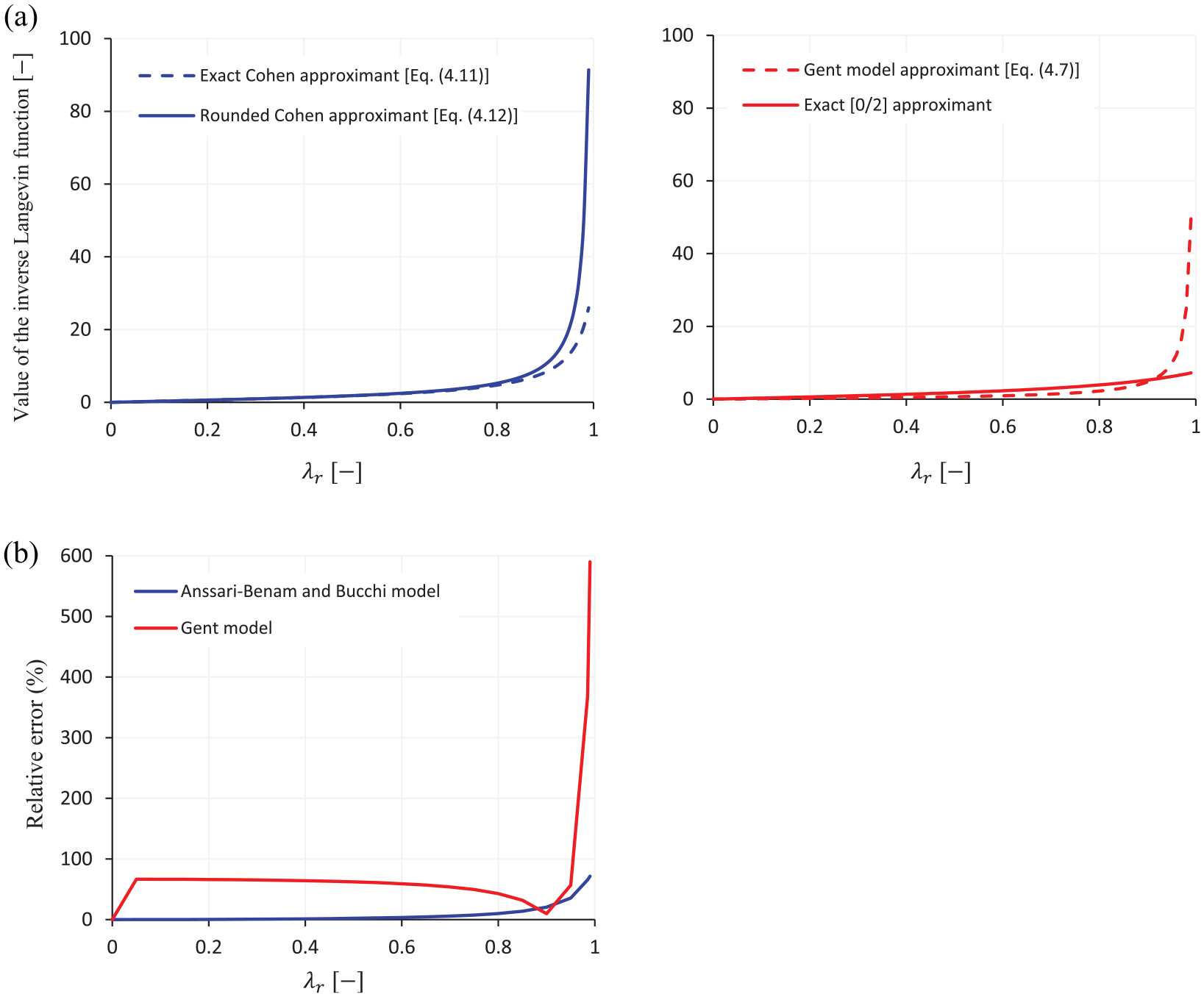
By comparison, the closest exact Padé approximation to the Gent model is the [0/2] approximant given by equation (4.8), which has the singularity point at . From this perspective, it is evident that the [3/2] Padé approximation of the inverse Langevin function is a more accurate approximation of the strain-hardening effect than the [0/2] approximant. Plots in Figure 1 provide a graphical comparison between the exact [3/2] and the rounded Cohen Padé approximants of , i.e. equations (4.11) and (4.12), as well as the same comparison between the exact [0/2] Padé approximant and that of the Gent model; i.e. equations (4.7) and (4.8), respectively. The relative errors have been calculated as the absolute percentage of the normalised difference between the exact Padé approximants and the approximants used in the models.
Comparison between the closest exact Padé approximants and the approximants used in the response functions of the Gent [10] and Anssari-Benam and Bucchi [15] models: (a) direct comparisons; and (b) the ensuing relative errors between the two approximants. Note that following [2], the Gent model approximant has been plotted for large values of () as a representative example. Large deviations are observed between the true [0/2] Padé approximants and that used in the Gent model in the vicinity of the asymptote.
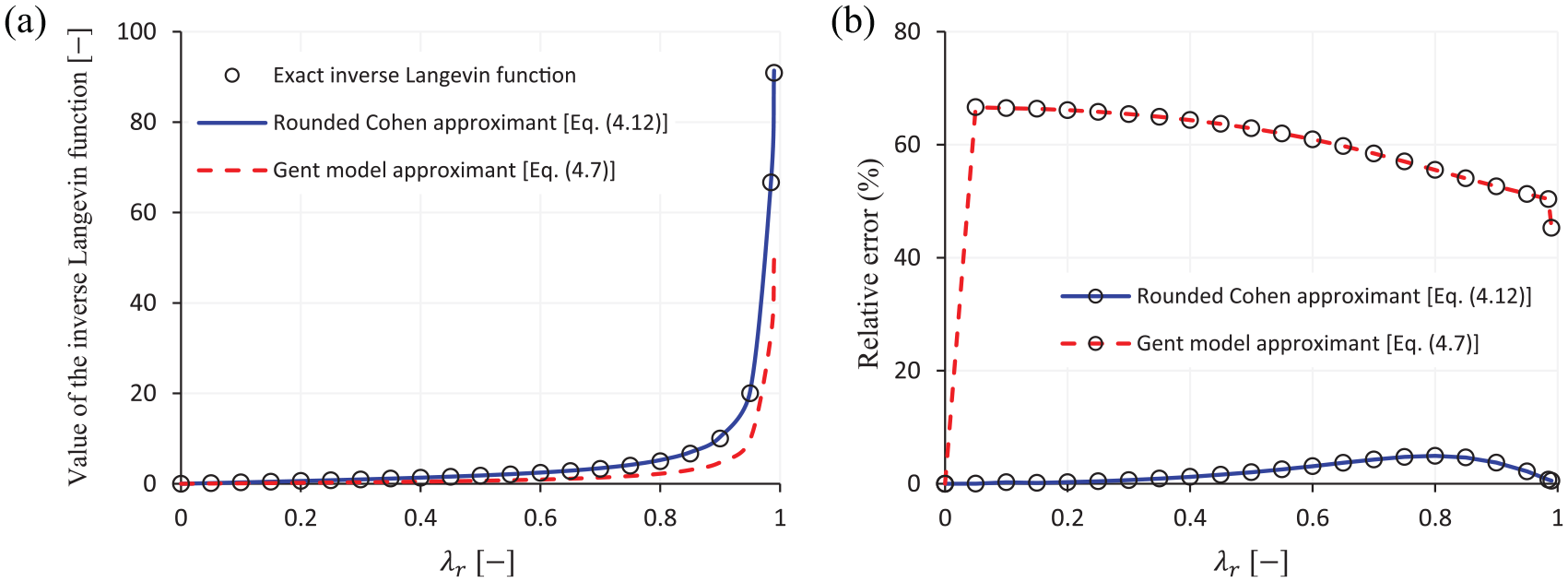
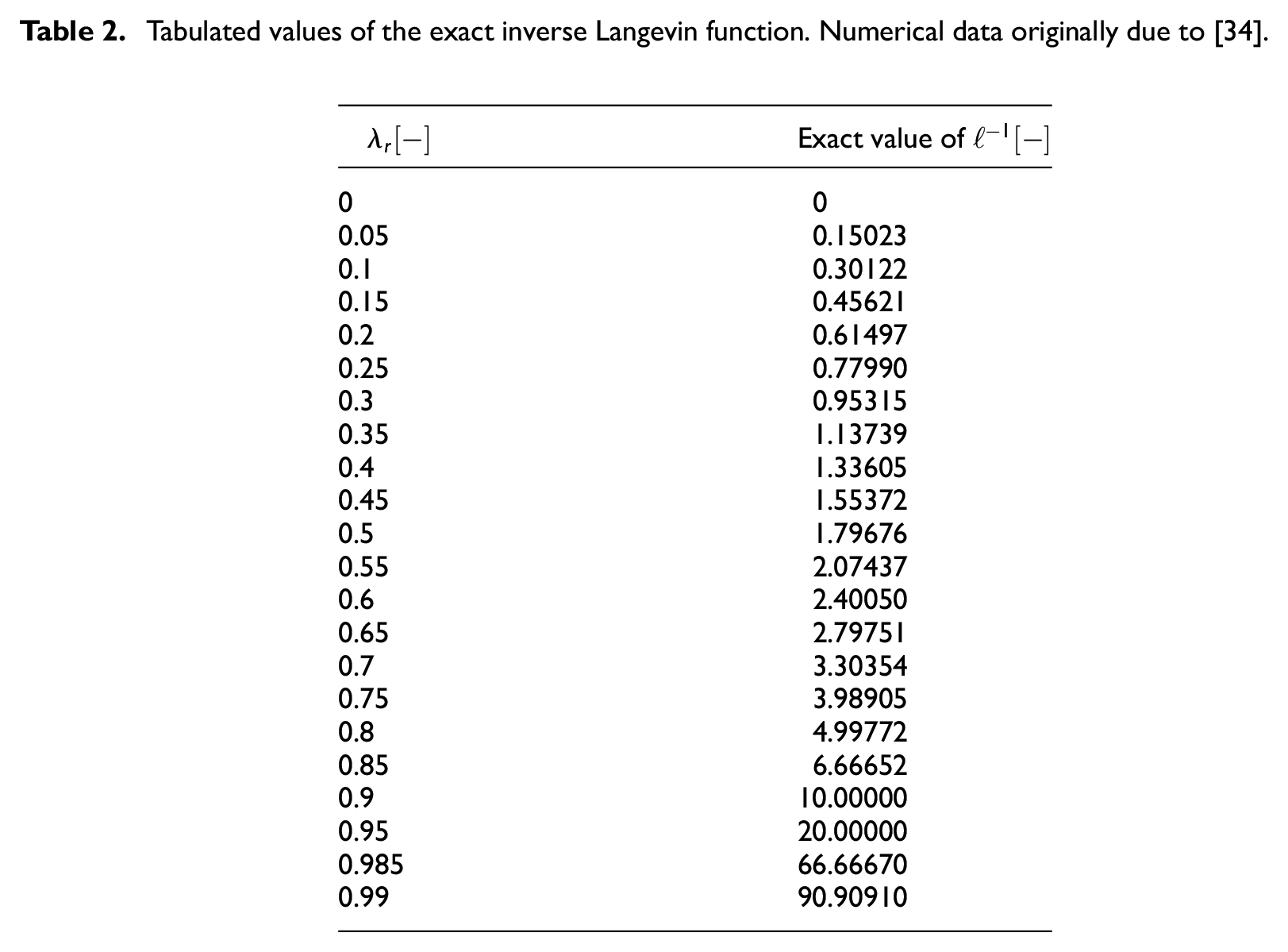
Plots in Figure 1 demonstrate that the gap between the closest exact Padé approximant of the response function of the Gent model and that actually incorporated in the Gent model is noticeably larger than the same gap in the Anssari-Benam and Bucchi model. Therefore, these plots graphically confirm the analytical point made in the foregoing that the model by Anssari-Benam and Bucchi is a more accurate approximation of the behaviour of the original inverse Langevin function . However, a more direct comparison is achieved if the exact values of the function are plotted against the approximants used in the response functions of the Gent and Anssari-Benam and Bucchi models. Those plots, along with the associated relative errors, for both models are illustrated in Figure 2. Note that in plotting these graphs equations (4.7) and (4.12) are used, and the numerical values of the exact function are taken from [34], tabulated in Appendix 1.
Comparison between the values of the original inverse Langevin function and the approximants used in the Gent [10] and Anssari-Benam and Bucchi [15] models: (a) a direct comparison; and (b) the relative errors. Note that the highest value of relative error for the rounded Cohen Padé approximant used in the Anssari-Benam and Bucchi model is ~ 4.94%.
Consistent with the analysis thus far, it is evident from the plots in Figure 2 that the model by Anssari-Benam and Bucchi is a more accurate approximate representation of the inverse Langevin function than that of the Gent model. In the application of these two models to experimental data pertaining to the deformation of elastomers, the more accurate approximation of the inverse Langevin function by the Anssari-Benam and Bucchi model leads to various favourable improvements in the modelling outcomes. A detailed account of the achieved improvements using various extant deformation datasets has been presented in [15] and [35], and we hence refrain from replicating those results here.
Remark 3. In a recently published note, Horgan [36] astutely observed that there is a relationship between the strain energy function put forward by Anssari-Benam and Bucchi, i.e. equation (4.2), and that of the Gent, i.e. equation (4.1), in the form:
which indicates that the response functions of the two models are also related. By comparing equations (3.12) and (4.5), noting equation (3.13) and that , it may be observed that:
which is equivalent to the relationship in [36] in terms of .
We note that the analysis presented here for the special case of the Anssari-Benam and Bucchi model can be generalised to the generic class which this model belongs to, devised in §3 and characterised by equations (3.9) and (3.15). Therefore, this new class of limiting chain extensibility models may be seen as a more accurate modelling tool for analysing the behaviour of rubber-like materials. The models belonging to this class retain the mathematical simplicity of the Gent model, but at the same time have structural molecular connection and capture the strain-hardening behaviour of the inverse Langevin function more accurately.
5. An adjunct with the term
Useful and versatile as generalised neo-Hookean functions are, datasets may be encountered at times that are not captured accurately by such models, as for example noted by Pucci and Saccomandi [37] in relation to the Gent model applied to the Treloar dataset within the small range of deformation. Another example was given in [35] in relation to the model by Anssari-Benam and Bucchi applied to the inflation data due to Rivlin and Saunders [38]. In such circumstances, the addition of an term to the generalised neo-Hookean function has proven to be advantageous in providing more accurate fits. In addition, recall that for appropriately modelling deformations such as torsion [24,25] and simple shear [26,27], the dependence of the function on has been demonstrated to be necessary. Therefore, an term adjunct to the generalised neo-Hookean function will be a judicious addition. However, we note that not any term will always prove to be useful. As a case in point, the inflation data of Rivlin and Saunders [38] was captured accurately only when the Pucci and Saccomandi term was added to the generalised neo-Hookean model in [15]; the commonly used did not improve the fit [35].
In this spirit, we seek to devise a general functional form as an adjunct to the generalised neo-Hookean part using the approach devised in §3. Accordingly, the simplest [1/1] rational functional form for the response function in may be considered as:
However, we recall Beatty’s argument [3] based on the analysis put forward by Gent [20] that the limiting extensibility value is only governed by . It follows that:
Therefore, the response function in equation (5.1) may now be re-written as:
where we have now substituted with and with . Since is now a constant, one may choose so that at each the value of corresponding is determined via the fraction functional form:
The response function given by equation (5.4) paves the way for developing a general term via:
where we note that with and .
Remark 4. A similar response function and may also be obtained using a [0/1] rational functional form for . The reason that both these two orders result in the same response function lies in the fact that the ensuing fraction should possess no asymptotes, as that limiting extensibility behaviour pertains to the functional form.
Remark 5. It may be observed that when then the term adduced by Pucci and Saccomandi [37] is recovered.
Therefore, with the term adjunct, the generalised strain energy function of this class of models takes the following form:
By means of an example, we consider the special case where , i.e. the model by Anssari-Benam and Bucchi in [15], and , so that the strain energy function in equation (5.6) becomes:
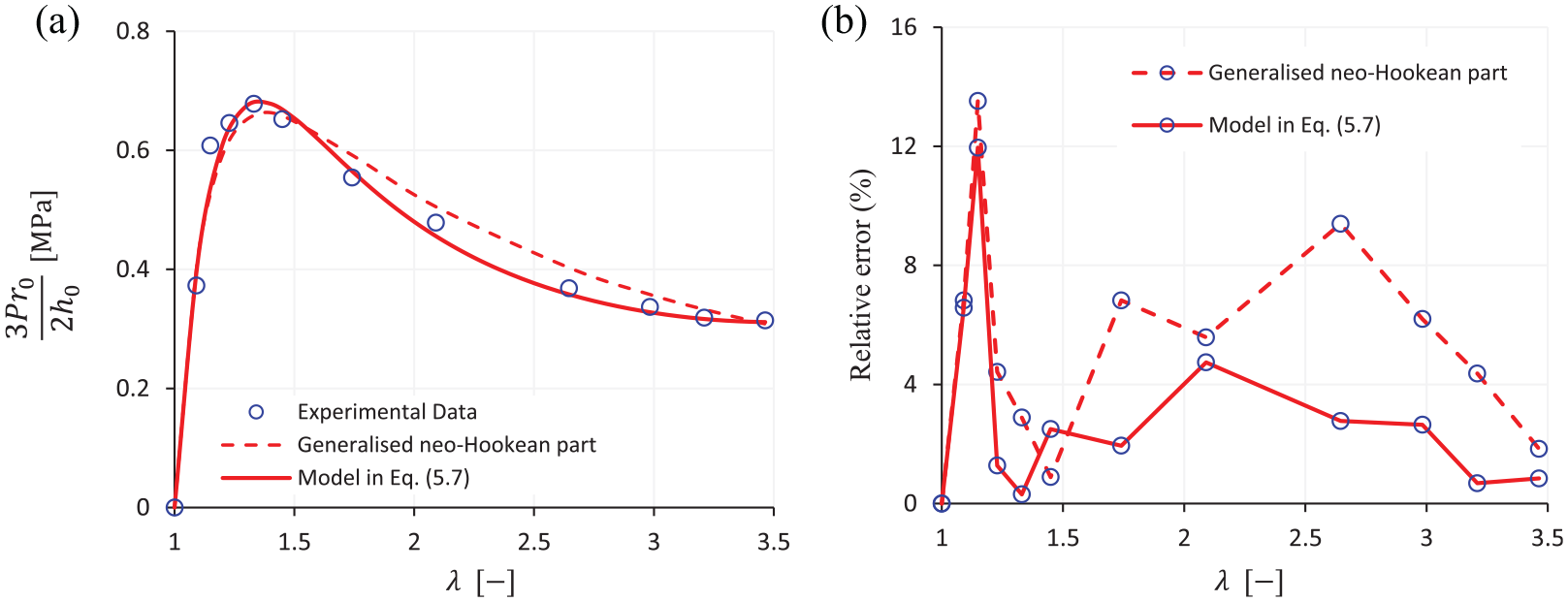
When this model is fitted to the inflation experimental data of Rivlin and Saunders [38], the achieved improvement is clear compared with the generalised neo-Hookean part only. Plots in Figure 3 illustrate and compare the fitting results. The model parameters are summarised in Table 1.
Experimental versus modelling results for the inflation data due to Rivlin and Saunders [38]: (a) the fitting results; and (b) the relative errors. The dashed line indicates the generalised neo-Hookean model by Anssari-Benam and Bucchi [15], while the continuous line is when the model in equation (5.7), i.e. with the additional term, is used. Note that is the inflation pressure, and are the initial radius and thickness of the balloon, respectively, and is the ensuing stretch.
Model parameters for the inflation data from [38].
A new class of limiting chain extensibility models was devised and presented in this note. A systematic approach as to how this class of models is constructed using a [1/1] rational approximant of the response function in was developed and detailed in §3. It was shown that unlike the class of models put forward previously, this new class not only embodies the strain-hardening behaviour due to the limiting chain extensibility feature, but also has a more direct molecular connection to the non-Gaussian behaviour of the molecular chain networks. These collective advantages do not pertain to many of the existing models in rubber elasticity.
A special case of the presented class of models, with , reproduces the model proposed by Anssari-Benam and Bucchi in [15]. While retaining the mathematical simplicity of the Gent model and embodying the same number of model parameters, it was demonstrated that the proposed model is a more accurate approximation of the inverse Langevin function. This was further corroborated by application of both the Gent and Anssari-Benam and Bucchi models to extant experimental datasets in §4. Given the structural (molecular) underpinnings, mathematical simplicity and improved modelling accuracy, this new class of models in general and the model by Anssari-Benam and Bucchi in particular may prove advantageous in modelling the mechanical behaviour of rubber-like materials that possess limiting chain extensibility features, including biological tissues.
Where more accurate fits are sought or the kinematics of the deformation dictates the inclusion of an term, the devised generic term in §5 may be considered a suitable adjunct to the part, as presented in equation (5.6). By means of an inflation dataset it was illustrated that the devised term adjunct is capable of readily improving the fits compared with the -only term, where the application requires such considerations.
Footnotes
Appendix 1: Tabulated values of the exact inverse Langevin function
Tabulated values of the exact inverse Langevin function. Numerical data originally due to [34].
Exact value of
0
0
0.05
0.15023
0.1
0.30122
0.15
0.45621
0.2
0.61497
0.25
0.77990
0.3
0.95315
0.35
1.13739
0.4
1.33605
0.45
1.55372
0.5
1.79676
0.55
2.07437
0.6
2.40050
0.65
2.79751
0.7
3.30354
0.75
3.98905
0.8
4.99772
0.85
6.66652
0.9
10.00000
0.95
20.00000
0.985
66.66670
0.99
90.90910
Acknowledgements
I am grateful to Dr Luigi Vergori for his review of the manuscript and suggestions. I should also express my gratitude to an anonymous reviewer for their detailed comments, enriching the content of this paper. I wish to dedicate this work to Millard F. Beatty, in highest esteem and regard, whose contributions have inspired and informed my work.
Funding
The author received no financial support for the research, authorship, and/or publication of this article.
ORCID iD
Afshin Anssari-Benam
Notes
References
1.
HorganCOSaccomandiG.Constitutive modelling of rubber-like and biological materials with limiting chain extensibility. Math. Mech. Solids2002; 7: 353–371.
2.
HorganCOSaccomandiG.A molecular-statistical basis for the Gent constitutive model of rubber elasticity. J. Elast. 2002; 68: 167–176.
3.
BeattyMF.On constitutive models for limited elastic, molecular based materials. Math. Mech. Solids2008; 13: 375–387.
4.
KuhnWGrünF.Beziehungen zwischen elastischen konstanten und dehnungsdoppelbrechung hochelastischer stoffe. Kolloid Z. 1942; 101: 248–271.
5.
JamesHMGüthE.Theory of elastic properties of rubber. J. Chem. Phys. 1943; 11: 455–481.
6.
ArrudaEMBoyceMC.A three-dimensional constitutive model for the large stretch behavior of rubber elastic materials. J. Mech. Phys. Solids1993; 41: 389–412.
7.
WangMCGüthE. Statistical theory of networks of non-Gaussian flexible chains. J. Chem. Phys1952; 20: 1144–1157.
8.
BeattyMF.A stretch averaged full-network model for rubber elasticity. J. Elast. 2003; 70: 65–86.
9.
Anssari-BenamABucchiA.Modelling the deformation of the elastin network in the aortic valve. J. Biomech. Eng. 2018; 140: 011004. DOI: 10.1115/1.4037916.
10.
GentAN.A new constitutive relation for rubber. Rubber Chem. Technol. 1996; 69: 59–61.
11.
KilianHG.Equation of state of real networks. Polymer1981; 22: 209–217.
12.
PuglisiGSaccomandiG.The Gent model for rubber-like materials: an appraisal for an ingenious and simple idea. Int. J. Non Linear Mech. 2015; 68: 17–24.
13.
HorganCO.The remarkable Gent constitutive model for hyperelastic materials. Int. J. Non Linear Mech. 2015; 68: 9–16.
14.
BeattyMF.On the radial oscillations of incompressible, isotropic, elastic and limited elastic thick-walled tubes. Int. J. Non Linear Mech. 2007; 42: 283–297.
15.
Anssari-BenamABucchiA.A generalised neo-Hookean strain energy function for application to the finite deformation of elastomers. Int. J. Non Linear Mech. 2021; 128: 103626.
16.
CohenA.A Padé approximant to the inverse Langevin function. Rheol. Acta1991; 30: 270–273.
17.
HolzapfelGA.Nonlinear solid mechanics: a continuum approach for engineering, Chichester: John Wiley & Sons Ltd, 2000.
18.
BeattyMF.Topics in finite elasticity: Hyperelasticity of rubber, elastomers, and biological tissues-with examples. Appl. Mech. Rev. 1987; 40: 1699–1734.
19.
DickieRASmithTL.Viscoelastic properties of a rubber vulcanizate under large deformations in equal biaxial tension, pure shear, and simple tension. J. Rheol. 1971; 15: 91–110.
20.
GentAN.Extensibility of rubber under different types of deformation. J. Rheol. 2005; 49: 271–275.
21.
MurphyJG.Some remarks on kinematic modeling of limiting chain extensibility. Math. Mech. Solids2006; 11: 629–641.
22.
DaviesCK.LDeDKThomasAG. Characterization of the behavior of rubber for engineering design purposes. 1. Stress-strain relations. Rubber Chem. Technol. 1994; 67: 716–728.
23.
YeohOH.Some forms of the strain energy function for rubber. Rubber Chem. Technol. 1993; 66: 754–771.
24.
HorganCOSaccomandiG.Simple torsion of isotropic, hyperelastic, incompressible materials with limiting chain extensibility. J. Elast. 1999; 56: 159–170.
25.
WinemanA.Some results for generalized neo-Hookean elastic materials. Int. J. Non Linear Mech. 2005; 40: 271–279.
26.
HorganCOSmaydaMG.The importance of the second strain invariant in the constitutive modeling of elastomers and soft biomaterials. Mech. Mater. 2012; 51: 43–52.
27.
DestradeMGilchristMDMurphyJG, et al. Extreme softness of brain matter in simple shear. Int. J. Non Linear Mech. 2015; 75: 54–58.
28.
BakerGAGraves-MorrisPR.Padé Approximants, 2nd Edition.New York: Cambridge University Press, 1996.
29.
Anssari-BenamAPaniMBucchiA.Specialized strain energy functions for modeling the contribution of the collagen network (Waniso) to the deformation of soft tissues. J. Appl. Mech. 2020; 87: 071006–071017. DOI: 10.1115/1.4046894.
30.
HorganCOSaccomandiG.Finite thermoelasticity with limiting chain extensibility. J. Mech. Phys. Solids2003; 51: 1127–1146.
31.
HorganCOSaccomandiG.Pure axial shear of isotropic incompressible nonlinearly elastic materials with limiting chain extensibility. J. Elast. 1999; 57: 307–319.
32.
HorganCOSaccomandiG.Pure azimuthal shear of isotropic incompressible hyperelastic materials with limiting chain extensibility. Int. J. Non Linear Mech. 2001; 36: 465–475.
33.
HorganCOSaccomandiG.Antiplane shear deformations for non-Gaussian isotropic, incompressible hyperelastic materials. Proceedings of the Royal Society A: Mathematical, Physical and Engineering Sciences2001; 457: 1999–2017.
34.
JedynakR.Approximation of the inverse Langevin function revisited. Rheol. Acta2015; 54: 29–39.
35.
Anssari-BenamABucchiASaccomandiG. Modelling the inflation and elastic instabilities of rubber-like spherical and cylindrical shells using a new generalised neo-Hookean strain energy function. J. Elast. 2021. DOI: 10.1007/s10659-021-09823-x.
36.
HorganCO.A note on a class of generalized neo-Hookean models for isotropic incompressible hyperelastic materials. Int. J. Non Linear Mech. 2021; 129: 103665.
37.
PucciESaccomandiG.A note on the Gent model for rubber-like materials. Rubber Chem. Technol. 2002; 75: 839–852.
38.
RivlinRSSaundersDW. Large elastic deformations of isotropic materials. VII. Experiments on the deformation of rubber. Transactions of the Royal Society of London Series A, Mathematical and Physical Sciences1951; 243: 251–288.