



Abstract
A novel data-driven real-time procedure based on diffuse approximation is proposed to characterize the mechanical behavior of liquid-core microcapsules from their deformed shape and identify the mechanical properties of the submicron-thick membrane that protects the inner core through inverse analysis. The method first involves experimentally acquiring the deformed shape that a given microcapsule takes at steady state when it flows through a microfluidic microchannel of comparable cross-sectional size. From the mid-plane capsule profile, we deduce two characteristic geometric quantities that uniquely characterize the shape taken by the microcapsule under external hydrodynamic stresses. To identify the values of the unknown rigidity of the membrane and of the size of the capsule, we compare the geometric quantities with the values predicted numerically using a fluid-structure-interaction model by solving the three-dimensional capsule-flow interactions. The complete numerical data set is obtained off-line by systematically varying the governing parameters of the problem, i.e. the capsule-to-tube confinement ratio, and the capillary number, which is the ratio of the viscous to elastic forces. We show that diffuse approximation efficiently estimates the unknown mechanical resistance of the capsule membrane. We validate the data-driven procedure by applying it to the geometric and mechanical characterization of ovalbumin microcapsules (diameter of the order of a few tens of microns). As soon as the capsule is sufficiently deformed to exhibit a parachute shape at the rear, the capsule size and surface shear modulus are determined with an accuracy of 0.2% and 2.7%, respectively, as compared with 2–3% and 25% without it, in the best cases (Hu et al. Characterizing the membrane properties of capsules flowing in a square-section microfluidic channel: Effects of the membrane constitutive law. Phys Rev E 2013; 87(6): 063008). Diffuse approximation thus allows the capsule size and membrane elastic resistance to be provided quasi-instantly with very high precision. This opens interesting perspectives for industrial applications that require tight control of the capsule mechanical properties in order to secure their behavior when they transport active material.
1. Introduction
A capsule is a liquid droplet enclosed within a thin elastic membrane. Capsules are found in nature in the form of cells or eggs, but they can also be artificially synthesized for a number of industrial and clinical purposes [1, 2]. The pharmaceutical [3], textile [4], cosmetic [5], and food industries [6] make a wide use of artificial capsules to control the release of active ingredients (drugs, cells, viruses, …), aromas, or flavors. The capsule radius is typically micrometric, ranging from a few microns to a few tens of microns.
Whether natural or artificial, capsules are always in suspension in an external fluid, which subjects the capsules to hydrodynamic forces when it flows and leads to their deformation. The dynamic behavior of capsules is thus governed by three-dimensional fluid-structure interactions, in which the membrane plays a crucial role. It ensures the protection and transport of the internal content, the control of its potential release and the deformability of the capsule thanks to its thinness and elastic resistance. However, the small size and fragility of the microcapsule make the assessment of its mechanical properties a challenging task. Different experimental methods exist to deform micrometric capsules and estimate their mechanical properties. For individual cells and vesicles, micropipette aspiration is the most used technique [7]. The mechanical properties are obtained by aspirating the particle into a micropipette at different pressure conditions and measuring the resulting deformation. Atomic force microscopy can also be used to deform capsules under known forces [8]. More recently, techniques have been developed for capsule populations in suspension, based on microfluidic experiments. These techniques involve flowing the capsules through a microchannel in order to apply inverse analysis techniques to the observed deformed profiles [9–11].
In all these cases, a numerical model is needed to determine the values of the mechanical properties. For the microfluidic experiments, numerical simulations based on the resolution of complex fluid-structure interactions [12–14] provide the deformed profile of the capsules at steady state. However, identifying the mechanical properties of a capsule by comparing its deformation with that obtained in the numerical simulations remains challenging. None of the existing studies has proposed a consistent method to solve the inverse problem.
In this work, we present a fast, accurate, self-contained technique for inverse analysis using a data-driven method based on the diffuse approximation [15]. We focus on experimental data obtained by flowing a microcapsule in a microfluidic square-section channel of comparable size. The experimental data consist of the capsule velocity and mid-plane profile at steady state, from which we deduce geometric quantities (e.g. maximum extension length and axial length) that are characteristic of it. Numerical models of this exact problem exist [13, 16]. That by Hu et al. [13] is used off-line to obtain a complete numerical data set of the three-dimensional steady-state shapes adopted by the capsule inside the microchannel for a wide range of values of input parameters: the size ratio, which corresponds to the capsule-to-tube confinement ratio, and the capillary number, which represents the the ratio of the viscous friction force acting on the capsule to the restoring membrane elastic force. A database of two-dimensional capsule profiles (cross-cuts) is obtained from these numerical simulations, along with their geometric quantities. The algorithm used to identify the mechanical properties of the capsules consists of applying the diffuse approximation method to the numerical database to deduce the size ratio and capillary number that correspond to the measured values of the geometric parameters of the capsule profile.
2. Materials and methods
2.1. Problem description
We consider an initially spherical capsule of radius a flowing within a long prismatic microchannel with constant square cross-section of side
The capillary number Ca, defined as

where
The size ratio
Our objective is to obtain the value of
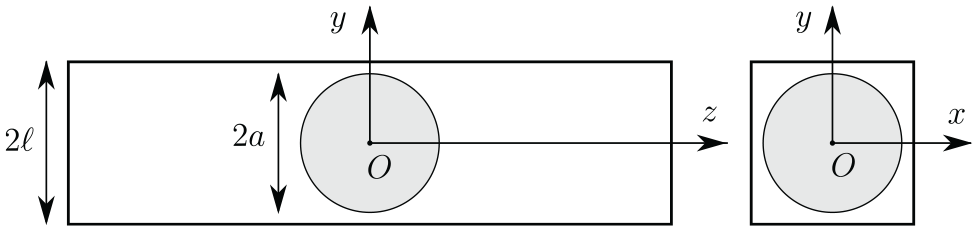
Initial configuration of spherical capsule of radius a in a square-section microchannel of side
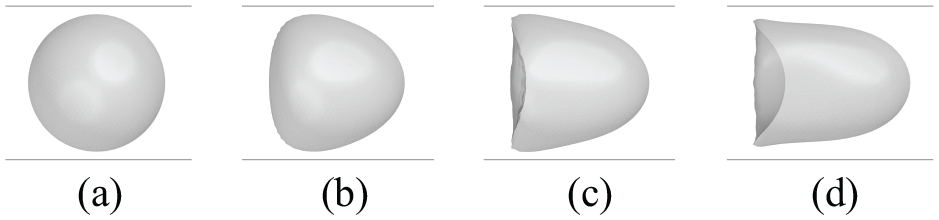
Numerical simulation of the evolution of a capsule, from rest to steady state, as it flows along the microchannel. The capsule is shown for
2.2. Experimental procedure
A suspension of polydisperse ovalbumin microcapsules of average diameter equal to 50
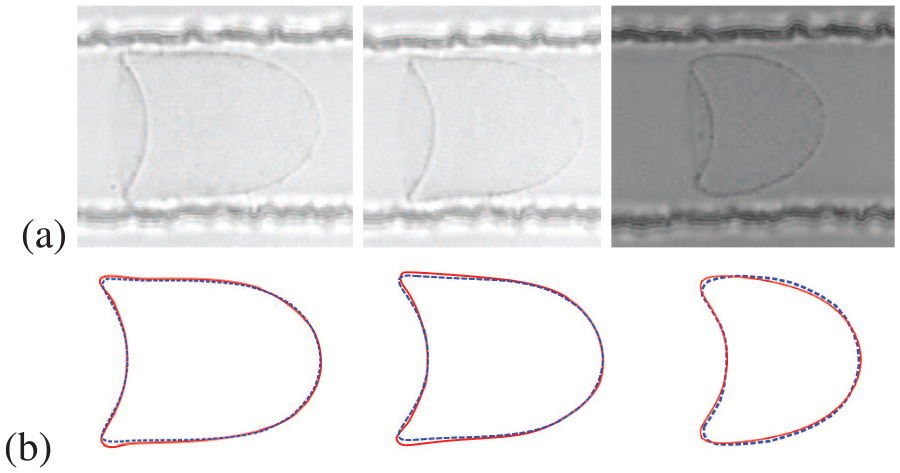
(a) Experimental images of ovalbumin microcapsules flowing at steady state [10]. (b) In red, their corresponding profiles captured using ImageJ; in dashed blue, the profile identified by diffuse approximation: (left)
The deformed profile of the capsules acquired experimentally can be characterized by geometric quantities that we normalize using the channel characteristic size
The maximum extension of the capsule along the longitudinal axis
The axial length
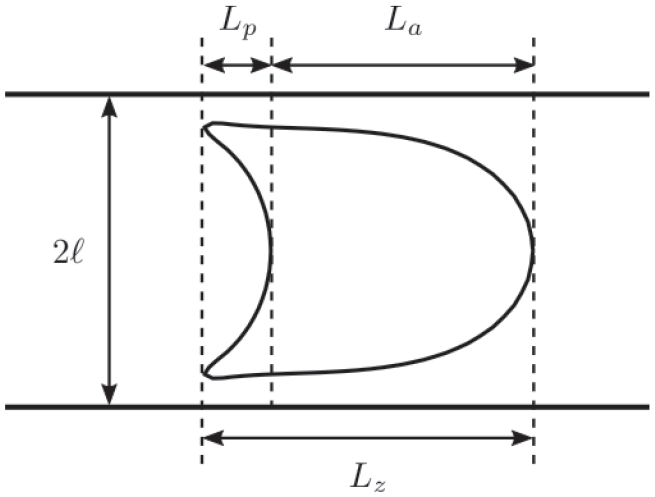
Some geometric quantities that can be measured from the capsule deformed profile: the maximum extension
Together, they provide the information on the parachute depth,
The other quantity obtained experimentally is the velocity of the center of mass of the capsule
The membrane surface shear modulus
The capsule radius a, which varies greatly from one capsule of the suspension to the next;
The mean undisturbed external flow velocity U, which is impossible to know with precision, since the flow rate provided by a syringe pump always fluctuates a little over time.
2.3. Equations governing the forward fluid-structure interaction problem
The inertialess flow of the deformable micrometric capsule along the channel is obtained by solving the Stokes equations in the external (

are solved in the domain shown in Figure 1, assuming no flow disturbance far from the capsule (i.e. the velocity field is the one in the absence of capsules at the inlet and outlet of the square channel), a no-slip boundary condition on the channel wall and capsule membrane, and the continuity of the normal load on the capsule membrane:

where

where
2.4. Numerical model
Equations (2) and (4), along with the boundary conditions, are solved using the numerical model described in [13]. This model, hereafter referred to as the BI–FE model, couples the boundary integral method, to solve the fluid flows, with the finite-element method, to solve the membrane mechanics. It is used to obtain an extensive database of steady-state shapes of capsules in flow. The values of the parameters
A database of
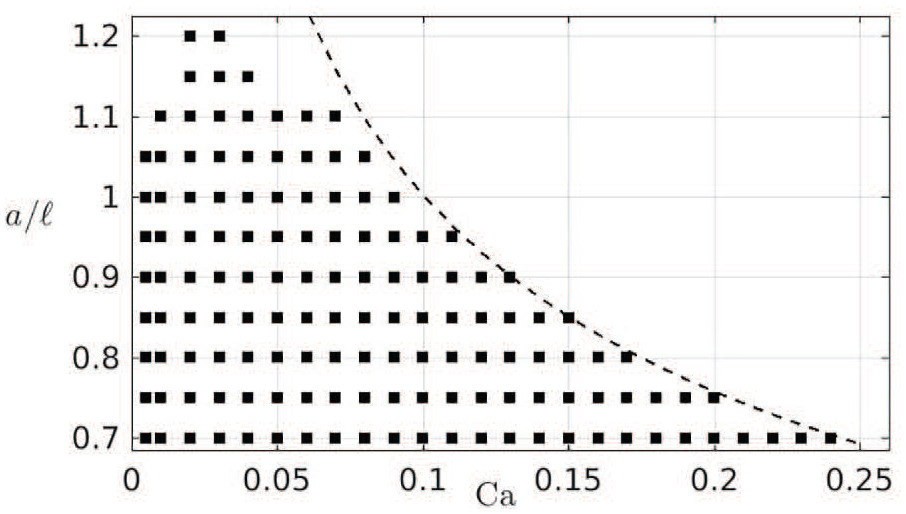
Values of
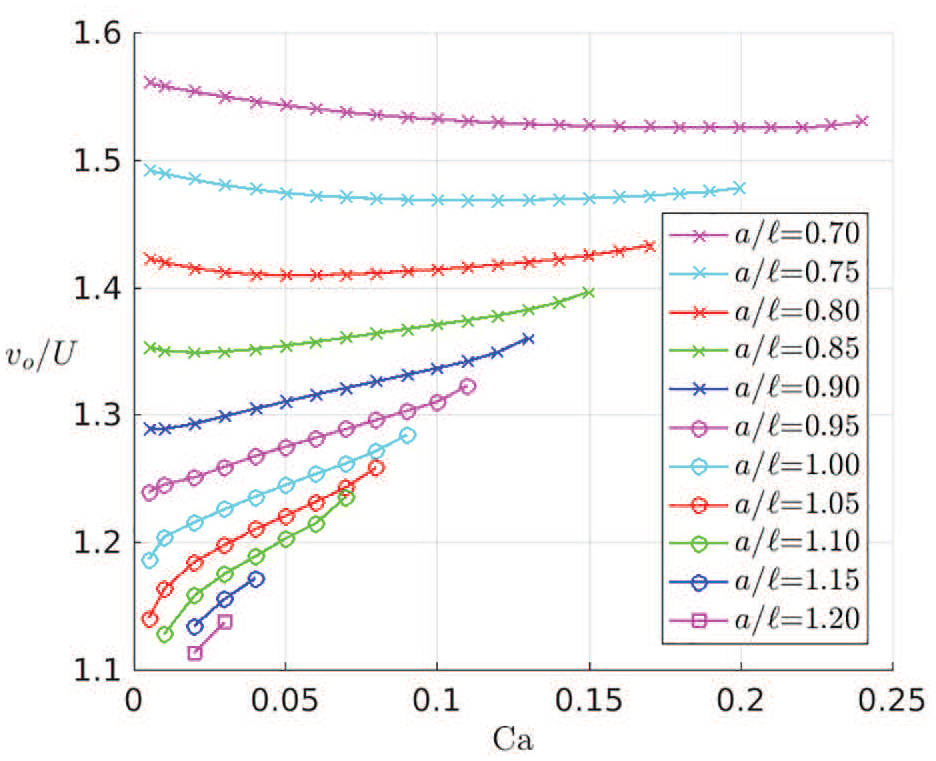
Values of
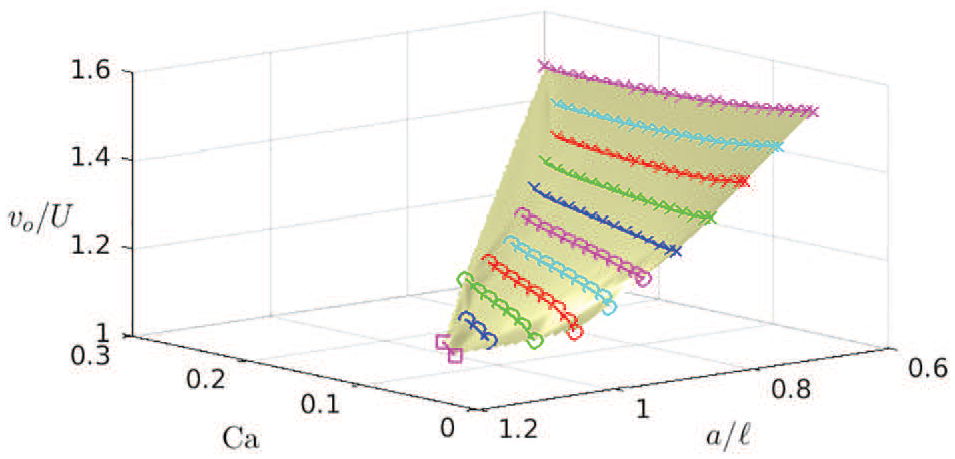
Points of
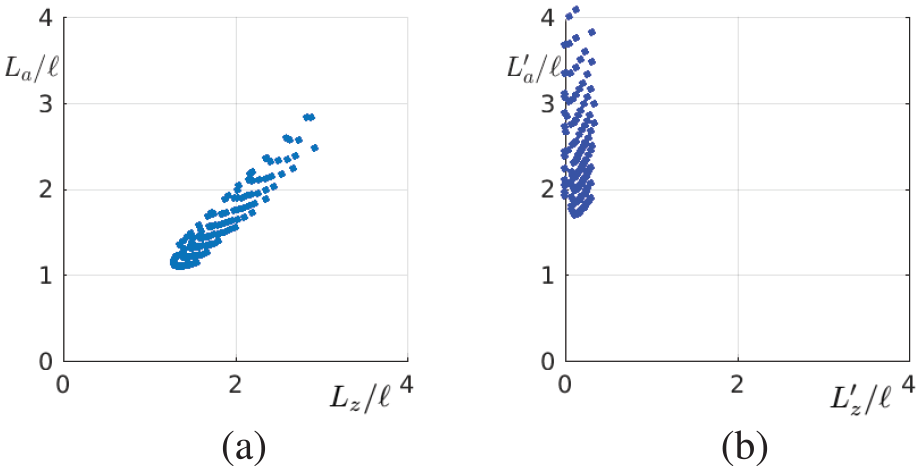
(a) View of the points of
2.5. Inverse analysis approach
The inverse analysis method presented here characterizes the mechanical behavior of the capsule membrane by determining the value of its surface shear modulus
2.6. Diffuse approximation
Only the two independent parameters of the problem,
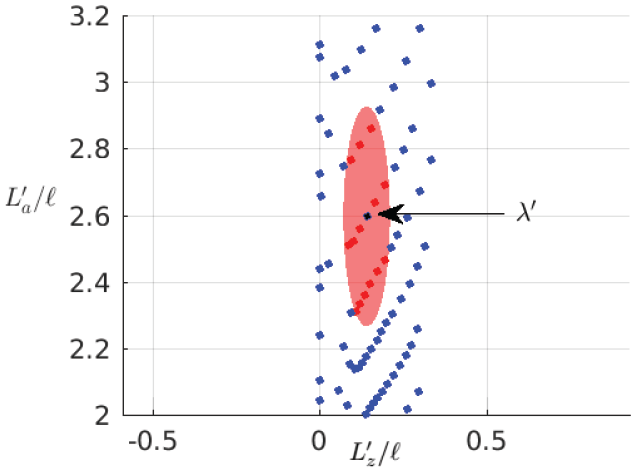
Using diffuse approximation techniques [15], we map an arbitrary point

where
Region of the
To approximate

The parameters
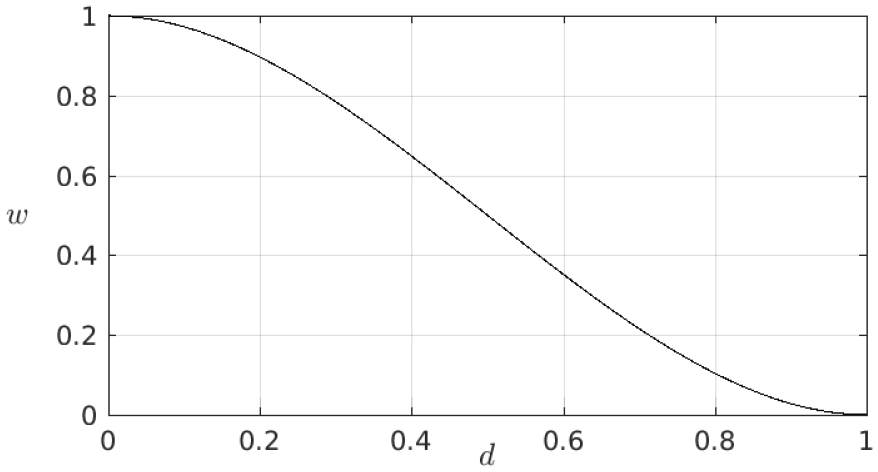
The weight assigned to each

where the normalized distance
Weight function w(d).
To find the vectors

This results in

where

Once the vectors

where

and
2.7. Interpolation
The diffuse approximation allows us to estimate the values of
3. Results
3.1. Validation of the method for an ovalbumin capsule
By way of illustration, we estimate the values of
3.2. Error estimation in the entire parameter space
An algorithm has been designed to assess the accuracy of the solutions

with
An overview of the resulting relative errors is provided for each parameter in Figure 11 by heat maps. The errors are generally higher along the borders of the domain than in the central region, especially for
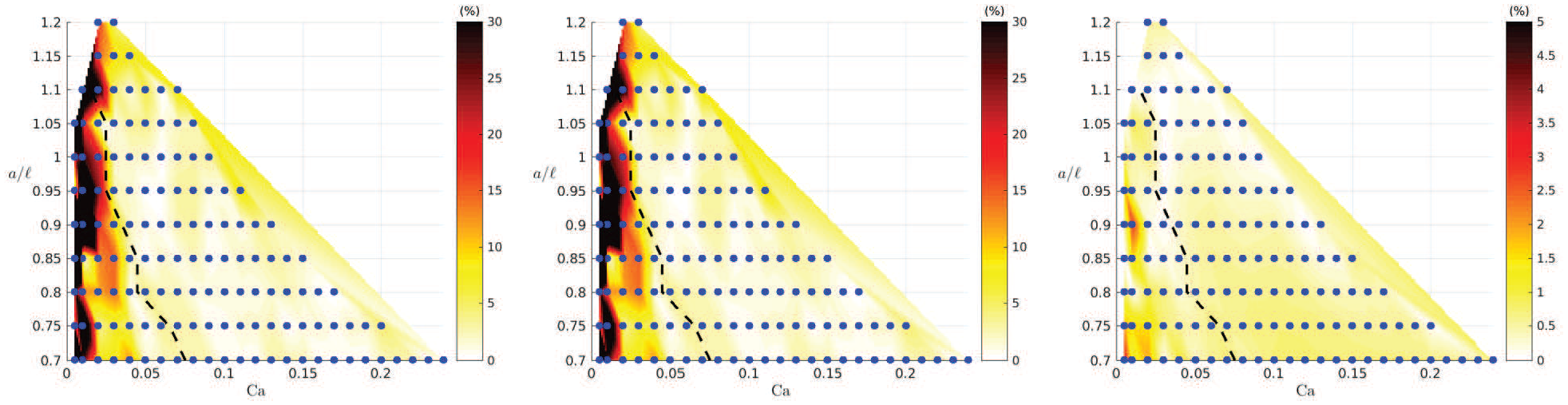
Heat maps of the relative errors
If we only consider the cases that respect the criterion, we find mean relative errors equal to
4. Discussion
The high correspondence between the capsule profile measured experimentally and that identified from the numerical simulation using diffuse approximation ( e.g. Figure 3(b)) indicates that the simulation is a very efficient technique to identify the mechanical properties of micrometric deformable capsules.
The mean error values indicate that the method is able to retrieve the unknown values of the microcapsule size a (from
The present results provide very interesting insight on the limit of the microchannel identification method. They show that the reliability criterion based on the global capsule stretch ratio
There is only one zone where the identification method leads to high errors even though the criterion is satisfied:
When compared with previously developed inverse analysis procedures based on microfluidics [9, 10], much lower errors are currently found with the diffuse approximation technique. As soon as the capsule is sufficiently deformed, the capsule size and surface shear modulus are determined with an accuracy of 0.2% and 2.7%, respectively. Hu et al. [10] determined these quantities with an accuracy of 2–3% and 25% in the best cases. Similar precision in the determination of mechanical properties was found using micropipette aspiration. Zhelev et al. [24], for instance, estimated the accuracy to be within 25%. Using diffuse approximation for identification thus improves both the accuracy and the reliability of the results.
The present results have been obtained for the neo-Hookean law, since we were interested in applying the technique to characterize the mechanical properties of ovalbumin capsules. The method is, however, valid regardless of the constitutive law used and could be applied to any artificial or natural (micro)capsule. The only challenge to use it on cells, such as red blood cells, is purely experimental: the cells will indeed have to be flowed in a microchannel of about
5. Conclusion
We have presented a novel inverse analysis procedure that uses a data-driven diffuse approximation technique to identify the mechanical properties of microcapsule populations. This procedure is applied to the flow of a capsule through a long prismatic microfluidic channel of comparable size. The hydrodynamic forces inside the channel lead to the deformation of the membrane of the capsule, which eventually reaches a steady-state shape. The latter depends on the constitutive law of the membrane and two independent parameters: the capillary number
The identification method is based on the results of numerical simulations of the fluid-structure interactions between the capsule wall and the fluid flows, obtained off-line. A comprehensive database of microcapsule deformed profiles and velocity ratios
Footnotes
Funding
The authors disclosed receipt of the following financial support for the research, authorship, and/or publication of this article: This work was supported by the Labex MS2T (program “Investments for the future"), the National Agency for Research (grant number ANR-11-IDEX-0004-02), and the European Research Council (ERC) (EU Horizon 2020 Research and Innovation Programme, grant number ERC-2017-COG - MultiphysMicroCaps).
