




Abstract

Terry O’Connor, a respected member of our Wilderness Medicine Society community and a driver for this specific journal issue on climate change and health, died May 10, 2024, at age 48 years. Terry combined his love for awe-inspiring mountain adventure with service to others in local, national, and international roles that included mountain search and rescue, philanthropy, emergency medicine, COVID-19 pandemic policy and research, podcasting, and educating health professionals on the health impacts of climate change. He was a doctors’ doctor, a mountaineer's mountaineer, and a dedicated public servant.
The creative tension that drove Terry's remarkable life was on full display at 29,032 ft. In 2006 video footage atop Mount Everest, captured just after he had summitted via the North Ridge, you can see the joy on his face and his sense of awe. He reflected on the surreal experience of looking down on the world below, having overcome the physical and mental demands of extreme altitude, along with practical challenges such as relieving himself in a down suit without freezing anything important. He then produced two photos out of his suit and dedicated his climb to the two individuals in the photos. One was Charlie Borgh, our mutual close friend and climbing partner, who had just been killed in an avalanche in the Canadian Rockies. The other was Terry's father, who a few years prior had taken his own life. It was a momentous place to honor these individuals and their positive impacts on Terry's life.

Yet Terry's particular journey to the top of Everest also had involved numerous disruptive expeditions spread over several years, months away from home, and considerable personal risk. Terry was a physician with loved ones at home and a blossoming medical career in front of him. Embedded within Terry's summit video and his thoughts throughout the expeditions was the question that many of us wrestle with—is this worth it?
Loss and joy, adventure and service, physical challenge and cognitive reflection—these dynamics, sometimes in sync and sometimes in tension, interwove throughout Terry's remarkable life. Like many talented mountain athletes with busy nonathletic professional lives, Terry constantly reflected on how best to use his time. He compassionately applied his skills to help others and was constantly pulled in many directions in EMS and clinical medicine, medical education, and philanthropy involving mountain communities. In the face of an almost unending amount of need in the world, when is it selfish to pursue voluntary mountain recreation activities that can absorb a lot of time and often bring real risk of injury or death? How do we value the joy and spark these activities often bring into our lives? Even if we agree, we periodically need to “fill our own cups” by re-energizing our spirits and bodies through activities in the mountains in order to joyfully serve others for the long haul, how do we decide when enough is enough?
Terry took these questions seriously in his podcast series (The Adventure Activist 1 ) and in a TED Talk delivered in 2017. 2 He argued that these adventurous mountain experiences help us be more compassionate people, more willing to give back to issues greater than ourselves. And he strove to live out his argument.
Raised in the San Francisco Bay area town of Orlinda, Terry excelled academically while playing rugby and conventional athletics. Early family skiing trips in the Sierras spurred his lifelong love for skiing and helped Terry's mountain skills come into focus later while he completed his undergraduate degree in philosophy at the University of Colorado Boulder. A guiding internship with Exum Mountain Guides in the Tetons followed, but Terry elected not to pursue the path of a professional mountain athlete and instead turned toward medicine, a field in which he thrived.
He completed medical school at the University of California, San Francisco, conducting research on high altitude medicine while also still ski patrolling in California and working in the summer as a climbing ranger in Mount Rainier National Park, and then he completed his emergency medicine residency at the Oregon Health & Science University in Portland. Lower-resource and expedition medicine roles in Nepal and many other countries followed. After practicing urban emergency medicine in Portland, Oregon, he found his way to Sun Valley, Idaho, embracing the mountain access, community connections, and opportunities in rural emergency medicine, wilderness medicine, and EMS direction that provided. He served as EMS director for the Blaine County EMS and search and rescue teams, building a community ethic of excellence and strong bonds within the teams.
Terry frequently traveled abroad for personal fulfillment as well as to practice global health. He spoke fondly of his experiences providing healthcare in Borneo, Nepal, and India and nurtured many relationships with colleagues in those places. Locally, Terry served as a public-facing leader during the COVID-19 pandemic in central Idaho, where his thoughtful contributions earned him the title “Healthcare Hero” from the Idaho Department of Public Health as well as the prestigious Excellence in Patient Care Award from the governor and the Idaho Hospital Association. In all of his efforts, Terry consistently brought an inspiring combination of humility, hard work, drive, joy, and fun.
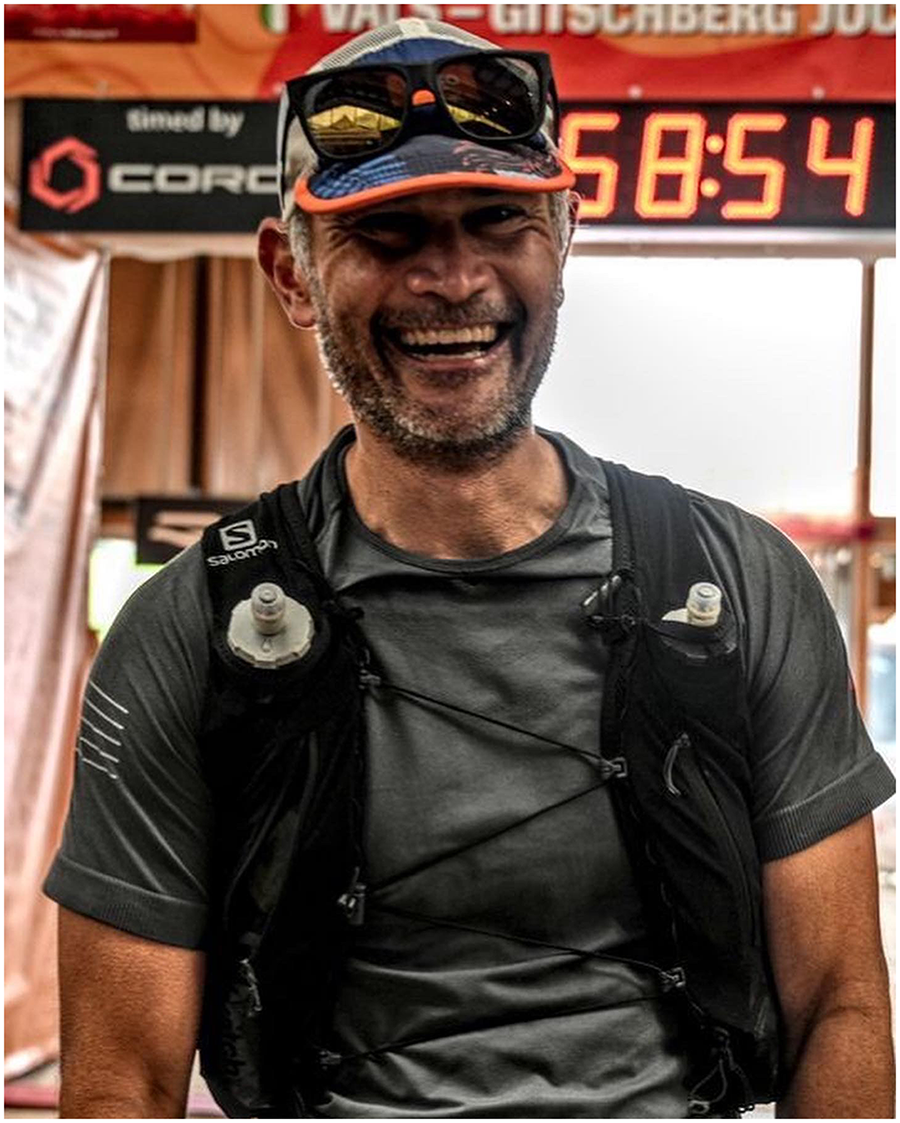
When enduring hardships that many of us go through, Terry faced them with the same grit that saw him through 100-mi trail races and other punishing endurance events: always a smile, always a quip, remarkably adept at code switching between levity and serious academic analysis. For a person whose life was so full, he had an amazing capacity for fostering connections: counseling friends through cancer diagnoses, being fully present when mentoring others in medicine, calling friends to catch up while en route to his next adventure. His memorial service highlighted the large number of individuals who considered Terry their best friend—somehow there was enough of Terry to go around.
As an environmental medicine physician, Terry was well aware of the risks in all aspects life, but especially those inherent in his backcountry pursuits. Over many years, he logged more than 100 backcountry ski days (thank you Sun Valley!) plus countless mountain running miles. Given this amount of exposure to unstable environments, he took mountain risk mitigation seriously, approaching his own risk assessments, avalanche skills, and group decision making in the mountains with the same intensity he brought to medicine, frequently teaching and presenting on these topics. Terry was a strong advocate for the value of the field and the joy that wilderness experiences bring into our lives.
Terry's next phase of life, focused on planetary health, was the culmination of his diverse skills and experiences up to that point. A decade ago, Terry looked out over hazy wildfire skies from a small ledge bivouac site high on the Grand Teton. As an emergency medicine physician and mountain sport enthusiast, it was apparent to him after decades of warnings about global warming that the changes were palpable, increasingly touching both the mountain areas he and his colleagues cherished and the patients they encountered. While many had long been sounding the alarm about the health risks from climate change, an established path for health professionals on climate issues was not yet well defined. Many health professionals were still asking: Is this our lane? If so, what unique voice do we have to offer?
Terry embraced this challenge head on and over the coming years intentionally acquired specific skills in planetary health, health and environmental policy, media training, storytelling, climate science, and community mobilization. Applying all of his insights, knowledge, and skills, Terry joined the University of Colorado's Climate and Health Program faculty as an architect of its novel diploma in climate medicine. He had a vision to mobilize a cadre of health professional leaders with expertise and actionable skills to advocate for climate and health solutions at the bedside and in our communities. He articulated a pathway that embraced our unique skillsets and privileged access as healthcare professionals and reassured us that this is indeed our lane. In just 2 years, Terry helped shape an inspiring international network of health professionals from disparate backgrounds into a larger, coherent movement. He was in a good spot, realistic about the fact that this was going to be hard, and yet ready to dig deep into the proverbial pain cave to see this succeed.
On May 10, 2024, Terry was killed in an avalanche while descending from the summit of Donaldson Peak in central Idaho near his home, brought about in part by rapid snowpack destabilization from uncharacteristic temperature fluctuations—a victim of the vagaries of our rapidly changing climate impacts in our world.
Terry, thank you for being a role model for embracing life. You accomplished a lot, gave more than could ever have been expected, and have inspired many people to continue on this path you helped carve. Now it is up to us to continue the work—and have fun along the way.
Quotation hanging above Terry's computer: The True Meaning of Life We are visitors on this planet. We are here for ninety or one hundred years at the very most. During that period we must try to do something good, something useful, with our lives. If you contribute to other people's happiness, you will find the true meaning of life.
Footnotes
Author Contribution(s)
Declaration of Conflicting Interests
The authors declared no potential conflicts of interest with respect to the research, authorship, and/or publication of this article.
Funding
The authors received no financial support for the research, authorship, and/or publication of this article.