



Abstract

To the Editor:
Anacondas (Eunectes spp., family Boidae) are among the largest living snakes. They are often considered the largest in terms of body volume and mass, although other constrictors, such as the reticulated python (Malayopython reticulatus, family Pythonidae), can reach greater lengths. 1
There are 4 species of anacondas in South America. The most common and widely distributed is Eunectes murinus, the green anaconda. In Brazil, it is possible to find the species E. murinus, E. notaeus (the Pantanal yellow anaconda), E. deschauenseei (spotted anaconda), which is restricted to some parts of the Amazon region, and E. beniensis, found in Bolivia. The largest of the species is E. murinus, which can attain estimated lengths of 6 to 7 m and weigh up to 100 kg.1,2
E. murinus lives predominantly in aquatic environments, feeding on fish, caimans, birds, and medium-sized mammals, such as capybaras. Predatory attacks on humans are very rare, and no formally verified scientific report exists of these snakes ingesting human beings.1–4
We describe here a predatory attack by a green anaconda on a 2-year-old male in midwestern Brazil. While bathing in the morning with his family (father and mother) in a stream close to his home in a rural area in the municipality of Vicentinópolis, state of Goiás, Brazil, the child was attacked by an adult anaconda with total length estimated as 4 m (Figure 1).
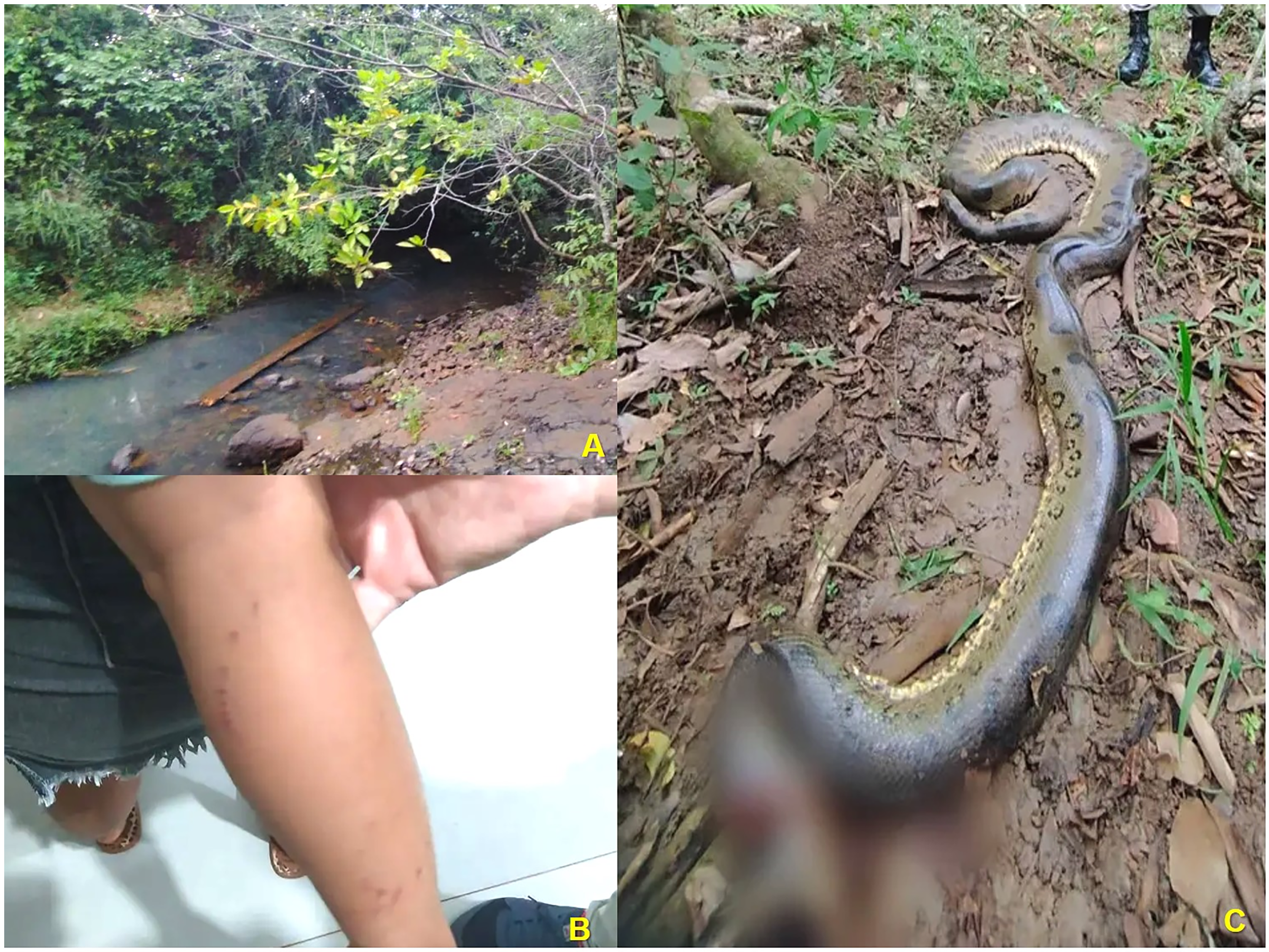
A, Location of the attack described, showing a stream and native vegetation. B, Injuries caused by bites to the victim's arm (the snake's attachment point to exert the constricting action showing superficial wounds caused by teeth). C, Specimen involved in the attack and killed by the forestry police. Images: Rural Military Police, Vicentinópolis, state of Goiás, Brazil.
The snake bit the left arm and entwined the boy's body. The parents failed to force the snake to release the child from its coils, and even after being hit repeatedly with a stick, the snake continued to constrict the child. A nearby military patrol heard the family's screams and responded but, upon reaching the scene, also failed to manually force the snake to release its coils. The child was freed when the snake was killed by repeated blows from a machete. The child was subsequently examined in the nearest emergency room and did not present any fractures or injuries to internal organs. The snake's attachment point (bite) showed teeth marks, which were superficial wounds.
Attacks on humans by anacondas are rare and, most commonly, are defensive in nature.1–4 This attack is worthy of note and should increase awareness of potential predatory attempts, especially on children. Currently, there is intense tourist activity in the Midwest Brazilian crystal-clear waters, where one of the main attractions is the observation of anacondas while snorkeling. 5 To the best of our knowledge, there have been no previously reported accidents involving anacondas in the region. Due to the tourist appeal, some places where anacondas can be observed in the wild are strictly preserved, and the natural prey of these snakes are maintained in good numbers. Therefore, it is possible that the few rare attacks by anacondas on humans, and the dozens of other attacks on domestic animals, are directly related to intense environmental degradation or even periods of extreme drought.
It is interesting to note that these misperceptions of exaggerated risks from anacondas in some parts of their range have caused a serious decline in their populations, thus having a significant ecological impact on regional populations of the species. 5
Footnotes
Acknowledgments
We are thankful to the Rural Battalion of the Military Police of the state of Goiás for the information and images.