




Abstract
Child sexual abuse perpetration prevention programs have been implemented in several Global North countries. There is limited research on how to best advertise these programs to attract eligible participants while ensuring public support for such programs, as well as participant characteristics that impact receptiveness to this advertising. The present study explored the effect of advertisement message framing and personal characteristics on support for a hypothetical perpetration prevention program. A partially representative sample of Canadian adults (N = 1,487; 50.3% female) completed an online survey and were randomized to one of three mock advertisements that varied in message framing (risk reduction, wellbeing enhancement, or a combination of both). Participants rated how much they supported the program and provided data about demographic characteristics, personality traits, and their attitudes and beliefs. There were high levels of support for the program, though the messaging frame had no effect on this outcome. Several characteristics including personality traits, political orientation, stigmatizing attitudes, and perceptions of crime control effectiveness were associated with program support. The findings suggest that perpetration prevention programs can advertise their services in a way that emphasizes risk reduction and/or wellbeing without risking public support, and there may be opportunity to increase program support by considering key characteristics of target audiences.
Introduction
Programs for the secondary prevention of child sexual abuse perpetration (herein referred to as CSA perpetration prevention programs) are interventions that provide support to individuals at risk of sexual offending against children with the aim of preventing offending behaviour (Seto et al., 2024). These programs have become increasingly popular, though there is currently limited research to support the efficacy of this approach (e.g., Seto et al., 2024; Stephens et al., 2022). It is crucial to promote these programs to potential clients in a way that attracts them as they face many barriers to help-seeking (e.g., fear of detection/exposure, fear of judgement, distrust; see Chronos et al., 2024). In the same vein, public support for CSA perpetration prevention programs is important as it can help break down barriers potential clients experience in seeking help and can also increase the social acceptability of these types of services (Letourneau et al., 2014; Zollner et al., 2014). Further underscoring the importance of public messaging is the finding that misperceptions about CSA are associated with support for punitive policies for those with CSA convictions (Fix et al., 2023). There is limited research on how to best advertise these programs to attract eligible participants while ensuring public support for such programs. Thus, the present study focused on evaluating the perceptions of Canadians to advertisements for a hypothetical CSA perpetration prevention program and the factors associated with greater support of such programs.
Impact of Messaging Framing on Support for CSA Perpetration Prevention Programs
A key question for social programs, including CSA perpetration prevention programs, is how to effectively frame services in advertisements to ensure high uptake among the target client population and support from the public. Given the significant and multifaceted needs in the target client population, CSA perpetration prevention programs should aim to help clients make improvements in risk factors for CSA perpetration and improve their psychological functioning and wellbeing (Beier et al., 2015; Knack et al., 2019; Stephens et al., 2024). The dual aim of CSA perpetration prevention programs provides multiple plausible targets for advertisements of these programs. Tupper (2021) hypothesized that program messaging framed around risk reduction may be helpful for generating public support due to its focus on protecting children from victimization but could dissuade those with a sexual interest in children from referring to a program due to the implication that clients are dangerous. The hypothesis by Tupper is supported by research that suggests those with sexual interest in children rate wellbeing related treatment targets as their highest and risk reduction as their lowest priority (Lievesley et al., 2023). As such, it is necessary to determine how messages should be framed to promote high levels of both uptake and support for CSA perpetration prevention programs. Additionally, past research on the effect of message framing has shown that messaging related to sexual interest in children can have an impact on how individuals with a sexual interest in children are perceived, including how dangerous they are, the degree to which their behaviour is biologically driven, and whether their behaviour is controllable (Chandler, 2016; Imhoff, 2015; Sambeek, 2018).
Although there is limited research on the impact of message framing on support and referrals to perpetration prevention programs, there is a small body of research on the impact of deterrence messaging on sexual offending. For instance, a randomized control trial conducted with 419 men who attempted to access a honeypot website containing child sexual abuse and exploitation material (CSAEM) proxy content found that those exposed to messaging that discussed the ability of police to track IP addresses and the potential illegality of the material were almost three times less likely to continue through to the website compared to those who did not receive this messaging; however, neither messaging condition outperformed the other (Prichard et al., 2022). A follow-up randomized control trial with 474 men found again that those exposed to deterrence-themed (i.e., information about police tracking IP addresses) messaging were five times less likely to continue through to the website compared to those who were not. Additionally, those exposed to therapeutic-themed (i.e., information about help resources) messaging were three-to-four times less likely to continue through to the website compared to those who were not; however, neither condition outperformed the other (Prichard et al., 2024). While these studies suggest that message framing can have direct impacts on deterrence, there remains a need to examine how message framing can also be used to encourage support for, and participation in, CSA perpetration prevention programs.
Two additional studies conducted in New Zealand specifically examined the impact of messaging on public support for CSA perpetration prevention programs. Thain & Christofferson (2026) found that risk reduction messaging had high levels of public support. Tupper (2021) tested the impact of messaging focused on risk reduction and wellbeing enhancement as goals of a hypothetical CSA perpetration prevention program in a sample of university students in New Zealand. A secondary aim was to examine how likely participants would be to self-refer to the program if they had a sexual interest in children and were concerned about this interest (arguably this would likely be difficult for participants to imagine and respond in a way that is similar to the target population), as well as how likely they would be to refer someone they knew who was eligible. The results of this study demonstrated high levels of support and program endorsement, regardless of message framing. Further, stigma toward individuals with a sexual interest in children was negatively associated with program support and referral likelihood. Tupper proposed that future research could examine the combination of a risk reduction and wellbeing enhancement message to see if this impacts findings.
Impact of Demographics, Personality Traits, and Attitudes on Program Support
Demographic Characteristics and Personality Traits
While message framing is one possible influence on support for CSA perpetration prevention programs, individual differences (e.g., demographic characteristics and personality traits) may also be associated with support for these programs, independent of message framing. Past research has found that various demographic characteristics are linked to attitudes toward those with a sexual interest in children, especially stigmatizing attitudes. For instance, a study by Fix and colleagues (2023) found that participants who identified as women or as White (relative to those who identified as men or as Black) were more likely to support policies aimed at CSA prevention. Similarly, younger age, having less education, and being female were associated with higher levels of stigmatizing attitudes toward individuals with sexual interest in children (Jahnke, 2018a; Jahnke et al., 2015). Another study examining negative attitudes toward individuals who committed a sexual offence found that non-White individuals were more likely to have negative attitudes toward individuals convicted of sexual offences compared with White individuals (Klein, 2015).
The literature on personality traits and attitudes toward individuals convicted of sexual offences is much more limited. Olver and Barlow (2010) are the exception as they found that openness to experience and agreeableness were associated with more positive, rehabilitative attitudes toward those who had sexually offended. In contrast, extraversion was associated with more negative, systems-related attitudes (i.e., attitudes supportive of managing those convicted of sexual offences using correctional and law enforcement methods).
Attitudes, Beliefs, and Behaviours
When it comes to sexual offending against children, support for punitive measures (e.g., incarceration) over progressive measures (e.g., prevention) is quite salient (Kernsmith et al., 2009; Mears et al., 2008). Conceptual work has argued that, in line with Moral Foundations Theory (Graham et al., 2011), those with liberal moral attitudes (e.g., caring, fairness) hold more favorable attitudes toward progressive measures for dealing with individuals who have sexually offended compared to those with more conservative moral attitudes (e.g., loyalty, authority; Harper & Harris, 2017). Empirical studies have supported this argument by linking conservative moral attitudes to punitive attitudes toward different types of crime (Fargher, 2019; Silver, 2017; Vaughan et al., 2019), including sexual offences (Barnett & Hilz, 2018). As such, those with more liberal moral attitudes may be more supportive of a CSA perpetration prevention program.
Past research has also linked various sociopolitical ideologies to negative attitudes toward stigmatized groups. For instance, in their study on punitive attitudes toward individuals with a sexual interest in children, Imhoff and Jahnke (2018) found that those on the right side of the political spectrum held more punitive attitudes compared to those on the left. Furthermore, conservativism is associated with more negative views toward individuals who have committed sexual and non-sexual offences, including overestimating levels of dangerousness (DeLuca et al., 2018; Hirschfield & Piquero, 2010; Rade et al., 2016; Rosselli & Jeglic, 2017; Socia & Harris, 2016). Taken together, it is likely that individuals with more conservative attitudes and beliefs would be less supportive of a program designed to assist a highly stigmatized group.
It is also important to note that there is a strong link between political extremism and conspiratorial ideation (i.e., the tendency to believe conspiracy theories), as conservative-leaning individuals have higher levels of general conspiratorial ideation (Min, 2021; Pasek et al., 2015; van der Linden et al., 2021). Additionally, conspiratorial ideation is associated with psychological tendencies more prevalent among conservatives (e.g., authoritarianism; Dyrendal et al., 2021). This is relevant to CSA perpetration prevention programs given the rise in general distrust of science among conservative leaning individuals and conspiratorial ideation related to CSA among these same individuals (Enders et al., 2022; Gauchat, 2012). It has also been found that distrust in science is associated with an overall lack of support for treatment programs for those who have committed sexual offences (Mancini & Budd, 2016). Recent research has demonstrated that believers in the QAnon conspiracy (i.e., that the world is governed by a secret global sex trafficking ring made up of satanic and cannibalistic elites; Miller, 2021) are primarily politically and socially conservative (Enders et al., 2022; Jackson et al., 2021). Therefore, it is possible that individuals who endorse high levels of conspiratorial ideation (especially those related to CSA or QAnon beliefs that focus on sex trafficking and sexual abuse) would be less likely to support CSA perpetration prevention programs.
Media engagement and beliefs about crime may also be important factors to consider when promoting CSA perpetration prevention programs. Heavy reliance on commercial media for news and information has been linked to more punitive attitudes toward those who break the law (Spiranovic et al., 2012). With respect to sexual offending, it has been shown that media reports that rely on fear rather than informative content produce more negative attitudes toward those who perpetrate sexual offences (Malinen et al., 2014). Additionally, past research has demonstrated that inaccurate perceptions of rising crime trends are related to more punitive attitudes toward those who break the law (e.g., McPhail et al., 2017; Shi, 2021; Spiranovic et al., 2012). As a result, spending a significant amount of time engaging with commercial media may impact support for CSA perpetration prevention programs, especially if this engagement leads to inaccurate perceptions of crime trends related to sexual offending.
Lastly, attitudes toward individuals convicted of sexual offences tend to be quite negative, with stigmatizing beliefs playing a significant role in shaping these attitudes (Craig, 2005; Ricciardelli & Moir, 2013). In addition to overestimating rates of sexual offending and recidivism, members of the public tend to hold stigmatizing beliefs about individuals convicted of sexual offences (e.g., that individuals convicted of sexual offences cannot be rehabilitated; Brown et al., 2008; Fortney et al., 2007; Glina et al., 2022; Levenson et al., 2007; Willis et al., 2010). These beliefs extend toward those with a sexual interest in children, regardless as to their offence status, as past research shows that stigma toward this group is associated with greater support for a punitive response, social distancing, and assumptions of offending (Jahnke, Imhoff, & Hoyer, 2015; Jahnke & Hoyer, 2013; Lievesley et al., 2020; Marono et al., 2023).
Present Study
Despite advancements in the literature on CSA perpetration prevention, there remain unanswered questions on how to best promote these programs. As the media can play a key role in both shaping attitudes toward prevention programming (McCartan et al., 2021) and providing useful education about the role of prevention programming (Self-Brown et al., 2008), exploring the effectiveness of potential CSA perpetration prevention advertisements is a necessary next step. While recent studies by Thain and Christofferson (2026) and Tupper (2021) provide a useful baseline for understanding the impact of message framing for CSA perpetration prevention programs, they focused exclusively on advertisement framing and stigma.
The aim of this study was to replicate and extend this important previous work in a Canadian sample partially representative of the general population based on age, sex, and province and territory. First, we aimed to replicate past findings on the way advertisements that vary on key dimensions impact overall support and endorsement of CSA perpetration prevention programs. In doing so, we added a third condition for message framing that combined wellbeing and risk reduction (Tupper, 2021 did not include a combined condition). Second, we examined the impact of a wide range of demographic characteristics, personality-related variables, and attitudes and beliefs on support and endorsement of CSA perpetration prevention programs. This study is important as findings could inform how to best advertise CSA perpetration prevention programs and provide valuable information on individual characteristics that influence receptiveness to such programs.
Based on past research by Tupper (2021) and the addition of a third messaging condition, we hypothesized that messaging combining elements of risk reduction and wellbeing enhancement would generate the greatest levels of support and endorsement compared with either type of messaging alone. Furthermore, based on research examining the potential role of individual characteristics in support for CSA perpetration prevention programs (e.g., Glina et al., 2022), we hypothesized that several demographic characteristics (i.e., being younger, being female, being an ethnic minority) and personality traits (i.e., high in extraversion, low in openness to experience and agreeableness) would be associated with lower levels of program support. Further, it was expected that conservative moral attitudes, right-wing political identification, conspiracist beliefs (including endorsing the QAnon conspiracy), distrust of science, higher media engagement, misperceiving crime trends, having greater support for punitive responses to crime, and higher levels of stigmatizing attitudes and beliefs toward individuals with a sexual interest in children would be associated with lower levels of program support. Additional demographic characteristics (e.g., religious affiliation) were considered in this study; however, hypotheses were not generated for these due to a lack of research in this area.
Method
Participants
The required sample size for this study was determined through an a priori power analysis using G*Power 3.1 (Faul et al., 2009) where it was determined that between N = 1,289 and N = 1,974 participants were required. Due to budget restrictions and participant availability through the survey panel employed for recruitment, we elected to stop recruitment once a final sample size of N = 1,500 was attained. Inclusion criteria were that individuals had to be a Canadian adult 18 or older. The survey was only available in English.
A total of N = 5,001 unique participants received an initial invite to the study via the research panel company Canadian Viewpoint (a Canadian survey panel company). These invitations were sent in batches to panelists prior to the application of exclusion criteria; however, quotas were set up via the online survey platform (panelists who clicked on the invite were unable to proceed with the survey if the quota had been filled) according to Canadian census data with the end goal of recruiting proportionally based on age, biological sex, and the size of each province and territory. Despite the intention to recruit proportionally according to province and territory size, there was intentional over-sampling of individuals from Atlantic Canada where an ongoing CSA perpetration prevention program had lower initial uptake.
Demographic Characteristics for the Sample
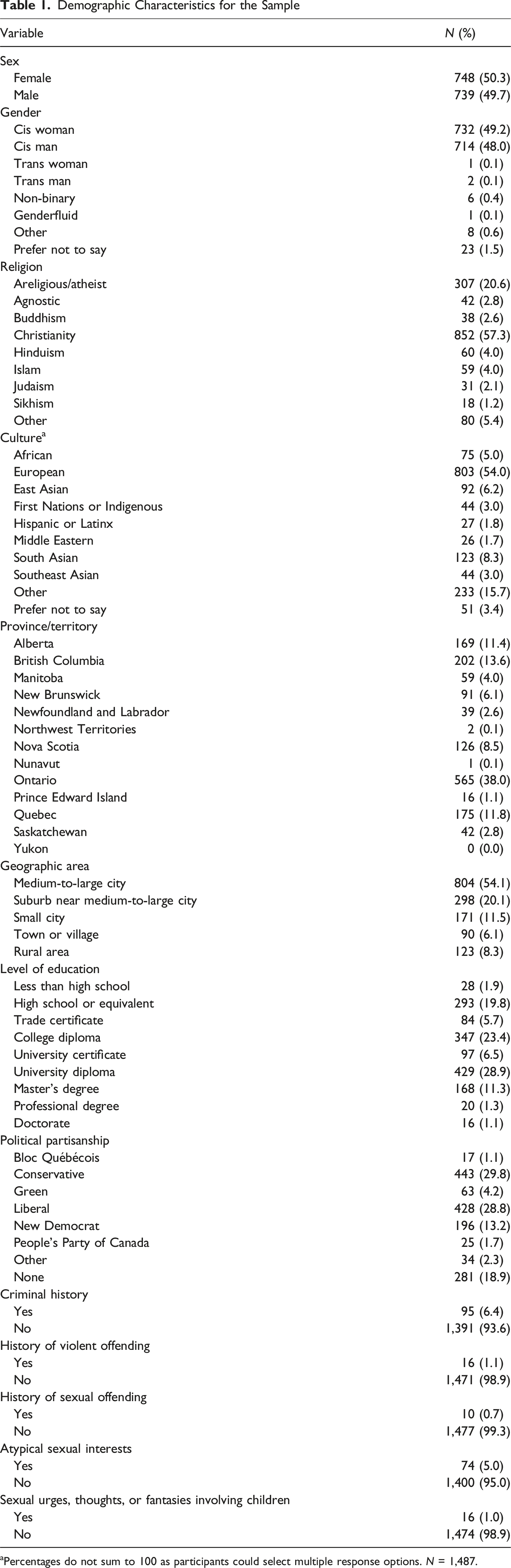
aPercentages do not sum to 100 as participants could select multiple response options. N = 1,487.
Measures
Mock Advertisements and Program Support
Participant viewed one of three advertisements for a hypothetical CSA perpetration prevention program (see online supplement for the advertisement conditions) to test the main hypothesis that message framing would impact program support. These advertisements depicted a close-up picture of the face of a young adult White male against a partially blurred background, with text describing the purpose of the program in the foreground (“We help individuals troubled by their sexual interest or behaviour involving children”). The program was intentionally left unnamed as to prevent potential response bias that could result from providing the name of an existing program.
To create the study conditions, three versions of the advertisement were created. Each advertisement included a very brief description of the purpose of the program, which remained consistent across the three conditions to ensure that, regardless of message framing, the advertisements clearly conveyed that the program is intended to support individuals experiencing sexual interest or behaviour toward children. The advertisements differed by message frame, and participants were randomized into one of three conditions. The first condition depicted risk reduction messaging (“To prevent child sexual abuse from occurring”), the second wellbeing enhancement messaging (“Live healthy lives with reduced distress”), and the third a combination of risk reduction and wellbeing enhancement messaging (“Live healthy lives with reduced distress and prevent child sexual abuse from occurring”). The message manipulation was informed by Tupper (2021) and aligned with our primary focus of comparing risk reduction versus wellbeing enhancement approaches (an ongoing point of debate in the literature) when communicating with the public. All advertisements used were created based on extensive discussion with our research team and in collaboration with EnterpriseHealth/Creative Currency, a marketing firm responsible for developing actual advertisements for perpetration prevention programs.
After participants viewed the advertisements, they were asked three questions based on questions used by Tupper (2021) that served as our three outcome variables: program support (“I would support the program”), likelihood to self-refer to the program if the participant imagined themselves as fitting the target group (“If I had sexual thoughts about children or was worried about my risk of sexual offending, I would refer myself to this program”), and likelihood to refer an eligible other to the program (“I would recommend this program to someone in my life who was having sexual thoughts about children or worried about their risk of sexual offending”). Responses to all three questions were provided on a 7-point Likert-type scale from 1 (strongly disagree) to 7 (strongly agree). Each question was treated as a continuous outcome variable in data analyses, and we focused primarily on support for the program as our main outcome of interest.
Demographic Questionnaire
Prior to completing study measures, participants completed a demographic questionnaire that inquired about age, sex, gender, religious affiliation, cultural background, province/region of residence, geographic area in which they lived (e.g., urban), and their educational background. Response options were informed by the way this information is collected in the census (Statistics Canada, 2020) and were a mix of binary or categorical variables (except age which was continuous). Further, participants were also asked if they had ever been investigated, arrested, charged, or convicted for a criminal offence, and, if so, whether they committed any violent or sexual offences. Furthermore, participants were asked to disclose whether they had any atypical sexual interests (i.e., “do you have any concerning or atypical sexual urges, thoughts, or fantasies”). If participants answered yes to this question, they were asked “do you have sexual interest, thoughts, or fantasies about children under the age of 14” (yes/no).
Big Five Inventory-10 (BFI-10)
The BFI-10 is a brief measure of the core traits of the Big Five personality domains (Rammstedt & John, 2007). This ten-item measure contains five subscales made up of two items each meant to represent the high and low poles of each personality domain: Agreeableness (e.g., “I see myself as someone who is generally trusting”), Conscientiousness (e.g., “I see myself as someone who does a thorough job”), Extraversion (e.g., “I see myself as someone who is outgoing, sociable”), Neuroticism (e.g., “I see myself as someone who gets nervous easily”), and Openness (e.g., “I see myself as someone who has an active imagination”). Items on this measure were rated on a 5-point Likert-type scale from 1 (disagree strongly) to 5 (agree strongly). One item from each subscale is reverse coded, and mean item scores are then computed for each of the five subscales, with higher scores on these continuous subscales signifying a stronger presence of that specific trait. Past research has shown that the BFI-10 is both reliable and stable across large samples (Rammstedt et al., 2023; Rammstedt & John, 2007), albeit with a notable drop in internal consistency compared to the full BFI that has been noted to be the result of quite short subscales consisting of only two items (Rammstedt & John, 2007). Internal consistency for the BFI-10 subscales in the current sample ranged from α = .14–.64.
Moral Foundations Questionnaire-20 (MFQ-20)
The MFQ-20 is a 20-item measure designed to assess individual priorities in moral decision-making according to the Moral Foundations Theory (Graham et al., 2011). The first ten items of the MFQ-20 are rated based on the extent to which a moral foundation is relevant to a person’s conceptualization of right and wrong, and the second ten items are rated based on the extent to which a person agrees or disagrees with the importance of a moral foundation on their moral decision-making. Items are scored on a 6-point Likert-type scale ranging from 0 (not at all relevant/strongly disagree) to 5 (extremely relevant/strongly agree). Each of the five moral foundations proposed by the Moral Foundations Theory are captured by a unique subscale containing four items each: Harm/care (the desire to minimize the suffering of others; e.g., “Whether or not someone suffered emotionally”), Fairness/reciprocity (the desire for everyone to be treated fairly; e.g., “Whether or not someone acted unfairly”), Ingroup/loyalty (the desire for loyalty to one’s ingroup; e.g., “Whether or not someone’s action showed love for his or her country”), Authority/respect (the desire for conforming to rules and norms; e.g., “Whether or not someone showed a lack of respect for authority”), and Purity/sanctity (the desire to avoid immoral behaviour; e.g., “Whether or not someone did something disgusting”). The MFQ-20 is scored by computing mean item scores for an overall “Progressivism” scale which is calculated by subtracting the means of the Ingroup/loyalty, Authority/respect, and Purity/sanctity subscales from the Harm/care and Fairness/reciprocity subscales. Scores on this Progressivism scale are continuous and can range from -15–10, with higher scores representing more liberal moral attitudes. Past research on the MFQ-20 has demonstrated that the scale has acceptable levels of internal consistency (Cronbach’s α = .65–.84), strong test-retest correlations (r = .68–.82), and convergent and discriminant validity with other measures (Graham et al., 2011; Kivikangas et al., 2021). Internal consistency for the MFQ-20 in the current sample was α = .88.
Political Orientation and Partisanship
To assess political orientation and partisanship, we adapted a measure from Blais et al. (2024). First, to measure political orientation, participants were asked to use a digital slider to place themselves on a left-right ideological spectrum. This slider had a midpoint of 50 and values at the extremities of 0 (far-left) and 100 (far-right) and was treated as continuous in analyses. To measure political partisanship, participants selected which Canadian political party they felt they most closely belonged to (“In federal politics, do you usually think of yourself as a …”), with response options including Liberal, Conservative, New Democrat, and Green. We adapted this question to include response options for the Bloc Québécois and the People’s Party of Canada. Participants were also given the option to respond with an unlisted party or state that they did not identify with any political party. The variable was treated as categorical in analyses (Blais et al., 2024).
Generic Conspiracist Beliefs Scale (GCB)
The GCB scale is a 15-item measure designed to assess individual differences in conspiracist ideation (Brotherton et al., 2013). The items of the GCB scale correspond to non-event-specific conspiracies across five domains, each consisting of three items: Government malfeasance (e.g., “The government is involved in the murder of innocent citizens and/or well-known public figures, and keeps this a secret”), Malevolent global conspiracies (e.g., “The power held by heads of state is second to that of small unknown groups who really control world politics”), Extraterrestrial cover-up (e.g., “Evidence of alien contact is being concealed from the public”), Personal wellbeing (e.g., “Technology with mind-control capacities is used on people without their knowledge”), and Control of information (e.g., “New and advanced technology which would harm current industry is being suppressed”). Each item of the GCB scale is scored on a 5-point Likert-type scale ranging from 1 (definitely not true) to 5 (definitely true). Mean continuous item scores are then computed for the total scale, with higher scores denoting a stronger presence of conspiracist beliefs. Past research has shown that the GCB scale is both a valid and reliable measure of conspiracist beliefs, having strong internal consistency (Cronbach’s α = .85–.93) and test-retest reliability (r = .89), as well as displaying both convergent and discriminant validity with other measures (Brotherton et al., 2013; Swami et al., 2017).
Given the nature of the present study, we supplemented the GCB scale with the four items from the original Conspiracist Beliefs Scale (also by Brotherton et al., 2013) related to distrust of science (scored separately from the GCB scale; e.g., “Government funded scientists manipulate evidence in order to support existing government policy”). Internal consistency for the GCB scale in the current sample was α = .96, while internal consistency for the distrust of science items was α = .87.
Conspiracy Theories and Misinformation
To measure specific conspiracist beliefs related to CSA, we adapted a measure from Enders et al. (2021). First, we presented participants with 15 different conspiracy theory statements generated by Enders et al. (2021; e.g., “The dangers of vaccines are being hidden by the medical establishment”) and asked the degree to which they believed in each one on a scale from 1 (strongly disagree) to 5 (strongly agree). Responses were then recoded so that those who responded with either “agree” (4) or “strongly agree” (5) were considered to hold a specific conspiracist belief. Unlike the questions contained in the GCB scale, these questions were designed to measure belief in specific conspiracy theories associated with concurrent belief in conspiracies related to CSA. Given that beliefs related to the QAnon conspiracy are also relevant but were not captured in this set of questions, we supplemented this measure with questions asking participants about their knowledge of the QAnon conspiracy (yes/no), and the degree to which they supported it [using a continuous score derived from a feeling thermometer that ranged from 0 (no support) to 100 (full support)] (Enders et al., 2021).
Media Usage
Questions were developed that inquired about a broad range of media usage, and these questions were in part informed by a similar set of questions developed by Al-Menayes (2015). We asked participants to estimate the number of hours per day they spent consuming the following types of media: social media, television, podcasts, radio, and news articles. Responses were less than 1 hour, 1–2 hours, 3–5 hours, 6–10 hours, and more than 10 hours. We treated this variable as continuous in nature, where higher scores reflected more intensive media use.
Perception of Crime Trends and Community Safety
To assess perceptions of crime trends and community safety, we adapted a measure from McPhail et al. (2017). First, participants were asked whether they felt crime trends in their neighbourhood had changed (“Over the last three years, do you think crime in your neighbourhood has…?”). The original questionnaire used a 5-point response scale ranging from 1 (decreased substantially) to 5 (increased substantially). We modified the response scale by asking participants to rate changes in crime on a 3-point scale (decreased, remained the same, increased) and by providing the option to respond that they were uncertain (i.e., “don’t know”). This variable was treated as continuous in analyses. Second, McPhail et al. (2017) presented participants with several crime control methods (“Which of the following do you think would be the most effective way to reduce crime in Saskatchewan?”) and were asked to choose whether they agreed or disagreed that each method would be effective. Responses were then recoded into two groups to create a dichotomous variable: support for punitive measures (e.g., increase punishment for offences) and alternative measures (e.g., increase prevention programs). We adapted this question to ask participants to consider crime reduction in their specific region (McPhail et al., 2017).
Lastly, McPhail and colleagues (2017) asked participants about agreement that capital punishment should be re-introduced in Canada as a punishment for those convicted of first-degree murder. We adapted this question by substituting first-degree murder with sexual offences against children and asked participants to respond on a four-point Likert-type scale from 1 (strongly disagree) to 4 (strongly agree). Participants also had the option to respond that they were uncertain about whether capital punishment should be reinstated. This variable was treated as continuous for analyses (with the uncertain responses excluded).
Stigma Inventory
The Stigma Inventory is a 15-item measure designed to assess stereotypes, affective reactions, and discriminatory intentions toward individuals with sexual interest in children (Jahnke, Philipp, & Hoyer, 2015). These 15 items are broken into four subscales of stigma: Controllability (three items; e.g., “a dominant sexual interest in children is something that one can choose”), Dangerousness (four items; e.g., “Somebody with a dominant sexual interest in children is a perverted sexual predator”), Sympathy and anger (two items; e.g., “When I think of a person with a dominant sexual interest in children, I feel anger”), and Social distance (six items; e.g., “I would have these persons as friends”). Items on the Stigma Inventory are scored on a 7-point Likert-type scale ranging from 0 (completely disagree) to 6 (completely agree). After reverse coding the positively worded items, mean item scores are calculated for the total scale, with higher scores on this continuous measure denoting stronger stigmatizing attitudes and beliefs. Past research on the Stigma Inventory has shown that the scale possesses acceptable levels of internal consistency (Cronbach’s α = .61–.97; Jahnke, Imhoff, & Hoyer, 2015; Jahnke, Philipp, & Hoyer, 2015). Internal consistency for the Stigma Inventory in the current sample was α = .85.
Procedure
This research was approved by the research ethics board at Saint Mary's University where the research was conducted (REB #24-010). Participants were recruited through Canadian Viewpoint, a market research company, and invited to complete a Qualtrics survey. Upon providing consent to participate, participants confirmed their eligibility before being presented with the instructions for the manipulation. Participants were then randomly assigned to one-of-three conditions depicting an advertisement for a CSA perpetration prevention program and were asked to study the details of the advertisement carefully prior to describing the degree to which they supported the program, whether they would self-refer to the program if they had a sexual interest in children or were concerned about their risk, and whether they would refer an eligible other. Participants then completed the remainder of the study measures before being asked a series of final questions (e.g., whether they responded to all questions truthfully). The vignettes were presented before the rest of the study measures as to not have the other study measures influence participants’ reactions to the vignettes. Recruitment took place from April to May 2024. 2
Data Analysis Plan
Prior to conducting our main analyses, descriptive statistics were generated for all study variables. Additionally, to assess for equivalence of demographic characteristics and other study variables across study conditions, a series of chi-square tests and one-way ANOVAs were carried out. The main hypothesis and research question was tested using a one-way ANOVA with three groups (prevention messaging, wellbeing messaging, combination messaging) and our main outcome of interest that focused on program support. 3 A one-way ANCOVA was also employed to re-test the hypothesis after controlling for any study variables which were not equivalent across conditions.
The second research question was tested across two different waves of data analyses. First, to select study variables for use in a multiple linear regression, a correlation matrix was generated between the continuous study outcome (program support) and all potential correlates. Additionally, a series of one-way ANOVAs were conducted to examine relationships between the multi-categorical indicator variables and program support. Any variables that were significantly associated with program support were then entered as indicators in a multiple linear regression model with program support as the outcome variable. While this approach is useful to identify candidate variables for a multivariate analysis in particularly large data sets, such an approach can introduce bias in the multivariate model by distorting regression coefficients and omitting potentially important confounds (Babyak, 2004). Given the size of our dataset and the large number of variables collected, this method allowed for a more manageable testing of our research questions.
Bias corrected and accelerated bootstrapping was employed for all analyses. Effect sizes are provided throughout. According to Cohen (1988), a correlation of .10 is small, .30 is moderate, and .50 or greater is large. For independent-samples t-tests, a Cohen’s d of 0.20 is small, 0.50 is moderate, and 0.80 or greater is large (Cohen, 1988). For one-way ANOVAs, an eta-squared value of .01 is small, .06 is moderate, and .14 or greater is large (Cohen, 1988). Finally, for chi-square tests of independence, Cramer’s V is interpreted relative to the degrees of freedom (Cohen, 1988). The authors take responsibility for the integrity of the data, the accuracy of the data analyses, and have made every effort to avoid inflating statistically significant results.
Results
The Effect of Message Framing on CSA Perpetration Prevention Program Support
In general, support for the CSA perpetration prevention program was high, as 79.8% (n = 1,187) of participants reported that they would support the program to some degree if it were offered, with the largest proportion of participants selecting “strongly agree” (n = 454, 30.6%). To test the main hypothesis of whether messaging had an impact on program support, a one-way ANOVA was conducted. The findings revealed that message framing was not significantly associated with support for the program, F(2, 1,477) = 2.60, p = .072, η2 = .00. The effect size was negligible, and all pairwise comparisons were negligible (all Cohen’s d < 0.20).
An important consideration when interpreting the above results is whether there was equivalence of study variables across the three study conditions. Only three of the study variables employed differed significantly across study conditions. First, religious affiliation differed across study groups, χ2(16, n = 1,479) = 26.44, p = .008, Cramer’s V = .10. Those belonging to the Christian faith were significantly underrepresented in the risk reduction condition and significantly overrepresented in the combination condition. Additionally, those reporting that they were areligious or atheist were significantly overrepresented in the risk reduction condition and significantly underrepresented in the combination condition. Second, moral progressivism differed significantly across conditions, F(2, 1,484) = 11.30, p < .001, η2 = .02. Specifically, those in the risk reduction condition were more morally liberal than those in the wellbeing enhancement and combination conditions. Finally, political orientation differed significantly across groups in that those in the risk reduction condition were significantly more left-aligned than those in the wellbeing enhancement and combination conditions, F(2, 1,453) = 6.56, p = .001, η2 = .01. For a visual depiction of all condition equivalence analyses, see the online supplement.
Since three of the study variables differed across study groups, a one-way ANCOVA was conducted to reassess the first hypothesis and determine whether program support would differ across study groups after controlling for the effects of these variables. In this analysis, messaging condition was once again used as the grouping variable, and moral progressivism and political orientation were entered as covariates (the other variable that differed across study groups, religious affiliation, was categorical and was therefore excluded from this analysis). Results of the ANCOVA revealed that the type of messaging displayed to participants was still not significantly associated with support for the program after controlling for moral progressivism and political orientation, F(2, 1,449) = 2.53, p = .080, η2 = .00. Furthermore, the overall effect size remained negligible, as did the effect sizes for the pairwise comparisons (all Cohen’s d < 0.20).
Correlates of Program Support
The second research question and remaining hypotheses focused on the impact of various correlates on program support. Pearson and point-biserial correlation analyses (see Table S2 in the online supplement) and one-way ANOVA analyses (see Table S3 in the online supplement) were used to guide variable selection for a multiple regression analysis. Examination of the correlation and ANOVA results suggested that several of the study variables were significantly related to program support: participant sex (r pb = .05, p = .044), agreeableness (r = .17, p < .001), conscientiousness (r = .10, p < .001), openness to experience (r = .05, p = .047), moral progressivism (r = .12, p < .001), political orientation (r = −.14, p < .001), conspiracist beliefs (r = −.11, p < .001), distrust of science (r = −.11, p < .001), number of conspiracy beliefs held (r = −.05, p = .047), hours spent listening to podcasts (r = −.05, p = .042), support for capital punishment (r = −.07, p = .019), stigmatizing attitudes toward individuals with sexual interest in children (r = −.13, p < .001), level of education [F(3, 1,476) = 4.33, p = .004, η2 = .01], political partisanship [F(7, 1,477) = 4.32, p < .001, η2 = .02], and perceptions of crime control effectiveness [F(3, 1,481) = 41.52, p < .001, η2 = .08]. As such, these variables were retained for use in the multiple regression analysis.
Multiple Regression Analysis Results of the Association Between Several Predictors and Program Support
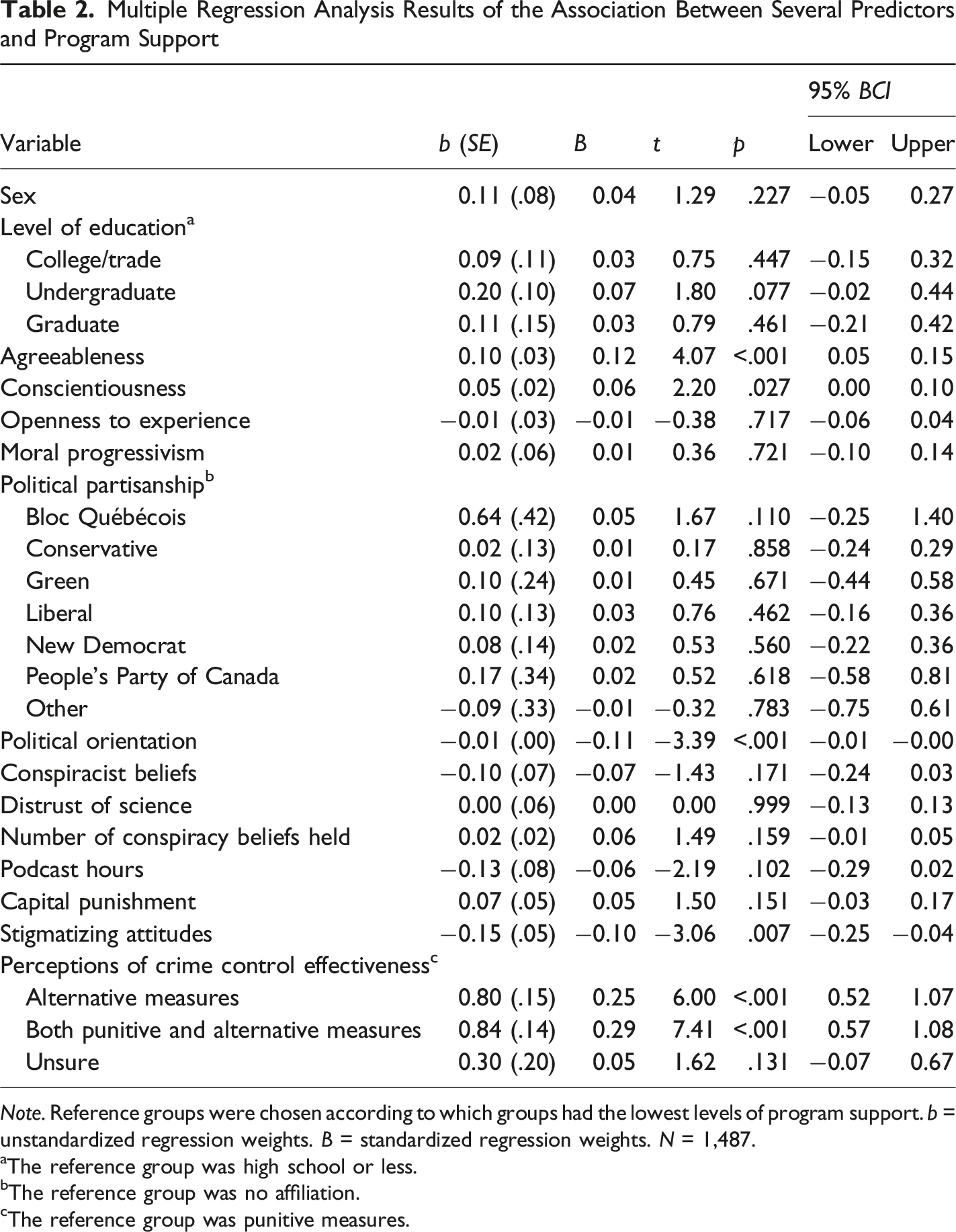
Note. Reference groups were chosen according to which groups had the lowest levels of program support. b = unstandardized regression weights. B = standardized regression weights. N = 1,487.
aThe reference group was high school or less.
bThe reference group was no affiliation.
cThe reference group was punitive measures.
Post-Hoc Moderation Analyses
To gain additional insight into whether the impact of message framing was dependent on participant characteristics, we conducted several post-hoc moderation analyses that were not originally part of our analysis plan. The moderators selected for use in these post-hoc tests were the same variables that emerged as significant in the multiple linear regression. For plots of these moderation analyses, see the online supplement. First, we conducted moderation analyses with a focus on personality characteristics. For agreeableness, the interaction effect with messaging condition was not significant, F(2, 1,474) = 0.31, p = .737, η2p = .00. Nonetheless, support was higher overall for those high in agreeableness across all conditions. That said, in the wellbeing enhancement condition specifically, support was lower for those both high and low in agreeableness relative to the other conditions. For conscientiousness, the interaction effect with messaging condition was not significant, F(2, 1,470) = 0.39, p = .678, η2p = .00. Support was consistent across all conditions for those high and low in conscientiousness.
Next, we conducted a moderation analysis using political orientation. In this analysis, the interaction effect with messaging condition was not significant, F(2, 1,147) = 0.64, p = .526, η2p = .00. Nonetheless, support was higher overall for participants identifying with left-wing political ideologies across all conditions. That said, in the wellbeing enhancement condition specifically, program support was lower overall, relative to the other conditions and more closely approximated the levels reported by those identifying with right-wing political ideologies.
Subsequently, we conducted a moderation analysis using stigmatizing attitudes. In this analysis, the interaction effect with messaging condition was not significant, F(2, 940) = 1.15, p = .319, η2p = .00. Nonetheless, those who had lower levels of stigmatizing attitudes demonstrated higher program support across all conditions. For those with higher levels of stigmatizing attitudes, the combination condition generated the highest level of support.
Lastly, we conducted a moderation analysis using perceptions of crime control effectiveness. In this analysis, the interaction effect with messaging condition was not significant, F(2, 671) = 2.91, p = .055, η2p = .01. Despite this, support was higher overall for those who support alternative measures of crime control across all conditions. For those who support punitive measures, support was lowest in the wellbeing enhancement condition and highest in the combination condition.
Discussion
The present results replicate the findings of both Thain and Christofferson (2026) and Tupper (2021) as there was high levels of support for CSA perpetration prevention programs across message frames, and higher levels of stigma were associated with lower program support. A secondary focus of the present study was to examine the impact of a wide range of demographic and personality traits and attitudes and beliefs on support for CSA perpetration prevention programs. Results were intuitive in that there were higher levels of support for CSA perpetration prevention programs among those who scored higher on measures that indicated they were more open, more liberal or left leaning, less likely to subscribe to conspiracy beliefs (inclusive of distrust in science), and less punitive in their views about crime and crime control. These variables did not significantly moderate the association between messaging condition and program support. Many of the effect sizes across these analyses were negligible in nature, though the effect sizes were in the moderate range for punitive views about crime and crime control.
Implications of Findings for CSA Perpetration Prevention Programs
The present results (i.e., that 79.8% of our sample supported the CSA perpetration prevention program to some degree) are consistent with both Thain and Christofferson (2026; 82.6% supported perpetration prevention) and Tupper (2021; 88.7% supported perpetration prevention). The high level of support observed in a distinct partially representative sample across conditions is promising for CSA perpetration prevention programs. Given that messaging condition was not associated with program support, these findings suggest that CSA perpetration prevention programs can likely advertise their program in a manner that is consistent with their ethos and worry less about the impact this might have on program support among the public. Nonetheless, different groups may have distinct preferences that need to be considered. For example, it is possible that professionals who might refer clients and funders who support CSA perpetration prevention programs may prefer risk reduction messaging, given findings that suggest mental health and general practitioners rate prevention as the most significant treatment need for individuals with sexual interest in children (Lievesley et al., 2022). Given that most programs are funded as CSA perpetration prevention programs and that this is a major component of such programs (e.g., Seto et al., 2024; Stephens et al., 2022), emphasizing both risk reduction and mental health/wellbeing goals seems like a fair approach.
Unfortunately, we were unable to examine the interaction between messaging condition and sexual offence history or the presence of atypical sexual interests given low endorsement for these questions. It is possible that potential clients may have different preferences in how CSA perpetration prevention programs are advertised. The wider literature provides some useful guidance on the way individuals with sexual interest in children may have heterogenous needs that go beyond perpetration prevention (e.g., Chronos et al., 2024; Levenson & Grady, 2019; Lievesley et al., 2025; Stephens et al., 2024). Further, in a survey of individuals with sexual interest in children, mental health was rated as the highest treatment priority followed by stigma, sexual frustration, and lastly risk reduction (e.g., Lievesley et al., 2023). Broader discussion of public health campaigns has highlighted the importance of involving individuals from the target group in the creation of targeted media campaigns (de Vere Hunt & Linoss, 2022). These findings again underscore the benefits of taking a two-pronged approach to advertisements to try and capture that CSA perpetration prevention programs are not narrowly focused on this as their sole treatment target.
A major takeaway from the our study is that there are several other characteristics that impact overall support for a CSA perpetration prevention program. More specifically, those who were less open, conservative leaning, high in conspiratorial ideation, and more punitive were less likely to support the program. Our findings about the role of stigma and wider conspiracy related beliefs highlight the impact that misinformation or misunderstanding can have on general support for CSA perpetration prevention, as sexual interest in children is a highly stigmatized and misunderstood condition (e.g., Jahnke, 2018b). The role of conspiratorial ideation on support for CSA perpetration prevention programs highlights that misinformation should be an important target to increase support for CSA perpetration prevention programs and other broad based public health approaches (de Vere Hunt & Linoss, 2022). It is possible that shifts in these types of beliefs might make it easier to implement public health approaches and have a positive impact on recruitment of potential clients to such programs (e.g., Seto et al., 2024); however, this assertion should be subject to further research.
Strengths and Limitations
The present study has several strengths including the recruitment of a large and diverse sample of Canadians, randomization into distinct message frame conditions, and the measurement of several potential correlates of program support using well-validated self-report measures. Additionally, our sample was partially representative of the Canadian population. According to the most recent population estimates, the average age observed in this sample was only slightly higher than the national average of 41.6 (Statistics Canada, 2024a). Furthermore, the sample sizes collected for both Western Canada and Ontario were almost proportionally identical to the actual population size in those regions (Statistics Canada, 2024b); however, the sample was not as representative of the population sizes of Eastern Canada and Quebec (Statistics Canada, 2024b). This was due to a deliberate choice to oversample from Eastern Canada given the ongoing CSA perpetration prevention program currently being evaluated, as well as the fact that French study materials were not available to participants. That said, the partial representativeness of this sample is a strength of the study.
Several limitations must also be considered. First, it is possible that the high level of support for the program is due to a self-selection bias in that those who support CSA perpetration prevention were more likely to consent to participate in the study. Additional evidence for potential self-selection bias was the high rate of non-completion for the survey. An important caveat, though, is that due to the survey design, we could not differentiate individuals who were excluded due to a quota being filled (and thus them being unable to respond to the survey) from those excluded for not completing the survey as information on the cause of failing to complete the survey was not collected. The result was that our response rate and exclusions had to be considered together rather than separately. Thus, an unknown number (but upwards of 38%) could be considered non-responders as they did not complete the survey due to one of their quotas being filled. When coupled with the high number of exclusions, these together may have impacted the generalizability of our findings. As such, our findings and their implications should be interpreted considering this potential bias.
Second, some of the questions asked to participants included “Uncertain/don’t know” options (e.g., perceptions of crime trends), meaning some of the variables collected had very few usable responses compared to others. While these were retained to present a more fulsome image of the data collected, the small number of cases within these variables may have misrepresented the role of these variables in explaining program support. In retrospect, we would have utilized different response options that minimized data loss. Another issue related to measurement was the low internal consistency for the BFI-10. As such, the findings pertaining to personality traits presented in this paper should be interpreted with some caution. Despite this limitation, our findings align largely with those observed in past studies that employed other measures of personality traits (e.g., the NEO PI-R; Olver & Barlow, 2010), meaning the low internal consistency is likely in part due to each subscale consisting of only two items.
Third, although we attempted to recruit a partially representative sample of Canadians in this study, not all demographic characteristics were taken into consideration as part of our sampling strategy (e.g., ethnicity, cultural background, religious affiliation). Notably, cultural affiliation would have been an interesting variable to match on, though potentially challenging due to significant cultural diversity in Canada. As such, while this research provides a strong starting point, replication work should seek to recruit samples that are proportional to the population on more characteristics than just age, sex, and geographic location.
Lastly, we initially wanted to examine the effect of emotion of the person featured in the advertisements on program support; however, pilot testing suggested that this manipulation did not work as intended, and many participants were able to tell that we used artificial intelligence to generate one of the images. Future studies may want to consider testing message framing that does not include images of people and instead focuses solely on written messaging. In the initial planning of the study, we wanted the advertisements to be the same except for our key variables of interest. In retrospect, the emphasis on this strict control did preclude us from using some of the actual advertisements that are used in these types of programs, perhaps limiting the external validity of these findings.
Future Research Directions
There is a need for future research to continue to examine the effects of different types of CSA perpetration prevention program advertisements on public support, but also program referrals. Optimally, the research would involve showing potential clients the different advertisements and examining the impact this has on self-referral to CSA perpetration prevention programs. It is also possible that a mixed-method or qualitative approach could be used to ask potential clients about their preferences in advertisement campaigns. Nonetheless, the needs of potential clients must be balanced with consideration of the public, professionals, and funders.
Additionally, future research should examine the impact of program advertisements on different target groups. For example, a major source of referrals to such programs would be other mental health professionals who might refer clients to the program. It would be useful to better understand the general perceptions of perpetration prevention and associated messaging on attitudes (i.e., program support) as well as behaviour (e.g., recommending the program to a potential client). Lastly, more research is needed to better understand evidence-based approaches to modifying misinformation surrounding sexual interest in children, perpetration prevention, and sexual offending more broadly.
Supplemental Material
Supplemental Material - Examining the Effect of Message Framing and Demographic Traits on Public Support for a Child Sexual Abuse Prevention Program
Supplemental Material for Examining the Effect of Message Framing and Demographic Traits on Public Support for a Child Sexual Abuse Prevention Program by Myles Davidson, Skye Stephens, Ainslie Heasman, Cory Gerritsen, and Ian McPhail in Sexual Abuse
Footnotes
Acknowledgements
We would like to thank EnterpriseHealth/Creative Currency, the marketing company that worked with our research team to provide input on their experience creating advertisements for CSA perpetration prevention programs, and who created the mock advertisements in the study.

Funding
The authors disclosed receipt of the following financial support for the research, authorship, and/or publication of this article: This research was supported by grant funding from Research Nova Scotia. The funder of this study was not involved in the conducting of this research or the preparation of this manuscript.
Declaration of Conflicting Interests
The authors declared the following potential conflicts of interest with respect to the research, authorship, and/or publication of this article: All authors have affiliations with the Talking for Change program. There may be a perceived conflict due to these affiliations.
Supplemental Material
Supplemental material for this article is available online.