




Abstract
Recent research indicates that the consequences of sexual offenses extend beyond target victims, including to non-offending partners of individuals with sexual offense histories. However, little research has focused on non-offending partners’ wellbeing and relationships with persons with sexual offense histories leading up to and following acts of sexual aggression. Non-offending partners may be secondary victims of their partners’ offenses in managing psychological difficulties (e.g., guilt, shame), social stigma and isolation, fear for their safety, or difficulties in their romantic relationships resulting from their partners’ sexual offenses, often with minimal supports. The current study examined key correlates of individual and interpersonal adjustment among 207 non-offending partners of individuals with histories of sexual offenses who were residing in Canada (n = 36) or the United States (n = 171). Findings indicate that positive changes due to the offense (i.e., improved finances), self-esteem, interpersonal adjustment, instrumental support, lower levels of acceptance, and humor positively predicted individual adjustment. Interpersonal adjustment was predicted by trust, intimacy, partner’s stress communication, and problem-focused and emotion-focused common dyadic coping. Findings highlight the need for services for non-offending partners, including interventions that address self-esteem and practical difficulties resulting from the offense, and couples therapy to address trust issues, intimacy concerns, and shared coping with stressors related to the offense.
Introduction
Despite evidence that many individuals with sexual offense histories report having developmentally appropriate romantic relationships before or following an offense (Duwe, 2013), there is limited understanding of their relationships or about their non-offending partners. Because relationships have implications for re-engagement in society and risk of relapse for persons with histories of sexual offenses (Hanson & Morton-Bourgon, 2004; Wyse et al., 2014) and because legal ramifications of sexual offense conviction and public awareness of sexual crimes negatively affect the psychosocial adjustment of non-offending partners (Bailey, 2018; Jung et al., 2013; Kilmer & Leon, 2017; Levenson & Tewksbury, 2009; Plogher et al., 2016; Tewksbury & Levenson, 2009), it is important to further examine non-offending partners’ perspectives.
Dealing With the Aftermath
Consistent with the theory of disenfranchised grief (Doka, 1999), individuals are left to grieve a “loss” of their lives in the way they knew them following their partner’s sexual offense (Bailey, 2018). In the aftermath of an offense, non-offending partners often report a loss of social support, including close relationships, being unable to live with relatives, and withdrawal from participation in community activities (Bailey, 2018; Duncan et al., 2022; Kamitz & Gannon, 2023; Kilmer & Leon, 2017; Tewksbury & Levenson, 2009). Non-offending partners also report experiencing an emotional loss of their partner in the way they once knew them, which is often made worse by separation due to incarceration (Cahalane et al., 2013; Duncan et al., 2022).
The public often views non-offending partners stereotypically in negative ways (e.g., deviant, predatory) (Plogher et al., 2016), despite indications that non-offending partners are rarely implicated in their partner’s offenses (McCloskey & Raphael, 2005). Many non-offending partners experience backlash from the public following their partner’s offense, including threats, harassment, and property damage (Levenson & Tewksbury, 2009; Tewksbury & Levenson, 2009). Even social workers, who are often trained to take a non-judgmental perspective, report believing that non-offending partners collude with persons with sexual offense histories in cases of child sex abuse (Plummer & Eastin, 2007). Stigma and negative attitudes directed toward non-offending partners can cause them practical difficulties, including not being hired or having other problems in their jobs, and financial hardship following their partner’s offense (Bailey & Sample, 2017; Kilmer & Leon, 2017; Levenson & Tewksbury, 2009; Tewksbury & Levenson, 2009). Non-offending partners also report concerns with housing related to negotiating housing laws, being forced to relocate, or coping with limited housing availability (Cassidy et al., 2021; Kilmer & Leon, 2017; Zilney, 2020).
Individual Adjustment
Despite a paucity of research on non-offending partners, findings suggest they experience high levels of psychological distress and social isolation (Bailey, 2018; Cahalane et al., 2013; Iffland et al., 2016; Kilmer & Leon, 2017; Tewksbury & Levenson, 2009). Furthermore, previous research indicates a significant proportion of non-offending partners have been the victim of emotional and sexual abuse (Iffland et al., 2014; Lewin & Bergin, 2001), which can further complicate distress and vulnerabilities resulting from their partner’s sexual offense and may place non-offending partners at increased risk of mental health difficulties. However, researchers have not systematically examined correlates of individual adjustment in this population.
Investigators have indicated that non-offending partners report using coping strategies to manage difficulties related to the sexual offense. Adaptive coping strategies include humor (Cahalane et al., 2013), finding support in online support groups (Bailey, 2018; Bailey & Sample, 2017), and participating in advocacy (i.e., speaking out about registration laws; Bailey & Sample, 2017). In contrast, maladaptive coping tactics reportedly used by non-offending partners include victim-blaming, using externalizing language to mentally separate an accused partner from an offense, and denying an offense (Bailey & Sample, 2017; Cahalane et al., 2013; Duncan et al., 2022; Iffland et al., 2016; Kamitz & Gannon, 2023).
Research has shown that denial also may be used as a coping strategy among individuals with sexual offense histories to protect against damage to their identity, reduce feelings of shame, maintain the support of loved ones, and avoid consequences of stigma related to sexual offenses (Blagden et al., 2014; Ware & Mann, 2012). Although research with community samples indicates that denial can have detrimental effects on individual adjustment (Doron et al., 2014), it also is part of a dynamic process that may protect wellbeing in the short term (Livneh, 2009). Overall, more research is needed to determine the implications of lack of realistic thinking on non-offending partners’ individual adjustment and ability to address future offense-related challenges.
Interpersonal Factors
Studies have shown that individuals with histories of sexual offenses often display deficits in intimacy (Cortoni & Marshall, 2001; Martin & Tardif, 2014) and attachment (Marshall, 2010; Miner et al., 2010). Research also indicates that non-offending partners often report difficulty with intimacy and conflict resolution (Lang et al., 1990; Ward et al., 1997) and decreased trust in their partner following an offense (Cahalane & Duff, 2017; Cahalane et al., 2013; Kamitz & Gannon, 2023). In considering these problems, it is important to investigate how non-offending partners in such relationships maintain relationship satisfaction and whether key factors contribute to the preservation of intimate relationships among individuals with sexual offense histories.
Research examining benefits exchanged in non-offending partners’ relationships suggests that individuals with sexual offense histories provide support and stability to insecurely attached and submissive partners who, in return, provide acceptance and serve as an outlet for their partner to act out a desire for control (Iffland et al., 2014, 2016). Both individuals with sexual offense histories and their non-offending partners appear to idealize the other partner and generally report low levels of conflict. In addition, non-offending partners who disbelieve or discredit allegations against their partner generally report plans to continue in their relationships (Kamitz & Gannon, 2023), suggesting that idealization or denial may serve as important relationship maintaining factors.
Barriers to relationship dissolution also may contribute to relationship maintenance among non-offending partners. Endorsement of various barriers to relationship dissolution (e.g., concerns about children, owning a house together, financial strain) is linked with lower rates of divorce among community samples (Previti & Amato, 2004). Notably, however, individuals who primarily attribute maintenance of their relationships to barriers report marital unhappiness, suggesting that barriers play an important role in keeping unhappy couples together (Previti & Amato, 2003). A recent qualitative study by Kamitz and Gannon (2023) revealed that non-offending partners often cite not wanting to upset or harm their children, negative consequences because of cultural implications, and other barriers as reason for maintaining their relationships. However, research has not examined the impact of barriers to relationship dissolution on relationship quality or the impacts of such barriers on non-offending partners in quantitative or larger samples.
Collaborative coping, or dyadic coping (Falconier & Kuhn, 2019), may help non-offending partners maintain their relationships after a sexual offense. Dyadic coping mechanisms have been shown to promote positive personal and interpersonal adjustment in couples dealing with a variety of stressors (Falconier et al., 2015; Staff et al., 2017), including a sexual offense (Iffland et al., 2016; Lytle et al., 2017; Zilney, 2020). Previous studies found that non-offending partners may use the offense as an opportunity to redefine and rebuild their relationship and prioritize family to combat offense-related challenges (Iffland et al., 2016; Lytle et al., 2017; Zilney, 2020). Further research is needed based on preliminary findings to determine whether processes of mutual support and collaboration explain why relationships between persons with sexual offense histories and non-offending partners persist despite immense difficulties that result from an offense. The aim of the present study was to investigate key factors that predict individual and interpersonal adjustment among non-offending partners. Based on the extant theoretical and empirical literatures, it was expected that non-offending partners who express relatively positive adjustment would also report fewer stressors (e.g., adverse childhood experiences, negative changes resulting from an offense) and greater use of individual (e.g., humor, social support) and dyadic (e.g., trust, intimacy) coping strategies.
Method
Participants and Procedures
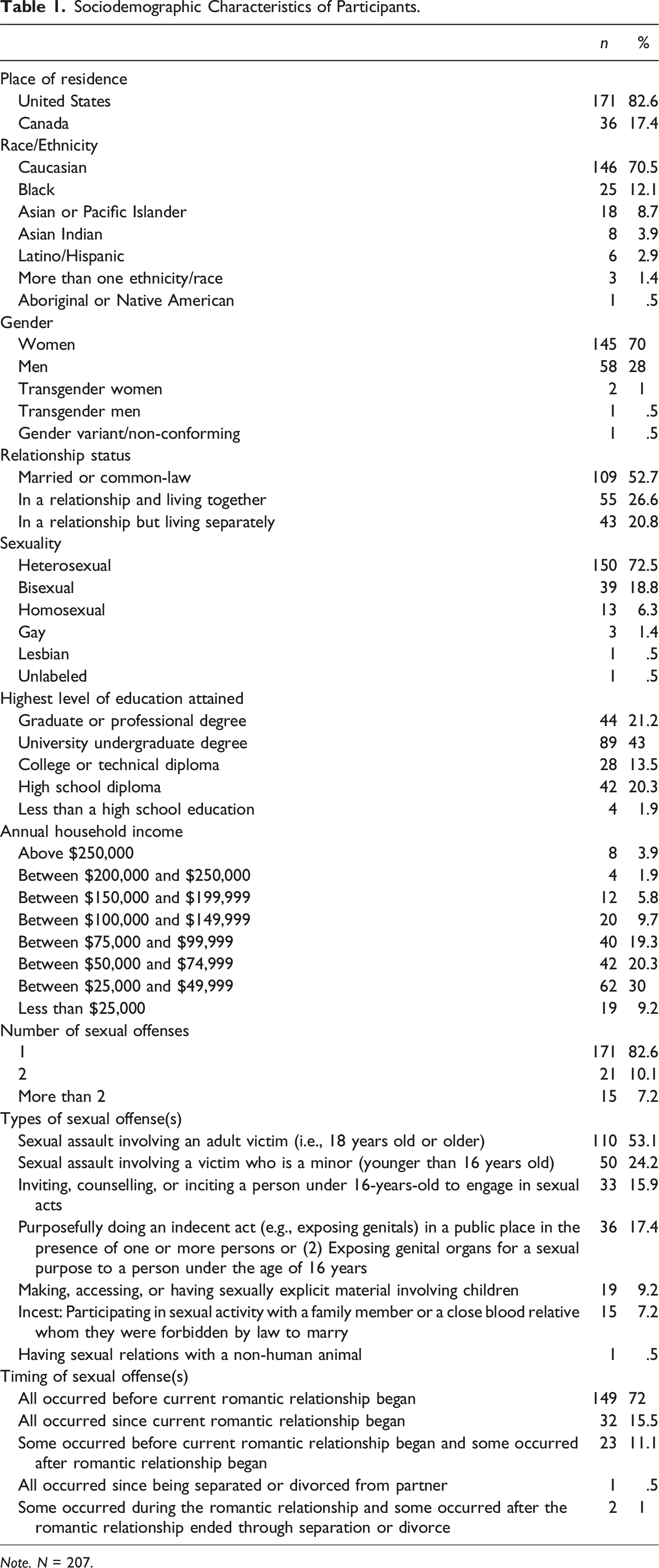
Sociodemographic Characteristics of Participants.
Note. N = 207.
Most participants identified as female (70%), followed by male (28%), transgender female (1%), transgender male (.5%), and gender varying/non-conforming (.5%). The sizeable minority of participants who identified as males in relationships with men with histories of sexual offenses contrasts previous studies on non-offending partners that include exclusively female-identifying participants (e.g., Bailey, 2018; Cahalane et al., 2013; Iffland et al., 2016; Shannon et al., 2013). However, recent research suggests that the proportion of males with histories of sexual offenses who report sexual orientations other than heterosexual (e.g., homosexual or bisexual) is as high as 19.9% (Meyer et al., 2022), indicating that male-male partnerships involving one partner with a history of sexual offenses may be more prevalent than previously indicated.
To ensure the sample was reflective of the desired population, interested individuals completed a researcher-developed pre-screening questionnaire and were excluded if they did not meet eligibility criteria (e.g., indicated they were not currently involved in a relationship with a man convicted or accused of one or more sexual offenses, did not reside in North America, were younger than 19 years old). Further, 282 individuals participated in the full version of the study but were not included due to not being currently involved in a romantic relationship (n = 12) or being screened out due to invalid or missing responses or repeated IP addresses (n = 270). Participants recruited from MTurk and Prolific received $3 USD ($3.96 CAD) in exchange for their participation. Participants recruited from other sources did not receive an inducement to maintain anonymity. Questionnaires and items were presented in a fixed order to all participants. This project was approved by the University of New Brunswick Ethics Review Board. The authors take responsibility for the integrity of the data, the accuracy of the data analyses, and have made every effort to avoid inflating statistically significant results.
Measures
Individual Adjustment
Individual adjustment was assessed using the 5-item Satisfaction with Life Scale (SWLS; Diener et al., 1985). Participants answered the degree to which they agree with items (e.g., “In most ways, my life is close to my ideal.”) using a 7-point scale ranging from 1 (“Strongly disagree”) to 7 (“Strongly agree”). Responses were summed to create a total score. Cronbach’s alpha for the scale was .91.
Interpersonal Adjustment
Self-reported interpersonal adjustment was assessed through an adapted version of the Quality of Marriage Index (QMI; Norton, 1983). The QMI includes 6 items (e.g., “We have a good marriage.”), five of which are measured on a 7-point scale, ranging from 1 (“Strongly disagree”) to 7 (“Strongly agree”). The sixth item includes a 10-point scale, ranging from 1 (“Extremely low”) to 10 (“Extremely high”), addressing “the degree of happiness, everything considered, in your marriage.” Responses were summed to create a total score. Items were modified for use with married and unmarried participants. Cronbach’s alpha for the scale was .95.
Changes Due to the Offense
A set of 7 items were developed to assess perceived life changes resulting from a partner’s sexual offense across key domains demonstrated in previous research to be most affected: finances, employment, support from family, support from friends, housing, relations with neighbors, and parenting children (Bailey, 2018; Kilmer & Leon, 2017; Levenson & Tewksbury, 2009; Tewksbury & Levenson, 2009). Participants were instructed to indicate the degree to which several domains (e.g., “finances”) have changed in their life because of their partner’s offense. Items were assessed using a 5-point scale ranging from −2 (“Has worsened a lot”) to 2 (“Has improved a lot”), with a midpoint of 0 (“Has not changed”). Scores were summed to create a total score, with higher scores indicating the presence of more positive changes resulting from the offense. Cronbach’s alpha for the scale was .85.
Self-Esteem
The 10-item Rosenberg Self-Esteem Scale (RSES; Rosenberg, 1965) was used to assess individual self-esteem. Participants were instructed to answer questions related to general feelings about themselves (e.g., “I feel that I have a number of good qualities.”). Items were assessed on a 4-point scale ranging from 1 (“Strongly disagree”) to 4 (“Strongly agree”). Scores were summed to create a total score. Cronbach’s alpha for the scale was .89.
Adaptive Coping
The Brief Cope Inventory (BCI; Carver, 1997) was used to assess coping strategies. The BCI includes 28 items (e.g., “I’ve been getting emotional support from others”), ranging from 1 (“I haven’t been doing this at all”) to 4 (“I’ve been doing this a lot”). Consistent with previous research (Meyer, 2001), items were summed to create one adaptive coping composite of instrumental support, acceptance, humor, active coping, emotional support, religion, planning, and positive reframing. Cronbach’s alpha for the scale was .89.
Adverse Childhood Experiences
History of trauma was assessed using the 10-item Adverse Childhood Experience Questionnaire (ACE-Q; Felitti et al., 1998). Participants were instructed to respond “yes” or “no” to statements describing adverse childhood experiences (e.g., “Did a household member go to prison?”), and response scores were summed to create a total score. Cronbach’s alpha for the scale was .80.
Denial
Acceptance or denial of the alleged sexual offense was assessed using an adapted version of the Acceptance of Sexual Offense subscale of the Sex Offender Acceptance of Responsibility Scales (SOARS; Peacock, 2000). The 8-item subscale was modified for use in this study to assess participants’ own self-reported acceptance or denial of their partner’s sexual offending behavior (e.g., “If the truth had been told, my partner would not have been accused of committing a sexual offense.”). Items were assessed on a 5-point scale ranging from 0 (“Do not agree at all”) to 4 (“Agree strongly”). Scores were then summed to create a total score, with higher scores indicating greater acceptance of the sexual offense. Cronbach’s alpha for the scale was .85.
Online Coping
To assess the use of online support-seeking behaviors, we used two items from an inventory of online coping created by van Ingen and colleagues (2016). Participants were asked to indicate the frequency with which they use online coping strategies (e.g., “I get emotional support from others through the internet.”; “I tried to get advice or help from other people about what to do through the internet.”) on a scale ranging from 0 (“This doesn’t apply to me at all”) to 3 (“This applies to me a lot”). Cronbach’s alpha for the scale in the current study was .88.
Trust
Trust was assessed using the 8-item Dyadic Trust Scale (DTS; Larzelere & Huston, 1980). For each item, participants were required to evaluate the degree to which their partner is honest (e.g., “My partner is perfectly honest and truthful with me.”) and benevolent (e.g., “I feel that my partner can be counted on to help me.”) towards them on a scale ranging from 1 (“Very strongly disagree”) to 7 (“Very strongly agree”). Responses were added together to produce a total score. Cronbach’s alpha for the scale was .91.
Intimacy
The Miller Social Intimacy Scale (MSIS; Miller & Lefcourt, 1982) consists of 17 total items, including 6 items that assess frequency of intimate relations (e.g., “When you have leisure time how often do you chose to spend it with him alone?”) and 11 items that assess perceived intensity of intimate relations (e.g., “How important is it to you that he understands your feelings?”). Each item was measured on a scale ranging from 1 (“Very rarely”) to 10 (“Almost always”). Responses were summed to obtain participants’ maximum level of perceived intimacy. Cronbach’s alpha for the scale was .94.
Dyadic Coping
The Dyadic Coping Inventory (DCI; Bodenmann, 2008) was used to assess how partners support each other when facing stressors. Consistent with a previous validation study of the English version of the DCI (Randall et al., 2015), we included 29 out of the original 37 items, as this provided the best fit for the data. The DCI assesses frequency of self coping behaviors (12 items; e.g., “I show empathy and understanding to my partner”), partner coping behaviors (12 items; e.g., “My partner takes on things that I normally do in order to help me out.”), and common dyadic coping (5 items; e.g., “We engage in a serious discussion about the problem and think through what has to be done.”) on scales ranging from 1 (“Very rarely”) to 5 (“Often”). Responses for each subscale were summed to create a total score. Cronbach’s alpha for all the scales combined was .94.
Barriers to Breakup
We used an adapted version of an 8-item, self-report measure assessing barriers to relationship dissolution (Knoester & Booth, 2000). Participants were instructed to rate the extent to which the following factors are important in keeping their relationship together: not wanting to leave their residence, financial security, religious beliefs, dependence on the other partner, the other partner’s dependence on the participant, disapproval from loved ones, concerns about causing their children to suffer, and worries about losing their children. The measure was modified for use with married and unmarried participants. Child-specific items were excluded for participants who did not have children. Responses were rated on a 3-point scale ranging from 1 (“Not very important”) to 3 (“Very important”) and responses were then summed. Cronbach’s alpha for the scale was .83.
Avoidant and Anxious Attachment
The Experiences in Close Relationship Scale-Short Form (ECR-S; Wei et al., 2007) was used to assess attachment. The ECR-S includes 12 items: 6 measuring avoidance (e.g., “I try to avoid getting too close to my partner.”) and 6 assessing anxiety (e.g., “I need a lot of reassurance that I am loved by my partner.”). Items ranged from 1 (“Disagree strongly”) to 7 (“Agree strongly”). Responses for each subscale were summed. The ECR-S was modified for use in this study to reflect feelings about the current romantic relationship rather than about romantic partnerships in general. Participants with low scores on the anxiety and avoidance subscales can be viewed as having a secure attachment orientation. High scores on either or both domains indicate insecure attachment style. Cronbach’s alpha was .73 for the anxiety subscale and .84 for the avoidance subscale.
Data Analysis
Structural Equation Modeling (SEM) was conducted in Analysis of Moment Structures (AMOS) version 26.0 (Arbuckle, 2019) to test an overall model and associations between key predictors and individual and interpersonal adjustment. In conducting SEM analyses, several steps were taken to ensure data quality. Patterns of missing data were visually inspected, and participants who completed fewer than 60% of items were removed from the dataset. Missing values analysis revealed there were no variables on which 5% or greater of responses were missing. Based upon examination, cases of missing data were deemed missing at random and excluded from subsequent analyses.
Reliability and Validity
Items with factor loadings smaller than .60 were examined and subsequently removed if there was no theoretical or empirical rationale for retaining them. Observed variables removed due to insufficient factor loadings included positive reframing, problem-focused supportive dyadic coping (self), stress communication (self), and emotion-focused supportive dyadic coping (partner). In addition, deleted items included those corresponding to denial (four items), barriers (one item), intimacy (two items), avoidant attachment (one item), and anxious attachment (one item). The reliability of latent variables was assessed using Cronbach’s alphas and Composite Reliability (CR). Alpha values ranged from moderate to excellent based on criteria for estimating the accuracy of internal consistency coefficients based on sample size and items per subscale (Ponterotto & Ruckdeschel, 2007). In addition, each CR exceeded the recommended value of .70 (Nunnally & Bernstein, 1994). Further, convergent validity is supported by the Average Variance Extracted (AVE) and CRs, which were all higher than or close to .50 and .70, respectively (Bagozzi & Yi, 1988). An exception to this was the ACE-Q, which produced an AVE value below .50. However, as the ACE-Q had a CR that exceeded the recommended value of .70, the convergent validity of this construct was adequate (Fornell & Larcker, 1981). Discriminant validity was assessed using the Fornell-Larcker criterion (Fornell & Larcker, 1981) by ensuring that the shared variance between all model constructs was not larger than their AVEs.
Normality
Multicollinearity was assessed by ensuring that each indicator had a Variance Inflation Factor (VIF) lower than 5 (O’Brien, 2007). In addition, Mardia’s coefficient for multivariate kurtosis (Critical Ratio = 21.594) was higher than the critical ratio cutoff of 5 (Byrne, 2016), indicating issues with multivariate normality. Given this result, the Bollen-Stine bootstrap technique was performed using 1000 samples as recommended by Cheung and Lau (2008).
Results
Descriptive Analyses
Means, Standard Deviations, and Minimum and Maximum Possible Scores for Included Scales.
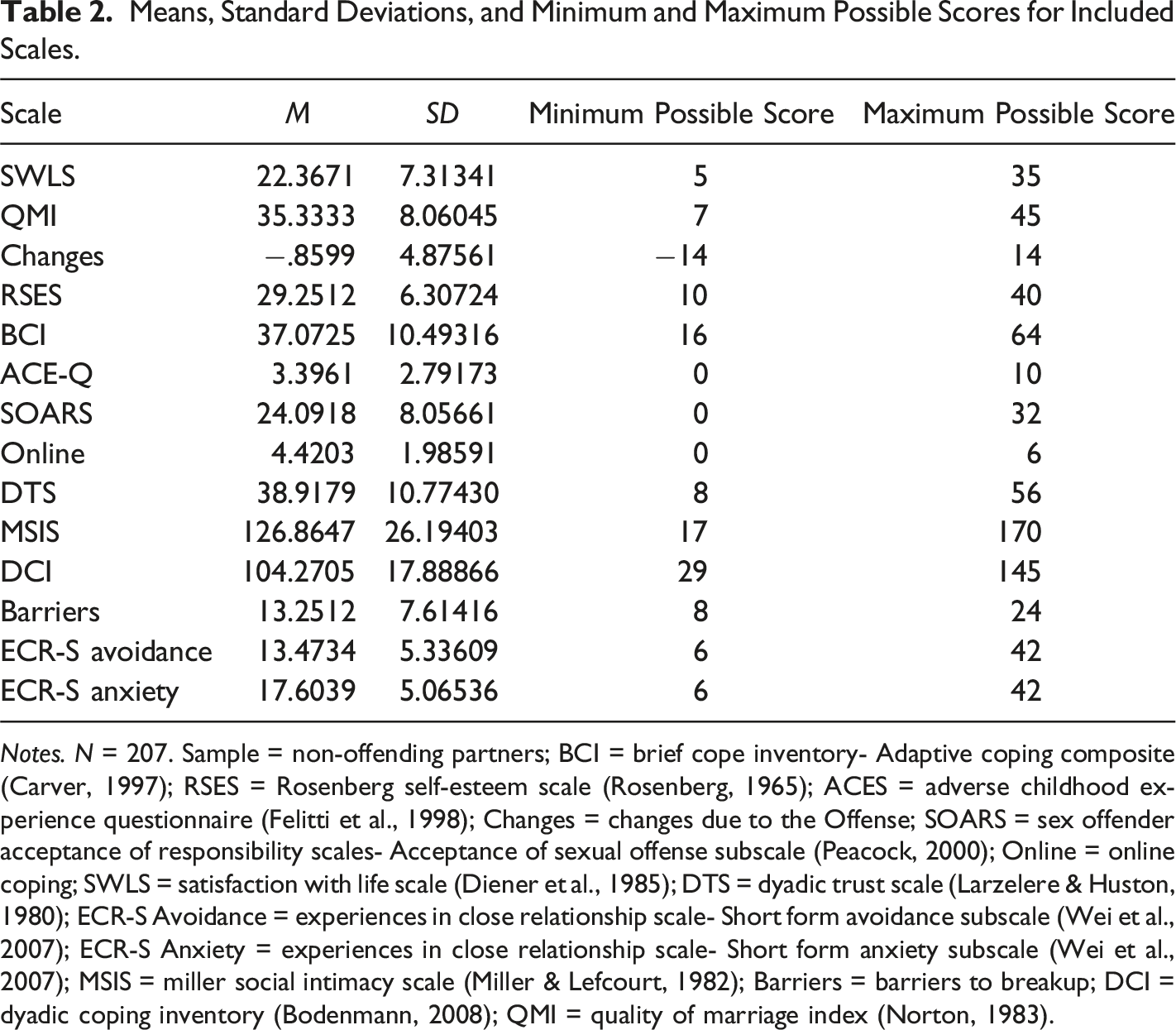
Notes. N = 207. Sample = non-offending partners; BCI = brief cope inventory- Adaptive coping composite (Carver, 1997); RSES = Rosenberg self-esteem scale (Rosenberg, 1965); ACES = adverse childhood experience questionnaire (Felitti et al., 1998); Changes = changes due to the Offense; SOARS = sex offender acceptance of responsibility scales- Acceptance of sexual offense subscale (Peacock, 2000); Online = online coping; SWLS = satisfaction with life scale (Diener et al., 1985); DTS = dyadic trust scale (Larzelere & Huston, 1980); ECR-S Avoidance = experiences in close relationship scale- Short form avoidance subscale (Wei et al., 2007); ECR-S Anxiety = experiences in close relationship scale- Short form anxiety subscale (Wei et al., 2007); MSIS = miller social intimacy scale (Miller & Lefcourt, 1982); Barriers = barriers to breakup; DCI = dyadic coping inventory (Bodenmann, 2008); QMI = quality of marriage index (Norton, 1983).
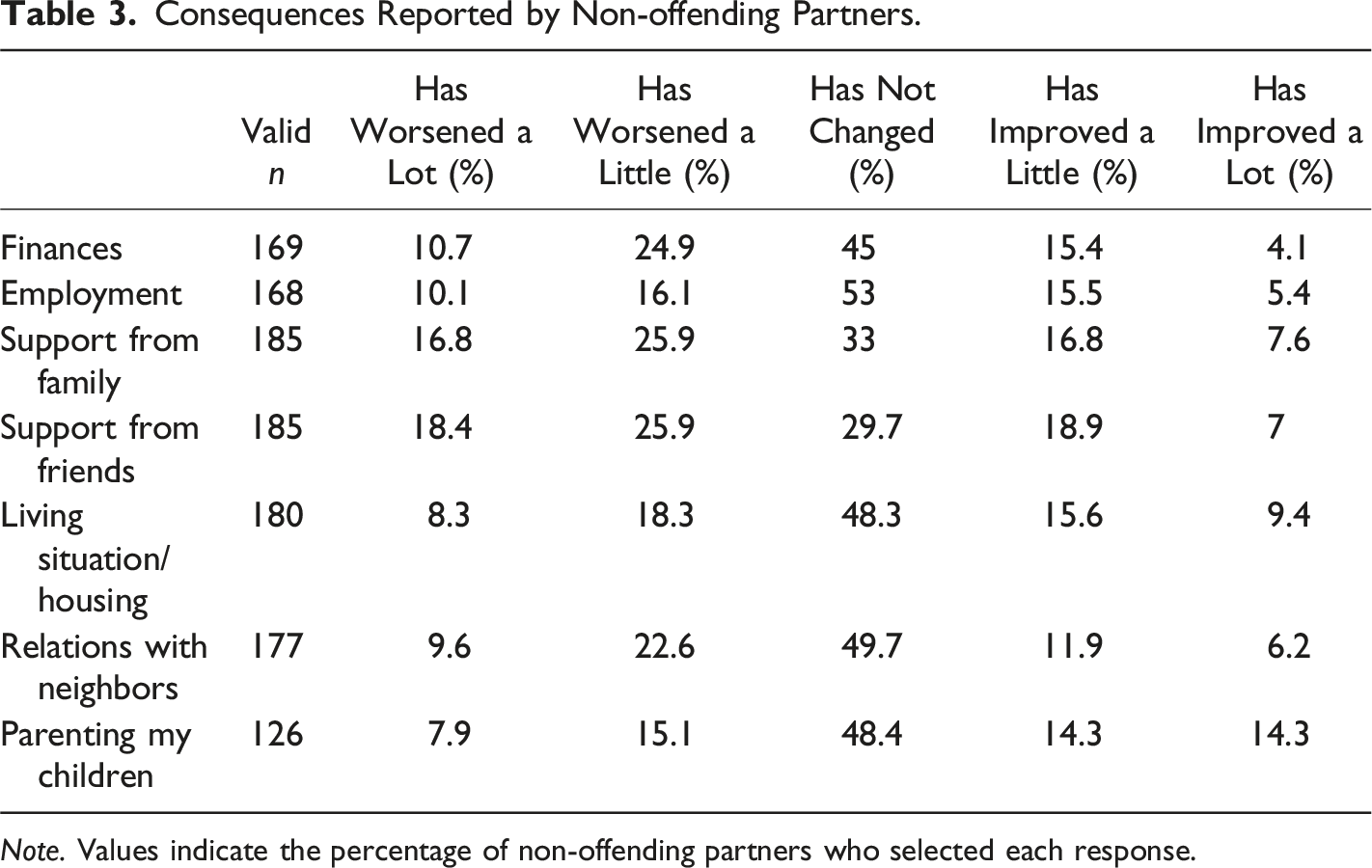
Consequences Reported by Non-offending Partners.
Note. Values indicate the percentage of non-offending partners who selected each response.
Model Fit
The adequacy of the hypothesized model was evaluated using various fit indices, Bollen-Stine bootstrapped χ2 = 15426.732, df = 6997, p = .000; CMIN/DF = 2.205; RMSEA = .076, 90% CI = .075 – .078; CFI = .568. Several of these values fell below recommended thresholds for acceptable fit; recommendations for acceptable χ2/df ratio (CMIN/DF) values being less than 5.0 (Wheaton et al., 1977); acceptable chi-square values are non-significant; recommended values for the RMSEA index are less than .06 (Hu & Bentler, 1999); and values above .90 are considered acceptable for the CFI index (Kline, 2023). Although the structural model exhibited poor overall fit across multiple indices, we retained the proposed variables in the analysis because they are grounded in prior empirical research involving non-offending partners and general community samples. In addition, it is probable that the study’s exploratory nature and the absence of a priori model specifications contribute to the noted fit challenges. As the analysis involves a complex interplay of variables that have not been fully addressed in previous research involving non-offending partners, it is expected that the model does not perfectly match the observed data.
Relationships in the Structural Model
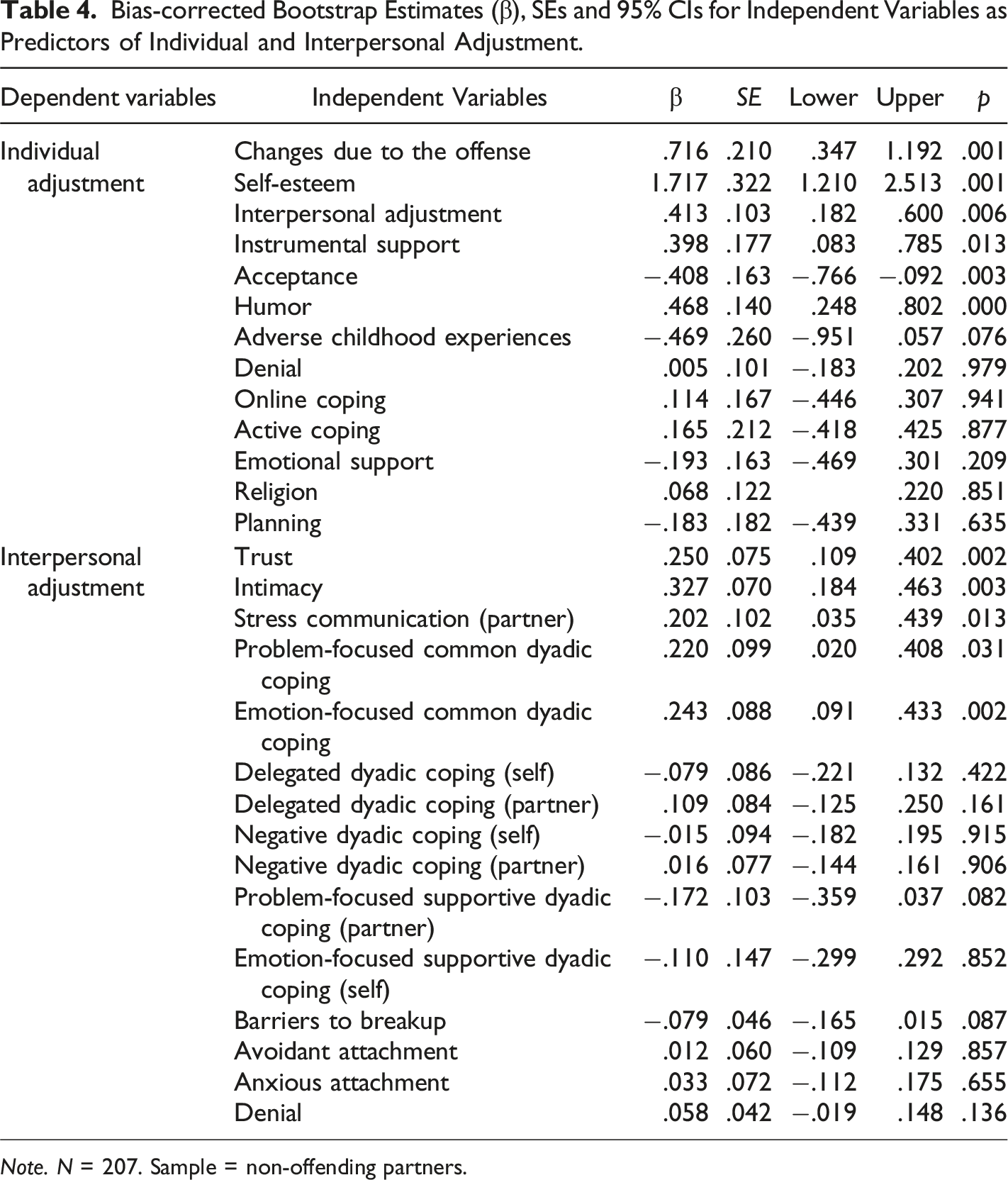
Bias-corrected Bootstrap Estimates (β), SEs and 95% CIs for Independent Variables as Predictors of Individual and Interpersonal Adjustment.
Note. N = 207. Sample = non-offending partners.
Supplementary Welch’s t-tests were conducted to compare mean scores on included measures between participants who indicated that the sexual offense(s) occurred prior to the start of their current romantic relationship and those who indicated the offense(s) occurred after the start of their current relationship (see Supplemental Materials). Findings revealed a significant difference between the two groups on mean scores for interpersonal adjustment (t(90.19) = 2.70, p = .008), denial (t(113.09) = 2.81, p = .006), trust (t(102.41) = 3.00, p = .003), dyadic coping (t(105.24) = 3.06, p = .003), and adaptive coping (t(122.63) = −2.31, p = .023).
Discussion
The primary aims of this study were to examine predictors of individual adjustment and relationship satisfaction among individuals following their partners’ sexual offense. Results indicated that self-esteem, interpersonal adjustment, humor, instrumental support, acceptance, and life changes resulting from a partner’s sexual offense were significantly linked to individual adjustment among our sample of non-offending partners. In addition, trust, intimacy, partner’s stress communication, problem-focused common dyadic coping, and emotion-focused common dyadic coping were linked positively with relationship satisfaction.
Individual Adjustment
Consistent with research demonstrating positive effects of high self-esteem on overall mental health among community samples (see Sowislo & Orth, 2013), we found that high self-esteem was linked to better overall individual adjustment among non-offending partners, possibly because it is associated with quality-of-life characteristics, such as social support (Marshall et al., 2014), physical health (Orth et al., 2012), relationship quality (Erol & Orth, 2017), and job satisfaction (von Soest et al., 2016). Qualitative work by Cassidy and colleagues (2021) suggests a link between self-esteem and ability to deal with a family member’s sexual offense, with non-offending family members identifying a change in their self-concept post-offense. Because perceptions of public stigma have been shown to negatively impact self-esteem in community samples (Link et al., 2001) and given that non-offending partners are frequently the target of courtesy stigma (Bailey, 2018; Bailey & Sample, 2017; Cassidy et al., 2021; Kilmer & Leon, 2017; Levenson & Tewksbury, 2009; Plogher et al., 2016; Tewksbury & Levenson, 2009), addressing the management of this stigma may improve self-esteem and individual adjustment in general. Overall, self-esteem is likely an important target area for intervention with non-offending partners given that stressful life events in general negatively impact self-esteem (Bleidorn et al., 2021; Tsai & Jirovec, 2005; Wonch Hill et al., 2017).
Healthy romantic partnerships are associated with fewer adverse mental health outcomes (Braithwaite & Holt-Lunstad, 2017; Proulx et al., 2007), and improvement to mental health has been shown to occur following interventions to improve relationship quality (Barbato & D’Avanzo, 2006). Among non-offending partners in our study, we similarly found a link between relationship satisfaction and individual adjustment. Because a high proportion of individuals with sexual offense histories report being in romantic relationships (Jung et al., 2013; Navarro & Jasinski, 2015), it is likely that support through couples therapy would benefit non-offending partners’ relationships and the wellbeing of both partners.
Comparable to rates in previous research (Levenson & Tewksbury, 2009; Tewksbury & Levenson, 2009), many non-offending partners reported experiencing collateral consequences because of their partner’s offense, including difficulties related to loosing support from family/friends (39.6%), employment (38.2%), finances (29%), relations with neighbors (27.5%), housing (23.1%), and parenting children (14%). Participants in our sample who experienced fewer collateral consequences reported better individual adjustment. Collateral consequences of a partner’s sexual offense have been linked to stress and distress in previous quantitative (Tewksbury & Levenson, 2009) and qualitative research (Bailey, 2018; Cahalane et al., 2013; Cassidy et al., 2021) with non-offending partners, suggesting that addressing these consequences through policy and services may promote greater individual adjustment among non-offending partners.
In line with prior literature focused on broad community samples, the present study found that receiving instrumental support, conceptualized as help from others to meet tangible needs (Cohen & Wills, 1985), was positively associated with individual adjustment among non-offending partners. Given that non-offending partners reported experiencing multiple practical difficulties (e.g., financial problems, difficulties caring for children, employment issues, housing problems), there is a clear need for such support from others. Previous research has demonstrated that receiving assistance to address such basic needs as shelter and finances is critical for overall wellbeing and higher intrinsic satisfaction (Greenwood et al., 2013; Maslow, 1943).
Regarding cognitive strategies in coping with a sexual offense, the use of humor was linked to better individual adjustment, likely due to its ability to serve as a distraction from stressors (Auerbach et al., 2014), facilitate cognitive reappraisal of stressful events as challenges rather than threats (Cann & Collette, 2014; Fritz et al., 2017; Kuiper, 2012), and promote satisfying social relationships (Bell et al., 1986). In contrast, acceptance was found in our sample to be negatively related to individual adjustment, likely because it can be a complex and painful process that involves acknowledging responsibility for current and past events, recognizing emotional distress (e.g., Secinti et al., 2019), and initiating future change (Stockton et al., 2019).
Contrary to prior research with community samples (Breuer & Barker, 2015; Livneh, 2009; Meyer, 2001; Zarse et al., 2019), online coping, active coping, emotional support, religion, planning, and denial were not significantly associated with individual adjustment. Because non-offending partners often struggle to maintain basic needs, such as shelter and security (Greenwood et al., 2013; Maslow, 1943), given their loss of financial and social capital (Bailey & Sample, 2017; Kilmer & Leon, 2017; Levenson & Tewksbury, 2009; Tewksbury & Levenson, 2009), perhaps individual-led coping strategies (i.e., online coping, active coping, planning, denial) and those less focused on tangible support (i.e., religion, emotional support) may be less important than receiving assistance from others in addressing the commonly encountered practical challenges. In addition, our null results between adverse childhood experiences and individual adjustment, which stands in contrast to some previous research (Zarse et al., 2019), may highlight that proximal factors are more closely linked to adjustment than are distal factors.
Relationship Satisfaction
Results indicate that problem-focused and emotion-focused common dyadic coping, which entail both partners working collaboratively to regulate their emotions and solve problems (Falconier & Kuhn, 2019), are associated with more satisfying romantic relationships among non-offending partners. This finding confirms previous research involving broad community samples indicating that appraisal processes that occur during shared coping, such as viewing a stressor as a shared problem rather than one that solely affects one partner, yield benefits for couples, including increased relationship maintenance behaviors and mutual responsiveness (Kayser & Revenson, 2016). Common dyadic coping also is associated with other relationship benefits (e.g., improved sexual satisfaction, increased passion, constructive conflict resolution, a sense of shared meaning; Ledermann et al., 2010; Vedes et al., 2013). Further, as shown in previous studies (Ledermann et al., 2010; Levesque et al., 2014), partner stress communication, which refers to participants’ perceptions of their partners’ ability to communicate their experiences of stress (Falconier & Kuhn, 2019), was linked to better interpersonal adjustment in our sample. Stress communication is a crucial precursor to collaborative coping, as it is associated with greater likelihood of the other partner subsequently providing support (Bodenmann et al., 2015). Furthermore, stress communication relies upon well-developed communication skills (Bodenmann, 2005), which may facilitate interpersonal adjustment (Yoo et al., 2014) among couples managing difficulties from an offense in other ways (e.g., improved coordination of coping responses, mutual validation of the other partner’s self-disclosure). Taken together, addressing communication and shared coping among couples may benefit non-offending partners by fostering more satisfying relationships in the aftermath of a sexual offense.
Delegated dyadic coping, negative dyadic coping, and problem-focused and emotion-focused supportive dyadic coping were not significantly associated with interpersonal adjustment, which is surprising given the body of literature highlighting connections between these forms of dyadic coping and relationship quality (see Falconier et al., 2015 for a review). It is possible that, amongst non-offending partners, joint strategies and appraisals used to manage stressors may be more important than each partner’s coping response to the other’s stress. Perhaps those non-offending partners who feel ostracized or isolated view jointly solving difficulties as more practical, less burdensome, or even more supportive than when coping with stressors on their own (Rottmann et al., 2015).
Consistent with previous research with general community samples (Ferreira et al., 2014; Yoo et al., 2014), we found that a high level of intimacy was linked to the perception of a more satisfying relationship among non-offending partners. Theoretical work suggests that intimacy is an important predictor of relationship satisfaction because it involves mutual disclosure of vulnerabilities and supportive and validating responses to a partner’s private confessions (Laurenceau et al., 2005; Mitchell et al., 2008). Overall, targeting ineffective communication patterns that interfere with mutual disclosure may be useful in couple’s therapy with non-offending partners.
Trust was a significant predictor of relationship satisfaction in the current study, which is in line with previous studies involving general community samples (Fitzpatrick & Lafontaine, 2017; Righetti et al., 2015). Individuals with higher levels of trust may be more likely to endorse satisfaction-promoting tendencies, such as resilience to partner complaints (Murray et al., 2012), less negative reactivity to conflict (Campbell et al., 2010), and remembering more pleasant than unpleasant events when reflecting on their partner’s behavior (Luchies et al., 2013). As such, addressing barriers to trust in the aftermath of an offense (e.g., communication deficits and difficulties accepting responsibility for the offense; Cahalane et al., 2013; Cahalane & Duff, 2017) may be crucial for enhancing relationship satisfaction among non-offending partners.
In contrast to the general literature on romantic relationships (Burgess Moser et al., 2016; Hadden et al., 2014; Lee & Pistole, 2012; Previti & Amato, 2003), anxious and avoidant attachment did not significantly predict interpersonal adjustment. Perhaps proximal factors (e.g., intimacy, trust, dyadic coping) may be more critical determinants of interpersonal adjustment among non-offending partners than attachment orientation. Further, contrary to our predictions, denial did not predict interpersonal adjustment in this study. The majority (72%) of non-offending partners in our sample indicated that the alleged offense(s) occurred before their relationship began, and supplemental analyses revealed that these partners endorsed lower levels of denial of the offense than participants who indicated that the alleged offense(s) occurred during their relationships. This may serve as an explanation for why non-offending partners in our study did not benefit from using denial: participants’ prior knowledge of the offense may have prevented them from conceptualizing the offense as a betrayal or an affair. Furthermore, barriers to breakup did not predict interpersonal adjustment, perhaps because barriers are generally a stronger predictor of commitment amongst couples than adjustment (Amato & Hohmann-Marriott, 2007).
Implications
Existing services geared towards non-offending partners primarily focus on child abuse prevention efforts and dedicate comparatively less time to addressing collateral consequences impacting non-offending partners or their individual psychological needs (e.g., Deblinger et al., 2001; Duff et al., 2017; Forbes et al., 2003; Hill, 2001; Shannon et al., 2013; van Toledo & Seymour, 2013; Wager et al., 2015). By highlighting the high prevalence of adverse practical and social collateral consequences of a sexual offense, results from the current study further emphasize the necessity for the development of supportive services that encourage use of humor as a coping mechanism and assist non-offending partners in overcoming practical challenges after a sexual offense.
Other research has demonstrated that sex offender registration and notification laws are not effective in reducing repeat sexual offenses by individuals with sexual offense histories (Zgoba & Mitchell, 2021) and create practical, psychological, and social difficulties for innocent non-offending partners (Cassidy et al., 2021; Levenson & Tewksbury, 2009; Tewksbury & Levenson, 2009). Although these laws are widely accepted in the general public (Anderson & Sample, 2008), legislators should consider the experiences of non-offending partners and the important role they fulfill in supporting successful reintegration of individuals with histories of sexual offenses.
Addressing challenges in non-offending partners’ relationships can increase satisfaction and bolster wellbeing among non-offending partners. However, intervention programs frequently exclude non-offending partners or focus only on their role in relapse prevention (for a review, see Brankley et al., 2017). Therefore, the development of couples therapy that concurrently addresses cognitions related to a sexual offense that contribute a lack of trust, barriers to adaptive communication and mutual disclosure that limit intimacy, and existing interpersonal patterns that stand in the way of engaging in mutually supportive coping responses is needed, as research has demonstrated that couples therapy is useful for addressing these issues in community samples (for a review, see Carr, 2019).
Limitations and Future Directions
It was impossible to determine whether non-offending partners included in our sample were the victims of offenses or whether an intrafamilial offense had taken place. This is an important area of future research because victims and those with interfamily offenses may have unique experiences regarding collateral consequences or difficulties in their romantic relationships (Daignault et al., 2017; Davies & Bennett, 2022).
Contrary to expectations, denial was not found to be linked with individual adjustment or relationship satisfaction in our sample, even though denial is frequently a focus of interventions and research involving persons with sexual offense histories (Blagden et al., 2014; Ware & Mann, 2012). More research is needed to understand impacts of level of acceptance on non-offending partners navigating various post-offense circumstances.
Given our sample included participants primarily from the United States, it is difficult to generalize findings to non-offending partners who reside elsewhere. Further research is needed to understand the experiences of non-offending partners who face important jurisdictional differences in legislation (e.g., public registration and notification requirements in the United States vs. federal, non-public sex offender registry in Canada; Department of Justice, 2007; Lussier & Mathesius, 2019).
A further limitation was the omission of dyadic analysis of non-offending partners and partners with histories of sexual offenses. This limited our ability to verify participants’ perceptions of their relationships and post-offense experiences included in this survey. Indeed, it would be beneficial to conduct interviews with both partners to determine if they experience their relationships and challenges post-offense in similar, unique, or complementary ways.
Most non-offending partners in our sample indicated that the sexual offense(s) occurred prior to the start of their current romantic relationship, and these participants endorsed higher levels of interpersonal adjustment, trust, and dyadic coping, and lower levels of denial and reliance on adaptive coping methods than participants whose partner was accused of an offense during their relationship. Consistent with our preliminary findings, non-offending partners who began their relationship after their partner was convicted or accused of an offense may not have experienced immediate effects of the public’s awareness of the sexual offense, including involvement in legal proceedings (Bailey, 2018), notoriety from media coverage (Zilney, 2020), social rejection due to stigma by association (Bailey, 2018;Bailey & Klein, 2018; Cahalane et al., 2013), feelings of betrayal if the offense was conceptualized as a form of infidelity (Cahalane et al., 2013; Zilney, 2020), and turmoil from deciding whether to end their relationship (Zilney, 2020). Thus, findings may be less generalizable to non-offending partners whose partner was convicted or accused of an offense during their relationship.
In addition, participants' perceptions of their partner’s offense also may have been shaped by factors such as their partner’s efforts to downplay guilt, their partner’s propensity to omit or alter details about the offense, or inaccurate portrayals or denial of the offense by close individuals such as their partner’s family members (Dietz, 2020; Lord & Willmot, 2004). Finally, because we did not examine state-dependent variables (e.g., self-esteem relating to the offense), we are unable to examine them as contributors to psychosocial adjustment.
Conclusion
To our knowledge, no study to date has examined the impact of collateral consequences on non-offending partners’ individual adjustment and satisfaction within their romantic relationships. The current study provides initial evidence of the role of difficulties due to the offense, self-esteem, acceptance, humor, instrumental support, and relationship satisfaction in determining individual adjustment among non-offending partners. Moreover, this study provides support for the impact of trust, dyadic coping, and intimacy on relationship satisfaction. Our findings point to the need for interventions that reduce the impact of collateral consequences and co-occurring interpersonal difficulties on non-offending partners with the aim of improving overall wellbeing among non-offending partners and reducing relapse among partners with sexual offense histories by increasing positive supports.
Supplemental Material
Supplemental Material - Predictors of Individual and Interpersonal Adjustment Among Non-offending Partners of Individuals With Histories of Sexual Offenses
Supplemental Material for Predictors of Individual and Interpersonal Adjustment Among Non-offending Partners of Individuals With Histories of Sexual Offenses by Katie Cassidy and Scott T. Ronis in Sexual Abuse
Footnotes
Declaration of Conflicting Interests
The author(s) declared no potential conflicts of interest with respect to the research, authorship, and/or publication of this article.
Funding
The authors disclosed receipt of the following financial support for this research. This work was supported by a university research fund from the University of New Brunswick University Research Fund (RF-EXP-2020-09) and a grant from the Social Sciences and Humanities Research Council of Canada (435-2023-0495). The funders had no role in study design, data collection and analysis, decision to publish, or preparation of the manuscript.

Supplemental Material
Supplemental material for this article is available online
References
Supplementary Material
Please find the following supplemental material available below.
For Open Access articles published under a Creative Commons License, all supplemental material carries the same license as the article it is associated with.
For non-Open Access articles published, all supplemental material carries a non-exclusive license, and permission requests for re-use of supplemental material or any part of supplemental material shall be sent directly to the copyright owner as specified in the copyright notice associated with the article.
