




Abstract
Engaging men has been established as central in addressing intimate partner violence. Yet few studies on intimate partner violence explored men’s perspectives on what constitutes sexual violence in relationships only. To explore how men conceptualize sexual violence, we engaged a qualitative approach to unpack men’s narratives of sexual IPV. The study was conducted in Mwanza, Tanzania using in-depth interviews with 30 married men. Men shared a broad spectrum of unacceptable behaviors that clearly or potentially connote sexual violence. Some of the acts were deemed to constitute sexual violence when directed to both men and women, while some were perceived as sexual violence when directed to women or men only. Threatened manhood underpinned men’s conceptualization of sexual violence against them by their partners. Although a large part of men’s narratives of sexual violence towards women seemed to challenge the common sexual scripts existing in patriarchal societies, some of their accounts indicated the persistence of traditional presumptions of masculine sexual entitlement. Our findings uncover additional dimensions of sexual violence that go beyond what is included in the current global frameworks, underscoring the critical need of giving people a voice in their local contexts in defining what sexual intimate partner violence entails for them. This may increase the likelihood of interventions becoming more acceptable and effective when targeting sexual violence, thereby contributing to reduced levels of sexual intimate partner violence.
Introduction
Intimate partner violence, particularly sexual intimate partner violence and its effects on women, has generated a much deserved attention across the world (Sardinha et al., 2022). A recent systematic review and meta-analysis of cross-sectional studies in sub-Saharan Africa has reported a pooled prevalence rate of lifetime sexual intimate partner violence against women of 18.8% (Muluneh et al., 2020). In Tanzania, 14% of women are reported to have experienced sexual intimate partner violence, most notably being physically forced to have sex by their spouse (United Republic of Tanzania, 2016). Intimate partner violence affects women’s sexual, reproductive, and mental health and has been linked with gynecological problems, unplanned pregnancies, sexually transmitted infections, including HIV/AIDS, lack of sexual desire, loss of pleasure in sexual life, poor mental health and trauma, and suicide attempts (Hien, 2008; Hussain & Khan, 2008; Jina & Thomas, 2013; Stöckl et al., 2012; WHO, 2021; Williams et al., 2008).
Sexual violence refers to “any sexual act, attempts to obtain a sexual act, or acts to traffic for sexual purposes, directed against a person using coercion, harassment or advances made by any person regardless of their relationship to the victim, in any setting, including but not limited to home and work” (WHO, 2002, p. 149). This definition implies that the meaning of sexual violence is not limited to sexual acts directed to women by men using coercion, but different forms of sexual acts directed by any person against another. However, because of hegemonic norms of masculinity and sexual entitlement that are dominant in many cultures, men are more likely to perpetrate sexual intimate partner violence (Dartnall & Jewkes, 2013; Watts & Zimmerman, 2002). Acknowledging that women experience sexual intimate partner violence at a much higher rate (Scott-Storey et al., 2022), some studies have also shown that men too experience sexual violence from women (Krahé et al., 2003; Moore et al., 2012; Platt & Busby, 2009; Stern et al., 2015). Compared to women, men are less likely to report rape and forced sex and more likely to report sexual coercion, including being coerced and pressured into unwanted sexual acts and unprotected sex through manipulations, threats and false promises (Platt & Busby, 2009; Scott-Storey et al., 2022; Stern et al., 2015). There is a stark absence of research on men’s experiences of sexual violence, with most studies conducted in high-income countries (Scott-Storey et al., 2022). As a response, we see an increase in surveys measuring men’s experiences of sexual violence using survey instruments designed and tested on women only. In Tanzania, a study of this kind among young men found that 10% of them reported being physically forced to have sex, compared to 9.3% of women (Mulawa et al., 2018). Prior research in our study setting, however, has shown that men conceptualize emotional intimate partner violence strikingly different to how the widely used survey tools conceptualize it, viewing it through a lens of being hurt that is strongly tied to feeling threatened in their masculinity and underlying power struggles in with their partners in respect to control of economic provision, sexual intimacy, and family matters (Mshana, Peter, et al. 2022a). This study therefore seeks to unpack men’s narratives of sexual intimate partner violence both against their female partners and against themselves to better understand what men mean when they report sexual violence perpetration or experience in survey research and whether there are acts of sexual intimate partner violence that should be included into existing survey sexual violence measurement tools.
Drawing on the sexual scripts theory (Gagnon & Simon, 1973; Simon & Gagnon, 1986), this paper seeks to analyze men’s conceptualization of sexual intimate partner violence and specific acts that express it. Sexual script theory is a sociological theory which states that human ideas and behaviors regarding sex follow social scripts (Simon & Gagnon, 1986). According to Simon and Gagnon (1986), scripts are essentially a metaphor for conceptualizing the production of behavior within social life. Different sexual scripts underlie different forms of sexual behaviors. For instance, a study conducted by Maticka-Tyndale et al.(2005) in four ethnic groups in Kenya found that the fear of being excluded, stigmatized, and rejected by peers, influenced boys to enter into sexual relationships and at times use force to engage in sexual activity. At the same time, women and girls in these communities were expected to be submissive and compliant to men’s sexual advances and acts (Maticka-Tyndale et al., 2005).
Thus, sexual scripts are the socially sanctioned norms and values regarding sexuality that individuals learn through the process of socialization and eventually come to embody (Rutagumirwa & Bailey, 2018; Simon & Gagnon, 1986). Fundamental to sexual script theory is the notion that sexual scripts are embedded and produced in specific cultural contexts, thus guide how people interpret, evaluate, and respond to different sexual situations and behaviors(Rose & Frieze, 1993; Rutagumirwa & Bailey, 2018; Simon & Gagnon, 1986; Stephens & Eaton, 2014). In other words, people draw upon these scripts when judging their sexual experiences and those of others, and when engaging in sexual behaviors (Stephens & Eaton, 2014). At the same time, sexual scripts are cultural ideological apparatuses that use both positive sanctions—such as approval and praise—to promote and enforce certain acceptable behaviors and negative sanctions—such as criticism and shaming—to discourage unacceptable behaviors in a given society. Following the sexual scripts theory, sexual meanings are socially constituted or constructed (Gagnon & Simon, 1973; Simon & Gagnon, 1986).
Interpreting sexual scripts in this way makes it seem as though sexual scripts are rigid and cannot be changed or transformed. It also seems, for instance, that in communities where nonconsensual sex is approved—particularly in societies where sex in marriage is believed to be a man’s right and a wife therefore has to be readily available for a man at any time—there is little hope to end sexual intimate partner violence (Hien, 2008; Hussain & Khan, 2008; Stern & Heise, 2019; Mshana, Peter, et al. 2022a). However, sexual scripts can change and be transformed. Parker (2010) has argued that the social context of the twenty-first century increasingly shapes the meaning of sex and sexuality around the world through being frequently mentioned, positively and negatively, in popular culture, the media, the internet, but also by religious institutions and leaders, government and states. He further emphasizes that, “In the midst of this contemporary setting, complex global transformations and crises intersect with the equally complex dynamics of personal and intimate relations, marking out and defining sex, or sexuality, as one of the most charged battlegrounds of the twenty-first century” (2010, 59–60). In particular, in the past four decades sexual struggles such as the feminist and lesbian, gay, and transgender rights movements and social movements such as the AIDS activism have impacted discourses on sex and sexuality transnationally. Although these movements—carrying with them certain sexual scripts—started in Western countries, they diffused into non-Western countries where they both shaped and were reshaped by local grassroots meanings about sex, sexuality, and sexual rights. This process has reconstituted and transformed sexual scripts in non-Western cultures (Parker, 2010).
Changing sexually violent behaviour has been one of the key challenges in intimate partner violence prevention research (Jewkes et al., 2012). In South Africa, 25 percent of young men reported ever raping a woman (Jewkes & Abrahams, 2002). In a study in Mwanza, Tanzania, our study site, 35% of women reported lifetime sexual violence by their partner (Kapiga et al., 2017). With levels of sexual violence being so high, there is a need to better understand men’s conceptualizations and perceptions of sexual violence. Understanding sexual scripts therefore offers opportunities to develop interventions that not only prevent physical intimate partner violence, but also mitigate sexual violence through better understanding married men’s understanding of sexual intimate partner violence by listening to and analyzing the ways in which they articulated acts connoting sexual violence to both partners in a sexual relationship.
Methods
Study Setting
For the current study, fieldwork was conducted in two urban districts (Ilemela and Nyamagana) of the city of Mwanza—the second largest city in Tanzania, located in the northwest of the country. In collaboration with the districts’ administration, two wards were purposively selected in each district to include one densely populated and one sparsely populated ward. The researcher visited the Ward Executive Officer (WEO) in each of the four selected wards for introducing the study and getting a list of all the streets within the ward. Then, four streets were sampled—one from each ward. To capture diverse perspectives on sexual intimate partner violence, the selection of the streets included four streets that represented different socio-economic areas such as residential, commercial and a street with people of mixed occupation.
Study Design and Methods
An exploratory qualitative research design was deemed to be best suited to examine the experiences and perpetration of sexual intimate partner violence from men’s perspective (Mason, 2002). The analysis is based on 30 in-depth interviews (IDI) conducted with married men in a heterosexual relationship that were focused on men’s understanding and experience of sexual intimate partner violence.
Study Participants and Recruitment
Demographic Information of the Study Participants.
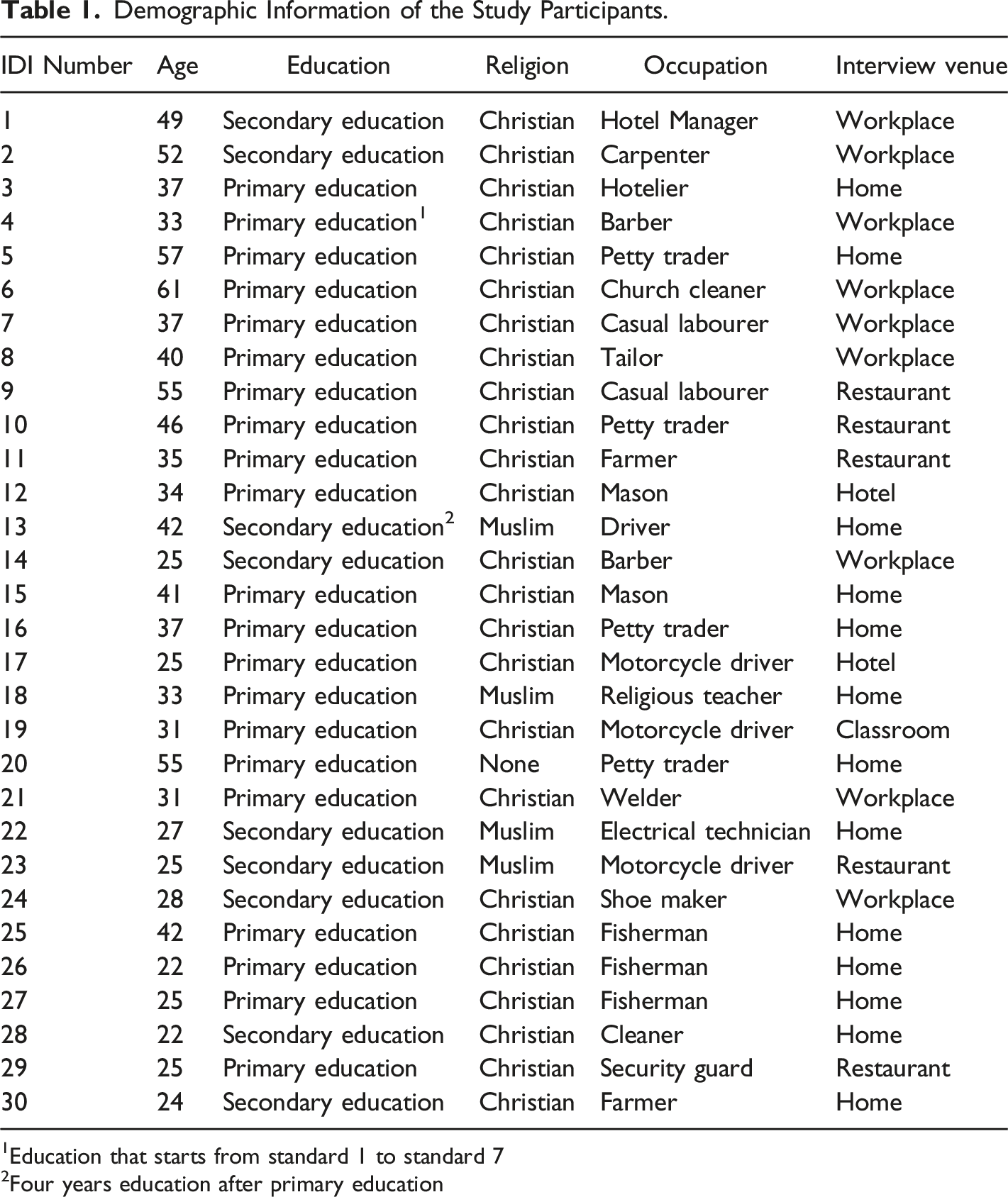
1Education that starts from standard 1 to standard 7
2Four years education after primary education
Data Collection
Data collection for this study continued between April and September 2019. Prior to the commencement of the actual fieldwork, the IDI topic guides, initially designed in English and later translated to Swahili, were pilot-tested and adapted. The IDIs were conducted in Swahili, the first language of the participants and the interviewer (DM). The researchers (GM, DM, DA, EP) confirmed the IDI guide for language appropriateness before it was used in the study. The IDIs were conducted in places of the participants’ choice including their homes, workplaces, hotels and restaurants. Other than the participants and the researchers, no one else was present during the IDIs.
Topic guides with open-ended questions were used in the interviews, the duration of which ranged from 90 to 210 minutes. The men’s perspectives on sexual intimate partner violence were mostly captured under the topics ‘relationships’, and ‘knowledge about violence in the community’. In the IDI guide, after building rapport with the men on asking them about their upbringing and employment situation, including stress at work, questions focused on behaviours in their communities that are harmful and hurtful to people, asking particularly about sexual violence against women and men in the general community: “What kind of sexual acts do women experience that might harm or hurt them?”. The second main topic was relationships, starting with questions about their current partner, their partner’s employment and what they like most about them, followed by questions on arguments in their relationships to lead to probes about physical violence and sexual behaviour toward one’s wife. Questions specific to the topic of sexual intimate partner violence started with the question: ‘In a sexual relationship, what are sexual behaviors to a wife or a female partner that are unacceptable or not normal?”, with specific probes on forced vaginal, anal or oral sex or what happens if a woman does not want to have sex and he wants to. Men were also asked “is there anything in a relationship that a woman can do to a man sexually that you consider abusive?” The participants were probed on their personal experience and those of others with sexual violence or abuse in their relationships. DM, the interviewer, was trained to follow-up closely on men’s examples to distinguish the different experiences men report in relation to sexual violence. All 30 IDIs were conducted by the same interviewer (DM)—a graduate Tanzanian male researcher with advanced training in qualitative methods and extensive experience in qualitative interviewing of men on issues of violence against women research. The interviewer’s access to the study community was facilitated by a number of factors, including his extensive experience in establishing rapport in community settings. The interviewer took field notes of what he observed and heard during each interview, and later on the day he expanded the notes into detailed descriptions. These observations were then discussed on daily basis during debriefing meetings to identify the issues that needed further exploration in subsequent interviews.
Ethical issues
Ethical approval for the study was obtained from the Ethics Committee of the London School of Hygiene and Tropical Medicine (Ref: 11918-3); and the National Health Research Ethics Committee (NatHREC) in Tanzania (NIMR/HQ/R.8a/Vol.1x/2475). Before the start of the fieldwork, the researchers contacted local authorities for permission to conduct this study in their administrative areas. Prior to the start of each IDI, the interviewer went through study information, and informed consent, and each participant signed individual consent. The participants were also asked for consent to audio record the interviews. Each participant was informed of their right to withdraw their consent at any time, and that the refusal would not have any impact to them. At the end of the IDI, each participant was provided with reimbursement of 8000 TZS (equivalent to 3.5 USD). Participants' anonymity was assured through the use of pseudonyms during the fieldwork. All identifiers were removed from the transcripts during the data cleaning process. All transcripts, field notes, and audio-recorded information regarding this study were kept in a secured place with access limited to those responsible for analyzing the data. Generally, the study did not pose any risk to participants except for emotional disturbance given the sensitive questions that men were asked about their understanding of sexual violence, which at times made them reflect on their own experiences with violence in their relationships. To address this, all participants were provided with information on referral options for help and support and were assured of assistance if they needed referral to specialized services.
Data Analysis
All interview recordings were transcribed verbatim, and analyzed in Swahili—the original language used to collect data for this study, and the native language of the data analysts in this study to minimize the chance of losing participants accounts that articulated sexual scripts through the translation process (Parker, 2010; Simon & Gagnon, 1986). The quotes used in this paper were translated into English by the researchers (DA & DM), and checked by the other Swahili authors for correct translation.Thematic analysis (Hennink et al., 2020) was used to examine how men define and articulate sexual intimate partner violence. We specifically explored the data to explain (1) what participants consider as sexual behaviors by a man to a female partner which constitute violence, and (2) sexually violent behaviors that a woman in a relationship could do to a man. First, ZM carefully reviewed half of the transcripts manually to identify initial inductive and deductive codes. The deductive codes were developed to focus on specific broad areas contained in the IDI guide, while the inductive codes were generated from the narratives of men. This process continued until half of the transcripts were reviewed and had reached saturation with no new categories emerging. Thereafter, ZM (the first author) coded all 30 transcripts using NVivo 12 software using a coding framework that was developed from both deductive and inductive categories. The categories were then reviewed by two researchers (GM & HS) for redundancy, and similar codes and categories were grouped under a single higher order category. Initial themes were then generated. Themes were then refined and validated by three researchers (GM, HS & DM). Themes were more clearly delineated during write up. The team jointly discussed which quotes would most effectively illustrate the themes that had been identified and confirmed throughout the process of analysis. In this paper, we used both the reports of the respondents and a critical appraisal of their reports against what has been reported/defined as sexual IPV. This type of interpretation is necessary to generate meaningful study findings and understanding the context and nuances of the results, prior to further interpretation of what the study findings mean (Hennink et al., 2020).
Results
Men shared a broad spectrum of behaviors by intimate partners in a heterosexual relationship that in their perspective connote sexual intimate partner violence. Three key groups emerged: (1) sexually violent behavior/actions by a partner experienced by both women and men, (2) sexually violent behaviors/actions when perpetrated by a male to a female partner only, and (3) sexually violent behaviors/actions when perpetrated by a female to a male partner only. Despite this categorization it needs to be noted that overall, men spoke a lot more about sexual violence committed by men towards their female partners than vice versa. Furthermore, for most men in our study, sex was equated with pleasure and seen as something done only with mutual consent, when both partners are in the right mood, on good terms, and have feelings for it. “For my side, doing something while we are in a misunderstanding is not right. For both partners to feel the pleasure, both have to have feelings, and not doing it if my wife doesn’t want to. It won’t be enjoyable. That’s why if my wife says that she is not in the mood to do it today, then I wait for another day, because there is always a next time.” (IDI-30)
Theme 1: Sexually Violent Behavior/Actions by a Partner Experienced by Both Women and Men
Forcing Your Partner to Have Sex
Men in this study clearly framed a man forcing his partner to have sex without her consent as sexual violence as it is unacceptable and hurtful. “You may find that she is tired or needs to sleep, or she tells you that ‘there is this particular problem’, but you still force her to have sex just because she is your wife. Even if she is your wife, if you do it without her consent it is also rape.” (IDI-30) “First of all, forcing someone to have sex is not acceptable. Sex is supposed to be consensual. Thus, when you force someone it means that you have done something inappropriate to her body. It doesn’t matter whether it is your wife or a lover. When you force her to have sex it means that you have done something against the normality.” (IDI-19) “If I want sex but a woman does not want to have sex, I need to be patient. Because if you force her while she doesn’t want to, that means you penetrate her without her consent. That is what we call raping her. You know although one would not expect rape to happen in marriage, it does occur.” (IDI-28)
A few participants in this study also stated that men could be pressured into having sex against their will if their female partner’s sexual urge was strong. They gave examples of women threatening men who denied them sex, which would force those men into having sex against their will. While women did not use physical violence or had the physical strength to force their partners to have sex, men felt pressured into complying to avoid arguments, accusations of infidelity, and thus protect their relationship. “Sometimes it happens that you are very tired and then on that day the woman wants to do it [sex] like hell. It happens to men too, there are times a woman wants sex but a man doesn’t. You then decide to do it but as you are tired. […] You don’t feel like doing it. That’s when arguments start. Your partner then suspects that you have had extra-marital sex and that’s why you are tired. It brings a lot of troubles in marriages.” (IDI-28)
The participants elucidated that men feel pressured to have sex while they are not in the right mood or are tired because of the sexual scripts depicting sexual performance as a sign of manliness and fidelity that does not allow them to insist on them not wanting sex. The narratives indicated that men’s sexuality is not simply the equivalent of erectile ability, but also tied to quality sexual performance that would bring a woman to orgasm, among other things. To the men, the right mood and body strength were vital elements for such a high quality sexual performance, thus, being pressured to have sex when tired or not in a right mood would risk them underperforming sexually, leading to their diminished manhood or failed masculinity. “You find that there are days when a man is very tired, you lack energy to do sex but the woman on that day is in a hyperactive mode, she has that desire. She forces you to have sex without being ready for it. Now if a woman forces you while you are that tired, you end up being inefficient [sexually]. We men sometimes lack sexual power; we struggle in making a woman to get a fast climax. That’s a big problem to us [men]. It brings up disturbances, and for the man it makes you do it without even wanting to do it.” (IDI-28)
While supporting other participants’ concern on forced sex by a female partner as something unacceptable to men, participants did not all agree that this constitutes sexual intimate partner violence. “It is like what I am telling you, sometimes you have your stress, the woman comes and starts speaking to you, she sleeps on you and starts asking for sex but you are tired. She may say that she will scream and if people gather then they will know it is because you denied her sex. So, you are forced to do it. If that happens then you have to be calm. That is not normal, but it’s not violence.” (IDI-13)
Male or Female Partner Having Other Sexual Relationships
Contrary to international norms on how sexual violence is defined, participants in our study felt that a partner’s extra marital affairs violate their exclusive right to have sex with them as husbands, boyfriend, wife or girlfriend and therefore constitutes sexual violence. The men’s narratives depicted sex as an act meant to be done with only one sexual partner at a time. Men described it as particularly hurtful when a woman dates one of her partner’s acquaintances or close friends. “A man could get married to a woman, but you will find out this man decides to fall in love with the neighbor. This is already abusive to her [wife]. He engages in love affair with another woman and his wife is aware of it. […] By doing that, it’s like he is abusing his own wife there.” (IDI-07)
Some participants had a very broad concept of what they considered to be sexual violence in this instance and even added that woman engaging in non-sexual acts such as flirting with other men or showing signs of being attracted to another man can be considered sexual violence. The narratives, however, commonly pointed that a man’s or woman’s engaging in other sexual relations would be considered specifically hurtful, particularly when one shows such behavior openly or behave carelessly to the extent that the news of his or her behavior is known to the public or their spouses. “What I know, may be letting you see that she is openly seeing another man, that can be violence or she has decided to do something abusive which hurts you a lot. She would not have beaten you or hit you with a sharp object, but portraying such kind of behavior to you, she will have hurt your heart immensely. So, I consider that as huge violence.” (IDI-16)
The sexual script behind it is that a woman’s infidelity, particularly when her behavior becomes public, would make people in the community question her partner’s sexual ability, which incites in men a feeling of being emasculated, being sexually inefficient, and a fear that their image as real men will be tarnished. Additionally, four men even feared that having other sexual partners would expand their female partner’s vagina, thus making it harder for them to sexually satisfy them. Others were also worried that seeing other men would expose their partners to men with better sexual skills than their spouses, which would make them deride their men’s sexual performance.
Partner Intentionally Refusing Sex
Men in this study framed sex as a joy and a sign of love to both partners and an essential component of a relationship. A partner’s refusal to have sex without good or justifiable reasons was therefore seen as a threat to the relationship, a denial of the expected role of wife and husband and therefore a form of sexual violence. “When a man is denied sex by his wife while it’s his right, he feels being violated. Even the religious books say we [married partners] should not deny each other sex. A man can really get hurt and angry if he is married but his wife refuses him sex, which is the joy of love, so when she refuses she denies him that joy then he must be angered.” (IDI-09)
Although in their narratives, the majority of participants commonly spoke of a woman’s sexual denial to her husband as violence, one participant also cited a man’s intentional denial of sex to his wife as a form of violence. “For example, when a woman is married, she has left behind everything, she had everything in her home, except a man. Now she has come to you, but it happens that you are tired of her, that subjects that woman to abuse. She experiences sexual violence because she doesn’t get the love which made her move from her home to yours. It means that if you deny her sex, […] she doesn’t get the sexual pleasure at her home, I see that as violence. (IDI-06#)
Men’s perception of sexual denial by a female partner as an act of sexual violence to them seemed to be woven into scripts that accept male sexual dominance and female submission as well as men’s sexual entitlement. Our analysis revealed that normative presumptions around masculine sexual entitlement, particularly those that frame sex as the right of a husband, appeared to inform men’s perception of sex as a woman’s primary conjugal obligation, which she has little or no choice to decline. “I don't think there is a woman who can say “I don’t have feelings” while in real sense she knows all the rules, she knows what are the responsibilities of a woman or what are responsibilities of a man […]. A woman cannot deny a man sex if they are married. […] She knows her obligation so long as I also know that when she is in menstruation, I cannot ask anything.” (IDI-08) “If you have married that woman, she can never refuse [sex]. If it happens, she refuses; she must have a special reason that she probably is in her menstrual period.” (IDI-07)
As mentioned in the quotes, the participants mentioned circumstances that would make a wife’s refusal of sex with her husband a non-violent act, including when the refusal happens for a few days only, or with justifiable reasons. The later include biological, physical and psychological circumstances such as her having her menstruation, feeling sick, tired or stressed, having no feelings, distrust in the partner’s health, or being out of mood. “Sometimes she refuses with a valid reason, probably she has her period, than it is clear. And sometimes somebody tells you that she is tired, or sick or feeling bad and so forth. So, you chill and tolerate for that one night.” (IDI-18)
Theme 2: Specific Sexually Violent Behaviors Towards Women by Male Partners Only
Asking or Forcing a Partner for Anal Sex
The analysis noted absence of a normative context for anal sex in the study community, with a majority of male participants perceiving it as unappealing. In this context, anal sex for them connoted brutality and punishment to women. In general, participants’ narratives depicted anal sex as illegal, which is the case in Tanzania. Thus if a male partner is asking their female partners for anal sex, even without coercion or force, some participants interpreted it as sexual violence because it is asking someone to break the law. “Violence is doing something that hurts and is unjust. It is not in accordance with the laws. So, doing such a thing means that you have been violent. For instance, you as a man you force your wife; you tell her ‘let me penetrate you against the nature [kinume na maumbile].’ You ask her like that. That’s surely violence.” (IDI-13) “Some people do that to their wives. One would have the audacity to ask her ‘Can we have sex this way (pointing to his buttocks). He surely knows that this is wrong, but he asks for it. That’s being selfish. Even if the wife declines his request, he would have tortured her psychologically as she would feel bad for being asked of that thing. (IDI-22) “Sexual violent behaviors to a woman that most of people know is demanding her to have anal sex. Here I don’t refer to having sex through the right place [vagina]; I refer to turning a woman around (kumgeuza mwanamke) and have sex with her through anus.” (IDI-10) “A lot of women with sexual partners experience different kind of violent behaviors, such as being beaten. And other men penetrate their women against the normal organ for sex [vagina]. I mean a man forces his wife to have sex against the nature [kinyume na maumbile] that is through the anal part. Aah, that is the violence we are talking about. The woman has already been abused; she is violated. What follows next is that she must be unhappy as she has been abused. She can never be happy.” (IDI-18)
The participants’ framing of anal sex as sexually violent behavior among sexual partners also appeared to be influenced by the cultural and religious scripts depicting heterosexual vaginal sex as an acceptable sexual practice among sexual partners, and penile-anal penetration as immoral and against nature. “When I say it is against the nature I mean that it is the area that is illegal. God said that sex should be through the front [vagina], that is where it has been legalized, and not the anal path.” (IDI-13)
Some men reported that some women in sexual relations, including those in conjugal relationships, are forced to acquiesce to unwanted anal sex by their sexual partners and remain silent given the cultural dubbing of sex as a private topic to be discussed between the partners only. “There are some women whose husbands penetrate them against the nature. It is something that she doesn’t like, but her partner forces her […] Doing that is gender violence. A woman in that situation cannot speak up for help as those are private problems that should not involve other people. She may be advised that ‘go and file your complaint as you have the right to do so’, but the truth is that she will not do that.” (IDI-24)
Husband not Preparing the Female Partner for Sex
Men’s narratives pointed to the importance of preparing a woman well for sex, stating that quality foreplay and preparations would not only put women in the right mood for sex, but also make their body ready, thus enable them to enjoy sex and prevent pain. “In my views, it is good to prepare a woman. When you prepare a woman well to the extent that she herself feels that she is ready [for sex], you can then have sex with her and she sees it as a good thing. Even when she gets some pain, it is not too much pain as she was ready for that act [sex]. With quality preparations, she can accept whatever that you want. When you tell her, ‘pose like this’, she does it, ‘pose like that’, she does as you suggest.” (IDI-21)
Based on sexual scripts about what enjoyable sex entails, participants therefore framed a man having sex with a female partner without preparing her as unacceptable behavior, interpreting it as rape if men go ahead without the woman being prepared. “There are many issues [that are unacceptable to a female partner]. You may go somewhere [out] with your wife or your partner and once you get inside, you ask her for sex immediately while she is not prepared, so that is not good. If she is not prepared, it is like you are abusing her, so those are unacceptable habits.” (IDI-26) “When you have sex with a woman without preparing her well, she can tell you that she has some bruises. Yes, just because you didn’t prepare her well. That’s like you have raped her, she doesn’t like doing it, but you force her. What is she supposed to do? You did not prepare her well. It is unacceptable!” (IDI-21)
Demanding Sex During Menstruation
In this study, participants referred to men demanding sex of their partner when the woman has her menstrual period more as unacceptable behavior than a form of sexual violence, as a behavior that is immoral and a criminal offence, and against culture, religious doctrines, regulations, and laws. However, demanding sex when a woman is menstruating was perceived as violent when it involved force. “According to the laws, it is unacceptable and I am a religious person and I say it is unacceptable. […] Even in our normal life it is unacceptable. It is unacceptable to have sex with a woman when she is in her periods.” (IDI-18) “Sex while a woman is menstruating is not normal and is against the morals. Personally, I have never done that. Some people do that, but I don’t. That indicates moral decay, because you are forcing her while she is unwell, you are forcing her to do what is not expected, it is a criminal offence.” (IDI-09)
Theme 3: Unique Sexually Violent Behavior Perpetrated by Female Partners to Men Only
As mentioned above, a few men also reported sexual violence they experience or what they have heard other men have experienced.
Hard to Satisfy Sexually or Demanding Excessive Sex
Many men in this study embedded men’s superior power and dominance in characteristics such as being able to engage in several rounds of sexual intercourse and having sexual prowess and stamina to satisfy a woman sexually. Based on this context, a few participants reported that female partners expect men to be strong sexual performers regardless of the circumstances, which challenge their manhood. The difficulties that men reported encountering in meeting this expectation—given the daily stress and exhaustion from work— was identified as a source of anxiety. They thus conceptualized a woman’s demand of excessive sex or a tendency of not being easily satisfied sexually as a form of sexual violence, which could cause them physical pain, even though the women did not use physical force. “There are many acts by women that violate men. It has happened to me. You perform sex and reach orgasm; she then takes you back to sex again. You perform again but she takes you back, several times. That has happened to me. […] I could not say no. I had to do it until I was too exhausted. […] She even tied us in a kanga,
1
so I would not be able to escape. So, I did it again and again. I would take a breath and then start over; that ever happened to me.” (IDI-12) “I can remember back in the days, yeah, there was a man who took a woman and went with her. […] When he was sleeping with her and they began to have sex, it reached a time when the man had lost all the energy and said that is the end for him. But the woman was still in need, so the man had to do it to the point that he got so much pain as he did it with extra energy that he did not expect to. Yeah, he had pain because he did a work that he did not expect to do. He was even showing to people that he got bruises, ‘I have got bruises all over here’. That was the end of their love, their love ended up there, he said that ‘this woman will kill me one day’ (IDI-20)
Men’s concern about women being hard to satisfy sexually was illustrated by one participant. He reported that his partner suspected him of infidelity owing to his poor sexual performance during a particular sexual encounter. He added that his wife derided his sexual performance, something which he interpreted as an affront to his masculinity. While he did not explicitly state that this is sexual violence, it explains why men in the examples stated above would feel forced to engage in the above-mentioned acts and therefore depict them as violence: “It has happened to me; you could be having sex and then she would go like, ‘how are you making love to me today, leave me alone’. So, there are women like that. She asks you like, where did you start today, this is not how you usually make love to me; where did you start today? The mood just disappears, you also start having other thoughts because you never really know with sex, you come from work thinking maybe that day you’ll do better. It’s like playing football, you could score today and lose tomorrow, so you could have sex with a woman and not satisfy her at all and she might think that maybe you started somewhere else when that is not the case.” (IDI-2)
Discussion
This qualitative study aimed to provide a detailed analysis of men’s perspectives on sexual intimate partner violence, both their own and that of female partners, reflecting particularly on the impact of the local context in which men and women live (Mchome et al., 2020). Giving voice to married men of myriad socio-demographic characteristics in explaining what sexual intimate partner violence entails for them enabled this study to uncover dimensions of sexual violence that go far beyond being physically forced to have sex. For instance, beyond forcing a woman to have sex, men also conceptualized other acts as constituting sexual violence, such as a partner having other sexual relations, and intentionally refusing sex, regardless of whether they were directed to the male or female partner. Unacceptable sexual behaviors toward women only included male partner wanting sex during her period, wanting sex when she is not in the mood, forcing her to have anal sex and not preparing her well for sex. Some men also considered asking a woman for anal sex to be sexual violence as anal sex is illegal in Tanzania and the woman is thereby asked to commit a crime that is punished with imprisonment. On the other hand, men considered a partner demanding excessive sex of them as a form of sexual violence towards men.
These insights have important meaning for future research on intimate partner violence research and programming. Studies that seek to investigate the prevalence of men’s experiences of intimate partner violence cannot simply utilize measurement tools that have been developed for women by simply changing the pronouns in the questions (Scott-Storey et al., 2022) as those do not necessarily reflect existing male experiences. While men in this study clearly spoke of sexual intimate partner violence against women to involve the use of physical force, their conceptualization of sexual intimate partner violence by women against men was centered around men feeling pressured into sex, because they tied their masculine identity to their sexual performance and not because of women’s use of physical force. Apart from coercive sex (Stern et al., 2015), the study also brought up additional forms of acts that men perceived as sexually violent to them that have not been mentioned previously, such as female partner intentionally refusing sex, having other sexual relations, being hard to satisfy sexually and demanding excessive sex. More research is needed to fully unpack the meaning of these statements and to understand whether there is a consensus across a wider population of men that these are forms of sexual violence. In addition, there is a need to explore men’s narrative directly with those of their partners and their wider context and to develop appropriate scales that capture men’s experiences of sexual intimate partner violence and to cognitively test them.
Furthermore, for both men and women, the concept of women’s marital duty to have sex need to be better understood. In accordance with other studies from Tanzania, women and men have differing views on whether it is a wife’s duty to have sex in marriage, which may lead to sexual intimate partner violence if the woman does not believe in this, but the man does. Also, it leads to underreporting of this form of violence among those who accept this as part of their marriage (Dwarumpudi et al., 2022) as they might not perceive this as sexual intimate partner violence. Conceptualizing denial of sex by either the female and the male partner as sexual violence, as also reported by women in Tanzania and Zimbabwe (Mchome et al., 2020; Watts et al., 1998), raises an important contradiction. While women argue that their partner’s denial of sex deny them a fulfilled sexual life that they can expect in a relationship and may also have economic consequences as their partner might spend their income on their mistress and their family (Aloyce et al., 2023; Mchome et al., 2020; Watts et al., 1998), they on the other hand do not necessarily agree with the fact that the woman has a duty to have sex with their partner because they are married.
Men’s perspectives on sexual violence against women align with those reported by women in Tanzania (Dwarumpudi et al., 2022; Mchome et al., 2020) and shows their attempt to contest and challenge the sexual scripts that support sexually violent behaviors towards women, which could have been influenced by the global feminist activism on gender and women’s rights in Tanzania (Parker, 2010). The broader contemporary gendered discourses that emphasize equality also seemed to shape men’s presentation of themselves in relation to sexual violence, as most of the men presented themselves as not following the traditional and stereotypical scripts of masculinity within their relationships. For instance, when asked of their reactions to a woman turning down their sexual advances, many portrayed themselves as being very supportive of their partners by accepting their denial and letting her be, persuading a partner for sex with romantic words, consulting doctors for their wife’s check-up or advise, and seeking help from parents, religious or local leaders. When men mentioned forced sex or rape as responses towards a woman’s sexual denial, the participants always referred to other men in the community, and none of them admitted to have ever coerced a partner to acquiesce unwanted sex—claims that are contradicted by the majority of the women in other studies in Mwanza (Kapiga et al., 2017; Mahenge & Stöckl, 2021; Mchome et al., 2020) and in other settings in Tanzania (Mwanukuzi & Nyamhanga, 2021). Participants’ tendency to misrepresent their sexual behavior could be because the men suspected that in relation to contemporary gendered discourses that emphasize equality, these behaviors would be interpreted negatively by the researcher. To some extent, this made it difficult for this study to discern the particular ways in which men performed masculinity in different spaces, such as in their sexual relationships.
Our results also show that the scripts on masculine sexuality that men acquired from their socialization and subsequently internalized have become tools that help them make sense of their sexual experiences and guide their expectations. For instance, based on the existing sexual scripts, behaviors that could be understood as constituting psychological violence, such as a partner’s infidelity, and behaviors that are not considered to constitute violence, such as a woman’s being hard to be satisfied sexually, and desiring certain sexual positions, were cited as a form of sexual violence. This could be influenced by the masculine sexual script that being able to satisfy a woman sexually is the most honored way of being a man and thus confirming a man’s masculinity (Aloyce et al., 2022; Rutagumirwa & Bailey, 2018). These findings point to a need for development programs to critically reflect on the ideas shared by the local people regarding sexual relationships and sexual intimate partner violence and ensure that they include into the frameworks only those behaviors that really constitute violence. On the other hand, to address men’s concerns, such as those regarding difficulties to accommodate partner’s sexual desire, programmers could incorporate some sexological knowledge to equip men and women with skills on how to navigate and communicate different expectations in an intimate relationship, including sex and respond to each other’s needs.
Along the same line, while some behaviors were mentioned to connote sexual violence to both men and women, the meanings behind the conceptualization of those acts as sexual violence towards women and men differed. For instance, although the participants’ framing of a man forcing his partner to have sex as sexual violence is based on the physical pain that the behavior might cause to a woman, their framing of pressurized sex of men by women as sexual violence seemed to be underpinned by the meaning and supposed value of a man’s sexual performance. Men were concerned that being forced to have sex while being tired or not in the mood would make them perform poorly sexually, thus unable to meet their women’s sexual desire—a cultural expectation of a “proper man” (Mshana, Peter, et al., 2022b). This is contrary to the findings by Stern et al. (2015), which show that the men’s negative reaction to forced sex by women is because such behavior does not fit the social stereotypes of masculine sexuality as being initiative. The findings in the current study indicate that we need to pay attention to the nature of relationships and their socio-cultural foundation in our attempt to understand sexual violence.
In respect to policy and programming, the study findings accentuate the need for development programmers to understand “local” definitions of intimate partner violence, as well as what sexual violence as a concept means to the community and how it is used before designing and implementing interventions. The benefit of this approach is threefold. First, understanding how men conceptualize sexual violence enables programmers to know how best to engage them in preventing sexual intimate partner violence and which behaviours are key to challenge. Second, it allows programmers to identify additional behaviors that constitute sexual intimate partner violence that are not included in the current measurement of violence, which is focused on forced sex, and thus updating their frameworks guiding intervention development. Third, integrating local constructs about sexual violence into a framework that aims to support the design of interventions can not only increase the likelihood of the acceptance by the community but also the effectiveness and sustainability of interventions. We would however caution that the attempt to accommodate the local concepts related to sexual violence needs further thinking to ensure that they do not include behaviors that constitute IPV. Another benefit is that the bottom-up approach could enable programmers to identify negative norms that perpetuate sexual violence in the community which may, in turn, enable them to design interventions to address them. For instance, consistent with previous research among women in the same community (Mchome et al., 2020), men in this study framed sex as a female obligation and a man’s conjugal right. Mchome et al. (2020) reported that women in Mwanza believed they need to abide with their husbands’ sexual desires, even when they did not want to. These observations indicate persistence of traditional presumptions of masculine sexual entitlement in men, which perpetuate violence against women and thus need attention. Such findings also show that in the study community, although the women have agency around sex, at least to some extent, it is largely intertwined with male pleasure and desire. Therefore, efforts to empower women to develop their sense of agency and thereby gain control of their sexuality, are crucial, and must co-exist with measures aimed at addressing constraints they face, including unequal gendered structures and relationships which underlie sexual violence against women.
This qualitative study was conducted in a small setting in urban Mwanza, and the data were collected from a small group of men. Thus, the sample size engaged in generating this data was not large enough to allow us to make conclusive statements beyond the research setting. Even so, as this study was conducted in multi-ethnic settings, and the fact that similar findings about sexual violence towards women are reported by other studies elsewhere in Tanzania (Mchome et al., 2020), it is possible that the perspectives expressed by the study participants on sexual intimate partner violence are relevant to other settings in the country, or even beyond the borders of Tanzania. Similarly, the interviews in this study were conducted only with married men in a heterosexual relationship. It is possible that the perspectives would differ if the study was conducted in unmarried men in a relationship. To establish a strong base of in-depth contextual knowledge about sexual violence, future studies should consider engaging other sub-populations in generation of data including adolescents and unmarried men and women in heterosexual and homosexual relationships. Additionally, given that the IDIs were conducted in places of the participants’ choice including their homes, working premises, hotels and restaurants, it is possible that their responses might be influenced that. However, we did not notice this during the interview as other than the participants and the researchers, as the research ensured that no one else was present during the IDIs sessions.
Conclusion
Our analysis on men’s narratives of sexual intimate partner violence indicated that sexual violence has more facets to it than only being physically forced to have sex and diverse local connotations. Thus, efforts need to be made to fully understand sexually violent behaviors in an intimate relationship to improve the measurement of sexual violence and to inform intervention designs, taking into account the local constructs of sexual violence, and the meaning attached to them.
Footnotes
Acknowledgments
We are deeply indebted to the study participants for their time and willingness to share their stories and making this study possible.
Declaration of Conflicting Interests
The author(s) declared no potential conflicts of interest with respect to the research, authorship, and/or publication of this article.
Funding
The author(s) disclosed receipt of the following financial support for the research, authorship, and/or publication of this article: The research was funded by the European Research Council (Starting Grant: IPV_Tanzania, grant number: 716458).
