




Abstract
Previous studies on multiple perpetrator rapes have shown that male sexual offenders who commit their offense alone differ on offender, offense, and victim characteristics from those who commit their offense in duos and 3+ groups. For the current study, 246 female sexual offenders have been studied regarding their co-offending pattern and the differences in offender, offense, and victim characteristics. Significant differences between solo (n = 73), duos (n = 146), and 3+ group offenders (n = 27) were found for the age at the first conviction, age at the time of the index offense, performed sexual acts, physical and verbal violence, victim gender, victim relationship, victim age, and location where the abuse took place. There were four indicators that could predict the assault type. Co-offenders were more likely than solo offenders to perform penetration on a female, intrafamilial victim who they assaulted indoors. These results have implications for interventions with offenders and criminal justice authorities.
Multiple perpetrator rape (MPR), defined by Horvath and Kelly (2009) as any sexual assault that involves two or more perpetrators, is relatively under-researched in both female and male samples. It is suggested that females are more likely than males to perpetrate a sexual crime with a co-offender (Gillespie et al., 2015; Vandiver, 2006; Williams & Bierie, 2015), and a recent review reported that most female sexual offenders have a male co-offender, who is often their romantic partner (Cortoni & Gannon, 2016). While the proportion of co-offending in samples of female sexual offenders has been debated (Johansson-Love & Fremouw, 2006; Williams & Bierie, 2015), it is certainly an element that requires more attention by researchers and it will be a central theme of this article.
The majority of the female and male studies on MPR have compared solo and co-offending groups. There is only one published study (Budd et al., 2017) that has examined other groupings in females (i.e., solo, coed pairs consisting of one male and one female, all-female groups, and multiple perpetrator groups that consist of a combination of three or more female and male sexual offenders), and two (da Silva et al., 2014; Park & Kim, 2016) in males (i.e., solo, duos, and 3+ groups). The results from these studies suggest that there are some significant differences between some of the groupings and Budd et al. (2017) recommended that future research should continue to examine subgroups in female sexual offending to better understand variations in offending. This understanding can aid law enforcement, policy makers, and treatment providers. Therefore, the main aim of the current study was to examine the differences in offender, offense, and victim characteristics between female sexual offenders who commit their offense alone compared with females who commit their offense as part of a duo, or as part of a 3+ group.
According to Forsyth (2006), a group can be defined as two or more individuals who are connected to one another by social relationships. There is some controversy in the literature about whether duos/dyads (e.g., romantic couples and friendships) should be considered a group, and therefore included in the group dynamics research (da Silva et al., 2013). This controversy is often referred to as the Moreland–Williams debate. According to Levine and Moreland (2012) dyads are different from groups because dyads form and dissolve more quickly, they are more emotionally involved with one another, and certain social aspects such as minority/majority relations cannot be applied to two people in a group. However, K. D. Williams (2010) claims that dyads should be considered as a group because group processes such as social loafing and facilitation, or in-group/out-group dynamics occur regardless of whether there are two or several people in a group. Consequently, dyads should be studied as being a (small) group. As a result of this debate within the group dynamics literature, it is important that group size is considered when conducting research on MPR.
Previous Research on Co-Offending of Female Sexual Offenders
To date, six studies have compared the characteristics and offending patterns of female solo offenders and co-offenders. The details of these studies are depicted in Table 1.
Studies on Offending Patterns of Female Sexual Offenders.
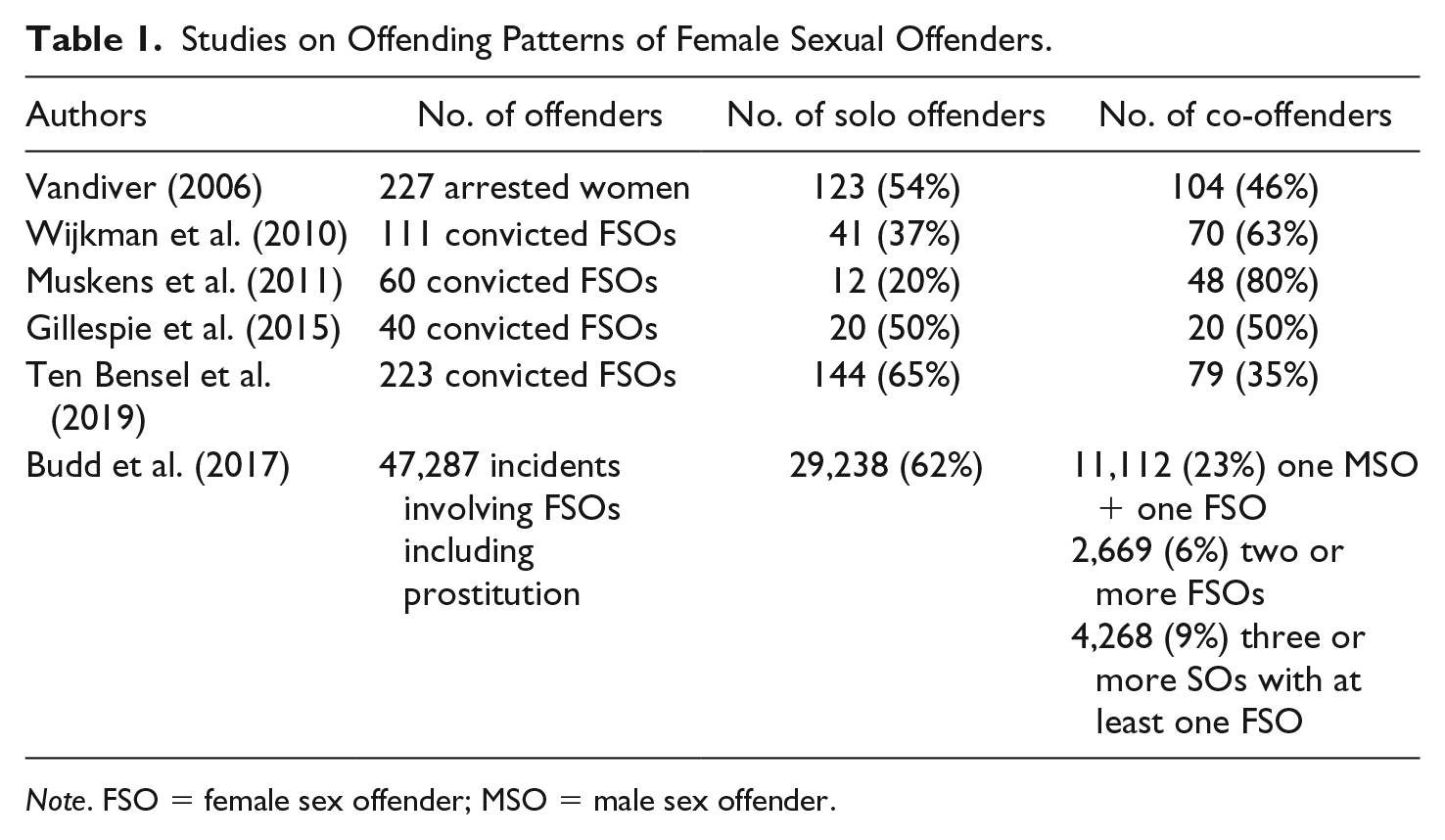
Note. FSO = female sex offender; MSO = male sex offender.
Regarding offender characteristics, Vandiver (2006) reported no differences regarding ethnic background and age, while Ten Bensel et al. (2019) reported that solo offenders were significant younger than co-offenders. According to Wijkman et al. (2010), solo offenders were less often mothers than co-offenders and they tended to be less often married than co-offenders. Gillespie et al. (2015) studied 20 solo offenders and 20 co-offenders on a large variety of clinical characteristics. Solo offenders showed a greater presence of personal vulnerabilities, such as mental health and substance abuse difficulties, while co-offenders reported a greater presence of environmentally based factors, such as a current partner who was a known sexual offender and involvement with antisocial peers. This is in line with what Muskens et al. (2011) found, namely, that the mean number of the Diagnostic and Statistical Manual of Mental Disorders (4th ed.; DSM-IV; American Psychiatric Association, 1994) Axis 1 disorders was larger among solo offenders than in co-offenders, and that solo offenders were significantly more likely to suffer from a mood disorder. However, it is contradictory with the results of Wijkman et al. (2010), who reported that solo offenders suffered less often than co-offenders from Axis II disorders. Furthermore, Ten Bensel et al. (2019) found no differences in the self-reporting of mental health history, drug and alcohol abuse and prior sexual abuse victimization. They did find that solo offenders had more often a high-school diploma and employment than co-offenders.
Concerning offense characteristics, Vandiver (2006) found no differences between the groups on type of offense and location of offense. Compared with solo offenders, co-offenders were significantly more likely to have multiple victims, familial victims, and victims of both sexes (Vandiver, 2006; Wijkman et al., 2010). Ten Bensel et al. (2019) reported that solo offenders were more likely to operate in authoritative positions, while co-offenders were more likely mothers committing criminal acts against their own children. Solo offenders also tend to have older males as a victim while co-offenders had younger female victims. Their findings regarding gender of the victim are supported by Wijkman et al. (2010) and Muskens et al. (2011). Finally, Wijkman et al. (2010) found that co-offenders have more often than solo offenders committed at least one offense that entailed penetration.
Criminal career characteristics are seldom studied for solo-, and co-offending women. Vandiver (2006) found that, when compared with solo offenders, co-offenders were significantly more likely to have previous convictions for nonsexual offenses. This is contradictory with the findings of Ten Bensel et al. (2019) who reported that solo offenders were more likely to have multiple arrests prior to their index offense.
As no empirical research had gone beyond the two-female sexual offender groupings of solo offenders and co-offenders, Budd, Bierie & Williams (2017) decided to compare other groupings such as females who offend with other females or females who sexually offend in larger groups. They found that, compared with solo offenders, incidents involving co-offending pairs are more likely to have female victims and are more likely to have relative victims (dependent children and intrafamilial family members). These results are consistent with the studies that were solely based on solo and co-offenders. Furthermore, they found that incidents involving three or more sexual offenders with at least one female sexual offender are more likely to have stranger victims, greater victim injury, and a concurrence of nonsexual crimes in conjunction with the sexual assault incidents. However, their results are based on a sample that consists of police-reported incidents. Data are recorded on incident level and not on offender/individual level. Besides, it was not possible to disentangle whether a woman was involved in more than one incident. Also, data from small- and medium-sized police departments are overrepresented and the data do not include data from areas with high crime, that is, New York City. All these aspects may limit the generalizability of their findings.
There are no published studies that compare female and male co-offending. Although R. Williams et al. (2019) directly compared female and male sexual offenders against children, only their female sample included co-offenders. They compared the offender characteristics of female solo offenders, female co-offenders, and male solo offenders and found that there were significant differences between the three groups in their psychological dispositions, environmental niche, and offense preceding factors. R. Williams et al. (2019) highlight the importance of a gender-specific approach to working with women who sexually abuse children and recommend that other subtypes of female and male sexual offenders should be researched.
Study Aims
As there is only one published study (Budd et al., 2017) where female sexual offender groupings based on size were examined, it is important to further investigate this area using diverse samples from different countries. As can be seen in the “Method” section, the sample used in the current study is different from the Budd et al. (2017) study as it is from a different county, data were collected from court files and criminal records, it relates to offenders and not incidents, and it includes data from all areas of the Netherlands. The key research question in this study was “Are there differences in offender, offense, and victim characteristics between female sexual offenders who commit their offense alone compared with duo offenders and 3+ group offenders?” Studying differences between offender subgroups is important as differences in the offense and offender characteristics could indicate that there may also be differences in risk levels and treatment needs. Furthermore, an additional aim of this article was to compare the findings on female MPR with previous findings on male MPR related to offender, offense, and victim characteristics. This is due to the fact that although there are studies that have compared female and male sexual offenders (Williams & Bierie, 2015; R. Williams et al., 2019), there is a lack of knowledge regarding differences between female and male co-offenders. Finally, if there are any differences in offender and offense characteristics, logistic regression analyses will be conducted to determine which variables are significant predictors of which rape type (solo, duo, or 3+ groups). That information could be relevant for law enforcement and treatment providers.
Method
Sample and Procedure
The data were obtained from the Netherlands central prosecution service, consisting of adult female sexual offenders who had been convicted of at least one hands-on sexual offense between 1994 and 2011. 1 Permission for the study was obtained from the Prosecutor General and the Minister of Safety and Justice. The sample did not contain women who had committed hands-off offenses (e.g., human trafficking, creating and distributing child pornography, or exhibitionism). The sample consisted of 261 women who committed a sexual offense either on their own, as a duo (with one other co-offender), or as part of a 3+ group. The offense where the women were convicted for was used to determine to which offender group they should be allocated to. There were no cases where the woman had engaged in solo offending as well as co-offending. The duo and 3+ groups consisted of female and male co-offenders. The criminal records of the women in the sample were retrieved by using the centralized system of the Netherlands Judicial Information service where all criminal records are digitally stored. A criminal record file contains all offenses ever registered by the Prosecution Service for a person, starting at the age of 12 years, the age of criminal responsibility in the Netherlands. When someone dies or reaches the age of 80 years, the file is cleared. When a person has temporarily lived abroad, the file can contain registrations of crimes committed in that country.
In addition to obtaining the criminal career information, access to the court files for all 261 women was also gained. Fifteen court files could not be analyzed because they had already been destroyed in line with retention guidelines, or could not be found in the archives; therefore, our final sample consisted of 246 women. Court files in the Netherlands always contain the charge as well as the judicial decision in which it is specified what offense(s) the defendant was charged with and, in case of a court verdict, found guilty of. Almost every court file contains transcripts of police interviews with the offender, reports by each involved police officer of his or her findings at each stage of the case, together with victim and sometimes witness statements. All 246 court files were analyzed and the offender and offense variables were scored, using the scoring tool for sex offenders previously developed and employed in studies by Bijleveld et al. (2007), and Wijkman et al. (2010).
The information in the court files was scored by the first author and a second senior researcher, assisted by three master’s students (two in criminology and one in clinical psychology). Each had been trained in analyzing and scoring court files. All scorers were instructed to code only information as explicitly written in the reports or files and not to interpret any contextual information. Most victim and offense characteristics were coded as present or absent, but some such as relationship to victim involved multiple categories. Age was coded as a continuous score. At the beginning, 10 randomly selected files were coded by two scorers, and codings were compared. It appeared that the information in the court files was in general clear and factual. Almost all court files were very unambiguous and there was very little doubt about the interpretation of the information. Agreement was 91%, with only some discrepancies in scoring values either as “not present” or “missing”—which did not affect our later analysis.
As many offenders performed or forced the victim to perform multiple acts, it was difficult to differentiate these acts and to determine exactly when they occurred (e.g., fondling, oral sex, and penetration). Therefore, the offense with the heaviest sentence of which the woman had been convicted was scored. In the case of multiple offenses and regarding the crime scenes, the crime scenes that were most prevalent were scored. When there was more than one victim, the age of the youngest victim was scored. The majority of the women (83.7%, n = 206) were ethnic Dutch. Other ethnic backgrounds were Turkish, Moroccan, Surinamese, Dutch Antilles, South American, and Asian. All the women in the sample were adults.
Results
Characteristics of the Offender Groups
Descriptive analyses consisting of frequency counts were conducted for the type of group (lone, duo, 3+ group), age, and ethnicity. Almost a third of the women (30%, n = 73) committed the offense alone and 70% (n = 173) had at least one co-offender, 59% (n = 146) had one co-offender, and the remaining 11% (n = 27) had two or more co-offenders. The majority of the women who had at least one co-offender, 57% (n = 140), committed the sexual offense with their intimate partner and they mostly committed this as a duo, 51% (n = 125). When a woman committed the offense together with her intimate partner, but also with other offenders (e.g., other family members, neighbors, and friends), their group composition was labeled as a 3+ group. There were only four same-gender groups (four duos) and, given this low number compared with the whole sample size, no separate analyses for groups that consisted solely of female offenders were conducted. Furthermore, these four duos were women who were not in an intimate relationship with each other, they were acquaintances. The composition of the 3+ groups ranged from groups of three to eight offenders and all offenders were acquaintances or relatives of each other. Seventy-two women (29.3%) had assaulted more than one victim, with a maximum of seven victims.
Offender, Victim, and Offense Characteristics
The average age of the women at the time of the index offense was 35.2 years (SD = 9.7). As the distribution of each group was significantly skewed (as established by using a Kolmogorov–Smirnov test), a one-way ANOVA to test for differences between several independent groups could not be used because by doing so the assumption of homogeneity of variance would be violated. Therefore, with the continuous variables, Kruskal–Wallis tests were carried out to determine whether there were any differences to be found at all between the three groups. If differences were found, Mann–Whitney U tests were used to determine which groups differed from each other. Pearson’s r was used as an effect size measure. As can be seen in Table 2, the solo offenders were significantly younger than the duo offenders at the time of the index offense, and at the time of the first conviction.
Mann–Whitney U-Test Results of Differences Between Solo, Duo, and 3+ Offenders for Age of the Offender.
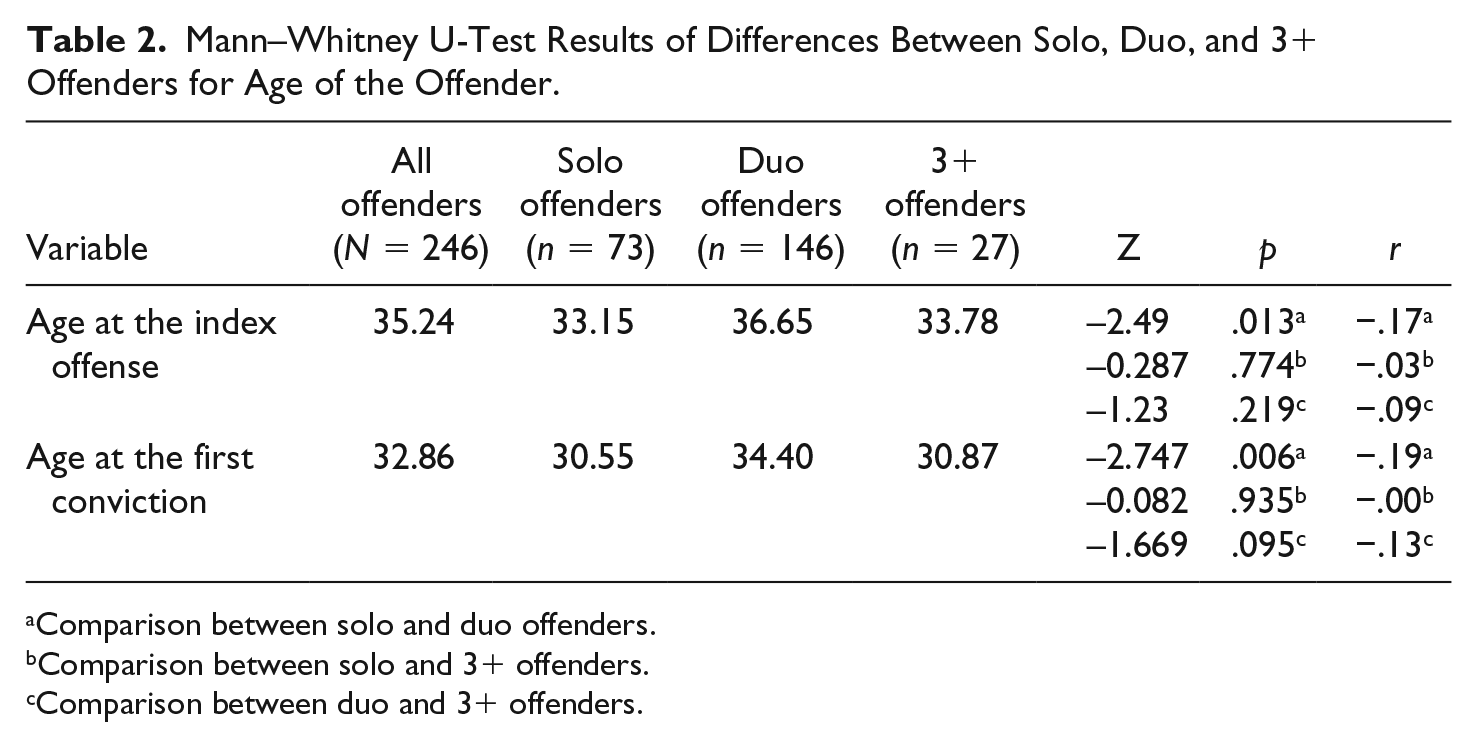
Comparison between solo and duo offenders.
Comparison between solo and 3+ offenders.
Comparison between duo and 3+ offenders.
With the categorical variables, chi-square tests were carried out to determine whether there were any differences between the groups. Various comparisons were carried out, but as this is an exploratory study, it was decided not to use a Bonferroni correction. For significance, the level of .05 was used. Furthermore, phi was used as an effect size measure. In relation to ethnicity, as can be seen in Table 3, solo offenders had more often a Western European background than duo offenders. Regarding committed sexual acts, the duo and 3+ group offenders were more often than solo offenders convicted of an offense that entailed sexual penetration of the body. In relation to violence, the 3+ group offenders used more physical and verbal violence during the offense than solo and duo offenders. Duo offenders committed the sexual offenders more than just once when compared with solo offenders and 3+ group offenders. When looking at victim characteristics, duo offenders assaulted a victim who they knew more often than solo offenders and 3+ group offenders, and solo offenders assaulted fewer female victims than duo and 3+ group offenders. Solo offenders assaulted a victim who was older than 18 years more often, had often more than one victim than duo and 3+ group offenders, and assaulted a victim who was younger than 12 years less often. Finally, duo offenders assaulted an intrafamilial victim more often than solo offenders and 3+ group offenders. For duo offenders, the assault was committed more often indoors
Chi-Square Results of Differences Between Solo, Duo, and 3+ Offenders.
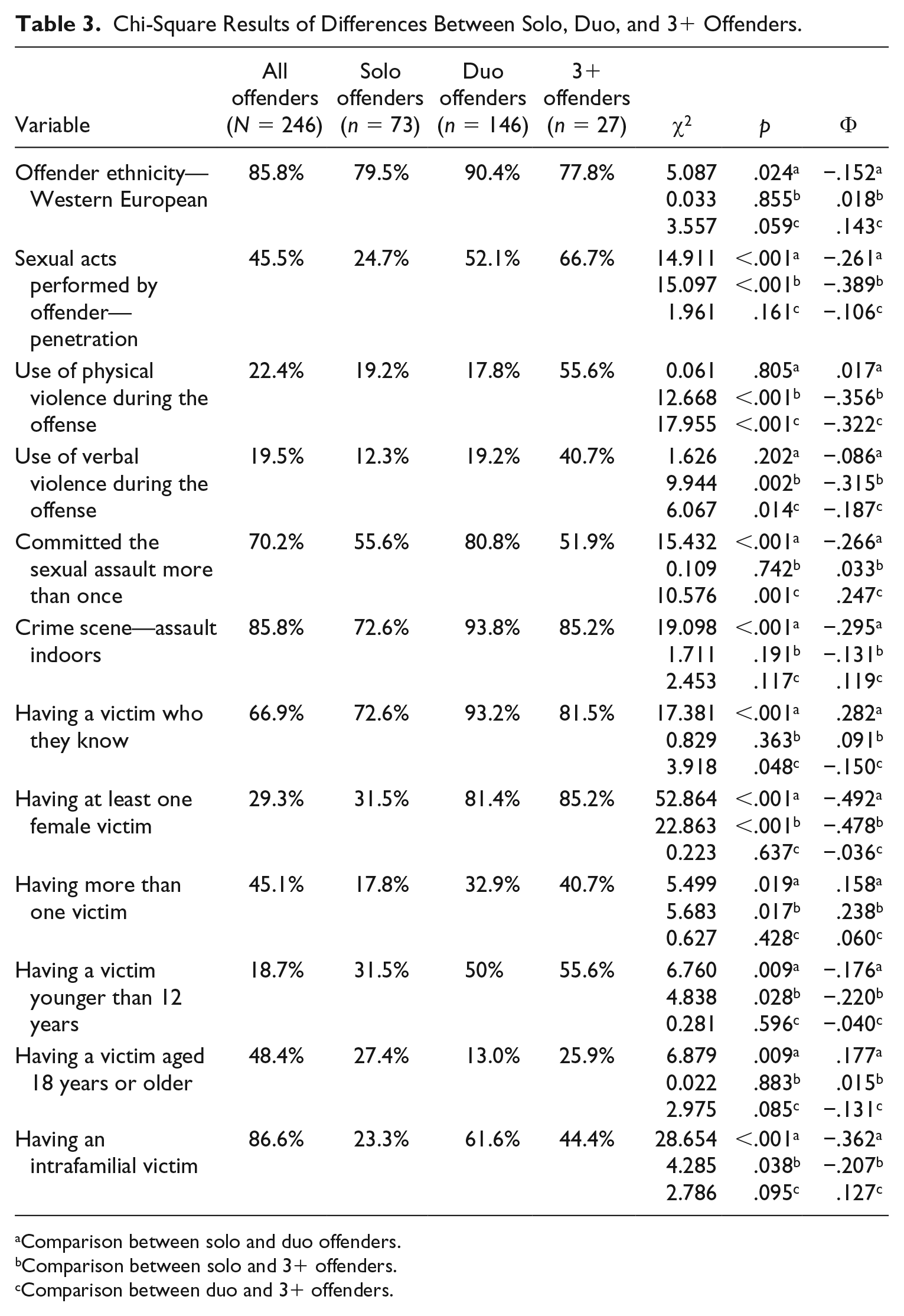
Comparison between solo and duo offenders.
Comparison between solo and 3+ offenders.
Comparison between duo and 3+ offenders.
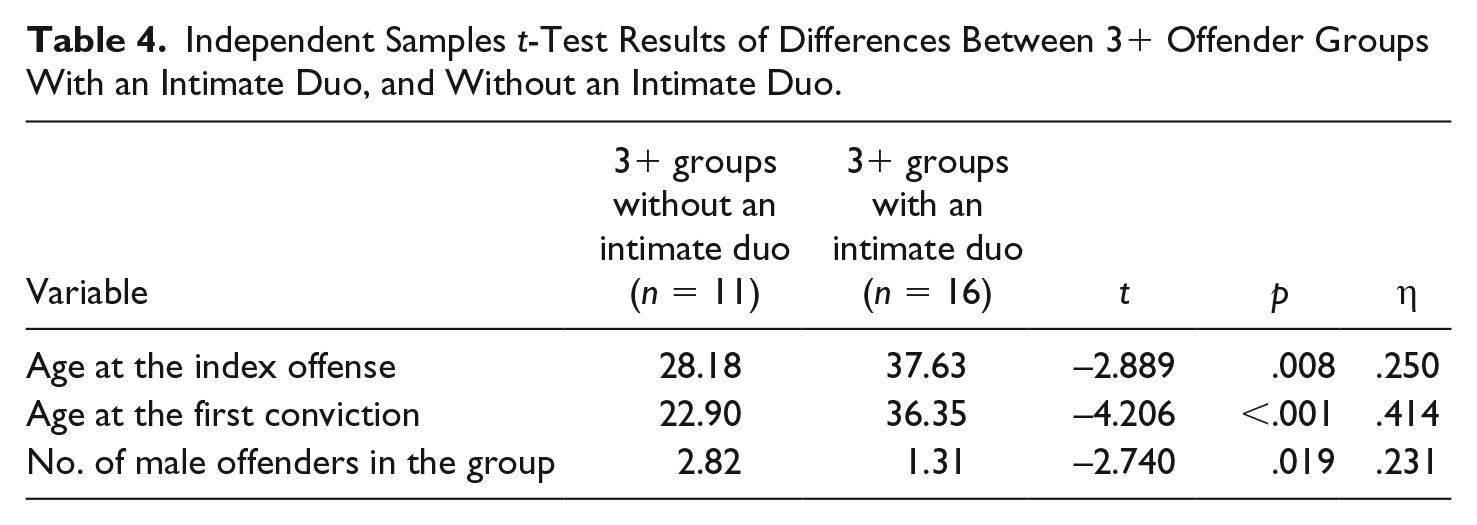
As it could be expected that the group dynamics of a 3+ group with two offenders who are in an intimate relationship differs from a 3+ group with offenders who are not in an intimate relationship (who are, for instance, friends or acquaintances), separate analyses were conducted on these two groups. It was recognized that the groups were small, which could hinder the analysis. However, it was considered that it would be worthwhile to conduct some exploratory analyses to determine whether these subgroups should be considered for future research. To examine whether there were differences within these 3+ groups, independent samples t-tests were used for the continuous variables. Chi-square tests were used for the categorical variables and, in the cases where the assumptions of the chi-square tests were violated, a Fisher’s exact test was used to test whether there were differences between the two groups. Table 4 shows that women who committed their sexual offense in a 3+ group that did not contain an intimate duo were significantly younger at the time of the index offense and significantly younger when they were convicted for their first offense. They were also significantly more often convicted for any offense before their sexual index offense, and they assaulted their victim significantly more often outdoors (see Table 5). These are all compared with women who committed their offense in a 3+ group, which had an intimate duo in their settings.
Independent Samples t-Test Results of Differences Between 3+ Offender Groups With an Intimate Duo, and Without an Intimate Duo.
Chi-Square and Fisher’s Exact Test Results of Differences Between 3+ Offender Groups With an Intimate Duo and Without an Intimate Duo.
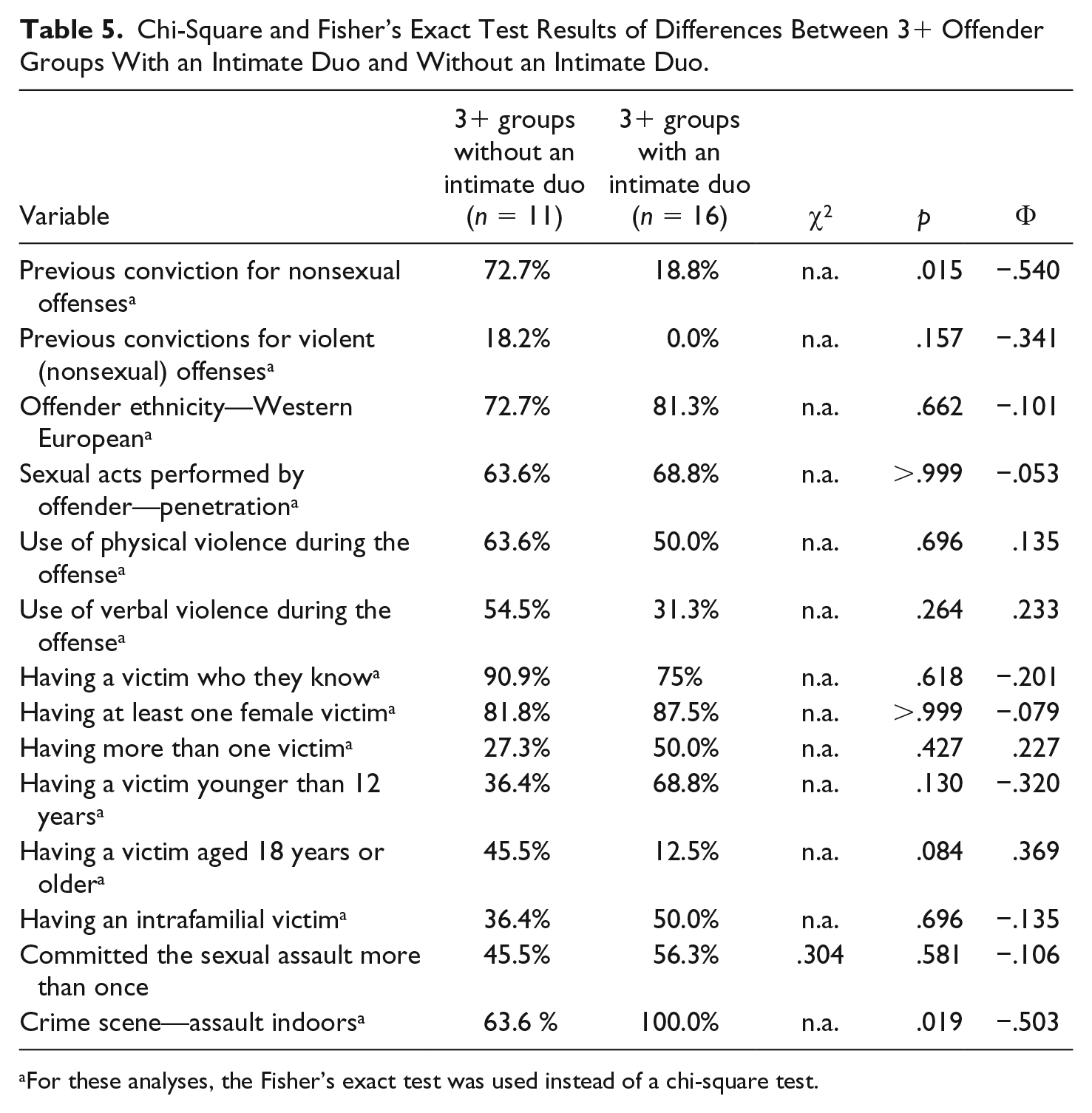
For these analyses, the Fisher’s exact test was used instead of a chi-square test.
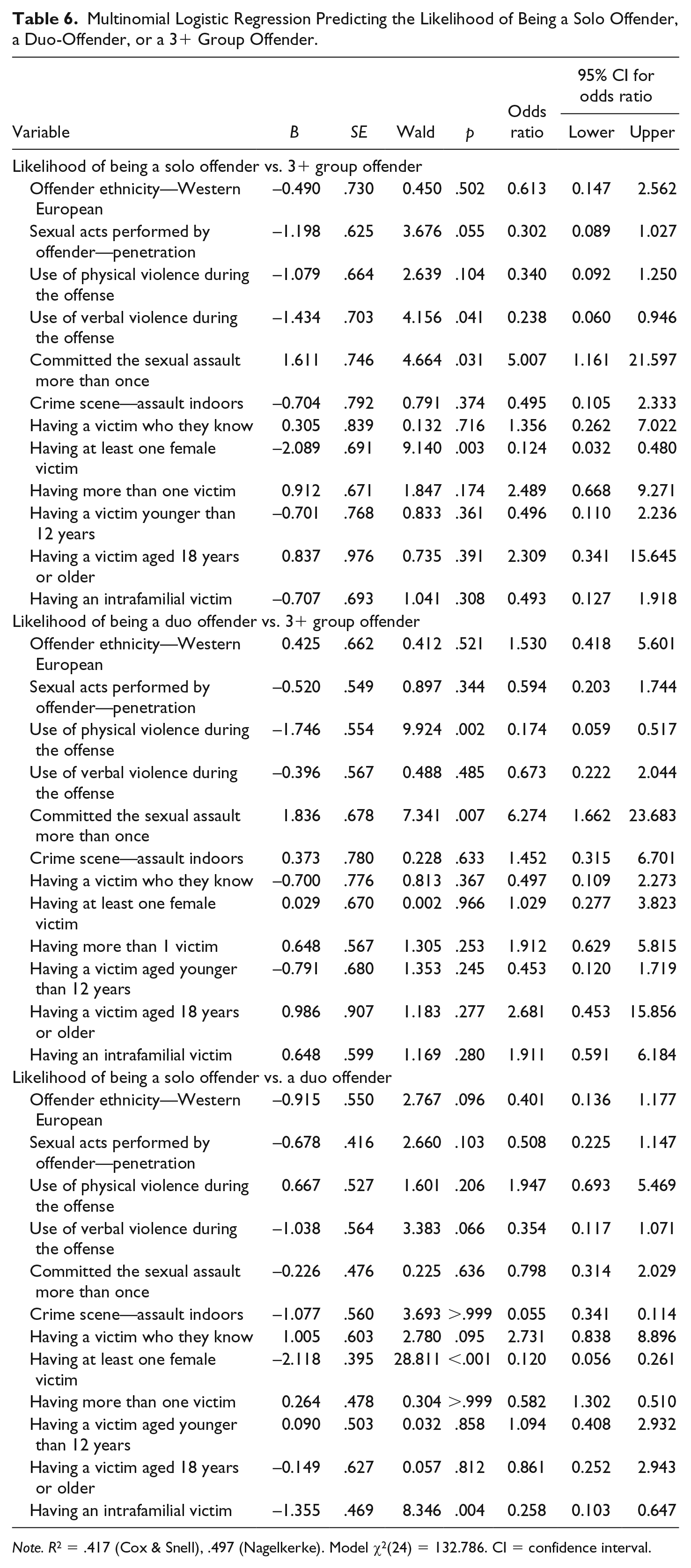
Finally, to determine which variables could predict the assault type (solo, duo, or 3+ offender groups), a multinomial logistic regression analysis was conducted using the 12 variables that were used to calculate the differences between groups (see Table 3). The results of this analyses are presented in Table 6.
Multinomial Logistic Regression Predicting the Likelihood of Being a Solo Offender, a Duo-Offender, or a 3+ Group Offender.
Note. R2 = .417 (Cox & Snell), .497 (Nagelkerke). Model χ2(24) = 132.786. CI = confidence interval.
Compared with a 3+ group offender, a solo offender was more likely to commit the sexual assault more than once, to use less verbal violence, and to have a female victim. Compared with a 3+ group offender, a duo offender was less likely to use physical violence and was more likely to commit the sexual assault more than once. Compared to a solo offender, a duo offender was more likely to have an intrafamilial victim.
Discussion
The main aim of this study was to analyze the differences in offender, offense, and victim characteristics of female sexual offenders who commit their offense alone compared with duo offenders and 3+ group female offenders. An additional aim was to compare the findings on female MPR with previous findings on male MPR. In general, some results were consistent to Budd et al.’s (2017) findings, which is the only study that had previously examined different female sexual offender groupings. In addition, the results suggest that there are some differences between female and male MPR.
The sample, which was representative of convicted female sexual offenders in the Netherlands, was made up of 30% solo offenders and 70% co-offenders This is consistent to what has been found in a number studies (Cortoni & Gannon, 2016) and highlights the need to gain more knowledge on co-offending in females as the majority of female sexual offending seems to involve co-offending. However, it is different from Budd et al.’s (2017) sample where the majority (62%) of the female sexual offenders were solo offenders and only approximately 38% were co-offenders. This could be due to cultural differences between the two countries or differences in the samples. The Dutch sample was made up of convicted offenders and it could be that it is easier to convict a female who commits a sexual offense with other co-offenders (particularly males) than to convict a female who commits a sexual offense on her own. More research is required to further investigate this.
In relation to offender characteristics, compared with solo offenders, duo offenders were significantly older, which was different from what was reported for male offenders by da Silva et al. (2014) and Park and Kim (2016) where the solo offenders were older than the duo and 3+ group offenders. This could be related to the fact that the majority of the female duos committed the offense with an intimate partner and the offenses often involved their children. On the contrary, the majority of male sexual co-offending tends to be with other male offenders and these tend to be younger than solo offenders.
In terms of offense characteristics, compared with solo offenders, duos assaulted their victim more often indoors (same as da Silva et al., 2014) and they more often assaulted an intrafamilial victim (same as Budd et al., 2017). Compared with solo offenders, duos and 3+ group offenders more often performed penetration and they more often assaulted a female victim. Again, this could be due to the fact that a large number of the co-offenders were male. As highlighted by Budd et al. (2017), it is important to better understand the dynamics between the female and male co-offenders regarding victim selection and sexual acts performed as this could better inform a gender-specific approach. Compared with solo offenders and 3+ group offenders, duos more often assaulted a victim who they knew (their children in the majority of the cases). These findings are consistent with those of Budd et al. (2017).
A few differences were found between 3+ groups with an intimate duo, and 3+ groups without an intimate duo. The 3+ groups without an intimate duo were younger at the time of the sexual offense, they were younger at the time of their first conviction, they had more often previous convictions for nonsexual offenses before the index sexual offense, and they assaulted their victim less often indoors. Although these results are based on very small samples and should be interpreted with caution, it seems that these groups without an intimate duo are quite comparable with male MPR groups in the Bamford et al. (2016) review. Furthermore, there are also some similarities with the 3+ groups in the da Silva et al. (2013) and Park and Kim (2016) studies. These similarities could be explained by the finding that the 3+ groups without an intimate duo contain more male offenders than the groups with an intimate duo. Further research is needed related to the dynamics between intimate duos and other co-offenders.
As the majority of female sexual co-offending involves a male intimate partner and is committed against an intrafamilial victim, which is different from the majority of male duo sex offending, it is likely that the motivations are different between both groups. Various factors (individual, sociocultural, and situational) have been found to play a role in MPR (Harkins & Dixon, 2009). In a study involving male MPR offenders (da Silva et al., 2017), it was found that the offenders identified group dynamics and process as reasons for their involvement in this type of sexual offending, along with sociocultural (belief and attitudes about women, sexuality, and rape myths) and situational factors (use of alcohol and drugs). In line with this, having a social cultural background with antifemale attitudes may not play a role for female perpetrators. However, in the 3+ groups, where the majority of the perpetrators are males, this could be the case for the males but not for the females. For the females, other factors could play a role (e.g., group dynamics). The females could be involved due to the same group dynamics as the males: conformity, deindividuation, behavioral contagion, and modeling (da Silva et al., 2017). However, although the same group dynamics could play a role in male and female MPR, these could be experienced in different ways by the different genders. It would be important to conduct in-depth qualitative research with females who committed a sexual offense with co-offenders to gain a better understanding of their reasons for taking part in the offense and the part they played.
Implications
The results of this study have some implications for police practice and treatment initiatives. Regarding implications for police practice, it is important to acknowledge the fact that a great number of the victims of female MPR are intrafamilial. Therefore, in cases of intrafamilial child abuse, police officers should also consider the involvement of more than one perpetrator during their investigation.
Seeing that it was found that the majority of the women who had at least one co-offender committed the sexual offense with their intimate partner, issues related to attachment and intimate relationships need to be considered in assessment and intervention. Attachment styles have been found to be linked to relationship quality (Mikulincer & Shaver, 2007). Furthermore, research has shown that attachment styles were related to satisfaction in sexual relationships, sexual dysfunction, and motivations for sex (Stefanou & McCabe, 2012).
As group dynamics are considered to play a role in MPR, these should be identified and addressed in prevention and treatment programs. Early prevention programs that incorporate issues of group behavior and peer pressure should be targeted at both boys and girls and include examining these dynamics in sexual behaviors. Furthermore, sexual education programs could include the identification of healthy and unhealthy intimate partner dynamics.
Etgar (2013) suggested that, when treating MPR offenders, it is important to examine the offender’s social role within the group, which will provide more information of possible risk factors and expected interactions in other groups. Therefore, in treatment programs for female MPR offenders this could be included. A number of differences between female and male MPR were identified, suggesting that there are different motivations and offense behaviors. This highlights the need not to transfer what we know about male MPR to female MPR but to further research these differences to develop treatment programs that target the specific characteristics and needs of female MPR offenders.
Regarding implications for future research, one can conclude that, given the results of this study, there are more similarities between duos and 3+ groups than differences. It is therefore fair to state that the literature on group dynamics can also be applied to offenders who commit their offense with only one co-offender. However, it is necessary to consider that the majority of the duos and some of the 3+ groups are made up of intimate partners. Therefore, it is necessary to examine dynamics between intimate partners when examining female co-offending. Gannon and colleagues (2008, 2010, 2014) have demonstrated in their pathways studies that the dynamics between intimate partners can be quite different for female sexual offenders. They found three patterns or pathways to female perpetrated sexual abuse. These pathways were labeled as Explicit-Approach, Directed-Avoidant, and Implicit Disorganized. A woman who has abused her children together with her husband could have explicitly planned her offending at both distal and proximal stages. Because of this planning and the lack of coercion as exerted by her husband, her pathway would have been labeled as Explicit-Approach. On the contrary, the pathway of a woman, who tended to offend either out of fear or to obtain intimacy with her husband while the offending was explicitly preplanned by this husband, would be classified as Directed-Avoidant. These two examples show that group dynamics can be different and need therefore to be studied in future research.
Another possibility for future research would be studying the criminal career characteristics of the three different groups. The solo offenders are the youngest offenders at the time of the index offense and they committed significantly less sexual crimes that entailed penetration when compared with duo offenders and 3+ group offenders. It would be interesting to examine whether their sexual index offense was the beginning of a career in sexual offending, or were they so-called once-only offenders (Wijkman et al., 2011).
Limitations
This research adds to the body of knowledge on female sexual offending and follows on from the only previous study (Budd et al., 2017) that examined different female sexual offender groupings. Some of the limitations in the Budd et al. (2017) study were addressed. For example, the data in the current study were on the offender level, which meant it was possible to determine if a woman was involved in more than one incident, and all of the areas in the Netherlands were represented. However, there are limitations that need to be considered. It is well established that sexual offending perpetrated by females is underreported to the police (Cortoni et al., 2017). Furthermore, there is a high attrition rate in the criminal justice system for sexual offenses and the conviction rate for these offenses is usually quite low (Jehle, 2012). This means that, although the sample is representative of convicted female sexual offenders in the Netherlands, it may not be possible to generalize the findings to nonconvicted, or nonreported female sexual offenders. Furthermore, the cases that are reported to law enforcements are likely to be the more serious, overt cases than the cases that are not reported.
Conclusion
Some differences were found between solo, duo, and 3+ group female sexual offenders (e.g., age, victim selection, and offense behaviors). However, the biggest differences were found between the solo and the multiple perpetrator offenders (duos and 3+ groups). It was concluded that the duos and 3+ groups were quite similar; however, it is necessary to consider that the duos were mainly made up of intimate partners and the dynamics between intimate partners are expected to be different from those between other co-offenders. It is necessary to further research the dynamics in the intimate partner duos and the groups without intimate partners. A number of differences were found between male and female MPR. Where similarities were found, these seemed to be related to the fact that male offenders were present. This suggests that it is necessary to research them separately and develop separate prevention and treatment programs based on their different characteristics and needs.
Footnotes
Declaration of Conflicting Interests
The author(s) declared no potential conflicts of interest with respect to the research, authorship, and/or publication of this article.
Funding
The author(s) received no financial support for the research, authorship, and/or publication of this article.
