




Abstract
The predictive validity of risk assessment instruments for persons who have committed sexual offenses has improved tremendously in the last four decades, but the progress has been limited to Western offender populations. The aim of this study was to examine the predictive validity of Static-99R, Stable-2007, Sexual Violence Risk-20, Version 2 (SVR-20 v2), Psychopathy Checklist—Revised (PCL-R), and Level of Service/Case Management Inventory (LS/CMI) in predicting recidivism of persons convicted on sexual offenses in Singapore. Retrospective data of 134 such persons were used to code the various instruments. Receiver operating characteristic analyses revealed that combined Static-99R/Stable-2007 new standardized risk ratings, SVR-20 v2 total scores and risk ratings, PCL-R total scores, as well as LS/CMI total scores and risk ratings predicted sexual recidivism. All the aforementioned instruments’ total scores and risk ratings (if applicable) predicted any recidivism. However, risk profiles of this sample differed significantly from the normative Western samples.
Keywords
Sexual offenses can have grave consequences for their victims and they elicit much public interest and concern. Criminal justice systems of many developed jurisdictions attempt to identify individuals with a history of sexual offending who are at higher risk of reoffending and provide deterrent or rehabilitative services to prevent these crimes from happening again. The field of risk assessment was developed as a result of this need and has been refined continuously in the last four decades. Currently, several meta-analyses demonstrated strong empirical evidence for risk factors in predicting risks (Hanson, 2005). However, a closer examination showed that there was minimal representation of different cultural and ethnic groups in these studies. A recent ruling by the Canadian Supreme Court called into question the use of specific risk assessment instruments with Canadian Aboriginal inmates (Ewert v. Canada, 2018). The highest court in the country recognized that cultural and ethnic differences may impact on the accuracies of risk assessment instruments. In the ruling, the judge established that if risk assessment instruments were used to predict risk for Indigenous offenders, sufficient empirical support should be a prerequisite to its use. Moving forward, there is a clear need to validate the risk assessment instruments beyond the North American and European White forensic populations (Haag, Boyes, Cheng, MacNeil, & Wirove, 2016; Shepherd & Lewis-Fernandez, 2016).
Cross-Cultural Validation of Risk Assessment Instruments
A review of the literature concluded that there were only a handful of studies that compare ethnic differences in risk assessment (Shepherd & Lewis-Fernandez, 2016; Shepherd, Luebbers, & Dolan, 2013). Some of these studies conducted in Western societies found differences in predictive validity of the risk assessment instruments among different ethnic groups of offenders residing in the same geographical locations. For example, the Level of Service Inventory—Revised (LSI-R; Andrews & Bonta, 1995) was more predictive of incidences of misconduct among White inmates than non-White inmates (Chenane, Brennan, Steiner, & Ellison, 2014). Similarly, a meta-analysis found that although LSI-R was predictive of general and violent recidivism in non-Aboriginal offenders, it was less predictive for Aboriginal offenders compared with non-Aboriginal offenders (Wilson & Gutierrez, 2014).
Specific to sexual offending, several studies have investigated the cross-cultural validity of Static-99R (Phenix, Fernandez, et al., 2016) in the increasingly ethnically diverse jurisdiction such as the United States (Carson, 2014). Lee and Hanson (2017) concluded that Static-99R was able to predict sexual recidivism across the three major ethnic groups, specifically White, Black, and Hispanic, but noted that more investigation is required to understand the lower predictive validity for Hispanic offenders. In a study on only Hispanic sexual offenders, Leguizamo, Lee, Jeglic, and Calkins (2017) found that both Static-99 and Static-99R were predictive of sexual recidivism of Latino offenders born inside the United States but were not predictive of those born outside of the United States. Leguizamo et al. (2017) hypothesized that the findings were possibly due to the inaccurate historical information prior to immigration to the United States. However, another study with a larger sample contradicted the above finding and found that the Static-99R predicted sexual recidivism of Latino offenders, regardless of their place of birth (Boccaccini, Rice, Helmus, Murrie, & Harris, 2017). These studies suggested that differences in predictive validity may vary across ethnicity, even within the same jurisdiction. If the use of risk assessment instruments were to extend beyond the North American and Continental European settings, validation studies are critical to substantiate their use.
To the best of our knowledge, only one published Asian study validated risk assessment instruments specifically on adult sexual offenders (Lin & Dong, 2005) and two published articles on risk assessment for youths who sexually offended (Chu, Ng, Fong, & Teoh, 2012; Zeng, Chu, & Lee, 2015). In Taiwan, Lin and Dong (2005) preselected items from the Rapid Risk Assessment for Sexual Offense Recidivism (RRASOR), Static-99, and Minnesota Sex Offender Screening Tool—Revised (MnSOST-R) that were predictive of sexual recidivism and came up with an adapted risk assessment instrument, called Taiwan Sex Offender Static Risk Assessment Scale (TSOSRAS). The new instrument was predictive of sexual recidivism at 3 years, but not at 7 years (area under the curve [AUC] = .76) of a sample of 421 adults who have sexually offended. Moreover, protective factors on their own did not have either predictive validity or incremental validity effect when used with the Estimate of Risk of Adolescent Sexual Offense Recidivism (ERASOR; Zeng et al., 2015).
The current state of cross-cultural validation of risk assessment instruments outside of non-Western countries is in its early development. With regard to the use of assessment tools, the American Educational Research Association (AERA), American Psychological Association (APA), and National Council on Measurement in Education (NCME) (2014) recommend that, When criterion-related validity evidence is used as a basis for test score-based predictions of future performance, and sample sizes are sufficient, test developer and/or users are responsible for evaluating the possibility of differential prediction for relevant subgroups for which there is prior evidence or theory suggesting differential prediction. (p. 66)
Accordingly, there is a strong need to validate the use of these instruments where evidence is scant.
Sexual Offending in Singapore
Singapore is an independent island state in South East Asia with a land area of 722.5 km2 and a total population of 5.64 million (Singapore Department of Statistics, 2019). Many statutes in Singapore are based on English common law (e.g., the Criminal Procedure Code, Attorney General Chambers, 2019a), but there are some statutes that are based on legislation from other jurisdictions (e.g., India) that were influenced by the English in the 1800s. Hence, similarities with other jurisdictions exist in the way that offenses are defined in Singapore, but the exact language of the laws might differ.
In Singapore, the penal code has undergone a major overhaul in 2019 to keep the code relevant to the changes in the society (Attorney General Chambers, 2019b). New sexual offenses were added and, for some offenses, the penalties were heavier. Examples of new sexual offenses include revenge pornography, cyber sexual exposure, and nonconsensual sex within a marriage. Unlike many developed and Western countries (e.g., Australia, Canada, and United States), Singapore does not have a sexual offender registry. Legislative changes typically take place over a longer period, but the society’s view of sexual offenses is constantly evolving due to factors such as increased public awareness, more services for victims, and changes in gender roles (McMahon, 2011). In mid-2019, an undergraduate from a local university took to social media to express her displeasure at the light punishment a fellow student received for filming her while showering in the university hostel (Channel News Asia, 2019a). Through the incident, the university made significant changes to future handling such cases including tougher sanctions on the offenders, setting up of victim support unit, and increased campus security (Channel News Asia, 2019b).
Notably, cultures and societies define what attitudes and behaviors are deemed as “normal” and “deviant.” That said, although there could be cross-cultural agreement about what constitutes offending behavior, the development of deviant attitudes and behaviors can vary as a result of cultural norms, gender roles, morals, religion, taboos, and expectations (e.g., Bhugra, Popelyuk, & McMullen, 2010; Lahlah, Van der Knaap, Bogaerts, & Lens, 2013). Consequently, differences in motivation, risk factors, and pathways for offending may arise, especially when there are cross-cultural differences as to how individuals cope, self-regulate, or even report crimes. As such, there are clear benefits to validate risk assessment instruments in different jurisdictions.
This Study
The aim of this study is to explore the applicability of the most commonly used instruments to predict recidivism risk among adults who have committed sexual offenses (Neal & Grisso, 2014), namely, Static-99R, Static-99R/Stable-2007, Sexual Violence Risk-20, Version 2 (SVR-20 v2), Psychopathy Checklist—Revised (PCL-R) and Level of Service/Case Management Inventory (LS/CMI). There are two types of predictive validity: discrimination and calibration (Gutierrez, Helmus, & Hanson, 2017), and the scope of this study is limited to discrimination between recidivists and nonrecidivists. The hypotheses are as follows:
Method
Sample
This is a retrospective study which consisted of 134 convicted adult male sexual offenders who were referred to the Clinical & Forensic Psychology Service (CFPS), Ministry of Social and Family Development (MSF), Singapore, between 2004 and 2012. CFPS provides assessment and treatment to young persons and adults who have engaged in offending behaviors. Adult sexual offenders were referred by their probation officers for risk assessments during the presentencing stage to determine their suitability for community supervision. As this was a retrospective study, 19 participants with limited archival information were omitted from the sample.
Instruments
Static-99R
The Static-99R (Helmus, Hanson, Thornton, Babchishin, & Harris, 2012) is one of the most widely used risk assessment instruments for adult sexual offenders (Hanson & Morton-Bourgon, 2009). It is an actuarial risk assessment instrument designed specifically to predict sexual recidivism risk among adult sexual offenders and it includes only static and historical risk factors. The Static-99R’s predictive validity has been validated in many studies. A recent meta-analysis found a moderate relationship between Static-99R and sexual recidivism, with a weighted average AUC of .69 (Helmus, Hanson, et al., 2012). In terms of inter-rater reliability, the intraclass correlation coefficient (ICC) for total scores is .78 (Hanson, Lunetta, Phenix, Neeley, & Epperson, 2014).
Stable-2007
Stable-2007 (Fernandez, Harris, Hanson, & Sparks, 2014) is usually used in conjunction with Static instruments, for the purpose of providing useful information about risk factors that can be reduced through intervention and management of the offender. It is an actuarial risk assessment instrument that consists of dynamic risk factors and can be used at different points of time to track changes in the recidivism risk. Some studies have also found that including information from Stable-2007 increased the predictive validity of Static-99 (Eher, Matthes, Schilling, Haubner-MacLean, & Rettenberger, 2012; Lussier, Deslauriers-Varin, & Râtel, 2010). The Stable-2007 coding manual consists of decision rules used to combine the Static-99R and Stable-2007. The reported AUCs for sexual recidivism in the original study (The Dynamic Supervision Project) of Static-99 was .74, Stable-2007 was .67, and the combination of Static-99 and Stable-2007 produced an overall increase in predictive validity which was found to be .76 (Hanson, Helmus, & Harris, 2015). The ICC of Stable-2007 is .79 on the total score (Fernandez et al., 2014).
SVR-20 v2
The SVR-20 (Boer, Hart, Kropp, & Webster, 1997) is the most commonly used structured professional judgment (SPJ) risk assessment instrument for adult sexual offenders (Kelley, Ambroziak, Thornton, & Barahal, 2018). It consists of both static and dynamic risk factors, and the risk factors were derived from a combination of research, theory, and clinical experience (Hart & Boer, 2009). SVR-20 can be used repeatedly to track and monitor changes in risk. The psychometric properties of SVR-20 are lesser known than those of Static-99R and Stable-2007. The available studies of SVR-20 have reported AUCs of risk categories and total scores to range from .49 to .83 and the ICC is in the excellent range around .84 (see Rettenberger, Boer, & Eher, 2011, for a review).
SVR-20 v2 (Boer, Hart, Kropp, & Webster, 2018) is the revised version and was recently published. However, at the time when this study was conducted, the SVR-20 v2 (Boer, Hart, Kropp, & Webster, 2010) was not yet available publicly and an electronic copy of the SVR-20 v2 was obtained from one of the authors, Dr. Douglas Boer. Both versions of SVR-20 contain 20 items but there were slight differences in the number of items in the three domains. In Version 2, there was an additional item “sexual health” in the psychosocial adjustment domain, and “past supervision failures” in Version 1 was now an item in the future plans domain, instead of psychosocial adjustment. It was also noted that in Version 2, “past nonsexual violent offenses” and “past nonviolent offenses” were collapsed into “past nonsexual offending.” Finally, “psychological coercion” was a new item which replaced the old item, “uses weapons or threats of death in sex offenses” under the sexual offense domain. Although the revised version retained the same number of items, the intent of the changes seemed to include more precise risk factors that predict sexual recidivism. Until studies are published on the psychometrics of Version 2, its enhanced predictive validity cannot be verified. This study will utilize SVR-20 v2 to contribute to the literature about this revised tool.
PCL-R
According to Neal and Grisso (2014), PCL-R (Hare, 2003) is the second most commonly used instrument in violent and sexual recidivism risk assessments. Although PCL-R was not designed to be a risk assessment instrument, it is commonly used because of its ability to predict recidivism (Olver & Wong, 2015). It was originally developed to measure the construct of psychopathy, which is “a constellation of affective, interpersonal, and behavioral characteristics, including egocentricity; impulsivity; irresponsibility; shallow emotions; lack of empathy, guilt, or remorse; pathological lying; manipulativeness; and the persistent violation of social norms and expectations” (Hare, 1996, p. 25). As PCL-R measures a long-standing personality trait, it is not expected to change over time. Pertaining to its inter-rater reliability, the ICC for single rating was reported to be high (.87) and the internal consistency was also high (α = .84; Hare, 2003). However, some studies have demonstrated ICC as low as .14 when used in clinical settings (Edens, Boccaccini, & Johnson, 2010; Murrie, Boccaccini, Johnson, & Janke, 2008; Rufino, Boccaccini, Hawes, & Murrie, 2012). A meta-analysis including a total of 95 studies examined the predictive accuracy of psychopathy (measured by PCL-R) for violence and found a moderate relationship between the two, where the weighted Cohen’s d for the PCL total scores was .47 and that Factor 2 had the strongest predictive validity of .57 (Leistico, Salekin, DeCoster, & Rogers, 2008).
LS/CMI
The Level of Service (LS) instruments, which include LS/CMI (Andrews, Bonta, & Wormith, 2004), are the most widely used risk assessment instruments to predict general recidivism worldwide (Wormith, 2011). LS/CMI is the most recent version of the LS instruments that incorporates risk assessment together with case management planning and management of offenders. It is designed to be an actuarial risk assessment instrument, but under exceptional circumstances the clinician using the instrument can apply a professional override to the final risk level. As it consists of both static and dynamic risk factors, it can be used to measure changes in levels of risk. The meta-analytic analysis demonstrated the LS instruments as strong predictors of general (r = .30), nonviolent (r = .25), and violent (r = .21) recidivism (Olver, Stockdale, & Wormith, 2014). The inter-rater reliability for time intervals of less than 6 months was found to be r = .88.
This is the only risk assessment instrument used in this study that has been validated and normed locally with a cohort of inmates (N = 1,294) released from the Singapore Prison Service in 2002 (Andrews, Bonta, & Wormith, 2010). Nearly 24% of the sample recidivated 1 year after release into the community. The cut-off scores for each banding of recidivism risk were lowered slightly compared with the original LSI-R, which was normed on the original North American sample. This was done to reflect the different distribution of total scores on the instrument in the local context. According to the manual, the internal consistency of Section 1 (i.e., General Risk/Need Factors) of LS/CMI is high, that is, α = .81, for Singapore prisoners. Predictive validity for the local prisoners was not reported in the manual.
Procedure
Approval for this study was obtained from the James Cook University’s Human Research Ethics Committee and the Research Ethics Advisory Panel of the MSF before the commencement of the study. For the purpose of this study, the first author retrospectively coded the risk assessment instruments from case files, which included (a) psychological reports prepared by psychologists at CFPS and information such as mental status examinations, personal, family, psychiatric, and offending histories as well as clinical formulation and risk management plans; (b) presentence reports prepared by probation officers; (c) charge sheets and statement of fact; (d) previous assessment and treatment reports; and (e) reports from employers and schools. On average, the first author took 3 hr to review each participant’s case files and score the risk assessment instruments. The risk assessment instruments were coded blind to the recidivism outcome.
After the completion of risk assessment ratings, recidivism data were obtained from the Criminal Records Office, Singapore Police Force, on May 28, 2013. The first author coded the recidivism data according to the following definitions: Recidivism was defined as the occurrence of a new offense that resulted in a criminal charge. Sexual recidivism was defined as reoffenses that were sexual in nature (e.g., indecent exposure, molestation, peeping, and rape) and classified based on the name of the charge as there was no information about the motivation of those offenses. Any recidivism was defined as any reoffenses, including sexual offenses.
To examine the inter-rater reliability, 10 randomly selected cases were coded separately by a psychologist who had 4 years of experience using the risk assessment instruments. The ICCs for single raters (using absolute agreement definition) were .79 (excellent), .78 (excellent), .85 (excellent), .68 (good), and .70 (good) for total scores on Static-99R, Stable-2007, PCL-R, LS/CMI, and SVR-20 v2, respectively (see Cicchetti, 1994, for ICC classifications).
Data Analysis
IBM® SPSS® Statistics V22.0 was used to analyze the data. Descriptive statistics were used to characterize the sample and the risk assessment instrument scores and risk categories. In addition, Pearson r correlations were used to examine the correlations between the scores on the risk assessment instruments. The predictive validity of the risk assessment instruments in the prediction of sexual and any types of recidivism was explored using receiver operating characteristic (ROC) curve analyses. The AUCs of the ROC curve, which range from 0 (perfect negative prediction) to 1.0 (perfect positive prediction), are often considered indices of overall predictive validity. According to Rice and Harris (2005), AUCs of .56 represent a small effect size, .64 a medium effect size, and .71 a large effect size. The current analyses used the risk assessment scores and risk categories as units of analysis, which is an acceptable and appropriate comparison method in this area of study (e.g., Chu, Thomas, Ogloff, & Daffern, 2013; Desmarais, Nicholls, Read, & Brink, 2010).
Results
Sample Characteristics
The sample comprised 134 male sexual offenders, who were referred to CFPS, MSF (Singapore) from 2004 to 2012. There were 19 other potential participants who were omitted from this sample due to missing recidivism data. The mean age at the point of assessment was 23.5 years (median = 20.0, SD = 8.5, range = 18-57).
As the sample consisted only of probationers who served their sentences in the community, it was assumed that the opportunity to reoffend in the community was present. Thus, the start of follow-up periods was calculated from the point of their psychological reports retrieved from the case files. The mean length of follow-up was 3.7 years (median = 3.2, SD = 2.0, range = 0.7-9.4). During the follow-up period, 6.0% (8/134) of the sample reoffended sexually, whereas 14.9% (20/134) reoffended nonsexually. Overall, 17.9% (24/134) of the sample reoffended during the follow-up period.
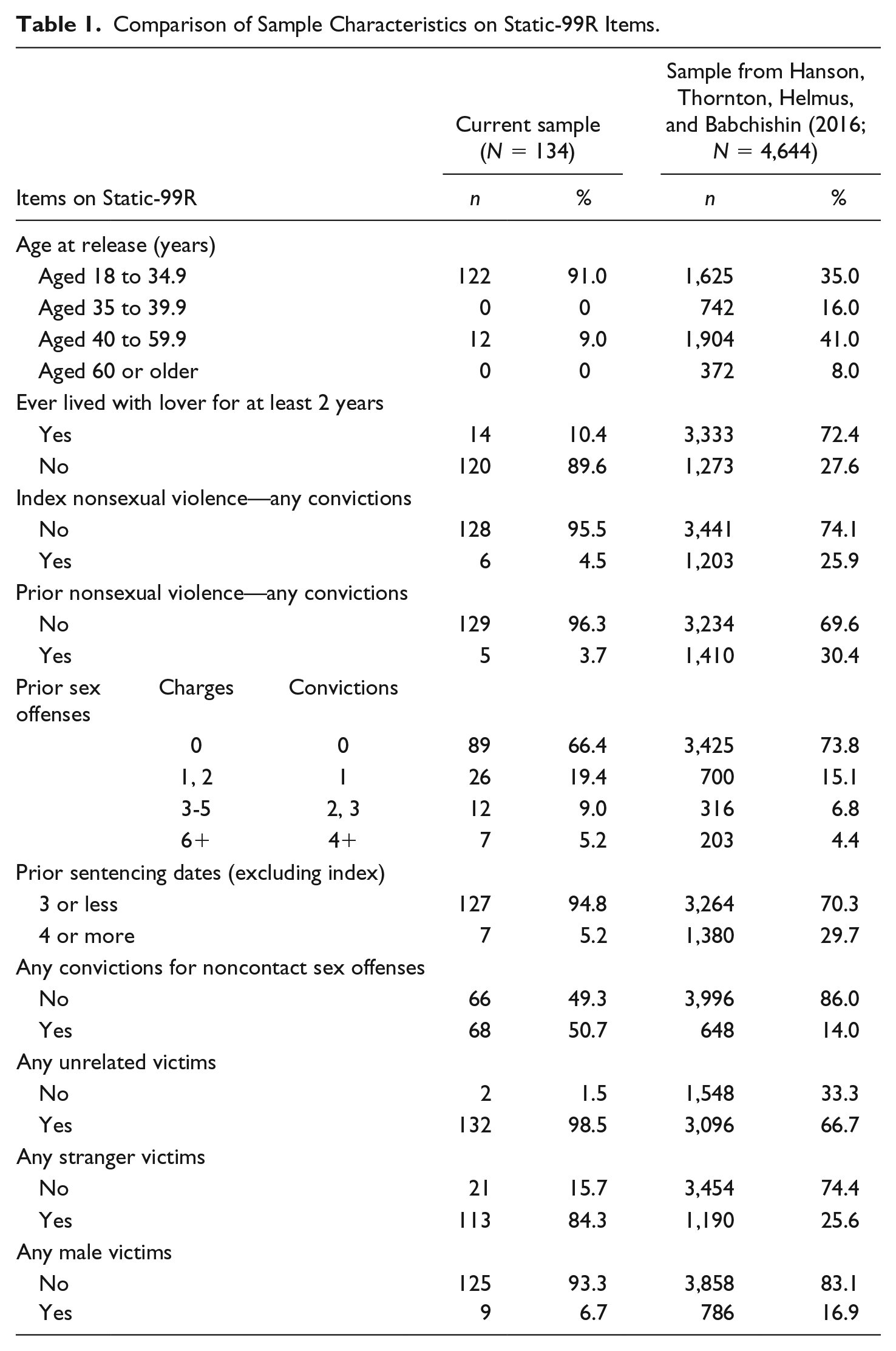
In this sample, 12.7% (17/134) of the participants have or ever had an Axis I disorder and 13.4% (18/134) of the participants had a recorded clinical diagnosis of intellectual disability (by registered psychiatrists and/or psychologists). Among the types of sexual offenses committed, 53.7% (72/134) of the participants committed noncontact sexual offenses (e.g., exhibitionism, voyeurism, stealing objects with sexual intent, etc.), 42.5% (57/134) committed contact sexual offenses (e.g., rape, molestation, frottage, fellatio, etc.), and 3.7% (5/134) committed both contact and noncontact sexual offenses. The sample characteristics based on Static-99R items were further compared with seven out of the 10 routine Static-99R samples from Hanson, Thornton, Helmus, and Babchishin’s (2016) study in Table 1.
Comparison of Sample Characteristics on Static-99R Items.
Descriptive Statistics of the Measures
The mean total scores, standard deviations, and ranges of the Static-99R, Stable-2007, SVR-20 v2, PCL-R, and LS/CMI are summarized in Table 2. Comparing the mean scores and standard deviations with the normative samples of these measures, this sample had more risk factors associated with sexual recidivism on Static-99R (M = 4.8, SD = 1.3 vs. M = 2.5, SD = 0.4; Hanson et al., 2016), yet fewer psychopathic features on PCL-R (M = 4.5, SD = 5.7 vs. M = 16.5, SD = 8.3; Hare, 2003) and fewer general offending risk factors on LS/CMI (M = 7.2, SD = 7.1 vs. M = 15.6, SD = 5.9; Andrews et al., 2004). Mean scores on Stable-2007 (M = 9.3, SD = 4.6) were slightly lower than those in the normative sample (M = 7.5, SD = 4.9; Fernandez et al., 2014).
Summary of Risk Assessment Instruments and PCL-R Scores.
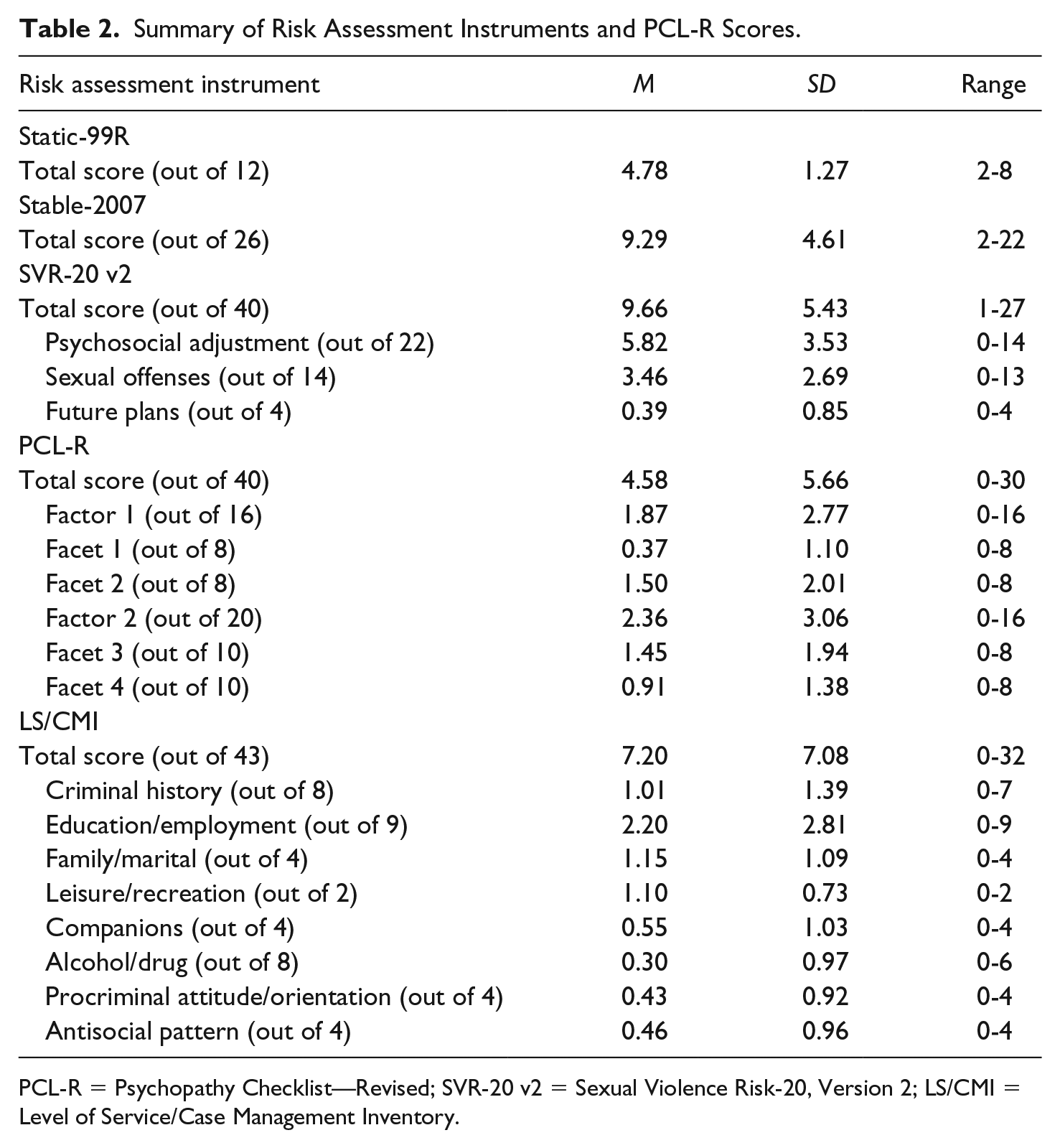
PCL-R = Psychopathy Checklist—Revised; SVR-20 v2 = Sexual Violence Risk-20, Version 2; LS/CMI = Level of Service/Case Management Inventory.
Correlations Between the Instruments
The correlations between all the measures’ total scores are summarized in Table 3. It is noted that the correlations between all the main measures were significant, but some of the subscale scores did not correlate with the main measures. The sexual violence risk instruments were all moderately intercorrelated, suggesting that they measure a common construct. Although Static-99R shared small to medium size correlations with other measures, its correlation was the weakest compared with the intercorrelations between other main measures.
Correlations Between Total Scores of Risk Assessment Instruments.
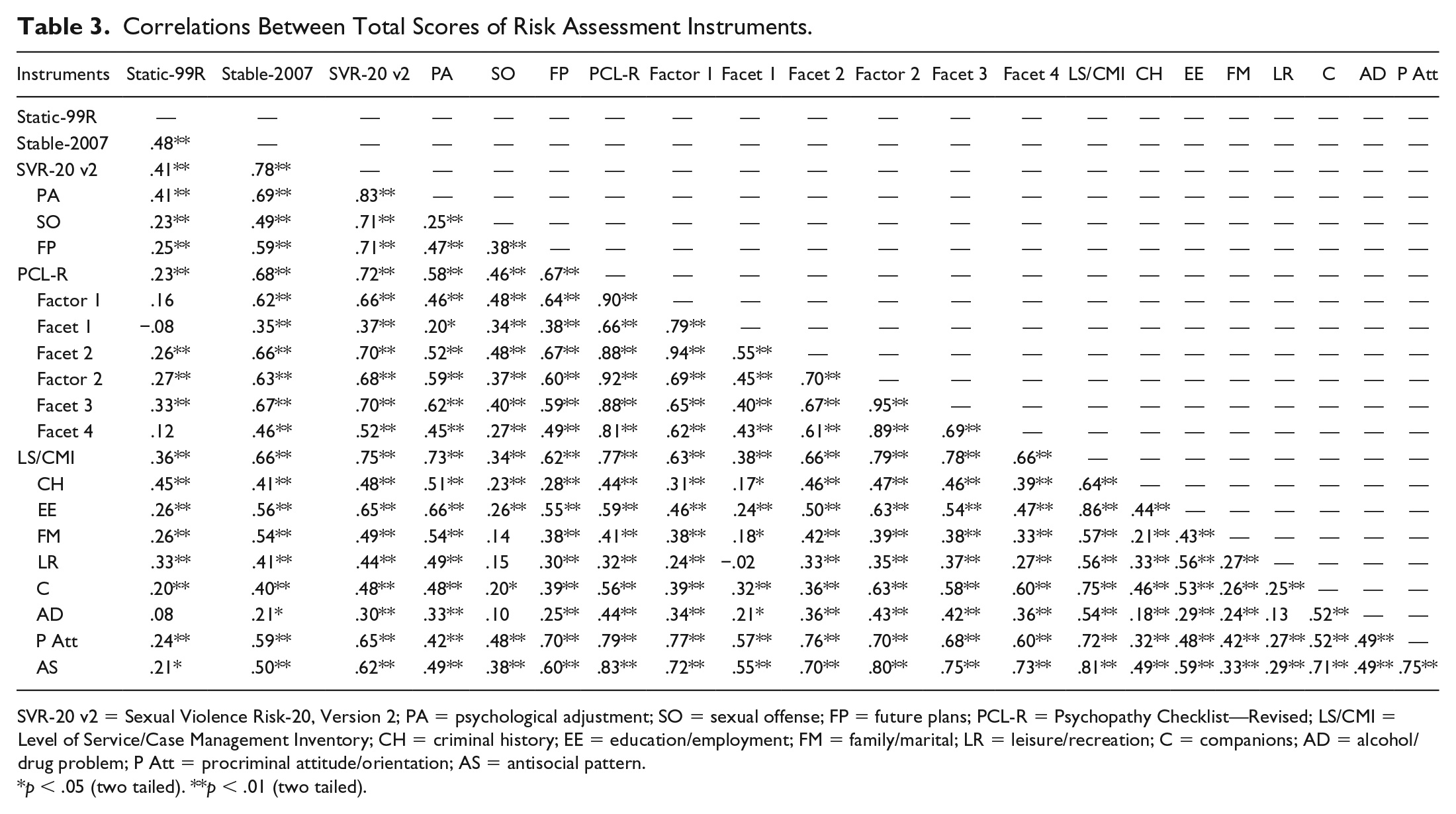
SVR-20 v2 = Sexual Violence Risk-20, Version 2; PA = psychological adjustment; SO = sexual offense; FP = future plans; PCL-R = Psychopathy Checklist—Revised; LS/CMI = Level of Service/Case Management Inventory; CH = criminal history; EE = education/employment; FM = family/marital; LR = leisure/recreation; C = companions; AD = alcohol/drug problem; P Att = procriminal attitude/orientation; AS = antisocial pattern.
p < .05 (two tailed). **p < .01 (two tailed).
Predictive Validity of Instruments for Sexual and Any Recidivism
Table 4 summarizes the predictive validity of sexual and any recidivism based on AUCs of the risk assessment instruments using their total scores, risk categories, and subscale scores. Due to the low base rate in this sample, it should be highlighted that even though most measures predicted recidivism, the confidence intervals (CI) were substantially wide. As such, the results should be interpreted with caution. In brief, all the instruments (i.e., Static-99R, Static-99R/Stable-2007, SVR-20 v2, PCL-R, and LS/CMI), regardless of total scores and risk categories, significantly predicted any forms of recidivism. The AUCs for the main measures were in the range of .64 to .79, and AUCs for the subscales ranged between .62 and .81. Most of the effect sizes were medium to large in magnitude.
Predictive Validity of Instruments for Sexual and Any Recidivism.
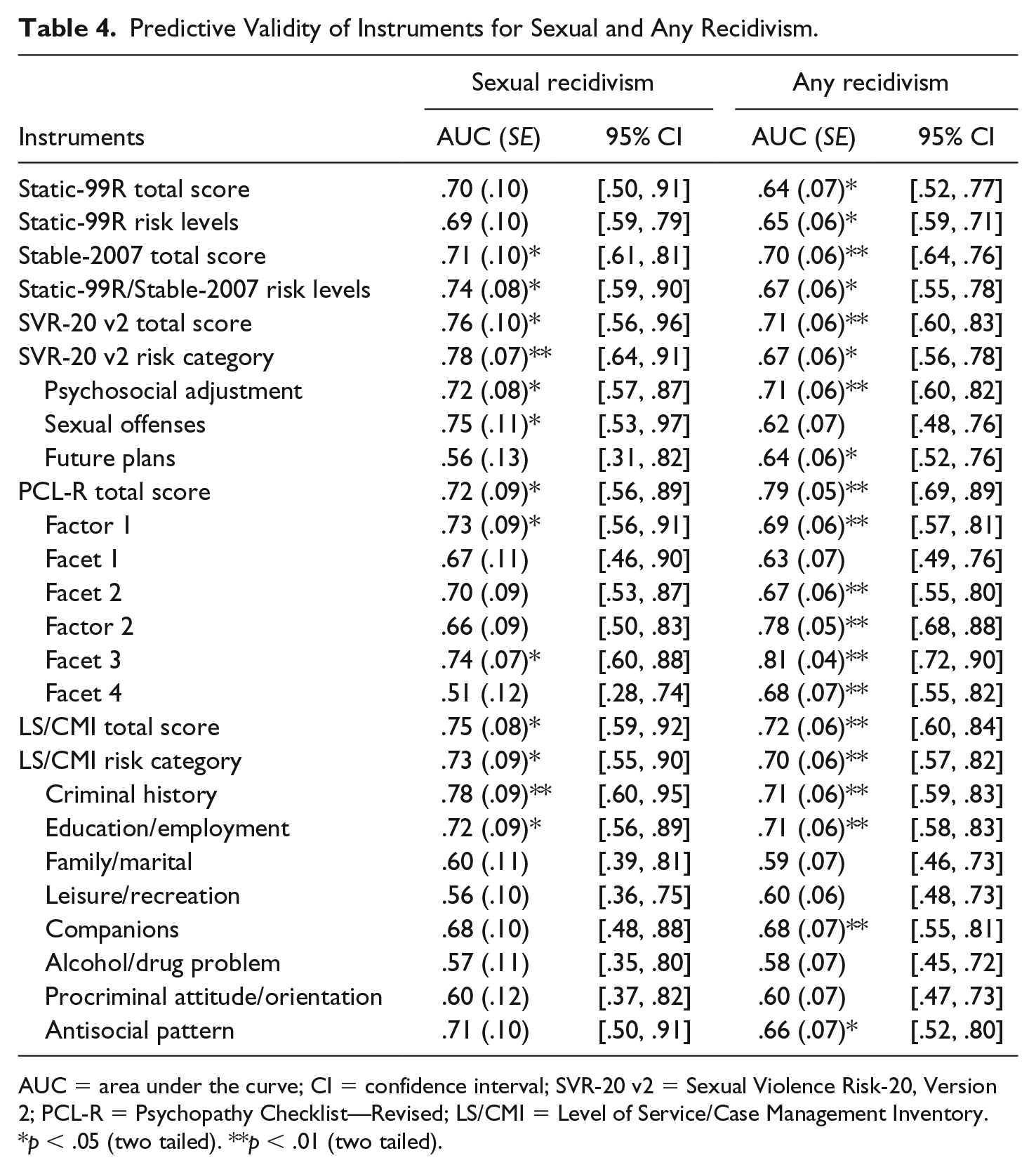
AUC = area under the curve; CI = confidence interval; SVR-20 v2 = Sexual Violence Risk-20, Version 2; PCL-R = Psychopathy Checklist—Revised; LS/CMI = Level of Service/Case Management Inventory.
p < .05 (two tailed). **p < .01 (two tailed).
For sexual recidivism, AUCs for the main risk scales ranged between .70 and .78, and the AUCs for the subscales were in the range of .51 to .78. Most of the effect sizes were medium to large in magnitude. Although Static-99R total scores were not significantly related to sexual recidivism, it is noted that it approached significance (CI reached but did not drop below .50).
Discussion
This study aimed to explore the applicability of Static-99R, Static-99R/Stable-2007, SVR-20 v2, PCL-R, and LS/CMI to predict sexual and any recidivism in the context of adults who have been convicted of sexual offenses and were referred to the Singapore probation services for suitability for community supervision. In general, the findings of this study supported both Hypotheses 1 and 2—All instruments predicted sexual and any recidivism; only Static-99R did not predict sexual recidivism. Although not significant, it is noted that the magnitude of predictive validity of Static-99R for sexual recidivism in this study is close to large (AUC = .70, 95% CI = [.50, .91]), similar to a meta-analysis examining the predictive validity of Static-99R for sexual recidivism (AUC = .69, 95% CI = [.69, .72]; Helmus, Hanson, et al., 2012). Due to the small sample size, low base rates, and the wide CIs in this study, caution should be exercised when interpreting the findings.
A possible explanation that Static-99R did not discriminate between sexual and nonsexual recidivists as well as the other sexual offender risk instruments is its inclusion of less culturally relevant risk factors. For example, the second item in Static-99R asks whether the offender has ever lived with a lover for at least 2 years, which may not be a risk factor in the local context. It is a common practice in Singapore that young adults live with their parents up to the time they get married and may not have a live-in lover until marriage. Thus, most of the sexual offenders would have received one point on that item even though it might not have been an additional risk factor in the Singapore context. Moreover, the younger age of this sample is correlated with the item and would have further skewed the group’s living arrangements to being a risk factor. Being an actuarial instrument, the measurement model in Static-99R assumes that an increase of one point on the total score would result in a similar increase in recidivism risk, whether from 2 to 3 points or an increase from 5 to 6 points (Hanson, Babchishin, Helmus, & Thornton, 2013). This assumption works well when each item is found to be empirically related to recidivism risk. In the Singapore context, as a result of one or more items that were not sensitive to the cultural norm, the assumption that each incremental point contributes to the same increase in risk could be violated.
Although the general finding of this study is that most of the investigated risk assessment instruments discriminated between recidivists and nonrecidivists, it is worth noting that the characteristics of this sample differed substantially on several variables when compared with the normative samples used in Static-99R, Stable-2007, PCL-R, and LS/CMI. First, despite a low base rate in this sample (consistent with the observed fewer psychopathic features and general recidivism risk factors), the distribution of scores and risk categories on both instruments were skewed toward higher risk on the Static-99R and Stable-2007. This was considerably so with Static-99R, where the participant at the lowest risk was at a Standardized Risk Level of III (Hanson, Babchishin, Helmus, Thornton, & Phenix, 2017). Second, the mean age of this sample of 23.5 was much lower compared with the Static-99R sample, where the mean age was 42 (Phenix, Helmus, & Hanson, 2016). The lower age of this sample was one of the contributing factors to the higher than average score on Static-99R. Third, the higher proportion of noncontact sexual offenders and the lower scores on general criminality (e.g., index nonsexual violence, prior nonsexual violence, prior sentencing dates, and any prior sex offenses) in this sample are more consistent with the profile of East Asian sexual offenders described in the Lee, Hanson, and Zabarauckas (2018) study. The majority of the current sample were of Chinese descent, which possibly shares more cultural commonality with Lee et al.’s sample than the normative sample on Static-99R. However, beyond the aforementioned similarities, victim profiles of these two samples differ (with the current study sample comprising a significantly greater proportion of unrelated and stranger victims). This suggests that although this sample shares some similarities with the East Asian sample residing in Canada (Lee et al., 2018), there are still considerable differences between the samples to suggest that adult males who have been convicted of sexual offenses in Singapore have a different risk profile.
Implications
An implication of this exploratory study was that it provides further support for Bonta’s (2002) call to validate instruments whenever the applicability of the cultural context is uncertain. The findings of this study supports the utility of the use of combined Static-99R/Stable-2007, SVR-20 v2, PCL-R, and LS/CMI for predicting sexual and any recidivism in individuals who have been convicted of sexual offenses in Singapore. It is highly recommended that clinicians assessing the risk of recidivism among adult sexual offenders in Singapore use these instruments to guide their risk assessments. They should also take into consideration the fact that the sexual offender risk profiles in Singapore are different from the samples that are predominantly White, possibly requiring different rehabilitation focus.
Limitations and Future Research
Despite the best efforts when designing this study, there were some limitations and methodological issues that arose and should be taken into account when interpreting the findings. First, compared with other studies that validated risk assessment instruments in a new population, this sample size was relatively small and recidivism rates were low. Sampling bias was likely to have contributed to the low recidivism rates. The participants of this study were limited to the sexual offenders who were referred to CFPS to assess for suitability for community supervision, thereby eliminating the sexual offenders who were already deemed by the courts not to meet the criteria for assessment. In view of the sampling bias, the results of this study may not be applicable to all sexual offenders in Singapore. Although the use of the ROC analysis helped in reducing the effects of low base rates (Rice & Harris, 1995), the problem with a small sample size is the higher chance of Type II error (i.e., reduced chance of finding a true effect). This might explain the satisfactory AUC values in the range of .60 to .89 found in this study, but they failed to produce a statistically significant effect.
Second, data for part of the study were gathered retrospectively and coding the risk assessment instruments was based on the available file information. Although the file information was comprehensive and covered most of the information required when coding the instruments, this data gathering methodology was less ideal than gathering prospective data for the purpose of the study. For example, specific information such as Factor 1 of PCL-R which taps into the interpersonal and affective style of the individual can only be inferred from the behavioral descriptions in the files. A face-to-face interview would have gathered more accurate information on the individual. Nonetheless, the retrospective method of coding instruments is commonly used in studies validating risk assessment instruments and findings from these studies are well accepted (Gray, Taylor, & Snowden, 2008).
Future studies could replicate the design of this study using a prospective method of collecting data, and using a larger sample size, and by following up with the sample over a longer period of time. Second, to improve the predictive validity of Static-99R in the local context, it would be helpful to examine the correlation of each item with recidivism and discard culturally irrelevant items from the instrument. To conduct such an analysis, a sample size larger than that used in this study is required. Third, this is the first known published study that validated the use of SVR-20 v2 to predict sexual and any recidivism. Further studies can be conducted to replicate the findings in other jurisdictions. Finally, the findings from this study could contribute to aggregate studies such as a meta-analysis to further validate the applicability of risk assessment instruments beyond the North American and Continental European forensic populations.
Footnotes
Acknowledgements
The authors would like to thank R.K. Hanson for his valuable inputs to this paper.
Declaration of Conflicting Interests
The author(s) declared no potential conflicts of interest with respect to the research, authorship, and/or publication of this article.
Funding
The author(s) received no financial support for the research, authorship, and/or publication of this article.
