




Abstract
Research suggests that there is a relation between childhood sexual abuse (CSA) and adulthood nonheterosexual orientation. To explore whether nonheterosexual orientation increases the risk of CSA, we recruited a large sample, added the variable of childhood gender nonconformity (CGNC), and applied the instrumental variable method. We found that heterosexual and nonheterosexual men who were more gender nonconforming in childhood were significantly more likely to report having a history of CSA than their gender-conforming counterparts. There was no relation between CSA and CGNC for heterosexual and nonheterosexual women. The instrumental variable analysis revealed that the increased prevalence of CSA experienced by nonheterosexuals compared with heterosexuals may be due to the influence of sexual orientation on CSA. In sum, the results suggest that nonheterosexuality may increase the risk of childhood sexual abuse.
Keywords
Childhood sexual abuse (CSA) occurs in all cultures and societies (Pereda, Guilera, Forns, & Gómez-Benito, 2009; Stoltenborgh, van Ijzendoorn, Euser, & Bakermans-Kranenburg, 2011). In addition, although not all research has demonstrated that the prevalence of CSA among lesbian, gay, and bisexual individuals is substantially higher than it is in heterosexual populations (Brennan, Hellerstedt, Ross, & Welles, 2007; Meston, Heiman, & Trapnell, 1999), higher prevalence of CSA among nonheterosexual individuals has been revealed in participants from the United States (e.g., Balsam, Rothblum, & Beauchaine, 2005), Canada (e.g., Saewyc, Pettingell, & Skay, 2004), and Australia (e.g., Zietsch et al., 2012), as well as in studies using the retrospective methods (e.g., Hughes et al., 2010), prospective methods (e.g., Wilson & Widom, 2010), and meta-analysis (e.g., Friedman et al., 2011). Moreover, empirical investigations aimed to determine the chronology of CSA and nonheterosexual orientation in adulthood are limited. Thus, the objective of the present study was to explore whether nonheterosexual orientation increases the risk of CSA by adding the variable of childhood gender nonconformity (CGNC) and applying the instrumental variable method.
CGNC and CSA
Children who do not conform to the social norms of their biological sex are termed gender nonconforming (Roberts, Rosario, Corliss, Koenen, & Austin, 2012). Specifically, we use this term to refer to boys who are relatively feminine or unmasculine and girls who are relatively masculine or unfeminine compared with the general population (Rieger, Linsenmeier, Gygax, & Bailey, 2008). A great deal of research has documented that homosexual individuals are more gender nonconforming in childhood than their heterosexual counterparts (e.g., J. M. Bailey & Zucker, 1995; Lippa, 2008). That is, on average, gay men are reported to be somewhat more feminine and lesbians are somewhat more masculine relative to their heterosexual counterparts. A meta-analysis conducted by J. M. Bailey and Zucker (1995) revealed that the sexual orientation difference in CGNC was large and effect sizes (Cohen’s ds) were about 1.0 for women and 1.3 for men. CGNC among homosexual adults has been evidenced in retrospective (Plöderl & Fartacek, 2009; Rahman, Bhanot, Emrith-Small, Ghafoor, & Roberts, 2012), prospective (Green, 1987), and cross-cultural studies (Cardoso, 2009; Whitam & Mathy, 1991), and in studies using childhood home videos (Rieger et al., 2008).
Moreover, given the strict norms guarding gender conformity and people’s negative attitudes toward gender nonconforming behavior, individuals who display gender nonconforming behavior are more likely to be targets for rejection, discrimination, victimization, and physical abuse than their gender-conforming counterparts (Sandfort, Melendez, & Diaz, 2007; Skidmore, Linsenmeier, & Bailey, 2006). Therefore, CGNC behavior displayed by children who are gay or lesbian in adulthood may be a possible reason why they are more likely to be sexually abused in childhood than their heterosexual counterparts (Figure 1). However, to our knowledge, only one study has examined the link between CGNC and CSA (Roberts et al., 2012). In addition, given the wide-ranging and long-lasting negative effects CSA may have on victims’ physical and mental health (Fergusson, McLeod, & Horwood, 2013), more studies are needed to explore the role of CGNC in the relation between CSA and sexual orientation.
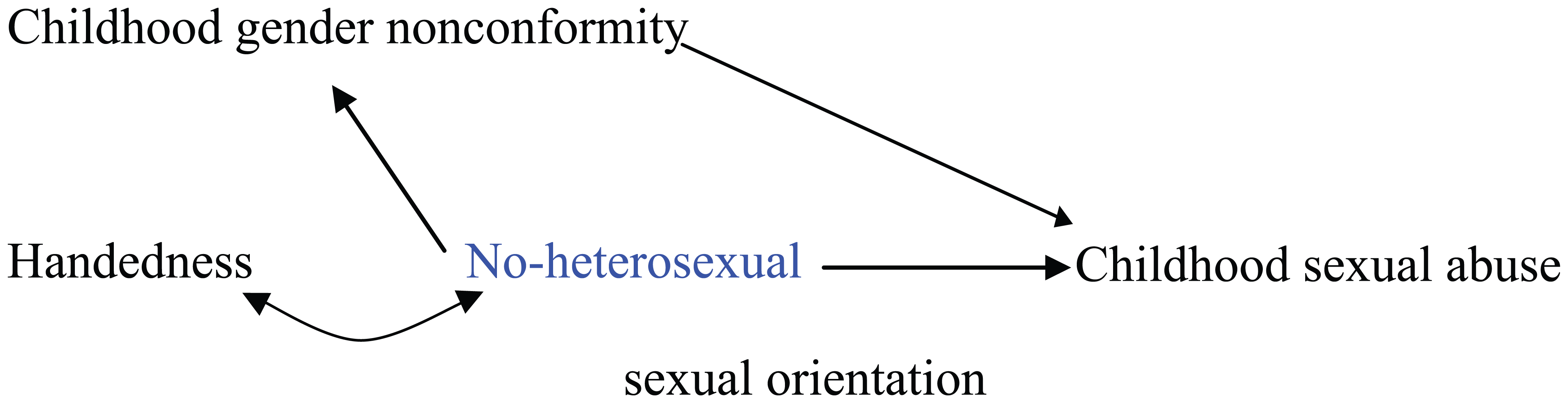
Pathway from nonheterosexual sexual orientation to childhood sexual abuse.
Sexual Orientation and CSA
Several theories have been offered to explain the association between CSA and sexual orientation. Given the majority of CSA perpetrators are men (Holmes & Slap, 1998), some researchers have suggested that CSA may cause an individual to develop a nonheterosexual orientation (Cameron & Cameron, 1995). Although both men and women report similar CSA experiences, divergent theories have been proposed to clarify the effect of CSA. Specifically, Gartner (1999) suggested that boys who are sexually abused by an older male may perceive the abuse as an indication that they are gay. It has also been speculated that when girls experience sexual abuse perpetrated by men, they may develop an aversion toward sexual relations with men; thus, they may feel more comfortable in intimate relationships with women (Marvasti & Dripchak, 2004). Furthermore, the experience of CSA may generate uncertainty about sexual orientation that leads to more experimentation with both opposite- and same-sex relationships, regardless of ultimate sexual orientation (Gartner, 1999).
There are also other explanations that suggest that nonheterosexual orientation may be a risk factor for sexual exploitation (Friedman, Marshal, Stall, Cheong, & Wright, 2008). For example, it is possible that teenagers who are exploring their sexual orientation are more likely to put themselves in situations (e.g., public sex environments) where there is an increased risk of being sexually abused (Balsam et al., 2005; Holmes & Slap, 1998). For instance, adolescent males who are exploring and questioning their sexual orientation may seek out and become involved in sexual relations with older men; it is also possible that some of these encounters may be coercive in nature. However, for many adolescent males, these relations may have been the only venue for sexual exploration (Relf, 2001). Because of people’s negative attitudes toward gender nonconforming behavior (Skidmore et al., 2006), it has also been suggested that children who are gay or lesbian in adulthood tend to display gender nonconforming behavior that increases their likelihood of being sexually abused (Andersen & Blosnich, 2013; Roberts et al., 2012).
Although considerable theoretical attention and debate has been given to understanding the relation between CSA and sexual orientation, empirical investigations in this area are limited. For instance, Wilson and Widom (2010) prospectively explored the association between CSA and nonheterosexual sexual relationships/cohabitation and reported that men who had experienced CSA were more likely than men in a control group to report nonheterosexual sexual partnership. However, this study had some limitations. First, official records of CSA that likely reflected particularly severe cases of CSA were used; therefore, cases of CSA that did not catch authorities’ attention were excluded, and the results may not generalize to a general sample. Second, it could not be determined whether the nonheterosexual sexual attraction preceded or followed CSA.
In another study, Roberts, Glymour, and Koenen (2013) investigated whether CSA preceded nonheterosexual orientation by using instrumental variable methods based on family characteristics (presence of a stepparent, poverty, parental alcohol use, and parental mental illness) that are linked to CSA but not directly related to sexual orientation. These authors suggested that CSA may cause individuals to develop a nonheterosexual orientation. However, other researchers doubted the validity of the instrumental variables that Roberts et al. (2013) used and suggested that a third variable, such as genes, could influence both the instrumental variables and the adult minority sexual orientation (D. H. Bailey & Bailey, 2013; D. H. Bailey, Ellingson, & Bailey, 2014). Moreover, Rind (2013) also provided an alternative model and argued that when normative controls (i.e., cultural norms) are weakened, counternormativity (i.e., deviant attitudes, unconventional or disapproved sex) mediates homosexual orientation rather than CSA. Thus, more empirical evidence is needed to examine the relation between CSA and sexual orientation.
The Instrumental Variable Approach
Due to the ethical constraints, most previous studies that have investigated the association between CSA and sexual orientation have used retrospective methods. In those studies, CSA before age 18 was measured retrospectively in adulthood and participants’ sexual orientation in adulthood was assessed. Thus, it is a challenge to ascertain the chronology of CSA and sexual orientation in these retrospective studies. Specifically, we cannot determine whether the nonheterosexual sexual attraction preceded or followed CSA or whether a third unmeasured variable affects both nonheterosexual orientation and CSA. However, the instrumental variable method can investigate whether correlations between putative causes (in this case, sexual orientation) and putative effects (in this case, CSA) are causal in cases where there are uncontrolled confounds or bidirectional causation (Angrist & Krueger, 2001). In addition, the instrumental variable method has been embraced by economists for some time (Angrist & Krueger, 2001), and researchers have suggested that the instrumental variable method is a promising approach for establishing causal effects and advancing developmental theory (Gennetian, Magnuson, & Morris, 2008). Thus, in the present study, we used the instrumental variable method to explore whether sexual orientation increases the risk of CSA.
In a classic example adopting instrumental variable method, Miguel, Satyanath, and Sergenti (2004) tested whether economic conditions affect likelihood of civil conflict in African countries. The correlation between these two variables may be bidirectional and can be affected by uncontrolled confounds, such as government institutional quality. Miguel et al. (2004) used rainfall variation as an instrumental variable because rainfall affected the income growth in sub-Saharan Africa that largely relied on rain-fed agriculture, while it was not directly related to civil right. They found that there was a strongly positive correlation between rainfall and income growth, and higher levels of rainfall were associated with significantly less civil conflict. Thus, they claimed that economic growth is strongly negatively related to civil conflict.
In the present study, the first step of the instrumental variable approach was to find good instrumental variables. In the present study, handedness was selected as an instrumental variable given its association with sexual orientation (Blanchard & Lippa, 2007; Lalumière, Blanchard, & Zucker, 2000). However, the results of studies on the relation between handedness and sexual orientation are inconsistent. Specifically, some studies have found that non-right-handedness is associated with homosexuality in both sexes (e.g., Blanchard & Lippa, 2007; Lalumière et al., 2000). Other studies have only found that homosexual men (e.g., Lippa, 2003) or homosexual women (e.g., Mustanski, Bailey, & Kaspar, 2002) are significantly more likely to be non-right-handed than their heterosexual counterparts. In addition, there are studies that have revealed that sexual orientation is not related to handedness for either sex (e.g., Miller, Hoffmann, & Mustanski, 2008; Rahman, 2005). However, a meta-analysis conducted by Lalumière et al. (2000) demonstrated that non-right-handedness was associated with homosexuality in both sexes with an average phi coefficient of .10 and homosexual individuals had 39% greater odds of being non-right-handed compared with heterosexual individuals. Moreover, most studies that did not find an association between sexual orientation and handedness had small sample sizes (e.g., Miller et al., 2008; Rahman, 2005). It is possible that the relation between sexual orientation and handedness was obscured because of the small sample size. Therefore, we hypothesized that Chinese homosexual men and women would be significantly more likely to be non-right-handed than their heterosexual counterparts in a large sample. Importantly, to be a good instrumental variable in the present study, handedness should relate to or affect sexual orientation but should not be either directly related to CSA or indirectly related via unmeasured putative causes. Moreover, handedness can plausibly be related to CSA through its association with sexual orientation (Baiocchi, Cheng, & Small, 2014).
The second step of the instrumental variable approach is to use handedness to extract variation in sexual orientation that is free of uncontrolled confounds. Finally, use this confounds-free variation in sexual orientation to estimate the cause effect of the sexual orientation to CSA (Baiocchi et al., 2014).
The Present Study
The objective of this study was to explore whether nonheterosexual orientation increases the risk of CSA by adding the variable of CGNC and applying the instrumental variable method. First, if CGNC behavior displayed by children who are nonheterosexuals in adulthood increased their likelihood of being sexually abused, it is reasonable to speculate that the prevalence of CSA would be elevated in youth who are more gender nonconforming. Second, we used handedness as an instrumental variable to explore whether sexual orientation increases the risk of CSA. Specifically, if participants who are non-right-handed are both more likely to have nonheterosexual orientation and to be sexually abused in childhood, this suggests a causal pathway from handedness through nonheterosexual orientation to CSA (Figure 1). If, alternatively, participants who are non-right-handed are more likely to have nonheterosexual orientation but do not have higher prevalence of CSA experiences, this suggests sexual orientation does not affect CSA.
Method
Participants and Procedures
Survey was administered in Chinese and data were collected via a web-based survey hosted by Wenjuanxing (a Chinese survey website). Gay participants were recruited via notices (including the website and purpose of the questionnaire) placed on some Chinese websites that serve gay individuals, including homosexual forums and chat rooms. Potential participants were told that participation in this project would contribute to our knowledge of sexual orientation and sexual identity development, and they were assured that their information would be kept strictly confidential. The process of recruiting heterosexual individuals was similar, except that they were recruited via notices posted on general Internet forums and websites. Participants were required to complete a questionnaire which comprised the measures of sexual orientation, CGNC, handedness, CSA experiences, and demographic information. A total of 1927 participants responded to the questionnaire but 174 responses were excluded from the analyses because they were incomplete. Thus, the rate of completion of this study was 90.97%. All study procedures were approved by the ethics committee of a local university prior to data collection.
Measures
Sexual orientation
Sexual orientation was assessed by one item pertaining to sexual identity. Participants were required to choose their sexual orientation from gay/lesbian, heterosexual, or bisexual in reply to the question, “What is your sexual orientation?”
CGNC
CGNC was measured by the CGNC Scale (Rieger et al., 2008) to the age of 12 years (Plöderl & Fartacek, 2009; Rahman et al., 2012). It has seven items which assess the degree of gender nonconformity of participants’ recalled childhood behavior for each sex and includes necessary contents (i.e., activity preference, rough play, and cross-dressing) used to measure CGNC (J. M. Bailey & Zucker, 1995). Many studies that used this scale found the sexual orientation difference in CGNC (e.g., Rieger et al., 2008; Skidmore et al., 2006). Example items of the CGNC Scale are “As a child, I preferred playing with girls than boys” for men and “as a child, I was called a tomboy by my peers” for girls. Items were rated on a 7-point scale ranging from 1 = strongly disagree to 7 = strongly agree. The Chinese version of CGNC Scale used in the current study was translated from the original one and back-translated. The Cronbach’s alpha of the scale in the present sample is .85.
Handedness
Handedness was assessed with the question, “Which is your natural writing hand?” (Blanchard & Lippa, 2007). Participants were required to choose their handedness from left, right, or ambidextrous (Mustanski et al., 2002). Research demonstrated that the range of scores used to determine non-right-handedness and the use of single versus multiple items to determine handedness did not affect the relations between handedness and sexual orientation (Lalumière et al., 2000). Thus, the present study used one item to assess handedness.
Childhood sexual abuse
CSA was assessed with the question, “Have you ever been forced or frightened by someone into doing something sexually that you did not want to do before age 18?” (Catania et al., 2008). Something sexually included both noncontact (e.g., sexual propositions and exhibitionism; Fergusson et al., 2013) and sexual contact (e.g., sexual fondling, touch someone or be touched in a sexual way, or other type of sexual activities including oral, anal, or vaginal intercourse; Catania et al., 2008; Roberts et al., 2013). Participants were classified as having had a CSA experience if they answered “yes.”
Demographic information
Demographic information included participants’ gender, age, education level (junior high school or less, senior high school, college, or postgraduate or higher), nationality (Han or the ethnic minorities), and province of residence.
Analysis
The analysis proceeded first use cross-tabulations to examine the relation between sexual orientation and CSA, and between sexual orientation and handedness. The analysis then adopted one-way (sexual orientation: heterosexual, bisexual, gay/lesbian) analysis of variance (ANOVA) separately by gender to address the sexual orientation difference in CGNC. The analysis further presented logistic regression approach separately by gender and sexual orientation to estimate the effect of CGNC on CSA.
The final analysis adopted the instrumental variable methods. First, we test whether handedness is a good instrumental variable using logistic regression. We next assessed the association between sexual orientation and CSA using conventional logistic regressions. We finally conducted instrumental logistic regression using a two-stage estimation process to estimate the effect of sexual orientation on CSA: The handedness was used as independent variables to model sexual orientation in the first stage; in the second stage, the predicted sexual orientation value from the first stage (rather than the actual sexual orientation value) was used as the independent variable in models with CSA as the dependent variable (Angrist & Krueger, 2001). The logistic regression and instrumental logistic regression were conducted with adjustment for age, education, and nationality. All analyses were conducted using SPSS 17.0.
Results
Demographic Information of the Sample
Table 1 presents the demographic information of the sample. The sample consisted of 340 heterosexual men, 388 gay men, 154 bisexual men, 426 heterosexual women, 309 lesbian, and 136 bisexual women from 32 provinces/regions of China. For age, a 2 (gender: male, female) × 3 (sexual orientation: heterosexual, bisexual, gay/lesbian) univariate ANOVA revealed a significant main effect for gender, F(1, 1747) = 128.68, p < .001, partial η2 = .07, indicating that men were significantly older than women, and there was not a significant effect for sexual orientation, F(2, 1747) = 0.62, p = .540, and no significant gender by sexual orientation interaction, F(2, 1747) = 2.67, p = .070. We then cross-tabulated education with sexual orientation separately by gender. Statistical analysis showed that both heterosexual men and women are significantly more likely than their nonheterosexual counterparts to report having higher educational level, χ2(6) = 68.80, p < .001; χ2(6) = 233.03, p < .001. We next cross-tabulated nationality with sexual orientation separately by gender. Statistical analysis showed that the heterosexual women are significantly more likely than their nonheterosexual counterparts to report being ethnic minority, χ2(2) = 13.89, p < .001. There was no relation between nationality and sexual orientation for men, χ2(2) = 1.15, p = .563.
Demographic Information, Prevalence of Childhood Sexual Abuse, and Handedness by Gender and Sexual Orientation.
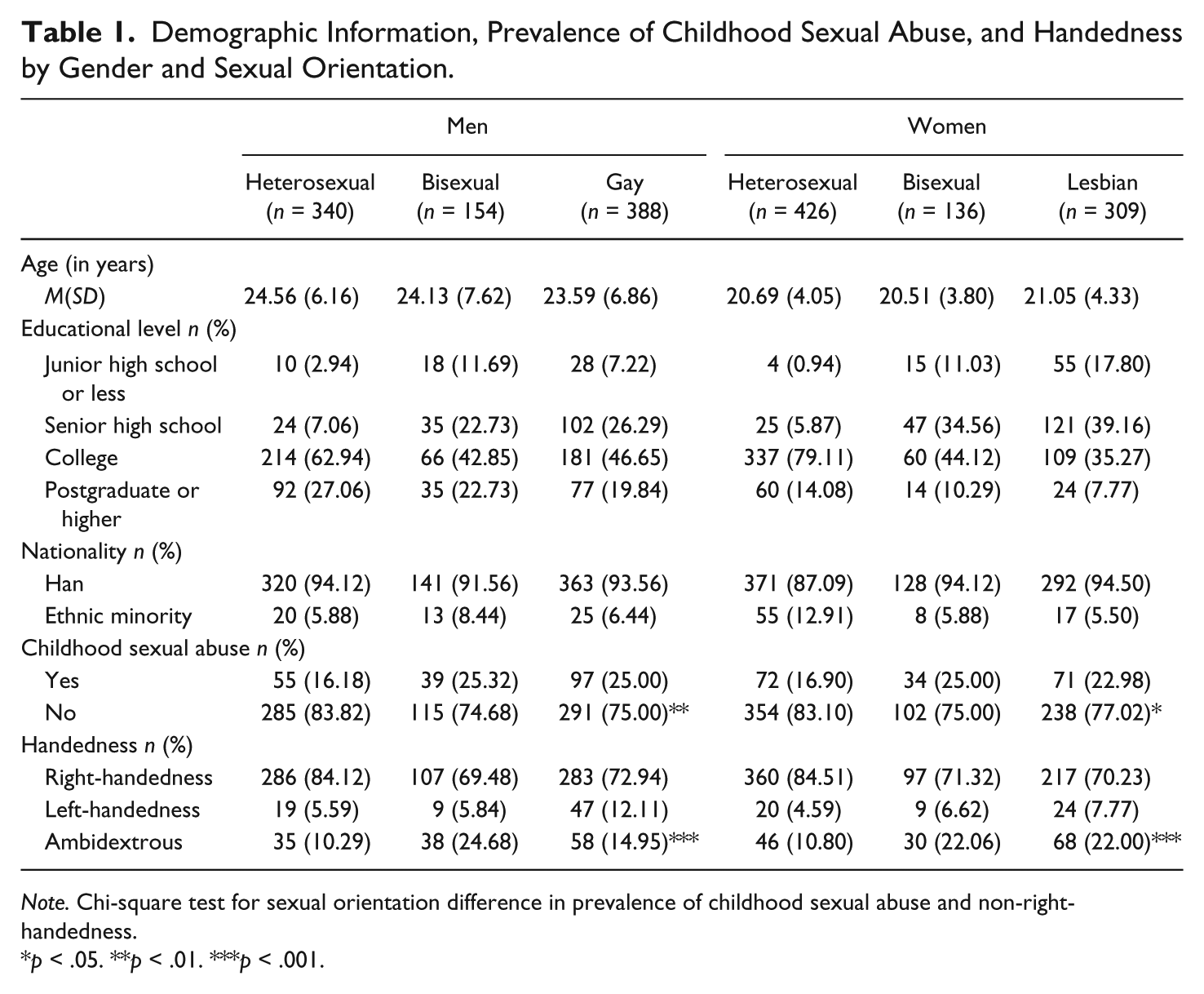
Note. Chi-square test for sexual orientation difference in prevalence of childhood sexual abuse and non-right-handedness.
p < .05. **p < .01. ***p < .001.
Sexual Orientation and CSA
Table 1 presents the prevalence of CSA separately by gender and sexual orientation. For both sexes, gay/lesbian and bisexual men/women were significantly more likely to be sexually abused in childhood than their heterosexual counterparts, χ2(2) = 9.80, p < .01, Cramer’s V = 0.11, and χ2(2) = 6.26, p < .05, Cramer’s V = 0.09, for men and women, respectively. Cramer’s V reflects the strength of relationship between two nominal variables and has a value between 0 and 1. A value close to 0 indicates a weak association, while a large value close to 1 indicates a strong association.
Sexual Orientation and Handedness
Table 1 also presents the distribution of handedness separately by gender and sexual orientation. For both sexes, both gay/lesbian and bisexual men/women were significantly more likely to report being non-right-handed than their heterosexual counterparts, χ2(4) = 25.59, p < .001, Cramer’s V = 0.13, and χ2(4) = 24.92, p < .001, Cramer’s V = 0.12, for men and women, respectively.
Sexual Orientation and CGNC
For both sexes, one-way ANOVA revealed a significant main effect for sexual orientation, F(2, 879) = 113.56, p < .001, partial η2 = .21, and F(2, 868) = 143.28, p < .001, partial η2 = .25 for men and women, respectively. Post hoc testing (LSD) showed that both gay (M = 3.95, SD = 1.38) and bisexual men (M = 3.51, SD = 1.23) were significantly more gender nonconforming in childhood than heterosexual men (M = 2.54, SD = 1.14), Cohen’s d = 1.11 and 0.83, respectively, all ps < .001; both lesbian (M = 4.83, SD = 1.55) and bisexual women (M = 4.34, SD = 1.50) were significantly more gender nonconforming in childhood than heterosexual women (M = 3.09, SD = 1.28), Cohen’s d = 1.42 and 0.94, respectively, all ps < .001.
CGNC and CSA
The present study demonstrated that both gay/lesbian and bisexual individuals are significantly more likely to be sexually abused in childhood, non-right-handed, and gender nonconforming in childhood than their heterosexual counterparts. In addition, only 16.54% (n = 290) of the total sample (n = 1,753) were bisexual individuals. Thus, we combined the gay/lesbian and bisexual participants into a single nonheterosexual group in the following analyses (Blanchard & Lippa, 2007).
Table 2 presents the results of the logistic regression approach. For both heterosexual and nonheterosexual men, CGNC was a significant predictor for CSA, Wald = 6.39, p < .05, Wald = 4.95, p < .05, indicating that heterosexual and nonheterosexual men who are more gender nonconforming in childhood were significantly more likely to report having a history of CSA than their gender-conforming counterparts. When the odds ratio (eB) was transformed to the percentage change in the ratio for one-unit increase in the predictor: 100 × (eB − 1), the results showed that heterosexual and nonheterosexual men who are more gender nonconforming in childhood had 41% or 19% greater odds of being sexually abused in the childhood, respectively.
Logistic Regression of Child Sexual Abuse on Childhood Gender Nonconformity, With Separate Analyses for Gender and Sexual Orientation.
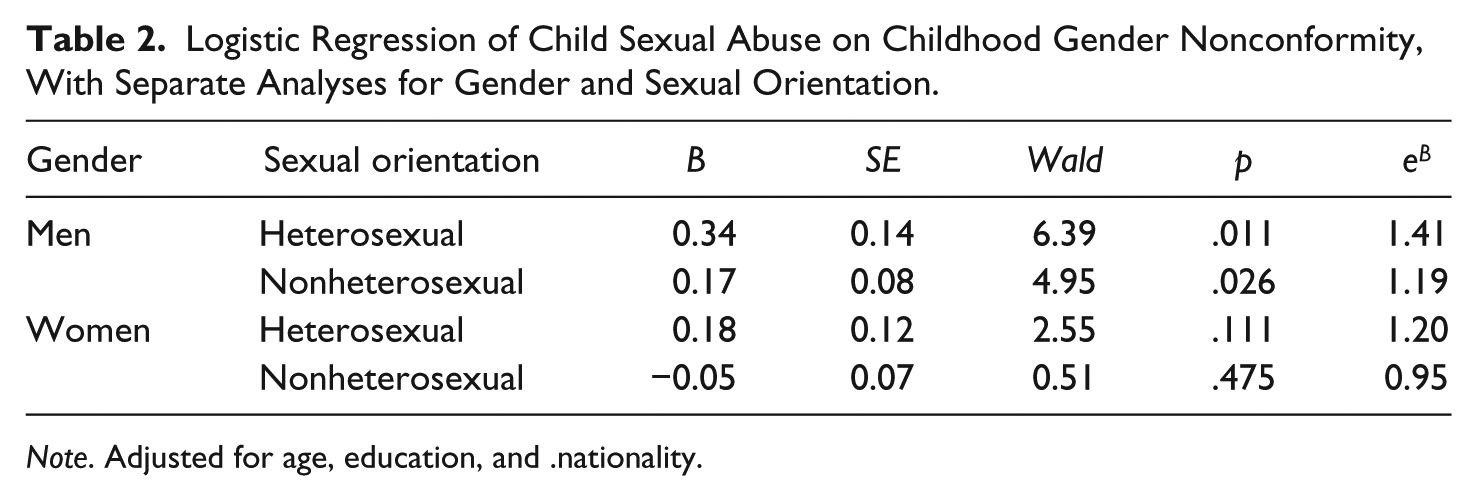
Note. Adjusted for age, education, and .nationality.
For both heterosexual and nonheterosexual women, CGNC was not a significant predictor for CSA, Wald = 2.55, p = .111, Wald = 0.51, p = .475, indicating that there was no relation between CSA and CGNC for heterosexual and nonheterosexual women.
Instrumental Variables Analysis
The logistic regression of sexual orientation on handedness revealed handedness as an instrumental variable strongly predicted sexual orientation (eB = 1.56, 95% confidence interval [CI] = [1.35, 1.81]). The Wald F-statistic = 35.39, p < .001, far exceeded the generally recommended threshold of F > 10 to avoid weak instrument bias (Staiger & Stock, 1997). In addition, the logistic regression of CSA on handedness revealed that handedness as an instrumental variable was not associated with CSA after adjustment for sexual orientation (eB = 1.14, 95% CI = [0.97, 1.33]), Wald F-statistic = 2.60, p = .107. This logistic regression indicated the handedness is a good instrumental variable.
In conventional logistic regressions, we found a strong association between sexual orientation and CSA, Wald F-statistic = 7.35, p < .01, indicating nonheterosexual individuals were significantly more likely to be sexually abused in the childhood than their heterosexual counterparts. In instrumental logistic regression, we also found a strong association between sexual orientation and CSA, Wald F-statistic = 4.63, p < .05, indicating sexual orientation may precede CSA and increase the risk of CSA. Overall, the estimate of effect of sexual orientation on CSA from the instrumental logistic regression (eB = 5.85, 95% CI = [1.17, 29.22]) are larger than the estimate from the conventional logistic analysis (eB = 1.43, 95% CI = [1.10, 1.84]). When the odds ratio (eB) was transformed to the percentage change in the ratio for one-unit increase in the predictor: 100 × (eB − 1), the results showed that participants with the nonheterosexual orientation had 43% or 48.5% greater odds of being sexually abused in the childhood in conventional logistic regression and instrumental logistic regression, respectively.
Discussion
The results of this study indicated that heterosexual and nonheterosexual men who were more gender nonconforming in childhood were more likely to report having a history of CSA than their gender-conforming counterparts. However, there was no relation between CSA and CGNC for heterosexual and nonheterosexual women. Previous research suggests that gender nonconformity is less socially acceptable in boys than in girls (Sandnabba & Ahlberg, 1999; Skidmore et al., 2006), with boys receiving more disapproval for CGNC (Sandnabba & Ahlberg, 1999). Thus, CGNC may have a stronger relation with child maltreatment and may increase the risk of more serious sequelae in boys than in girls (Roberts et al., 2012). A second explanation for this result is Femi-negativity. Femi-negativity is defined as the devaluation of femininity, especially a devaluation of any form of femininity that does not adhere to gender norms (Bishop, Kiss, Morrison, Rushe, & Specht, 2014). Moreover, gay men are reported to be somewhat more feminine relative to heterosexual men, and Chinese people show a relatively negative attitude towards lesbian and, especially, gay orientations (Gai, Wang, Gai, & Xun, 2013; Yu, Xiao, Wang, & Shun, 2010). Consequently, men who are feminine experience prejudice, discrimination, and even violence (in this case, CSA; Blair & Hoskin, 2015). The results of the present study support this hypothesis.
A number of possible explanations for the relation between CSA and CGNC emerged herein. First, a great deal of research has documented that homosexual individuals are more gender nonconforming in childhood than their heterosexual counterparts (J. M. Bailey & Zucker, 1995; Lippa, 2008). Thus, those individuals who display more gender nonconforming behavior are likely to be children who are gay or lesbian in adulthood. Given societal restrictions on adolescent sexual behavior or on same-sex sexual behavior, which limit the number of opportunities and locations in which adolescents can safely explore their sexuality, it is possible that teenagers who are exploring their sexual orientation are more likely to put themselves in situations (e.g., public sex environments) where there is an increased risk of being sexually abused (Balsam et al., 2005; Holmes & Slap, 1998). However, the present study did not measure those risk-taking behaviors. Thus, this explanation needs to be tested in further research. Second, research has also shown that individuals tend to expect homosexual men to be feminine and homosexual women to be masculine (Haddock, Zanna, & Esses, 1993). Thus, individuals who display more CGNC may more often be labeled as sexual minorities; this may increase their likelihood for being targets for maltreatment (Skidmore et al., 2006). Third, it is possible that individuals who are willing to identify themselves as gay men and lesbians and describe themselves as gender nonconforming in childhood may also be more willing to report CSA experiences (Roberts et al., 2012).
Previous retrospective studies that investigated the association between CSA and sexual orientation cannot determine whether the nonheterosexual orientation preceded or followed CSA or whether a third unmeasured variable affects both nonheterosexual orientation and CSA. However, the instrumental variable method used in the present study can investigate whether correlation between sexual orientation and CSA is likely causal (Angrist & Krueger, 2001). Specifically, the instrumental variable analysis revealed that the increased prevalence of CSA among nonheterosexuals compared with heterosexuals may be due to the influence of sexual orientation on CSA. This may operate through previously proposed pathways. As noted above, this relation could be due to individuals placing themselves in risk-taking situations or due to children who are gender nonconforming being targeted for CSA; however, it is also possible that the explanation can be found in the literature on the onset of sexual experience in nonheterosexual teenagers. Previous studies have demonstrated that nonheterosexual teenagers are more likely to have earlier sexual experiences and an increased number of sexual partners (e.g., Goodenow, Szalacha, Robin, & Westheimer, 2008; Parkes et al., 2011). In addition, Rind (2013) suggests that the likelihood of being sexually abused increases when a minor engages in several early sexual experiences or has multiple partners. Research has also found that there is a relation between CSA experience and increased sexual activity (e.g., Najman, Dunne, Purdie, Boyle, & Coxeter, 2005). However, the relation between CSA and increased sexual activity is bidirectional (Rind, 2013), and it is possible that CSA leads to more risky sexual behaviors (Lloyd & Operario, 2012).
In addition, we found that the estimated effect of sexual orientation on CSA from the instrumental variable analysis was larger than the estimate from the conventional logistic analysis. Sexual orientation is generally defined by whether someone is erotically attracted to females, males, or both (LeVay & Valente, 2006). Savin-Williams (2006) noted that the assumed prevalence of gay men and lesbians depends on which component is being used to assess sexual orientation and which criteria are used to classify individuals as gay men and lesbians. In the present study, we used sexual identity to assess sexual orientation. On one hand, the measurement of sexual orientation based on sexual identity excluded those who have same-sex attraction or engage in same-sex behavior but do not identify themselves as gay, lesbian, or bisexual (Savin-Williams, 2006). On the other hand, Chinese people show a relatively negative attitude towards lesbian and gay orientation (Gai et al., 2013; Yu et al., 2010). Thus, some Chinese gay men and lesbians may not characterize themselves as nonheterosexual. As a result, it is possible that the difference between heterosexuals and nonheterosexuals in the prevalence of CSA was attenuated; the estimated effect of sexual orientation on CSA from the conventional variable analysis is smaller than the estimate from the instrumental logistic analysis.
The application of the instrumental variable method used herein relied on the assumption that the instrumental variable would affect the sexual orientation and would only be related to CSA through its association with sexual orientation. The prenatal hormone theory has been proposed and suggests that prenatal androgen exposure is associated with CGNC (J. M. Bailey & Zucker, 1995) and handedness (Lalumière et al., 2000). Thus, it is reasonable to speculate that CGNC may be related to handedness. Our results and previous research (Roberts et al., 2012) have found there is a relation between CSA and CGNC. Thus, it may also be that handedness is related to CSA through its association with CGNC. Importantly, it has been documented that sexual orientation is associated with both handedness (Lalumière et al., 2000) and CGNC (J. M. Bailey & Zucker, 1995; Lippa, 2008). Thus, the relation between handedness and CGNC may be through their association with sexual orientation; this does not contradict our assumptions for the instrumental variable.
There are also different explanations for the association between sexual orientation and CSA, including the proposal that CSA causes an individual to develop a nonheterosexual orientation (Gartner, 1999; Roberts et al., 2013). However, other arguments have also been made against this explanation. First, research has shown that sexual orientation is more socially influenced and malleable in women than in men (Diamond, 2007). Thus, it is conceivable that external factors such as CSA might influence sexual orientation in women to a greater extent than in men. However, previous studies that have examined whether CSA causes an individual to develop a nonheterosexual orientation have yielded the opposite results (Roberts et al., 2013). Second, if CSA causes nonheterosexuality, there should be a much higher percentage of the population identifying as gay/lesbian or bisexual (Andersen & Blosnich, 2013). Third, the studies in this area did not explore the effect of CGNC on CSA; indeed, CGNC may explain the difference in abuse between heterosexuals and nonheterosexuals (Andersen & Blosnich, 2013). Considering these arguments and the results of this study, it is possible that nonheterosexual orientation precedes CSA.
Importantly, our results should be considered in the context of six further limitations. First, the experiences of CSA and CGNC were measured retrospectively; thus, recall error could bias the results. However, a study comparing retrospective reports of CGNC and an assessment based on the analysis of childhood home videos found these two methods were consistent (Rieger et al., 2008). Second, there was no measure of the separation between CGNC and when CSA occurred. Thus, we cannot ensure nonconforming gender behaviors preceded CSA. Third, we used only a single item to assess the occurrence of CSA. Previous research has revealed that it is difficult for single-item measures to achieve acceptable reliability (Postmes, Haslam, & Jans, 2013). In addition, Stoltenborgh et al. (2011) pointed out that the number of questions used to assess CSA affects the reported prevalence of CSA. Thus, the single item used in the present study may affect our estimated prevalence of CSA. Fourth, we used a high cut-off age (up to age 18) to define childhood. Previous research has revealed that the age used to define childhood affects the estimated prevalence of CSA (Pereda et al., 2009). Thus, the present study may yield a higher prevalence estimate than studies that used a more restrictive definition of childhood (e.g., up to age 13). However, the prevalence of CSA found in the present study was comparable with the prevalence estimate reported in a meta-analysis (21.0%) that used up to age 18 to define childhood (Pereda et al., 2009). Fifth, the sample used in this study was recruited through the Internet and, therefore, was not selected at random. Importantly, individuals who use the Internet may not necessarily be representative of all heterosexuals, gay/lesbian, and bisexual individuals. Therefore, the results may not easily be generalizable to the population at large. Sixth, it may be problematic to combine gay/lesbian and bisexual individuals because bisexual individuals sometimes differ from gay/lesbian individuals on some constructs. However, the similarity between gay/lesbian and bisexual individuals in the measures (the prevalence of CSA, handedness, and CGNC) assessed in this study and the small number of bisexual individuals attenuated the potential for the results being skewed by combining gay/lesbian and bisexual individuals together. These limitations should be addressed in future replication studies.
In conclusion, for heterosexual and nonheterosexual men, CGNC may increase the risk of CSA. However, there was no relation between CSA and CGNC for heterosexual and nonheterosexual women. The increased prevalence of CSA experienced by nonheterosexuals compared with heterosexuals may be due to the influence of sexual orientation on CSA. In sum, the results suggest that nonheterosexuality may increase the risk of CSA.
Footnotes
Declaration of Conflicting Interests
The author(s) declared no potential conflicts of interest with respect to the research, authorship, and/or publication of this article.
Funding
The author(s) disclosed receipt of the following financial support for the research, authorship, and/or publication of this article: This research is supported by the MOE Project of Humanities and Social Sciences (15YJA190011), China.