




Abstract
Implications for Practice and Research
Intentionally engaging with nature is an avenue for generating a healing force that could be facilitated by nurses caring for patients. Florence Nightingale was both practical and mystical; the application of spiritual dimensions to health and healing routinely surfaced in her writing. Nature immersion, a generative healing force emerging from within a person who is connecting with earthy materials, is embodied as personal emergence. Implementation of action guided by the middle range Theory of Nature Immersion notes requires that nurses plan for creative approaches that put those in our care in touch with earthy materials.
Florence Nightingale's perspectives on public health affirm her appreciation for the strong impact of nature on health and healing, and suggest an integrative approach that crosses a range of disciplinary interests, including sanitation, statistics, healthcare design and delivery, and spirituality (Dossey, 2010; Rosa & Hassimiller, 2020). A seldom recognized perspective, healing vital power, is the focus of this article. To Nightingale, power resided in nature; “Nature alone cures” (Nightingale, 1859, p. 74). She also noted that power is embodied in the person, specifically in the context of health: “Health is not only to be well, but to be able to use well every power we have” (Nightingale, 1893, p. 186). In this context, power implies a healing force generated from within; it can be nurtured by others and expressed through the physical body (Beck, 2005a, p. 158). The term vital power is defined as a life spark or natural impulse expressive of the human spirit; a life-spark is an energizing “life-giving power” (Beck, 2005b, p. 181; Nightingale, 1893, p.189).
Extending this thinking by introducing nature immersion, if one assumes that well-being can be achieved through person–nature engagement where well-doing occurs, there is reason to believe that intentionally engaging with nature is an avenue for generating a healing force that could be facilitated by nurses caring for patients. The primary purpose of this article is to explore vital power described by parents who were reflecting on their children's well-being during occasions of doing in nature. A secondary purpose is to evaluate the potential of a nature immersion structure to serve as a guide to nurses wishing to maximize their impact on health and well-being by connecting those in their care with earthy materials.
Florence Nightingale's Perspective on Nature, Health, and Spirituality
Nightingale's evidence-based nursing practice was grounded in her emphasis on empiricism (Nightingale, 1914, p. 28), observation, and experience. Empiricism guided her thinking about the nurse's ability to affect health through proper use of environmental dimensions like fresh air, pure water, efficient drainage, cleanliness or sanitation, and light or direct sunlight/cloudiness, nature-based approaches for promoting health and healing. Considering the cleanliness factor, the hygiene practice of thorough handwashing is a gold standard whose relevance has now been emphasized during the coronavirus pandemic (McDonald, 2021). Regarding the “life-giving power” of nature (Nightingale, 1893, p.189), Nightingale stated, “[W]hat nursing has to do in either case, is to put the patient in the best condition for nature to act upon him” (p. 75). Her environmental concerns were ahead of her time, as her works have now been identified as precursors to the United Nations (UN) Sustainable Development framework (in Dossey et al., 2019). These authors directly linked the UN's 17 Sustainable Development Goals with Nightingale's work to emphasize their relevance and to bridge the temporal distinction between the two. For instance, Sustainable Goal #6 regarding clean water and sanitation for all is consistent with Nightingale's admonition to be wary of using well water for domestic purposes (Nightingale, 1859, p. 53).
Nightingale was both practical and mystical; her thoughts were related to both the physical and metaphysical (Dossey, 1998, 2004). To her, phenomena on this planet were regulated by natural laws but her thinking moved beyond the physical. The application of spiritual dimensions to health and healing routinely surfaced in her writing. Nursing the well at home, in contrast to nursing the sick in a hospital, was what Nightingale (1893) called health-nursing (p. 186). Nightingale's health-nursing for a “healthy soul” had long been buried under her predominant recognition in health-care reforms. Nightingale (1893) said that “health-nursing is to keep or put the constitution of the healthy child or human being in such a state as to have no disease” (p. 186). Thus, health-nursing is to nurture another's nature, thereby maximizing the potential for restoring or preserving health. The interconnection of science and spirituality was central to her work and life. “In sanitary science there is a test, —to make the body healthy. But this test does not exist for theological physicians, viz.:—to make the soul healthy” (Nightingale, in Calabria & Macrae, 1994, p. 32). The inclusion and exercise of spiritual faculties were just as indispensable as physical ones for health and healing. It (Mankind) says, if any one dies of hunger, ‘you must not starve—so and so shall be punished if you do’; or ‘you shall be provided for at the expense of society.’ But it never says, ‘you shall not starve spiritually—you must not want the bread of life—so and so shall be punished if you do, if you lack the satisfactions which are as necessary to the faculties and feelings as food is to the physical wants.ʼ (Calabria & Macrae, 1994, p. 94)
In Suggestions for Thought, a compilation of wholistic views, Nightingale indicated that all humans’ faculties and functions from the physical through spiritual be exercised for the harmonious development of health, healing, and happiness (Calabria & Macrae, 1994). Nightingale demonstrated herself on a health–healing–happiness journey as she exercised her own faculties, consistent with her heart. For instance, the calling of nursing instilled in her sense of “spiritual vocation” lived during the Crimean Mission despite powerful opposition (Falk-Rafael, 2022, p. 139). Her vital power was nurtured by those who supported her life-spark, a natural impulse expressive of her human spirit, while she was pursuing her nursing vocation. As demonstrated in Nightingale's own life journey, when one's human nature life-spark is honored so that one's life direction coincides with life-spark, then, health and healing potential can be experienced. When life-spark and life direction coincide, one is put in the best condition for nature to take its course.
A Conceptual Structure That Led to Secondary Analysis
According to the Nature Immersion Model originally developed with a Nightingale foundation (Nagata, 2018), “modification of human environments” (p. 373) was vital to human health, putting humans in the best position for nature to enact its healing potential. This original model linked human connection with earthy materials to well-being. The model was based on research that documented parental reports indicating that nature-based engagement nurtured child well-being (see Figure 1).
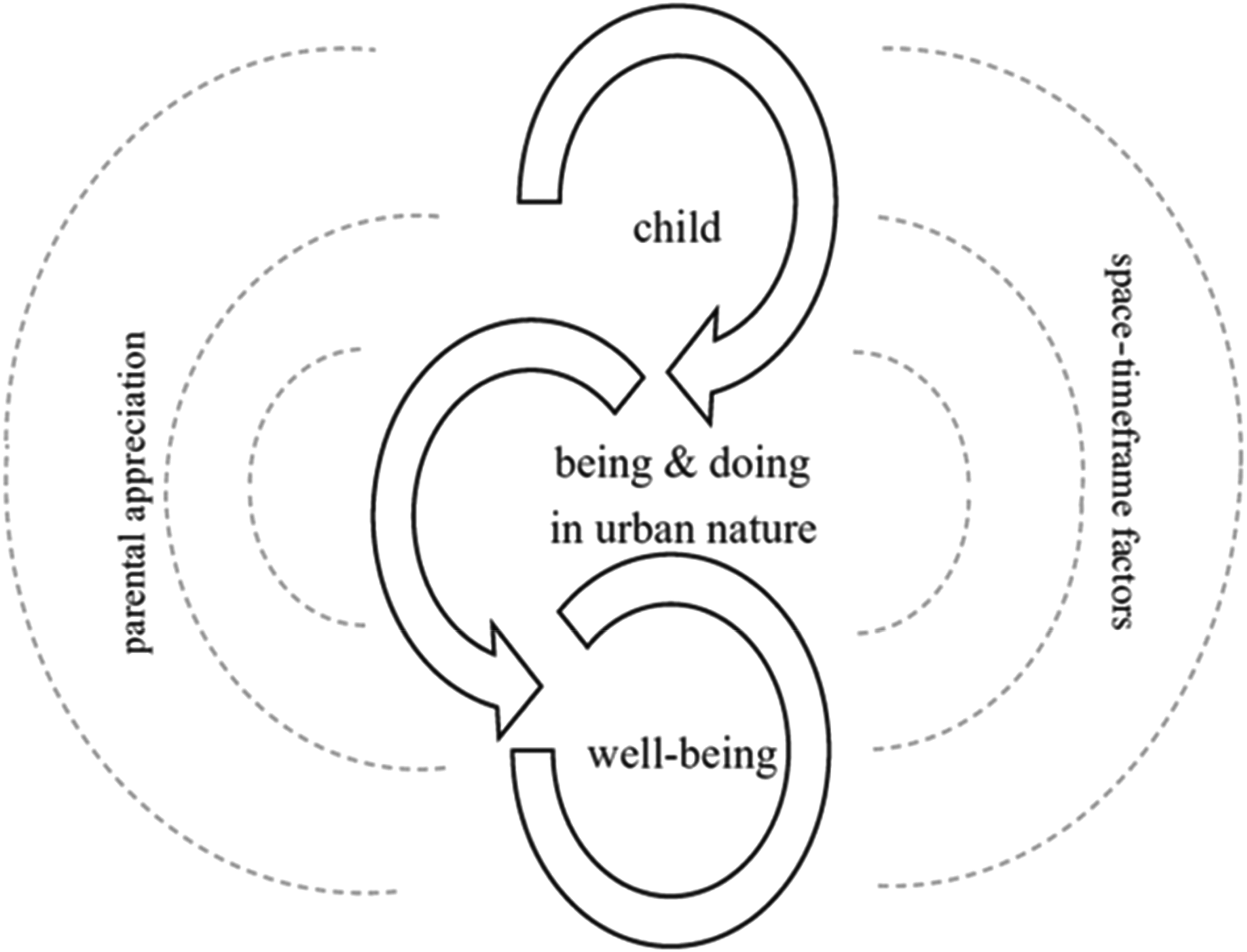
Nature Immersion Model Integrated for Well-Being of Urban Children.
Parental reports highlighted factors that enabled nature to do its best work when children engaged in being while doing in natural environments. These factors included parental appreciation (for child–nature connection) and space-timeframe factors (frequency of visit to nature environment; time spent at each visit; overall timeframe for nature immersion; Nagata & Liehr, 2021, pp. 175–176). In this study, child well-being was identified by parents who described their impressions of changes in their children arising as they engaged with nature; parents detected energy and loving spirit in these situations. Their descriptions stimulated the researchers’ thinking about vital power as described by Nightingale. The parental impressions, combined with interest in Nightingale's perspective on vital power, inspired the researchers to conduct a secondary analysis of existing data that could lead to considering the role of the nurse in the potential for nature immersion for health-nursing, described by Nightingale as strengthening conditions supporting health and wellness (Dossey et al., 2005). The central idea in this model, being and doing in urban nature, connects with Nightingale's emphasis on nature's key role in health and healing, represented in the model as well-being. Further, parental emphasis on energy and loving spirit inspired the exploration of vital force as a meaningful thread of well-being.
Aims of the Study
The aims of this analysis were to explore vital power through parental descriptions of children's being while doing in nature; and, to assess the usefulness of the Nature Immersion Model as a guide for nursing practice. The research questions were:
What patterns of being while doing in nature were observed in association with parental reports of change in well-being for their children? What qualities of vital power were evident in parental descriptions of changes in well-being?
Vital power was operationalized as parental descriptions inclusive of observed energy/excitement/interest. Finally, consideration was given to optimizing the usefulness of the Nature Immersion Model as a health-promoting structure to guide nursing practice.
Method
Design
This qualitative study used directed content analysis. The original data set, which incorporated quantitative and qualitative components, demonstrated the importance of nature immersion for urban children through parental reports. The study had human subjects’ approval by the Institutional Review Board at Florida Atlantic University.
Procedures
Participants
The original data set comprised reports from fifteen parents who were interviewed with open-ended questions to understand how nature immersion occasions in an urban area promoted the well-being of their children. The opening interview question asked parents to describe how they believed nature engagement (any occasions where children spent time in blue or green spaces in New York City) contributed to their child's well-being. Blue spaces are defined as spaces covered with water bodies (rivers, oceans, etc.); green spaces are defined as spaces covered with vegetation (plants, woods, etc.) (Nagata & Liehr, 2021). These occasions of engagement ranged from structured experiences in a city vegetable garden to play in city parks to school activities that accessed outdoor venues. While analyzing the original interview data set, the principal investigator (PI), an experienced holistic nurse practitioner, noticed reports of changes in energy/excitement/interest that called for looking more closely at parental reports of observed changes discussing their child's well-being.
Descriptions of being and doing in nature associated with parental reports of change in child energy/excitement/interest were extracted from the original 15 interviews by the PI. This change described by parents was accepted as consistent with vital force, another way that Nightingale defined vital power (Nightingale, 1893, p. 189). Relevant interview segments were extracted from parental transcripts.
Data Analysis
Directed content analysis was conducted to address the two research questions. Directed content analysis (Hsieh & Shannon, 2005) guides the researcher to explore data by conceptually validating and extending an existing model or theory. The Nature Immersion Model (Figure 1) served as a framework. Specifically, the elements of the model that guided analysis were being and doing in urban nature and well-being. To address the first research question, the PI identified patterns of being while doing in nature that generated change in child well-being expressed as energy/excitement/interest, operationalized as life-spark. For the second research question, the essence of vital power was explored. The PI coded descriptions of energy/excitement/interest into categories, where all descriptions in each category were consistent. For each category, the qualities reflecting the essence of vital power were grouped into emerging themes. The emerging themes were then peer-reviewed by an expert theorist/qualitative researcher who confirmed the consistency between parental descriptions, themes, and concepts being explored. Throughout this process, rigor was primarily addressed through the exercise of actions consistent with the trustworthiness criteria of credibility (e.g., peer debriefing with another researcher; triangulation of parental descriptions with writings from Nightingale) and confirmability (e.g., audit trail to document thinking process; Cypress, 2022).
Results
Findings From Deductive Analysis
Addressing Research Question 1, the following patterns of being while doing in nature were associated with parental descriptions of child well-being: Use of one's best faculties for the betterment of self and others, and imagination of one's own self as a pioneer, both of which were infused with pleasant feelings about one's own self. The dimensions of vital power (Research Question #2) synthesized from the composite interview data exemplified in Table 1 included unbridled presence that energizes; embracing initiative for personal growth; and nurturing through connection.
Nature-Immersion Patterns, Parental Descriptions, and Nightingale's Verbatim Perspectives.
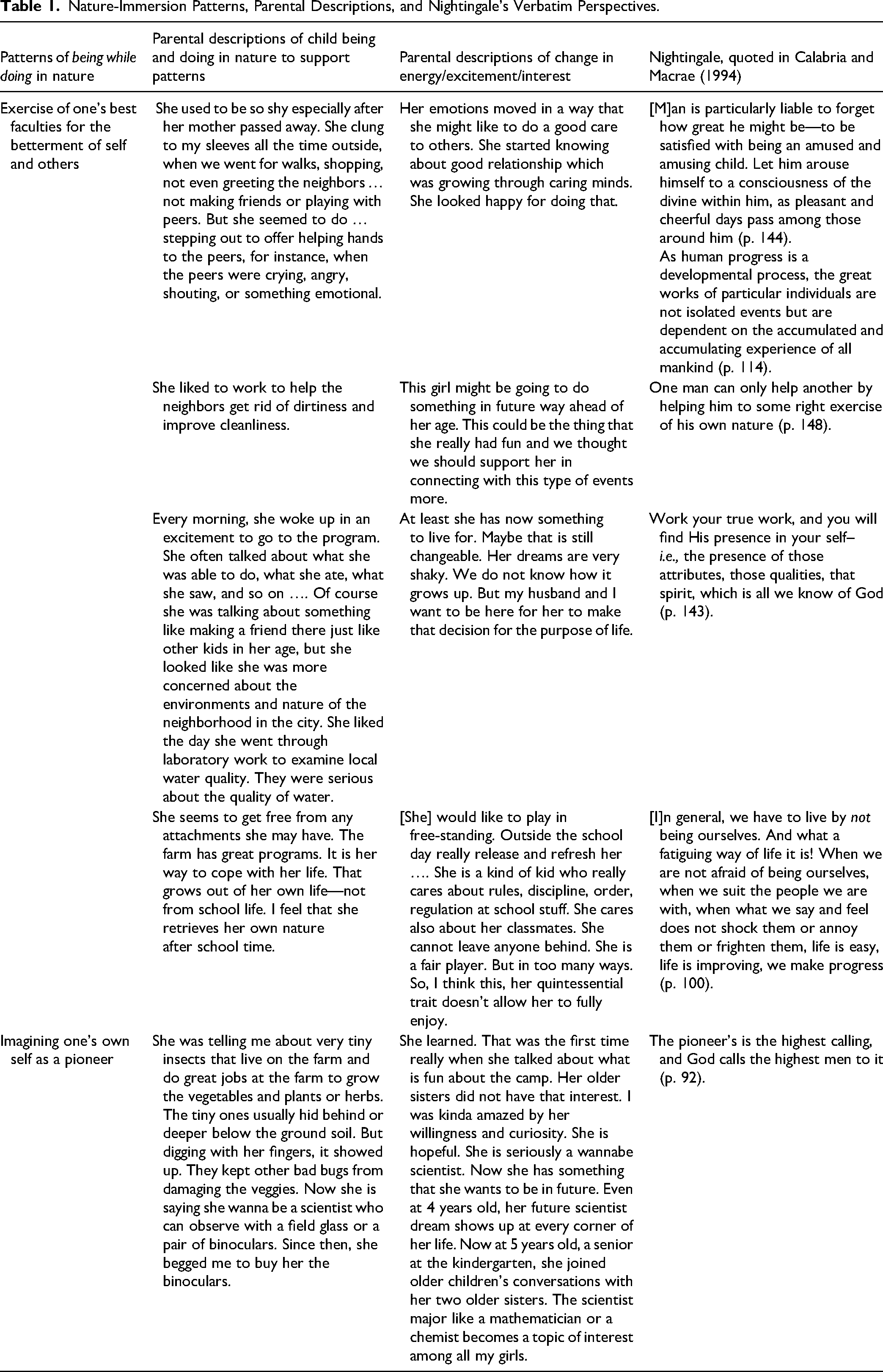
Threaded through the three essences of vital power (unbridled presence that energizes; embracing initiative for personal growth; nurturing through connection) and supported by the data in columns 2 and 3 of Table 1 was spontaneity rather than deep intentionality on the part of the children. Specific phrases that indicated spontaneity included the child's willingness to start “stepping out” which generated happiness; waking up with excitement in anticipation of a day with purpose (going to the farm program); retrieving her own nature after school while releasing and refreshing; and begging for binoculars in the mid of parental amazement at willingness and curiosity. The spirit or life-spark was manifest in every child's being while doing, regardless of age-related development. However, the nature immersion occasions of the children did not occur spontaneously but rather intentionally, initiated by the parents: “…my husband and I want to be here for her to make that decision for the purpose of life.” and “…we thought we should support her in connecting with this type of events (farm program) ….”
The child's vital power was expressed in his or her unbridled presence in nature that energized and excited the self. Nature was spacious enough to allow the child's sense of freedom, without any strings attached. The vital power-generating pattern, “use of one's best faculties for betterment,” emerged as a nurturing spirit that connected the child with others. One parent talked about her daughter caring about her classmates: “She cannot leave anyone behind” but this mother worried that this “quintessential trait” interfered with her enjoyment. Consistent with this mother's concern and as noted in Table 1, the drive to nurture can challenge the self. Nightingale suggested, “When we are not afraid of being ourselves, when we suit the people we are with, when what we say and feel does not shock them or annoy them or frighten them, life is easy, life is improving …” (in Calabria & Macrae, 1994, p. 100).
One other notable suggestion by Nightingale, “the pioneer's is the highest calling” (in Calabria & Macrae, 1994, p. 92), manifested in the being while doing pattern of imaging the self as a pioneer in a projected future. Nature's space seemed to spur openness to future possibilities, documented in the vital power theme, embracing initiative for personal growth, as indicated by one parent's suggestion that her daughter is now a “wannabe scientist.” Inherent in personal growth was a sense of the powerful human spirit observable when considering energy/excitement/interest. The essence of vital power interfaced with some level of spirituality for the child. Parental descriptions implicitly noted changes in their children that addressed the human spirit: trying in an unconditional way to take care of others and a noticeable change that suggested living with purpose.
The children's being while doing in nature was accompanied by life-sparking moments unrelated to age; rather these moments were laden with a sense of the children's spirit. Corresponding to the Nature Immersion Model, urban nature provided situations for being while doing that manifested in well-being, a personal emergence described by parents as energy/excitement/interest, expressive of vital power.
Proposing a Structure to Support Health, Healing, and Happiness
One important purpose of this work was to consider the usefulness of the Nature Immersion Model for nurses wishing to promote health, healing, or happiness. Health-nursing is designated to nurture Nature, both the space and the self of the person in care. The Nature Immersion Model (Figure 1) guided this secondary analysis. However, the model structure is limited by its focus on children and the specifics of parental views. Further development of the model, presented as a middle-range Theory of Nature Immersion (Nagata, 2024) addresses the original model's deficiencies and proposes a more generalized theoretical structure for promoting health through immersion in nature. Specifically, the theory notes that “Nature immersion, a generative healing force emerging from within a person who is connecting with earthy materials, is embodied as personal emergence” (Nagata, 2024, p. 316). See Figure 2.
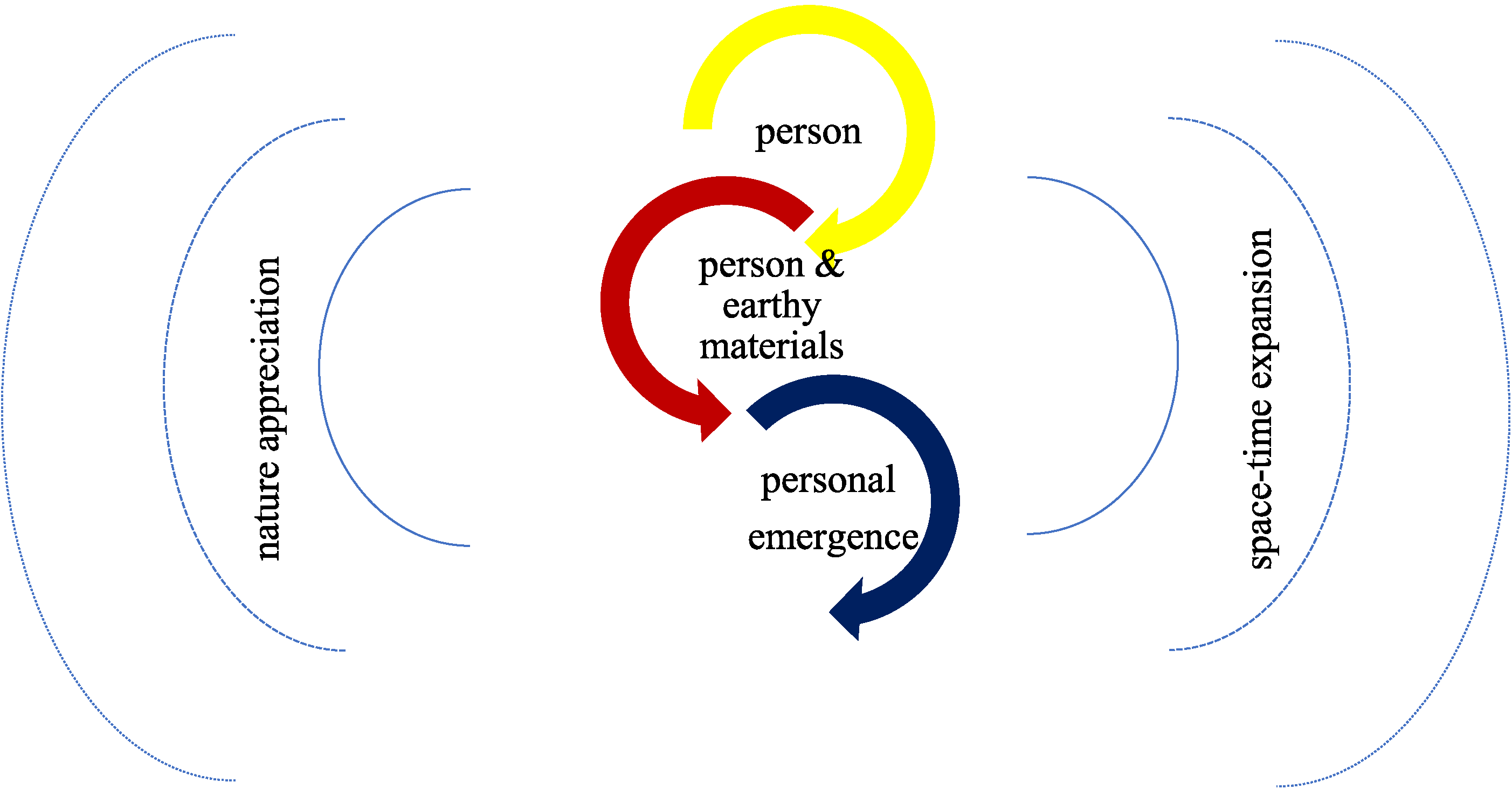
Middle Range Theory Model of Nature Immersion.
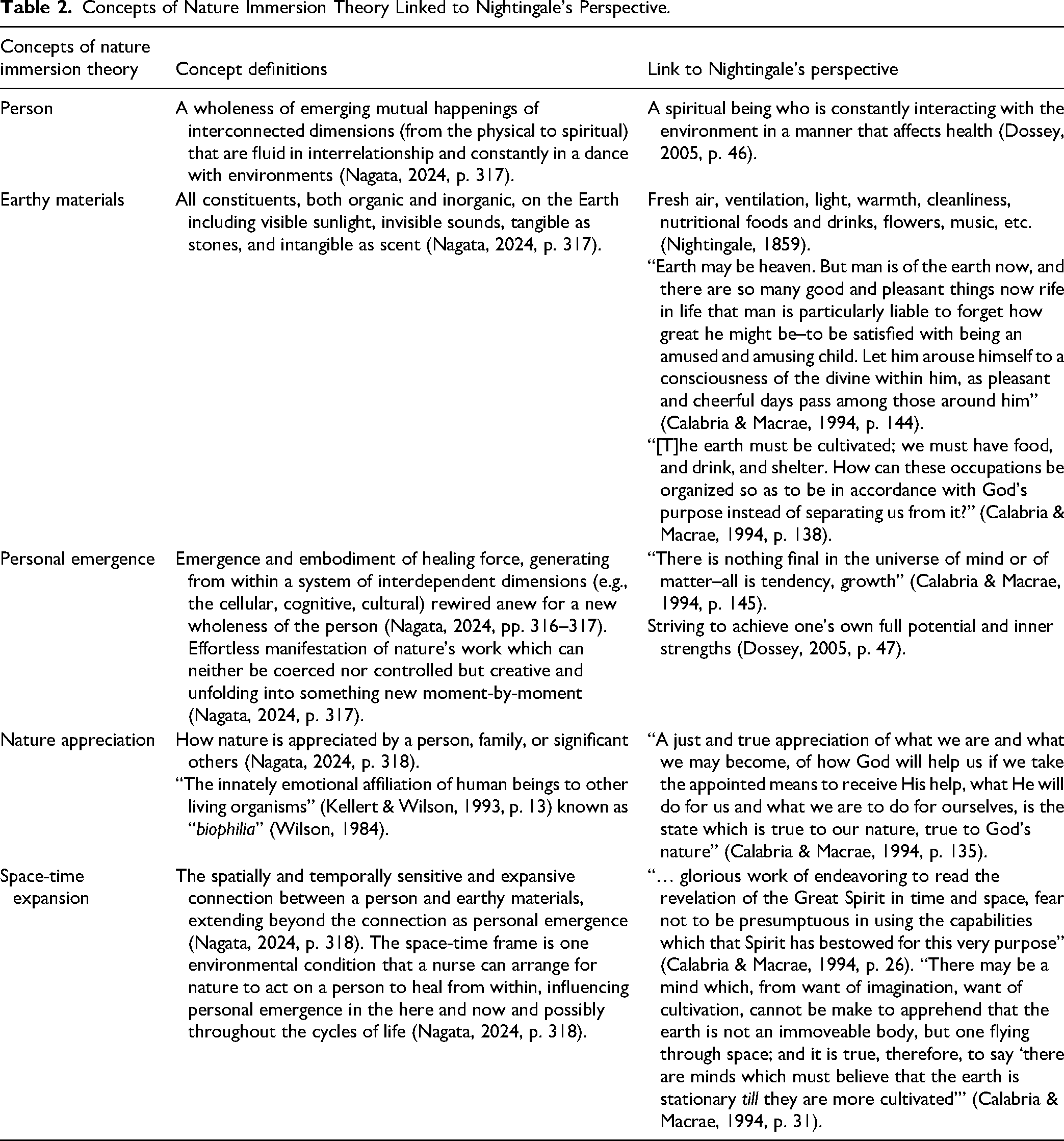
Linking the concepts of this middle-range theory to Nightingale's thinking provides insight into the historical roots of the theory, and it emphasizes healing force as a common thread between the theory and Nightingale's ideas (see Table 2). The theory proposes that healing force generates from within human wholeness, manifesting in personal emergence, when a person and earthy materials connect. This is an intentional connection well within the scope of nursing practice.
Concepts of Nature Immersion Theory Linked to Nightingale's Perspective.
Discussion and Implications for Nursing Practice
In Nightingale's perspective, the essence of health-nursing was promoting health, healing, and happiness, and was instilled with spiritual or mystic experiences manifesting as a spark of exercising one's own faculties (Nightingale, in Calabria & Macrae, 1994). The experiences were implicit in basic research studies as an underlying order and unity, yet explicit in applied research studies as statistical patterns (Macrae, 2020). The effects of health-nursing can be traced to the ultimate destination or evolution of human souls because the path is aligned with higher harmony of the universal laws or thoughts of God in Nightingale's words: [T]he only means of attaining ultimate well-being is to align the personal will with the will of God. It is not the freedom of choice which is the important element, but the power to create those causes which will make the human character reflect the Divine. (Calabria & Macrae, 1994, p. 69)
The middle-range Theory of Nature Immersion provides a structure guiding nursing action to promote health and well-being. Implementation of action guided by the theory requires that nurses plan for creative approaches that put those in our care in touch with earthy materials. Still, the life-spark has rarely been conceptualized in research. The closest conceptualization may be salutogenesis, which suggests that human health emerges through a sense of coherence in a continuum rather than a dichotomy (Antonovsky, 1996). The focus of salutogenesis is consistent with health-nursing as both emphasize wholism rather than reductionism.
Generally, past studies tended to focus on the psychophysiological effects of immersion in nature. For example, studies have shown evidence of the beneficial effects of forest bathing, a Japanese health-promoting endeavor accomplished while attentively walking through woods (Timko Olson et al., 2020). This sort of woods-walking is called 森林浴 (shinrin-yoku) in Japanese and forest-bathing in English. Researchers have indicated improvement in a range of health outcomes including cardiovascular indicators (Song et al., 2019; Zeng et al., 2020) and psycho-spiritual indicators like sense of self-growth (McCaffrey & Liehr, 2015, 2017).
The phenomenon of healing shifts is another expression similar though not identical to the life-spark or arousal/alignment of higher harmony with nature and therefore, healing rather than ailing. The shift toward healing proceeds as a phenomenon that is spacious enough for something new to emerge (Davidson et al., 2011). The space in which nursing implementation occurs can be intentionally channeled to elicit healing shifts by integrating earthy materials into everyday caring. The nature of earthy materials is irreducible and whole in itself that could meet the unpredictable nature of another being at a given time and space. These approaches are in line with the concept of Variety introduced by Nightingale in Notes on Nursing: What It Is and What It Is Not (1859, pp. 33–36). For instance, in writing about the “sick” room, she emphasizes the introduction of color through flowers or gazing out the window at “knots of wood.” She emphasizes that the impact of this sort of variety is a whole health effect: People say the effect is only on the mind. It is no such thing. The effect is on the body, too. Little as we know about the way in which we are affected by form, by colour, and light, we do know this, that they have an actual physical effect. (Nightingale, 1859, p. 34)
Options for applying the Nature Immersion Theory in nursing practice are only limited by the creativity of the nurse. The pursuit of evidence that explains mechanisms contributing to the beneficial effects of nature immersion is a fruitful area for future study. The Nature Immersion Theory is a foundation for considering and then implementing options that can be researched for human health, healing, and happiness, thereby contributing to nursing knowledge development.
Limitations
This was a secondary analysis of data from parents about their children. Therefore, the entire qualitative data set relied on parental reports rather than expressions noted by the investigator while observing the children in nature. Given this circumstance, the findings are heavily reliant on parental perceptions. The parental words might have mirrored what they deemed socially desirable, and children themselves may have described the nature immersion occasions differently. Despite this limitation, the study findings contributed to the development of the middle-range Nature Immersion Theory, confirming the theory's definition of personal emergence inclusive of a vital healing force.
Conclusion
This analysis has contributed to nursing knowledge by culminating in a description of a middle-range theory with roots in Florence Nightingale's understanding of nature, that has the potential to enhance health, healing, and happiness. The middle-range Theory of Nature Immersion serves as a guide for creative nursing practice and for further development of this thread of disciplinary knowledge, warranting nursing research attention.
Footnotes
Acknowledgments
We would like to express our warmest gratitude to educators at Battery Urban Farm in New York City, and the parents for their wisdom and insights of their children's nature-immersion occasions.
Author Contributions
All authors met the four criteria of the authorship recommended by the International Committee of Medical Journal Editors. Dr. Nagata was a principal investigator of the study and primarily contributed to the work of the literature review, conception and design, data collection, data analysis and interpretation, and write-up in draft. Dr. Liehr, an experienced researcher and theorist, contributed important intellectual content by reviewing the logical flow and theoretical contexts of the manuscript and revising the draft to the final approval of the version to be published. We made an agreement to be accountable for all aspects of the work in ensuring that questions related to the accuracy or integrity of any part of the work are appropriately investigated and resolved.
Declaration of Conflicting Interests
The authors declared no potential conflicts of interest with respect to the research, authorship, and/or publication of this article.
Funding
The authors received no financial support for the research, authorship, and/or publication of this article.

Author Biographies