



Abstract
Taking Charge of Your Health & Wellbeing (The University of Minnesota, 2016) is an online interactive community resource with a focus on health and wellbeing. This resource was created by The University of Minnesota's Earl E. Bakken Center for Spirituality & Healing (
In the personal health assessment, the findings are strengths-focused, keeping a positive perspective on the findings, but also allowing the user to reflect on areas of improvement.
Overview of Tools and Resources
The purpose of the resource is clearly defined on the homepage as “Enhance your wellbeing: You're in charge. Learn how a holistic approach to wellbeing can help you discover health, contentment, purpose, and connection.” On the main homepage, you will find a plethora of information. The prominent feature is a visually appealing interactive pie chart highlighting six components of wellbeing: 1) environment, 2) health, 3) relationships, 4) security, 5) purpose, and 6) community. Each section of the pie chart opens with a full definition of each individual wellbeing component and an active hyperlink to more detailed information. Six additional sections of resources focus on being mindful, living healthy, finding meaning, creating healing environments, creating connection, and feeling safe. Some of the most popular features are emphasized at the bottom of the website through a visual grid format.
The interactive site has two main header tabs: 1) Manage Health Conditions and 2) Try Holistic Practices. Under Manage Health Conditions you will find 19 common health conditions with corresponding hyperlinks to information. Under Try Holistic Practices, you will find 30 supplementary subheadings. The first hyperlink takes the user to information about the definition of holistic practices; a series of additional hyperlinks to other valuable resources such as a free course for health-care providers on integrative medicine focuses on how to incorporate complementary therapies in clinical practice to improve outcomes and promote wellbeing. The following 29 subheadings under the Try Holistic Practices heading are examples of holistic practices with hyperlinks to information about each type of complementary therapy or approach.
The site offers a personal health assessment questionnaire with 13 Likert-style questions related to different components of wellbeing. This assessment tool is informal, time-appropriate, user-friendly, and free of health jargon. Upon completing the assessment, the user has the option to review the findings within a 45-minute timeframe, but also has the option to email or print the results for further assessment. One highlight of this assessment is that the findings are strengths-focused, keeping a positive perspective on the findings, but also allowing the user to reflect on areas of improvement. Under each finding, the user has the opportunity to set a goal related to improving health and wellbeing.
Finally, this website complies with the Health on the Net Foundation Code of Conduct (HONcode) standard for trustworthy health information, which validates the following ethical principles: authority, complementarity, privacy, attribution, justification, contact details, financial disclosure, and advertising policy. The HONcode was created in 1996 as a means to standardize requirements to establish the reliability and credibility of health information.
Value of the Tools and Resources
There are a variety of target audiences for this resource due to its design, usability, and comprehensive materials. For example, health-care providers, health-care organizations, and interdisciplinary team members could use this tool as way to promote health behavior change for their patients. Links to online tools could easily be included on health-care organizations ‘websites for accessibility to users. Health-care administrators and nurse educators might use this tool to promote healthy behaviors and resilience through the development of holistic practices within groups of nurses and/or nursing students. Resilience training has been shown to be an effective way to combat burnout, anxiety, and stress (Zhai et al., 2021).
Additionally, incorporating this tool into orientation or residency programs might create a culture of health and wellbeing and provide avenues to promoting healthy behaviors within health-care professions. Furthermore, this tool could be utilized by employee health nurses (health care and industry) and school nurses (both in high school and higher education settings) working with individuals with specific areas of health concern who want to set goals to manage these areas. Most importantly, this interactive resource is designed in a way that could be used by the general public without direction from health-care professionals.
Patient Education Materials Assessment Evaluation
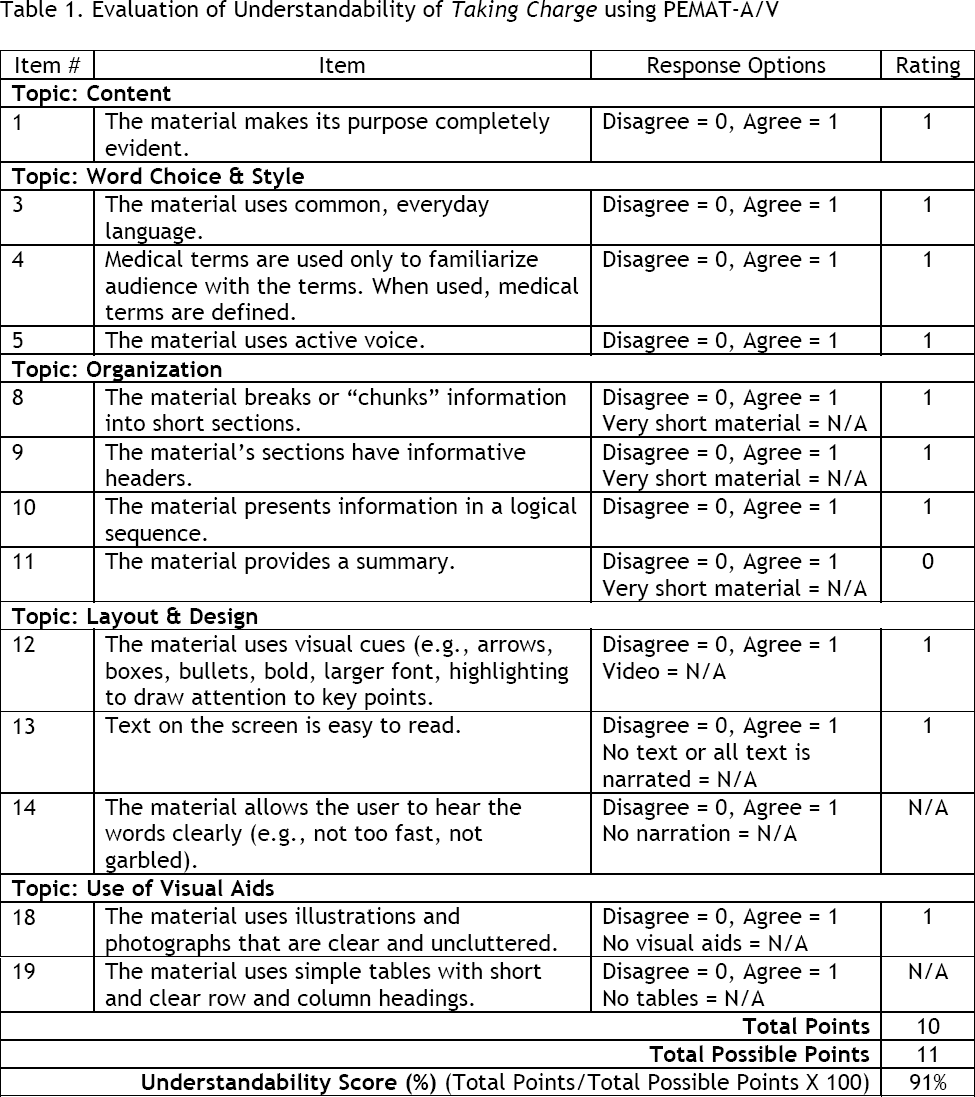
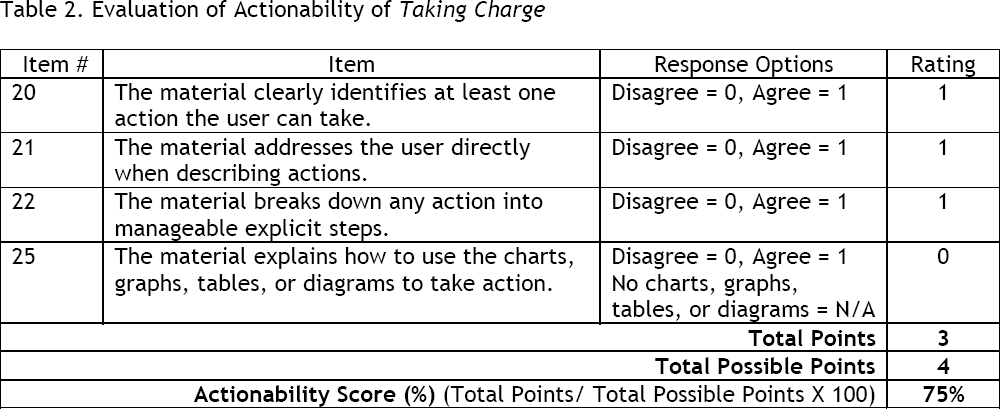
This public online resource can be used by health-care providers as well as the general public. As part of this review, I chose to evaluate this online resource with the Patient Education Materials Assessment Tool for Audio-Visual Materials (PEMAT-A/V) (Shoemaker et al., 2013) because of the combination of text, still images, animation, and interactive content found in this resource. Researchers have demonstrated that the PEMAT has strong internal consistency, inter-rater reliability, and construct validity (Shoemaker et al., 2014). Table 1 shows the evaluation of the website's understandability; Table 2 shows the site's actionability. For an item to receive a rating of “agree”, the characteristic measured must occur throughout the material at least 80% of the time. Higher scores on both understandability and actionability indicate higher quality materials. Taking Charge is an excellent resource for understandability and actionability based on the scores of 91% and 75%, respectively.
Evaluation of Understandability of Taking Charge using PEMAT-A/V
Evaluation of Actionability of Taking Charge
Strengths
Goal Setting and Behavior Change
One feature of this resource that is most useful is the goal-setting feature. Goal setting is a major component of health behavior change; however, an appropriate framework of goal setting is important for outcomes. Goals may range from easy to difficult, be performance- or mastery-based, and include action and coping plans as well as specific, measurable, achievable, realistic, and timely (SMART) criteria. For example, in order for change to occur, framework elements need to include goals and action plans that are mastery-based, appropriately challenging, and intrinsically motivating. Furthermore, self-efficacy is an important component of behavior change (Bailey, 2017; Bandura, 1977). This site incorporates many of these components into the interactive goal-setting features.
The goal-setting features demonstrate easy usability for a variety of persons at various educational levels, and focus on the concepts of flexibility, positivity, concreteness, and harmony in goals. Within the design of the goal-setting feature, it is clear that a
Within the design of the goal setting feature, a theoretical framework for change theory clearly served as the foundation.
Visual Interest, Ease of Use, and Organization
This resource is extremely well designed, with quality graphics and excellent visual space. Color is used appropriately, and the materials are eye-catching to the reader. The text content provided on each page is balanced with illustrations or charts for all types of learners and enhances the interactive experience. The content is well-organized and easy to follow for health-care professionals and for the community at large.
Information Quality
This resource provided a plethora of information on a variety of common health conditions and holistic practices to address health and wellbeing. While the material did not fully encompass all conditions or practices, the information provided was comprehensive and evidence based. As noted before, the materials met high standards for understandability and actionability when used as patient education material.
Recommendation for Improvement
Overall, this interactive resource has an abundance of advantages and benefits for use. However, there are a few areas that could be addressed to further enhance the usability of this resource. First, the goal-setting tool, while useful, has several components and may be a bit cumbersome and time-consuming (longer than 10 minutes), and may lose user interest. Secondly, there are a large number of hyperlinks, which may feel overwhelming to the user. Third, audio narration could be added to the website for accessibility and increased interest for auditory learners.
While the majority of content is extremely well organized, one section might benefit from reorganization. Under Try Holistic Practices, the first hyperlink (What are Holistic Practices?) could be moved to a different section, and the types of holistic practices condensed into the five key characteristics of holistic practices, giving users the ability to search for a specific category of approach versus looking at each type individually. For example, each of the 29 types of holistic practices could be listed under one of the five corresponding types of holistic practices: 1) alternative medical systems, 2) mind-body interventions, 3) biologically-based therapies, 4) manipulative and body-based methods, or 5) energy therapies, and then described in more depth through hyperlinks.
Summary
I found Taking Charge of Your Health & Wellbeing to be an innovative, comprehensive, and valuable resource. The design has appeal and allows for a variety of uses with a diversity of target audiences. Strengths include the goal-setting and behavior change design, the visual interest, and ease of use, along with the organization and quality of content. Results from the PEMAT-A/V assessment demonstrated high levels of understandability and actionability for use in patient educational materials. For readers of Creative Nursing, this tool is an innovative way to combine current nursing and interdisciplinary literature related to health, wellbeing, and holistic practices for a healthy lifestyle in a well-designed interactive model. Due to the quality of design and ease of use, this resource has significant advantages and benefits in a variety of circumstances. This contribution to the literature as an interactive comprehensive medical resource is original, valuable, and dynamic.
Cite this article
Lane, S.H. (2023). Taking Charge of Your Health & Wellbeing: An interactive resource from the Earl E. Bakken Center for Spirituality and Healing at the University of Minnesota.
Footnotes
Susan Hayes Lane, PhD, MSN, RN, (she/her) is an Associate Professor in the Department of Nursing, Beaver College of Health Sciences, at Appalachian State University in Boone, North Carolina, US.