




Abstract
The life of a nurse since the Covid-19 pandemic is characterized by high rates of anxiety, depression, and burnout, leading national organizations to declare the nursing shortage a national emergency. Solutions cite work-life balance, but this term has no clear guiding definition. Experts in the organizational psychology and personal development literature suggest other ways to reconsider this dilemma, that of integration. In this paper the concept of integration is proposed to focus on relationships with family and friends, work, and oneself. The American Association of Critical-Care Nurses ‘standards for a healthy work environment are used to frame the benefits of an integrated life. Strategies to achieve an integrated life, one with meaning and purpose, are described to create more happiness and joy and to begin to mitigate the nursing shortage.
The worldwide nursing community is experiencing staffing shortages and physical and mental health issues that are leading to high rates of burnout, depression, and turnover (National Academy of Medicine, 2019; Buchan et al., 2022; Office of the U.S. Surgeon General, 2022). In 2021 the American Nurses Association (ANA) urged the United States Health and Human Services Administration to declare the nursing shortage a national emergency (ANA, 2021). With the current intense focus on the value of nurses, now is the right time to consider the life of a nurse and suggestions to increase satisfaction, well-being, joy, and happiness as one way to increase retention in the health workforce. In order to ensure that nurses are part of the solution to health-care redesign, including staffing solutions, they need to act with confidence that comes from physical and mental well-being, so their voices are heard.
I first saw the phrase “…a life that works with a life that counts” in Peter Block's book The Answer to How is Yes: Acting on What Matters (1991, p. 27). Block asks the question: What do we mean when we say we want more balance in our lives? Balance is a term you hear and read nearly every day. Business and organizational leaders often encourage their employees to have “work-life balance.” This suggests that we see work and life in opposition to each other. Block asks, does it mean perhaps we are not alive at work? Do we keep our personal lives separate from our work lives, and if so, what are the implications? Block formulates the concept of putting balance in our lives through engaging with what we think is most meaningful and doing things that are useful and practical. Therefore, balance in life truly depends on having meaning and purpose and being fully alive wherever you are.
In this paper I propose that the term integration of life and work may be a more clarifying and powerful term than balance. Integration suggests that composing a life in which there is synergy between work and home, family, friends, and volunteer pursuits is a more appropriate goal than balance. Some in the business world are advocates for the benefits of integration of work and life (e.g. Friedman, 2014), but this concept is not common in the health-care or nursing literature. First I will explore notions of integration versus separation in a nurse's life, then how a healthy work environment as defined by the American Association of Critical-Care Nurses (AACN; 2016) is a framework for satisfaction in nursing that can integrate with well-being at home. When clinicians come home upset and frustrated with the care or lack of compassionate interactions they provided, the well-being of their family and friends is impacted. Finally, I identify the benefits of an integrated life and key strategies to achieve a life that counts.
Differing views about balancing work and home are common. A nurse may proudly say, “I leave work at work,” while another (perhaps more common) view is, “I wake up at night and can't stop thinking about my patients or colleagues.” Ruminating during long commutes home over what could have been done better happens often. Sometimes related to disrespectful communication and/or perceptions of not having enough time to get everything done in a shift, these negative and damaging feelings are more often seen in unhealthy work environments (Ulrich, et al. 2022).
The term integration suggests that composing a life in which there is synergy between work and home, family, friends, and volunteer pursuits is a more appropriate goal than balance.
Is There a Case for Work-Life Balance?
The answer to this question is likely no, except for very few people. There are thousands of studies, opinion pieces, and warnings about the importance of work-life balance across various professions since the 1970s. It truly remains a buzzword with fuzzy and individual interpretations. A focus on work-life balance causes many health workers to feel even more stress and guilt as they attempt to balance and juggle life's priorities. The Office of the U.S Surgeon General (2022) recently released a framework that introduces the term work-life harmony instead of work-life balance; it's too early to see how this will be received by nurses.
What is An Integrated Life? the Case for Integration
Author, poet, and organizational development leader David Whyte has discussed the concept of “three marriages” as a guide to an integrated life (Whyte, 2009). Whyte uses the term marriages to refer to strong commitments that a person makes, to work, to personal ongoing relationships, and to oneself. All are equally important to well-being in life. Note that the idea of marriage here is not restricted to a formal marriage, but encompasses close personal relationships, known to be essential for well-being.
According to Whyte (2009), the concept of work-life balance is too simplistic; he advocates for integration, since our very human seeking for happiness often leads to discouragement when different aspects of life are set against one another. A novel aspect of his thesis is that we may become exhausted and finally give up on one or more of these commitments, in order to gain an easier life. How often have we heard a nurse say, “I have no time for exercise,” or “I never see my friends,” or, unfortunately even more common today, “I can't do this anymore, I'm quitting.”
Creating a Rich Work Life: Implementing the Healthy Work Environment Standards
Most nurses yearn to find, create, and sustain a healthy work environment (HWE) as an important part of an integrated life. We spend so much time at work, nearly 100,000 hours in a typical lifetime (Worline & Dutton, 2017). I calculated my own hours as a nurse and professor in critical care and academic leadership, and came up with 95,880 hours, and that did not count work as a nursing assistant in a nursing home during college.
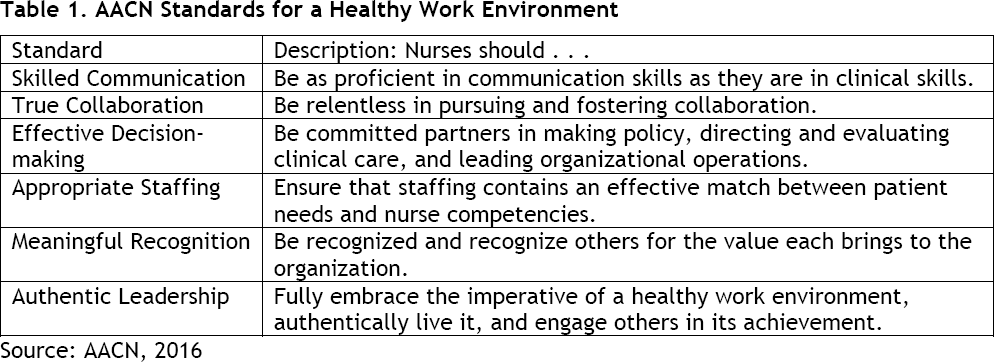
In 2005 AACN developed six standards for healthy workplaces, and reaffirmed them with evidence in 2016 (AACN, 2016). The AACN HWE standards are a framework for bringing high levels of satisfaction into the workplace as patient safety and outcomes improve and joy and happiness for health workers returns. They serve as a benchmark for excellence and have been time tested for over 15 years. Why would we wish to live in a work setting that is disappointing at best and harmful to us and our patients at worst?
Table 1 defines the AACN standards. They cover skillful communication, true collaboration, effective decision making, appropriate staffing, meaningful recognition, and authentic leadership. Each standard connects evidence-based practices with outcomes for patients and for nurses ‘well-being. Multiple studies over time continue to support the value of these standards (Ulrich et al., 2022). Nurses often cite their reason for staying in a particular setting as the nurse manager and their peers, all aspects of the Authentic Leadership standard.
AACN Standards for a Healthy Work Environment
Source: AACN, 2016
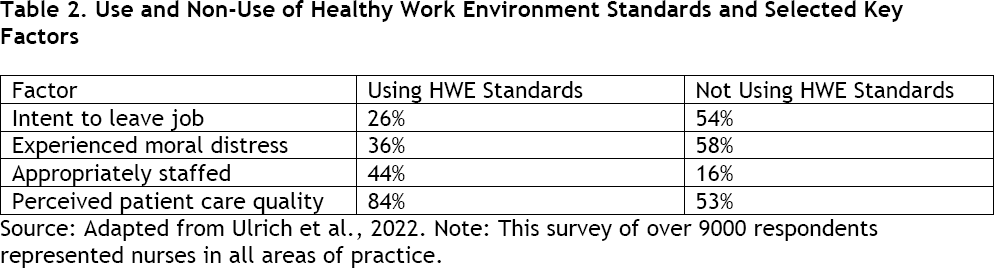
The health of the work environment has declined since 2018, based on periodic assessments by AACN between 2006 and 2021 (Ulrich et al., 2022). There is some good news. Data consistently shows that hospitals that have implemented these standards outperform those that have not, in the areas of overall health of the work environment, nurse staffing and retention, decreased moral distress, and lower rates of workplace violence. Units utilizing the HWE standards show dramatic differences in staffing, intent to leave, and other key factors, compared to units that do not, as seen in Table 2. These findings suggest that nurses ‘well-being as well as patient outcomes are of concern.
Use and Non-Use of Healthy Work Environment Standards and Selected Key Factors
Source: Adapted from Ulrich et al., 2022. Note: This survey of over 9000 respondents represented nurses in all areas of practice.
Examplar: Meaningful Recognition
All six HWE standards are useful in an assessment of the practice environment. An often-cited standard is Meaningful Recognition, defined as being recognized and recognizing others for the value each brings to the organization. This recognition is not a one-time gift for Nurses Week, but continuous acknowledgment of contributions each day. Everyone wants to know they matter at work. Promising research on well-being of a national sample of nurses suggests that nurses who had a higher sense that they mattered felt more meaning at work and more supported by their peers and their organization, and were more engaged (Haizlip et al., 2020). This indicates that shared governance practices in which nurses are engaged in key projects on their unit to ensure safe patient care (Porter-O'Grady, 2019), and Joy at Work programs sponsored by the Institute for Healthcare Improvement (Perlo et al., 2017), can have positive impacts on nurse satisfaction and retention.
The Pause
As an example of this standard, a nurse developed a compassionate action to acknowledge fellow health-care providers as well as the patient, after an unexpected death in the Emergency Department. Jonathan Bartels, RN, BSN, is a palliative care nurse in the University of Virginia Health System. Here is the story of his kind and empathetic action to create The Pause:
I noted that when people die after a traumatic incident, a code, often I would see surgeons and docs and nurses walk away in frustration, throw their gloves off in a defeatist attitude, not recognizing that the patient was a human being we worked on saving. So, after these deaths I decided it would be a good thing to stop, pause and do a moment of silence. Just stopping; honoring the patient in your own way, in silence. (Bartels, 2014, p. 75).
Bartels ‘design of a simple act of a 45-second Pause to show compassion for the patient and family and for his fellow nurses and health-care team members has caught the attention of hospitals worldwide (Cunningham et al., 2019). Hospitals that adopt the Pause, as hundreds have, can create a healthier work environment. The Pause may also be used as a metaphor for slowing down, reflecting on what would best serve in given situations, and then proceeding with wise action. Meaningful recognition has many facets; most are easy to implement, as this example demonstrates, on a journey to a healthier work environment. When we consider how much time is spent in our work life, improving even one aspect can have a positive snowball effect.
A simple act of a 45-second Pause to show compassion for the patient and family and for health-care team members has caught the attention of hospitals worldwide.
Benefits of An Integrated Life
There are three specific benefits to an integrated life. It reflects the authentic self. It offers multiple ways to achieve success. And it fosters well-being, joy, and happiness. An integrated life reflects our authentic selves by fostering clarity, meaning, and purpose. Being ourselves at work allows others to see us as we really are and invites connections and belonging. It is less stressful to be ourselves; while not oversharing, letting colleagues know of our family, outside interests, and maybe some worries, make us human and humble. Everyone has struggles and suffers. We can bring our home life to work in good ways: Who has a special needs child? Who is getting married? When should we have a small party? Nurses who value our compassionate collegiality will go out of our way to learn about our team members, not in a gossipy way, but in a supportive way. Nurses may be more likely to remain with a hospital unit when the staff are all valued colleagues.
An integrated life offers many ways to claim your success, whether at home, in school, in hobbies or exercise, or at work. Consider what a former student of mine, Haley Schlottman, RN, DNP, FNP-BC reported:
I have learned to adapt to job stresses as best I can, and I like the word integration much better than work-life balance because [balance] assumes they each operate in a silo. Balance implies you have it or you don't, where synergy/integration means there is a give and take, a reciprocity. Increasing demands in one domain can lead to a reprioritization in the other domain, and that is OK. I achieve synergy by setting boundaries, when work demands feel too high, intentionally limiting time spent doing work at home, or when home life feels too stressful, intentionally working on ways to improve my professional self. Good friends and a mentor help more than anything! (H. Schlottman, personal communication, May 19, 2020)
A hallmark of an integrated life is satisfaction with Whyte's three marriage commitments (2009) – how we evaluate and celebrate success on the journey to a self-described meaningful life, one with passion and purpose. The final benefit is the elements of joy and happiness that are possible with an integrated life.
Why would we wish to live in a work setting that is disappointing at best and harmful to us and our patients at worst?
The Institute for Healthcare Improvement's Joy at Work project shows how this is true (Perlo et al., 2017). Asking staff, “What is a pebble in your shoe?” (meaning a small irritant at work that could change with dedicated attention by a passionate team) has had amazing results for positive feelings and happiness (Feeley & Swenson, 2016). A Healthy Work Environment team from the University of Virginia School of Nursing was involved in a rapid-cycle improvement project about email boundaries, with surprising success that has lasted for more than five years (Perlo et al, 2017).
Strategies for An Integrated Life
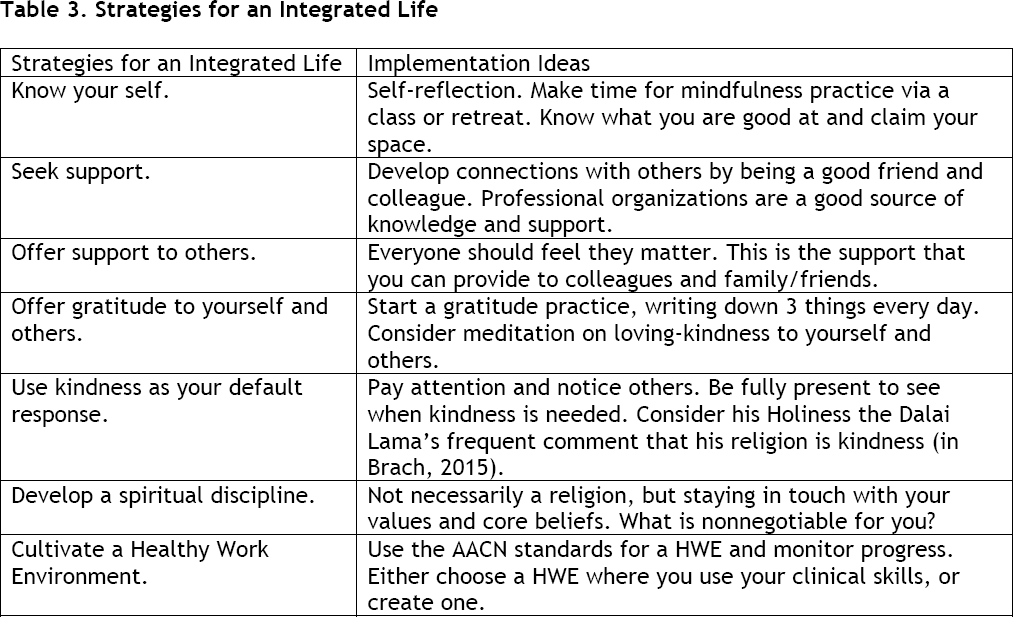
These many benefits of an integrated life yield the next question: How do I get there? Table 3 outlines seven strategies for an integrated life, with suggested ideas to consider and practice. Some may seem common sense, but all have a growing evidence base. For example, yoga, mindfulness, and other contemplative practices have become mainstream as more health-care institutions and medical and nursing schools offer these practices. Numerous studies report promising success in reducing stress and anxiety (Kabat-Zinn, 2018) and could be the start of an integrated life (Fontaine et al, 2021). Vanderkam (2022) found that doing more of what you love, that is meaningful to you, energizes you across all aspects of life; her study counterintuitively showed that participants who did more of what they love had a perception of more time in the day, not less, leading to increased satisfaction.
Strategies for an Integrated Life
Summary and Conclusion
In this paper I have offered some new ideas on work-life balance and encouraged the concept of an integrated life, with rationale from scholars and thinkers outside nursing such as Peter Block and David Whyte. The crisis of a nursing shortage, not the first one in history, has necessitated new thinking about the life of a nurse. Society has a vested interest in ensuring the health and well-being of this precious resource, nursing. The power of a healthy work environment for nurses ‘well-being should lead to a call for universal implementation of the AACN Standards. Every nurse deserves to be healthy, to have joy at work, and to have an opportunity for well-being and a meaningful life.
Cite this article
Fontaine, D.K. (2023). Composing a life that works with a life that counts for nurses. Creative Nursing 29(1), Article 5.
Footnotes
Acknowledgement
This article contains material from Self-Care for New and Student Nurses, published in 2021 by Sigma Theta Tau International. I am grateful to co-authors Dr. Tim Cunningham and Dr. Natalie May.
Dorrie K. Fontaine, RN, PhD, FAAN, (she/her), is Dean Emerita and Professor Emerita at the University of Virginia School of Nursing in Charlottesville, Virginia, and co-author of Self-Care for New and Student Nurses.