




Abstract
Purpose
In France, 40,000 Port-a-Cath (PAC) are inserted each year. These medical devices are prone to complications during their insertion or use. The education of patients wearing these devices could be a lever to reduce the risk of complications. The objective of this work was to develop, in a multi-professional and consensual manner, a unique and specific skills reference framework for patients with PAC and to propose it as a reference tool for health professionals.
Methods
A multidisciplinary working group was set up to draw up this reference framework of skills. The first stage of the work consisted of a reflection leading to an exhaustive list of competencies necessary for the patient. These skills were then classified according to three different fields of knowledge (theoretical, know-how and attitudes). Finally, the working group identified priority competencies and established a grid that can be used to evaluate the level of acquisition of these competencies.
Results
Fifteen competencies were identified: five relating to theoretical knowledge, six relating to know-how and four relating to attitudes. These competencies were broken down into sub-competences. Seven competencies or sub-competencies were selected to constitute the list of priority competencies.
Discussion
This competency framework provides a reference framework for the education of patients with PAC and will help to harmonise practices within the different teams that care for patients with PAC.
Introduction
The Port-a-Cath (PAC) appeared in the 1980s and its use has grown rapidly since. This medical device (MD) was designed to allow repeated access (1000–2000 punctures per PAC) to the intravenous system, thus preserving the patient's venous capital and limiting the risk of extravasation. 1 This MD is composed of a hollow box of a few centimetres, more or less cylindrical, designed in a very resistant and biocompatible material. It is located under the skin, connected to a flexible radio-opaque catheter inserted in a vessel. This device is inserted through the jugular vein or under the collarbone, in the operating room, most of the time under local anaesthesia. The PAC makes it possible to administer aggressive or long-term treatments such as chemotherapy, parenteral nutrition, antibiotics, antivirals or blood products in better conditions of comfort and safety for the patient and the care team. 2 In France, 40,000 devices are installed each year. 3 In 10%–13% of cases, these devices are subject to complications during insertion or use.4–6 These complications may be early 7 (local hematoma, scar disruption, pneumothorax and gas embolism), or occur later for many of them 8 (venous thrombosis, 9 infections,10–12 extravasation 10 and skin necrosis 1 ) or even be of mechanical origin (migration, 13 catheter rupture and occlusion).
In order to avoid the risk of complications or to allow for their early management, it is crucial that the patient acquires knowledge and skills regarding the device that will be or has been implanted. In the interest of safety, they must know the precautions to take, the risks to which they will be exposed and the actions they will have to take in the event of a problem. Competence is a process that allows multiple resources to be brought together in a situation. The resources mobilized are diverse: knowledge, skills or abilities and resources with normative dimensions. 14 For this reason, patient education is an essential part of therapeutic management. According to the definition of the World Health Organization (WHO), therapeutic education aims to help patients acquire or maintain the skills they need to manage their lives with a chronic disease. It is an integral and ongoing part of patient care. It involves organized activities, including psychosocial support, designed to make patients aware and informed about their illness, hospital care, organization and procedures, and health and illness-related behaviours. This is intended to help them and their families understand their illness and treatment, work together, and take responsibility for their own care, with the goal of helping them maintain and improve their quality of life. 15 This education must be based on a genuine pedagogical approach based on a prior assessment of the patients’ representations and needs. 15 It participates in the improvement of their health and quality of life as well as that of their relatives. 16 The first step in therapeutic education is to develop a reference framework of skills, that is, to reach a consensus on the definitions of the skills and attitudes that patients are supposed to acquire in order to manage their treatment and prevent avoidable complications while preserving or improving their quality of life. In the literature, several studies present competency frameworks 17 in particular for specific chronic diseases, such as multiple myeloma 18 or cystic fibrosis. 19 This reference system offers a tool that is favourable to the development of skills and to the coherence of practices and training. 20
One of the American Society of Clinical Oncology guidelines for central venous catheter care is the transmission of information from the healthcare team to the patient. 21 However, after a review of the literature, we have come to the conclusion that, to date, there is no published competency framework for patients with PAC.
The objective of this work was to develop, in a multi-professional and consensual manner, a unique and specific reference system for patients with PAC and to propose it as a reference tool for health professionals.
Materials and methods
A multidisciplinary working group with varied skills (eight pharmacists – including five pharmacists specialized in clinical pharmacy, a pharmacist specialized in oncology and two pharmacists specialized in medical infusion devices, a doctor in charge of the medical oncology day hospital service, a surgeon in charge of PAC insertion, and a nurse in charge of training nurses in the use of PAC) was set up to develop this reference system of skills. Among them, five have validated training in therapeutic education that they put into practice in their daily life. An initial preparation phase made it possible to define the common objective, the functioning of the group and the role of each person. The implementation phase took place between January and August 2021. During this period, the group met four times.
The first two meetings were devoted to a reflection leading to a comprehensive list of skills needed by the patient. These skills were classified according to three different fields of knowledge:
- The theoretical knowledge about the medical device, management, adverse effects or warning signs and daily life (= to know). - The know-how, being the decision-making and action skills in different situations like complications, dangerous situations, scar maintenance for example (= to do). - The attitudes, being the skills of daily management and the implementation of adaptation capacities such as being able to communicate about the system or being able to react according to the situation (= to be).
The third meeting was devoted to identifying the priority skills related to patient safety. Finally, the fourth meeting was used to establish a grid for evaluating the level of acquisition of these priority skills, which could be used in interviews with the patient. The reference framework presented in this article is the consensual result of this work.
Results
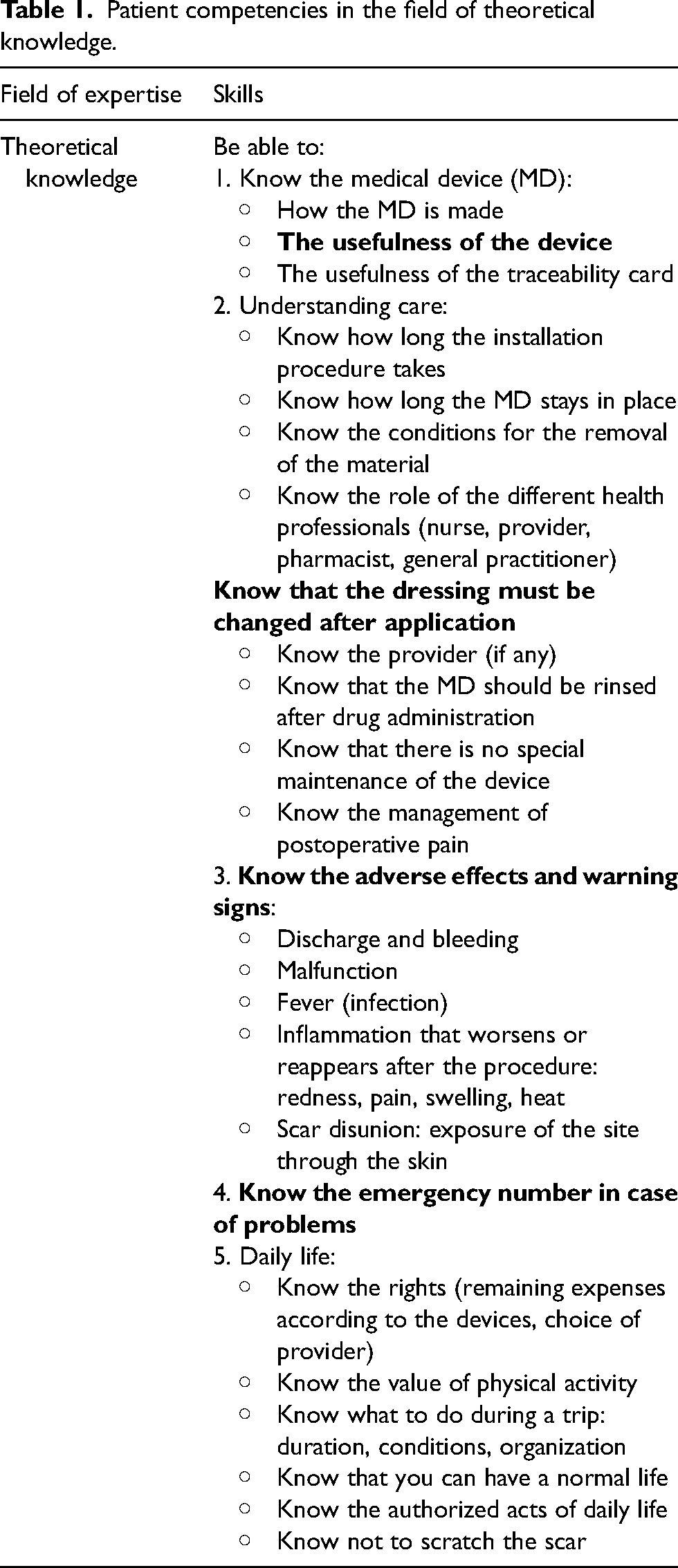
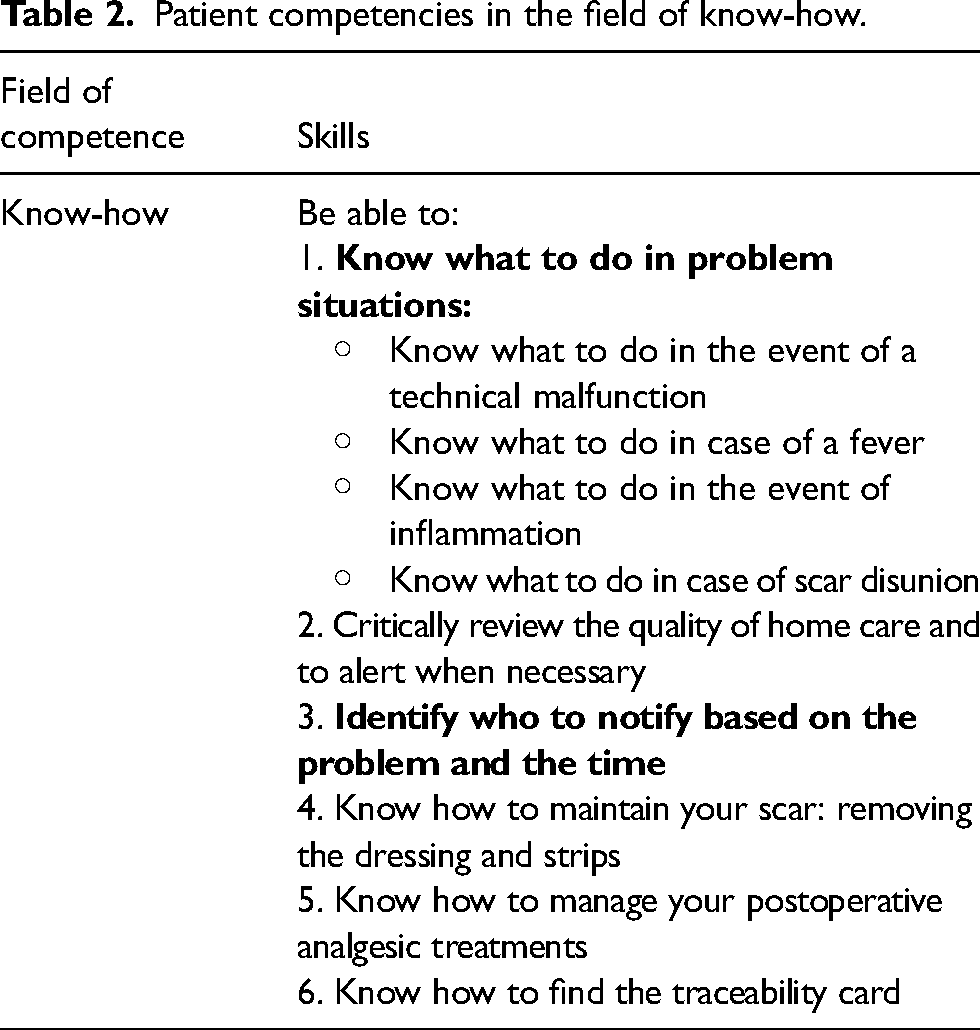
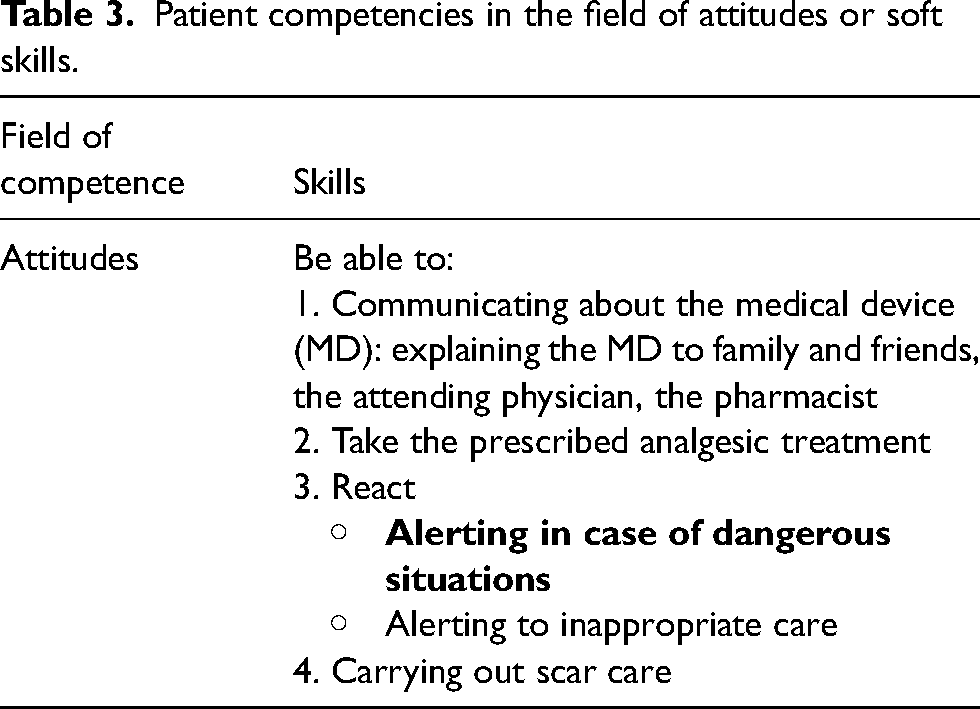
In the end, 15 competencies were identified to constitute the complete reference system: five relating to theoretical knowledge (Table 1), six relating to know-how (Table 2) and four relating to attitudes or interpersonal skills (Table 3). These competencies were broken down into sub-competencies and classified by theme.
Patient competencies in the field of theoretical knowledge.
Patient competencies in the field of know-how.
Patient competencies in the field of attitudes or soft skills.
Seven competencies or sub-competencies were selected to form the list of priority competencies. These are identified in
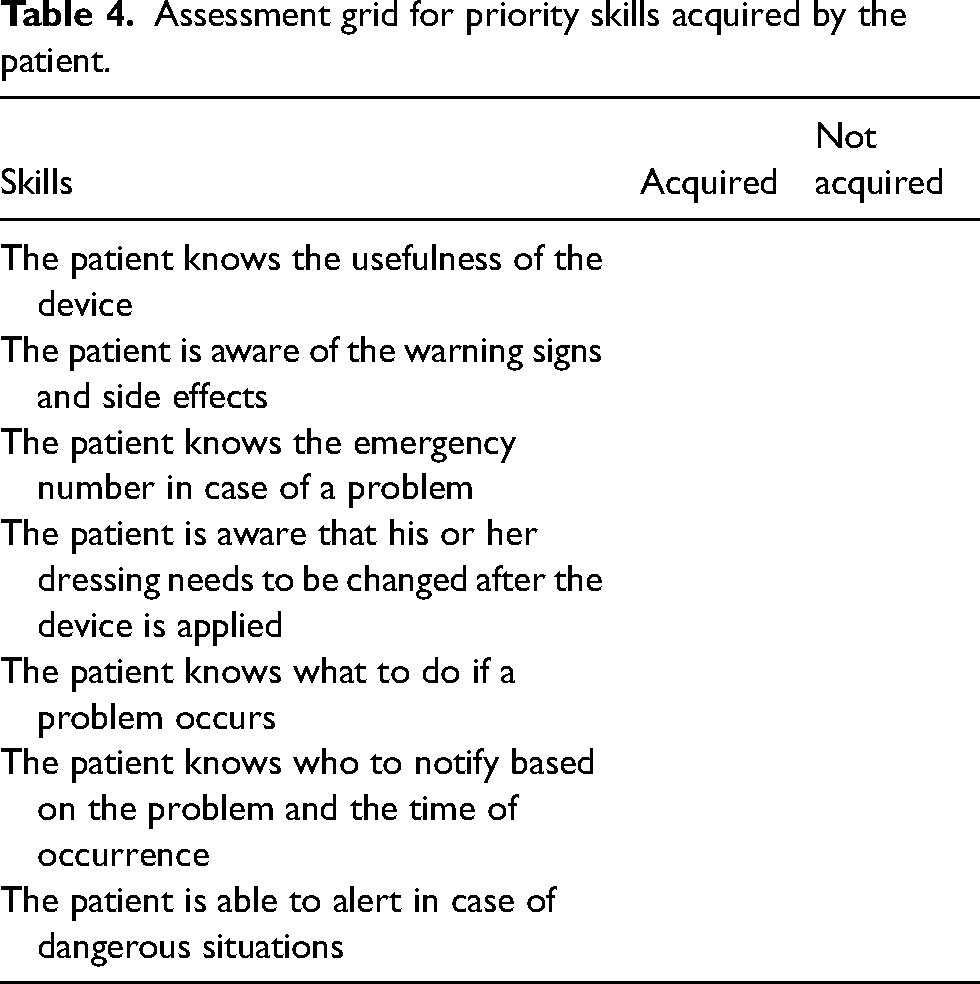
The competency assessment grid was defined as shown in Table 4. Each line of this grid explores a skill deemed to be a priority. These skills can be considered acquired or not acquired by the patient.
Assessment grid for priority skills acquired by the patient.
Discussion
Given the inexistence of a competency framework for patients with PAC in the scientific literature, it seemed obvious that this work could be useful to patients, their relatives, and the healthcare community. In addition, a recent systematic review highlights a need for the transmission of information and skills for patients with central venous catheters. 22 These sometimes complex skills can be acquired through therapeutic education, ideally by setting pedagogical objectives that allow their progressive acquisition. These objectives are centred on the patient and are written in a clear and comprehensible manner, using terms such as ‘be able to …’, ‘know …’, ‘understand …’, which will make it possible to reinforce the empowerment, which gives the patient a positive feeling of control over his or her life and removes the feeling of helplessness. 23
It is not intended to require that each patient with a PAC master all the skills listed in this reference system, but to provide caregivers with a complete reference system that allows them to choose the skills to be worked on according to the needs of the patients emphasising priority skills that are essential for patient safety. It can be used by all those who take care of the patient: physicians, surgeons, nurses and pharmacists, depending on the items explored and the local organizations.
The content of the referential follows the recommendations of the French High Authority for Health with regard to the competencies sought for patients. 15 It aims at the acquisition of these skills, particularly self-care skills, and the awareness of personal resources. These skills can be acquired through the development of personal qualities such as self-confidence, communication and problem solving.
The creation of this guideline was the first step in setting up a structured educational approach for patients with PAC. On the basis of this guideline, the educational work will consist in having the patient reach the educational objectives allowing him/her to develop skills that can help avoid the occurrence of complications. It is planned to set up pharmaceutical interviews with patients with PAC and to evaluate the impact of this new activity. The pharmaceutical interview is a privileged moment of exchange between a patient and a pharmacist during which the latter advises the patient, issues education and prevention messages. 24 This is why it seems ideal to us to integrate these interviews into the patient's care program. Moreover, it appears essential to integrate this PAC theme into existing therapeutic education programs for oncological diseases. Indeed, sufficient patient education and satisfaction with the treatment lead to an improvement in the patient's quality of life and a reduction in side effects.25,26
Conclusion
This competency framework provides a reference framework for the education of patients with PAC. Although it can be used by all caregivers, it will particularly help pharmacists to identify gaps in skills that need to be targeted so that patients can gain maximum benefit from PAC with minimum complications.
Footnotes
Authors’ contribution
All authors participated in the multidisciplinary working group. The first draft of the manuscript was written by Pierre NIZET and all authors commented on previous versions of the manuscript. All authors read and approved the final manuscript.
Declaration of Conflicting Interests
The author(s) declared no potential conflicts of interest with respect to the research, authorship, and/or publication of this article.
Ethics approval
Not applicable.
Funding
The author(s) received no financial support for the research, authorship, and/or publication of this article.
