



Abstract
In Canada, municipal elections are typically non-partisan contests. Incumbents enjoy a large advantage in these settings, whereas non-incumbents must mobilize campaign resources to make their name and message known to residents. How do non-incumbents mobilize campaign resources without support from party organizations? We suggest that they draw on what we call campaign capital. Campaign capital comprises pre-existing endowments candidates can utilize when campaigning: prior campaign experience, personal funds, and embeddedness in local networks. Analyzing an original dataset linking responses from a campaign-time survey of 1,450 candidates in municipal elections to election results, campaign finance disclosures, and census data, we show that campaign capital shapes the ability of non-incumbents to raise money and mobilize campaign volunteers, and that spending and volunteer mobilization in turn predict electoral success. The findings have implications for research in local and urban politics, democratic representation, electoral studies, and campaign finance reform in Canada and beyond.
Introduction
The vast majority of Canada's more than 3,500 municipalities hold non-partisan elections. 1 Research in Canada and the United States 2 has shown that non-partisan elections are low-information contests that present unique challenges for both voters and non-incumbent candidates. Voters lack the benefit of partisan cues to help them make choices, and media coverage of local races is often sparse or entirely absent (Holman and Lay 2020). In this context, vote choice is strongly influenced by the demographic characteristics of candidates (Badas and Stauffer 2019; Matson and Fine 2006) and name recognition, and incumbents enjoy a large and well documented electoral advantage (Lucas 2021; Schaffner, Streb and Wright 2001; Taylor and McEleney 2019). Meanwhile, non-incumbents (we use the term to refer to challengers running against incumbents, as well as candidates running in open races with no incumbent present) need to mobilize resources to get their message out to potential supporters (Adams 2010; Lieske 1989), without being able to rely on logistical, financial and messaging support from party organizations. What shapes the ability of non-incumbents to mobilize campaign resources, and how does resource mobilization in turn influence their performance at the polls?
Existing work on resource mobilization in non-partisan local elections is limited, and none of it focuses specifically on non-incumbents. Evidence from both Canada and the United States suggests that campaign spending does influence candidate performance (Kushner, Siegel and Stanwick 1997; see also Bonneau 2007 and Gierzynski and Breaux 1991), and that incumbents can leverage their name recognition into a fundraising advantage (Holbrook and Weinschenk 2014; Taylor and McEleney 2019). Such studies are based on data from a limited number of large urban municipalities, however. In addition, as far as we are aware, no research has focused on the role of campaign volunteers, even though widespread anecdotal evidence suggests that they may be important ingredients for electoral success.
If money and volunteers are important for non-incumbent success, what shapes a candidate's ability to mobilize these campaign resources in the first place? As far as we are aware, there is no research on this question. Insofar as non-partisan settings put the onus on candidates to mobilize their own campaign resources, though, it is likely that a candidate's pre-existing personal endowments may influence their ability to mobilize money and campaign volunteers. In this paper, we identify three types of pre-existing personal endowments that may be significant: personal financial resources, interpersonal networks, and past campaign experience. Together, we call them campaign capital, and we propose a theoretical model of the connections between campaign capital, resource mobilization, and non-incumbent electoral performance.
Our empirical analysis works backwards through our proposed model. First, we examine whether campaign spending and volunteer mobilization are associated with stronger electoral performance for non-incumbent candidates. Second, we move a step back in the causal chain to examine whether the three components of campaign capital – personal financial resources, local interpersonal networks, and past campaign experience – influence these candidates’ ability to mobilize money and volunteer labor during an election campaign.
Our analysis draws on a novel linked dataset that brings together election results and campaign finance disclosures with campaign-time survey responses from mayoral and council candidates in the non-partisan general municipal elections held in the Canadian provinces of British Columbia and Ontario in October 2022 (N = 1,343). The survey responses come from a broad range of local contexts, including a total of 195 municipalities ranging from small towns to large urban municipalities, and 547 different electoral contests. The diversity of municipalities and electoral contests allows us to control for a wide variety of contextual factors and produce broadly relevant insights about our questions of interest.
Literature Review
Local Election Campaigns: Which Resources Matter, and for Whom?
It might seem self-evident to claim that candidates in local elections must mobilize resources to succeed. However, the relationship between resource mobilization and candidate success is not straightforward. First, the causal mechanism that links resource mobilization to vote choice is indirect: Voters do not choose a candidate because that candidate has mobilized more resources than the competition, but mobilizing resources may be necessary in order for voters to learn about a candidate and their electoral platform. Second, the results of past research suggest that not all candidates are equally reliant on campaign resources. As we noted earlier, the low-information environment of non-partisan local elections confers a large incumbency advantage on those who are running for re-election (Lucas 2021; Schaffner, Streb and Wright 2001). While incumbency may help candidates to mobilize money and volunteers during a campaign (Taylor and McEleney 2019), its primary significance lies in the fact that it gives a candidate other advantages, such as name recognition and the opportunity to secure a ‘personal vote’ based on past record (Lucas, McGregor and Tuxhorn 2022). Incumbent candidates may thus have less need than non-incumbents to mobilize campaign resources to secure votes.
By contrast, deploying resources may be critically important for non-incumbents, for several reasons. Detailed information about local candidates is often not readily available in the mass media (Cutler and Matthews 2005); in non-partisan settings, voters lack the heuristic of party labels that can give them information about a candidate's issue positions (Holman and Lay 2020; Lucas 2021; Matson and Fine 2006); and low barriers to candidate entry in many local jurisdictions can lead to crowded races, especially in larger urban settings, intensifying competition for voter attention (Taylor and McEleney 2019: 213). In this context, non-incumbents who aim to mount a serious electoral campaign must mobilize resources in order to proactively engage residents through a variety of tools and activities: advertising, lawn signs, social media campaigns, door-to-door canvassing, endorsements, and so on.
There are two main kinds of resources that make other campaign activities possible: money and volunteer labor. Most research to date has focused on money, likely because candidate financial disclosures, where available, are amenable to quantitative analysis. There is some evidence from both American studies (Adams 2010; Gierzynski, Kleppner and Lewis 1998; Krebs 1998) and Canadian ones (Kushner, Siegel and Stanwick 1997; Kushner, Siegel and Stanwick 2001) of an association between campaign spending and vote share in local elections. Looking at large American cities, Adams (2010) finds that campaign spending is a necessary (although insufficient) condition for electoral success, and that there is a context-dependent minimum threshold of spending for a viable race, such that those “who do not raise money rarely win, nor are they even competitive” (54). However, findings regarding the strength of the association are inconsistent across different studies, and some studies have found no association at all (Taylor and McEleney 2019). The big-city focus of these studies may privilege a particular type of campaigning style – citywide and large-ward candidates may require a capital-intensive ‘air war’ strategy to increase their visibility, while candidates in smaller jurisdictions and districts may be able to rely exclusively on a ‘ground game’ of interpersonal interactions and word-of-mouth.
There is very little research that examines the role of volunteer labor in local election campaigns in Canadian or American municipalities, especially in nonpartisan contexts. However, widespread anecdotal evidence, as well as recent work on Quebec municipalities by Mévellec (2021), both suggest that candidates rely heavily on campaign volunteers to execute their ‘ground game’ and reach their prospective constituents, to solicit campaign donations, and to perform a wide variety of other campaign tasks, raising the possibility of an association between volunteer mobilization and success at the polls.
Campaign Capital
The central proposition that we explore in this article is that the ability of non-incumbent candidates to mobilize money and volunteer labor in a non-partisan campaign is influenced by their pre-existing personal endowments – material, social, and experiential. Since most scholarship on campaign dynamics has examined contexts in which political parties provide resources to candidates, there has been virtually no research on this issue. National-level work on election campaigning in the United States has produced the related concept of “candidate quality”, which is usually operationalized as whether a candidate has held office before (Carson, Engstrom and Roberts 2007). However, this simple, unidimensional concept by no means captures the various pre-existing endowments that might be relevant for candidates in non-partisan local elections. Accordingly, in this paper we focus on three kinds of pre-existing assets that may influence the ability of candidates to mobilize money and labor in a campaign: personal financial resources, interpersonal networks, and prior campaign experience. We collectively refer to these as a candidate's campaign capital, and we suggest that together, they constitute a stock of resources that candidates can draw on to generate a flow of money and volunteer labor during their campaign. We discuss each form of campaign capital in turn below.
Personal Financial Resources
In non-partisan settings, candidates cannot rely on financial support from a party organization. In addition, some Canadian jurisdictions – including both British Columbia and Ontario, from which our data are drawn – have strict limits on allowable campaign donations. In British Columbia, individual contributors are prohibited from donating more than $1,250 in total to candidates or elector organizations running in the same jurisdiction. In Ontario, contributors cannot donate more than $1,200 to any single candidate, and no more than $5,000 to all candidates running in the same jurisdiction. Corporate and union donations are prohibited in both provinces (Elections BC 2024a, b; Ontario 2022). Such restrictions may encourage candidates to self-finance their campaigns. 3 Indeed, among our survey respondents in Ontario and British Columbia, 36.3 percent self-financed more than half of their campaign costs, and 17.5 percent entirely self-financed their campaigns. As a result, we might expect a candidate's pre-existing stock of financial resources to influence their ability to spend money during a campaign.
Interpersonal Networks
A candidate's politically relevant interpersonal networks constitute a second type of campaign capital. For local candidates, networks developed through involvement in local associations that interact regularly with municipal government – business associations, neighborhood associations, and locally-focused interest groups – may be particularly useful for campaign purposes. In their interview-based study of local politicians in Quebec, Mévellec and Tremblay (2016) found that many had a history of community involvement prior to running for local office and saw running for office as an extension of their community activism. Such network ties might facilitate the mobilization of campaign resources in various ways. Perhaps most obviously, they could be a source of campaign volunteers, but they might also be used to solicit donations and/or to distribute and effectively target campaign messaging.
Prior Campaign Experience
The most electorally valuable form of prior political experience in local elections is incumbency. However, precisely because of the strength of incumbent advantage, we expect that resource mobilization may not be important to incumbent electoral success, and our focus in this paper is on non-incumbents. For non-incumbents, various forms of prior campaign experience, such as having run for office before or having worked on other candidates’ election campaigns, may facilitate resource mobilization in two main ways. First, candidates may draw on their prior campaign experience to develop more effective strategies and allocate available resources efficiently in their current campaign. In addition, past campaign experience may function as another source of network resources, positioning candidates within networks of politically active people that can be used to recruit volunteers and raise funds.
Theoretical Model, Expectations, and Exploratory Questions
Based on the above discussion we propose a theoretical model of causal links between campaign capital, resources, and electoral performance, shown in Figure 1. Our model is oriented towards non-incumbent candidates, since the presence of a large incumbency advantage means that resource mobilization is less likely to be relevant to incumbent electoral performance, an expectation that is supported by empirical modeling results presented later in this paper. Working through the model from right to left, we suggest that a candidate's electoral performance is associated with their level of campaign spending and volunteer mobilization, since spending and volunteers allow a candidate to activate a range of campaign tools and activities – advertising, signs, door-to-door canvassing, fundraising events, and so on – through which they can present themselves and their message to prospective supporters. Spending is made possible through self-financing, fundraising, or a combination of the two. A candidate's ability to mobilize money and volunteers during a campaign is in turn shaped by their pre-existing stock of campaign capital: personal financial resources, politically mobilizable interpersonal networks, and prior campaign experience.
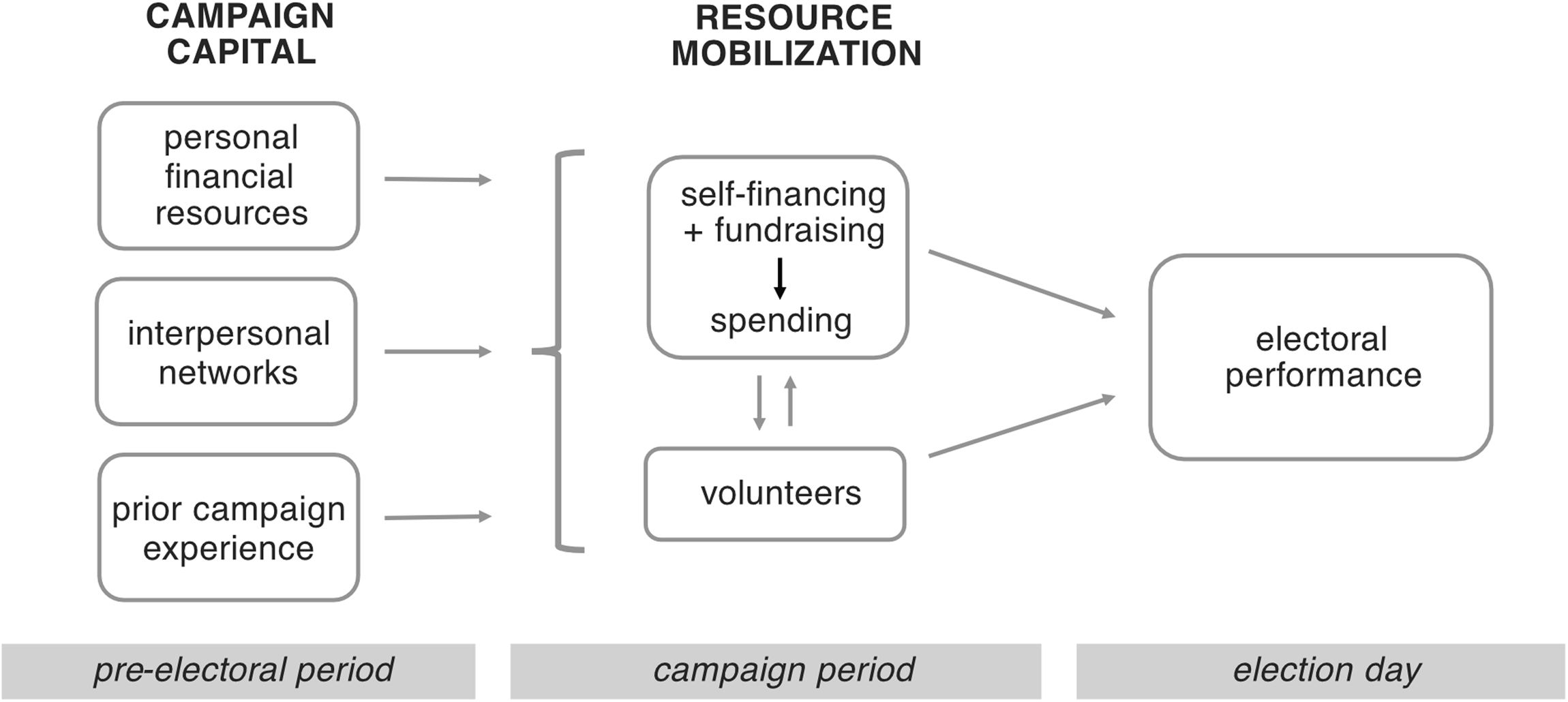
Campaign capital, resources, and non-incumbent electoral performance: A model.
From this theoretical model we derive the following empirical expectations:
Non-incumbent candidates who spend more money, as well as those who mobilize more volunteers, will be more likely to win after controlling for contextual variables. We expect that these associations will be weaker, or entirely absent, for incumbents, since the large incumbency advantage is likely to wash out any resource-related effects. For non-incumbents, the mobilization of money and volunteers during a campaign will be positively associated with one or more kinds of campaign capital – personal financial resources, interpersonal networks, and/or prior campaign experience.
In addition to testing these expectations, our empirical analysis engages with a series of more specific exploratory questions. These questions fall into two broad categories:
The functions of campaign capital: How do different kinds of campaign capital support resource mobilization? For instance, do interpersonal networks support fundraising capacity, volunteer mobilization, or both? Pre-existing personal financial resources are likely to facilitate self-financing, but do they also support resource mobilization in other ways? What kinds of mobilization capacities are supported by prior campaign experience? Are some kinds of campaign capital more versatile than others? Resource substitution: Do candidates substitute different kinds of campaign resources depending on their campaign capital? For instance, do candidates with fewer personal financial resources engage in more fundraising or recruit more volunteers?
Empirical and Institutional Setting
Our analysis focuses on candidates running in the 2022 local elections in the Canadian provinces of Ontario and British Columbia. With a 2021 Census population of 14,223,942, Ontario is the most populous province in Canada; British Columbia, with 5,000,879 residents, is the third most populous. Our decision to focus on these two provinces was informed by a nested most-different-systems case selection logic, as well as by data availability considerations.
British Columbia and Ontario have different municipal electoral systems, which maximizes variation in local electoral context for the purposes of our analysis. In addition, unlike many smaller Canadian provinces, Ontario and British Columbia feature a wide range of municipalities in terms of population, ranging from large cities to small villages. Our provincial case selection thus maximizes both cross-provincial variation in electoral systems and within-province variation in local context across individual municipalities.
According to the 2021 Census, 89 percent of British Columbia's residents live in 161 incorporated municipalities. The largest, the City of Vancouver, has 662,248 residents; the smallest, the remote village of Zeballos, has 126 residents. Most municipalities have small populations – 63 percent of the province's municipalities have a population of less than 10,000 – but two-thirds of British Columbians live in the 20 largest cities. Council representation is typically at-large – that is, council candidates compete for seats in a single multi-member district – with the mayor being directly elected. 4 Across the province in 2022 there were 326 distinct contests for 1,031 municipal seats: 165 races for 870 council seats and 161 for mayor. 5
Most of Ontario's population lives in 416 lower- or single-tier incorporated municipalities, with the former being organized into two-tier counties or county-like arrangements. 6 Unlike in British Columbia, council representation is typically single-member-ward-based, although some municipalities (typically smaller ones) elect their councils at large, have mixed systems with a combination of ward and at-large seats, or have multi-member wards. In 2022, there were 1,574 distinct local contests across the province: 1,160 for 2,362 council seats and 414 for directly elected heads of council. 7
All municipal elections in Ontario are nonpartisan; all fundraising and expenditure is undertaken by individual candidates and no party labels appear on the ballot. By contrast, local political party-like “elector organizations” are permitted by law in British Columbia. These may raise and spend funds independently of individual candidates, and candidates and elector organizations may transfer money to one another. They are unrelated to parties at the provincial and federal levels and typically exist only in large urban municipalities. In 2022, elector organizations contested elections in 13 out of the 161 municipalities. Given our focus on non-partisan contexts, we exclude these municipalities from our analysis.
Both Ontario and British Columbia are data-rich environments for students of local elections, which facilitates our analysis. 8 British Columbia, to the best of our knowledge, is the only North American province or state that centrally regulates and collects information about local elections: nomination forms, including contact information; election results; self-reported information about candidates, including political experience and gender; and campaign finance disclosure reports. Ontario legally prescribes collection of similar data; however, unlike in British Columbia, the data are collected and held at the municipal level, which means that it was feasible but more labor-intensive to collect the necessary information for our study.
Data, Variables, and Measures
Datasets
Our analysis draws on data from four joined datasets. At the heart of our analysis is a survey dataset that contains responses to a two-wave survey sent to candidates for municipal office in 2022 in Ontario and British Columbia. In British Columbia, the survey was sent to all candidates in all municipalities province-wide. 9 In Ontario, where the provincial government does not maintain a centralized database of candidates for local office, we sent the survey to candidates in the 69 lower-tier municipalities with a 2021 Census population of greater than 20,000, manually collecting contact information from municipal websites. 10 The first wave of the survey was sent as soon as possible after the nomination deadline, and the second wave was sent the day before election day. Each wave contained a battery of standard questions, as well as some wave-specific questions. Some candidates answered both waves, whereas others answered one or the other. To maximize our N, our analysis combines responses to standard questions that were asked in both waves.
Altogether, 1,450 distinct mayor and council candidates responded to the survey in British Columbia and Ontario. For our analysis, we exclude acclaimed candidates (N = 19) and, as mentioned above, candidates in the 13 British Columbia municipalities where elector organizations ran candidates in 2022 (N = 88), resulting in a sub-sample of 1,343 respondents. 11 Candidates from a total of 547 distinct contests are represented, including 186 in British Columbia and 361 in Ontario. In terms of municipal-level coverage, responses in British Columbia come from 127 of the province's 161 municipalities. In Ontario, responses come from 68 of the 69 municipalities with a 2021 population of more than 20,000. As noted above, we were not able to survey candidates in smaller Ontario municipalities. Because we also exclude survey respondents from British Columbia municipalities in which elector organizations are active, which tend to be large urban municipalities, there is a cross-provincial asymmetry in our sample, such that the Ontario respondents mostly come from larger municipalities and the British Columbia respondents come from smaller ones. 12 Excluding acclamations and candidates in British Columbia jurisdictions in which parties competed, across both survey waves, 34.2 percent of councilor candidates and 28.1 percent of mayoral candidates responded in that province, and 28.5 percent of invited councilor candidates and 25.7 percent of invited mayoral candidates responded in Ontario. The overall response rate was 29.9 percent.
For the present analysis, we joined our survey data with information from three other datasets. The candidate dataset merges, at the candidate level, two separate datasets disseminated by Elections BC or by individual municipalities in Ontario. 13 The first is candidate nomination information submitted by municipalities. In British Columbia, this records each candidate's name, sex, and past political experience, including incumbency; in Ontario we have only the name. 14 The second is election results, including the number of votes cast for each candidate and the winner.
The campaign finance disclosure dataset contains data derived from the candidates’ financial reports, including total contributions and expenditures, and amounts contributed by the candidate to their own campaign. 15 Finally, the context dataset contains the absolute population and population density of each electoral district contested. 16
Variables and Measures
Campaign Capital
We assess a candidate's personal financial resources by collapsing seven ordinal category responses to a survey question about approximate household income into three categories: ‘low income’ ($0–74,999), middle income’ ($75,000–149,999), and ‘high income’ ($150,000 and over). These categories divide our sample roughly into thirds.
We measure politically mobilizable interpersonal networks based on responses to the survey question: “What organizations have you been involved with or a member of during the past five years?” Of the 12 possible responses in the survey, we identified three – ‘local business association / chamber of commerce’, ‘resident, neighborhood or ratepayer group’, and ‘local issue-focused group / advocacy group’ – whose activity clearly relates to local politics, making them likely venues in which a candidate could develop politically mobilizable local networks. Using these responses we constructed a four-level ordinal variable that sorts respondents, respectively, into those who were active in zero, one, two, or three types of local organizations.
We separate previous campaign experience into two variables that capture distinct types of experience. 17 Worked on campaigns is a dichotomous variable based on responses to the question: “Have you worked on someone else's election campaign during the past 10 years?” Ran before is a dummy variable constructed from responses to a matrix question that asked whether a respondent had run for office before, at what level of government, and whether they had won or lost. All respondents who had run for office before at any level of government, successfully or unsuccessfully, were coded as “ran before”. 18
Resource Mobilization
We operationalize candidate spending during a campaign as cents spent per resident of the electoral district. 19 The variable was constructed based on mandated financial disclosure data and was logarithmically transformed to account for the heavily right-skewed distribution. Self-financing and fundraising (that is, donations received from others) are similarly operationalized in cents per resident, log transformed. The volunteers variable is constructed by combining second wave responses to the survey question “Approximately how many volunteers worked on your campaign?” with responses to the analogous first wave question and then adjusting for district electoral district population. Again, the variable is logarithmically transformed to normalize a skewed distribution.
Electoral Performance
We operationalize electoral performance as a dichotomous variable – having won or lost. We use this measure rather than vote share due to the comparability issues that emerge when comparing districts of different magnitude (i.e., single-member vs. multi-member districts). 20
Control Variables
The models presented below also include a range of variables that control for potentially relevant personal and contextual factors. As discussed earlier, the literature demonstrates the existence of a large incumbency advantage. Based on this work, we expect to find that incumbents are much more likely to win office than non-incumbents, and that mobilization of money and volunteer labor are not significant predictors of incumbent electoral success. While our main analytical focus is on non-incumbents, we account for these anticipated effects of incumbency in our modeling in two ways: by controlling for incumbency in our all-candidate models, and by also running separate models for incumbents and non-incumbents.
Other individual-level controls are sex and self-reported minority status, as well as length of residency in the neighborhood and homeownership. There are plausible reasons why residency and homeownership might have a positive effect on resource mobilization, the former as a proxy for neighborhood rootedness, the latter capturing the material interest in property values and neighborhood qualities that candidates may be highly motivated to protect or enhance. We know that homeowners are more engaged in local politics than non-homeowners (Fischel 2005; Jiang 2018; McGregor and Spicer 2016). Candidates who are homeowners may be able to capitalize on this to mobilize money and/or volunteers from fellow homeowners, and long-term residency may facilitate the formation of mobilizable networks.
At the contextual level, we control for the population density of the electoral district and the number of opponents in the race, since previous research has consistently shown a negative relationship between the number of opponents and electoral performance (Krebs 1998; Taylor and McEleney 2019). Since some of our candidates ran in multi-member electoral districts, we adjusted the number of opponents for district magnitude – for example, in an at-large district with 10 seats and 40 opponents, the adjusted number of opponents would be four. We also include whether or not a race is an open race (that is, there is no incumbent present), as the absence of an incumbent significantly and predictably improves the electoral performance of candidates (Trounstine 2011).
We also control for whether the candidate is running for a council position or a mayoral position. We have no a priori expectations of why this might matter. While elections for head of council may receive more public and media attention than those for council seats, we note that, given the preponderance of at-large council elections in our sample, council elections are not necessarily “smaller” than mayoral elections. A majority of the candidates in our sample (55 percent) face the same municipality-wide electorate, regardless of the office contested. As a robustness check, we include separate models that exclude mayoral candidates in the Appendix. 21 Finally, in all models we apply a fixed effect control at the level of the province, to account for the fact that the provincial context may matter in ways that are not captured in our other variables.
Our survey coverage in terms of respondents, municipalities, districts, and contests, as well as descriptive statistics for all variables included in the analysis, broken out by province and office, are summarized in Tables A1–4 in the Appendix. 22
Analyses and Findings
Determinants of Candidate Performance
To begin, we examine the determinants of candidate performance, operationalized as the odds of winning. In Figure 2 we present the results of logistic regression analyses for candidates who ran in jurisdictions without local political parties, excluding those who won by acclamation. 23 In order to test for incumbency advantage and examine whether the determinants of candidate performance differ for incumbents and non-incumbents, we present three sets of results: for all candidates, for incumbents, and for non-incumbents.
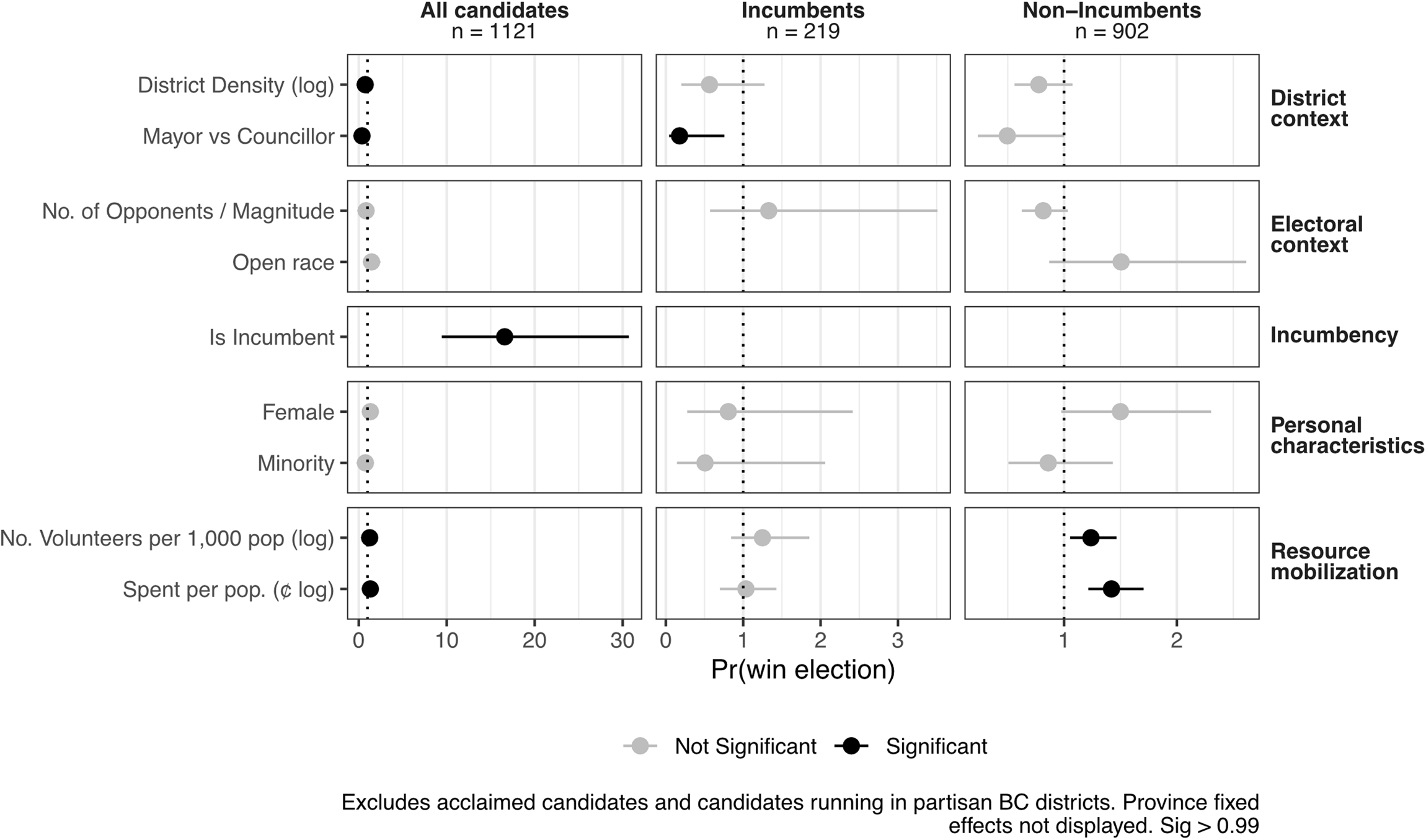
Determinants of candidate performance (win/lose) (odds ratios).
Our results underline the significance of incumbency advantage in non-partisan local elections, as incumbency is by far the strongest predictor of winning in the all-candidates model. There is also strong support for our expectation that the determinants of electoral performance are different for incumbents than for non-incumbents. In the incumbents-only model, resource mobilization in the form of volunteers and campaign spending is not a significant predictor of winning for incumbents. In fact, the only significant variable is whether the race is for a mayoral or a council seat, with mayoral incumbents being less likely to win. Since our models control for the number of opponents, we cannot interpret this finding as an indication that mayoral races are more crowded in an absolute sense. However, the finding does suggest that the structure of competition differs in mayoral and council races, and that incumbent mayors are, on average, more likely to face ‘serious’ challengers than incumbent councillors.
For non-incumbents, our results indicate that resource mobilization does matter, and that it is not just a matter of money, since both spending and campaign volunteers are positively and significantly associated with the odds of winning an election; indeed, they are the only variables that are significant in the non-incumbent model. Our results thus provide strong support for our expectation that resource mobilization predicts electoral performance for non-incumbents.
Determinants of Raising and Spending Funds
We now take one step back in the causal chain and examine the links between campaign capital and resource mobilization. For the sake of completeness we again present results for all-candidate, incumbent, and non-incumbent models. However, since the findings above support our expectation that resource mobilization does not matter to incumbent electoral success, we will focus our discussion on the non-incumbent models (found on the right side of each figure). We begin with the factors that influence a candidate's ability to raise and spend money during a campaign. We start with
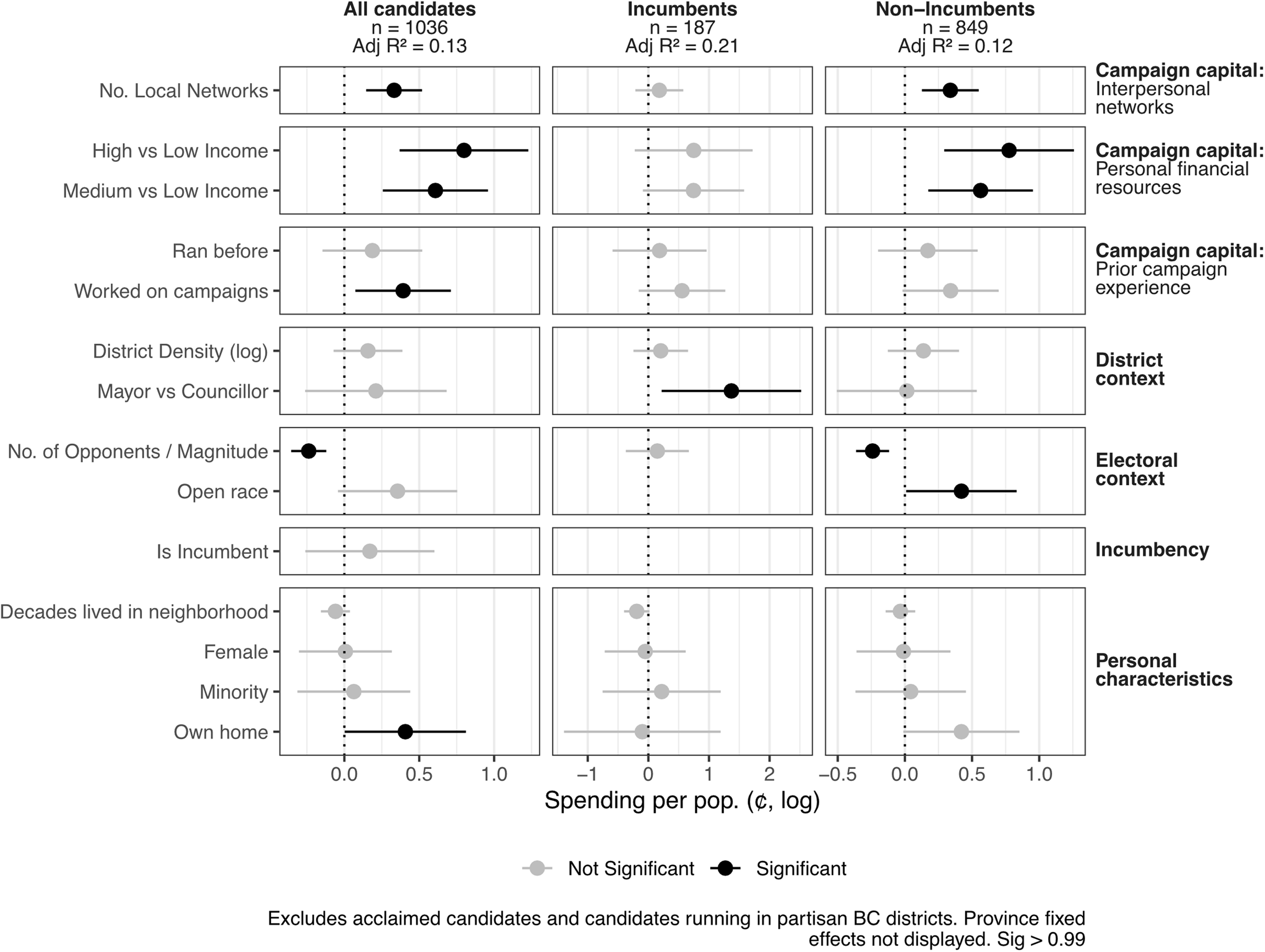
Determinants of spending.
The results for non-incumbents suggest that campaign capital matters. Most notably, both a candidate's personal financial resources and the strength of their local interpersonal networks are positively and significantly associated with campaign spending. In addition, having previously worked on others’ campaigns is a significant predictor at the >0.95 level, although not at the >0.99 level (see also Table 1 below). These results support our expectation that pre-existing personal resources help non-incumbents to mobilize campaign funds. Beyond our campaign capital variables, the results also suggest that non-incumbents spend more in the context of an open race. We suspect that this is because non-incumbents have significantly greater chances of success in races that lack an incumbent, which may motivate them to spend more on average. 24
Statistical Significance of Positive Associations Between Campaign Capital and Resource Mobilization by Non-Incumbents.
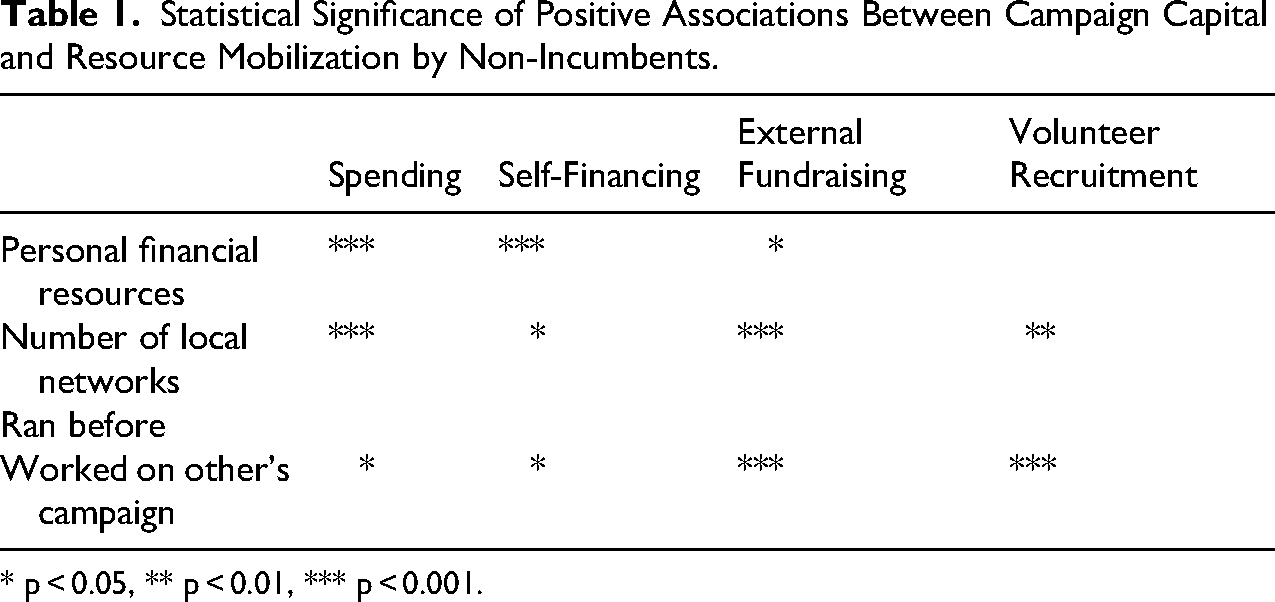
* p < 0.05, ** p < 0.01, *** p < 0.001.
In our theoretical model (Figure 1), we note that the connections between campaign capital and spending are indirect, since a candidate's ability to spend is a combined function of their self-financing and fundraising activity. To obtain a clearer picture of the connections between campaign capital and the mobilization of financial resources, we examine the determinants of self-financing and external fundraising separately. Figure 4 shows the results of OLS regression analysis of the determinants of
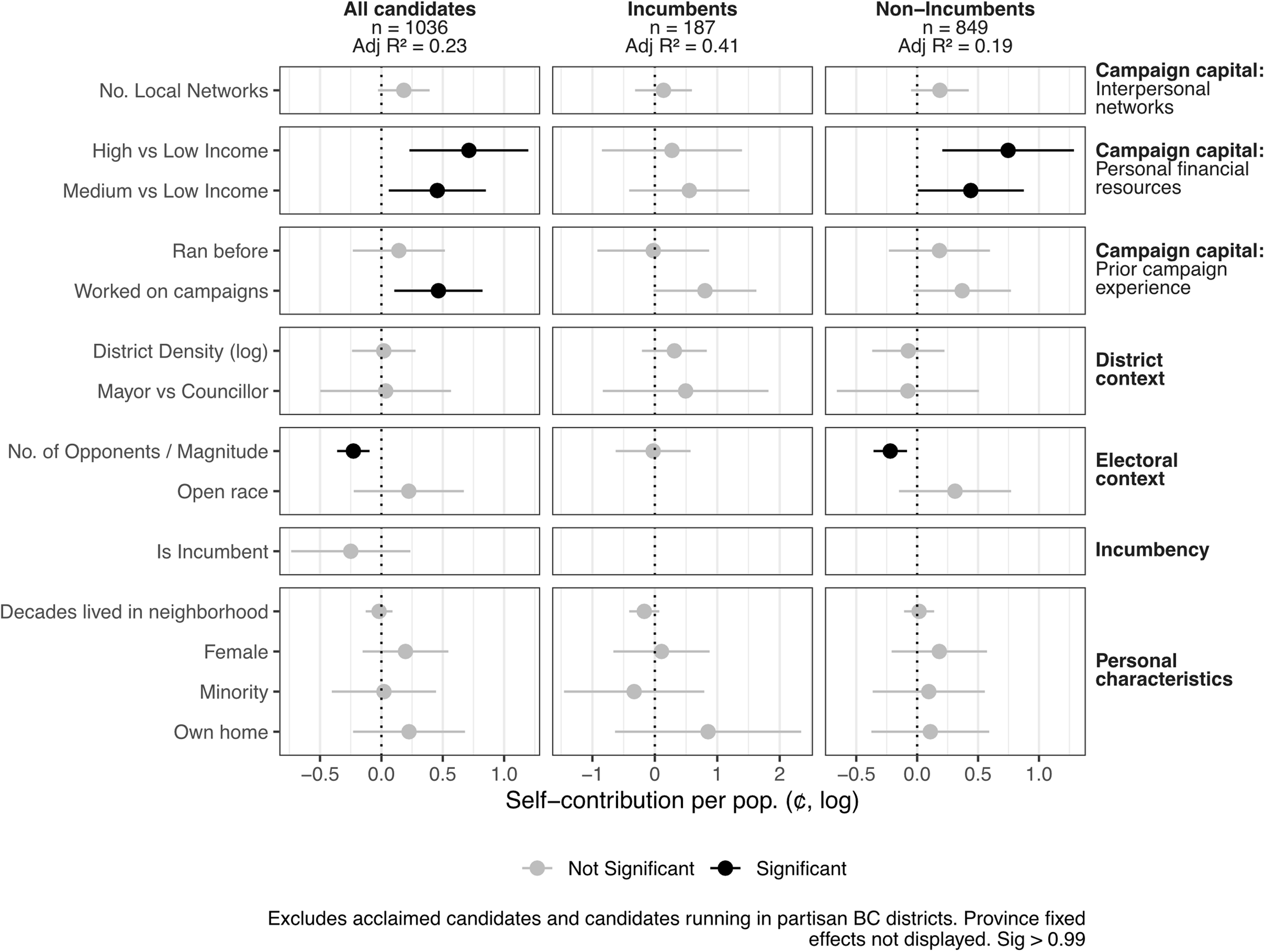
Determinants of self-financing.
Figure 5 shows results of OLS regression analyses of the determinants of
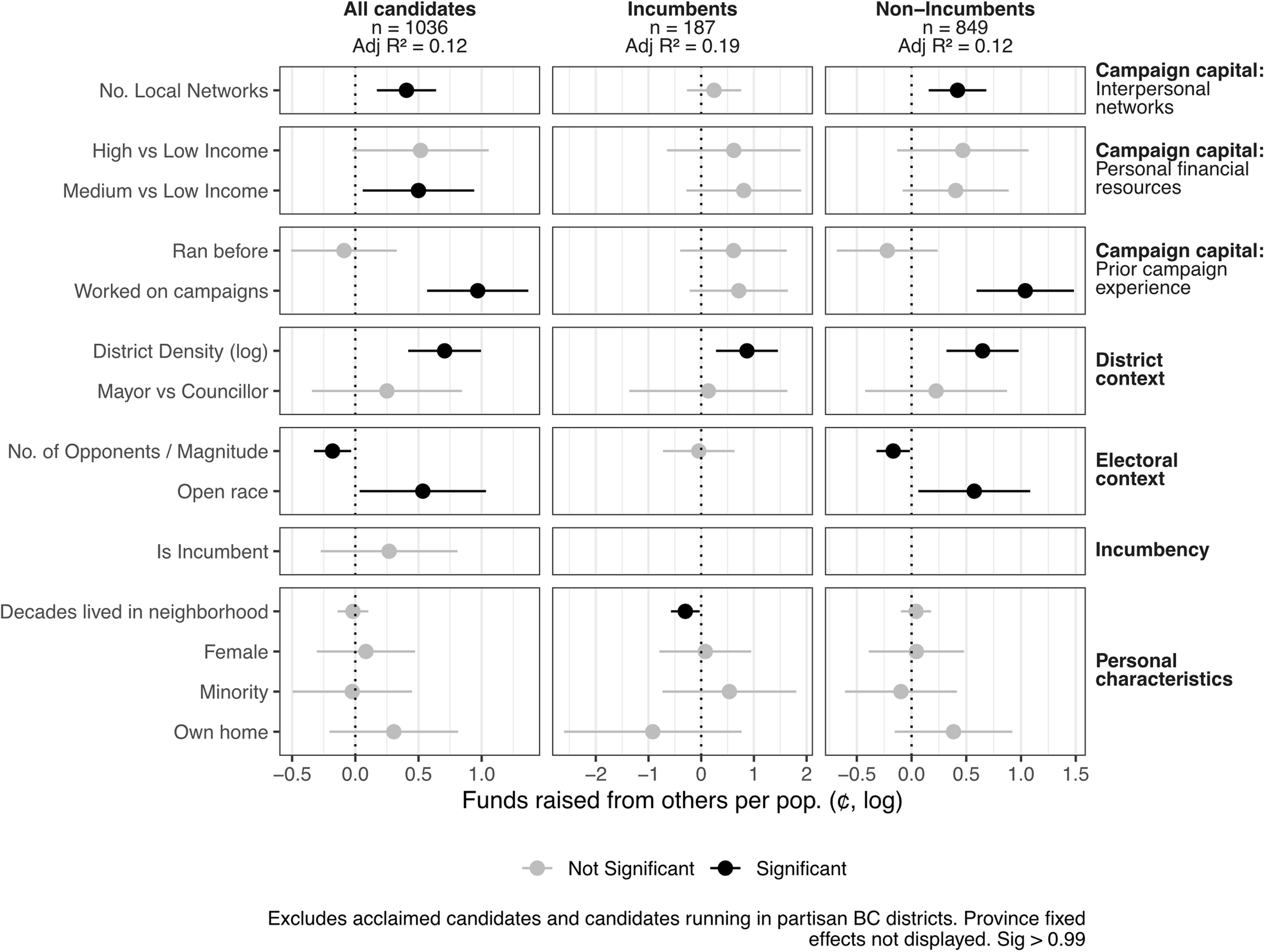
Determinants of external fundraising.
There are also some unexpected results in Figure 5. First, having run before for office is not a significant predictor of fundraising. This counters our expectation that having previously run for office might confer similar advantages as having worked on other candidates’ campaigns. We cannot fully explain this finding, but we suspect that it is the result of systematic bias stemming from the nature of the ‘ran before’ variable. Specifically, our analysis of non-incumbents by definition excludes many respondents who have successfully run for office in the past - namely, those who are now incumbents. Instead, ‘ran before’ captures two groups: candidates who have run before but have always lost (N = 166); and candidates who have run before and won at least once, but at some other level of government, or in the more distant past (N = 213). The former are disproportionately likely to be low-quality or ‘unserious’ campaigners; and the latter have prior experience in contexts that are relatively far removed from their current electoral context, so any strategic insights and interpersonal networks they may have developed in those contexts may be of limited applicability to their current bid for office. 27
Beyond our campaign capital variables, a second unexpected result is that district density is positively correlated with fundraising. In our view, this may be because in jurisdictions with low contribution limits, such as British Columbia and Ontario, fundraising involves labor-intensive tasks such as organizing events and canvassing door-to-door for donations, which are relatively easier to do in a more densely populated urban setting. It is also worth noting that, as with spending, fundraising is positively correlated with open race contexts, which - as we noted earlier - may motivate non-incumbents to put more effort into their campaigns.
Determinants of Volunteer Recruitment
As we saw in Figure 2, volunteers are a significant predictor of electoral performance. Figure 6 presents the results of OLS regression analyses regarding the determinants of volunteer recruitment. 28 For non-incumbents, both the strength of their local networks and the experience of having worked on others’ campaigns are positively associated with volunteer recruitment, again supporting our theoretical expectations. As in the models where fundraising is the dependent variable, having run for office before is, surprisingly, not associated with volunteer recruitment. We suspect that the same issue of systematic bias stemming from the nature of the variable accounts for the unexpected result in this case as well.
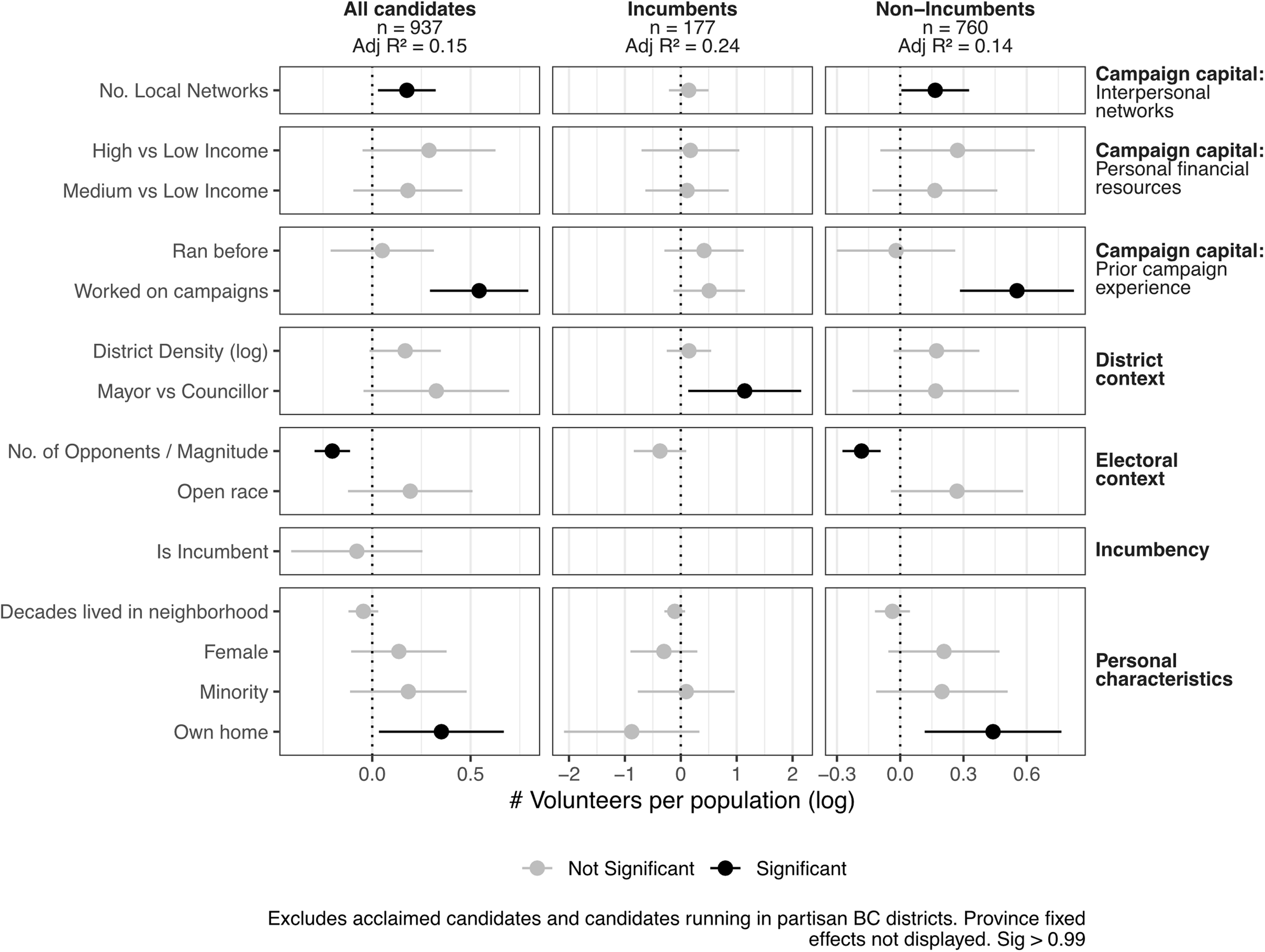
Determinants of volunteer recruitment.
In addition, home ownership is a significant positive predictor of volunteer recruitment for non-incumbents. While we did not articulate expectations regarding homeownership in our theoretical model, its significance for volunteer recruitment is not entirely surprising. Previous research has shown that homeowners have stronger neighborhood-level social networks than non-homeowners (Leviten-Reid and Matthew 2018), and these social connections may constitute avenues for volunteer recruitment that are not captured in our ‘local networks’ variable. In addition, being a homeowner may give a candidate greater legitimacy among other homeowners, who are more likely than non-homeowners to be motivated to participate in local politics (McGregor and Spicer 2016), which could also assist with volunteer recruitment.
The Functions of Campaign Capital
In general, then, our results provide robust support for our theoretical expectations. We find that the electoral performance of non-incumbents is shaped by the intensity of their campaign spending and volunteer recruitment, and that the mobilization of money and volunteers in a campaign is in turn shaped by a candidate's pre-existing campaign capital. The results also give us insight into our exploratory questions about the functions of campaign capital – that is, how different kinds of campaign capital support resource mobilization. Table 1 summarizes the findings, showing the threshold of statistical significance met by each campaign capital variable.
Personal financial resources play a straightforward role in supporting resource mobilization: Candidates with higher household incomes contribute more heavily to their own campaigns, which allows them to spend more money overall. Local interpersonal networks appear to have a dual function: They help candidates to recruit campaign volunteers, and they also facilitate fundraising, which boosts candidates’ overall campaign spending. In addition, candidates with prior experience of working on others’ campaigns recruit more volunteers and fundraise more than those without, which provides robust evidence for the strategic importance of prior campaign experience. By contrast, having run for office before is not a significant predictor of resource mobilization. As we noted above, we do not think this necessarily suggests that prior runs for office are of no value for resource mobilization in subsequent campaigns; rather, the result may reflect the fact that those who learned the most from prior runs for office are already incumbents, and so are excluded from our non-incumbent models.
Types of Campaign Capital and Patterns of Resource Mobilization
Our final analysis explores whether candidates substitute different kinds of resources in their campaigns, and whether the kinds of resources that they mobilize are based on the kind of campaign capital that they possess. Let us start with substitutability. Do some candidates run labor-intensive campaigns while others run capital-intensive ones, or do candidates mobilize both kinds of resources in tandem? A simple correlational analysis reveals that spending and volunteers (per resident and log-transformed) are strongly positively correlated (r = 0.35, p < .001, sig = .99). Excluding candidates who spent no money and had no volunteers strengthens the correlation further (r = 0.67, p < .001, sig = .99). 29 In short, higher spenders have more volunteers and vice versa.
To further explore the underpinnings of this correlation, we develop models that assess the degree to which the capacity of non-incumbents to spend and recruit volunteers depends on their stock of different types of campaign capital. We do this by estimating the marginal effect of the number of local networks on spending and volunteer recruitment for candidates, contrasting candidates with high and low income levels (see Figure 7). 30 These models exclude incumbents. We find that high-income candidates spend at higher levels regardless of the number of networks they possess, likely due to their superior capacity to self-finance. For low-income candidates, however, having more networks is important, since it enables them to close the spending gap with high-income candidates. In the case of recruiting volunteers, by contrast, networks are equally important regardless of income.
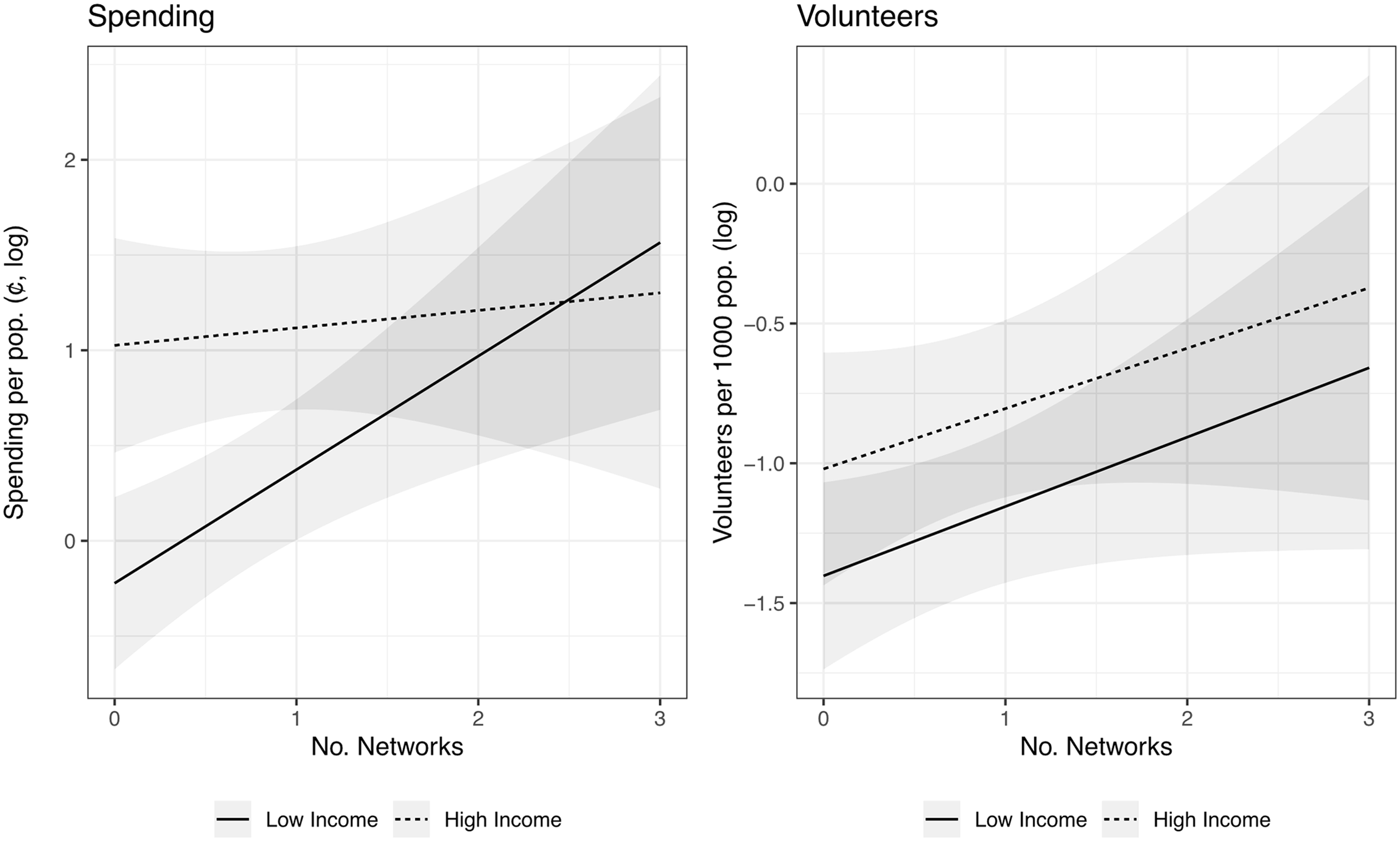
Marginal effect of networks on spending and volunteers, by income level.
These findings suggest that rather than being substitutable, campaign resources appear to be additive – candidates do not choose to either raise and spend more money or engage in more volunteer recruitment. Rather, they tend to do more or less of both, depending on their existing stock of campaign capital in the form of networks. It may also be the case that campaign resources are interactive over the course of the campaign period. In other words, candidates may draw on their stock of campaign capital to mobilize resources, but as a campaign unfolds, positive feedback among volunteer recruitment, fundraising, and spending generates campaign momentum. However, exploring these dynamics is a task for future research.
Conclusions
Non-partisan local elections present a unique set of circumstances and challenges for non-incumbent candidates. Drawing on a unique linked dataset that covers more than 500 electoral contests across two Canadian provinces, our findings confirm the existence of a large incumbency advantage in non-partisan settings, and our modeling approach, which analyzes incumbents and non-incumbents separately, indicates that the two sets of candidates face a very different electoral calculus. Moving beyond the common analytical focus on financing only, we find that both financial resources and volunteer labor are significant predictors of electoral performance for non-incumbents, a result that validates widespread anecdotal evidence concerning the importance of volunteer labor in local election campaigns.
Most significantly, our results underline the importance of pre-existing candidate resources, which we call campaign capital. Using data gathered from a wide variety of local campaign contexts, we find robust support for our core theoretical proposition: That the ability of non-incumbents to mobilize money and labor is influenced by their pre-existing interpersonal networks and financial resources, as well as by their prior campaign experience. We find that interpersonal networks and prior campaign experience support both fundraising and volunteer recruitment capacities, while personal financial resources enhance the ability of candidates to self-fund their campaigns. In addition, our exploration of the relationship between campaign funding and volunteer labor finds that they are not substitutable campaign resources, whereby one compensates for the lack of the other. Instead, candidates tend to deploy both to a greater or lesser degree, depending on their pre-existing campaign capital.
Our findings demonstrate the analytical power of linked datasets – in this case including survey data, election outcomes, financial disclosures and census data. In substantive terms, our findings have broader implications for our understanding of non-partisan local elections. Although our data come from the Canadian context, the majority of municipal elections in the United States are also non-partisan and require candidates to mobilize their own campaign resources. Our findings suggest that jurisdictions in which candidates cannot secure campaign funding from a single external source (such as a political party or a major donor) favor non-incumbents who have stronger financial resources of their own. In other words, in a non-partisan context, strict campaign finance limits may advantage wealthier non-incumbents.
But our results also show that the ability of non-incumbents to mobilize campaign resources is supported not just by personal wealth but by a variety of pre-existing personal assets, including rootedness in local community life and experience of past campaign involvement. Campaign capital, in other words, is multifaceted, and much of it is built incrementally. Choices that candidates have made long before their run for office – to engage in community life, to be active in local organizations, to support other candidates in their campaigns – allow them to develop personal assets that unlock pathways to resource mobilization at campaign time. And just as different aspects of campaign capital support resource mobilization in complementary ways, so resource mobilization during a campaign may be subject to interactive dynamics, including positive feedback loops among fundraising, spending, volunteer mobilization, and a variety of concrete campaign activities. In short, for non-incumbents in non-partisan local elections, the road to success involves a dynamic process of building and deploying capabilities and assets that starts well before nomination day and continues throughout a candidate's run for office.
Our findings open up numerous avenues for further research. We will note three of these by way of illustration. First, as we have noted, our dataset covers many local contexts – from small villages to large cities, and both mayoral and council contests, in two subnational jurisdictions. But how, and how much, does such variation in local context matter? For instance, do interpersonal networks matter more to electoral success in small towns than in large cities? Are volunteers equally important in council and mayoral campaigns? Second, insofar as election campaigns involve a dynamic interplay of resource mobilization and deployment, as we have suggested, then this opens up a fascinating avenue for research on within-campaign dynamics. Finally, we have noted that a candidate's ‘seriousness’ – that is, their motivation and commitment to their own candidacy – may also shape their ability to mobilize resources. Exploring the role that motivation and commitment play in shaping the choices that a candidate makes both before and during a campaign is another fruitful avenue for future work. Our understanding of the dynamics of campaigning and resource mobilization in non-partisan local elections is just beginning to develop. A theoretically and empirically rich field of inquiry is open for all scholars interested in local politics, democratic representation, and electoral studies.
Supplemental Material
sj-pdf-1-uar-10.1177_10780874261441608 - Supplemental material for Campaign Capital, Resource Mobilization, and Candidate Performance in Local Elections
Supplemental material, sj-pdf-1-uar-10.1177_10780874261441608 for Campaign Capital, Resource Mobilization, and Candidate Performance in Local Elections by Martin Horak and Zack Taylor in Urban Affairs Review
Footnotes
Acknowledgments
The authors are grateful for work performed in support of this project by research assistants Brittany Bouteiller, Reagan Cockburn, Ivana Gotovac, and Amanda Gutzke, as well as for valuable comments from Anne Mévellec and Jack Lucas.

Ethical Approval and Informed Consent
This study received ethical approval from the University of Western Ontario Non-Medical Research Ethics Board (reference #2022-121360) on August 18, 2022. Survey participants whose anonymized data are used in this study were informed that their consent was implied through their voluntary completion of the survey.
Funding
This project was supported by the Social Science and Humanities Research Council of Canada (Insight Grant #435-2022-0582).
Declaration of Conflicting Interests
The authors declared no potential conflicts of interest with respect to the research, authorship, and/or publication of this article.
Data Availability
Supplemental Material
Supplemental material for this article is available online.