



Abstract
While today's workers are facing rising housing costs, high inflation, and stagnating wages in many parts of the country, low-income workers have been especially hard hit. There has been a great deal of attention paid to increasing the federal minimum wage and to utilizing local affordable-housing bonds, but living wage ordinances are another, lesser-utilized tool available to municipalities trying to address poverty in their jurisdictions. Unfortunately, the literature discussing the possible benefits and costs of these wage ordinances on local governments and contractors is becoming increasingly outdated, and there is an immediate need to revisit the impact of these policies. The research note presented here provides a brief overview of the literature; a discussion of the complex legal landscape, including state preemption laws, that impacts local autonomy to adopt wage ordinances; and an inventory of wage policies from the ten largest municipalities in all fifty states. Finally, a renewed call for research is made.
Introduction
It is estimated that almost 38 million people live in poverty in the United States (U.S. Census 2023). Families in poverty-stricken situations struggle to afford basic necessities such as housing, healthcare, food, and childcare. We witnessed renewed energy in the policy space addressing poverty and low-income households during the Covid-19 pandemic, when multiple policies at all levels of government were revisited, including the earned income tax credit, unemployment insurance, and child tax credits. Additionally, there has been a growing effort at the local level to supplement federal and state strategies aimed at addressing the needs of low-income households (e.g., DeFilippis et al. 2019; Kearney and Mogstad 2019). Similarly, we saw an increase in local efforts centered around affordable housing policies.
Here, we focus on another powerful tool that local governments may consider when addressing issues facing their low-income populations: living wage ordinances. These ordinances, which take into account local cost-of-living metrics such as housing costs, are unlike state and federal minimum wage laws, which tend to persist over time and do not account for localized economic variations. Interest in local wage ordinances was brought center stage by worker-led movements such as the Fight for $15. The Fight for $15 mobilized thousands of workers—many of whom had never been involved in labor activism before—through walkouts, protests, and strikes. Workers and policy networks across the country rallied in cities like Los Angeles, Chicago, and Seattle, forcing local governments to take action (Isacoff 2022; Doussard and Schrock 2022, 2023).
While the federal minimum wage has not changed since 2009, subnational wage policies have not been as stagnant. In 2023, twenty-seven states increased their minimum wages, and at least twenty-seven local governments did the same (Bhattacharya 2023). Not all local governments, however, are authorized to enact wage ordinances. More than half of states have laws that preempt local governments from adopting a local wage ordinance (University of Wisconsin Population Health Institute 2022). As we discuss further, these laws do not necessarily preclude local living wage ordinances, and they have been challenged by municipalities in states such as Florida and Arizona (Kim, Aldag and Warner 2020; Doussard and Schrock 2023).
Excellent research has been conducted on living wages, but much of it is two decades old (e.g., Adams and Neumark 2004; Martin 2006). Since that period, (1) a more diverse set of jurisdictions has adopted living wages, (2) the gap between minimum wages and living wages has grown as inflation and the cost of living have increased, (3) state preemptions have become more commonplace, (4) worker and entrepreneurial networks’ efforts to seek a living wage have intensified and brought more attention to the issue, and (5) there have been serious advances in causal analysis and quasi-experimental methods that allow for a better understanding of the true impacts of living wage laws. Given the important role that living wages may play in addressing poverty, this research note briefly discusses previous literature on the topic and the potential impact of state preemption laws, presents data on local wage ordinances from the largest municipalities in all fifty states, and renews a call for more research on the subject of living wages.
What Are Living Wage Laws?
Living wage policies are a market-based approach for mandating wage minimums based on geographically specific expenditure data related to a family's likely minimum costs for food, childcare, health insurance, housing, transportation, and other necessities. The living wage incorporates cost elements and the approximate effects of income and payroll taxes to determine the minimum employment earnings necessary to meet a family's basic needs while maintaining self-sufficiency. If living wage laws are enacted, state and local governments may require some private businesses and government entities to pay above-market wages and benefits to their workers.
While similar to minimum wage policies, true living wage policies are distinct in how they are determined. A minimum wage is the lowest amount employers are legally required to pay covered employees. It may be intended to reflect the cost of living in a general sense, but it is typically not derived from localized data and may remain unchanged over time despite significant shifts in local economic conditions. In contrast, a living wage is the calculated minimum amount of compensation a worker needs to afford basic necessities in a specific jurisdiction. For example, the per-hour living wage in Massachusetts for a two-working-adult family with one child is $24.72, while in Alabama the same family structure requires $17.92 (Glasmeier 2023). Notably, not all living wage ordinances are set as high as these estimates. Another difference between a living wage and a minimum wage is that living wage ordinances typically apply only to private businesses that benefit from public money (e.g., through assistance or contracts [Kumler 2007]) and to public-sector employees.
Living wages are also comparable to prevailing wages, but the two differ in scope and purpose. Prevailing wages are set by surveying local market rates for comparable work and typically apply to contractors on publicly funded construction or infrastructure projects, often aligning with union wages (Basten 2017; Wall, Madland and Walter 2020). 1 In contrast, living wages generally cover fewer workers, with about 80 percent of ordinances applying to service contractors such as janitorial staff (Bartik 2002). At the federal level, prevailing wages are regulated under the Davis-Bacon Act (Public Law 71-798, enacted in 1931), and most states have similar “little Davis-Bacon Acts.” These laws significantly affect worker compensation: the Congressional Budget Office (CBO) estimated that repealing the Davis-Bacon Act would save the federal government about $14 billion between 2018 and 2026 in construction costs alone (CBO 2016). Because the scope of covered workers differs, the economic impacts of prevailing and living wage laws are not directly comparable. In short, living wage laws focus on ensuring workers can meet basic needs, while prevailing wage laws are designed to guarantee fair compensation.
Existing Work on Living Wages
Since 1994, when Baltimore adopted its living wage policy for government contractors, local living wage ordinances have sparked significant debate. Advocates argue these mandates reduce poverty, decrease reliance on social safety nets, boost consumer spending, and curb worker exploitation. Critics, however, highlight the burden on employers, particularly small businesses, and contend that such policies lead to job losses for low-skill workers and price increases to cover wages not required in a free market. They also note that, as most living wage laws apply only to government employers and their contractors, they may increase the cost of public services (Holzer 2008; Gaille 2019).
Nearly three decades of living wage ordinances have produced a robust but aging body of literature. Given current inflation, economic shifts, the widening gap between living wages and the federal minimum wage, and other social and economic changes, it is critical to reassess the impacts of these ordinances. Applying findings from past studies to today's workers and employers requires caution.
Prior research on living wage effects shows modest positive impacts on poverty reduction (Neumark and Adams 2003; Adams and Neumark 2005; Clain 2008; Holzer 2008; Neumark, Thompson and Koyle 2012). However, some evidence suggests these policies primarily benefit higher-wage and higher-skill workers within low-income households (Adams and Neumark 2005). The impact on employment is mixed: some studies indicate negative effects on hours and jobs (Neumark and Adams 2003; Adams and Neumark 2005; Holzer 2008; Neumark, Thompson and Koyle 2012), while others find no evidence of job losses (Lester 2011) or report increased productivity among affected workers (Rizov, Croucher and Lange 2016).
While most research focuses on private-sector costs, some studies examine public-sector impacts. The Economic Policy Institute found that living wage laws have small to moderate effects on municipal budgets, with increased costs for contracted work typically less than one-tenth of 1 percent of a municipality's overall budget (Thompson and Chapman 2006), though it did not specify the cost increase for the contracted work itself. Pollin and Luce (1998) estimated that living wage laws raise costs for city contractors by 1 to 2 percent, with less than 1 percent passed on to the city. Similarly, Reich, Hall and Jacobs (2005) estimated that living wage policies at San Francisco International Airport (owned and operated by the City and County of San Francisco) cost just under 1 percent of revenues, or about $58 million annually. Notably, no research has explored whether applying living wage policies to a local government's own employees increases costs. As the gap between minimum and living wages widens, these costs are likely to grow, potentially expanding the scope and benefits of these policies for affected workers.
The political environment significantly influences the adoption of living wage ordinances, with “progressive” communities more likely to implement them (Martin 2001, 2006; Swarts and Vasi 2011; Clain 2012). In such communities, where governments may already pay above-market wages, the impact of living wage policies may be muted, affecting fewer workers and reducing both benefits and costs. Poverty levels also predict which communities adopt these policies (Martin 2006). For a comprehensive overview, see Adams and Neumark (2004), Sosnaud (2016), and Chapman and Thompson (2018). 2 However, much of this research predates the influence of organizations like Fight for $15, whose visibility and political pressure may have altered the dynamics of adopting jurisdictions. Relatedly, studies on similar policies, such as minimum wage increases, highlight the growing role of economic and racial justice coalitions and urban policy entrepreneurs (Doussard and Schrock 2022, 2023; Lesniewski and Doussard 2017).
A Look into Living Wage Ordinances by State
To better understand the landscape of living wage ordinances across the nation, we used purposive sampling to identify the ten most populous jurisdictions in each state from U.S. Census Bureau (2022) data, along with the District of Columbia. 3 This sample captures variation in size, location, and political context, which is important given the previous literature. The dataset provides a basis for examining which socio-economic and political factors influence the adoption of living wage policies, as well as their impact on budgets and workers, across a geographically and politically diverse set of large- and medium-sized cities. However, the largest municipalities often have the highest costs of living, making them more likely to enact wage ordinances. This pattern may also be reinforced by the prevalence of policy networks in urban areas and by greater governmental financial and administrative capacity (UC Berkeley Labor Center 2025; EPI 2017; NELP 2024).
Several search approaches were deployed to identify living (and minimum) wage ordinances in the selected jurisdictions. In accordance with standard legal research practices, the first step involved consulting secondary sources that referenced the primary laws of interest. These searches were reasonably successful. Organizations such as the National League of Cities and state-specific municipal associations provided curated information on local living and minimum wage legislation that set wage levels above state and federal minimums. Some searches retrieved references to sections of local ordinance codes, which served as a foundation for further inquiry. Recognizing that this information was not available for all municipalities of interest, we conducted additional research to address data gaps and validate the findings of earlier sources, using resources such as Municode and products from American Legal Publishing. Because neither publisher includes all municipalities’ ordinances, in those cases we relied on local resources, such as state and municipal websites, to identify any relevant local ordinances.
One challenge in categorizing and identifying living wage ordinances is that, while there are meaningful differences between living and minimum wage policies, the terms are often used interchangeably when referring to wage alterations. Although the conflation of minimum and living wages is common, it complicates the process of formulating and carrying out research inquiries. For this reason, we collected data on both types of policies. Applying the definition of living wages presented previously, we categorize these policies into minimum and living wage ordinances.
Findings Summary
Table 1 provides an overview of municipal wage-ordinance data. It summarizes (1) the number of municipalities, by state, within our sample that (a) do not have a wage ordinance or (b) have a wage ordinance, and whether a given ordinance specifies if it is a minimum wage or a living wage requirement; (2) among municipalities with a wage ordinance, whether that ordinance applies to most workers or only to a subset of workers; and (3) whether the state has a preemption law for local wage ordinances. Of the 501 municipalities included in this analysis, 61 have at least one form of local wage ordinance, with 41 categorized as living wage ordinances. Table 2 provides citations to these ordinances. Our finding that only 14 percent of even the largest municipalities have wage ordinances indicates that adoption of such ordinances remains uncommon.
Number of Municipal Living-Wage Ordinances by State for the Ten Most-Populous U.S. Municipalities.
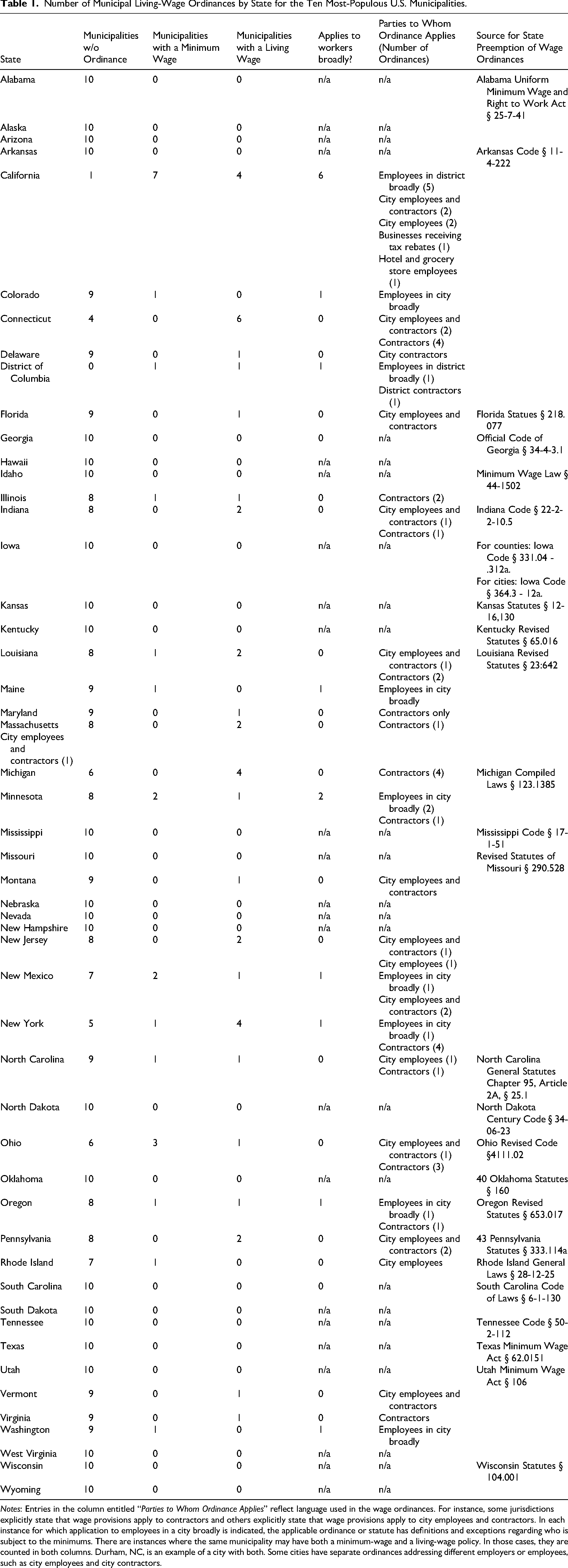
Notes: Entries in the column entitled “Parties to Whom Ordinance Applies” reflect language used in the wage ordinances. For instance, some jurisdictions explicitly state that wage provisions apply to contractors and others explicitly state that wage provisions apply to city employees and contractors. In each instance for which application to employees in a city broadly is indicated, the applicable ordinance or statute has definitions and exceptions regarding who is subject to the minimums. There are instances where the same municipality may have both a minimum-wage and a living-wage policy. In those cases, they are counted in both columns. Durham, NC, is an example of a city with both. Some cities have separate ordinances addressing different employers or employees, such as city employees and city contractors.
Statutory References for Minimum- and Living-Wage Policies in the Ten Most-Populous Municipalities in States with Such Policies.

We compiled data that included the state, municipality, ordinance notice 4 , ordinance citation 5 , and notes. 6 The notes provide additional information and context on governance and public decision-making within the legal framework of wage legislation. Some ordinances explicitly state whether a higher hourly wage applies to contractors, municipal employees, or both. Others do not specify scope and may ultimately require judicial interpretation, which is beyond the scope of our research.
Our findings indicate that most sampled municipalities do not have wage ordinances requiring higher rates of pay than the state or federal rate, and only eight states have more than two such ordinances among the municipalities sampled. Some jurisdictions restrict coverage to specific types of employees (e.g., hourly vs. salaried or full-time vs. part-time workers). Others extend higher-wage ordinances more broadly. For example, Portland, Maine, has a more expansive living wage ordinance that covers hospitality and service workers as well as seasonal employees. These groups were likely included so that tourists and visitors would absorb the cost of higher wages, thereby reducing the burden on local taxpayers. One additional nuance is that in some instances local living or minimum wage rates may be surpassed by the state wage requirement.
Obstacles in Information-Gathering and Legal Research
It is critical to note some of the challenges we faced while conducting research in this area. Such challenges are inherent in local government legal research and include differences in the structure of local governments state by state; the lack of standardization in the collection and public availability of primary law; the differences in terminology used for essentially the same concepts; and the lack of secondary sources, commentary, and legislative history that can help explain the law and aid interpretation (e.g., Cohen and Olson 2000; Olson, Kirschenfeld and Mattson 2020). These challenges complicate the task of gathering comprehensive information about local ordinances regarding wages.
The degree of local autonomy granted to a municipality by the state is especially relevant to understanding the ability of municipalities to enact and enforce wage ordinances. Some states delegate power to political subdivisions like cities, counties, and towns to enact their own ordinances, provided those ordinances are not prohibited by and do not conflict with state law. Home-rule authority—where a measure of power is granted by the state to a local government, conditional on specific terms being accepted—is one example. Other states limit local government autonomy strictly to powers explicitly granted by the state. Adding to the complexity, many states offer a blend of these two approaches (Bowman and Kearney 2012; Su 2017; Russell and Bostrom 2016; Davidson et al. 2022; Dalmat 2005).
It is fitting at this point to introduce the issue of state preemption. An initial goal of our project was to compile a list of states that have enacted preemption measures barring local governments from adopting living wage legislation mandating wage rates that surpass state and federal minimums. Preemption is integral to relationships among different levels of government in the federalist system, setting boundaries between the exercise of national powers under the U.S. Constitution, which can supersede competing state laws, and powers reserved to the states. Similarly, within states, preemption sets the boundaries between powers reserved to the state government and those that may be exercised at the local level.
Some influential policy advocates, such as the Economic Policy Institute (EPI) and the National Employment Law Project, have asserted that a number of states have preemptive wage statutes. For example, EPI (2025) presents information on what it refers to as “workers’ rights” preemptions, which include minimum wage (25 states), prevailing wage (12 states), and paid leave (25 states) ordinances. These wage ordinances vary: some apply broadly, like minimum wage, while others apply only to contractors, like prevailing wage. If state preemptions were effective and enforced, such statutes would prevent a local government from requiring wage thresholds higher than those established under state law for applicable employers. Whether local governments comply with such statutes is another matter.
A local governing body in a state with such a statute may not interpret the law as entirely preemptive, or it may choose to enact a wage threshold as a policy statement regardless of the state's action or inaction. For example, cities in Florida, Arizona, Michigan, and Arkansas have placed minimum wage initiatives on ballots in efforts to circumvent state legislatures (UC Berkeley Labor Center 2025; Doussard and Schrock 2023). A local government in this situation may also conclude that a higher wage threshold is unlikely to be invalidated by a court, especially since judicial review requires either a dispute arising from local enforcement on a noncompliant employer or an employer willing to invest in litigation rather than pay the higher wage. This is particularly relevant for living wage ordinances, the focus of this analysis, since they typically apply only to the government itself, its contractors, and/or recipients of government aid. These practical considerations make state preemption an unreliable basis for understanding the realities of local policy. For example, some states have statutes that appear to foreclose local wage ordinances but contain ambiguity. In North Carolina, for instance, the state minimum wage statute preempts local governments from adopting higher general wage requirements. However, a recent amendment exempts “[a] local government regulating, compensating, or controlling its own employees” (N.C. Gen. Stat. Ann. § 95-25.1 (2025)). Another statute explicitly prohibits cities from requiring private contractors to pay higher-than-state minimum wages (N.C. Gen. Stat. Ann. § 160A-20.1 (2025)). The City of Durham has a living wage ordinance for its employees, which does not conflict with state law, and still retains in its code a living wage ordinance for contractors doing business with the city (Durham, NC, Code of Ordinances, Chapter 18, Article II, Section 18–19).
Another key consideration when discussing state preemption is local autonomy. There is compelling evidence that home rule (i.e., state grants of greater local autonomy) reduces the likelihood that preemption laws will be upheld in court (Swanson and Barrilleaux 2020). However, in the case of wage ordinances, there is also evidence that home rule is not sufficient to overcome preemption when the state has explicitly preempted living wage and minimum wage ordinances, and courts have reached different conclusions depending on state–local relationships and statutory language (Lysobey 2019; Madsen 2019; Halpin 2009).
Despite the impact of local autonomy, states are typically successful in “occupying the field” when preemption laws are challenged by local governments, particularly when challenges are perceived as politically motivated or driven by ideological differences between the state and a large urban locality (Gillette 2007; Hicks et al. 2017; Riverstone-Newell 2017; Swanson and Barrilleaux 2020). However, as shown in Table 1, some states have both local wage ordinances and state preemptions. This tension underscores the need for more nuanced legal analysis regarding the extent to which such state laws are enforceable and applicable in local practice. Researchers relying on preemptions in their analyses are cautioned against treating the issue as black and white.
An additional complication is internal municipal compensation policies. Researchers examining the fiscal or labor market impacts of living wage policies may face challenges when internal policies—rather than formal ordinances—establish living wage rules for local government employees. As mentioned above, the City of Durham has a living wage ordinance. By contrast, the neighboring towns of Chapel Hill and Carrboro, and Orange County, do not. Instead, these jurisdictions have internal compensation policies covering living wages and are certified living wage employers, meaning that all employees are paid at least the local living wage (Kaufman 2022; Keck 2024). Notably, these policies do not apply to private firms contracting with the towns or county. These internal policies are not captured in our data, which includes only ordinances. Nonetheless, they are critical to any discussion of living wages, and failure to account for them may mislead researchers. For instance, comparing Durham to Chapel Hill and Carrboro based solely on ordinances could suggest that only Durham has a living wage policy, leading to muted and inaccurate measures of policy impacts.
Another concern for researchers involves enforcement. Because we found no significant empirical evidence on how local governments enforce living wage policies, we cannot provide clarity on typical enforcement practices. One presumption is that enforcement would require an authorized state office to review business filings to confirm compliance, particularly by contractors, as municipal authorities alone may lack the capacity to do so. Monitoring could instead be carried out by state or local departments responsible for worker protection, equity offices, or labor standards offices (e.g., Results for America n.d.), or even by advocacy-oriented nonprofit organizations (e.g., Orange County Living Wage n.d.).
In some cases, living wage ordinances may function more as symbolic gestures than as enforceable mandates, which may help explain earlier empirical findings that such ordinances had limited effects on poverty levels (e.g., Neumark and Adams 2003; Neumark, Thompson and Koyle 2012), as well as evidence that they were adopted primarily by progressive communities (e.g., Martin 2001, 2006; Clain 2012; Doussard and Schrock 2023).
Directions for Future Research
While there is robust literature on wage policies, additional scholarship on living wages is greatly needed. This article highlights the difficulties of collecting data on living wage ordinances, the legal constraints posed by state preemption, and provides an updated inventory of local living and minimum wage ordinances across the most populous cities in all fifty states. Our goal is to lay a foundation for renewed attention to living wage policies and to encourage future research in this area.
A central area for further study is the impact of living wages on poverty, employment, businesses, and governments, as well as on who benefits and to what degree. Prior studies suggest that relatively few workers are directly affected. For instance, only 2 to 3 percent of workers in the bottom decile were impacted (Holzer 2008), and the beneficiaries were not always the lowest-paid workers (Adams and Neumark 2005). However, as the gap between the minimum and living wage grows, these earlier estimates may understate current impacts. Estimates of contemporary ordinances show similarly modest reach in some cases and a larger impacts in others: St. Petersburg's ordinance is expected to affect 211 of 3,600 city employees (City News Team 2023; St. Petersburg 2023), Austin's 4,100 of 17,000 (Lee 2022; City of Austin 2023), and San Diego's 6,500 of 13,000 (Garrick 2023; California State Controller 2024). Moreover, the fiscal implications vary: San Diego estimates $83.2 million in added FY2024 personnel costs (City of San Diego 2023), while St. Petersburg projects only $495,000 (LeFever 2022). Understanding whether wage increases are modest or meaningful, and whether they reduce poverty or substitute for other public assistance, remains an open question.
The drivers of ordinance adoption also deserve renewed attention. Earlier research emphasized politics and opportunity over local economic conditions (Martin 2001, 2006; Swarts and Vasi 2011; Clain 2012), while more recent work points to the role of policy networks (Doussard and Schrock 2023; Clavel 2010). The changing landscape of local governance—marked by stagnant federal minimum wages, rising living costs, and widespread staffing shortages—suggests new dynamics are at play. In 2022, state and local governments employed 700,000 fewer workers than before the pandemic (Smith 2022), and many jurisdictions cite recruitment and retention as motivations for wage increases (Mecklenburg County 2022; Garrick 2023; Owens 2024). In such cases, adopting a living wage may be less about ideology or advocacy and more about matching labor market conditions to attract and retain employees.
Regional dynamics are another promising area of inquiry. Diffusion effects may shape both adoption and labor market outcomes. For example, Johnson (2017) found that when only one jurisdiction adopts, wage compression and job restructuring may occur. Other research suggests spatial proximity makes local policymakers more responsive to worker-led campaigns (Judd and Hinze 2018). These patterns raise questions about how living wage ordinances interact with regional labor markets and whether competitive pressures expand their influence beyond adopting jurisdictions.
Finally, methodological advances create opportunities for stronger analysis. Techniques such as propensity scores, difference-in-differences with staggered timing, and synthetic controls, as well as machine learning approaches, have strengthened causal inference. While used in minimum wage research (e.g., Wiltshire et al. 2023; Cengiz et al. 2022), these methods have yet to be fully applied to living wages. Updated analyses could more precisely estimate causal impacts, reduce concerns of selection bias, and reveal broader interactions with other policies and local conditions.
Overall, a modern assessment of the adoption and impacts of living wage ordinances is overdue. Such work could inform intergovernmental relations, policy diffusion, and urban governance scholarship while also engaging debates on equity, labor markets, and fiscal sustainability. Linking living wage research to urban development, housing affordability, public health, and inequality would further integrate this topic into interdisciplinary urban studies. As costs of living continue to rise and local governments adapt to shifting labor markets, rigorous evidence on the consequences of living wage policies is critical to guiding practice and informing policy at all levels of government.
Footnotes

Funding
The authors received no financial support for the research, authorship, and/or publication of this article.
Declaration of Conflicting Interests
The authors declared no potential conflicts of interest with respect to the research, authorship, and/or publication of this article.