




Abstract
In this paper, we explore the role of community-based, nonprofit community development organizations within competing narratives of neighborhood change. Using Grand Rapids, Michigan as our case study, we analyze data composed of historical news articles from local media and in-depth interviews with key community stakeholders. First, we identify three competing narratives of neighborhood change, highlighting the varying roles that nonprofit developers have played over time—from heroes to villains to allies. Next, we use the interview data to tease out how nonprofit developers make sense of and respond to these evolving and competing narratives of change. We find that nonprofit developers are deeply concerned about residents’ fears of gentrification and displacement and are, in principle, committed to deep community engagement. However, these organizations are constrained by their position within the development system as they navigate community needs versus their own organizational goals.
Introduction
Narratives are the stories that we tell to make sense of our experiences; they provide a window into how people interpret and experience the world around them (Ospina and Dodge 2005). Thus, stories of neighborhood change offer insights into how communities perceive neighborhood development. For some, developers are the protagonists of neighborhood change, helping them revitalize a community. For others, developers are villains, fostering displacement and gentrification. While “developers” may include a number of different institutional actors, from private real estate companies to hospitals and universities (Etienne 2012), here, we focus on the unique role of nonprofit developers within stories of neighborhood change.
We explore how community-based, nonprofit community development organizations (CDOs) are understood within competing narratives of neighborhood change—from heroes to villains to allies. We asked: (1) what are the dominant narratives of neighborhood change, (2) how are nonprofit developers framed in these narratives, and (3) how do nonprofit developers navigate narratives surrounding neighborhood change? Using Grand Rapids, MI as our case study, we begin by illustrating how neighborhoods changed between 2000 and 2020. Our qualitative data set includes 391 news articles from local media during that same time and transcripts from six in-depth interviews with nonprofit CDO practitioners, journalists, and community leaders. We use abductive thematic content analysis (Thompson 2022) to explore how nonprofit developers are framed in local news media and in interviews. We first identify three thematic narratives of neighborhood change: neglect/revitalization, property values/poverty, and gentrification/displacement. Then, we examine how nonprofit developers were framed within each narrative, highlighting them as saviors, villains, or allies. The interview data allow us to tease out how CDO practitioners make sense of and respond to these evolving narratives of change within a midsize city. We find that nonprofit developers are deeply concerned about residents’ fears of gentrification and displacement and are, in principle, committed to deep community engagement. However, these organizations are constrained by their position within the development system as they navigate community needs versus their own organizational goals.
The paper begins with a review of the literature on the perceived role of CDOs in facilitating these processes. We then focus on how local actors frame neighborhood change and the role of news media in supporting, or diluting, these narrations. We then provide a brief discussion of Grand Rapids, MI, as our case study. As a mixed-methods study, we then discuss our data and methods in order to triangulate how nonprofits make sense of and respond to narratives of neighborhood change in the context of actual demographic changes. After presenting our empirical results, we discuss the implications of this study and provide suggestions for future research.
Nonprofit Developers as Agents of Neighborhood Change
Nonprofit organizations have a long history of neighborhood development. Nonprofit developers, which may include community development corporations (CDCs), are community-based organizations, though they may not be geographically bounded like CDCs. Often, nonprofits act on behalf of the communities they serve, providing gap services to those in need (DeFilippis and Saegert 2007). However, within the context of urban development, nonprofits occupy a more nuanced role. The literature on nonprofit influence in neighborhood development highlights the complicated and evolving role nonprofit organizations, especially CDOs, have played in facilitating or combatting neighborhood change.
The rise of urban development nonprofits began during the 1960s with the creation of Community Action Agencies sponsored by Lyndon Johnson's “War on Poverty” initiative. Community Action Agencies were initially grassroots and founded in the needs and desires of residents, sometimes even fighting against urban renewal efforts (DeFilippis and Saegert 2007). Yet, Newman and Lake's (2006) historical analysis of community-development nonprofits found that by the end of the twentieth century, the democratic and redistributive goals of the community development movement were replaced by governments and foundations that focused on rebuilding neighborhoods rather than incorporating residents into these changes resulting in a shift in nonprofits to serve political and economic elites (see also Zdenek and Walsh 2017 and Korver-Glenn and Mayorga 2024). Fraser and Kick (2014) argue that this new breed of nonprofits (public–private partnerships) redirected attention toward drawing in capital investment into low-income neighborhoods through neoliberal strategies. City-building nonprofits govern residents to align with their revitalization goals (Raco 2003). Thus, city-building nonprofits exemplify a shift in urban governance from city managerialism to entrepreneurialism (Harvey 2002).
The nonprofit sector, conceived as a separate sector operating independent of government, allows a rollback of state welfare through a parastate apparatus composed of voluntary sector organizations under control of government agencies that still determine program eligibility. State institutions even create nonprofit agencies to implement public policies (Salamon 1987; 1995). McQuarrie (2013) outlines the stages of change in CDOs that move them away from community-led work: (1) community organizing groups are eliminated from the field through competition with emergent community developers, (2) competition between clientelist and technocratic CDCs creates a standard of “expert” authority in the field, and (3) consensus organizing which valorizes collaboration and partnership but that is deployed as a tool of elite authority. Given political, economic, and cultural changes across urban communities, the nonprofit sector has evolved from a salient factor in the War on Poverty to a strategy including comprehensive, multisector approaches to addressing social issues (Zdenek and Walsh 2017).
While CDOs have produced a variety of material and symbolic benefits for distressed, marginalized communities, scholars have noted how nonprofit and philanthropic organizations embody racialized practices (Logan and Feit 2024, also see Blessett and Danley 2024). These organizations have been argued to operate within the legacy of settler colonialism and White saviorism (Heil 2018; Love and Stout 2024; Ojeda and Wall 2023). For example, Ojeda and Wall (2023) argue White saviorism, which perpetuates the narrative that wealthy White people have a responsibility to “save” poor and disenfranchised non-White people, sits at the foundation of the nonprofit sector. This not only reifies particular relations of power and privilege, yet it also structures a range of suitable policy interventions and perceptions of their success (Love and Stout 2024). The expanded role of CDOs in community organizing and municipal politics may influence local views of these institutions as protagonist or antagonist, and their redevelopment efforts (Heil 2018; Newman and Lake 2006; Stoecker 1997, 2003).
There are other ongoing initiatives in and out of the nonprofit sector that work to combat neighborhood decline, yet with varied outcomes. For example, Ehlenz (2021) recognizes the success of Duke University's bottom-up community engagement strategy toward community reconstruction following economic collapse. Duke's function as an anchor institution reduced gentrification pressures via collaboration with existing residents and large stakeholders (Ehlenz 2021). Etienne (2012) discusses the role of university-driven development in the City of Philadelphia and how residents feel excluded from development processes while expressing concerns of gentrification. Rose (2002) discusses examples of equitable development efforts across the U.S. that have successfully combated gentrification. Models include the Fifth Avenue Committee in Brooklyn, which works to require developers to include affordable housing in market rate developments and create landlord incentives to keep tenants, as well as the Interstate Alliance to End Displacement in Portland, which focuses on the city budget to win rental assistance to those facing rent escalations (Rose 2002). Rose (2002) additionally outlines effective steps in community action that nonprofits can take to limit gentrification. However, depending on their political and economic ties, efforts to combat the deleterious effects of gentrification and other forms of neighborhood change may be limited even for CDOs rooted in values of social justice.
Part of the government's incentive for private partnerships aimed at redevelopment stems from having a property tax–based economy; private developers will choose to work in neighborhoods where nonprofits create market confidence. Increases in land values, as a result of economic restructuring, drive market interest into formerly disinvested or underinvested communities (Heil 2018). The rising tax base, as a function of increasing home prices and land values, infers processes of reinvestment often resulting in forms of gentrification and subsequent modes of displacement. Consistent with historical colonial power dynamics, leaders of nonprofit development organizations have argued to have taken on a “donor centric culture of philanthropy” characterized by the prioritization of donors over the needs of the communities they serve (Sheehan 2021). Stakeholders in these nonprofits need tangible marks of progress, which often excludes community impact measures needed by residents. Attainable goals for CDOs and other nonprofit stakeholders include measures harmful to current residents, such as raising the tax base by bringing higher income people into the area, “buying and holding” properties for the private sector, focusing on eliminating crime, or building new properties through “new-build gentrification” (Davidson and Lees 2010; Hyra 2016; Lees, Slater and Wyly 2013).
However, scholars have pointed to CDOs and their divergent internal structures and contrasting external contexts of their development activities. For example, Kirkpatrick (2007) finds one CDO was dominated by market-oriented interests and the economic logic of exchange-values while the other was dominated by community-oriented interests and the social logic of neighborhood use-values. Gittell and Wilder (1999) posit four key factors in CDC perceived success: mission, organizational competency, political capital, and funding. They too note that these factors operate differently depending upon local contextual factors. Bolton (2022) notes that CDOs are not a monolith; the practices in which they engage often straddle both ends of the spectrum—from protagonist to antagonist.
Local Institutions and Conflicting Frames of Neighborhood Change
Neighborhoods are dynamics spaces harboring a range of individuals and institutions. And local actors understand changes within their respective neighborhoods in a variety of ways. For example, Martin (2003) argues that neighborhood organizations foster a neighborhood identity that masks social differences, such as ethnicity and class, among residents by describing the physical condition of the neighborhood and the daily lives of its residents. By using “place-frames,” neighborhood organizations provide a motivating discourse for a neighborhood-oriented agenda (Martin 2003). The ability to name and define places reflects how institutions and social structures wield power. This framing shapes how places and spaces are understood, categorized, and situated within broader social and economic frameworks (Martin 2000, 2003; Rucks-Ahidiana 2024; Korver-Glenn and Mayorga 2024). Framing has always been used as a strategy to shape viewpoints in land use processes and development conflicts, especially in the realm of planning and politics (Goetz 2008; Nguyen, Basolo and Tiwari 2013). Moreover, it helps identify the cause of local problems while also highlighting potential points of intervention (Bradshaw 2007). Scholars of agenda formation have noted that problem definition and agenda setting have focused on three strands of thought: (1) the identity and characteristics of political actors, (2) the nature of difficulties or harms themselves, and (3) the deliberate use of language and symbols as a way to get an issue onto the public's agenda (or alternatively keeping if off) (Stone 1989; also see Stone 2022). Political actors do not simply accept these “causal stories”; rather, they compose stories that describe harms and difficulties, attribute them to actions of specific individuals or organizations, and assert their power to stop them (Stone 1989, see also Palfreman 2006). As noted earlier, with gentrification holding mixed views from local actors, CDOs are uniquely positioned within these discourses often perceived as acting on behalf of the state rather than local denizens (Fraser and Kick 2014; Raco 2003). However, the role of local news media in this process helps substantiate or undermine CDOs’ role within neighborhood change.
In their discussion of the growth machine, Logan and Molotch (1987) depict the news media as essential for “selling growth to the public” (72). Often framed as a promoter of development, the news media occupies a salient role in promulgating some voices while diluting others (Rucks-Ahidiana, Choi and Dobreva 2025). Scholars suggest that the media plays a key role in “manufacturing consent” and reinforcing taken-for-granted understandings of gentrification as common sense (Liu and Blomley 2013). However, the results tend to be mixed in terms of their material and symbolic effects. Discourse, language, and rhetoric are all proxies for underlying thought systems (Smitherman 1999: 94; also see Dantzler and Hackworth 2025). For example, in their analysis of news media's assessment of gentrification in Baltimore and San Francisco, Rucks-Ahidiana, Choi and Dobreva (2025) find that the news media assesses gentrification as good for Asian and Black neighborhoods but bad for White and increasingly White, Latinx neighborhoods revealing a salient connection between race and value. In another study, Rucks-Ahidiana (2024) invokes the concept of “controlling images” to denote how the news media and other institutions use racialized and gendered interpretative stereotypes as a form of social control. Stereotypes, as a form of discourse, affect how development, investment, gentrification, and segregation control neighborhoods (Rucks-Ahidiana 2024) and conflicting perceptions from residents of revitalization efforts (see Ciorici and Dantzler 2019). In a study of Canadian print media, Tolfo and Doucet (2021) found that early accounts of gentrification emphasized its negative effects on marginalized communities. However, over time, those narratives changed from negative depictions to ones of celebration then critique reflecting middle-class representations (Tolfo and Doucet 2021). The media thus serves as an apparatus for understanding the salience of narratives and how they change over time. These shifts are continual (Tolfo and Doucet 2021) allowing for a thematic approach in understanding how discourses serve as a political and cultural force central to the production of “place” (Liu and Blomley 2013; Rucks-Ahidiana 2024). Moreover, it allows us to understand not only what is included but also what is excluded and “silenced” within these narratives.
There is a long-standing narrative of nonprofits being the institutional arms of the community that they serve; however, given the divergent approaches of CDOs, it is still unclear as to whose needs they are really catering to as their local environment changes. As we have discussed, nonprofits shape their own goals based on organizational values and funding strategies. Community development organizations are likely to approach development differently depending on their position within their local political economy. Our study contributes to the literature by exploring the role of CDOs in shaping and navigating discourses of neighborhood change, specifically gentrification, within a changing midsized city. Before discussing our methodological approach, we will discuss the context of our study.
Grand Rapids, MI: A Rapidly Changing City
Grand Rapids, Michigan—located in the western, lower peninsula of Michigan—is home to approximately 200,000 residents and is the second largest city in the state (U.S. Census Bureau, 2025). Founded as a city in 1850, Grand Rapids experienced rapid growth from 1860 to 1930s, growing from 8,000 to more than 168,000 (Bratt 2010). It gained prominence over the second half of the nineteenth century given its major lumbering center which gave the city its reputation as “Furniture City” (Jelks 2006). Grand Rapids was a part of the large industrial manufacturing corridor of the Rust Belt. The city was influenced by local Protestant religious ethos. White and Black households were said to live in relative harmony given the sociopolitical nature of its place in the North because of the relatively small size of the Black population up until the 1950s. Jelks (2006) notes that the formation of the African American community within Grand Rapids followed similar dynamics of other Northern cities; however, its American Protestant culture structured a nuanced terrain of ethnic identity formation for both African Americans and White ethnic groups. Resettlement patterns after World Wars I and II followed by the Great Migration in the mid-twentieth century by southern Black households (Bratt 2010). The city saw another increase in population in the 1970s, growing to 197,000, before shrinking again in the 1980s (U.S. Census Bureau, 2025).
Interestingly, the growth seen over the last 20 years has been modest by comparison to years previous. What changed, however, was the demographic makeup of the city. From 2010 to 2020, there was a nearly two percentage point decrease in Black/African American residents and a one percentage point increase in Hispanic and Latino/a residents (U.S. Census Bureau, 2025). Still, this is not the first time the city has experienced significant demographic shifts. World War II marked an influx of Mexican and Puerto Rican migrants and immigrants to Grand Rapids due to wartime labor initiatives used to fill a growing labor gap. Latino/a migrants often filled industrial or agricultural positions, forming a shared bond based on their “Spanish-Speaking” identity as well as common work, religion, and discrimination (Fernández 2013). Black/African American and Latina/o migrants alike faced harsh housing discrimination and were forced to occupy older parts of the city such as Baxter, Roosevelt Park, Heartside, and the South East End neighborhoods (Bratt 2010; Fernández 2013). The US 131 expressway eventually ran through the predominantly Black neighborhood of Roosevelt Park, further excluding resident voices from the structured urban planning of the 1950s (Bratt 2010).
Simultaneously, the city, like many other cities of this era, updated its approach to urban planning; 1950 marked a renewed focus on city planning in Grand Rapids. Urban planners took a more involved approach than their predecessors, launching new public transportation, more accessible infrastructure for cars (including the construction of US 131 expressway), and waterfront redevelopment. The Progressive Republicans of the 1950s also expanded community involvement by introducing voices of reformers, business leaders, and neighborhood activists. This included long-suppressed resident voices, although they were eventually alienated by the new developments (Bratt 2010). However, like his predecessors, Progressive Republican Paul Goebel succumbed to pressures from business leaders, prioritizing the interests of the business elite in his New City plan. Similar to the previous Republican administration, the New City plan remained hands-off in areas dominated by the private sector (Bratt 2010). This history still resonates throughout the city resulting in the rise of nonprofit actors and stark demographic changes within and across neighborhoods throughout the city. Given the historiography of the city, we use Grand Rapids, MI, as a case study to understand the role of CDOs in facilitating and navigating dynamics of neighborhood change but specifically gentrification.
We selected Grand Rapids as our case for both analytic and practical purposes. First, while our methodology is not focused on identifying generalizable findings, Grand Rapids’ population size (approximately 200,000) is situated within the top 150 cities by population (U.S. Census Bureau, 2025). Its midsize status reflects a more generalizable type of urbanity versus more commonly researched U.S. superstar cities. Like many other cities, especially those in the Midwest and North, the city has experienced significant demographic changes, making it a particularly rich site of investigation. Further, one of the authors is from Grand Rapids, enriching the analysis, as well as providing familiarity with and access to data.
Hypotheses, Data, and Methods
Based on extant literature and familiarity with the case, we anticipated that nonprofit developers would initially be framed as “saviors”—actors who are seen as fixing broken places and aiding “needy others.” This framing aligns with community narratives around the “white savior complex,” which were evident in several key articles within our dataset. These critiques, articulated by local residents and community leaders, highlight concerns that nonprofit developers often enter communities with prescriptive, top-down solutions rather than fostering genuinely collaborative partnerships, particularly in lower-income communities of color. Borrowing from others, we can understand the concept of “savior” as aligned with Dickson et al.'s (2023) concept “white saviorism,” 1 wherein “White development practitioners want to “save” racialized communities while supporting a capitalist system that encourages land grabs, exploitation of Black and Brown bodies and dispossession of local knowledge and worldviews” (3). However, given our period of analysis, we also expected the narrative to evolve over time in response to rising public awareness and critical discourse around the unintended consequences of neighborhood change and gentrification. Accordingly, we approached our analysis with the expectation that CDOs would occupy a more liminal or contested narrative space—positioned between development mandates and community accountability.
To investigate these shifts, we adopted an abductive analytic approach, combining inductive coding with theoretically informed interpretation. We analyzed a dataset of 391 news media articles from 2000 to 2020, as well as stakeholder interviews conducted between May and June 2021. This mixed-methods design enabled us to trace both public portrayals of nonprofit developers and the lived experiences of those directly engaged in neighborhood change efforts.
Narratives, Thematic Content Analysis, and Neighborhood Change
Narratives are the stories through which individuals and groups interpret experience and make sense of complex phenomena. As socially constructed and evolving accounts, narratives help structure collective understandings of political and policy problems—including poverty, blight, and economic disinvestment. Narratives operate through framing devices, character construction, and causal explanations (Palfreman 2006; Stone 1989), providing insight into how values are negotiated, and institutional actors are evaluated (Dispensa and Brulle 2003; Hester and Gonzenbach 1995). By examining narratives over time, we are able to track how key actors—such as nonprofit developers—are discursively constructed in relation to shifting community challenges and development regimes.
For this study, we compiled 391 local news media articles published between September 2000 and August 2020. 2 These articles came from three sources: the Grand Rapids Press / MLive (n = 136; 2000–2020), Rapid Growth Media (n = 165; 2006–2020), and The Rapidian (n = 90; 2010–2020). Articles were identified through keyword searches (e.g., “displacement,” “gentrification,” “revitalization,” “neighborhood change”) using Newsbank, internal search functions, and The Wayback Machine.
The dataset was initially hand-coded using NVivo by two authors, who conducted first-round coding for key references to development, stakeholders, and the framing of problems by community actors. We paid particular attention to direct quotes, as these often reflect stakeholders’ explicit narrative positioning. Through iterative analytic memos and team discussions, we identified preliminary themes including: neglect and revitalization; gentrification and displacement; and property values and poverty.
In a second round of coding, the lead author refined thematic categories and focused specifically on nonprofit developers within these narratives. We identified three dominant narrative frames through which CDOs were portrayed:
Saviors: typically framed as top-down agents of revitalization emphasizing economic growth, tax incentives, and institutional development (often aligned with critiques of the white savior complex); Villains: portrayed as complicit in or directly contributing to displacement and gentrification; Allies: positioned as facilitators of participatory processes, resident empowerment, and equitable development.
To strengthen our analytic claims and explore patterns over time, we supplemented this qualitative coding with Python-assisted text analysis. 3 Using custom scripts, we extracted and analyzed narrative frequencies across the 20-year sample, enabling us to track temporal patterns in framing and identify key inflection points—notably around 2006 (the launch of Rapid Growth Media) and 2017 (a period marked by rising critique and resident-led resistance). This integration of computational tools enhanced our ability to quantify shifts in narrative emphasis and visualize how portrayals of nonprofit developers evolved across time and media outlets.
Interviews with “Gentrification Stakeholders”
After collecting and coding 391 news articles, we sought to triangulate and enrich our findings with interviews with key stakeholders (Denzin 1971; Lincoln and Guba 1985) to explore whether stakeholders’ perspectives aligned with or diverged from the narratives found in media coverage (Mathison 1988). In total, we interviewed six stakeholders: a public official, three nonprofit developers, a neighborhood organizer, and a local neighborhood-focused journalist. Interview participants were selected based on their knowledge of Grand Rapids’ community development system. Only one organization declined to be interviewed.
After receiving exempt IRB approval from Kent State University, the lead author conducted interviews in May and June 2021 over Zoom. All interviews were recorded and transcribed with the interviewee's permission. Transcripts were first deidentified and given a pseudonym, unless otherwise requested by the interview participant, and then coded based on our previous findings. These supplemental interviews allowed us to explore how nonprofit developers made sense of and navigated often competing narratives of neighborhood change, providing additional layers of complexity. While we found evidence that stakeholders were familiar with the competing narratives of neighborhood change we had identified, what we heard from the three neighborhood developers offered more nuance and complexity to our findings. These three interviews were coded a second time to capture the complexities in their positions and how they contested the roles attributed to them in public narratives. These supplemental analyses helped us establish not only triangulation (Mathison 1988) but also complementarity (e.g., elaboration and clarification) and initiation (e.g., paradoxes and contradictions) (see Greene and Caracelli 1997). This helps us to reframe how CDOs navigate evolving narratives of neighborhood change.
Throughout the analysis, we maintained reflexivity, regularly discussing our positionality and potential biases as researchers. This reflexive approach ensured that our interpretations were rooted in the data rather than shaped by preconceived notions about nonprofit developers’ roles in neighborhood change. The next sections present our findings, beginning with how nonprofit developers were framed across these three narrative types in the media, followed by insights drawn from interviews with CDO leaders navigating these complex public discourses.
Findings
Narratives of Neighborhood Change and the Role of the Nonprofit Developer
Across the 20-year dataset, three frames emerge: CDOs as saviors, villains, and allies. While some articles focus directly on nonprofit organizations, others center public or private actors—but still shape the narrative terrain CDOs must navigate. Below, we walk through each frame, paying attention to how these narratives shift over time.
Neglect, Revitalization, and the Nonprofit Savior?
Like many Rust Belt cities, Grand Rapids experienced significant economic decline and disinvestment following the collapse of its industrial sector in the mid-twentieth century. By the 1950s, downtown was losing businesses to the suburbs, traffic congestion had worsened, and “city politics were bitter” (Ellison 2014). Between 1962 and 1969, more than 120 buildings were demolished to make way for US-131, while city elites pursued urban renewal focused on commercial growth (Bratt 2010). These efforts disproportionately impacted adjacent neighborhoods such as Baxter and Heartside, which became defined by poverty, blight, and disrepair (Harger 2002; 2004).
Early 2000s news coverage cast these neighborhoods as both in crisis and full of potential. A Grand Rapids Press article from 2000 described Oldtown-Heartside as not only “hopeless and helpless” but also an “opportunity” for redevelopment (Naudi 2000). The same article quoted developer Sam Cummings stating, “I do think if we are going to redefine the entirety of the [district], there is going to be some gentrification. Now, I’m not endorsing that. But that's probably going to happen.” In the same piece, Richard Craig of Inner City Christian Federation (ICCF) attempted to counter concerns about displacement: “We try to dispel the notion that we’re here to push people out… We’re here to be good neighbors” (Naudi 2000). These early accounts established the “savior” narrative: nonprofits and private developers as redeemers of broken neighborhoods, albeit amid nascent concerns about displacement.
Inner City Christian Federation was regularly cited in early redevelopment efforts in Baxter. In a 2002 Grand Rapids Press article, ICCF Director Ina Burmeister said the neighborhood “cries out for work,” highlighting the organization's emphasis on new housing and volunteer support (Morrison 2002). The piece framed ICCF as addressing local needs, yet the solutions appeared externally driven rather than community-led.
Other nonprofits emerged in city-led efforts as logistical partners. In 2003, the Grand Rapids Press reported on a $3 million federal grant for lead remediation in Grandville Avenue and Baxter. Home Repair Services was one of several nonprofits enlisted to carry out abatement work, but the initiative itself was orchestrated by the city. “We hope to get this in place and rolling by the end of October,” noted Connie Bohatch, director of community development (Harger 2003). Here, the narrative emphasizes technical expertise and coordination, with nonprofits positioned as contractors rather than community conveners.
In some cases, coverage did highlight collaborative efforts across organizations. A 2006 article reported that Lighthouse Communities and the South East Community Association had received HUD funding through the Neighborhood Revitalization Strategic Area (NRSA) program. According to the article, the initiative allowed nonprofits “more leeway” in how they deployed resources (Morrison 2006). Yet while the narrative emphasized interorganizational cooperation, there was little mention of resident participation. Jeremy DeRoo of Lighthouse described the NRSA as a way to “promote neighborhood revitalization,” but the language remained technocratic and grant-driven.
The savior narrative also aligned with market-driven redevelopment. A 2006 Rapid Growth Media article, titled “Housing at All Costs,” celebrated both private and nonprofit investment as key to transforming neighborhoods such as Heartside and South Division. Dwelling Place and ICCF were cited as early stabilizers who had improved housing stock and signaled the potential for future development. Yet the same article featured developers pushing for upscale investment: “The city has some catching up to do,” said Sam Cummings, referencing the need for more high-end housing (Slaughter 2006). Nonprofits were thus positioned as foundational actors whose presence legitimized further capital investment.
A similar framing appeared in a 2009 Rapid Growth Media article reporting on $5 million in new investment on the city's West Side. The piece credited nonprofit groundwork as helping to attract further interest, though most of the article focused on private developers and the city's economic development strategy. The tone was boosterist: nonprofits were framed as catalysts that had improved conditions enough to justify further investment, but their role in shaping the direction of that investment remained unexamined (MIBiz 2009). Nonprofits were thus positioned as foundational actors whose presence legitimized further capital investment.
The 2006–2016 periods saw a dramatic rise in savior-coded articles, with a mean annual count of 17.8—compared to just 3.2 per year in the preceding years. This discursive spike closely aligns with the launch of Rapid Growth Media, a development-focused outlet that often emphasized progress narratives and public–private collaboration. These media accounts reinforced a top-down orientation: nonprofits were depicted as catalytic institutions bringing order and opportunity to struggling neighborhoods, not as grassroots partners facilitating community voice.
Across the entire range of articles, from 2000 to 2020, savior is the most common narrative: nonprofit developers are framed as essential to neighborhood revitalization—but not as partners in democratic or participatory processes. They appear in the media as implementers of technical solutions, facilitators of grant compliance, and early-phase stabilizers who make way for private capital. Although organizations like ICCF, Dwelling Place, Lighthouse Communities, and Home Repair Services may have engaged in more collaborative work behind the scenes, the press rarely reported on those aspects. Instead, nonprofits were positioned predominantly as saviors—ostensibly well-meaning, institutional actors responding to visible neighborhood decline, but ultimately occupying a hierarchical role in the redevelopment story. The savior frame thus narrows the understanding of what community development can be, prioritizing physical improvement and economic viability over voice, power, and long-term equity.
Gentrification, Displacement, and the Nonprofit Villain
By the mid-2010s, Grand Rapids’ media narratives shifted. Nonprofit developers—previously cast as partners in renewal—were increasingly framed as complicit in processes of neighborhood change that prioritized capital over community. The shift did not necessarily impugn motives, but it did reflect deepening skepticism about institutional power. Nonprofit developers were no longer cast as benevolent actors. They were now being portrayed as institutional stakeholders—at times, as villains—whose actions, however well-intentioned, contributed to the displacement of or perceived harm to long-standing communities.
A powerful early critique appeared in a 2015 Rapidian article, arguing that redevelopment in Grand Rapids perpetuated structural exclusion. “Displacement is, in fact, the start of the cycle of reinvestment,” Robinson (2015) wrote, linking current dynamics to histories of redlining and disinvestment. The article acknowledged that some organizations, like LINC UP, had pledged “zero displacement,” but maintained that their work occurred within broader systems of inequity. “The cost of gentrification has been and will continue to be a price communities of Color cannot afford and must not accept” (Robinson 2015). The critique was clear: even when nonprofit developers acted in alignment with their mission, the broader system in which they operated remained extractive.
A few months later, Andrew Sisson's 2015 article in The Rapidian echoed these concerns, describing how affordable housing was increasingly “just out of reach” for residents of the West Side. He noted that the city's approach to revitalization, while aimed at recovery, produced displacement. “The tricky dynamic of revitalization… drives demand on the existing housing stock and simply put, is out-pricing and displacing residents before any benefits are realized to them” (Sisson 2015). Although nonprofit organizations were not always the central actors in these stories, they were nevertheless implicated, especially when they failed to intervene or align with residents resisting change.
In some cases, the critiques were direct. In 2016, Rapid Growth Media reported on Urban Roots, a community farm in Madison Square, which faced displacement after LINC UP sold the land to a for-profit developer. Community members expressed frustration with the decision, especially given LINC UP's stated commitment to equity. One resident warned that “once [the land] changes hands to a private organization, there is no going back” (Miguel-Cipriano 2016). The sale, while legally permissible and fiscally rational, positioned the nonprofit as prioritizing institutional interests over grassroots partnerships.
By 2017, even positive coverage carried undercurrents of mistrust. A Grand Rapids Press article profiled Dwelling Place's redevelopment of a former school into affordable housing. While the project was celebrated, Solis (2017) included the voice of a longtime resident who questioned whether redevelopment truly served existing communities: “They don’t need to tear down any of these buildings. We have plenty of people here that don’t have nothing or are homeless” (Solis 2017). This framing, while more measured, captured a growing tension—between physical improvements and social belonging.
In 2018, the Grand Rapids Press reported that ICCF had purchased 28 properties from a Chicago-based investment group in a move to stabilize housing supply. While CEO Ryan VerWys expressed concern about displacement—“We’re concerned about the displacement of longtime residents”—the article also noted that AmplifyGR, an initiative funded by the DeVos Foundation, had helped support the purchase (McVicar 2018). Even efforts explicitly designed to mitigate gentrification were entangled in critiques of institutional power, philanthrocapitalism, and redevelopment from above.
These examples point to a discursive turning point. Prior to 2015, villain narratives were rare—averaging fewer than five per year. After 2017, however, they more than doubled (mean = 10.5, p = .004). The articles show why: community organizers, longtime residents, and even nonprofit voices themselves began publicly contesting the effects of redevelopment. This was not merely about rising rents but it was about power, ownership, and the erasure of working-class Black and Latino/a communities.
Where once nonprofits were framed as neutral service providers or mission-driven helpers, they were now described as “anchor institutions” with disproportionate sway over the future of neighborhoods. Even partnerships with good intentions became suspect. The villain narrative, in this sense, is not a blanket condemnation but a critical lens—one that reveals how well-meaning organizations can become complicit in systems of exclusion when driven by external mandates and insulated funding streams.
Importantly, this villain framing often emerged as a reframing of the earlier savior narrative—an attempt to name and critique the harms that result when development occurs without meaningful community participation. The concern was not that housing or economic development were inherently problematic but rather that the process by which they were pursued increasingly disregarded the perspectives and priorities of existing residents. Gentrification and displacement were not abstract risks—they were experienced realities, and as these experiences accumulated, they reshaped the broader public narrative. Many of these critiques were amplified by The Rapidian, a community journalism outlet whose reporting frequently centered grassroots voices and highlighted how nonprofit-led development could, at times, replicate the very dynamics it aimed to redress.
Nonprofit Developers as Allies
Ally narratives—while representing a small portion of the overall dataset—have gained traction over time. Emerging most clearly after 2010, they reflect a discursive shift toward more participatory, resident-centered approaches. In contrast to the top-down logic of savior narratives or the harm-centered critiques of villain frames, ally narratives highlight nonprofit developers as potential facilitators of inclusive development—organizations learning to listen, adapt, and share power. This framing aligns with a modest but statistically significant trend: the number of articles coded as Ally increased at a rate of 0.15 per year, with p = .029, particularly following the emergence of The Rapidian, a community journalism platform that foregrounded grassroots voices.
A 2011 Rapidian article documented a turning point in public dialogue. Following vandalism against Uptown businesses, Rapid Growth Media converted a panel into an open forum where residents and business owners discussed neighborhood change. Community organizer K.C. Caliendo noted that each win came after “hundreds of block club meetings, potlucks and dumpster clean-ups,” highlighting the grassroots labor that undergirded revitalization. Eddie Grover, another longtime resident, warned against using sanitized terms like “Uptown,” stating that “when we put those titles on things or give them their little names, that disassociates the people… that makes a big difference” (Cheng 2011). Rather than glossing over tensions, this forum reflected the beginning of a more open reckoning with the need for resident involvement.
The Eastown Community Association offered another model. Celebrating its 40th anniversary, an article by Shannon Cunningham described the group's long-standing commitment to neighborhood cohesion, safety, and resident voice. She wrote: “Each year, the ECA celebrates success, but we also take time every year to critically review areas of potential improvement.” With support from the Kellogg Foundation and Aquinas College, the ECA evolved from a small group of residents into a robust neighborhood institution focused on “creating opportunities for neighbors and friends to engage and connect” (Cunningham 2013). While the article was celebratory, it underscored the importance of reflexivity—of constantly evaluating whether development initiatives align with community values.
This ethos of inclusive, iterative work was echoed by community journalists themselves. In a 2016 article, Kiran Sood Patel described The Rapidian's mission as “championing the voices and stories of community journalists on a platform that is entirely the community's.” She and colleague, Briana Ureña-Ravelo, emphasized that community journalism is “people-powered and driven by the community, not by revenue”—a logic that mirrors many CDOs’ aspirations to resident-led development. The Rapidian didn’t just report on participation; it helped enact it, creating space for dialogue, storytelling, and shared meaning-making (Patel 2016).
These shifts became especially visible in the late 2010s, as new organizations like the Heartside Downtown Neighborhood Association (HDNA) began to formalize. Cochair Alysha Lach White, writing for Dwelling Place in The Rapidian, described the group's vision: “We envision a downtown for everyone, and a neighborhood voice that is powerful and heard” (Dwelling Place 2019). As the article details, the HDNA emerged from potlucks and grassroots organizing—not institutional mandates. Their bylaws and mission foregrounded equity and resident empowerment, with a commitment to being “safe keepers of things that are important and sacred to the community such as the architecture, the neighborhood identity, and the artist community,” as Lindsey Gadbois, an HDNA board member, noted (Dwelling Place 2019).
Ally narratives, then, do not depict nonprofits as saviors swooping in with solutions, nor as villains enacting harm. Instead, they present these organizations as evolving actors—learning, adapting, and sharing power with residents. These framings are not uniformly celebratory; they often include critical reflections and cautionary notes. But they mark a meaningful shift toward participatory governance and community-accountable development.
Narrative Trajectories Over Time: From Boosterism to Contestation
The evolving portrayals of nonprofit developers in Grand Rapids are not static, nor evenly distributed across the 2000–2020 period. As Figure 1 illustrates, distinct discursive shifts emerge in the temporal data—suggesting changing public expectations, media influence, and resident response to redevelopment. These narrative trends map onto both structural shifts in the local media landscape and broader debates about equity, ownership, and power in neighborhood change.
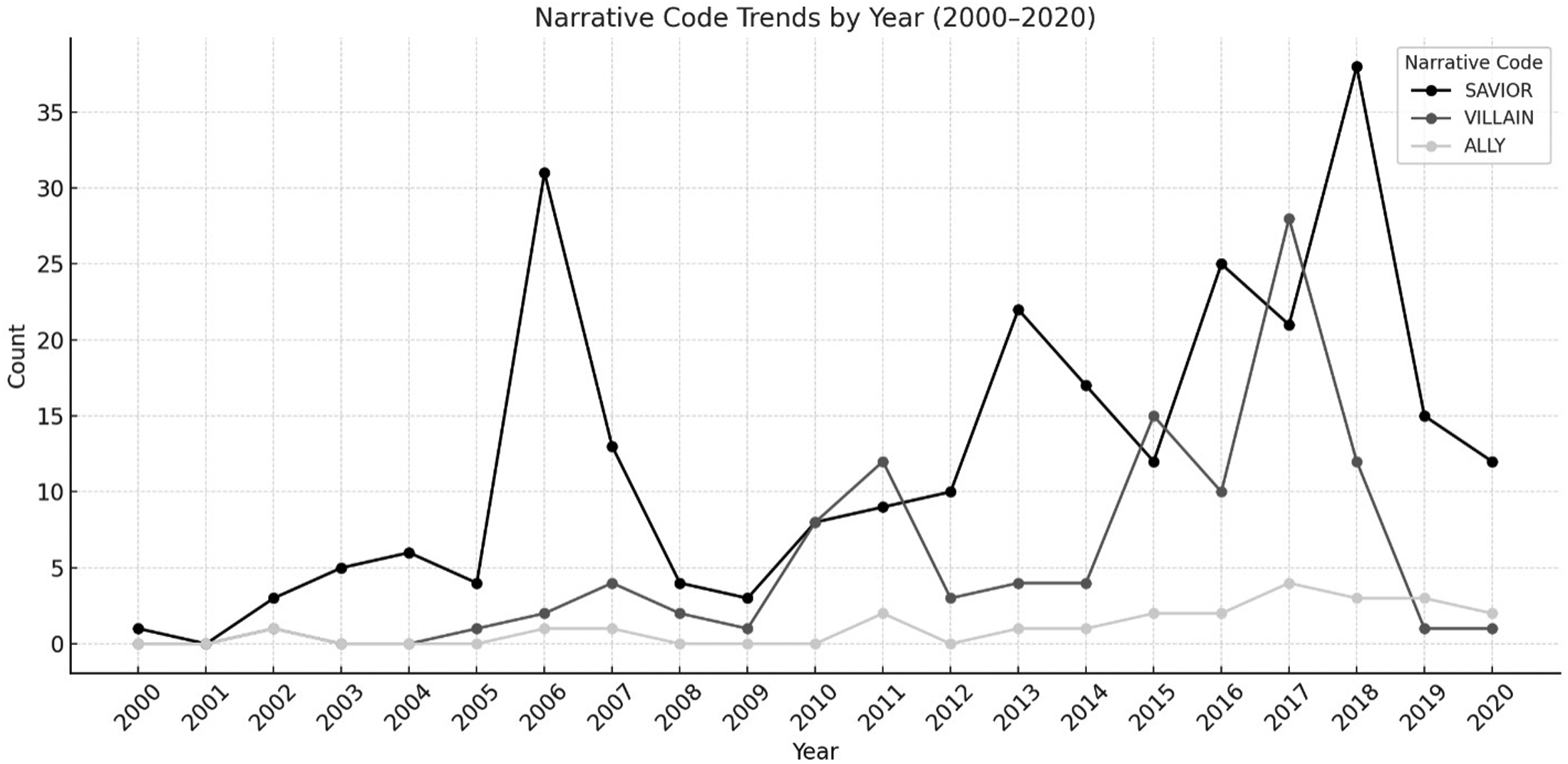
Narrative code trends by year (2000–2020).
Savior narratives (dark gray) appear intermittently early on, but rise sharply beginning in 2006—a year that aligns with the launch of Rapid Growth Media. This media outlet's entry marks a clear inflection point: from 2006 to 2016, the mean annual count of SAVIOR-coded articles jumps to 17.8, compared to just 3.2 in the preceding years. This spike coincides with a discursive turn toward top-down success framing, economic redevelopment, and development boosterism. Articles from this period often highlighted new investments, public–private partnerships, and revitalization efforts led by nonprofits such as ICCF and Dwelling Place—frequently casting them as engines of positive transformation, regardless of community pushback.
In contrast, Villain narratives (medium gray) are less frequent in the 2000s but rise sharply after 2015, peaking in 2017. While the average villain-coded article count was fewer than five per year in the first decade, this doubled in the post-2017 period (mean = 10.5, p = .004). This discursive shift reflects not only increased critique but a growing willingness—especially among residents, organizers, and independent journalists—to name the harms of redevelopment when pursued without transparency or community consent. The villain framing does not necessarily reject the idea of development but reframes it through the lens of power, displacement, and broken trust. Importantly, this shift also reflects the accumulation of lived experience with redevelopment outcomes—particularly in historically marginalized Black and Latino/a neighborhoods.
Ally narratives (light gray) remain comparatively rare but trend steadily upward beginning in 2010, the same year The Rapidian began publishing. While the overall volume is small, the upward slope is statistically significant (p = .029), increasing at a rate of 0.15 per year. The Rapidian, a community journalism platform rooted in participatory storytelling, appears to have played a key role in amplifying resident voices and surfacing stories of collaborative, equity-focused development. These stories often depict nonprofit developers attempting to recalibrate—working more intentionally with neighborhood groups, building partnerships with resident leaders, and embedding participatory mechanisms into their processes.
These trends demonstrate that portrayals of nonprofit developers are not fixed. Rather, they respond to shifts in local discourse, lived experience, and institutional positioning. The same organization can be portrayed as a savior in one decade and a villain in the next—or, increasingly, as something more complex: a potential ally striving to renegotiate its place within contested urban terrain.
These shifts reveal how nonprofit developers have been imagined and reimagined over time. The same actor may be hailed as a savior in one context and critiqued as a villain in another. Increasingly, they are framed as potential allies—negotiating community voice, institutional demands, and the contested terrain of urban development. We explore these tensions further in the next section, drawing on interviews with CDO leaders and community stakeholders navigating this shifting narrative landscape.
Nonprofits Navigating Conflicting Narratives
Community development organizations in Grand Rapids are frequently framed in divergent ways—as constructive collaborators enhancing neighborhood infrastructure or as contributors to gentrification and displacement. These contrasting narratives reflect how nonprofit developers engage with community needs, communicate priorities, and demonstrate accountability. Aware of these tensions, many CDO leaders actively adapt their strategies to reconcile these conflicting narratives, emphasizing transparency, humility, and a collaborative spirit in their interactions with residents, striving to align their development goals with the evolving priorities of the communities they serve. In this section, we draw on our small sample (n = 3) to get a snapshot of how these leaders navigate the narratives described above.
One developer, Jenn, from a well-known neighborhood revitalization organization in Grand Rapids, emphasized her organization's emphasis on “humble accountability” as key to preserving a cooperative relationship with the community: When we have contentious conversations, it's done as a form of accountability, but it never comes as a surprise. We try to say, “Hey, heads up, this is a challenge. Why don’t you partner with us to find a solution?” I think we approach that as a partnership. – Jenn
Other developers reinforce this idea, acknowledging and openly accepting criticisms as part of their community role: I know there are people who would say, “they’re not good at this,” and we receive that. We’re not perfect. – Evan
Developers recognize that negative perceptions often result from a lack of community engagement or unclear project communications. Jenn recalls: One of our missteps was not updating neighbors when plans for a commercial space fell through. There was a lot of neighborhood anger about that. – Jenn
And another developer echoed these sentiments, pointing out that even when things go as planned, they’ll never necessarily meet the expectations of everyone in the neighborhood, leaving them open to more negative criticism from local community members: I mean, some of it is trying to stay humble and not claim to be—we’re not going to do things perfect….So you have to stay humble and know that if you have a hundred stakeholders, by the time you get your development done, not all hundred of them are going to love it. – Evan
In an effort to avoid these kinds of situations altogether, developers are careful and intentional when explaining their plans and avoid making promises that they cannot keep: You have to really walk the line in how you are expressing to the community what the possibilities are because, I mean, it took me a decade of working in this work to understand the funding process and then to be able to really adequately share it with other people. And I still don’t always get it right. – Jenn
Development organizations are also intentional about acknowledging their shortcomings and failures, acting preemptively to make space for locals to express their feelings and become involved in resolving the issues while acknowledging their limitations as organizations. Yeah, we are an organization, and we do need funding at the end of the day. And ultimately, what we’re doing when we do hear that negative feedback is try to really intentionally look at, listen to that and see how we change what we do. – Jenn
Another significant component of development that impacts how development organizations are characterized by the public is how the development organization arrived to the project to begin with. Knowing this, nonprofit developers note being intentional about not involving themselves in local projects when they’re not asked to and taking their charges from the community members themselves rather than outside interests. We’ve tried to take the approach that we don’t really ever want to go into anyone else's neighborhood and say, “We’ve got a wonderful plan for your neighborhood because we bought this land and we want to build something here or we can get something built.” We’ve tried to stay in a position where its like, “are we invited in by someone who has longer presence in the neighborhood?” – Evan
Some developers even go as far as invoking religious language to justify their presence and involvement in certain neighborhoods to stakeholders: [I] talk about [redlining and displacement] from a Christian perspective, that is something God cares about. When that unfair and unjust situation is in play that's something we, as people of faith, should be caring about and doing something to address. – Evan
Tom, another developer, encapsulates the challenge of navigating competing narratives, emphasizing both the community's role in self-driven change and external forces’ impact: …there are at least two strong competing narratives, the one is “we did this,” where the community articulates how they came together and they manage, change or they address problems, resolve that and move a community forward based on their involvement in their vision and [the other] one is which some outside force…came in, bought up a bunch of stuff and changed buildings. – Tom
For CDOs to maintain positive perceptions, leaders like Tom underscore the importance of amplifying community voices and supporting inclusive city development: I think our ability to find ways to connect with and lift up the stories of what a community is by the people who live in that community is essential for us to kind of create more inclusive cities that allow all people places to stay. – Tom
As Stoutland (1999) argues, CDOs operate within the constraints of competing demands, often balancing grassroots relationships with institutional requirements. These interviews reflect how nonprofit developers navigate that space, constantly adjusting their practices and public positioning. Their identities—as saviors, villains, or allies—are not fixed but shaped through iterative interactions with neighborhood residents, funders, and public discourse. As one developer observed, narratives of neighborhood change are often “written by people who aren’t from the neighborhoods, particularly communities of color. They don’t get the chance to write their own stories.” Community development organization leaders, aware of this, are increasingly trying to amplify those stories—an act of narrative repair that speaks not only to how development is done but who gets to define its meaning.
Conclusion
Community development organizations play a critical role in local revitalization, negotiating complex narratives as saviors, villains, and allies. This study highlights the contextual factors that shape CDOs’ work in midsized cities, with Grand Rapids serving as a focal point. In Grand Rapids, we identified three main neighborhood narratives—neglect/revitalization, property values/poverty, and gentrification/displacement—that shape how CDOs are perceived. These narratives reflect broader debates over the multiple pathways of neighborhood change, underscoring the ongoing need for CDOs to balance development goals with community needs.
These competing narratives deepen our understanding of nonprofit-community dynamics (Mitchell 2001; Perkins 2009). Initially, the “savior” narrative framed communities as needing rescue, especially neighborhoods such as Oldtown-Heartside and Baxter, which had long histories of neglect (Harger 2002; 2004). Early on, discussions of gentrification and displacement were limited. However, as Mitchell (2001) and Perkins (2009) note, rising housing costs have shown how market forces influence state-nonprofit relations. Local resistance also shifted the narrative, with antigentrification groups framing CDOs as villains whose revitalization efforts were perceived as destabilizing long-term residents. Similar to Hom's (2022) findings on urban Chinatowns, placemaking politics in Grand Rapids emerged, as communities reframed development to critique or justify changes. Within the “villain” narrative, CDOs are cast as antagonists, especially when redevelopment efforts seem to prioritize external interests. AmplifyGR, for instance, faced local skepticism due to its foundation ties, reflecting a broader urban restructuring through public–private partnerships (Fraser and Kick 2014). In Nashville, similar coalitions play more direct roles (Fraser and Kick 2014), whereas nonprofits in Grand Rapids have adopted a reflexive approach, responding to local resistance while meeting external demands.
The surge in gentrification and displacement discourse in Grand Rapids aligns with national conversations that intensified after 2010, signaling a growing American focus on housing affordability and urban equity. Situating Grand Rapids within these larger shifts, our analysis illuminates both the specific challenges faced by midsized cities and their broader implications. This contextualization clarifies how CDOs in Grand Rapids respond to local gentrification concerns, aligning their strategies with the expanding national discourse on urban redevelopment and displacement. This study situates its findings within the broader American narrative on CDOs’ roles as “gentrification stakeholders” (Dantzler 2021; Rucks-Ahidiana 2022). In recent years, neighborhood concerns shifted toward gentrification and tenant protections, complicating CDOs’ roles further. Gentrification narratives added new perspectives on the role of diverse actors in neighborhood change (Brown-Saracino 2017). As with other studies (Etienne 2012; Fraser and Kick 2014; Hom 2022; Stoutland 1999), our findings suggest that community development reflects political-economic contexts that shape how CDOs navigate complex local dynamics (Addie and Fraser 2019).
This study yields two key implications for understanding CDOs’ roles in neighborhood change. First, CDOs operate within a temporal political-economic context. Initially framed as “gentrification stakeholders” (Rucks-Ahidiana 2022), CDOs have shifted from responsive to reflexive, balancing community engagement with structural pressures, including funding dependencies and competition with private developers (DeFilippis and Saegert 2007). Faust (2022) suggests that neighborhood development imposes a temporal order, which we interpret as “temporal conflict” for CDOs managing higher-income influxes in areas they aim to stabilize. Community development organizations, created to meet local needs, must navigate these goals alongside changing demographics influenced by their revitalization efforts. Thibault (2007) argues that contemporary community development increasingly distances CDOs from community members due to funding constraints and professionalization—a trend also observed here. Secondly, our findings align with McQuarrie's (2013) view of CDOs progressing through “stages of change” within evolving narratives of poverty (Cruikshank 1999). Community development organizations have increasingly redirected their attention toward drawing in new capital. Since the 1960s, community development has increasingly depended on CDOs and external investment (Stoecker 1997; 2003), highlighting this neoliberal shift (Harvey 2002; Thibault 2007) and an evolving ecosystem of community actors.
While focused on Grand Rapids, our study's findings may apply differently across cities with varying institutional and power dynamics. Future research might examine how funding influences CDO practices (Chaskin and Greenberg 2015; Kohl-Arenas 2011) or investigate the racialized logics of neighborhood change (Dantzler 2021; Dantzler, Korver-Glenn and Howell 2022; Korver-Glenn and Mayorga 2024; Hackworth 2019; Rucks-Ahidiana 2022). Moreover, given our limited focus on interviews, future studies may expand upon a more robust, diverse sample of nonprofit developers to understand their motivations across varying contexts. Understanding CDO-community relationships is essential for examining both the historical impact of CDOs and the modern politics of neighborhood redevelopment.
Footnotes
Declaration of Conflicting Interests
The author(s) declared no potential conflicts of interest with respect to the research, authorship, and/or publication of this article.
Funding
The author(s) received no financial support for the research, authorship, and/or publication of this article.
