



Abstract
The influential factors of government budgeting have often been examined in large-N studies, but a comprehensive overview of the empirical findings is still missing. This paper focuses on the local level of politics and reviews recent quantitative studies on culture budgets. It assesses the validity of the arguments, the consistency of the empirical results, and possible future pathways for the following predictors: government ideology (a), electoral cycle (b), spatial dependence (c), solvency of the public budget (d), residents’ average age (e), education (f), and income (g). The conclusion is that (b), (d), and (g) have proven to be solid predictors of local government cultural expenditure, while the evidence for (a), (c), (e), and (f) is mixed. Future studies are recommended to use an updated set of predictor variables and to focus on sub-items in order to strengthen their internal validity and facilitate the derivation of practical implications.
Introduction
When Horrigmo (2013) found in an innovative paper published in Urban Affairs Review that the degree of sociocultural change within a community determines local cultural expenditure, this had major implications for the explanation of policy-making at the local level. Research at a level so close to the citizens requires a more holistic set of variables than the higher levels because sociocultural demand variables play a more determinative role. 1 The paper demonstrated the distinctiveness of urban cultural policy, so an up-to-date literature review that singles out the cultural expenditures of local governments is necessary. However, such a review has been missing 2 to date—one that evaluates the impact of the paper and fills larger gaps in the literature: Which supply and demand variables have been used in government budgeting research and which ones are most determinative? What is the status quo? Where to go from here?
A review of this kind would also benefit the practical side of the matter because understanding the mechanisms that underlie public funding can equip policy-makers with evidence necessary to design the optimal policy for a government body. 3 A strategic, evidence-based cultural governance that takes demand and supply factors of private and public cultural consumption into account can make incisive differences to the perspectives of the people in the area. Cultural services do not require special natural resources or highly skilled personnel, so a vibrant cultural life is able to relieve the public budgets of otherwise weak local economies with substantial dividends, e.g., from tourism (Fullerton 1991). Public and private investments to augment the cultural capital of a place promote urban regeneration, refine collective identity, and thereby promote local development (Fabbri and Canova 2010).
This paper fills the gap and reviews the empirical research studies that give the highest leverage. “Leverage” refers to how much a study advances the knowledge on the impact of a certain predictor, so to the added value it provides for determining quasi-causal effects. 4 Moreover, the review deals with quantitatively detectable influences only and is restricted to large-N studies. The number of studies presented in the main text is such that the review remains both cohesive and accessible for established as well as new scholars of government budgeting research.
The selection is moreover limited to studies on municipalities in functioning UN democracies to ensure that there are fundamental parallels in terms of social dynamics and public accounting. In the Classification of the Functions of Government (COFOG) of the United Nations Statics Division, the culture item is division no. 8, consisting of six groups: Recreational and Sporting Services; Cultural Services; Broadcasting and Publishing Services; Religious and Other Community Services; R&D Recreation, Culture, and Religion; and Recreation, Culture, and Religion N.E.C. 5 The UN member states are allowed to set their own guidelines when it comes to the details how their lower governments structure the budget. The COFOG nevertheless gives a good overview of the policy areas booked in an average public culture budget. It is more than just grants, loans, and subsidies to festivities and facilities; it may also include expenses for certain sports, the media, the cult, and even cultural research.
The review structures the drivers of local cultural spending into supply and demand variables. Within these two fractions, the variables are ordered by how strong the argument is, going from the weakest to the firmest ones:
The larger institutional level comprises four supply variables which constitute the “institutional readiness” to satisfy popular demand for public culture. These are the party affiliation of the main government offices (a), the electoral cycle (b), the spatial dependence (c), as well as the financial solvency of the government body as indicated by debt and transfers (d). The studies in the field estimate the popular demand for culture in a community via the essentialist argument. It is assumed that the preference for cultural policy is related to the residents’ average age (e) and the socioeconomic capacity of a municipality, namely, the residents’ average education (f) and income (g).
Each section has two subsections: Argument presents how the scholars deduced their argument as to why the variable should be decisive for the volume of public spending; Evidence discusses the empirical findings, in this case the effect estimates of the stochastic model estimations the researchers ran over quantitative data. After all the supply and demand variables have been reviewed, the section Synthesis highlights which variables have proven themselves to be not just predictors but influences and how much they contribute to explaining the variation in the culture budgets. The section Total Spending or Sub-Items? reasons why future studies should think twice before they estimate the total volume of the culture budget.
The final Conclusion section states that government ideology, age, and education lack a solid argument as to why they should be predictive of the volume of the culture budget. Accordingly, they have produced opposing results or insignificant results. In contrast, the electoral cycle, the financial solvency, and the residents’ average income are solid predictors of the volume of the culture budget. More attention needs to be paid to the aspect of spatial dependence, as it is one of the variables with great practical value for drafting a cultural governance. The datasets used for studying it have been lacking originality and were defined by mere considerations of availability or the researchers’ familiarity with the political system. Future studies also need to be more open to new sets of variables such as those used by Horrigmo (2013) and define the dependent variable more precisely, as culture has very different manifestations. It is recommended to use sub-items of the culture budget as response variable, as different social subgroups adhere to different types of culture. Provincial and federal statistical offices of developed countries are nowadays able to provide harmonized data at this level of granularity.
Studies that implement the recommendations of this paper will produce evidence that enables academia and policy-makers to gain a better understanding of the demand and supply side of cultural policy. Understanding the components of a professional cultural governance is important, because the task is not as simple as some local governments handle it: Bottom-up requests for funding, preferences of the broad public, directives of the governing politicians, and economic rentability can be very different things that skilled policy designers and public managers need to reconcile.
Supply
Some aspects are argued to make public officials more supportive of discretionary spending such as culture. These supply variables constitute the institutional side of public provision. Four predictors are reviewed: party affiliation (a), closeness to elections (b), spatial dependence (c), and financial solvency (d).
Party Affiliation (a)
Argument
Although the end of ideology school of the second half of the twentieth century proclaimed the exhaustion of the ideological battle (Bell 2000; Vincent 2009), democratic policy-making is still subject to different ideologies among which voters choose. They no longer differ in the most basic principles, but they are predictive of policy output at least directionally (Cusack 1997). The argument is that parties seek to satisfy the preferences of a targeted electorate, and this leads to notable differences in the policy areas they emphasize and marginalize (Hibbs 1977).
Cultural funds are an important strategic lever of local governance, as they are at the discretion of (local) politicians like hardly any other funds (Franzese and Jusko 2006). This makes them suitable for researching party politics.
Both sides, the left and the right, can be argued to emphasize cultural policy because all subgroups of society today have their supply on the public culture market, regardless of income (Black 2002). Left-wing parties follow the principle of egalitarianism and show a preference for social change and equality achieved through fiscal redistribution (Anderson and Singer 2008; Federico and Sidanius 2002). They may invest in cultural amenities to bridge income gaps by lowering entrance fees, and they may improve accessibility of cultural goods and direct public attention to less established cultural producers (Fullerton 1991). Right-wing parties, instead, may increase cultural spending because their constituencies adhere to more performative and cost-intensive cultural practices, for example, traditionalist culture or so-called highbrow culture (Hansen 1997; Potrafke 2010; Schulze and Ursprung 2000).
Moving beyond the stereotypes, criticism on the applicability of the common concepts of ideology to subnational political arenas has been growing. Municipalities have a face-to-face connection between citizens and politicians, the cost of vocalizing one's own political statement (not using the infrastructure of an association) is lower, and community-specific problems may be of a kind that citizens do not associate with programmatic, ideological approaches (Gerring and Veenendaal 2020).
Socialization is also different in political microcosms. Behavior that deviates from the “common denominator” is more likely to be socially sanctioned, so public disagreement comes with higher social costs (Gerring and Veenendaal 2020). The sublime but consistent sanctioning mechanism can stall the formation of in- and outgroups. The we-feeling remains stronger than any sense of partisanship.
These considerations make semi-ideological concepts for explaining local policy-making more interesting. 6
Evidence
Research designs in the field of empirical ideology research test for a covariation between the ideology variable and the extent of cultural funds recorded in public budgets by running additive regression models on government. The left–right scheme of analysis dominates.
Connolly and Mason (2016) research the topic at its roots. Policy priorities are downstream from politicians’ priorities, so they regress the mechanism one step by looking at their communicated preferences. They survey local representatives in California, finding that the more conservative their political stance is, the more they are ready to cut spending on social services, housing, and community development, and the less willing they are to cut spending on arts and culture. The paper finds evidence that speaks for the stereotypes of the political arenas of the upper levels of administration. However, since this paper is opinion research, it remains unclear to what extent the publicly stated preference is legislated. 7
Tausanovitch and Warshaw's paper (2014) demonstrates that elected representatives of cities and towns of over 20,000 residents in the United States are well able to enact their democratic mandate in distinctively different ways, just like the politicians of the upper levels are. The suggestion is that citizen preferences transpire in a simple liberal 8 -conservative dichotomy. The authors find “that a broad array of city policy outcomes are not apolitical, nor are they divorced from national political schisms. Policy outcomes in city and town governments can be predicted by the policy conservatism of their citizens” (620–621). In symbiosis with the Connolly and Mason study which was also on the United States, more conservative places would indeed invest relatively more into culture than liberal places. 9
In several other studies, the ideology variable has been a control variable. Šťastná (2009) estimates the covariates of public cultural expenditure of 205 Czech municipalities. She finds no significant association with party variables. Horrigmo (2013) finds in a cross-sectional analysis of Norwegian municipalities that the share of votes cast for left-wing parties is in a significantly positive association with the total cultural expenditures. Getzner (2022) finds for Austrian municipalities that social-democratic mayors tend to spend more on culture. The advantage of the Getzner study is that he controls for spatial dependence in his model, so by including the cultural spending of the neighboring municipalities, the single unit treatment value assumption is not as hard, and the omitted variable bias is mitigated.
The Benito, Bastida, and Vicente (2013) study investigates how cultural funds are used as mobilizing forces in Spanish municipalities. Parties need to mobilize their target group(s) to maximize the vote share, and this financial effort is connected to how close elections are. 10 The authors do not find a significant influence by party ideology on pre-electoral cultural spending per se, but the two sides of the political arena seem to time the inflation of the culture budget differently. There is a difference of €33.06 from the peak (election year) to the valley (second year after the election) when there is a left-wing mayor in office, whereas right-wing mayors only produce a difference of €12.14 in per capita spending. This difference is only significant and negative in the second year after the election. In the election year, the model indicates no significant difference. Left-wing parties produce a bigger cyclicality, which suggests that they put more emphasis on the mobilizing function of cultural funds.
The empirical studies on the importance of party ideology for cultural policy-making of the last ca. 15 years have been scarce and carried out in different environments. The studies are not bound by a vivid interaction and speak to different discussions. The studies that find a significant effect in the data report that left-wing majorities are likely to allocate more funds to culture budgets. Growing attention must be paid to assessing the empirical worth of semi-ideological approaches to the matter.
In general, longitudinal studies on the budgets issued around political changes should be increasingly prioritized in this party-political view because they are able to incorporate time-invariant heterogeneity specific to the panel unit.
Methodically, the scarcity of studies is the fruit of a problematic dependence of the treatment on the circumstances, which hinders causal inference by model estimation. A possible solution is to look at elections that were won by a small margin, like Pettersson-Lidbom (2008) does for predicting municipal economic indicators. He assumes that the winner of photo-finish elections is determined by sheer luck. His argument is that this makes the distribution of the incumbent's ideology quasi-random and thereby takes a step toward the causal claim.
Beyond this methodical problem, there is still a major conceptual concern future studies on the ideological effect must face. A mayor does not dedicate perpetually more funds to the culture budget just because of party affiliation, like a machine would constantly produce more output when it has a certain program running. Certain parties in the municipal council could very well target societal subgroups that value public cultural spending over other spending and therefore be more willing to inflate the culture budget, but the extent of this mobilization method is ultimately dependent on the values of circumstantial variables like average income, political competition, or intermunicipal cooperation. A longitudinal study with interactions that focuses on left-to-right and right-to-left mayoral changes and keeps confounders constant could help tackle this concern.
Closeness to Elections (b)
Argument
Electoral goodies have been a tool for fiscal mobilization throughout the ages (Aidt and Mooney 2014; Dubois 2016). They produce political business cycles (PBCs) in the spending figures, meaning “increases in government spending or the deficit or decreases in taxes (including changes relative to long-term trends) in an election year, which are perceived as motivated by the incumbent's desire for re-election” (Drazen 2008, 462). The consideration is simple: Myopic voters fall prey to this top–down pandering, whereas rational voters sanction unreasonable allocative behavior.
But when it comes to the local level, higher-level administrations are able to trigger spending increases in pre-electoral periods by making fiscal transfers to local governments (Jones, Meloni and Tommasi 2012). This intergovernmental redistribution does not impose higher future burdens on the budget of the local territorial entity, so that being a fiscally rational voter in local elections becomes irrational (Peltzman 1992). Seen as the mobilizing function extends to fiscally conservative voters, local budgets, primarily in their discretionary part like the culture budget, are expected to reflect any strategic timing more than the budgets of the upper levels.
Evidence
Among the first ones to focus on PBCs in municipal cultural spending was the Benito, Bastida, and Vicente (2013) study mentioned above. It examines the cyclicality of the culture budgets of all municipalities of the Spanish region of Murcia in the time range 1995–2008. The paper contains exhaustive explanation and is methodically sound, running Arellano–Bond-estimated GMM regressions. The authors find a U-shaped PBC for cultural spending which reaches its valley in the second year after the election, highlighting that a considerable part of the spending volume is a function of proximity to elections. More importantly, the study detects significant interactions of municipal cultural expenditure, primarily with political competition and ideology.
The internal validity of the study is quite solid, as the estimation addresses the endogeneity inherent to spending decisions by aiming to remove it with instruments and first differencing. The external validity and the scope the conclusions apply to are not clearly defined by the authors. Murcia is just a small region in the South of Spain.
Sanjuán et al. (2020) test for all medium-sized municipalities in Spain whether cultural spending increased in the pre-election and election years of the 2015 and 2019 municipal elections and whether its volume was positively associated with the probability of mayoral re-election. Logit models indicate that, compared to sports, health, and education, the culture budget shows the most extensive increase in the pre-election and election years. Financial resources spent on culture also have the highest positive marginal effect on the probability of being re-elected.
Regardless of the marginal effect being on the verge of significance (p-value of 0.07), they investigate territorial entities that account for only 30% of all Spanish inhabitants. It is also not convincingly clear why this behavior would only be seen in medium-sized municipalities even though they try to reason it. They state that personal contact outweighs the impact for small ones, while regional and national policy does so for large ones.
The evidence on the cyclicality of cultural spending is scarce, there are not more than two studies on this specific topic, but it is consistent regarding its interpretative suggestion. There is little reason to doubt the main finding. Incumbents use discretionary funds in an opportunistic way. The studies are in partial disagreement over the size aspect, with one using all municipalities of a rather rural region, the other one using medium-sized ones only. Although the very existence of PBCs for cultural funding is not questioned, future studies can make useful contributions by exploring the moderating circumstantial variables and the electoral consequences of funding increases with more original approaches.
The two studies cited are stepping stones for exploring the many unanswered questions about the cyclicality of spending that are promising for party managers: How does the competition for public resources vary by the size of a municipality? 11 If certain (sub)items are increased, are others to experience an absolute reduction in the election year? Do reductions also interact with the chances of re-election? Are the electoral returns to fiscal incrementalism linear or marginally decreasing, with the possibility of the returns on electoral success being negative, if the increases are too extensive?
Spatial Dependence (c)
Argument
The budgeting behavior of municipalities is interdependent if changes in the public provision do not exclusively entail compensatory changes in citizens’ private consumption but directly entail changes in the public provision of neighboring municipalities. If these changes are nonspurious, the spatial autocorrelation is the fruit of intermunicipal dependence. In technical terms, the spending policy of the own municipality is a function of the spending policy of the neighboring municipalities.
This sort of interdependence can be positive or negative, depending on the slope of the reaction function. Negative spatial autocorrelation means that an increase in expenditure on an item in one municipality is likely to lead to a decrease in expenditure on the same item in the municipalities close by and vice versa. Accordingly, one speaks of positive spatial dependence when budgetary changes are imitated by the neighbors.
The proposed mechanisms underlying municipal interdependence are manifold. Intermunicipal cooperation, strategic substitution, spillover, and freeriding can cause negative spatial autocorrelation, whereas acquired tastes 12 and yard-stick competition 13 can be the reason for positive spatial autocorrelation (Getzner 2022; Werck, Heyndels, and Geys 2008).
Evidence
In contrast to the predictors reviewed so far, the spatial interdependence of culture budgets has been researched more extensively. Studies use cross-sectional (Šťastná 2009; Werck, Heyndels, and Geys 2008) as well as longitudinal (Akai and Suhara 2013; Lundberg 2006) approaches. Spatial lag models with a weight matrix constitute the most common method. The exogenous 14 variation of the neighbors’ spending is the main regressor. The equations giving the weight matrix vary strongly, as will be seen.
Lundberg (2006) performs a panel analysis of 2,760 Swedish municipalities between 1981 and 1990. In his spatial matrix, municipalities have the value 1 if they are neighbors and 0 if they are not. He puts various distances to test, defining municipalities as neighbors if they are less than 100, 200, and 300 min by car. Using seemingly unrelated regressions, 15 the spatial effects of increases in cultural and recreational spending are found to be significantly negative for all three definitions of neighborhood. Spending increases will ceteris paribus trigger decreases elsewhere, and this effect decreases with travel distance. The paper pioneered controlling for neighborhood effects, and it demonstrated a demand model, namely, the spatial interaction model.
Akai and Suhara (2013) state they advance the discussion by including fixed effects specific to the region in the empirical model, but their actual advancement lies in the precision of the dependent variable. They estimate the costs for events and research and for the administration of cultural institutions. This gives the total expenditure related to ad hoc political decisions, leaving aside the costs for the construction of cultural amenities. Their data includes 45 Japanese local governments over an 11-year period, resulting in 495 observations. They find a significantly negative spatial autocorrelation for the culture budget. The most significant relationship between total spending and neighborhood spending results from weighting by geographic distance, followed by travel time, the uniform approach (1 if neighborhood, 0 if not), and the population size. The authors missed the opportunity to explain to what extent Japan being a centralized polity determines the applicability of the findings to other systems.
Getzner (2022), by contrast, detects a small but significantly positive spatial autocorrelation for the cultural spending of Austrian municipalities. Like Lundberg and Akai and Suhara, he uses the travel time required by car as the weighting matrix. The spatial effect he estimates is between 0.06% and 0.15% for each percentage point of increase in cultural expenditure. One of the major advantages of his study is the large sample size, analyzed in a longitudinal perspective. He runs the model on an impressive total sample of 31,350 outcome values stemming from all 2,096 Austrian municipalities and unfortunately omits statements on the external validity.
Werck, Heyndels, and Geys (2008) interestingly leverage cross-sectional data. They investigate the interactions of spatial dependence running a spatial lag model on the 2002 culture budgets of 304 Flemish municipalities. Their novelty is to test for asymmetries in the spatial pattern. The population size and the status of being a central place may be determinative in the strength of spatial dependence. The volume of the neighbors’ culture budget is interacted with a neighborhood dummy, in a further estimation with the population size, and finally with another dummy indicating whether a neighbor is 1 of the 13 central places in Flanders. Across the entire sample, there is a significantly positive autocorrelation of per capita spending. As for central places, the coefficient of the spatial indicator is negative but not significant. The strongest positive covariation with the neighbors’ spending is estimated among municipalities that are not central places. Methodically, this study is a big step in the right direction because it allows for variable impacts of spatial proximity. Knowledge of the moderating influences of spatial effects is direly needed for evidence-based policy–making.
In general, the theoretical discussion on spatial dependence per se is evolved and has been developed in tentative interaction. A conceptual deficiency for future studies to face is the assumption that the government bodies are perfectly informed about the cultural activities of the neighborhood. Would a municipality not cooperate/compete with one or two selected neighbors rather than with its entire neighborhood as given by (travel) distance? Spatial dependence may be more of a constant than volatile nature, which would speak for the cross-sectional research design of the Werck, Heyndels, and Geys (2008) paper.
The evidence is inconsistent 16 —the coefficients are negative for Sweden and Japan and positive for Austria and Flanders. This corresponds to the breadth of control variables that are used in the models, especially those of public finance, because the Swedish 17 and the Japanese study do not regress on them. The omission of every indicator of financial solvency may have induced a bias, hypothetically in the shape of spuriousness that the IV approach did not fully integrate.
Using an instrument variable approach comes with new considerations to make. For example, regarding the exclusion restriction, the methodical assumption in studies like Akai and Suhara (2013, 239–240) and Werck, Heyndels, and Geys (2008, 21) is that the instrument (control variables of the neighbor municipalities) for the regressor of interest (neighbors’ spending) is in no statistical dependence with the response variable (own spending). This would undermine that spatial autocorrelation stems from intermunicipal exchange, such as freeriding, because the neighbors’ supply and demand variables are assumed (and possibly proven via the corresponding test) to have no deterministic power in their own spending decisions. This would, for instance, imply that citizens only then satisfy an increase in their cultural demand elsewhere, if their own municipality does not provide for it; otherwise, they exclusively stay within municipal borders. It is considerations like these that epitomize the prevalence of tough assumptions in public budgeting research.
The studies are still far from pinning down the precise reasons behind spatial covariation. The datasets of all the four studies contain arbitrary panel units for random timeframes, whereas they should focus on situations that allow for high-leverage designs, e.g., researching spatial dependence as a function of the mayors’ party affiliation, of language and other social barriers, or of morphological givens (valleys/islands). These more original settings would be a means to better test what is actually driving spatial correlation and what is not.
In general, one first needs to clarify whether opposing spatial dynamics could be at work, like freeriding and yard-stick competition, as they could offset each other in the budget totals and lead to erroneous inference. Even such a preanalysis would give no hint as to the specific driver of a positive or a negative spatial autocorrelation, as there are several for both kinds. It is essential to see additional dimensions of the covariation in the tradition of Werck, Heyndels, and Geys (2008), and still, it remains questionable whether the logic of stochastics is suitable for investigating this volatile topic, as it presupposes common and predictable dynamics.
The topic of spatial dependence is multifaceted and difficult to model or even to grasp empirically. Maybe, exploratory analyses of more granular large-N data that use artificial intelligence will one day enable researchers to better connect the theoretical and the empirical side of this complex phenomenon.
Financial Solvency (d)
Argument
If culture is a normal or luxury good (positive income elasticity of demand), the expectation is a positive relationship between its public subvention and the financial situation of the public budget, often measured as transfers and debt. As mentioned in point (b), spending increases do not entail time inconsistency in the budget because subnational governments benefit from intergovernmental transfers. It follows that there is little incentive for a politics of counter-cyclical 18 investment.
The financial indicators, in this review municipal debt and intergovernmental transfers, can a priori be classified as endogenous. Public debt cannot be interpreted as exogenous because it might be in some relationship of causation with other variables in the model such as socioeconomic indicators. For intergovernmental transfers, Cárdenas and Sharma (2011) have rightfully identified the endogeneity with the flypaper effect. The discussion is once more about purely statistical associations that need to be tested in case studies.
Evidence
The studies measure debt in absolute values and per capita values or relative to the revenue of the budget, which is used as a proxy for the community gross product. The negative relation of debt to cultural spending has been found by cross-sectional and longitudinal studies (Getzner 2022; Schulze and Rose 1998), though there are studies that find no significant effect (Benito, Bastida, and Vicente 2013; López, Martínez-Ortiz, and Cegarra-Navarro 2017; Werck, Heyndels, and Geys 2008) or do not control for it directly (Akai and Suhara 2013; Kopańska 2018; Šťastná 2009).
As for the transfers received from upper levels of government, Werck, Heyndels, and Geys (2008) and Benito, Bastida, and Vicente (2013) find significantly positive econometric effects, whereas Šťastná (2009) does not find a significant impact.
The covariations found in these studies confirm that culture, in its part that is subject to public intervention, tends to be a normal or luxury good. 19 The comparison of the effect size is fuzzy because the indicators are defined in different ways across countries. 20 As these studies suggest, the cultural investments of local governments are pro-cyclical.
There is still potential for interesting findings regarding how cultural funding reacts to the financial solvency of a territorial unit compared to other spending items: In the case of extreme municipal debt, many legal frameworks foresee that one of the upper tiers of administration must appoint a supervisor to monitor and scrutinize the budgetary policy. It is the question if incumbents with re-election aspirations change the allocation of outgoing cashflows for cultural purposes in such a situation. Do they save on culture or rather on other discretionary public goods? If they do, will the private spending on culture increase, or is public investment a mere addition? Is the PBC nullified in such cases? What about electoral competition then?
As for intergovernmental transfers, future studies should take a further step in the causal chain and determine whether the increased public investment in local culture stimulated by the transfers boosts the fiscal returns of culture (e.g., via tourism) to a noticeable extent. Precise multiplier effect analyses of government investment on government revenue are needed to get an understanding of the consequences of earmarked intergovernmental transfers.
Demand
At the local level of administration, the demand side is essential for the decisions made, as explained in the introduction. The demand variables in public budgeting research are based on the essentialist argument. The axiom is that a certain characteristic of a community entails a certain preference for a public good. This demand section deals with the three most used predictors age (e), education (f), and income (g) of the private households in a local administrative division.
Age (e)
Argument
One strand of literature argues that parents with young children exhibit a higher preference for cultural goods because they are interested in passing cultural knowledge on to future generations (Schulze and Ursprung 2000). It follows that households with younger people are more willing to demand the deployment of public resources for cultural purposes. The train of thought has been challenged by Rushton (2005) with the economist argument on opportunity costs. Parents of young children have little temporal resources. The opportunity costs of parental time might reduce the desire for government intervention in cultural amenities and augment the desire for public attention to more basic goods, for instance, goods in the realm of social policy. Older people are then argued to prioritize the consumption of cultural goods because they have cheaper spare time.
Evidence
The researchers discretize the ages into categories and use the shares of people in these ranges for the modeling.
Among the papers on cultural spending of subnational polities that do find a positive association of age with cultural spending is Šťastná (2009). The age-related variables are the share of young people (under 15 years) and of aged people (over 65 years). In her dataset of Czech municipalities, she finds a significantly positive association with cultural spending for both predictors, meaning that the dependent population is associated with a more voluminous culture budget than the share of people of working age.
Werck, Heyndels, and Geys (2008) find the same association for people of age 65 or older throughout most of the model specifications, whereas the effect of the share of people under 19 remains insignificant with a negative point estimate.
Getzner (2020) finds that municipalities in Austria with an advanced residents’ age tend to issue higher culture budgets. He operationalizes the age variable as the share of citizens being older than 45, which comes closer to catching the variation of people being retired as of people in the working age. It allows for the same conclusion as the two studies above.
However, some scholars estimate different associations in their empirical studies. Benito, Bastida, and Vicente (2013) find a negative relationship between cultural spending and the share of young people as well as aged people, so the volume of the dependent population comes with larger outlays. They use the same classification as Šťastná (2009), though spatial dependence is not an influence in their paper. López, Martínez-Ortiz, and Cegarra-Navarro (2017) use the same classification for the age variables. Although they include spatial lags in their model, they find no significant effect. Their model shows that the share of younger people among the residents is positively associated with cultural spending.
As different as the theories are, so is the empirical evidence. Once again, there is a lack of studies focusing on the age variable instead of employing it as one of many control variables. Considering the different findings, the corollary is that public cultural consumption is not commonly predictable by the residents’ age.
However, the correct operationalization of the opportunity cost argument would require using the precise share of the dependent population. This seems to be a promising avenue for future research, as opportunity costs covary with whether or not one is of working age. The hypothesis could be then: The more people are of working age, the lower the demand for cultural activities, especially because communities with a high proportion of employed people may need to entertain fewer cultural and recreational assets and instead express demand for other, more pressing policy areas. However, age would then be a proxy of employment status, rather than of aspects directly related to age. It is worth investigating whether there is an interaction with income, as wealthy pensioners are likely to require different public subsidies than less wealthy pensioners.
Education (f) and Income (g)
Argument
Education and income of the population are two closely linked characteristics, because in countries with a solid public education system in the tertiary sector, the latter is downstream from the former. Educated people with high incomes have inevitably come into greater contact with culture in all its forms as part of their education and career. Culture is positively addictive in that the demand for culture is an incremental function of past culture consumption (Stigler and Becker 1977), so the income elasticity of demand for cultural goods should be positive. The “addiction” widens the gaps between the societal groups in the demand for cultural goods.
A positive effect of education and income on culture budgets can be evidence for the arts provision hypothesis (Feder and Katz-Gerro 2012), proposing that public spending on entrance fees be used to increase demand and promote cultural education for a larger part of the population, regardless of which party is in power. A negative effect is indicative of the old hegemony theory. It posits that sophisticated, high-income art consumers wish to restrict public funding of culture to turn certain parts of the population away and maintain an exclusive milieu (Feder and Katz-Gerro 2012). 21
The opportunity costs argument makes a distinction between education and income, as they can have different implications for the political demand: Parallel to what was proposed for young people, Getzner (2020) points out that the opportunity costs of leisure time are higher for people who gain a high active income, so their demand for cultural activities might be lower than the demand of highly educated, medium- or low-income people.
Evidence
Just like the other variables, education and income have been used as mere control variables in parametric models that ran over government-provided budgetary data. The empirical studies measure the average education by the share of residents holding a certain degree, and for income, they use the median income of private households before or after taxes.
Feder and Katz-Gerro (2012); Werck, Heyndels, and Geys (2008); and Getzner (2022) find significantly positive associations of higher formal education with the volume the political community dedicates to culture. 22 Other papers like Schulze and Rose (1998) and Benito, Bastida, and Vicente (2013) find no significant or even negative associations with higher degrees. It should be noted that Schulze and Rose only research orchestra funding. Benito et al. apply a lose indicator of education by using the share of people “with at least second-degree studies” (16). Due to this imprecise measurement, it is questionable to what extent such a wide definition really captures the important variation because secondary education can also mean vocational–technical schools. 23
The evidence is more consistent for the income variable. Even though the theory leaves little doubt on the direction of the effect if culture is a normal or luxury good, studies reporting a negative association of income are very rare but can be found. For example, Schulze and Rose (1998) find a negative covariance of income with municipal funding of public orchestra.
When overall expenditures are the dependent variable, the evidence is consistent throughout the studies. Ceteris paribus, the models reveal a positive correlation (Benito, Bastida, and Vicente 2013; Getzner 2002, 2022; Horrigmo 2013; Kopańska 2018). Officials grant more financial attention to cultural policy when the private income earned in their community is above average.
To sum up, the evidence is mildly pointing toward education having a positive correlation. Studies differ in how they make education operational and have not yet found a convincing solution. Conceptual questions remain—is the subject area in which a diploma was attained more informative of political preferences than the level of the degree? Can education be proxied by the attainment of diplomas? Are there operational alternatives to formal education?
The residents’ income seems to be a more consistently positive-signed model predictor, which speaks to the arts provision hypothesis. The empirical analyses cannot substantiate the argument about opportunity costs, suggesting that, in modern democracies, income-related considerations on leisure time are not upstream of political preferences.
It is noticeable that the models do not include the source of active income. If the effect varies by its source, interacting income with contextual variables gives insight into its heterogeneity:
The models do not control for the share of tourism in the gross community product. Municipalities with a large tourism industry produce not only for permanent residents but also to please the tourists’ demand for local culture, speculating on returns to investment (Burnett, Cutler, and Thresher 2007). Tourist destinations would have above-average incomes and public cultural spending but only to please the tourists. Another strong moderation of the income effect should stem from commuters who might have a high income but spend their day elsewhere, as the income is active. Some municipalities serve as dormitory and the residents live and consume most of the time in other places. An interaction between income and age yields insights as well because when people retire, the active income of the household decreases. A high average age could therefore mask the effect of income. However, this is difficult to theorize on at the community level: The budget constraint of older people is not as low as that of younger people with the same income because they tend to spend less on fixed costs such as rent or childcare.
For both variables, it remains unclear to what extent education and income are proxies of other variables such as urbanization. Both tend to be more pronounced in urban centers. Multicausality and multicollinearity are conceptual and methodical malaises of public budgeting research, especially for demand variables like these two, and a cure is difficult to find.
Therefore, future studies enrich the discussion if they disentangle the arguments for education and income in the economist tradition of Getzner (2020). Studies should focus on these two influences as independent variables and emphasize the potential differences between education and income. What is the relationship with public cultural expenditure if income is high but education is low or vice versa? At the abstract level, all these methodological improvements for demand variables can test the legitimacy of the essentialist argument in public budgeting research.
Synthesis
Table 1 classifies all variables by the soundness of the argumentation they are based on and by the explanatory power they have shown in the empirical tests. The last column contains the path for future studies, as explained in the corresponding section.
Results of the Review.
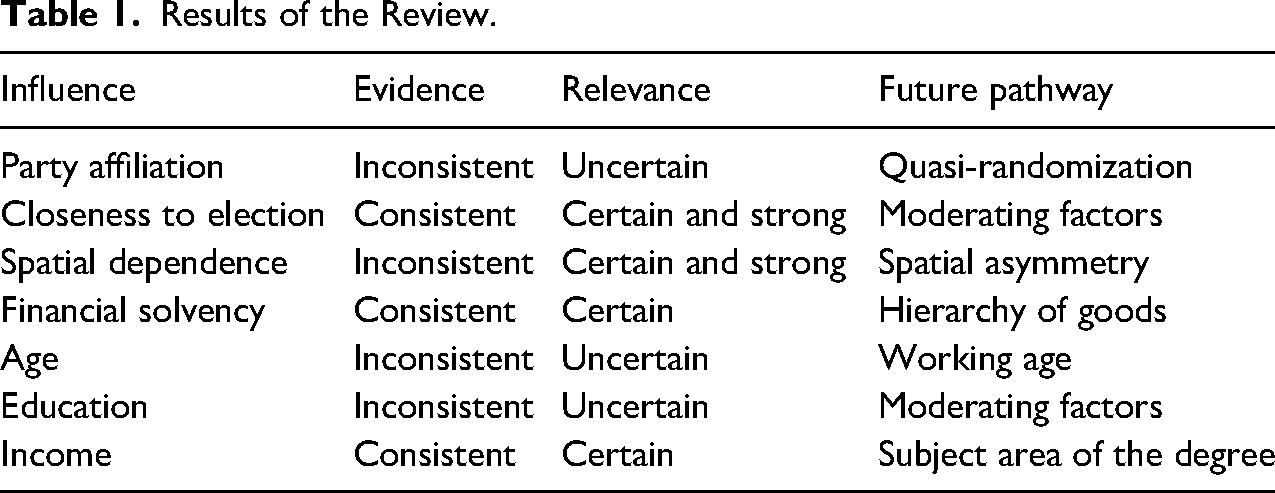
The variables can be put into two groups:
There is intersubjective agreement on the budgetary consequences of the electoral cycle, financial indicators, and income. These predictors transcend their stochastic use and are to be called influences because they are based on solid argumentative and evidentiary foundations. If the volume of local culture budgets increases by closeness to elections, by income and by financial solvency, it follows that public cultural investment is a normal/luxury good whose consumption pattern is pro-cyclical. There is more ambiguity regarding the influence of ideology,
24
spatial dependence, and the demand variables age and education. Except for spatial dependence,
25
these are the variables where the argument as to why they should be relevant lacks specificity and is questionable. The question is whether they are legitimate predictors indeed or just variables at hand that have been “why not” added to the model.
If the argument is not the problem, the inconsistency of evidence these predictors have been producing throughout the contexts may come from common upstream factors like politico-institutional parameters. The political behavior at a level so heavily dependent on higher levels varies across democracies, so countries whose legal framework grants a great deal of leeway for budgetary measures to their subnational units may contrast with countries that impose a more uniform management of public revenue and/or expenditure. This trickles down to having a moderating effect on the relevance of the party-political predictor, 26 of the neighbors’ spending (spatial dependence), and especially of the demand variables. Nevertheless, differences in the fiscal discretion the local units have been granted by the legislation of the provincial and federal level are unlikely to cause a complete reversal of the effect, and some degree of country-specific heterogeneity in the effect size is normal. After all, cultural policy is mainly a local issue, as explained above.
For the variables with argumentative solidity, the influences plus spatial dependence, 27 a short discussion on the relative 28 effect size helps to get a better oversight over which influence is most determinative for the culture budget.
The studies dedicate limited attention to how much each single predictor explains, if any at all—the common focus lies on stochastic significance, meaning the relation between the point estimate and the standard error the optimizer finds in the sample for each predictor. As far as it is feasible, a short evaluation of the effect sizes across the studies is advantageous nevertheless because it enables to complement the findings above with a second dimension. 29
The electoral cycle is the most powerful determinant of the annual cashflows in a public budget of a functioning democracy as it provides a timetable for the potential relevance of different contextual variables, in addition to being ceteris paribus indicative in itself. The volume of the outlays grows in years with electoral competition (Benito, Bastida, and Vicente 2013; Sanjuán et al. 2020), and this cyclicality is more pronounced under left-wing governments (Benito, Bastida, and Vicente 2013). The effect size is not altered when a mayor decides to run for re-election (Benito, Bastida, and Vicente 2013), but it is increased when the re-election is successful (Sanjuán et al. 2020). It is found to be greatest for the budgets of medium-sized municipalities (Sanjuán et al. 2020).
Another factor that is certain to be relevant is spatial dependence, as citizens consume in other places than their residence. The indicators of spatial correlation pass the thresholds of significance (Akai and Suhara 2013; Getzner 2022; Lundberg 2006; Werck, Heyndels, and Geys 2008) and seem to be as determinative of the volume of the culture budget as the variables for the financial solvency of the public budget, if they are included in the model (Getzner 2022; Werck, Heyndels, and Geys 2008). 30 The effect of spatial dependence is even more determinative among noncentral places, so in remote areas where population centers are distant (Getzner 2022; Werck, Heyndels, and Geys 2008). 31
The strength of spatial correlations shrinks with growing travel time from center to center by car (“cross-price effect”) (Akai and Suhara 2013; Lundberg 2006) and seems to be unrelated with personal income (Lundberg 2006). The local income tax (“own-price effect”) does not alter the effect size (Lundberg 2006). Two pressing questions for future inquiries remain: How may the research design moderate the effect size? And most importantly, do the different reasons for spatial dependence, as mentioned in (c), also entail different effect sizes?
A further classification of the residents’ income and financial solvency, the two remaining influences, is not yet possible because it is difficult to disentangle them. They are in a kind of mediating relation because a high income has itself indications on budgeting demands and is also indicative for the solvency of the public budget. As mentioned above, the financial indicators are highly subject to effect heterogeneity. As long as there are no studies spotlighting these two variables, there is no gain in forcing an—even tentative—classification of their relative effect sizes.
The effect sizes of the solid predictors are strongly determined by circumstantial factors. Seen as spatial dependence is still a kind of black box, empirically speaking, one can safely classify the electoral cycle as the main predictor, as the model outputs and the numerous strongly cyclical graphs in the cited studies show. This complies with the mobilizing function of discretionary spending, a function that is dominant in the quid pro quo mindset of local politics. The timing of cultural policy is crucial, but section (b) shows it is an under-investigated topic of studies on spending policy.
Total Spending or Sub-items?
To explain the context in which the findings were obtained, it is necessary to unpack some of the problematic aspects concerning the response variable in the studies. Future studies must take three elements budgeting research (implicitly) builds on into consideration if they want to come to conclusive findings.
Firstly, studies estimating total public supply of culture lack internal validity due to conceptual imprecision. The term “culture” is an umbrella term that gathers a heterogeneity of manifestations. Using the total spending may induce some vagueness that makes it hard to entertain a coherent discussion about public culture budgets, whether one researches the budgetary attention for traditional culture or contemporary art makes a difference for demand and supply variables.
Secondly, the assumption that systemic political demand can be deduced from personal characteristics like age and education should be questioned for the aggregate spending item. The essentialist argument—personal characteristics are predictive of political behavior like public spending preferences—seems to be a stopgap needed for quantitative research. Age and education as model predictors have also been found to be based on questionable arguments and produce conflicting evidence, so these demand variables call for future studies that estimate the volume of sub-items only. Rather than the total consumption, it is the kind of culture a community consumes that varies by its average age, etc. 32
Thirdly, even if utils are a function of the price, it is questionable whether this function is comparable across goods. If societal subgroups differ in the goods they demand and if cultural goods differ in prices, the amount spent is a very vague proxy. The quantity of utils produced would not be deductible from the price paid. This would put public spending as a measurement for political emphases into question and negate a central assumption of public budgeting research. Once again, narrowing down the scope to a certain expression of culture would mitigate this problem.
In light of these imperfections, future papers that estimate the whole culture item need to be more engaged in understanding their internal validity, in discussing their assumed causal structure (e.g., with causal graphs), in making the components of the item explicit and in specifying the external scope of their findings. For variables of uncertain relevance, mostly demand variables, the research community should also get familiar with the idea that they are not systemically deterministic in the volume of the total culture budget.
Whenever the research question allows, high-leverage empirical studies must narrow down their scope. Focusing on sub-items can weaken the listed criticisms, as sub-items encompass a more homogeneous range of items. This would improve conceptual precision and make the first point of criticism obsolete, it would make the claim criticized in the second point that a particular characteristic predicts the response variable more legitimate, and it would, of course, moderate the range of the prices of the commodities.
Conclusion
Public budgeting research determines statistical dependencies rather than bulletproof causality because many influences of public provision are endogenous and cannot be randomized. 33 A predictor is only then reliable/quasi-causal if it is based on solid argumentation and if the significance and the direction of its effect are replicated in a convincing majority of empirical studies. This reliance on observational studies is the reason why literature reviews like this are all the more important for government budgeting research.
This paper provides an overview of the main demand and supply predictors that have been used in econometric studies on municipal cultural expenditures. It reviews the theoretical and empirical aspects to characterize the status quo and develop recommendations for future studies. Although the main problem of not being able to randomize the potential influences will persist, the recommendations collected in this review help to make the results of future observational studies more conclusive. They are transferable to other comparable research projects on government budgeting.
The main finding is that the electoral cycle, the residents’ average income, as well as the financial solvency (debt and transfers) of the municipal budget are solid predictors of the volume of municipal culture budgets and can be called influences. Spatial dependence—the impact of the spending policy of neighboring municipalities—is undoubtedly an additional relevant factor, but the empirical studies have not yet succeeded in exhaustively characterizing its multilayered effect. As for the relative importance of the influences, the electoral cycle can be seen as the most determinative factor, although circumstantial factors like party-political competition moderate its relevance.
The review discovers that the inclusion of ideology, the residents’ average age and education as predictors has been based on questionable arguments and that these very same predictors have also been producing contradicting evidence and/or null findings. Future studies should test whether there is an underlying pattern which moderates the effects. Some institutional parameters (e.g., federalism vs. centralism, proportional vs. majority representation) can determine the relevance of these variables, especially of age and education as demand variables.
If there is no such intermittent factor, these variables should no longer be used for modeling, and a new set of variables must take their place: The research community has been neglecting demand variables that capture the “people climate,” meaning the suitability of a location for contemporary creative circles. If demand for discretionary spending, such as culture, depends on value orientations and lifestyle preferences in addition to economic and political considerations (Horrigmo 2013), the inclusion of these New Political Culture predictors provides a promising alternative and supplement to the predictors above to improve the models.
As response variable, the studies have been estimating a highly aggregated spending item. However, the culture budget of territorial entities in functioning democracies is comprised of many different subsections, as the COFOG definition shows, and this heterogeneity is consequential because different sub-items can be associated with different subgroups of the electorate. This can explain why some predictors produce opposing coefficients throughout the studies, especially the predictor variables of the demand side. The recommendation is to break down the aggregate of total cultural expenditures and to use sub-items (like traditional culture, contemporary arts) instead. The increased homogeneity of sub-items will bolden the internal validity of the studies.
As public budgeting studies make efforts to gain internal validity, they will become more conclusive regarding the implications for public management. More interaction between academia and policy advisors is necessary because policy-makers run danger to be behind the game: Some municipalities may see cultural policy as a secondary priority and prefer to save money rather than invest in culture, even though there is much to be gained, for example, from a proper cross-sectional and intermunicipal strategy. Centering cultural policy on providing funds in an application-based system is comfortable but not strategic, as this neither ensures that the funded measures will meet broad demand nor that they will be remotely economically advantageous for the community.
With a larger pool of evidence at hand, policy-makers are able to take a long-term and effect-based perspective on the allocation of public capital investments. A better understanding of the demand and supply side makes sure that policy measures are both well-received by the broad public, sustainably funded, and come with some sort of lasting dividend. A professional cultural governance therefore promotes measures that not only satisfy popular demand but at the same time serve a tailormade strategy to commodify the cultural potential of the place for cultural and fiscal dividends.
In this framework, this review is a first snapshot and critique of the quantitative empirical studies, and it is the task of future studies, whatever their methodology, to gain a more concrete understanding of how local cultural policy measures can be developed that most neatly achieve the objectives.
Footnotes
Declaration of Conflicting Interests
The author declared no potential conflicts of interest with respect to the research, authorship, and/or publication of this article.
Funding
The author received no financial support for the research, authorship, and/or publication of this article.
