




Abstract
To understand temporality and power of citizens in urban planning and development processes, we need to understand how closure is achieved. We define closure as the moment when active contestation against a particular planning decision ends. The temporal and democratic nature of urban planning and development thus give possibilities of using temporal power over closure to the hands of social movements and citizens. To show how these ideas work in practice, the paper presents three literature-based vignettes: in Helsinki, activists were able to deny closure for a decision to construct housing on Malmi Airport for decades, in St. Petersburg, already constructed buildings had to be lowered because citizen activism, and in New York, even if Pennsylvania Station was demolished, legacy of the conflict over its preservation lead to re-writing of the city's historical preservation policies, never allowing the case to be fully closed.
Introduction
In 1963, New York City lost Pennsylvania Station, one of its most grandiose buildings. The trauma of this loss had a significant impact on the historic legacy preservation policies in the city and still resonates with many New Yorkers today. In a very different place and age, in Saint Petersburg in 2008, city authorities ordered the reduction of the height of a newly completed high-rise building because it interfered with the city's cherished skyline. In Helsinki, activists have been stalling and delaying the redevelopment of Malmi airport since the 1970s.
These three vignettes point towards the question: who actually has agency and power in conflicts over urban planning? Even though urban development is often spearheaded by either (local) government officials or powerful developers, resisters—citizen coalitions and social movements—are often able to stop, or at least stall, development, sometimes for decades. Should this ability be considered a type of temporal power?
In numerous cases around the world and throughout decades, urban contention develops along complex timelines with obscure beginnings, uncertain resolutions, and convoluted progressions. Urban planning and city building produce three-dimensional results: new buildings, highways, parks, and more. Still, the fourth dimension, time, is salient. Urban development processes that lead to decisions take time and evolve over time, through political and commercial processes as well as public discussion—and involve deliberative and consensus-seeking elements. This temporality creates places for the use of power. Closure, agreement of the involved parties that the decision was, indeed, made and will be implemented, is a major milestone for such processes. And yet, as we will show in this article, closure in democratically organized planning and development processes is not a single and definite moment: participants—urban planners, city authorities, and organized collectives of urban residents—can revisit their previously made decisions, revoke consent, and revive cases that seemed “closed,” sometimes even after development has already happened. All in all this makes time and temporality into an important yet undertheorized aspect of power in urban development projects.
In this paper, we propose a set of conceptual tools for taking time and temporal regimes into account in the analysis of public participation in urban development processes. To make sense of the temporal regimes of democratic urban planning and the ways multiple participants with different access to resources and power can influence planning decisions, we redefine the concept of closure using planning theory and radical democratic theory in combination with the scholarship on political temporality. By analyzing urban development conflicts with this conceptual lens, we can better understand the type of power social movements and coalitions hold, as well as move beyond the binary idea of either success or failure as the possible outcomes of social movements. Temporal power over closure implies that delaying or even renegotiating after the fact can be important outcomes for social movements, even if their primary goals would not be achieved.
Recently, social movement scholars have began paying close attention to the temporal dimension of political processes, but in this body of literature, time still mostly appears as an organizing principle that allows for the analytical breakdown of political processes into segments (episodes, waves, “abeyance” or mobilization, and so on). In this article, we look at time as a dimension of power and agency which players bring into action to negotiate and contest urban development and related planning decisions in democratic processes. This shift in perspective allows us to prioritize continuity over discrete moments (e.g., protest episodes) or configurations (e.g., political regimes), while looking at time not as a monolith or immovable structure, but a pliable and dynamic continuum. Additionally, distinguishing between and centering the concepts of imposed and consensus-based closure makes it possible to stay mindful of distinct changes in the intensity or inactivity of political processes and conflicts. It also makes it possible to analyze the roles of different political players, including social movements, in the making and unmaking of political decisions in planning.
Building on the growing literature on urban and political temporality, we suggest that instead of focusing on the formal adoption of a plans as a single moment of decision, urban planning projects in democratic contexts are better understood as interactive processes unfolding over time, with deliberative and public participation and potential for social movements to stretch the decision-making windows by delaying closure or contract them by increasing public pressure and the sense of urgency. This broadens the timeframe for analyzing decision-making related to urban planning. Before any construction, demolition, or renovation can begin, active resistance to a particular project must cease, or at least cool down to manageable levels. We define closure as a situation when contentious interactions come to a halt. This definition allows us to grasp the temporary nature of closure in urban planning: conflicts can be revived by interested parties later. It also allows us to highlight the temporal agency of social movements and ordinary people who participate in urban planning: they, too, can stretch and shrink the decision-making timeline and have power to grant or revoke their agreement to move on.
Closure has been defined within democratic theory as a “time at which all concerned can agree that the matter has been decided and the system moves on” (Marx Ferree et al. 2002, 294). We build on this definition and expand it to better cover urban development conflicts by linking it with the theoretic literature on deliberative democracy and agonism in urban planning (Bäcklund and Mäntysalo 2010; Bond 2011; Eranti 2017; Eranti and Meriluoto 2023; Healey 1992; Kühn 2021; Swyngedouw and Heynen 2003). We then connect this line of thinking with the emerging way of thinking about temporality in political processes and social movements (Auyero 2014; Gillan and Edwards 2020; Gokmenoglu 2022; Kemmer and Simone 2021; Koster 2020; Zhelnina and Tykanova 2019).
Our argument has three main tracts. First, in line with Gokmenoglu's (2022:651) call for theorizing “the ways in which time is contested, negotiated, and politicized” (see also and Gillan and Edwards 2020 for social movements, and Dobson and Parker 2024 for planning theory), we foreground the political dimension of time within urban planning and development, highlighted by their processual nature. Politicization of time is often conceptualized as temporal power: the ability to control other people's time, impose urgency, or delay decisions. Below, we will discuss the temporal nature of democratic closure, which is strongly associated with—albeit temporary—hegemony, often ensured by political enforcement (Mouffe 2005). Still, in democratic regimes, the temporal nature democratic processes create possibilities for the use of temporal power for social movements and other non-institutional actors.
Second, we show that together with the democratic nature of urban planning, this temporal and processual character of planning conflicts emphasizes collective closure-making, as well as the potential collective denial of closure. There are several pathways to closure in deliberative processes. Ideally, all interested parties in principle agree on the plan. Such consensus, however, is rarely possible. The other option for closure is a situation where, despite differences of opinion, active opposition and contention ends. Third, in contrast to the existing literature on the political dimensions of time, we argue that ordinary people can not only be subject to the exercise of temporal power by more resourceful players, such as politicians, corporations, and their coalitions, but can also exercise temporal agency. They can stretch and shrink decision-making windows by delaying closure or creating a sense of urgency by protesting and influencing public opinion. The tactics and repertoires they can turn to can differ depending on when the controversy evolves: before or after the formal decisions on the project are made and before or after the project is implemented. In the conclusion, we discuss how this analysis can be useful also outside the immediate context of urban development.
Our analysis aims for a theoretical contribution. We support this theoretical analysis with examples drawn from broader literature, as well as with three more spelled-out vignettes based on the authors’ previous research and some well-studied cases of urban development conflicts. The selection of the three vignettes reflects the flexibility and dynamism of temporal analysis of closure: each of the examples illustrates a different temporal scenario and shows how our conceptual tools can be useful for recognizing the role of closure in seemingly different situations.
The selection of vignettes follows the research experience of the authors, and is, therefore, limited to certain geographical locations and political contexts. Still, some theoretical approaches informing our analysis, notably the theories of political temporality, were developed in the cities of the Global South (Auyero 2014; Auyero and Swistun 2009; Ghertner 2017; Kemmer and Simone 2021). Building on these ideas, we demonstrate how concepts derived from the Global South can provide valuable analytical tools beyond their original contexts. Our vignettes include cases from what is typically labeled as the “Global North” (the US and Finland) as well as Russia, whose position in the North-South divide is more ambiguous. Applying this theoretical lens to diverse political and geographical settings highlights both its broader applicability and how local specificities shape urban planning negotiations in different contexts.
Urban Development as a Temporal Democratic Process
At least since the advent and institutionalization of communicative planning, urban planning processes around the globe have included deliberative and consensus-seeking elements (to give a few examples, for US, see Einstein, Glick, and Palmer 2019, 55–56; for Europe, see Nadin et al. 2021; for China, see Hu, de Roo, and Lu 2013; for India & South Africa, see Calderon and Westin 2021; for Russia, see Semenov and Minaeva 2021). These practices include local boards for citizens, employment of interaction planners, practices of collecting citizens feedback about plans undergoing preparation, and what can even be described as veto-like power of challenging planning and construction decisions in courts. At least some kind of oversight, and often outright decision-making power, is commonly vested on democratic institutions such as municipal councils, governments and planning boards (Bäcklung and Mäntysalo 2010; Einstein, Glick, and Palmer 2019; Eranti 2017; Flyvbjerg 1998; as a more general look on the veto-power of citizens, Rosanvallon 2008). Urban and national contexts vary in terms of the specific configuration of institutions, procedures, and involved players: in some countries land-owners are prime movers in urban planning and development, while in other places, cities and municipalities have both final say over and major resources for drafting urban plans and development projects (Haila 1999). Additionally, urban planning projects often cause public discussion and evaluation in the public arena.
Deliberative efforts introduced by communicative planning (see e.g., Healey 1992), as well as the naturally emerging public deliberation of projects highlight the processual nature of urban planning (see also Dobson and Parker 2024 for a summary of planning & temporality). Any given urban development proposal exists and is “in play” (Palonen 2003) potentially for a long time. During this time, these proposals are alive and in flux, residents and institutional players scrutinize and criticize them, and cities, investors, and the whole participating coalitions assess their economics, funding and marketability. Proposals and projects may even involve multiple milestones when some parties claim closure, only to be opposed, contested, and pulled into a decision-making process again. For example, in the plan for a car-free Aarhus in Flyvbjerg's classic Rationality and power (1998), after the publication of the plan by the municipal authorities, the local Chamber of Commerce starts drafting counterplans, the local paper opposes the plan, and economic and political realities shift. The publication of what appeared to be a “decision,” thus, launched a decision-making process involving multiple players who refused to close the case and eventually led to the plan's undoing.
Unlike in many other democratic processes, in urban development, the decision to adopt a given plan is not the end of the process. In an urban planning process, the intended outcome is actual physical construction, and there can be a substantial lag between that and the formal decision-making. Kemmer and Simone (2021, 583) describe this stretching of time in the following way: “urban promises point to an elasticity of the relations between human/material ‘promisors’ and residents (…) ‘minor’ futures emerge from the indeterminacy of ‘time buffers’ or moments of temporal suspension between expectations and actions, between imagination and materialization, and between declarations and dispositions.” An urban plan is thus a “promise” until it is made real by the act of construction—a minor piece of the future, not necessarily on the scale of a whole city, but some small part of it. There is a difference between the actual act of decision, which creates the “minor future” and the promise of the plan, and the actual act of construction.
Koster (2020) finds that construction projects have effects on people both before they happen, and long after they have happened, not just in the moment of construction and in the following moves. We take this observation further and argue that, to understand the democratic decision-making in urban planning, we need to examine how, in addition to being affected by redevelopment, people can affect construction projects: not only in contributing to the democratic decision-making, but also after that. The temporal lags between formal adoption of plans and their physical realization create strategic openings for citizens and social movements. We will conceptualize different ways of achieving or denying closure as a crucial tool for taking advantage of these strategic openings, which are available to citizens and social movements at different stages of urban planning processes (similar to how different dilemmas emerge at different points in time, see Jabola-Carolus et al. 2020). In the literature-based vignettes we introduce below, we demonstrate how even the construction of a building does not always mean that a case is closed, and that everybody involved moves on. In particular cases, the aftermath of a construction project might involve anything from attempts at having the building demolished or changing the building codes to prevent similar things from being built (or demolished) going forward.
Defining Democratic Closure in Urban Planning Conflicts
In the important text on communicative planning, Healey (1992) posited that planning happens “through a debate.” Given that urban planning is a temporal process, the question we ask is: when does that debate end, and how should we understand closure in this kind of democratic process? In this section, we revisit democratic theory and literature on participatory urban planning to provide a definition of closure 1 within discussions of democracy; we also identify different ways of achieving it, distinguishing between consensus-based and imposed closure (the latter being based on temporary hegemony of power). To understand the hegemonic nature of these decisions, we turn to Chantal Mouffe's ideas of agonistic pluralism, framing conflict as a constitutive element in democratic processes in which actors seek the elusive closure. We argue that, through creation and maintaining of conflicts, closure can be revoked, revisited, declined, or negotiated at different phases along the urban planning process.
In democratic theory, public debates have been a key setting for the analysis of closure. Marx Ferree et al. (2002) map different theoretical models of the public sphere in democratic societies (representative liberal, participatory liberal, discursive, and constructionist), each based on a different approach to public debates and a different valuation of closure. In a representative liberal democracy, closure is the norm: debate before decision-making is good, but after that it becomes discouraged, even harmful. The goal of a debate is to come to a decision which then must be implemented, even if the decision is strongly opposed by significant minorities. Discursive and participatory traditions, on the other hand, emphasize the avoidance of non-consensus-based closure altogether. These models of democracy prioritize reaching conclusions through a debate over making quick decisions. The core ideas of communicative and democratic urban planning align with this logic. Finally, constructionist ideas of the public sphere call into question the whole value of consensus, and thus closure itself, in the face of a radically plural world.
The constructionist vision of the radically pluralistic public sphere aligns with both the realities of urban planning and Chantal Mouffe's (1993, 2000, 2005) theorizations of the democratic processes. Closure, in this view, is never complete and is always temporary, subject to revisions, negotiations, and revocations. Mouffe's approach to democracy, agonistic pluralism, centers conflicts that are inseparable from plurality. The role of political actors is to disagree, to have conflicting value-bases, and to create conflicts, but their relations remain agonistic (they can have competing goals and interests without seeking to destroy or eliminate each other) as opposed to antagonistic. In such agonistic relations, consensus can be reached, but it is always a temporary hegemony, often possible only through some kind of political force (Mouffe 2005).
In urban planning, acknowledging the plurality of the world and accepting Mouffe's ontology of radical contingency requires more openness to new and alternative views, along with tolerating the institutional ambiguity (Bäcklund and Mäntysalo 2010). Privileging this approach over the Habermasian communicative model and its associated aim of consensus (Bond 2011; Mäntysalo, Mattila, and Hirvola 2023) opens the urban planning field to accepting conflicts as an integral element of the democratic processes instead of focusing on ways to mitigate them. In agonistic planning the stakeholders may agree on certain issues and respectfully agree to disagree on others (for a broader outlook, see also Kühn 2021; Swyngedouw and Heynen 2003).
Deliberative practices of planning call for a communicative and consensus-searching view of closure (Bäcklund and Mäntysalo 2010), and have the inherent tension also associated with the discursive and participatory models of the public sphere mentioned above: premature and imposed consensus should be avoided, even if it makes deliberation and decision-making longer and costlier. Due to the physical nature of urban construction, this kind of avoidance of premature or imposed closure is not only hard to achieve but also often not neutral in nature. Avoiding closure can benefit some involved parties more than others: opponents of a project can use denial of closure as a tactic, while the proponents cannot. This situation empowers, for example, conservative and conservationist participants (such as older, wealthy, and white residents blocking construction of multi-family housing, as portrayed by Einstein, Glick, and Palmer 2019), or, in another example, enables progressive Jacobsian (Jacobs 1961) movements against high modernist projects (Scott 1998). Additionally, the materiality of consequences in urban planning decisions set them apart from, for example, policies and legislation: they cannot remain eternally re-negotiable.
If we take the radical Mouffean idea of plurality seriously, as the agonistic democratic planning practices (Bäcklund and Mäntysalo 2010) or the constructionist model of the public sphere (Marx Ferree et al. 2002) suggest, the whole idea of closure becomes harder to sustain. Bäcklund & Mäntysalo argue that, in agonistic models, the role of the citizen is to provide complementary planning capabilities—to directly challenge the core concepts of planning. If differences in opinion can never be completely taken away, there is little hope that people or social movements acting on their behalf to influence urban planning projects would be satisfied by the mere fact that their “voices were heard” and their “complementary views” were acknowledged. The dissident opinions remain, and closure becomes contingent on temporary hegemonies (for an operationalization in urban context, see Eranti and Meriluoto 2023).
Thus, in the context of deliberation in urban planning, it makes sense to separate imposed closure from consensus-based closure. With imposed closure we refer to a moment where a decision has been made based on a temporary hegemony, but fundamental disagreements remain. Consensus-based closure refers to a situation where major participants in a planning process have reached some level of agreement. This is the “making sense together while living differently” envisioned by Healey as one of the core tenets of communicative planning (1992, 143, see also Healey 1997).
Closure in urban planning and construction is thus best seen as an emergent phenomenon: the (democratic) decision-making and related deliberative and participatory processes are necessary, but not sufficient conditions. Since any closure can always be seen as a temporary hegemonic arrangement from the outside, even if it can seem consensus-based for the participants, we propose a definition that incorporates this possibility: Closure is the moment when active contention ends. This is not necessarily the moment when grievances or disagreement end, although that is also possible.
Seen this way, closure is at the hands of the citizens and activists. Closure is a choice made by the actual or potential activists. This also means that closure is a feature of the planning and construction process seen as a democratic process. 2 Construction is, however, also a physical activity, and thus imposed closure can often be achieved through hegemonic means even if consensus-based closure is an impossibility. As we will show in our vignettes, a critique against a construction project that operates on a fundamental level can haunt it even after completion of construction. And also the other way round, in some cases even if (preservation) activist projects fail, they can in turn haunt all future construction projects in the area.
If closure is finally at the hands of the activists, how do social movement players interpret these temporalities and the different possibilities emerging at different phases of the planning process? Next, we look into the literature on temporal power, agency, and the strategic interaction of social movements.
Temporal Power, Agency, and Time in Social Movements
The temporal nature of the urban planning process calls for a serious attention to the temporal dimensions of power and agency in either reaching consensus-based closure, or resisting imposed closure.
Seminal work on temporality and power attributes the capacity to make people wait, rush them, and set deadlines to the powerful state actors (Auyero 2014; Bourdieu 2000). Waiting is one of the clearest expressions of the unequal distribution of temporal power: waiting for decisions, appointments, promised programs is usually something the powerless do. Moreover, waiting is a “profoundly disempowering process” (Auyero 2014, 242), and sometimes can be experienced as “temporal violence” the state performs on its subjects.
Urban scholars have also analyzed how unequal distribution of waiting within societies plays out in urban redevelopment. Announcement of new projects can cause significant disruptions to people's lives and their private planning and strategizing, imposing the new “project time” (Koster 2020) or a new temporal horizon on them. Promised projects and improvements can also make people wait, creating an uncertain “in-between” timescape between the promise and the implementation of a project (Kemmer and Simone 2021). Unfulfilled, but looming projects create a sense of threat and rupture among those who live in targeted neighborhoods and buildings (Sakizloglu 2014; Watt 2021), and this can go on for indefinite periods, bringing neither peace nor closure.
In urban redevelopment processes, some players seem to have more temporal power, that is the power to rush or delay others. The classic “growth coalitions” (Logan and Molotch 2007) of city officials and developers, for example, can contrive surprise projects before the public can understand what is going on, and set up fences, dig up ditches or fell trees to make their efforts look irreversible or at least more material and, supposedly, more difficult to fight.
Still, an emerging way of thinking about temporality suggests that the less powerful, the ordinary people can, too, try and exercise some temporal agency. For example, Ghertner (2017) demonstrates that ordinary residents “on the margins” of the state can strategically intervene with state bureaucracies. Zhelnina (2023) shows that urban grassroots can resist the temporal pressures of urban redevelopment projects. Kemmer and Simone (2021) argue that even unfulfilled urban projects create more than just patient waiting: anticipating a promised future, residents in the areas affected by an uncompleted project, generate new possibilities and trajectories.
It is, therefore, logical to explore how the temporal dimension of power is negotiated during political contestations, and how social movement actors, usually representing the less powerful players in political fields, can strategically work toward closure or try to postpone it. 3
Temporality is an emerging theme in social movement studies (Gillan and Edwards 2020): movements are clearly temporal phenomena, developing as “cycles” or “waves,” negotiating continuity and change, invoking images of the past and alternatives for the future. Social movement outcomes usually conceived as “successes” or “failures” (Gamson 1975) can also be thought of in terms of achieving closure as a result of intensive strategic interactions between multiple players. Analyzing the results of social movement activities as closure also allows us to decenter social movement players and look at these outcomes from the points of view of multiple players, as the strategic interactionist perspective suggests (Jasper and Duyvendak 2015). This way, we can foreground the interactive processes of negotiating, delaying, or achieving closure.
Research on social movement outcomes shows that it is often difficult to define them, as movements achieve multiple incremental gains and incur losses that may or may not lead to a final victory (Jasper et al. 2022). In these incremental processes, players face a variety of temporal dilemmas (Jabola-Carolus et al. 2020): for example, balancing between short-term and long-term gains which often are at odds, or deciding whether to stabilize an organization and make it more persistent over time, risking its flexibility and democratic features (institutionalization dilemma). In different moments, players also face different dilemmas, as well as have different options and tools available to them. Moreover, political institutions themselves can be arranged in ways limiting or facilitating meaningful democratic participation: “Rendering political institutions more participatory or deliberative is a matter of stretching institutional schedules to permit deeper democratic participation. Compressing such schedules, by contrast, is a tactic to limit such participation” (Jabola-Carolus et al. 2020, 652). These rules and timescapes may themselves become an issue for contention and democratic engagement as players question the rules of the game and demand broader inclusion.
In summary, our theoretical model proposes that in democratic contexts, the success of urban development is dependent on closure of the democratic process. We interpret closure as a situation when active contention ends: that is, the involved parties, even the ones still disagreeing with the decision, either make a choice not to continue their active opposition (consensus-based closure) or are subordinated by the use of hegemonic power (imposed closure). The processual nature of urban planning creates temporal opportunities for use of power, not only for institutional actors but also for social movements and citizens. One of the main avenues for this use of power comes through denial of closure. And finally, given the pluralism of human interests and valuations, there is always a possibility of revoking or revisiting a situation where closure has seemingly been reached.
This theoretical framework allows us to analyze seemingly different scenarios, as we will now illustrate with several examples of various strategies ordinary citizens, social movements, and activists can implement to delay, deny, revoke—or even re-open closure.
Seeking and Denying Closure in Practice
In this section, we situate actual urban planning conflicts within our framework and show how citizens and social movements are using temporal power and strategies to affect consensus-based closure and delay or deny imposed closures. We do so first by turning to the vast field of urban planning research and demonstrating how our conceptual framing can enhance the existing analyses, and then use three literature-based vignettes to go more in-depth. In all cited cases, the power of citizens and more organized movements to deny the closure plays out in different ways in different points of the urban planning process. Each of the examples highlights a different facet of the process and the requirements of either closure or the pressure needed to push closure backwards. If we only applied the optics of urban social movement research to these case studies, we would see scenarios that could be identified as success or failure of the activists, or as an ambivalent (unresolved) outcome. Where conflicts happen temporarily affects or even defines the strategies, tactics, and available repertoires of action for social movements.
The existing literature on citizen participation in urban planning offers multiple examples of how citizen-participation can change decisions or outright kill projects in the deliberative phase. Here we present three short examples, before moving to three more spelled-out vignettes.
First, Einstein, Glick, and Palmer (2019, 24–57) discuss the tactics of delaying controversial construction projects in their study of a redevelopment on site of a former church in Massachusetts which was to be turned into a mixture of market-rate and affordable housing, but strong local opposition prevented closure for years. This example shows how different participatory institutions in the US context create opportunities for residents to oppose, delay, downscale, and stall development projects, even if the construction eventually takes place. The opponents of the project made use of the existing “historic and environmental regulations,” raised their concerns in public meetings, lawsuits, and media campaigns: “While neighbors’ aim might be to stop a development, they can accomplish a similarly powerful goal: delay” (p. 51). Eventually, the project was negotiated down to half of its original size, and something approaching consensus-based closure was achieved. Denying this closure for years seemed to be one of the goals of the powerful neighborhood opposition.
Second, the strategies around achieving closure can become contested and temporally fractured, as the example of the East Side Coastal Resilience Project in New York City described by Araos (2021) demonstrates. In this case, different parties were initially on track of achieving a consensus-based closure in a participatory project of designing a coastal resilience infrastructure, but the city authorities’ decision to impose a non-consensual closure (suggesting a different version of the project than the one agreed on in participatory process) disrupted the achieved balance. It fractured the community of residents, some of whom were ready to accept the imperfect project while others mobilized to prevent it from happening altogether. Examples like this show that looking at closure in deliberative processes requires foregrounding different players involved, as well as their alliances and fracturing and their diverging temporal strategies.
While powerful players can rush their project through approval processes and try to set foot in a particular urban space by fencing in the construction site, for example, the popular strategy activists turn to is delaying closure. Litigation and indefinite extension of a project's horizon can be costly and drain resources even from the resource-rich backers of the contested proposal. However, there are examples when alert and concerned citizens, too, take action before the immediate threat emerges, preventing it from happening (Zhelnina 2023).
And third, sometimes these conflicts take on a more intra-elite nature. Flyvbjerg (1998) shows how a powerful coalition of newspapers, business interest and the like tried to use newspaper coverage, alternative plans, activism, and all possible means to stop a social democratic mayor in a Danish city from implementing a car-free mobility plan, ranging from participation in the deliberation to litigation and obstruction in the project phase.
The preceding three examples, as well as the following three broader vignettes, are organized temporally, from earlier to later in the urban planning process. This temporal organization of the vignettes is presented in Figure 1.
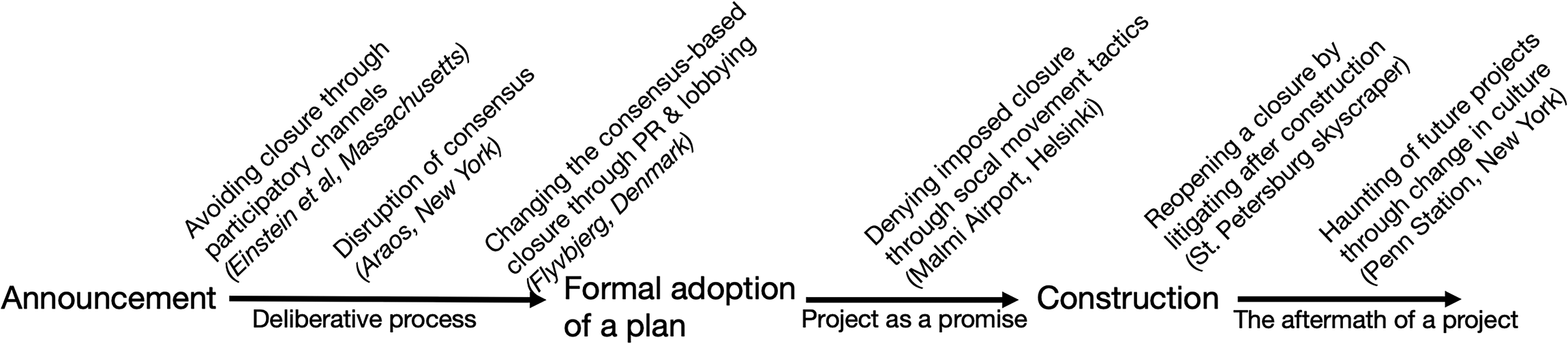
Temporal organization of vignettes and literature-based examples along the temporal organization of democratic planning process.
As these examples are rather well understood in the literature, we now move to three vignettes that better illustrate the potential of our conceptual framework in understanding activism that happens in the later parts of urban planning processes: denying closure during democratic decision-making, re-opening closure through litigation after construction is already happened, and finally an example showing how civic activism can make a construction project with an imposed closure haunt all future construction project of the same type. These vignettes are based on literature and have been chosen based on how the theoretical tools presented here can help us understand urban planning conflicts. To maintain coherence, these three vignettes are all from preservationist movements. They are also all rather resourceful, able to create coalitions, and employ legal means in addition to traditional social movement tactics. This helps us highlight the different options for temporal agency available for movements.
Denying Closure: Obstruction and Legalization, Pushing Back Construction After Decision-Making
The first vignette is about social movements denying closure in the face of a hegemonic political construction project. Physical means of stopping construction and denying closure have been well-documented, but public pressure and legal means can also be used in a similar manner.
Blockades and other physical means of stopping construction, obstructive direct action, have been in the toolbox of environmental movements for long, and increasingly so since the 1980s (McIntyre 2021, 9–11). Obstructive direct action offers a clear-cut example of denying imposed closure in a construction process: even though urban development has already been decided, and the actual construction machinery is already in place, activists can, using in the last measure their own physical bodies, to stop the construction from happening. This kind of final Hail Mary effort can also be quite successful, at least if it succeeds in turning the issue into a public political fight, and in drawing media attention (etc.) to the issue (McIntyre 2021, 12–13). In this kind of action, due to the nature of the process, timing and strategic sequencing (Jabola-Carolus et al. 2020) is crucial, because success is a matter of being in place when the demolition is slated to happen. It can also easily veer into the territory of high-risk activism.
But if we look at blockades as an example of denial of closure that happens after (democratic) decision-making and before the actual construction happens, we see that there are also other, less confrontational movement strategies possible in this phase of the conflict.
In 2014, the City of Helsinki and the Finnish state reached a common understanding that Malmi Airport in Helsinki was slated for housing construction. The airport then was actively used for pilot training and hobbyist aviation, and did not have regular national or international travel flight connections. The redevelopment was first proposed in public forums in the 1970s, and in some way already in 1952 when the current main airport, Helsinki-Vantaa, was built to replace Malmi as the international airport of Helsinki. In 2002, discussion and public debate became serious enough that the Friends of the Malmi Airport association was formed to fight for the airport (Eranti and Meriluoto 2023).
The decision to turn the airfield into housing was done in order to combat urban sprawl and housing shortages, and the general plan included new mixed-tenure housing for approximately 25,000 people. There was a broad political consensus backing the construction of the housing. An active core, composed of aviation enthusiasts, commercial users of the airport and a diverse coalition including nature conservationists, built environment enthusiasts, scouts and guides, and local residents formed a social movement fighting against the decision. Instead of obstructive direct action, this comparatively well-connected and resourced group focused on lobbying, public relations work, as well as various legal and conservationist routes for stopping the construction process (Eranti and Meriluoto 2023).
These included a complaint to the parliamentary ombudsman, a citizen initiative to get the parliament to protect the Airport legally (Lex Malmi), an attempted municipal referendum in the city of Helsinki over the future of the airport, several court cases over the legality of the plan, an effort to get the Finnish Heritage Agency to protect the area based on heritage values (and additionally, the inclusion of Malmi Airport on the ICOMOS list of most endangered built heritage sites), and also focusing on municipal elections, since before the implementation, plans can be changed (Eranti and Meriluoto 2023).
What these efforts have in common is that they include a form of power that is either at the level or higher than the city of Helsinki in the decision-making hierarchy. The Parliament of Finland potentially has power over many things (although not necessarily in this particular case), heritage protection can potentially be dominant, and of course the city can change its own plans.
In the end, in early 2021, the shoe dropped at last, and after a court case turned against the coalition, the City of Helsinki ordered them to leave. The social movement decided not to comply with these orders and remained in place while launching several formal complaints at various administrative levels. After failing to get an injunction, they were ordered a daily fine by the court, and this eventually led them to vacate the airport—although unauthorized landings and take-offs continued until the City of Helsinki installed concrete measures stopping them from happening. These are to be considered less as a coordinated direct action, and more as a final sign of principled defiance.
Given that the first inklings of this conflict were public in the 1970s, the airport activists were able to hold off the decision for over 50 years passively, and 20 years actively. In the temporality of uses for airport space, even if they were eventually evicted, this represents a serious win for the users of the airport. The City of Helsinki was able to use hegemonic power to impose a closure and come to a decision on the use of the airport. But social movements were able to deny this closure after the decision-making was already done, by various legal means, by trying to raise the level of the issues and appealing to higher power (in this case the parliament), or by reframing the administrative issue as a democracy-issue via referendums, as well as in the end via injunctions.
Reopening Closure: Litigating After Construction
In some specific examples, even the actual construction of the contested building or infrastructure does not constitute closure for the process. In our second example, city statutes around building height along a historically preserved skyline led to lowering of two already built buildings.
In August 2008, the Council for urban development of Saint Petersburg, Russia, 4 decided that the height of an already constructed and operating building of the Trade and Finance Stock Exchange had to be lowered. The 18-story building had to lose two stories and be lowered from 67 to 63 m (Pushkarskaya 2008). The tall building interfered with the city's skyline, and spoiled the view of the historic embankments along the river Neva. The developers violated the previously agreed height for the building at 63 m, and had to bear the additional costs for the deconstruction at $6 million on top of the $52 million that the construction already cost.
Activists noticed the height of the building and its interference with the skyline only when the building was completed. The heated protests began in June 2008 and involved the city's heritage preservation movement that was at its strongest at the moment, and multiple sympathetic politicians, journalists, and art historians. The public campaign helped disclose that the project received a green light in the late 1990s and early 2000s, when city officials who since then have left their office allowed for the violation of the construction height permitted by the zoning rules in the area (48 m). The city allowed the building to be constructed at the 54 m height, which the developer violated once more, hoping that the completed building will not draw attention. Unfortunately for the developer, by 2008 the preservationist movement in Saint Petersburg (Tykanova and Khokhlova 2020) grew stronger than it was even in 2002, and managed to mobilize enough political support for the city government to issue the unprecedented decision to lower the height of an already completed building. The zoning law and the height regulations for the city center were also revised to limit the high-rise construction in the city center and around it. The agreed eventual height for the new Stock Exchange of 63 m was a significant compromise compared to the officially allowed 48 m, which reflects the city's initial failure to comply with its own zoning regulations by issuing a building permission violating these norms. 5
In this case, there are at least two moments when closure seemed achieved: the initial permission for the construction issued in 2002 implying a more or less consensus-based closure, and the completion of the building in 2008. Still, in each of these situations it was again challenged and deconstructed: first by the developer, who decided to add a couple more meters to the coordinated height, and then by the preservationists who interfered in the situation after the building's completion, reopening an imposed closure.
Interestingly, in some discussions about the need for the lowering of the building, speakers invoked other examples of buildings that were approved for construction before the introduction of the new zoning law limiting the construction height. For example, the residential complex Monblan (74 m) that was completed in 2006, stands out in the city's skyline and is officially considered an “urban development mistake” (Shishkin 2012). Some mistakes, even if completed and final, open up new possibilities in the future and become paradigmatic examples of what not to do for the upcoming controversial projects.
Haunting: How a Torn-Down Building can Affect the Skyline Indefinitely
Some cases open new wounds instead of closure, sparking protest energy and invigorating discourses for years to come. One such case is the infamous demolition of Pennsylvania station in New York City.
A giant and lavish structure, Pennsylvania Station was constructed in 1910 and survived for only a little longer than 50 years: in 1961, amid financial trouble and falling ridership, the Pennsylvania railroad company decided to demolish the station building, move trains underground, and allow developers to construct a sports and entertainment complex, Madison Square Garden, in its place. Despite the symbolic importance of the station (“gateway to NYC” that made you “feel important,” see Beschloss [2015]), without protection law, it was only a piece of private real estate; it could be bought, sold, and demolished. In 1963, after an unsuccessful campaign to save the building, it was reduced to rubble.
But in its demise, the building, although not physically there anymore, continued to haunt the city. The trauma of the demolition invigorated the heritage protection activism, changed the way people talked about architectural legacy of the city, and eventually led to the introduction of the historic legacy protection legislation in NYC (Plosky 1999). The movement advocating for the historic preservation law did not begin with Penn Station (“arguably,” Allison writes, it started in the 1930s with Robert Moses’ plans to build a bridge through Battery Park and the historic Castle Clinton). Still, Penn Station “generated headlines and editorials” (Allison 1996, 358) and sealed the direction of a “paradigm shift” in preservation. But thanks to the spectacular demise of Penn station, Grand Central Terminal evaded the same fate, along with other less architecturally impressive buildings than Penn Station. In 1965, a bill was signed that created the New York City Landmarks Preservation Commission, and the “landmarks designation's place as a legitimate land use tool was confirmed” (Allison 1996, 350). It gave the city the ability to impose preservation on private owners of historic buildings.
Penn Station was, of course, not the beginning and not the only factor that led to the introduction of the heritage protection legislation. Some scholars have even “chosen to de-emphasize the demolition of Pennsylvania Station as the [preservation] movement's originary moment” (Schmitz 2015). Still, the magnitude of the Penn Station's case makes it a symbolically significant non-existent building that many authors use as a case in favor of protection measures: “as a direct result, on April 15, 1965, Mayor Robert Wagner signed the Landmark Law, which created the Landmarks Preservation Commission” (Broyles 2012).
Even though the actual Penn Station building is long gone, the legacy of its demolition and the construction of Madison Square Garden on top of it affect the future decisions regarding historic buildings in Manhattan. This happens through the historic legacy protection legislation.
Thus, the figure of the old Penn Station can be said to haunt the city—in this one spectacular case, closure was eternally denied. This vignette also demonstrates how the activists’ temporal power can operate by stretching the political conflict beyond the timeline of a particular building project, and amending the rules of the game for the future planning endeavors. Sometimes setting and framing a construction project's legacy can be even more influential than anything done to the particular construction project.
Conclusions
Time is a salient dimension in urban planning, redevelopment, and construction. All the physical construction has to happen in time, and it rarely starts at the moment of decision making—thus creating openings for anyone with skin in the game to call up citizens in opposition of the project. Implicitly, the notion of a particular temporality of closure is incorporated in different conceptions of democracy: different traditions outline specific orders of deliberation, decision-making, and challenging the democratically accepted alternatives. In our analysis, we have articulated this temporal component and suggested that it can be used as an analytical tool to understand the development of planning processes and conflicts.
Based on our reading of democratic and planning theories, we have suggested a new theoretical framework for the analysis of democratic urban redevelopment practices that foregrounds the importance of the temporal analysis of power and agency. Our approach calls for analyzing the temporal power in democratic decision-making processes in urban planning, which involves various milestones (announcement, formal adoption of the plan, construction), periods of deliberation and particular project times between the announcement and realization, all of which can be stretched or condensed as a result of strategic actions of the involved parties. We have argued that temporal power is not only the prerogative of the powerful institutional players (city administrations, politicians, and corporations): ordinary people, especially mobilized and organized as collective players, can exercise temporal agency and delay (or completely deny) closure in urban conflicts—as can rival political elites and interest groups.
Closure, the moment when interested parties no longer contest or challenge the proposed future construction process, marks the turning point leading to material, tangible change in the urban settings. We have made a distinction between consensus-based closure, implying a peaceful ending of deliberation, and imposed closure, implying the use of temporary hegemonic power. Together with the temporal analysis, these show how closure is not necessarily reached at the end of the official decision-making process, or even after the construction (or demolition) has happened.
Importantly, in line with Mouffe's notion of agonistic pluralism, closure is inherently temporary: it could be revisited, revoked, or questioned even after the question seemed “closed.” No closure is ever complete, as grievances and differing opinions are always bound to exist—but there is a difference between situations with active resistance and those without. And even an imposed closure can be denied through direct action and social movement mobilization. This is why our analysis puts the existence of closure in the hands of the actual or potential actors resisting planning changes, rather than developers, planners, or other officials.
The theoretical framework proposed here—approaching urban development projects as temporally unfolding processes, recognizing the role of closure, distinguishing between consensus-based and imposed closures, and recognizing the role of resistance in any kind of closure—are helpful in understanding urban development and planning conflicts. These concepts and approaches recognize the role democratic processes (including social movements) play in urban planning and make it easier to empirically evaluate and theoretically define the effects of communicative, participatory and/or agonistic planning theories and practices.
Our theoretical framework also offers a fresh perspective on the issue of social movement outcomes. From the point of view of the classic movement scholarship, for example, the three situations we use to illustrate our analysis could be classified as activists’ loss (Penn Station), success (Saint Petersburg Stock Exchange), or an ambivalent outcome (Malmi Airport). Looking at these examples from the point of view of temporality and closure, however, lets us see that in all of these cases time and closure dynamics were at play, enacted by the involved players, and leading to more complex outcomes than “success,” failure,” or “non-result.”
In our three vignettes, we have seen different scenarios of how closure can be negotiated at three different stages of the process. In the case of Malmi airport, after the decision was made but before the implementation of the contested project, activists turned to litigation and obstructive direct action to delay the construction work and make their dissent feasible. These tactics can prolong the process, making it costly for the adversary and potentially discouraging the less resourceful players from pursuing the completion. Even after the project is completed, however, activists can deny closure, as the example of the Saint Petersburg's Trade and Finance Stock Exchange building demonstrates. As in the case of Malmi airport, the preservationist movement in Saint Petersburg at the time had accumulated enough resources, including skills, knowledge, alliances, and public attention to pressure the city authorities to censure the project developers and force them to reduce the height of the completed building. In the case of Pennsylvania station, the demolition of the building marked the traumatic resolution of the concrete fight to save the building but became a turning point on a wider continuum of the fight for historic preservation in New York City. After that, activists could use the precedent and the emotions generated by the demolition to change the direction of the historic preservation policies in the city.
In all three cases, activists turned the tables on the more resourceful players by delaying the implementation of their plans, forcing them to spend money and time by returning to the projects they already deemed completed, or reminding them of the mistakes of the past. In all three cases, movement players needed to accumulate significant and diverse resources to be able to exercise their temporal agency and manipulate the projects’ timelines. These movements also had to take temporality explicitly into account: even when decisions on turning the airport into housing had already been made, there were many years of operation to be gained through denying the closure, with the potential upside of reversing the actual decision.
In this paper, we have confined the analysis of democratic closure and temporal power within urban planning and development processes, as well as focused specifically on the role of social movements and citizens. In principle, we think that the conceptualizations presented here should be applicable to other situations and other kinds of players. In the research literature on time and urban planning, the focus has often been on development coalitions or officials, and their role could be described through denials and impositions of closure as well. We can also see how the broader analysis of urban political processes could benefit from focusing on temporal power and closure.
Footnotes
Declaration of Conflicting Interests
The authors declared no potential conflicts of interest with respect to the research, authorship, and/or publication of this article.
Funding
The authors received no financial support for the research, authorship, and/or publication of this article.
