



Abstract
Along with socioeconomic resources, “strong ties” of family and friends increase political engagement. However, most daily interactions are casual encounters with “weak” social ties. How do these interactions shape political participation in urban environments? Interpersonal contact with weak ties may enable information sharing and increase voting participation. Using an original individual-level dataset that merges geocoded Census data, voter file data, and city permits for neighborhood “block parties” in Philadelphia, this study explores the ways one-off events that draw neighbors together influence turnout. The results show neighborhood block parties are positively associated with individual-level voting. These mobilizing effects are particularly visible in African American neighborhoods. Taking advantage of the fact that some blocks request permits some years and not others, the data allow for time-variant tests, linking changes in the strength of neighborhood-based “weak ties” with increased turnout. This research suggests that casual interactions among neighborhood weak ties shape political engagement.
Cities are, by definition, full of strangers … Even residents who live near each other are strangers, and must be, because of the sheer number of people in small geographical compass. (Jacobs [1961] 2016, 30)
Although socioeconomic resources and the close social ties of friends and family are established predictors of civic engagement, most social interactions in urban environments occur within large and diffuse social networks. As Jacobs ([1961] 2016) articulates in The Death and Life of Great American Cities, “weak” social ties that consist of neighbors, colleagues, acquaintances, and even strangers are central to urban social life. In fact, most interactions in urban settings occur in apartment buildings, coffee shops, stores, at bus stops, on street corners, and on public transit. Existing research suggests that interactions with weak ties are socially consequential, increasing access to resources and information (Granovetter 1973, 1974, 1983). To that end, weak social ties affect a range of outcomes, including health, social wellbeing, and professional opportunities (Ryan 2011; Sandstrom and Dunn 2014; Wegener 1991; Zigron and Bronstein 2019).
Casual encounters with weak social ties may also have implications for political participation in urban environments. More specifically, interpersonal encounters within expansive social networks may shape civic engagement by increasing the likelihood of political information sharing. This research applies Granovetter's (1973) theory about the utility of weak social ties in expansive professional networks to local acquaintances in the political realm. Weak ties are important sources of novel information because they are more likely than close ties to have connections to networks that individuals do not already have access to. Once neighborhood acquaintances interact for the first time, they may begin to recognize each other as “neighbors.” With lowered barriers to future interaction, neighbors may share all sorts of information with each other, including political information, an important civic resource. Some examples include the details of local elections, voter registration deadlines, and polling locations. These social sources of political information may play an important role in increasing political participation.
Despite their potential importance, little is known about the political consequences of such informal interactions in shared urban spaces. How, if at all, do casual interactions with neighborhood-based weak ties shape individuals’ political participation? We examine this question by considering the role of neighborhood block parties in shaping voter turnout in Philadelphia, the sixth most populous city in United States. Cities are useful settings for studying interpersonal contact with weak ties because they offer more opportunities for strangers to interact than small towns or suburbs (Jacobs [1961] 2016). Urban spaces in the United States also reflect a history of racialization and class dynamics, which have implications for how civic resources are distributed (Anderson 2011; Hirsch [1983] 2021; Hyra 2017; Massey and Denton 1993; Trounstine 2018).
This paper focuses on block parties, events that that facilitate the development of weak social ties between neighbors in Philadelphia. Block parties are one-off community events that bring neighborhood acquaintances together. The city allows residents to apply for permits to close their residential blocks to traffic to host neighborhood get-togethers. These parties occur frequently in neighborhoods throughout the city. Administrative permit data show that over 100,000 block parties occurred in Philadelphia between 2006 and 2016 (Karkun Sen 2018). Although there are many other local settings and events where neighbors can meet and develop social ties, this study centers block parties because their incidence can be measured and linked to civic outcomes using administrative data. Prior research indicates that block parties have consequences for social outcomes in Philadelphia, including crime (Sinchaisri and Jensen 2021). Do block parties also shape civic engagement?
Using an original individual-level dataset that merges administrative voter files for a random sample of nearly 100,000 Philadelphia residents with geocoded tract-level Census data and city permits for neighborhood block parties, we test whether casual encounters with weak social ties increase voter turnout. First, we identify a strong positive association between block parties and turnout in the presidential election. Living on a block that held at least one block party in 2012 is associated with nearly a 2 percentage point boost in voter turnout, controlling for a range of established individual- and neighborhood-level predictors of turnout, including age, gender, population density, and neighborhood demographics. Moreover, the association between block parties and voting is larger than that of most targeted GOTV (get-out-the-vote) interventions (Kalla and Broockman 2018). 1
Second, we conduct time-variant tests, leveraging the fact that a subset of blocks requested permits for parties in some years and not others. This allows us to link the strength of neighborhood-based “weak ties,” indicated by the absence and subsequent presence of block parties in sequential years, with an increase in individual voter turnout of almost 3 percentage points. In contrast, the presence and subsequent absence of block parties in sequential years is not associated with decreased turnout, which suggests that the weak social ties developed at block parties in years past may outlast the parties themselves. Although these tests are not causally identified, they indicate that weak neighborhood social ties are dynamic and may vary in their strength and relationship with civic engagement over time.
Third, the mobilizing effects of block parties are pronounced in neighborhoods with large African American populations, where such gatherings may amplify the civic impact of weak ties created through community-building institutions, including churches, barbershops, schools, and other local organizations (Calhoun-Brown 1996; Harris-Perry 2004; McDaniel 2008; Tate 1991; White and Laird 2020). By contrast, differences in the civic benefits of block parties are less certain across lines of neighborhood socioeconomic status, measured in terms of median rent and college education. Taken together, the results have important implications for understanding how social relationships influence political participation in diverse urban environments, suggesting that casual encounters with neighborhood-based weak ties increase civic engagement.
The Impact of Resources and Local Social Ties on Political Participation
Foundational research in political science finds that resources and, to a lesser extent, close personal ties play a central role in shaping individuals’ civic skills and political engagement (Rosenstone and Hansen 1993; Verba, Schlozman and Brady 1995; Wolfinger and Rosenstone 1980). For example, education, income, and free time increase access to political information and opportunities to participate in politics (Verba, Schlozman and Brady 1995). Moving beyond resources, social ties, including family and close friends, may influence political views and engagement (Campbell et al. 1960; Jennings and Niemi 1968; Wolfinger and Rosenstone 1980). Although most political discussion occurs at home, membership in civic organizations, and interactions with community “opinion leaders,” may also impact political decisions (Berelson, Lazarsfeld and McPhee 1954). These deep personal ties formed in non-political settings facilitate the development of civic skills needed for political participation.
Although less is known about the political impact of weak social ties, the demographic characteristics of spatially defined social environments influence individuals’ political views and engagement. For example, several studies find that neighborhood socioeconomic composition affects political participation (Giles and Dantico 1982; Huckfeldt 1979; Leighley 1990). Other characteristics of local contexts, including partisan and racial composition, may also affect political views and engagement (Gimpel, Dyck, and Shaw 2004; Huckfeldt 1986; Huckfeldt and Sprague 1987; Lyons 2011; Weatherford 1982). For example, living in majority African American neighborhoods may increase feelings of community and civic efficacy among African Americans (Anoll 2022; Bledsoe et al. 1995). Racial context may also influence the civic engagement of other minority groups, such as Asian Americans (Cho, Gimpel and Dyck 2006).
Another line of work suggests that social ties in local contexts may influence political engagement through social pressure. By this account, sharing information about individuals’ voting behavior with other community members creates a social obligation to participate in politics. In a large-scale field experiment, Gerber, Green and Larimer (2008) find that sending citizens a mailer claiming their voting history will be publicized to their neighbors increases turn out by over 8 percentage points, relative to a pure control group (p. 38). 2 The authors argue that social pressure from neighbors, friends, and acquaintances plays an important role in increasing civic engagement. This finding has been replicated, albeit with smaller mobilizing effects, across populations and contexts (Davenport et al. 2010; Gerber, Green, and Larimer 2010; Gerber et al. 2017; Großer and Schram 2006; Mann 2010; Panagopoulos 2010; Rogers et al. 2017).
Finally, weak social ties may boost political participation by laying the foundations for information sharing. Existing research suggests that “weak social ties are more instrumental than strong ties, providing informational resources rather than support and exchange of confidences” (Kavanaugh et al. 2003, 267). Granovetter (1983) argues that “weak ties provide people with access to information and resources beyond those available in their social circle” (209). By this account, strong ties provide social support while weak ties provide access to information, opportunities, and resources (Granovetter 1973, 1983; Wellman 1982; Weng et al. 2018).
Taken together, this work suggests that weak social ties affect people's lives by increasing access to relevant information. Although applications of this theory typically focus on sharing information about job opportunities in large professional networks (e.g., Granovetter 1974), it may also extend to other contexts, including education, migration, and mental health (Granovetter 1983; Ryan 2011; Sandstrom and Dunn 2014). We apply this logic to local networks and civic engagement. Just as making a new contact at a professional meeting increases access to work-related information, meeting neighbors at one-off community events may increase access to information about a range of local issues, including politics. More broadly, neighborhood-based weak social ties may provide residents with political information that facilitates civic engagement.
Weak Social Ties, Neighborhood Block Parties, and Civic Engagement
Weak social ties may develop among neighbors through interactions in a range of shared urban spaces, including neighborhoods, public transit, parks, local stores, schools, and religious organizations (Hampton, Goulet and Albanesius 2015; Oldenburg 1989; Small and Adler 2019; Whyte 2001). Other characteristics of urban neighborhoods, including population density, diversity in the use of space, and residential stability may also affect the development of weak social ties. In a foundational book on urban development, Jacobs ([1961] 2016) argues that high-density and mixed-use (e.g., residential and commercial) forms of urban living generate social connections. Others find that neighborhoods where residents have lived for many years or with mixed-use development are more socially connected (Cabrera and Najarian 2015; Kasarda and Janowitz 1974; Sampson 1988; Thompson 2018). These findings comport with theories of population dynamics and civic engagement, which argue that dense urban environments lay a foundation for the development of social ties, which increases civic participation (Tavares and Carr 2013).
Although a variety of characteristics of urban environments may foster social connections, we focus on the example of block parties because they are neighborhood-based events that represent spatial instances of interpersonal contact that we can measure with bureaucratic data. However, this logic may also apply to other types of social interactions in urban environments, including community-sponsored events and chance encounters in a variety of local spaces.
As neighbors get to know each other at block parties and other social events, they may provide each other with political information. The nature of political information discussed at block parties can range from complaints about neighborhood public goods provisions (e.g., potholes and street closures), to the dynamics of local politics (e.g., school board elections and community-based activities), and the details of upcoming elections. Moreover, since elections are administered at the local level, knowledge about the voter registration process and the location of polling places is a useful civic resource. These new information sources can have mobilizing effects, especially in communities where residents have limited access to civic resources through close friends, family, or professional networks.
Block parties are one-off community events requiring government approval that offer residents of urban neighborhoods opportunities to meet many of their neighbors at the same time. Philadelphia residents organize block parties as opportunities to gather with neighbors, especially to celebrate major summer holidays or for personal events. Individuals can also request block party permits on behalf of organizations in their neighborhoods, such as churches, community associations, and schools. Data on block parties held in Philadelphia between 2006 and 2016 indicate that a vast majority are communal events. For example, 91.7% of block parties were permitted as “general” neighborhood get-togethers, about 7.4% were permitted as “community” events, some of which had organizational sponsors, and only 0.8% were permitted to celebrate “personal” events. See Table A1 in the online supplemental materials for a detailed classification of event categories.
Regardless of their specific purpose, block parties are part of the neighborhood-based social infrastructure in Philadelphia and serve as touch points in the community. Even personal events are communal in nature given the details of the application process, which is discussed in detail below. We describe block parties as “one-off” events because they do not occur on a regular basis. As of 2023, each residential block in Philadelphia was only eligible to host five such gatherings per year (Savage 2023).
The City of Philadelphia's Street's Department allows residents to apply for permits to close their streets for block parties “between 8 am and 8:30 pm” through an online 3 registration process (“Street Event Application” 2021). Residents may apply to hold two types of events: general “block parties” which can occur for 12 hours on weekends or a few summer holidays, and “other events,” like “birthday celebrations, weddings, proms, and serenades,” which can last for a maximum of 6 hours (“Street Event Application” 2021). Applicants are required to pay a monetary fee ($25 for block parties and $150 for other events) and submit signatures from 75% of households on the block 4 approving the party at least four (and ideally 21 days) in advance of the party (“Street Event Application” 2021).
The requirement to obtain signatures from 75% of households on the street may be intended to divest the city of liability for events that occur at block parties. To that end, the event application includes spaces to list “the number of households on the block, the signatures and addresses of all petitioners,” and indicates that the petitioners “agree to be responsible for all injuries to persons or damage to property” (“Street Event Application” 2021). Since three-quarters of households on a block must sign the application, weak neighborhood ties may be established through the process of requesting a permit in addition to the party itself. However, the process of obtaining signatures does not require the formation of strong social ties.
Prior to approval, the local police review the application, checking for police activity and prior permit violations. Existing research shows that block parties have a complex association with crime. While block parties organized to celebrate public holidays and religious events are associated with high crime rates, those held to commemorate community and personal events are associated with lower crime rates (Sinchaisri and Jensen 2021). While party approvals have declined in recent years, in 2016, the last year represented in the block party permit dataset, the city approved about 96% of over 6,000 applications (Marin 2021). Given the large number of parties that occurred and the limited number of rejections, we assume that permits were issued for all applications between 2006 and 2016 that meet the qualifications described above. While the nature and volume of block parties in Philadelphia is distinctive, similar administrative processes exist to permit street closures for parties in other U.S. cities, including Chicago, New York, and Seattle (City of Chicago 2023; City of Seattle 2023; NYC: Citywide Event Coordination and Management 2023).
The administrative permit data used in this study show that 105,610 block parties occurred in Philadelphia between 2006 and 2016 (Karkun Sen 2018). 5 These social gatherings occurred all over the city but were especially common in North, South, and West Philadelphia (Sinchaisri and Jensen 2021). These quadrants of the city feature a dense grid of rowhouses or tightly sited “twin” Victorians with no driveways. The classic street-grid in Philadelphia facilities block closures, as most residential areas are neatly bounded by a linear block. As is the case in many dense urban environments, few homes in these neighborhoods have private outdoor spaces. Therefore, block parties create temporary outdoor spaces to socialize and gather that might otherwise be lacking, except in public parks.
Although Philadelphia block parties are primarily social events, some may have an explicitly political dimension. For example, residents of a West Philadelphia neighborhood held a block party to “reclaim their community” after an incident of gun violence (“West Philly Community Comes Together for Anti-Violence Block Party.” Yahoo News 2020). Local politicians may also stop by block parties for community outreach. For example, in an op-ed in the Philadelphia Inquirer, Burnett (2018) recalls “the neighboring block party on 29th Street, featured a band, the biggest Electric Slide group I’d ever seen, and some of the best food in all of North Philadelphia. Even Mayor Ed Rendell would show up.” These characteristics of block parties, coupled with the sheer magnitude of occurrences, suggest that they are major community events in Philadelphia that provide neighbors with opportunities to establish social connections.
There are several reasons that block parties offer a useful case for studying the influence of weak social ties on political participation in urban environments. First, although many people do not know their neighbors, individuals who live on streets with block parties can meet in a casual setting and the ties forged may extend into sustained contact in daily life. Even parties that are primarily held to commemorate personal events are communal in nature, in the sense that they require approval from nearly all (90%) neighbors and occur in a shared physical space. This implies that other residents of the block may pass through the party or be invited to attend. Second, block parties are events that occur infrequently but often consistently on the same block, no more than a few times per year, but often year after year. They are thus more likely to foster shallow social connections between weak ties as compared to the deep relationships that develop through participation in recurrent local events (e.g., Halegoua and Johnson 2021).
In line with these ideas, we argue that weak social ties increase political engagement through the development of political information networks. One-off community events like block parties lay the foundation for increased political information sharing by lowering the barriers to future contact between neighbors. For example, individuals who met at a block party might speak to each other in passing on the street and share information about local politics. While it is also possible that block parties increase participation through social pressure (e.g., Gerber, Green and Larimer 2008), we argue it is less likely, since neighbors do not represent strong social ties. Block parties may also facilitate the development of weak ties among residents of the block and other attendees who live on nearby blocks or even in other parts of the city. These non-residents may offer political information that was not immediately available to residents of the block.
As Figure 1 shows, we argue that block parties have a reciprocal relationship with the development of weak social ties in local neighborhoods. In turn, both block parties and weak social ties developed through other means may increase voter turnout by heightening the likelihood of information sharing between neighbors. This conceptualization draws on Sampson's (2012) argument about the cyclical dynamic between neighborhood context and social outcomes. Rather than attempting to isolate the effect of neighborhood context on social outcomes, Sampson (2012) argues that features of urban neighborhoods shape collective social processes and individual outcomes, which in turn shape the characteristics of neighborhoods in a complex and reciprocal process (357).
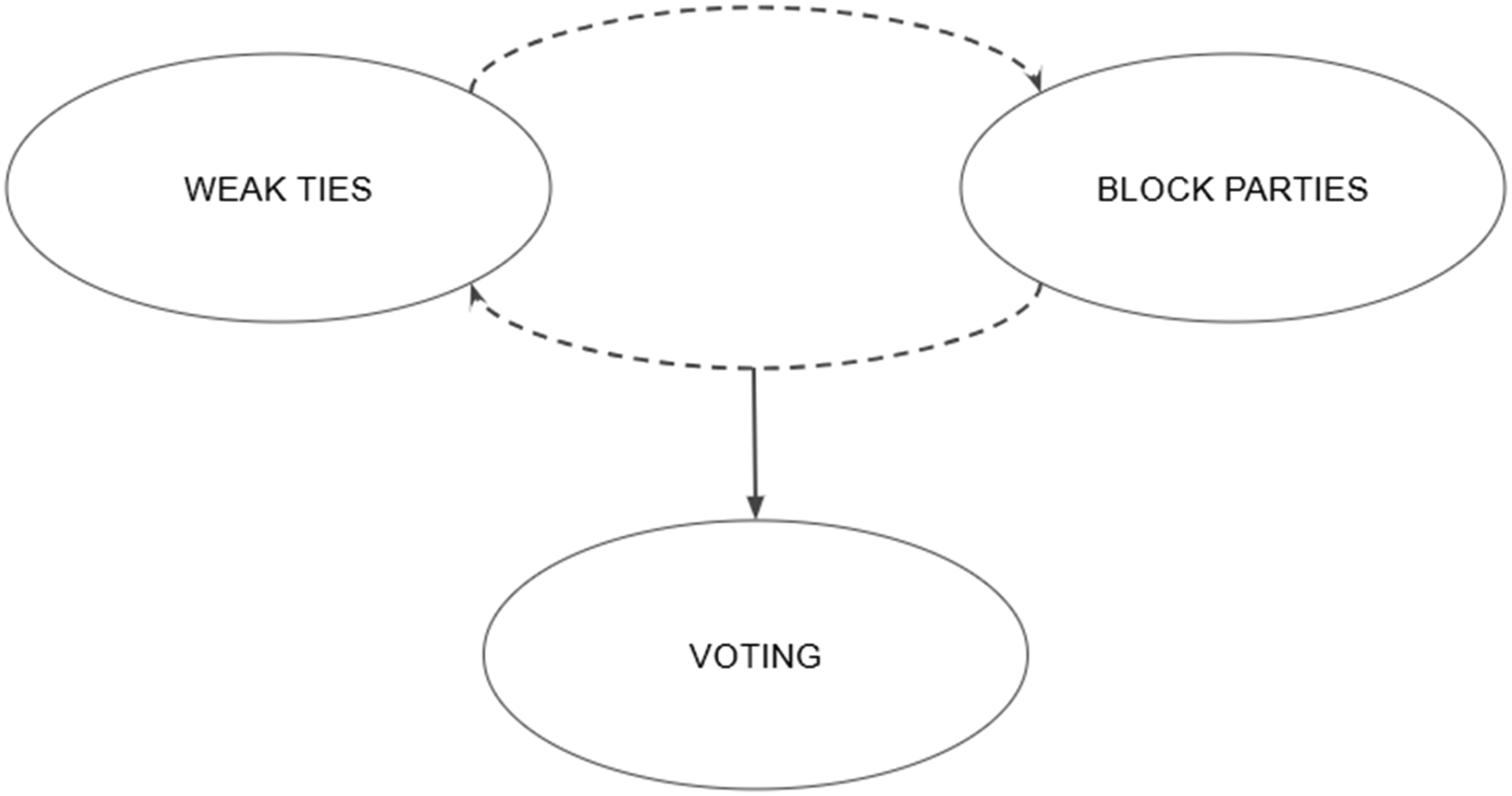
Relationship between weak social ties, block parties, and civic engagement.
By this account, weak social ties between neighbors exist to some degree on all streets across Philadelphia, regardless of whether block parties occur. These ties may be generated by a range of factors including population density, housing styles, length of residence, and neighborhood resources. For example, weak social ties may be fairly limited on streets with large apartment buildings with a lot of residential turn over, where neighbors may not have many chances to meet each other. In contrast, weak social ties may be more robust on streets where residents have settled for many years and some neighbors are friendly with each other.
Block parties may increase the strength and number of weak social ties between residents in both types of environments. In turn, once weak social ties are strengthened, block parties are more likely to occur. Both factors also increase the likelihood of civic engagement. This implies that weak social ties and the incidence of block parties reinforce each other in a “feedback loop” and that the effect of each dimension on voting cannot fully be disentangled from the other (Sampson 2012, 424). Drawing on these claims, the shared space and civic engagement hypothesis predict that living within a one-block radius of at least one block party in the year before an election increases the likelihood of voting in that election.
However, block parties may increase civic engagement more strongly in some communities than others. We consider the differential impact of block parties by neighborhood race and class. To that end, the racial mobilization hypothesis predicts that block parties will have larger effects on turnout in neighborhoods with many (vs. few) African American residents. This expectation draws on a historical of racial segregation in Philadelphia and a rich literature on civic resources within Black communities (Anderson 2011; Logan and Bellman 2016). We predict that the weak ties that block parties create are amplified by strong community institutions like churches, barbershops, and informal social networks which cultivate norms of civic engagement in African American neighborhoods (Calhoun-Brown 1996; Dawson 1994; Harris 1994; Harris-Perry 2004; McDaniel 2008; Tate 1991).
Turning to class-based differences, block parties could serve as important civic mobilizers in low socioeconomic status neighborhoods by strengthening community ties among residents who have limited access to civic resources and information from standard sources, including close friends, family, or the media (Verba, Schlozman and Brady 1995; Wolfinger and Rosenstone 1980). In such environments, weak social ties may be particularly important sources of political information. The political resources hypothesis predicts that the mobilizing effects of block parties are largest in low (vs. high) socioeconomic status neighborhoods, measured in terms of college education and median rent.
Data and Methods
We test these expectations using a unique dataset that merges geocoded voting data with city permits for neighborhood block parties. The bureaucratic data on block party permits was shared by Shrobona Karkun Sen and has been used public mapping projects and research about the impact of neighborhood events on crime (Geeting 2016; Sinchaisri and Jensen 2021). The base dataset represents a random sample of 99,371 individuals from 999,838 registered voters in Philadelphia in 2013. This sample represents approximately 10% of all registered voters in Philadelphia at the time. 6 Voter files were obtained from administrative records for Philadelphia County, which reflects the same geography as the City of Philadelphia. Each registered voter's home address was geocoded matched to a census tract. Less than 1% of observations were dropped due to an inability to geocode. We assume that these limited number of dropped observations are distributed randomly across tracts in the sample. The analytical sample of 99,371 registered voters live in 381 census tracts across Philadelphia. 7 We merge to the voter file data with aggregate measures drawn from the American Community Survey 8 (ACS) and block party permit data (US Census Bureau 2021).
We focus our analysis on the 2012 elections because they represent one of the few standard presidential election cycles in the period during which the block party data are available (2006–2016). The 2012 presidential election featured Obama, an incumbent, running for re-election against Romney, a mainstream challenger. Unlike the 2008 and 2016 cycles, there were limited turnout complications due to the distinctive dynamics of the election. Furthermore, although Obama was on the ballot in 2012, it was not a “hyper mobilized” election year in Philadelphia, a plurality Democratic and African American city. While many Philadelphia voters turned out to vote for Obama in record numbers in 2008, these patterns did not extend to the next election cycle (“As Far as Voter Turnout, 2012's Got Nothing on 2008.” WHYY 2012). Finally, Pennsylvania was not seen as a key battleground state in 2012 as it was in 2016 and 2020. Therefore, Philadelphia did not receive as much attention from political candidates as it did in subsequent years.
Variables
The variables used in the analysis are measured on the individual, census-tract, and city-block levels. The individual-level variables contained in the Philadelphia voter registration files include age, gender, and date last voted. 9 We expanded the base voter registration data in several ways. First, we determined whether every registered voter voted in the 2012 presidential election, a binary indicator. If this date matched the 2012 president election, we code an individual as having voted in 2012. If an individual voted in any of the “off-cycle” elections in 2013, we assume they also voted in the 2012 presidential election. All other respondents are coded as non-voters in 2012.
Second, we enrich the respondent-level data with census tract-level demographic and residential variables drawn from the ACS. The spatial variables are coded either as continuous measures or binary indicator variables, based on their distributions (Section 1 in the online supplemental materials). Tract-level measures with non-normal distributions were recoded into binary indicators. These binary cutoffs fall at the median of each continuous measure for the full sample of registered voters in Philadelphia. The remaining tract-level variables follow an approximately normal distribution and are coded as continuous measures. As a robustness check, we also estimate the main models with all controls coded as continuous measures (Table A10 in the online supplemental materials).
The tract-level variables include: the percentage of housing that is multi-unit (defined as greater than or equal to two units; binary cut-off: greater than 11%) as an indicator of the built environment; median gross rent (continuous, unit = $300), and the percentage of the population with a bachelor's degree (binary cut-off: greater than 16%) as measures of socioeconomic status; the percentage of the population living with related children as an indicator of household structure; population density (binary cut-off: greater than 19,167 persons per square mile) as an indicator of both the built environment and opportunities for engagement with neighborhoods; the percentage of the population that is African American (binary cut-off: greater than 32%) as a measure of racial demographics; and the percentage of the population that is foreign born (binary cut-off: greater than 8%) as another social indicator. See Section 1 in the online supplemental materials for further coding details.
Finally, we generated and merged several novel spatial variables into the respondent-level data. These include binary indicators for whether at least one party occurred on a respondent's block, which serves as the key independent variable and the intervention term in our quasi-experimental framework, and distance from the nearest polling place which serves as a control. The block party measure was coded as follows. First, the block party permit data were geocoded to the longitude/latitude location at the center of the block of the party's permit application. Next, a nearest-neighbor analysis was employed using the R package “nngeo” to determine whether a block party occurred within 152 m (approximately the distance of one city block) of the registered voter's home address in 2011, 2012, or in both years (Dorman 2020). This analysis takes as its inputs two spatial data frames, a and b, as well as researcher-defined search radius. This radius, defined as a Euclidean distance, is used to draw a search area around each observation i in data frame a, in this analysis, each voter's residential address. It also determines the presence of any observation j in data frame b, a block party in either or both years under analysis, within that radius. The presence/absence of an observation in the search radius is then coded as a binary indicator variable of presence/absence for each voter, as well as a continuous measure of the total number of parties on the search radius.
Three binary indicators for presence/absence of a block party in 2011, 2012, or both years within roughly a city block of a registered voter are utilized as described below. Going forward, we refer interchangeably to a block party happening “on” an individual's block or within roughly a block of an individual's address. We also use the terms “blocks” and “streets” to describe an individual's immediate neighborhood. Figure 2 illustrates how the block party measures are coded for two hypothetical registered voters. Person A lives within a 152-m radius of five unique block parties and person B lives within a 152-m radius of a single party in 2012. In the continuous measure, person A would be coded as living on a block with five parties and person B as living on a block with one party. In the binary measure, both would be coded as living on a block with at least one party in 2012.
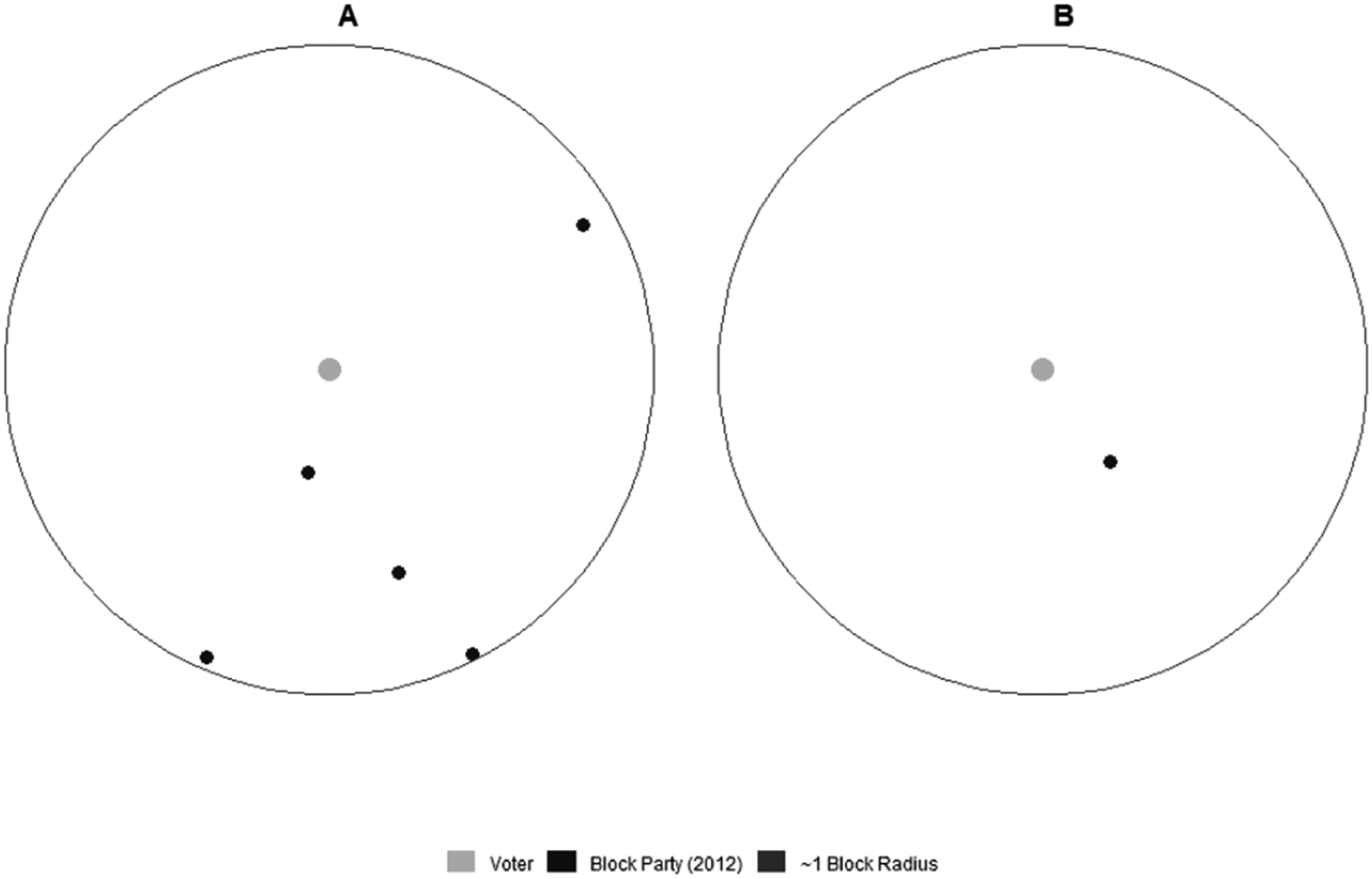
Spatial visualization of block party coding.
Empirical Strategy
We use hierarchical models to regress the indicator for an individual's turnout in the 2012 presidential election onto the indicator for at least one party on their block in 2012. We measure block parties and turnout in the same calendar year because we conceive of parties as events that lay the foundation for the development of weak social ties between neighbors. This builds on the work of Sinchaisri and Jensen (2021), who use block parties as measures of “community vibrancy,” and explore their relationship with local crime rates using regression models (2). Since most parties take place in the spring and summer, they may impact voting several months later during elections in November (Geeting 2016).
The model specifications incorporate the effects of higher-level geographies and respondent-level characteristics on respondent-level voting. We use hierarchical models, nesting individual registered voters into census tracts. The models include individual-level predictors, tract-level predictors, street-level indicators of block parties (matched to individuals), and random intercepts at the tract level. Since voting in the 2012 presidential election is a binary outcome, we use logistic regression. In the “naïve model,” we regress voting in the 2012 presidential election onto the binary block party indicator. The “individual-level model” adds controls for age and gender and the “full model” adds the census tract-level controls. We also conduct several tests leveraging over-time variation in the incidence of parties on an individual's block, along with additional analyses and robustness checks described in detail below.
Results
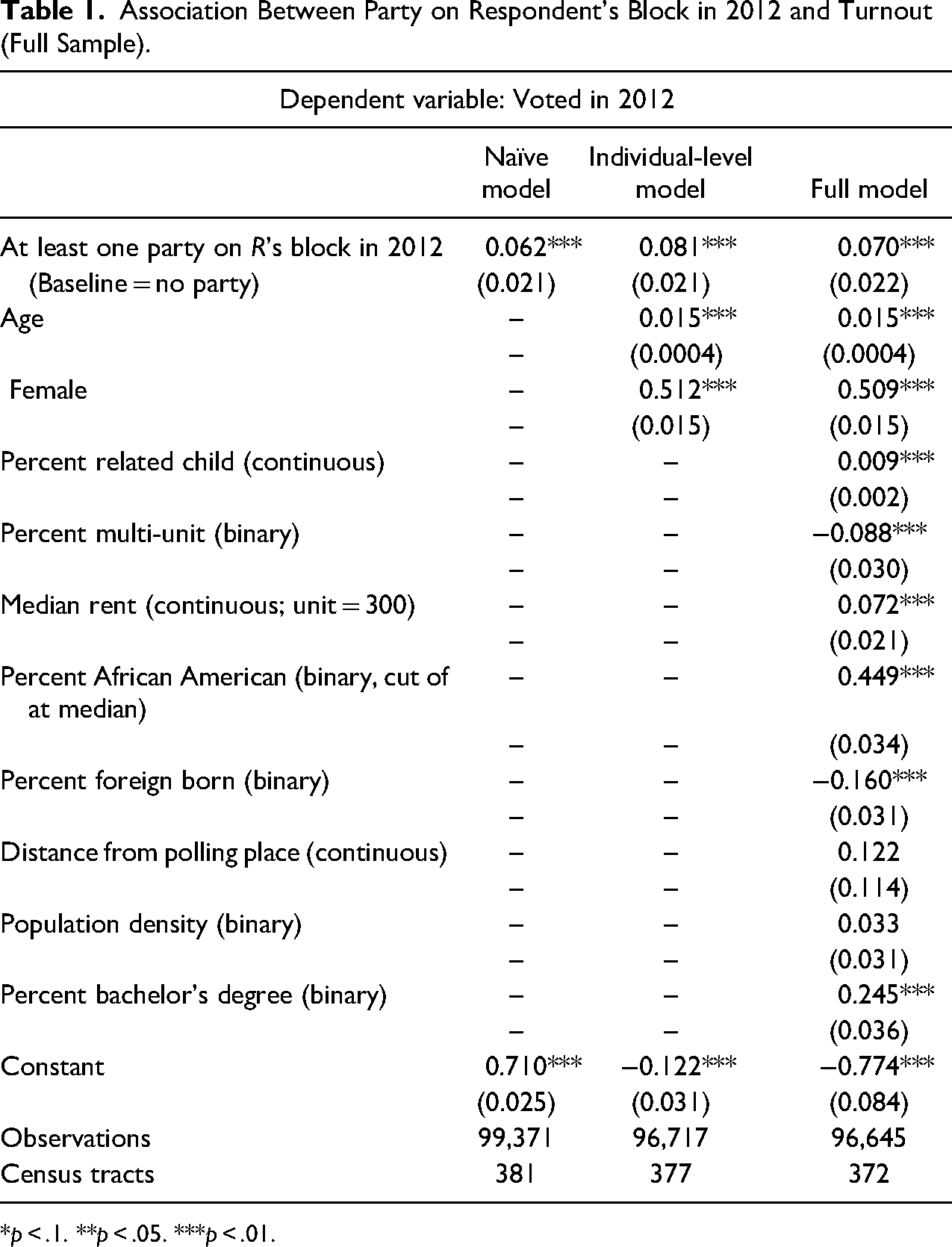
The results support the hypothesis that living on a block that hosts parties is associated with increased voter turnout. Figure 3 presents the association between parties on an individual's block and turnout as predicted probabilities of voting for the naïve, individual, and full models. The regression results are reported in Table 1 and as log odds ratios in Table A7 in the online supplemental materials.
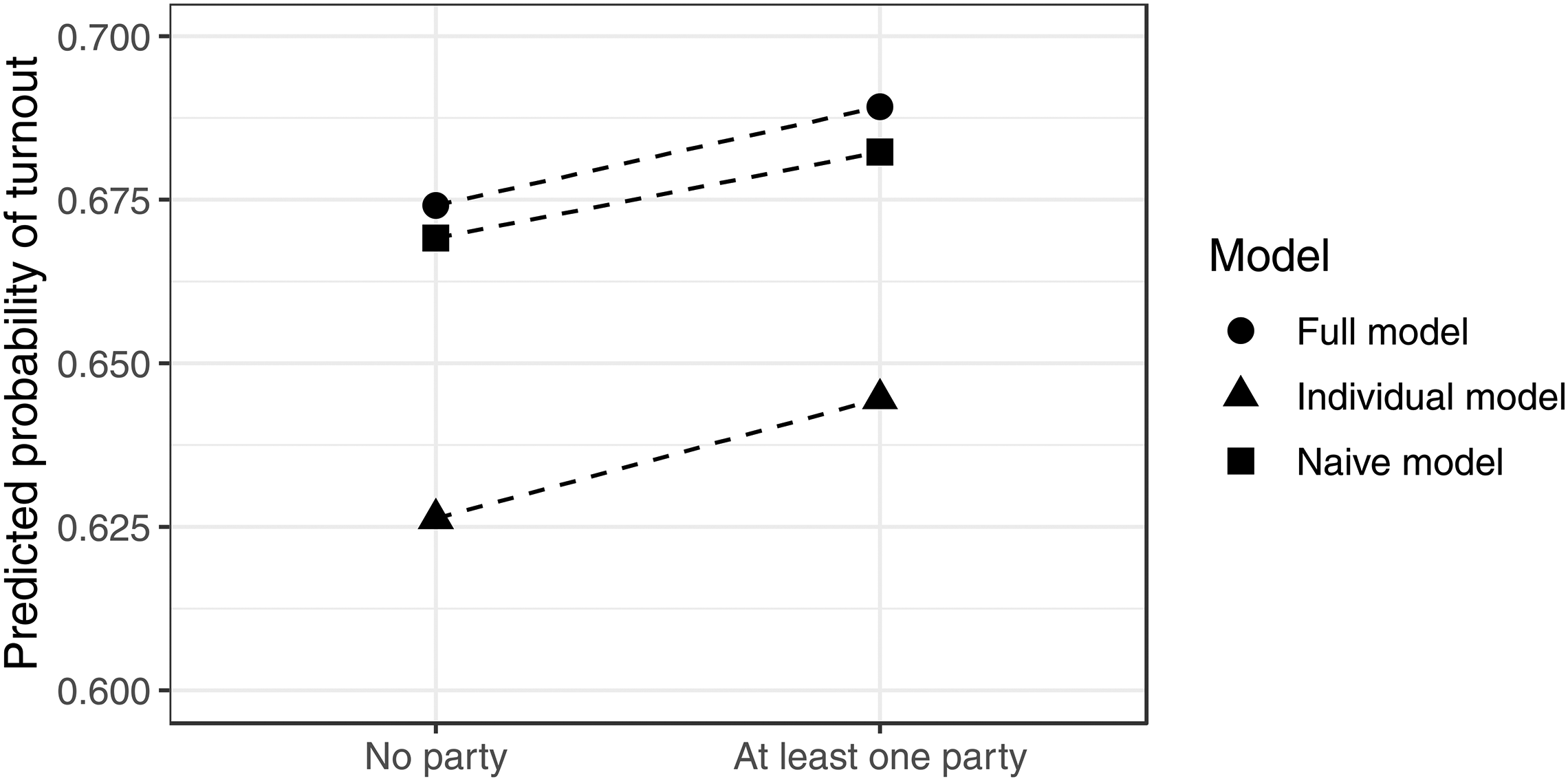
Predicted probability of turnout by parties on a respondent's block in 2012.
Association Between Party on Respondent's Block in 2012 and Turnout (Full Sample).
*p < .1. **p < .05. ***p < .01.
As the shared space and civic engagement hypothesis predicts, living on a block with at least one party in 2012 is positively associated with increased turnout, relative to living on a block with no parties, across the three models (Figure 3). The robust positive and statistically significant association between block parties and turnout holds at the p < 0.01 level after accounting for a range of individual- and tract-level controls, including age, gender, neighborhood racial composition, population density, and socioeconomic status (Table 1). In the naïve model, living on a block with at least one (vs. no) party boosts the probability of turnout by about 1.3 percentage points, from 66.9% to 68.2%. The magnitude of this effect increases with the addition of controls. In the individual model that accounts for age and gender, living on a block with at least one (vs. no) party boosts the probability of turnout by 1.9 percentage points, from 62.6% to 64.5%. Finally, living on a block with at least one (vs. no) party increases turnout by 1.5 percentage points, from 67.4% to 68.9%, in the full model that also accounts for tract-level characteristics. This association also holds in a model in with all controls coded as continuous measures (Table A10 in the online supplemental materials).
Although the association between parties and turnout is small, it is comparable to the effects of established predictors of turnout and larger than those of most voter mobilization interventions. For example, tract-level median rent, a standard contextual measure of socioeconomic status, has about a 1 percentage point association with turnout (Table 1, p < 0.01). Moreover, a meta-analysis of nearly 50 field experiments testing various “Get-out-the-vote” interventions estimates that the average effect of such mobilization efforts on turnout is essentially zero (Kalla and Broockman 2018). Even cost-intensive social incentives for voting, like “Election Day parties,” held outside polling places with free food and carnival festivities only increased voter turnout by about 3 points (Addonizio, Green and Glaser 2007). In comparison, block parties, events that are not explicitly political, may be an effective mobilization tool.
Over-time Variation in Block Parties and Turnout
Although the previous analysis shows a robust positive association between living on blocks with parties and voting, it is possible that this correlation is driven by factors other than weak social ties. For example, a correlation between block parties and voting may capture the possibility that civically engaged people simply live on more social blocks. While the reciprocal relationship between weak social ties and block parties implies that the two cannot be fully disentangled, if the result is driven by the fact that block parties are more likely to occur on blocks where residents are already civically engaged, then the incidence of block parties should not be associated with turnout rates from one year to the next. To address this concern, we conduct two quasi-experimental tests that leverage over-time variation in the incidence of parties on a respondent's block. These analyses offer evidence of whether weak social ties among residents of blocks are dynamic and shape civic engagement in different ways over time.
While this analysis falls short of causal identification, it offers an observational test of whether the association between block parties and turnout occurs in the predicted direction (i.e., the incidence of block parties leads to increased turnout and a decline in parties leads to decreased turnout). Research in urban geography leverages the timing of events to analyze a range of social outcomes using quasi-experimental methods (Heckert and Mennis 2012; Lee et al. 2022). Our study applies similar methods to voting, an important civic outcome shaped by space and place.
First, we focus on the subset of 26,951 registered voters who lived on blocks with no parties in 2011. Among this subset, we regress turnout in 2012 onto a binary “treatment” indicator for having at least one party on a respondent's block in 2012. We assume that assignment to treatment within the subset of respondents who had no party on their block in 2011 is as if random and uncorrelated with turnout. We expect that treated individuals (e.g., those who live in on streets with at least one block party in 2012) will turnout at higher rates than those who live on streets with no parties in 2012.
Second, we focus on the subset of 72,420 registered voters who lived on blocks with at least one party in 2011. Among this subset, we regress turnout in 2012 onto a binary “treatment” indicator for having no parties on a respondents block in 2012, following the same assumptions. In this case, we expect that treated respondents, who live on streets with no block parties in 2012, will turn out at lower rates than those who live on streets with at least one party in 2012. Table A4 in the online supplemental materials presents the sample sizes and turnout rates for each of these subsets and treated and controlled units within them, which are similar across both subsets (Table A4 in the online supplemental materials).
Next, Figures 4 and 5 evaluate the random assignment assumption, presenting the spatial distribution of treated and control individuals across the two quasi-experimental tests. Although treated and control units are distributed throughout the city, block parties are not spatially random (see Section 2 in the online supplemental materials). Some spatial clustering of block parties is to be expected, with fewer parties occurring in the suburban Far Northeast and Northwest quadrants of the city, and more occurring in the densely populated South, West, and North quadrants. Much of this pattern is likely due to built-environment typologies. For example, a suburban development pattern, featuring backyards and longer blocks, that is less conducive to closures, predominates in the Far Northeast. As another example, the Northwest parklands, which traditionally do no host block parties, take up large amounts of area.
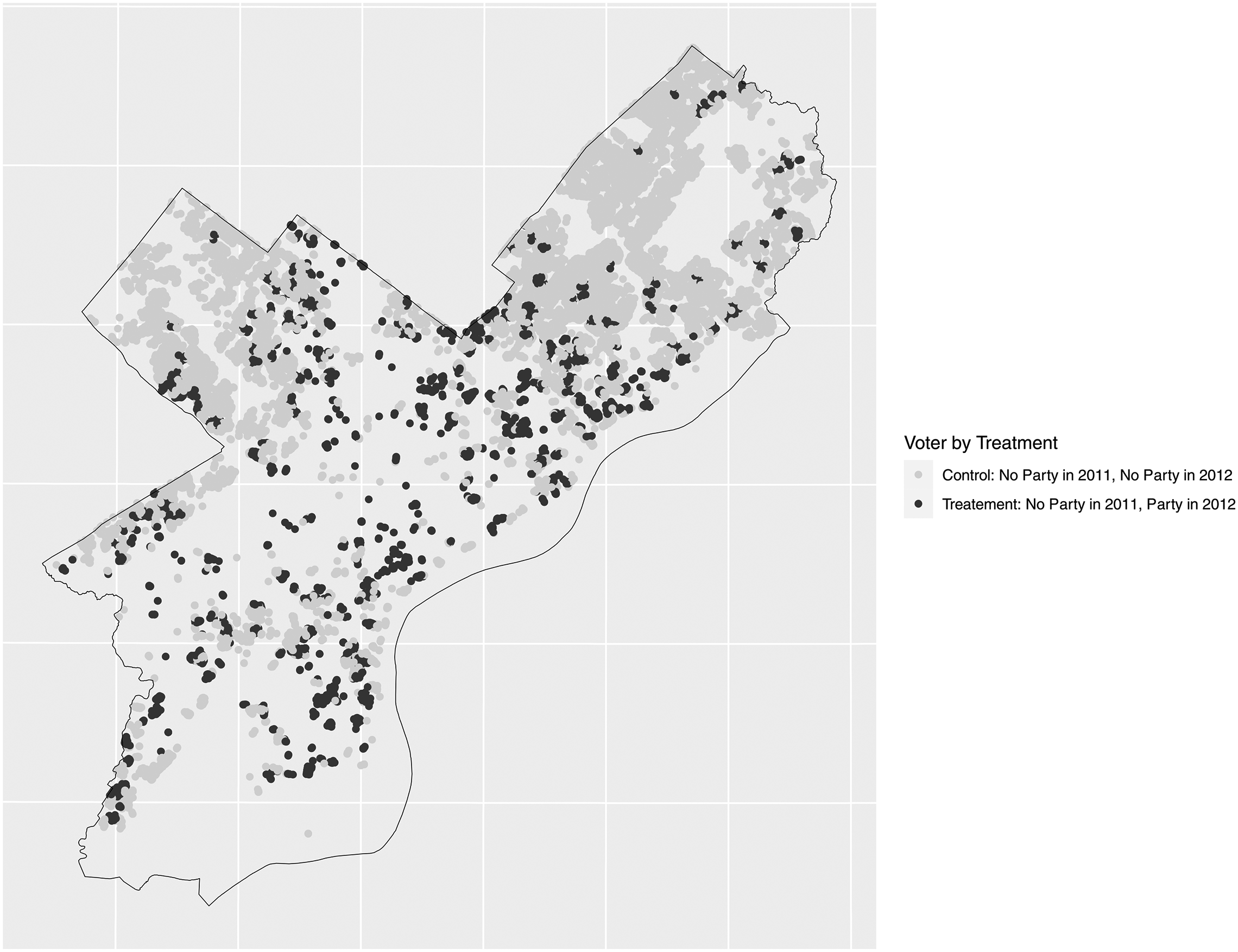
Distribution of voters without a block party within 152 m in 2011 by presence/absence of a block party within 152 m in 2012 (quasi-experimental test one).
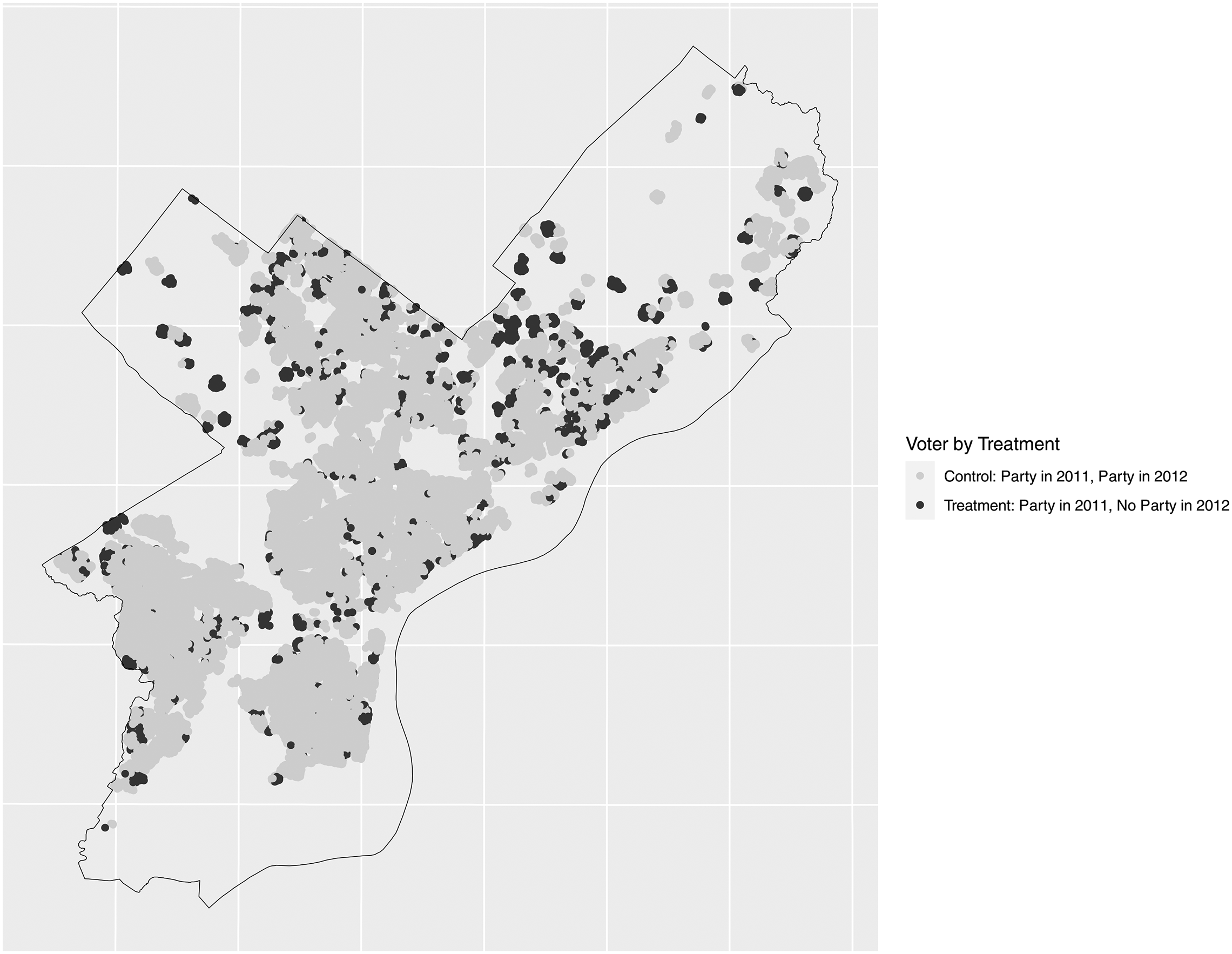
Distribution of voters with a block party within 152 m in 2011 by presence/absence of a block party within 152 m in 2012 (quasi-experimental test two).
Despite some spatial clustering of block parties, “treated” units are relatively evenly distributed, appearing in most areas where “control” units are present. We assume that assignment to treatment is “as if random,” and that the observed spatial clustering of parties is an artifact of population density or built environment typology. For example, in Figure 4, the cluster of control units in Northeast Philadelphia almost entirely occurs in areas with low population density and a suburban built environment. We also assume that tracts with higher population densities have dense built environments. In turn, this more compact built environment allows for more opportunities for block parties to happen (or to stop happening), within a block of respondents’ homes. We control for the non-random spatial distribution of parties by including tract-level population density along with other controls.
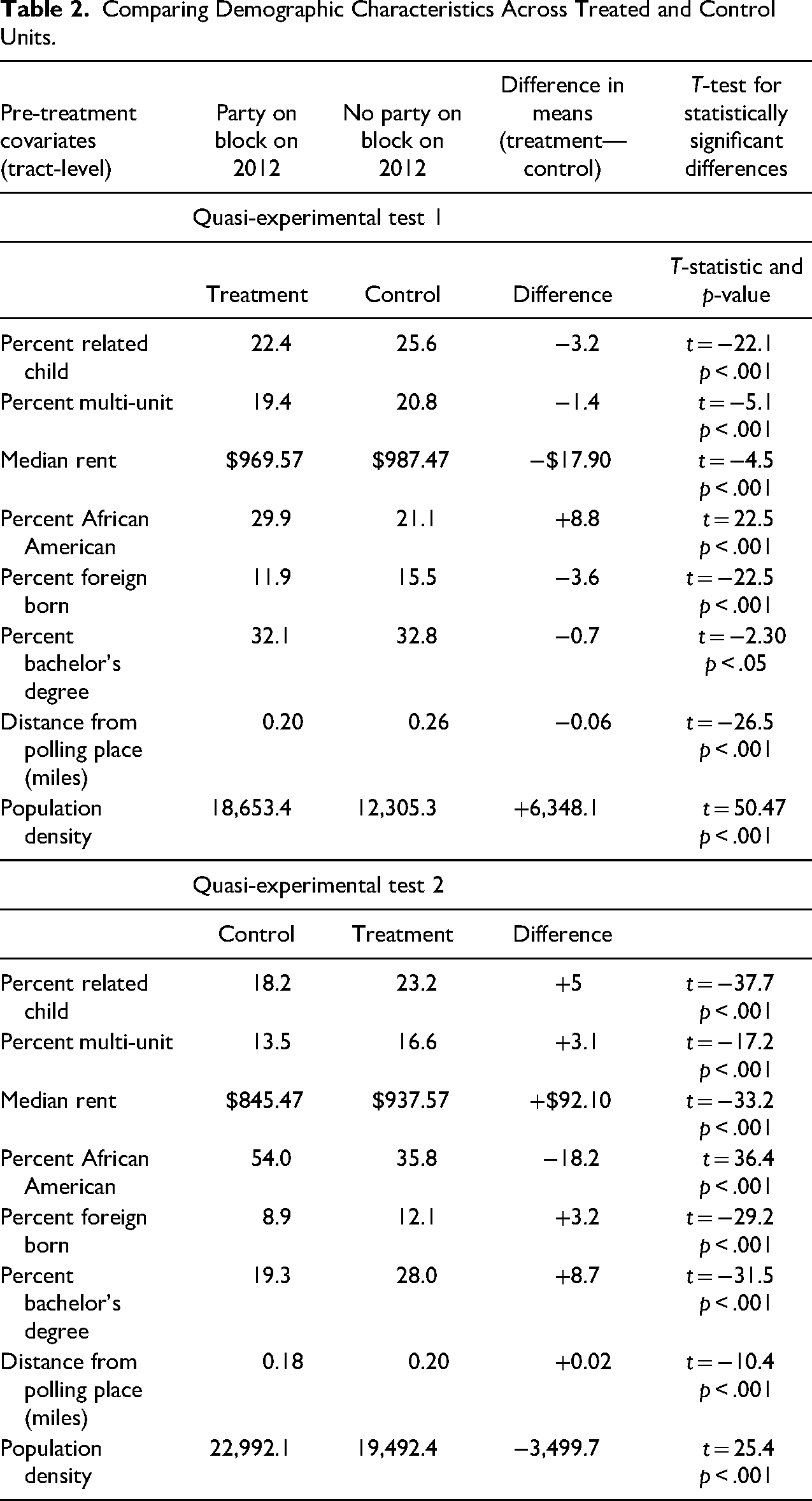
A major assumption underlying the natural experiment approach is that “treated” and “control” units are similar on observable pre-treatment characteristics. An analysis of tract-level characteristics reveals minor substantive differences between “treated” and “control” respondents that are statistically significant, suggesting that our data fall short of this assumption (Table 2). Although levels of pre-treatment characteristics differ across the treatment and control groups, these differences are small in magnitude. Moreover, the observed differences do not correspond to greater access to civic resources among respondents of blocks that hold parties, suggesting that assignment to “treatment” is not correlated with standard predictors of turnout in the expected direction. For example, tract-level socioeconomic resources and education levels were higher for individuals who lived on blocks without parties than those who lived on blocks with at least one party (Table 2). If blocks that hold parties are already more civically engaged, they should have higher levels of these resources, according to prior work (Rosenstone and Hansen 1993; Verba, Schlozman and Brady 1995).
Comparing Demographic Characteristics Across Treated and Control Units.
Although these tests fall short of the criteria for natural experiments, the results are useful for understanding the dynamic relationship between parties and turnout and offer a useful complement to the associational models. To account for observed differences across treated and controlled units, the full model controls for these tract-level demographic characteristics. Figure 6 presents the effects of parties on an individual's block on the predicted probability of turnout in 2012. The first panel displays the results of the first test, conducted on respondents living on a block with no parties in 2011. The second panel displays the results of the second test conducted on the subset living on a block with at least one party in 2011. Full regression results and odds ratios are included in Tables A5–A6 and A8–A9 in the online supplemental materials.
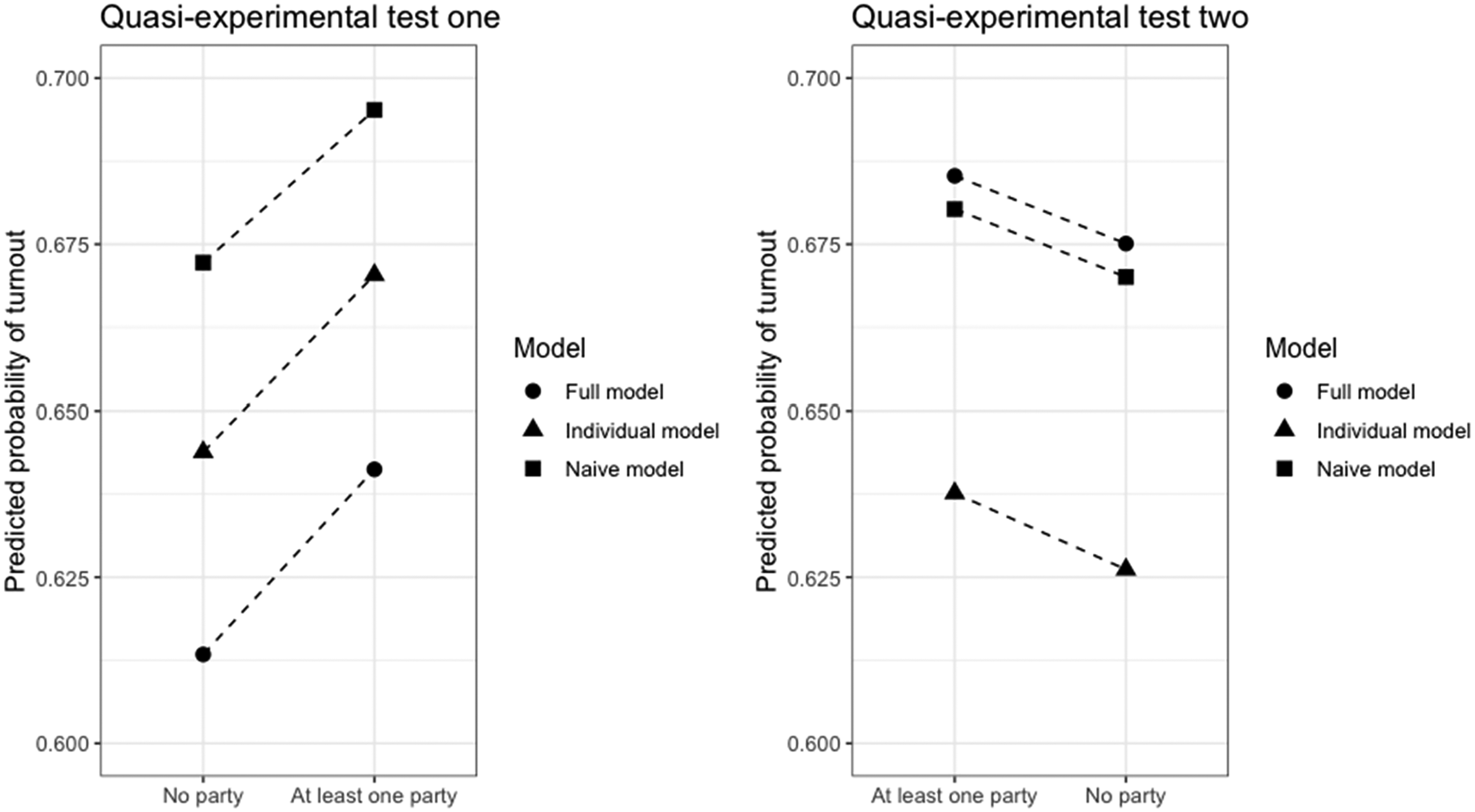
Effects of block parties on turnout in 2012 (quasi-experiments).
The results further support the shared space and civic engagement hypothesis. The first test offers evidence that living on blocks without parties in 2011 but at least one party in 2012 is associated with an increase in the likelihood of voting. Among this subset of registered voters, the baseline condition is no block parties in 2011, so having at least one party on their block in 2012 is a “treatment” that should be associated with increased voting. As Figure 6 shows, having at least one party on an individual's block in 2012 significantly increases their likelihood of voting across all three models (p < 0.01). Relative to no party, having at least one party in 2012 boosts turnout by 2.3 percentage points, from 67.2% to 69.5% in the naïve model. This effect increases to 2.6 points in the individual model, boosting turnout from 64.4% to 67%. The treatment effect is 2.8 percentage points in the full model, boosting turnout from 61.3% to 64.1%. These effects are statistically and substantively meaningful, comparable in magnitude to those of established contextual predictors of voting (Table A5 in the online supplemental materials).
The second test offers suggestive evidence that living on blocks which have at least one party in 2011 and no parties in 2012 reduces voting, but the results are statistically uncertain. Among this subset, the baseline is having at least one party in 2011, so having no party on their block in 2012 should be associated with decreased voting. As Figure 6 shows, having no party on an individual's block in 2012 decreases the likelihood of voting across all three models, although these effects are not statistically significant at the p < 0.05 level (Table A6 in the online supplemental materials). The lack of a significant demobilizing effect of unusually quiet years on blocks that had a party in 2011 suggests that the weak neighborhood ties developed through block parties may persist over the course of several years, even if occasional gatherings do not continue.
The Cumulative Effects of Block Parties: Evidence of Weak Ties
Next, we explore the possibility that block parties are indicators of deep social ties already in place in tightly knit neighborhoods rather than weak social ties, as our theory predicts. If block parties are indicators of deep (rather than weak) social ties, the total number of parties occurring each year should have a stronger association with turnout than the binary indicator for at least one party. To test this claim, we regress turnout onto the total number of parties within one block of an individual's address in 2012. The first model uses a continuous measure of the total number of parties within a 152-m radius of a respondent's address (Table A11 in the online supplemental materials). The second model uses an alternative measure, with multiple permits for the same block on sequential dates coded as a single party (Table A12 in the online supplemental materials).
Across all six models, the total number of parties on individuals’ blocks has a weaker association with turnout than the indicator for at least one party (Tables A11 and A12 in the online supplemental materials). Although the coefficient is positive and similar in magnitude across all six models, it is only statistically significant at p < 0.05 in models that control for age and gender. Relative to no parties, having nine parties on or around an individual's block in 2012 increases the predicted probability of turnout by about 1 percentage point in the individual model. 10 This suggests that a single party on a block that hosts parties infrequently is equally (if not more) mobilizing than multiple parties on close-knit blocks.
Testing the Racial Mobilization and Political Resources Hypotheses
Finally, it is possible that the mobilizing effects of block parties are conditioned by the racial and class composition of neighborhoods across Philadelphia (Anderson 2011; Hirsch [1983] 2021; Hyra 2017; Massey and Denton 1993; Trounstine 2018). Although race and class-based inequalities intersect with and compound each other in Philadelphia, we consider the role of block parties in shaping civic engagement separately in neighborhoods that have many African American and many low-socioeconomic status residents. Philadelphia voter registration records do not include information about individuals’ race or socioeconomic status, but we use neighborhood-level characteristics to test these expectations.
First, we test whether living in census tracts with a high percentage of African American residents moderates the association between block parties and turnout. African Americans, who make up a plurality of residents of Philadelphia, vote at relatively high rates despite systematic barriers to civic participation (Philpot, Shaw and McGowen 2009; Verba and Nie 1987; Walton 1985). One potential explanation drawn from a rich literature in political science is a strong civic culture built through local African American organizations, including churches, schools, community centers, barbershops, stores, and other institutions (Calhoun-Brown 1996; Harris 1994; Harris-Perry 2004; McDaniel 2008; Tate 1991; White and Laird 2020). The racial mobilization hypothesis predicts that the effects of block parties are particularly strong in predominantly African American neighborhoods, where the civic impact of neighborhood social ties developed at block parties may be amplified by the strong civic norms built through other community institutions.
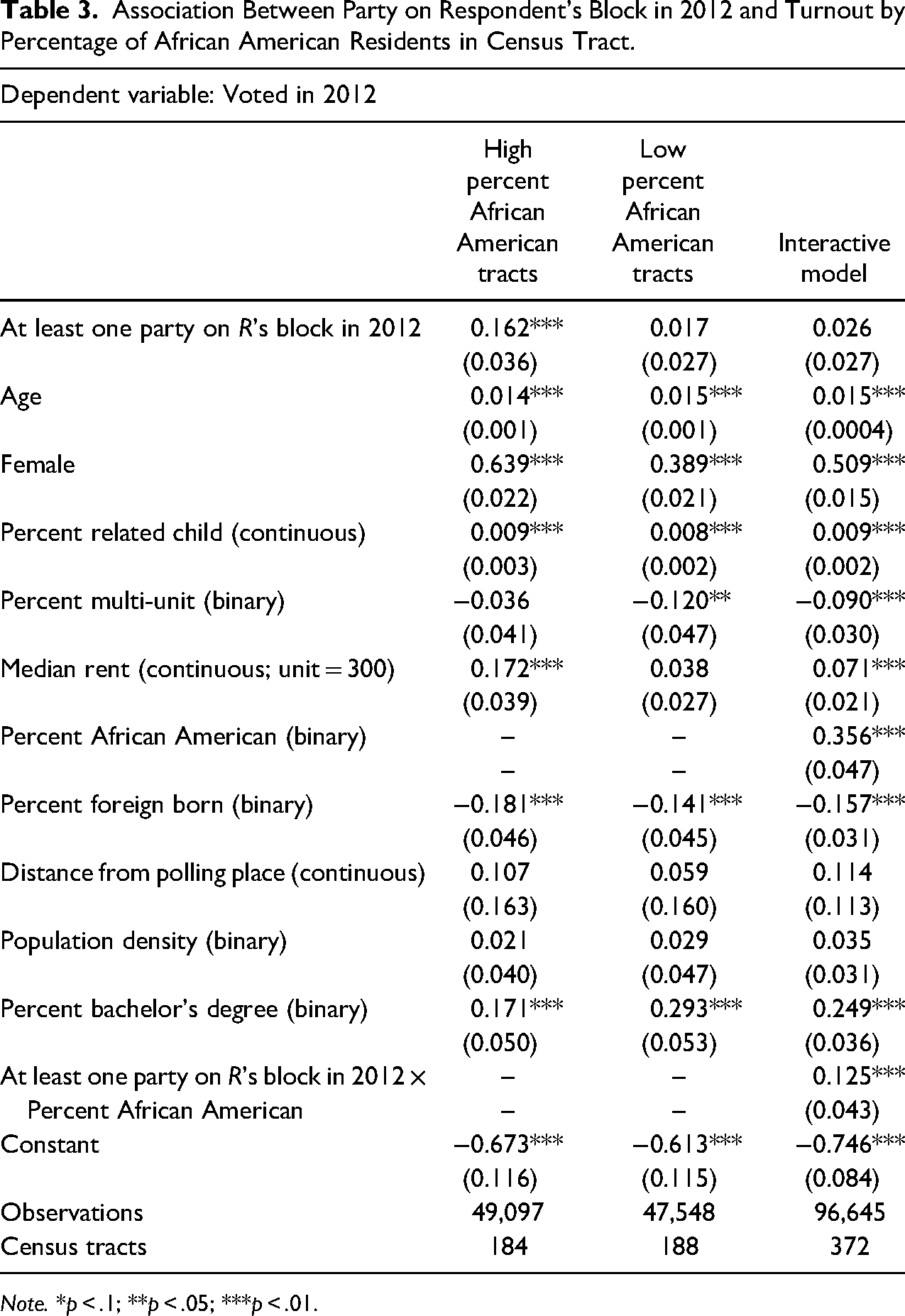
The percentage of African American residents is coded with a binary indicator, cut at 32%, approximately the median percentage of African American residents in a census tract for all registered voters in Philadelphia. We regress turnout onto living on a block with at least one party in 2012: separately for subsets of respondents who live in tracts with high and low percentages of African American residents and in a third model that interacts the indicator for block parties with an indicator for neighborhoods with a high percentage of African American residents (Table 3).
Association Between Party on Respondent's Block in 2012 and Turnout by Percentage of African American Residents in Census Tract.
Note. *p < .1; **p < .05; ***p < .01.
The results support the expectation that the mobilizing effects of block parties are strongest for those who live in neighborhoods with many African American residents. First, living on blocks with at least one party in 2012 has a large positive association with turnout among individuals who live in census tracts with a high percentage of African American residents (p < 0.01) (Table 3, column 1). In contrast, the association between block parties and turnout among those who live in tracts with a low percentage of African American residents is statistically indistinguishable from zero (Table 3, column 2). In the interactive model, the interaction term between the block party indicator and high percentage African American tract indicator is a large and statistically significant predictor of turnout (p < 0.01) (Table 3, column 3). 11 These results offer strong support for the racial mobilization hypothesis, indicating that block parties only have a meaningful relationship with turnout in neighborhoods where at least about a third of the residents are African American.
Next, we consider whether the civic impact of block parties also varies by neighborhood class status, as the political resources hypothesis predicts. If block parties increase the likelihood of information sharing, they may substitute for standard political resources like education, free time, and income, which lead to increased civic participation (Verba, Schlozman and Brady 1995; Wolfinger and Rosenstone 1980). If this is the case, block parties may also have a stronger mobilizing effect in tracts with lower (vs. higher) education and income levels.
To test this claim, we re-estimate the models separately for those who live in tracts with a low and high percentage of residents with at least a bachelor's degree and low and high median rent. The percentage of college-educated residents is coded with a binary indicator, cut at 16%, the median percentage for the full sample. Tract-level median rent is coded with a binary indicator, cut at $858, the median of average rent in a census tract for the full sample. We re-estimate separate models for each subgroup and a model with an interaction term between the subgroup indicator and the block party measure (Tables A14–A15 in the online supplemental materials).
The results offer mixed evidence of the political resources hypothesis, suggesting that the association between block parties and turnout is stronger in neighborhoods where fewer residents have access to standard educational and economic resources, but the differences are statistically uncertain. Block parties have a statistically significant mobilizing effect in tracts with a low percentage of college-educated residents and tracts with low median rent (p < 0.01) but no statistically significant effect on turnout in highly educated or high rent neighborhoods at the p < 0.05 level (Tables A14–15, columns 1–2 in the online supplemental materials). The interaction terms between the block party indicator and these socioeconomic measures are negative, although they do not reach the standard threshold for statistical significance (Tables A14–15, column 3 in the online supplemental materials).
Taken together, these results convey that both racial and class-based neighborhood dynamics may condition the association between block parties and civic engagement. However, the racial composition of neighborhoods is particularly powerful. What drives the mobilizing effect of block parties in neighborhoods with a high percentage of African American residents? One possibility, which we mentioned above is that the mobilizing impact of weak ties generated at block parties are heightened by African American community-building institutions. We propose two related mechanisms below, rooted in linked fate and political efficacy. Although we are unable to test these mechanisms directly with the data available, future work may explore these possibilities.
First, perhaps community-building events increase perceptions of commonality among neighbors in an era in which many people are disconnected from other community members. Research on race and politics suggest that the development of linked fate with other members of their racial group shapes the voting behavior of African Americans (Dawson 1994; McClain et al. 2009). Although linked fate is an established predictor of turnout and vote choice in the African American community, recent work suggests it may vary in strength over time and that in-person meetings with neighbors increase African American civic engagement (Shaw, Foster, and Combs 2019; Smith, Bunyasi and Smith 2019). If block parties increase linked fate with neighbors in African American neighborhoods through in-person contact and the development of weak ties, it may explain this large participatory boost.
Another possibility is that the process of gathering signatures from neighbors to obtain a block party permit creates a sense of political efficacy among residents who successfully procured a service from the local government. Research on political efficacy finds that it is associated with civic engagement (Almond and Verba 1963; Campbell et al. 1960; Verba and Nie 1987). This finding holds in the African American community, albeit with different conceptualizations of political efficacy at the racial group level (Leslie et al. 2023; Mangum 2003; Shingles 1981). This suggests that developing political efficacy through a community-building activity (e.g., securing a permit to hold a block party) may especially increase turnout among African Americans.
Conclusion
This research uses spatial data and analysis techniques to extend previous work on social ties and civic engagement. We show that one-off community events have the power to increase political participation. Using a dataset that merges bureaucratic block party permits and voter files, we find that interpersonal contact between neighborhood acquaintances at community events is politically consequential. Despite their one-off nature, block parties are gatherings where neighbors meet each other for the first time that are associated with increased voter turnout. This is direct observational evidence that the relationships people build with neighbors and acquaintances—no matter how weak or limited those relationships may be—have implications for civic engagement.
As the shared space and civic engagement hypothesis predicts, living on a block that held at least one party in the summer of 2012 is associated with an increased likelihood of voting in the election several months later. Though block parties are associated with a modest boost in turnout, it is comparable in magnitude to those of several established contextual predictors of voting, including neighborhood socioeconomic status. Perhaps more strikingly, the effect of block parties on turnout is larger than many GOTV voter mobilization interventions, which include door-to-door canvasing, mailers, and phone calls, suggesting that they are an effective mobilization tool, even though they are not explicitly political (Green and Gerber 2018; Kalla and Broockman 2018).
Two additional tests that leverage over-time variation in the occurrence of parties offer evidence that the association between block parties and turnout is temporally dynamic. Although these analyses are not causally identified, they offer further evidence of a directional effect. The first shows that the sudden incidence of a block party in places where they usually do not occur provides an even larger participatory boost than the original analysis uncovered. The second shows that the absence of a block party in places where they occurred previously may decrease turnout, although the effects are less statistically precise. The participatory boost that block parties offer residents can develop rather quickly in places where parties typically do not occur but an unusually quiet year on blocks where parties typically occur may not lead to a sudden decline in turnout. This suggests that the impact of weak social ties on civic engagement increases with the level of social engagement individuals have with their neighbors. However, once contact is initiated, it may be sustained through other interactions.
The mobilizing effects of block parties appear to reflect weak relationships built during occasional interactions rather than the strong bonds of close friends and family. The strongest evidence of this claim comes from an analysis of the cumulative number of block parties in an individual's neighborhood, which indicates that the mobilizing effects of parties are driven by their one-off nature rather than the living on tight-knit blocks that host multiple parties every year. Therefore, parties boost turnout through casual contact with strangers and acquaintances rather than existing social connections in tight-knit communities.
While block parties boost turnout in neighborhoods across the city, their strongest effects are in African American communities, which have strong local social institutions that facilitate civic engagement (Calhoun-Brown 1996; Harris-Perry 2004). As the racial mobilization hypothesis predicts, interpersonal contact may heighten the civic impact of community institutions in such neighborhoods. The fact that block parties most powerfully increase voter turnout among non-immigrant African American residents of Philadelphia conveys that the confluence of race, class, space, and community events have important implications for civic engagement in urban settings. It also contributes to a growing literature which suggests that social ties may play an important role in mobilizing ethno-racial minorities (Anoll 2022; White and Laird 2020). Future work may further explore how the racialization and class stratification of urban space shapes social contact and civic engagement in American cities, drawing on theories of community-building local institutions, linked fate, and political efficacy (Dawson 1994; Harris-Perry 2004; Leslie et al. 2023; Shaw, Foster, and Combs 2019).
While these results are informative, they leave open several questions for future work. First, the block party permit and voting data used in this analysis are restricted to 2011 and 2012. We expect that the results generalize beyond the two-year time frame, but further research is needed to confirm this expectation. Second, the analysis is limited to registered voters in Philadelphia. While we expect that one-off community events mobilize first time voters to register and participate in politics in other cities, we are unable to test these claims directly.
Perhaps most significantly, we are unable to directly test the individual-level mechanism driving the effects of block parties on civic engagement. Although we suspect that weak social ties aide in political information sharing, is possible that parties increase civic engagement through other means. Most notably, the weak social ties built at block parties may boost civic engagement through social pressure from neighbors to participate in politics (Gerber, Green and Larimer 2008, 2010; Rogers et al. 2017). Another possibility is that weak social ties increase civic participation by establishing social capital, especially among residents of diverse urban neighborhoods (Granovetter 1973; Putnam 2000). Future work should explore these possibilities, with a particular focus on identifying and testing mechanisms.
Looking to the future, the mobilizing role of block parties in Philadelphia may be at risk due to the legacy of COVID-19 and recent police involvement in the permit approval process. Social distancing during the COVID-19 pandemic limited interpersonal contact between neighborhood acquaintances. For example, Philadelphia did not issue block party permits in 2020, despite low caseloads during the summer. Moreover, block party permit application rates remained well below their pre-pandemic norms during the summer of 2021, after many residents were vaccinated (Marin 2021). According to Tiye Thompson, a block party organizer in South Philadelphia, the decline reflects a diminution of weak neighborhood ties. In a quote published in the Billy Penn Newsletter, she said, “The shores and beaches are packed like never before, but people have not gotten back into the socialization of their neighbors” (Marin 2021).
Another roadblock to the return of block party culture is that the police are increasingly denying permits for parties in North and West Philadelphia, citing concerns of “criminal activity,” even though block parties do not have a uniformly positive relationship with crime (D’Onofrio 2023; McLellan Ravitch 2022; Sinchaisri and Jensen 2021). These permit denials are particularly troubling because they are concentrated in predominantly African American neighborhoods, where block parties play a particularly important role in mobilizing voters. These factors are contributing to a decade-long decline in block parties held in Philadelphia. While nearly 6,000 parties were held in 2015, about 2,300 were held in the summer of 2022 (D’Onofrio 2023).
Weak social ties play a central role in the daily interactions of an individual's life, especially for people who live in urban settings. This research shows that these quotidian social events, which are not inherently political in nature, can have political consequences. Occasional interactions among neighbors, acquittances, and even strangers can leave a lasting political impression, comparable to that of expensive voter mobilization campaigns.
One-off community events, like block parties, offer a physical space for neighbors and community members to get together and make surface-level bonds. In turn, these bonds extend into the fabric of daily social life and can foster political activity. Future work may explore the civic implications of meetings in other public settings that may foster the development of weak social ties in urban environments, including recurring community events, regular organizational meetings, and informal “chance encounters” in varied local settings.
Supplemental Material
sj-docx-1-uar-10.1177_10780874241270041 - Supplemental material for Shared Space and Civic Engagement: Block Parties and Voter Turnout in Philadelphia
Supplemental material, sj-docx-1-uar-10.1177_10780874241270041 for Shared Space and Civic Engagement: Block Parties and Voter Turnout in Philadelphia by Tanika Raychaudhuri, Joshua H. Davidson and Michael Jones-Correa in Urban Affairs Review
Footnotes
Acknowledgements
We are grateful to Shrobona Karkun Sen for coding and sharing the block party permit data. We also thank Andrew Flores, Andrew Proctor, Amber Wichowsky, and research seminar participants at Princeton University and the University of Houston for their helpful feedback. A previous version of this manuscript was presented at the 2021 Annual Meeting of the American Political Science Association.
Data Accessibility Statement
A replication package which includes code, data files, and additional information to reproduce analyses presented in the paper and Appendix in the online supplemental materials is available through the Dataverse Project repository: 
Declaration of Conflicting Interests
The authors declared no potential conflicts of interest with respect to the research, authorship, and/or publication of this article.
Funding
The authors received no financial support for the research, authorship, and/or publication of this article.
Supplemental Material
Supplemental material for this article is available online.
Notes
Author Biographies
References
Supplementary Material
Please find the following supplemental material available below.
For Open Access articles published under a Creative Commons License, all supplemental material carries the same license as the article it is associated with.
For non-Open Access articles published, all supplemental material carries a non-exclusive license, and permission requests for re-use of supplemental material or any part of supplemental material shall be sent directly to the copyright owner as specified in the copyright notice associated with the article.
