



Abstract
Research on council estate regeneration in London has revealed predominantly negative outcomes, including direct and indirect displacements, the loss of homes and communities, and the slow-violence enacted on residents by lengthy programs. Drawing on recent EU-funded research on Woodberry Down (Hackney), we highlight similar negative effects, alongside some positive, ambiguous, and novel outcomes. We discuss these mixed findings within two emerging trends: a new turn to criticizing “antigentrification” work on estate regeneration; and a housing policy turn back to promoting council homes and the refurbishment of council estates. We conclude that it is premature to evict “antigentrification” perspectives in the longue durée of estate regeneration in London, even in the case of Woodberry Down, which has had some significant community won victories. We also reveal new complicating factors in this “gentrification story”—“Guppies” and precarious private renters who are not the wealthy, professional gentrifiers of earlier new-build gentrification literatures.
Introduction
In 2018 one of Europe's largest estate regeneration projects, the redevelopment of the Woodberry Down council estate 1 in Hackney, inner London, was named “London Project of the Year.” It was praised for “not only regenerating the local area but also building a genuine community, actively welcoming new residents and involving local people.” The Chair of the judging panel said: “The team behind Woodberry Down should be incredibly proud of successfully taking on the regeneration of the local area with integrity and a genuine desire to improve not just the physical environment, but also residents’ economic aspirations and social wellbeing.” 2 In regeneration circles it was/is touted as a regeneration success story but in academic accounts Woodberry Down has been seen as another example of the problematic state-led gentrification of council estates in London, even if these scholars note some important wins by the residents’ association (see Lewis 2017; Nelson and Lewis 2021; Watt 2021). Our own research has found many of the same negative impacts as the latter who researched on Woodberry Down before and at times parallel to us, and as the other, now substantial literature (which we discuss later) on estate regeneration across London has outlined. Yet we also found many positives—the previous wins that the Woodberry Down community fought for have been expanded on, the redevelopment is being more favorably embraced by longstanding and newer residents, and there are some new and more ambiguous outcomes. So what are we to make of this?
The sociologist, Paul Watt (2021, 8), has recently criticized what he calls an “antigentrification” perspective in academic writing on estate regeneration in London: According to this perspective, estates are being destroyed by the onward predatory—indeed planetary—march of gentrification in the ideological guise of “regeneration”.
Drawing on recent research undertaken during COVID and post-COVID, we present an up-to-date account of the redevelopment of Woodberry Down, discussing some newer and more ambiguous outcomes. In what follows: we situate the case of Woodberry Down through a review of the previous academic literature on the redevelopment of council estates in the United Kingdom, especially in London where it has occurred much more aggressively. We discuss why, and how, we undertook our research in/on Woodberry Down, before turning to the estate itself, the redevelopment and our research findings. In our conclusion, we discuss the complexities and ambiguities identified in the context of a seeming policy turn back to promoting council housing in London and refurbishment over redevelopment.
The Housing Policy Turn Away From Council Housing
The housing policy turn away from state investment in council housing in the United Kingdom and its ensuing privatization was the result of a political shift that started with the British Prime Minister Margaret Thatcher's “Right to Buy” legislation (see Hodkinson and Essen 2015; Hodkinson and Robbins 2013). It continued under subsequent governments, including under New Labour, up until around 2020/2021 (for exhaustive reviews see Lees and White 2020; Watt 2021), when evidence began to emerge of a turn back to promoting the retention and building of new council homes, especially in London.
Thatcher's 1980 Housing Act gave all council tenants the right to buy their council homes, and saw the council housing system begin to implode (see Malpass 2005). Between 1980 and 2022 2,003,239 council homes were sold through right to buy in England, 4 around 300,000 of these in London. Subsequently the 1986 Housing and Planning Act gave councils the option of transferring all or part of their council housing to another landlord (known as stock transfer), such as a registered social landlord (see Forrest and Murie 1988; Cole and Furbey 1994). Starved of other funds the “stock transfer” of council estates to registered social landlords, typically housing associations, became one of the primary ways to upgrade and (re)invest in British council housing (Howell 2007). In many cases, private capital was brought in by means of public–private partnerships between local councils and developers (Brown and Yates 2012).
The launch in 1994 of the Single Regeneration Budget (SRB) which aimed to enhance the quality of life of local people in deprived neighborhoods across the United Kingdom gave councils the option to bid for funding to kick-start demolition of the most “deprived” council estates and replace them with mixed-income communities (Tunstall 2011). Woodberry Down received SRB funding for the early phases of its redevelopment. These new demolitions were accelerated by the New Labour government's 2001 Green Paper which introduced the Decent Homes mandate, ensuring a minimum set of livability standards for council housing. New Labour then announced its Mixed Communities Initiative in 2005, billed as a comprehensive approach to reducing concentrations of poverty in disadvantaged areas in England by engineering the social mixing of deprived communities (see Lupton and Tunstall 2010), 5 as we discuss later Woodberry Down became an MCI site.
The austerity adopted after the 2007/2008 global financial crisis further weakened the budgetary capacities of local governments to keep to the Decent Homes mandate or repair, reinvest in, or regenerate their council housing. The 2010–2015 Coalition (Conservative/Liberal Democrat) Government then proceeded on the path to radical reform of public housing by making more budget cuts (from £8.4 billion to £4.5 billion) (Lees and White 2020). And the trend toward the demolition of council estates was further strengthened with the passage of the Housing and Planning Act of 2016, when a £140 million fund was set up to enable the demolition and redevelopment of over 100 so-called “sink estates.”
More recently, project-based self-financing models (Thompson and Hepburn 2022) have proliferated, whereby the land is sold or leased to a private developer and the regeneration of the estate made possible by demolishing the original blocks, building a new, denser development with market rate units used to cross-subsidize the production of new social/affordable housing, deliver new community services, and fund critical infrastructure improvements.
In practice, over four decades, different UK governments proactively laid the foundations for the rise of a “financialised municipal entrepreneurialism,” in which local government became the “active executor of financialisation” (Beswick and Penny 2018; see also Beswick et al. 2016; Purcell and Ward 2022). Within this framework, as Thompson and Hepburn argue (2022), “the state is incentivised to deliver its statutory obligations and strategic objectives in creating public benefits by extracting value from urban development through maximising yields (…) and raising profitability—all of which, ironically and paradoxically, works against the public interest, by for instance squeezing out on-site provision of affordable housing.” We turn now to the research and evidence on the impacts of estate regeneration in London.
Research on Council Estate Regeneration in London
There has been a plethora of research on the lived experience of the redevelopment of council estates in C21st London. To date the bulk of this research has found overwhelmingly negative impacts for longstanding, low-income, sometimes predominantly minority, council estate communities. As the turn to wholesale council estate demolition and redevelopment was emerging, Brown and Lees (2009) discussed the case of the King's Cross Ten Estates in Islington where stock transfer from council to housing association (the Peabody Trust) ownership and a £15.2 million regeneration program, a mix of refurbishment and new-build development, was marred by problematic resident engagement and participation; they found that even though residents were not displaced, new forms of sociospatial exclusion (indirect or phenomenological displacement) emerged. That same year, Watt (2009) used the term “state-led gentrification” (on “state-led gentrification” see Lees, Slater and Wyly 2008, 220) to refer to the wholesale and piecemeal displacement of council estate communities that came with council housing stock transfers in London.
As Lees and White (2020, 59) note, “London was already ahead of the sink estate strategy, as the Mayor of London's (2014) Housing Strategy called for the ‘vast development potential in London's existing affordable housing estates’ to be unlocked through private redevelopment.” New Labour Prime Minister Tony Blair announced the 2005 Mixed Communities Initiative mentioned earlier on the largest social housing estate in Europe, the Aylesbury Estate in Southwark. Lees (2014) criticized the policy as “state-led gentrification” undertaken through the guise of mixed communities policy, she showed how tenant support for the regeneration of the Aylesbury was manipulated and misrepresented and how choices were closed down for them, leaving them ultimately with a “false choice” between a regeneration they did not want or the further decline of their estate. Belotti (2016) was one of the first to research the benefits and costs of demolition versus refurbishment, she was critical of the wholesale demolition on an unnamed London council estate that has massively disrupted people's lives and awarded inadequate compensation to leaseholders.
Subsequently research on estate regeneration really took off, this included two significant pieces of research on estates across London that happened in parallel. The two projects were: a 3 year research project funded by ESRC and co-produced between academics, the London Tenants Federation and Just Space (see London Tenants Federation et al., 2021) which was published on an open access (now archived) website: Estatewatch.London, and the research brought together in Paul Watt's (2021) recent book. Both bodies of research concluded that the estate redevelopments they studied came at a high social cost for longstanding residents, unleashing waves of direct, and indirect displacements of council tenants, leaseholders, and private tenants, disrupting communities, families, and individual lives.
The ESRC research was published in a series of journal articles and academic book chapters and was presented as evidence at the second Aylesbury Public Inquiry (Hubbard and Lees 2018; Lees and Hubbard 2020a). It included a live database of council estates under threat co-produced with council tenants, a number of factsheets, handouts and guides co-produced with the London Tenants Federation and Just Space. The research provided empirical evidence that added to and improved theorizations of displacement, including: conceptualizing “survivability” as a form of resistance and consideration of the experiences of “un-homing” that continue afterward (Lees and Robinson 2021); understanding displacement for minority residents in relation to histories of racial discrimination, the destruction of ethnocultural infrastructures, and longstanding racialized inequalities (Lees and Hubbard 2022); a view well beyond the point of displacement of immigrant residents’ experiences of displacement from their country of birth and the pain of a “double displacement” from a council estate (Estatewatch.London); consideration of the emotional and psychic impacts of displacement and their relation to preexisting health inequalities (Lees and Hubbard 2020b); how the “Right to Buy” promises of homeownership were reneged on and destroyed when leaseholders were displaced by compulsory purchase orders in estate redevelopment (Elliott-Cooper, Hubbard and Lees 2020); and the complexities of “accumulative dispossession” in the intersection of estate redevelopment, welfare reforms, poverty, and the precarity of low-income work (Lees and White 2020).
Watt's (2021) book included a detailed policy analysis which examined the rise and fall of public housing and the emergence of estate regeneration policy; an analysis of a number of estates before regeneration, looking at their marginalization and inclusion, their role as valued and devalued places; and study of the regeneration process itself moving from degeneration to displacement by regeneration, and resistance to this. Together these two bodies of research, undertaken pre-COVID, provide substantive evidence on residents’ lived experiences of a number of estate regeneration programs across London and suggest that the outcomes have been predominantly negative. They echo other work on municipal dispossession in London which sees it as a form of “relational disarticulation” played out through three interconnected processes of disowning, disavowal, and differential disposability (Ferreri 2020). Indeed, Watt's (2023) recent work talks about the reality of regeneration for residents as involving multiple layers of physical, social, symbolic, and psychosocial “degeneration.”
But in the face of this now significant body of research the case of Woodberry Down seems more complex, it demonstrates all the negatives but also some positives and some more ambiguous findings. The analytical contribution of this article is to think through how critical urban scholars might balance these complex findings in answering the question: Is Woodberry Down an example of “successful regeneration” or is it yet another example of “state-led gentrification”? Does it stand with or against the hegemonic narrative of estate regeneration in London as having overwhelmingly negative impacts on residents and communities?
Situating Our Research in/on Woodberry Down
As we have discussed in-depth research on the redevelopment of council estates in London has been on-going in the 2000s. So why did we do research on Woodberry Down? Two reasons: (i) the research presented in this article is from an EU funded 6 project which looks at the social impacts of green/sustainability plans on low-income neighborhoods in major European and US cities. The project was comparative—Berlin, London, and Boston—and the cases all had to fit the remit of that comparison. The bid to the EU for funding pre-dated much of the other published research undertaken on Woodberry Down (e.g., Lewis 2017; Nelson and Lewis 2021; Watt 2021) but by the time we received the funding that other work had begun; nevertheless (ii) this was fortuitous in terms of giving us access to research on earlier moments in the redevelopment and in providing other academic research for us to compare (if not necessarily ground truth) our own findings with.
The research we undertook on Woodberry Down, which took place 2020–2022 with some additional updating research 2023–2024, includes quantitative and qualitative content analysis of the master plans and relevant policy documents from Hackney Council and the development partners; plus publicly accessible commercial reports, videos and websites, and social media pages created by the residents and/or other nonprofit institutions operating in the case study area. Qualitative content analysis looks for latent meanings that can change the course of research—this was important in that we wanted to begin the research with an open mind as to the impacts of this regeneration scheme (see Sheydayi and Dadashpoor 2023, who describe the procedures we undertook). We also undertook 24 (formal) in-depth semistructured interviews with residents (10 council tenants in the old blocks, six new housing association tenants, two temporary tenants, two leaseholders, and four new private homeowners) in which we asked them about their lived experience of the regeneration to date, and what they thought the positives and negatives had been; and five interviews with key stakeholders, including the ex-Chair of the residents association. In addition, we undertook participant observation during numerous visits by us both to the estate over a period of 2 years, attended community meetings, and talked at length with Nelson and Lewis (2021) about their research on the estate (including not wanting to tread on their toes, over exhaust residents, etc.). In our participant observation we also undertook 18 (informal) conversation style interviews with old and new residents walking in and around the original estate and the redeveloped homes.
In what follows we do not shy away from the complexity and ambiguity of our findings, rather we use them to question the antigentrification stance that Watt (2021) has criticized.
Woodberry Down: History and Redevelopment
Officially opened in 1949 Woodberry Down was completed in 1962 and consisted of 57 five-to-eight storey blocks containing 2,013 dwellings on 64 acres of land (see Figures 1 and 2). The estate is bounded by the New River on its north, east, and south sides; and Seven Sisters Road cuts from east to west across the estate, creating two geographical cores—the north/west core adjacent to Finsbury Park, and the southern core facing two large water reservoirs built in 1833. It was heralded as “the estate of the future” by the press at the time (The Star, November 17, 1953), and was a showcase of the post-war Keynesian welfare state vision—with an NHS health center, a primary school, a comprehensive secondary school, a public library, a senior center, and a parade of shops.
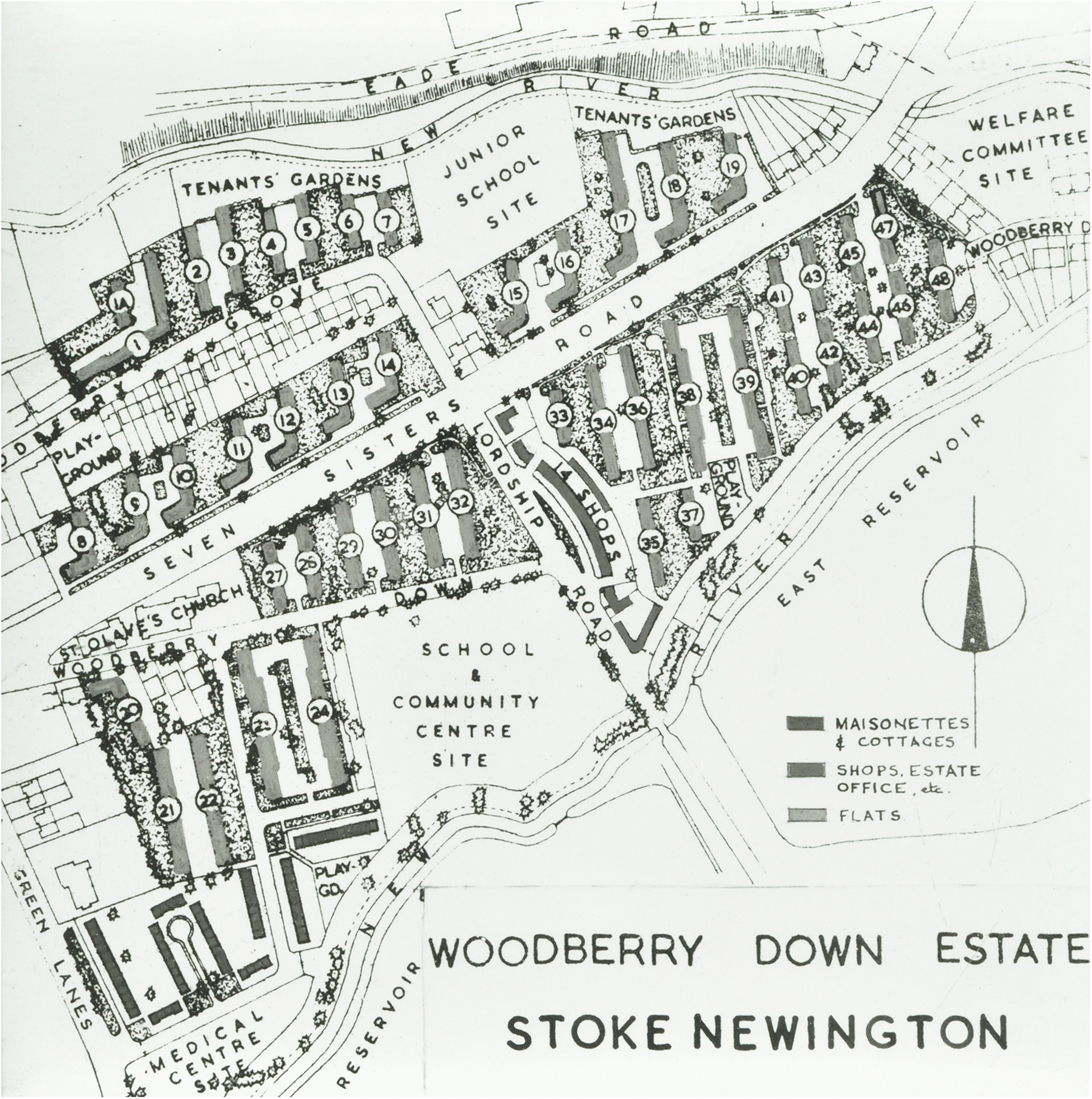
Woodberry Down Estate, image © London Metropolitan Archives (City of London).
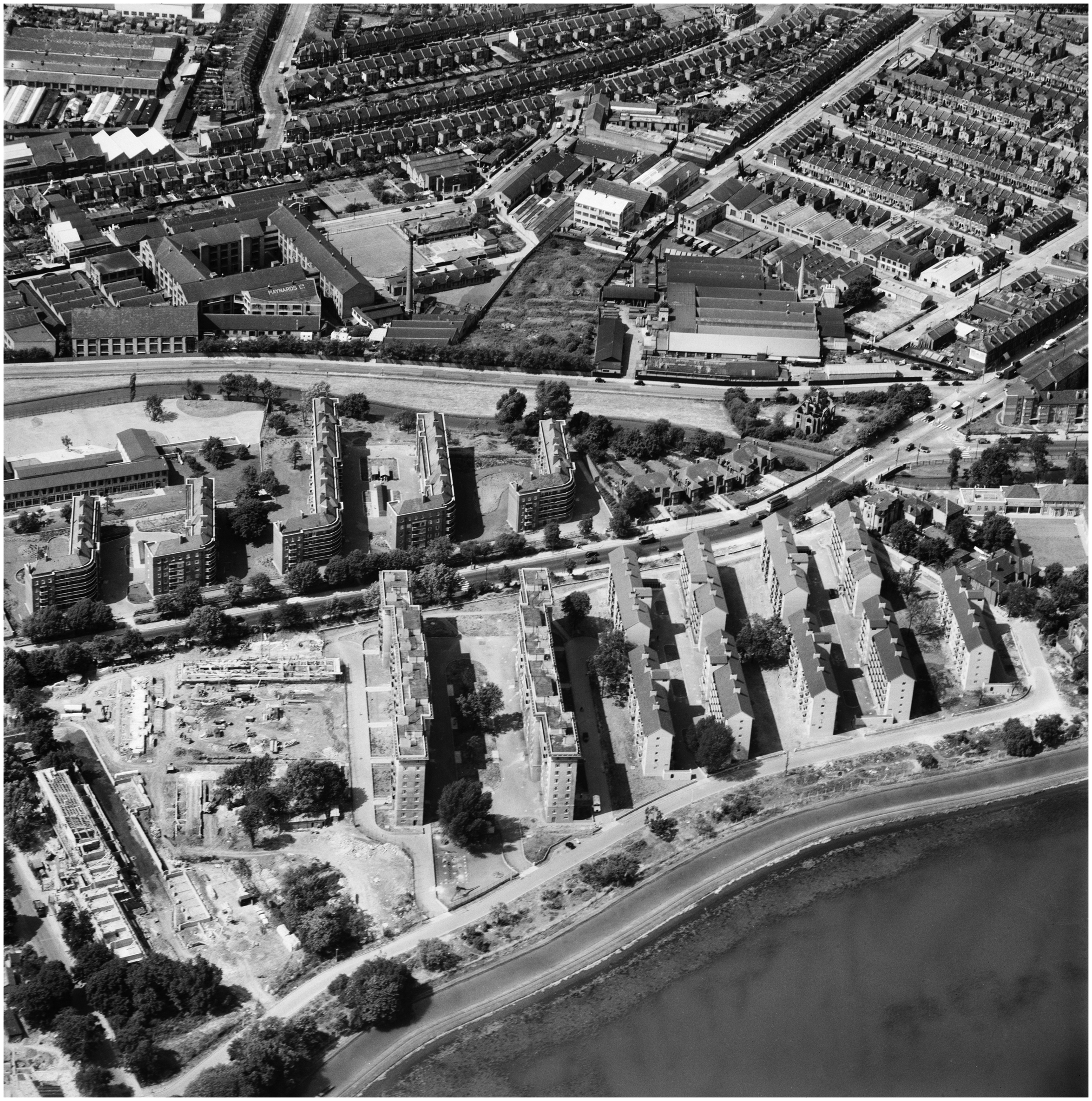
The Woodberry Down Estate between New River and East Reservoir, Stamford Hill, 1952. EAW044315—Source Historic England Archive.
But by the late 1980s, the estate had fallen into a state of neglect, and residents started leaving. Flats were boarded up to deter squatters, unemployment was high and drug-related crimes gave Woodberry Down a notorious reputation. But this was a “managed decline,” as one long-term council tenant said to us: … the reason why they’re in an unlawful state is because the local authority has not upkept them…they’ve…let them run down and then turn around and say ‘the area is a slum because the blocks are no good’.
Despite this, the estate was able to preserve strong community bonds and resident involvement remained high, in fact in the early 2000s there were about nine tenants and residents’ associations on Woodberry Down (Hudson-Smith et al. 2002).
In 2001, Woodberry Down was awarded £25 million to kick-start demolition through the SRB. In response to New Labour's Decent Homes mandate, Hackney Council ordered a structural assessment which concluded that many of the housing blocks were in an advanced state of disrepair and refurbishment was not feasible (Nelson and Lewis 2021). In 2005 the estate was recognized by the government as a National Demonstration Project for the MCI, an Area Action Plan was prepared which confirmed the demolition of most blocks. The planning application approved in 2009 ensured the provision of 4,684 new housing units (59% private market, 31% social rent, and 10% shared ownership).
Hackney Council was about to transfer all the housing stock to a Housing Association when the funding was pulled by the Government's Homes and Communities Agency due to budget pressures in the wake of the global financial crisis. Consequently, a private finance initiative was devised, and the Council agreed to transfer the land on a 299 year lease, on an incremental plot-by-plot basis, to private development company Berkeley Group, which would demolish the housing blocks and develop new homes over time. The public–private partnership with Berkeley would allow the project to be “self-financing,” as the redevelopment of the existing 1,980 homes then owned by the Council would be cross-subsidized by the construction of over 2,700 extra homes to be sold on the private market. In 2010, a £1 billion, 20-year Principal Development Agreement between Hackney Council, the developer Berkeley, and the Housing Association Notting Hill Genesis was signed that set out what was to be delivered, and the respective roles of the partners. Critically, the partnership also included the residents’ organization Woodberry Down Community Organization (WDCO) and the Manor House Development Trust (today known as London Trust) as a self-financing social service provider.
In 2010, Hackney Council received £6.26 million in Homes and Communities Agency funding to build 87 new units for social rent as part of phase 1 (Hackney News 2010). The 2014 Section 106 Agreement stated that the share of affordable housing would be 36% in phase 2, 41% in phases 3, 4, and 5, and higher than 41% in phases 6, 7, and 8 “to compensate for a lower level of delivery on phases 1 and 2, and ensure that the scheme as a whole delivers 40.8% affordable housing” (Hackney Council Planning Sub-Committee 2014). However, the tenure split for social housing to be produced in phases 6, 7, and 8 was to be determined by a viability assessment to be submitted by Berkeley as phases progress (Greater London Authority 2014) (see Figure 3).
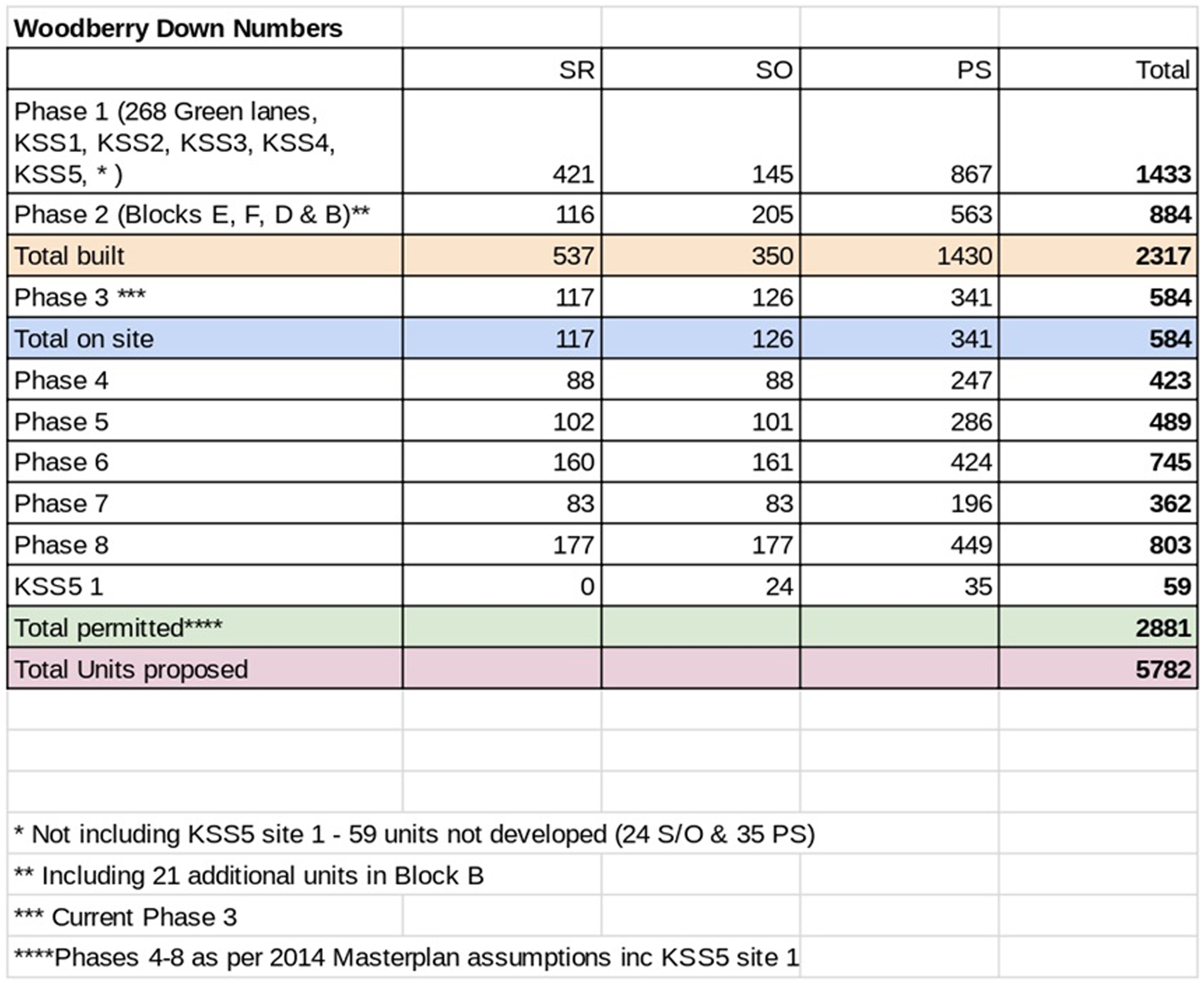
Breakdown of units for social rent (SR), shared ownership (SO), and private sale (PS) by phase (Hackney Council, February 14, 2023).
Importantly, as a result of the agency of WDCO, the new master plan incorporated commitments to a stronger tenure mix and other provisions such as including more units of social housing with views of the reservoirs (interview, former WDCO Chair 2021). Thanks to the phasing plan, there will also be no decanting in the future phases of development: each completed phase will house people from the demolition of the following phase.
In 2020, Hackney Council's Planning Committee approved phase 3, which is currently under construction. Phase 3 will deliver 584 units, of which 341 will be market rate and 243 will be “affordable” (117 social rent units and 126 shared ownership and shared equity units). Consultations for phase 4 were held in 2021 and 2022, and concerns were expressed both regarding the density and height of the new blocks and the loss of social homes. 7 In late 2023, consultation with residents was held around an updated Masterplan which will cover phases 5 to 8 which is to be submitted in 2024. The results of the consultation expressed growing concerns for the increased density, the growing burdens on the existing infrastructure, the overall loss of social homes and the lack of family-sized flats in shared ownership. Concerns were also expressed about the design of elevated podiums which would compromise the original open character of Woodberry Down. 8
At the end of the first two phases of redevelopment, 537 council tenant households had been relocated into new social housing units. The older housing blocks north of Seven Sisters Road were home to another 900 households, half were council tenants and leaseholders waiting to be re-housed in the new properties, the other half were temporary tenants provisionally housed by Hackney Council but who had no right to the new housing within the development scheme: as of 2022, there were 322 secure council tenancies at Woodberry Down still waiting to be re-housed, around 416 nonsecure temporary tenants and 157 leaseholders (Hackney Cabinet Meeting 2022a). According to the latest figures provided by the Council in 2023, all remaining Woodberry Down secure tenants will be re-housed by the completion of phase 5. Once they have re-housed all the existing social tenants, any future social rent accommodation will be offered to those on the council housing waiting list who have the highest priority.
What is clear is that the number of social rent homes to be delivered at Woodberry Down will be prone to fluctuations over the years (the project is now set to be completed by 2040) depending on many different variables. These will include political savvy (the ability of the Council and WDCO to negotiate with Berkeley on the delivery of sufficient units to allow for the relocation of all the residual council tenants during the next phases of redevelopment), future market trends including ongoing inflationary pressures, increases in energy prices and in costs of construction materials, and, crucially, Berkeley being able to maintain its profit margin.
As a result of the on-going redevelopment, Woodberry Down today is a “hybrid” neighborhood (Watt 2021). Private properties in the new buildings range from £590,000 (average) for a 1-bed flat up to £1,475,000 for a 3-bed flat in the Skyline Tower overlooking the reservoir. The stark contrast between the rough solidity of the old council blocks (Figure 4) and the shiny cladding of the new towers (Figure 5) serves as a reminder of the glaring social differences in this still deprived, yet now seemingly gentrified neighborhood. The 2019 Index of Multiple Deprivation showed that Woodberry Down was still one of the 10% most deprived neighborhoods in England (ONS 2023). And population data shows the polarization between the new owners and private renters in the new-build development and those still living in the original council estate: 16% work in high or intermediate managerial or administrative or professional positions while 37% are unskilled manual workers, casual or lowest grade workers, pensioners and other households who depend on social benefits; 29% are educated to degree level or above, while 26% have no educational or professional qualifications. Nevertheless, Woodberry Down remains ethnically mixed, it is 35% Black/Black British, 25% White/White British, 21% Turkish, and 8% Asian/Asian British (Hackney Cabinet Meeting 2022b). With redevelopment on-going, poorer and more affluent populations now live side by side, and as the neighborhood changes, it is losing a large part of its social history.
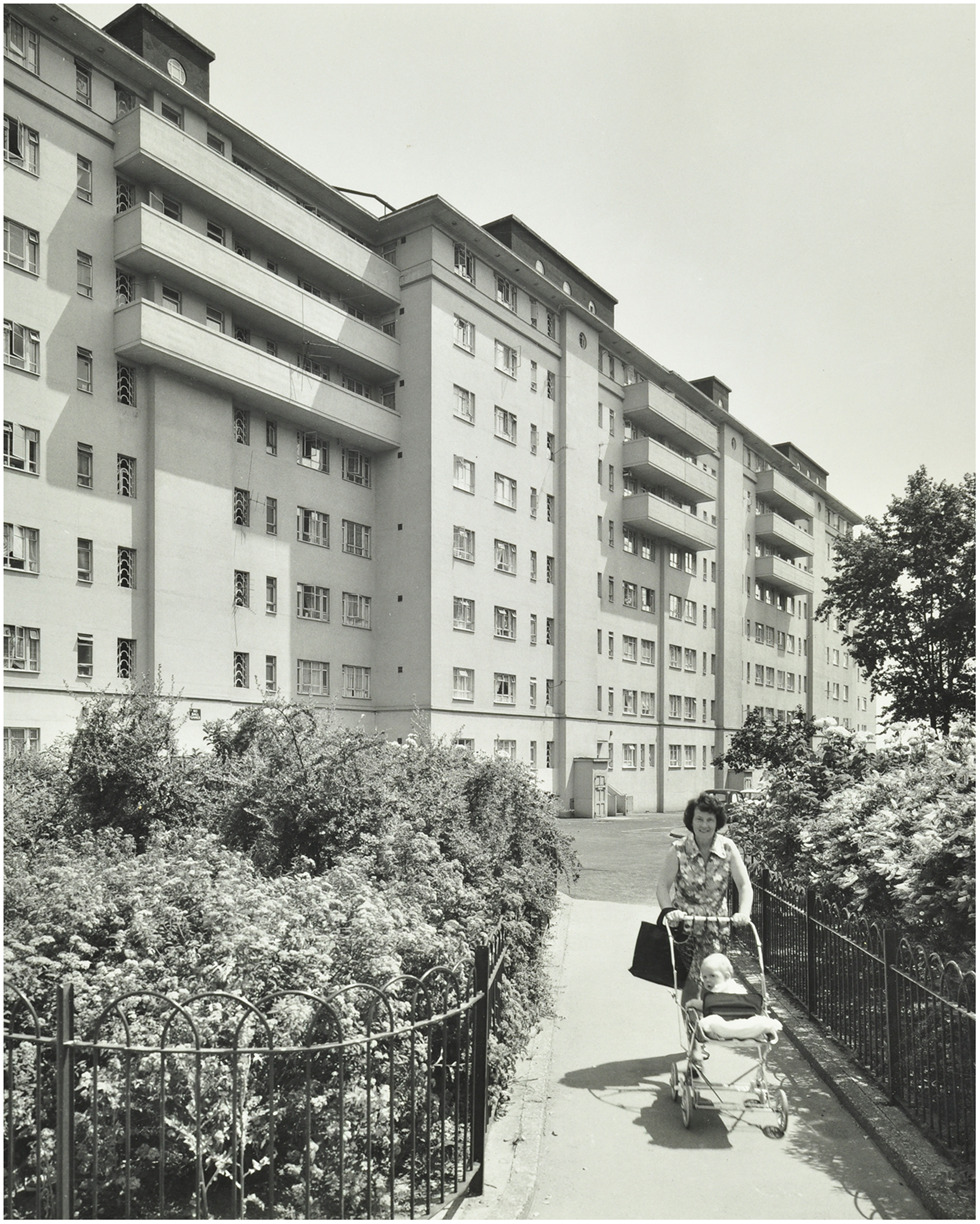
Woodberry Down (1973), image © London Metropolitan Archives (City of London).
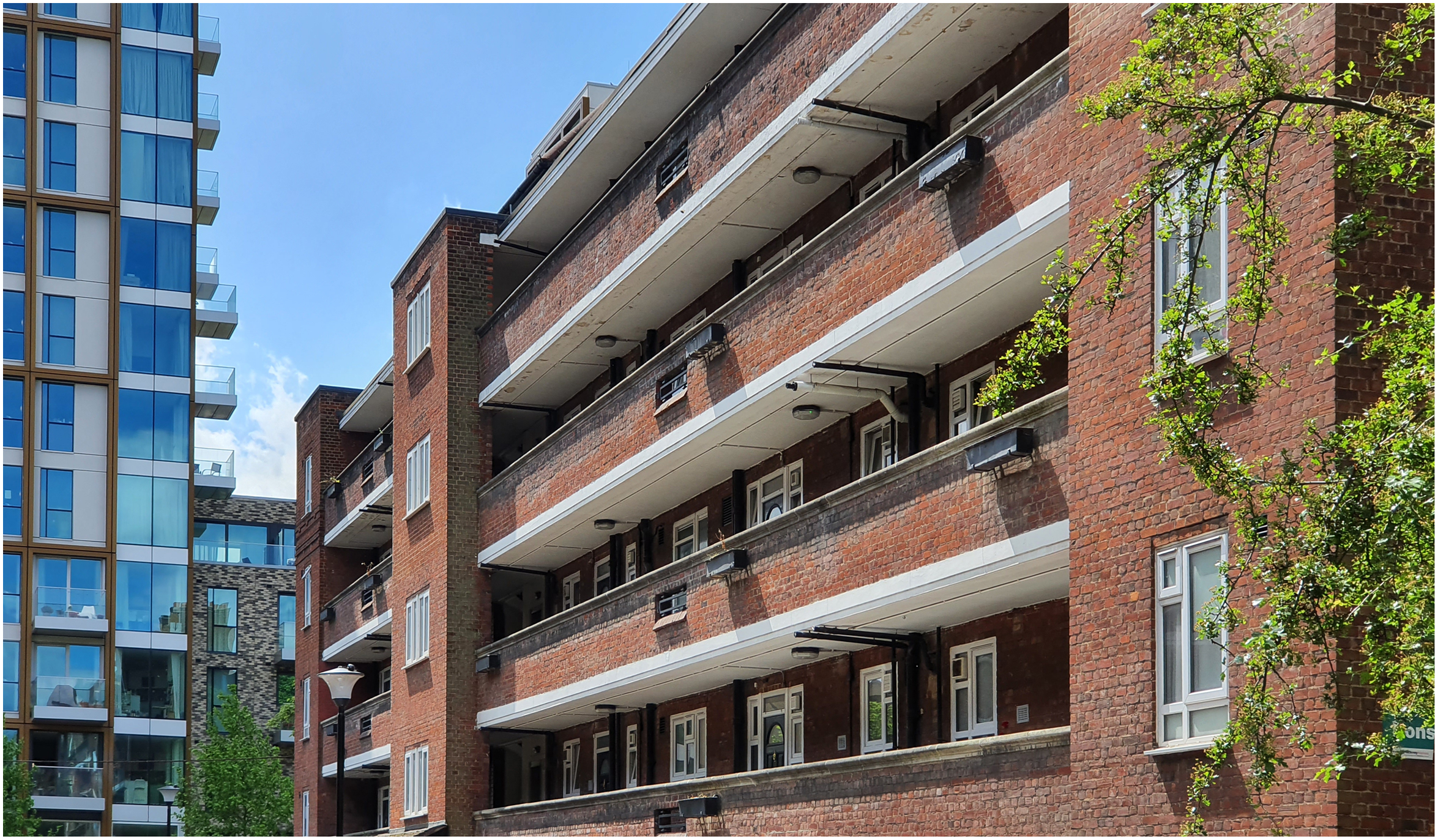
Contrast between old and new architectures at Woodberry Down in 2022, image © Alessandro Busà.
Estate Regeneration Outcomes on Woodberry Down to Date
In what follows we briefly outline the negative outcomes that tally with other research on estate redevelopment in London, then we focus on outcomes in Woodberry Down that eschew what Watt (2021) calls the “antigentrification stance,” before discussing other more ambiguous, but nevertheless significant findings.
Displacement, Slow Violence, Social Tectonics
There has certainly been a loss of council homes. In 2009, before redevelopment started, there were 2,013 housing units at Woodberry Down: 1,458 council rent, 522 leasehold, and 33 private properties (Greater London Authority 2009). On completion of the redevelopment there will be enough units to relocate all the existing remaining secure council housing tenants by the end of phase 5, however, there will be a net loss of around 190 units for social rent as compared to pre-regeneration numbers. And the new social rent homes are not council homes: housing association rents are similar but higher, and the securities ensconced in council tenures have been lost (see Lees and White 2020).
Research into the impact of estate regeneration in London has shown that leaseholders are more likely to be displaced from the immediate area than council tenants, and that they get displaced much further away (see London Tenants Federation et al. 2014). This has been the case for Woodberry Down too. With the compensation received for their leasehold properties, few were/are able to afford the shared ownership options presented in the new development or other similar regeneration schemes in Hackney. Leaseholders who had become outright homeowners through “Right to Buy” now faced the prospect of paying exorbitant rents or mortgages to be able to afford new shared-ownership units in the new development. To date the average compensations offered to leaseholders in Woodberry Down have covered less than a 30% ownership stake in a newly built unit of comparable size (an old two-bedroom council flat would be compensated with about £220,000, while an equivalent in the new development would be about £700,000). One resident interviewee said to us: I remember one lady… she moved somewhere in East Anglia, that is where she felt she could afford something.
Echoing what happened on the ex-Heygate Estate in Southwark, by 2017, 55% of the new market units in phase 1 had been purchased by overseas investors, mostly buyers from South East Asia (Lewis 2017). This reflects a wider trend in the real estate market of major global cities, where new homes are purchased by foreign investors looking to store their money safely through buy-to-let schemes, or simply to use as secondary residences (Fernandez, Annelore and Aalbers 2016). As a resident interviewee said: About 70 percent of people in our little group here (private homes) are non-resident owners. And most of those are rented out. There's a huge number of Asian people living here renting. Some of them whose parents own, but others who rent here from other Asian owners.
Lees and Hubbard (2022) have discussed the “slow violence” of estate regeneration, this is also apparent at Woodberry Down. Tenants were concerned about the duration of the redevelopment, whether it would be completed, and questions were raised about how many of the elderly council tenants would eventually die before having a chance to relocate into the new housing units: in 2022, 31% of Woodberry Down tenants were aged 55–64 (Hackney Cabinet Meeting 2022b). As a retired council tenant, born and raised on Woodberry Down said: But when you look at the bigger picture, they’re thinking, well, if it's going to take us 40, 50 years, how many people are going to die that live in these flats? So just say 25 percent are going to leave anyway, people get married and move. So they’ve already calculated what they need to build… A general sense of uncertainty looms because of the many years that have passed since the launch of the regeneration, and the many years ahead before its completion.
In the meantime, the majority of tenants that were there at the beginning of the redevelopment continue to live in the old estate, mostly in the blocks north of Seven Sisters Road. Being scheduled for future demolition, these are properties the Council no longer intends to invest in (see Lees and Robinson 2021, on managed decline). As a young council tenant born in Woodberry Down said: you get mould in the corners of the rooms, there's cracks and stuff happening in the walls… they’re not too bothered in fixing things, you may complain a lot, but they just don’t get back to you.
The longue durée of the redevelopment has also created a new geographical divide between the South Side, which is the largely redeveloped area of the estate facing the reservoirs, and the “old blocks” on the North Side, where the majority of extant council tenants are still living. A recent homebuyer said: People have developed their own way of living from the location they actually live in on the site … The council thinks it is making this into one nice community. It isn't going to happen, because people do what is best for them. New incomers rarely venture into the area North of Seven Sisters Road, and if they do, they don’t feel safe there. A recent homebuyer said: I rarely go there because I would feel nervous walking alone on that side, because you often go along and you see there have been people just sleeping there rough or smoking, you can see this drug smoking gear dropped on the floor…
In many ways this is reflective of the social tectonics that Davidson (2008) has spoken of in relation to new-build gentrification in London, where incomers and old-timers rarely interact, as a council tenant said: I think there is a divide. I mean, putting people together, trying to bring them all together is a good idea in theory. I don’t think it works as well as they would like it to work, because… how do you get people from the private blocks to mix with the common people? And, you know, we’re all just trying to be together, but we’re not…
Like happened on the Aylesbury Estate (see Lees and Robinson 2021), where as blocks to be demolished were decanted, temporary tenants were placed in the empty units. This was an additional scissor in the weakening of the social fabric of Woodberry Down, as a secure council tenant said: They only put in temporary tenants … as a result, you’ve got a much more disjointed, disconnected community.
As longtime neighbors moved into the new-build social housing, their neighborly ties were dispersed and broken, they found that the design of the new-build housing without the open landings and long internal corridors of the original Woodberry Down estate offered less opportunities for social interaction: It's a shame they can’t build the same sort of blocks… Because that's the other thing that gives you that sense of community: the open landings. So you can stand outside on your landing and you can talk to your neighbour or you can go out onto the balcony on the other side and you can talk to the people on the opposite block … But in the new blocks, it's very like a hotel. You go in. You walk down a corridor. There's all the doors off this corridor. There's none of that sense of community that you have in the old blocks. It is ironic that these very same open landings were targeted as “indefensible spaces” leading to social malaise and criminality as part of the push to bulldoze high-rise council estates like the Aylesbury (see Lees and Warwick 2022, 187–8). Here we find confirmation of the social value of these indefensible “streets in the sky.”
Big Wins: The “Right to Return” and the Split-Household Policy
One of the most positive findings from our research is that an effective “Right to Return” policy (where there are enough replacement social rent properties to rehouse all secure tenants) makes for a more engaged participation of residents and fosters positive perceptions of the redevelopment in the community. Even if the redevelopment of Woodberry Down produces no net increase in social-rented housing units, the units to be delivered should be enough to house all the remaining secure council tenants, possibly by the end of phase 5. In the midst of what is a significant “state-led gentrification” (around 1,600 new people have moved into Woodberry Down), the fact that the residents won a guaranteed “Right to Return” and feel confident that a strong advocacy represents their interests and guides their interactions with the developer is a real win. Through WDCO the residents fought to be heard and for a balanced and integrated community from the earliest consultations onwards. They made their voice heard in a Memorandum of Agreement, they were involved in the Masterplan review, a round table, and monthly meetings with the development partners and the Mayor of Hackney (see Nelson and Lewis 2021, for detail on how the residents affected the outcomes of redevelopment).
Indeed because of the “Right to Return” clause, many of the interviewees in the old housing blocks did not appear to be too concerned about future phases of the redevelopment. They were firm in their conviction that their blocks will not be demolished until a replacement home in a new phase was built.
Unlike in other council estate redevelopment projects in London due to the “Right to Return,” few secure council tenants have left Woodberry Down, as an independent tenant counseling representative explained: When it comes to the council tenants, I’d say about 80 to 90 percent stay on the estate. So the council tenant's offer currently is people can either move and stay on the estate into Notting Hill Genesis Homes, or if they wish, they can move off and stay with the Council elsewhere in Hackney. People have tended to stay in Woodberry Down.
Another ground-breaking policy which was strongly advocated by WDCO and the Council was the “Split-household Policy” agreed in 2022, which states that “if there are adult children over 18 who have lived continuously in the home for 10 years or longer, in any phase of the regeneration scheme, they will be offered the opportunity to move to a home of their own that meets their housing needs on the estate, subject to the availability of suitable homes available for letting on the estate, or otherwise an offer will be made off the estate” (Hackney Cabinet Meeting 2022b). The tenants counselor explained: So in effect, every child in a family on a council tenancy will get their own one-bedroom, which doesn't happen elsewhere in London, so kids aren't expected to share (…) which again, if you look at London and the sorts of pressure that council housing and social housing is under, is hugely attractive.
This significant achievement has gained enthusiastic support among secure tenants who have lived all of their lives in Woodberry Down. However, this provision was the result of a long-fought, 20 years long battle—a battle whose results the tenants in the previous phases of development were not able to benefit from—as a third-generation Woodberry Down mother of two explained: The rules are changing and there will be some provision for a limited number of adults to separate the tenancy … It's been a pretty thankless battle until three weeks ago, but there is potential there - that is a huge change!
Social Mixing and New Opportunities
WDCO has also facilitated the social mixing that New Labour sought through its MCI policy. WDCOs membership includes a large majority of longstanding council tenants, but over the last few years it has gradually come to include representatives from the new homebuyers. There are sometimes struggles because of the different stakes at play between the tenants and the homebuyers, and tensions can run high. At times, the old residents have felt side-tracked by a new crowd of people who they saw as having just arrived on the estate. The homebuyers were cognizant of this: The other residents are apprehensive about this because we’re more educated, we’ve all been on boards and things like that, so we’re more used to this situation, and I think we’re aware that we've got to be very careful not to take it over.
However, newcomers have a growing awareness of the value of WDCO's longstanding presence in the neighborhood and recognize that WDCO derives its authority and influence from the strength of the historical community who has shaped it and made it what it is today—the old council tenants. They are the ones who for years have made their voices heard and made WDCO into a real powerhouse that was/is able to confront the Council head-on and get things done. A new homebuyer confirmed this feeling: The only people the council will listen to is WDCO, so you have to get involved with WDCO … They’ve got a lot to offer because they’ve got the back history.
Another homebuyer argued: Meeting people who had grown up on the estate, that really helped me kind of locate myself within the community. I'm very positive about WDCO, I think it's been very powerful in retaining agency for the existing residents … I think WDCO is such a good example of where the residents have really engaged and challenged and got themselves embedded legally within structures.
Likewise, some council tenants on the board are happy with the newcomer's challenging ways: To be honest, it's an absolute relief that there are people who are really very demanding. I mean, the new residents are very accomplished. They’re very articulate … I’ve said many times that I think the developers need WDCO more than WDCO needs the developers. Now, the developers have got people who are at least as articulate and demanding, and part of me thinks, thank God for that!
WDCO is so well respected in Woodberry Down that many residents and stakeholders voiced their frustrations about a (“antigentrification”) Guardian newspaper article (Chakrabortty and Robinson-Tillett 2014), which largely overlooked accounts from council tenants and members of the residents association, or any report of their successful work in the neighborhood. The former WDCO chair had this to say: They interviewed me for an hour, they interviewed other people for an hour, who were saying ‘Actually we are negotiating this, we are doing quite well with this’, they talked to social tenants and other people … and none of us were in the Guardian article.
But what he said afterwards really resonated: It’s a very sort of patronizing attitude of the media, of academics, you know, that social tenants who have been discussing this at great length for many years, they are too stupid to see what’s good for them, you know?
“Antigentrification porn” of the kind that the Guardian showcased serves as a cautionary tale for academic studies that serve narratives of vulnerability, while overlooking accounts of human agency and of individuals and collectives fighting to make the best out of a situation of adversity. Herzfeld and Lees (2021) describe this as “the voyeuristic activities by academics, even so-called scholar-activists, and documentary filmmakers, setting out to capture displacees being affected/wounded by gentrification in vulnerable, deeply personal moments, and packaging that trauma for consumption by other academics or the public.” As the Chief Executive of London Trust reiterated: You (Guardian article authors) said there is no community here. Well, you didn’t come into the community centre once! So, you know, thanks very much. And you talk about the powerful treading on all the little people … Well, actually you’re the Guardian, you’ve just trod on five years of our work up here, and what we did!
Woodberry Down provides a compelling example of the successful collective agency of council estate residents and community empowerment in the midst of the upheaval of council estate redevelopment; something that Watt (2021, 22) critiqued as “snuffed out” in academic writings.
New opportunities for council tenants have also emerged as part of the redevelopment. The reopening of access to the reservoirs and new provision and services were notable. Woodberry Down council tenants had fought for over a decade to preserve the reservoirs near to their estate. In 1992, Thames Water had plans to sell the land and concrete them over to build new housing, unleashing a backlash that coalesced in the “Campaign to Save the Reservoirs,” whose collective action and petition to Parliament forced Thames Water to backtrack on its plans. As part of the regeneration plans for Woodberry Down, almost £1 m in funding was used to reopen the Wetlands (see Figure 6), including the East reservoir bordering the first construction sites in the redevelopment.
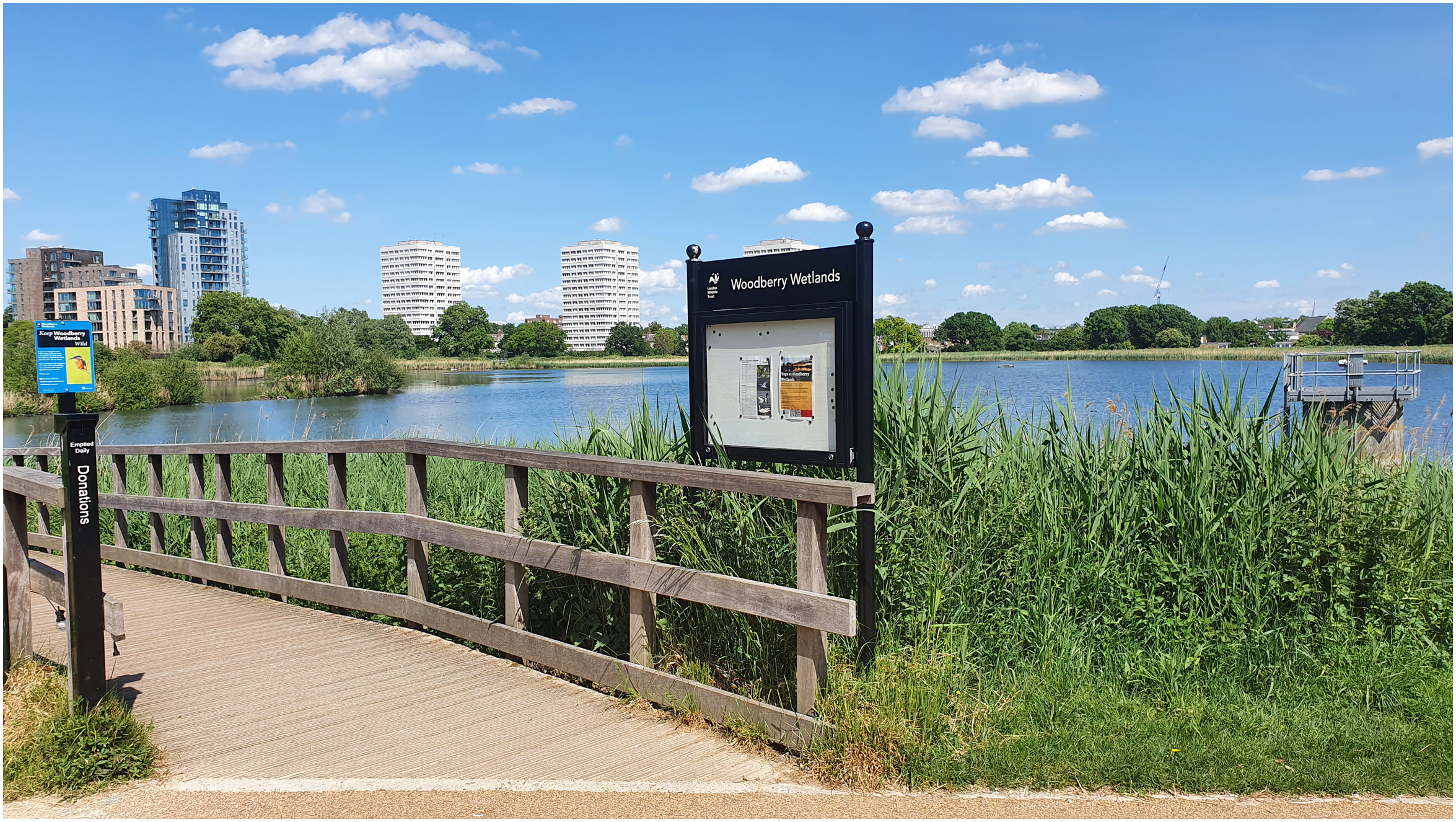
The reopened Woodberry Wetlands in 2022, image © Alessandro Busà.
Public access to the East reservoir reopened in 2016. The partnership between Berkeley Homes, Thames Water, and the London Wildlife Trust facilitated reconnection of the estate with the wetlands, expanding access to all residents in Woodberry Down and the neighborhood at large. This move has been very well received, with the redevelopment and its natural assets becoming known outside of the neighborhood and to London more widely. Old time council tenants who have moved into the new housing blocks have direct access to the reservoirs and appreciate the beauty and health benefits connected with this new green open space: I am a full-time carer to my youngest who has autism. She is 10, and the Wetlands is her favourite place. Because she can run free, ‘cause she has no safety awareness, running around in the street is quite dangerous for her. But there she can just run free … We didn't have that when I was growing up. So to have that now is amazing!
The reservoirs are not only popular with people in Woodberry Down, their popularity is growing among Hackney residents and Londoners in general. Many see the opening of the reservoirs as the biggest success in this redevelopment, and not just for its esthetic appeal, but for its social purpose, as a newly moved-in homebuyer told us: The people walk around the estate, they take their kids to the park, they go for a walk around the reservoir and you bump into people, and so I think there is more and more mixing going on, and I would describe it as a win-win actually. I really would.
New provisions, services, support, and opportunities have also emerged because of the coordinated interplay of, and initiatives provided by, the development partners Berkeley, Notting Hill Genesis, and Hackney Council (with strong support from WDCO). These have included the delivery of a large multipurpose community center (the Redmond Community Centre), the redevelopment of the youth club, the delivery of training and job offers though partnership with Hackney Works and Way to Work, which has a local office at the Community Centre and works like a sort of job center. A council tenant who helped found Woodberry Aid, a food bank that helped delivering food to residents during the COVID-19 pandemic said: The partners do a lot for community engagements…Through the pandemic, they supported the Manor House Trust (now London Trust), they gave them 50 lunches a day to help residents of Woodberry Down, and they do many community events as well.
A young woman born and raised in Woodberry Down is now the CEO of a nonprofit which works with youths at risk in Hackney; supported by the redevelopment partnerships and funds made available as a result of the regeneration, she engages Woodberry Down youth in the production of films, teaching them how the media industry works, as well as giving them the opportunity to work in front and behind the camera: The age group that we were targeting is what we call “early intervention.” So, try and get it fixed before it gets bad. And we found that gangs are recruiting them younger and younger … It's hands-on learning and doing something for them to be excited about, which opens up employment for them if that's their field… who knows, one of them may become famous. If there's one child that we’ve helped, that's amazing.
She has faith that the presence of more investments will only activate further positive energies in the neighborhood: So for the development, we hear two views, you know? And you have those that think the development is bad and the money grabbing, blah blah blah. But me, I'm a lawyer, I'm a businesswoman. I see things in a different light … Of course, in everything, you have advantages and disadvantages. But I also know that with the regen going on, it brings a lot of positive change which I can see around me. And the changes to the people in the community with the job opportunities as well that is created.
We collected accounts of social tenants who found a job for their kids through apprenticeships and training that were provided through the new community center: My daughter did her apprenticeship at Manor House Trust for Business Admin, and now she's working in a hotel in Kings Cross. My son, we went through the process of interviews, and he was lucky to get an apprenticeship… Now he’s doing landscape gardening. The road he wants to go is to be able to protect the nature … Both my kids have benefited from what's happened on Woodberry Down.
A recent immigrant, a woman, told us about finding a job after coming to Woodberry Down: When we first came, imagine: it was a new country, new habits, new everything… when I discovered the community centre, it was for me like an oasis, because I was alone, my English was not very well… And, you know, with Hackney Works, they advised me what to do, and I actually I started everything there … I was following their advice, and in five years, I am a lecturer in a college, all because of them.
A young third-generation Woodberry Downer engaged himself and worked as a volunteer in the community center, he goes to College and has founded a youth group called STAY to empower young adults in Woodberry Down, especially in the decision making around redevelopment: Growing up here, I know a lot of talented people that if they had the energy redirected to the right areas, they could be world leaders, you know, visionaries, there’s so much talent in these areas, it is just not recognized, ‘cause people don'’ feel like they can go into certain rooms and places. So my goal is giving people this empowerment to do whatever they can to take advantage of the multitude of opportunities that this area has to offer.
Large sums were invested by the Council in the new youth club The Edge, which was built during phase 1 from the ashes of the old youth club called Parkside. The club has been a staple for the kids in and around Woodberry Down and has acted as a safe space to keep children from the streets. The renovated youth club is used mostly by the children of council tenants, they have opportunities for learning, doing homework, playing, going on trips together. And it offers unparalleled equipment, as a young interviewee said: You have the access to things that you would never have access to. Well, you go to a place like that and you have top of the range computers, a recording studio, dance studio, it lets you do whatever you want … I had a few friends that make music and they have a recording studio there, they went there and they started making music, they learned how to engineer using the music software…
These more positive findings have not been evident in previous research on estate regenerations in London.
Outcomes That are More Ambiguous: Downsizing and “Generation Rent,” the “Privilege” of Social Tenants, Mixed Feelings
Our interviews with new homeowners and tenants at Woodberry Down revealed some new patterns absent in the estate regeneration literature to date. One of the main themes to emerge was related to seniors downsizing and senior mobility. It is not just young urban professionals moving into these redevelopments—many seniors are now downsizing (see Banks et al. 2012) and moving from houses to flats. Particularly in London, where home equity is very high, downsizing is a strategy for homeowners to set aside money for retirement while also saving on taxes, energy bills, and maintenance costs. In a housing complex like Woodberry Down, older homeowners can take advantage of easier maintenance, disabled access, elevators, and lower bills. As a new resident, a recent retiree, who had moved to one of the new blocks in 2014 stated: I’m in a block called Rivulet and there are quite a lot of larger three-bedroom apartments and quite a few people in our demographic have decided to move here… I wouldn't say elderly because we don't think of ourselves as elderly. We all still work a little bit, you know, part time and things, but we all have similar backgrounds.
Many have made this choice to cash in equity and savings for retirement, while keeping on supporting their adult children who are struggling to find affordable housing in London; a form of “intergenerational family support” (Wong 2019) in which older family members may have more financial solidity than their children. This retired teacher in her late 60s explained: I lived sort of ten minutes’ walk away. So I was watching it develop over the years. And then we decided to downsize, we sold up and moved, 10 min up the road. We used to live in an end of terrace Victorian House, just off Stoke Newington Church Street. So we cashed in the absurd (chuckles) house price inflation and managed to get a place that would be better as we got older… we both are retired now.
Research on “Generation Rent” (millennials priced out of home ownership) has shown the decreasing access to homeownership of employed young adults who are forced into an exploitative rental market because they can’t access credit to own a home; at the same time they are prevented from accessing social housing, causing them to delay household formation (Byrne 2020; Watt 2020, 202). This generation is locked in a “low-pay, no-pay cycle” of precarious and low-paying jobs that make the dream of homeownership an unrealistic expectation. The family home can thus become a refuge in the chaos of an overpriced rental housing market, as explained by this homebuyer in Woodberry Down: We ended up with the three-bedroom, which was bigger than we really needed. But, as it turned out, you know, with adult children, they leave home, they come back, they leave, they come back. So actually having two extra bedrooms was very good.
During the interviews several accounts of new residents living in the private units that were rented from overseas buyers also emerged. Some were doubling up in one-bedroom apartments, most were young professionals on limited incomes who were struggling to stay because it was too expensive, as a recently moved tenant told us: I know a lot of people who are renting in the Skyline/Skylark. They are renting, like three people in one apartment, they are not rich, they are like me. They are not the people who actually bought the apartments. Then we know people who have a good salary and actually give all the salary for rent only because they wanted for their kids to go to a good school.
In Woodberry Down, a three-bedroom in the Skyline Apartment tower, with a south-facing balcony overlooking the reservoirs and the London skyline, was advertised with a rent of £5,200.00 per month (PrimeLocation 2023). To buy the equivalent in the same tower would cost you £1.3 million (Rightmove 2024). These are not properties for the average Londoners, as the CEO of London Trust explained: Many of these buyers are kind of investors as well. And those flats are let out and have exorbitant rents and people can’t afford it. And so they are flat shares and, you know, three single people sharing the flat or whatever it may be. And so that's the market, I'm not sure you can blame Berkeley for that, that's the way property is sold in the UK. Well, that is a tragedy for ordinary Londoners.
A long-time social housing tenant who launched the Woodberry Aid food bank during the pandemic, revealed: Through all this stuff with Woodberry Aid you get to know what's happening on your estate a lot better, especially through the pandemic. So we do know there's a lot of private renters on Woodberry Down that have struggled a lot, really a lot.
Another social housing tenant summarized the transient and precarious nature of these private tenancies: You think they’ve got this disposable income, they’re working in the city, they’re making loads of money. But yeah, I heard even recently, one lady in one of the newer blocks, well she said lots of people in her block are moving out because they can't afford it … But we think the people in the posh blocks are rich because they are in these flats and they're renting them and they're just working in the city… And that's the perception of a lot of people in the old blocks. But a lot of them, you know, they're all just normal people.
Given the struggles private rental tenants are having, it is perhaps not surprising that some expressed a longing for the “privileged” position of social housing tenants in the competition for the scarce resource of housing (see Hoggett, Wilkinson and Beedell 2013, on perceptions of unfairness around the distribution of the social benefit entitlements in the UK): It's not fair (chuckles)! They don’t know how it is to give away all your salary for a small space. And so when I hear how much they are paying for a three-bedroom apartment in a new building, I’m feeling very jealous. Yes, I am! (chuckles). Of course, they give the houses to people who are very low income … But how come people like us, my husband is working, he's a father, I’m working, I was studying, I'm a mother, and we are struggling in a very small space … We are two people, and one salary goes to pay rent, it's a shame.
Referring to the achievements of WDCO with regards to the split household policy, a retired homebuyer expressed both admiration and frustration, as this would not be an option for her children: They (council tenants) are getting places for their adult children to live as social tenants. Incredible, that is an amazing win. And I can say it's fantastic how they’ve done that. But actually, when I talk to people who have got that privilege… they are not understanding how that can feel very difficult for people whose children are not able to get to live in London, you know? I mean, my child has no chance of buying a house. And he has no chance of being a social tenant. What's he left with? He's left with us. You know, trying to share the privilege of our home ownership with him.
We found that former council tenants relocated into the housing association units were generally very satisfied. Most of these homes were slightly bigger than their previous council homes. This does not mean that there were not issues with the design in previous phases—for example, some residents complained about the new flats having combined open plan kitchens/living rooms (Nelson and Lewis 2021), but many of these issues are being resolved in the latest phase due to WDCO's input. They all have elevators which has been life changing for elderly residents and those with small children, and their new homes are located in largely improved surroundings.
We did though identify generational differences in appreciation of the new units. Young people were the most prepared for change, as this interview with a college student, whose family had lived for three generations in Woodberry Down council housing, recently relocated into a new flat, expressed: A lot of people, they fear change or difference … I don’t see what the negatives could be from living in a house that has damp, broken windows, and moving into a better house, better surroundings. So I’m all for regeneration. Of course there's going to be negatives, right? There's negatives to everything. But I don’t feel that in this case, especially in this area, that the negatives outweigh the positives.
Some adult residents, however, were more circumspect about living in the new flats. A recently moved single mother told us: People in the old blocks think that the new blocks are brilliant. Not that they’re not, but, you know, there are still issues with a different housing manager and all of that with the new properties… And I sometimes feel I moan about it, and I shouldn't, because it's a nice new block, and people are still in an old block where it's damp and it was cold.
Conclusion: Regeneration (Success) or Gentrification (Failure)?
So what might critical urban scholars, like ourselves, whose previous writings have been attached to the antigentrification narratives Watt (2021) criticizes, make of these mixed, and in places complex and ambiguous findings? What are the implications for the research evidence base on (and theorizations of) estate regeneration in London and mixed communities policy as state-led gentrification, both in the United Kingdom and elsewhere? Should Woodberry Down be seen as an example of “successful regeneration” or is it yet another example of “state-led gentrification”? Are our findings important in relation to the newly turning policy tide back to supporting council homes and the refurbishment, not demolition and redevelopment, of estates?
As discussed, there have been negative impacts that tally with previous research: the redevelopment has produced no new council housing at all and no net increase in social-rented housing units, leaseholders have been displaced, residents have found living through the on-going regeneration stressful, the building and redevelopment phases have created new social tectonics in the neighborhood. Yet, there have also been some positive outcomes: for example, an effective “Right to Return” policy which has made new residents and moved across council tenants largely positive and those yet to move optimistic about the redevelopment. The proviso being that the longer the redevelopment takes, the more elderly residents who have a right to return will die off, so Berkeley is playing with time. A “Split-household policy” was won and new forms of social mixing, and new social and economic opportunities for residents, including young people, have also emerged. It seems that over time a new, more positive, shared consensus is emerging based on shared subjectivities, this is not unsurprising given over the long-term communities tend to move toward a shared consensus (see Matthews 2013). Yet, it is important to note that WDCO's advocacy has been decisive in steering the redevelopment towards a more positive trajectory. This strong community group has guided the residents’ interactions with the developer and proved pivotal in the wins; its agency has been crucial in ensuring the survivability of many of the pre-existing council tenants in this neighborhood. Lees, Annunziata and Rivas-Alonso (2018) have discussed individual survivability (the fact of being able to survive, to continue to live or exist, especially after coming close to being destroyed or displaced by gentrification) and the possibilities of it being scaled up, and in Woodberry Down we find an important example of “community survivability” which deserves deeper and further investigation. But also interesting are the other forms of survivability (in the face of wider gentrification pressures in London) in the new private housing—“Generation Rent” adult kids living with their parents (some of whom are known as “Guppies” giving up on property) because they cannot afford to buy (or rent) elsewhere, and multiple private renters sharing one and two bedroom flats because rents are unaffordable. These Guppies and precarious private renters, with some occasionally revealing a hint of envy toward the ex-council tenant's tenures that they will never be able to access, are not the gentrifiers discussed in the new-build/mixed communities gentrification literature.
Woodberry Down's regeneration is on-going, as such it seems way too soon to claim it is a regeneration success. We can say, however, that state-led gentrification has occurred, but that its outcomes have been massively mitigated by WDCO and complicated by the factors of Generation Rent and a hyper-gentrified London. Many of the in-movers are Gen Z, who have been called “Generation Precariat”: 9 this financially precarious group are not the wealthy, professional gentrifiers of the new-build gentrification literatures (e.g., Davidson and Lees 2010): they may have the same social and cultural capital, but their economic capital is depleted. Ironically, they share more in common with classic pioneer gentrifiers or otherwise marginal gentrifiers (see Rose 1984); we might even be able to say they are not gentrifiers at all. What is clear is that the gentrification landscape is not as Black and White as it is often portrayed, and for the most part the who-to-blame must shift from individuals to the state and investors. Gentrification is unjust: of the eight different injustices Dawkins (2023) has identified linked to gentrification (deprivation, estrangement, erasure, domination, censure, exploitation, disrespect, and marginalization), the original residents on Woodberry Down have experienced some of these more than others, and some of them probably not at all. As Dawkins says, for a variety of reasons not all residents (and we’d add communities) in gentrifying neighborhoods experience the same types of injustice.
We undertook, and are publishing, our research on Woodberry Down in a somewhat altered landscape to that of Lewis (2017), Nelson and Lewis (2021), and Watt (2021), for there now appears to be a policy turn in the United Kingdom back to building council homes and safeguarding those in place, rather than dismantling them. At national level the Labour Party's Deputy Leader Angela Rayner has promised that the next Labour Government will place social and council housing at the heart of Labour's secure homes plan. In late 2023 she claimed: “The next Labour Government will deliver the biggest boost to affordable, social and council housing for a generation, and get those social homes built, brick by brick. We’ll start by rebuilding the dream of a safe, secure, affordable home that the Tories have taken a wrecking ball to over the last thirteen years.” 10 There has been, however, silence on the estate “regeneration” wrecking ball that New Labour supported and that is on-going in London.
Likewise, the now newly re-elected Labour Mayor of London, Sadiq Khan, has pushed for “a new golden era in council home building,” boasting in 2023 that he had started to build more than double the number of council homes than the rest of England. His initiatives include a £1 billion Building Council Homes for Londoners, a £10 million Homebuilding Capacity Fund, and a ‘Right to Buy-back’ program. In 2023 he also announced a new Council Homes Acquisition Programme which will give councils access to funds to purchase homes from the private market, responding to Londoners’ urgent need for social housing and temporary accommodation. Understandably though, he has been criticized for doing all this (a drop in the ocean) in the face of the on-going demolition of council estates in London. Confronted by groups like Just Space, the London Tenants Federation, and others, the Mayor of London had sought to mitigate some of the criticisms of estate regeneration in his 2018 Good Practice Guide to Estate Regeneration, 11 in which he sought: resident consultation and involvement at every stage of regeneration; a mandatory ballot in the case of demolition, social tenants guaranteed full rights to return and leaseholders and freeholders given a fair deal; and the number of social housing properties remaining the same or increasing. But in reality, the Mayor has limited planning powers to enforce best practice on estate regeneration projects. Controlling access to limited GLA funding is one of the only ways he can exert power. And there has been push back on his guidance, especially with respect to local councils’ manipulation of resident ballots, nor did it help that just before his Good Practice Guide came out, the Mayor signed off on a number of estate regeneration demolition programs in secret (see Estatewatch.London's 2023 Alternative Good Practice Guide to Estate Regeneration). Moreover, he has continued to support estate regeneration, for example, he overturned Tower Hamlett's rejection of the second part of the Aberfeldy Estate regeneration in Poplar, which will provide only 363 homes for social or affordable rent, 77 for intermediate rent, and 1,099 private homes.
At the local level, London Councils are increasingly skeptical of these project-based, self-financing redevelopment models wherein council land is leased to a private developer who generates profits from the sale of new market-rate housing, which are then used to subsidize the provision of housing at social rent. An obvious consequence of this self-financing model is that the provision of housing for social rent is bound to private market finance and the vagaries of financial booms and busts. Although Hackney Council did not sell the public land Woodberry Down council estate sits on (unlike Southwark Council did for the Heygate Estate, see Lees and Ferreri 2016; see also Horton and Penny 2024, on the fight against the Haringey Development Vehicle sell off of public land) and gained in the short term from a “financialization fix” by having a private developer cover the upfront costs of regeneration, it will lose the large part of any potential future returns deriving from the redevelopment and related sales, which will instead be appropriated by the developer. Only profits from leases and sales above an agreed rate of 21% are shared between Berkeley and the Council (Nelson and Lewis 2021): as such, Hackney Council has forfeited much of the return from future land value uplift (Christophers 2016; 2022).
London council estate residents and their supporters have long fought back against demolitions and redevelopment (Lees and Ferreri 2016; Hubbard and Lees 2018; Lees and Hubbard 2020a; Lees and Robinson 2021; Watt 2021; Horton and Penny 2024)—in a recent warning to developers manipulating estate regeneration plans, deviating on what was promised to residents, in early 2024 a Judicial Review in the High Court against Southwark Council and Notting Hill Genesis was won halting demolition on the Aylesbury Estate. The Public Interest Law Centre, who brought the claim, said: “We are hopeful that today's ruling has far-reaching consequences in favor of estate residents across the country who feel powerless to affect change on the land they call home. This judgment should serve as a warning to developers who disregard historical masterplans and the promises they make to communities in the process of gentrification.” 12
However, in this new landscape of a supposed turn back to supporting council homes, absolutely nothing is guaranteed with respect to estate regeneration. It is not clear where the funding will come from, it is more likely that private funding will continue to be sought for council estate regeneration, leading to state-led gentrifications; and there have been wins on the Aylesbury Estate before, but they have only ever been temporary. Post-Brexit, in light of the substantial austerity cuts downloaded on UK cities and a super-charged housing market, it is hard to see a positive turn towards an estate regeneration that does not gentrify. Indeed, WDCO's recent response to proposals for the next phases of regeneration in Woodberry Down have sounded the alarm on a denser development with more than 50% privately owned homes and fewer social homes than pre-regeneration: This is what disturbs me the most…We’re going through this long regeneration. How do we end up with fewer social homes than there were at the start despite being much denser? And the number of homes have increased 2.5 times. This is the main worry. (Ex WDCO Chair Geoff Bell quoted in Mykkanen 2024)
We would vouch that in the context of a supposed policy turn back to council homes, the threat of gentrification for council estates in London has not gone away. Estates are undergoing demolition as we speak, and new schemes have been given the go ahead in 2024. There needs to be a new council estate regeneration national policy enacted that does not gentrify, that does not displace and disrupt communities, that retains council tenancies (see Busà 2024, for an example of how to do “renovation without renoviction” in our comparison case in Germany).
In conclusion, we are concerned that “the ‘eviction’ of critical perspectives from a field in which they were once plentiful has serious implications for those at risk from gentrification” (Slater 2006, 737). Shaw and Porter (2009) have noted how we need to better understand how regeneration can take place while limiting gentrification and its negative impacts, to inform policy, practice and academic debate. We have done that here. Shaw (2009, 260) emphasizes how important it is to “continually fight” to develop more equitable polices and approaches for regeneration without gentrification, to continue searching for understandings of how ‘“true” urban regeneration can take place (Lees and Ferreri 2016, 22). We agree, and our work will continue to do so.
Footnotes
Authors’ Note
The authors are grateful to all the key informants who participated in the interviews and provided their valuable time and insights. This article also benefited greatly from the useful feedback from three anonymous referees and the patience of the Urban Affairs Review editors, plus the extra support Tim Weaver gave. Thank you all.
Declaration of Conflicting Interests
The authors declared no potential conflicts of interest with respect to the research, authorship, and/or publication of this article.
Funding
The authors disclosed receipt of the following financial support for the research, authorship, and/or publication of this article: This work was supported by the H2020 Marie Skłodowska-Curie Actions (grant number 837749).
