



Abstract
Controlling urban sprawl are the overarching challenges facing cities worldwide. This article delves into the pivotal role of policy entrepreneurship throughout the planning and implementation phases of compact city initiatives. Drawing insights from the experiences of Aomori City and Toyama City in Japan, this study scrutinizes the drivers behind the shift toward urban compactness and its consequent outcomes. The incorporation of policy studies theories into the realm of compact city development has been scant. To bridge this gap, the research leverages process-oriented theories from policy studies to dissect the decision-making processes guiding compact city development in these two pivotal municipalities. Through this investigation, it is revealed that the effective transition to compact urbanization in Japanese municipalities predominantly stems from policy entrepreneurship. The author posits that this achievement is primarily attributed to adept local mayors who possess the acumen to cater to specific local needs.
Introduction
The “compact city” is one of the key responses in urban policy for tackling the pressing challenges that cities are facing, such as environmental sustainability, economic viability, and social cohesion (UN-Habitat 2012). The policy undertakings of compact city in Japan cannot be explained without reference to the historically institutionalized paths of past events and decisions made by policy makers. As described in the following sections, the inter-issue relationships, particularly between protecting small retail businesses and revitalizing city centers, shed light on the historical roots of Japan's transition towards urban compactness. It is characteristic of Japan's experiences that policy makers used the ideas of compact city as a survival instrument for regional cities’ revitalization, in comparison to that of Western countries where they seem to consider the concept of compact city being suitable for major cities, such as Melbourne, Vancouver and Paris, to lessen the impact on the environment and enhance quality of life (e.g., European Commission 2012; OECD 2012).
In the late 1990s, the Ministry of Land, Infrastructure, Transport, and Tourism (MLIT) in Japan initiated efforts to advocate for urban compactness. Prior to these nationwide initiatives, forward-thinking cities had already formulated specific compact city policies tailored to their individual circumstances (e.g., Sasaki 2013; Mori 2021). 1 These pioneering cities provided valuable insights that now inform the deliberations of the national government regarding policy courses of action. Policy learning from those localized endeavors served as a compass for national ministries, recognized as a yardstick for an exemplary model of compact city development. The MLIT accordingly came up with the national “Compact Plus Network” policy, which was approved by the Cabinet in August 2015 (MLIT 2015). The narrative presented in this article underscores how innovative municipalities harmonized their context-sensitive initiatives with overarching national strategic priorities. This synchronization, in turn, enabled these municipalities to secure essential national funding for the effective execution of their endeavors.
As of February 2020, in compliance with a nationally guided policy of forming a compact urban structure (i.e., Location Adjustment Plan and Regional Public Transportation Network Formation Plan), 209 out of 1,747 municipalities had made such city plans (MLIT 2023). Most municipalities embraced the national scheme trend, primarily seeking national subsidies, without demonstrating a deliberate effort to formulate a tailored policy model for their specific localities. In contrast, some forward-looking local authorities, such as the selected municipalities of Aomori and Toyama in this article, developed a localized policy model.
This article demonstrates that mayoral entrepreneurship is a crucial ingredient in a city's ability to make an effective transition to compact urbanization. The institutional authority held by Japan's local mayors is significantly formidable compared to others (Reed 1982; Takao 2018). In Japan's local government system, a dual representative system is employed where residents separately elect both the mayor and the assembly. However, the right to propose budgets and bylaws is exclusively granted to the mayor, while the assembly holds decision-making authority. Furthermore, if the mayor disagrees with the assembly's decision, he/she can exercise the right to request reconsideration, and he/she also possess discretionary power to execute the budget based on their independent judgment. Therefore, the authority vested in Japan's local mayors is robust.
To curb urban sprawl and ensure accessibility and mobility within local communities, key factors like growing demands, available resources, and geographical context all seem intertwined with the policy choices encompassing compact city strategies. However, these factors leave fundamental queries unanswered: What spurred the timing of policy formulation? How did the decision-making processes shape concrete policy outcomes? Existing analyses of compact city transition pathways have scarcely tapped into process-oriented theories within policy studies. Such theories could yield a more comprehensive comprehension of the dynamic and interactive changes transpiring in locally specific conditions. This article argues that municipal governments occupy a strategic juncture as positioned between the vertical dichotomy of national administration and local communities, and the horizontal division of various local stakeholders’ interests. Accordingly, municipal governments, with the mayors at the forefront, hold the potential to serve as a cohesive force amidst fragmentation. Local mayors hold a strategic advantage of identifying and exploiting entrepreneurial opportunities for policy change. This article claims that mayoral entrepreneurship plays a key role in spearheading locally tailored transitions toward a compact city paradigm.
Literature Review
Arguably, the most frequently cited line of argument is provided by OECD documents in 2012, defining the characteristics of compact city as an urban form of spatial compactness which refers to density and proximity of development patterns and accessibility to public transport, local services, and jobs (OECD 2012, 12). Following this report, UN-Habitat (2012) claims that urban density is instrumental in fostering prosperity and social cohesion and mitigating adverse environmental impacts. The ideas of compact city have thus emerged in the global urban discourse, although a universally embraced model of urban policy objectives and strategies to tackle these challenges remains elusive. In a broad sense, the overarching objective of compact city is to enhance urban density, while pursuing with the intertwined goals of achieving high levels of economic viability, environmental quality, social equity in the urban environment.
If the objectives of compact city policy entail addressing diverse urban challenges such as environmental preservation, urban revitalization, and social equity, then the pragmatic inquiries revolve around in what ways the policy ideas should be implemented and with what effects. The regulatory / promotional designs of compact city emerge from the theoretical debate, revealing an array of implementation tools at the operational level: population/employment densities (Churchman 1999; Neuman 2005); reduced intra-urban distances (OECD 2012; Kasraian, Maat and van Wee 2017; Hamiduddin 2018); and network connectivity (Hillier 1996; Churchman 1999; Berghauser Pont and Haupt 2009). Density development aims to keep residents close to service facilities, thereby enhancing the efficient use of urban land. Consequently, this approach fosters the design of reduced intra-urban distances, resulting in shorter commutes to public transportation hubs and an amplified mobility within local and regional networks. To encapsulate, the evolution of compact city development hinges upon intricate interplays among a myriad of regulatory and promotional designs.
The subsequent inquiry revolves around the policy effects of compact city. It is difficult to detail the categories of compact city impacts in an inclusive way, but in a broad sense, those impacts are closely linked with three fundamental areas, economic, social, and environmental. These areas have been tested as responses to multiple urban challenges, ranging from downtown revitalization to ensuring social equity and achieving carbon neutrality. Depending on the analytical frameworks, researchers focus on a certain set of the outcome measures for the performance of compact city development. To illustrate, economic outcomes include more productive workers due to the presence of agglomeration economies (Neuman 2005; OECD 2012), less commuting-time and more accessible employment (Dieleman and Wegener 2004). Social outcomes include more efficient delivery of public services (Carruthers and Ulfarsson 2003) and more social interactions among residents (Burton 2002). Environmental outcomes include a decrease in urban CO2 emissions (Hickman et al. 2011; Wimbadi, Djalante and Mori 2021) and more energy efficiency (OECD 2012; Rode et al. 2014).
Therefore, the literature is extensive, encompassing numerous contributions that focus on specific characteristics of compact city policy and their policy effects, but hardly on the process of ongoing decision-making towards urban compactness. This article aims to shift the focus from solely examining policy components and outcomes to exploring the process of ongoing decision-making that connects policy objectives to policy effects. It also emphasizes the necessary capacities for a diverse set of actors to effectively develop and implement policies.
In this context, this article centers on the pivotal role played by policy entrepreneurs, with a particular emphasis on local mayors, as crucial agents in municipal governance. Mayoral entrepreneurship, as defined here, encompasses the actions of mayors (policy entrepreneurs) who possess both the skill and drive to tackle policy problems, seizing the strategic position to bring about tangible and significant change. This definition of mayoral entrepreneurship builds on the theoretical frameworks of the policy entrepreneurs in the the multiple streams approach (MSA) in the field of policy studies (Kingdon 1984; Zahariadis 2014; Cairney and Jones 2016). A pioneer in the study of policy entrepreneurship noted that policy entrepreneurs “… could be in or out of government, in elected or appointed positions, in interest groups or research organizations” (Kingdon 1984, 122). The key role of agency within the multiple streams (problems, policy solutions, and politics) is played by policy entrepreneurs who can exploit “windows of opportunity” for policy change (Boin, Hart and McConnell 2009; Béland and Howlett 2016). These windows can emerge as a result of multiple joining of “process streams” in combination: a “problem” cannot be ignored, a “policy” solution may be available that is practical and viable to adopt, and “political” events may suddenly get the problem on to a government's agenda (Kingdon 1984).
Yet the diversity of conceptualizations of policy entrepreneurship poses challenges for their systematic analysis. In response, we employ the term “policy entrepreneurship” within a specific context, leveraging insights from the MSA. Policy entrepreneurship is characterized as a pattern of individual or collective actions, focusing on their attempts to transform policy ideas into substantive policy change through individual or collective actions (Kingdon 1984; Mintrom and Norman 2009; Petridou and Mintrom 2020; Arnold 2022). Policy entrepreneurship is also conceived not only as a distinctive set of policy streams, but also underpinning competencies and motivations. Kingdon's definition of a policy entrepreneur is as follows: “Advocates who are willing to invest their resources—time, energy, reputation, money—to promote a position in return for anticipated future gain in the form of material, purposive, or solidary benefits” (Kingdon 1984, 179).
Probably the most important question is what successful entrepreneurship does mean to influence the policy process. The shared characteristic is the capacity to influence others. Impactful success for policy entrepreneurship is realized when they manage to change the policy preferences of others (Teske and Schneider 1994). Alternatively, for some, success manifests as agenda-setting, where the policy entrepreneur's favored issue becomes a consideration for policymakers (Mintrom and Vergari 1998; Mintrom 2013). Kingdon noted that policy entrepreneurs can be non-elected or non-appointed actors (Kingdon 1984, 122). This suggests that policy entrepreneurs are those who can influence others, even in the absence of formal authority over them. They also possess the skill and drive to identify and exploit opportunities that others may overlook to bring about policy change.
Here, it is essential to recognize that the concepts of leadership and entrepreneurship are not mutually exclusive, as various forms of leadership impact entrepreneurial endeavors (Harrison, Paul and Burnard 2016; Leitch and Volery 2017). The underlying traits and behaviors crucial for both leadership and entrepreneurship can be considered overlapping, given the shared need for effective communication skills, a heightened awareness of actions, and a dedication to policy ideas, creativity, and strategic thinking. Nevertheless, the intended effects of entrepreneurship on the policy process differ distinctly from leadership. Policy entrepreneurs distinguish themselves by actively working to transform policy ideas into innovative policies, thereby exerting influence on existing policy frameworks (Kingdon 1984; Mintrom and Norman 2009). In contrast, policy leadership aims to achieve objectives largely within the confines of established institutional settings, focusing on incremental thinking (e.g., Pressman 1972; Burns 1978).
This article will examine the role of elected mayors who exercise policy entrepreneurship in Japan. The mayor has formal and legal authority in institutional settings that are the primary sources of the control mechanism of an ideal mayor to influence others. At the same time, the focus of this article is not on mayoral leadership, but rather on mayoral entrepreneurship. Our interest is in mayoral entrepreneurs who do exploit a policy window to initiate changes that cannot be accounted for on the grounds of formal authority and institutional factors alone.
MSA analyses primarily examine the federal/national level of politics where policy entrepreneurs navigate the three parallel and mostly independent processes – addressing policy problems, devising policy solutions, and considering political conditions, which come together at critical times for a policy to emerge (Kingdon 1984). In contrast, this article focuses on mayoral entrepreneurship at the local level, highlighting four significant arenas of municipal activities: 1) Central-local relations, especially the financial dependence of localities on the central government in Japan; 2) Stakeholder collaboration that sets the local policy agenda; 3) Mayors who capitalize on political opportunity; and 4) Intercity competition including policy emulation and learning. These facets of municipal public policy are embedded in a convergence of the different streams of analysis: 1) Issue framing to capture policy attention (problem stream); 2) Proposing solutions to policy problems (policy stream); and 3) Providing decision makers with the motive and opportunity to turn it into actual decisions and outcomes (politics stream). Importantly, these streams are not rigidly compartmentalized, nor do they necessarily follow a linear progression from one stage to another. By exploring these convergent streams, the article aims to capture the intricate interconnections among phenomena shaped by both social structures and individual actions over an extended period of time.
Research Approach
This article takes a qualitative-interpretative approach to analyse the available information of two pioneer cities: Aomori City and Toyama City. Aomori City can be regarded as a pioneering municipality in adopting urban compactness as a city policy, as it was the first in the country to clearly state the formation and promotion of a “compact city” in its urban planning master plan (1999). The reason for addressing Toyama City is that while municipalities promoting compact city policies exist throughout the country, Toyama City has been cited as a successful case by the OECD (2012).
These two cities share a strong commitment to compact city development, but each has pursued its own design strategy. The article places special emphasis on unveiling the “black box” of policy-making processes, employing process-tracing to offer inferential insights often absent in quantitative analyses. The central focus of analysis is the intricate and dynamic process of intentional human behavior, emphasizing the evolving nature of these actions rather than singular policy choices in the realm of compact city development. The approach of process tracing contributes significantly by delving into detailed descriptions and highlighting the causal sequence that contextualizes process-tracing observations (George and Bennett 2005; Bennett 2008). It captures a dynamic ongoing process of policy–making that stretches over extended timeframes and involves a diverse array of interests and participants. A comprehensive understanding of Japan's urban sprawl and its policy responses requires an exploration spanning the last six decades. This exploration encompasses the intricate interplay of multiple cycles among agents, various levels of governance, and different spheres of authority within Japan's policy transformation landscape.
Why were the mayors’ favored issue becomes a consideration for the two pioneer cities and able to effectively influence the policy process? In this study, drawing from preliminary observations, it is posited that a specific type of mayoral entrepreneurship driving policy changes, significantly contributes to the variations in transitioning toward a more compact city, despite both mayors being equally active in this transition within the two cities. Given the scope and level of locally specific transitions in the issue area of compact city policy, the author will integrate aspects of the transitions with agency-based analytical concepts, such as, the MAS and “windows of opportunity” for policy change. These concepts focus on the independent influence of the individual actor. The diverse stages of compact city development can be primarily explained by the purposive adaptation of decision makers to the physical environment and organisational characteristics. The analysis will thus look beneath the aggregate relationships to more qualitative evidence of localised motives for local policy development. To identify the motivations and purposes behind policy making and implementation, personal communications including correspondences, unpublished interviews, and dialogues with stakeholders who held leadership roles, are used. These sources aid in identifying the driving forces behind policy making and implementation, thereby furnishing inferred causal connections. Documentation from different types of publications, such as government documents, published survey data, and newspaper articles, is also used to corroborate the collected information. 2
The causal-process observations in this article are conducted with reference to a set of assumptions that are formulated through the lens of the MSA in the context of compact city policy.
Problem stream: Issue framing for policy attention
3
- During the initial phases of agenda-setting, a policy entrepreneur is anticipated to emerge as a frame producer. This anticipation stems from the issue complexity of compact city, namely one of the leading paradigms of urbanism, which requires expert knowledge to understand the problems of urban sprawl.
The classic work of Roger Cobb, Ross and Ross (1976) offers a valuable framework for cross-national comparison of the agenda-setting process. The framework effectively captures the different ways in which issues enter the agenda. In liberal-pluralistic political systems, one prevalent agenda-setting process entails external groups taking the initiative to place an issue on the public agenda, thereby compelling policy makers to inclusion it in the policy agenda. However, this outside initiative process is unlikely in expert-driven compact city development.
The existing literature has primarily focused on the framing ability of the mass media, signalling to the public what is considered important (e.g., McCombs and Shaw 1972; Gitlin 2003; Gans 2004). In the issue area of compact city development, however, the mass media's role as primary frame producers is less likely. This is because the complexity of the issues involved often leads to them being overlooked and underreported. The media coverage only weakly engages with the most part of the technical reasoning debate (e.g., Bauer and Bucchi 2007; Holliman et al. 2008). Instead, the mass media tends to place emphasis on unambiguity as a news value, involving around which is familiar or what the public easily understand.
The policy entrepreneur thus emerges as a potential frame producer with the skills and determination to raise public awareness and increase public support. This article focuses on on the relevant processes at the municipal level. Similar to many advanced democracies, local mayors in Japan have the prime responsibility for policy initiatives (Borraz and John 2004). In Japan, the power to adopt local ordinances and budgets is legitimately given to the elected members of local assemblies. Policy formulation, however, predominantly resides within the mayor-led administration, given that city assemblies generally lack the capacity and resources for in-depth investigation and policy formulation (Takao 2018). In contrast to the council-manager government, Japanese municipal governments are institutionalized on a presidential system that favors mayoral entrepreneurship. An alert mayor is expected to identify procedural inefficiencies and fragmentation as “windows of opportunity” for driving policy change. The mayor serves as a crucial communication conduit and offer problem-solving suggestions.
Policy stream: Proposing solutions to policy problems - At the local level, the technical and operational feasibility of policy formulation and implementation relies on the availability of local knowledge or place-based knowledge accessible to a policy entrepreneur. This individual can effectively bridge the gap between expert knowledge and the specific needs of local communities. This hypothesis is grounded on the idea that firsthand experience within the immediate environment of local communities is essential for evaluating the relevance of expert knowledge in addressing the diverse array of local experiences (Collins and Evans 2002; Wynne 2003; Jasanoff 2006). Politics stream: Providing decision makers with the motive and opportunity to turn it into actual decisions and outcomes (Kingdon 1984) - One of the requirements postulated for successful policy entrepreneurship is the existence of interested parties’ consent, which the entrepreneur can mobilize to aid in achieving specific goals. This is a necessary condition in compact city development, since exerting political influence over individual preferences concerning their residence is deemed inappropriate in liberal democracies. The successful implementation of compact city development thus largely relies on residents’ willingness to move into targeted areas.
While lay people may have a difficulty of diverting attention and limited resources to engage with the complexities of urban sprawl and accessibility issues, local mayors occupy a strategic position to accumulate diverse resources and employ them effectively to gain expertise. In this context, they have potential to act as problem-solving mediators capable of striking a balance between expert knowledge and social concerns. Their strategic position allows them to bridge the gap between the national government and local communities, enabling them to know whom to contact, where to access information, and how to connect with various community needs, priorities, and values. In other words, mayoral entrepreneurship can be pragmatically competent to deal with policy problems within national elite networks while remaining motivated by its concerns for local experience. For example, an alert mayor is adept at aligning locally specific initiatives to national strategic priorities and securing national funding for successful implementation (Takao 2016).
The opportunities for mayoral entrepreneurship are influenced by various factors, including the political structure of a city (leading political parties, influential interest groups, local electoral systems), the type of local government, and the availability of financial, jurisdictional, and staff resources (Pressman 1972; Svara 1990; Stoker 2006). Once local mayors assume office, they take charge of setting the agenda, proposing solutions, and ensuring policy implementation to achieve their goals. It is important to note here that the actions of mayors who possess both the skill and drive to seize their strategic position for significant change, as well as personal variability, should not be underestimated.
The quality of mayoral entrepreneurship lies in the mayor's capacity to align the city's direction with public preference. It is expected to mitigate policy inefficiencies caused by political frictions and reduce transaction costs in shaping institutions and their interactions. Mayoral entrepreneurship is envisioned as mobilizing the sources of influence to promote cooperation and deference among others. The politics stream points to cost-sharing/burden-sharing for compact city objectives, while involving utilizing incentive mechanisms and coordinating devices to persuade residents to work towards for achieving the city's goals. The resulting consent from the city's residents not only helps to shape political legitimacy, but also translates into actual decisions and outcomes through their incentivized willingness to cooperate with the city's actions.
The findings of this country-specific study are not directly intended to establish cause/effect relationships between variables in different circumstances (generalizability), but rather to present the results of the country-specific study that may be applied in other similar situations (transferability). Structural and institutional factors, such as political structure, local government types, financial resources, and mayoral jurisdiction, which are peculiar to the two cities, may influence mayoral entrepreneurship opportunities. Notably, Japan's municipal governments operate under a presidential system, giving mayors more control over the local bureaucracy. However, Japan's fiscal decentralization, emphasizing the transfer of expenditure management to lower government levels, poses challenges for policy entrepreneurship (Takao 2018). Limited revenue-raising options constrain decision-making autonomy for Japanese local governments, leading them to heavily rely on national transfer payments to handle significant expenditure responsibilities (IMF 2020). 4
The following section of the case studies will empirically establish that compact city development did in fact take place, how it was accelerated, and that the observed factors of this acceleration did indeed add up to a compact city development. Finally, the Discussion section will seek to identify the causal relationships among the various factors and synthesise the findings into a causal mechanism that elucidates the influential forces driving the development of compact cities at the local level.
National Initiatives and Politics
In the 1960s, the expansion of larger and more affordable supermarkets posed a challenge, prompting the ruling Liberal Democratic Party (LDP) to prioritize the protection of small retailers, a crucial constituency. Small retailers demanded regulations on the opening or expansion of supermarkets. In response, the Ministry of International Trade and Industry (MITI) drafted the Large-Scale Retail Stores Law (LSRSL), which was passed by the National Diet in 1973. 5 This legislation was the product of extensive negotiations and compromises among small retailers, large-scale stores, the MITI, and the LDP (Upham 1993, 270; Schoppa 1997, 150).
The political compromise of competing interests was evident in Article 1 of the law, which presented a somewhat contradictory approach. It was intended to ensure the “business opportunity of small retailers” while simultaneously promoting the “protection of consumer interests” and the “appropriate development of the retail industry,” including the modernization of the distribution sector. Articles 3 and 5 mandated that developers planning to build a store with a retail space exceeding 1,500 m2 must submit detailed plans to the MITI. 6 The development approval was conditional upon satisfying a preliminary investigation, delegated by MITI to the local Chambers of Commerce, which created deliberative councils comprising merchants, consumers, and experts. Their role was to investigate the proposed plan and engage in negotiations with the prospective large retailer. In other words, the MITI effectively delegated the initial responsibility of interest coordination to the local level. The council deliberation normally took place behind closed doors and continued until the members reached a unanimous decision, often involving adjustments with the prospective large retailer (Sugioka 2009, 54). In cases of prolonged settlement, the law granted the MITI the authority to issue a recommendation (Article 7) or a compliance order (Article 8) to prevent “serious harm” to the business opportunities of small retailers. If deemed necessary, the MITI could impose requirements on the proposed large retailer store, such as reducing its floor space, delaying store openings, or limiting operating hours.
The US-Japan Structural Impediments Initiative (SII) talks started in the late 1980s. The LSRSL stirred strong criticism from both inside and outside of the country. Within Japan, both the Economic Planning Agency and the Fair Trade Commission began to press for the eventual revocation of the LSRSL, which might be in violation of Japan's WTO commitments (Upham 1993, 283). During the 1989 −1990 US-Japan SII talks, US officials called for the liberalization of regulations governing large stores, which were considered as structural barriers limiting US exports to Japan (FTC 1993). In response, by 1994, Japan liberalized new store openings with 500 m2 to 1500 m2 of floor space while abolishing the system of local deliberative councils in the pre-notification stage. This led to a notable increase in notification submissions for new store openings within the specified floor space range, rising from 786 in 1990 to 1,089 in 1994 (MITI 1995, 174). Finally, in 1998 the foreign/domestic pressures culminated in the passage of the new Large-Scale Retail Store Location Law (LSRSLL), effectively abrogating the old LSRSL.
MITI's officials engaged in the legislative process faced greater pressures to address the conflicts arising from the organization's vested interests. The MITI successfully persuaded the ruling LDP to repeal the old LSRSL by providing small retailers with subsidies, especially for the revitalization of downtown shopping areas. In 1998 the old LSRSL was replaced by the machi-zukuri sanpō, a set of three community/neighbourhood planning laws. These laws consisted of : 1) the revised City Planning Law, which managed zoning regulations and land use planning under the jurisdiction of the Ministry of Construction (MOC); 7 2) the Act on Vitalization in City Centers, which provided aid, through the joint management of the MITI, the MOC, and the Ministry of Home Affairs, to the revitalization of local city centers; 8 and 3) the LSRSLL, under which the MITI exercised its supervisory authority over preservation of the living environment in the vicinity of large stores. 9 In response to specific local requirements, city governments were given authority to: 1) designate special use districts, regarding zoning and siting regulations and 2) take their downtown revitalization initiatives in cooperation with retail stores, local residents, and other stakeholders involved in city management. Prefectures and designated cities were then mandated to ensure that large-scale retail stores would preserve the surrounding living environment, with an emphasis on addressing issues such as noise, waste, parking space, and landscaping.
Most municipal authorities acknowledged that the machi-zukuri sanpō could offer certain strategies for revitalizing their declining regional cities. However, as illustrated by the following case studies, several municipal authorities contended that the three laws fell short in addressing the intricate challenges confronted by local communities. The enforcement of the three laws coincided with the period of the Great Heisei Consolidation, initiated by the national government in 1999 with the aim of creating functional administrative units as part of Japan's decentralization drive (MIC 2003). This initiative led to a nearly 50 percent reduction in the number of municipalities, declining from 3,229 in 1999 to 1,821 in 2006 (MIC 2009a). Regional cities engulfed neighbouring small towns and villages and annexation brought in much larger administration areas with outlying communities. Additional funds were often required to meet needs for improved social infrastructure. By then, due to population ageing, depopulation, and the resultant shrinking of economic activities, most localities had been running a budget deficit since the early 1990s. Consequently, these localities grappled with the imperative of avoiding a potential downward spiral that could wreak havoc on city budgets. 10
In 2006, in order to prevent urban sprawl, the City Planning Law strengthened regulations on “Large-Scale Visitor-Attracting Facilities.” This measure prohibited in principle investors from locating large-scale retail outlets in the suburbs (MLIT 2009). Concurrently, a cross-ministerial package of subsidies was extended to the implementation of municipal efforts for city center revitalization. However, the merged regional cities harbored concerns that this centralized regulation of urban functions might not adequately address the socio-economic disparities existing between areas experiencing population growth and those facing depopulation. There was a prevailing sense of unease that the advantages stemming from city center revitalization could unintentionally sideline marginalized communities situated on the outskirts, potentially exacerbating their marginalization (e.g., Tōō Nippō February 19, March 29, May 1, 2007).
Structure-Based Characteristics of Aomori and Toyama Cities.
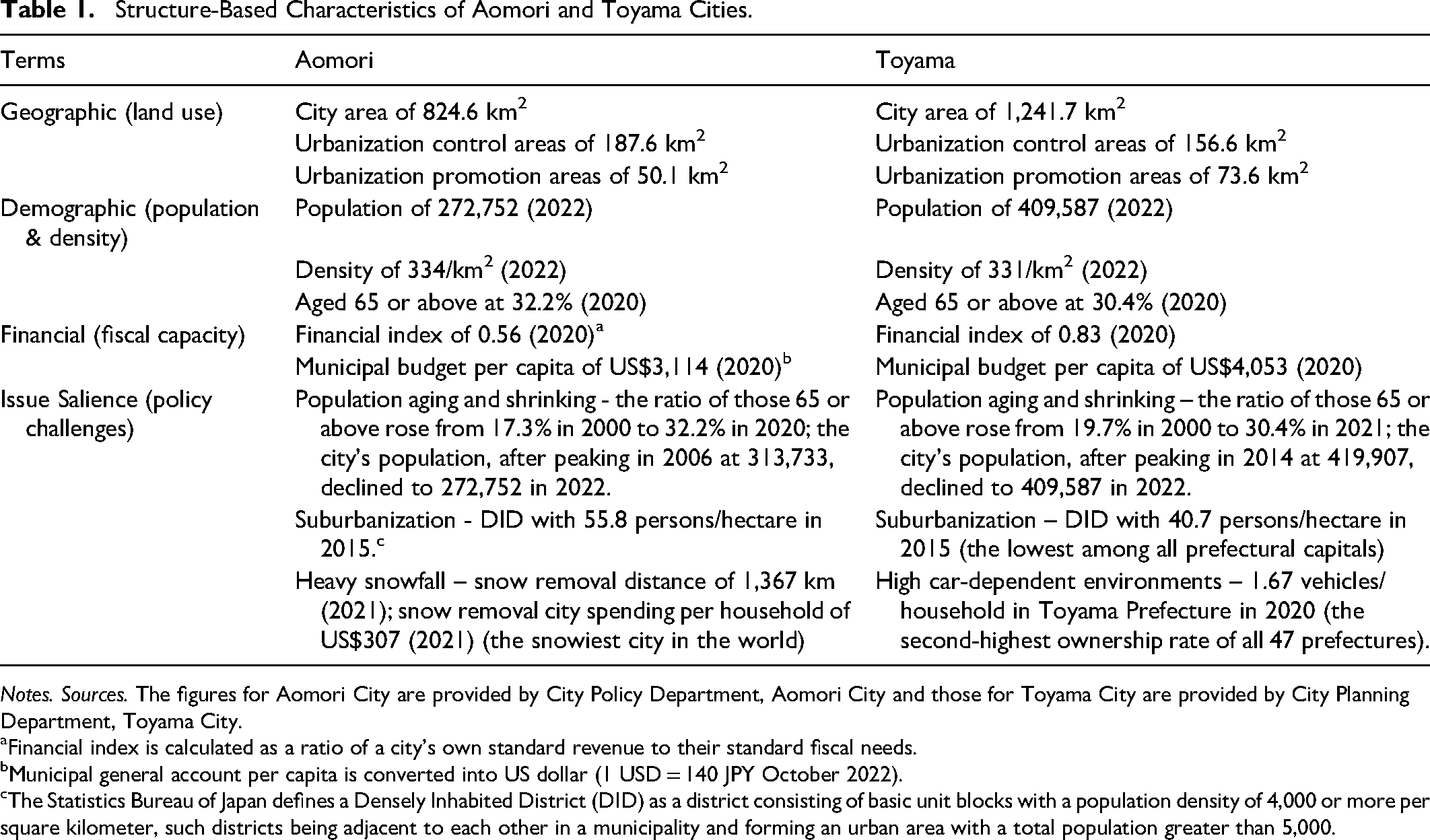
Notes. Sources. The figures for Aomori City are provided by City Policy Department, Aomori City and those for Toyama City are provided by City Planning Department, Toyama City.
Financial index is calculated as a ratio of a city's own standard revenue to their standard fiscal needs.
Municipal general account per capita is converted into US dollar (1 USD = 140 JPY October 2022).
The Statistics Bureau of Japan defines a Densely Inhabited District (DID) as a district consisting of basic unit blocks with a population density of 4,000 or more per square kilometer, such districts being adjacent to each other in a municipality and forming an urban area with a total population greater than 5,000.
The Port City of Aomori – The Capital of Aomori Prefecture
Aomori City is a junction point of the route connecting the mainland of Honshu and Hokkaido and is a strategic point in transportation and logistics within Japan. By merging Aomori City, the core city of Aomori prefecture, with surrounding cities and towns such as Hirauchi Town, efforts are being made to form a city that will become the center of the overall development of the prefecture (see Table 1).
In 1989 Sasaki Seizō successfully ran for the mayor of Aomori City, pledging, for the first time in Japan, a campaign for creating the “compact city.” From 1989 to 2009, he assumed public office, following a tenure as the Vice Chairman of the Aomori Chamber of Commerce and Industry. He astutely recognized the challenges posed by being situated in the world's snowiest city, particularly in terms of city planning. These challenges encompassed the management of snow removal expenses and the formulation of strategies to attract customers throughout the winter months. It was at the 1988 national symposium on snow-persistence that Professor Ishihara Shunsuke introduced Sasaki Seizō to the concept of a “compact city,” during his keynote address. Drawing inspiration from the efficiency of compactness demonstrated by Stockholm, the speaker argued that cities enduring heavy snowfall could harness the benefits of a more compact urban structure. This revelation profoundly influenced Sasaki's ideas for city planning, as documented in Sasaki's work (2013). The exchange of ideas convinced Sasaki and subsequently the leaders of Aomori's shopping districts to learn from the experiences of other countries’ compact city development (Sugioka 2009, 58; personal communication with an ex-member of the Aomori Chamber of Commerce and Industry November 2, 2022). At the agenda setting stage, the ideas of compact city received attention primarily due to the mayor's keen interest and motive. Mayor Sasaki thus gained a potential place to steer public attention to the relatively unknown topic of compact urbanism, should he choose to actively assume this role.
Mayor Sasaki accepted the fundamental ideas of compact urban planning, but as the transferred policy instruments had to be adapted to the locally specific conditions there was little practical experience from around the world for Aomori City to draw on (Sasaki 2013). First-hand experience, such as the skyrocketing costs of snow removing work and the losing role of Aomori as a hub port in connecting the mainland with Hokkaido (due to the opening of the Seikan Tunnel in 1988), required the mayor/city departments to emphasize the key role of local knowledge that would be necessary for judging the usefulness of urban compactness as a practical problem-solving tool to meet the diversity of local experiences (Tōō Nippō May 2, 1989; personal communication with executive officer of the Urban Development Division, Aomori City October 25 2022). Under these circumstances, the mayor sought to propose solutions to the city's challenges, while enhancing expert knowledge with the place-based knowledge and making the most of it for problem solving.
The Aomori City Master Plan was adopted in 1999. The planning process was led by the mayor's agenda setting and supported by the city administration's Urban Development Division. The City Assembly literally approved the policy directions and implementation designs. LDP-backed Mayor Sasaki was able to easily work with LDP members and LDP-affiliated assemblymembers who retained a comfortable majority of the Aomori City Assembly (Secretariat of the Aomori City Assembly 2001). There were no major issues involved in the relationships between the mayor and city assemblymembers, which might otherwise have forced local politicians to engage in contentious interaction with the mayor. The conflict-free relationships, along with the mayor-led problem solving, opened a window of opportunity to formulate the Aomori City Master Plan.
The Plan was designed in consideration of three policy directions: “restricting the disorderly expansion of urban areas,” “revitalizing the city center,” and “promoting the compactness and diversity of urban functions” (Aomori City 1999). Following these policy directions, as Figure 1 shows, the Plan was operationalized on a phased density configuration as going from the city center to the suburbs: “inner-city” (2,000 hectares old urban areas [including 117 hectares city center] for revitalization), “mid-city” (3,000 hectares potential areas for future development), and “outer-city” (64,000 hectares suburb areas for development control) (Terasawa 2007). 11 This can be described as a monocentric pattern of development, characterized by a central urban pole with a high concentration of employment and businesses, resulting in the migration of people from the periphery towards the center.
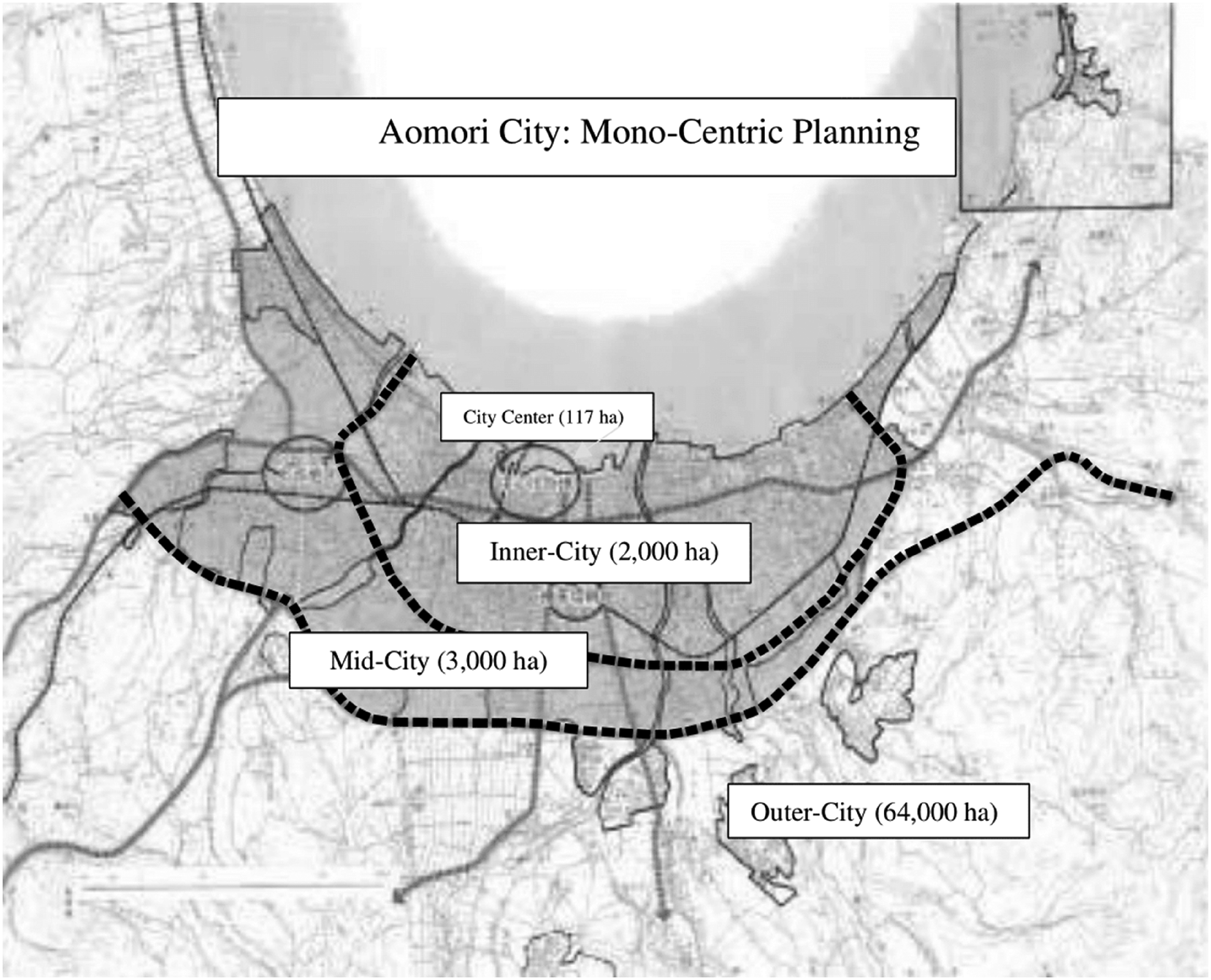
Aomori city: mono-centric planning.
Despite holding a position of influence, the mayor did not actively assume the role of a frame producer to promote the legitimacy of the compact city policy. The agenda setting was not a case of collaboration between citizens and elected policy makers for city planning, but rather a mayor-led, top-down process. Despite the lack of participatory accountability, the city's ability to deal with the problems of urban sprawl derived largely from new ways of thinking and action by the alert mayor who was adept at influencing a handful of the enthusiastic local actors, especially the Aomori Chamber of Commerce and Industry, to aid in the pursuit of his policy beliefs (Sugioka 2009; personal communication with a member of the Shinmachi Shopping District Promotion Association November 25, 2022).
Potential problems of the Aomori City Master Plan became salient during its implementation stage, especially from 1999 to 2009. The Plan was formulated with the aim of curbing the disorderly expansion of its outskirts. This approach stands in contrast to numerous other cities that permitted the opening of large stores in their outskirts. In this sense, Mayor Sasaki was far-sighted from the viewpoint of controlling urban sprawl. However, at the operational level, his city departments displayed their limited ability to demonstrate how the policy ideas could be effectively implemented, as evident from residents’ feedback about the policy's impact. The mayor made minimal efforts to garner the goodwill of the affected residents who were expected to relocate from the outer-city to targeted areas, while still ensuring their freedom to choose a place to live. According to a source from MLIT (2021), the mayor took direct action by communicating with investors who wanted to establish large-scale commercial facilities exceeding 10,000 m2 on the outskirts of the city. The mayor effectively prevented these investors from proceeding with their planning. As a result, no new commercial facilities of such scale were constructed in communities on the outskirts. Local residents of the outer-city began to feel left behind as the Aomori City Master Plan focused on the inner-city revitalization (Tōō Nippō February 19, March 29, May 1, 2007).
From 1970 to 2000, the population outflow from built-up areas to newly developed areas accounted for over 1,3000 people (Aomori City 2007). During this period of suburb development, a significant proportion of the age group of 30–50 years-old settled in the outer-city area (Ōhashi and Ishizaka 2009). As they aged and retired they tended to have limited assets except their houses, it was very difficult for them to purchase more expensive housing and resettle in the inner-city area (Ōhashi and Ishizaka 2009). According to a survey conducted by Aomori City in June 2005, some residents were angry and confused saying, “As the city prioritizes a strategy of the regeneration of the city center, it will become more and more difficult to live in the suburb areas” and “those who are already living in the outer-city area will be left out in the cold” (cited in Machi Mura October 31, 2005). In 2007 when Aomori City's revitalization plan of the city center was approved by the national government for financial support, those residents also expressed dissatisfaction with the “abandonment” of their areas (Tōō Nippō February 19, March 29, May 1, 2007).
Mayor Sasaki worked closely with the Council for the Revitalization of Central Urban Districts. This council was established in 2006 by the Aomori Chamber of Commerce and Industry (Aomori City 2007). In the quasi-industrial districts of Aomori, there were plans to transform these areas into residential ones. Property developers and investors conducted briefing sessions with concerned residents to explain their proposals. However, the final decision-making process was carried out by the Aomori City Planning Council (Mayor's consultive body) behind closed doors, without giving local residents the opportunity to have a say in the city's decision. As a result, the residents were not able to express their opinions or influence the outcome of the transformation plan (Wakizaka 2007). Apart from the inner-city and mid-city areas, it became evident that Mayor Sasaki failed to establish and reinforce effective coordination with residents in the outer-city regions. The missing element in Sasaki's approach was the ability to gain residents’ consent. It is not only essential for residents to embrace the city planning of compact urbanism but also crucial for them to be willing to relocate according to the plan. As described below, the mayor's lack of efforts to engage in meaningful consultation and take residents’ genuine concerns into account had a detrimental impact, motivating residents to participate in the planned intra-urban migration.
The policy effects of revitalizing the city center were identified across four types of policy measures: redevelopment, support for revitalization of shopping districts, aged person welfare work, and projects for increasing the resident population. One well-known case of redevelopment was the Auga mixed-use commercial-public building as part of Aomori-train-station revitalization strategies. A joint public-private enterprise built it at a cost of US$140 million, with national subsidies covering US$65 million of the cost. From the beginning of its operation in 2001, the facility was stuck in a cycle of debt and the municipal government continued to provide emergency funding to get it out of a debt spiral, yet it was unable to stand financially on its own (Aomori City 2016; Asahi Shimbun June 28, 2016).
Regarding the second type of policy measures to revitalize the shopping districts, the city established a special district to attract investments in large-scale commercial facilities. Additionally, they acquired vacant stores with the purpose of renting them out to aspiring entrepreneurs and new businesses. But the revitalization work was far from complete; indeed, the ratio of vacant stores in the city increased from 10.7 percent in 2005 to 15.7 percent in 2011 and the annual sales of the retailers in the city dropped from 67.5 billion yen in 2002 to 56.5 billion yen in 2010 (Aomori City 2012).
In 2006 the joint public-private enterprise constructed the Mid-Life Tower apartment building on land adjacent to the Aomori Station. This initiative aimed to offer elderly individuals convenient access to medical services, transportation options, shopping, and other amenities. Despite this being a showcase project of the third type of policy measures, the progress of elderly households’ migration into such facilities in the city center remained painfully slow: between 1995 and 2007 the population of those aged 65 and over in the inner city continued to be a declining trend, although the speed of decline was somewhat moderated from 2000 by a series of new initiatives (Ōhashi and Ishizaka 2009, 181).
Regarding the final type of policy measures to boost the overall resident population, the city implemented a housing removal support system through various projects, including roads equipped with snow melting systems, converting existing private housing into public housing, and establishing an apartment house supply system (741 units provided between 2002 and 2007) (Aomori City 2012). Unfortunately, the value of residential properties in the inner city was often too high, preventing outer-city residents from moving into the improved living infrastructure. Additionally, the housing removal support system did not operate smoothly (Yamada 2018, 177). Therefore, the policy effects were very limited, especially on residents’ willingness to support the transformation plan. The plan was rather abrupt, dividing the city into one strong center and three tiers of city areas. Despite these measures, there was little incentive for residents to relocate to the targeted areas.
Around 2008, Mayor Sasaki began to lose his influence on various actors, including the LDP and independent assembly members, and ready platforms for publicity, such as friendly newspapers or TV stations. The poor business performance of the Auga that was supposed to play a central role in the city planning came under fire for its poor performance. Some opposition members held the mayor accountable to the City Assembly, by saying, “How do you see the fact that (the city administration) left such significant deterioration of its financial condition unaddressed and unreported to the City Assembly” (Aomori City Assembly December 3, 2008). Even a ruling party-sided member expressed his concern: “I am afraid that the compact city projects will collapse since the city, as principal shareholder, lacks self-discipline” (Tōō Nippō May 21, 2008).
This criticism then effectively shifted the focus from a specific project to the compact city model itself. An independent member argued, “City-center revitalization has been used as a way of getting national subsidies, not for promoting well-being for all” (Aomori City Assembly December 5, 2008). Changes in the evaluation of the city's compact city model also became visible at the City Assembly with some members stating, “the extreme concentration (centralized functions) in front of Aomori Train Station won’t get anywhere as (the city departments) cannot obtain the understanding of the local people” (Aomori City Assembly March 10, 2009).
In the mayoral election of April 2009, ruling camp-backed incumbent Sasaki was defeated by progressive Shikanai Hiroshi who called for a change in the city's management for which Sasaki had borne the prime responsibility since 1989. Mayor Shikanai (2009–2016) stated that he would respect the fundamental policy beliefs of compact city yet argued that he would make business interests more responsive to the diverse needs of all local residents, thus fostering the legitimacy of compact city policy (Aomori City Assembly June 25, 2009). His policy solution for meeting the political pressures of various residents was to rework the strategies for compact city development by extending support to several other shopping areas and 12 civic center as key bases of local communities, while continuing the revitalization of the city center (Aomori City Assembly June 25, 2009).
In October 2016, however, Mayor Shikanai resigned the post to take responsibility for being incapable of recovering City's financed money. Following his resignation, the core belief of urban compactness remained supportive among local residents, 12 but required the continuous learning of adaptive capacity to make it better fit to locally specific conditions.
The Port City of Toyama – The Capital of Toyama Prefecture
In January 2002 Mori Masashi was elected mayor of Toyama City and served five consecutive terms until his 2021 resignation. He initially served as a LDP member of the Toyama Prefectural Assembly from 1995 to 2002 and was acutely aware of unsustainable urban sprawl. Once elected, he began policy promotion under the slogan of “new leadership” (Honda 2021, 38). His own style of political accountability was to emphasize that elected officials must go beyond the setsumei sekinin (responsibility for credible explanation) to the settoku sekinin (responsibility for persuasion) by which citizens voluntarily comply with their policy ideas (Good Luck Toyama Monthly April 1, 2021, interview with Mori Masashi; Mori 2021). Under his leadership, in April 2005, seven municipalities merged into a greater Toyama City where he was elected the first mayor (Kitanihon Shimbun December 21, 2002). For the purpose of building trust and credibility in the ideas of new city planning, from 2005 to 2007 the mayor held nearly 130 various symposia/explanation meetings to the residents in various locations with the informational campaigns gradually persuading residents to comply with guidelines towards a less car-dependent community (Jichitai Tsūshin April 1, 2016, Interview with Mori Masashi; Good Luck Toyama Monthly April 1, 2021; Honda 2021). The mayor demonstrated his capacity as a frame producer to raise public awareness and increase public support.
Mayor Mori also emphasized vertical coordination between national mandates and local needs. This was especially important in central-local government relations, due to financial dependence by localities on the center in Japan. To this end, the mayor successfully invited mid-level national bureaucrats through the mid-career “loaning out” program (shukkō) from the MLIT with seven such bureaucrats serving as deputy mayor for the city between 2002 and 2021 (Sābisoroji April 28 2015, interview with Kyōda Noriaki). 13 The mayor took initiatives to vertically bridge policy gaps among local residents’ concerns, municipal policy, and national mandates by working with MLIT bureaucrats but also motivated by his concerns for local experience. He displayed high levels of social acuity while engaging in policy conversations.
In November 2002 a Study Group for Compact City Planning, consisting of twenty young members from different city departments, began considering how to drive locally specific transitions to become a compact city (Kyōda 2015, 27). In March 2004 the Study Group came to the conclusion that Toyama City had no alternative, other than pursuing more compact urban forms as a model for achieving a sustainable city for the future and released a final report on policy objectives and implementation designs (Toyama City 2005). The mayor called for a more joined-up government through interdepartmental communication to find ways to cooperate on problem solutions to urban sprawl. Alarmed by his observation, “that no city could survive with low residential density and high car usage,” the mayor started undertaking a city management project by seeking to change the ways of thinking by local residents and city employees (Kyōda 2015, 27).
The deputy mayor from the MLIT and academics, such as urban engineering Professor Morimura Michiyoshi, extended expertise and guidance for defining low residential density as a problem that the city needed to solve. Taking their advice, the study team members learned about the benefits and necessity of compact city planning from the best practices in active overseas development (personal communication with an executive officer of the City Improvement Section). The members then assisted Mayor Mori with the informational campaigns for the problem recognition by which community members would realize they needed a solution to the problems of low residential density and high car usage.
Following the 2006 revision of the three community/neighbourhood planning laws, the Toyama City Basic Plan for City-Center Revitalization, of which the mayor-led city administration and the Toyama Chamber of Commerce and Industry cooperated in the drafting, was accredited in 2007 by the Cabinet City-Center Revitalization Office as the first, together with Aomori City, cases of compact city plans (Toyama City 2007a). In this plan, building upon the proposal by the Study Group, Toyama City clearly stated its compact city policy as the core of city planning. Since seven municipalities just merged into the greater Toyama City in 2005, as Figure 2 indicates, the model projects were designed as polycentric urban structures containing multiple walkable communities (local hubs) that would be connected with each other through a public transit system (Toyama City 2007a). During this forward-thinking phase of city planning, Mayor Mori's entrepreneurship played a crucial role as a driving force, empowering the integration of expert knowledge to address the implications of the municipal merger.
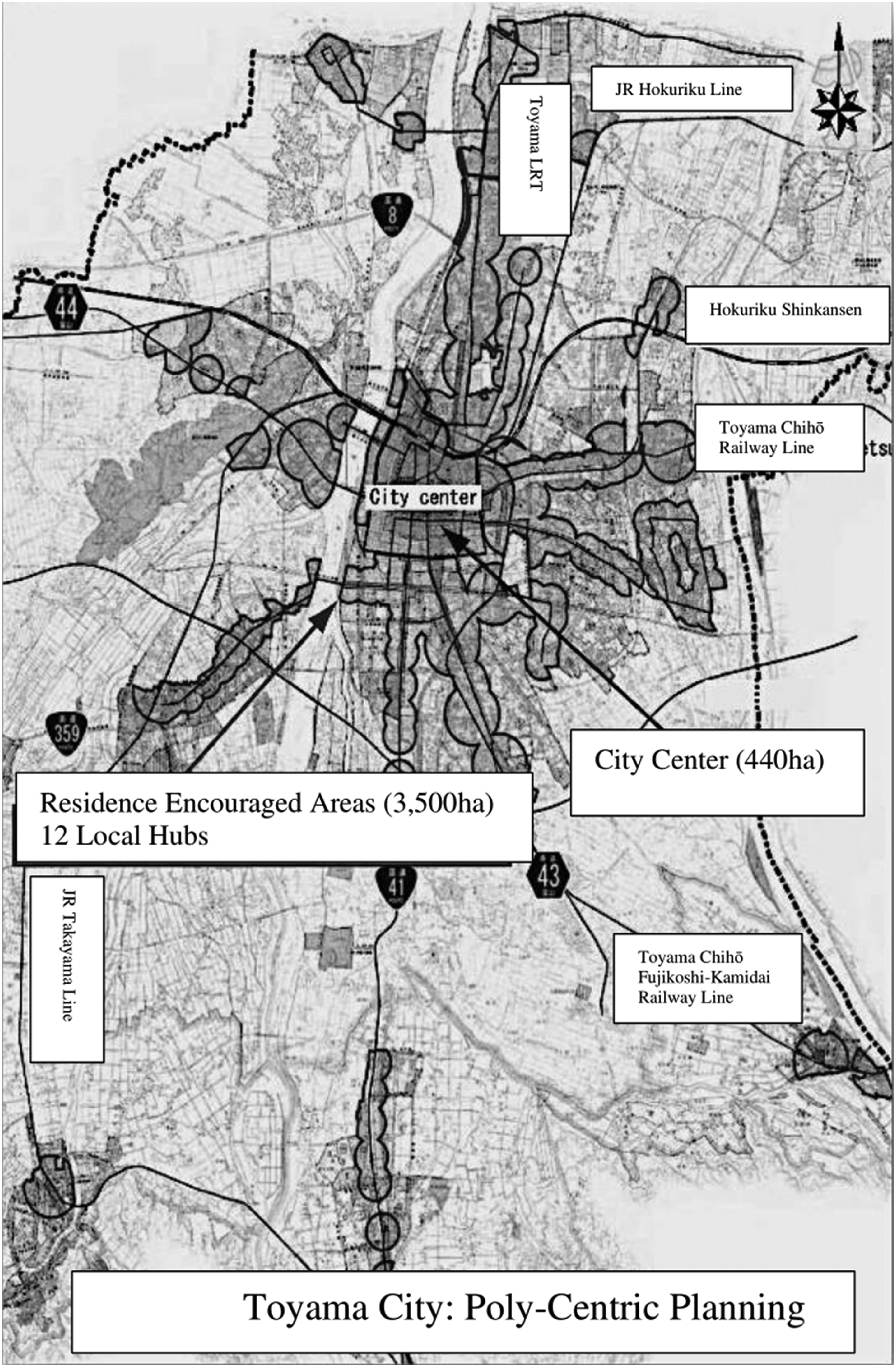
Toyama city: poly-centric planning.
To put the polycentric ideas into action, Mayor Mori came up with four areas of policy measures: creating an incentive mechanism to induce residents to comply with policy directions (e.g., subsidies to incentivize residents to move into the city center); improving public transport facilities (e.g., Light Rail Transit [LRT] initiatives to enhance transportation connectivity); revitalizing the city-center (e.g., strategic location of public facilities to attract more activity); and facilitating the formation of a social agreement (e.g., workshops and discussions on urban residence to foster a sense of ownership and cooperation).
The political structure of Toyama City provided Mayor Mori with the motive and opportunity to turn his policy belief into action. Mayor Mori hardly faced opposition to the ideas of a compact city in the Toyama City Assembly of which the great majority were LDP-backed members and other conservative members. While giving tacit approval to the policy principle, they simply asked the mayor and city departments for clarification and elaboration (Toyama City Assembly March 4, 2007; Toyama City Assembly March 2, 2008; Toyama City Assembly June 2, 2009). The mayor repeatedly stated, “(The compact city projects) will be operated, not with tightening of regulations, but with the application of incentive schemes for residents and businesses concerned,” to transform the urban space through transit-oriented development (Toyama City Assembly March 2, 2008). He emphasized that the city would start moving from a visionary stage towards gradual transformation, which was based on polycentric development with already existing local hubs. This form of incentivized polycentrism was more likely to win greater public support than the form of regulated monocentrism, which required the large-scale relocation of facilities and people.
His initial challenge was to persuade residents to accept the introduction of the LRT in Toyama City. As this key project was also considered as the first case of the LRT in Japan by the MLIT, Toyama City was able to meet and receive useful information and expertise from engineers, MLIT officials and other experts (Takami and Hatoyama 2008, 194–5). In May 2004, an observation team of 25 residents’ representatives, headed by Mayor Mori, visited Strasbourg in France and other European cities with LRT networks and the images of those networks were broadcast via local Japanese television and news media and shared with other residents (Shibutani 2004). Mayor Mori thus leveraged his position to acquire additional resources through policy learning from expert advice and preparing platforms for publicity, including newspapers and television stations. Through these efforts, he effectively persuaded residents to support his initiatives. Toyama Light Rail was introduced in 2006 and Toyama Centram, inner-city train loop line, was completed in 2009, while ensuring accessibility of bus services for every member of the community.
As the LRT networks were built, the mayor-led city administration designed incentive measures to motivate residents and investors for active participation in the transit-oriented development. The Central City Area Revitalization Section (city department) carried out the “Odekake” Commuting Pass Project that provided easy access to public transportation at a nominal charge (90 US cents) for those aged 65 and over. Based on publicly subsidized networks of public transportation, the mayor undertook initiatives to attract private investment and cluster public investment and various urban functions, such as housing, welfare, education, and commerce, in the city center (4.4 km2) and areas alongside public transport routes (34.9 km2). To induce migration into those areas, the Housing Planning Section (city department) provided builders and citizens’ buyers/tenants with financial support (units construction subsidies, subsidies for housing purchase, and rent assistance [awarded for funding 1,074 cases or 2,684 units between 2005 and 2018]), among others (Kyōda 2015, 29–30).
Although Mayor Mori devoted his energies to act as an autonomous provider of services for compact city development, he had to deal with the gate-keeping capacity of the national government for financing the compact city projects. Transfer payments (i.e., local allocation taxes and national treasury disbursements) from the central government to Toyama City made up a large proportion of the city's revenue at 20.5 percent in FY 2006 (Toyama City 2007b). Depending on the type of national support, such as Strategic Support for the Revitalization of Commerce in City Centers (METI - where the ratio of national treasury disbursement is 2/3 or 1/2 to a project-specific account) and Improving Social Structure General Grants (MLIT -where the ratio of national treasury disbursement is 1/2 or 1/3 to a project-specific account) (Toyama City 2022a), an effective exercise of mayoral leadership required sufficient financial resources on the part of the city government. Fixed asset tax and city planning tax accounted for nearly 50 percent of the annual revenue of the City with the city center representing only 0.4 percent of the total city land area, generating a quarter of city's tax revenue (Toyama City 2023). The city center thus played a key role in Toyama City's public finance.
Mayor Mori argued that taking measures to raise tax revenues in the city center might have a greater impact on increasing annual revenues. In so arguing, his proposal aimed to use a market-based solution to raising funds for compact city projects. He explained it by saying, “(We) need to focus on the city center in an investment process of selection and concentration; as a result, the rise of land values (in this area) would increase tax revenues, which could be redistributed for people living in neighbouring parts of the city” (Good Luck Toyama Monthly April 1, 2021). He emphasized the political legitimacy of this redistribution measure and added, “This strategy of selection and concentration came to be supported by the City Assembly and the residents at large” (Good Luck Toyama Monthly April 1, 2021). The ratio of the city center, accounting for the city total of fixed asset tax revenue, declined from 34 percent in 2001 to 28 percent in 2005, as land values in this area continued to drop during the period (Toyama City 2011, 5). By 2006, the rate of decrease in land values slowed down due to redevelopment activities and the projected Hokuriku Shinkansen extension to Toyama City which encouraged investors.
As the service responsibilities for compact city development continued to grow, so did public expectation that the compact city projects would produce the proposed results. Under these circumstances, Mayor Mori was most interested in measuring their performance for strengthening accountability (ISHES News June 20, 2013). He accordingly stated, “I met with many potential opponents at many meetings and persuaded them with data-driven storytelling. As the number of residents who understand our policy measures increases, this will create another opportunity for public investment” (ISHES News June 20, 2013). Taking a pragmatic look at the financial difficulty of managing the LRT in a profitable manner (about JPY0.3 billion/year of the operation cost), for example, the mayor successfully persuaded residents to acknowledge the potential financial losses yet accept the expected social benefits would be worth it in the long run (Kriss et al. 2021, 7; personal communication with civil engineering staff, Toyama City November 2, 2022).
Toyama City's evidence-informed policy formulation was carried out by key empirical indicators, such as the population density of 339 people /km2 and the car dependence of 1.62 vehicles per household (Toyama City 2023). The population density of Toyama City was found to be one of the lowest among prefectural capitals. The car ownership rate per household in Toyama Prefecture was the second highest of all 47 prefectures (the first being Fukui Prefecture at 1.72). The urban form of low population density was then reported to induce higher car dependence, public transportation decline and higher greenhouse gas emissions (Toyama City 2005).
Toyama City's performance was then regularly measured and monitored. The implementation of the city center revitalization, as part of the first City-Center Revitalization Plan from 2007 to 2012, was structured around three policy pillars for evaluation- enhancing convenience of public transport (Toyama City public transportation plan), creating vibrancy in the city center (Toyama urban facility location plan), and promotion of urban residence (Toyama urban facility location plan). The policy impact was evaluated by empirical indicators for each pillar assessment– number of daily passengers of Toyama Light Rail and Toyama Centram, number of pedestrians in the city center, and net migration into the city center (Toyama City 2007a).
Portram (Toyama Light Rail from the city center to the ocean front) and Centram (City loop line in the city center) were built to increase mobility for all population segments as the first pillar of the compact city development. Monitoring people's mobility was the key instrument for persuasive leadership. The average number of passengers per day of all the local tramways reversed the downward trend and continuously increased from 15,551 in 2006 (when the Portram began operation) to 20,429 in 2019 (when COVID-19 was about to hit the residents). More than one-quarter of these passengers changed their commutes from private cars to public transport options. The LRT system provided barrier free access and the “Odekake” tickets to the elderly. In 2006 about 2,600 senior residents were using the system every day, and by 2017 the Portram elderly ridership nearly doubled on weekdays and rose over three times on weekends. By then, the Centram line, completed in 2009, also saw an increase of 61 percent in elderly passengers. Thus, the outcome measures for the performance of efficient public transport networks would appear to be quite positive. 14
Creating vibrancy in the city center was the second pillar. As described above, Toyama City's compact city policy provided financial incentives for the development of housing, public facilities, and public transportation systems rather than directly extending tax incentives to individual businesses in the city center. The daily pedestrian count on weekdays at nine sites in the city center witnessed a rise, going from 32,266 in 2007 to 37,342 in 2019, just before the onset of COVID-19 among the residents. By contrast, the number of retail stores in the city center continually dropped from 1,278 in 2007 to 822 in 2012 and 595 in 2016. It would seem that the incentive mechanisms did not have any significant effect on sale growth in those retail stores, with retail sales in the city center also on a decreasing trend from 111.3 billion yen in 2004 to 79.5 billion yen in 2014. 15 The future challenges Toyama City faced were to promote economic resurgence and create job opportunities in the city center. The longer-term outcomes and impact are yet to be seen.
Residential concentration was the third pillar. To persuade residents’ inflow into the target areas, Mayor Mori sought to actively identify the needs and hear the voices of residents via the Citizen’ Attitude Surveys (June 2005, April 2010, May 2015, July 2020) and other related surveys (Consumption Trend Survey in January 2012, Resident Survey in the City Center in November 2013, Demographic, Health Survey in May 2015, and Public Transportation Survey in July 2019), along with hundreds of his symposia/explanation meetings with the residents in various locations. The population in the areas alongside public transport routes as percent of the total population increased from 28.0 percent in 2005 to 38.8 percent in 2019. In 2010 residents who moved into the city-center and the public transport route areas began to outnumber those who moved out. For example, in 2006 the moved-out people (9,111) exceeded the moved-in people (8,346); but a reverse trend was observed in 2010 and by 2019 the moved-in people (8,480) significantly surpassed the moved-out people (7,499). 16 Therefore, the intended outcomes of the city's plan to increase the number of moved-in residents would seem to be quite positive.
The mayor-led city administration implemented intervention strategies based on what had been learned through opinion surveys of residents and their experience in community context. Mayor Mori found that public response to compact city initiatives and performance had changed over time and he adapted the findings to implementation designs. Not surprisingly, Citizen’ Attitude Surveys revealed that if they were younger or resided for shorter periods in the targeted areas, they tended to report satisfaction with the convenience of commuting to offices or schools as key reasons for continuing to live in these areas. The Surveys also showed that as they resided for longer periods in the targeted areas, they tended to be more attached to their living environment (Toyama City 2022b). The respondents pointed out that the main policy areas for persuading them to continually reside in the targeted areas were educational environment, childcare support, health and welfare for the aged (Toyama City 2022b). Mori's policy entrepreneurship would seem to demonstrate both ability and drive to bridge gaps among local residents’ needs, municipal policy and national mandates, as residents were gradually relocating to areas along public transport lines and to the city center. Although only suggestive rather than definitive, the net increase in inhabitants, along with the new tram network, was expected to eventually experience economic resurgence in the city center (personal communication with an executive officer of the City Improvement Section, Toyama City November 14, 2022; personal communication with a member of the Shinmachi Shopping District Promotion Association November 25, 2022).
Discussion and Conclusion
A surprising finding is that the role of mayors is facilitated by their strategic position to act as an intermediate agent in connecting local knowledge/needs with national policy and bringing together different city departments in collaborative action. Unlike the council-manager or mayor-council form of government, which imposes restricted limits on mayoral jurisdiction, municipal governments in Japan follow an institutionalized presidential system that fosters a more conducive environment for mayoral entrepreneurship. In Japan, local mayors have the authority to strategically restructure city departments for effective city planning, allowing them to gain greater control over the local administration and exert sustained leadership. They wield a surprisingly substantial amount of discretionary power when it comes to policy entrepreneurship and innovations, while facing significant constraints imposed by nationally defined revenue-raising regulations. This is partly attributed to the dependence of national ministries on municipalities for the successful implementation of national policies. As a result, a degree of local flexibility is tolerated to cater to locally specific needs (see Table 2).
Mayoral Entrepreneurship in Aomori and Toyama
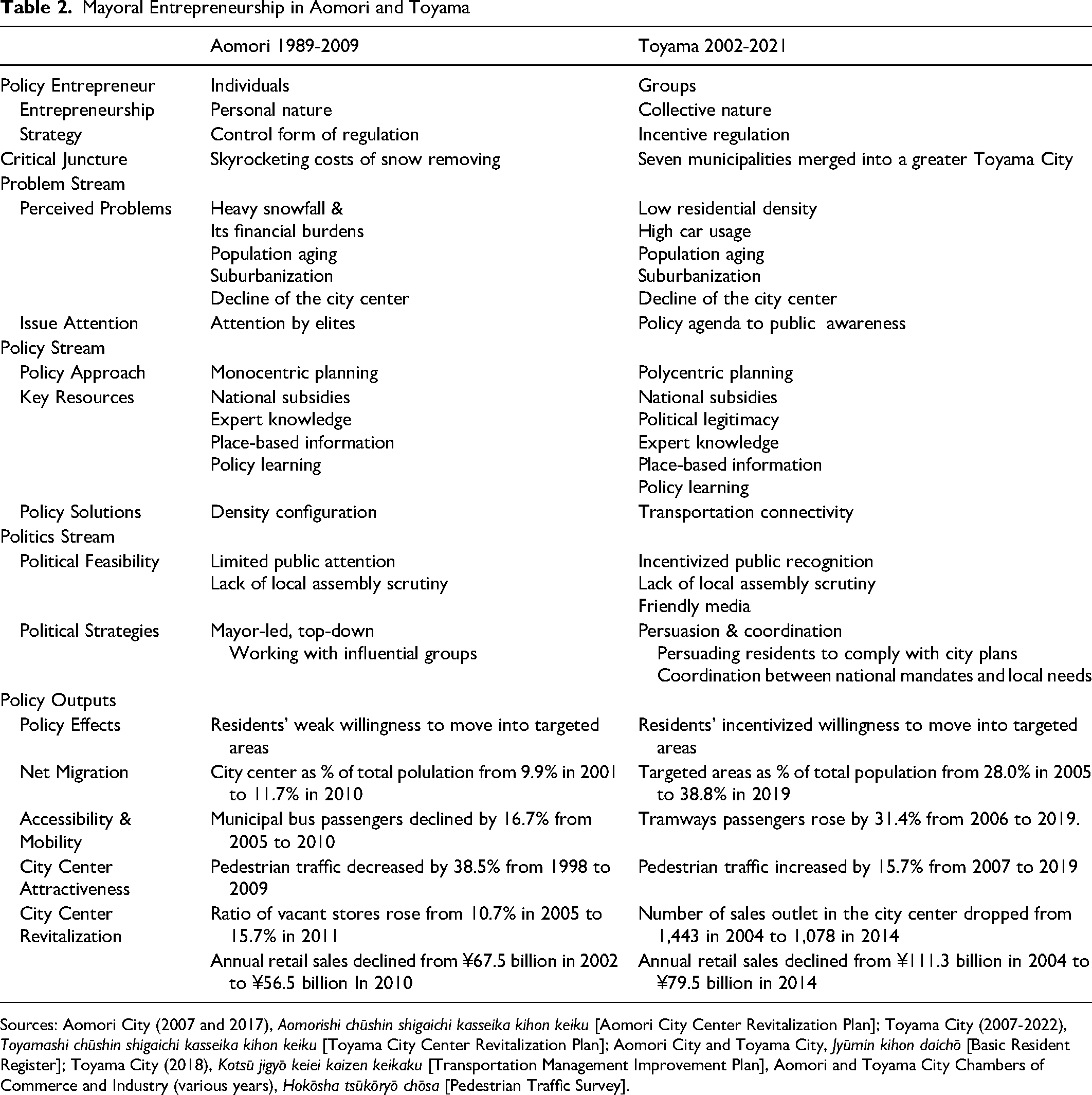
Sources: Aomori City (2007 and 2017), Aomorishi chūshin shigaichi kasseika kihon keiku [Aomori City Center Revitalization Plan]; Toyama City (2007-2022), Toyamashi chūshin shigaichi kasseika kihon keiku [Toyama City Center Revitalization Plan]; Aomori City and Toyama City, Jyūmin kihon daichō [Basic Resident Register]; Toyama City (2018), Kotsū jigyō keiei kaizen keikaku [Transportation Management Improvement Plan], Aomori and Toyama City Chambers of Commerce and Industry (various years), Hokōsha tsūkōryō chōsa [Pedestrian Traffic Survey].
Mayor as a frame producer. There are the different ways in which issues enter the agenda. In both Aomori and Toyama Cities, the issue of urban sprawl initially lacked attention from both the news media and local residents, causing it to be overlooked on the public agenda. Conversely, Toyama Mayor Mori took the initiatives to formulate a course of action, framing it from the policy agenda to the public agenda for successful implementation. Aomori Mayor Sasaki also initiated to get the issue on the policy agenda, but as a frame producer, he made limited efforts to raise the issue's profile on the public agenda.
Understanding the long-term implications of urban sprawl and urban compactness as viable solutions requires specialized expertise. This indicates that local mayors, equipped with policy expertise not widely shared or easily acquired, are better positioned to shape the agenda in policy-issue areas where they possess privileged knowledge. However, in Japan, the majority of local governments affected by urban sprawl do not seem to consciously pursue a policy model for compact city development. Therefore, the mayor's skill, drive, and exercise of discretionary power, along with their core beliefs regarding policy coordination, become crucial ingredients in a city's ability to address the challenges posed by urban sprawl.
Mayoral entrepreneurship with place-based knowledge. Mayor Mori successfully made use of place-based knowledge, making it technically and operationally feasible to propose solutions for the issues of low residential density and high car usage in Toyama. Toyama-type compact town development aimed to create a city structure based on clusters consisting of walkable areas connected with each other through a public transit system. This approach effectively utilized the merger of seven cities and towns, optimizing the use of multiple centers.
Likewise, Mayor Sasaki of Aomori drew on the city's experience of being designated as a specially heavy snowfall area to guide the targeting of compact city development efforts. During winter, heavy snowfall in Aomori City led to numerous problematic roadblocks and exerted a heavy strain on the city's finances. To address this, the primary idea was to avoid further expansion of the urban area and instead focus on creating a single central area. Thus, place-based knowledge, particularly in the policy area of compact city development, provides policy makers with an opportunity to propose policy solutions to these challenges.
Command-and-control regulation or incentive-based regulation. To transform their policy initiatives into actionable decisions, the mayors in this study acquired a range of resources, such as ample staff support, national subsidies, media coverage through newspapers for publicity, and a supportive environment within the local assemblies. Moreover, the consent of citizens affected by the proposed policy ideas was essential to the effective implementation. Mayor Mori advocated for his policy ideas using the tagline “responsibility for persuasion,” encouraging citizens to willingly embrace and adhere to his proposed initiatives. By contrast, Mayor Sasaki primarily worked with influential groups, especially the Aomori Chamber of Commerce and Industry, at critical times for his policy ideas to emerge.
As a method for progressing with compact town development, the main difference between the two cases is that Mayor Sasaki deployed a large part of problem solutions through a control form of regulation to the targeted stakeholders, whereas Mayor Mori devoted his energy to an incentive regulation approach that was in use to induce the targeted residents and businesses by offering rewards to desired goals. Regulatory rules, which were unilaterally dictated by local authorities against specific actors, could reduce the feasibility of compliance and undermine political legitimacy deriving from popular consent to their action. Incentive regulation could help to elicit popular consent to their action. Indeed, Mori's use of financial incentives, not penalties, played a positive role in motivating residents and businesses to participate in the planned patterns of intra-urban migration. This observation boils down to the assertion that the successful implementation of compact city policy largely depends on the affected citizens’ willingness to move into targeted areas.
The impact of mayoral entrepreneurship is naturally contingent upon certain prerequisites, including political structures that determine the variation of individual actors’ behavior, as well as the unique opportunities presented by specific issues, which can significantly differ across various policy areas. Further research is imperative to gain a more comprehensive comprehension of the causal implications of mayoral entrepreneurship, both within the specific policy contexts of compact city development and from a cross-national standpoint.
Footnotes
Declaration of Conflicting Interests
The author declared no potential conflicts of interest with respect to the research, authorship, and/or publication of this article.
Funding
The author received no financial support for the research, authorship, and/or publication of this article.
