




Abstract
The COVID-19 pandemic was one of many global challenges localities have contended with over the past few decades. In response to such global pressures, economic development practitioners are tasked with safeguarding their localities’ economic and social well-being. But little is known about how these types of shocks and challenges have influenced overall economic development practices and planning. To address this question, we conducted in-depth interviews with thirty-seven local economic development practitioners from Ontario, Canada. We find that practitioners, in their bounded autonomy, push back against global forces such as the COVID-19 pandemic in an attempt to safeguard their localities. Further, the findings show that over the last three years a shift occurred in nearly all parts of local economic development – from greater emphasis on human capital, to changes in what sectors of local economies are favored and targeted, to alterations in the day-to-day work occurring within local economic development offices.
Introduction
How do you manage a local economy in the face of external—and often global—pressures? And what happens when there is a “shock to the system”? Can communities shape their economy and destiny? Or are they carried along—like leaves on a stream—by external pressures? These are questions that local officials in most advanced economic regions have grappled with, becoming more pressing since the emergence of COVID-19. As such, we use the case of COVID-19 to examine how economic development practitioners are influenced by local pressures and how they respond. COVID-19 presents an interesting case study, as it was simultaneously a series of external shocks caused by the pandemic, government responses, and economic collapse, but also a longer series of global pressures pushing down on local communities. Pushing back were economic development practitioners who are empowered by their municipalities to make decisions for their communities.
COVID-19 has been extensively examined at the macro level, where the economic impacts are well understood. The International Monetary Fund (2020) noted that the economic crisis emerging from the COVID-19 pandemic was the most severe crisis since the Great Depression. The Organization of Economic Co-operation and Development (2021) found that due to the crisis, the global economy in 2020 contracted by 3.5 percent. The effects of COVID-19 on Ontario and Canada are reflective of other economic areas, as globally the severe and deep impacts of the pandemic produced a global health crisis in 2020 and an economic crisis following that (Gong et al. 2020; Kang et al. 2020). In the Canadian context, the Province of Ontario—the country's largest economic region—was one of the hardest hit areas. In 2020, the province experienced a decline in the real gross domestic product of 5 percent, and had the lowest rate of active businesses and the second lowest employment levels in Canada relative to pre-pandemic levels (Government of Canada 2021). As with other regions, Ontario's provincial government instituted a series of lockdowns (i.e., public health responses) between 2020 and 2022, while travel and trade restrictions were implemented by the federal government. These impacts of the pandemic, the economic crisis, and government responses manifested at the local level and it was local governments and their economic development practitioners who were forced to shepherd their communities through the crisis (see Hall and Vinodrai 2021; Sutton, Lambert, and Arku 2022).
Evidence exists on local policy responses to COVID-19. From a policy standpoint, “economic development policies and activities implemented collectively have assisted businesses with their operating costs (supply) or attempted to increase consumer spending to the businesses (demand)” (Wilson et al. 2020: 862). During the pandemic, economic development efforts trended toward “stabilizing existing businesses by increasing demand for business products and services, rather than just mitigating costs” (Johnson et al. 2022: 175). Johnson et al. (2022) and Sutton, Arcidiacono, et al. (2023), Sutton, Arku, and Oosterbaan (2023), Sutton, Arku, and Sadler (2023) also identified greater collaboration both between jurisdictions and between the public and private sectors, while Vik, Curtis and Dayson (2023) highlighted the shift toward online service delivery. Finally, Hall and Vinodrai (2021) identified a number of key strategies adopted by rural communities in Canada, including business outreach and “buy local” campaigns.
Past research has focused primarily on the macro-level effects of COVID-19 and specific economic development strategies and policy responses to the pandemic. What is absent is an exploration of the middle ground—how these types of shocks and challenges have influenced overall economic development practitioners’ perspectives, practices, and planning. In other words, how have such crises influenced “big picture” issues of local development? To address this lacuna, this paper explores the research questions:
In doing so, rather than focus on policy, this research considers the context in which local economic development practitioners perceive themselves to have operated in over the past several years, how these have impacted the “big picture” aspects of local economic development (i.e., planning and strategy/focus), how this has affected practitioners’ work, and where practitioners felt they were able to make tangible change in their community.
To do so, this paper conducts in-depth interviews with thirty-seven practitioners in Ontario, Canada. Such qualitative studies are important because they provide insight into the qualitative effects of events that quantitative methods cannot adequately capture (Gong and Hassink 2020). Further, practitioners’ perspectives and actions are important to examine as they are tasked with guiding the economic development of municipalities and are intimately connected with many actors in local economies. The interview findings can also inform policy responses to future crises at various levels of government and provide insight into where recovery efforts should be placed, especially regarding economic development initiatives.
Context: The “Local” in Local Economic Development
Events such as the COVID-19 pandemic have periodically plagued municipalities globally, having severe economic impacts and even steering the course of history in some instances (see Chen et al. 2011; Florida, Rodríguez-Pose, and Storper 2021; Glaeser 2022; Hak, Meijboom, and Buskens 2006; Smith, Keogh-Brown, and Barnett 2011). Beyond COVID-19, it is well understood that local economies face pressures from various external sources (Sutton and Arku 2022a). Communities and their local governments do not exist in a vacuum but instead in constant tension with external forces that exert influence and shape economic landscapes, influencing how local governments plan and manage their jurisdiction (Cleave, Arku, and Chatwin 2017; Sutton, Cleave, et al. 2022; Sutton, Lambert, and Arku 2022). These can be broad forces (i.e., globalization, deindustrialization, liberalization of trade, changes in the behavior of upper levels of government) or acute events (i.e., natural disasters like Hurricane Katrina, the terrorist attack of 9/11, pandemics including SARS in 2002/2003 and COVID-19, the 2008 financial crisis, major industrial plant closures) but all have tangible impacts on communities and their economies (Bristow and Healy 2018).
Within this context, responsibility for generating local economic growth has increasingly been assigned to local municipal governments (Arku 2014; Cleave, Arku, and Chatwin 2017). Four decades of neoliberal governance have redefined the roles of local government. Cities and other contemporary urban centers have experienced political-economic, social, and spatial restructuring (Brenner and Theodore 2002; Peck 2002), and within the contemporary capitalist system have become the sites of capital accumulation (Doel and Hubbard 2002; Swyngedouw 1997). This re-scaling of power has led to “changing political-economic power relations, transformations in institutional capacities, and shifts in the parameters of political agency” (Peck 2002, 332). Within the context of local economic development, this change has meant reduced financial support from upper levels of government, as well as a continual downloading of policy responsibility.
Local Economic Development and Its Practitioners
Within this broader context, local economies are still managed. City officials—economic development practitioners in particular—are tasked with developing and implementing strategies that not only strengthen the local economy but also enhance the well-being of their communities (i.e., social well-being and quality of life) (Arku 2015; Bowman 1988; Leigh and Blakely 2017). As Arku (2014, 99) argues, “officials strive to attract and retain economic enterprises to promote the economic and fiscal health of their communities and to improve the tax base, which local governments rely on heavily to provide municipal services.”
To achieve such objectives, practitioners often employ an array of techniques and tools (Arku 2015; Leigh and Blakely 2017; Rubin and Rubin 1987). Achieving these objectives is difficult, however, as practitioners face internal and external challenges. Internally, practitioners must deal with factors such as limited capacity, lack of resources, aging infrastructure, and geographic remoteness in their economic development efforts. Practitioners have also contended with external challenges, such as economic restructuring and intensifying global competitive pressures (Cleave, Arku, and Chatwin 2017; Leigh and Blakely 2017; Taabazuing, Arku, and Mkandawire 2015). To address the various internal and external challenges that have arisen over time, practitioners’ economic development initiatives have evolved (Arku 2015; Arku and Oosterbaan 2015; Bradford 2010; Sutton, Lambert, and Arku 2022), shifting from “shoot anything that moves; claim anything that falls” approaches to more strategic and long-term approaches (Cleave, Arku, and Chatwin 2017; Rubin 1988). In fact, a common theme within the contemporary economy is a call for local governments to evolve from ad hoc and reactive planning to more proactive and comprehensive approaches.
Practitioners are at the center of economic activities in municipalities. They attempt to carry out the economic development visions and goals of politicians and councils as well as attempt to satisfy the needs of (potential) local businesses (Rubin 1988). Furthermore, practitioners frequently interact and collaborate with local communities and social groups on various projects (Leigh and Blakely 2017; Sutton, Cleave, et al. 2022). Simply put, the connectedness of practitioners with their local economy is reflected in that much of their work tends to be collaborative in nature with other local actors (Sutton, Arcidiacono, et al. 2023; Sutton, Arku, and Oosterbaan 2023; Sutton, Arku, and Sadler 2023).
Local Economic Development and Dealing with Disruptions
In the economic context, crises result from sudden or slow-burning disturbances that disrupt localities’ economies (Pendall, Foster, and Cowell 2010). Crises can be produced by endogenous or exogenous events (Sutton, Arcidiacono, et al. 2023). Over the last several decades, municipalities have become increasingly vulnerable and susceptible to external events due to the increased globalization of the world economy, resulting in the deepened functional integration and increased interconnectivity of economies (Dicken 2015; Ringwood, Watson, and Lewin 2019). Therefore, akin to the butterfly effect, municipalities can experience crises produced by external events (Zolli and Healy 2012). Crises, by their very definition, have adverse impacts on municipalities’ economies and the livelihood of their residents (Bristow and Healy 2020; Martin 2012; Sutton and Arku 2022b).
Aside from the immediate adverse impacts, the impacts stemming from crises can have long-term negative effects or provide an opportunity for growth and development. Municipalities that respond negatively to crises can experience a permanently less favorable long-term growth trajectory; the reverse is also true (Martin 2012; Romer 2001; Sutton, Arcidiacono, et al. 2023). In this regard, crises can be a “blessing in disguise,” providing a window of opportunity for municipalities to enhance their long-term growth path if they are able to adapt their economy (Banica, Kourtit, and Nijkamp 2020). For instance, when examining the impact of natural disasters on localities worldwide since 1990, Banica, Kourtit, and Nijkamp (2020) found that crises can have positive long-term effects, such as increased income per capita, improvement of infrastructure, and technological upgrading. Along similar lines, crises can be equated to what Schumpeter (2013) calls “gales of creative destruction,” in which old and outdated forms of production are forced to close and supplanted by new and more innovative forms of production. When investigating the impact of several severe crises faced by Boston from 1630 to 2003, Glaeser (2005) notes that the city's long-term urban health and increased economic success result from the city's ability to successfully and repeatedly respond to crises by engaging in new and competitive industries. In particular, Glaeser (2005) attributes Boston's continued success following several crises to its ability to adapt, resulting from its abundance of human capital (i.e., skilled labor and entrepreneurialism).
Study Area: Ontario, Canada
Ontario is Canada's main economic region (population 15.8 million, 39.0 percent of Canada; Statistics Canada 2023b), generating approximately 38.7 percent of the national gross domestic product (Statistics Canada 2023a). The Province of Ontario and its municipalities represent a suitable study site for several reasons: (1) from a political and economic perspective, Ontario is similar to many other advanced economic regions; (2) COVID-19 significantly impacted the province; and (3) interventions from upper levels of government have impacted how local governments approach managing and developing their communities.
More specifically, Ontario is an advanced political-economic region, facing many of the same issues as other places (i.e., the USA, Western Europe, and Australia). Along with a changing economy, a devolution of power and decision-making forces local governments to be more active in managing economies. In the case of COVID-19, the Government of Ontario demonstrated a willingness to be active and interventional, with policy decisions directly impacting local economies and the lives and livelihoods of residents in the province. Beyond the COVID-related context, local economic development efforts in Ontario exist within a tension between greater local responsibility and stringent upper-level government control, providing an opportunity to unpack local economic development efforts while still considering the context in which they occurred.
Additionally, situating this study in a single political region is beneficial as it allows for control of broader social and political issues, macro-level institutional restrictions, and the general economic development climate. In other words, examining a single political region allows differences detected within the research to be more readily attributed to local variability.
Pre-Crisis Economic Context and Issues
Like many other localities globally, Ontario has been experiencing economic restructuring for several decades. This includes shifting away from traditional industrial activities—punctuated by plant closures and the erosion of manufacturing—toward knowledge-based and advanced manufacturing. Globalization, the 2008 financial crisis, and rising energy costs were key drivers of this deindustrialization (Arku 2015; Cleave, Arku, and Chatwin 2017; Ray et al. 2017). The outcome was a contraction of the manufacturing and industrial sectors, with almost 300,000 jobs lost between 2000 and 2019 (Cleave et al. 2019).
The province has also been experiencing a housing crisis, with housing costs rising sharply, by 75 percent between 2014 and 2020 (Canadian Real Estate Association 2023). The housing crisis tends to be centered in Toronto, where costs outstripped increases in income (i.e., 2006–2018, median household income grew 30 percent, and average home ownership costs grew 131 percent; Canadian Centre for Economic Analysis 2019). Pre-COVID-19, the rising costs began re-orientating the provincial economy, with talent initially migrating from core urban areas like Toronto into smaller cities and more peripheral areas (Marowits 2019). This outflow was characterized by white-collar workers who could work remotely, as the overall capacity for remote work was low in the province (Clarke and Hardy 2022).
Simultaneously, local economic development practitioners in Ontario have been forced to take more holistic perspectives on the bounds of their responsibilities, such as focusing on service delivery and quality of life (see Arku 2015; Cleave, Arku, and Chatwin 2017). This more holistic consideration of the local economy and its tendrils through all parts of the community is due to changes in the political-economic context in which cities in advanced economies (i.e., Canada, Australia, the United States, and Western Europe) operate.
Within Ontario's political-economic landscape, local governments experience greater autonomy but only within narrow bounds (i.e., bounded autonomy). While political responsibility has continuously been downloaded from upper-level governments onto municipalities over the past several decades (Bourne et al. 2011; Cleave, Arku, and Chatwin 2017; Donald 2005), most local governments are forced to operate within tight legislative bounds (Gertler 1990; Reese 1993). This administrative control stems from the fact that, cities in Ontario are “creatures of the provincial government” (Sancton 2000). Through the province's Municipal Act, the provincial government defines the bounds of local action through legislative restraints that define the scope of local power. Relevant to this study, the province holds an array of historical institutional controls that define the tools available to municipalities in the area of economic development. Consequently, local economic development in Ontario is paradoxically both more proactive and more controlled (Cleave, Arku, and Chatwin 2017). Because of the changing economy and the political influence of the provincial government, local economic development practitioners in Ontario, in their bounded autonomy, have become more creative and proactive in how they operate to overcome external pressures and shocks. In many regards, Ontario is further along this path than other advanced economies.
Exploring the Impacts of COVID-19 in the Province of Ontario, Canada
Despite having the third lowest case rate of any province/territory, Ontario, and its economy, was severely impacted by the COVID-19 pandemic (Statistics Canada 2024). Figure 1 shows the economic impact of the pandemic on Ontario, which took hold in March 2020. Ontario experienced a sharp decline in employment of 706,600 from the first shock (March to April 2020), 167,200 from the second shock (December 2020 to January 2021), 136,500 from the third shock (March to April 2021), and 148,800 from the fourth shock (December 2021 to January 2022). The four major shocks experienced by Ontario since the beginning of the pandemic make this crisis unique in its length and in the multitude of shocks that comprised it compared to other crises the province has experienced over the past century. Despite the shocks experienced, Ontario in 2023 re-gained and surpassed its pre-pandemic employment levels.
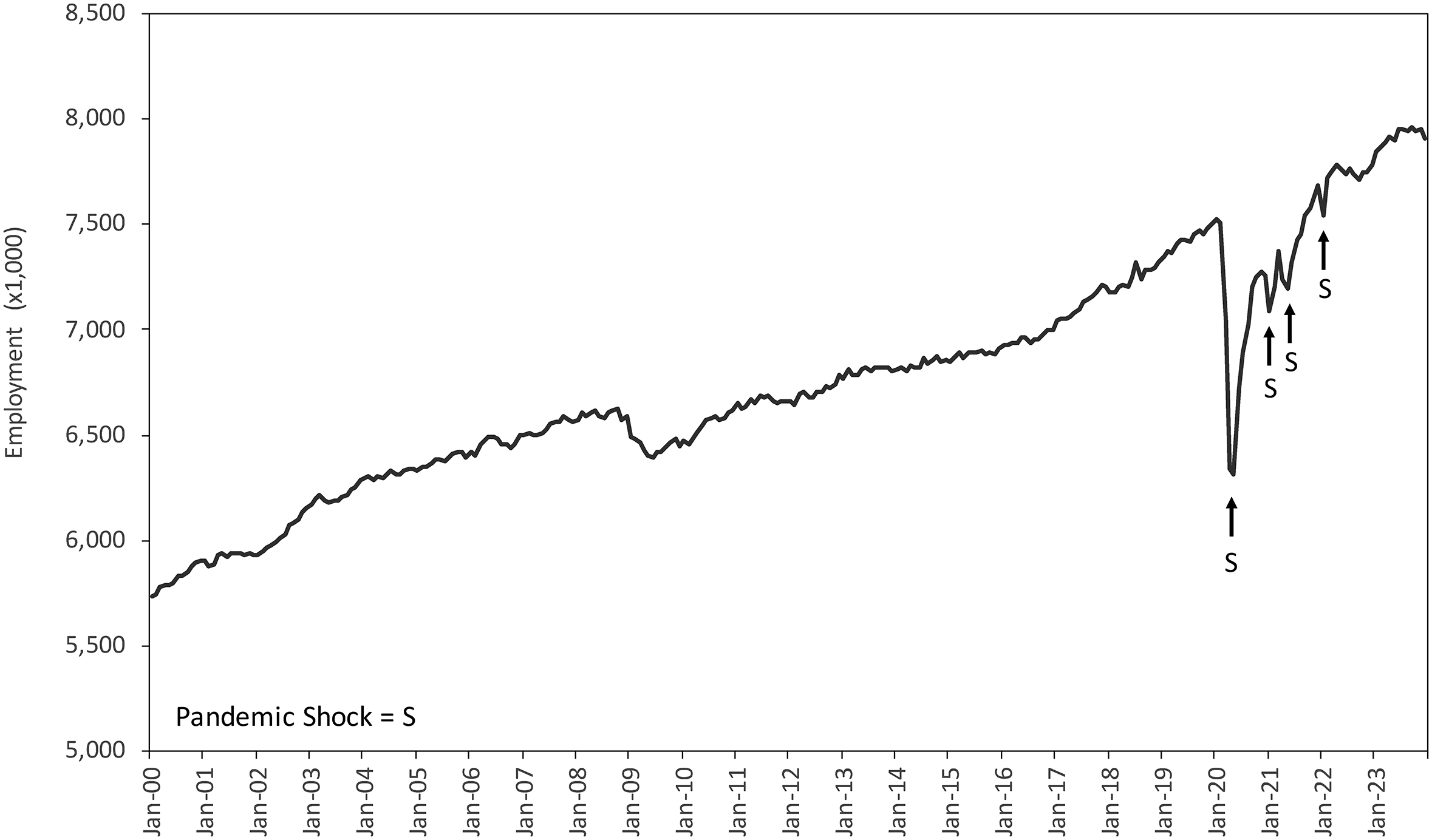
Ontario's employment trend, January 2019, to December 2023.
In an attempt to soften the economic impact, financial support programs were implemented at all levels of government to assist businesses and people during the pandemic and economic crisis. These included the Small Business Relief Grant by the Provincial government, and the Canadian Emergency Response Benefit and the Canadian Emergency Business Account by the Federal government.
Timeline of COVID-19 in Ontario, Restrictions, and Effects
Ontario had a unique policy response to the pandemic when compared to other provinces, such as British Columbia and Alberta, and nearby USA states, such as Michigan. In particular, Ontario imposed more restrictive measures on their residents during the pandemic. For example, Ontario “ordered” their residents to stay home during several provincewide lockdowns (Cameron-Blake et al. 2021) and even strengthened their enforcement measures in April 2021 to ensure compliance (Ontario Government 2021). Meanwhile, British Columbia and Alberta simply “recommended” or “urged” residents to stay home when they declared a public health emergency or implemented lockdown measures (Cameron-Blake et al. 2021). Despite implementing some more restrictive measures (e.g., business closures) at the start of the pandemic, the Michigan Supreme Court ruled that such measures were unconstitutional and thereafter, only less restrictive measures (e.g., social gathering capacity) were implemented (Michigan State University, n.d.).
Furthermore, Ontario's policy response during the pandemic was more ad hoc. For instance, residents in Ontario experienced lockdowns whenever COVID-19 cases spiked (Cameron-Blake et al. 2021; Nielsen 2021). In contrast, British Columbia and Michigan implemented their most restrictive measures at the beginning of the pandemic and slowly lifted restrictions as the pandemic ensued, while Alberta was altogether reluctant to impose any restrictions on its province, as it took a pro-business and less public health-focused attitude “grounded in personal accountability” (Cameron-Blake et al. 2021; Michigan State University, n.d.).
In March 2020, the first case of COVID-19 was reported in Ontario. Between 2020 and 2022, COVID-19 spread like “wildfire”. The Provincial government closed all public schools in the province on March 12, 2020, and declared a state of emergency five days later. The first provincewide lockdown was announced on March 23, 2020, and extended until November 20, 2020, requiring businesses to close. Starting May 4, 2020, businesses (primarily essential services) were progressively allowed to open as COVID-19 cases decreased. However, non-essential businesses, especially those in the service and tourism sectors, remained closed or heavily restricted to contain the spread of the virus (Nielsen 2021).
On September 28, 2020, the Premier declared that the province was experiencing a second pandemic wave. As the pandemic progressed, the province created a five-tiered, color-coded system that applied various degrees of restrictions on regions based on case rates in their area. Regions experienced rapidly changing restrictions as they fluctuated through the tiers of the new system, resulting in businesses experiencing a turbulent economic landscape of cyclical closures and openings. The Premier announced the second provincewide lockdown on December 21, 2020, including a stay-at-home order for four weeks in Southern Ontario and two weeks in Northern Ontario (Nielsen 2021; Ontario Government 2020). On February 16, 2021, the lockdown was finally lifted, except for some regions such as Toronto, York, and North Bay-Parry Sound, with regions returning to the five-tiered, color-coded system. Again, regions were subjected to periodic lockdowns, causing businesses to close in an attempt by the province to contain the spread of the virus (Nielsen 2021). Due to their frequency, periodic lockdowns became known as “rolling lockdowns.”
The Premier announced an “emergency brake” on April 1, 2021, in response to a third wave of COVID-19 and six days later declared a state of emergency and implemented a stay-at-home order, thus signalling the third provincewide lockdown (Nielsen 2021; Westoll 2021). Five months later, in September 2021, a fourth lockdown was initiated in response to another wave of COVID-19 (McKenzie-Sutter 2021). Although not a provincewide lockdown, on January 5, 2022, numerous businesses, such as those in the retail and service sectors, were forced to close again due to the increasing spread of the omicron variant (Ontario Government 2022), with restrictions being progressively lifted over time. Overall, the province of Ontario has experienced four waves of the pandemic and three provincewide lockdowns with periodic closures of regions and sectors due to a high number of COVID-19 cases.
Methods
To evaluate how local economic development practitioners interpreted COVID-19, in-depth interviews (n = 37) with practitioners from municipalities (n = 35) across Ontario were used (Figure 2). This qualitative approach is a well-established approach to studying local economies (Arku 2014; Rubin 1988). Using a qualitative methodology allows for a comprehensive interrogation of COVID-19 and local economic development, generating deep insights into economic development practitioners’ experiences, knowledge, and perspectives. The approach used for this study complements existing COVID-19 research that was survey-based (see Hall and Vinodrai 2021) or focused on a single community (see Johnson et al. 2022; Wilson et al. 2020) or at a national level (see Hall and Vinodrai 2021; Hermelin and Persson 2022). This study also focuses on the context and impacts of economic development work rather than specific strategies local governments adopted (see Sutton, Arcidiacono, et al. 2023; Sutton, Arku, and Oosterbaan 2023; Sutton, Arku, and Sadler 2023; Sutton, Cleave, et al. 2022; Sutton, Lambert, and Arku 2022; Wilson et al. 2020).
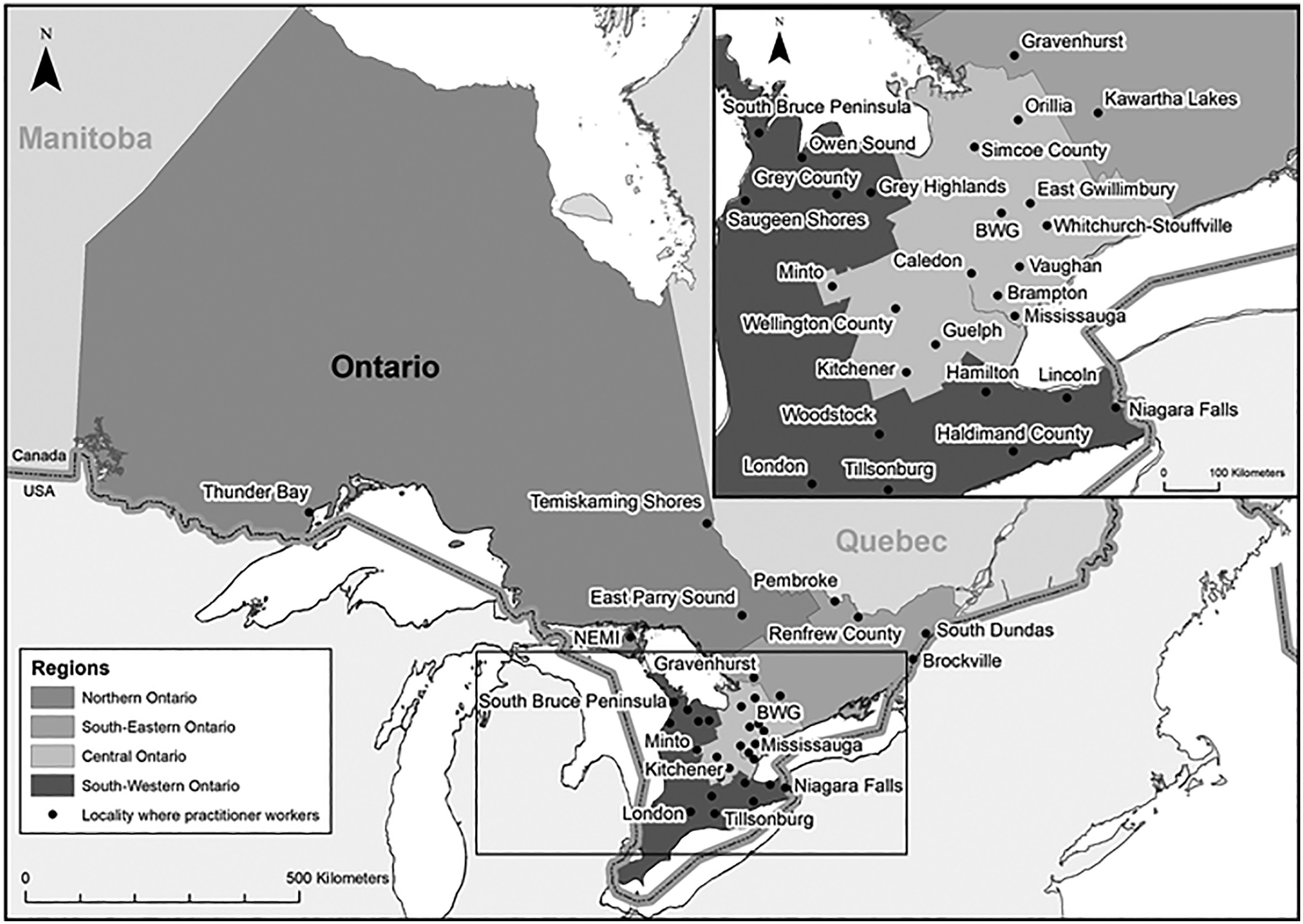
Location of practitioners interviewed.
Study Participants
Interviewees were all local practitioners (i.e., directors, managers, and senior staff) who work directly in economic development positions for their municipalities. These participants were selected for the interviews due to their experience, level of responsibility, position, and knowledge of their local economy during the COVID-19 pandemic, as well as the broader issues surrounding their economies and local economic development in general. Simply put, practitioners provide great insight into their communities and local COVID-19 responses as they are highly integrated into almost every facet of their locality.
Over 50 invitations to join the study were sent. The invitations were strategically sent to practitioners from diverse geographic locations and municipal sizes, with the intent to gain a representative sample of the different regions within the province. To maximize diversity, one practitioner per municipality was targeted. After the thirty-fifth interview, content saturation was reached as well as a representative sample was developed. On two occasions, an additional practitioner from the same office joined the interview. While 35 municipalities were represented, 37 total practitioners were included in the study. The interviewed practitioners worked in a diverse array of municipalities (summarized in Table 1). These included participants from four upper-tier municipalities (i.e., regional governments that have local governments beneath them, for example, counties), lower-tier municipalities (i.e., local governments integrated into a regional government; generally, towns and townships), and single-tier municipalities (i.e., local governments with no regional government above them; typically, cities). The interviewed practitioners came from a range of municipalities based on population size (13 practitioners from large municipalities with populations above 100,000; 9 from medium municipalities between 30,000 and 100,000; and 13 from small municipalities below 30,000 people. This categorization is based on Statistics Canada Population Centre Classifications).
Demographics of Practitioners’ Municipality.
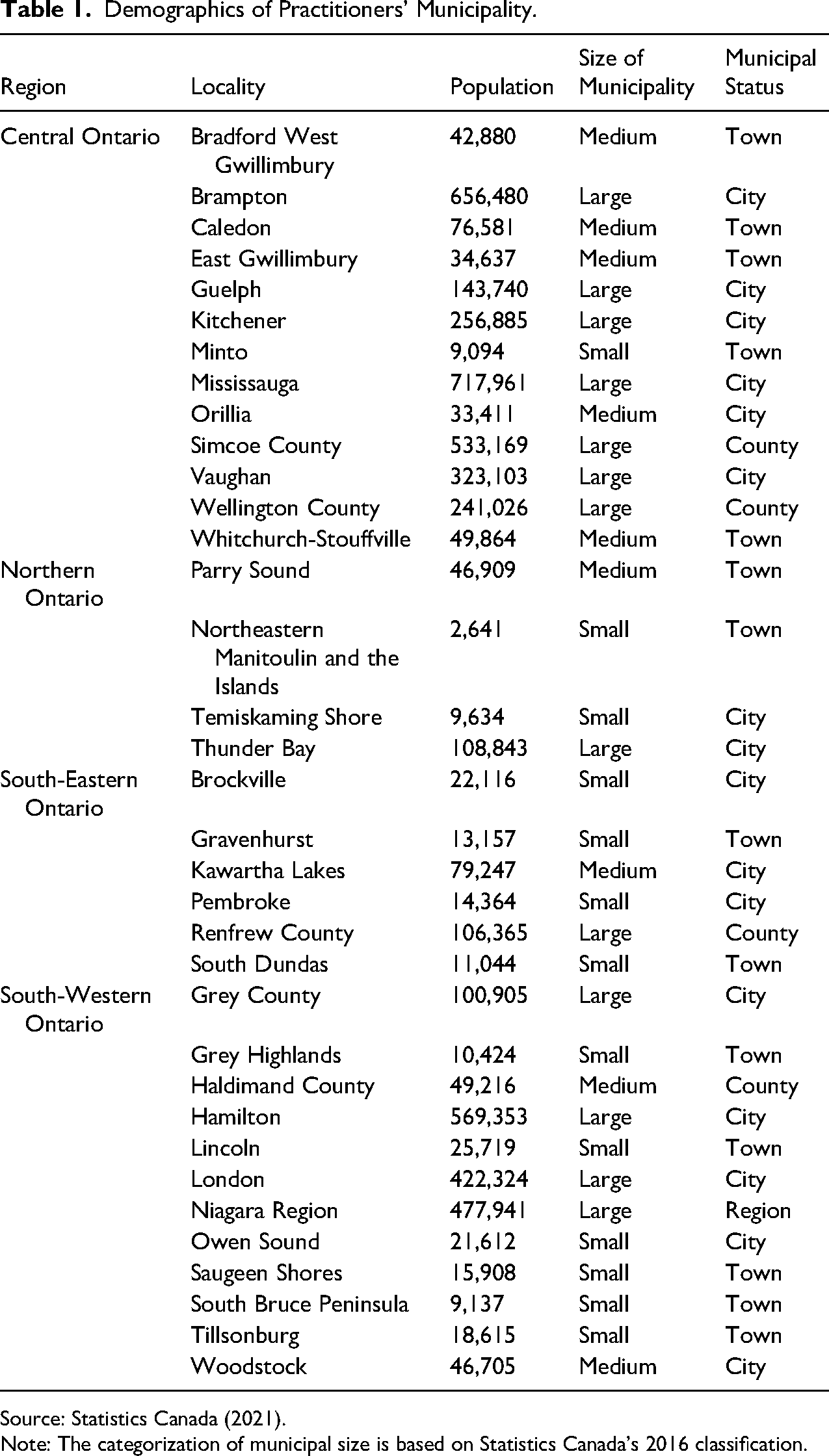
Source: Statistics Canada (2021).
Note: The categorization of municipal size is based on Statistics Canada's 2016 classification.
Finally, the geographical location of participants and the municipalities they represent were dispersed throughout Ontario, with a heavy concentration in South-Western and Central Ontario, reflecting the distribution of the province's population. Besides four practitioners working in municipalities in Northern Ontario (i.e., Thunder Bay, Timiskaming Shore, East Parry Sound, and Northeastern Manitoulin and the Islands), all the practitioners worked in Southern Ontario (Figure 2).
Data Collection and Analysis
The interviews were semi-structured, with practitioners being asked open-ended questions. To allow for more in-depth and comprehensive answers, practitioners were provided with the interview questions before being interviewed. Interviews were conducted over Zoom by a single researcher and were audio recorded. The interviews ranged from 38 to 83 min in length, with an average interview duration of approximately an hour. Using NVivo software, the interviews were transcribed verbatim and thematically analyzed by three researchers. Codes were developed based on the research objectives and the data, which were vetted line-by-line. This coding process is considered the most appropriate for context analysis (Clifford and Valentine 2003; Strauss and Corbin 1990). Two researchers inspected the transcripts and codes to ensure their accuracy and reliability.
A grounded and inductive approach was employed to analyze the data. In particular, the evaluation criteria of credibility, transferability, dependability, and confirmability were employed to ensure qualitative rigor in analysis. These evaluation criteria ensure qualitative research demonstrates an “authentic representation” of interviewees’ experiences while moving beyond their experiences and situating them in a larger context with certainty (Baxter and Eyles 1997). The paper's research objective guided the interviews.
Findings
Analysis of the interviews with local economic development practitioners provided insights into how COVID-19 influenced their jobs—in terms of overall approach, areas of focus, and planning. Since local economic development practitioners in Ontario's municipalities are tasked with ensuring their community's economic well-being (i.e., supporting residents and businesses), this group provides valuable insight into local government efforts.
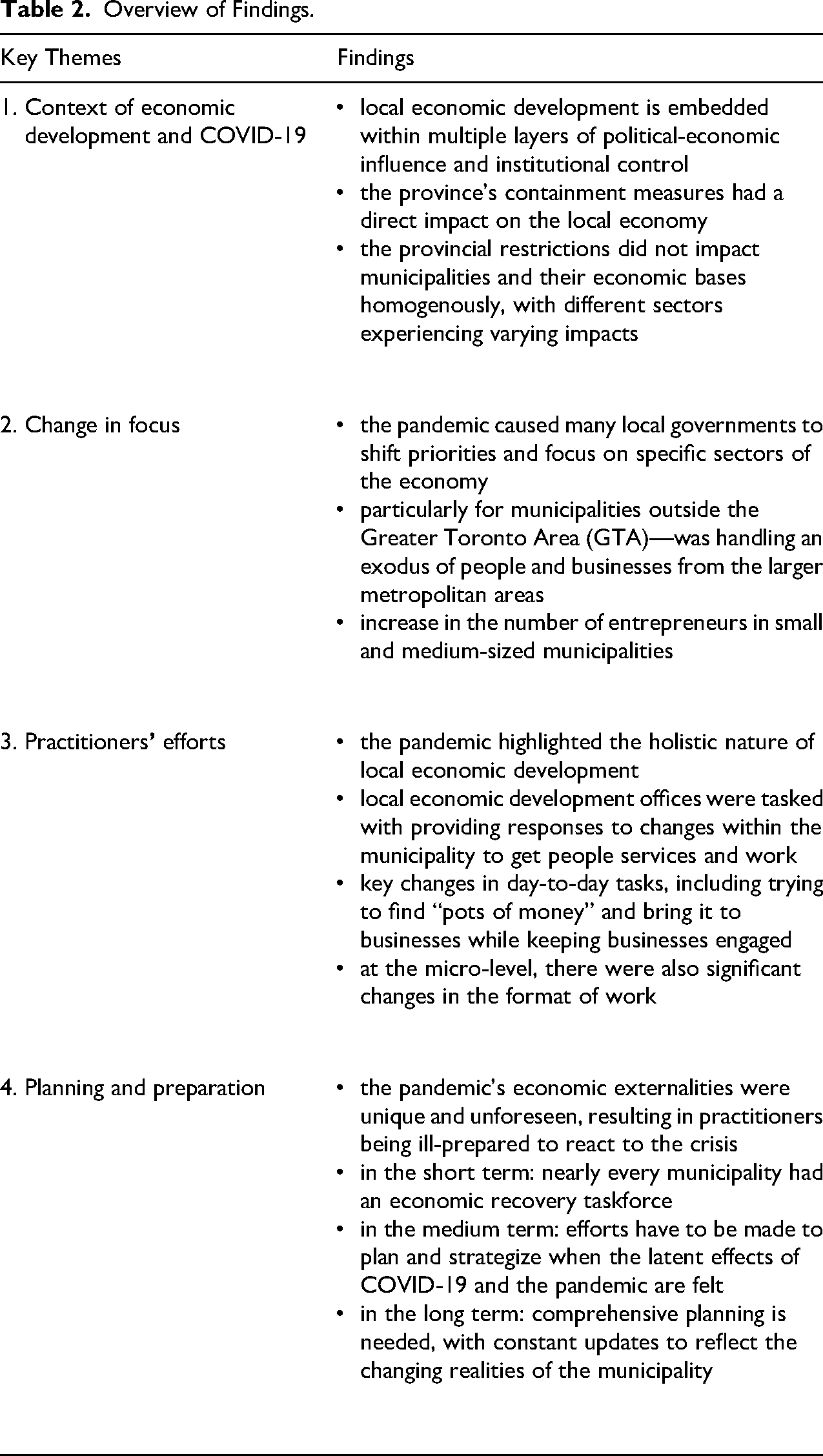
Four key themes emerged from the interviews (n = 37) and structured the presentation of practitioners’ perspectives. The first theme is the Context of Economic Development and COVID-19 and provides insight into how the practitioners contextualized what has happened since spring 2020 (answering RQ1). The second organizing theme that emerged—Changes in Focus—incorporated macro-level changes that forced local governments to make changes in their “broader” economic development efforts due to a rapid change in the local context (also answering RQ1). The next theme, Practitioner Efforts, considers how COVID-19 and the resulting economic issues impacted practitioners and what was done to counteract the external forces pressing on their communities (answering RQ2). The final theme, Planning and Preparation, considers the way that municipalities and their governments have been positioned to deal with economic crises, including those spurred by COVID-19, and how that has changed in the intervening period (answering RQ3). Intertwining all four organizing themes are challenges, opportunities, and lessons learned (see Table 2 for a summary of findings).
Overview of Findings.
Throughout the results, the practitioners’ perspectives are anonymized and referenced numerically from 1 to 37, with the prefix “P” for practitioner.
Context of Economic Development and COVID-19
A key question of local economic development is whether local governments have any real control over their economy or if they are swept along by larger political and economic forces. Emerging from practitioner responses, it is clear that despite greater local autonomy and responsibility, local economic development is embedded within multiple layers of political-economic influence and institutional control. The pandemic reinforced how embedded communities in Ontario are within the global economy. As one practitioner (P26) noted, a key lesson from COVID-19 was: Just our vulnerability to global issues … I didn't really know just how integrated we were … 100 billion dollars worth of goods transit our borders every year. But you don't really understand how that really impacts you fully until the borders close.
The negative impacts of the disruption of global supply chains on localities’ economies were most frequently noted by practitioners primarily from medium and large-sized municipalities, suggesting as urban centers grow and become more entrenched in the global economy, they become more exposed to external shocks and disruptions.
The provincial restrictions and periodic lockdowns—except for essential businesses like most of the health sector, public services, and some manufacturing—did not impact communities and their economic bases homogenously. As expressed by one practitioner, the “impacts were uneven across different sectors” (P04). For example, businesses in the tourism and service sectors (e.g., restaurants and hotels) were disproportionately affected by provincial containment measures, primarily due to social distancing restrictions. Another practitioner stated, “We lost about 90 percent of our tourism market in the first year” (P26).
Indeed, another practitioner dichotomized businesses into the “haves and have-nots,” differentiating those that benefited from the crisis and those that were adversely impacted. For instance, a practitioner noted that businesses in the real estate sector benefited as “sales for real estate are through the roof. You don't need to use incentives” (P17). A similar sentiment was identified as: “certain sectors like manufacturing actually did better during the pandemic, we actually grew jobs during the pandemic. Our exports actually grew by $2 billion in 2020” (P26). Construction also experienced exceptional growth during the economic crisis due to the exodus of people and businesses from the larger metropolises (such as the GTA) to small and medium-sized municipalities in Northern and Southern Ontario. One practitioner commented that “projections are now for this year … to go over $2 billion in annual building construction value,” resulting from the influx of people and businesses into their locality (P20). In summary, the pandemic caused many local governments to shift the “big picture” priorities and focus that underpinned their local economic development efforts.
Furthermore, the office sector was hit hard because provincial stay-at-home orders resulted in businesses in the professional and technical sectors working remotely, leaving offices—especially in municipalities’ downtowns—empty. The reduced presence of the labor force in downtown areas further compounded the effects on service sector businesses that relied on the foot traffic, as expressed by one practitioner, “800 employees are no longer shopping downtown or having lunch downtown, it has a huge impact” on local businesses (P03). The municipalities that specialized in vulnerable sectors—like the tourism and service sector—tended to be small-sized, thus typifying localities that were disproportionately impacted compared to medium and large-sized municipalities.
This is not to say that practitioners took a completely negative view of interventions by higher levels of government. This is reflected by one practitioner who stated, “I think a lot of [business closures were] mitigated by the temporary measures that were in place. I don't think we're going to see the full fall over for some time to come” (P07). Similar perspectives were common with respect to the Federal-level Canadian Emergency Response Benefit (CERB), which provided valuable influxes of resources and funding to those impacted by business closures. This, however, contains hidden risks, as practitioners explained that some businesses were unsustainable but kept afloat due to government funding (P30): the real impacts of COVID-19 on our business community are likely not to be felt or have likely not been felt yet. We're watching for what we call zombie businesses. Businesses who maybe weren't doing the greatest and have had the opportunity to access various federal, provincial and municipal funding sources. And that has sort of kept them going. And what is the impact of that going to be in the next couple of years? So, I think we're really going to start seeing the impact on our businesses over the next 12 to 24 months.
When financial support from various levels of government is withdrawn, then unsustainable businesses or those who have not adapted will close, with “zombie businesses” accounting for the bulk of businesses that will permanently close. In other words, governmental financial support programs may delay the crisis’s true impact, which will be revealed when funding ceases. Again, this provides evidence that local economies and the governments that manage them exist in a context where many pressures exist beyond their control. Therefore, practitioners must do their best to navigate the challenges as they arrive.
Beyond the global economic disruptions, much of the local economic development context emerging from the interviews was related to provincial institutional controls. Altogether, roughly 83 percent (29) of practitioners noted that the provincial government's containment measures directly impacted their local economy. 1 The impacts of COVID-19 and the need for public health interventions were inherently understood by consensus among the practitioners, regardless of their localities” size. But practitioners also saw the economic impact that morphed into the 2020 economic crisis as resulting from stringent policies implemented by upper-level governments that shut down most of the economy, except essential businesses. This was articulated by the practitioners, who noted that “the economy crashed artificially because of regulation” (P12). Another practitioner expressed that “the [provincial] government is the one that is screwing us here” (P02).
A key reason for these sentiments was the loss of autonomy felt within local governments, as they were forced to operate within vague or rapidly changing guidelines set by the province. The one practitioner (P25) articulated this as: It was also challenging with the provincial announcements and having no support. We felt helpless in that way. We knew there was a program there, but we couldn't implement them … it was a lack of knowledge about what was legal and what was illegal. It was a huge issue.
Rather than operating independently, the local governments were tasked with interpreting provincial policy and acting within those bounds. Many practitioners cited jurisdictional challenges and limited budgets they could not exceed—due to legislative controls—as making some responses more challenging. They therefore deployed programs and tactics that fit within a more constrained set of boundaries.
Changes in Focus
During the pandemic, local economic development practitioners were forced to operate in a rapidly changing economic environment. As noted with past pandemics, not all segments of the economy were equally affected, and outcomes were often unexpected and unplanned for.
Counterintuitively, the impact of the provincial containment measures has accelerated the exodus of people and businesses from larger metropolitan areas and included a much broader swath of the workforce compared to pre-pandemic (which was dominated by white-collar workers with high incomes). This was articulated by one practitioner who noted: “when you look at the strength of the housing market, it's extremely good. Much of it is the wave from the GTA finally hitting here and other parts of Ontario” (P13).
Municipalities outside the Greater Toronto Area (GTA) saw a substantial influx of people and businesses from larger metropolitan areas that suddenly had to be supported. Practitioners noted the exodus of people and businesses from GTA was driven by two key factors: a “hot” real estate market and greater capability of remote work across a wide range of sectors. Migration ensued from large to medium- and small-sized municipalities. One practitioner commented, “we've had a lot of people move in from the GTA … a lot of them are now working from home” (P21).
The influx of people and businesses became a pressing focus for local governments dealing with challenges that emerged due to the lack of housing and employment land (i.e., available or serviced land). Many municipalities could not fully capitalize on the mass exodus from the larger metropolis, in terms of growth in the number of businesses or labor supply. Concerning their lack of available land, one practitioner stated, “a lot of our manufacturers are expanding, and the challenge is that we do not have industrial land [for them to expand]” (P12).
The migration did allow for a change in focus, where local economies could now prioritize human capital within their economic development efforts. Indeed, a common theme that emerged throughout the interviews was the increase in the number of entrepreneurs in small- and medium-sized municipalities. Practitioners noted that laid-off workers started their own businesses during the economic crisis—especially during the lockdown periods. As expressed by one practitioner: “people chose to take a risk. Some people have actually opened up businesses through the pandemic” (P28). Another practitioner commented that “in one year there were 800 new small businesses started. And if people continue to turn to being more entrepreneurial and starting their own businesses … then we're going to need more people to help them do that” (P27). The increased “entrepreneurial spirit” was not unique to the 2020 economic crisis, but rather a common phenomenon often occurring during crises. For instance, one practitioner noted (P03): If we think back to 2008, … we have the economic downturn. At the time, I was [working for another municipality]. And at the time, I was running … an incubator and … the numbers spiked. They tripled. We saw a huge influx of entrepreneurs. So once this pandemic started … I've been saying this all along. We are going to see such an increase in entrepreneurship that has not been seen since 2008.
Further, although some experienced permanent business closures, several municipalities experienced a greater number of start-ups or businesses relocating to their area. A practitioner noted that aside from the negative effects, “we still had about 37 new businesses open during COVID, far more than closed” (P16). As businesses closed, they tended to be supplanted by new businesses, as expressed by one practitioner, “it's sometimes okay if things die off, because there are new things as long as you're open and receptive … I see that dying businesses that are fading out and I see these new businesses, and the community still is getting what it needs” (P32).
In sum, the exodus of people and businesses from larger urban centers had a domino effect in which their arrival into surrounding municipalities increased housing prices and absorbed available land, which in turn forced people and businesses looking for affordable housing and available land to locate farther and farther away from places such as the GTA, resulting in growth throughout the province. One practitioner commented (P32), Urban outmigration, which everybody is seeing, we saw pre-COVID, but obviously accelerated dramatically with COVID. I get calls constantly, from people looking to set up businesses, probably at twice the rate I did pre-COVID. People wanting to either look for land or space to rent and there is an emerging interest in relocating businesses to this area. Some of it was happening before, but not at the pace it is now . … We have new housing coming in the area. We broke ground on our first new subdivision . … We've got a new hospital going in. There's going to be a new school. We've got new commercial development.
Although the migration of people and businesses outside of the GTA started before the pandemic, the increase in remote work accelerated this outward migration as the location of residence and place of work has become increasingly detached. One practitioner noted, “we have also seen a significant transition in people from the GTA buying up homes … selling their home in the city, buying up here and working remotely” (P29). Thus, the increase in remote work reduced the importance of place for certain sectors, especially in the technology and professional sectors. For instance, one practitioner commented that the “shift to remote work has created new opportunities for people to be employed in technology-related industries really globally … my neighbor works for Google. He lives in [Ontario], but he's employed by Google in San Francisco” (P20). Another practitioner noted that in their municipality, “during the period between 2020 and 2021, professional scientific and technical services saw huge growth of … new jobs and over 100 percent growth. That is because a lot of people working in those sectors moved [here]” (P26).
Practitioner Efforts
In some regard, the pandemic highlighted the holistic nature of local economic development. This sentiment was common across all respondents and articulated as follows (P03): economic development was at the forefront of it because obviously, the city needs to operate. The city needs those core services and mandated services which operate within the economic development piece. So, the economic development case, it was all-hands-on-deck.
This reliance on local economic development to provide a range of services across the community reinforces the comprehensive role it plays – extending far beyond business attraction.
Interviewees noted that a key role of local economic development practitioners was to mitigate damage and maintain the health of the community, as the impacts of the crisis do not just adversely impact municipalities’ economies via closures and layoffs. They had and continue to have adverse consequences on the livelihood of residents. As commented by one practitioner, “businesses started closing, and people started losing their livelihood” (P26).
Indeed, economic development efforts move past solely focusing on their municipality's economic health to focusing on their community's broader well-being. For instance, one practitioner developed a community response team that focused on (P29): outside of economic development, a lot of the social elements as well as affordable housing, homelessness prevention, downtown growth, things of that nature. So that was a community-wide effort to have a more big-picture lens on COVID recovery, not just an economic lens.
Another practitioner noted that “the impacts of business closures or the impact of layoffs have a big impact on our downtown with increased drug use, increased crime, increased homelessness, increased mental health issues” (P17).
To address these issues, a number of strategies were deployed, as local economic development practitioners were tasked with providing responses to changes within the community to get people services and employment. Across the majority of interviewees, we found a clear sentiment: recruitment efforts to fill gaps in sectors with labor shortages came to the forefront for practitioners. Laid-off workers were reabsorbed into the workforce, while some sectors experienced labor shortages. One practitioner stated that, during the pandemic, they “focused on workforce retention and attraction development…and engaged in bringing together job seekers and job employers” (P10). More specifically, one practitioner stated that “people who worked in the hospitality industry that were laid off are now working in slightly better-paying jobs in another industry” (P28).
To further support the community, local economic development practitioners were also tasked with finding ways to maintain the sense of community by finding alternative ways to host festivals and other important local cultural events and to provide better access to parks, green space, and recreation sites. One practitioner described: “If we're able to conduct workshops in-person and other programming in-person… it's just the in-person stuff is just way more supportive of the community” (P11).
On the more traditional economic side, practitioners identified business support as a key role. However, due to provincial financial controls, local governments in Ontario could only provide marginal financial support. Instead, local economic development offices and their communities stretched resources and found “pots of money” for businesses (P25): We have a plan, which is specifically geared toward downtown businesses for some funding to help with beautification or upgrades to their buildings. And so, when our planner and the manager of community services at the time decided to see if they could adapt that program a bit so that they could offer some COVID-19 support, so it gave a thousand dollars to any business that applied in regards to things like getting hand sanitizer, plexiglass, stuff like that, to help mitigate that cost.
With the financial constraints, more creative efforts were needed to support businesses, particularly in the immediate aftermath of the spring 2020 lockdowns. As one interviewee described “we created a PPE directory, so businesses who needed PPE knew who to contact, and we facilitated connections with a lot of our businesses who supply it” (P37).
Interestingly, as the pandemic ensued and periodic lockdowns and restrictions were (re-) implemented by the province, a day-to-day challenge facing practitioners was keeping businesses engaged as businesses became fatigued in their attempts to adapt to the changing economic and political landscape. One practitioner commented (P24), I think the biggest challenge was that businesses were getting quite tired … our business center was offering … $2500 for businesses, but they couldn't engage them to just put in the application. They were trying to help them write the applications, and people were really just kind of done, it didn't matter if it was free money.
Altogether, this suggests that the practitioners played an important role in keeping their community's business sector going. However, keeping their community’s business sector going moved beyond financial support to softer kinds of support. This observation was further reinforced through the social support provided by local governments to keep community members moving forward through the stress and challenges of the pandemic. The social support provided extends beyond the supply and demand strategies previous research identified (see Hall and Vinodrai 2021; Hermelin and Persson 2022; Johnson et al. 2022; Wilson et al. 2020), suggesting that holistic and community-focused policies were needed beyond financial and economic ones, and these social realms are where tangible impacts could be made to support the community.
Planning and Preparation
Despite local governments becoming more proactive in their planning and preparation (Arku 2015; Cleave, Arku, and Chatwin 2017; Leigh and Blakely 2017), the pandemic's economic externalities were unique and unforeseen, resulting in practitioners being ill-prepared to react to the crisis. The respondents’ autonomy is of limited utility if there are no plans and procedures to respond to external pressures and shocks.
The interviewees indicated that there was very little contingency planning, with one practitioner (P26) noting, “I don't think anyone was prepared for this” and that “We've never experienced this kind of destruction. Even the economic downturn in 2009 and SARS didn't even come close”. Another practitioner stated, “the last pandemic was … during World War 1. So, there's no real playbook” (P18). Another practitioner rhetorically asked, “Mass hysteria? Yeah” (P28). All practitioners interviewed suggested they were unprepared for the pandemic and the ensuing economic crisis, regardless of their pre-pandemic established emergency response plans that tended to focus more on natural disasters. One (P03) noted: “we are very reactive and not proactive. Because even though I think we were prepared and we handled it well, it was a reactive preparedness.”
Additionally, it was not a discrete one-off shock but rather a long process that constantly evolved with periodic lockdowns and economic stops and starts. Ontario experienced four waves of the pandemic and three provincial-wide lockdowns, resulting in a turbulent environment for economies within the province, with practitioners calling the periodic lockdowns from the Ontario government “rolling lockdowns.” A practitioner noted, “I think we were taken aback, like a lot of other municipalities, about COVID-19 and sort of the uncertainty and unknowing that COVID-19 brings … it was just such a rapidly evolving process” (P08).
A common theme that arose during the interviews was that the full impact of the economic crisis had not been felt yet. One practitioner stated, “I think it's in two or three years that we'll see the big impact of business closures” (P17). Practitioners emphasized that the full effects of the pandemic have not surfaced due to government financial support programs, such as the Canadian Emergency Business Account, but will manifest within approximately two to three years when the funding support programs end. Efforts will have to be made to plan and strategize if and when the latent effects of COVID-19 and the pandemic are felt.
Navigating the economic challenges, nearly every municipality had some form of economic recovery taskforce that did short-term responses. However, an appreciation existed in the medium and long term for more preparedness and better planning (P03): The next pandemic, and there will be one, hopefully not in our lifetimes, but there likely will be, or there'll be some other disaster. And we also have to make sure that we don't get stuck on “here's the manual of what happened in 2020 and 2021” … technology will change overnight, and business needs are going to change. Workforce needs are going to change and have changed, and we just need to be adaptable. So, whatever we create has to be a literal living process document.
The implication is that a plan is necessary so local governments do not get caught off guard by the next crisis, but it needs to be constantly updated to reflect the realities of various municipalities, which will be a time-consuming and expensive process.
More directly related to economic development, divisions existed on whether to develop a specific mid-term COVID-19 recovery plan or to be more comprehensive in planning. As one practitioner noted, “Some communities are choosing to do a COVID-19 recovery plan. We're choosing not to do that because we don't even have enough staff …. So, we're choosing to wait instead and doing this like a five-year comprehensive plan” (P17). These perspectives speak to the need for strong planning to help guide local development—both in terms of managing the overall economy and preparing for disruption. But they also highlight that serious roadblocks around staffing and resources must be overcome to enable effective plans.
Discussion
This paper aimed to provide insight into how the COVID-19 pandemic influenced “big picture” issues in local economic development in the Province of Ontario, Canada. In doing so, it sought to provide insights into the context in which economic development occurs, the impacts of COVID-19 and the subsequent economic crisis, and how it changed how local governments manage and plan their economies.
Emerging from the practitioners’ perspectives, it is clear that local governments in Ontario truly are “creatures of the province” (see Sancton 2000) and in fact, heavily influenced by many other external forces. While the scope and scale of the pandemic and its impact were substantial, the practitioners emphasized that provincial controls constrained them. Most practitioners (70 percent) indicated that provincial containment measures drove the economic impacts of COVID-19. While the crisis was perhaps inevitable, several practitioners coined the crisis in the province an “artificial shock” where the crisis’s impact on Ontario's municipalities was perceived to be predominantly policy-induced and just reinforced how little control local governments have. This is not unique to Ontario but was ubiquitous to jurisdictions worldwide in which governments implemented lockdown measures as they were faced with “radical uncertainty” during the pandemic and had to make difficult trade-offs between health and economic challenges (OECD 2020). Beyond the province's response, COVID-19 facilitated shifts in the economy and population, where communities suddenly had to respond and plan for changes in industrial-base and influxes of people moving out of core urban areas (i.e., the GTA). In short, the political and economic pressures heavily constrained what local governments could do, forcing them to respond to pressures and shocks outside their control.
Within this context, local economic development practitioners had some areas where they could make tangible impacts. In particular, their responses highlight how they played a significant role in keeping communities afloat, while addressing the changing context. A key sentiment of the practitioners was that due to limitations—such as constrained budgets and rolling interventions from the province—much of their work was meant to “keep the community going.” While this had more classic economic development elements—such as finding employment for affected workers—other important roles also existed in simply keeping business owners motivated and finding them financial support.
As expected, the crisis negatively impacted municipalities” economies, resulting in numerous permanent business closures, job losses, and mass layoffs. The crisis also directly impacted the residents of these areas, resulting in social and health-related problems such as increased homelessness, drug use, and mental health issues. This finding supports Bristow and Healy's (2020) assertion that crises affect the very livelihood of municipalities’ residents. From an economic development perspective, these challenges elucidated several processes. The practitioners’ responses showed that they considered their mandate to be much broader than business attraction and support, to touch all parts of the community. This holistic view of economic development reinforces the argument that Arku (2014) and Leigh and Blakely (2017) have made on needing to expand conceptualizations of economic development. This need for a holistic approach is evident in the case of COVID-19, which had clear impacts on community health and well-being along with economic ones. However, this perspective should also be applied outside of crises.
Further, the economic crisis impacted businesses differently depending on their sector, with those in the tourism, retail, and service sectors experiencing the brunt of the negative impacts. Conversely, businesses in essential services (e.g., public services and most of the healthcare sector) and the manufacturing, real estate, and technological and professional sectors were less impacted (especially the latter two sectors), due to their capacity to reorganize themselves, including their ability to work remotely or adapt and follow social distancing guidelines. Although the crisis impacted all aspects of municipalities’ economies, its economic effects were more pronounced in specific sectors.
The variation across sectors did provide an opportunity for practitioners and their municipalities to refocus their economies. In particular, the crisis resulted in some municipalities experiencing greater growth (e.g., revenue, new businesses, and increased labor force) over the two years from 2021 to 2023. In essence, municipalities were able to take advantage of the window of opportunity provided by the crisis. It was also clear that underlying local capacities—around available labor and developable land—were necessary for this potential repositioning to occur, which can, for a time of crisis, become a “blessing in disguise” (Banica, Kourtit, and Nijkamp 2020). Further, if new and innovative businesses in municipalities are not able to take advantage of crises (i.e., grow and expand) due to the closure of old and outdated businesses and the release of resources and labor, then Schumpeter's (2013) “gales” of creative destruction may not materialize, resulting in a greater experience of destruction.
Interestingly, several key pre-pandemic trends accelerated in 2020. First, small and medium-sized municipalities exemplified those that were able to capitalize on the exodus of people and businesses from larger urban centers, which was accelerated by the crisis. Available land for businesses and affordable housing for people was largely absorbed during the crisis, which created a domino effect, causing people to migrate out from larger urban areas. Second, a novel finding was that entrepreneurialism drastically increased through the crisis, specifically by those laid off. The decade before COVID-19 saw a slow but steady rise in entrepreneurs in the province, reflected in business start-ups and self-employment. Entrepreneurialism spiked in the immediate aftermath of COVID-19. In fact, supporting entrepreneurs through the crisis was a challenge for some practitioners due to the sheer number of entrepreneurs wanting assistance to start a business. One practitioner commented that during crises like the 2020 economic crisis and 2008 financial crisis, the “entrepreneurial spirit” increased, resulting in a surge of new businesses. Thus, a positive effect of the pandemic was increased entrepreneurialism, which can have important implications for long-term growth and development.
Conclusion and Policy Implications
Upper-level government policy responses to the COVID-19 pandemic have demonstrated the influence of multi-scalar policies. Similarly, the pandemic has illustrated the vulnerabilities and susceptibility of municipalities due to their integration into the global economy. Throughout this paper, however, the role local economic development practitioners play in supporting and managing their municipalities in the face of such dual pressures (i.e., multi-scalar policies and external disturbances) is highlighted.
Shifting from the more typical investigation of the negative effects of crises, the paper provides a more comprehensive overview and greater insight into ways communities and economic development practices have changed since 2020. In this, practitioners also identified potential positive effects and windows of opportunities to enhance their long-term growth trajectories along with negative effects—such as business closures, mass layoffs, and revenue decline. Some municipalities in Ontario were able to capitalize on these opportunities, but this was not equally felt across all communities. Others were unable to take advantage of such opportunities due to the lack of the necessary capacities, such as available land and a labor supply. In summary, crises create winners and losers, or as one practitioner put it, “the haves” and “the have-nots.”
To complicate the matter further, we also found a temporal aspect to the crisis due to the rolling lockdowns, creating a turbulent and unpredictable economic landscape for municipalities. As indicated by interviewed practitioners, the full impact of the crisis has not been realized due to government financial support programs throughout the pandemic that have supported unsustainable businesses (i.e., zombie businesses). Thus, investigating the full impact of the crisis will be a fruitful endeavor for future research.
Further, the crisis exacerbated pre-existing issues in Ontario, such as rising housing costs and the outflow migration from larger urban centers to smaller and peripheral communities, tightening the labor market and reducing available land, which will require greater attention from all government levels following the pandemic's end. Finally, an important finding from the interviews was the increase in entrepreneurialism throughout the crisis, with practitioners suggesting that this surge in entrepreneurial spirit is common during crises (this was characterized by self-employment and business start-ups). However, the COVID-19 era highlighted how dynamic—and fleeting—the economy can be. In Ontario, self-employment has receded (15.6 percent of the workforce in 2020, 14.1 percent in 2023; Government of Ontario 2023). So, relying on entrepreneurs cannot be taken for granted; instead, it must be carefully cultivated within communities, as practitioners felt this was a vital process in getting through the pandemic. Nevertheless, starting a business is one thing, but maintaining a business is more difficult and may explain the decline in self-employment after the pandemic. Therefore, practitioners may need to adjust their efforts to support businesses that emerged during the pandemic.
Our findings provide important policy implications. First, local economic development practitioners and their work need to be recognized as key contributors in managing local economies. Being central within local government can allow for a more immediate response to the crisis (i.e., immediate financial support and rehiring/retraining programs), engendering an improved perspective on opportunities to retool local economies, and opportunities to conduct longer-term comprehensive planning. However, a key insight of this paper is that planning needs to become more continuous and organic compared to the more rigid approach to developing plans that currently exist.
Despite the pandemic raging on for four years as of the time of this writing, practitioners argued that the full effects of the crisis have not yet been realized. This speaks to the need for planning within local economic development to address the long-term effects of such shocks. Practitioners’ responses indicate little preparation for any kind of disruption—despite previous research showing an increasing effort to undertake formal planning efforts in recent years (Arku 2015; Cleave, Arku, and Chatwin 2017; Sutton, Lambert, and Arku 2022). A key finding that emerged from the practitioners was a need for formal planning that incorporates contingency planning into their broader economic development efforts.
Clearly, local economic development practitioners felt that COVID-19 and government responses profoundly impacted all aspects of local economic development. Expectedly, remote work was cited as a major change, as has been identified in other emerging research (Sutton, Arku, and Sadler 2023). Future research can explore the economic change spurred by COVID-19, as well as approaches developed to respond to external pressures going forward. Additionally, future research should explore responses by geography to uncover important differences in the ways communities respond.
The main takeaway from this paper is that economic development practitioners face a dual challenge. On the one hand, practitioners must deal with institutional constraints; on the other, they must deal with global forces. Nevertheless, practitioners—although reactive to occurrences and events—actively, not passively, help shape the well-being of their community. In other words, practitioners, in their bounded autonomy, push back against global forces in an attempt to safeguard their localities.
Footnotes
Acknowledgments
We thank the practitioners who participated in this study, our partner in the study, the Economic Developers Council of Ontario (EDCO), and the Social Sciences and Humanities Research Council (SSHRC) Partnership Engaged Grant for funding this project. We are most grateful to Judith Sutton for her thoughtful suggestions on the initial version of the paper. Lastly, we thank the editors of the Journal of Urban Affairs Review and three anonymous reviewers who provided insightful comments that improved the paper.
Declaration of Conflicting Interests
The authors declared no potential conflicts of interest with respect to the research, authorship, and/or publication of this article.
Funding
The authors received financial support for the research of this article from Social Sciences and Humanities Research Council of Canada, Grant/Award Number: 435‐2018‐0857.
