



Abstract
This study examines municipal enforcement officers’ role perceptions because their role has shifted from a traditional officer to a broader, social role within the community as a “city host.” Furthermore, we investigate whether role perceptions influence how officers cope with role conflicts. Interviews showed that municipal enforcement officers perceive sufficient discretion in their work and develop their own role perceptions. Some officers adopt a networking role and cooperate with various parties while others fulfill a narrower role as a bureaucrat and rely heavily on rules and protocols. Some officers successfully balance both roles. The way municipal enforcement officers perceive their role has an influence on their coping behavior. Given the belief that there should be a shift from bureaucratic styles of policing towards a broader, more social, role in communities, organizations should be aware that role perceptions play an important role in how officers behave.
Introduction
This paper focuses on municipal enforcement officers in the Netherlands (Buitengewoon Opsporingsambtenaren or BOAs), who are mostly appointed to supervise local neighborhoods and town centers and whose position has been extensively discussed (van Steden 2017). The main task of municipal enforcement officers has been to supervise local neighborhoods and town centers. However, municipal enforcement officers have been criticized for fulfilling a too narrow bureaucratic policing role (van Steden 2017; van Stokkom 2014). Especially since the Netherlands Court of Audit published a highly critical evaluation report about the functioning of officers in 2012, the position of municipal enforcement officers has received increased public attention (Rekenkamer 2012). The Court of Audit concluded that officers fulfilled a narrow role and lacked the communication skills necessary to connect with local inhabitants. As a result, municipal enforcement officers are nowadays no longer only expected to patrol the streets: they should also fulfill a broader and more social role as “city hosts” (van Steden 2017). It became their task to respond to the priorities of the communities in which they work by gathering information and cooperating with various parties such as the police, citizens, youth workers, and homeless shelters.
The changing role of municipal enforcement officers, who can be regarded as street-level bureaucrats, reflects a broader shift in tasks and responsibilities of public organizations (Bullock 2013; Durose 2007). The introduction of New Public Management (NPM) and, later, New Public Governance (NPG) has reformed public organizations and subsequently what is expected of their employees (Kruyen and Van Genugten 2020; Rhodes 2016). With the rise of NPM, street-level bureaucrats are expected to become more entrepreneurial by focusing on results and treating citizens as customers (Noordegraaf and Steijn 2014; de Maillard and Savage 2022). With NPG, street-level bureaucrats are expected to increasingly collaborate with citizens and stakeholders in networks (Brandsen and Honingh 2013).
While the influence of NPM and NPG have changed the expected role of street-level bureaucrats, there is only limited attention in the public administration literature, and especially in that concerning street-level bureaucrats, as to how street-level bureaucrats perceive their own role in an increasingly changing and complex context (Agger and Poulsen 2017; Sager et al. 2014; van der Meer, Vermeeren, and Steijn 2022). This insight is relevant given the critical role that street-level bureaucrats have in the policy implementation process (Tummers et al. 2012). The perceptions street-level bureaucrats have of their roles could impact whether and how policies are implemented. The term role perception refers to how individuals define their work role, such as how broadly they perceive their role, what tasks and goals they see as relevant, and how they believe they should deal with them (Parker 2007, 406). By empirically studying the role perceptions of municipal enforcement officers, a first contribution of this study is to provide insight into the consequences of new modes of governance for the role of street-level bureaucrats (Sager et al. 2014).
Moreover, we link role perceptions to behavior by focusing on the role conflicts that municipal enforcement officers perceive and their coping behavior. It is often argued that the influence of NPM and NPG has increased demands stemming from policies and from the organization, but also from a changing relationship with clients and other stakeholders (Durose 2007; Thomann 2015). While street-level bureaucrats still have to respond to the demands of organizational policies and their professional norms, they now also have to respond to new demands coming from an increased complexity of relations and interactions between various actors (Agger and Poulsen 2017; Sager et al. 2014). This complexity can lead to role conflicts for street-level bureaucrats (Loyens and Maesschalck 2010). Hence, the second focus of this study is on role perceptions and their relationship with role conflicts and ways of coping at the street level. This will provide a better understanding of how street-level bureaucrats use their discretion in public service delivery in the contemporary public sector context (Agger and Poulsen 2017; de Graaf, Huberts, and Smulders 2016).
From a policing scholarship perspective, this paper provides valuable insights into challenges related to alternatives to traditional police officers (Bittner 1990; Muir 1979). Today, cities increasingly look to alternatives to traditional police officers and face pressures to expand the role of officers in community-oriented ways (Cheng 2022; Gascón and Roussell 2019; Gordon 2022). By concentrating on municipal enforcement officers, we offer a deeper understanding into community-based policing alternatives.
The study therefore answers the following research question: How do municipal enforcement officers perceive their role and how do these role perceptions influence role conflicts and coping behavior?
To provide an answer, we qualitatively examined the perceptions of municipal enforcement officers in a large municipality in the Netherlands. Based on interviews, we provide in-depth insights into how officers understand their role. Further, we show that role perceptions influence the way municipal enforcement officers cope with role conflicts. Based on this, we argue that role perceptions are crucial to understanding coping behavior.
Theoretical Framework
Defining Street-Level Bureaucrats
Lipsky (1980) introduced the term street-level bureaucrats to refer to certain workers in services such as schools, the police, and welfare departments. Crucially, these workers interact directly with individual citizens and fulfill public tasks on behalf of the common good. While the work of street-level bureaucrats is embedded within rules and procedures, it also requires improvisation and responsiveness when interacting with individual citizens (Maynard-Moody and Musheno 2000). Street-level bureaucrats inherently have discretion in their work and have the autonomy to make some decisions themselves. This discretion of street-level bureaucrats enables them to deal with situations that are too complex to simply apply the rules (Hupe 2019).
As noted above, the street-level bureaucrat now operates in a public sector context that has significantly changed (Needham and Mangan 2016). Traditionally, street-level bureaucrats worked in bureaucratic organizations that focused on standardized public services, where street-level bureaucrats had little discretion to shape public policies (Durose 2007; Wilson 1887). With the public sector changes, it is now argued that the hierarchical and bureaucratic assumption that street-level bureaucrats cope with clients in a standardized way is limited in its ability to understand the complexity at the front line (Durose 2007; Sager et al. 2014). That is, we should look to NPM and NPG to understand the perceptions of street-level bureaucrats in today's public sector (Davidovitz et al. 2022; Sager et al. 2014).
With the rise of NPM, greater emphasis has been placed on service quality, customer orientation, and performance indicators on the assumption that this would lead to improvements in the efficiency and effectiveness of public organizations (Brodkin 2011; Thomann 2015). It has been argued that, as a result of NPM, the tensions caused by a lack of resources and increased demands, which has always characterized the working conditions of street-level bureaucrats (Lipsky 1980), have increased (Cohen et al. 2023). These NPM-based pressures led street-level bureaucrats to develop entrepreneurial strategies and to make decisions that prioritize efficiency (Cohen et al. 2023; Durose 2011). Nevertheless, decisions made at the street level are context-dependent and influenced by the broader institutional context as well as by personal characteristics, such as the individual perceptions of street-level bureaucrats (Cohen et al. 2023; Thomann 2015). For instance, research by Cohen et al. (2023) shows that the institutional environment in which street-level bureaucrats operate influences their practices. The authors found that in a context that promotes entrepreneurial behavior, such as in Israel, street-level bureaucrats were more likely to engage in entrepreneurial behavior while, in a context emphasizing regulatory standards, such as in Germany, street-level bureaucrats focused more on administrative practices. That is, street-level bureaucrats developed distinct coping strategies that reflected the prevailing institutional characteristics of their country.
However, a further shift towards governance has been seen. In this, NPG is promoted based on the presumed existence of a plural state where multiple actors contribute to the delivery of public services (Osborne 2006). Where street-level bureaucrats working in traditional organizations derived their authority from their public position and professional expertise, the NPG perspective calls for street-level bureaucrats who are able to network and to work across organizational boundaries (da Cruz et al. 2022; Hugg 2020; Sullivan and Skelcher 2017). This involves street-level bureaucrats being expected to engage with citizens and other stakeholders, and then work together to address complex societal issues. While the street-level bureaucrats collaborate with different kinds of parties, and these parties take over tasks related to the implementation of policies, governments remain responsible (Sager et al. 2014). This results in increased complexity in relations and interactions between front-line actors (Agger and Poulsen 2017; Sager et al. 2014).
As a result of the shift from a bureaucratic hierarchy to involving markets and networks, the role of street-level bureaucrats working on the front-line has changed (Sager et al. 2014). As such, different perceptions of the role of street-level bureaucrats can be distinguished related to each of these three government perspectives (Kruyen and Van Genugten 2020; van der Steen, van Twist, and Bressers 2018). While the traditional street-level bureaucrat can be characterized as a bureaucrat, in the NPM perspective one should adopt the role of a result-oriented entrepreneur. Under NPG, the basic role of a street-level bureaucrat becomes that of a networker who is externally oriented, that is someone who tries to connect the various interests of stakeholders in a network (Van der Wal 2017). van der Steen, van Twist, and Bressers (2018) found that many civil servants continued to cling to the traditional role perception, while others had adopted the NPG role. However, very few civil servants supported NPM principles. Accepting that public organizations face multilayered government perspectives, it is possible for street-level bureaucrats within one organization to have multiple perceptions of their role (Kruyen and Van Genugten 2020). Especially given that, in the literature, role perceptions are known to be subjective, meaning that two workers with identical jobs could each have different perceptions of their role (Grobgeld et al. 2016; Parker 2007). These perceptions are shaped by the environment and by personal attitudes, values, and past experiences (Parker 2007).
Street-Level Bureaucrats’ Role Conflicts and Coping Behavior
Given the influence of NPM and NPG, street-level bureaucrats are confronted with increasingly conflicting expectations (Van Gestel, Kuiper, and Hendrikx 2019; Sager et al. 2014). Smith et al. (2011, 977) for instance state that the “problems of implementation have been magnified by a shift from hierarchy to networks and market forms of delivery.” In addition, Sager et al. (2014) argue that due to new modes of governance, the complexity of relations has increased resulting in role conflicts. Street-level bureaucrats still have to deal with demands stemming from policies and their organization, while NPG has increased demands emerging from citizens and other stakeholders (Durose 2007; Loyens and Maesschalck 2010). Furthermore, street-level bureaucrats have their own professional knowledge and attitudes, that is the set of rules on how to act professionally (Tummers et al. 2012). When all these demands become ambiguous, and when decisions have to be made under pressure and with limited resources, street-level workers will inevitably perceive role conflicts in their work (Tummers et al. 2012). That is, a role conflict occurs when street-level bureaucrats are confronted with two or more conflicting demands (Noordegraaf and Steijn 2014; Vink et al. 2015). de Graaf, Huberts, and Smulders (2016) showed that street-level bureaucrats faced role conflicts, and that the context of their specific job influenced which conflicts they perceived. While some of these conflicts were already identified by Lipsky (1980), new conflicts were also identified, for instance between being responsive and working in a more efficient manner (de Graaf, Huberts, and Smulders 2016).
Following Tummers et al. (2012) and Vink et al. (2015), we distinguish four types of role conflicts: policy–client, policy–professional, organizational–professional, and professional–client. A policy–client role conflict arises when street-level bureaucrats have to implement a policy while experiencing the behavior demanded of them by clients as incongruent with the behavior demanded by the policy content. A policy–professional conflict occurs when formal rules and regulations conflict with the professional attitudes, values, and behavior of a street-level bureaucrat. An organizational–professional conflict occurs when street-level bureaucrats perceive the role behavior demanded by the organization in implementing policy as conflicting with their own professional attitudes, values, and behavior. Finally, a professional–client role conflict occurs when there is a difference between the needs and expectations of the client and the professional values and attitudes of the street-level bureaucrat.
In reality, a street-level bureaucrat will never be able to satisfy all the conflicting demands from policies, the organization, citizens, and other stakeholders, and therefore has to develop coping mechanisms (Lipsky 1980). Coping is viewed as one of the key responses when dealing with role conflicts (Loyens and Maesschalck 2010). Coping behavior is defined as “the cognitive and behavioral efforts made to master, tolerate, or reduce external and internal demands and conflicts among them” (Folkman and Lazarus 1980, 223). The way in which street-level bureaucrats develop coping strategies has consequences for the services they provide and the outcomes they realize (van Berkel and Knies 2016). Tummers et al. (2015) identified three distinct families of coping: moving towards clients, moving away from clients, and moving against clients. Moving towards clients is regarded as a coping strategy that aims to help the client. In moving away from clients, street-level bureaucrats deal with clients in a standardized way by routinizing their offerings. Another coping strategy within this family is to decrease the service available to clients (Lipsky 1980). The third coping family, moving against clients, involves confrontational interactions with clients. Here, street-level bureaucrats might stick rigidly to the rules, or even confront clients in a hostile manner (Vink et al. 2015). Recently, Davidovitz et al. (2022) found that street-level bureaucrats mostly used their discretionary space to move towards clients. Further, the institutional environment and organizational setting played a role in their motivation to move towards clients. Furthermore, in their study on role conflicts and coping behavior, Agger and Poulsen (2017) found that handling role conflicts constituted a central part of the work of street-level bureaucrats. It was found that skills such as conflict resolution, negotiation, and communication are becoming increasingly necessary for street-level bureaucrats to cope with the role conflicts in their work.
In this study, we take the view that various government perspectives produce different role perceptions while simultaneously increasing contradictory demands that can lead to role conflicts. We argue that the way street-level bureaucrats perceive role conflicts and cope with them will depend on how they perceive their role.
Method
Case Description
To examine the role perceptions, role conflicts, and coping behaviors of municipal enforcement officers, a case study was conducted within a single large municipality in the Netherlands. Municipal enforcement officers can be regarded as street-level bureaucrats as they have direct contact with citizens, fulfill public tasks on behalf of the common good, and have wide discretion in their work (Lipsky 1980; van Steden 2017).
In the literature, municipal enforcement officers are often referred to as part of “plural policing” or an “extended policing family” (Terpstra, Van Stokkom, and Spreeuwers 2013). In many countries, there has been an increase in this new type of enforcement officer. This can be explained by a parallel withdrawal of the police, whose focus has shifted from small violations to combating more serious crime (van Steden 2017). In some countries, municipal enforcement officers hold many police powers while, in others, they lack any enforcement power. Furthermore, in some countries, officers are part of the police whereas, in other countries, they are servants of the municipality (Cherney and Chui 2010). For instance, in the United Kingdom there are community support officers that report to the police while, in Austria, there are Ordnungsdiensten Stadtwachen who belong to the municipality (Terpstra, Van Stokkom, and Spreeuwers 2013).
The role of municipal enforcement officers has often been discussed in the Netherlands. From a historical perspective, municipal enforcement officers evolved from the former municipal city wardens who were launched in the late-1980s. Although city wardens were introduced to prevent small violations, they were mainly recruited from the long-term unemployed as a means of getting them back into work. As a consequence, municipal enforcement officers continue to struggle with a poor image acquired during that period as having a lack of skills (van Steden 2017). During major reforms in 1993, city wardens were phased out, and municipal enforcement officers were introduced to increase the influence of municipalities over policing and law enforcement strategies (van Stokkom 2014). In contrast to city wardens, municipal enforcement officers have special powers, such as the right to issue fines for minor offences and are equipped with handcuffs. Giving municipal enforcement officers such special powers is seen as a major step in their professionalization (van Steden 2017). In addition, citizens are becoming more demanding regarding public safety and, further, the police have left more and more tasks to municipal enforcement officers (van Stokkom 2014). As a consequence, municipal enforcement officers have been transformed into mature professionals alongside the regular police.
Another major shift in the professionalization of municipal enforcement officers occurred in 2016 when they were expected to take on broader, social tasks within the community by becoming “city hosts.” Previously, the traditional municipal enforcement officers had been criticized for fulfilling only a small role and lacking any connection with local inhabitants. Today, one of the tasks of municipal enforcement officers is to facilitate environmental improvements by empowering people to take care of their community. Especially in small neighborhoods, officers are required to gather information from local inhabitants and provide solutions through establishing contacts with the police, maintenance services, citizens, and other stakeholders in youth work, addiction care, and housing associations. The information gathered can range from reports of broken windows and desired speed restrictions to feelings of lack of safety (van Steden 2017). As such, officers are regarded as “the eyes and ears” of the neighborhood. Municipal enforcement officers thus embody very different roles. The introduction of the “hosting” function also reflects a broader shift in the tasks and roles of public organizations.
Research Design
This study uses the critical incident technique to answer the central research question. The critical incident technique is a qualitative research tool that asks participants to recall experiences of what they consider to be critical events (Hensing, Timpka, and Alexanderson 1997). Although the critical incident technique has not been widely used in the field of public administration, Fountain (1999) argued that it could help researchers understand behaviors that are critical to complex jobs in public organizations. As the method captures problems that frequently occur, or are complex in nature, it allows the researcher to identify how employees perceive their work situation (Flanagan 1954; Hensing, Timpka, and Alexanderson 1997). This approach is therefore highly appropriate given that this study aims to study the role perceptions of municipal enforcement officers and whether role perceptions influence how they cope with role conflicts. While critical incidents seem exceptional, the collected incidents can also be routine incidents. By reflecting on specific situations that participants experienced in their work, it can provide detailed insights gained from them.
By using individuals’ words, recollections, and stories in relation to a specific phenomenon, the focus is very much on the respondents’ perspective (Butterfield, Borgen, and Amundson 2009). The details collected of incidents typically include three features: (1) a detailed description of the incident, (2) a description of the behavior of the participant in the incident, which gives an understanding of why certain actions were or were not taken, and (3) the outcome or consequences of the incident. Having a clear description of the outcome provides information on the effectiveness of the behavior and the skills required to enact that behavior.
Data were collected through semi-structured interviews. This approach is well-suited to the study because it allows the researcher to listen to respondents’ stories and to ask follow-up questions (Butterfield, Borgen, and Amundson 2009). Interviews were held with municipal enforcement officers and contained two elements. In the first part, the questions were related to their background, competencies, and how they see their own role as municipal enforcement officers. During the second component, participants were asked to recall and describe one or more specific situations where they felt they were experiencing conflicting demands. We asked respondents to give an example of a concrete event that had taken place within their work. The follow-up questions then encouraged the participant to describe the measures taken to handle the situation and the consequences.
Study Population
The fieldwork took place over a four-month period (June to September 2019) and involved formal and informal meetings, several observations in the field, and the abovementioned interviews. The formal and informal meetings and observations provided a better understanding of the organizational context, helped in framing the interview questions, and in building a rapport with the respondents. In total, 27 interviews were held with municipal enforcement officers before saturation was achieved. Interviews were conducted by the first author. All the interviews lasted between 36 and 96 min with an average of 62 min per interview. By including officers working in three different municipal districts, the study ensured a heterogeneous group of respondents. Our research team collaborated closely with the municipality, allowing respondents to willingly take part in our study. However, as researchers, we strived to ensure diversity in terms of age, gender, and tenure so as to capture a range of perceptions. As a result, respondents were not randomly selected, and so there may be a selection bias towards municipal enforcement officers who were more inclined to participate in voluntary research interviews. This could potentially limit the generalizability of the study. Nevertheless, the primary goal of our research is to gain insight into enforcers’ perspectives on their role and how they cope with role conflicts, rather than to generalize findings to all street-level bureaucrats.
Data Analysis
With the permission of the respondents, all the interviews were recorded, anonymized, and transcribed following the General Data Protection Regulation (GDPR). The transcripts were coded and analyzed by the first author using ATLAS.ti 8. The analysis of the interviews consisted of three phases. In the first phase, the municipal enforcement officers’ perceptions of their role were classified as one of the following three categories: bureaucrat, entrepreneur, or networker (van der Steen, van Twist, and Bressers 2018). The placement into one of the role perception categories was determined by respondents’ perceptions of their role, rather than from their reports of their actions. Respondents who indicated that they served the common interest by relying on rules and regulations were coded as bureaucrats, those who were driven by results would be categorized as entrepreneurs. Finally, respondents who emphasized their relationships with citizens and other stakeholders were coded as networkers. We also found respondents who drew on both the bureaucrat and the networker perspectives, and these were categorized as “inbetweeners.” It should be noted that the analysis was based on the perceptions of individuals. This does not exclude the possibility that the perception of roles may vary among participants in different cases.
In the second step of the analysis, critical incidents that represented a role conflict were addressed. A total of seventy-eight role conflicts were identified in this way. We categorized these role conflicts as policy–client, policy–professional, organizational–professional, or professional–client. Further, we analyzed how individuals handled these specific situations by distinguishing moving towards, moving away from, or moving against the client. We also coded whether respondents solved the situation alone, or together with citizens or other stakeholders. In order to enhance the reliability and validity of this qualitative study, the interview guidelines and data were discussed among the research team. For instance, we analyzed the data as a research team and differences in interpretations were discussed and resolved by recoding some of the data.
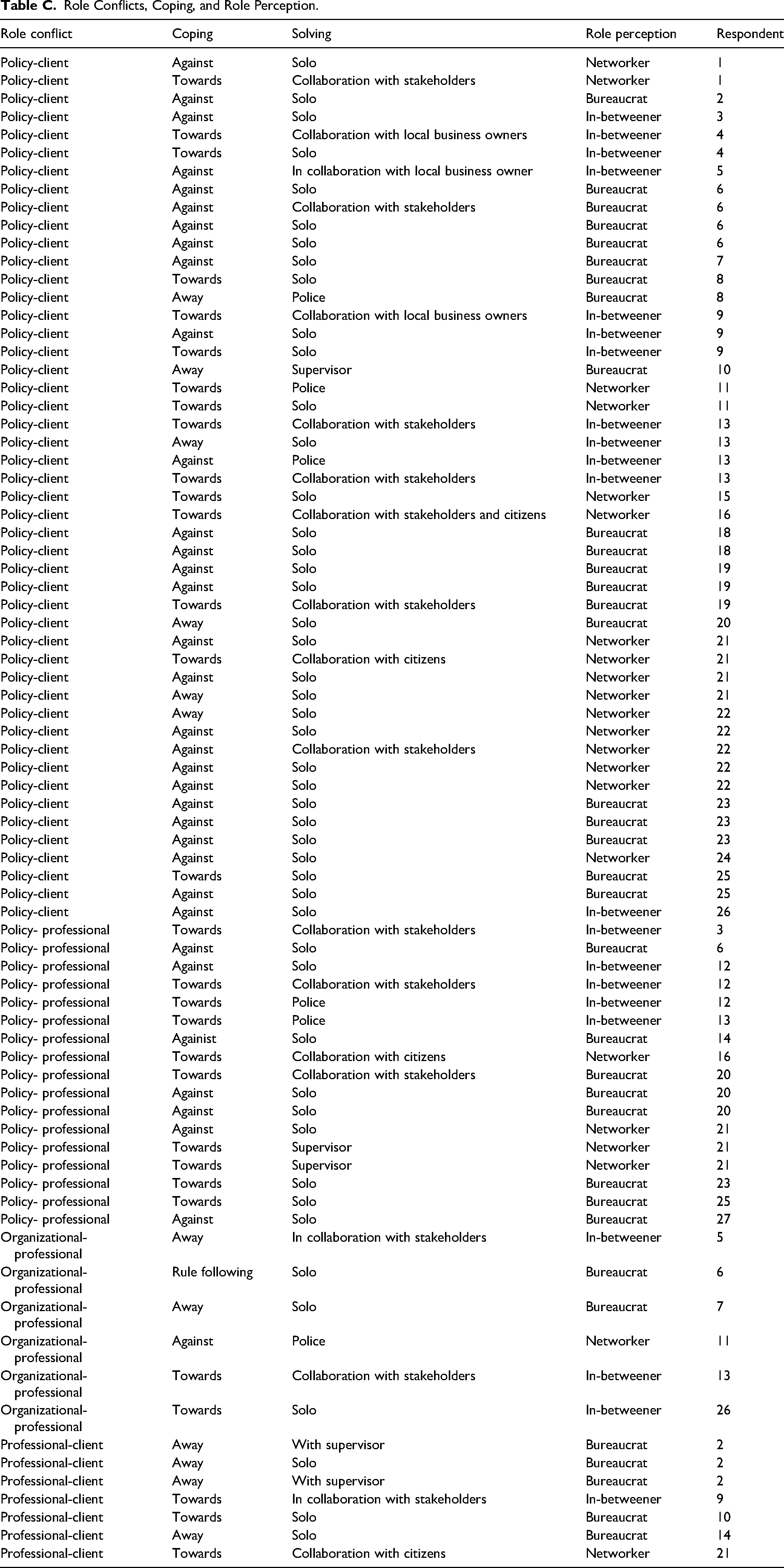
Finally, in the third step, we analyzed to what extent the role perceptions differed and how role perceptions influenced the perceived role conflicts and coping behavior. An overview of the interviewed respondents (Table A), the coding scheme (Table B), and the relations among role conflicts, coping, and role perception (Table C) are provided in the Appendix.
Results
Role Perceptions of Municipal Enforcement Officers
The interviews showed that, collectively, municipal enforcement officers perceived sufficient discretion in their work to be able to hold substantially different interpretations of their role. We found that thirteen of our respondents aligned themselves with the “narrow” regulatory law enforcement role, which we labeled as a bureaucrat, while seven respondents perceived themselves as having a wide, social role as a networker, and another seven who sought a balance in perceiving their role as between being part of regulatory law enforcement and being a friendly face on the street. This final group, we label “inbetweeners.” Interestingly, we did not find any municipal enforcement officers fitting the NPM role of entrepreneur. Below, we elaborate further on these various role perceptions.
Bureaucrats
About half of the respondents interpreted their role as that of a traditional officer. These officers consider their main task to be to determine whether citizens are following the rules and to intervene if they are not. On this basis, we categorized these respondents as bureaucrats.
The interviews showed that there are two main reasons why these officers rely on rules and protocols. First, they may perceive rules as legitimate and useful, and are convinced that strict rule enforcement is necessary to maintain public order. Second, for three of these officers, a law-and-order orientation provided guidance when working on the street. These three officers had been in their job less than a year and they relied on the rules and protocols they had learnt during their training. However, as Table A in the Appendix shows, not only relatively inexperienced officers were categorized as bureaucrats, also some very experienced respondents who had been officers for more than twenty years. The likely explanation for this, as we referred to earlier, is that, historically, officers were trained as bureaucrats with a sole focus on crime prevention. One municipal worker who had been employed for nineteen years explained how he was trained: That is how we used to be trained, you had to sound like a gramophone record. Like: you get a fine – why did I get a fine – because your car is illegally parked. That is the standard sentence. That is what they called a broken gramophone record. (R19)
Respondents adopting the bureaucrat role would mention the importance of knowing the law when working on the street. They indicated that citizens could tell when an officer was not fully aware of the rules. Furthermore, these workers saw themselves as having competencies such as thoroughness, confidence, and communication skills to be able to explain why someone is being warned or fined. One municipal enforcement officer stated: You must know your legislation. You must know what you are allowed, and what you are not allowed, to do. If you issue a fine, you must clearly substantiate why you issued that fine. If you do not know what you are talking about, everyone gets away from you on the street. (R25)
Municipal enforcement officers who rely on a narrow, regulatory law enforcement perception of their role sometimes apply the rules in a standard, inflexible way that can conflict with the needs of local inhabitants. One officer recalled how she once fined a man for parking in a taxi space in front of the hospital. The car owner argued that he parked there to pick up his wife who had just had chemotherapy and could not be outside for too long. The respondent stuck to the protocol by arguing that she could not make exceptions, even in this situation.
Networkers
Another group of municipal enforcement officers did not believe that strict enforcement was essential to safeguard local neighborhoods. These officers want to maintain good relationships with the public and aim for a broad “social ambassador” orientation. As such, we categorize this group of officers as networkers.
The interviews showed that these networkers are service-oriented and sensitive to the needs of citizens by being willing to be flexible in enforcing rules. These officers indicate that they enjoy solving local problems together with others, that they are visible in the neighborhood, and support local initiatives. They have considerable contact with citizens and local business owners, and know them personally. This is well illustrated by the example of an officer who mentioned that, within her neighborhood, there were problems with litter as a consequence of the malfunctioning of mobile sensors on the rubbish containers. Rather than focusing on who was creating the litter and issuing fines, this respondent gave her phone number to the residents and asked whether they could help her by taking photographs of the litter on the street. She used these inputs from the neighborhood to show the municipality how the poorly working sensors led to littering in the neighborhood. In this way, she saw herself as a contact person for the municipality. Another interviewed officer expressed this feeling by stating:
You are actually a hub between everyone. (R1)
The interviews furthermore showed that those officers who rely on interactions with citizens adopt a broad role by focusing on a wide variety of local problems. Officers mentioned that citizens also report things that are outside the responsibility of the municipality, such as issues in courtyards and conflicts between neighbors. Although these are not within the task description of municipal enforcement officers, officers who perceive themselves to be networkers will give attention to such reports. One respondent for instance mentioned: A lady contacted me because a lot of green algae had grown on the back path. In her street, many people sublet and there is no homeowners’ association. I told the lady, let's see what I can do for you. You want to keep it clean, also as a fire escape. I took pictures and sent them to someone at the environment department to ask whether he could remove it. Then we have done something for this lady, that is important, in this way you also build a rapport. (R16)
In contrast to the bureaucrats, these networkers do not want to be seen as an authority who relies only on the rules. They want to be accessible to citizens and openly admit that they prefer to avoid issuing fines as they believe this is not the most effective approach. One interviewed officer for instance stated: I am not really into fines, honestly, I write the lowest number of fines in my team. In the beginning you had to issue a fine, but now the municipality gives you the choice, whether or not to fine. These are the nicest things in my job: just talk, get to know the people, get to know the neighborhood. (R11)
As shown in Table A of the Appendix, networkers had worked thirteen years on average as an officer. This suggests that relatively experienced officers are willing to take on this broad role as a “city host” even though they had been trained in the more traditional officer role. Another relevant finding is that all the municipal enforcement officers who interpreted their role as a networker stated that they possess competencies such as being social, and able to talk to all kinds of people, and being accessible.
Inbetweeners
The interviews identified that, in addition to those officers who rely on rules and those who rely on interactions with citizens, there is also a group of officers who seem to balance both these roles. We therefore categorize these officers as inbetweeners.
Inbetweeners are faithful to the law, but also seek collaboration with citizens and relevant stakeholders. “In-between” officers explained that some situations demand strict enforcement, while others require more flexibility and cooperation with citizens. Furthermore, some inbetweeners mentioned that they were very aware of the importance of their professional behavior, and that their presence influenced security in their neighborhoods. As such, officers categorized as inbetweeners strive to further professionalize their role. This included arguing for an increase in their police-like powers in order to be able to take on more responsibilities. Inbetweeners would like, for instance, to carry a baton or pepper spray, and also to be allowed to tackle offences such as public drunkenness, loitering, and using drugs. Further, in-between officers have especially close contact with all kinds of organizations to tackle local problems.
As Table A in the Appendix indicates, most of the respondents in this group (five of the seven interviewed) were relatively young (under thirty) and had worked as an officer for an average of four years. As such, they have been employed during the period in which officers were being transformed from uniformed ambassadors into “city hosts.” Furthermore, most respondents in this group had followed specific enforcement training. In-between officers see themselves as possessing competencies such as being confident, communicative, and flexible, but also as possessing collaboration skills. One respondent, for instance, stated:
You need to be able to work together, not only with colleagues, but also at the network level, so police, local business owners, youth coaches, organizations that work with homeless people, you name it. (R3)
Role Conflicts Faced by Municipal Enforcement Officers
Using the critical incident technique in our interviews enabled us to identify seventy-eight role conflicts. In line with expectations from the literature, four types of role conflicts were found. The majority of the collected incidents (48 situations) were identified as policy–client role conflicts. Here, municipal enforcement officers often perceived situations in which the role behavior demanded by citizens or local business owners conflicted with the policy content. Citizens, for example, disagreed with being fined and asked for personal circumstances to be taken into consideration. Further, many situations were mentioned in which citizens or local business owners expected support from officers on an issue that was outside the officers’ responsibilities. Tensions between the rules of the municipality and the demands of local inhabitants sometimes escalated with municipal enforcement officers even experiencing violence.
Another seventeen role conflicts were identified as policy–professional conflicts. Municipal enforcement officers are usually appointed to supervise local neighborhoods and town centers and, accordingly, are not armed and not allowed to use offensive power. Nevertheless, some officers faced a role conflict between the policy content of not using offensive power and their professional value of ensuring public safety. Furthermore, difficult situations arose because current policies require officers to increasingly cooperate with police officers, and some of the municipal enforcement officers felt like they were not always taken seriously by the police. Sometimes, municipal enforcement officers and police officers disagreed on the street as to the appropriate intervention. As an example, one officer, who we categorized as a bureaucrat, was facing a situation in which a citizen was causing a nuisance and refusing to give his identity card to the officer. The officer then involved the police and, once they arrived, the offender offered his card without further resistance. According to the policy related to the role of municipal enforcement officers, this person should have been taken to the police station. However, the police officers refused, considering this to be excessive.
Municipal enforcement officers also perceived conflicts between organizational logic and professional norms. In our analysis, six situations were categorized as organizational–professional conflicts. Given that local governments are taking on more of the responsibility for tackling public order problems, mayors have to decide, in collaboration with the police, which powers are to be given to municipal enforcement officers and which to police officers. As a result, the powers of officers differ between municipalities and, within the municipality investigated, the officers had relatively limited powers. In effect, they cannot fine people for offences such as public drunkenness, loitering, or using drugs. On the street, this can result in difficult situations for municipal enforcement officers. For instance, a situation was described in which a citizen appeared to be drunk and disorderly, but the officer was not allowed to intervene. Situations like this often led to incomprehension among bystanders.
Finally, we found seven situations that we identified as professional–client role conflicts. For instance, the expectations of a citizen in reporting disputes with neighbors to the municipality conflicted with the professional value of the official who considered that citizens should resolve these situations themselves.
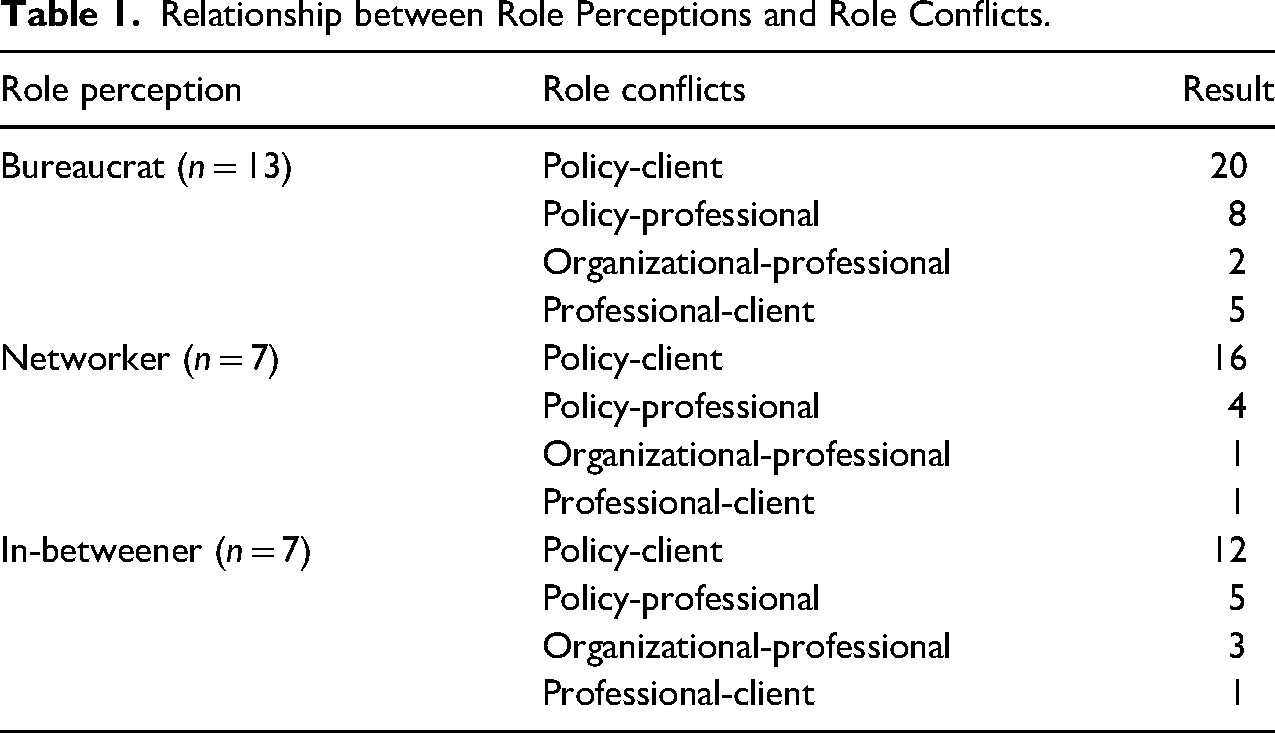
As municipal enforcement officers are increasingly expected to collaborate with police officers, stakeholders, and citizens, they nowadays have to balance conflicting demands from their organization, policies, stakeholders, and citizens, and their own professional values. Consequently, we found that municipal enforcement officers perceived a range of role conflicts. Table 1 provides insight into the relationship between role perceptions and role conflicts. Most of the role conflicts were identified as policy–client conflicts regardless of the officer's role perception. As such, the results indicate that municipal enforcement officers with different role perceptions do not perceive role conflicts that differently.
Relationship between Role Perceptions and Role Conflicts.
How do Municipal Enforcement Officers Cope With Role Conflicts?
Although municipal enforcement officers with different role perceptions do not perceive role conflicts differently, the interviews showed that their role perceptions influence their coping behavior. The most common coping strategy of the bureaucrat officers is to rigidly follow the rules, which fits within the coping category of moving against the client (Tummers et al. 2015). Bureaucrats stick to rules without taking personal circumstances into consideration. Another finding is that bureaucrats mostly deal with situations individually, rather than seek collaboration with external parties. Conversely, the dominant coping strategy of networking officers is to move towards clients (Tummers et al. 2015) and to collaborate with others. In situations of rule violation, these officers prefer to discuss the situation rather than to issue a fine. In addition, networkers increasingly collaborate with citizens or local business owners to deal with a given situation.
Interestingly, although inbetweeners, just like networkers, cooperate with citizens, the interview data show that it is especially officers in this group that seek to collaborate with external stakeholders such as youth workers, street coaches, and homeless shelters. This emphasizes that inbetweeners not only collaborate with citizens but also have close contact with all kinds of organizations. Another finding is that inbetweeners do not necessarily use the coping strategies evenly, rather they more often move towards, rather than against, the client. In-between officers explained this by arguing that some situations demanded strict enforcement, whereas others asked for more flexibility and cooperation with citizens. One respondent referred to a situation in which some local inhabitants who were moving out and had placed a large container in the middle of the street. In that instance, the respondent was strict and justified it as follows: In that particular situation, you have to let go of thinking along. The moment you start thinking along, this gives them the space to say “we will move the container in a bit.” In this particular case, you have to be very firm. (R9)
Furthermore, when comparing the reported critical incidents, we saw that some officers perceived similar situations but acted in quite different ways. An example is in responding to homeless people in the neighborhood. One respondent, categorized as a bureaucrat, faced a situation in which she found a homeless man under a bridge. She asked for his identification card and, when he refused to give it, she called the police and then decided to issue a warning of a possible neighborhood ban. In a different reaction, an officer categorized as an inbetweener mentioned a situation with a homeless person where he had contacted social support and shared information that would help them find the appropriate support for this person. Another example of differing coping behaviors following from different role perceptions can be found when reacting to reports by citizens that fall outside the officers’ responsibilities. Respondents who were categorized as bureaucrats do not address such issues based on the principle that they are not part of their responsibility. Conversely, networkers will contact the citizen and try to help resolve the situation. One municipal enforcement officer, categorized as a networker, argued: I'm just more social. You can be very rigid, with all the rules and guidelines. But people don't see it that way, people expect something from the municipality, and I want to take that responsibility. (R21)
Municipal enforcement officers who differ in their role perceptions thus cope with similar critical incidents in different ways. Table 2 gives an overview of coping behaviors for each role perception.
Relationship between Role Perceptions and Ways of Coping.
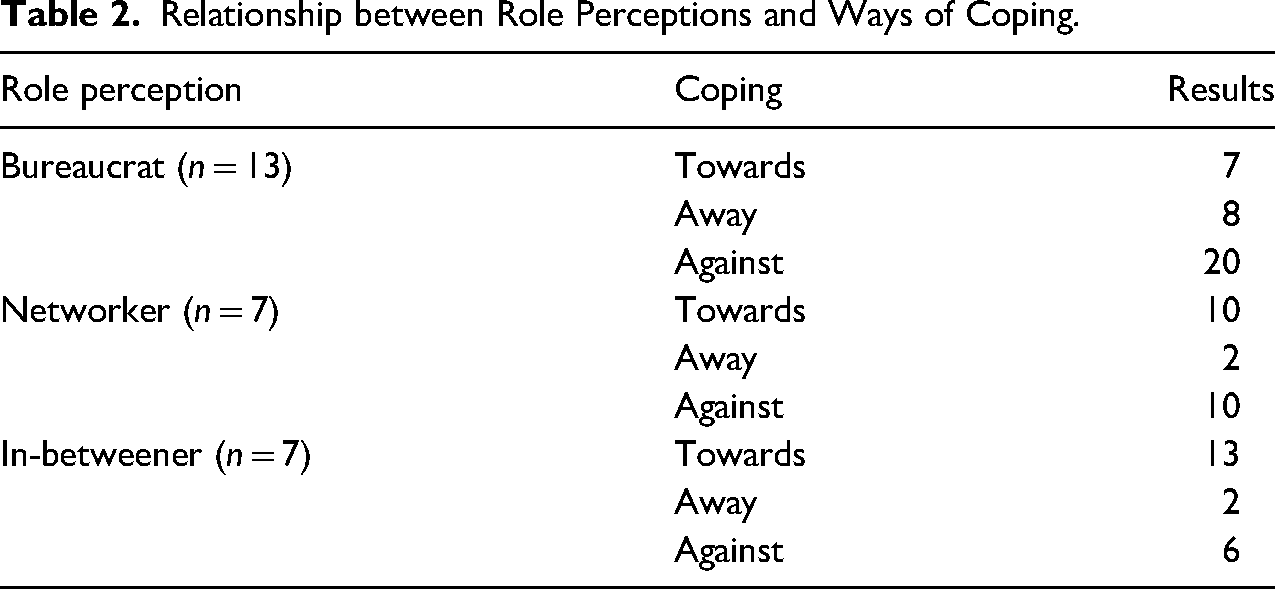
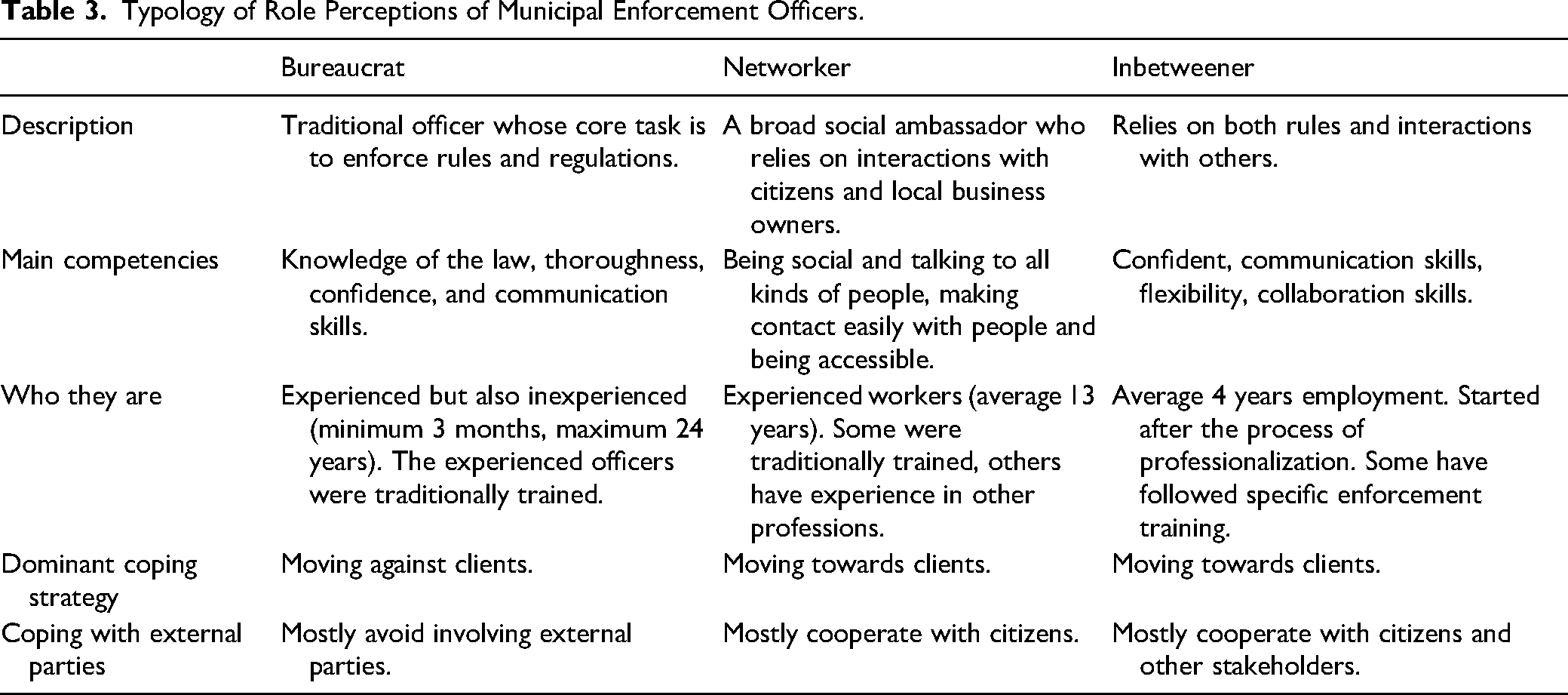
Table 3 offers insight into what might explain the different role perceptions of municipal enforcement officers. It seems that the competencies that a municipal enforcement officer possesses influence the role perception they emphasize. To act as a networker, one should be social and sensitive to the needs of citizens while, to act as a bureaucrat, one needs to know the rules. The inbetweener needs to be capable of taking on both roles and needs to be able to collaborate with different organizations. Whether or not municipal enforcement officers have followed specific enforcement training also seemed to play a part as it was especially inbetweeners who had followed such training and further developed their competencies. Further, the amount of time that an officer had been working in the municipality also seemed to influence their role perception and, in turn, their coping behavior. Our data suggest that relatively inexperienced officers apply the rules because they sometimes lack the ability to take contextual factors into account.
Typology of Role Perceptions of Municipal Enforcement Officers.
To conclude, the position of municipal enforcement officers has been changing. Policy documents on the role of municipal enforcement officers in the Netherlands describe how the position of officers has changed from being uniformed officers without any special powers to officers who have a great say in law enforcement strategies within municipalities (van Stokkom 2014). Given this change, we expected municipal enforcement officers to increasingly perceive conflicting role expectations between being a bureaucratic officer who relies on rules and being the friendly and cooperative host who connects with citizens and stakeholders. However, what we found was that even though the position of municipal enforcement officer had formally changed, municipal enforcement officers still stick to their own perceptions of their role. Respondents who interpret their role as networkers argue that the role always had a social orientation: the only change is that this is now officially recognized. Conversely, bureaucrats state that they see themselves as “city hosts” when they reduce crime and lessen feelings of insecurity by regulatory law enforcement. In this way, bureaucrats seek their own interpretation of the recently implemented policy of being an ambassador of the city.
Conclusions
The aim of this study was to explore how municipal enforcement officers understand their role in a changing environment and how this role perception affects role conflicts and coping. To this end, interviews were held with municipal enforcement officers in a large Dutch municipality. The position of these officers has changed over time as they are now expected to take on a broader, more social, role in collaborating with local inhabitants as a “host” of the city.
We found that even though the position of municipal enforcement officers has changed, officers hold substantially different interpretations of what their current role is. We found that, in practice, there were three role perceptions, which we labeled bureaucrats, networkers, and inbetweeners. We further collected critical incidents that represented role conflicts and found that most role conflicts emerged from tensions between the policy content and the behavior demanded by citizens. Although the role perception that an individual municipal enforcement officer held did not seem to be a factor in how they perceived role conflicts, the interpretation of their role did influence how they coped with role conflicts. Bureaucrats appeared to more often move against the client by strictly following rules. Further, such officers tend to resolve situations alone rather than collaborate with others. In comparison, the dominant coping strategy of both networkers and inbetweeners is to move towards the clients. Networkers collaborate more often with citizens and local business owners, while inbetweeners seek to collaborate with various stakeholders such as youth workers and homeless shelters.
We have argued that street-level bureaucrats today operate in a wider context of bureaucratic organizations that have been influenced by NPM and NPG principles. While several officers indeed act as networkers, in line with the organization's demands, half of the respondents still perceived their role as being the bureaucratic officer who relies on rules and protocols. These findings demonstrate that municipal enforcement officers perceived wide discretion in their work and in fulfilling their role (van Steden 2017). Although it has often been argued that NPM influenced the work of street-level bureaucrats (van Berkel and Knies 2016), our study shows that, at least within this organization, officers have not adopted the NPM role of an efficient and result-driven entrepreneur. These findings support the earlier conclusions of van der Steen, van Twist, and Bressers (2018) and Selden, Brewer, and Brudney (1999) that many civil servants hold to the traditional perspective, and very few support the principles of NPM. As such, the further changing of the context, towards NPG principles, creates an opportunity for those officers who want to take on a broader social role, while also creating room for those who still want to orientate themselves towards a law-and-order role.
The street-level bureaucrat literature offers only a limited understanding of the consequences of various government perspectives on the role of street-level bureaucrats (Sager et al. 2014). This study contributes to that literature by showing the importance of the role perceptions of municipal enforcement officers in a context of changing expectations (Brandsen and Honingh 2013; Zacka 2017). This is especially relevant given the critical role that street-level bureaucrats play in the policy implementation process as in how policies are implemented at the front line (Tummers et al. 2012). On the one hand, we show that municipal enforcement officers have been affected by NPM and NPG reforms given that these have influenced the expected role. On the other hand, we show that municipal enforcement officers use their discretionary space to develop their own perception of their role when dealing with tensions between different government perspectives. Scholars have argued that role perceptions are important predictors of behavior (Parker 2007) and, in this study, we empirically show that the way municipal enforcement officers perceive their role indeed influences how they cope with role conflicts. Individual differences in role perceptions help explain how municipal enforcement officers understand their work and responsibilities, and consequently their coping mechanisms. In practice, individual characteristics such as competences, training and length of experience seem to be relevant in explaining municipal enforcement officers’ role perceptions. Nevertheless, more research is needed to study why officers perceive and practice different roles. The findings of this study thus emphasize the importance of paying attention to employees’ role perceptions as these have consequences for their behavior (Grant and Hofmann 2011; van der Meer 2023). As such, this study improves our understanding of how street-level bureaucrats use their discretion and which factors shape street-level bureaucrats’ discretion.
Notwithstanding these findings, there are several limitations to address. First, our study is limited in that it focuses on municipal enforcement officers within a single municipality in the Netherlands. A full understanding of street-level bureaucrats cannot be established from a single case study, and we must be careful when generalizing the results as we cannot draw conclusions regarding the overall population of street-level bureaucrats. Further studies are needed to understand how different types of street-level bureaucrats, in other policy areas and in other countries, understand their role and the effects this has (Shoub and Christiani 2022). This is especially relevant given that research shows that the institutional context might have a significant influence on street-level bureaucrats’ discretion (Cohen et al. 2023).
A second limitation is that we were unable to analyze changes over time since we only interviewed municipal enforcement officers at one point in time. Therefore, we do not know, for instance, whether the role perception of being an entrepreneur has decreased over time, or whether the inbetweener is a new role perception that did not exist before the introduction of NPG principles. Further research is needed to understand the implications over time of introducing NPG principles within public organizations. To this end, we would recommend longitudinal research to detect how positions change, and how civil servants cope with these changes over a lengthy period.
Third, there can be an overlap between the three role perceptions and respondents’ perceptions of their role may alter in different situations, as we observed for the inbetweeners. To get insight into the complex nature of role perceptions, we recommend future research to do ethnographic research aimed at directly observing activities rather than solely focusing on participants’ perceptions (Jerolmack and Khan 2014).
A final limitation is the bias associated with the bureaucratic role perception. Following Tummers et al. (2015), our operationalization of coping includes being “hostile” towards citizens. Our empirical findings suggest that bureaucrats appeared to move more often against clients. Nevertheless, we do not conclude that bureaucrats are inherently hostile towards clients. On the contrary, we found that adherence to laws may be related to their training. Additionally, research emphasizes the necessity of taking action against clients when serving at the frontline of public service provision (Tummers et al. 2015).
The findings of this study have implications for public organizations, given the pressures cities face to expand the role of officers in community-oriented ways (Cheng 2022; Gascón and Roussell 2019; Gordon 2022). Asking municipal enforcement officers to act as an externally oriented, collaborative “city host,” rather than as a bureaucrat who follows the rules, has consequences for these workers. Public organizations should be aware that employees with the same job can interpret their role in different ways, and that this will have consequences for policy implementation on the frontline. This is especially important because our study shows that many municipal enforcement officers continue to adopt the traditional bureaucratic role. As such, public organizations need to consider how their employees can be enabled to take on a new role. The findings indicate that training can play a key role in providing municipal enforcement officers with the competencies required to go beyond those of the traditional law-enforcing officer. In HR terms, this requires street-level bureaucrats not only to have specialist skills but also an additional skillset covering communication, negotiation, and influencing (Kruyen and Van Genugten 2020). Given that public organizations believe that there should be a switch from bureaucratic styles of policing towards a broader, more social, role in communities, they need to adjust their training and recruitment to support enforcers in enacting this new role.
Footnotes
Appendix
Role Conflicts, Coping, and Role Perception.
| Role conflict | Coping | Solving | Role perception | Respondent |
|---|---|---|---|---|
| Policy-client | Against | Solo | Networker | 1 |
| Policy-client | Towards | Collaboration with stakeholders | Networker | 1 |
| Policy-client | Against | Solo | Bureaucrat | 2 |
| Policy-client | Against | Solo | In-betweener | 3 |
| Policy-client | Towards | Collaboration with local business owners | In-betweener | 4 |
| Policy-client | Towards | Solo | In-betweener | 4 |
| Policy-client | Against | In collaboration with local business owner | In-betweener | 5 |
| Policy-client | Against | Solo | Bureaucrat | 6 |
| Policy-client | Against | Collaboration with stakeholders | Bureaucrat | 6 |
| Policy-client | Against | Solo | Bureaucrat | 6 |
| Policy-client | Against | Solo | Bureaucrat | 6 |
| Policy-client | Against | Solo | Bureaucrat | 7 |
| Policy-client | Towards | Solo | Bureaucrat | 8 |
| Policy-client | Away | Police | Bureaucrat | 8 |
| Policy-client | Towards | Collaboration with local business owners | In-betweener | 9 |
| Policy-client | Against | Solo | In-betweener | 9 |
| Policy-client | Towards | Solo | In-betweener | 9 |
| Policy-client | Away | Supervisor | Bureaucrat | 10 |
| Policy-client | Towards | Police | Networker | 11 |
| Policy-client | Towards | Solo | Networker | 11 |
| Policy-client | Towards | Collaboration with stakeholders | In-betweener | 13 |
| Policy-client | Away | Solo | In-betweener | 13 |
| Policy-client | Against | Police | In-betweener | 13 |
| Policy-client | Towards | Collaboration with stakeholders | In-betweener | 13 |
| Policy-client | Towards | Solo | Networker | 15 |
| Policy-client | Towards | Collaboration with stakeholders and citizens | Networker | 16 |
| Policy-client | Against | Solo | Bureaucrat | 18 |
| Policy-client | Against | Solo | Bureaucrat | 18 |
| Policy-client | Against | Solo | Bureaucrat | 19 |
| Policy-client | Against | Solo | Bureaucrat | 19 |
| Policy-client | Towards | Collaboration with stakeholders | Bureaucrat | 19 |
| Policy-client | Away | Solo | Bureaucrat | 20 |
| Policy-client | Against | Solo | Networker | 21 |
| Policy-client | Towards | Collaboration with citizens | Networker | 21 |
| Policy-client | Against | Solo | Networker | 21 |
| Policy-client | Away | Solo | Networker | 21 |
| Policy-client | Away | Solo | Networker | 22 |
| Policy-client | Against | Solo | Networker | 22 |
| Policy-client | Against | Collaboration with stakeholders | Networker | 22 |
| Policy-client | Against | Solo | Networker | 22 |
| Policy-client | Against | Solo | Networker | 22 |
| Policy-client | Against | Solo | Bureaucrat | 23 |
| Policy-client | Against | Solo | Bureaucrat | 23 |
| Policy-client | Against | Solo | Bureaucrat | 23 |
| Policy-client | Against | Solo | Networker | 24 |
| Policy-client | Towards | Solo | Bureaucrat | 25 |
| Policy-client | Against | Solo | Bureaucrat | 25 |
| Policy-client | Against | Solo | In-betweener | 26 |
| Policy- professional | Towards | Collaboration with stakeholders | In-betweener | 3 |
| Policy- professional | Against | Solo | Bureaucrat | 6 |
| Policy- professional | Against | Solo | In-betweener | 12 |
| Policy- professional | Towards | Collaboration with stakeholders | In-betweener | 12 |
| Policy- professional | Towards | Police | In-betweener | 12 |
| Policy- professional | Towards | Police | In-betweener | 13 |
| Policy- professional | Againist | Solo | Bureaucrat | 14 |
| Policy- professional | Towards | Collaboration with citizens | Networker | 16 |
| Policy- professional | Towards | Collaboration with stakeholders | Bureaucrat | 20 |
| Policy- professional | Against | Solo | Bureaucrat | 20 |
| Policy- professional | Against | Solo | Bureaucrat | 20 |
| Policy- professional | Against | Solo | Networker | 21 |
| Policy- professional | Towards | Supervisor | Networker | 21 |
| Policy- professional | Towards | Supervisor | Networker | 21 |
| Policy- professional | Towards | Solo | Bureaucrat | 23 |
| Policy- professional | Towards | Solo | Bureaucrat | 25 |
| Policy- professional | Against | Solo | Bureaucrat | 27 |
| Organizational- professional | Away | In collaboration with stakeholders | In-betweener | 5 |
| Organizational- professional | Rule following | Solo | Bureaucrat | 6 |
| Organizational- professional | Away | Solo | Bureaucrat | 7 |
| Organizational- professional | Against | Police | Networker | 11 |
| Organizational- professional | Towards | Collaboration with stakeholders | In-betweener | 13 |
| Organizational- professional | Towards | Solo | In-betweener | 26 |
| Professional-client | Away | With supervisor | Bureaucrat | 2 |
| Professional-client | Away | Solo | Bureaucrat | 2 |
| Professional-client | Away | With supervisor | Bureaucrat | 2 |
| Professional-client | Towards | In collaboration with stakeholders | In-betweener | 9 |
| Professional-client | Towards | Solo | Bureaucrat | 10 |
| Professional-client | Away | Solo | Bureaucrat | 14 |
| Professional-client | Towards | Collaboration with citizens | Networker | 21 |
Declaration of Conflicting Interests
The authors declared no potential conflicts of interest with respect to the research, authorship, and/or publication of this article.
Funding
The authors received no financial support for the research, authorship, and/or publication of this article.
