




Abstract
The floods caused by Hurricane Matthew in 2016 affected Lumberton, a socioeconomically diverse city in North Carolina with 729 public housing units. Public housing residents face unique challenges in accessing resources and post-disaster temporary accommodations, further delaying their recovery compared to other survivors. This paper investigates the obstacles to public housing recovery and the residents’ recovery challenges using descriptive statistics, mapping, and qualitative analysis in Lumberton. Findings show the dependency of public housing units’ recovery on assistance policies and decisions of various organizations, including local housing authorities. Multiple changes in recovery plans and limited, uncertain, delayed funding and bureaucratic obstacles to funding allocation slow the units’ recovery and prolong the residents’ displacement, adversely affecting their recovery. Hence, pre-disaster resilience initiatives should address these vulnerabilities and the recovery policy's limitations to support public housing units and residents’ recovery. Moreover, affordable housing recovery must become a priority in national housing recovery policies.
Introduction
Housing recovery is one of the most essential components of the overall community recovery process (Bolin and Stanford 1991). Re-establishing housing is a critical element of the individuals’ ability to go back to their life routines and functions (Peacock et al. 2017). Housing is also a basic element of household recovery after disasters, affecting health, employment, finances, and educational attainment, among other outcomes (Fothergill and Peek 2015). Nevertheless, not everyone in a community has an equal chance at recovering their home after a disaster.
Socioeconomic elements shape various aspects of disasters because disasters are social phenomena (Fothergill and Peek 2004). Hence, pre-disaster socioeconomic inequalities, often referred to as social vulnerability factors such as race, ethnicity, income, poverty, gender, age, and housing tenure can determine the level of preparedness, response, and recovery from disaster events (Cutter, Boruff and Shirley 2003; Tate 2012; Van Zandt et al. 2012). There is a clear consensus in the disaster recovery literature about slower and more challenging pathways that socially vulnerable households and communities face in disaster housing recovery (Fothergill and Peek 2004; Hamideh and Rongerude 2018; Levine, Esnard and Sapat 2007; Peacock et al. 2014; Tate 2012; Van Zandt et al. 2012). Many of the disparities in housing recovery are linked to the severity of damages as a result of old and poor-quality structures that are often occupied by low-income and vulnerable households (Fothergill and Peek 2004; Haas, Kates and Bowden 1977; Peacock et al. 2012; Van Zandt et al. 2012; Van Zandt and Sloan 2017). This disparity in damage patterns results in the slow recovery of low-income and racial minority neighborhoods (Bates and Green 2009; Drakes et al. 2021; Finch, Emrich and Cutter 2010; Gotham 2014a; Green and Olshansky 2012; Green, Bates and Smyth 2007; Hamideh and Rongerude 2018; Zhang and Peacock 2009). In addition, socially vulnerable groups sometimes face obstacles to obtaining recovery resources due to their limited education and language skills, negative public biases and stigma about their dependency and deservingness of governmental aid resources, failure to apply or repay their loans (Berke, Kartez and Wenger 1993; Hamideh and Rongerude 2018; Nguyen and Salvesen 2014), as well as their limited capacity and power to organize and pursue a collective interest, and to participate in recovery decision making (Hamideh 2020; Hamideh and Rongerude 2018; Kamel and Loukaitou-Sideris 2004).
The public housing residents are one of the population groups that face various post-disaster recovery challenges in housing recovery due to their socioeconomic vulnerabilities as well as the lack of adequate disaster assistance and policy to address their needs. Therefore, recovery can be seized as an opportunity to address such vulnerabilities and build back affordable housing to close the historic gaps in needs and improve its quality. Disasters are also shown to reduce the number of available public housing units, increase the average waiting time for getting units, and increase the paid-rent portion for the tenants (Davlasheridze and Miao 2021). Nevertheless, recovery studies rarely focus on the vulnerabilities of public housing residents and the inadequacy of recovery policies in shaping the housing recovery of public housing residents.
Public housing residents are often low-income, racial minorities, seniors, and some have disabilities. Furthermore, public housing residents neither own nor rent their homes—renting from a private entity in the private market—even though many residents pay subsidized rent for their units to the local housing authorities or private landlords participating in housing voucher programs. The public housing units are owned by either public housing authorities or private landlords and rented through government-provided vouchers. As a result, residents of public housing have minimal control over pre-disaster mitigation, response, evacuation, as well as recovery of their homes in the face of disasters. Considering the combination of individual vulnerabilities and residents’ limited control in recovery of their homes—public housing units—we studied the complex and unique challenges and obstacles to housing recovery of the residents of public housing in the aftermath of Hurricane Matthew in Lumberton, North Carolina.
While previous research has addressed the effects of social vulnerability on recovery (Bergstrand et al. 2015; Flanagan et al. 2011; Fothergill and Peek 2015; Highfield, Peacock and Van Zandt 2014; Morrow 1999; Van Zandt et al. 2012) and the role of housing types on the pace of housing recovery (Comerio 1997; Hamideh, Peacock and Van Zandt 2021; Kamel and Loukaitou-Sideris 2004; Lee and Van Zandt 2019; Lu 2008; Lu et al. 2007; Wu and Lindell 2004), there is limited research about public housing recovery, particularly on how it is shaped by recovery policy and how it affects the socially vulnerable public housing residents. We address this gap in our case study of Lumberton public housing recovery after Hurricane Matthew.
In this paper, we aim to answer three questions:
What are the social vulnerability factors more common among public housing residents? What roles do recovery funding, plans, and policies play in the recovery of public housing units? What challenges do socially vulnerable public housing residents face in housing recovery?
We first provide a review of rental housing and public housing policies in the US, and housing recovery for socially vulnerable populations and public housing recovery in the aftermath of disasters. We then discuss the background of our case study and the data and methods employed in this research. Finally, a detailed discussion of findings is provided, leading to a few recommendations for housing recovery policy.
Recovery Policy, Social Vulnerability, and Marginalization
Rental Housing and Public Housing Policies in the US
Public housing refers to the residential units established by local Housing Authorities (HA) under the Housing Act of 1937 to provide housing for low-income families, the elderly, and persons with disabilities (HUD n.d.; Schill 1993). Following the policy of not building new public housing units in the mid-1990s, HUD dispenses federal aid to local HAs to provide or help pay the rent of low-income residents (HUD n.d.) by means of different programs, including vouchers for subsidizing the rent of market-rate homes (HCV), low-income housing tax credits (LIHTC) for building new units, as well as Indian and public housing. These programs are designed to help housing cost-burdened families so that they pay less than 30% of their income on housing (HUD n.d.).
Public housing was considered a solution for reducing inner-city poverty and isolation (Riis 2011; Stoloff 2004). However, following the Housing Act of 1949 with the goal of providing "a decent home and suitable living environment for every American family" (McCarty 2014, p. 3) public housing began to shelter more families of color, particularly African American families who were displaced by the urban renewal, leading to segregation of these groups. Early public housing was a reaction to high-density and dark slums. The program attempted to design modern buildings for the working class with higher standards of living, including central heating, elevators, and green open spaces (Bloom 2012; Goetz 2011). It resulted in high-rise public housing buildings in New York, Atlanta, Chicago, and New Orleans. However, reported spatial segregation and dysfunction of the public housing program resulted in declining numbers of units (Goetz 2011). In 1968, following the concerns about the concentration of poverty in the cities, the construction of high-rise public housing buildings was prohibited (McCarty 2014). In the 1960s, new programs were developed to subsidize privately owned units for low-income families and seniors (Vale and Freemark 2012) and to make the segregation of public housing based on race illegal through the Fair Housing Act (McCarty 2014). In the early 1970s, The Department of Housing and Urban Development (HUD) shifted the program from primarily constructing new units to using and subsidizing the existing units in the housing market with Section 8 vouchers. In the mid-1990s, the construction of new public housing units ended because of a decision by the federal government to stop funding new developments (McCarty 2014; Vale and Freemark 2012).
Despite the benefits public housing provides in terms of access to social support, employment, and health services for poor populations (Fertig and Reingold 2007), its residents face unique challenges that can be addressed with policy and investment. Public housing developments are often located in distressed neighborhoods with a high concentration of poverty, aging structures, and natural hazards risk (Talen and Koschinsky 2014). This combination of increasing urbanization, social inequities, and higher disaster risk has made public housing more susceptible to adverse impacts of disasters (Cutter, Boruff and Shirley 2003; Van Zandt et al. 2012; Vlahov and Galea 2002) and subsequently slower recovery (Hamideh, Peacock and Van Zandt 2018; Kamel and Loukaitou-Sideris 2004). Similarly, renters in the private housing market have little control and resources, and rental property owners have little incentives for maintaining structures compared to homeowners. Homeowners often stay in the same house longer and have better access to financial assistance or incentives for mitigation (Lee and Van Zandt 2019; Taheri Tafti and Tomlinson 2013; Van Zandt et al. 2012), while landlords are driven by the immediate cost-benefit trade-offs of mitigation investments in the form of increased rents. The Housing Act of 1937 did not consider any provision for the maintenance and renovation of public housing units. The construction of the units was financed by the federal government, while rents were expected to cover the operating and maintenance expenses. This ever-growing financial gap has affected the quality and design of public housing since its inception. Subsequently, housing authorities face challenges for disaster mitigation investment given the declining popularity of public housing (Goetz 2011) and the subsequent shrinkage of funding for its maintenance for decades. Therefore, the public housing residents stay in increasingly fragile units that are often highly exposed to hazards leaving little options for their vulnerable residents because the units are highly subsidized.
Previous research shows housing tenure is an element of a household's ability to foresee, prepare for, respond to, and recover from disasters (Lee and Van Zandt 2019). Residents of public housing have little control and much uncertainty and complication over the maintenance of units, their evacuation, return, clean-up, home repairs, and reconstruction because they are neither homeowners or renters according to the housing market specifications. The evacuation decisions of this group are complex and based on both personal and external factors, including previous experience of disasters, caregiving responsibilities, family roles, medical needs, and the safety of shelters (Hernández et al. 2018). Their return and home repairs are a function of the local policies of housing authorities. The housing authorities decide when they can return and how to clean up or repair their units.
Housing tenure also determines the types, amount, and timing of government recovery resources after disasters. As a result, public housing—similar to rental housing—is faced with a challenging, uncertain, and slow recovery path (Lee and Van Zandt 2019; Peacock, Dash and Zhang 2007). The recovery aid policies presume that a renter household can find another unit if their home is damaged, despite known challenges of finding affordable and accessible rental units after disasters (Peacock et al. 2014), especially for low-moderate income households. The affordable rental unit owners in the private market are often reluctant to rebuild quickly due to the limited turnover in low-income housing and the prominence of profitability in their business recovery decision (Comerio 2014; Fussell and Harris 2014). For public housing, HUD helps some displaced residents to find shelters by collaborating with the local housing authorities and with Federal Emergency Management Agency (FEMA) under a joint housing assistance platform (HUD n.d.).
Without a clear, unified assistance policy for public housing, the assistance programs vary in each disaster and are mostly for temporary housing only. For instance, HUD offered DHAP (Disaster Housing Assistance Program) after Hurricanes Katrina, Rita, and Ike to local housing authorities to provide public housing residents with temporary housing. This program covers a portion of the rent that the household cannot afford after considering living costs and the market-rate rent of the unit. A few months later, the program asks the households to pay a greater share of their rent and helps prepare them for the full responsibility of their housing prices before the program ends (NLIHC 2017). The Disaster Voucher Program (DVP) was offered for rehousing of the public housing residents, and the Tenant Protection Voucher (TPV) was delivered to the households whose their public housing units were intended to be dismantled or revitalized after Katrina (Henrici, Helmuth and Fernandes 2010). Hence, the residents of public housing units often remain transient in the aftermath of disasters, and their housing recovery lags behind the other community cohorts.
Housing Recovery for Socially Vulnerable Populations
Housing recovery is a complex, market-driven, and unequal process. Its trajectory depends on the disaster losses and characteristics of the impacted community, such as access to funds, shelter needs and preferences, disaster experience, and the accessibility of housing alternatives, as well as socio-demographic features of the affected households understood as social vulnerability (Bolin and Stanford 1991; Peacock et al. 2017). Disasters amplify the pre-existing disparities in communities (Kamel and Loukaitou-Sideris 2004; Zhang 2006), hence housing recovery presents an exacerbation of the pre-existing housing market's social arrangements and inequalities. Recovery disparities based on social vulnerability elements such as race, ethnicity, income, poverty, sex, age, religion, and housing tenure (Cutter, Boruff and Shirley 2003; Finch, Emrich and Cutter 2010; Tate 2012; Van Zandt et al. 2012) are intensified and intersectional because vulnerable groups are often clustered in older, hazard-prone, low-income neighborhoods (Bergstrand et al. 2015; Flanagan et al. 2011; Fothergill and Peek 2015; Highfield, Peacock and Van Zandt 2014; Morrow 1999; Van Zandt et al. 2012). Public housing developments represent a clear and concerning example of such clustering of vulnerable households in low-resource and hazard-prone neighborhoods (Carter, Schill and Wachter 1998; Hamideh and Rongerude 2018; Schill 1993).
Racial and ethnic minority and low-income households face significant obstacles to begin and complete restoration of their structures in the aftermath of disasters because of their limited savings or insurance and challenges in applying and receiving aid through loans and grants (Fothergill, Maestas and Darlington 1999; Sutley and Hamideh 2018; Zhang and Peacock 2009). Low-income minority homeowners struggle to qualify for low-interest SBA loans (Kamel and Loukaitou-Sideris 2004; Peacock, Dash and Zhang 2007), given their lower credit availability or present ownership documents to qualify for grants (Talbot et al. 2020). In addition to limited access to recovery resources, minorities are usually underrepresented in recovery planning because of their limited economic power and exclusion in policy-making processes (Gotham 2014b; Graham 2020; Hamideh 2020; Hamideh and Rongerude 2018; Pyles et al. 2018; Weil 2011). Limited voice of marginalized groups in recovery decisions has led to short- and long-term inequalities in housing recovery outcomes (Gotham 2014b; Graham 2020; Hamideh and Rongerude 2018).
Historically, the U.S. Government has followed a hands-off approach in the long-term housing recovery, making it a market-driven process—unlike the recovery of public amenities and infrastructures—because all housing is viewed as private property in the disaster recovery policies (Comerio 1997, 2014; Zhang 2006; Zhang and Peacock 2009). In this approach, property owners are responsible for the restoration and rebuilding of damaged units presuming that either private resources or insurance or a combination of both can be accessed by all (Comerio 1997; 2014; Zhang and Peacock 2009). This overarching hands-off policy is in contrast to the role of government in shaping access to housing before disasters (Peacock et al. 2017) and is slowly changing with the growing share of the federal programs in providing financial recovery resources after disasters (Comerio 1997; NAC 2020; Olshansky and Johnson 2014; Peacock et al. 2017).
While facing more damages from disasters and hence need more financial assistance, housing in lower-income neighborhoods—including owner- and renter-occupied housing—tends to receive lower and more delayed financial aid than owner-occupied homes in middle to high-income communities (Bullard and Wright 2018). Further, they encounter barriers to obtaining the available resources, articulating their communal demands, and participating in recovery decision-making processes (Kamel and Loukaitou-Sideris 2004; NAC 2020; Van de Lindt, Peacock and Mitrani-Reiser 2018), leading to longer displacement and recovery lags compared to the higher-income owner households.
Housing disaster assistance programs—focused primarily on homeowners—were created after the 1970s (Comerio 1997; 2014) and are provided through FEMA, SBA (Small Business Administration), and HUD after the declaration of an emergency situation (Bolin 1993; Comerio 2014; Zhang and Peacock 2009). FEMA helps the owners through The Minimal Home Repair Program (MHR) and offers them partial insurance and grants to complete small restorations to provide livable structures. The SBA Disaster Loan Program helps cover the costs of insured and uninsured structures’ rebuilding, determining the amount of the loan based on the value of the property and the owner's credit. More recently, HUD's role in housing recovery has become more substantial through HOME investment partnership and Community Development Block Grant (CDBG) programs (Johnson 2014).
The flow of FEMA resources assistance is particularly slower to respond to needs for more low-income housing and rental housing (Fothergill and Peek 2004; Fussell and Harris 2014). For example, after Hurricane Katrina, the rents increased in New Orleans because of the economic and social pressures that were caused by a two-year delay in FEMA assistance for rental units. Therefore, eventually, rental assistance was issued through the Road Home Program (Fussell and Harris 2014). These units are sometimes repaired and put back on the market at a higher rent, not affordable to the former residents anymore. Therefore, delays in financial assistance may impede the recovery of rental units by landlords because of their limited financial resources and incentives for quick restoration, particularly when they own several units (Fussell and Harris 2014; Zhang 2006).
For the restoration of public housing developments, the resources are limited to FEMA assistance, insurance, and CDBG-DR funds. The FEMA assistance and CDBG-DR funds are reimbursement-based, which causes delays in the recovery of public housing developments since the housing authorities face significant funding shortages even for normal maintenance. While these funds are a great source of assistance for the communities, they may become a hurdle because, for example, HUD needs action plans in which the community is engaged to disburse CDBG-DR funds (Olshansky and Johnson 2014). However, Local governments in the disaster-declared regions can apply or expedite their pending requests for HUD's grants (Peacock et al. 2017; Zhang and Peacock 2009).
HUD is able to consider limited flexible regulations via waivers or suspension of standard requirements for CDBG-DR recovery programs (Johnson 2014) to speed up the recovery pace. However, HUD and other government agencies lack a predefined policy or procedure for addressing the needs of public housing for post-disaster recovery. As a result, recovery of public housing and the fate of its residents after disasters usually follow the local political agendas and priorities, ranging from low-priority to hostility toward helping these residents return home. Housing authorities sometimes face political barriers in replacing the lost public housing units or have little economic motivation or capability to restore them (Graham 2012; Hamideh and Rongerude 2018). In fact, using emergency financial funds, housing authorities, public administration, and decision makers have sometimes seized the disaster opportunity to demolish public housing structures, as in New Orleans after Hurricane Katrina and in Galveston after Hurricane Ike.
While disaster recovery can provide an opportunity to relocate public housing units from risky to safer zones or offer redevelopment plans such as mixed-income housing, the decisions to replace old public housing developments have often led to the displacement of the original residents as well as substantial shrinkage of the number of subsidized units and housing affordability for low-income families in the larger community. For instance, in 2011, the Bessemer housing authority in Alabama planned to relocate the 124-unit complex of public housing units to a safer site in the aftermath of Tropical storm Lee to mitigate future risks (Debro 2011). But the housing authority did not provide residents with comprehensive information about the process or demolition date, and the process was not clear enough to engage residents in either the planning or recovery phase. Similarly, Galveston Housing Authority demolished four public housing complexes in the aftermath of Hurricane Ike, 2008 to replace them with new units with limited inclusion of the affected residents in the process and the years of delay in rebuilding units resulted in the displacement of these households (Hamideh and Rongerude 2018).
This discussion highlights three main gaps in terms of housing recovery of public housing residents. First, while different studies show a prolonged housing recovery for socially vulnerable populations, we have limited knowledge of the most common social vulnerabilities among public housing residents and the ways that public housing residents’ social vulnerabilities shape their experience of housing recovery. Second, little is known about the role of governmental recovery funds and policies as well as the slow pace of unit repairs in the long-term housing recovery of this population. Moreover, few studies investigate the challenges that these socially vulnerable populations face in their long-term housing recovery and its impacts on their life experience. We address these three gaps in this case study of Lumberton after Hurricane Matthew.
Background: Lumberton Public Housing After Hurricanes Matthew and Florence
Hurricane Matthew made landfall in North Carolina as a Category 1 storm on October 8, 2016 and hit the East Coast on October 7 as a Category 3 Hurricane (Van de Lindt, Peacock and Mitrani-Reiser 2018). Several communities in North Carolina were devastated because of the heavy rainfall and flooding after the Hurricane with some areas getting more than 15 inches of rainfall in a couple of days (Van de Lindt, Peacock and Mitrani-Reiser 2018). Lumberton is a small city in the southeast of North Carolina and the County seat of Robeson County, with a population of 21,707 as of 2016. The city got inundated because the Lumber River flooded after Hurricane Matthew while the grounds were already saturated from September heavy rains.
Lumberton is a minority-majority city with a high percentage of Native Americans and African Americans. With around one-third of households at or below poverty, the city needed affordable housing prior to Hurricane Matthew. More than half (52.3%) of the households in Lumberton are renters (Affordable Housing Online n.d.), 53.3% of whom were rent-burdened and spent more than 30% of their income on rent, prior to Hurricane Matthew (HACL 2017). Before Matthew, Lumberton had 24 low-income housing complexes with 2,228 affordable apartments for rent, 1,528 of which are income-based and 700 rent subsidized apartments, as well as 210 units that are Project-Based Section 8 voucher subsidized apartments or project-based (PBV) (Affordable Housing Online n.d.). There were also 729 public housing units in twelve different sites and 596 Section 8 vouchers in Lumberton (HACL 2017). While the HACL is the largest housing authority in Robeson County, the city has a shortage of affordable housing, indicated by 53.3% of renters in the private market who are rent-burdened (HACL 2017). While the specific socio-demographic composition of Lumberton makes this case study unique; nevertheless, several aspects of the affordable housing challenges and vulnerabilities in the city can be generalized to many similar cities and communities because Lumberton is not the only community with a large socially vulnerable population and a large stock of affordable housing stock in the flood zone or high-risk areas.
As a result of Matthew, around 36% (267 units) of Lumberton public housing units got flooded (Dorsey 2017). According to the Housing Authority of Lumberton (HACL), around 267 families out of 335 displaced households in Lumberton were public housing residents (HACL 2017). According to Robeson County Emergency Management department, a few of these households were moved to the hotels and motels in Lumberton or nearby cities like Laurinburg, Fayetteville, Rowland, Spring Lake, Charlotte, and Durham and some of them stayed with their families and friends based on our interviews with Lumberton's public housing residents. According to HACL, many of these households remained displaced for more than six months following Hurricane Matthew.
HACL estimated the public housing developments’ total flood damages at $8 M and unmet needs at around $5 M. Unmet needs include the repair's essential costs and needs that are not covered by insurance or other resources (State of North Carolina 2017). Based on the HACL reports, only 145 out of the 267 damaged units had flood insurance coverage. It was reported that 112 units out of 145 insured structures experienced significant damages, and 33 underwent minor damages (HACL 2017). After accounting for the number of damaged structures and the available public housing units before the Hurricane, HACL only had 462 remaining units available for lease in the aftermath of Hurricane Matthew. This made HACL the largest housing authority in Robeson County (Shiles 2017a) even after Matthew losses. Figure 1 shows the location of the twelve public housing developments in the city's school district boundary and Table 1 shows the information about each of the twelve complexes.
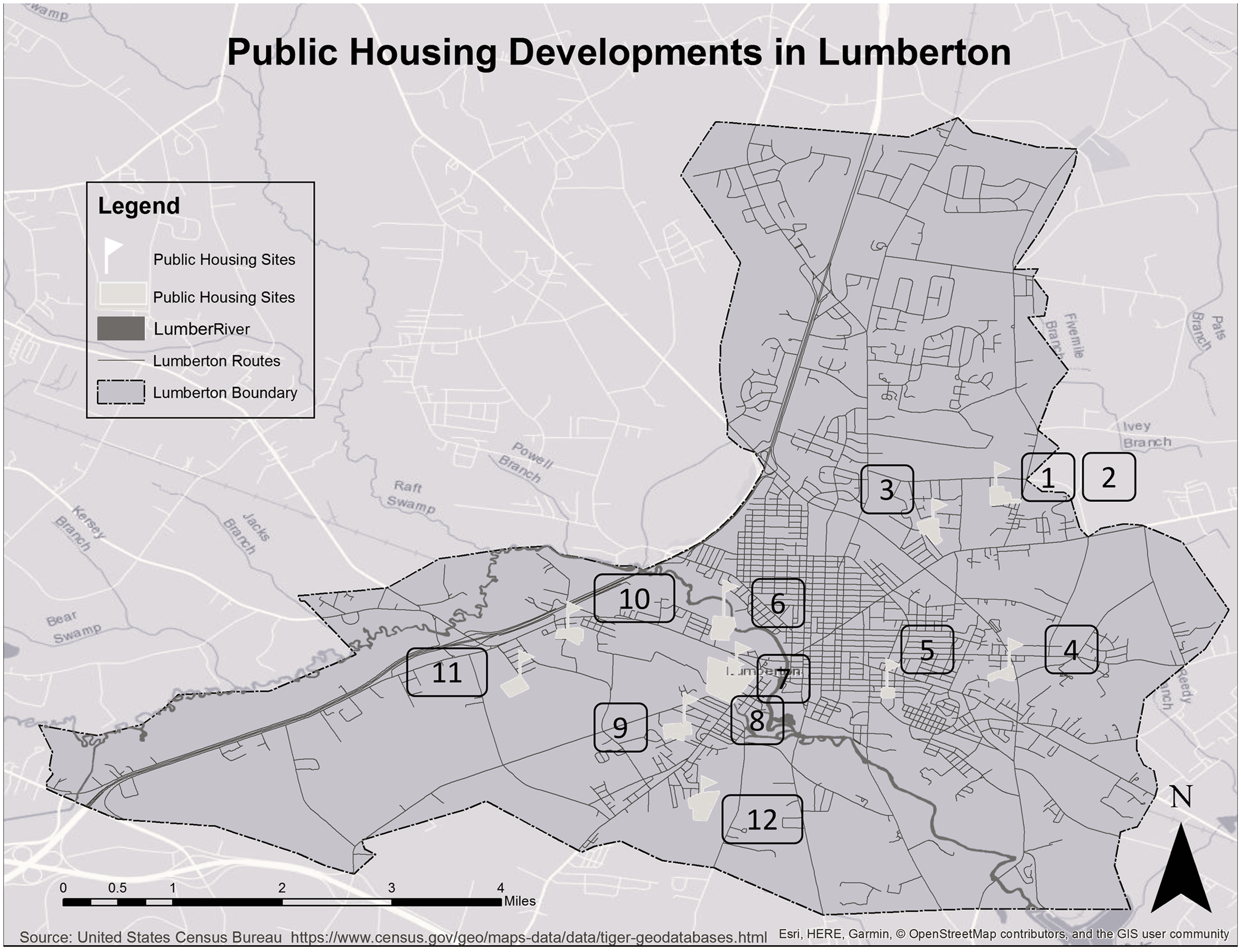
Location of public housing developments in Lumberton, NC. Prepared by authors using the HACL archive.
Public Housing Complexes in Lumberton.
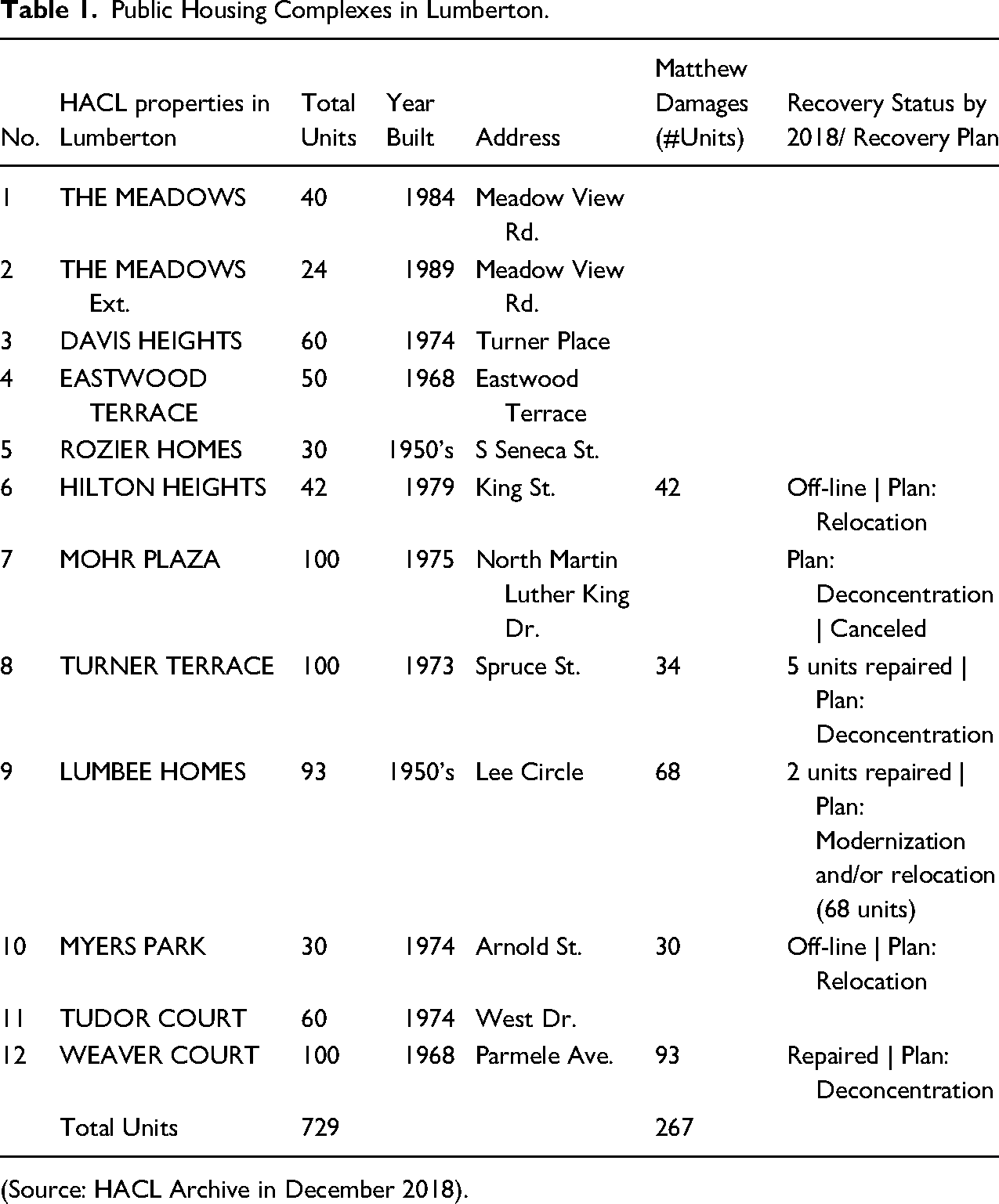
(Source: HACL Archive in December 2018).
After assessing Hurricane Matthew's damages, HACL planned to relocate two of its complexes, Myers Park and Hilton Heights, with 72 apartments to another site outside the 100-year floodplain. This plan resulted in designating Myers Park and Hilton Heights as "off-line" complexes, which remained vacant for more than two years after the flood without replacing the lost units elsewhere. By definition, off-line units are excluded from the leasing lists after HUD's approval because of the market conditions, natural hazards, casualty loss, etc. HACL also adopted a deconcentration policy for three complexes, including Turner Terrace, Mohr Plaza, and Weaver court. Deconcentration policy aims to create income diversity in public housing developments by bringing higher-income tenants into lower-income developments and lower-income renters into higher-income developments under the public housing program. Based on HUD policies, the developments that house either seniors or disabled residents or both are excluded from deconcentration (NHLP 2001) which resulted in removing Mohr Plaza from the plan (HACL 2021). Finally, HACL planned the modernization and renovation of Lumbee homes to improve physical and management conditions in the HACL 5-year plan (HACL 2017).
The HACL had access to a few different sources for restoring damaged public housing units. According to the HACL Executive Director, FEMA offered 75% ($13 million) of the requested funds for HACL recovery plans through the Hurricane Matthew Public Assistance (PA) Program in August 2017 (more details in the 2017 CDBG-DR Action Plan (State of North Carolina 2017) and disaster recovery grant action plan number B-16-DL-37-0001 [HUD 2017]). The State government was responsible for allocating the rest of the funds to recover the public housing developments (Hunter 2017). FEMA had approved funding for the 16 proposed public assistance projects by HACL in the form of reimbursement; hence HACL was responsible for paying for debris removal, hazard mitigation planning, and repairs and would receive the approved funds after completing FEMA's review at the end of each project (Shiles 2017b). Insurance covered $3 million of the recovery plan implementation, including the restoration of Weaver Court's units (Reeves 2017). Also, in the Hurricane Matthew CDBG-DR Action Plan, the State of North Carolina allocated $5 million to the HACL for the unmet needs of public housing developments—the necessary costs that are not covered by insurance or other resources (State of North Carolina 2017).
HACL faced many challenges in rehousing displaced tenants. For example, one of HUD's recent policies is to replace the physical public housing units with vouchers through the Rental Assistance Demonstration (RAD). In 2012, Congress authorized RAD as a voluntary HUD program and a new method of fulfilling the growing capital improvement needs of old public housing units while preserving HUD's programs of Rental Supplement, Rental Assistance Payment, and Moderate Rehabilitation. This initiative aims at enabling public housing agencies to lower public and private debts and reinvest in existing public housing units, without relying on extra funds from Congress. This program is critical for HUD because of the $36 billion backlog of public housing capital improvements.
Data and Methods
To examine the challenges of public housing residents in the housing recovery, we used a case study approach to investigate this phenomenon in-depth in Lumberton. This research is a part of a longitudinal and interdisciplinary recovery field study of Lumberton, conducted by the National Institute of Standards and Technology (NIST)-funded Center of Excellence (CoE) for Risk-Based Community Resilience Planning with collaborators from the NIST.
We applied two distinct analyses to answer our research questions : (1) for describing the vulnerabilities of the public housing residents in relation to progress in housing recovery (research question 1), we applied mapping techniques and descriptive statistics; (2) for examining the role of recovery funding sources, policies, and plans in public housing recovery (research question 2) and the challenges of public housing residents in recovery overall and obstacles of their housing recovery (research question 3), we conducted a qualitative analysis using interviews with public housing residents and local officials as well as collected secondary data. Each group of analyses is described in detail below.
First, we analyzed the social vulnerability of the city block groups before Hurricane Matthew (the American Community Survey (ACS)-5-year estimates at the block group level) to examine the relationship between vulnerability, flood damages, and the status of recovery of housing units. The block group data was used because it provides the opportunity to gauge social vulnerability information in a small spatial scale that represents more or less homogeneous neighborhoods. We applied the Van Zandt et al. (2012) vulnerability mapping approach in which the social vulnerability index is weighted by block groups’ population density. In this procedure, factors including household characteristics, age, transportation needs, housing features, racial characteristics, poverty, educational and employment conditions, and language proficiencies were used (Van Zandt et al. 2012). These factors were chosen based on the findings of social vulnerability literature about differences in the abilities of various groups in predicting, responding, and recovering from disasters (Wisner et al. 2014). Taking these indicators and converting them to proportions between 0 and 1 by a related base simplifies comparisons by block-groups and in every case (see Table 2).
Social Vulnerability Scores.
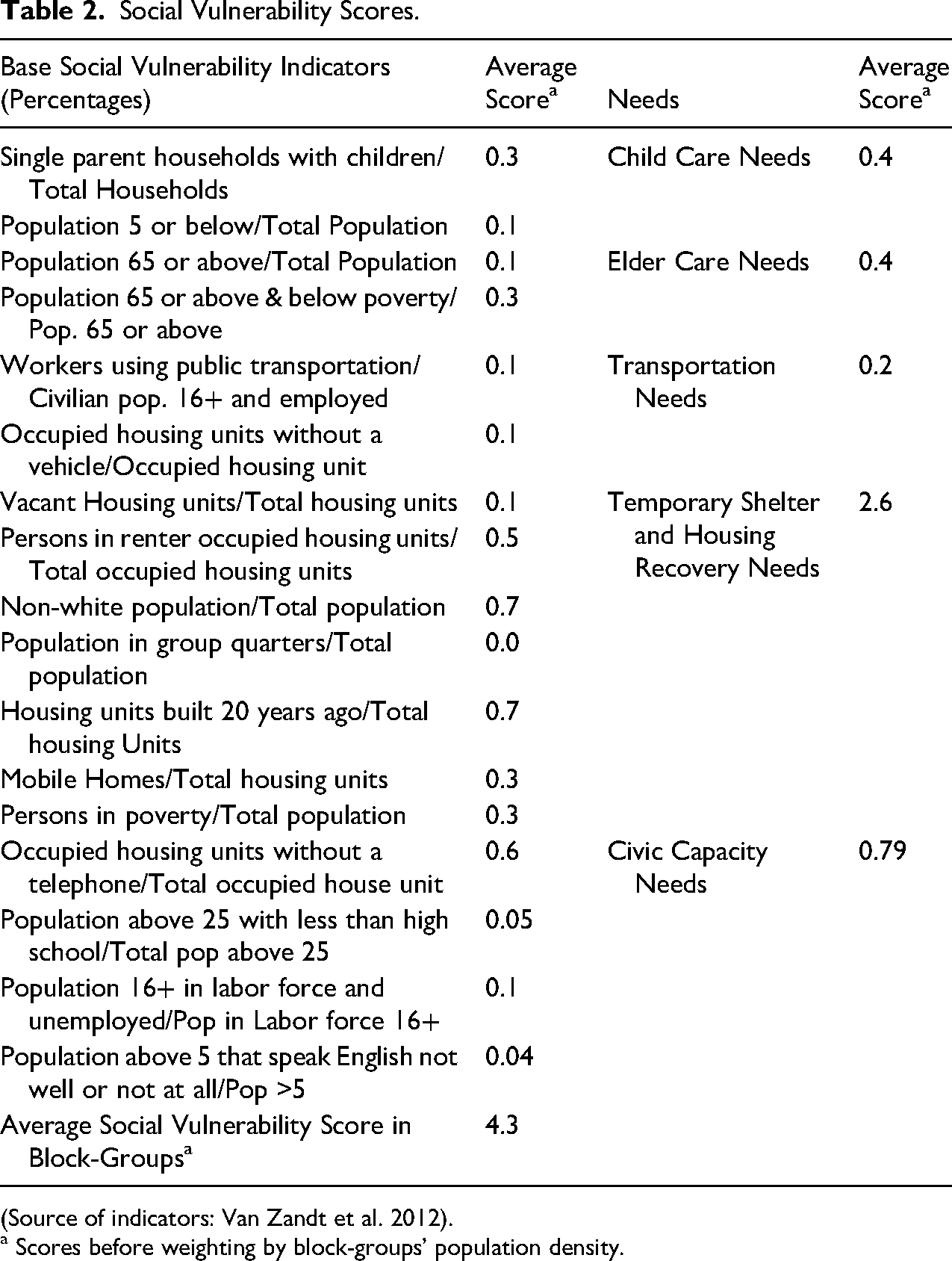
(Source of indicators: Van Zandt et al. 2012).
a Scores before weighting by block-groups’ population density.
By adding all these social vulnerability scores and weighing them by population density of each block-group, we prepared a Choropleth map of social vulnerability of the city using ArcGIS. We defined three levels of social vulnerability for block-groups: low (0–25 percentile), medium (25–75 percentile), and high (75–100 percentile). This map was used as a base map for the other spatial mapping purposes of our analyses (see Figures 2, 3, and 4).
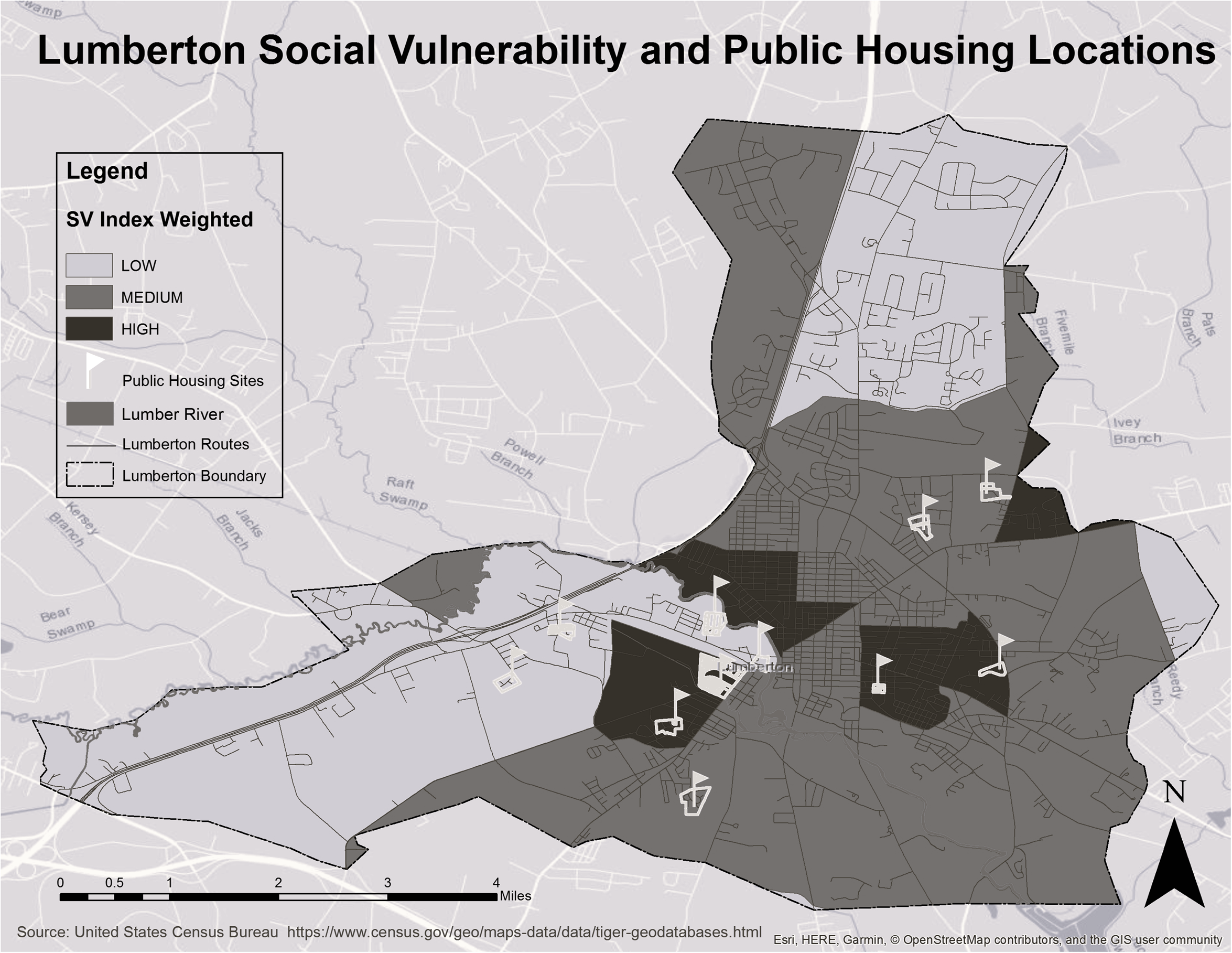
Social vulnerability in the block group level with the public housing developments’ location, prepared by authors.
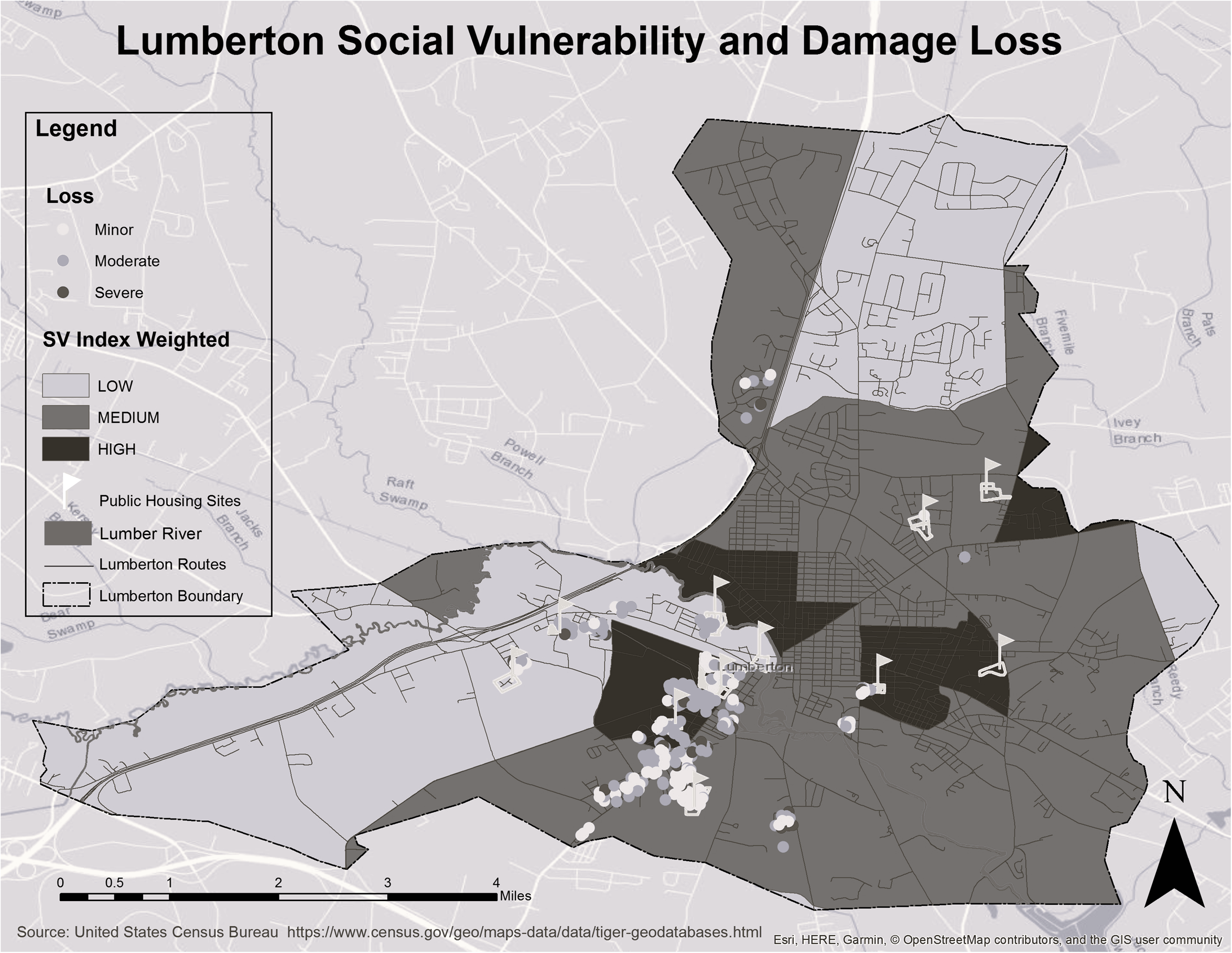
Social vulnerability in the block group level with the damage loss distribution among sampled houses, prepared by authors.
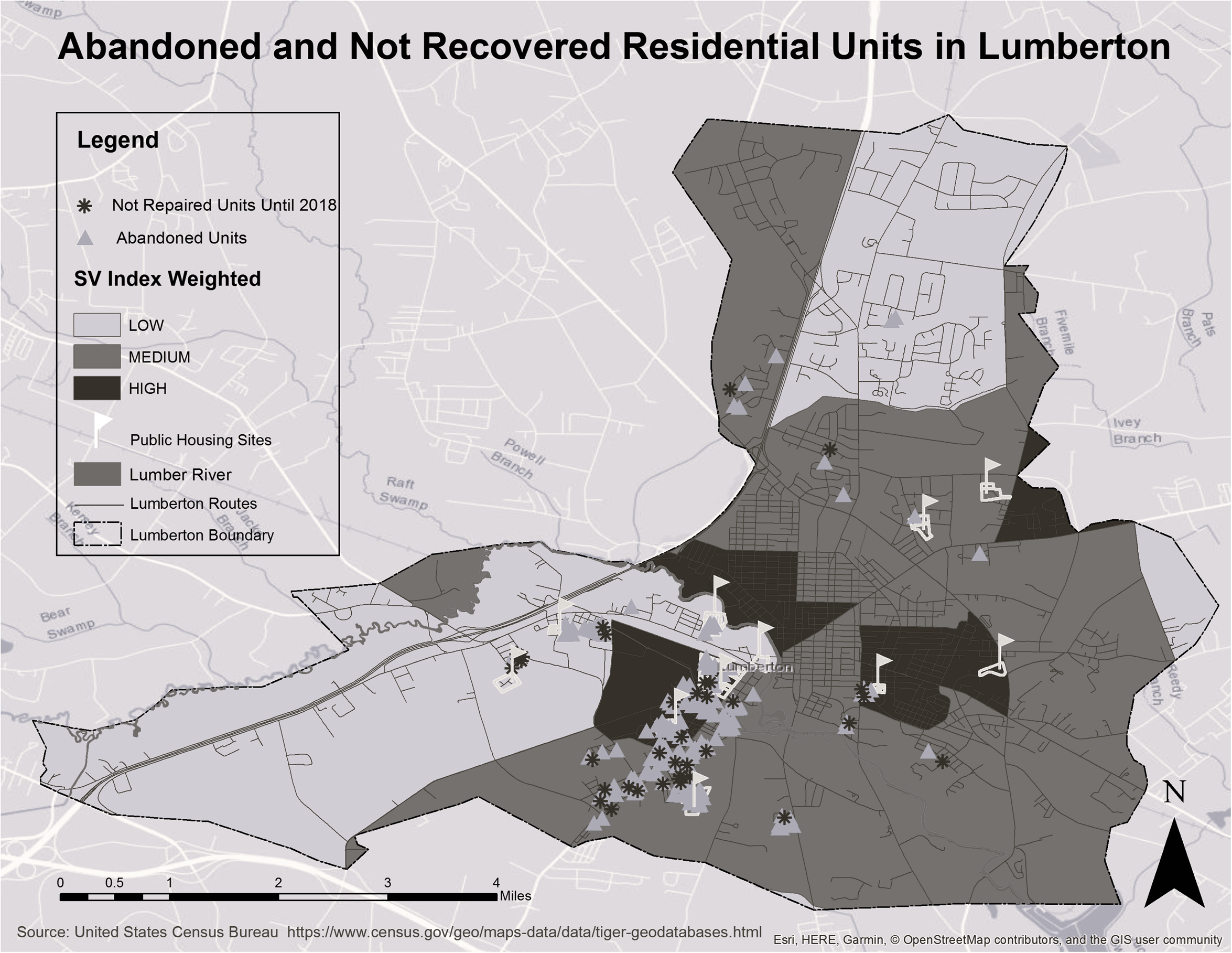
Social vulnerability in the block group level with the recovery status of sampled houses, prepared by authors.
We also used the results of two waves of households’ surveys of 568 sampled units that were implemented by CoE in December 2016, a few months after Hurricane Matthew, and in January 2018, 14 months after the Hurricane. We mapped the occupancy status data collected through the 2018 households’ survey and overlaid it with the social vulnerability map in ArcGIS to show the social vulnerabilities of public housing developments. The differences between the recovery outcomes of public housing units and the other residential units were calculated using household surveys from January 2018.
Second, we used primary data gathered through our local officials and public housing residents’ interviews and from secondary sources, including media content, plans, and official documents. Searching in the media content published between October 2016 and December 2019, we found 25 relevant articles about Lumberton public housing units with information about the damages, funding allocation, and distribution to HACL, State and City plans for public housing units’ recovery, displaced and returning residents. We also reviewed HACL's strategic plans and the CDBG-DR action plans and the FEMA grant summary to find the projects and funding allocations for the public housing recovery. The review of media articles and official documents helped us both gather valuable data for analysis and identify the relevant critical stakeholders, local agencies, nonprofits, charities, and advocates involved in Lumberton public housing recovery for interviews.
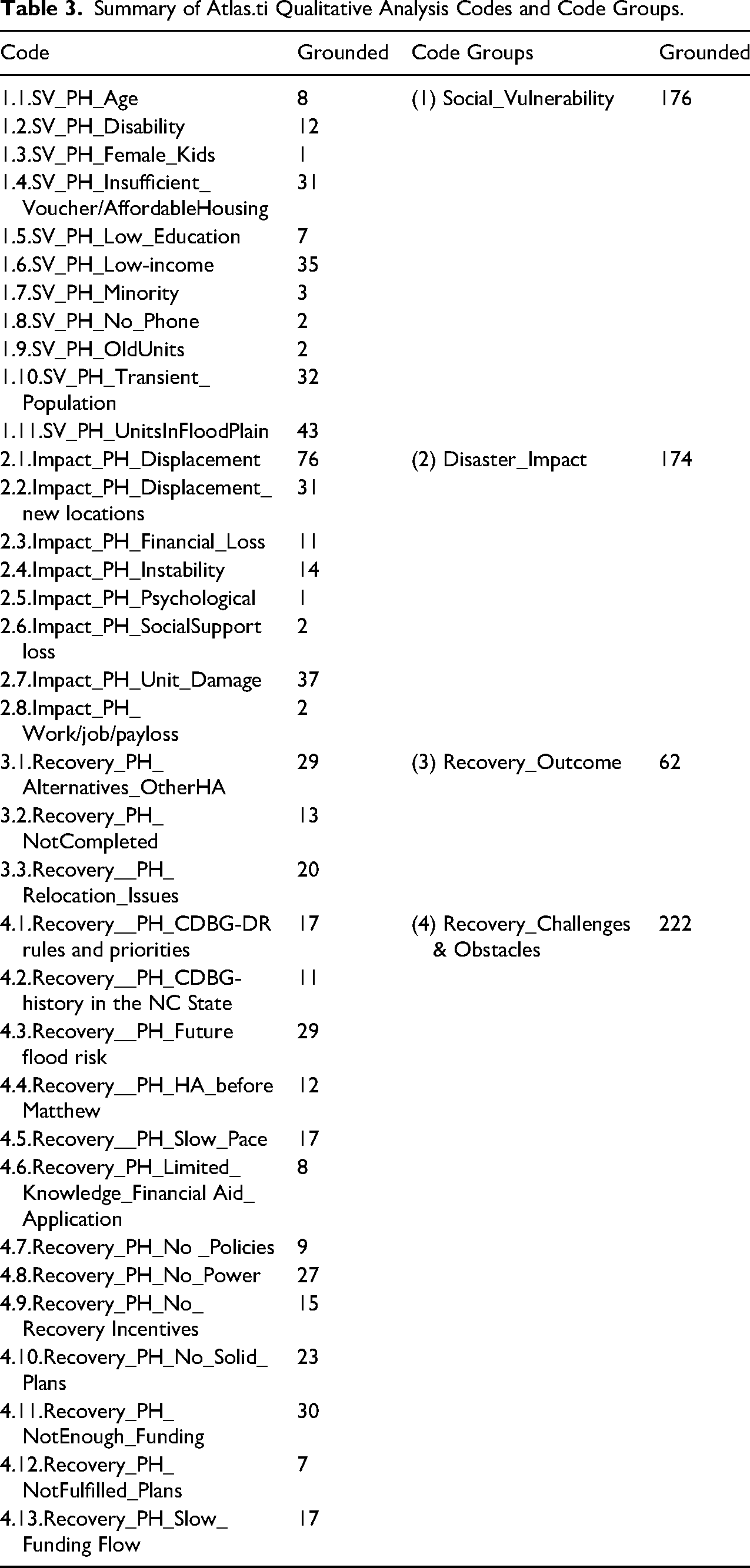
We made a purposive list of key informants for interviews through media articles. Our interviews with 14 local officials, community leaders, and nonprofits were conducted in December 2018 as part of the CoE longitudinal study in Lumberton. The interviews were semi-structured with questions about Lumberton's affordable housing needs, damage assessments, displacements, recovery plans, funding resources, recovery progress, and barriers to the public housing recovery. Semi-structured interviews offer time and flexibility so the interviewees can share thoughts without significant limits. Moreover, we conducted seven semi-structured interviews in April 2019 with public housing residents whose units were flooded to investigate their vulnerabilities and understand their displacement and recovery experiences. In total, 21 semi-structured interviews were conducted with residents and representatives of different agencies involved in public housing. Twenty of these interviews were recorded, and all were supplemented by extensive field notes taken during and shortly after the interviews. All interviews, media content, and field notes were transcribed professionally and then uploaded into Atlas.ti software for coding and the rest of the analysis. We conducted thematic analysis, including open coding and thematic coding steps, to reduce the massive data and focus on in-depth and nuanced insights that our participants offered. All transcribed materials were first coded based on an open coding approach with an exploratory lens. We then developed categories (four categories: social vulnerability, disaster impact, recovery outcome, and recovery challenges and obstacles) and subcategories (35 subcategories) of codes (see Table 3) to outline the themes based on the qualitative coding system described in Saldaña (2021). In this system, combined detailed codes helped us to have an insight into the patterns in the data and develop a coherent set of findings. The coding scheme was designed to systematically reveal public housing residents’ vulnerabilities in the recovery process, their recovery outcomes and trajectories in comparison to the other Lumberton residents, gaps in public housing recovery planning, policymaking, and funding and consequences for the recovery outcomes.
Summary of Atlas.ti Qualitative Analysis Codes and Code Groups.
This study has potential limitations, like all research. First, parts of our findings are based on interviews with local officials and public housing residents in the city. Therefore, there might be potential bias in questions and answers and self-selection bias in reporting the responses. Survivor bias is another potential issue we face because the only source of information about the length of displacement of the public housing residents who had not returned at the time of our data collection is the personal communications and speculation of their former neighbors and HACL staff as well as stories shared in local media. Lastly, we collected the interview data for this study during a two-week period in the aftermath of Hurricanes Matthew and Florence without returning to the community for follow-ups. While secondary data was collected up to March 2022, returning to the community and interviewing the same groups again for follow-up after more disaster funding became available and considering Hurricane Florence's effects would make the findings more robust. Lastly, we only focus on one case study in this paper. These limitations call for more long-term, in-depth and comparative case studies to investigate public housing recovery funding and policy gaps and common recovery challenges of public housing residents that should be taken into account in federal, state, and local housing policies and spending programs.
Findings: Public Housing Recovery Challenges
Our analysis and synthesis of quantitative, spatial, and qualitative data through descriptive statistics, mapping, and qualitative coding resulted in four distinct themes. The following themes summarize the findings as answers to our research questions about recovery obstacles of public housing, including vulnerabilities of its residents, the obstacles and gaps in recovery funding, plans, and policies in addressing Lumberton's public housing needs, and their housing and overall recovery challenges after Hurricane Matthew.
Social Vulnerability: Minority Renters in Old Buildings
The findings of this section emerged from our spatial mapping and descriptive statistics. The overlay of the social vulnerability map and the public housing developments’ location shows that 273 of the public housing units (37%) are located in the neighborhoods with high scores of social vulnerabilities and 224 units (31%) in the block groups with the medium scores, as indicated by dark gray on the map in Figure 2. The damage loss distribution map shows that the majority of all sampled damaged houses, around 84%, are in block groups with medium or high social vulnerability. Among our surveyed units, 68% of privately owned homes and 36% of public housing units suffered moderate to severe losses (see Figure 3). When we overlaid the surveyed residential units’ recovery map as of January 2018 with the social vulnerability distribution map, a third of damaged units emerged as not repaired fourteen months after Hurricane Matthew, 81% of which are located in block groups with medium or high social vulnerability. Similarly, around 85% of abandoned units are in the medium to high social vulnerability block groups (see Figure 4). Our housing survey indicates two-thirds of the public housing units remained abandoned fourteen months after the floods in comparison to a third of privately-owned damaged units. Additionally, HACL's documents and our field observation two years after the flood reveal that 72 vacant units in the 12 public housing developments were reclassified as off-line units—no longer available for rent. These units were in the 100-year floodplain areas and taken off-line by HACL after Hurricane Mathew to be relocated to a higher elevation area. However, these units have not been relocated and replaced six years after the reclassification, which means extended displacement and potential loss of affordable housing for 72 individual households and loss of access to their local resources and networks. Our interviews with HACL administrators in December 2018 revealed that only 85 of the 267 (31%) damaged public housing units were restored two years after the Hurricane, and less than half of displaced public housing residents had returned to Lumberton.
Table 2 shows the average scores of each social vulnerability indicator in block-groups of Lumberton. The social vulnerability index scores show that housing tenure, race, and age of the housing units have the highest scores and are the major vulnerabilities of the block-groups where public housing units are located. These block-groups are located in the central and southern parts of Lumberton, where the population density is higher, and there is a concentration of racial minority renters with school children (Van de Lindt, Peacock and Mitrani-Reiser 2018). Hence, the concentration of low-income racial minorities in distressed public housing structures makes up for most of the vulnerabilities of this community cohort in the face of disasters. These residents live in old structures without sufficient maintenance efforts by the housing authorities, which put them at risk of serious destruction. The relatively large number of damaged public housing structures (70% of sampled public housing units) compared to damages to privately-owned housing (51% of sampled privately-owned units) in Lumberton demonstrates the pattern of vulnerabilities to the severity of disaster damages. This widespread damage and lack of available public housing stock displaced many households for a long time. This analysis reveals that housing tenure, race, poverty, and distressed structures are the most common features of social vulnerability among public housing residents. We also found a pattern of higher rates of abandonment and vacancy as well as slower repairs in public housing units compared to the other privately-owned residential units.
Based on our public housing residents’ interviews, we found that households in public housing units were displaced for an extended period of time, ranging from 6 months to more than two years after the Hurricane. Note that we were able to interview only the public housing residents who returned to Lumberton, and the time range reported here reflects only the response of that group and not the permanently displaced residents.
[C: They offered up the hotel rooms and stuff, but by the time FEMA came through with doing that, Housing Authority had already been out here and any house that was livable and still like person--as long as it was--because the area that flooded, the ground's contaminated and stuff like that, but they tried to make sure that all the areas where people were going to come live at again, they made sure it was okay. I didn't have to do all those other options, but I do know people personally that ended up in hotel rooms for at least six, seven months, almost a year. A lot of them never completely recovered.]
Obstacles to Rebuilding Public Housing Units and the Housing Recovery of its Residents
Inappropriate policy for public housing recovery and many changes in plans: Our interviews with the local officials indicated that RAD was one of the suggested policies for keeping affordable housing stocks in Lumberton and rehousing public housing residents in the aftermath of Hurricane Mathew. The RAD policy seeks to convert public housing units to a Section 8 platform with a long-term contract that must be legally renewed. Housing authorities are given the option to replace public housing units with Section 8 project-based vouchers (PBV) or Section 8 project rental assistance (PBRA) under this program. PBV and PBRA contracts are 15- or 20-years long, respectively, and must always be renewed. These long-term contracts provide more stable funding sources for the PHAs due to the fact that private institutions might be more willing to lend them money. As a result of this change, it will be easier for PHAs to borrow money and use low-income housing tax credits (LIHTCs) to make improvements to preserve the public housing units. Due to its Section 8 status, the properties in RAD have access to the same financing tools that the rest of the affordable housing industry uses, while long-term Section 8 contracts protect the RAD properties from public housing's Federal funding decisions (HUD 2021).
Nonetheless, in Lumberton, HACL was unable to provide section 8 vouchers to many of the displaced families after Hurricane Matthew because the public housing residents were unable to pay the RAD subsidized rent with vouchers. As a result, based on our interviews with local officials, HACL sought to rehouse these families by relocating them to other housing authorities with available units throughout Robeson County or State of North Carolina.
[L: So, what's unique about us in the city of Lumberton is [that] not only have we been here with Matthew. Then we were hit with Florence and on top of that we've got HUD making a big push to get rid of housing units. […] Well, we don't want to convert to RAD not necessarily [because of] existing units. And here's my question. That person that I've got [who has] lived over ten years in Turner Terrace right now that can only afford to pay 50 dollars a month rent. Am I going to find a fifty-dollar vouchers? [No]. What happens to them?! In Louisville, Kentucky, in New York in those areas, Resources abound. Robeson County resources don't abound!]
HACL developed multiple plans for addressing the affordable housing shortage caused by the damages after Hurricanes Matthew (2016) and Florence (2018). This process can be described as piecemeal and fraught with challenges and uncertainties associated with securing funding and land for implementation. First, HACL planned to repair 171 units, demolish and relocate 30 units of Myers Park that had been flooded by both Hurricanes Matthew and Florence, and relocate Hilton Heights development (42 units) to maintain the city's public housing stock (HACL 2021). In 2018, the HACL stated that in order to modernize the 93 units of Lumbee Homes, they might consider RAD if sufficient funding is provided. However, five years after Hurricane Matthew, according to the 2021 HACL annual plan, they were still looking for a site to relocate the aforementioned 72 units of Myers Park and Hilton Heights and 68 units of Lumbee Homes. In March 2022, HACL announced that they would relocate and rebuild 72 units of Myers Park and Hilton Heights in a 30-acre new site near the Robeson County Health department. North Carolina Office of Recovery and Resiliency (NCORR) provided $5.9 million of funds for this project. HACL anticipates that the relocation project will be started sometime in the fall or winter of 2022 and may be completed in 2024. The HACL administrators also announced that there is no CDBG-DR fund and no local resources for rebuilding Lumbee homes, estimated to be $15 million (Horne 2022). To this end, regarding their existing structures, they are developing courses of action that may address the demolition of all these units and cause the permanent loss of 68 units (HACL 2021).
The delays, changes in plans, and uncertainty about rebuilding public housing units put further pressure on the already inadequate affordable housing stocks of Lumberton. There was a long waiting list for the Section 8 voucher program (1200 households) and a shortage of public housing units in Lumberton before Matthew and the Hurricane made 267 of the units unavailable due to damages and floodplain location. Based on our interviews with HACL administrators, 182 units out of 267 damaged units were still abandoned two years after the Hurricane. These units include the 72 units of Hilton Heights and Myers Park, which were planned to be taken off-line but not relocated by the time of the interviews and even five years after the Hurricane despite the plans. By 2021, even more units (e.g., Lumbee homes units) are earmarked for potential demolition (HACL 2021) partly due to Hurricane Matthew and/or Florence, and the slow pace of finding a relocation site and funding resources.
Slow flow of insufficient funds: The interviewees also argued that the allocated funds for the recovery of units based on the FEMA PA program's reimbursement policy were insufficient and moved slowly. The HACL interviewees also argued that FEMA's calculations of grants were based on unrealistic expense assumptions and the units’ repair cost more for the HACL than estimated by FEMA PA. These differences in the real costs and allocated funds resulted in difficulties for HACL to rebuild the units and thereby slowed the pace of public housing units’ recovery. For example, one of the interviewees mentioned these differences in costs and allocated funds in the following quote. More than four years after Matthew, these needs for additional funds were also reflected in the amendments of the CDBG-DR action plan (State of North Carolina 2022).
[A: We're going to receive [money] for Hilton Heights. $800,000 the state portion of it. From FEMA we're going to get $2.4 million. That's what we work for! We signed a contract with FEMA saying we're going to rebuild these outside the flood zone and we can't get a penny anymore from what FEMA [promised,] $2,430,766. We're estimating that the cost to rebuild the 42 units is going to be 8 million dollars. Our insurance that we collected was $1 million. 1 million plus 2 million is 3 million, 3 million minus $8M is $5M. That's what we estimated [we have less] for Hilton Heights! Now, did we estimate high? Yes [Sarcastic]! $125 per square foot. But if you want to build something new right now here in Lumberton would be $ 150–265 per square foot.]
One of the other financial challenges HACL faced in repairing the units is related to reimbursement of expenses through FEMA financial assistance. For example, in December 2018 (more than two years after Matthew), HACL announced in interviews that FEMA had only reimbursed $3.5 million of the $13 million approved cost of repairs. Given the significant amount of budget and capital shortage, local housing authorities, including HACL, suffer from maintenance and rehabilitation even without disasters, slow reimbursement of disaster repair costs poses another major obstacle to the timely recovery of damaged public housing units and subsequently, displacement of the most vulnerable residents of those units.
In addition to the slow pace of reimbursement, requirements around the use of FEMA funds also created obstacles against the timely restoration of units in Lumberton. According to FEMA reimbursement policies (see FEMA 2020 and FEMA 2022), the repair/rebuilding of public housing units must be aligned with mitigation goals, and the grantee housing authorities must improve the condition of the units using PA funds. While HACL interviewees discussed the importance of mitigation strategies such as elevation, confirming the best practices established by several studies on the build-back better approach (Paulik et al. 2021; Wang et al. 2016), meeting these mitigation requirements proved very challenging and sometimes debilitating for achieving timely recovery. In some of the Lumberton public housing developments, including Hilton Heights and Myers Park, elevating the units was not deemed cost-effective based on FEMA's PA mitigation measures, and it was preferable to relocate them to an area outside the floodplains. Moreover, the City's requirement of limiting the number of public housing units within a quarter-mile radius restricted the potential sites for relocation. The consequence of these requirements and decisions was a six-year delay in finding a new site for the relocation of such units. This, in turn, led to the prolonged displacement of former residents of those units and further shrinkage of affordable units for low-income residents of Lumberton. Hence, limited resources, insufficient allocated funds, as well as the relocation's bureaucratic process caused major delays in the restoration of public housing units.
Lack of voice from local government and HACL in recovery funding decisions: According to the interviews, HACL or Robeson County had little involvement in the State recovery planning process. The State made plans for recovery without directly involving representatives of public housing authorities. HACL plans for their units’ repairs and rebuilding were a part of their annual plan and made separately and independently from the State's recovery plans. These units’ recovery plans were a part of the 2017 HACL 5-year plan on which the Resident Advisory Board (RAB) had to make recommendations and comments. Such disconnect indicates a weakness in the State's resilient recovery efforts after Hurricane Matthew because including representatives of socially vulnerable populations in recovery planning is a vital in rebuilding resilient communities by reducing marginalization.
As mentioned above, housing authorities relied on government funding for the public housing recovery. The interviewees suggested that such reliance is an important factor in determining recovery outcomes. Until December 2018, HACL had not yet received the CDBG-DR funds. According to the HACL, despite HUD's claim that the promised CDBG-DR funds were sent to the State of North Carolina, HACL had yet to receive the funds two years after the Hurricane. Uncertainty about timing of receiving assistance for repairing the damages of public housing units was partly due to lack of involvement of local officials in state disaster recovery funding decisions and significantly limited their ability to plan and act for restoration the units in a timely manner.
Local officials noted in the interviews the flexibility and discretion of local jurisdictions in spending CDBG funds in North Carolina. This spending flexibility suggests, according to some of the local officials, that the State has more flexibility in spending CDBG money on infrastructure rather than low-moderate-income housing before Matthew (Nguyen et al. 2017). They believed that the state of North Carolina's response to Hurricane Matthew was similar to their response to affordable housing needs under regular circumstances. One concern was that instead of prioritizing the recovery and improvement of low-moderate-income housing in smaller low-density areas the State devotes funds to infrastructure rehabilitation and enhancement in populated urban regions which has posed challenges in providing affordable housing in low-income communities such as Lumberton (Nguyen et al. 2017). The interviews highlighted Lumberton's lack of a voice in state decision-making, the time-consuming process of securing financial sources for housing projects, and the priority changes of the CDBG-DR funds, all of which delayed the public housing recovery. In our 2018 interviews, one of the local officials shared this sense of neglect with respect to pre-disaster spending on affordable housing which sets the stage for more adverse recovery outcomes after a disaster:
[L: One of the officials somewhere in the state of North Carolina made this decision. […] Robeson County was getting $400,000 every three years to provide housing. All that money goes to the infrastructure now! So, there's no money going into housing. Guess where the infrastructure money goes? Did they go to the poor areas? No, they don't! The probable places to go in North Carolina are Charlotte, Raleigh, Wilmington, Asheville. If you look at the way money is spent, it goes to the more populated area. The rural areas are getting less and less of the pie because they have the least amount of voice. who's standing up when CDBG housing money that helps low-income individuals, senior citizens [is cut?], when I was saying it's taken out and put in infrastructure, who stands up and screams it from the mountain tops? Nobody!]
Nonetheless, it should be mentioned that in late 2018, more than two years after Hurricane Matthew, the State of North Carolina established NCORR to better manage the recovery process. Based on the CDBG-DR action plan, this office is responsible for administering the public housing allocated recovery funds such as the funds for the relocation of 72 HACL units which has not started six years after the Hurricane (State of North Carolina 2022).
Long-Term Housing Challenges: Displacement and Transient Populations
Our case study shows that many public housing units (10%) are located in floodplains and have suffered significant damages, and a large population (267 families or 725 individuals) was displaced as a result of Hurricane Matthew's damages. While HACL was established in 1949 to provide low-income people with clean, safe, and affordable housing and help them improve their quality of life (HACL n.d.), this aim is often hard to obtain in rural Eastern North Carolina, specifically among low-income families (Nguyen et al. 2017). In Lumberton, the majority of the census tracts are concentrated areas of poverty meaning that more than 20% of the population are living in poverty (Bishwa 2011; North Carolina n.d.). Our interviews with local officials and the residents of public housing units also indicate that tenants of public housing typically cannot afford temporary housing after disasters due to a variety of problems, including limited income, poor credit, and poor access to information, and experience delays in their rehousing. This local government's inability to adequately restore the public housing units results in long-term displacement of the public housing residents and subsequent adverse effects of it.
Lumberton public housing residents faced many challenges during their prolonged displacement. They could not find permanent housing and were displaced for a long time due to the limited available assistance and their poverty. As the quote below shows, they also used post-disaster FEMA assistance funding for purposes other than the permitted ones, in this case, housing assistance which exposes them to duplication of benefits. Some of the public housing residents used housing assistance funds to purchase food, replace their damaged car, etc. Previous studies have pointed to how socially vulnerable populations’ limited education may make it challenging to apply for different sources of assistance (Van Zandt et al. 2012) but rarely investigated how low-income vulnerable residents fail to avoid duplication of benefits. Duplication of benefits, sometimes called double-dipping, occurs when a person or household receives multiple resources of financial assistance simultaneously for the same purpose. By law, FEMA cannot provide financial assistance when a person or household uses another type of financial assistance for the same need (E-CFR 2002).
[B: I waited up until April of 2017. From October [2016] to the next year April 2017. […] We were depressed. Like I said, living in the hotel I heard a lot of complaints on the money that FEMA gave them to help rebuild, you know the furniture. But, when it was time to move, a lot of them didn't have most of the money because they had to eat. They had to feed their children. They couldn't feed their children or themselves by microwave every day.]
Additionally, the residents face the uncertainty around restoring a permanent home because of their lack of control on their units’ restoration. Their local housing authority repairs their units using federal funding sources. This dependency on federal funds brings the public housing recovery fate open to the impacts of various political plans. The lack of voices and representations in policymaking also compels housing authorities to pursue any plan, regardless of the consequences for displaced households.
The lengthy recovery process caused a 25 percent shrinkage in the public housing stocks for Lumberton's low-income tenants. Our field observations and interviews with the current Lumberton public housing residents show that many of those displaced families never returned, and some of the displaced tenants were housed in other housing authorities in Robeson County and around the state of North Carolina with the help of the HACL. The HACL officials helped some of those displaced families to get subsidized units through housing choice vouchers, or even get assistance for the down payment of a house. However, at the time of our data collection in December 2018, there were still 82 displaced families in search of housing units according to HACL records.
Local officials shared concerns in interviews about losing residents and subsequently the economic actors and social capital in the city with the shrinkage of low-income housing stock due to the slow recovery pace Lumberton lost part of its low-income population who moved to the nearby communities in search of affordable housing. This population out-migration may have long-term impacts on the community's social capital with lost ties and thereby adversely affect the community's resilience in the long run. Because social factors, including participation, inclusion, and a sense of belonging to a community, contributes to community resilience (Aldrich and Meyer 2015). As a result, Lumberton lost some of its capacity to respond to disasters when it lost some of its population stability.
Conclusions and Recommendations
The primary goal of this research was to identify the barriers to the public housing recovery and challenges its socially vulnerable residents face as a result of the delayed recovery of their units. This study shows that public housing residents have higher vulnerabilities than other disaster survivors and that public housing units’ recovery lags behind other residential units. Major vulnerabilities of public housing neighborhoods are due to the old structures, poverty, race, and housing tenure. Moreover, the precarious housing tenure of public housing residents, neither renters nor owners, takes control away from them in the housing recovery process. As a result, the outcome of their housing recovery depends on their local housing authority's decisions and the availability of federal and state funds.
Segregation in the housing market has forced the public housing programs in the past to build developments in both socially and physically vulnerable areas. Furthermore, the ongoing loss of public housing units and increasing deferred maintenance of the existing units across the nation (NLIHC 2021; Vock 2019) means an increasing shortage of units and physical distress that can compound both physical and social vulnerabilities in disaster conditions as well as normal situations. Hence, national investments in public housing, such as the $65 billion investment of the Build Back Better Act and increasing funding in the annual spending bills for HUD's and USDA's affordable housing and homelessness programs, may help address some of the vulnerabilities of affordable housing in the face of increasing extreme events (NLIHC 2021; 2022).
Housing recovery policies are not transparent with regard to the recovery of public housing, as shown by the Lumberton case study, partly because the federal government has a limited role in the housing recovery process. The housing recovery process is not a level playing field for the entire community but rather one in which some will benefit, and others will suffer as a result of the market-driven system. When planning for the recovery of their units, a local housing authority is reliant on scattered, slow, and insufficient federal funding and local political agendas. This dependency results in continuous changes in recovery plans and delays in completing the process, which does not adequately address the interests of the displaced tenants. Furthermore, the public housing authorities do not have a strong voice in the recovery decision-making processes of the states. Given the dependency of public housing residents on governmental resources and the local housing authorities’ reliance on public resources for the repairing of the units, this study calls for more transparent federal policies and guidance in terms of housing recovery of public housing residents. Clear and strong federal policies and financial support for public housing recovery is most effective when developed before disasters to enable and create accountability for state and local housing agencies in planning and pursuing timely repairs and reconstruction plans after a disaster.
The Lumberton case showed how State and Federal delays and uncertainties associated with the availability and use of recovery funds limit housing authorities’ decisions and efforts to recover and mitigate future losses to the units. While the local housing authority planned various mitigation and recovery programs, the unit recovery outcomes were slow, and none of the plans were carried out even after six years. Findings from this research also demonstrate that State pre-disaster policies toward affordable housing and CDBG investments can increase the burden of post-disaster recovery of the units by creating a larger need for deferred maintenance in the existing units and unmet housing needs before the disaster.
Disinvestment in affordable housing before the disaster and hence exacerbation of unmet housing needs after the disaster, many changes in the local public housing recovery plans, limited, uncertain, and delayed funding, and bureaucratic hurdles in allocating funds have resulted in a protracted public housing recovery in the Lumberton case. While these factors were found in this case study, we argue that several of them are present in many other disaster-prone communities across the nation due to the structural and nationwide shortcomings of both public housing and disaster recovery programs (Hamideh and Rongerude 2018; Hamideh and Sen 2022; Martin 2021; 2022; Martin et al. 2019). This disaster recovery delay exacerbates and further intensifies the long-term shrinkage of low-income housing stocks in the United States in turn further increasing the vulnerability of low-income households due to their precarious housing conditions. With HUD's $56 million investment in assisting people in a disaster-affected area who cannot access all services provided by FEMA programs (HUD 2022), the RUSH program promises a significant opportunity to address the housing needs of America's lowest-income and most marginalized households.
The disaster damages and shrinkage of the public housing stock resulted in the long-term displacement of a large number of families. Displaced public housing tenants do not have access to a variety of temporary housing options available to other middle-class families. Due to the residents’ limited savings and lower bank credit, these displaced families are often unable to afford security deposits or other requirements for temporary or permanent housing after displacement. Furthermore, this case study showed that these residents are socially and economically marginalized, resulting in their limited familiarity with bureaucratic processes, institutional norms and practices which results in misinformation about federal financial assistance, such as FEMA grants, in the aftermath of disasters. Our findings confirm those of earlier studies (e.g., Comerio 1997) that housing assistance is sometimes used by disaster survivors to meet their other needs and highlight the pressing issue that the public housing tenants, similar to other low-income disaster survivors, fail to use financial assistance to provide their temporary shelter because of their depleted savings. It is also critical to connect and provide information and guidance to these communities about the financial assistance processes and rules around eligibility and uses in the aftermath of disasters in a way that is appropriate for their needs and preferences for communication rather than one size fits all official information sharing channels. More adaptive and community-driven disaster assistance information sharing, and application support can help increase the accessibility and effectiveness of the limited but available resources for those most in need.
This case study demonstrated the challenges public housing residents face as a result of the delayed recovery of their units and exacerbated by their vulnerabilities. Public housing tenants are transient populations even before disasters, given their limited choice of housing. Displaced households, after disasters, are given temporary housing vouchers or sometimes rehoused in neighboring communities by other housing authorities if there are any open units. Currently, however, the national shrinkage of public housing stock will make it harder to find open units in order to rehouse disaster-displaced public housing tenants leading to more frequent moves between less stable housing options (Sutley and Hamideh 2020). This long-term displacement has adverse effects on their health, access to their social networks, jobs, and schools of their children and thereby lowers their quality of life. This study highlights the interconnected issues and challenges residents face as a result of the slow recovery of public housing units that should be considered in long-term recovery policies that target low-income populations. We confirm one of the major challenges found in the recovery of public housing residents by other researchers (Hamideh and Rongerude 2018; Rongerude and Hamideh 2019). While residents have very little control over the recovery of the units they call home, they are at higher risk of suffering adverse quality of life outcomes from delayed repairs or reconstruction of the units due to their higher social vulnerability compared to other disaster survivors.
Lastly, public housing complexes in Lumberton and across the nation represent a combination of very high physical vulnerability due to old structures suffering years of deferred maintenance and exposure to disasters as well as the very high social vulnerability of the residents. This intersection of vulnerabilities and risks necessitates comprehensive pre-disaster resilience initiatives that invest in risk mitigation, build capacity among residents, and include their voices in decisions that shape their risks and recovery outcomes (Graham 2020). Given the severity of the recovery challenges seen in Lumberton public housing and other similar cases, affordable housing recovery, particularly governmental subsidized housing, must become a priority in national housing recovery policies.
Footnotes
Acknowledgements
The authors would like to acknowledge the Risk-Based Community Resilience Planning Center of Excellence funded by the National Institute of Standards and Technology to facilitate this collaboration in the Lumberton field study and provide a platform for this interdisciplinary thinking and research on the housing recovery. The views expressed are those of the authors and may not represent the official position of the National Institute of Standards and Technology or the U.S. Department of Commerce.
Declaration of Conflicting Interests
The author(s) declared no potential conflicts of interest with respect to the research, authorship, and/or publication of this article.
Funding
The author(s) received no financial support for the research, authorship, and/or publication of this article.
