




Abstract
This article focuses on national and local anti-homeless ordinances and investigates emerging spatial banishment strategies and their impacts on unhoused folks’ basic freedoms. First, we review debates on co-existing geographies of punishment and care through theoretical and legal lenses. Focusing on sixteen cities in the United States, we examine categories of anti-homeless ordinances and their evolution in the past two decades. Next, we focus on Los Angeles and use archival research and interviews with activists to examine the expansion of newly emerging anti-homeless spaces. Our research details ad hoc strategies of spatial banishment targeting homelessness. We find that the city represents a fragmented landscape of “no-go-zones” for the unhoused. We posit that the COVID-19 pandemic enabled various spatial banishment strategies and that Los Angeles is neo-revanchist. We advocate for city policies that abolish spatial banishment strategies and respond to the needs of the unhoused.
Introduction
On March 24, 2021, Los Angeles police (LAPD) officers swept a homeless encampment in Echo Park, a historic city park in Los Angeles (hereafter, LA), where during the previous months unhoused individuals had set their tents. In the ensuing clash, 182 people were arrested for failure to disperse and 193 park dwellers were displaced (Lenthang 2021). One year later, only seventeen of the displaced individuals had received housing, eighty-two had disappeared, and six had passed away (Roy et al. 2022). Heated debates continue in the city about police tactics, the city's failure to respond to the plight of unhoused citizens, and the rights of (un)housed park visitors and of the residents of park-adjacent neighborhoods.
LA is the epicenter of homelessness in the United States, but homeless counts have risen in many other US metropolitan areas over the past decade despite efforts and funding from local governments and nonprofits to address the issue. According to the U.S. Department of Housing and Urban Development (2020) more than half a million people experience homelessness every single night, and anecdotal evidence suggests that these numbers have increased during the COVID-19 pandemic.
As a reaction to homelessness, which became visibly prominent in the 1980s and 1990s, US cities became increasingly hostile to the unhoused, passing “quality-of-life” ordinances and carrying out police sweeps in public spaces (Davis 1990; Kohn 2004b; Loukaitou-Sideris and Ehrenfeucht 2009; Smith 1996). Such ordinances subject people to harassment, fines, incarceration, displacement, dispossession of property, and psychological trauma (Darrah-Okike et al. 2018; Herring, Yarbrough and Alatorre 2020; Mitchell 2003). Colloquially known as “sit-lie” ordinances, some of them penalize even sitting on sidewalks, forcing individuals without shelter to be constantly on the move.
This increasing criminalization of homelessness by municipalities led geographer Neil Smith (1996) to coin punitive strategies as “revanchist,” as cities purposefully target the unhoused for spatial banishment. Some scholars have recently characterized cities as “post-revanchist” (DeVerteuil 2019; Murphy 2009), as the passage of homeless service and affordable housing initiatives like “Housing First” programs have a less punitive bent toward those experiencing homelessness (Hennigan 2017; Padgett, Henwood and Tsemberis 2016). Pertinent to our article, however, critics of “post-revanchist” analyses have recharacterized cities as “neo-revanchist” because many continue to adopt “quality-of-life” ordinances and conduct police sweeps that produce anti-homeless landscapes, while failing to build long-term affordable housing to shelter their unhoused population (Clarke and Parsell 2020; Levy 2021). To assess the fluctuations in “neo-revanchist” enforcement, spatial banishment, and the production of anti-homeless spaces, we ask two questions:
How do cities regulate homelessness through legal and spatial enforcement? How have cities developed neo-revanchist landscapes and strategies, and how were these strategies further enabled in LA during the COVID-19 pandemic?
To ground our focus, we review “quality-of-life” ordinances in sixteen US cities and further focus on one of these cities, LA. Here, we analyze the city's recent strategies of spatial exclusion of unhoused residents in public spaces. Through this case study, we demonstrate that the city has produced a fragmented landscape of “no-go-zones” for the unhoused. We argue that LA is neo-revanchist because the COVID-19 pandemic enabled various spatial banishment strategies that exacerbated sociospatial exclusion for unhoused people. Drawing from the voices of advocates for the unhoused, we offer five recommendations to create more inclusive public spaces and less punitive service and housing provision geographies.
Our article is divided into six sections. First, we review scholarly debates pertaining to revanchism, post-revanchism, and neo-revanchism that illustrate fluctuations in anti-homeless strategies. Second, we set our topic in its broader historic context by reviewing literature on municipal regulation of homelessness, significant court rulings, and contemporary municipal strategies of spatial banishment. Third, we present our methodology. Fourth, we problematize the post-revanchist discourse through a descriptive analysis of “quality-of-life” ordinances in sixteen cities. Fifth, we assess how LA's revived enforcement of quality-of-life ordinances and other spatial exclusion strategies expanded during COVID-19. Lastly, we conclude with reflections on the problematic nature of the production of anti-homeless zones during the pandemic and offer recommendations for more humane public space policies for unhoused folks.
Revanchism, Post-Revanchism, and Neo-Revanchism
Criminalization of the unhoused through policing, enforcement of “quality-of-life” ordinances, and displacement were initially depicted by scholars as “revanchist” (Smith 1996), “carceral” (Davis 1990), and “post-justice” (Mitchell 2001). Cities have recently invested in expanded homeless services and shelters, reflecting an overall ambivalence in permitting the growth of tent cities and RV streets, which some scholars have argued has produced “post-revanchist” cities. DeVerteuil's (2006: 117) case study of the evolution of LA's shelter system provides an empirical and a theoretical “counterweight” to earlier revanchist discourse, documenting the multiplication of institutional homeless spaces (e.g., megashelters) and new modes of “poverty management.” Murphy (2009) describes how San Francisco transitioned from direct cash assistance to provision of permanent housing and other services under former mayor Gavin Newsom's “Care Not Cash Initiative.” According to Murphy, post-revanchist San Francisco follows a municipal discourse of “compassion,” while its government simultaneously attracts global capital investment and displaces unhoused folks. Murphy highlights policing, citations, and regulation of panhandling as strategies of displacement to attract capital to areas for redevelopment, while the city implements more “compassionate” policies that divest from direct cash assistance and rather rely on the private real estate market to solve the affordable housing and homelessness crises. In LA, Stuart (2014) investigates how cities offer services and shelter to some but also intensify policing and criminalization for those who are deemed “shelter-resistant.”
In the United Kingdom, May and Cloke (2014) explore the “messy middle-ground” between homeless services provided by third-party (often religious) organizations and punitive regulations in neoliberal, post-revanchist cities, and investigate strategies of “resistance,” “resilience,” and “reworking.” Resistance to criminalization includes food, services, and care provision. Resilience involves provision of shelter. Reworking connotes organizing that attempts to restructure policy toward housing justice and permanent housing solutions. This post-revanchist scholarship reveals emerging policy strategies that are “ambivalent, possibly even accommodative” (DeVerteuil, May and von Mahs 2009, 652), but downplays the ongoing hostile geographies of homelessness, as shelters often serve as spaces of control for the unhoused (Hennigan and Speer 2019). Indeed, shelters, tent cities, and even temporary housing require behavioral compliance, impose rehabilitative services through surveillance, and provide services and shelter as a quid pro quo for getting off the streets. Johnsen, Fitzpatrick and Watts (2018) provide a five-tiered “power-based typology”—force, coercion, bargaining, influence, and tolerance—to describe different strategies in homeless management for unhoused folks and illustrate how post-revanchist cities produce spaces of social control.
Force describes the enforcement of ordinances through policing to provide services and shelters. Stuart (2014, 1921) discusses how in LA police officers often arrest unruly or problematic individuals and bring them into shelters; but also “allow for a considerable presence of homeless people in public, so long as these individuals can demonstrate adequate proof of their commitment to rehabilitation.” If force isn’t adequate, people are coerced into accepting services and shelters.
Coercion serves a dual function: it encourages unhoused folks to accept services and shelter and legitimizes the spatial displacement of shelter-resistant individuals from privatized public spaces (Johnsen and Fitzpatrick 2010). Often, a single offer of shelter is made in exchange for no arrest. This social control strategy happens on the sidewalks outside of shelters in response to complaints by housed residents (Herring 2021) or within permanent supportive housing to compel housed individuals to rehabilitate themselves (Sparks 2012). As evidenced in Herring's (2021) case study of criminalization outside shelters in San Francisco, while shelters provide unhoused folks with beds to avoid force, shelter quality is subpar, lengths of stay are short, and there is increased policing around shelters that leads to further criminalization of unhoused people. Similarly, Hennigan and Speer (2019) call the dynamic of coercion in downtown Phoenix as the “pull of services” and the “push of anti-homeless laws.” In rare cases, the unhoused are given agency to decline services, access non-rehabilitative housing, and barter with officers to avoid force and coercion.
Bargaining shifts away from punitive treatment and gives the unhoused more freedom in accessing housing, services, and shelter. For example, individuals may accept cash assistance with the assumption that they will use it for rent, food, and other necessities. However, research highlights difficulties when unhoused individuals exert this monetary form of freedom. Sparks (2012, 1519) looks at how a “Housing First” policy in King County (A Roof Over Every Bed in King County) was demeaning, reproduced stigmatization of the unhoused as “deviant and dependent subjects,” and limited their ability “to participate as full and active citizens shaping social policy.” A similar “Housing First” approach in Phoenix propped up a market-based ethos and a private contract with a landlord who held discretionary power in evicting unhoused individuals (Hennigan 2017). Wakin's (2014) ethnography of vehicular homelessness in Santa Barbara County illustrates how individuals who try to use vouchers to rent housing run into bargaining issues with landlords.
Influence reflects a discursive, regulatory, or even design act where an outreach worker or a police officer encourages an encampment to pack up and move elsewhere or beseeches an individual to accept services or shelter. Through interviews with unhoused individuals at a tent city in Seattle, Sparks (2017) finds that homelessness responses place blame on the victim instead of on failed housing policy. In a case study of shelter provision and resistance in Brisbane, Australia, the police have acted less punitively by referring unhoused folks to shelters, but ongoing criminalization reproduces stereotypes of “deserving” and “undeserving” unhoused individuals (Clarke and Parsell 2020). Case workers also play a key role in social control strategies by providing obligatory services to people with substance use issues, while constantly surveilling their private spaces (Hennigan 2017; Sparks 2012). Although touched on in the Johnsen, Fitzpatrick and Watts (2018) social control typology, forms of auditory and architectural nudging remain undertheorized and understudied. Examples include 7-Eleven stores playing discordant music outside at night and anti-homeless spikes abutting private buildings (Rosenberger 2017, 2020).
In Fresno, California, Speer (2017) examines the less punitive type of social control—tolerance—by talking with unhoused folks to analyze alternative expressions of home in a tent city. Tent cities represent community-stewarded, decommodified forms of housing within neoliberal cities that exist in interstitial spaces. They are sometimes tolerated by cities, and may function as both sites of resistance and containment (Herring 2014; Herring and Lutz 2015). Research from Fresno and Seattle finds that, at best, encampments function as spaces of care and alternative expressions of home, as they provide residents with opportunities for autonomy, community, and mutual care (Herring and Lutz 2015; Speer 2017). At worst, they represent segregated geographies (Parker 2020; Speer 2018) and spaces of seclusion (Herring 2014). The creation of tent wards through urban policy—construction of fencing, establishment of rehabilitative services, codification of strict rules, and policing—produces “quasi-carceral spaces that govern homeless mobility” (Speer 2018: 160).
Strategies of spatial banishment through enforcement of ordinances and policing in public spaces produce punitive geographies that co-depend on and co-exist with care geographies. Post-revanchist landscapes legitimize the criminalization of unhoused folks in public spaces by offering them rehabilitative services and short-term shelter—what some scholars describe as “neo-revanchist.” Neo-revanchist cities reveal “the spectacular logics of punitive urbanism” and “the everyday logics of control” (DeVerteuil 2014, 875). Neo-revanchist spaces reflect neoliberal imperatives to condition unhoused folks to be self-sufficient through rehabilitation, coercion, surveillance, and punishment. Regulations that codify acceptable behaviors and policy strategies that promote gentrifying aesthetics have produced neo-revanchist landscapes that criminalize the unhoused through a “national politics of exclusion” (Levy 2021, 923). The development and enforcement of ordinances, regulations, and policing strategies in neo-revanchist cities have produced a patchwork of anti-homeless spaces. It is important to understand how neo-revanchist ordinances have historically evolved, been legitimated by court rulings, worked to support urban development goals like gentrification and public space privatization, and impacted advocacy and outreach efforts of activists. Next, we review the evolution of quality-of-life ordinances and their legal legitimization through the courts.
From Vagrancy Laws to the Criminalization of the Unhoused in Neoliberal Cities
It has been argued that the historical reproduction of homelessness is a product of capitalist political economies and the legal and spatial structuring of social relations between the housed and unhoused, rich and poor, deserving and undeserving (Mitchell 2011). In the late nineteenth century, US cities adopted vagrancy ordinances targeting street activities such as panhandling, loitering, and prostitution (Adler 1989). But these ordinances were arbitrarily enforced by municipalities, and in 1972, the US Supreme Court ruled them to be unconstitutionally vague in the case of Papachristou v. City of Jacksonville. 1
But as visible homelessness proliferated in US cities in the 1980s and 1990s, some mayors were elected on promises to “clean up the streets” (Loukaitou-Sideris and Ehrenfeucht 2009; Mitchell 1997). Anti-homeless strategies were legitimized by the dynamics of neoliberalism, financialization of capital and housing, and gentrification (Kohn 2004a; Mitchell 2003; Smith 1996). These macrostructural forces privatized and fortressed public spaces through policing, design, and surveillance. Cities like Seattle, LA, and New York, among others, began implementing “quality-of-life” ordinances in the 1990s to give police discretion in criminalizing the status of being unhoused (Amster 2003; Blomley 2012; Herring, Yarbrough and Alatorre 2020; Mitchell 2003; Smith 1996). Targeting sleeping, camping, lying and sitting, dwelling in vehicles, loitering, panhandling, and food sharing, such ordinances multiplied and became more detailed in many cities (Adler 1989).
Adler (1989) argues that we should pay attention to how vagrancy laws and quality-of-life ordinances have been dubiously implemented to maintain social and moral order through policing of non-criminal activities like standing, sitting, and sleeping. While panhandling is not perceived to be dangerous, “conventional wisdom regards panhandling as a deviant activity, engaged in by the stigmatized poor” (Lee and Farrell 2003: 300). According to Blomley (2012), police logic—urban laws that target and criminalize objects, obstructions, people, and behaviors—impacts claims to public space. Scholars have noted that such legislation aims to primarily protect capital and elite property interests (Blomley 2009; Chambliss 1964; Ehrenfeucht and Loukaitou-Sideris 2014; Mitchell and Staeheli 2006). As vagrancy laws evolved into quality-of-life ordinances, we discuss next how their enforcement became legitimized by indeterminate court rulings and follow with an overview of strategies of spatial banishment.
Reactions of the Courts: Constitutional Tests, Definitive Precedents, and Recent Anti-Camping Rulings
Previous judicial reviews of the constitutionality of vagrancy and quality-of-life ordinances have tested the facts of each case against the free speech and freedom to assemble clauses of the first Amendment, 2 the unreasonable searches and seizures clause of the Fourth Amendment, 3 the cruel and unusual punishment clause of the Eighth Amendment, 4 and/or the due process and equal protection clauses of the Fourteenth Amendment. 5 Prior legal scholarship has assessed the effectiveness of lawsuits, but evaluating the constitutional violations of ordinances goes beyond the scope of this article (see Baker 1990; Berg 1994; Cook 2006; Kieschnick 2018; Liese 2006; Mitchell 1998b; 1998a; Lynch 2002; Tars et al. 2014; Waxman 1994). Tests of the unreasonable searches and seizures clause of the Fourth Amendment and the cruel and unusual punishment clause of the Eighth Amendment have more successfully gained injunctive relief by the courts (Gerry 2007; Kassis 2013). In contrast, for First and Fourteenth Amendment tests, the courts have often decided in favor of the discretion of cities and police in providing alternative public forums for assembly and options to avoid unjust arrests by moving people along or taking them to a shelter (Koestner 2014; Mitchell 1998b). Below, we review two important precedents in ongoing legal decisions regarding the constitutionality of anti-homeless strategies and present a recent court ruling on an anti-camping ban in Boise, Idaho that led to indeterminate outcomes, demonstrating the dubious nature of court rulings in legitimizing ongoing anti-homeless strategies.
Courts have weighed whether ordinances directly target a person's conduct or their status. The “status doctrine” stipulates that it is unconstitutional for an ordinance to criminalize conduct directly linked to one's addiction, affliction with disease, or status as unhoused or impoverished. 6 Courts have tested whether the ordinances comprehensively ban free speech, loitering, and dwelling in public spaces; the extent to which cities are appropriately exercising their police power in maintaining a sense of order and control for the general welfare of the public; and whether adequate constitutional challenges are being raised to challenge these ordinances as part of a “necessity defense,” 7 which tests whether ordinances unjustly target a biologically necessary activity like sleeping, going to the bathroom, or eating and drinking.
In 2019, in a case seen as a major victory for the rights of the unhoused, the Ninth Circuit in Boise, Idaho 8 found that bans on sitting or sleeping in public space constitute cruel and unusual punishment. Subsequently, the Denver County Court cited Robert Martin v. City of Boise (2019) (hereafter, Martin) in dismissing a defendant's ticket in violation of an anti-camping ordinance, which the court ruled as unconstitutional. 9
But despite the ruling in Martin, the lack of consensus between the US Supreme Court, district courts, and courts of appeal have encouraged cities to adapt their anti-homeless ordinances to criminalize conduct in particular spaces, while not explicitly targeting one's status as unhoused or comprehensively banning unhoused folks from public space. In 2020, the Oregon Court of Appeals ruled in favor of the enforcement of an anti-camping ordinance that resulted in a ticket given to an unhoused individual. 10 Without explicitly presenting the facts of a constitutional challenge, courts have often ruled in favor of municipal ordinances and police power and discretion.
Municipal Strategies of Spatial Banishment
On their end, cities have instigated four different strategies to banish the unhoused from using public space for basic biological needs by: (1) redesigning “quality-of-life” ordinances; (2) employing zoning and containment tools; (3) conducting routine maintenance and redesign of public spaces; and (4) using big data and photographs to encourage police sweeps.
In response to dubious court rulings, cities continue to redesign and enforce “quality-of-life” ordinances to restore order in public spaces. Beckett and Herbert (2010) present a case study of anti-homeless laws in Seattle, including parks exclusion laws (i.e., anti-camping), trespass laws (i.e., loitering near private property), and off-limit orders (i.e., Business Improvement Districts). They argue that “quality-of-life” ordinances, hostile architecture, and police sweeps act as “legally hybrid tools” that exacerbate the punitiveness of banishment strategies, produce a city of “no go” areas, and make it difficult for activists and unhoused folks to resist spatial exclusion. Such ordinances are anti-homeless, eliminating the use of public space for dwelling, outlawing biological necessities, and stymieing basic freedoms (Waldron 1991). As cities seek partnerships with real estate developers in downtown redevelopment efforts, they continue to enact laws that reduce the agency of the unhoused (Mitchell and Staeheli 2006). During the ongoing back-to-the-city movement, cities prioritize gentrification and listen to NIMBY and business demands with little consideration for the rights and well-being of unhoused folks (Mitchell 2011).
Historically, tent cities and service-dependent districts have been subjected to zoning plans and containment strategies because they disrupt Euclidean zoning and the economic development potential of urban space. In the 1990s, influenced by the writings of legal scholar Robert Ellickson (1996), many cities sought to spatially contain homelessness. Ellickson advocated for the adoption of zoning to outlaw misconduct associated with one's status as unhoused in central business districts, while tolerating it in Skid Rows and interstitial public spaces. Such strategies of containment are promoted through hostile architecture (such as the elimination of public bathrooms and benches) (Loukaitou-Sideris 1993) and displace the unhoused from the spaces they prefer to live because of greater availability of food and services (Schor, Artes and Bomfin 2003). Recently, Parker's (2020) history of the material persistence of tent cities in Sacramento, originally during the Great Depression, and most recently after the Great Recession, demonstrates how encampments are discursively and physically partitioned outside of the political aspirations of growth. Through the enforcement of “quality-of-life” ordinances, unhoused folks are also partitioned from public view to a city's periphery.
Cities also carry out routine maintenance of infrastructure as a strategy to justify police sweeps of areas with unhoused folks. Gordon and Byron (2021) discuss governance efforts in Toronto and San Francisco to produce spaces of belonging and exclusion through maintenance. They juxtapose the distribution and maintenance of formal housing and informal encampments to reveal the politics of informal infrastructure development and maintenance in cities. They find that, in both cities, maintenance can be routinized or ad hoc based on the requests of housed residents who make 311 calls; at the same time, the displacement of unhoused folks is predicated on a city's desire to maintain order, economic development agendas, and capitalistic architectural aesthetics. The authors argue that we must acknowledge the conditions of exclusion that lead to informal construction, critique the politics of routine infrastructure maintenance, understand who benefits, and assess how to best incorporate and maintain informal communities of care for the unhoused.
Lastly, the use of photographs and big data represents a new banishment strategy by cities to make homelessness visible so that it can be policed through preexisting anti-homeless laws. Goldfischer's (2018, 2020) case studies of (1) the 2015 “Peek-a-boo, we see you too” campaign to photographically document unhoused people and (2) the use of 311 data to spatialize unhoused hotspots in New York City illustrate how cities have adopted strategies to increase the visibility of homelessness and perceived disorder to criminalize unhoused folks. Nonconsensual photographs of unhoused individuals disregard their humanity, dignity, and agency; create expectations that they cannot exist in public spaces; and obscure the processes of gentrification, eviction, and erasure that produce visible homelessness. The use of 311 calls to identify hotspots of two or more unhoused people shifts the focus away from routine maintenance of encampments to move-along orders targeting perceived congregations of unhoused folks.
Prior research has focused on the rise of anti-homeless ordinances from the 1980s to the 2000s (Garnett 2005; Mitchell 2003; The National Coalition for the Homeless 2006). Cities in the 2010s have implemented new strategies of spatial banishment supported by “quality-of-life” ordinances; they have attempted to skirt court rulings by criminalizing one's conduct in different spaces and at different times; and they have justified their banishment strategies through their provision of homeless services and shelter. In what follows, we examine the various types of spatial banishment strategies across sixteen US cities. We then focus on one of these cities—LA—and present empirical data to demonstrate how its strategies evolved during the COVID-19 pandemic.
Anti-Homeless Ordinances and Spatial Banishment in Sixteen US Cities
Research Methodology
To assess the policy and legal landscape of neo-revanchist strategies since 2000, we conducted a content analysis of court rulings and “quality-of-life” ordinances in sixteen US cities. To delve deeper and examine how such policies were further enabled during the pandemic, we chose LA as a case study and analyzed policy documents, scanned news coverage, and mapped city spaces affected by emerging policies. Additionally, we conducted supplementary interviews with activists to assess the role of police and the impact of spatial banishment strategies in public spaces on people experiencing homelessness. These interviews illuminated insights into emerging strategies of spatial banishment during the pandemic.
We selected the sixteen cities because they have (1) sizable unhoused populations; (2) significant court cases and rulings receiving academic and media attention; and (3) spatial banishment strategies targeted at unhoused folks. We chose LA as a case study because homelessness continues to be a top challenge in the city, as evidenced by the recent efforts of the new mayor Karen Bass, but also because of the city's political will to expand its spatial banishment strategies.
To understand the extent of spatial banishment strategies in LA, we conducted archival research of magazine and newspaper articles for the last 15 years (2006–2021). We searched Google and Twitter for key words like “police sweeps,” “sit-lie law,” “street clean ups,” and “special enforcement zones.” The Twitter and Instagram account of Street Watch LA (a nonprofit coalition of tenant rights activists) provided us with a timeline of City Council decisions, court rulings, and police sweeps during the pandemic. To understand the on-the-ground impacts of neo-revanchist banishment strategies on outreach and advocacy, we conducted semistructured interviews (lasting from 45 to 90 min each) with five activists who provide direct outreach to the unhoused and have attempted to deter sweeps of encampments. We asked them: “In what ways does the city continue enforcing its ‘sit-lie’ ordinance?”; “How does enforcement affect unhoused individuals in public space?”; “How was outreach and advocacy on behalf of the unhoused affected during COVID-19?” Additionally, we reviewed photographs, maps, and narratives about police sweeps from advocacy groups like Ktown for All (a homeless advocacy organization based in Koreatown) and Street Watch LA. We chose these organizations because they are involved in daily outreach and weekly political advocacy efforts, as well as attempts to blockade police sweeps. Photographs taken by activists, in addition to information from interviews, helped us understand how neo-revanchist strategies expanded during COVID-19, how police sweeps are carried out, who is involved, what items are targeted for clean ups, and where unsheltered individuals go after being displaced. Lastly, with the help of activists from Ktown for All, we used QGIS software to map LA's pandemic-era anti-homeless policy landscape. Our purpose was to understand and visualize the extent of criminalization and lack of public space for life-sustaining activities.
One key limitation of this study is that our understanding of fluctuations in the production of neo-revanchist landscapes relies on only the accounts of activists. Their perspective is typically downplayed, while those of outreach workers and the police are often prioritized. Therefore, we deem that uplifting the activists’ perspectives is appropriate given the extensive literature on banishment, criminalization, and policing of homelessness in the United States and LA (Darrah-Okike et al. 2018; Dozier 2019; Gerry 2007; Herring, Yarbrough and Alatorre 2020; Mitchell 2003; Roy et al. 2022; Stuart 2016; Vitale 2010). 11 Nevertheless, we present only one part of the story.
Anti-Homeless Ordinances in Sixteen US Cities
To understand the type and status of current legislation targeting homelessness, we first examined a representative selection of sixteen US cities. Drawing from the National Law Center on Homelessness and Poverty's (NLCHP) No Safe Places (2019) report, we reviewed the types of conduct that “quality-of-life” ordinances target in these cities.
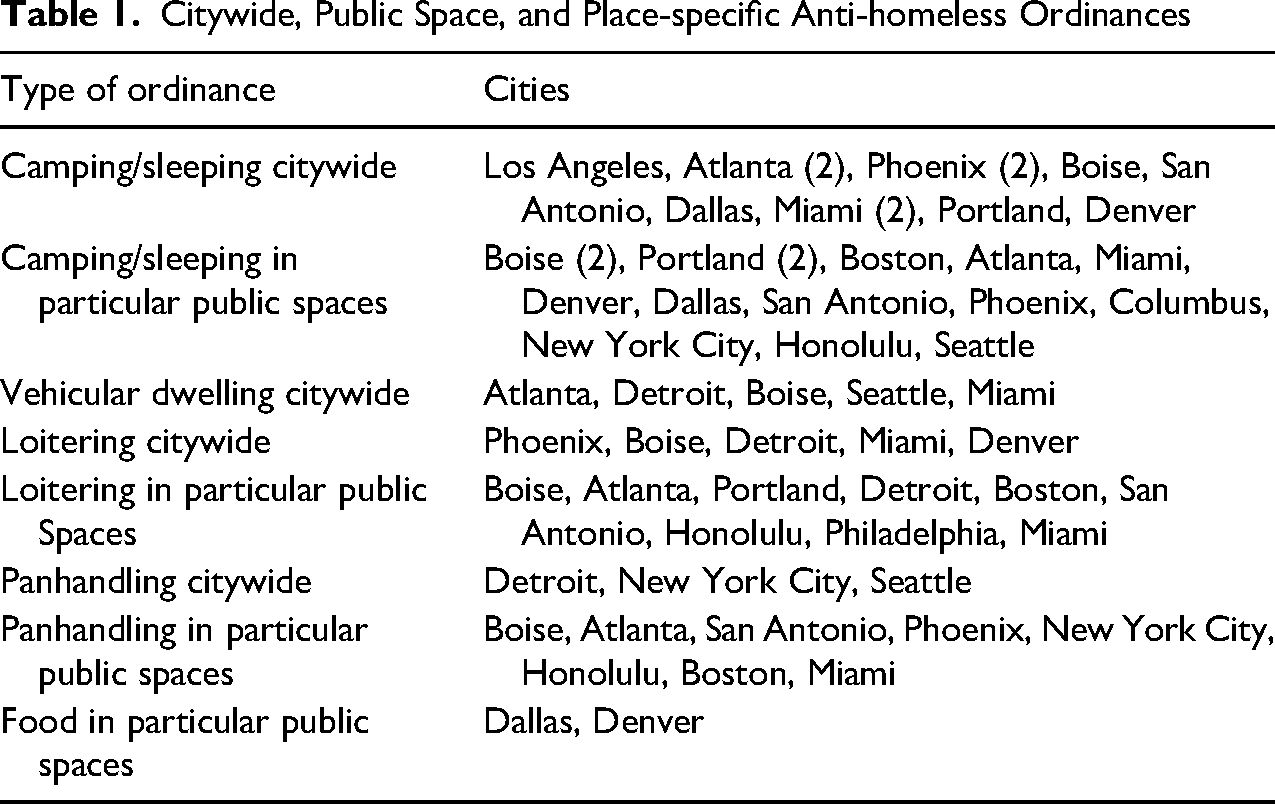
The sixteen cities together have a total of 61 “quality-of-life” ordinances that can be classified into four categories. To avoid constitutional challenges due to vagueness, many of these ordinances have been amended to become highly specific regarding space and/or time. They ban and criminalize (1) sitting and sleeping in public spaces (camp); (2) hanging out in public spaces (loitering); (3) asking people for money (panhandling); and (4) requesting or receiving food or drink (food). Figure 1 shows the latest year that an ordinance was implemented or amended to conform to court rulings. Some cities have more ordinances than others. Miami has six ordinances targeting homelessness; Boise has five, while Phoenix, San Antonio, and Atlanta have five each. Prior to 2000, a total of nine camping ordinances, seven loitering ordinances, and three panhandling ordinances were written into city codes in these sixteen cities (approximately 30% of the total ordinances presented in Figure 1 and Table 1). Philadelphia and LA are the only cities which have not implemented or updated their “quality-of-life” ordinances since 2000. As we will contend in the next section, this does not mean they have stopped criminalizing homelessness or expanding the boundaries of anti-camping ordinances and other hidden policing strategies. After 2000, twenty-eight camping ordinances, four loitering ordinances, eight panhandling ordinances, and two food ordinances were implemented. The significant increase in these ordinances after 2000 is attributed to post-9/11 securitization efforts in downtowns (Marcuse 2006; Mitchell 2003) and the impacts of redevelopment and gentrification on the regulation of public space conduct (Bauman et al. 2019; Mitchell and Staeheli 2006). Since the COVID-19 pandemic, eight camping ordinances were implemented. Cities increasingly rely on the discretion of local police to enforce these ordinances, which ban sitting citywide, criminalize standing near ATM machines, and outlaw homelessness near popular tourist destinations, while partitioning cities into zones of public space and private property, and privileging pedestrian flow and economic development goals that prioritize processes of gentrification (American Legal Publishing 2022; Blomley 2009; 2010; Code Publishing Co 2022; General Code 2022; Goldfischer 2020, 2018; Municode 2022; Parker 2020; Quality Code Publishing 2022).
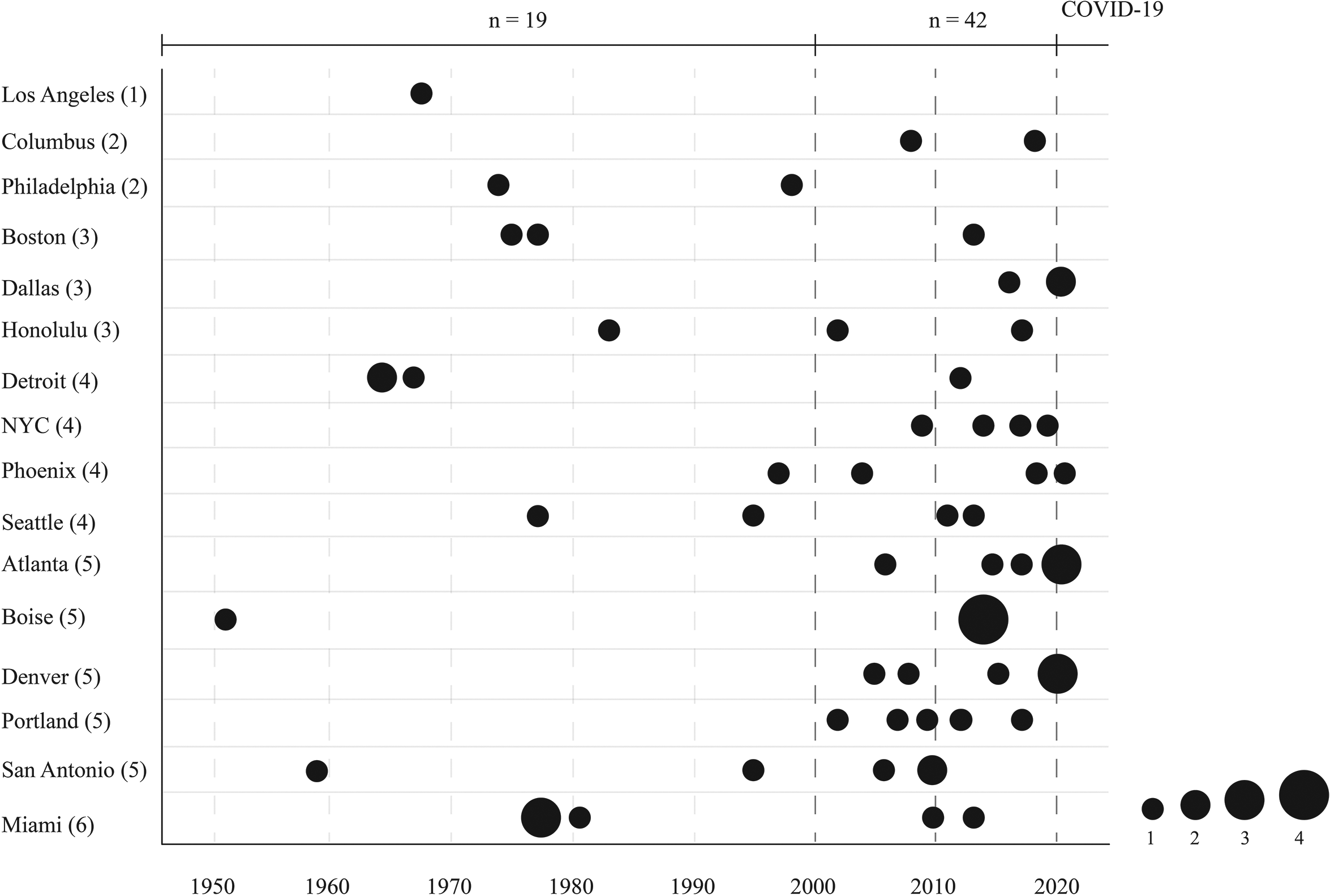
Timeline of anti-homeless ordinances by type in 16 US cities (American Legal Publishing 2022; Code Publishing Co 2022; General Code 2022; Municode 2022; Quality Code Publishing 2022).
Camping ordinances outlaw camping, sleeping, and/or sitting in streets, parks, and plazas, and some even outlaw sitting on public sidewalks. For example, Boise Code § 6-17-06 bans setting up tents or makeshift shelters along the Boise River, which stipulates that no one may “use any of the streets, sidewalks, parks or public places as a camping place at any time” after hours of operation. While the previous ordinances ban camping in various public spaces, LA Municipal Code (LAMC) § 41.18(d) prevents even sitting on sidewalks, stating that: “No person shall sit, lie or sleep in or upon any street, sidewalk or other public way.”
Loitering ordinances criminalize congregating for an extended time in particular spaces. For example, Atlanta's Ordinance § 110-59(c) states, “No persons shall congregate or gather within 150 yards of any entrance to the Chastain Park amphitheater during the hours of 7:30 p.m. to 1:00 a.m.” on performance nights.
Panhandling ordinances outlaw speech that requests monetary assistance from people in public. Frequently, these ordinances target “aggressive” panhandling, and the discretion of police often determines what “aggressive” means. For example, Boston Code § 16-41.2 outlaws aggressive solicitation near bus shelters, parking garages, sidewalks cafes, commercial land uses, and crosswalks.
Food ordinances make it illegal to receive, request, cook, and/or consume food or drinks in public spaces. For example, Denver Code § 39–73 requires submission of applications and payment of fees for those entering parks and recreation property for the purposes of cooking and consuming food. These types of ordinances often target unhoused individuals who usually need to eat in public spaces.
Responding to court rulings that “quality-of-life” ordinances were unconstitutional, cities have adapted ordinances regulating specific public spaces, while leaving citywide enforcement to the discretion of police. Many ordinances simultaneously target homelessness citywide and within specific public spaces. Twelve ordinances criminalize camping or sleeping citywide, while 15 ban camping or sleeping in particular places (e.g., riverbeds and sidewalks). Four cities criminalize vehicular dwelling; since vehicular homelessness can only occur in streets and parks, such bans can be considered citywide. Five cities ban loitering citywide, while nine ban it from specific public spaces (e.g., sidewalks and near food establishments). Three cities criminalize panhandling citywide, while eight ban it on freeway offramps and near ATMs. Lastly, Denver and Dallas do not allow cooking or consuming food in campsites and sidewalks without a permit or paying a fee.
In response to the controls imposed by the ordinances, grassroots groups and organizations in the sixteen cities have sought to guarantee some basic freedoms to unhoused individuals to exist in the city. For example, they provide outreach cards that give the unhoused information about legal assistance services, housing, clothing, and free meals. 12 They establish observers at campsites to disrupt and prevent police sweeps. 13 Some host food and clothing giveaways where activists surround the area to deter police intervention. 14 In response to the pandemic's impact on the unhoused, particularly the LGBTQIA + and youth of color communities, groups also provide food, housing, and healthcare. 15 But while significant literature has reviewed and criticized these earlier public space controls and regulations (Loukaitou-Sideris and Ehrenfeucht 2009; Mitchell 2003; Wyly and Hammel 2005), with few exceptions (Dozier 2022; Goodling 2021), we have less empirical research that analyzes emerging anti-homeless strategies, their spatiality, and their impacts on outreach. To partly address this gap, in the next section, we focus on LA and examine the city's emerging strategies of spatial banishment in spaces of homelessness during COVID-19 and their impacts on outreach and advocacy.
Citywide, Public Space, and Place-specific Anti-homeless Ordinances
Spatial Banishment in Los Angeles
With anywhere from 50,000 to 100,000 unhoused individuals vying for public space for sitting, sleeping, and other basic biological necessities, LA represents a paradigmatic case to investigate municipal actions and activist responses toward homelessness. Many city sidewalks, parks, and plazas have become contested spaces, pitting the survival needs of the unhoused against private property and municipal interests (Collins and Loukaitou-Sideris 2016). According to the 2020 homeless census, people tend to concentrate in areas like Skid Row with high densities of homeless services and places with adequate public space like Venice Beach (Figure 2). In 2016, voters passed Measure H (LA County) and Proposition HHH (City of LA) to fund homeless services, shelter expansion, and affordable housing construction. This support for expanded poverty management strategies reflects a compassionate homeless policy landscape supported by the votes of more liberal residents (Laniyonu and Byerly 2021), which is juxtaposed by spatial banishment efforts in the city. 16
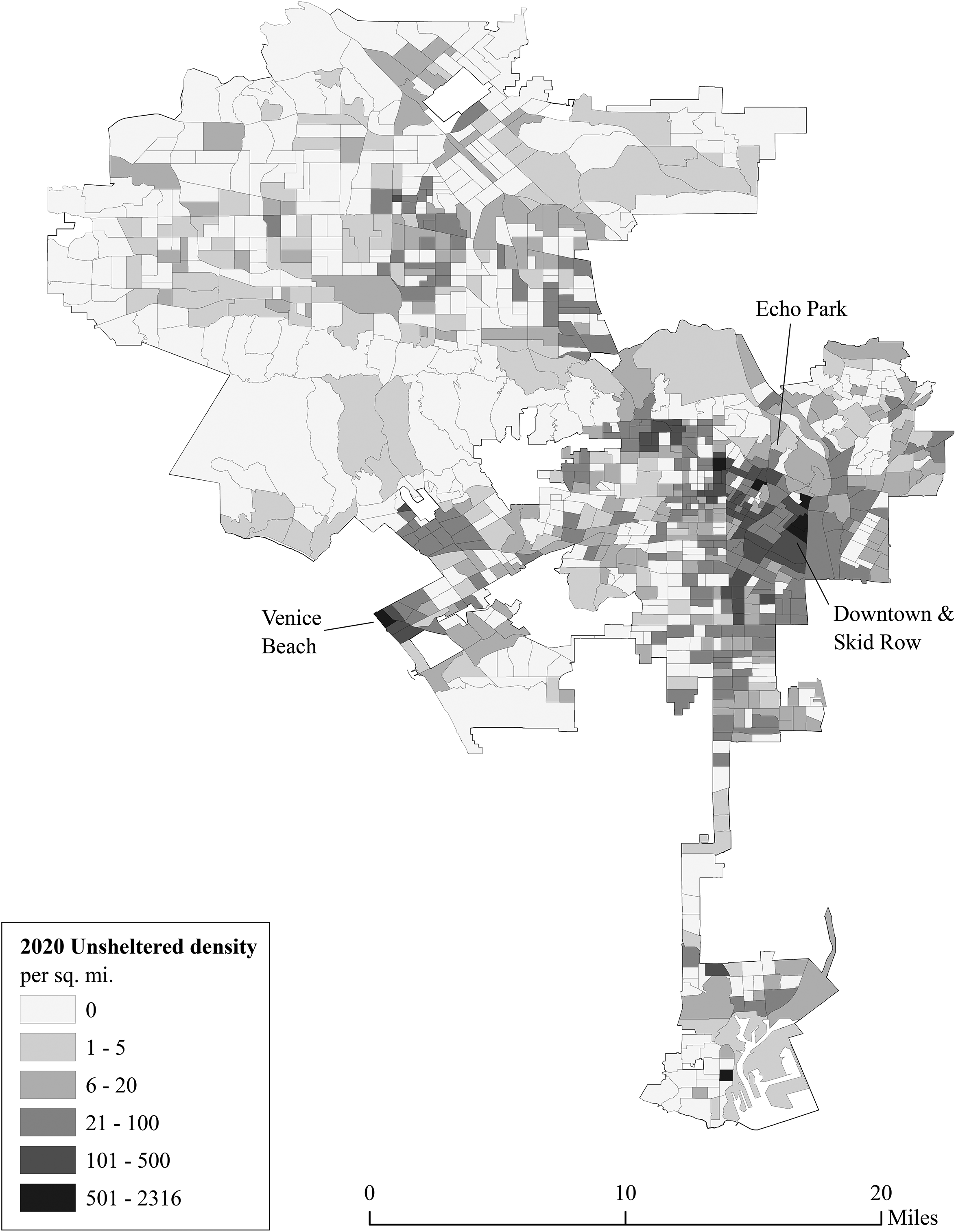
Density of unsheltered individuals by census tract (2020).
Since early on, anti-homeless legislation has been pervasive in LA and continues to impact and be contested by activists. In 1968, the city passed Los Angeles Municipal Code 41.18(d), colloquially known as the “sit-lie” law, which bans individuals from sitting, hanging out, and sleeping on city sidewalks. In the early 2000s, clashes between unhoused activists and local businesses reached a tipping point, as former police chief William J. Bratton began reinforcing the “sit-lie” ordinance (Blasi and Stuart 2008; Vitale 2010). This subjected unhoused individuals, who had nowhere else to sleep or sit due to a shortage of shelter beds and permanently affordable housing, to fines of $1,000 and 6 months or more of incarceration. In 2003, the ACLU brought a lawsuit against the city. In Jones v. the City of LA, a district court upheld the ordinance because it criminalized a person's conduct and not their socioeconomic status. However in 2006, the Ninth Circuit Court of Appeals ruled that Edward Jones and other unhoused individuals in Skid Row had illustrated past harm and the threat of continued future punishment without the possibility of accessing permanent housing (Gerry 2007). The settlement stated that until the city provided 1,250 permanent housing units, it could not reinforce the “sit-lie” ordinance.
In 2018, the city met this requirement and resumed enforcement of the ordinance until the ruling in Martin. The same year, former Mayor Eric Garcetti implemented the shelter program “A Bridge Home” (ABH), which seeks to act as a temporary bridge from living in the streets to living in permanent housing. This program, however, has not been very successful. By November 2020, only 15% of 1,500 individuals placed into these shelters had moved to permanent affordable housing (Oreskes and Smith 2020). At the same time, the city has set up a Special Enforcement Zone (SECZ) around each shelter, where outreach workers at the Los Angeles Homeless Service Authority (LAHSA), LA Sanitation employees, and LAPD officers enforce street clean ups, notifying unhoused individuals in particular areas that they must leave for street cleaning or be subjected to policing and dispossession. 17 The newly elected Mayor Karen Bass is continuing this short-term solution with the “Inside Safe” initiative; the police sweep people off the streets, sanitation workers destroy their property, and unhoused individuals are taken to motels for a 1-year experiment. 18
Spatial Banishment During COVID-19
During COVID-19, LA has employed a variety of spatial banishment strategies through legally hybrid tools of legislation and policing, which present a difficult challenge for the unhoused and their advocates to contest. The city primarily uses force and coercion to displace and dispossess unhoused people, while bargaining for rights to the city and having an influence in policy-making decisions are downplayed or outright ignored (Johnsen and Fitzpatrick 2010). Table 2 presents a timeline that demonstrates how the city has haphazardly produced a fragmented anti-homeless landscape.
Fluctuations in LA’s Anti-Homeless Strategies During COVID-19
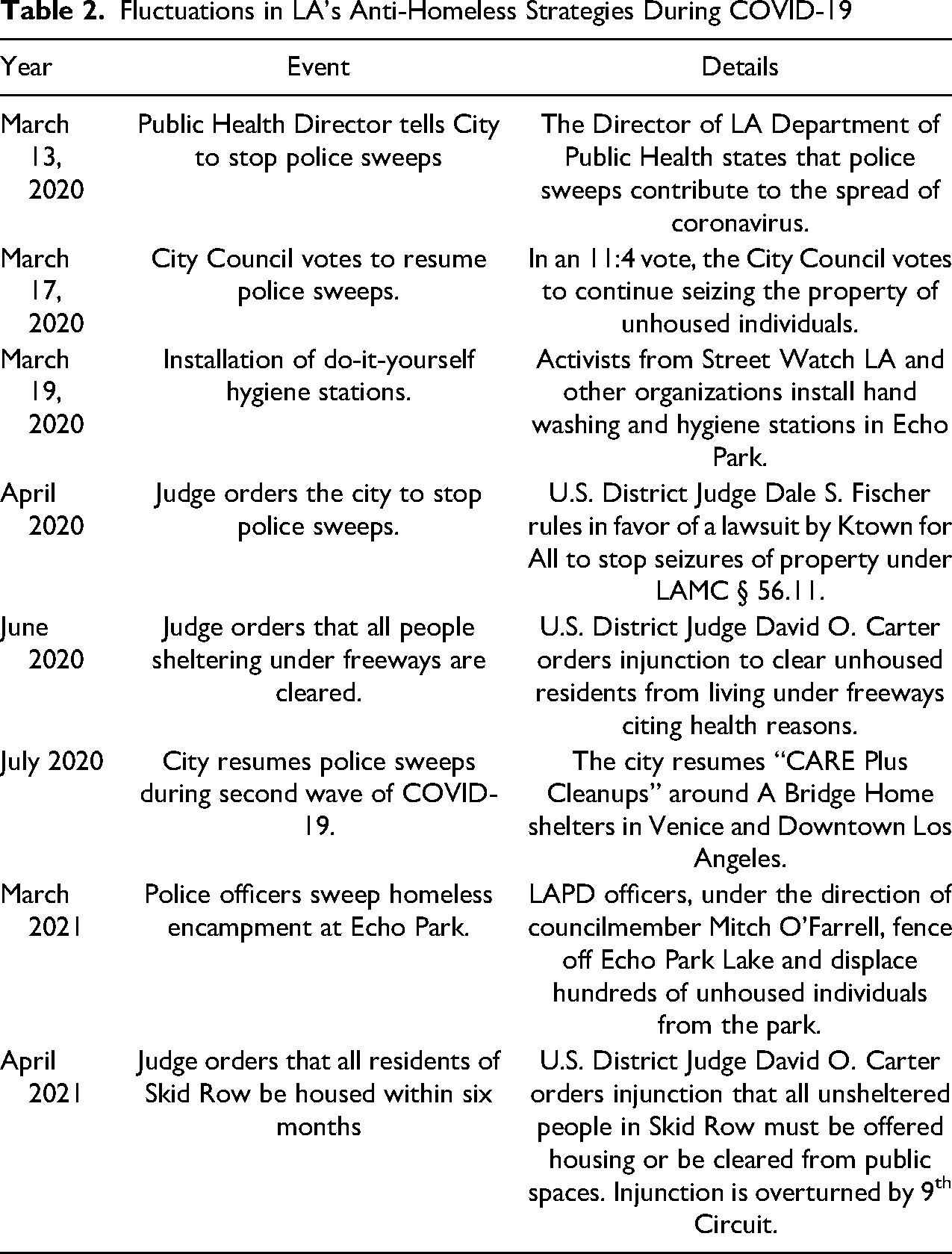
In 2019, the City Council expanded the boundaries of the “sit-lie” (41.18d) regulation to cover additional sidewalks and parks within 500-feet of schools, parks, daycare facilities, and cultural venues (Stiles, Menezes and Reyes 2019). At the same time, the Echo Park encampment developed as the result of regulatory indifference, and unhoused individuals were able to produce an autonomous space to shelter. Police sweeps temporarily stopped after March 2020, in response to the pandemic and under advisement by the Centers for Disease Control that pushing encampments to other parts of the city would spread the virus. 19 However, in late July 2020, the city and neighborhood councils voted to resume sweeps under freeways, in public spaces like Echo Park, and around ABH shelters. 20 Sweeps and blockades started occurring regularly, especially at ABH sites in Canoga Park, Hollywood, North Hollywood, and Van Nuys. Around each ABH facility, the City has established a SECZ to enforce sweeps of the unhoused around these heavily policed, prison-like compounds. 21 The facilities are fenced in, the shelters are office trailers, and individuals receive a cot partitioned within each trailer.
Through force and coercion, sweeps or “cleanups” (as they are called by political leaders and the police) are 9-to-5 operations led by LAPD officers; sanitation workers dispose the personal property of the unhoused individuals; and LAHSA employees distract them through conversation. 22 Costing anywhere from $15,000 to $20,000 per cleanup and about $30 million annually, with approximately 10 officers per unhoused person, sweeps are carried out weekly to force people to accept shelter. 23 The activists interviewed called this strategy “soft incarceration” because it forces unhoused individuals to accept shelter despite their concerns and experiences with overcrowded conditions, harassment, and sexual violence. These SECZs are set up where longtime encampments exist, and activists see their proliferation as a citywide strategy to set up no-go criminalization zones and place unhoused people into camps.
Most notably on March 24, 2021, hundreds of armed LAPD officers surrounded Echo Park Lake and taped off major streets and freeway exits to dismantle the encampment, offering the option between shelter or jail time for violating LAMC § 63.44, which bans overnight camping in public parks. Since this clash, police sweeps have continued at other sites according to interviewed activists. Advocate #3 called the ongoing small-scale sweeps “the echoes of Echo Park” and “arbitrary” and “criminal.” Advocate #4 called LA's homeless policy landscape “perverse.” Table 3 summarizes the city's anti-homeless policy landscape and strategies of spatial banishment during the COVID-19 pandemic.24–26
City of Los Angeles (In)visible Anti-homeless Policy Landscape
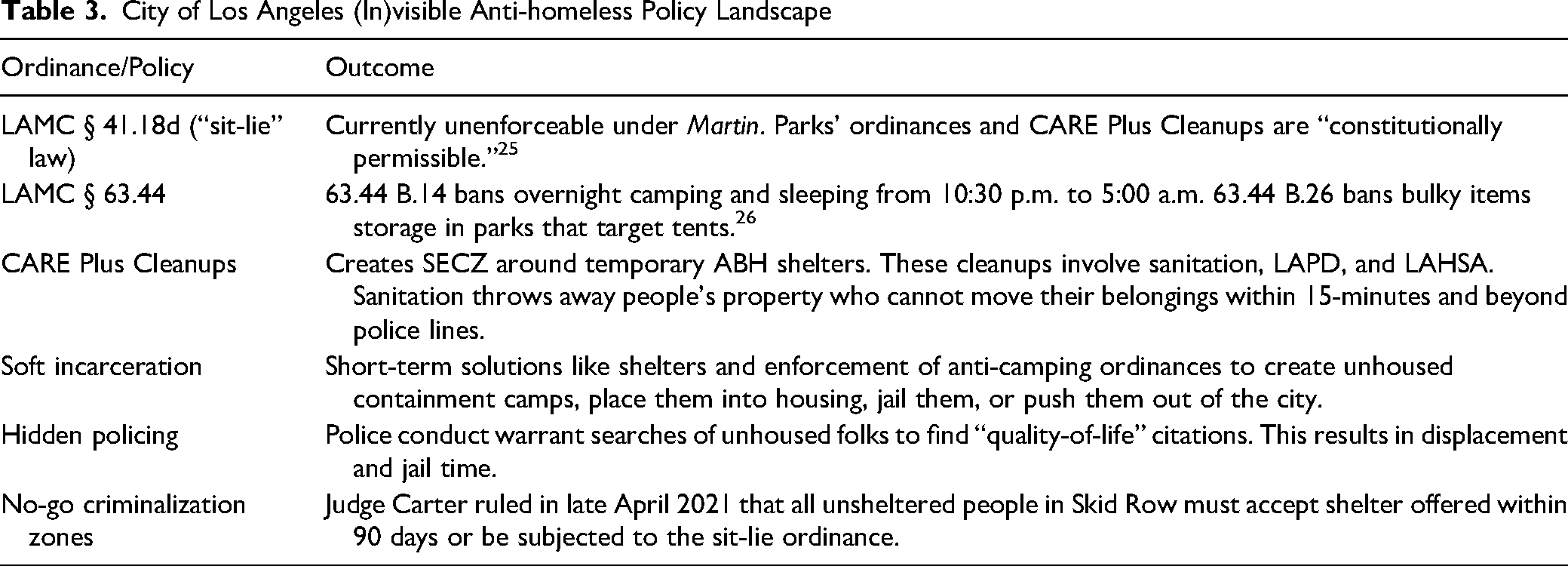
According to our interviewees, five strategies of spatial displacement produce an anti-homeless policy landscape in LA: (1) enforcement of quality-of-life ordinances; (2) police sweeps around short-term shelters and within large parks; (3) offers of services and shelter to contain, punish, and/or displace the unhoused from public spaces; (4) hidden policing strategies like warrant searches and ticketing; and (5) creation of no-go zones under freeways and in Skid Row. The use of force and coercion to displace unhoused folks makes it difficult for them to bargain with the police or know which spaces they are allowed to be and at what times. Figure 3 shows a map we created to spatialize LA's current anti-homeless policy landscape. Almost half of the city's land area (294 out of 600 square miles) and all census tracts with unhoused people are covered by a strategy of spatial banishment, which subjects most unhoused people to displacement and dispossession. 27
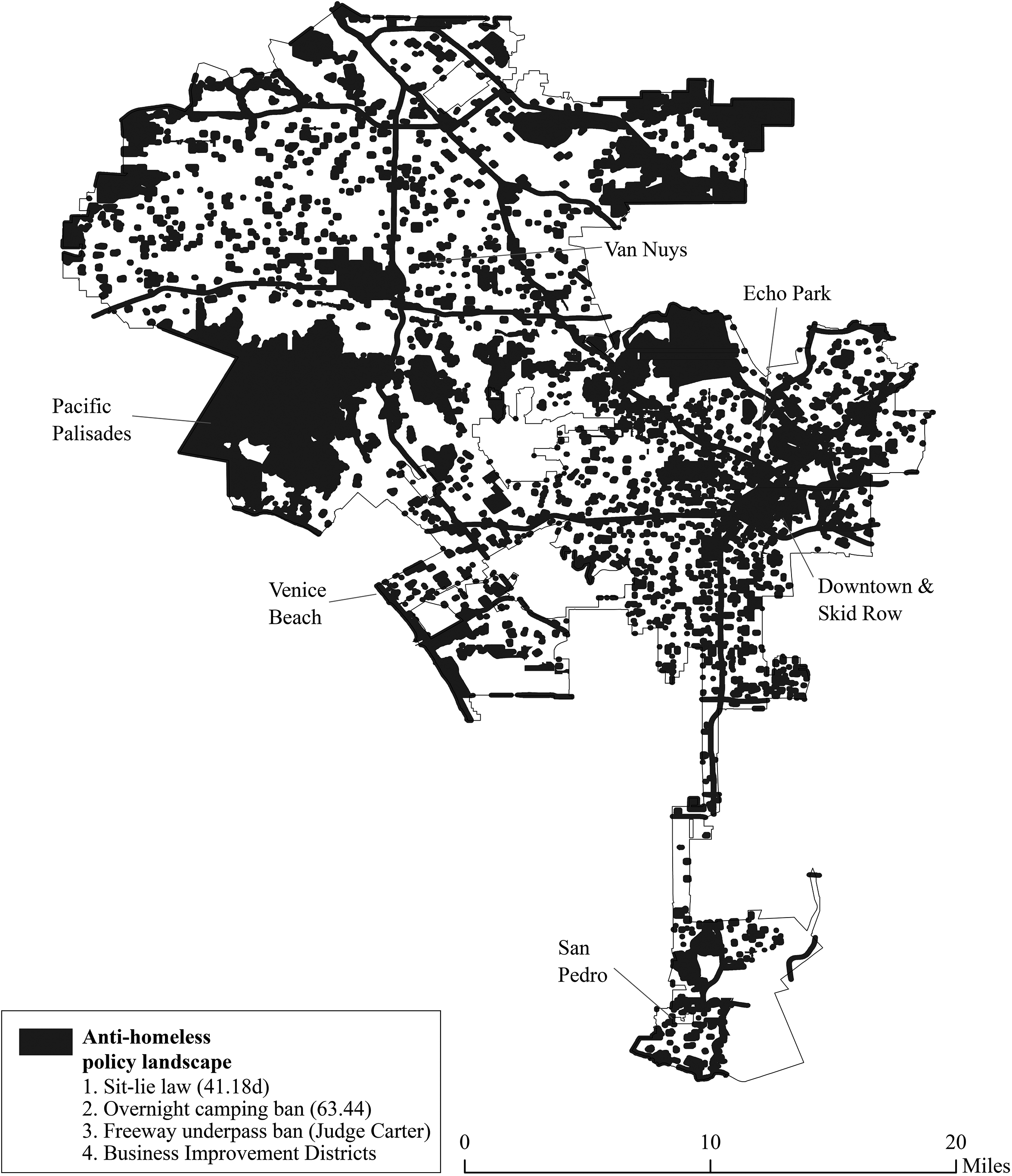
Spaces covered by LA’s anti-homeless policy landscape (2020).
Los Angeles as a Neo-Revanchist Landscape: Perspectives From Advocates
The anti-homeless policy landscape of LA reflects the production of a fragmented neo-revanchist city. This is enacted spatially through the re-enforcement of “quality-of-life” ordinances, shuffling of unhoused people between public spaces into temporary shelter spaces (Roy et al. 2022), and hidden policing strategies under the guise of public health mandates. For example, Advocate #1 suggested that public health protocols like the CARE + cleanups (police sweeps) further criminalize the unhoused: If there is any type of criminalization or enforcement, it will always disproportionately affect poor minorities the most. That is one thing to think about: how people's rights can be affected by the public health measures. There's so much that is going to change post-pandemic. There's more of an appetite for surveillance. I have heard about cops harassing people because their tents aren’t far enough apart from one another. Criminalization is always a threat behind every posited positive public health thing that they implement.
Advocacy organizations like Ktown for All, Street Watch LA, and LA Community Action Network contend with weekly sweeps that are unconstitutional under the precedent of the Martin ruling. This ruling is important because although the city was able to reach the 1,250-shelter bed requirement requested in Jones, it does not have enough shelter beds to justify continued enforcement of police sweeps. Indeed, in 2019, the city only had 15,000 shelter beds for 26,606 unsheltered individuals (LAHSA 2020). In response, there has been renewed activism against expanding spatial banishment strategies—provision of hygiene kits, construction of mutual aid infrastructure like showers, Twitter storms using #HomesNotZones and #ServicesNotSweeps to raise awareness, Zoom bombing to disrupt council votes, and community breakfasts before sweeps. However, our conversations with advocates revealed that their outreach work is often short-lived and impacted by police force.
Advocates’ power to block sweeps is limited because they have to contend with armed police. Two activists described their initial successful attempts to create blockades of about 80 people to prevent sanitation agents and police from displacing unhoused individuals in Van Nuys. But the police later brought approximately 80 armed officers who created their own blockade and taped off the encampment, reminiscent of a crime scene. While advocates distinguish SECZ zones as either “militant” (involving police) or “non-militant” (without police presence), they describe most cleanups as “traumatic, demoralizing, and inhumane.” They take place in the morning when unhoused folks are sleeping, place unrealistic expectations on them to clean and move their stuff within 15 minutes, and result in displacement, dispossession, and, in rare cases, death. Two advocates indicated they had been followed by police and arrested for their efforts to provide food to people, vying for more time to move property, and negotiating with sanitation workers and LAPD to stop the sweeps. Advocate #4 stated that “Another gentleman ended up going into the hospital for a few days … Two people died. One person had a mental breakdown and got the cops called on her. Another person went to the hospital. That's in a friendly SECZ!” Advocate #3 detailed a story from a non-militant SECZ sweep. A mother said, “My son has seizures. He was seizing last night. If we move him, he will have more seizures.” Someone in sanitation documented that, and they weren’t moved that day. They came back three weeks later and made them move. The son immediately had a seizure and ended up on the floor. Someone in sanitation immediately said, “You can’t say that we did that. You can’t say that we caused that.”
Advocates also described other processes of displacement and the setting up of “no-go criminalization zones.” These include banning camping under freeway underpasses, police searching unhoused individuals for warrants, and short-term policy responses to Martin, such as building shelters to justify sweeps instead of permanent supportive housing. As prior research that looks at the physical and psychological impacts of sweeps has documented (Beckett and Herbert 2010; Darrah-Okike et al. 2018; Herring, Yarbrough and Alatorre 2020), people's shelters and communities are bulldozed and their medicine, IDs, wheelchairs, and legal documents are confiscated. Weekly police contact, displacement, and dispossession may lead to depression, seizures, and even suicide. Advocates argued that individuals are offered short-term, unstable shelter, but their humanity is disregarded, their property destroyed, and their needs are ignored. Soft incarceration, hidden policing, and the ad hoc creation of encampment-free zones, according to Advocate #2, create: a confusing, haphazard, patchwork system of places where people can and can’t be. That obviously creates real problems for unhoused people who are not going to pull up the city maps that show you the red zones and the green zones when they’re deciding where to set up camp. That is an unreasonable expectation, so when you’re creating those zones where they are becoming extremely at risk of arrest or harassment, that's a problem.
At the beginning of the pandemic, activists were able to provide dependable outreach to encampments because there was a moratorium on police sweeps. As the moratorium was lifted, large encampments were swept, unhoused people were displaced, and quasi-legal no-go-zones were aided and abetted by hidden policing strategies. According to the activists interviewed, the best they could do in militant and non-militant spatial banishment zones was to provide community meals to stall police sweeps in an effort to ensure people could save their possessions and property. While they continued to participate in vocal resistance at council meetings and during sweeps, these newly emerging neo-revanchist spaces have impacted outreach efforts by forcibly displacing unhoused people and pushing them into an unstable cycle of looking for places to practice life-sustaining activities. With little knowledge as to where unhoused people were spatially banished, activists could not provide hygiene kits, meals and water, and points of contact for access to services and opportunities for housing.
Conclusion
In recent years, some scholars have argued that cities have become “post-revanchist” because they have initiated citywide initiatives to provide mental healthcare, hygiene services, and affordable housing, indicating a more compassionate policy landscape towards homelessness. However, our review of “quality-of-life” ordinances in sixteen US cities and our case study of spatial banishment strategies and their impacts on advocacy efforts in LA clearly show that cities are still predominantly revanchist even if they pursue some positive citywide initiatives. Our review showed that cities have intensified their efforts to control visible homelessness by reenacting “quality-of-life” ordinances since 2000 and adding new such ordinances to their municipal codes even if the courts have ruled some of them to be unconstitutional. The pervasiveness of these ordinances violates unhoused individuals’ constitutional rights and human dignity. They also impact mutual aid efforts by activists to provide hygiene and sanitation infrastructure, meals and water, and housing and service opportunities by displacing unhoused people to different parts of the city.
While Smith (2009) and Levy (2021: 923) have posited that neo-revanchism—strategies to rehabilitate, coerce, surveil, and punish unhoused people through enforcement of public space regulations, shepherding into short-term shelters, and gentrification of urban space—operates at planetary and national political–economic scales, we have illustrated how neo-revanchism functions haphazardly in LA. Our case study of municipal strategies and their impacts on outreach and advocacy efforts in LA shows that the city has in recent years, and even through the pandemic, stringently controlled visible homelessness through its “quality-of-life” ordinances, encampment sweeps, and hidden policing and soft incarceration strategies, which together create a fragmented landscape of “no go zones” for the unhoused. We call these municipal strategies and policies “neo-revanchist.”
Further efforts are required to reimagine LA as a post-revanchist landscape that creates inclusive public spaces, administers services, and provides housing without policing. Ideally, the experiences and tacit knowledge of unhoused communities would be incorporated into urban policy to realize public space and housing justice. Our interviews with activists indicated five initiatives that cities can undertake to help unhoused individuals. First, their voices and needs must be included in citywide homeless policy decision-making processes. Second, cities can provide more public toilets and shower facilities, which will help unhoused individuals maintain basic hygiene. Third, sanitation agencies should provide sanitation services, receptacles, brooms, and other cleaning supplies so that unhoused folks can keep their property safe and encampments clean. Fourth, cleanups should primarily involve social workers with no police presence to prevent psychological and physical trauma. Lastly, transfer to shelters should be voluntary; if someone does not accept shelter because of past traumatic experiences, they should not be penalized.
The Echo Park encampment sweep was a boiling point for unhoused activism calling for a right to the city and to housing. We argue that sweeps and confrontations brought into sharp relief that forced displacement and dispossession under the guise of sanitation represents a neo-revanchist policy regime. This regime is enacted spatially and produces an ad hoc anti-homeless landscape that impacts advocacy and outreach efforts to provide mutual aid in dependable locations. Such an anti-homeless regime (Amaral 2021) can pervade a city's public spaces and create “no-go-zones” for the unhoused through the enforcement of “quality-of-life” ordinances. “Tough love” campaigns by cities expressed through a “false language of compassion” (Robinson 2019: 47) either coerce individuals into subpar shelters through increased police contact or displace them into interstitial city spaces, further stripping them of their right to public space. People's capabilities to self-manage and control how they use public space are based on their status as unhoused. Respect for and incorporation of unhoused individuals’ voices, needs, and lives must be central to policy responses aiming for social justice. To become “post-revanchist” and end homelessness, cities should follow the initiatives proposed by the advocates, abolish spatial banishment strategies, and pursue compassionate policies that unconditionally (i.e., zero criminalization) provide life-sustaining services and permanently affordable housing opportunities.
Footnotes
Declaration of Conflicting Interests
The author(s) declared no potential conflicts of interest with respect to the research, authorship, and/or publication of this article.
Funding
The author(s) disclosed receipt of the following financial support for the research, authorship, and/or publication of this article: This work was supported by the UCLA Graduate Research Mentorship.
