




Abstract
Depictions of school choice offering greater individual and local autonomy are widespread, yet they sit uneasily with portrayals of such policies within African-American political discourse. This article analyses the ways in which opposition to publicly funded private school vouchers has been used as a cue to signal solidaristic ties to the African-American electorate. School choice is highly racialized. Black politicians have been known to campaign against school choice policies by presenting them as tools of White outsiders to break up and divide the Black community. Although opinion polls have indicated that a majority of African-American voters support education vouchers, in a campaign context school choice policies can be framed through the prisms of racial authenticity and community control. Using data drawn from interviews with political operatives and archival research in Newark, New Jersey, this article demonstrates that school choice can paradoxically be rendered as a policy of community disempowerment.
Introduction
It is well-established that in majority-White contexts, White opponents of African-American candidates sometimes attempt to “racialize” their Black opponent in an effort to minimize their appeal to White voters (Gomolin et al. 2007; Mendelberg 2001; Westen 2007; White 2007; Winter 2008). In campaign communications and stump speeches, White candidates align Black opponents with policies which are not ostensibly racial but evoke negative racial stereotypes when associated with a Black candidate. These issues include crime (Hurwitz and Peffley 2005), the death penalty (Williams 2012, 107), drugs (Rudolph and Gymerah 1997), gun control (McIllwain and Caliendo 2011, 24), taxes (Sniderman and Piazza 1993, Ch 4), and welfare (Gilens 1999). By raising the salience of implicitly racialized policy issues, White candidates endeavor to activate White fears of “Black threat” and to imply that their opponent is “too Black” to represent a majority-White electorate (Blalock 1967; Donovan 2010; Key 1949; Sonenshein 1990; Strickland and Whicker 1992).
Far fewer scholars, however, have studied the role of racialized policy issues within majority-Black electoral contexts when two African-American candidates compete against each other. Political scientists have often minimized the importance of policy in these election campaigns, focusing instead on turnout strategies (Bedolla and Michelson 2012; Carton 1984; Harris 1999; Washington 2006), patronage (Hamilton 1979; Jennings 1992; Kaufmann 2004, 122–28; Keiser 1997), and generational tensions (Burnside and Rodriguez 2010; Gillespie 2010a; Gillespie and Tolbert 2010; Ifill 2009; Lewis 2010).
This article argues that Black candidates in intra-Black electoral contests also raise the salience of policy issues with implicit racial content in order to limit the electoral appeal of their opponent. Specifically, Black candidates in majority-Black electoral contexts often attempt to “reverse racialize” their opponent by aligning him or her with White outsiders and with issues assumed to advance the interests of Whites at the expense of African-Americans. In doing so, voters are invited to question the candidate’s racial authenticity and commitment to the Black community. The aim of this racial campaign strategy is to imply that the opponent is “not Black enough” to represent a majority-Black electorate, which is built on the linkage of Black identity and loyalty to racial group interests (Dawson 1994).
In this article, I show that the issue of private school vouchers has been used strategically as one such implicitly racialized policy in a contentious intra-Black election. School vouchers are taxpayer funded subsidies to individual families to support parents’ ability to enrol their child in a private school. Few scholars have remarked on the racial connotations of school vouchers in election contexts in part because, as Desmond King and Rogers Smith (2011) argue, their racial dimensions are “less obvious” than other aspects of education policy such as affirmative action, busing, and school integration (p. 194). However, vouchers were part of the original toolkit to resist Brown v Board of Education, and their history is as racially inflected as other policies such as busing. My case study evidence suggests that this racial history remains relevant in urban communities. Additionally, modern-day voucher programs are often associated with neoliberal reform efforts, which undercut the public sector, drive down investment in public goods, and diminish community control over public assets (Lipman 2011).
To advance this argument, I examine the 2002 Newark mayoral election between four-term incumbent Sharpe James and challenging one-term councilman Cory Booker, both Democrats. This election, although nearly two decades old, is instructive for several reasons. First, it occurred at an important time in the development of school voucher policies. In February 2002, the Supreme Court heard the case Zelman v Simmons-Harris about the use of private school vouchers in Cleveland, Ohio. In a 5-4 ruling the court declared that vouchers, even those used for religious schools, were constitutional. While vouchers are now present in half of American states, in the early 2000s they were still only deployed in a handful of settings (Hackett 2020). The conflict in Newark was a sign of the policy and campaign battles to come. Second, the election took place at a crucial moment for Black electoral politics as the “first generation” of urban Black mayors was being challenged to hand over control to younger Black candidates. Third, the failed presidential candidacy of Cory Booker renewed interest in his early political career, his heterodox policy stances, and his fraught relationship with the Black community.
This election has attracted an unusually large amount of popular and scholarly interest for a mayoral contest in a city of Newark’s size, but no study has yet concentrated on the specific policy issues, including school vouchers, which featured in the election (Curvin 2014; Gillespie 2012; Kraus 2004; Persons 2009; Wharton 2013). This article argues that Sharpe James, who was re-elected, successfully portrayed Cory Booker as an “outsider” who acted as a puppet for White, conservative elites. James pointed to Booker’s support for vouchers as evidence of Booker’s estrangement from the Black community, arguing that as mayor Booker would “abandon our children.” 1 Although opinion polls suggested that a majority of African-American voters nationally supported school vouchers, in this campaign context vouchers became a key wedge issue in the Black electorate. 2 Vouchers were framed as a test of Black voters’ commitment to the solidaristic principle of Black linked fate, which refers to the degree to which African-Americans believe that what happens to Black people generally will have something to do with their own life. 3 The article focusses specifically on the racial appeals to African-American voters, who formed an absolute majority of the electorate, because, as Sharpe James’s strategists confirm, this community was the main locus of the two candidates’ electoral struggle. 4 Cory Booker was expected to win the White and Latinx electorates.
The article first sets out a theory of racialized campaign strategies. It proceeds by explaining the article’s data sources and methodological approach. Subsequently, the article provides a description of racial politics in Newark and the peculiarities of the 2002 mayoral candidates. The following section provides an analysis of school vouchers as an implicit racial cue. School choice was presented as a mechanism to strip power and autonomy from the Black community. The article shows that vouchers became the policy evidence to support Sharpe James’s claim that Booker wasn’t “for real,” a subtle challenge to his racial authenticity and bona fides to represent the mostly Black city. Finally, the article comments on how these findings extend beyond Newark.
Theory of Racial Campaign Strategies: Racialization, Deracialization, and Reverse Racialization
Scholars of African-American campaign politics have increasingly directed their attention to the dynamics of campaigns in which Black candidates face White opponents (Donovan 2010; McIllwain and Caliendo 2011; Nordin 2012; Smith 2009; Tate 2012; Tesler 2013). Commentators have remarked on the willingness of some White candidates to deploy implicitly hostile racial themes to minimize the appeal of their Black opponents (Persons 2009, x). Tali Mendelberg (2001) has argued that open racial hostility is rarely effective and, in many cases, can prove counterproductive, but political psychologists have identified the continued potency of the implicit racial cues in activating negative stereotypes about Black candidates (McIllwain and Caliendo 2011; Terkilsden 1993; Westen 2007; Wilson 1990). This is a process of candidate “racialization,” the process whereby racial attitudes are brought to bear on political preferences so that there is an associative link between a voting choice and racial feelings. While most scholarship has assumed that this associative link is always negative for Black candidates in majority-White electorates, scholars have argued elsewhere that positive racial associations can also operate in these contexts (Johnson 2018).
While political scientists have studied White attitudes toward implicitly racial policy issues, much less attention has been paid to Black voters’ attitudes in racially contentious intra-Black political competitions. This article argues that a different form of racialization is at work, where one Black candidate is associated with stereotypically White policy issues in an effort to make him or her appear less authentically Black. This article uses the term “reverse racialization” to refer to an opposition strategy of distancing an African-American candidate from his or her Black racial identity by associating him or her with Whites and policies thought to advance White interests at the expense of Blacks. The article differs from Tyson King-Meadows (2010) who uses the term “deracialization.” Deracialization is unsatisfactory in this context because it improperly privileges the rhetorical style and policy agenda of White voters and politicians as “non-racial.” It is important that items which are associated with Whites are acknowledged by scholars as having racial content, rather than presenting them as “deracialized.” It should also be stated that “reverse racialization” has no connection with the problematic idea of “reverse racism,” which wrongly implies that strategies to improve opportunities for racial minorities is driven by anti-White animus.
Majority-Black jurisdictions remain an important and relevant electoral context (Citrin, Green, and Sears 1990; Donovan 2010; Hajnal 2007; Highton 2004; Reeves 1997; Sigelman et al. 1995; Stokes 2004; Terkilsden 1993; Tesler 2013; Voss and Lublin 2001). Between 2000 and 2010, there was almost no decline in the number of majority-Black big cities (Table 1). In 2000, there were 20 majority-Black US cities with populations of more than 100,000 inhabitants. In the following census in 2010, 19 of these 20 cities remained majority-Black. The one exception was St Louis, Missouri where the proportion of African-Americans in the city’s population declined from 51.2% in 2000 to 49.2% in 2010. Overall, as indicated in Table 1, these cities saw an average 0.2 percentage point increase in the proportion of residents who were African-American.
Majority-Black Cities with Populations over 100,000 Inhabitants (2000–2010).
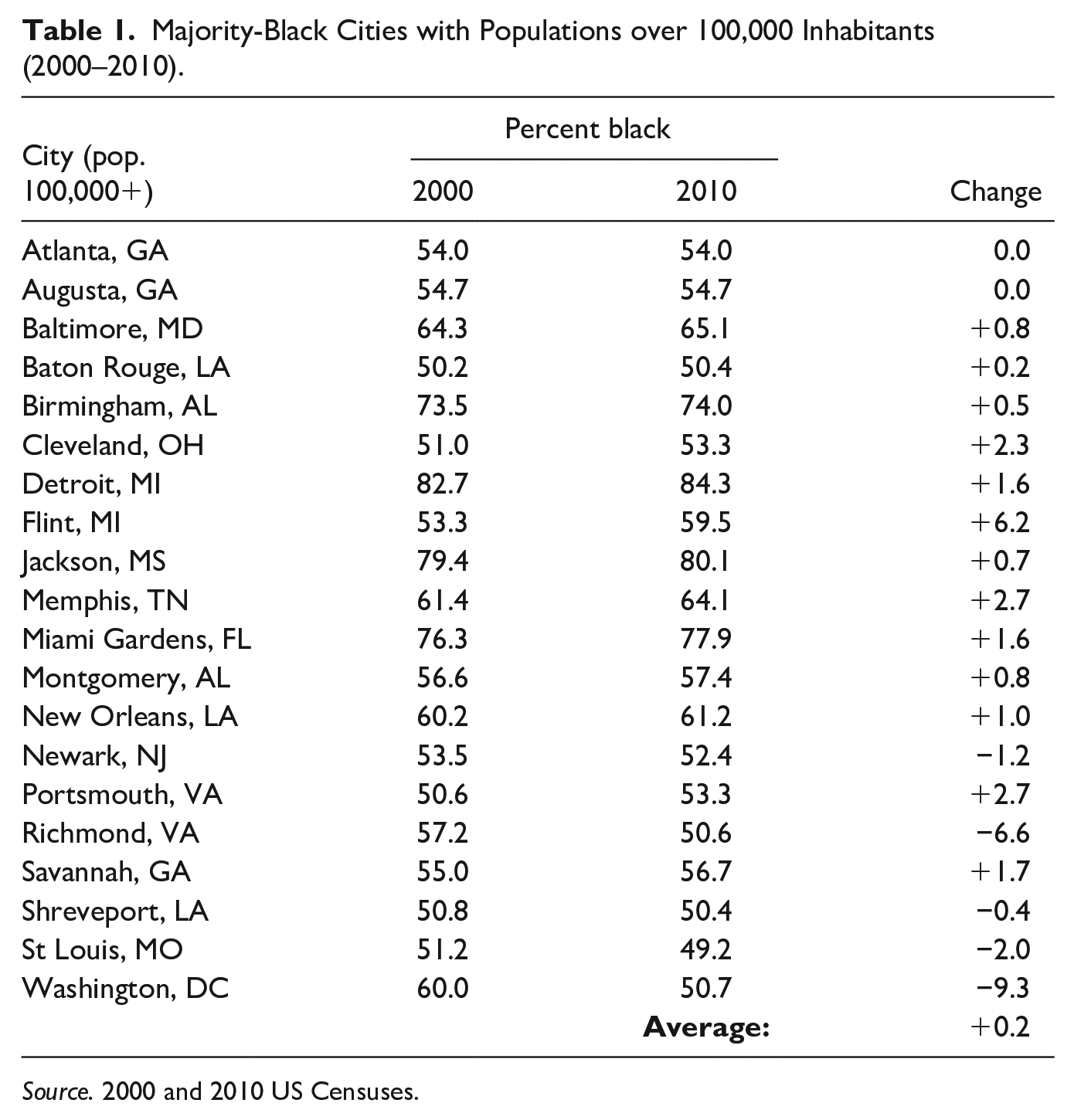
Source. 2000 and 2010 US Censuses.
Too often commentaries present a linear evolution of Black politics from an old-fashioned “racialized” style to a more modern, “deracialized” model with the latter seen as ethically superior to the former. Regrettably, scholarly interpretations of elections in majority-Black contexts remain too wedded to scholarship which explored majority-Black contexts in the 1960s and 1970s. The majority-Black racialized campaign continues to be associated with Black “militancy,” and “traditional” Black leaders continue to be portrayed as corrupt, flashy, buffoonish, or incompetent (Gillespie 2012, 233; Swain 1993/1995, 79; Thernstrom and Thernstrom 1997, 483). Newark”s first Black mayor Ken Gibbson, elected in 1970, was subjected to these racist portrayals (Holmes and Roper 2019).
This staid approach risks overlooking developments in Black electoral politics in the past quarter-century. Predominantly Black cities are not time capsules of “old-fashioned” Black militancy. Black politics has developed and changed in important ways since its modern genesis in the mid-twentieth century. In reality, these jurisdictions have also seen increasingly sophisticated voter mobilization strategies, messaging techniques, and communication tools. This article reorients focus to policy discussions in intra-Black political contests and emphasizes the imaginative messaging techniques used to frame these issues to mobilize certain urban electorates (Wolbrecht and Hartney 2014).
Data and Methods
The aim of this research is to describe and explain the production of racialized policy messages in intra-Black elections in urban America. It cannot make direct claims about the causal effects of these messages, but it traces the process by which a seemingly non-racial policy like school choice can become negatively associated with White racial power by African-American politicians. This is a necessary contribution because it is often assumed that “racialized” campaigning involves White candidates linking Black opponents with negative stereotypes about African-Americans. Few have investigated the reverse process.
The article adopts an in-depth, single-case study approach. There are several benefits to the single-case design. First, the single-case design helps to identify variables and relationships which might otherwise be obscured by larger cross-case analyses (Small 2009). The strength of a single-case design does not lie in providing decisive confirmation of general hypotheses but rather in bearing on the plausibility of arguments about politics (McKeown 1999). Second, this design allows for serious attention to the subtleties and nuances of racial campaigning. Claims about race are most meaningfully understood when embedded in peculiar local and historical contexts. Finally, this research hopes to stimulate further cross-case analyses of school vouchers in studies of racial campaign politics. As John Gerring (2002) writes, a single-case study tout court does not imply a single-case study tout seul (p. 147).
The 2002 Newark mayoral election deserves specific attention for several reasons. First, the campaign has already received an unusually large amount of interest from political scientists, historians, and political commentators, yet the policy content of the election has been largely overlooked. 5 Second, the case is not idiosyncratic but, as Gerring (2007) insists, is a case of “something broader than itself” (p. 248). Cory Booker’s challenge of Sharpe James represented an important national shift in Black political leadership, as ideologically centrist Black candidates who came of age after the civil rights movement attempted to supplant more left-wing “movement” Black leaders. 6 Finally, education policy has been a highly contentious and salient issue in Newark for over half a century. With 42% of adults in Newark lacking a high school diploma, education attainment in the city is unacceptably low. 7 Newark historian Robert Curvin makes the important point that in a city which has suffered the devastating loss of its manufacturing jobs, the imperative of providing local children with a high-quality education assumes an even higher level of significance than it ordinarily would merit (Curvin 2014, Ch 9).
This case study is based on extensive, original research. It draws from 15 in-depth interviews with individuals who were involved in the 2002 mayoral election as campaign staff, political activists, civil society leaders, and commentators. I interviewed six members of the Booker campaign and subsequent administrations—including a chief of staff, an election day field director, and organizers in both the Black and Latinx communities. I also interviewed campaign consultants who worked for Sharpe James, and they invaluably provided me with a sample of campaign communications. Among civil society actors, I interviewed two trade union leaders, one whose union (fire brigade) supported Booker and the other whose union (teachers) supported James. I also interviewed a former leader of the New Jersey NAACP as well as two members of Newark City Council, who both supported James. Finally, I interviewed a filmmaker who made a documentary about the election (Academy Award-nominated Street Fight) and an historian of Newark who was active in the city’s politics for half a century.
These interviews served three important functions. First, they helped to fill informational gaps which arose through my reading of secondary accounts of the campaign and candidates. Second, the interviews helped to establish the strategic intention of their campaign communications. Third, interviewees offered interpretive insights regarding political culture and context which were critical to identifying both implicit and explicit racial cues. 8
While in Newark, I accessed three archives: the Newark City Archives, the Cummings Information Center at the Newark Public Library, and the New Jersey Historical Society. I uncovered dozens of primary documents, including campaign literature, candidates’ private e-mails and letters, internal strategy documents, one-hundred newspaper articles, and a variety of campaign ephemera. The archival materials show precisely which public appeals were made, while the interviews help to uncover the strategic intention behind the choice of campaign rhetoric. The interviews inform upon the intended effect of these interventions. Together, these sources shed light on the process of “reverse racialization,” even if they cannot be used to measure its actual effect.
Newark
In order to unpack the complexities of racial identity and notions of racial authenticity in a campaign, scholars are advised to situate political actors within their particular local and historical contexts. The local setting in this case study is especially important because of the emphasis placed on “insider” and “outsider” status in Black Newarkers’ expression of racial solidarity (Morrell 2018, xv). Several interviewees, unprompted, described the city as “parochial”
9
and one long-time Newark resident described it as unashamedly “clannish.”
10
A former city councillor joked that she had lived in Newark for more than 50 years and was still sometimes viewed as an outsider.
11
A different Black city councillor explained to me, “at the end of the day I would say that Newark is one of the most xenophobic cities in America. And rightly so in a lot of instances.” The interviewee went on to explain that Whites “kept African-Americans out of the political system. . .and school board government and school district government, [while] taking the spoils. Basically raping the city, taking the spoils back to the suburbs, and none of them went to jail for it. That’s the simple fact of the matter of it. So there was a real distrust of anybody who didn’t look like us coming into our community.”
12
Cory Booker was born and raised in one of these overwhelmingly White suburbs (Harrington Park), attended predominantly White schools, and was educated at Stanford, Yale, and Oxford. To understand why Booker struggled to be viewed as an “authentically” Black candidate in the 2002 mayoral election, it is essential to recognize the strong sense of identity held by Black Newark residents bound up in a sense of “struggle” and (rightful) sense of abandonment by suburban Whites.
Situated along the Passaic River in northern New Jersey, Newark is a 15-minute journey by train from midtown Manhattan. Geographically, the inhabited city is shaped like a cross with the downtown district located in the “Central” ward, and four wards which emanate from it, eponymously labeled the North, East, South, and West wards. The city is highly racially segregated. Three of the city’s wards—the Central, South, and West wards—are predominantly African-American, whereas Latino/as form the majority in the North and East wards. According to Claudia Granados, one of Booker’s 2002 field directors, “the wards are very [racially] segregated. . . I use the word racial because I think everything is seen under that lens, whether it’s a new construction project, whether it’s a new school that comes in. No matter what it is, there’s always a racial component to it.” 13
Newark was the site of one of the worst urban riots in US history. Known as “The Rebellion” by some Newark residents, five days of civil unrest in July 1967 ended with 26 dead and over one-thousand injured (Kraus 2004, 2). More than any other event, the riots have shaped the social makeup of the city and its political identity (Herman 2013; Mumford 2008; Tuttle 2009; Williams 2014). They also signaled the end of White municipal leadership. In the 1970 mayoral election following the riots, Kenneth Gibson was elected the first Black mayor of Newark and Sharpe James was elected to represent the South ward on Newark City Council. Mamie Bridgeforth, who lived in Newark during the rebellion, summarized in an interview, “It holds a symbolic impact on the city because it was the watershed event that took the African-American and Hispanic population, if you will, from being oppressed to being actively involved not only in the power structure in the city of Newark but the power structure in the state of New Jersey.” 14 Modia Butler, Cory Booker’s chief of staff, explained that the riots “framed the way folks thought about representation and thought about how you campaign, how you govern, [and] how you develop a city.” 15 Jermaine James, Cory Booker’s mayoral chief of staff, posited that although the rebellion contributed to the departure of many businesses and shops from Newark, the change was, “some say, for the best in terms of diversity, in terms of Black power, in terms of opportunities for minorities.” 16
Since 1966, Newark has been majority-Black. In 2000, African-Americans made up 53.5% of the city’s population, Hispanics constituted 29.5%, and Whites constituted 14.2%. By the time of the 2002 mayoral election, the city’s population had progressively shrunk for half a century. In 1960, the population of Newark was 405,220. In 2000, it was 273,546. As Figure 1 shows, the decline of the city’s White inhabitants was particularly stark: from 265,889 Whites in 1960 to only 38,884 White residents in 2000. This sense of departure and abandonment left many residents sceptical of outsiders.
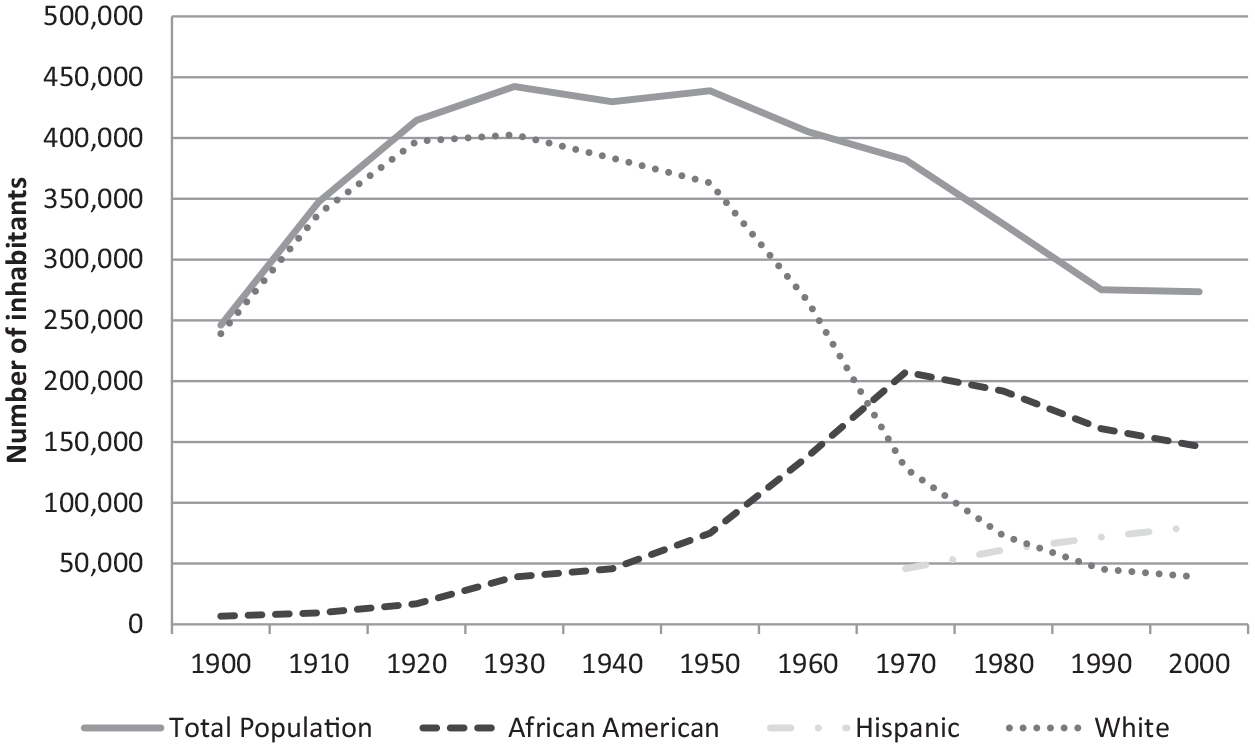
Racial characteristics of Newark residents, 1900–2000.
All of my interviewees agreed that Newark is a “politicized” city, with an unusually vibrant political culture and, as one campaign worker put it, a city with a “sense of itself.” 17 One of Sharpe James’s political consultants explained, “There’s a real identity. . .whether you would share the Newark experience, which they viewed in many ways as a negative experience, but there was a bond in having shared that negative experience in Newark. Having had the riots, survived the riots, the decline of the city. . .that was sort of a bonding thing in a way.” 18 Sharpe James captured these sentiments when he told a gathering in the majority-Black West ward a fortnight before the 2002 election: “The people who left Newark could never believe we’d still be here.” 19
In spite of the city’s difficulties, evidence suggests that by 2002 residents believed that Newark was improving. According to internal polling conducted by the Sharpe James campaign in March 2002, 57% of Newarkers believed that the city was going in the right direction, as opposed to 25% who did not. 20 From the perspective of the James campaign, Cory Booker’s frequent references to the city’s failings were expected to be received poorly by many residents. Robert Curvin, who acted as an early mentor to Booker in Newark, worried that Booker’s “constant harping about the negatives of the city. . .offended Newark residents” (2014, 260). Anant Raut, a former Yale classmate, characterized residents’ reaction from his own experience coming to Newark for the first time to canvass for his friend Booker, “It was kind of like, Who are you all to tell us what’s best for Newark, you know? Thank you for delivering us our savior but we have our own guy already.” 21 Newarkers felt that they together had climbed the “rough side of the mountain,” as Sharpe James described, and they objected to insinuations that there had been no progress in spite of their sacrifices. 22
Education Politics in Newark
Education policy has been highly contentious in Newark for over half a century (Golin 2002; Noguera and Wells 2011; Rich 1996; Yaffe 2007). Local control of the school district was ended in 1995 as the New Jersey Department of Education took over the district directly, citing “failure on a very large scale.” 23 This action only deepened sentiments of the city being besieged by outsiders. The takeover did not contribute to a dramatic increase in the quality of education in the city. John Abeigon, Director of Organization at the Newark Teachers Union, expressed dissatisfaction with the state takeover. He reflected, “You would expect the state would do a better job than the corrupt local officials they took over. That has never turned out to be the case. They are more corrupt and on a larger scale. . . The traditional schools never changed. They were ignored as they had always been.” 24 Capturing the feelings of indignation over the state takeover, Sharpe James supported a ticket of candidates in the April 2002 Newark school board elections who called themselves the “Home Team.” All were elected over Booker’s “Team for Change.”
Education politics in Newark has been historically racialized (Holmes 2019). When the state of New Jersey sent an auditor to inspect public school finances, a school board member called him “a White overseer” (Rich 1996, 105). Using Newark as a case study, Michael Parenti (1970) famously took issue with Robert Dahl’s (1961) “pluralist” theory of government, which suggested that minority groups can access power through good organization. He pointed out that the Black community in Newark was well-organized—through groupings such as the Newark Community Union Project—but were repeatedly ignored by the city’s White leadership. This racial strife collided with the city’s model of “militant” educational activism (Rich 1996, 100). In 1968, 250 White students in the affluent Newark exclave of Vailsburg went on strike to demand that Black children from elsewhere in Newark not be admitted to the school, in protest of an integrative court ruling. 25 In the 1970s, Black nationalists on the Newark School Board pushed for local schools, such as South Side High School, to be renamed after Black power figures, such as Malcolm X Shabazz.
Even though by 2002 Newark’s education policy was almost entirely controlled by state-appointed administrators, the future of education continued to be heatedly debated within the city. There are several reasons for this. First, although the state of New Jersey provided 72% of the school district’s funding, education remained the largest item of expenditure on the city budget, costing even more than policing. Second, some Newark residents still viewed the school board, which after the 1995 takeover was purely an “advisory” body, as a locus of community power. Domingo Morrell (2018) describes school board meetings as “community gatherings,” with a lively, festive atmosphere. Citizens “relied on school-level politics to challenge state-sanctioned discrimination,” and the board played “a particularly important role in the process of political socialization and political empowerment” (2018, 5, 6). Third, after the takeover there was little visible progress in educational outcomes. Citizens grew increasingly frustrated with the stasis. Finally, there was an undeniable racial dimension to the state’s takeover of certain municipal school districts. There were four cities which lost local control of their school districts to the state: Camden, Jersey City, Newark, and Paterson. All were poor, majority non-White cities. The state officials were mostly White; the local officials were mostly Black and Latinx. These actions compounded a sense that White state officials did not trust Black and Latinx locals to govern their own affairs. In other parts of the country, predominantly Black school districts, such as Cleveland (66% Black enrolment), were forced in the 1990s to accept voucher programs by majority-White state legislatures (Gooden, Jabbar, and Torres 2016). Cleveland’s experience served as a warning of what the state of New Jersey could do to Newark.
Private School Vouchers
Private school vouchers refer to “taxpayer-funded scholarships that parents might use to send their children to accredited private schools” (King and Smith 2011, 193). The issue of vouchers assumed an outsized role in the 2002 Newark mayoral election. This is surprising because the mayor of Newark was powerless to implement a voucher scheme due to the state’s control of the Newark school district. Nearly all voucher programs have been imposed by state legislatures. Nonetheless, the issue was discussed because of its wider, implicitly racial, symbolic significance. A voucher policy was presented as a scheme by conservative Whites to strip further power from the Black community. Sharpe James highlighted Cory Booker’s support for vouchers and used it as a racial cue to limit Booker’s support among Black voters. The issue of vouchers helped James “reverse racialize” Booker, casting him as an agent of White interests rather than as a “linked fate” Black politician.
While today associated with a “color-blind” coalition of free-market education theorists (see Betts and Loveless 2005; Chubb and Moe 1990; Howell and Peterson 2002), the first iteration of school vouchers were used “principally by opponents of racial progress” (Hackett and King 2019, 234). The year after Brown v Board of Education in 1954, Milton Friedman (1955) published a chapter in which he argued that the government should cease operating schools and, instead, provide parents with funds to send their children to privately operated schools of their choice. Although Friedman wrote in his chapter that he “deplore[d] segregation and racial prejudice,” the first voucher programs were designed to allow families to evade school integration orders (Johnson and King 2019). White families could use publicly funded tuition grants to send their children to “segregation academies,” which were mono-racial private schools established in direct response to Brown. The most extreme example occurred in Prince Edward County, Virginia, where in 1959 the school district closed all of its schools rather than follow a court integration order. The county, then, issued families with vouchers to attend private schools, none of which accepted Black students. For several years, Black students in the county went without any formal educational instruction before the Supreme Court ruled the move unconstitutional in 1964. 26
In the 1970s and 1980s, no major voucher programs were introduced, but they were revived in the 1990s by Republican state legislators (Hackett 2020). The new voucher programs were framed as providing an opportunity to African-American and poor children to “escape” poorly performing schools (Gooden, Jabbar, and Torres 2016). The evidence for vouchers’ effectiveness in improving outcomes for the worst off is mixed (see Barnard et al. 2003 but compare Abdulkadiroglu, Pathak, and Walters 2018; Krueger 2004). Critics of vouchers argue that they siphon money from public schools (D’Entremont and Huerta 2007) and can deepen school segregation (Garcia 2008). Vouchers were consistent with the strategy embraced by the American right to transform social policy through liberalization, using public resources to support capitalist logics such as competition and value-return (see Apple 2006; Schram, Fording, and Soss 2011).
Many Black elites, including most Black elected officials and Black political organizations such as the NAACP, oppose vouchers (King and Smith 2011). A 1999 survey of Black elected officials by the Joint Center for Polticial and Economic Studies found that 69% were opposed to vouchers. 27 Vouchers individualize the civil rights struggle, violating its historic solidaristic principles (Dawson 1994; Scott 2013). Nonetheless, individual African-Americans have been more receptive to the idea. In a 2002 poll, 57.4% of African-Americans replied affirmatively when asked, “Would you support a voucher system where parents would get money from the government to send their children to the public, private, or parochial school of their choice?” 28 A 1999 Public Agenda poll found 68% support for vouchers among African-Americans. 29 Tom Pedroni’s (2007) study of the Milwaukee voucher movement argued that Black parents’ support was “not naïve submission” but rather a tactical move in the context of chronic disinvestment of public education (p. 212). One African-American parent in Chicago characterized her fellow Black parents’ dilemma as follows: “[They] are drowning in the middle of the sea. [If] someone rows up in a boat and offers them an oar,” they will take it “because it’s better than nothing” (Lipman 2011, 134).
Yet, school vouchers can be rendered as policies which operate against the interests as African-Americans. As King and Smith (2011) point out, in elections where voters have been asked to approve or reject school vouchers, African-Americans have voted overwhelmingly against them. Two years before Newark voters went to the polls, 68% of Black voters in California and 77% of Black voters in Michigan voted against school vouchers in referendums. Joshua Cowen and colleagues have also found that where voucher programs have been implemented, Black parents are less likely to opt into them and they are more likely to drop out of the programs than Whites (Cowen et al. 2012). Therefore, the framing of vouchers in a given context is critical to explaining African-Americans’ variable support (Hess 2003).
By his own account, Cory Booker came to support school choice after moving to Newark. A Newark Teachers Union official professes that the union had identified Booker as a supporter of charter schools and private school vouchers from the time he his ran for Newark City Council in 1998.
30
In September 2000, Booker gave a speech to the free-market Manhattan Institute where he clearly expressed his support for vouchers: I have always been, up until maybe four or five years ago, a strong advocate for the old-fashioned way of educating children. I supported public schools only. Even charter schools made me a little uncomfortable when I first heard about them. But after four or five years of working in inner city Newark, I began to rethink my situation, rethink my philosophy, rethink my views on public education, simply because of the realities I saw around me. Being outcome-focused started to change my view in favor of options like charter schools, contract schools and, yes, vouchers.
31
During his council tenure, Booker traveled to Milwaukee, Wisconsin, a city which began one of the first private school voucher programs in the country to learn about their education policies (Witte 1998, 230). 32 In 1999, Booker was a founding member of Excellent Education for Everyone (E3), a charity founded by New Jersey businesspeople to promote school vouchers. 33 He also joined other pro-voucher groups, including the Black Alliance for Educational Options, where he served on the board. 34 King and Smith (2011) argue that while ostensibly a Black organization, the group relies “heavily” on support from “conservative, predominantly White foundations,” including the Bradley Foundation and the Walton Foundation (p. 202). Booker was also a board member of the Alliance for School Choice. 35 In his Manhattan Institute speech, Booker echoed Milton Friedman in redefining the notion of “public education” from the provision of state-run schools free at the point of use to “the use of public dollars to educate our children at the schools that are best equipped to do so—public schools, magnet schools, charter schools, Baptist schools, Jewish schools, or other innovations in education.” 36 Booker argued that a “poor parent should be able to choose a school for their child if their local bureaucracy won’t deliver a quality education.” 37
Booker’s speech and position on vouchers received praise from conservative-leaning commentators. George Will complimentarily compared Booker to Stephen Goldsmith, the Republican mayor of Indianapolis and in Will’s estimation “a pioneer of privatization.” 38 In its endorsement of Booker published one week before the election, the New York Post, owned by Rupert Murdoch’s News Corp, congratulated Booker for having “even dared to utter the ‘v’-word—‘vouchers’—as a potential public-school solution.” 39 However, among more traditional Democratic bases of support, Booker’s position on vouchers raised concerns. The otherwise supportive New York Times described Booker’s position on vouchers as “problematic” given that they “could end up eroding public support for public schools.” 40 The left-of-center commentator Seth Mnookin charged in New York Magazine, “Parts of his platform (school vouchers for instance) are borrowed from Republicans.” 41
It should be noted that Booker’s shift in favor of school choice and education reform did not entirely set him apart from the Black community. Jesse Rhodes (2011) has argued that civil rights groups were key drivers of teacher accountability and even some forms of school choice resisted by teachers unions. Christina Wolbrecht and Michael Hartney (2014) highlight cracks in the Democratic coalition over education policy. These scholars warn against portraying all pro-reform Democrats as corporate sell-outs or as dry electoral pragmatists. Rhodes, in particular, argues that egalitarian concerns about inadequate educational standards for minority students in traditional schools were behind some African-American activists’ embrace of ideologically heterodox school choice policies in the 1990s.
In contrast to Booker, Sharpe James took a strong stand against school vouchers in the campaign, even though there was some evidence to suggest that James had been more equivocal on the issue earlier in his mayoralty. 42 In an interview with the Star-Ledger, James explained, “Most important, I am unequivocally opposed to Mr Cory Booker’s support for vouchers which would destroy the public school system.” 43 James framed Booker’s support for vouchers both as a sign of Booker’s lack of confidence in the abilities of Newark’s children and as a nefarious attempt to sell off the city to outsiders. At their only televised debate, Sharpe James charged that Booker had “been all over this country saying how bad Newark students are—can’t read, can’t write. . . Mr Booker wants to destroy the public schools, turn them into private schools, and make money.” 44
This language was echoed by the Newark Teachers Union, one of the largest unions in the city with about 5,000 members. 45 The NTU cited Booker’s support for vouchers and “privatization” as among their reasons for not endorsing him. 46 Joseph Del Grosso, the president of the NTU, charged, “He seems to be of the opinion that you can privatize schools.” 47 The alliance between teachers’ unions and Newark’s Black leadership is unsurprising. African-Americans are disproportionately represented in the public sector, and there is community pride in Black control of municipal institutions like public schools (Hess 2003; Morrell 2018, 5). This was undoubtedly the case in Newark, as the interviews confirmed. Wilbur Rich (1996) went so far as to describe this alliance in Newark as a “cartel” (p. 121).
Vouchers featured regularly in both media reports and campaign advertisements. In a sample of 99 local newspaper articles in the month before the election, 21% mentioned the voucher issue. 48 The policy featured even more prominently in the Star-Ledger, Newark’s paper of record. In an exhaustive collection of articles covering the campaign in the month before election day (n = ), 31% of Star-Ledger articles mentioned vouchers. Of Sharpe James’s two negative television advertisements, one attacked Booker for his position on school vouchers. 49
In addition to the James campaign’s television advertising, the New Jersey Education Association (NJEA), the largest teachers’ union in the state, ran a television advert which “slammed” Booker’s support of school vouchers. With a photo of Booker on the screen, the narrator warned, “Cory Booker wants to take money away from public schools.” 50 Both James and his surrogates also produced leaflets which attacked Booker for his position on vouchers. The NJEA printed a “Newark Mayoral Report Card,” which gave Booker was given an “F” on vouchers. James was awarded an “A+.” 51 The James campaign released a leaflet focused entirely on education, which is shown in Figure 2. It warned that Booker would “abandon our children.”
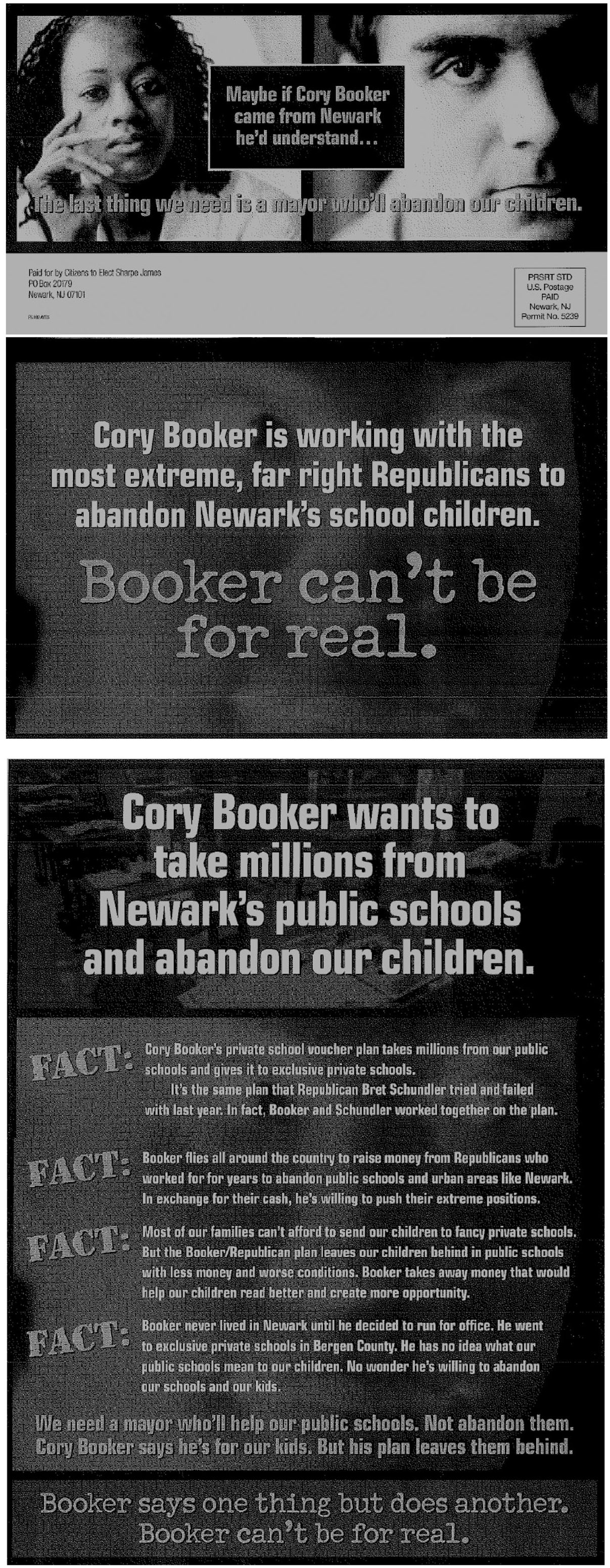
Sharpe James education leaflet.
Reverse Racialization: “Booker Can’t Be For Real”
In the 2002 Newark mayoral election, Sharpe James raised the salience of Cory Booker’s past statements in support of school vouchers in order to align Booker with White interests and limit his appeal among Newark’s Black voters. Vouchers became a proxy for anti-Black, anti-Newark, and Republican elites from whom the Black residents of the city had fought for decades to establish autonomy. James’s opposition to vouchers became a cue for his commitment to Black racial solidarity, while Black voters were invited to question Booker’s racial authenticity.
It is well-established that African-Americans are the Democratic Party’s most consistently supportive demographic (Tate 1994), with support as high as 85% to 95% in most elections over the past half-century (Fauntroy 2007). A commitment to Democratic politics has become a totemic aspect of Black identity (White and Laird 2020). After the procedural legislative victories of the 1960s, the next stage of the civil rights movement was African-Americans’ struggle to gain control of their own cities. These cities are overwhelmingly Democratic, and many Black mayors have been elected on programs of redistribution and material uplift. Yet, US cities are legal creations of state governments and rely on their beneficence for autonomy (Frug and Barron 2008). As Peter Burns noted, urban regimes are intergovernmental regimes (Burns 2002). As African-Americans rose to political prominence in urban America in the late twentieth century, Republican legislators, sometimes working with rural and suburban Democrats, formed coalitions to curtail urban influence (Holmes 2019; Kantor 1988). This was true for New Jersey, where Republican governors Tom Kean and Christine Todd Whitman were the architects of the policies which deprived Newark residents of control over their school district in 1995. In contrast, Democratic governor James Florio protected Newark from a takeover in the early 1990s, and the incumbent Democrat Jim McGreevey had begun the process of returning powers to the school board. Domingo Morrell suggests that Newark’s public schools were taken over by the state of New Jersey not because Newark local officials and parents were negligent but “precisely because they cared and demanded more” (Morrell 2018, xvii).
It is not surprising, then, that perceived alignment with conservative ideology and the Republican Party was viewed by Newark voters as tantamount to a betrayal of the Black community for White interests. While Booker was not a Republican, his views on school choice were used as evidence to argue that his policies were “borrowed from Republicans.” 52 He was not helped by support from prominent Republicans in the campaign, including Jack Kemp the 1996 Republican vice-presidential nominee, who had a longstanding interest in urban affairs. The James campaign couched Booker’s support from Republicans in racial language. The James campaign website posted an article which pointed to Booker’s association with the right-wing Heritage Foundation, the Manhattan Institute, and the American Enterprise Foundation. Drawing a direct line from voucher policy to the segregationists who once used vouchers, the website contended that Booker was “comfortable in the company of people whose political ancestors hosed down and blew up Black children in Birmingham.” 53
A key goal of the James campaign was not only to argue that Booker had Republican supporters but that Booker himself was a Republican in all but name. On various occasions, James referred to Booker as a “Republican masquerading as a Democrat” 54 and a “stealth Republican.” 55 In their televised debate, James confronted Booker directly, stating, “You are a closet Republican for vouchers and you refuse to admit who you are.” 56 James’s leaflets charged that Cory Booker took money from “the most extreme far right Republicans,” as Figure 3 shows. This ideological critique had an inextricable racial dimension, given racially polarized partisanship and negative perceptions about Republicans’ commitment to racial justice in the Black community (Johnson 2017).
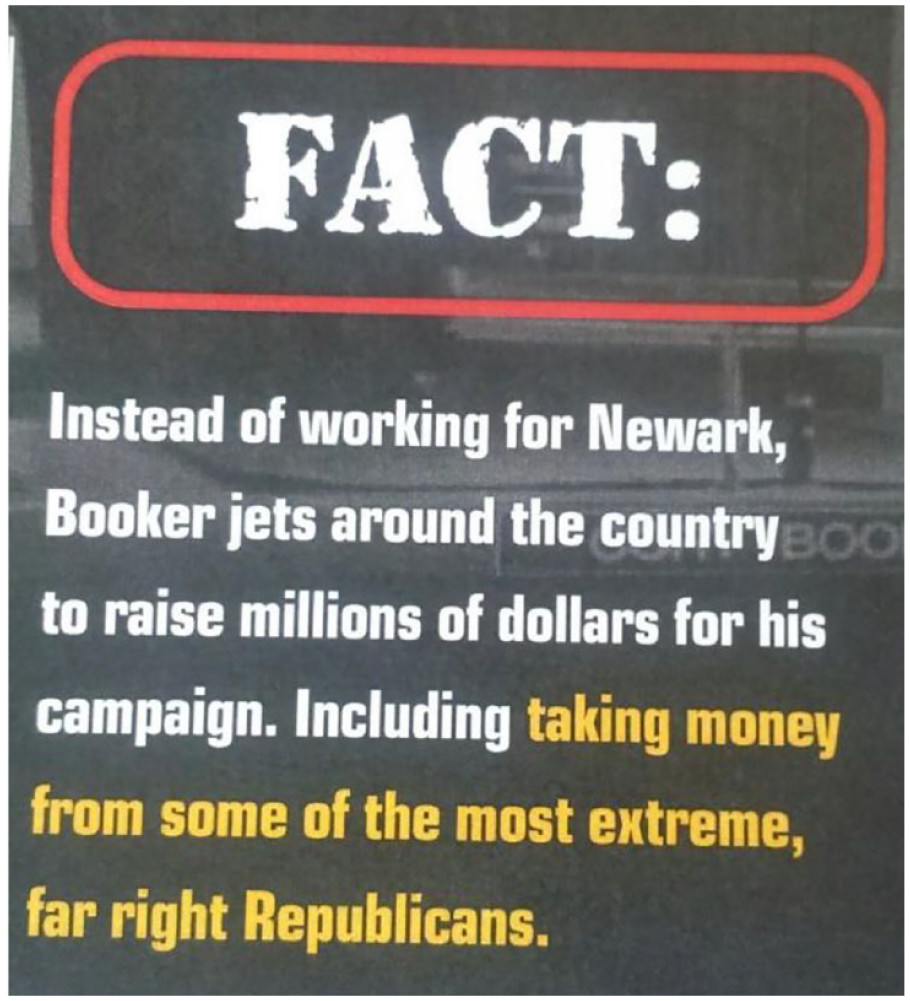
Excerpt from Sharpe James leaflet, “Cory Booker isn’t for real.”
Booker’s support for private school vouchers was the central piece of evidence for this critique. Jeffrey Kraus explains that Booker’s support of school vouchers was “seen by many as contrary to the principles of the Democratic Party” (Kraus 2004, 5). In contrast, James was supported by the Newark Teachers Union for his consistent support of the traditional model of local control and comprehensive education. In an interview, NTU Organization Director John Abeigon applauded James as “a strong advocate for public schools and for local control and for neighborhood schools. He wasn’t one of these reform-for-profit type of politicians.” 57 Jonathan Tepperman, writing in the New York Times, wrote that James “slammed” Booker for supporting vouchers. Tepperman added, “The most interesting thing about James’s attacks. . .is the way they reflect an attempt not just to undermine Booker’s authenticity as a Newarker and a Democrat but also as a Black man.” 58
The thematic slogan chosen by the James campaign to capture these sentiments was “the Real Deal.” Municipal elections in Newark are officially non-partisan, but candidates may include a slogan on the ballot. While James chose the provocative slogan “The Real Deal,” Booker opted for the blander, “Change We Want, Leadership We Need” (Kraus 2004). In his previous two re-election campaigns, in 1994 and 1998, James had used the slogan, “Let’s continue the progress.” James initially deployed the same slogan in his 2002 campaign. However, in March, Governor James McGreevey instructed several consultants from his 2001 gubernatorial election to work for James’s re-election. James had been instrumental in helping McGreevey to secure the Democratic gubernatorial nomination by organizing a conference of big-city mayors to ward off a challenge by US Senator Robert Torricelli (Curvin 2014, 198). Two of McGreevey’s advisors, Steve DeMicco and Brad Lawrence, advised James to abandon “Let’s continue the progress” in favor of a slogan which struck to the heart of Newark residents’ doubts over Booker. They proposed the slogan “The Real Deal,” which appeared on James’s campaign materials from mid-March (see Figure 4). At this time, attack leaflets charged that “Booker can’t be for real” (Figure 2).
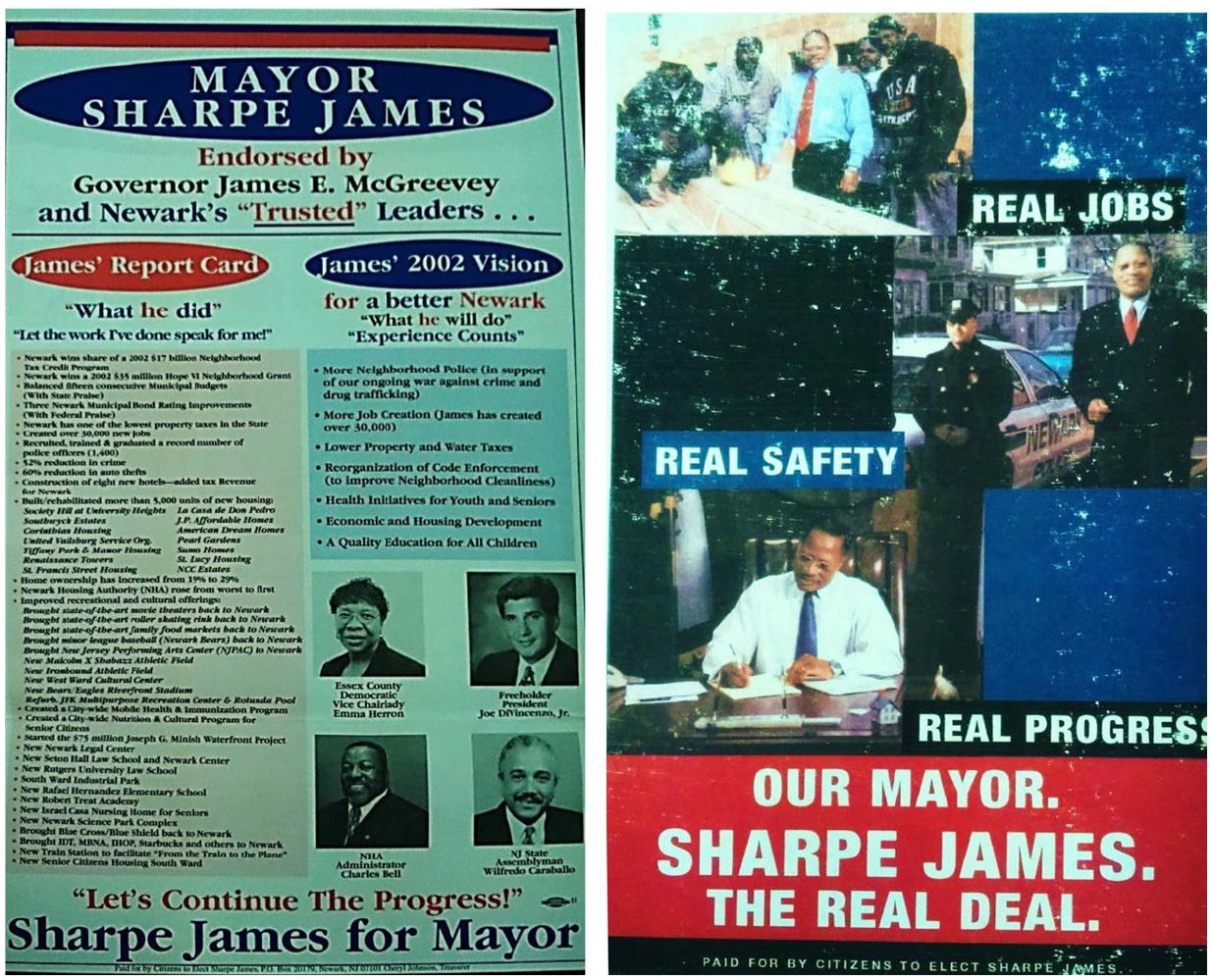
James leaflets before (left) and after (right) McGreevey consultants, 2002.
DeMicco explained the decision to use “The Real Deal” as follows: “We knew that Cory’s biggest vulnerability was that he was perceived by a lot of the old time rank and file voters—and certainly in several of the wards, especially in the South ward and a few others—as a carpetbagger, as somebody who was not really a Newark guy, wasn’t born in Newark. That he wasn’t really somebody who was genuinely out for the interests of, especially, the long-time residents of the city.”
59
Brad Lawrence added, In urban politics “there’s a very parochial sense of it’s us [versus them], and Newark is at the sort of pretty extreme point of that, meaning that there was a real identity. Part of it may be forged because of certain racial dynamics. Part of it was the post ‘67 riot dynamic. So, there was a particular parochiality that worked both to James’s benefit and to Cory’s detriment. . .[W]e saw in the [internal] polling that there was a scepticism about Booker’s authenticity.”
60
The Real Deal slogan became an implicit appeal to Black “racial solidarity” (Gillespie 2012, 64). DeMicco, Lawrence, and other James advisors 61 profess that this was not their intention in choosing the slogan, and DeMicco and Lawrence expressed regret in how the slogan was used. However, the point remains that the vernacular use of the slogan undoubtedly involved racial connotations, and it was highly effective. Booker’s campaign manager, who is Black, argued in an interview that there were several layers of meaning to the accusation that Booker was “not for real.” The first of these was the charge that Booker was “not really Black.” 62 Booker’s support for vouchers had been the key policy evidence in this process of “reverse racialization.”
On 14 May 2002, under the supervision of federal monitors from the Justice Department, Sharpe James was re-elected to an unprecedented fifth term, securing 53% of the vote to Booker’s 46%. 63 A third candidate Dwayne Smith received 1% of the vote. James won the city’s three majority-Black wards, whereas Booker won the two majority-Latinx wards, which have smaller eligible voting populations. James’s victory was decisive as a result of the support he received from the African-American electorate, which Steve DeMicco had predicted “on the numbers that was where Sharpe needed to win the race.” 64 The scale of James’s victory in the South ward, where he won nearly two-thirds of the vote, was itself decisive. 65 James won 3,895 more votes than Booker in the South ward, which was larger than James’s overall margin of victory in the city (3,494 votes). 66
At its core, reverse racialization involves signaling that a Black candidate lacks solidarity with the Black community. This manifests itself in three inter-linking elements: (1) community control, (2) ideology, (3) partisanship. Cory Booker’s support for school vouchers, however well-intentioned, was highly susceptible to Sharpe James’s strategy of reverse racialization. James framed vouchers as yet another external education reform imposed on Newark by the same suburban interests, who had abandoned Newark after the 1967 rebellion. The evidence which James needed was easily accessible; the policy was publicly supported by neoliberal economists and Republicans, and the policy’s origins lay in an effort to vitiate the historic Brown v Board ruling.
Conclusion: Reverse Racialization Beyond Newark
The case study’s findings extend beyond Newark in two key respects. First, they shed clearer light on the racialized politics of private vouchers, a policy which has only grown in popularity since 2002, as public resources are continually repurposed for conservative ends (Jacobs, King, and Milkis 2019). Vouchers redefine a matter of democratic control (public education) as one about individual consumer choice, which in turn further atomizes and disempowers people (Lipman 2011, 144) Correspondingly, as Lester Spence (2015) writes, “the crisis of urban education is in part a crisis of democracy” (p. 76).
The racialized crisis of urban education is not limited to Newark. The pattern of a predominantly White higher-level government imposing neoliberal “solutions,” such as vouchers, on predominantly Black cities has persisted and intensified over the last 20 years (Hackett 2020; Morrell 2018). Neoliberalism entails the withdrawal of governmental forms of social welfare and public services and transferring public resources to private actors on the basis that competitive markets are more effective and efficient. These policies provide new opportunities for capital accumulation, while reducing communal involvement and public accountability (Jones and Ward 2002; Lipman 2011, 6).
The Newark study shows that reverse racialization dislodges a common strategy of neoliberalism, which is to naturalize market processes and to present market-driven policies as politically and race neutral (Leitner, Peck, and Sheppard 2007). School choice “conveniently denies structural and ideological bases of persistent racial disparities.” This racial silence is its political strength. As Pauline Lipman (2011) writes, “Deracialization is the silent partner of the market” (p. 12). Reverse racialization contests this race-neutral framing.
The second wider contribution is to show that reverse racialization can be a form of resistance against the “neoliberal turn in Black politics” (Spence 2015). Reverse racialization has caused problems for Black politicians, like Booker, who require strong support in the African-American community as a building block for their political ambition. This is especially true in cities and other contexts where African-Americans make up a majority of the electorate.
The 2010 mayoral election in Washington, DC showed similar dynamics to the Newark mayoral race. Vouchers had been imposed on DC by Congress in 2003, but the evidence that the policy had improved standards in the district was mixed (Carnoy 2017). Mayor Adrian Fenty, an African-American Democrat, was a supporter of the voucher program and had pleaded in 2009 with the Obama administration to maintain it. He had also appointed a schools chancellor, Michelle Rhee, who was strongly opposed by teachers unions and the local school board. 67 While Fenty’s heterodox policy positions won him accolades in the White electorate, his support among African-Americans declined precipitously. As he approached re-election in 2010, Fenty’s approval with African-Americans was just 29%, while it was nearly double with Whites (57%). 68
Fenty was challenged in the Democratic primary by councilman Vince Gray, who voiced his opposition to vouchers and asserted his support for community control of education. 69 Gray performed best in the predominantly Black areas like Anacostia (80%), while faring poorly in White neighborhoods, securing just 13% in the mostly White, affluent Georgetown precinct. Yet, in the majority-Black DC Democratic electorate, solid support from the Black community was enough to hand Gray the nomination and, by implication, the mayoralty.
The final contribution of this article is its demonstration of the analytical importance of attending to the intradiversity of Black political behavior and thought. By focusing on policy differences in an election between two Black candidates, the article challenges prominent, problematic castings of Black communities and Black electorates as monolithic. In doing so, the paper initiates helpful theorizing about Black political behavior.
The intra-Black electoral struggles of the early twenty-first century were often framed as generational and presentational: an old guard who wouldn’t let go versus a youthful vanguard with fresh ideas with “crossover appeal” and “ambition” beyond city politics (Frasure 2010; Gillespie 2010b; Gillespie and Tolbert 2010; Walters 2007). This study makes the case for scholars to prioritize policy and ideological differences. African-American candidates use sophisticated messaging strategies to draw on community solidarity as a form of political strength. Reverse racialization makes appeals to “linked fate,” not purely as descriptive representation but also on substantive grounds of community control and democratic power.
Footnotes
Acknowledgements
I wish to thank the following people for agreeing to be interviewed by me: John Abeigon, Mamie Bridgeforth, Modia Butler, Marshall Curry, Robert Curvin, Steve DeMicco, Walter Fields, Pablo Fonseca, David Giordano, Claudia Granados, Jermaine James, Brad Lawrence, Van Parish, Ron Rice, and Anant Raut. My thanks go to the librarians of the three archives at which I worked in Newark: the Newark City Archives, the Cummings Information Center at the Newark Public Library, and the New Jersey Historical Society. I am grateful to Ursula Hackett for her feedback on an earlier version of this paper, which was presented at the annual meeting of the American Political Science Association (Washington, DC, 30 August 2019), and to the two anonymous reviewers.
Declaration of Conflicting Interests
The author declared no potential conflicts of interest with respect to the research, authorship, and/or publication of this article.
Funding
The author received no financial support for the research, authorship, and/or publication of this article.
