



Abstract
This article offers an overview of neighbourhood-based BIDs (NBIDs) in Sweden. Swedish NBIDs tend to appear in stigmatized residential areas engaging with pressing sets of urban issues that have been longstanding concern of social policy. Their overarching goal is raising property values in neighborhoods on the edge between urban decline and (re)development potential. Emerging in a neoliberalizing institutional context, NBIDs present themselves as correctives to public-policy failures by promoting property-oriented solutions. The adaptation of the BID model in the Swedish ‘post-welfare’ landscape, however, exhibits, and arguably exacerbates, the shortcomings found in BID elsewhere. Their opaque institutional structure and lack of accountability contribute to curbing democratic influence over local development, thus reinforcing spatial inequalities. We argue that the growing political advocacy for the institutionalization of the BID model in Sweden presents a new milestone in the neoliberalization of urban governance, as private actors are promoted to legitimate co-creators of urban policy.
Introduction
In September 2020, the Swedish government commissioned the National Board of Housing, Building and Planning to “review any obstacles for using the [Business Improvement District (BID)] method” to help address socio-economic exclusion in struggling urban areas. Stressing BIDs’ putative success in dealing with similar issues in other parts of the world, the government has argued that coalitions of local property owners, together with residents and public actors, could help “lift” socio-economically challenged neighborhoods out of poverty through real estate investments, crime prevention, and security measures (Regeringen 2020a). The governmental investigation comes after two decades in which BID-inspired partnerships have proliferated across struggling residential areas in the country, in the absence of a national enabling legislation. With widening socio-economic inequalities and deep-seated urban segregation becoming a major problem for metropolitan regions, BID partnerships appear to be increasingly hailed by Swedish policymakers as ostensibly successful solutions to place-based exclusion.
Despite its growing relevance, we still lack an understanding of the local adaptation of the BID model in the (post-)welfare Swedish context, and the extent to which it has retained the neoliberal legacy of its international predecessors. Given their increasing proliferation and calls for institutionalization, it is pivotal to understand the role that the BIDs assume in the Swedish urban context, the ways in which they adapt to and influence ongoing urban transformations, and ultimately the possible implications of the adoption of BIDs as a tool for counteracting segregation. In this article, we aim to cast light on these questions by providing an overview of the existing residential BID landscape in Sweden. In order to grasp the BID model's relevance within the broader urban context in Sweden, we (1) provide a geographical investigation of the model and (2) analyze the political-economic rationales of BIDs in relation to their key constituent actors and the local institutional contexts in which they are embedded. We discuss our findings against the background of the transformation of the Swedish welfare model since the 1990s, in conjunction to the global variegated neoliberalization of urban governance (Brenner and Theodore 2002). By doing so, we also offer an empirical account of an understudied BID type—neighborhood-based BIDs (henceforth: NBIDs)—a Swedish local adaptation of the BID “policy in motion” (Ward 2007), so far absent from the academic literature. Finally, we aim to contribute to emerging public debates on the institutionalization of BIDs in Sweden as a “method […] to combat exclusion and create safer residential areas” (Regeringen 2020a), by offering critical insights into the ways in which NBID partnerships have been implemented in Sweden so far.
Our analysis shows that NBIDs tend to appear in stigmatized residential neighborhoods with a high re-development potential and a long history of public area-based interventions. Emerging in an already neoliberalizing institutional landscape (Clark and Hedin 2009; Baeten, Berg and Hansen 2015) characterized by growing urban entrepreneurialism (Harvey 1989; Hertting, Thörn and Franzén 2021), NBIDs present themselves as a corrective to previous public policy failures by promoting property-oriented solutions. We argue that this can be interpreted as a move forward in the normalization of urban entrepreneurialism (Hertting, Thörn and Franzén 2021) in Swedish urban governance, as private actors for the first time explicitly co-create urban policy through NBIDs. The growing power assumed by private real estate actors in residential areas is enabled by the close alliances that the NBID partnerships forge with (increasingly business-minded) municipal housing companies (MHCs) and (growth-first oriented) local authorities. Ultimately, we maintain that their geographical and institutional contexts, as well as their organizational nature, should raise concerns about the socio-spatial effects NBIDs might have in terms of democracy, accountability, and uneven development.
The remainder of the article is organized as follows. In the coming section, we elaborate on the study's methods. Then, we outline an appraisal of the international literature on BIDs with a particular focus on their conceptualization as vehicles of neoliberal urbanism. Following, we present the BID landscape in Sweden and delineate our object of study—the neighborhood-based BIDs. Further, in the following two sections, we analyze the geography of Swedish BIDs and their key actors within their institutional contexts. Finally, we discuss some critical implications of our findings.
Methods
The research for this study was undertaken over the course of three years, in the period 2017–2020. It began as an exploratory mapping of BID-like partnerships in Sweden, focused on their emergence, structure and operations. The analysis presented in this paper relies on two main sources of data: interviews with key informants and document analysis. We rely on interviews and published reports on BIDs in Sweden in order to outline the NBIDs network and select our cases.
We conducted twenty-one semi-structured interviews with key informants. The interviewees were recruited through the respective NBIDs webpages and “snowball” sampling. Nine interviews were done with NBIDs’ managers or vice-managers (most of which also hold important positions in local administrations, MHCs, and regional governmental institutions; the rest are housing/security experts). Five interviews were done with NBIDs’ board members (two representing MHCs, one a cooperative housing association, and two the Private Property Owners Association in the board). Interviews were also conducted with a Malmö City council member, a Gothenburg City district director, a municipal board chairman, an urban planner, a manager of a BID-like association (Svenska Stadskärnor), and two representatives of the Tenant Union. The interviews lasted between forty minutes and two hours. The questions generally revolved around five themes: the BIDs’ activities, plans and goals; the BIDs’ history, initiators, and the reasons for their formation; management structure, day-to-day functioning and financing; relations with the municipalities, other public agencies and private companies; perspective and opinions on municipal urban plans and area policies. The interviews were recorded, transcribed, and analyzed following the themes above. Anonymity has been retained for all respondents.
In addition to the interviews, general and factual information was gathered from written sources. Publications were used to draw information about the introduction and characteristics of the Swedish BID model, especially: BIDs på Svenska (“BIDs in Swedish”), published by the Private Property Owners Association (Fastighetsägarna 2017); and BIDs in Sverige (“BIDs in Sweden”), a feasibility study commissioned by several public agencies (Johanna and Westlin 2009). The works of Sahlin (2007) and Stenberg (2010a) were helpful to understand the formation processes of the partnerships in Gothenburg before they started calling themselves “BIDs.” Additionally, reports published from the NBIDs themselves (such as: Holmberg 2009, 2012, 2014, 2016), as well as content from their respective websites, newsletters, and minutes from their meetings provided an insight in their activities and plans. We paid special attention to discourses on safety, articulation of values and goals, and place representation. Documents such as municipal urban plans, plan programs, police reports, media reports, and demographic statistics constituted complementary data to understand the local historical and planning contexts.
BIDs as Vehicles of Neoliberal Urbanism
BIDs stand for self-taxing collaborations between business and property owners within geographically delimited areas—predominantly commercial and downtown business districts—that aim to increase the areas’ attractiveness and promote economic activity (Hoyt and Gopal–Agge 2007; Morçöl et al. 2008). Originally a North American phenomenon, the first BID partnerships emerged in the 1970s in the wake of sprawling suburbanization and the decline of downtown retail cores, but grew tremendously since the early 1990s against the background of urban decline and spiraling urban crisis (Ward 2007). In the United States particularly, BIDs have become a common presence in struggling commercial areas as a means to thwart economic decline and revitalize business through “community entrepreneurialism” and property-led regeneration (Schaller 2019). The BID model has since become an international phenomenon, widely recognized as part of the business-friendly zoning arsenal of neoliberal urban policies (Sager 2011).
In the context of the post-Fordist economic restructuring, cities have increasingly become “important geographical targets and institutional laboratories for a variety of neoliberal policy experiments” that have as an overarching goal “to mobilize city space as an arena both for market-oriented economic growth and for elite consumption practices” (Brenner and Theodore 2002, p.368). In this prevailing “zero-sum inter-urban competition” (Harvey 1989), proponents have argued that BID partnerships give an advantage to places competing for capital in growth-oriented city making (Mallett 1994; Levy 2001; Lloyd and Peel 2008). Entrepreneurialism, innovation, effectiveness in dealing with urban issues, and giving businesses a stronger voice in city development are among the most valued benefits that the model is claimed to bring to various stakeholders (Lloyd et al. 2003).
In conjunction with the model's global proliferation, BIDs have also become a common point of contention for many observers. Scholars have highlighted their democratic shortcomings with respect to excluding residents and the wider public from the partnerships’ boards (Cook 2008), comparing BIDs to “commons cartels” that provide “one set of commons users a privileged place at the table” (Foster 2011, p.132). Questions over who holds the power to dissolve them, and on what grounds, have further underscored a perceived lack of accountability and democratic capacity (Morçöl and Wolf 2010). Ward (2006, p.68) claims that “BIDs would appear to be neoliberalism personified: embodying the ideal of state withdrawal while at the same time requiring a different form of state involvement.” He underlines three defining characteristics of BIDs in support of his argument: (1) they tend to present themselves as solutions to the failures of past public policies; (2) they encourage inter-urban competition for the share of consumers and capital; (3) and they claim to offer a flexible, rapid, effective way of governing, set in contrast to a slow bureaucratic state (Ward 2007). Others have also noted that the partnerships’ focus on urban growth often comes at the expense of broader social commitments (Foster 2011; Schaller 2019), while promoting the privatization of urban commons and the disciplining of public spaces in the name of safety and security (Eick 2012).
With the growing importance of urban economies, BIDs present a ready-made model “of a new form of statecraft” (Ward 2007, p.666) in which private actors attain a key role in urban development and governance. However, as examples of an “actually existing neoliberalism,” they appear in place-specific forms, “within inherited institutional and spatial landscapes” (Peck, Theodore and Brenner 2009, p.49). Neoliberal urbanism operates as an incoherent “mongrel regime,” mixing with pre-existing institutional frameworks (Peck, Theodore and Brenner 2009; Baeten 2012). The state, thus, often remains a defining factor in the attempt to maximize cities’ economic potential, while internalizing market principles as its overall guidance (Taşan-Kok 2012). After all, neoliberalism in Sweden “does not entail the abandonment of welfare provision in […] cities but rather a hollowing-out of its principles from the inside out through state-led empowerment of private companies to interfere in urban policy matters that were once the privilege of the state only” (Baeten and Listerborn 2015, p.258).
Although it has been argued that Sweden has resisted thorough neoliberalization (Harvey 2005), authors have pointed that crucial sectors—including planning, urban and housing policy—have nonetheless been the subject of neoliberal restructuring at least since the 1990s (Clark and Hedin 2009; Larsson, Letell and Thörn 2012; Christophers 2013). This has spurred or exacerbated a widening of the inequality gap, severe socio-economic and ethnic segregation, and increasingly unaffordable housing. It is crucial to understand how the BID model has been established and fitted to this political-economic landscape. Through unpicking the BIDs’ emergence and interaction with pre-existing institutional configurations, we will both get a better insight of the contextually-embedded and path-dependent neoliberalization of Swedish cities, and a concrete example of the adaptation of a neoliberal model within a “post-welfare” Nordic context.
BIDs in Sweden: Emergence, Variations, and Goals
BIDs have evolved into a flexible partnership model characterized by a great amount of “elasticity and resilience” with respect to local governance regimes (Michel and Stein 2015, p.75). By extension, they have posed major conceptual challenges for scholars grappling with “their nature and functions” (Morçöl et al. 2008, p.3). The difficulty to provide a workable definition has been further exacerbated by the lack of a standard naming convention, with a variety of names and abbreviations used across the globe (Hoyt and Gopal–Agge 2007). The standard definition used in the literature describes a BID as “a territorial subdivision of a city in which property owners or businesses are subject to additional taxes … reserved to fund services and improvements within the district and to pay for the administrative costs of BID operations” (Briffault 1999, p.368). While some authors allow for partnerships based on voluntary contribution to be counted as BIDs (Houstoun 1997), the self-assessment mechanism (which implies the compulsory involvement of all property and business actors within the district) is considered a crucial distinction that separates BIDs from other similar models (Mitchell 1999; 2008; Cook 2008). As a corollary to the self-taxing mechanism, BIDs must also be authorized by law (Mitchell 2008, p.4).
In that sense, strictly speaking, there are no “proper” BIDs in the Swedish context. With no legal framework in place (and therefore no legal means to enforce compulsory participation or self-assessment), the partnerships that adopt the BID label in Sweden could be described as “BID-like” or “BID-inspired.” Still, these partnerships clearly state that they are inspired by the BID model and, importantly, they consider and call themselves “BIDs.” The main difference from other contexts where the model is legally established is that existing BID partnerships in Sweden are not publicly sanctioned organizations. This means that there are no ballot requirements or participation quotas necessary in order to start a BID (membership is always voluntary), and there are no sunset provisions attached to their operation. In that sense, they are not formally accountable to local governments; it remains unclear who holds the responsibility to oversee their activities and, by extension, who has the legal right to dissolve them. We would argue, nonetheless, that the partnerships studied here share some defining characteristics with their legally established counterparts that warrant their recognition as BIDs, including a geographically delineated zone of operation, a privately directed property-based initiative, and a similar scope of activities distinctly geared for real estate appreciation. BIDs in Sweden can thus be defined as geographically delimited urban areas where property and business owners, organized in a non-profit association, pay voluntary membership fees in order to fund services and small-scale improvements within their district.
There are two groups of partnerships in Sweden that fall in this category and refer to their associations as BIDs, or BID-inspired. The first group are direct successors of the earlier Town Center Management organizations (henceforth TCMs; Svenska Stadskärnor in Swedish) that emerged in the 1980s (Forsberg, Medway and Warnaby 1999). TCMs were an initiative aimed at reversing the decline of traditional commercial urban cores through public-private partnerships between local governments and other urban stakeholders. In recent years, the national TCM association has begun experimenting with their own BID model in an attempt to prop-up the competitiveness of smaller urban communities outside the metropolitan regions (Svenska Stadskärnors BID modell 2017). TCMs are present in most city centers across the country and have been criticized for promoting “sanitization” of public spaces for consumer-friendly purposes and for depoliticizing private actors’ influence in urban governance (Thörn 2011; Landzelius 2012; Hertting, Thörn and Franzén 2021).
The second group of BID partnerships (and the focus of this article) are property-based, non-profit associations established in residential neighborhoods—Neighborhood Business Improvement Districts (NBIDs). 1 Internationally, residential BIDs are far less common than their commercial equivalent, but they have had a longstanding presence in some places in the United States, including Washington DC (Schaller and Modan 2005; Schaller 2019) and Pennsylvania (Morçöl and Patrick 2006), and more recently in Germany (Kreutz 2009; Michel and Stein 2015). In Sweden, NBIDs are a steadily growing phenomenon with ten BID-like partnerships currently operating in housing areas in Stockholm, Gothenburg and Malmö—the oldest established in 2001, and the newest in 2019 (Table 1). However, researchers have only just begun catching up with the NBID phenomenon. The few academic publications on the topic have examined NBIDs largely from a criminological perspective (Kronkvist and Ivert 2020), with only a handful of studies offering a broader insight into their practices in relation to issues such as citizen participation, social commitments and democratic accountability (Sahlin 2007; Stenberg 2010a; 2010b; Valli and Hammami 2020). Moreover, the existing literature has focused largely on a few single cases and lacks a geographical perspective that could provide a more encompassing picture of the Swedish model.
Overview of Operating NBIDs in Sweden.
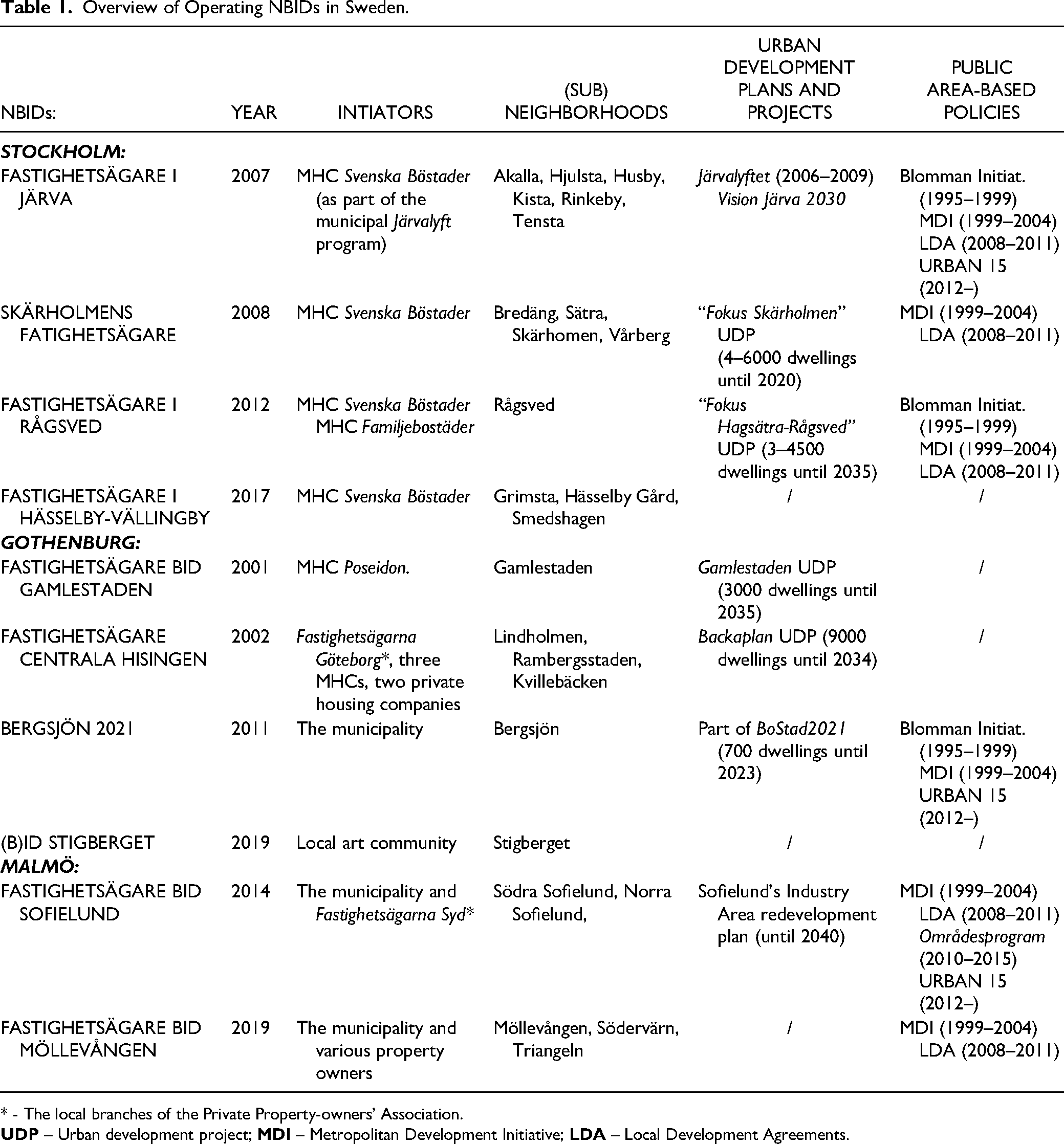
* - The local branches of the Private Property-owners’ Association.
The following two sections, to be read together with Table 1, outline the history and geography of the NBIDs in Sweden, the institutional and political economic context in which they emerged, their aims and the underlying rationales guiding their goals and strategies.
The Geography of Swedish NBIDs
The profound changes of the Swedish welfare state have concurred with increasing urban social problems linked to concentrated poverty, crime, and social and ethnic segregation. These issues have been largely associated with a number of stigmatized residential neighborhoods experiencing a spiral of decline amidst a lack of affordable housing and socio-economic inequality. Many of these areas have been subjected to governmental regeneration efforts which since the late 1990s have taken the form of area-based policies (Andersson 2006). 2 The selective approach of targeting “pockets of poverty” represented a change in course, some suggesting due to the limited possibility for universalistic sectoral policies, owing to the country's adjustment to the EU monetary regime (Andersson, Bråmå and Holmqvist 2010, p.250). The success of the policies has been inconclusive. While socio-economic improvements among individuals have been noted, the areas themselves may have been left even more stigmatized due to lack of physical measures and selective out-migration (Andersson 2006). The NBIDs have been mostly forming in these stigmatized neighborhoods (see Table 1), but also in socio-economically challenged areas that have not been part of any public policy efforts but which nonetheless share a similar negative reputation perpetuated in media and political circles 3 .
The first NBIDs in Sweden were formed in the early 2000s in Gothenburg, in the context of publicly directed efforts aimed to reverse a negative trend in problematic housing areas through area-based development strategies in collaboration with civil society and the business sector. Property Owners in Gamlestaden (Fastighetsägare Gamlestaden) and Property Owners in Centrala Hisingen (Fastighetsägare Centrala Hisingen) were started by municipal housing companies (henceforth: MHCs) and private landlords concerned with local safety—an umbrella term concerning “(good) urban planning, local development work, crime prevention and general improvement of deprived residential areas” (Sahlin 2007, p.280).
Citing growing insecurity, crime, social exclusion and a concentration of problematic residents, the largest MHC in Gothenburg, Poseidon AB, started a BID-like collaboration with private landlords and other stakeholders to help turn the negative trends. The overarching aim of the Property Owners in Gamlestaden, as summarized by the general manager of Poseidon AB, was to “positively affect the value development of rental apartments as well as owner-occupied flats” by reducing crime rates, diversifying the local population (amongst else by offering tenants on social contracts 4 to be moved in public housing in other areas), and increasing safety (quoted in Sahlin 2007, p.291). Taking control over the area's development has also entailed strategic property acquisitions aimed to push out unwanted landlords that allegedly showed little interest in the development of their districts (Malm, Malm and Gustafsson 2002).
Since the late 1990s, safety has become the operative word for public-private partnerships and urban renewal efforts in areas with socio-economic challenges. The Gothenburg NBID model has been successfully copied in six more areas in Stockholm and Malmö that have faced similar problems. In Stockholm, three of the NBIDs had been placed on the list of “most vulnerable areas” in Sweden, based on a nation-wide investigation by the Crime Prevention Council (Polisen 2015) highlighting crime and safety issues, socio-economic challenges and ethnic segregation. The initiative to start the first NBID collaboration in Malmö came from an area-based program administered by the municipality in the period 2010–2015, aimed to raise the standard of living in five “particularly vulnerable areas” (Malmö Stad 2015) (Figure 1).
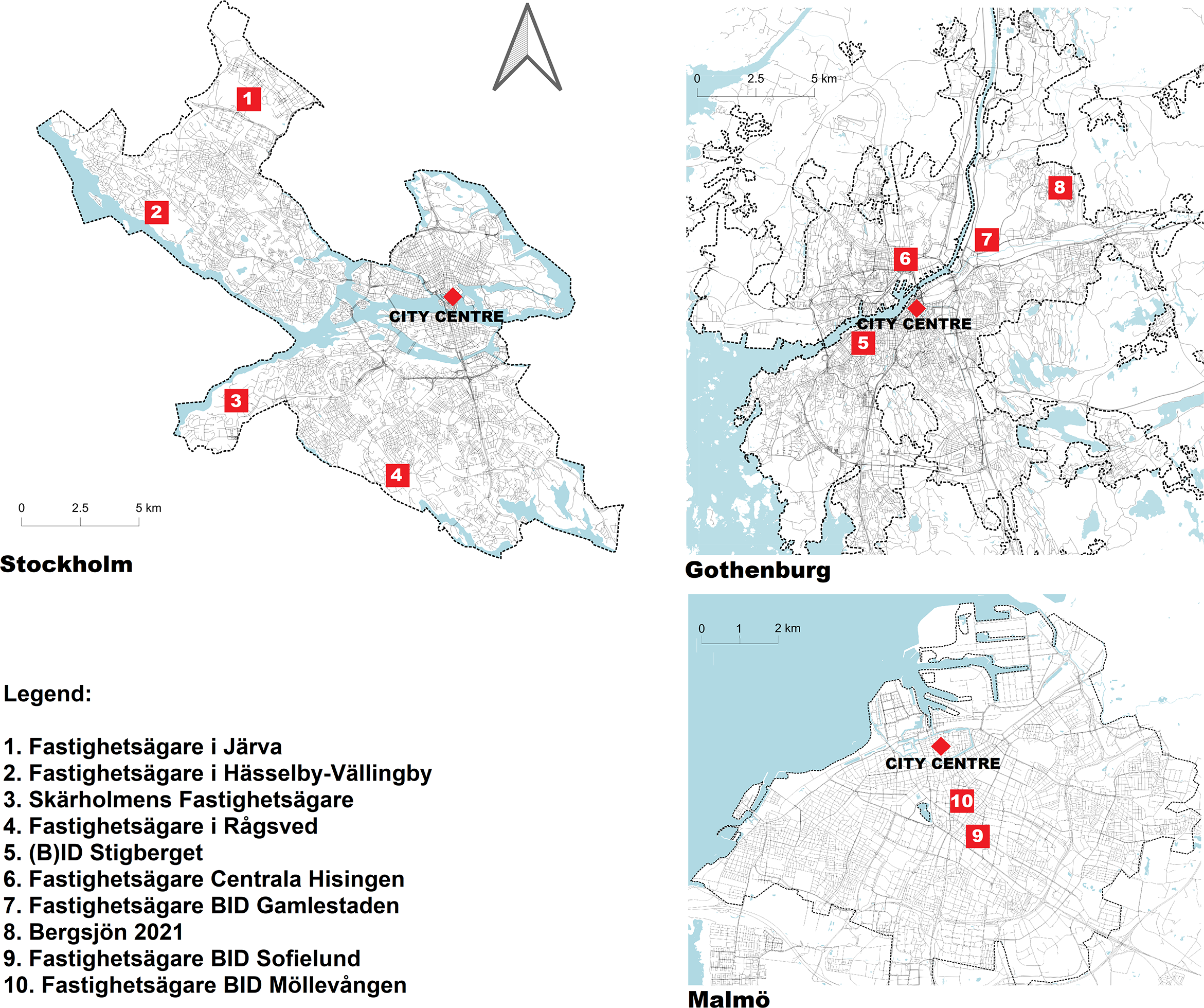
Location map of NBIDs.
Aside from socio-economic challenges and a damaging reputation, however, the geography of NBIDs exhibits another common feature: they emerge in areas planned for major infrastructural investments and redevelopment.
Gamlestaden and Centrala Hisingen are located in the industrial waterfront of Gothenburg not too far from the city center, surrounded by brownfield sites earmarked for redevelopment (Göteborgs Stad 2009). Development plans around central Gothenburg promise to “stretch the inner-city” to Centrala Hisingen and Gamlestaden (Göteborgs Stad 2012, p.32), which have already been designated for future densification. Both property partnerships have been involved in the preparation of development plans and visions for their respective areas as local consultants (Göteborgs Stad 2006, p.7) and regularly collaborate with planners (interview, NBID manager, 2018).
In Malmö, Sofielund's appeal lies in its inner-city location, an industrial area designated for redevelopment, and the presence of a strong local cultural and art community. Its location has turned the area into a redevelopment corridor for the desired integration of the southern suburbs with the central part of the city (Malmö Stad 2014). A train station that has opened in 2019 at the edge of the area, has also made Sofielund an important commuters’ node. In anticipation of the urban transformation in the area, in 2019 the NBID members established a development company through which they can acquire, own, manage, and develop property (Sofielunds Utvecklingsaktiebolag 2019). BID Sofielund has also collaborated with the municipality in the creation of the Sofielund strategic development plan (Planprogram, Malmö Stad 2021).
All Stockholm NBIDs have been earmarked for extensive developments and urban densification based on urban plans and policies from the past decade. These plans aim to turn several high-potential urban areas located in the outskirts into “centers of gravity,” connected with a new efficient network of public transport (Stockholms Stad 2010). Kista (in Järva), Skärholmen, and Vällingby are three of nine focus points considered to have the largest potential for becoming regional city centers (Stockholms Stad 2006, 2010, 2016), the latter two already highlighted in the post WWII comprehensive (ABC) planning of Stockholm. The 2018 Urban Development Plan marks Järva, Skärholmen, and Rågsved as focus areas: “specially highlighted areas where investment and planning resources should be concentrated” (Stockholms Stad 2018).
As noted elsewhere, the NBIDs’ formation is highly conditioned on the success of an “urban crisis” narrative and the notion that the BID model presents an appropriate solution (Stein et al. 2017). The relative failure of previous public policies, together with wider stigmatizing processes (Backvall 2019), have shaped the spatial pattern of their emergence. As past policies have failed to improve the areas’ reputation and their physical condition, stigmatization has kept property values depressed. This, in turn, made the areas frontiers of untapped economic potential amid increasingly expensive cities. The NBIDs’ strategic location in areas earmarked for development, and their alignment with the goals of the municipal plans, makes it difficult to disentangle their effects from those of other interventions. Their overarching goal, however, has been clear - to facilitate urban regeneration at the local scale by means of disciplining undesired behavior, displacing visible poverty and working on the areas’ reputation, as listed in the strategy portfolios in the NBIDs reports (Valli and Hammami 2020).
The NBIDs promise a more efficient and sustainable approach to the urban issues as an alternative to public welfare programs, highlighting the short-termism of earlier publicly-led urban regeneration efforts: “There has been a lot of welfare money coming from the government … lots of projects have been done in this area, and people are so tired of projects. Projects come and go, you know” (Interview, NBID manager, 21.09.2017). Instead, NBIDs insist that a property-based, privately directed initiative that focuses on improving the economic prospects of the place, not the people, has a better chance at delivering the desired improvement to these areas in the long run. As a Malmö City council member has emphasized, public projects have been successful on an individual level but do little to help the area; NBIDs, on the other hand, “work with real-estate owners, and the buildings … well, they don’t move” (interview, 20.12.2017). Although they cite social issues such as place-based poverty, crime, and vandalism as the chief reasons behind their emergence, the overarching goal of NBID partnerships is to boost local property markets (Holmberg 2009, p.137; 2014, p.15). Thus, although they balance a completely different set of issues and complexities compared to BIDs established in commercial areas, NBIDs share the same overarching agenda—capturing flows of value associated with the general upgrade of the built environment.
The Key NBID Actors and Their Institutional Context
As De Magalhães (2014, p. 930) has argued, “any investigation into the character of BIDs and their roles need to refer to their institutional context, and it is only with reference to it that they can be evaluated.”
The introduction of NBIDs in 2001 came on the heels of a broader neoliberal shift in Swedish urban and housing policies which saw urban social issues (including crime prevention) increasingly addressed through area-based public-private partnerships since the early 1990s, gradually replacing traditional cross-sectoral policy efforts. This shift took place in conjunction with the incremental dismantlement of the post-war welfare model that was based on universal principles of redistribution, and a gradual shift to a so-called post-welfare regime described by Baeten, Berg and Hansen (2015, p.209) as “the decentralization of welfare provision to lower government echelons […] and to the private market” consistent with efforts to “organize state welfare provision more in line with market principles.” The result has been a progressive entrepreneurialism in urban governance set against an unevenly developed urban landscape.
In this section, we discuss the emergence and role of NBIDs in the context of neoliberalizing urban trends by means of highlighting NBIDs’ key actors within their institutional environment. We adopt Morçöl and Wolf’s (2010) conceptualization of BIDs as actors in a governance network (as opposed to viewing them as governmental tools, public-private partnerships, or private governments) since Swedish NBIDs are “autonomous from governments, they exist in relationships with other actors (e.g., governments), and they participate in collective action to determine policy goals in urban areas” (p.909). Two types of actors have had a decisive role in shaping the NBID agenda in Sweden: residential property owners and local governments.
Residential Property Owners
The NBID associations are essentially organizations formed around and led by residential property owners. The initiative for their formation had come from one or few property owners with a significant share in the housing stock, or, in some cases, the municipality and/or the local branch of the national Private Property-owners’ Association (Fastighetsägarna). In most cases, however, the initiative came from the MHCs. To understand the rationale of their engagement, it is important to briefly recall the main shifts in the Swedish housing system and MHCs since the 1990s.
The postwar Swedish housing system, central to the welfare state, has been characterized by a universalistic approach and a strong state support. Scholars have argued, however, that Swedish housing has been going through a neoliberal transformation (Clark and Hedin 2009; Christophers 2013; Grundström and Molina 2016). Most agree that this process has accelerated since the beginning of the 1990s, a juncture deemed as the “neoliberal system switch in housing policy” (Clark and Hedin 2009, p.179). The new direction towards increased deregulation and privatization has entailed policies prioritizing owner-occupancy over rentals, marketizing the public housing and the co-operative housing sector, and discontinuing or reducing of housing subsidies. Although “islands of regulation” have remained in place such as the use-value-based rent regulation (Christophers 2013), this regulatory mechanism has been somewhat circumvented when it comes to new construction. 5 Furthermore, rent-regulation has been under sustained attack from the political Centre-right. In 2020, a governmental proposal for an introduction of market rents for newly constructed rentals has led to a serious political crisis (Regeringen 2020b). These changes have collectively contributed to an increasing housing shortage, especially in the rental sector, and an acute housing unaffordability in the larger cities. Skyrocketing rents and property values have added pressure to the few islands of affordability in stigmatized urban areas.
The MHCs, most of which were established in the 1940s to implement the social commitments of the national housing policy, have also gone through significant transformations. A series of changes since their establishment have marked an increasing marketisation and partial withdrawal from their universalistic principles. Initially, MHCs were “owned and controlled by the municipalities” and “run as independent enterprises on a non-profit basis” (Bengtsson 1994, p.186). Since the 1990s, however, municipalities have been allowed to sell their housing stock to private owners and co-operatives. This had a significant impact in some cities, such as Stockholm, where many apartments were sold, especially in the inner city, thus leaving MHCs mostly with properties in peripheral and unattractive areas (Andersson and Turner 2014). Furthermore, in 2011, complying with an EU directive for fair market competition, a change in legislation was introduced requiring MHCs to “act according to business-like principles” (Riksdagen 2010). Financial considerations have thus become increasingly important for MHCs, at the expense of their social responsibility and universalistic principles (Grander 2018). In order to secure market returns on their investments, MHCs have been pushed to spatially and socio-economically restructure their housing stock by buying property in attractive locations, developing their under-performing properties in stigmatized areas, and adopting stricter entry requirements for prospective tenants (Grander 2018; Gustafsson 2019).
Increasing the value of their portfolio has thus become an explicit goal for both public and private property owners establishing NBIDs: “The location is in the middle of the city center and in order to have an area that central, that could not maximize its possibilities … there are a lot of possibilities there to increase the value in long term” (interview, NBID board member/ representative of the Private Property Owners Association, 29.09.2017). An MHC manager underlined their economic objectives as a primary reason for establishing the NBID in Gamlestaden: We stressed that this was not a social project […] The result from the perspective of the property owners was a relatively high rise in value of the rental properties and owner-occupied dwellings (quoted in Sahlin 2007, p.291)
NBIDs’ efforts to improve the areas’ reputation include physical upgrade, crime prevention and safety measures, marketing, promotional events, and so on. Since their membership is on a voluntary basis, these joint efforts often necessitate some convincing, coaxing, and even disciplining of uncooperative property owners. Moreover, as one of the NBID managers explained, some landlords are even at risk of being pushed out of the area: [M]e and some lawyers […] I had the fire department and the police with me, we started knocking on doors in this area. We used the legislation we had, to force the property owners to take care of the properties, or even better, to get rid of them. […] In one year, I think we got rid of these property owners. We still have around 60 owners in this small area, but now we have control. Really control over them. (interview, NBID manager, 21.09.2017)
Physical improvements of the property are not the only change that the NBIDs aim to prompt in their areas. Many of them insist that the demographic composition is also in need of an upgrade. As illustrated by Valli and Hammami (2020) in the case of NBID Gamlestaden, the local MHC has restricted the access to housing for undesirable tenants, justifying it with notions of order and security. One of the NBID's main goals was to elevate the neighborhood's socioeconomic status by reducing the concentration of socially marginalized residents such as social benefit recipients and substance addicts (Holmberg 2012). Similarly, in Malmö, too many residents in the area housed through “social welfare contracts” were considered a major issue: [W]e had a lot of bad property owners in this area, property owners who didn’t take care of their property, who didn’t give a shit who’s living in their property. So, it was very easy for [the social services] to put them here […] We wrote a letter to those services and told them that they are not allowed to put anyone in this area before talking to us. So, we stopped that, very quickly. Now we have about…I don’t think that we have more than 50 social contracts in [the area] (interview, 22.11.2017, NBID manager)
The efforts of the property owners have, thus, often entailed exercising control beyond their own property. NBIDs offer means to implement stricter maintenance requirements and safety measures, but also to induce demographic changes by imposing stricter housing entry requirements, dispersing undesirable tenants, or taking more control of the area through buyouts of uncomplying landlords. These efforts sometimes mean persuading other members and “free riders” of the measures’ benefits, a process that entails bending to the will of more powerful members (Stenberg 2010b, p.8).
As typically the largest stakeholders in these areas, MHCs often take a leading role in the NBID process. Moreover, NBIDs maintain that due to MHCs (quasi)public nature and their reputation as the protectors of broader social commitments, their involvement affords greater legitimacy and credibility to the partnership (Holmberg 2009, p.11). The MHCs’ involvement in NBIDs, however, is not without drawbacks for the partnerships, as their municipal ownership status has been liable to politicization. In some cases, neighborhood unrest and protests have pushed back against MHC-led (NBID-initiated) development projects that would have increased rents considerably (see: Westin 2011).
Local Governments
Local governments have been involved in NBIDs’ formation and operation in various ways. In the most direct sense, the municipalities of Malmö and Gothenburg have been the initiators of the NBIDs in Sofielund and Bergsjön, respectively. Moreover, all NBID partnerships and their local governments maintain a close, albeit sometimes opaque, relationship materialized through cooperation agreements, mutual activities, and co-financing engagements. To understand the rationale underlying local governments’ entanglement with property partnerships, we need to look at the broader developments concerning changes in their role and responsibilities in the last thirty years.
The economic crisis in the early 1990s and the political shift to the right have brought a neoliberal restructuring of the postwar welfare system that entailed a series of major cuts in welfare expenditure and a set of reforms that have delegated responsibility for managing social issues to municipal level. Neoliberalization and fiscal restrictions have resulted in a centralization of financial power and a decentralization of responsibility (Elander and Montin 1990, p. 165), and brought “the market into the state” based on “the view that market principles will bring efficiency and quality” (Newman and Thornley 1996, p.206). Consequently, municipalities have had to rely more on the private sector when dealing with urban issues, which in turn secured a stronger position for private actors in urban planning and development matters (ibid, p.214). This signifies a shift towards “neoliberal planning” (Baeten 2012), as it has increasingly become a common practice for urban development projects to “originate from private planning consultancies and large development firms” (Clark and Hedin 2009, p.188).
The entrepreneurial governance approach has been employed as a panacea for an array of urban issues, combining “good-business-climate” objectives with goals like breaking segregation and reducing crime. The first national urban policy—the Metropolitan Development Initiative (MDI)—has made explicit the new prominent role of the three largest cities as frontrunners of the economic growth of the country (Prop. 1997/98:165). The policy set an example for future area-based public efforts, although it remained unclear how its two main goals—promoting growth and breaking segregation—were to be linked in practice (Hertting and Urban 2020, p.81). Subsequent area-based programs have been less about unemployment, education and participation, and “more and more about security and crime” (ibid, p.83). The stigmatized immigrant and low-income neighborhoods have thus been deemed “spaces of outsidership” (Schierup, Ålund and Kellecioglu 2020) and have seen the state's approach shifting “from welfare to warfare”, as social services have increasingly been substituted by more police and private surveillance (Thapar-Björkert, Molina and Villacura 2019). Meanwhile, delegated crime prevention responsibilities to private actors and civil society, marked with the introduction of the first national crime prevention program in 1996 6 with focus on situational crime prevention and CPTED, 7 have turned “safety” into a key concept in urban and housing matters. This new national approach to crime prevention involved establishing municipal crime prevention councils that included property and business owners along with local police forces, municipal authorities, and NGOs (Sahlin 2007, p.279).
Against this background, low-income residential areas across Sweden saw a proliferation of “partnerships for safety.” The first NBIDs formed in Gothenburg in 2001 and 2002 were an immediate product of work groups related to the national crime prevention program. The popularization of strategies like CPTED, “broken windows theory,” and “zero tolerance” motivated housing companies in stigmatized areas to work closely with crime experts and consultants. Some of these experts were key in establishing the NBIDs. Their roles have varied from providing consulting services, producing reports and surveys on crime and security as a basis for forming NBIDs, to managing NBIDs. Security experts have also been critical in the spreading and promotion of the BID model in Sweden by organizing conferences, publishing reports and guidelines, holding lectures, and engaging in political lobbying.
The local state has been involved in different ways. In most cases, representatives of municipal departments, typically from the Planning-, the Real-Estate-, or the Traffic Departments, are acting as adjunct members in the NBIDs’ boards. Their main role is “to listen, and to be part of the network” (interview, NBID manager, 26.10.2017). Additionally, municipalities have offered public support for the BID model, sometimes as a partner and co-financier of NBIDs’ projects and operation, or in some cases by leading the process of formation. On the initiative of the local NBID, Malmö City has financed private security guards in Möllevången's public spaces (Sydsvenskan 2021), and has helped the NBID in Sofielund in getting funds through the governmental Swedish Agency for Economic and Regional Growth (Tillväxtverket 2017). Private security guards have also been placed in Gamlestaden on behalf of the NBID, financed by The Swedish National Council for Crime Prevention (BRÅ 2020).
In 2018, Gothenburg City signed the first official collaboration agreement with the NBID in Gamlestaden, and in 2019 established an official position for a BID coordinator for East Gothenburg. A new agreement was signed in 2021 between NBID Gamlestaden, Gothenburg City and the Police Department settling on common goals, cooperation, and co-financing in areas varying from urban development and new construction to crime-prevention and energy efficiency (BID Gamlestaden 2021). The municipality has committed, among other things, to finance the BID coordinator position, to finance and co-finance common projects, and to provide a platform for communication between the city administration and property and business actors (ibid, p.14). A similar collaboration agreement has been signed with the NBID in Centrala Hisingen (Göteborgs Stad 2020).
In some cases, the local government and the NBIDs positions overlap, further blurring the line between private and public interests. The NBID manager of Gamlestaden is at the same time the municipal BID coordinator for Eastern Gothenburg, and a board representative for the Liberal Party (Liberalerna) in the regional council. The NBID manager of Sofielund was also the coordinator of a municipal area-based program for breaking segregation that directly preceded the formation of the NBID. Although officially representing the City in the NBID, he is unambiguous about challenging the municipality when it comes to representing the interests of the property owners: The Association for me is more like a lobby organization, so I can use the ideas and the things that we think we have to do for the development of Sofielund. I can take that to the City Council, because I am employed by Malmö City, and we can talk about it and see what can we do. (interview, 21.09.2017)
Furthermore, he argues that the NBID model provides a useful way to push forward the planning and development process, while promulgating their own particular visions: If you have a property, or you have a business, you want things to happen faster, but the structure in the City is so slow. It takes such a long time. You have to have plans for everything, you have to discuss it, you have to have talks about things and so on, you know what I am talking about. And, I think the BID structure has been challenging a lot of those structures. […] We have challenged the structure in the City, and even made it easier for things to happen faster in this area. (interview, 21.09.2017)
However, not all agree that having municipal servants directly involved in the work of the partnership is beneficial to the NBIDs. The manager of a NBID in Stockholm, for example, has expressed concern about municipal financing diluting their property-led agenda: I said to [a NBID manager in Malmö] that it’s bad to have the municipal support […] Because it’s not a long-term solution. It’s a long-term solution if the property owners fund everything. Because the property owners must know that the goal is to increase the property values […] It’s very important that the private property owners are not hesitating that this is increasing their property value. (interview, 26.10.2017)
Authors have noted that the agendas of private investors and municipalities in Sweden have become increasingly aligned (Thörn 2011; Thörn and Holgersson 2016; Listerborn 2017; Hertting, Thörn and Franzén 2021). The emergence of a travelling neoliberal policy such as the BID-model has therefore occurred in a (post)welfare landscape that was already in the process of progressive neoliberalization. The changes in housing and urban policy have seen MHCs and local states adopting growth-first business-oriented strategies, increasingly aligning their objectives with those of private real-estate actors. Some of the failures of previous policies, that serve as a pretext for NBIDs’ formation, have also been associated with the neoliberal turn. By giving more power to business interests in matters of urban governance and development, therefore, the NBIDs attempt to counteract neoliberal failings with more neoliberal tactics (see also Richnar and Olessen 2019). This approach, we argue, has several important implications that we will discuss next.
Implications for Democracy, Accountability, and Spatial Inequality
Although they have adapted to the Swedish context in the distinctive ways we illustrated above, NBIDs still retain some of the shortcomings of the BID model recognized internationally. The increased attention they are getting by state authorities, perceived as legitimate partners in reversing segregation patterns, calls for a closer look at their limitations. We here highlight and discuss three issues that warrant particular attention: their democratic capacity; their unclear accountability structure; and their role in reproducing spatial inequality.
Democratic Capacity
NBID membership is reserved chiefly for property owners and to a lesser extent businesses and associations, rendering other residents, such as renters and the civil society, non-existent at the decision-making level. Although NGOs and individuals (e.g., artists) are sometimes included in specific projects, they are never invited at the decision-making stage. Individual property owners in cooperative condominiums are generally accepted only if the condominium cooperative association is a member. Even the Tenants Union (TA), a historically important institution in Sweden representing renters’ rights, has not been offered a membership. Calling attention to their opposing agendas with the property owners, one NBID manager suggested that it is better if the TA is not part of the association: “They are, in a sense, enemies […] They’re fighting very hard; the TA to get the rents lower, and the property owners to increase them” (interview, 22.11.2017).
NBIDs often lobby for beneficial treatment from governmental agencies and influence strategies and visions for future developments in their own districts. Directly and in coordination with local governments, they exercise control not only over their property, but over entire neighborhoods. The exclusion of most residents from the NBIDs, thus, limits the opportunity for some of the most vulnerable groups in the city to influence the changes and transformations in their own living space.
Similar to BIDs in the United States (Schaller and Modan 2005, p. 395), NBIDs in Sweden provide opportunities for realizing “the vision, needs and desires of the constituencies that already enjoy great access to economic and political capital.” At the same time, they circumvent the right of local residents, particularly renters, to not only determine what is produced in their city, but “how it is produced, and to participate in its production” (Marcuse 2012, p.51). While in some places BIDs grant voting rights to residents as well (Hoyt and Gopal–Agge 2007, p.951), Swedish NBIDs have taken the more common route of reserving the power to decide for property owners only. This can be considered a step back when compared to earlier top-down area-based policies in which the municipalities were “obliged to conduct a local democratic dialogue” (Nilsson 2007, p.14). Although some argue that the citizen participation was reduced to tokenism, a democratic objective was at least nominally stated (Lawson 2004).
Accountability Concerns
Researchers have highlighted the difficulty of holding BIDs accountable even where they have been institutionalized, arguing that governments seldom practice their rights to oversee or dissolve them (Foster 2011; Morçöl and Karagoz 2020). We suggest that the lack of a legislative framework in Sweden makes it that much harder to hold NBIDs accountable to local governments or the wider public. Without a legal mandate, it is not clear who is responsible for overseeing their activities. Our interviews suggest that there is no clear accountability structure even in those cases where the municipality is more directly involved. Therefore, it is up to the willingness and capacity of individual municipalities to regularly monitor their work.
The question of introducing a legal framework splits the opinion amongst BID leaders. While some have been pushing for a national legislation (Holmberg 2016), others see a possibility for more flexibility and freedom from stringent accountability measures in the legal vacuum: I think, if you have legislation, then it would be stricter and more regulated what we can do, and what we cannot do. And, maybe there will be more expectations on the BID, from the authorities, or the police, or even the people that are living in the city. Maybe that’s not good; I’m not sure … Now, we are a little bit freer; we can work with the things that the members think are the most important (Interview, NBID manager, 09.11.2017).
In relation to the lack of a legal framework, NBIDs also have no “sunset clauses,” and many of the NBID managers stressed that they work with a long-term perspective in mind. However, it is not clear on which performance measurements the decision for their necessity in the areas would be made, since many NBID managers have admitted that it is hard to clearly distinguish which indicators have been affected by the work of the partnerships alone.
We maintain that the lack of accountability that most BID models share internationally is further exacerbated by the lack of regulation in Sweden, especially given the NBIDs entanglement with state actors. While some authors argue that BIDs should be made more accountable to the residents of the areas and the wider public, Swedish NBIDs are free from even the basic accountability measures applied elsewhere (Morçöl and Karagoz 2020). Without a clear structure of accountability, the residents in NBID areas would find it difficult to contest or influence the direction of developments in their neighborhood that have been decided “beyond-the-state” (Swyngedouw 2005, p.2002).
Creating and Reproducing Spatial Inequality
We maintain that property-led initiatives, like the NBIDs, present a looming danger for the few affordable housing islands in Swedish cities, increasing the risk of displacement for their most vulnerable residents. The recurring narrative is to make the NBIDs areas “safe, livable, and attractive,” and the NBIDs seem to have particular groups in mind to achieve that vision.
As NBID managers have argued, “the more decent people get into these suburbs, the less space is left for those who make disturbance” (interview, NBID board chairman, 09.11.2017). Some groups, like “social welfare contract” tenants, are explicitly considered a hindrance to the positive development of property values (Holmberg 2012, 2016). This has motivated NBIDs to take measures of invisibilizing and disciplining poverty. Unwanted groups are being displaced or disciplined through CCTV surveillance and increased policing.
The NBIDs’ overarching goal to increase property values, and the tactics they employ to achieve this, pose a risk that they will create preconditions for some form of gentrification, especially in the best connected areas. NBIDs themselves have reported a rise in the property values of rentals and condominiums in some places (Holmberg 2012, p.35; 2016, p.49). Many of the areas have been earmarked for large urban development projects that would add a significant number of new dwellings in the coming years. Given that newly constructed apartments have significantly higher rents due to the “presumption rent” rule, it is reasonable to expect a “new-build gentrification,” unless active countermeasures are introduced. NBIDs, moreover, tend to propagate a “false choice urbanism” narrative (Slater 2014) by presenting the prospect of gentrification as an inevitable fate, insisting that otherwise the neighborhoods would slip into “slumification” (see: Valli and Hammami 2020). By promulgating gentrification as the only viable solution to urban decline, NBIDs seek to enclose the few islands of affordable urban space; therefore, it seems more probable that they will reinforce rather than counteract socio-economic segregation.
Conclusions
The Neighborhood-BID model is currently under scrutiny for being introduced as a formalized national tool for urban governance in Sweden. In this article we have analyzed the landscape of actually existing BID-inspired organizations in the country with the aim to understand: (1) what the Swedish variation of BIDs looks like, and how it has been adapted to the Swedish (post-)welfare context; and (2) the distinctive role BIDs play in influencing ongoing urban transformations. Starting from a contextualization of the Swedish NBIDs against the backdrop of the neoliberal shifts in Swedish housing and urban governance (Clark and Hedin 2009; Baeten 2012; Hedin et al. 2012; Larsson, Letell and Thörn 2012), we have argued that two specificities of the Swedish NBIDs are particularly important to understand their role: their geographical patterns and the institutional landscape in which their key actors operate.
Our analysis shows that residential BIDs in Sweden tend to appear in stigmatized neighborhoods that are perceived to have high (re)development potential due to locational advantages or have been earmarked for redevelopment in municipal and regional plans. Thus, the NBIDs’ geography suggests that they frequently emerge at the “frontier of profitability” (Smith 1996, p.186), i.e., areas on the edge between urban decline and profitable opportunities. Targeting areas that have historically been the focus of sustained public efforts, dealing with socio-economic exclusion, NBIDs engage with a pressing set of urban issues that have long been on the top of the social policy agenda of both national and local administrations. Like area-based welfare policies before them, NBIDs cite social issues such as concentrated poverty, crime, and insecurity as the chief reasons behind their formation. By presenting themselves as local grassroots organizations that have a tacit knowledge of their distressed communities, NBIDs promulgate a particular framing of urban problems that positions them as legitimate actors to provide (profitable) solutions. However, unlike previous policies that sought to address localized socio-economic disparities through welfare programs focused on social inclusion and labor market integration, NBIDs’ overarching goal is to improve a neighborhood's prospects by energizing real estate markets. As such, we argue that NBIDs signal a new milestone in the neoliberalization of Swedish urban policy, with coalitions of property owners increasingly affecting urban policy making.
Moreover, in their operation and interaction with public actors, the Swedish BIDs display an opaque institutional nature and a lack of accountability that contribute to the restriction of space for democratic influence over planning and local growth issues. This suggests that BIDs not only exacerbate already existing power inequalities in urban governance, but also risk reinforcing uneven urban development. Hence, we argue that BIDs remain primarily a vehicle that enables property companies and other private commercial actors the opportunity to shape local growth strategies and wield greater power over future trajectories of urban change. Ultimately, our evidence challenges the notion that BIDs should be used as a measure to alleviate place-based exclusion in Swedish cities by illustrating that their underlying goals and values diverge from, and sometimes fundamentally contradict, public efforts to combat segregation and socio-economic inequality.
At the end, however, we would caution against overstating the transformational impact of NBIDs on their own, as they represent only one actor in a complex urban governance network. Despite their claims of effectiveness, it is difficult to disentangle the effects of NBIDs from those of other actors and policies. NBIDs’ budgets and actions are limited; as observed in other European contexts, their power lies in influencing and lobbying (Michel and Stein 2015; Richner and Olesen 2019). It is largely due to the broader structural changes in urban governance in the past three decades that they are able to harness the political power of increasingly business-oriented MHCs and growth-first local authorities.
Footnotes
Acknowledgments
The three authors have contributed to equal extent to the research process and the writing of this article and are all to be considered as first authors. The paper has drawn from a postdoctoral project (Valli) funded by the CRUSH research platform (FORMAS – 259-2013-1794) and an internship (Kusevski and Stalevska) in the research platform “Shifting conceptualizations of property in Sweden” (funded by Department of Urban Studies, MaU FO 4.1–2016/265). Part of the empirical material on BID Gamlestaden draws on a previous project of Valli with Feras Hammami (Swedish National Heritage Board F2016-0040; 2017–2020) that touched on the case from other viewpoints. We are grateful to the interviewees for their time and availability. We would like to thank the Editors and the four anonymous Referees for their constructive feedback, as well as Peter Parker, Kristian Olesen, and Guy Baeten for their feedback on earlier versions of the manuscript. Responsibility for all errors of fact or interpretation is the authors’ only.
Declaration of Conflicting Interests
The authors declared no potential conflicts of interest with respect to the research, authorship, and/or publication of this article.
Funding
The author(s) received no financial support for the research, authorship, and/or publication of this article.
