



Abstract
This paper compares and contrasts suburban and urban residents’ attitudes and behavior toward development by comparing the frequency and motivation for mobilization of residents in the suburbs of Surrey, British Columbia, and Brampton, Ontario, with residents of their respective metropolitan urban cores. It finds that suburban residents engage less in planning politics than their urban counterparts and that they are more likely to oppose development than urban residents. However, while some variation exists in the concerns suburban and urban residents raise when they express their opposition to development, overall, the concerns of residents in suburbs and urban cores are largely the same. The data suggest that what differences exist between suburban and urban residents in the politics of urban development and planning likely arise due to the varying nature and prevalence of development encroaching on existing neighborhoods, rather than from underlying cultural differences.
Introduction
The perception of suburban residents as distinct creatures shaped by their environment and a unique ethos when compared with your average urbanite has persisted in academic literature since at least the 1950s—see for instance Whyte’s (1956) classic depiction of suburbanites in The Organization Man; or, more recently, Filion’s (2018) description of suburbanite culture in the Greater Toronto Area, and Fischel’s (2015) characterization of homeowner dominated suburbs in Zoning Rules! Modern scholars continue to study this difference, particularly as it relates to ideology and voting behavior (see for instance Gainsborough 2005; McGrane, Berdahl, and Bell 2017; Walks 2004; Williamson 2008).
Although relatively limited when compared with the literature devoted to the politics of development in central cities, there is also a growing body of literature on the subject of the politics of development and planning in suburban municipalities. This literature (see, for instance, Charmes and Keil 2015; Nicholls 2006; Phelps 2012; Phelps et al. 2006) seeks to understand the interests and behavior of actors in suburban settings and to explain the forces that have shaped the development of these areas.
However, despite the existence of both of these growing bodies of literature, there are few studies that specifically address the role that suburban residents play in the politics of development and planning, with a few important exceptions (Babcock 1966; Filion 2018; Fischel 2001; Oliver 2001; Whittemore 2012; Whittemore and BenDor 2019). Of these studies, even fewer compare development politics across suburbs or between suburbs and their respective central cities (see Logan and Rabrenovic 1990). As a result, we have a very incomplete picture of residents’ engagement in the politics of development and planning in suburbs and how suburban residents’ attitudes and behavior compare and contrast with each other and their urban counterparts.
This paper is a step toward a better understanding of the role suburban residents’ play in the politics of development and planning and how they compare with their counterparts in urban centers. It addresses three questions:
Are suburban residents more or less engaged in planning politics than urban residents? Are suburban residents more likely to oppose development than urban residents? Do suburban residents’ reasons for mobilizing against development differ from urban residents?
This paper answers these questions through the analysis and comparison of original datasets that look at residents’ participation in statutory public hearings and nonstatutory open houses in two suburbs (Brampton, Ontario, and Surrey, British Columbia) and the urban cores of their respective metropolitan areas (Toronto East York (TEY)—a sub-jurisdiction of Toronto, Ontario—and Vancouver, British Columbia).
It finds that suburban residents engage less in planning politics than their urban counterparts and that they are more likely to oppose development than urban residents. However, while some variation exists in the concerns suburban and urban residents raise when they express their opposition to development, overall, the concerns of residents in suburbs and urban cores are largely the same. The data suggest that what differences exist between suburban and urban residents in the politics of urban development and planning likely arise due to the varying nature and prevalence of development encroaching on existing neighborhoods rather than from underlying cultural differences between urban and suburban residents. These findings may indicate that residents participating in the politics of urban development share a similar mindsight regardless of locale. While this paper does not disprove the existence of a distinct suburban culture, it suggests that such a culture does not substantially affect how and why residents engage in the politics of development and planning. Alternatively, the findings of this study may indicate that the interests and behavior of suburban and urban residents are converging, as least as they pertain to planning and development.
The remainder of this paper is divided into five sections. The “Residents and Development” section discusses the existing depiction of suburban politics and residents’ behavior in academic literature. The “What are Suburbs?” section discusses and defines what constitutes “suburban” and “urban” in this paper. The “Case Selection and Methodology” section introduces the four cases and the methodology adopted for this study. The “Analysis” section presents analysis, findings, and answers to the three research questions. Finally, the “Conclusion” section draws the conclusion.
Residents and Development
There is a large body of research that examines the structures, politics, ecology, and urban form of suburbia (for one of the most complete reviews of this literature, see Keil 2018). However, there are few studies that address the role suburban residents’ play in planning politics. As a result, in order to build a framework for this research, this paper examines the existing literature on suburban residents and development politics; literature on suburban and urban residents’ voting behavior; accounts of urban residents’ mobilization; and research examining residents’ reasons for mobilization for or against urban development. This body of research suggests three questions that form the basis for analysis in the latter half of the paper.
Resident Engagement and Attitudes
Although there are few direct studies of the behavior and attitudes of suburban residents engaged in the politics of urban development, what literature exists, and the broader literature related to it, depict suburban residents as largely conservative in their outlook toward development, and largely engaging in the planning process in order to prevent development from occurring.
The earliest research on the political behavior of suburbanites depicts them as largely disengaged from politics, and lacking the civic capital of their urban counterparts (see Oliver 2001 for an account of this literature). However, Babcock’s (1966) account of the politics of zoning suggests that residents in many predominantly residential suburban municipalities were very engaged in protecting their turf from unwanted uses and development. In fact, Babcock’s account of zoning disputes suggests that residents formed the main opposition to developers in suburban municipalities and that the municipal government’s role was largely to act as an arbiter between competing private interests (Babcock 1966: 141). Babcock’s account, though not exclusively focused on suburbs, depicts suburbanites as conservative, engaged, and reactionary with regard to development.
More recent studies affirm Babcock’s depiction. For example, Fischel (2015) notes that suburban homeowners employ zoning largely as a way to protect their neighborhoods from unwanted development that may reduce the value of their homes, only allowing some uses, such as industry, when doing so would offset residential property taxes. In his account of planning politics in Los Angeles, Whittemore (2012) argues “suburban preservationists” were successful, from the 1960s to 2000, in pushing antigrowth policies predicated on protecting their neighborhoods from intensification. Whittemore and BenDor (2019) find further evidence of strong antidevelopment attitudes among suburban residents in a longitudinal study of residents’ submissions to planning hearings in Henrico County, Virginia, and Charmes and Keil (2015) note the same in their study of suburban densification in Paris and Toronto. Similarly, in their study of neighborhood associations, Logan and Rabrenovic (1990)—in one of the few studies contrasting suburbs and central cities that account for development politics—found that, while neighborhood associations, regardless of their location, typically emerged in order to combat development, suburban associations were much more likely to continue to focus on development issues than urban associations.
In Canada, Filion (2018), in his study of the suburban municipalities in the Greater Toronto Area, found that suburbanites often mobilize in “… defence of the low-density character of the suburb in the face of densification initiatives” (p. 7). He further argues that resistance to density emerges from concerns over traffic patterns and threats to the existing homogeneity of the suburb. Filion (2018) goes so far as to argue that suburban residents’ attitudes toward development are a result of a distinct culture based on a car-dependent lifestyle, in contrast to both rural and urban residents. This research suggests that suburban residents’ engagement in the politics of urban development and planning is largely driven by an interest in preserving their neighborhoods by preventing unwanted encroachment.
Comparisons of suburban and urban residents’ voting behavior in Canada and the United States reinforce the notion that suburbanites are conservative and reactionary, and that they differ from urban residents. In Canada, McGrane, Berdahl, and Bell (2017) found that suburbanites were more socially conservative than their central city counterparts, while Walks (2004) found that suburban and urban voters differed on a number of issues related to economic conservativism. In the United States, Williamson (2008) found a relationship between living in suburbs (areas with younger housing stock and reliance on cars) and voting Republican or holding a more conservative ideology. Lastly, Gainsborough (2005) found urban voters were more likely to vote for Democrats than suburban voters, and that, in general, suburban and urban voters hold different views on a number of issues and how they weigh issue importance. Although each study defines suburban and urban differently, they offer evidence that suburban residents in the United States and Canada differ politically from urban residents, and offer additional evidence of the parochial attitudes of suburbanites. Such findings support the notion that suburbanites are different from urbanites.
Given the shifting nature of suburbs, the potential for conflict over development in the suburbs is likely to be even greater today, as their populations, land use, and economies increasingly diversify. Authors’ such as Phelps and Wood (2011) and Charmes and Keil (2015), drawing on the concept of post-suburbia, argue that suburbs are shifting away from homogeneous, primarily residential jurisdictions, to diverse, mixed-use communities that challenge each other and central cities for economic growth and development. Today, much of suburbia is experiencing pressure to densify and diversify in land use, at the same time, Phelps (2012) argues that the interest of suburban residents has slowly shifted from exchange value to use value. The emergence of “post-suburbia,” therefore, may be creating a tension between growing and new patterns of development, driven by government policy and economic forces, and suburban residents’ conservative and preservationist values (Charmes and Keil 2015).
Studies examining the politics of urban development are far less uniform in their depiction of residents’ attitudes and behavior than the literature on suburbanites. Resident mobilization against development in central cities is a well-known occurrence. And many early studies suggest that the residents of central cities mobilized for progressive causes (Mollenkopf 1983; Stone 1993), which would contrast sharply with the accounts of suburban resident mobilization. However, other accounts of urban residents depict them as insular and regressive in their attitude toward change, not unlike the depictions of suburbanites. DeLeon (1992), for instance, describes the important role middle-class homeowners played in the progressive “antigrowth” movement in San Francisco—the dense, highly urban, central city of the fragmented Bay Area metro. However, he suggests that the support of middle-class homeowners was predicated on parochial, not in my backyard (NIMBY) interests, rather than actual support for progressive policies. In their research on Vancouver, Ley and Mercer (1980) and Hasson and Ley (1994) found that while residents in lower-income neighborhoods fought development over concerns regarding displacement, residents in more affluent neighborhoods mobilized for traditional NIMBY concerns. 1 These studies suggest that while there may be resident-led progressive movements in the inner-city that are largely absent in the suburbs, suburbanites may yet share a similar mindset with more conservative, middle-class residents in the urban core.
This existing body of literature suggests that both suburban and urban residents are engaged in the politics of urban development. And the shifting nature of suburbs, including increasing developmental pressures, suggests the opportunity for conflict over development may be increasing in suburbia. This suggests this paper’s first question for analysis.
Are suburban residents more or less engaged in planning politics than urban residents? The more conservative and reactionary nature of suburbanites, when compared with urbanites, suggests a second question. Are suburban residents more likely to oppose development than urban residents?
Why Residents Engage
To further understand resident engagement in planning politics and whether suburbanites and urbanites differ in their behavior, this paper also examines what motivates residents to engage in the politics of planning and development. Whittemore and BenDor’s (2019) study of Henrico County provides some evidence of the concerns of suburban residents, specifically. Although some residents in their study did attend public hearings in support of development, the majority of residents attended in opposition. Of the many reasons they gave for opposing a proposal, concerns related to traffic and roads were the most common, followed by concerns over drainage, density, property value, encroachment, size of units, and use (Whittemore and BenDor 2019, Figure 1).
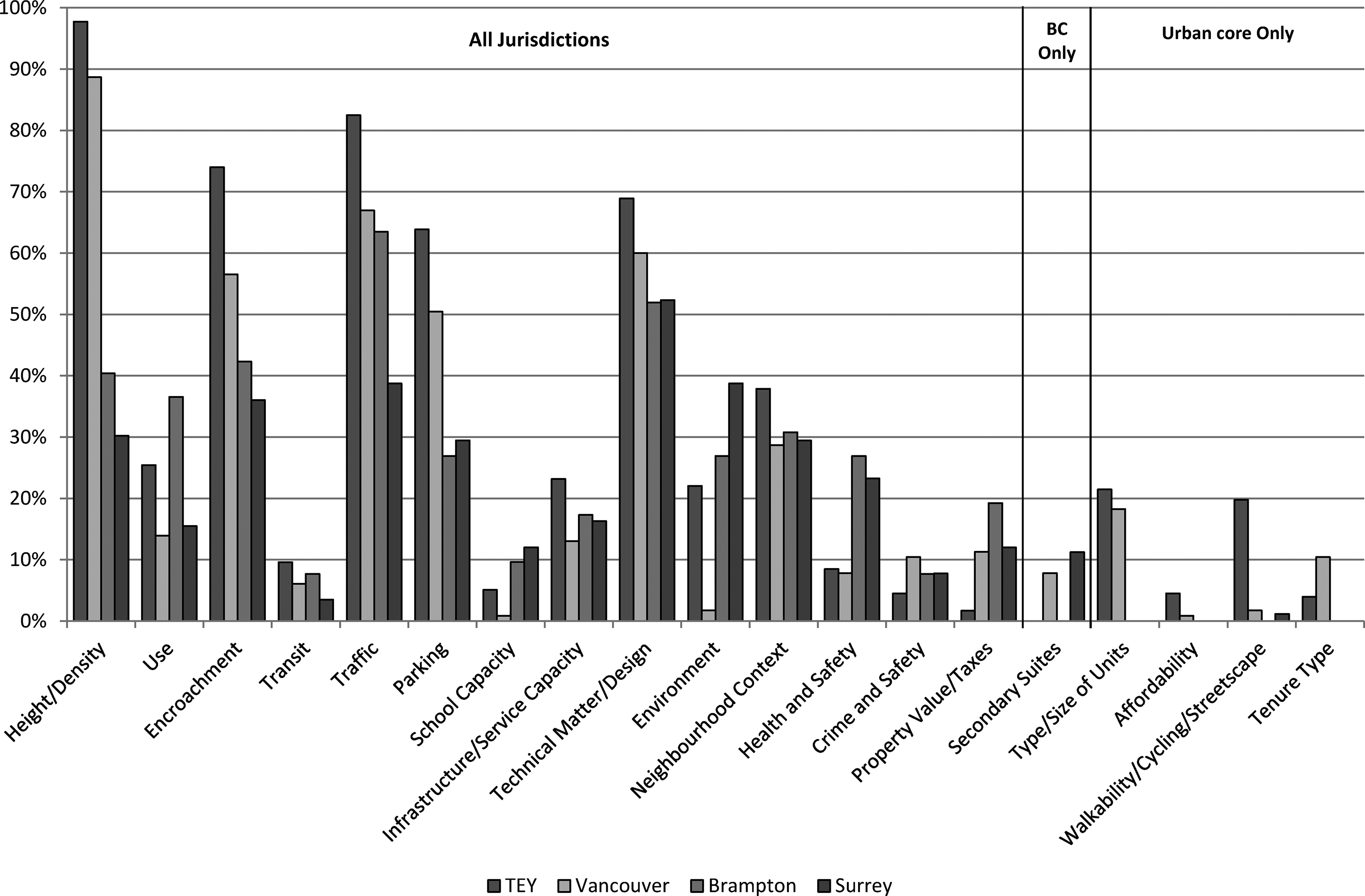
Frequency of concerns raised by residents.
Other studies examining the motivation for opposing development do not distinguish between suburbs and central cities, offering no clear evidence of how suburban and urban residents differ. Nevertheless, they offer further indicators of residents’ motivations for mobilization, which largely coincide with the findings of Whittemore and BenDor (2019). In their study of community participation, Einstein, Palmer, and Glick (2019) found that almost one-quarter of residents opposed proposed development due to concerns over traffic and congestions, while other opponents argued that the new development would be out of character with the existing community, a similar concern noted by Fischel (2001) in an anecdotal account of opposition to development in Hanover, New Hampshire. Likewise, in his earlier study, Pendall (1999) found that residents raised concerns over the effect new development would have on existing infrastructure in over half of the cases he studied and that traffic accounted for the vast majority of such concerns.
This particular focus on traffic, congestion, and roads mirrors Filion’s (2018) argument that suburban residents’ attitudes toward development derive from their car-dependent lifestyle. Although Einstein, Palmer, and Glick (2019) and Pendall’s (1999) research does not allow for fine distinction between suburban and urban opposition, the volume of concerns relating to traffic in both of their studies may well reflect the “suburban culture” that Filion and others have identified. If so, we would expect to see differences in the reasons that urbanites and suburbanites mobilize. This suggests the paper’s third and final question:
Do suburban residents’ reasons for mobilizing against development differ from urban residents?
What are Suburbs?
One of the quandaries of studying suburbs is the question of where urban ends and suburbia begins. The literature discussed above adopts a wide variety of definitions, of which not all are compatible. This makes situating any research into the existing debate on suburbs very difficult. Asking what suburbs are opens a Pandora’s Box of conflicting and evolving definitions and a myriad of new and related terms in academia. Addressing all the different perspectives on the nature and definition of suburbs is beyond the scope of this paper (for good synopses on this subject see Walks 2007; Oliver 2001). Instead, this section defines “urban” and “suburban” as utilized in this study.
There is typically little debate about what constitutes the “downtown” or central city of a city region in Canada and the United States. With a few exceptions, most metropolitan areas in Canada and the United States began with a core city typified by high levels of density and mixed-use development. The central cities gave birth to metro regions that began to expand and sprawl as new technology and infrastructure facilitated the movement of people and goods further and further from the core. In this scenario, the central city or “downtown” is the original municipality at the heart of the metropolis. Where debate emerges is when one tries to define where the border of the suburban begins.
There are two broad approaches to defining what is “urban” and “suburban” (for a similar typology used to distinguish between theories of the suburban/urban cultural divide see Walks 2007). The first approach to defining what is suburban is the municipal boundary approach. The municipal boundary approach to defining suburbs is very common in the United States and largely defines suburbs as the municipalities that surround the central, originating municipality. The basis for this definition is largely historical. In the United States and Canada, the first suburbs emerged well before the postwar advent of expressways, heavy car dependence, and “Corporate Suburbs” (Linteau 1987), which typified postwar development in the metropolitan periphery. Although the invention of the automobile—and specifically the mass-marketed cars of Henry Ford—played an important role in early suburban development, the creation of trolley rail lines was often the main facilitator of new development outside the boundaries of the central municipalities (Lewis 1996; Linteau 1987; Oliver 2001). Along with this new technology, laws facilitating the creation of new municipalities allowed land speculators, businesses looking for lower taxing jurisdictions, and residents looking to escape the evils of the downtown, to incorporate new municipalities on the outskirts of the central cities (Linteau 1987; Oliver 2001). This heralded the early age of metropolitan fragmentation.
This definition is based on the earliest conceptions of suburbs in the United States and Canada as the municipalities that surround the core city. The continued use of this definition in the United States, today, is premised on the continued fragmentation of many American metropolitan regions, and the history of exclusion often associated with such suburbs. The “flight” of affluent White residents from the central cities to the suburbs often involved the use of exclusionary zoning and other tactics to keep out unwanted members of society and land uses perceived as detrimental to their communities (Lewis 1996; Oliver 2001). In the United States, the suburbs were, to a large extent, defined by the people that created them (Oliver 2001).
In Canada, White flight and the hollowing out of the central city/downtown did not happen on the same scale experienced by American cities. Canadian municipalities also lacked the rights to home rule that limited annexation and amalgamation to the south (Shanks, Coates, and Harris 2017). Nevertheless, the early emergence of suburbs in Canada began in much the same way as it did in the United States, driven by land developers looking to capitalize on laws enabling the creation of fringe municipalities (Linteau 1987). The continued appeal of this approach is the simplicity of comparison achieved by defining suburban and urban based solely on the boundaries of municipalities.
There are a number of limitations with this approach, however. First, though there are many metropolitan regions in the United States where extreme levels of fragmentation continue to reign and central cities’ boundaries have remained the same for seemingly time immemorial (e.g., see St. Louis), there are also many consolidated city regions such as Houston and other cities that have annexed the very same suburbs that once surrounded them, such as the City of Los Angeles. If one adopts the municipal boundary definition, does that mean that a city such as Houston has no suburbs, or that suburbs cease to exist when they are annexed by the central city?
Most analyses of suburban development recognize important distinctions between prewar and postwar development. The perception of municipalities as sprawling, primarily residential, and car-dependent places largely applies to suburbs built after World War II. In contrast, prewar suburbs—particularly the earliest suburban development, share many of the urban form characteristics of the originating central city (Lewis 1996; Linteau 1987). Although they may lack the diversity of uses, these earlier prewar suburbs are largely “urban” in form. They are dense, pedestrian-oriented neighborhoods, with some mix of retail and other uses along with residential. In Canada, most of these early suburbs were long since annexed or amalgamated into their respective originating city.
The alternative to the municipal boundaries definitions of suburbs is one based on urban form and certain sociodemographic variables derived from such distinction between old and new suburbs. This is a more complex method for distinguishing between suburban and urban, as it involves assembling data on an array of variables such as car use and dependence, homeownership, land use patterns, period of development, and patterns of commuting, to name but a few. This approach, at once, provides both a finer-grained means for distinguishing between different types of communities, while also resulting in greater ambiguity. Typically, researchers that adopt this approach end up creating typologies of different types of communities. For instance, both Walks (2007) and Gordon and Janzen (2013) adopt such an approach in their analyses of Canadian metro regions. Walks (2007) adopts a threefold typology based on the contiguous extent of development extending from the core during three different time periods corresponding to shifts in development and the built form: inner city (pre-1946), inner suburbs (1946–1971), and outer suburbs (after 1971). Gordon and Janzen (2013) focus on the dominate mode for commuting in different areas of the metro regions. This results in an intuitive fourfold typology of exurbs—car-dependent areas on the fringe of the metro with low -density development similar to rural areas; auto suburbs—suburban areas dependent on cars; transit suburbs—suburban areas where residents rely on transit for commuting; and active core, areas where residents walk or bike to work.
This study combines aspects of the municipal boundaries approach while considering urban form and sociodemographic characteristics to distinguish between urban and suburban. The definition utilized in this paper draws primarily on the work of Walks (2007) and Gordon and Janzen (2013), while considering some of the sociodemographic measures Oliver (2001) includes in what is largely a municipal boundary approach to studying suburbs.
This study focuses on two urban cores that correspond with the City of Vancouver and the TEY Community Council area of the City of Toronto. Gordon and Janzen categorize the majority of Vancouver as “active core” with the remainder being “transit suburb.” This distinction largely applies to TEY too, with exception of a few “auto suburbs” neighborhoods. Walks, in turn, categorizes the majority of Vancouver as “inner city,” with a section in the southwest being “inner suburb,” while he classifies all of TEY as the inner city.
Borrowing again from Gordon and Janzen this study characterizes the cities of Surrey and Brampton as auto suburbs. Gordon and Janzen (2013) classify all of Brampton as an “auto suburb.” The majority of Surrey is also “auto suburb” with exception of a “transit suburb” area corresponding with Surrey City Centre. Walks characterizes all of Brampton as “outer suburb” and the large majority of Surrey as “outer suburb” except for a small section in the northwest of the city which he characterizes as an inner suburb.
To summarize, this paper defines the term urban core as an area with contiguous development existing before 1946 and where residents largely commute using active transportation or transit, and auto suburb (or just suburb) as areas largely built out after 1971 and where residents largely commute by car. These four case studies also conform to Oliver’s (2001) findings in Democracy in Suburbia. Although Oliver adopted a municipal boundary approach to distinguish between central cities and their suburbs, in doing so he developed a classification system based on three variables: city population, percent of population that commutes, and percent of population that owns homes (Oliver 2001, Table 5.1, 140). The population distinction has weak explanatory power in Canada. For instance, Surrey is physically larger than Vancouver, and its population is expected to exceed Vancouver’s in the next few decades. However, there are significant differences between the two urban cores and the two auto suburbs when comparing commute to work and homeownership, as illustrated in the last two columns of Table 1 in the following section. Homeownership rates in the two suburbs are much higher than in the urban cores, and residents in the suburbs are much more likely to travel outside of their own census subdivision to get to work than residents in the urban cores. These distinctions are important because they reinforce the differences between the auto suburbs and their urban cores.
Select Sociodemographic Information for Each Case.
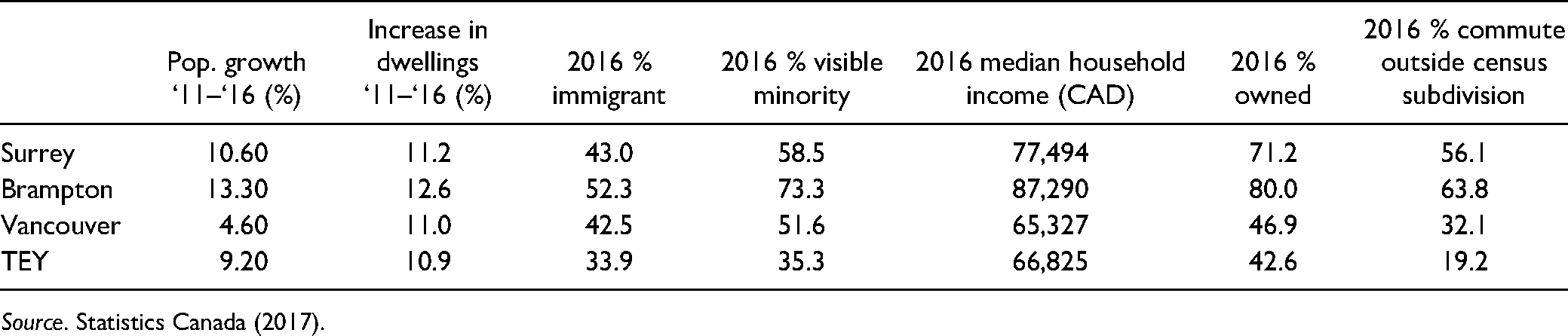
Source. Statistics Canada (2017).
In adopting these case studies and definitions of urban core and auto suburbs, this study minimizes the number of intervening variables that could skew its findings. Both urban core areas, largely built out before 1946, are undergoing a significant resurgence in development, a process that began in the late 1990s. Likewise, while both post-1971 auto suburbs experienced some decline in percentage growth over the last decade, they continue to experience significant development pressure. In contrast, many of the “inner suburbs” in each metro region—areas built between 1946 and 1971, using Walks’s (2007) definition—have experienced a significant decline in development, and in some instances in population. It would be a largely futile exercise to compare residents’ attitudes and responses to development if little to no development is occurring in their area. Certainly, one would expect their attitudes to differ from faster-growing areas based largely on the differences in growth pressures. The choice of case studies using the definitions above avoids many such pitfalls.
Case Selection and Methodology
Identifying Cases for Comparison
Beyond the definition of urban core and auto suburb, this study factored in a number of other variables when selecting cases for analysis. First, this study focuses on jurisdictions that hold statutory public hearings on planning in front of all or part of city council. 2 Statutory public hearings for matters of planning are a common requirement of municipalities throughout Canada and the United States. Such hearings are the final, and sometimes only occasion for residents and other interested parties to voice their support or opposition to a proposed development. Increasingly, municipalities record all or a portion of the content of these hearings, which allows for the collection of data regarding resident involvement in planning politics, from simple calculations of the number of residents attending such hearings to their expressed concerns with a specific project (for a similar approach see Whittemore and BenDor 2019).
The venue where public hearings occur and the geographic area it represents can vary by municipality. Some public hearings take place in front of a whole sitting of council, while others take place in front of subcouncils or committees of council. In order to distinguish between urban cores and auto suburbs, this study focuses on venues with comparable populations and a similar number of elected representatives, rather than focusing solely on municipalities as a whole.
While public hearings occur in front of city council as a whole in the cities of Surrey and Vancouver, in Brampton, they occur in front of a planning committee, which is made of the whole of council, without the mayor. In Toronto, the city’s four community councils conduct the statutory public hearings for all but a very few—usually citywide—planning issues. These community councils roughly coincide with the boundaries of the lower-tier municipalities that existed before the Municipality of Metropolitan Toronto’s amalgamation in 1998. Three of the councils represent three large, former suburban municipalities, Etobicoke, North York, and Scarborough, while the last council, Toronto and East York (TEY) roughly corresponds to the former City of Toronto, Borough of East York, and portions of the City of York. Each of these councils makes recommendations to the full city council, which is nominally responsible for making a final decision; however, in practice, final decisions are made at the community council level (Moore 2013).
The fact that it is the community councils in Toronto where public hearings and final decisions occur is important for this study because the majority of the City of Toronto’s 2.9 million people reside in what Walks (2007) would define as inner suburbs, whereas, the area TEY encompasses is highly urban. While the City of Toronto, as a whole, and the City of Vancouver are not good comparators for this study, TEY and Vancouver are. During the period of this study, the boundaries of the TEY Community Council (TEYCC) were based on the boundaries of twelve city wards, with the councilors from each ward sitting on the community council. Thus, the size of TEYCC is in line with Vancouver’s City Council and the suburban municipalities. As a result, the broad functions of the TEYCC are largely the same as the equivalent bodies in the other three jurisdictions.
This study also considered comparability along sociodemographic lines. While differences in car dependence, period of development, and built form are important factors when distinguishing between urban cores and auto suburbs, it was necessary to limit other variables that may alter the behavior and interests of residents. The choice of cases reflects an attempt to limit such variations. The population of the four jurisdictions is broadly similar. TEY had the largest population during the period of this study, at 765,465, followed by Vancouver, at 631,486, Brampton, at 593,638, and Surrey, at 517,877. In addition, as illustrated in Table 1, all four jurisdictions: experienced high growth rates and a similar increase in the number of dwellings during the period of this study; have similar diverse populations based on the percentage of immigrants and visible minorities; and have similar levels of affluence among households. These similarities limit the likelihood that factors such as variations in ethnic composition or the pace of development would influence the findings of this study.
Despite the underlining similarities between the four jurisdictions, there are some important institutional differences between the two Ontario and two British Columbia cases. Brampton and Toronto both employ a ward-based, nonpartisan system for electing councilors, while Surrey and Vancouver elect councilors via an at-large, partisan system. And, during the period of this study, municipal decisions on planning in Ontario were appealable to the Ontario Municipal Board, a powerful quasi-judicial body, whereas no such appeal body exists in British Columbia (Moore 2013). As a result, one may expect more residents to attend formal public hearings in the two British Columbia cases, as they present the only opportunity for residents to address councilors on planning issues, in contrast to the cases in Ontario, where ward councilors often involve themselves in informal meetings with developers and residents (Moore 2016). Beyond levels of participation, it is unlikely that such institutional differences would alter residents’ mindsets toward development, however.
Data Collection
Most states and provinces in the United States and Canada where municipal councils have jurisdiction over planning require municipalities to hold an official or statutory public hearing where residents can express their opinion on proposed planning changes and development. At a minimum, the minutes of these meetings can indicate the volume of resident participation in hearings, and in best-case scenarios, the minutes will provide an account of residents’ concerns or support for proposals. Informal open houses can also offer such insight, when city planners record residents’ concerns. While residents’ engagement and mobilization can take many forms, statuary public hearings for planning proposals and development offer the best means to gauge and compare residents’ mobilization and attitudes toward planning and development proposals.
In order to compare residents’ attitudes and behavior toward planning and development, databases of all official plan and zoning by-law amendment applications that made their way to statutory public hearings in each jurisdiction from 2012 through 2016 were compiled. These databases focus on applications for official plan and zoning by-law amendments due to the nature of planning in Canada. Although Canadian municipalities employ zoning in a manner similar to American municipalities, rezonings and official plan amendments are not only common, but the norm (Moore 2013, 2016). Typically, zoning by-laws and official plans provide only a baseline for use and density. They do not constrain developers or municipalities from changing the restrictions at any point in time. As property values have skyrocketed in both the Toronto and Vancouver city regions, developers have sought to build bigger and denser, resulting in all development proposals requiring a rezoning or official plan amendment application. By focusing on these applications, this study can account for residents’ attitudes toward development for the vast majority of proposals that make their way through each jurisdiction’s administration.
In turn, the paper focuses largely on statutory public hearings, because such hearings are the only occasions residents can address the entirety of the body responsible for making planning decisions. Attendance and participation in these hearings provide one important measure of residents’ overall involvement in planning politics.
The databases were compiled using minutes of council and committee meetings for each jurisdiction, video archives of meetings for TEY, and city planning reports to committees and councils. The process for creating the databases involved going through the appropriate minutes and identifying applications for rezoning and official plan amendments, imputing the relevant data within the minutes for each entry, and then going through reports from city planning for each application. Due to the nature and format of minutes and reports within and between each city, much of this was accomplished by direct input, rather than using data collection software. In order to avoid errors, each entry was double-checked by different team members. 3
In total, the databases include data for 115 applications in Brampton, 597 applications in Surrey, 268 in TEY, and 158 in Vancouver. The high number of applications in Surrey is indicative of a quirk in that city’s development practices. 4 Proposals with residential units included account for the majority of all development proposals in each city; however, the average number of units per application in Surrey was much lower than the other three. 5 Surrey official plan and rezoning applications included on average 29 residential units compared with 219 in Brampton, 362 in TEY, and 150 in Vancouver. Despite this, the number of units proposed in Surrey from 2012 through 2016 (17,321) was largely in line with that in Vancouver (19,763) and Brampton (13,149). TEY was the outlier in the total number of proposed units, with 79,764—likely a result of a preponderance of bachelor and one-bedroom units and the exuberance of the Toronto condo market.
Drawing on the committee and council minutes from all four jurisdictions, and video archives from the TEYCC, the databases include the number of individuals that spoke to council for each application (excluding representatives of developers). For Surrey, Vancouver, and Brampton, council and committee minutes provided the number of residents that spoke in opposition to a proposed development, in support, and those who spoke but did not express either support or opposition. 6 For Toronto, video archives allowed for a similar breakdown.
For Surrey and Brampton, the nature of the concerns raised by speakers at the public hearings was categorized using council and committee minutes. However, this was not possible for Vancouver and TEY. For those jurisdictions, city planners’ detailed accounts of concerns residents raised during open houses conducted prior to the statutory public hearings were used. Because of the different sources for this data, instead of counting the total number of times a specific concern was mentioned at any given meeting or hearing, all references to a specific category of concern in a single meeting were coded as one reference. This prevents comparison of the total number of times a specific concern was raised, but allows for comparison of what concerns were raised most frequently throughout all cases (e.g., concerns over increased traffic were raised at least once in seventy-five of the 158 applications in Vancouver).
Categories of concerns were created through an inductive process. New categories were added as needed and later combined where necessary. Each jurisdiction has some concerns specific to them; however, such outliers were rare. For the most part, the same fourteen categories arose in each jurisdiction, as depicted in Table 2.
Category of Concerns Common to all Four Jurisdictions.
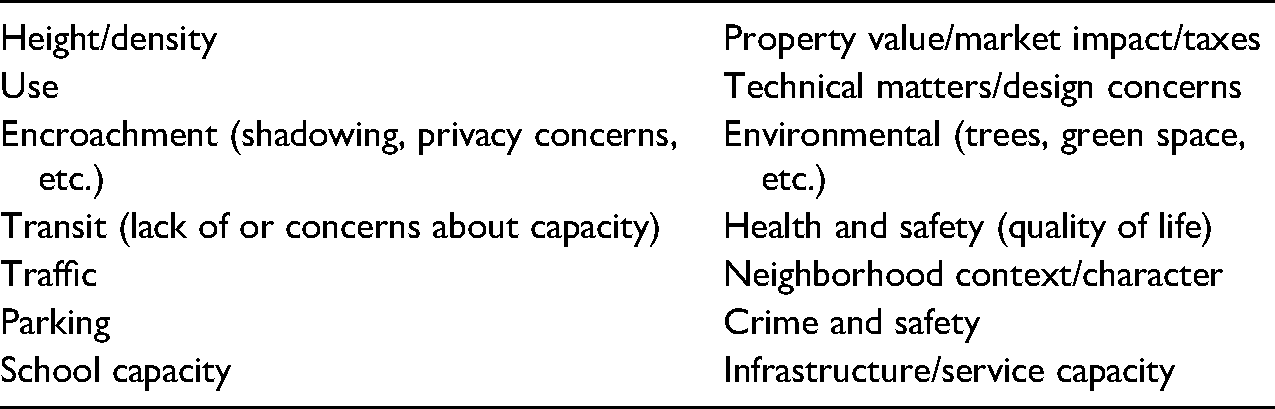
Another five categories arose in two or three cities: type/size of unit, affordability, active transportation and streetscape, housing tenure type, and secondary suites. Categorization was a relatively straightforward process, as residents making statements at public hearings, and city planning accounts of residents’ opinions during open houses, used largely the same language to express concerns.
In addition to data on attendance at public hearings and residents’ concerns, a number of other variables were included in the database. This study included information on the nature of the development proposal—whether the project proposed primarily residential use or other uses, and how proximate the site of a proposal was to existing residential development. For the latter, Google Maps was used to determine whether residential development was within 100 m of the development site. 7 In Ontario, 100 m from the site is the required area for dissemination of development proposal information to the public (there are no such area requirements for dissemination in British Columbia).
Analysis
To begin with, this analysis considers the first of the research questions outlined above:
Are suburban residents more or less engaged in planning politics than urban residents?
In order to answer this question, the paper compares the volume of speakers that addressed the council at public hearings as a measure of resident mobilization. Each “case” represents a proposal for a zoning by-law or official plan amendment considered at a public hearing. Table 3 breaks down the percentage of proposals where residents spoke by jurisdiction.
Frequency of Residents Speaking at Public Hearings.
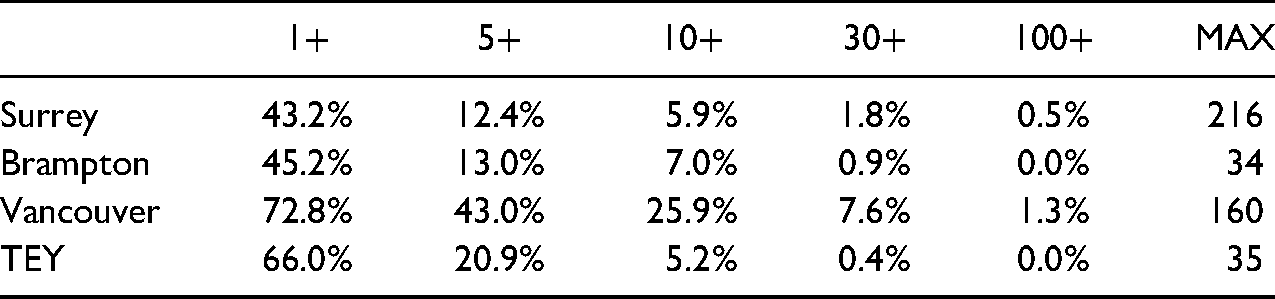
The first column includes the percentage of proposals where at least one resident spoke. At this threshold, there is a clear difference in the frequency of residents speaking in the two suburbs when compared with the two urban cores. Residents spoke in less than half of the hearings in Surrey and Brampton, whereas residents in Vancouver and TEY spoke at 72.8% and 66% of hearings. However, one or two residents attending and speaking at a hearing does not indicate significant resident mobilization. As a result, columns 2 through 5 examine the percentage of hearings with five or more, ten or more, thirty or more, and 100 or more speakers in attendance. At five or more and ten or more speakers, there is a clear difference between Vancouver and the other three jurisdictions. At thirty or more and 100 or more, we see a growing difference between the two ward-based jurisdictions and the two at-large municipalities. Finally, the final column shows the maximum number of speakers that attended an individual hearing in each jurisdiction. There is a very clear difference between the at-large and ward-based jurisdictions here as well.
Table 3 suggests that while a difference exists between the urban cores and suburbs in the overall frequency of attendance and speaking at meetings, residents in the two at-large municipalities, Vancouver and Surrey, mobilize in far greater numbers than in TEY and Brampton. This finding may well result from the institutional differences noted in the method section of this paper. In TEY and Brampton, ward councilors engage with residents throughout the planning process prior to the public hearing—in TEY, some councilors will even lead the way during the consultation process. Moore (2013) suggests the heavy engagement of Toronto councilors in the planning process reflects how susceptible they are to being punished by residents if they appear to ignore their interests or fail to engage residents regularly. Given Brampton’s similar ward-based, nonpartisan system for electing councilors, councilors there may also feel pressured to intervene or engage early in the planning process. In contrast, councilors elected in the partisan, at-large elections in Vancouver and Surrey will not face this same pressure. A comparison of the number of residents that attend informal open houses could shed more light on this distinction. However, planning reports in the two suburban municipalities omitted this information, and reports from Toronto were inconsistent in the information they provided.
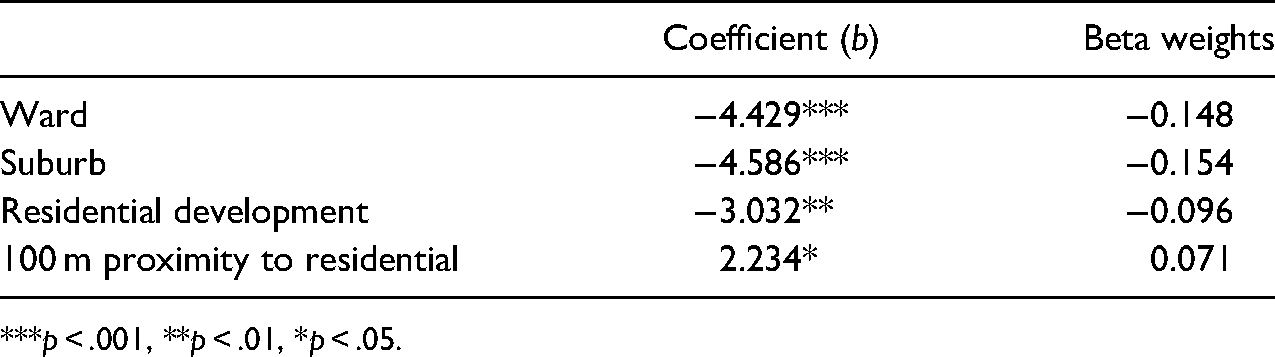
In order to determine whether the differences in Table 3 are solely a product of institutional difference or whether they do reflect a suburban/urban divide, an ordinary least square (OLS) regression (using direct entry of the independent variables) was carried out on the combined databases. The dependent variable is the number of residents speaking at public hearings to each zoning by-law and official plan proposal in all four jurisdictions from 2012 through 2016 (n = 1138). The OLS regression then considers four independent dummy variables: whether the hearing was in a ward or an at-large jurisdiction (coded 1 for ward); whether the jurisdiction was a suburb or urban core (coded 1 for suburb); whether the proposal was for residential development (coded 1); and whether the proposal was within 100 m of existing residential development (coded 1). 8 In all four cases, the vast majority of proposals were within 100 m of some residential development; however, a higher proportion of proposals were near a residential development in the two urban cores than in the two suburbs—in Vancouver and TEY 95% and 94% of proposals were within 100 m; while in Brampton and Surrey the numbers were 86% and 90%, respectively. Table 4 shows the result of the regression.
OLS Regression: Resident Participation at Public Hearings (n = 1138).
***p < .001, **p < .01, *p < .05.
Three of the four predicators show significant negative relationships with resident participation. The findings suggest that residents in a jurisdiction with ward-based electoral systems mobilize in lower numbers than residents under at-large systems and that suburbanites will mobilize in fewer numbers than urbanites. Both of these results confirm the findings from Table 3. However, the regression analysis provides greater evidence of a suburban/urban divide, which is only apparent at low numbers in Table 3. The findings suggest that both variables, institutional structural and being a suburban resident, may influence participation rates in public hearings. However, regardless of institutional variation, suburban residents are less engaged than their urban counterparts.
In addition to this finding, the regression analysis also suggests residents in all jurisdictions are more likely to participate in larger numbers when a project involves a use other than residential. This finding is consistent with Logan and Rabrenovic’s (1990) depiction of the motivations for neighborhood association formation in New York’s Capital District.
More importantly, a proposal’s proximity to residential development has a positive relationship to resident participation in public hearings in all jurisdictions. This supports accounts of residents’ motivation for mobilization in the existing literature and suggests that the proximity to existing residential development may be a factor in resident mobilization in both urban core and suburban jurisdictions.
The next question this analysis considers is:
Are suburban residents more likely to oppose development than urban residents?
To address this question, the paper examines the ratio of residents participating in support or opposition to development proposals. This was determined using the council and committee minutes of Vancouver, Surrey, and Brampton, and the video archives of the TEY Community Council.
Table 5 shows the ratio of residents participating in support and opposition to development, and the maximum number of residents that attended a meeting in support or opposition. The existing literature on resident mobilization in planning politics suggests the motives of suburban residents are largely oppositional, while the motivations of urban residents vary—some residents mobilize in support of progressive forms of development, while others mobilize against development that they believe will negatively affect their neighborhood. The findings in Table 5 suggest that suburban residents are more likely to mobilize against development than urban residents.
Support and Opposition.
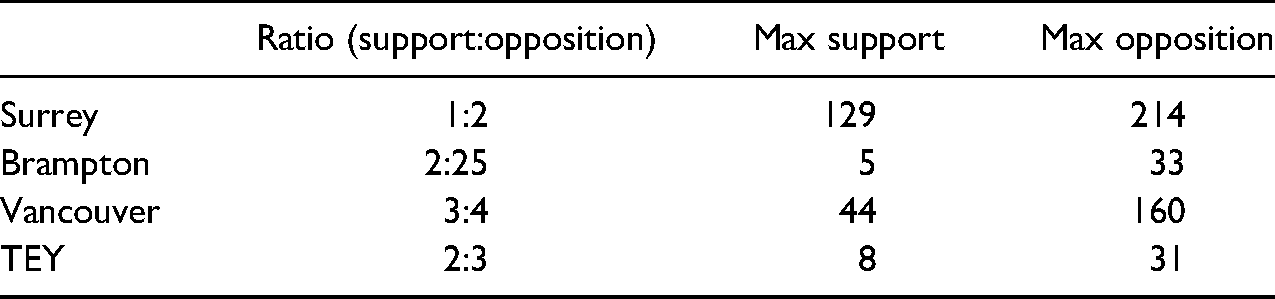
In Vancouver, three residents attended in support of a development proposal for every four that attended to oppose one. This ratio was the closest of the three jurisdictions, suggesting Vancouverites are the most likely to mobilize in favor of development. Toronto followed Vancouver with two residents attending in support for every three that opposed development. The ratio for both suburbs was greater. In Brampton, the ratio was very high, with only two residents attending in support for every twenty-five attending in opposition. Such numbers are very similar to Whittemore and BenDor’s (2019) findings in Henrico County. However, while the ratio was greater in Surrey than in the two urban cores, the one resident attending in support for every two that opposed a development was much closer to the ratios of the urban cores than Brampton.
The findings in Brampton support the depiction of suburban residents as largely conservative NIMBYs. However, the findings for the other three jurisdictions undermine this depiction somewhat. Suburban residents are more likely to oppose development; however, opposition in urban cores is still higher than support, and suburbanites do mobilize in support of development. This finding suggests that, while suburbanites may be more conservative in their approach to development than urbanities, they are not as different as the literature suggests.
Finally, this analysis considers question 3:
Do suburban residents’ reasons for mobilizing against development differ from urban residents?
In order to address this question, this paper examines residents’ attitudes toward development in each jurisdiction by comparing the frequency that residents raised specific concerns.
9
Figure 1 compares the frequency that specific concerns were raised by residents in each jurisdiction—the percentage shown is the percent of all cases where at least one resident spoke at a public hearing.
10
There are a few notable differences between the urban cores and suburbs. Residents in Vancouver and TEY raised the issue of height and density far more often than their suburban counterparts (the first set of columns in Figure 1). In fact, height and density were the most common concerns raised in the urban cores. This distinction likely arose due to the greater prevalence of mid-rise and high-rise condo proposals and their proximity to lower-rise residential development in the urban cores. For instance, in TEY and Vancouver, 92.1% and 91% of all proposed development with a residential component include mid-rise or high-rise apartments. In Brampton and Surrey, the proportion was 22.9% and 8.1% in comparison. The issue with height and density in Vancouver and TEY is also reflected in their concerns over encroachment. In the two urban cores, residents expressed concerns regarding shadows, in the suburbs, encroachment concerns were mostly related to overlook (e.g., having a three-story townhouse overlook a backyard) or the proximity of certain uses adjacent to housing (such as parking or garbage disposal).
Urban residents also raised concerns over parking more frequently than suburban residents, and only urban residents raised concerns regarding the type and size of units (e.g., whether proposals included enough two- and three-bedroom units), housing affordability, walkability/active transportation/streetscaping, and tenure of housing (rental or owned). The only category where suburban residents expressed concerns more frequently than urban residents was that of health and safety. Suburban residents were more likely to raise concerns regarding access for emergency vehicles, and concerns relating to the safety of pedestrian crossings at intersections.
Despite differences in the frequency that residents raised concerns in the suburbs and urban cores, few of these differences suggest a substantive distinction between urban and suburban residents’ attitudes. Residents in both the suburbs and urban cores predominantly expressed concerns over how a proposed development would alter or negatively affect their existing community. In fact, the issue of traffic, which was a defining characteristic of opposition to development in Einstein, Palmer, and Glick (2019), Whittemore and BenDor (2019), and Pendall’s (1999) studies, was raised more often as an issue in the two urban cores than in the two auto suburbs. In TEY, residents raised concerns over traffic in over 80% of cases, compared with <40% of cases in Surrey. As for the nebulous concept of neighborhood context or character, which Einstein, Palmer, and Glick (2019) noted in their study, residents in all four jurisdictions raised such concerns at a similar rate.
Where differences in frequency of concerns emerge, such as density in the urban core, they appear to largely be a product of context. The concerns raised in the two British Columbia municipalities regarding secondary suites support this finding. Residents raised this issue in 8% of the cases in Vancouver and 11% in Surrey. The issue was never raised in TEY or Brampton. This distinction is likely the result of policies supporting the creation of legal secondary suites—in order to increase affordable housing stock—in Surrey and Vancouver, and the relative infrequency of basements in those jurisdictions in comparison to Brampton and TEY. Residents in Surrey and Vancouver perceived basements as problematic because they could be converted into illegal secondary suites. During the period of this study, Brampton was in the process of creating a plan to allow secondary suites, while Toronto focused on allowing housing on laneways. It is possible that the question of secondary suites will grow in importance in those two cities in the future.
Urban residents’ concerns regarding walkability, active transportation, and streetscapes may be the only instance where a cultural distinction between suburban and urban attitudes is apparent, as residents in the urban core may choose a lifestyle that is less car-dependent. However, while residents in TEY raised these issues in almost 20% of the hearings, Vancouver residents raised them only 2% of the time. As result, this too could be simply a question of context, as TEY residents often focused on the narrow width of sidewalks in their neighborhoods.
These findings cast doubt on portrayals of suburbanites’ uniqueness in the realm of planning politics. Although the concerns residents in Surrey and Brampton raise conform to Filion’s (2018) perception of them, the suburban realm that they live in cannot fully account for their sentiment and motivations for opposing development, as the same concerns are regularly raised by residents living in the urban cores of their metropolitan areas. Suburban residents’ reasons for mobilizing against development do not substantially differ from urban residents.
Summary of Findings
As this analysis only compares four jurisdictions, one cannot make broad generalizations based on these findings. Nevertheless, this analysis provides strong evidence to address the three questions asked at the onset of the paper.
Are suburban residents more or less engaged in planning politics than urban residents? Are suburban residents more likely to oppose development than urban residents? Do suburban residents’ reasons for mobilizing against development differ from urban residents?
Suburban residents in Surrey and Brampton are less engaged in the politics of planning and development than their urban counterparts. And they are more likely to oppose development than urban residents. However, the majority of residents that participated in the planning process in all four jurisdictions opposed development, and the motivations for this opposition were largely the same in each jurisdiction. As the findings from the OLS regression in Table 4, and the findings from Figure 1 suggest, opposition to development appears to be driven by concerns regarding encroachment in all four jurisdictions. While there may be more progressive forces in the urban core than in the auto suburbs, concern over various forms of encroachment on one’s neighborhood appears to drive the majority of resident participation in planning politics in both urban and suburban settings. This fact is not surprising when one considers that the majority of proposals in all four jurisdictions are near existing residential development. However, it does suggest that suburban residents’ engagement in the politics of development and planning may not be so unique when compared with urban residents.
Conclusion
The findings of this paper raise important questions regarding scholar’s understanding of suburban and urban residents’ attitudes toward development and culture. For the most part, the residents of Brampton and Surrey conform to the depictions of suburbanites as conservative and parochial. However, their attitudes do not differ substantially from urban residents in their respective urban cores.
These findings may indicate that residents participating in the politics of urban development share a similar mindsight regardless of locale, or that the interests and behavior of suburban and urban residents are converging, as least as they pertain to planning and development. The similarities between urban and suburban residents’ attitudes toward development challenges arguments that suburbanites’ participation in planning politics is driven by a unique car-oriented culture. Rather, concerns regarding the encroachment and impact of development on existing neighborhoods seem to dominate the minds of both urban and suburban residents.
It is possible that the mindset toward development attributed to suburban culture is not, in fact, a product of living in the suburbs. It may be that, as De Leon found in San Francisco, once progressive movements in downtowns have simply given way to neighborhood parochialism as new development threatens established middle-income neighborhoods in the urban cores. That is, past differences between suburban and urban attitudes and behavior toward development may have simply reflected the absence of growth pressures in the urban core for much of the later twentieth century.
Footnotes
Declaration of Conflicting Interests
The author declared no potential conflicts of interest with respect to the research, authorship, and/or publication of this article.
Funding
The author disclosed receipt of the following financial support for the research, authorship, and/or publication of this article: This work was supported by the Social Sciences and Humanities Research Council of Canada (grant number 430-2018-00141).
