




Abstract
With the advancement of comparative studies within the field of immigration and sociopolitical movements, scholars have attempted to understand how politico-institutional contexts influence the mobilization strategies of immigrant rights organizations at the local level. In this article, I make use of a field approach to explain how these organizations face different group-and issue-specific conditions regarding their involvement in local policy-making processes. Empirically, I examine the advocacy work of immigrant rights organizations in their aim to protect the rights of undocumented immigrants in Boston (USA) and Amsterdam (the Netherlands). By approaching power and resistance as relational phenomena, the results indicate that the intersection of distinct institutional and organizational mechanisms has differently impacted the local fields of immigrant politics. Taking different routes, in both cities immigrant rights organizations have found ways to constitute an affirmative institutional and discursive counterpower that challenges the national exclusionary citizenship regimes from the ground.
Keywords
Introduction
Over the past three decades, immigration-related issues have gained significant salience in public discourses and political agendas in most countries of the Global North. National obsessions with controlling immigration and securing borders have contributed to the Brexit vote in the United Kingdom, as well as to the electoral victory of Donald Trump in the United States. In the United States, an increasing number of states and local governments have enacted their own immigration laws, many of which have signed on to enforcement partnerships with the federal government (Varsanyi 2008). In Europe, entry and residence rights have increasingly become conditional on the successful completion of civic integration programs (Bonjour and Duyvendak 2018) and internal immigration controls have accelerated considerably (Van der Woude et al. 2014).
There is a broad scholarly agreement that both national approaches have resulted in a punitive public culture to expel undesired persons. Yet, as these measures fail to effectively address the structural forces that undergird international migration patterns, irregular and undocumented residence has become a fact of life on both sides of the Atlantic. In a response to the exclusionary national policies, immigrant rights organizations (IROs) have stepped up to the plate to meet the needs of immigrants, including those without legal residence rights (Ambrosini and van der Leun 2015; De Graauw 2014; Ramakrishnan and Bloemraad 2008).
Many scholars in the field of immigration and sociopolitical movements have addressed the question of what factors shape the mobilization of IROs in these hostile political environments. Engaging with this literature, I seek to explain how IROs influence pro-immigration policies at the local level, 1 and in which ways these organizational strategies converge and diverge by means of a comparative case study design. I specifically analyze the emergence of local pro-immigration policies that pertain to the demands of equal rights and basic protections for undocumented immigrants in Boston (USA) and Amsterdam (the Netherlands). These involve noncooperation ordinances that limit the authority of local government employees to cooperate in federal immigration law enforcement in the form of the “Trust Act” in Boston, and policy programs that provide basic living standards for refugees whose asylum claims have been dismissed in the form of the “National Alien Provision Program” in Amsterdam.
Boston and Amsterdam are two urban cases that lend themselves particularly well to a comparative study. Both cities have left-leaning governments and organizational infrastructures that actively represent the interests of undocumented immigrants. Although these two factors are considered as the most critical conditions for the enactment and implementation of pro-immigration policies (De Graauw and Vermeulen 2016), the underlying dynamics of the policy-making processes differ between both cities and provide, as such, a good opportunity for comparative research focused on explaining variation in policy outcomes. I use the cases to excavate the key features of these two variants of immigrant politics. By doing so, I adhere to Goldstone’s (2004) notion of “relational field” that could be read as a derivative of Bourdieu’s (1985, 1989) seminal conception of the “field of political struggle.” This approach is well-equipped to show that the distinct dynamics are not simply the result of a clear set of solidified and independent national and local conditions, but that IROs face their own group- and issue-specific fields of relations in the involvement of local policy-making processes.
In this article, I examine these issues in several sections. First, I provide a review of the literature on political opportunities and multilevel governance, and develop a specific variant of the relational field approach. Second, I present the cases and research approach. In the empirical sections, I shall try to substantiate how specific combinations of various conditions have impacted immigrant politics in Boston and Amsterdam in different ways. And finally, I contrast both empirical outcomes based on this comparative case study design in the conclusion.
Political Opportunities and Multilevel Governance
It is hard to overstate the importance of the so-called “political process” approach to the studies of social movements. Since the 1970s, the notion of the “political opportunity structure” (POS) has increasingly been deployed for the systematic analysis of how politico-institutional contexts shape organizational opposition as latent political opportunities. First introduced by Eisinger (1973), POS has been elaborated upon as an analytical framework by scholars both in the United States (e.g., McAdam 1983; Meyer 1993; Tarrow 1988) and Western Europe (e.g., Koopmans and Statham 2001; Kriesi et al. 1992; Rucht 1996).
Although the interrelated concepts of POS have been broadly conceived with varying emphasis on each of the dimensions, the initial precept is that “the dynamics of collective action—even in its most ‘expressive’ and anti-political forms—are best understood in relation to the political process” (Tarrow 1988, p. 422). As such, POS generally refers to the restructuring of power relations among the economic and political elites that creates a window of opportunity for collective action to address and challenge institutionalized discourses and political practices. From this line of reasoning, POS encompasses a range of structural features that can make them more or less insulated from civil society and the demands of community-based organizations. These features include, among others, the specificities of the electoral system, the degree of federalization or centralization of the political system, and the configuration of political parties. However, the POS approach has been criticized on various grounds. For the argument of this article, I specifically focus on two of them. The first critique is ontological and relates to the way in which POS scholars treat state structures in a way that Bourdieu and Wacquant (1992) have equated with “social physics,” that is, as objective, self-actualizing entities which can be “materially observed, measured, and mapped out independently of the representations of those who live in it” (Bourdieu and Wacquant 1992, p. 8). The danger of this structuralist point of view is that it is incapable of understanding practices other than derivations of scholastically preconstructed models. Bertossi and Duyvendak (2012) have argued that POS models are constantly contradicted by political and legal actions at different levels. Conflictive perceptions and deviations that develop in social networks, therefore, “cannot be merely viewed as ‘pathologies’ of the model, but are fully part of what must be explained” (Bertossi and Duyvendak 2012, p. 244, emphasis mine).
The second critique stems from the first one and relates to the issue of dialectics of scale. POS merely pertains to central state-focused mobilization and often denies the dialectics of geographically differentiated state systems (Miller 1994). These studies often overlook how central states and multiple local states, which each possess their own degree of autonomy in policy-making processes, influence each other and therefore should be understood as being mutually constitutive (Brenner 2001).
To investigate the distinct geographies of local immigration policies, a more recent type of research can be distinguished that is conducted under the heading of “multi-level governance” (MLG) in both the United States (e.g., Varsanyi 2008; Walker and Leitner 2011; Wells 2004) and Western Europe (e.g., Bak Jørgensen 2012; Poppelaars and Scholten 2008; Spencer 2018). The MLG approach emerged in response to the shifting idea that policy making is not merely central state-focused, but takes place in multilevel settings. Therefore, MLG distinguishes itself from POS by the recognition of, and focus on, the existence of some form of coordinated action between different governmental levels within specific policy domains.
Scholten (2013a) distinguishes three ideal types and degrees of coordination between various governmental levels in policy-making processes. First, the “centralist approach” is characterized as top-down and assumes that national governments hold primacy in the formulation and coordination of policies where local governments are at most involved in their implementation. This form of policy follows most strongly the logic of unitary, centralized states (Bak Jørgensen 2012). Second, the “localist approach” refers to governance modes that have devolved national policies to lower-tier governments. This involves a more bottom-up approach where policies are not merely implemented but formulated by local governments. This form of MLG follows most strongly the logic of federal states that divide political authority and policy-making capacity among national and subnational governments. Here, an institutional policy structure will have to evolve at the local level (Scholten 2013a). Finally, when local leadership is strongly involved in the politicization of the topic, a third approach of “governance decoupling” might emerge, which means that there is no meaningful coordination between different governmental levels and that the policies at these various levels may even contradict each other.
Despite MLG’s important contribution to POS research in facilitating a more comprehensive understanding of the differing and overlapping mandates for local authority policies toward regular and irregular immigrants, these studies still remain particularly state-focused. Moving toward the perspective of organizations and their practices to influence local policies, Dikec and Swyngedouw (2017) have recently urged scholars to rethink urban politics as fields of action. As such, approaching mobilization processes from the perspective of organizations in relation to the multiscalar institutional conditions that impinge on them in variegated ways is crucial if we are to understand how organizations can act as political conduits through which they transform their strategies into policy influence on the local level.
In what follows, I elaborate on such an alternative analysis by understanding local immigrant politics as group- and issue-specific fields of relations where the “precise effect of factors depends on the particular movement, issue, and the relationships among other factors that are operating” (Goldstone 2004, p. 357).
Toward a Field Approach
Although Goldstone’s (2004) field approach to the study of social movements and organizational action can, most likely, be traced back to Bourdieu’s (1985, 1989) concept of the field of political struggle (most likely, because Goldstone does not cite his work as such), I first highlight some of the elements of Foucault’s (1982, 1990) work that have contributed the formulation of the analytical framework I will briefly present below.
Especially Foucault’s idea on the “local centers” of power is noteworthy to discuss here, because it redirects attention away from the specificities of state structures and the actions of the representatives who are commonly assumed to exercise power toward the local settings where power reveals itself (Uitermark 2005). Foucault’s genealogical studies sought to demonstrate that power does not simply flow from representative institutions of central states to local settings of everyday life and vice versa, but that these local settings themselves consist of a multiplicity of force relations which, in turn, act through multiple points of resistance: These points of resistance are present everywhere in the power network. Hence there is no . . . pure law of the revolutionary. Instead there is a plurality of resistances, each of them a special case . . . by definition, they can only exist in the strategic field of power relations. (Foucault 1990, pp. 95–96)
While Foucault’s framework is particularly relevant here in illustrating the group- and issue-specific dimensions of resistance and mobilization in localized fields of power relations (Goldstone 2004), his critique of state- and subject-centered notions of power was so far-reaching that it has become hard to identify the locations of its exercise and resistance (for an excellent discussion, see Cronin 1996). Bourdieu (1985, 1989) agrees with Foucault in viewing power and resistance as relational phenomena but specifically locates, by contrast, the exercise of power in the interactions between state representatives and social agents who are embedded in fields of political struggle. Through symbolic interactions, each of the groups of agents try to legitimize their vision of the social world and impose it on others from their respective position in the field “by jettisoning the old political vocabulary . . . designed to describe the social world” (Bourdieu 1989, p. 21). Especially in times of crises, such as level-specific political developments or events as identified by Scholten (2013a), these symbolic interactions provide an important base for local conjunctural alliances.
In short, the field approach to the study of organizational action does not make an analytical distinction between the sphere of the state and civil society. Conceiving of this dichotomy as a caricature “with little relation to reality” (Goldstone 2004, p. 344), Goldstone integrates both of them into a complex localized field consisting of numerous actors who mutually influence each other in the institutionalization process of overlapping and diverging world visions.
In a relatively recent comparison between Amsterdam and Los Angeles, Nicholls and Uitermark (2013) follow this field approach by showing how the intersection, rather than the independent influences, of institutional and organizational mechanisms impacts the local fields of immigrant politics. In Amsterdam, city officials seem to possess the institutional capacity to selectively provide some organizations with the material and discursive resources to achieve control in immigrant organizations. By contrast, city officials in Los Angeles lack this institutional capacity due to the absence of federal financial support. This governmental laissez-faire attitude (Bloemraad and Graauw 2011) has paved the way for organizations to construct an independent coalition of community-based organizations pressuring city officials to support social-justice issues.
To further empirically substantiate this approach, I first provide a background of the national policies in the United States and the Netherlands that function to expel undocumented immigrants. Thereafter, I discuss the case studies and my methodological approach. I then introduce the dominant discourses and policy programs in Boston and Amsterdam. The remainder of the article discusses how IROs interact with city governments in the policy-making processes.
Localizing Bordering Powers in the United States and the Netherlands
Both the United States and the Netherlands have expanded their capacities to control their national borders against undocumented immigrants. In both countries, these efforts have resulted in the devolution of power to “individualized border enforcers” (Nicholls 2016, p. 43) such as local governments, police, and service providers. In doing so, two markedly different welfare states embarked on similar paths that sharpen boundaries between the national citizen and the undesired “Other.” Yet while the United States and the Netherlands are on similar policy trajectories regarding undocumented immigrants, local governments are differently embedded in the respective national contexts. The significance of the local dimension of immigration policy making varies between both countries, depending on the institutional role assigned to different territorial levels in shaping these policies (Caponio 2010, p. 166).
In the United States and the Netherlands, state and local governments are constrained to draw up their own immigration laws in a context of exclusive federal and national control over immigration and citizenship. Yet in both countries, as described above, administrative powers have been devolved to lower levels of government to enforce policies discriminating against individuals based on their residence status. In the United States, this has resulted in the creation of city policies that are directly involved in, or opposed to, the repatriation of undocumented immigrants at the federal level, whereas in the Netherlands this has resulted in discretion in the implementation of, or opposition to, elements of national legislation.
In the United States, the devolution of administrative powers to enforce federal immigration laws emerged during the “tough-on-crime” era of the 1980s and more specifically when the Personal Responsibility and Work Opportunity Reconciliation Act (PRWORA) was enacted in 1996. PRWORA excludes undocumented immigrants from Supplemental Security Income, Temporary Aid for Needy Families, nonemergency Medicaid, and many other publicly funded services (Varsanyi 2008, p. 889). The 1996 Illegal Immigration Reform and Immigrant Responsibility Act (IIRIRA) was strategically devised by Clinton’s administration—and has been revived under Trump’s administration (White House 2017)—to enforce this type of legislation at local levels in an attempt to further curb the presence of undocumented immigrants. IIRIRA enables local governments to enter into Memorandums of Agreements that spur collaborations between local police and federal immigration agents of the Immigration and Customs Enforcement (ICE) to verify the legal status of persons during daily law enforcement activities (Kretsedemas 2008).
However, as local governments are not obliged to inform ICE about a person’s unauthorized presence unless that individual has committed a crime, other cities have advanced pro-immigrant policy approaches that restrain government employees from inquiring or disseminating information about the legal status of residents whom they encounter. When such ordinances are implemented on the basis of states’ “home rule” provision to safeguard the safety, health, and well-being of all city residents, they can legitimately exist alongside the efforts of the federal citizenship regime to exclude undocumented immigrants (De Graauw 2014). Accordingly, home rule provisions provide cities, at least theoretically, with statutory defense against assertions of federal preemptive power (Parlow 2008).
The Netherlands represents a unitary state structure that can be described as a “consensus government” (Andeweg 2000). As such, the lower tiers of government—the provinces and municipalities—are essentially responsible for implementing national policies (Caponio 2010). Access to the national government is collectively organized by the Cooperation of Dutch Municipalities (VNG). Every law in which local implementation is needed is presented to the VNG in draft form that mayors and aldermen can access. As such, most administrative functions at the municipal level are performed in co-governance with the national state. Sometimes this collaboration is merely procedural, in other cases the administrative functions of municipalities are stipulated in detail by ministerial departments based on conditional grants (Groenendijk 1998).
In this context of strong national-local connections between institutional actors in policy-making processes, Habraken et al. (2013) have argued that the role of Dutch civil society organizations is less pervasive than in the United States and often subject to “cooptation,” which refers to the dilution of their claims and symbolic strategies to accommodate them within the established political order (Campbell 2001). Indeed, both national and local government officials have developed various techniques to exert control over civil associations, predominantly—but not exclusively—based on the Dutch history of state support for social programs. As part of the tradition of a relatively strong welfare state, there are more policies designed to actively target ethnic minority groups to overcome inequalities than in the United States (Schneider and Crul 2010). This institutionalized pattern providing subsidies to civil society organizations has resulted in a situation in which many organizations in the Netherlands might regard the state, rather than their constituencies, as their primary source of financial support and legitimacy (Habraken et al. 2013, p. 744). Accordingly, when behavior becomes clearly defined through the institutionalization of IROs, they might lose their identity and objectives (Castells 1983, p. 328).
However, although the policy-making capacities of Dutch municipalities in the field of immigration are far less extensive than that of U.S. local governments, they have some discretion in alternative interpretations of the local enforcement of national immigration policies. This has specifically been the case since the enactment of the Linking Act of 1998, that, by linking residence status to a social-fiscal number required for work, housing, and taxing, excludes undocumented immigrants from a whole range of basic living provisions (Van der Leun 2003). Van der Leun (2006) has interrogated the process of shifting down internal immigration controls from national to local government institutions that are entitled to enforce measures of the Linking Act on a daily basis. These new measures have required “street-level bureaucrats” (Lipsky 1980) to report suspected undocumented immigrants to the police and recalibrated the collaboration between the national immigration police and local police to detect and detain undocumented immigrants in local jurisdictions (Nicholls 2016). At the same time, however, Van der Leun (2006) has shown how the high degree of discretion and professional autonomy of some of these street-level bureaucrats and local officials often result in outcomes that run counter to the exclusionary measures of the Linking Act.
Given the tighter relationships between the national and local governments in the co-governance of undocumented immigration in the Netherlands, it could be expected that the policy ambiguities on this issue are much less prominent than in the United States. However, as described above, they are still a fact of life in the Netherlands as they emerge through the local resistances of professionals, city officials, and IROs that oppose national policies or put their professional ethics above national policies (Broeders and Engbersen 2007).
Case Studies, Research Process, and Method
Bearing in mind the national-level policy developments, I focus on IROs which continue to be located in urban areas, as many documented and undocumented immigrants settle in cities. I chose Boston and Amsterdam, because both cities have political environments that are generally open to the concerns and claims of nonprofit organizations and histories of community involvement in advocating for social and political justice for minority groups.
As of 2016, 2 Boston is home to 658,279 residents and ranks number five in the highest share of immigrants of the total population among the 23 largest cities in the country (U.S. Census Bureau 2016). Almost one third (27.6%) of Boston’s population is foreign-born. Based on the 2016 American Community Survey (ACS), the Boston Planning & Development Agency (BPDA 2018) reports data on the undocumented immigrant population at the city level. According to ACS, approximately 95,000 noncitizens live in Boston (U.S. Census Bureau 2016), including residents who already have Lawful Permanent Resident statuses, international students on F-1 visas and temporary employment visa (H-1B) holders. After subtracting those Boston residents from the total noncitizen population, BPDA (2018) identifies approximately 22,000 noncitizens whose legal residence status is difficult to identify and who are likely to be undocumented.
Although Boston had gained a reputation for dealing poorly with racial-ethnic diversity and the ensuing socioeconomic inequalities after a series of violent racial protests and riots stemming from the school busing crisis of the 1970s (Halter 2007), Boston can currently be considered as being tolerant of diversity and friendly toward immigrants. Especially since the election of the liberal Mayor Thomas Menino in 1993, the City of Boston stressed the importance of addressing ethnic-racial injustices. Despite the absence of a coordinated federal integration policy (Bloemraad and De Graauw 2011), his city administration established several policy programs to increase affordable housing and provide better health care to minority groups. Moreover, in the same year of Menino’s election, the Office of New Bostonians came into existence as one of the first city departments in the nation to connect immigrant communities to City Hall. A discourse in urban governance emerged that concerned the importance of ethnic communities and grassroots politics (Rougeau 2015). Since this period, IROs play a pivotal role in advocating for and incorporating newcomers to the society of the Greater Boston region (Melnik et al. 2009). This has not considerably changed since the 2014 election of the current liberal Mayor Martin Walsh and his city council led by 12 Democratic councilmen. Boston’s governance model can be described as “populist” (DiGaetano and Strom 2003) with politicians usually inclined to include organizations in policy-making processes. Hence, key players are politicians and community actors who seek to control the public and political agenda.
Similar to Boston, Amsterdam has traditionally attracted a high number of immigrants compared with the rest of the country. Although Amsterdam has a different ethnoracial composition (see Table 1), also about one third of Amsterdam’s 834,713 residents is foreign born (OIS Amsterdam 2016). Based on the detention data of undocumented immigrants of the Ministry of Justice and Security (2015), the number of undocumented immigrants in Amsterdam was estimated to be 3,979, with a 95% confidence interval ranging from 2,523 to 5,435 between July 2012 and July 2013. Most of the interviewed city officials assumed the last number to be correct.
Statistical Overview Amsterdam and Boston, 2016.
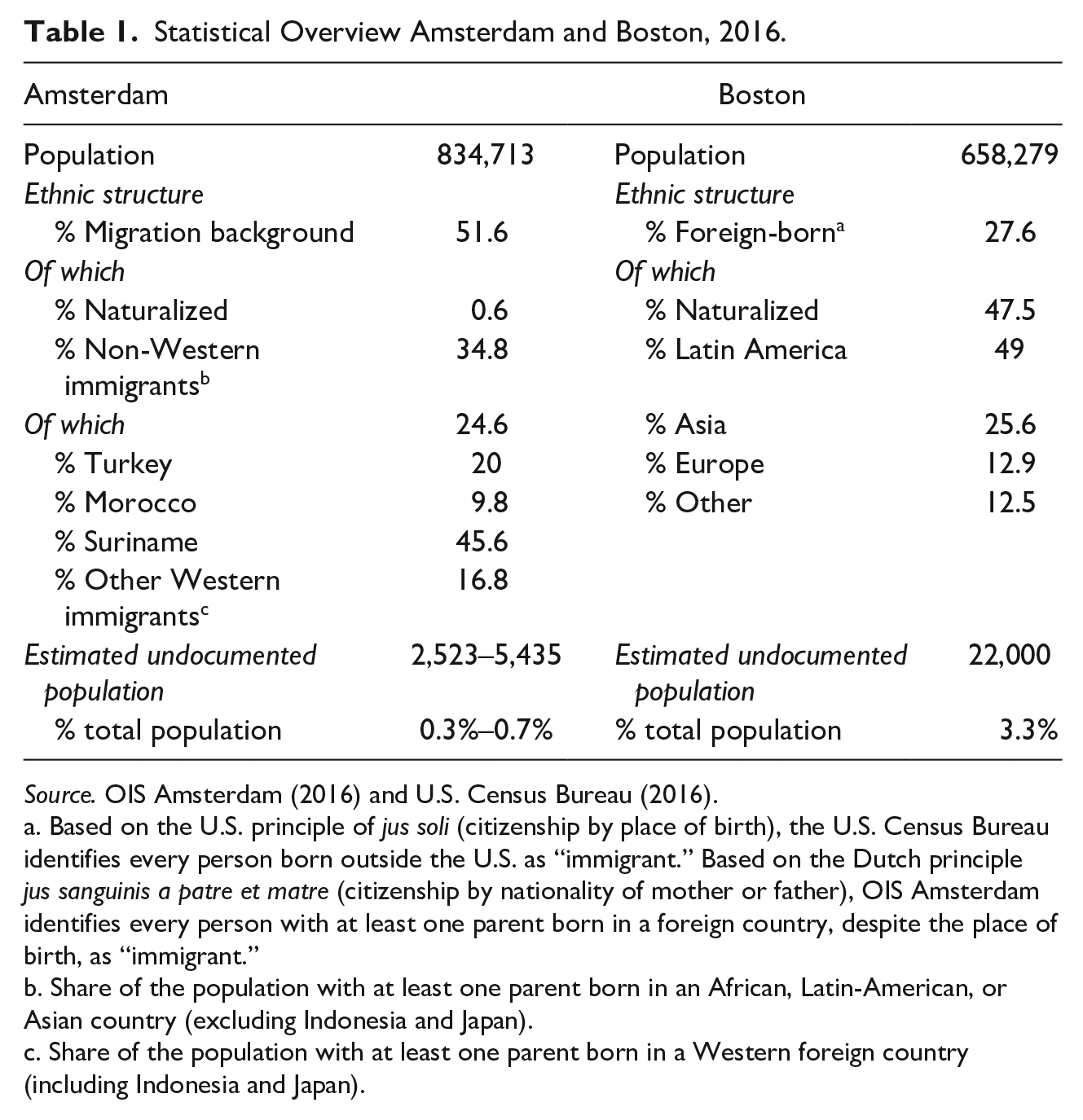
Source. OIS Amsterdam (2016) and U.S. Census Bureau (2016).
Based on the U.S. principle of jus soli (citizenship by place of birth), the U.S. Census Bureau identifies every person born outside the U.S. as “immigrant.” Based on the Dutch principle jus sanguinis a patre et matre (citizenship by nationality of mother or father), OIS Amsterdam identifies every person with at least one parent born in a foreign country, despite the place of birth, as “immigrant.”
Share of the population with at least one parent born in an African, Latin-American, or Asian country (excluding Indonesia and Japan).
Share of the population with at least one parent born in a Western foreign country (including Indonesia and Japan).
To understand the specificity of the Dutch ways of dealing with immigrants compared with the American ways, it is necessary to consider the concept of “integration,” whereby local governments have assumed active roles in mediating the relationship between immigrants and others within the city, with a specific focus on their perceived ethnic, cultural, and religious particularities. Until the early 1990s, Amsterdam was well known for this multicultural policy approach. City officials developed a local institutional structure that officially recognized specific immigrant groups and provided them with financial support to improve their socioeconomic position (De Graauw and Vermeulen 2016, p. 998). Since the 1990s, however, immigration policies have been subsumed in a more general and ambiguous diversity discourse (Van Eck, Hagemans, and Rath 2020). Since then, subsidized policy programs have weakened and tend to emphasize intra- rather than intergroup contacts between a diverse array of residents (Hoekstra 2017). This can be described as a “dialogical approach” to immigrant integration that “[stresses] the diversity possibilities for identification with the city of Amsterdam as a means of creating social cohesion on the city level” (Scholten 2013b, pp. 161–162).
Amsterdam City Council has long been dominated by the Labor Party (PvdA) which formed broad coalitions that left out extremes at the political spectrum. The present city council (2018–2022), headed by the Green-Left party in coalition with the PvdA, Social Liberals (D66) and Democratic Socialists (SP), represents the left-wing progressive politics of the city. The governance model of Amsterdam has been described as “consensual” (Alexander 2003), whereby advisory committees and other means of collective political decision-making allow for the co-optation of external elements into its governance structure.
To examine how IROs in Boston and Amsterdam organize themselves and interact with city officials in the relational fields of immigrant politics, I interviewed key actors in both places. The data-gathering process started with 10 semistructured interviews with elected officials and appointed governmental employees (five in Boston, five in Amsterdam) to gain an insight into the urban discourses on undocumented immigrants and the implemented policies. During these interviews, respondents discussed their assessment of current and past immigration policies, the choice of certain types of policies over others, and the relationship between local policies and national legislation.
To identify suitable nonprofit IROs in Boston, I made use of the 2018 IRS Business Master File and identified several active registered tax-exempt organizations (501(c)3) in the categories of “Civil Rights, Social Action and Advocacy” and “Ethnic and Immigrant Services” of the National-Tax Entity system (NCCS 2019). For the case of Amsterdam, I made use of the Business Register of the chamber of commerce and identified organizations in the category of “Political and Advocacy Organizations” (KvK 2019). After having contacted several organizations involved in the advocacy for the rights of undocumented immigrants, I asked participants who agreed on an interview to recommend other key actors involved in policy advocacy whom they believed I should speak with.
A major consequence of this snow-ball sampling technique is that the final interviewees were more likely to know one another than would be in case had they been randomly selected. Rather than conceiving of this as a “bias,” as Small (2009) has argued, it provides important in-depth knowledge of the social relationships of actors involved in the field of immigrant politics. The goal, therefore, is “not to give a ‘complete’ account but to get the main connections right” (Tilly 1992, quoted in Desmond 2014, p. 559). This resulted in 27 interviews with employees and volunteers of IROs (15 in Boston, 12 in Amsterdam). I conducted one additional interview with an employee of an intergovernmental organization in Amsterdam that offers support to refugees during their asylum processes. For these participants, I used a topic list for the semistructured interviews to gain specific information about the internal structure of their organizations, their ideological motivations, objectives, and successes and failures.
Altogether, this article is based on 38 in-depth interviews with policy actors in both cities, conducted between September 2018 and May 2019 in people’s offices, at university campuses, in community centers and local cafes. All interviews lasted between one and two and a half hours and were audio-recorded and fully transcribed afterward. Thematic coding of the transcriptions focused on analyzing how interviewees described the main factors accounting for the passage of the pro-immigration laws in their cities. The descriptive accounts below are based on those analyses.
Boston: The First Legislative Step Toward a Public Ethos of Civic Participation
In 2014, the City of Boston established its first hard policy with formally binding forces as a response to the exclusionary federal immigration enforcement efforts. Following Massachusetts state law, city council passed unanimously the Boston Trust Act which forbids police officers from detaining immigrants on the basis of a civil immigration detainer request issued by ICE, after they have become eligible for release from custody (City of Boston 2014, p. 2). The legal power of this type of Trust Act was confirmed in the court case Lunn v. Commonwealth that pended from April to July 2017. The decision of Massachusetts’ authorities to hold Lunn in State custody on the basis of a federal immigration detainer request, after he would otherwise have been released from his arrest for unarmed robbery, was dismissed as moot and in conflict with the Massachusetts Constitution (Justia US Law 2017).
After asking the policy advisor of the newly rebranded Mayor’s Office for Immigrant Advancement (MOIA) how this type of legislature reflects the City’s attitude toward undocumented immigrants, it became clear that the Act can be considered as a tool to make it easier for all Bostonians, regardless of their “legal” or “illegal” status, to interact with Boston’s official institutions: I think that his Act has less to do with what might be characterized as illegal immigrants . . . We sort of serve all people who are foreign-born regardless of status . . . The priority of this Act was to establish trust between immigrants and local law enforcement. The City of Boston has taken a formalized decision through this Act of not taking part in the federal program. You have to understand this Act as an official legal mechanism for not doing so. Now, they [undocumented immigrants] can report crimes, so that they feel safe to report civil law violations . . . And so that is a part of civic integration, that is being part of a community. We know that when everybody buys into our body politic, we have a better functioning society. (Interview MOIA, November 2018)
Recently, in June 2019, Mayor Walsh and Councilor Zakim announced amendments to the 2014 Boston Trust Act to further its original intent of ensuring “that all residents feel included in Boston’s civic life” (quote from Mayor Walsh’s speech during the National Welcoming Week; City of Boston 2016). The updated Trust Act clarifies the roles of all local authorities by forbidding them to transfer someone to immigration authorities unless ordered by judicial authorities. Presenting the passage of the 2019 Trust Act as a “proud moment,” Councilor Zakim stated, In the five years since, immigrants have been scapegoated and attacked by so-called leaders in this country. These updates to the Trust Act that Mayor Walsh and I are presenting are an example of how Boston continues to stand up for our values. Our City’s resources and law enforcement personnel should be used to protect Bostonians, not to enforce failed federal immigration policy. (City of Boston 2019, p. 3)
This insurgent institutional force did not simply emerge from consensual decision-making within city council, but was rooted in advocacy programs by IROs as I will illustrate below. As a local response to the Immigration Reform and Control Act of 1986 which allowed almost five million immigrants to become permanent residents throughout the United States, a centrally organized, yet diverse ensemble of faith-based organizations, human rights advocacy groups, and grass-roots immigrant organizations has developed. This Coalition, 3 located in Boston and representing over 130 member organizations throughout Massachusetts—members that were publicly supportive of the Coalition even if not maximally engaged in its efforts—played a central role in the policy-making process of the Trust Act by connecting immigrant organizations and their constituencies to city officials. Promoting the rights and socioeconomic integration of immigrants and refugees, the Coalition provides policy analysis and advocacy, citizenship assistance, and capacity-building programs for member organizations.
Asking about the historical development of the centralized structure of the Coalition, the leader of integration projects explained, Coalitions work here because our nonprofits are so underresourced; they are struggling for funds, they are all, you know, really skimping. We might have similar missions and visions and different ways to carry that out, but I’ve worked in a few different nonprofits and we only got things done by working in broad-based coalitions . . . The bottom line is that we are all so strapped for time and resources, that it’s, you know, an idea of working together by dividing into smaller committees. (Interview, November 2018)
The lack of funding does not only apply to the member organizations, but also to Coalition itself. As a 501(c)(3) tax-exempt entity, the Coalition may engage in policy advocacy programs, but is barred from governmental funding for partisan politics (De Graauw 2007). This has resulted in a situation in which the Coalition primarily depends on private funding. The leader of integration projects further explained, So, our funding is mostly private . . . We’re a 501(c)(3), we can’t promote any kind of candidates. We can’t endorse anyone running for office, we can’t endorse certain, like, initiatives . . . We’re always walking a funny line here. If we’re going to a rally or protest, we say like: “We’re doing this in our own time, we’re not doing this as being a member of [the Coalition],” you know? So, the city and state can only fund us for certain initiatives, such as our citizenship assistance programs, but they generally do not fund us for advocacy. So, that is funded by foundations or private donors. (Interview, November 2018)
Rather than criticizing the limited provision of monetary resources to the nonprofit sector, every analyzed organization in Boston tended to characterize the networking responses they have developed as an opportunity. None of the organizations opposed the government’s liberal laissez-faire attitude that appeals to immigrants’ responsibilities and self-governing capacities to advance their rights. In fact, many organizations have made the conscious decision to not make use of the scarcely available governmental resources. The policy program director of an IRO for occupational safety explained, We have, over the last 15 years, really tried to ease off our dependency on governmental funding. [W]hat we find is, depending on who’s in charge of the administration, or what all of a sudden happens to the budget, certain departments or line items get slashed, and then we’re the one that end up feeling the impact of that. (Interview, December 2018)
If the context of limited financial governmental support for immigrant right issues has molded IROs into relatively autonomous agencies, it also appears to have augmented their capacity to sustain financially independent networks, which find locally elected politicians in support of their proposals (Conlon 2017).
These networks, however, do not only consist of relationships among the organizations themselves but they also actively reach out to other types of agencies (see also Melnik et al. 2009, pp. 74–75). The executive director of an immigrant faith-based organization explained how its members tried to improve local protection for undocumented Latino immigrants in industries plagued by sexual harassment. Through active collaboration with a Boston-based university, the organization was able to “create research and recommendations that can affect and implement policy down the road” (Interview, November 2018). This autonomous base from which IROs and external agencies try to exert control over policy agendas was also used in the case of the Trust Act, as the following statement of the director of legislative affairs of the Coalition exemplifies: A little-known secret about the way that legislation and policies happen at the state and local level is that organizations that are experts in the field, such as ours, actually formulate those policies and legislation and then find the right politician to help them pass. So, we actively reached out to Councilor Josh Zakim who filed the [2014] Trust Act and then we basically expanded that type of Trust-policy and created a bill at the state level, called the Safe Communities Act. This Act goes one step further and says: We don’t want to deputize local and state police as ICE agents. And we shouldn’t be holding people illegally in violation of the Fourth Amendment. So, the only thing it does is upholding our Constitution. (Interview, November 2018, emphasis mine)
Similar to city officials, most IROs make use of legal arguments to criticize the current federal immigration enforcement practices. By naming the Constitutionally granted obligations, both city officials and immigrant advocates highlight the role that state and urban policies play in realizing equal personhood and rights for locally present persons (Wells 2004). Advocates reached out to strategically selected city officials to garner support for the expansion of the 2014 Boston Trust Act and to implement the bill at state level. Moreover, they met privately with different police departments that showed interest in supporting the bill. This strategy did lead, however, to some internal tensions among different immigrant organizations: We had this, like, moment where some people of the police department wanted to support the bill. But this caused some controversy within the Coalition. Some immigrant organizations and other member groups first didn’t want to work together with police departments, because they are the reason why fear exists among immigrant communities in the first place, right? So, there are things that happen along the way, so that maybe not everyone is happy with the collaborations. (Interview, member of the Coalition, October 2018)
Despite the tensions that arose from the conflictive positions that stakeholders hold in the relational field of immigrant politics (Bourdieu 1985), the support from representatives of police departments turned out to be important to get sponsors for the bill during the hearing in the State House. They helped to press the argument that undocumented immigrant communities will be more likely to report law violations to local police, and thus, that the bill enhances public safety. Eventually, the Massachusetts Senate approved Senator Jamie Eldridge’s amendment to the State budget that involves the key protections for undocumented immigrants as devised by the Coalition. The executive director replied, “At a time when our federal government is tearing families apart, tonight’s votes send a powerful message that in our Commonwealth, we value and welcome immigrants.” 4
The Boston case shows that many interdependent group- and issue-specific factors (Goldstone 2004) have contributed to the passage of the Trust Act. First, the federal context of government retrenchment has created pressures for IROs in Boston to centrally organize in an overarching Coalition. Second, as already argued by Nicholls and Uitermark (2013), the high mobilization capacities of such coalitions and their relatively financial independence have allowed the Coalition to create, rather than merely influence, pro-immigration policies. Third, IROs could do so because city council members were receptive to the arguments advanced by advocates, sharing the same arguments by declaring the federal intervention of individual border enforcement (Nicholls 2016) at the local level as unconstitutional. Finally, by capitalizing on the federal structure that allows city governments to legislate in areas of local concern pertaining to the safety, health, and well-being of all city residents, the Trust Act has been formulated in such a way that it can legitimately exist alongside the efforts of the federal citizenship regime to exclude undocumented immigrants (De Graauw 2014). The case of Boston resembles the approach of governance decoupling (Scholten 2013a), whereby the developed institutional policy structure of the Trust Act contradicts with the exclusionary measures toward undocumented immigrants at the federal level.
As such, the successful implementation of the Trust Act marks an important institutional and discursive shift that “challenges the dominant system of authority to varying degrees and promotes and enacts alternative imaginaries/understandings of community and security” (Strunk and Leitner 2013, p. 78). By encouraging and cultivating a safe “public ethos of democratic participation,” the Trust Act has constructed the first, most basic, foundation at the local level for “civic practices and associations of a society in which individuals face each other [not] as pure legal subjects . . . but as public agents in a political space” (Benhabib 1992, p. 140). At the same time, however, the Trust Act does not expand the de jure rights of undocumented immigrants in Boston’s jurisdiction. From this point of view, the Trust Act is most of all symbolic in the Bourdieusian sense that its implementation embodies the political struggle for “the power to transform the social world by transforming the categories [of citizenship] through which it is perceived” (Bourdieu 1985, p. 202). I agree with De Graauw (2014) that without legal status, “as a channel for becoming rights-bearing subject[s]” (Sassen 2007, p. 106), undocumented immigrants will never be able to become equal members of U.S. society. The Trust Act does provide, however, a first legislative step in this direction by institutionally and discursively framing the notion of citizenship in terms of belonging through safe, civic participation in everyday politics instead of legal membership. I turn now to Amsterdam, a distinct but comparable case for understanding how the group- and issue-specific conditions differently impact local immigrant politics.
Amsterdam: Same Aspiration, Different Route
Similar to Boston, city officials in Amsterdam have been active in trying to oppose various aspects of the national exclusionary citizenship regime. In the underlying argumentation, they also tend to make use of the concept of local participation, rather than citizenship status, to denote “a common point of identification and a way of formulating shared norms and rules of conduct” (Hoekstra 2017, p. 371). Alderman Groot Wassink wrote in his policy letter Diversity and Inclusivity, I have noted that conversations with Amsterdammers about citizenship have a bonding function and contribute to a “sense of belonging” . . . These conversations have the goal to set values according to which we would like to live together in our city . . . This approach aligns with the doctrine of a democratic city and democratic participation. (Municipality of Amsterdam 2018a, p. 12)
5
Within this discourse of urban citizenship as a gesture of shared belonging, the municipality has taken two approaches that pertain directly to the provision of basic protections for undocumented immigrants. First, there have been attempts to obstruct the local enforcement of the national Linking Act, including measures of the local police to apprehend, identify, and detain illegally residing immigrants. Second, it executes activities that fill gaps in the national framework by setting up facilities to support the basic needs of refugees whose asylum claims have been dismissed.
As a result of the Linking Act and the 2001 New Aliens Act,
6
none of these facilities are provided to this group by the national government. Kos, Maussen, and Doomernik (2015, pp. 357–358) describe the first form of action as “administrative disobedience,” while the latter includes measures to “soften” or “complement” national policies. Concerning the first form of action, city officials in Amsterdam have agreed with local police officers not to collaborate with in-country policing. The chairman of the leading Green-Left Party in city council explained, We have an agreement with the Amsterdam police department to not—and I find this personally a terrible word—participate in the hunt for undocumented immigrants. So, if someone without legal documents reports to the police, this does not automatically mean that the police will arrest that person. (Interview, March 2019)
However, without Constitutionally granted obligations to construct ordinances that provide alternative interpretations of the enforcement of national immigration laws, city officials in Amsterdam have not been able to create concrete legislation in the form of a Trust Act as in Boston. Despite this, city officials have been able to formulate and implement a complete policy program to complement national policies. City council presented in its coalition agreement a plan to fill the gaps in the national framework by providing 24-hour shelter to 500 refugees whose asylum claims have been dismissed, and who are, as such, excluded from national public services. The City of Amsterdam decided to function as a pilot-municipality within the so-called “National Alien Provision” (LVV) program, which consists of close cooperation between the national department Repatriation and Departure Services (DT&V) and the VNG. Initiated by the former State Secretary of Justice and Safety, the goal of the national program is to provide shelter to this group of immigrants in the five biggest cities of the Netherlands on the condition that the municipalities cooperate with DT&V to ensure repatriation (Rijksoverheid 2018).
However, as most of the city council members in Amsterdam refused to comply with this condition (Interview, council member Green-Left Party, February 2019), they drafted an alternative execution plan. This execution plan, called Building a Sustainable Perspective, stipulates that the immigrant group has to receive 24-hour shelter for at least one and a half years—including shelter for the so-called Dublin-claimants—and intensive social and legal guidance to cover the whole range of legal possibilities instead of repatriation. Active participation in an “inclusive city” is considered as the most important dimension of the perspective plan (Municipality of Amsterdam 2018b, p. 27). This alternative version of the LVV-program turned out to be successful, as the chairman described: In the beginning, we were very reluctant to participate as pilot-municipality in the LVV-program, because it had been initiated by a state secretary from the VVD [conservative liberal party]. [H]e endorses the importance of repatriation rather than residence . . . We were afraid that it would be very focused on: you can come in, but you have to collaborate to ensure repatriation . . . So, we decided: we make our plan first and afterwards we will negotiate with the state secretary . . . We started the negotiation on the basis of this plan, and he said: “Yes, this is possible.” So, right now, we get money from the national government to execute our own program, except for the people we also would like to provide shelter to, who are refugees with a Dublin-claim. The state secretary does not want to pay for this group. Luckily, we have our own money to do so. (Interview, March 2019)
The implementation of this alternative version of the LVV-program that mitigates the exclusionary dimension of repatriation as initially envisioned by the national government exemplifies that city officials can get the ear and cooperation of central state actors to manipulate national decisions at a city level (Uitermark 2005). Similar to Boston, the strategies of city council members to do so have been affected by the involvement of IROs.
However, whereas IROs in Boston are centrally organized as a way to advocate for legislative changes at the city level, in Amsterdam this pressure materializes through less formally organized activities. The political organizational sphere consists of related, but more fragmented, organizations that do not claim sole representation over the undocumented immigrant groups in the city. Three types of organizations can be distinguished: an activist advocacy and squatter group that consciously rejects any form of governmental collaboration; several independent faith-based organizations that offer direct support to undocumented immigrants in the form of shelter, food, and legal advice; and several intergovernmental organizations that combine advocacy work with support to undocumented immigrants on behalf of the municipality.
The Council for Refugees (VWN), belonging to the third type of organizations, played an important role in the formulation of the local version of the LVV-program. As one of the municipality’s “chain partners” that executes the local version of the LVV-program in Amsterdam, VWN embodies the strong links between undocumented immigrants and local authorities. VWN makes strategical use of this interdependent relationship, as the manager of the juridical team explained: We monitor, we express our concerns, and we propose policy initiatives based on our expertise and database of the clients. So, we have brought a lot of information to the surface. And people in the city council have used that information. In the first phase, that was done by council members who had been involved with undocumented immigrants themselves or had received our information. And right now, after the elections, those people have, for example, filed a motion, they have acquired other roles in the municipality and have been able to realize policy initiatives and proposals. (Interview, May 2019)
At the same time, the VWN manager of the juridical team emphasized that this awareness for the need for 24-hour shelter could not be realized without the involvement of other organizations. She mentioned in particular the “visible presence” of the activist advocacy and squatter group. Being wary of the collaborative governance structure in which the LVV-program is embedded, the activist advocacy group consciously abstains from accessible municipal subsidies. The initiator of the group expressed the concern that the collaboration in the LVV-program between DT&V on the one hand, and the municipality and VWN on the other, would be increasingly controlled by the former. As a result, when organizations such as VWN receive subsidies from both governmental levels “ . . . they [might] become encapsulated by governmental institutions through which they run the risk of losing their objectives” (Interview, February 2019).
Instead of collaborating with such organizations, the advocacy group has decided to persevere in acting independently from institutional organizations. The group publicly highlighted the lack of sufficient government housing and assistance for refugees whose asylum claims have been dismissed by setting-up tent camps and squatting empty buildings in the city (Fieldnotes visit squatted building, June 2019). Moreover, they continuously visited existing emergency shelters provided by the municipality (the so-called “bed-bath-bread” [BBB] arrangements) and pointed to their shortcomings after a tragic event: At a certain moment, there was a conflict in the BBB when some women wanted to improve their rights. And these women, who stood up [for their rights], were suspended from the BBB. One of these women was found dead in a park later that day. [T]hat had created such a feeling of unsafety, that they asked me to visit the BBB every morning. I was all over it and started to comment on all kinds of practical stuff in the BBB. That is perhaps an example of symbol politics, but it did help to bring the bad circumstances of the BBB facilities to public attention. And now there is 24-hours shelter for a fraction of this group. I: So that is an example of how your work has contributed to the decision in the LVV-program to provide 24-hours shelter? Yes, definitively. In fact, it had been a daily protest up until the moment we saw the results. (Interview, member activist advocacy group, March 2019)
As the “early riser” organization that has triggered the start of the policy-making cycle (McAdam, Tarrow and Tilly 1996), the activist group made the lack of sufficient living standards for undocumented immigrants visible and contributed to the public awareness of the unequal treatment and fate of this group. Intergovernmental immigrant organizations as the VWN and the municipality itself have drawn from this distinctly local process of knowledge production for the formulation of the local version of the LVV-program. Rather than being co-opted by the national government, as the initiator of the activist group feared, both VWN and members of city council were able to change the initial plans of the central state actors, as these changes turned out to be politically beneficial for the latter group as well. A city council member explained, You can say a lot about [the state secretary], but he has been an alderman in Rotterdam himself, so he knows really well how many problems occur at the local level when you have too many undocumented [immigrants] living on the street. In that sense, he is a genuine pragmatic man and I think that that has been one of the main reasons why we have found a solution so quickly. (Interview, February 2019)
The policy-making process in Amsterdam shows, first of all, that the strong interdependencies between the national and local governments, in combination with the lack of municipal legislative power, provide less room for maneuvering in creating an independent space of resistance for IROs in their advocacy strategies. Contrary to Boston, the case of Amsterdam exemplifies the centralist approach (Scholten 2013a) which assumes that national governments hold primacy in the formulation and coordination of policies where local governments are at most involved in their implementation. Although city officials and IROs might share the same symbolic strategies by encouraging a public ethos of equal personhood and rights just like in Boston, the latter fear that city officials might lose their objectives in their collaboration with national officials.
This is not to say, however, that this centralist approach unilaterally retrains the freedom of the former to propose alternative policy initiatives as argued by Habraken et al. (2013). Faced with this tighter web of localized power relations, a more circumscribed, but by no means restricted, field of strategies has emerged. Whereas IROs in Boston have made use of relatively permanent possibilities to create policies in the “multilayered jurisdictional patchwork” of immigration federalism and enforcement (Varsanyi et al. 2012), in Amsterdam they have made use of temporal possibilities opened up by political changes within city council to advance their visibility and policy proposals by introducing their information, expertise, and experience into the field of immigrant politics. This has, eventually, resulted in a consolidated policy program that extends the symbolic realm by providing material resources that meet the basic life needs of a limited number of undocumented immigrants and allows, to a certain degree, their local participation in everyday politics.
Conclusion and Discussion
In this article, I have explored the question of what factors shape the political mobilization of IROs in Boston and Amsterdam, and how their strategies have impacted local pro-immigration policies. Rather than providing a comprehensive theory of the process of policy formation, I made use of Goldstone’s (2004) field analysis to shed a light on the group- and issue-specific conditions that differently influence the internal dynamics of immigrant politics. It could be argued that the resulting synthesis that emphasizes the importance of the interactions between, rather than the independent influences of, organized interests of IROs on the one hand, and the nature of state structures on the other, offers a fruitful approach to analyze differences and similarities in the mobilization patterns of IROs across cases.
By comparing two cities which are both embedded in exclusionary citizenship regimes, but have themselves political environments that are generally open to the concerns and claims of IROs, my empirical observations suggest that variations in the strength of local-national policy-making interdependencies highly impact the organizational strategies of IROs. Although this outcome is not necessarily at odds with the POS and MLG approaches to local immigration policy making, I have tried to provide an empirical account of how IROs are differently involved in the policy-making process, based on the available opportunities and constraints set by specific political environments.
Embedded in a national context that holds a laissez-faire attitude toward community building, many IROs in Boston are centrally organized in an overarching Coalition that has developed almost independently from governmental resources. Making use of its relative financial autonomy in policy advocacy, this Coalition has been involved in all steps of the construction of the Trust Act within a political field where city officials hold the administrative discretionary power to regulate the safety, health, and well-being of all residents regardless of their citizenship status (De Graauw 2014). As such, organizations capitalize on the discretionary power of competing government levels to protect the rights of undocumented immigrants in legal terms. In Amsterdam, both the national and local government intervene with more force in the political organizational sphere, resulting in a more scattered infrastructure of IROs. These stronger state–civil society interdependencies narrow the opening for organizations to construct an autonomous base from which to influence immigration policies as happens in Boston (see also Habraken et al. 2013; Nicholls and Uitermark 2013).
However, by drawing on Foucault’s (1982, 1990) and Bourdieu’s (1985, 1989) conceptualization of local power relations within this field approach, it becomes clear that despite the limited options in the Dutch institutional structure to influence local immigration policies, IROs do have some room for maneuvering. Whereas organizations in Boston made strategical use of the permanent institutional opportunities presented, in Amsterdam they capitalized on the temporal political chance offerings within city council to convince city officials to further protect the rights of undocumented immigrants and provide material resources for their basic life needs.
Moreover, following Strunk and Leitner (2013), my case studies demonstrate that IROs’ strategies of policy involvement are not only a reaction to the exclusionary citizenship regimes at the national level, but also constitute an affirmative institutional and discursive counterpower. Although both Boston and Amsterdam do not have the capacity to expand de jure rights of undocumented immigrants, Boston has institutionalized the first symbolic measures toward their safe, everyday civic participation in the form of the Trust Act. Amsterdam, by following the same approach, has complemented gaps in the national citizenship regime by providing material resources that meet the basic life needs of a limited number of undocumented immigrants in the form of the LVV-program.
To really confirm the merits of Goldstone’s (2004) approach to immigrant politics as used in this study, I suggest three lines of inquiry directing future research. First, the field approach should be applied to more case studies. A full appreciation of its explanatory power could be furthered through more systematic comparative case studies that include other types of politico-institutional contexts in which cities and their immigrant politics are embedded.
Second, now that we are witnessing international waves of protests in opposition to institutional racism and police repressions in the aftermath of George Floyd’s death on May 25, 2020, it becomes clear that the field approach should also be tested against the mobilizations of other groups. Although these mobilizations are different in many ways, they share some fundamental things in common: both groups undertaking mobilizations have faced intense marginalization and they have developed strong oppositional identities vis-à-vis the national political status quo (Nicholls and Uitermark 2018, p. 247).
Finally, these national policy status quos should be further theorized within the wider context of criminal justice imageries and the resonance of such policy rhetoric with “criminological accounts of penal populism” (Bosworth and Guild 2008, p. 704). Growing evidence shows that undocumented immigrants and members of other racial and ethnic minority groups are increasingly subject to discourses of criminalization in national government legislation and in the media. The critical task, then, for scholars and policy makers alike, becomes how to articulate more radically progressive politics at the local level for the formation of both intergroup and “scaled” alliances (Swyngedouw 2004) that are rapidly becoming key components in strategies to produce fully democratic and inclusive spaces.
Footnotes
Acknowledgements
I thank Els de Graauw and Jan Rath for their constructive comments and insights. This article draws its inspiration from our shared discussions. The comments from the editors and anonymous reviewers are much appreciated.
Declaration of Conflicting Interests
The author(s) declared no potential conflicts of interest with respect to the research, authorship, and/or publication of this article.
Funding
The author(s) received no financial support for the research, authorship, and/or publication of this article.
