




Abstract
There has been growing interest among practitioners and academics in the emergence of intergovernmental relations between local and Aboriginal governments in Canada. Initial research has focused on describing the nature of these relations but has yet to develop any theoretical expectations regarding why some communities are more likely to cooperate than others. We address this lacuna by developing a theoretical framework for explaining the emergence of cooperation between Aboriginal and local governments. After identifying a set of variables and specifying how they are likely to affect the propensity of communities to cooperate, we conclude with a discussion of how future researchers might use this framework to investigate cooperation and noncooperation between Aboriginal and local governments in Canada and in other settler societies.
Keywords
Introduction
What factors affect the emergence (and persistence) of cooperative relationships between Aboriginal governments and local authorities? This research question has become an important one for practitioners and scholars interested in local/regional government, Indigenous politics, federalism, and public administration for a number of reasons. As urban regions expand their development, and as Aboriginal communities increase their land base and jurisdiction through land purchases, self-government, and land claims agreements, the result has been more frequent interactions between Aboriginal and local governments regarding land use, service provision, resource sharing, and cultural and economic development (Abele and Prince 2002; Alcantara and Nelles 2009; Government of British Columbia 2006; Greater Vancouver Regional District 2005). Coordination, or the lack thereof, on these issues, can have a powerful effect on both communities.
Successful land use coordination can create or support joint economic development opportunities and more livable communities overall. On the other hand, lack of land use coordination can be a major source of tension and spur conflicts between neighboring communities, leading to servicing problems and to the need for dispute avoidance and resolution mechanisms. Conflicts can arise over broad community objectives or specific cross-border land use impacts such as those involving noise, smell, light (or lack thereof), increased traffic, ground water pollution, and others. (Union of British Columbia Municipalities 2000, p. 3)
Given the important policy implications of this emerging type of intergovernmental relationship, a range of policy actors at a variety of levels have shown a strong interest in finding ways to facilitate further cooperation among Aboriginal and local governments. For instance, in Canada, a number of federal and provincial government departments (in Ontario and British Columbia), and municipal and Aboriginal umbrella organizations (both national and regional), have independently or jointly produced reports and conferences aimed at helping local and Aboriginal governments initiate and sustain cooperative intergovernmental relations with each other. Their reasoning for pursuing these activities is that not only do municipal governments have a legal obligation to consult neighboring Aboriginal communities, but that there are important instrumental benefits as well (Abele and Prince 2002; Nelles and Alcantara 2011). “Strong municipal-Aboriginal relations can assist in meeting a range of objectives, including identifying areas of mutual interest and developing joint initiatives, meeting regulatory requirements for community development, partnering on service delivery and resource management” (Ontario Ministry of Municipal Affairs and Housing 2009, p. 2). For Indigenous groups in particular, establishing cooperative intergovernmental relations with local governments is also desirable. According to Coates and Morrison (2009), the success of Aboriginal self-government is contingent on effective and harmonious relations with local, regional, provincial/territorial, and national governments . . . Where there have been tensions, for example between the Kamloops First Nation and the city government in the 1980s, progress on economic and community development came to a halt. Where levels of co-operation are high, Kamloops again providing a good example, as do Westbank, the Squamish Nation, Saskatoon, and many northern communities, major changes and advances have been possible. (p. 118)
In this article, we build on the existing research to develop a theoretical framework 1 for explaining cooperation and noncooperation between Aboriginal and local governments in Canada and perhaps other settler countries such as the United States, Australia, and New Zealand. Our focus will mostly be on Indian Act bands, although our framework does provide the theoretical tools to examine other types of Indigenous self-government structures. For the most part, existing research has focused mainly on developing a typology of agreements (which are a form of formal cooperation between Aboriginal and local actors) that are emerging in Canada (Nelles and Alcantara 2011) and on developing a framework for explaining informal cooperation as part of the broader comprehensive land claims negotiations process (Alcantara and Nelles 2009). By formal cooperation, we mean the variety of intergovernmental agreements (Nelles and Alcantara 2011) and intergovernmental bodies created by Aboriginal and local governments to facilitate cooperation (Gayda 2012). By informal cooperation, we mean situations where Aboriginal and local government actors work together without the use of formal mechanisms (Alcantara and Nelles 2009). No one has yet tried to construct a framework that explains formal cooperation between local and Aboriginal governments and so our paper attempts to fill that important lacuna.
Our hope is that scholars will use the theoretical propositions generated in this article to guide their empirical analysis of Aboriginal–local government relations in Canada and in other settler societies. We also envision practitioners using our theoretical arguments to pursue stronger ties with their neighboring Aboriginal/local communities. Of course, Aboriginal (and perhaps local) communities are extremely diverse in nature; in Canada, for instance, there are approximately 630 First Nations and dozens of Inuit and Metis communities, many of whom have different languages, cultures, histories, and political/legal institutions. Although our framework was constructed to be flexible enough to capture this diversity, we realize that future empirical work will likely lead to important modifications in our theoretical framework. Nonetheless, we are confident that our framework provides a useful starting point for empirically investigating the factors that affect the propensity of Aboriginal and local governments to cooperate.
The article begins by briefly describing the lay of the land in Canada as it relates to Aboriginal–local intergovernmental cooperation. Next, we review the literature on Aboriginal–settler relations to situate these developments within that broader context. Finally, we sketch out our theoretical framework and specify the variables that we think have a strong effect on cooperation, before ending with some final thoughts about how future researchers might use this framework empirically to study a variety of relations in countries with significant Indigenous populations. In this sense, our work follows in the tradition of Feiock (2007, 2009), who has written theoretical articles that others have used to inform and guide their empirical work on intermunicipal collaboration (see Andersen and Pierre 2010).
The History of Local Government–Indigenous Government Relationships in Canada
Despite their importance, very little is known about these relations beyond some general and localized descriptions (Abele and Prince 2002; Nelles and Alcantara 2011). In a recent survey of trends in British Columbia, for instance, Nelles and Alcantara (2011) analyzed 93 publicly available intergovernmental agreements between local and Aboriginal governments, finding that the number of agreements has increased steadily over time. The majority of these agreements were “jurisdictional negotiation” agreements in which the Aboriginal government agreed to pay a yearly fee to the municipality in exchange for the provision of fire protection, garbage collection, snow removal, and the like, to the Aboriginal community. Second most common were “relationship-building” agreements, in which the signatories agreed to work toward establishing a more formalized cooperative relationship. Typically, these agreements included a set of common principles, such as mutual recognition and respect, and a commitment to communicate and/or meet regularly to discuss issues of common concern. A third set of agreements attempted to “decolonize” relations between the two governments. In addition to including many of the same provisions found in the “relationship-building” agreements, decolonization agreements went further by attempting to establish a more just and equal relationship between local and Aboriginal governments. Many of these agreements, for instance, contained statements about the existence and recognition of the inherent right of Aboriginal self-government, Aboriginal rights and title, and Aboriginal ownership of their traditional territories since “time immemorial” (Nelles and Alcantara 2011, p. 320). Finally, one agreement in the sample dealt with capacity building, in which the neighboring local government agreed to provide the First Nation with self-government expertise and training (Nelles and Alcantara 2011). The classification of these agreements by type can provide useful insight into the prevalence of certain types of relationships. In the theoretical framework presented in this article, we focus on the emergence of cooperation between Aboriginal actors and local governments without distinguishing types.
Our own preliminary research confirms that these agreements are not limited to British Columbia, but instead can be found across Canada. Our ongoing research has found approximately 12 formal agreements in Nova Scotia, 97 in Ontario, 52 in Saskatchewan, and 6 in Yukon Territory. We have also found dozens of informal agreements in all of these regions, and we expect to find more in the rest of the provinces and territories as we complete our data collection. We have not yet begun to collect agreements from the United States but preliminary discussions with Indigenous scholars in that country indicate that such agreements exist; we also expect that they exist in other settler countries as well.
In short, the existing research and our own data collection efforts suggest that these agreements are emerging across Canada in greater numbers, spanning the four categories of agreements originally developed by Nelles and Alcantara (2011). Coupled with these empirical trends is a strong interest among government and nongovernmental actors in generating a set of best practices for fostering cooperative relations between local and Aboriginal governments. Thus, there is both a demand and need for scholarship that develops a theoretical framework for explaining the emergence (or lack) of intergovernmental cooperation between Aboriginal and local governments.
Aboriginal–Settler Relations in Canada: Situating Indigenous–Municipal Relations
In general, much of the literature on Aboriginal–settler relations in Canada has focused on the relationship between Aboriginal governments and the federal, provincial, and territorial jurisdictions in which they are embedded (Abele and Prince 2003; Alcantara 2013; Alcantara and Nelles 2013; Bakvis, Baier, and Brown 2009; Papillon 2008, 2012). Very few scholars, however, have looked at the intergovernmental relationships between local and Aboriginal governments. Given the lack of existing scholarship on this topic, some researchers have sought to adapt elements of the broad literature on intermunicipal relationships and metropolitan governance to explain the emergence of Aboriginal–municipal intergovernmental relations in Canada (see Alcantara and Nelles 2009; Gayda 2012). The literature on intermunicipal cooperation attempts to determine how collective action emerges between local authorities. It asks what factors affect the construction of partnerships between local governments at the regional scale and why cooperation has emerged as a governance strategy in some metropolitan areas, but not in others (Feiock 2007; Nelles 2012). Understanding Aboriginal–local relationships invokes similar questions: Why have cooperative relationships developed between some Aboriginal governments and neighboring local authorities where parties recognize a potential for mutual benefit while in other cases no, or even antagonistic, relationships have emerged?
In their application of intermunicipal cooperation frameworks, Alcantara and Nelles (2009) note that despite the breadth of the literature and its engagement with a wide variety of theoretical approaches, there exist few comprehensive theories of metropolitan governance. The most highly developed are rational choice approaches that focus on the cost–benefit analyses that underpin decisions to cooperate and individual case studies that examine best practices in metropolitan governance (see Feiock 2007, 2009; Steinacker 2004). However, none of the literature they reviewed offered a framework that could be used to test the influence of a wide variety of variables—including institutions and opportunities but also variables that explore the impact of factors such as capital and leadership—in Aboriginal–local relationships. In response, Alcantara and Nelles (2009) modified their own framework to explain the relationship between Kwanlin Dün First Nation and the local government of Whitehorse in Yukon Territory, Canada, which was an example of informal cooperation in the context of modern treaty negotiations.
This framework was based on research conducted by Nelles (2012) on intermunicipal cooperation with the aim of creating a theoretical approach that could explain the emergence of collective action between local governments. She argued that the universe of variables that can affect the emergence of metropolitan governance can be reduced to three broad categories: institutions, opportunities, and civic capital. Her central argument was that, while institutional and opportunity variables are valuable to understanding the emergence of partnerships, in any given case their impact was not predictable. That is, the same institutional conditions could have positive or negative impacts on the emergence of partnerships depending on the case. Similarly, opportunities can create either positive or negative incentives to cooperate. However, civic capital only has a positive influence on intermunicipal cooperation. Therefore, regardless of contextual factors such as institutions and opportunities, the emergence of metropolitan cooperation was more likely in places with greater civic capital.
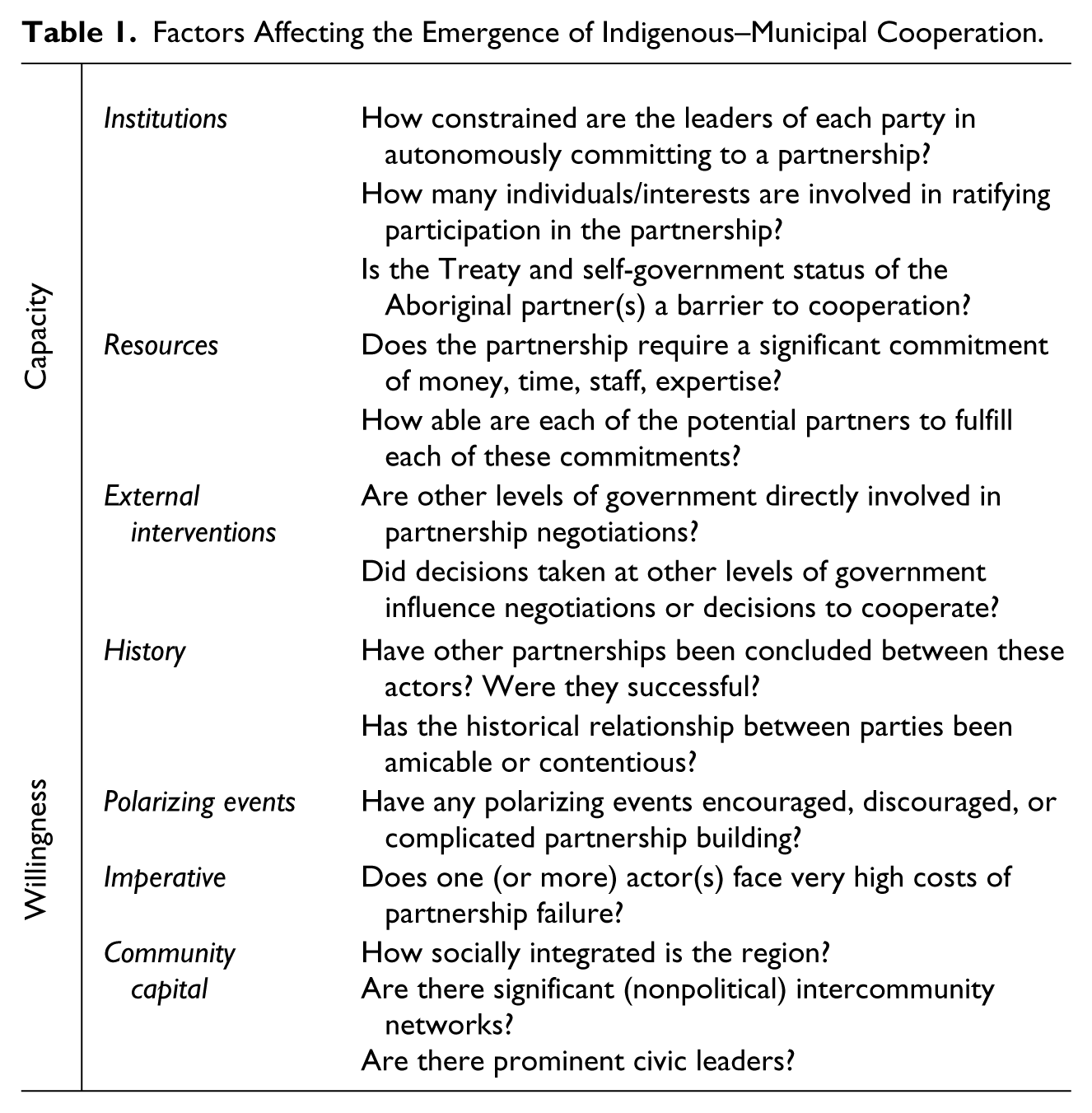
Alcantara and Nelles (2009) adopt a similar framework and reach similar conclusions. The major differences between the two approaches after adaptation for the Aboriginal–local context are detailed in the first two columns of Table 1. The most significant of these were the addition of qualifications about the capacity of local and Aboriginal leaders; access to resources as a form of power asymmetry; government intervention in treaty negotiations as a form of intervention; and the omission of several factors that did not apply to the Aboriginal–local or strictly Canadian context (i.e., local party politics, group size, and previous government structures). More recently Gayda (2012) applied a similar framework to her analysis of relationships between the City of Elliot Lake, the Province of Ontario, and Serpent River First Nations. While this modified “civic capital” framework has proven useful in the analysis of the Kwanlin Dün and Serpent River cases, we believe that the content, conceptualization, and operationalization of these variables can be improved for broader application.
Factors Affecting the Emergence of Indigenous–Municipal Cooperation.
Toward a Theoretical Framework
Similar to some of Richard Feiock’s (2007, 2009) work on metropolitan governance, the primary purpose of this article is to propose an updated, and more precisely elaborated, theoretical framework to guide future empirical analyses of cooperative relationships between Aboriginal and local governments. 2 This framework builds on previous research (discussed earlier) by Alcantara and Nelles (2009) and Gayda (2012) but with several key differences: The framework outlined here introduces more nuances between variables, conceptualizes and categorizes variables differently, and goes a step further to operationalize the variables for use across comparative cases.
Background Considerations
This theoretical framework begins with the assumption that in any case examined, there will have been an opportunity to collaborate—that is, a problem that could have been solved by Aboriginal–local government collective action—and that all parties to the partnership have the potential to benefit from the relationship. That is, this framework is not intended to explain inaction where cooperation may only benefit one party. Rather, it is formulated to explore why cooperation emerges, or does not, in areas where a potential mutual benefit from collective action has been identified and is recognized by all parties. 3
A second caveat is that although we have adapted our approach from literature on local intergovernmental relationships, we want to emphasize that we recognize that Aboriginal governments are not the same as other Canadian local authorities, nor would we argue that they should be treated as such. However, they share a number of similarities that justify the use of the intergovernmental model with modifications sensitive to key differences (Nelles and Alcantara 2011). From a structural point of view, municipal and (most) Aboriginal governments (e.g., band council-style communities) in Canada are similar across a number of dimensions. They are both forms of government to whom political power has been devolved to administer a legally bounded territory, to provide services to their constituents, and to participate in the localized implementation of policies developed at senior levels of government. Both forms of government consist of democratically elected councils and leaders and, since the 1988 amendment of the Indian Act, wield similar revenue raising and economic development tools. Finally, while Aboriginal governments are often involved in policy areas and challenges that are distinctive from non-Aboriginal communities, a large proportion of the daily concerns that occupy municipal politicians are also shared by First Nations leaders. Yet, it is important to note that many First Nations reject the characterization of their governments as municipal, despite the similarities.
The key structural differences between the two types of government concern their constitutional status and status of relationships with other levels of government. Local and Aboriginal governments in Canada fall under the constitutional purview of different levels of government: Provinces are responsible for municipalities (The Constitution Act, 1867 §92.8), while the responsibility for “Indians, and Lands reserved for Indians” (The Constitution Act, 1867 §91.24) belongs to the federal government. Furthermore, their roles are established by different sets of legislation. Aboriginal issues are governed largely by the Indian Act while local governments are governed by provincial municipal acts and, on occasion, specific local charters. On a practical level, this means that each form of localized government—Aboriginal and non—are subject to very different sets of legal frameworks and have hierarchical and historical relationships with different parts of provincial and federal bureaucracies. Finally, while the legal status of local governments in Canada is fixed since the Baldwin Act (1849), the legal status of individual Aboriginal communities varies by province depending on their treaty status. While many Aboriginal groups have concluded land claims negotiations with the Crown, there are still a significant number that are in the process of concluding, have failed to establish, or have not yet attempted to negotiate treaties (Alcantara 2013). Treaty status can therefore be an important institutional distinction between Aboriginal groups, and accord rights that are distinctive from those of local governments. Furthermore, the treaty experience is an important historical context, which may profoundly shape the propensity of Aboriginal groups to trust and enter into further relationships with Canadian governments (Alcantara 2008).
Despite these important differences, it is possible, and fruitful, to analyze relationships between Aboriginal and municipal governments using a single theoretical framework. Even analyses of intermunicipal relationships that fail to recognize differences between the partners do so at their own peril. Our aim here is to construct a framework that incorporates these main distinctions between different types of local authorities, be they Aboriginal or municipal. We expect that these relationships will display many of the same attributes observed in the intermunicipal governance literature, namely, that a wide variety of variables conspire to encourage or discourage partnerships, but that only a few of these variables will be predictive.
The Foundations of Cooperation: Capacity and Willingness
One of the main differences between the framework developed here and the one introduced by Alcantara and Nelles (2009) is the conceptualization of the relevant variables and the relationship between them. The Alcantara and Nelles (2009) framework—hereafter referred to as the “original framework”—sharply divided variables between three categories: institutions, milieu variables, and civic capital. These categories permitted the authors to distinguish between different groups of variables in terms of their functions and relationship to local governments. For instance, institutions were described as the relatively stable rules of the game, imposed by other levels of government, which shape local decision making. Opportunities, or milieu variables, were characterized as the more episodic types of events—difficult to predict and outside of the control of local authorities—that can alter local incentives to cooperate. These events can include natural occurrences, such as natural disasters, that increase the potential benefit of collective action for mutual aid; or political events, such as the creation of a provincial grant or funding stream, which might either create incentives for local cooperation or competition depending on the formulation of the program. The main object of such a conceptualization was to distinguish between long-term and relatively predictable contextual conditions and those that are of shorter duration and more difficult to anticipate, but that nonetheless can profoundly influence local decision making. While these categories are relevant, they also obscure what is, in our opinion, a more important but less distinctive difference between types of variables, that is, the relationship of different types of variables to the two poles of capacity and willingness to enter into a cooperative partnership.
We argue that the decision to enter into a partnership is determined by two important factors: the capacity of actors to enter into such an arrangement, and their willingness to do so. Capacity is defined as what partners are permitted to do by the structures that govern them as well as what they are able to do with the tools at their disposal. Willingness, by contrast, is the degree to which actors are disposed to invoke their capacities to act. Where actors lack the capacity to enter into partnerships, it is not surprising that they do not. Indeed, where partners are not significantly constrained by rules or resources (among other things), the emergence of cooperation is still not assured. It is therefore important to consider the factors that affect the political will to sacrifice a degree of local autonomy, however small, to collective action. We contend that in cases in which all of the relevant actors have sufficient capacity to enter into a partnership—recalling the assumption that all partners perceive potential benefit from such an arrangement—the emergence of the partnership depends on the political will of each of the actors to engage in a cooperative relationship. One could even further imagine that sufficient political will could, in fact, overcome capacity barriers to cooperation by actors lobbying to change legal restrictions and so on. Whatever the status of capacity, it is willingness that is the key.
One of the main drawbacks to using the capacity/willingness conceptualization is that while gaining clarity in defining the broad foundations of cooperation, we lose the neat categorical divisions of the original framework. Where institutions, milieu, and civic capital were distinctive groups of variables, it is more difficult to clearly separate which variables affect capacity and which affect willingness. This is because some variables may have an influence on both elements of the framework. This phenomenon is discussed in more detail in the following sections; however, it is not difficult to imagine that something like the presence of antecedent governance arrangements may influence the ability of actors to partner (by providing a facilitating forum or model) and their willingness to do so (depending on whether their previous experience was positive or negative). As a result, we conceptualize the relationship between variables within the framework as inhabiting a spectrum (see Table 1). Variable types are arranged along the spectrum, between capacity and willingness, depending on their tendency to influence one to a great degree than the other. All seven sets of variables can affect both capacity and willingness, but do so with varying strengths (i.e., institutions tend to affect capacity more than willingness, relative to other variables).
The Elements of Cooperation
This theoretical framework categorizes variables that may affect the emergence of cooperation between Aboriginal and municipal governments into seven groups: institutions, resources, external interventions, history, polarizing events, imperative, and community capital. Some remain quite similar to those posited in the original framework, while others are significant additions. These groups are discussed in the order in which they are arrayed on the capacity–willingness axis, discussed above. For each empirical case study, researchers must make a determination of the effect of each of the categories on the development, or not, of cooperation. While quantitative research using this framework is not impossible, we have envisioned and constructed it primarily as a guide to qualitative investigations. Each group of variables, and the individual variables within each group, will have a positive, negative, or no effect on cooperation. Researchers have the additional option to qualify their assessment with terms, such as “strong” or “weak,” “major,” or “minor,” to distinguish differences in magnitude.
In case study research, there is often an explanation for success, or failure, that stands out immediately and that has been adopted as a consensus by popular media and opinion. One of the main functions of this framework is to encourage researchers to explore as many of the potential impacts on cooperation as possible to better understand the interaction between forces that produce certain outcomes. While it is possible that the same explanation will emerge as dominant upon deep analysis, this framework may still be useful to illuminate other minor, or even significant, contributing factors.
That said, in presenting this framework, we make no claims to absolute comprehensiveness nor do we expect that it will be applied unmodified by other researchers. As a framework, it provides a conceptual approach to the question of Aboriginal and municipal government cooperation and suggests an array of factors that our research indicates has the potential to influence this type of behavior. In the following section, we discuss each variable group and subtype in turn. We particularly note the degree to which each influences capacity and/or willingness and hypothesize the potential impact, positive or negative, on cooperation.
1. Institutions are the rules and norms (Hodgson 2006) that govern the decision-making processes of local government and Aboriginal actors. Institutions typically affect the degree to which actors are able to enter into specific types of agreements. However, the impact of institutional constraints can certainly also affect their willingness to do so. Among the most important institutional factors that can affect the emergence of cooperation are executive autonomy, jurisdictional autonomy and functions, and treaty status and decision-making processes. Many of these are interrelated—that is, executive autonomy and decision-making processes—so it is likely that the effects of those variables will track together.
Executive autonomy: The degree to which executives are empowered to make decisions on behalf of their constituents without rigorous ratification processes can liberate leaders to make commitments to partnerships. However, this autonomy can be a double-edged sword. Where leaders are committed to cooperation, then executive autonomy can ease the negotiation process by reducing the number of actors that need to be involved, and assuaged. Where one or more empowered executives oppose cooperation, however, they can also be incredibly powerful in blocking progress. It is therefore difficult to predict whether a relatively autonomous executive will be an advantage or barrier to cooperation. In the Canadian context, local government executives are typically quite weak and are rarely empowered to commit their bureaucracies without council approval. Lower autonomy does not necessarily preclude cooperation but can potentially add to the challenges of reaching a mutually beneficial agreement. The degree of executive autonomy of Aboriginal governments, however, can vary significantly from case to case. Executives may be bound by consensus decisions of the council or may enjoy more political freedom (Alcantara and Whitfield 2010). For most First Nations under the Indian Act, for instance, the powers of the chiefs are constrained by the need for band-council approval, and so executive autonomy is circumscribed, at least formally. Informally, however, executive autonomy varies from band to band, especially in communities where certain families dominate local band politics. In either case, there is likely to be a degree of asymmetry in executive autonomy that may prove frustrating to the party with fewer internal barriers to agreement.
Decision-making processes: As discussed above, the decision-making processes within local governments and Aboriginal governments may be quite different. Both the types of decision-making processes and the asymmetry between them can function as barriers to the emergence of cooperation. Where more individuals, and interests, are involved in negotiations, the more difficult it can be to secure collective action (Olson 1965).
Legal status: The legal status of the Aboriginal government relative to others in the Canadian federation can also complicate cooperation. Treaties and self-government agreements typically set out and clarify the lands, rights, and responsibilities of Aboriginal governments. Therefore, where treaties and self-government agreements exist, Aboriginal governments operate in a uniquely settled and transparent political space. Where treaties and self-government agreements are not in force, or are in the process of negotiation, there may be a measure of uncertainty about the extent and limits of Aboriginal jurisdiction. This legal uncertainty can make cooperation with other governments more difficult to achieve, particularly in cases where treaties and self-government agreements are in the process of being negotiated (Alcantara 2008). From another perspective, the uncertainty generated by the negotiation process (or lack thereof) may induce Aboriginal governments to seek local partners to build political capital for future negotiations or extend their political reach on issues affecting their constituents.
2. Resources: Both Aboriginal and municipal authorities typically govern with relatively few resources, particularly outside of the larger cities and settlements. Where local and Aboriginal authorities have discretionary funds to support joint projects, cooperation will likely be easier to establish. The availability of financial resources can be important even when partnerships do not require significant monetary contributions. Even in the most ad hoc arrangements, the process of meeting and coordination is not without costs (i.e., travel, renting conference facilities, or providing refreshments). The ability of each party to share those costs can be significant to the conclusion of a successful agreement.
In addition to financial resources, administrative resources, time, and expertise can also influence cooperation. For instance, support staff may not be reliably available to manage communication and project implementation in governments—Aboriginal and municipal—with small or part-time staffs. Similarly, the time commitment required by elected officials and representatives to conclude even simple agreements can be onerous. Where legal or specialized knowledge is required, local and Aboriginal officials may lack the expertise to proceed without external (and often expensive) assistance (Alcantara 2008; Evans 2011).
Every political decision entails a set of costs. Even the preliminary discussions about the potential for partnerships are not entirely free. All actors shoulder some burdens—be they financial, administrative, or temporal—in the process of coming together and in maintaining the partnership. The extent to which each partner is able to spare the necessary resources can be an important factor in the emergence of collective action. The more discretionary resources each partner has, the less likely that they will cite this factor as a barrier to cooperation.
3. External intervention—Occasionally, senior levels of government will become a factor in the construction of regional partnerships between municipal and Aboriginal governments (Gayda 2012). Senior levels of government, such as the provincial or federal governments in Canada, can influence the formation of local partnerships in two ways: directly, through direct participation in the negotiation process; or, indirectly, through policy actions that affect local decision making. The first, and more activist, instance is the easiest to identify and analyze. In these cases, the senior level of government either leads the formation of the partnership, or is a member. This is most typical in areas where local- and senior-level jurisdictions intersect, as is the case with environmental governance (i.e., managing watersheds). Whether they are leaders or simply participants in the partnership, the presence of a senior level of government can bring enticements (such as resources) to the local participants; add weight to an issue and attract the participation of local actors; or impose requirements for local participation. All of these can significantly alter the decision-making processes of local actors toward cooperation.
Indirect influence by senior levels of government can be more difficult to detect but can also be significant in promoting (or discouraging) partnership formation. For instance, a provincial government may pass new legislation requiring new environmental protections for locally owned land. To more economically satisfy this additional burden, local authorities may seek partnerships with other localities or governments. While these indirect influences are difficult to predict, they can provide significant, and usually unintended, motivation for local cooperation.
4. Historical factors: Partnerships do not emerge in a vacuum—They are the product of, and conditioned by, the historical context in which they were nurtured. As such, the success of previous partnerships and the historical relationship between Aboriginal and local authorities can profoundly affect the willingness of partners to engage in collective action.
The success, or failure, of partnerships between local actors, even in unrelated policy areas, can be powerful indicators of the likely behavior and trustworthiness of the parties involved. Where partnerships have been successful, it is more likely that local actors will be willing to engage in another. Where previous partnerships, or negotiations, have failed, the actors are likely to have negative memories of the experience and may be wary of another attempt.
Even where no other partnerships have been implemented, or attempted, the historical relationship between local and Aboriginal authorities will influence the decision-making process. The various levels of government in Canada and in other settler societies have a long history of colonialism with its Indigenous peoples. Indigenous peoples in Canada, for instance, have been subject to residential schools in which Indigenous children were forcibly removed from their families and placed in schools taught by non-Indigenous teachers, usually affiliated with Christian religions. Aboriginal traditional governments have been erased and replaced with elected band councils, creating situations where traditional and elected Aboriginal leaders today struggle with each other to govern their communities. Indigenous forms of property ownership have been replaced by Canadian ones, usually with profoundly negative consequences (Flanagan, Alcantara, and Le Dressay 2010). All of these historical factors can severely impact the ability of Indigenous and local governments to cooperate.
In addition to a colonial history of discriminatory policies, a failure to consult Aboriginal representatives on a development project, failure to pay for services on time, or an outspoken personality in either group can also sour relations between local authorities and affect the perceptions of contemporary actors even when those people, policies, or developers are long gone (Alcantara and Nelles 2009). Rightly or wrongly, history has the potential to be a powerful barrier to cooperation (or even contemplating cooperation). While negative history is not insurmountable, the negative perceptions that it generates can be very difficult to overcome. 5. Polarizing events: Polarizing events are any kind of change that affects the calculus of any of the potential partners. These can be the product of individual decisions (such as the decision to implement a specific policy) or completely unpredictable events (such as natural disasters; Birkland 1997). A polarizing event can be a reason for a partnership to form, it can lead to the dissolution of what appeared to be successful negotiations, or it can lead to the dissolution of a partnership. As with external intervention, polarizing opportunities can be direct or indirect.
Direct polarizing events are those that are initiated by the actors involved in partnership negotiations themselves. If one partner decides to act in a way that will aggravate their partners, whether it is related to the substance of the partnership or not, this can constitute a polarizing event and introduce complications into negotiations or threaten existing agreements. For instance, if an Aboriginal government decided to build an attraction on their land that competed with attractions in neighboring municipalities, this may sour negotiations on other issues, regardless if they are related or not. Knowingly pursuing policies that will be unpopular with (potential) partners can, intentionally or not, destabilize relationships and can be construed as an act in bad faith.
Indirect polarizing events are those initiated by actors outside of the partnership, or through an act of God, that significantly changes the incentives for cooperation. For instance, cooperation motivated by a change in legislation (such as the environmental example given above) may be negated by the emergence of a not-for-profit willing to fund local compliance. This would remove the immediate need for at least one of the actors for cooperation on this issue. Similarly, a natural disaster, such as the flooding of a nearby river, could prompt Aboriginal and local authorities to partner for flood management and recovery. In this case, a shared threat can function as a positively polarizing event (Gayda 2012).
A significant feature of polarizing events is that their impact on partnerships can vary substantially, and their influence can be either positive or negative. An unpopular political decision by one of the actors may not necessarily scuttle a partnership, but it can make it more difficult. The emergence of an alternative to cooperation (such as a new source of funding) can eliminate the necessity for collective action altogether. As such, polarizing events can be incredibly powerful in partnership formation (or dissolution).
6. Imperatives: In most partnerships, the motivations for cooperation and the benefits that each partner received from cooperation vary. In some cases, a partnership that is merely convenient for one partner may be a necessity for the other(s). This asymmetry of “need,” or imperative for cooperation, need not necessarily be a factor in negotiations. However, it is possible to imagine a case where one actor, or several, badly needs the cooperation of the others. When the stakes are much higher because of the costs of failure, a partner may be willing to overlook other mitigating circumstances (i.e., a history of bad blood, or the time it will take to get a deal done due to constraints on local autonomy). While these situations are most likely relatively rare, the imperatives that local decision makers face in approaching partnerships can be important to understanding the emergence, or failure, of cooperation.
7. Community capital: Community capital is a combination of attributes of an urban region, and its peripheral settlements, that form a shared civic identity. These are the factors that form a feeling that municipal and Aboriginal communities are “in this together” in the minds of residents, political representatives, and groups within the region. While Aboriginal and non-Aboriginal communities may have separate governing structures, community capital blurs these jurisdictional boundaries to unite these groups as residents of a unique and shared—if politically fragmented—territorial space.
Community capital is unique among the variables listed here in that its effect on the emergence of cooperation will always be positive. While government intervention and imperatives, for instance, can have either positive or negative effects on cooperation depending on the context, community capital has a positive influence on the emergence of partnerships. Where a collective and inclusive vision of the regional community is strong, partnerships between Aboriginal and municipal governments will be more likely to be proposed and successfully negotiated.
This variable is also one of the most complicated to operationalize. It is difficult to measure collective identity and shared vision. To put some flesh on these conceptual bones, we use a series of proxies that function as indicators of the depth of community capital. Principal among these is the degree of integration, participation in civic organizations across community boundaries, and regional leaders.
Social integration between Aboriginal and municipal communities can be an important indicator of mutual respect and shared identities. Where there is regular interaction between communities, it is more likely that this sense of identity will emerge. Some indicators of social integration include measures such as the proportion of Aboriginal residents in the main municipality; the proportion of Aboriginal children in the municipal school population, shopping, and entertainment use patterns (i.e., Where do communities do their shopping, go to movies, or play sports?); and participation of Aboriginal individuals and families in municipal programs (such as sports leagues or volunteer groups). The degree of representation of Aboriginal individuals within the governance of school boards and civic groups is also a signal of social integration.
Nonpolitical intercommunity networks are also an important indicator of regional integration. Where more local civic groups are actively inclusive in their catchment areas, it is more likely that a shared conception of community and vision have been established. This can be measured by surveying local civic groups—such as charities, churches, business associations, and community groups—to determine where they perceive the boundaries of their region, who their leadership “represents,” and where they source new members.
Finally, community leaders who are active champions of inclusive civic engagement are one of the most visible dimensions of community capital. Where community leaders vocally pursue the joint interests of Aboriginal and non-Aboriginal communities, they are likely to be reflecting the views of others in the region and be articulating a vision supported by a regional coalition, if not by regional consensus. Such civic leaders can be identified through a combination of secondary sources (such as media reports) and by interview subjects. It is important to also get a sense of the level of support for these leaders (and opposition to them) to evaluate whether they are indeed indicators of community capital or vocal outliers.
It is important to note that each of these aspects of community capital quite deliberately refers to community or civic integration, networks, and leaders, rather than existing political ties. Political relationships are excluded from this variable to avoid the trap of tautology, where the presence of political partnerships explains political partnerships. While previous political partnerships may be significant, they are considered as historical factors rather than evidence of community capital. We argue that the social ties that are built between communities as a by-product of organic and ordinary interaction form the basis of a shared identity that can lead to a greater willingness on the part of political actors—and their constituents—to consider formal political partnerships between Aboriginal and municipal governments for their collective benefit. This collective identity may, in some cases, be powerful enough to overcome barriers imposed by the previous six factors that might be intractable in more divided communities. To be clear, the argument that we make here is that the deeper social ties are between communities, the more likely that formal political partnerships will form. Social integration and ties are not partnerships. Thus, we are not attempting to explain the formation of political relationships between Aboriginal and local governments by the presence of existing partnerships but by the degree of intercommunity integration.
We have also deliberately chosen to use the language of “capital” to anchor this concept. We do so as a direct acknowledgment of the conceptually related concepts of social (Coleman 1988; Evers 2003; Lin 2001; Putnam 2000) and civic capital (Henton and Melville 1997; Potapchuk and Crocker 1999; Wagner 2004; Wolfe and Nelles 2008) that also rely on the presence of networks, civic engagement, and trust to explain phenomenon such as collective action and innovation. While our formulation certainly owes an intellectual debt to these predecessors, community capital is a unique and specialized variation on their conceptual themes. Perhaps most importantly, the term capital implies a resource that can be accrued (or lost), used to productive purposes (or squandered). Community capital will not inevitably increase over time. Nor is it immune to depreciation if community interaction wanes. As such, it is important to judge the emergence of each partnership relative to community capital at that point in time rather than through the lens of the present.
The seven dimensions of this theoretical framework were envisioned to provide a better understanding of the emergence of relationships between Aboriginal and municipal governments. Applying this framework to empirical cases will enable researchers to explore which of these is/are most powerful in predicting the emergence of these types of partnerships and develop a more robust theory of Aboriginal–municipal government relations.
Conclusion
The goal of this article was to specify a more comprehensive theoretical framework to inform future empirical analyses of the factors that produce formal cooperation between Indigenous and local governments. To do so, we drew upon the existing literatures on intermunicipal cooperation, metropolitan governance, and Aboriginal–municipal intergovernmental relations to identify a set of variables that might affect both the willingness and capacity of Aboriginal and local governments to cooperate. This framework, we think, provides a more useful and theoretically grounded way of identifying possible factors that might influence intergovernmental cooperation between these actors in a variety of contexts and countries.
Given the importance of conceptual clarity and comprehensiveness when specifying a new theoretical framework, we choose to write a stand-alone article that fully specified the framework, much in the tradition of some of Feiock’s (2007, 2009) work, rather than providing a much shorter specification of the theory accompanied by empirical analysis. The main advantage of this approach is that the full theoretical scope and implications of the new framework can be specified and discussed, allowing other researchers to immediately begin testing and analyzing it. The main disadvantage, of course, is that the robustness of the framework can only be challenged (and defended) on theoretical grounds. In our view, however, a full specification of the theoretical framework at the expense of empirical analysis is an important contribution, especially when no competing theoretical framework currently exists. Of course, future empirical work is needed not only to test the robustness of the framework’s theoretical propositions but also to modify and improve its explanatory power and generalizability among Indigenous groups and across countries.
Future researchers might apply this framework in a number of ways. Scholars might analyze the effect of the three sets of factors that affect capacity the most—institutions, resources, and external interventions—by examining various types of Indigenous self-government models in Canada and the United States. In both countries, Aboriginal groups and American Indian tribes have access to a wide range of internal institutional designs. In Canada, for instance, the majority of groups have band-council style governments, with a small but growing number of groups adopting new forms of self-government through the creation of new Aboriginal constitutions and the signing of self-government agreements with the Crown (Alcantara and Whitfield 2010). Similarly, in the United States, there exists significant variation in the governance structures that American Indian tribes have adopted (Wilkins 2002). In both countries, each of these different governance structures is accompanied by a certain type of fiscal arrangement and relationship with the relevant federal/national and provincial/territorial/state governments.
Other researchers interested in the effect of history and polarizing events could also interrogate these factors either comparatively or within one country. Our preliminary research suggests that Aboriginal and local governments across Canada, for instance, have different historical relationships with each other. The government of Sault Ste. Marie in northern Ontario has a history of both amicable and contentious relations with different neighboring First Nations. Similarly, the city has experienced polarizing events that have involved all of its neighboring First Nations communities.
The effects of imperative and community capital could also be examined comparatively or within a single country. The prospect of partnership failure and the differing costs that might stem from that failure is something that all Aboriginal and local communities face, regardless of region or country. Similarly, there exists a wide variety of communities with differing levels of social integration, intercommunity networks, and prominent civic leaders in settler countries like Canada, Australia, New Zealand, and the United States. In Canada alone, for instance, scholars might focus on one large metropolitan area, like Vancouver, to examine the effects of these factors. Indeed, the city of Vancouver has varying levels of imperative and community capital with the many First Nations communities that fall within or outside of its municipal borders.
Footnotes
Declaration of Conflicting Interests
The author(s) declared no potential conflicts of interest with respect to the research, authorship, and/or publication of this article.
Funding
The author(s) received no financial support for the research, authorship, and/or publication of this article.