



Abstract
This study examines the relationship between colonial divestment (school closures, municipal funding cuts) and gender-based violence (GBV) in Puerto Rico. Analyzing administrative data across 13 judicial regions from 2017 to 2022, spatial analysis reveals regional GBV disparities. OLS regression models, accounting for spatial dependence, assess the impact of divestment on domestic violence crime rates and protective order requests/approvals, controlling for socioeconomic factors. Findings show divestment associated with increased rates of domestic violence crimes and protective order requests. Framed within decolonial theory, this research suggests that divestment in the form of school closures and funding cuts is associated with heightened GBV.
Introduction
The devastating consequences of gender-based violence (GBV) are well-documented, yet its root causes remain complex and multifaceted. While the relationship between socioeconomic factors and GBV has been explored (Bhatta, 2014; Koenig, Stephenson, Ahmed, Jejeebhoy, & Campbell, 2006; Owusu & Agbemafle, 2016), less attention has been paid to the role of state divestment in exacerbating this violence, particularly within colonial contexts. Existing research highlights the importance of strong public institutions in supporting vulnerable populations and promoting social well-being (Messner & Rosenfeld, 1997; Savolainen, 2000). However, I argue that colonial divestment actively undermines these protective mechanisms, creating conditions that can increase women and girls’ vulnerability to GBV. Black decolonial feminist scholarship illuminates the distinct criminological consequences of colonial state disorganization, particularly its disproportionate impact on Black and Indigenous women and children through GBV (Federici et al., 2021; Narvaez et al., 2018). This paper extends this crucial line of inquiry by examining how colonial divestment, specifically in Puerto Rico, contributes to GBV by eroding the very public institutions designed to support vulnerable populations and promote social well-being. I focus on domestic violence crime rates and rates of requests for protective orders citing domestic violence and sexual assault, and explore how the closure of schools and municipal funding cuts creates vulnerabilities for women and girls.
This paper contributes to the field by examining the relationship between public sector size and GBV within a non-sovereign context, specifically Puerto Rico. Puerto Rico presents a compelling case study, having experienced both drastic divestment from its public education sector and a declared state of emergency due to alarming rates of GBV (Robles, 2021). Since 2010, over 650 public schools, approximately 45% of the island's total, have been closed due to budget cuts (Yedidia et al., 2020). These cuts, imposed by the unelected US Fiscal Oversight and Management Board (FOMB) since 2016, are part of broader austerity measures impacting public health and environmental protections (Cheatham & Roy, 2022). Scholars argue these measures prioritize colonial debt repayment to US-based hedge funds over essential social support systems (Cheatham & Roy, 2022; Lamba-Nieves et al., 2021). This board operates without democratic accountability to the Puerto Rican people, effectively denying them a voice in decisions that drastically impact their lives (Jiménez, 2025; Rodriguez-Díaz & Lewellen-Williams, 2020). The unelected nature of the Fiscal Control Board's decision-making power over financing, administration, and maintenance of public institutions on the archipelago means that residents lack a democratic pathway for resisting these divestments in public education and health (Jiménez, 2025; Rodriguez-Díaz & Lewellen-Williams, 2020).
Puerto Rico also reports some of the highest rates of GBV in Latin America (Economic Commission for Latin America and the Caribbean, 2020), including alarmingly high rates of domestic violence and femicide, with some studies indicating that it has one of the highest rates of women killed by their partners globally (ACLU, 2012; Sanmartín Esplugues & Iborra, 2010). This violence takes many forms, including physical, psychological, sexual, and economic abuse, and disproportionately affects women and girls (Zavala-Zegarra et al., 2012). The situation is exacerbated by factors like poverty, social inequality, and the aftermath of natural disasters like Hurricane Maria, which can disrupt support systems and create conditions that increase the risk of GBV (Xu & Catterson, 2024; Rodriguez-Díaz & Lewellen-Williams, 2020).
In 2021, the island government declared a state of emergency due to this “epidemic of gendered violence” (Robles, 2021). From 2014 through 2018, femicide rates in Puerto Rico among women aged 18 to 24 were about 19 per 1,000; this extremely high rate was followed by the next at-risk category of women aged 25 to 34, who reported a femicide rate of 6.4 per 1,000. These demographic trends within femicide rates are reflected among reports of domestic violence cases as well. In 2016, women comprised 83% of all reported domestic violence cases, of which 60% were aged 20 to 34 (Narvaez et al., 2018). Despite their non-sovereign status, however, Puerto Rican women have a history of mobilizing for local protections, and through their efforts were able to pass Law 54 in 1989 (identified as the first legal instrument against domestic violence in Latin America) and Law 20 in 2001, which established the Women's Advocacy Office, an office and position whose counterpart in the United States did not exist until 2009 (Roure, 2011). Although both pieces of policy have, for over 20 years, codified in Puerto Rico the importance of education in changing gender relations, Puerto Rican women continue to suffer high rates of GBV, and the archipelago's education system continues to be targeted for financial divestment by the fiscal control board.
This paper integrates three key bodies of literature to: (1) examine the relationship between public sector divestment and interpersonal crime rates in a non-sovereign territory, and (2) conceptualize GBV as a manifestation of friction between colonial governance and the non-sovereign population. The first area of research references economic sociologists and criminologists who build on Polanyi's work, suggesting that worsening economic conditions within democratic contexts increase criminal behavior (LaFree & Tseloni, 2006; Stamatel, 2017). This provides a theoretical framework for understanding divestment in Puerto Rico's public education as a risk factor for crime. The next body of literature incorporates decolonial public health scholars who highlight the socio-ecological consequences of colonialism, arguing that imposed dependency and lack of self-determination negatively impact well-being (Axelsson et al., 2016; Dahlberg & Mercy, 2009; Lafarga Previdi & Vélez Vega, 2020; Pérez Ramos et al., 2022; Turshen, 1977). Conceptualizing violence as a public health issue, they frame the unelected fiscal control board as a social determinant of health, creating friction between the Puerto Rican public and the governing body.
Finally, the work of Caribbean decolonial Black feminists, such as Mayra Santos Febres, Shariana Ferrer-Núñez, and Zoán T. Dávila Roldán, centers the experiences of queer, trans, Black, and Indigenous women and children in Puerto Rico, who face heightened risks of GBV due to diminishing access to public education and healthcare (Federici et al., 2021). This analysis combines these perspectives, using administrative data spanning 2017 through 2022 on domestic violence cases, protective orders, school closures, and municipal funding to explore the complex interplay of colonialism, austerity, and GBV in Puerto Rico.
Literature Review
The Institutional Buffer: Criminology and Public Sector Size
This paper examines the complex relationship between public sector divestment, particularly in education, and GBV within the non-sovereign context of Puerto Rico. It draws on several interconnected strands of scholarship, beginning with the foundational work of Karl Polanyi (1945) in economic sociology. Polanyi argued that non-market institutions, such as social programs and protective legislation, are essential to mitigate the harsh effects of capitalism and prevent social disintegration. This theory has found empirical support in criminological research, which has demonstrated a negative correlation between the strength of these institutions, including public education, and crime rates (Brantingham and Brantingham, 1981; Gould, Weinberg, & Mustard, 2002; Lochner & Moretti, 2004; Mustard & Klick, 2001; Pratt & Cullen, 2005). Zullo (2021) further develops this concept, proposing that interpersonal crime can be understood as a “measure of friction” between the governing system and the governed, with robust public sectors fostering social harmony and reducing interpersonal crime. His longitudinal analysis of US counties supports this claim, showing a strong inverse relationship between public sector size, especially in education, and violent crime.
These findings align with criminological theories emphasizing the role of economic disadvantage and limited socially legitimate opportunities in driving crime (Merton, 1938; Messner & Rosenfeld, 1997; Messner et al., 2012). Research has consistently shown that neighborhoods with high rates of unemployment (Bender & Theodossiou, 2016) and poverty (Hsieh & Pugh, 1993) experience higher crime rates. While research directly linking divestment in public education to GBV is limited, related work suggests potential connections. Education is a recognized protective factor against GBV (UNICEF, 2020), and divestment can reduce access to it. Furthermore, public schools often function as crucial social safety nets, and their closures can exacerbate existing inequalities that contribute to GBV (Jewkes et al., 2002; Baron et al., 2022). Underfunded schools struggle to implement GBV prevention programs and create safe environments (Fonck et al., 2015). Given the established link between education and GBV prevention (Bloom, 2008), any factor reducing access to quality education, including divestment in the form of school closures, raises serious concerns.
Colonial Governance and Divestment in Puerto Rico
The case of Puerto Rico is particularly relevant due to its unique colonial context. Since 1503, the archipelago's institutions have been shaped by colonial logics, ultimately resulting in a system of trade and tax policies under the 20th-century US administration that led to substantial, unrepayable colonial debt (Cheatham, 2022). The imposition of the US FOMB in 2016 intensified this dynamic. While ostensibly tasked with fiscal oversight, debt restructuring, and economic management (Lamba-Nieves et al., 2021), the FOMB has implemented severe austerity measures, prioritizing debt repayment to US-based hedge funds over essential social services, including education, health, and environmental protections (Ayala & Bergad, 2020; Cheatham 2022; Figueroa & Rolón, 2020; Torruella, 2018). This divestment occurs within a context where Puerto Rico lacks full democratic representation and control over its own governance and the funding of its public institutions.
Within this paper, the FOMB is conceptualized as a macro-structural determinant of health that actively shapes the conditions for violence through resource allocation. Qualitative analysis of the Board's administrative record provides concrete evidence of a structural prioritization of debt service over safety infrastructure. When the Puerto Rican government requested a crucial $7 million allocation to fund the “State of Emergency” initiatives for gender violence prevention in 2021, the FOMB formally reduced the request to just $0.2 million in their corrective budget letter, a 97% reduction (Center for a New Economy, 2021). Concurrently, the Board approved significantly larger, non-essential expenditures in the same fiscal window. This administrative action confirms concerns raised by Puerto Rican scholars in the Center for Puerto Rican Studies 2023 special issue on femicide, who describe the crisis as stemming from “discursive complicit denial” and “bureaucratic inaction” (Rodríguez-Coss, 2023; Ortiz Blanes et al., 2022). By systematically stripping the public sector of the capital required to operationalize its own emergency declaration, the FOMB transforms austerity from an abstract economic policy into a tangible mechanism that curtails the state's capacity to protect its citizens.
Structural Divestment as a Causal Mechanism for GBV
The FOMB's austerity measures have had a devastating, multi-sector impact on public education, affecting both the University of Puerto Rico (Brusi et al., 2018) and the K-12 system. Remaining schools face drastic budget reductions, leading to widespread teacher shortages, larger class sizes, and diminished resources that destabilize the system (Delpier, 2021). These systemic failures disproportionately affect low-income communities and students with disabilities, thereby weakening education's critical protective role against GBV.
In Puerto Rico, schools often serve as vital community hubs, offering resources beyond education, including social support, recreational activities, and even spaces for addressing experiences of violence (Lytton, 2011). School closures, therefore, have far-reaching consequences, particularly for marginalized communities (Delpier, 2021). I theorize three concrete mechanisms through which school closures might exacerbate GBV in this context. First, schools function as critical nodes of surveillance and support; teachers and counselors are often the primary mandatory reporters who identify early signs of abuse and connect families to social services (Lytton, 2011). When schools close, this line of defense is severed, increasing the isolation of vulnerable women and children. Second, school closures enforce a privatization of care, shifting the burden of supervision and education back into the household. In a context of economic austerity, this increases the “strain” within the domestic sphere, a well-documented precursor to interpersonal violence (Agnew, 1992). Finally, the closure of schools in Puerto Rico might force women, who disproportionately bear the responsibility of child-rearing, to exit the workforce or reduce their hours, deepening the economic dependency that often entraps victims in abusive relationships. By dismantling these institutions, the state effectively removes the “eyes on the street” (Jacobs, 1961) and the social capital that protects against community disorganization. The criminological and sociological implications of these closures extend beyond educational loss; they represent the erosion of “safe spaces” that function as buffers against household violence.
Decolonial Feminism and the Structural Determinants of Violence
While individual-level risk factors for femicide, such as age and education level, have been studied in Puerto Rico (Avilés & Reyes, 2018), this paper adopts a structural perspective. It conceptualizes GBV as a public health consequence of structural divestment, with colonialism as a key determinant of that divestment in Puerto Rico. This paper draws upon Czyzewski's (2011) framework of Indigenized social determinants of health, which identifies colonialism as a distal determinant of health inequities, and aligns with Caribbean decolonial Black feminist thought, which theorizes GBV as a direct consequence of colonial and neocolonial power structures. Both perspectives argue that colonialism's legacy of exploitation, domination, and dehumanization creates and perpetuates the conditions that normalize and enable violence, particularly against Black and Indigenous women and children (Navarro & Saldaña, 2021). These scholars emphasize the intersectional nature of oppression, demonstrating how race, gender, class, and colonial status intertwine to shape experiences of violence. Their work exposes how coloniality continues to manifest in contemporary forms of violence, including economic exploitation, state violence, and social inequalities, all of which contribute to the prevalence and severity of GBV in the Caribbean (Briggs, 2002). Integrating insights from criminology, economic sociology, and decolonial Black feminist scholarship, this study examines the relationship between public sector divestment and GBV rates in a non-sovereign territory.
Data and Measures
This study examines the relationship between colonial divestment, particularly in education, and GBV in Puerto Rico's 13 fiscalias (judicial regions): Aguadilla, Aibonito, Arecibo, Bayamón, Caguas, Carolina, Fajardo, Guayama, Humacao, Mayagüez, Ponce, San Juan, and Utuado. The average population of a fiscalia in 2021 was 254,713, slightly larger than the average US county population of 211,149 (US Census Bureau, 2021). The analysis uses data from five sources: the Puerto Rican Community Survey (demographic and socioeconomic data); the Bureau of Puerto Rican Police (reported domestic violence cases); the Puerto Rican Department of Justice (protective order requests and approvals); the Puerto Rican Department of Education (school closures); and the Puerto Rico Office of Management and Budget (municipal funding records). The data for this study consists of an original compilation of administrative records aggregated at the judicial region level across Puerto Rico. The primary data period for all dependent and independent variables spans 2017 to 2022. This period was chosen specifically to capture the dynamic relationship between colonial austerity and GBV during a time of extreme socio-environmental shock, including the island's post-Hurricane Maria recovery (beginning late 2017), the 2019–2020 seismic activity, and the public health crisis of the COVID-19 pandemic.
Dependent Variables
Five dependent variables capture spatial variation in gendered violence. Three variables relate to violations of Law 54, Puerto Rico's Domestic Abuse Prevention and Intervention Act, which addresses physical, psychological, sexual, and economic abuse. These include:
Domestic Violence Crime Rate: Number of reported Law 54 violations per 100,000 residents in each fiscalia. Calculated as (reported Law 54 violations / fiscalia population) * 100,000. (Keighley, 2017) Protective Order Request Rate (citing Law 54): Number of protective order applications citing Law 54 violations per 100,000 residents. Calculated as (Law 54 protective order requests / fiscalia population) * 100,000. Protective Order Approval Rate (citing Law 54): Percentage of protective order requests citing Law 54 that were approved. Calculated as (approved Law 54 protective orders / requested Law 54 protective orders) * 100.
Two additional dependent variables measure protective orders related to sexual assault:
Protective Order Request Rate (citing Sexual Assault): Number of protective order applications citing sexual violence per 100,000 residents. Calculated as (protective order requests citing sexual assault / fiscalia population) * 100,000. Protective Order Approval Rate (citing Sexual Assault): Percentage of protective order requests citing sexual assault that were approved. Calculated as (approved protective orders citing sexual assault / requested protective orders) * 100.
Independent Variables
Two primary independent variables measure colonial divestment, reflecting the impact of the unelected FOMB’s policies.
Municipal Funding Cuts: Percentage reduction in approved municipal funding for each fiscalia between the 2017–2018 school year and the 2021–2022 school year. Calculated as ((2017 funding – 2021 funding) / 2017 funding) * 100. School Closures: Percentage of schools closed in each fiscalia between the 2017–2018 school year and the 2021–2022 school year. Calculated as ((2017 school count – 2021 school count) / 2017 school count) * 100.
Control Variables
Six demographic and socioeconomic variables are included as controls:
Proportion Male: Percentage of male residents in each fiscalia. (Elonheimo et al., 2014; Kruttschnitt, 2013) Proportion Married-Couple Households: Percentage of households headed by married couples. (Bhatta, 2014) Proportion Without Secondary Education: Percentage of the population aged 25 and over without a high school diploma. (Fella & Gallipoli, 2014) Proportion Black or of African Descent: Percentage of the population self-identifying as Black or of African descent. (Duhaney, 2022) Unemployment Rate: Percentage of the labor force that is unemployed. (Altindag, 2012) Poverty Rate: Estimated percentage of households with annual income below $24,999 (the poverty level for a family of four in Puerto Rico). (Seid & Alemu, 2021)
Table 1 includes descriptive statistics of each judicial region in Puerto Rico in 2021 by the variables used in this analysis.
Descriptive Statistics by Puerto Rican Judicial Region in 2021.
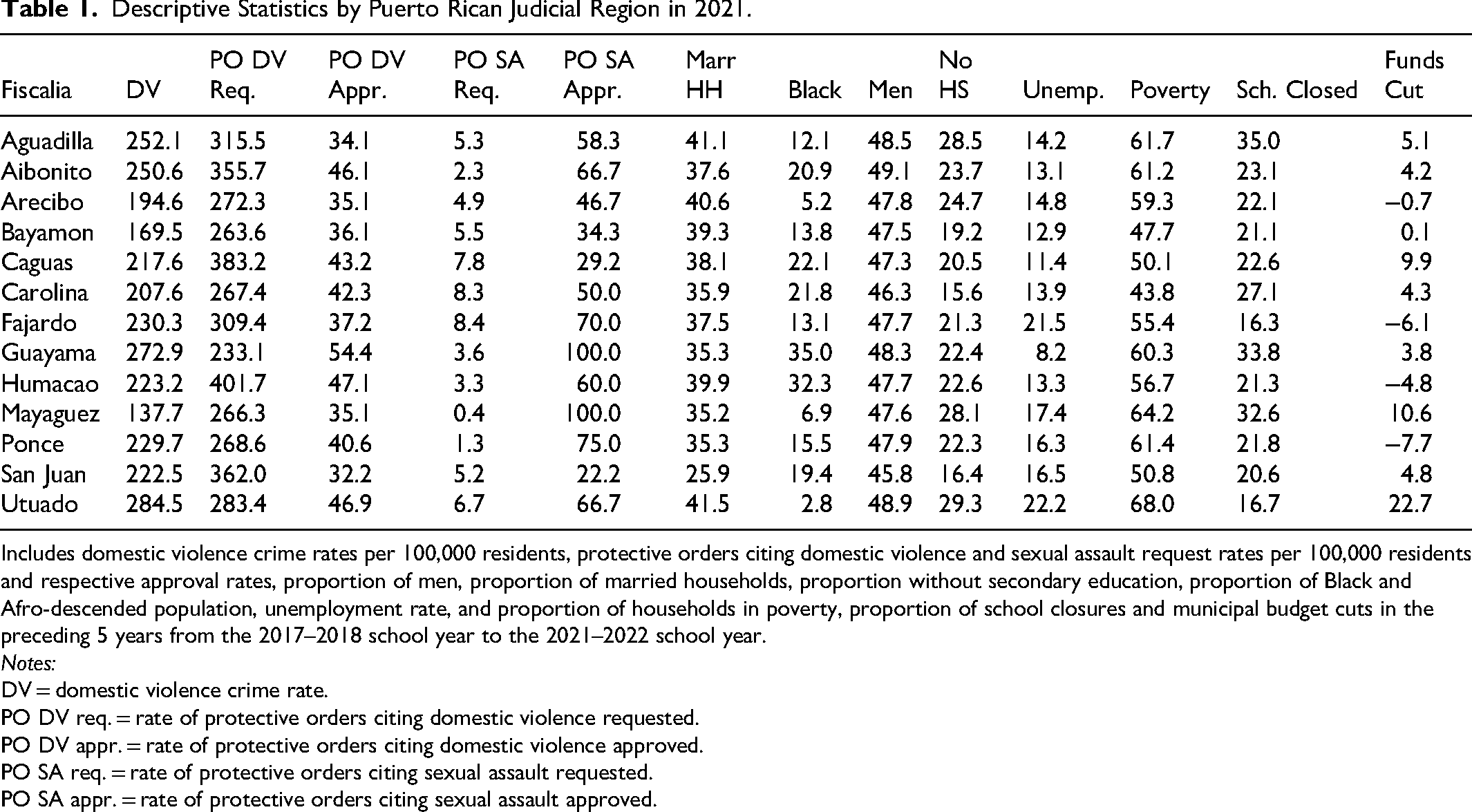
Includes domestic violence crime rates per 100,000 residents, protective orders citing domestic violence and sexual assault request rates per 100,000 residents and respective approval rates, proportion of men, proportion of married households, proportion without secondary education, proportion of Black and Afro-descended population, unemployment rate, and proportion of households in poverty, proportion of school closures and municipal budget cuts in the preceding 5 years from the 2017–2018 school year to the 2021–2022 school year.
Notes:
DV = domestic violence crime rate.
PO DV req. = rate of protective orders citing domestic violence requested.
PO DV appr. = rate of protective orders citing domestic violence approved.
PO SA req. = rate of protective orders citing sexual assault requested.
PO SA appr. = rate of protective orders citing sexual assault approved.
Hypotheses
Hypothesis one
After controlling for demographic and socioeconomic factors, greater colonial divestment (fewer schools and lower municipal funding) will be associated with higher domestic violence crime rates and higher rates of protective order requests citing both domestic violence and sexual assault. This is hypothesized to result from reduced community organizing capacity to prevent GBV and diminished public resources to respond to it.
Hypothesis two
After controlling for demographic and socioeconomic factors, greater colonial divestment will be associated with lower approval rates for protective order requests citing both domestic violence and sexual assault. This is hypothesized to reflect state incentives to limit expenditures required to enforce protective orders.
Analytic Methods
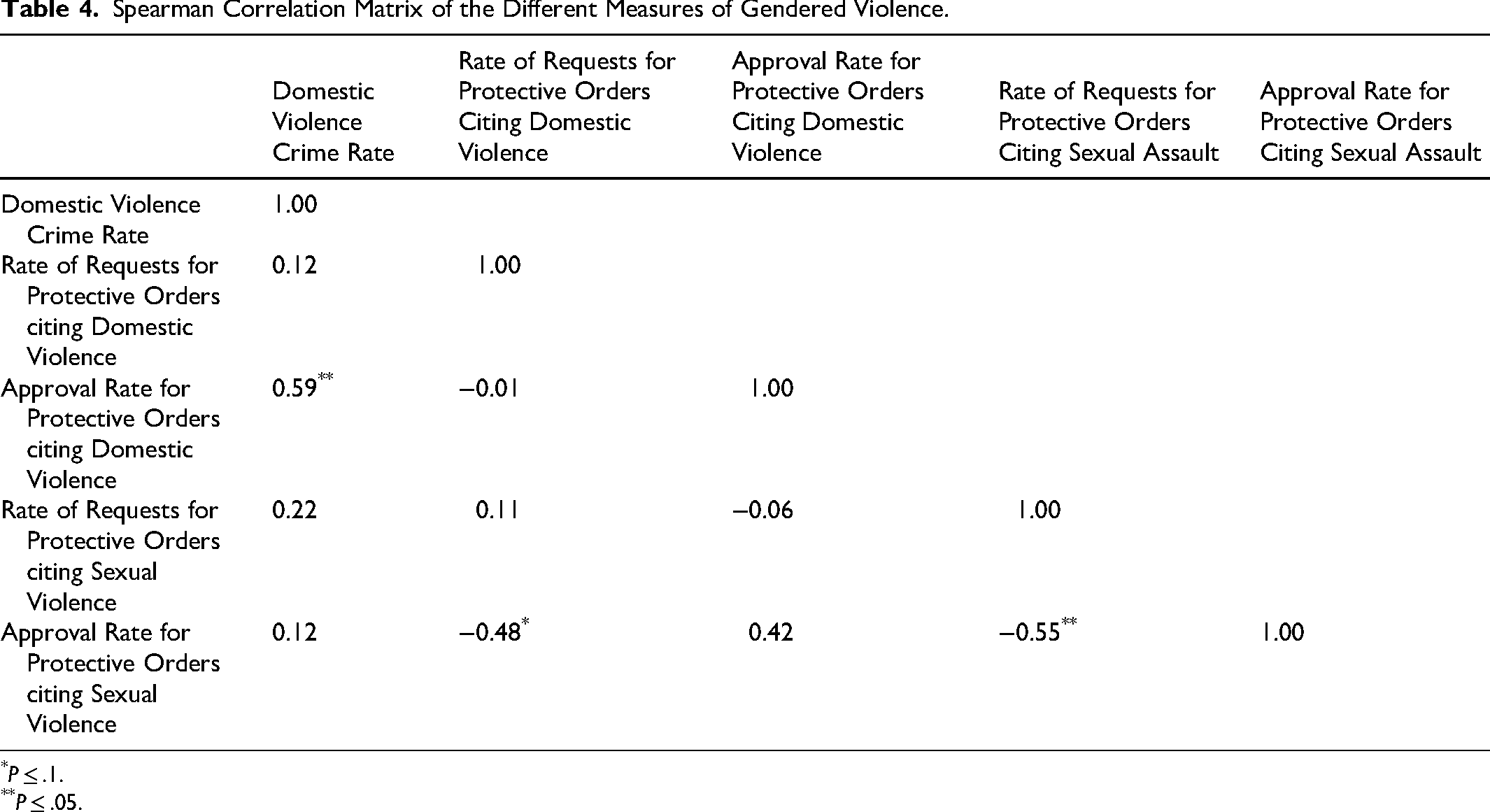
Correlation matrices explored relationships between dependent variables. Local Moran's I (LISA) was used to identify spatial autocorrelation and clusters (“hot” and “cold” spots) of crime and protective order activity, using first-order queen contiguity to define spatial relationships between fiscalias (Anselin, 1995; Durlauf et al., 2010).
Ordinary least squares (OLS) regression models were used to examine the island-wide relationships between dependent and independent variables. Each dependent variable was modeled separately, with the four protective order models also including the domestic violence crime rate as a predictor (Durlauf et al., 2010; Wallace et al., 2006). LaGrange Multiplier Tests assessed spatial dependencies in OLS residuals. Where spatial dependence was detected, spatial lag models (SLMs) or spatial error models (SEMs) were used to improve model fit, assessed using the Akaike information criterion (AIC).
For each dependent variable, three models were estimated: (1) demographic controls only; (2) demographic and socioeconomic controls; (3) demographic, socioeconomic, and colonial divestment variables. The discussion will focus on the effects of the divestment variables and the race control variable.
Results
Spatial Patterns of Gender-Based Violence
Figure 1 visually represents the spatial distribution of our five key dependent variables across the 13 fiscalias (judicial regions) of Puerto Rico. Panel A focuses on the domestic violence crime rate, offering a geographical snapshot of reported incidents. A visual inspection reveals distinct hotspots in the fiscalias of Utuado, Guayama, and Aguadilla. These regions stand out, each reporting between 251 and 285 domestic violence cases per 100,000 residents. This finding is particularly noteworthy because these high-crime fiscalias are geographically distinct from the island's major urban metropolitan centers, such as San Juan, Ponce, and Mayagüez. This observation challenges conventional wisdom and hypotheses that often link urbanicity to higher crime rates (et al., 2014), suggesting that other, perhaps more localized, factors may be at play in these specific regions. It prompts further investigation into the socio-ecological characteristics of Utuado, Guayama, and Aguadilla that might contribute to these elevated rates.
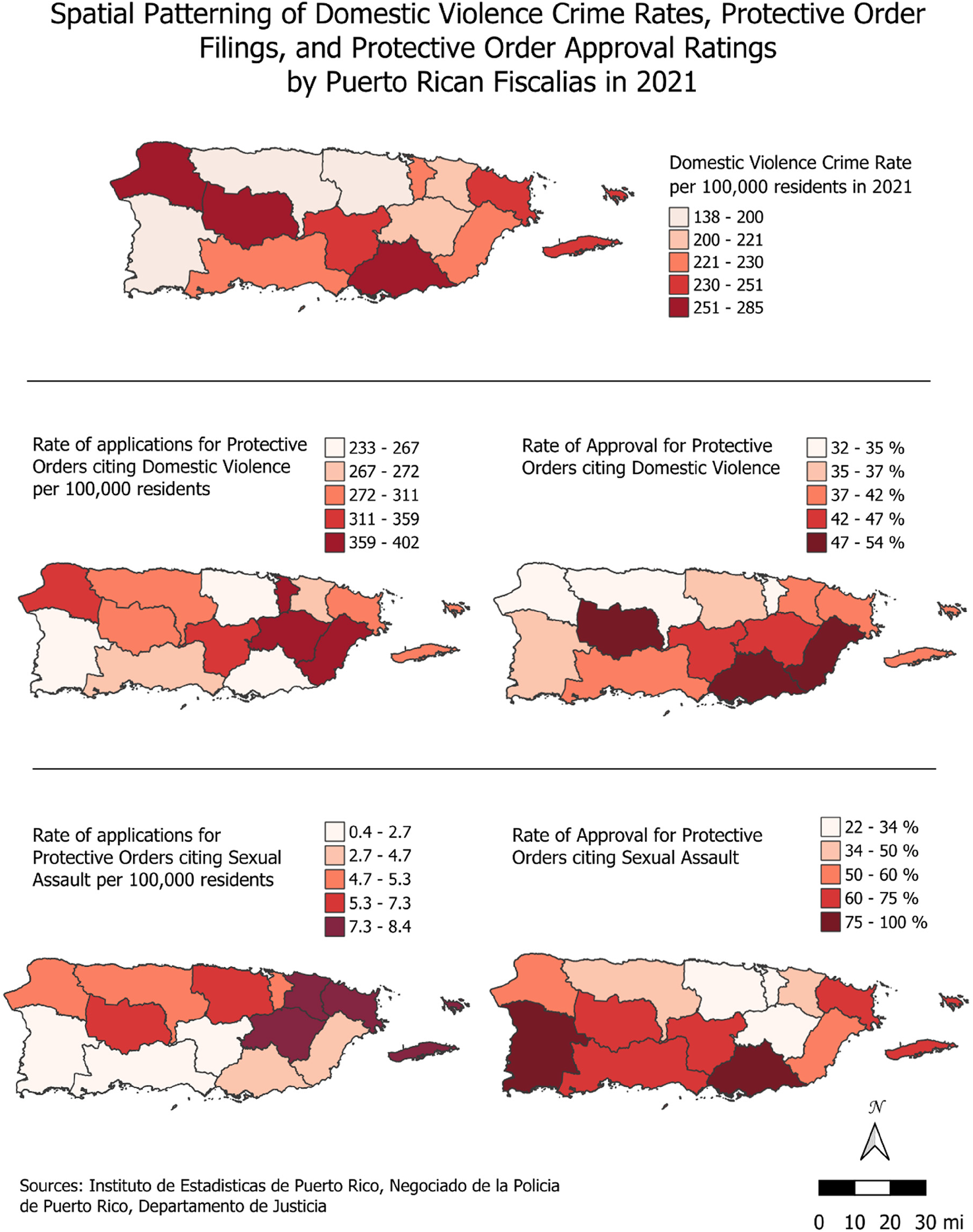
Spatial patterning of domestic violence crime rates, protective order request rates, and protective order approval rates by puerto rican judicial regions in 2021
Panels B and C of Figure 1 shift the focus to the spatial patterns of protective order requests and approvals related to domestic violence, respectively. A comparative analysis of these two maps reveals a concerning disconnect between the demand for protection and its provision. The fiscalias of San Juan, Aguadilla, and Arecibo, which are among the top three in terms of protective order requests citing domestic violence, exhibit a strikingly different pattern when it comes to approvals. These same regions fall into the lowest quantile for approval rates, with less than 35% of requests being granted. This discrepancy raises serious concerns about access to justice and the efficacy of protective measures for victims of domestic violence in these areas. It suggests potential systemic barriers within these fiscalias that hinder the granting of protective orders, despite a clear need.
Moving to protective orders citing sexual assault, Panels D and E of Figure 1 present a similar, albeit distinct, pattern. The northeastern fiscalias of Ceiba, Canovanas, and Aguas Buenas report the highest rates of protective order requests citing sexual assault, ranging from 7.3 to 8.4 per 100,000 residents. However, the approval rates in these regions paint a troubling picture. Canovanas reports an approval rate of less than 50%, while Aguas Buenas falls even lower, below 34%. Bayamón, which ranks in the second-highest quantile for request of protective order citing sexual assault (5.3–7.3 per 100,000 residents), also suffers from a low approval rate, below 34%. This pattern suggests that victims of sexual assault in these fiscalias, despite seeking legal protection, face significant barriers to obtaining it. The low approval rates in the face of high-request rates point to a potential crisis of access to justice for survivors of sexual assault in these fiscalias.
These descriptive spatial patterns provide crucial insights into the distribution of gendered violence across Puerto Rico. They highlight the complexities of measuring and understanding violence, as different metrics reveal distinct regional hotspots. While reports of domestic violence are more concentrated in the southeast and northwest, protective order requests for both domestic violence and sexual assault are more frequent in the east and northeast. Interestingly, the approval rates for these orders are higher in the southeast and southwest. These spatial variations, particularly the disparities in approval rates, carry profound implications. They affect not only individuals seeking protection and state intervention but also the work of private actors and organizations striving to provide support and address the harms of violence, especially in areas where state action may be limited. The discrepancies between requests and approvals raise questions about the responsiveness of the legal system and the potential for revictimization through denial of protection.
Effects of Colonial Divestment on Gender-Based Violence
This study examined the relationship between colonial divestment, socioeconomic factors, and rates of violence against women in Puerto Rico, focusing on domestic violence and sexual assault. OLS regression models, accounting for spatial dependence, were employed to analyze data across judicial regions. Five demographic and socioeconomic variables (proportion of men, proportion of married-couple households, proportion without a secondary education, proportion of the Black population, unemployment rate, and proportion of households in poverty) and two variables measuring colonial divestment (proportion of school closures and municipal budget cuts in the preceding 5 years) were included in the models.
Domestic violence crime rates
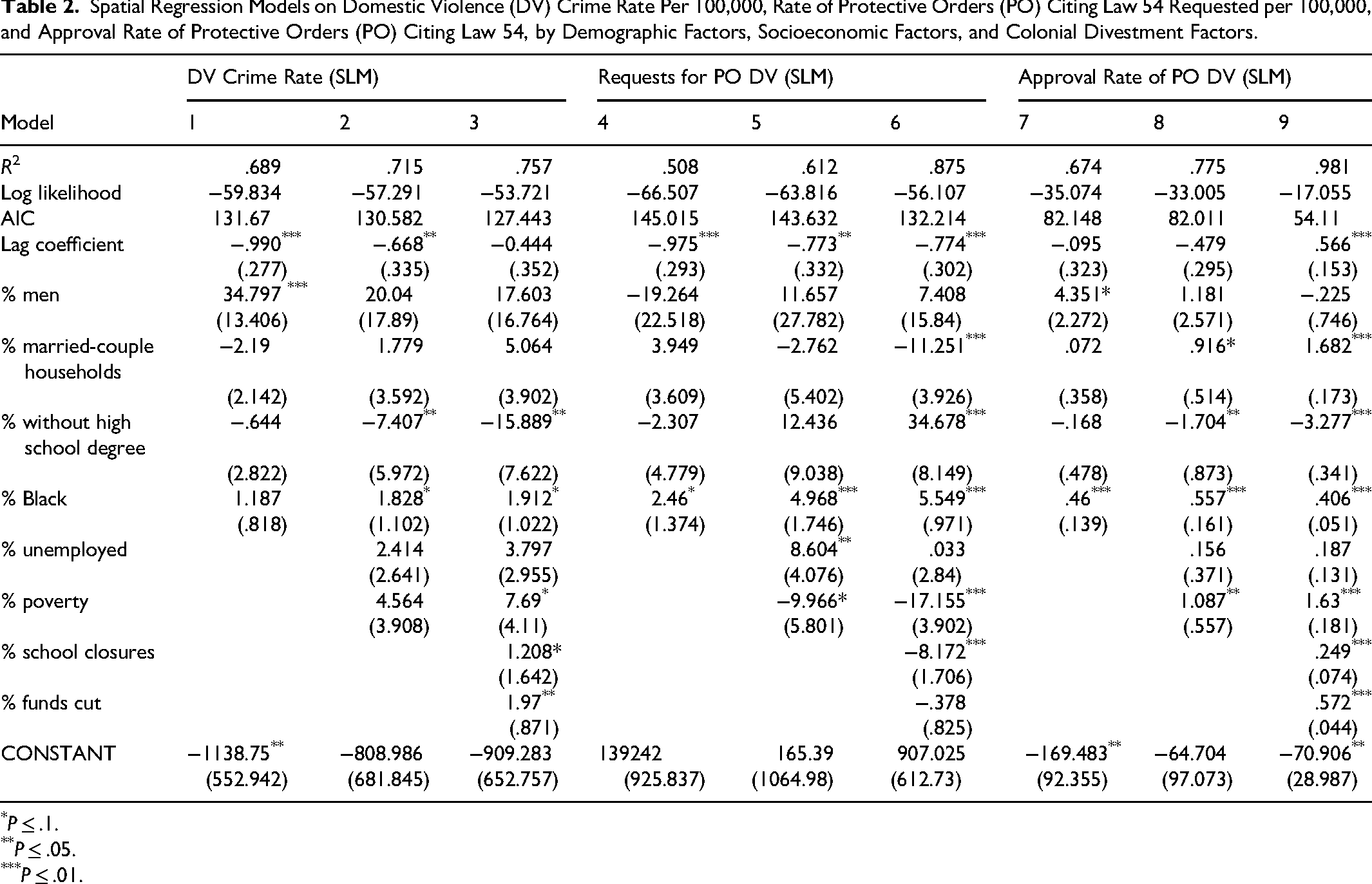
Spatial diagnostics (LaGrange Multiplier tests) indicated an SLM was most appropriate for domestic violence crime rates. Initial models (1 and 2, Table 2) showed a negative spatial lag coefficient, suggesting a pattern where regions with higher reported domestic violence crimes per 100,000 residents were bordered by regions with lower rates. However, this spatial clustering effect became non-significant in the full model (3, Table 2) after including colonial disinvestment variables, indicating that the spatial patterning of domestic violence may be explained by the distribution of school closures and budget cuts.
Spatial Regression Models on Domestic Violence (DV) Crime Rate Per 100,000, Rate of Protective Orders (PO) Citing Law 54 Requested per 100,000, and Approval Rate of Protective Orders (PO) Citing Law 54, by Demographic Factors, Socioeconomic Factors, and Colonial Divestment Factors.
P ≤ .1.
P ≤ .05.
P ≤ .01.
Model 3 explained 75.7% of the variation in domestic violence crime rates (R2 = 0.757). The inclusion of divestment variables increased the R2 by 4.2 percentage points and reduced the AIC from 131.67 (Model 1) to 127.44 (Model 3), supporting the inclusion of these variables. While the coefficients in spatial lag models cannot be interpreted directly as marginal effects, the results suggest a positive association between divestment and domestic violence. Specifically, each percentage point increase in municipal funding cuts was associated with a 2 case increase in violations of Law 54 per 100,000 residents (P < .05). School closures showed a similar positive trend, with each percentage point increase associated with a 1.2 case increase in Law 54 violations (P < .1). 1 These findings support the hypothesis that divestment is associated with increased domestic violence. Additionally, a significant positive association was observed between the proportion of the Black population and protective order requests citing Law 54 violations, with each percentage point increase associated with a 5.5 case increase per 100,000 residents (P < .01).
For protective order approvals (citing domestic violence), LaGrange Multiplier tests again indicated spatial dependence, and an SLM was used (Models 7–9, Table 2). Model 9 explained 98.1% of the variance (R2 = 0.981), with a 22 percentage point increase attributable to the divestment variables. The AIC decreased from 82 (Model 7) to 54.11 (Model 9). Contrary to the initial hypothesis, both school closures (P < .01) and budget cuts (P < .01) were positively associated with approval rates for domestic violence protective orders, albeit with small effect sizes (0.25% and 0.57% increase, respectively, per percentage point increase in divestment).
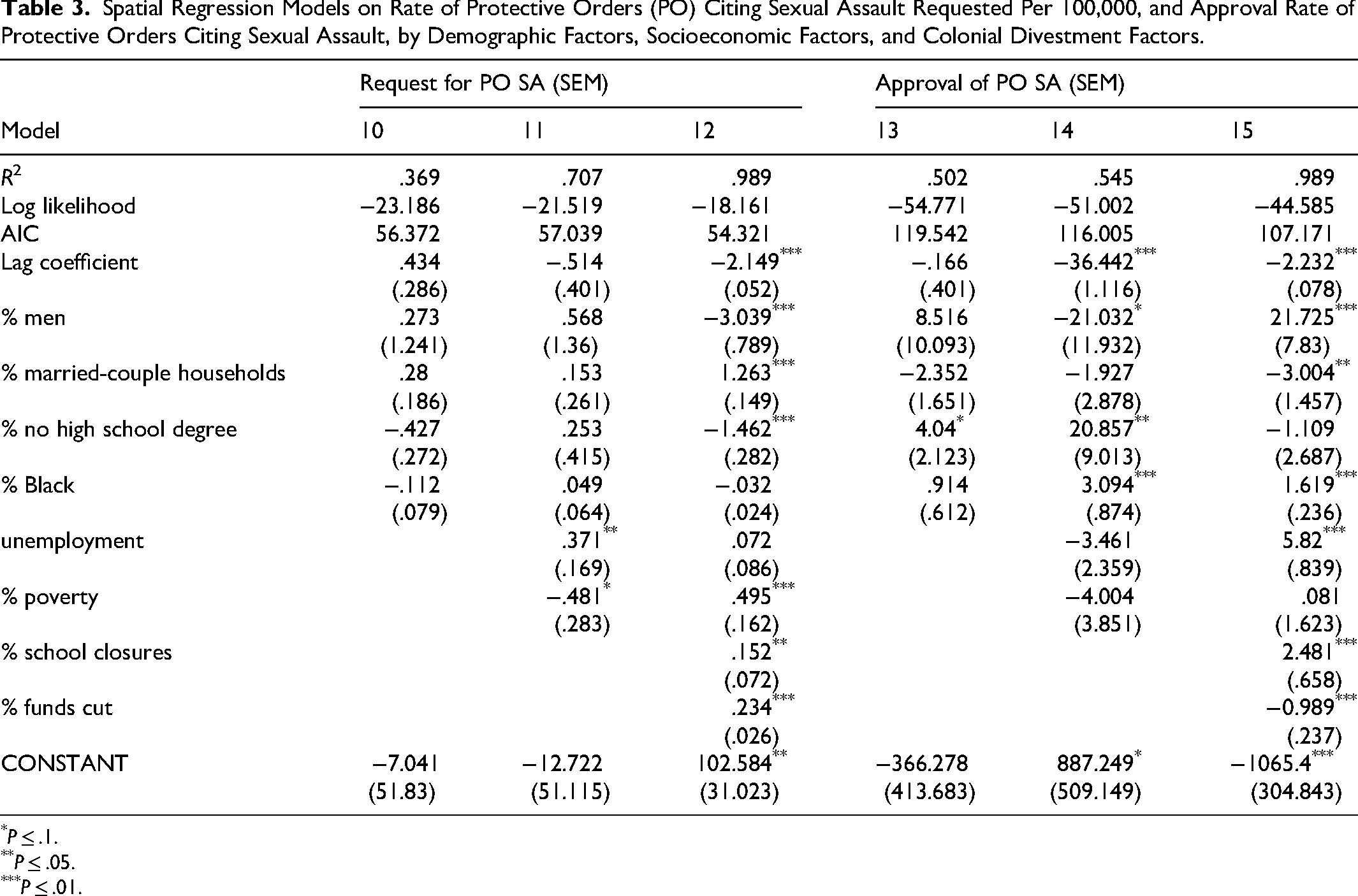
For protective order requests citing sexual assault, a spatial error model was deemed most appropriate (Models 10–12, Table 3). Model 12 explained 98% of the variance (R2 = 0.98), with the AIC decreasing from 56.3 (Model 10) to 54.3 (Model 12). Supporting the primary divestment hypothesis, both school closures (P < .05) and budget cuts (P < .05) were positively associated with requests for protective orders citing sexual assault (0.15% and 0.23% increase, respectively, per percentage point increase in divestment).
Spatial Regression Models on Rate of Protective Orders (PO) Citing Sexual Assault Requested Per 100,000, and Approval Rate of Protective Orders Citing Sexual Assault, by Demographic Factors, Socioeconomic Factors, and Colonial Divestment Factors.
P ≤ .1.
P ≤ .05.
P ≤ .01.
Finally, for approvals of protective orders citing sexual assault, A spatial error model was also used (Models 13–15, Table 3). Model 15 explained 98% of the variance (R2 = 0.98), with the AIC decreasing from 119.54 (Model 13) to 107.17 (Model 15). Supporting the secondary divestment hypothesis, budget cuts were negatively associated with approval rates (every per percentage point increase in funding cuts, was associated with a 1% decrease in approval rates, P < .01). However, contrary to expectations, school closures were positively associated with approvals (2.5% increase per percentage point increase, P < .01).
Preliminary models including the domestic violence crime rate as a predictor for protective order outcomes were ultimately excluded due to AIC comparisons. However, significant correlations between domestic violence crime rates and the other dependent variables were observed (Table 4). A moderately positive correlation was found between domestic violence crime rates and approval rates for Law 54 protective orders (r = .59, P = .035). Moderately negative correlations were observed between protective order requests citing sexual assault and their approvals (r = −.55, P = .053), and between requests for protective orders citing domestic violence and approvals of protective orders citing sexual assault (r = −.48, P = .093). Notably, regions with the highest rates of requests for protective orders citing sexual assault had the lowest approval rates. Increases in domestic violence crime rates were negatively associated with approval rates for both sexual assault and domestic violence protective orders.
Spearman Correlation Matrix of the Different Measures of Gendered Violence.
P ≤ .1.
P ≤ .05.
Taken together, these results raise serious concerns. The finding that judicial regions with a higher proportion of residents requesting protective orders for domestic violence and sexual assault are less likely to grant those applications than other regions (as evidenced by the negative correlations) is particularly troubling. This disparity in approval rates raises questions about potential systemic biases or barriers within these regions. It also prompts further investigation into the causal relationship between protective order approvals and reported domestic violence incidents. Specifically, it is crucial to explore whether lower approval rates may contribute to an increase in subsequent domestic violence crimes, either by discouraging victims from seeking help or by leaving them more vulnerable to further abuse. Future research should examine the factors contributing to these low approval rates in high-request regions and investigate the potential downstream consequences for victims and communities.
Discussion
This study examined the complex relationship between colonial divestment, particularly in education, and GBV in Puerto Rico, a non-sovereign territory deeply shaped by its colonial history. Bridging economic sociology, criminology, and decolonial Black feminist scholarship, this research explored the impact of school closures and municipal funding cuts on domestic violence crime rates and protective order dynamics. Analyzing administrative data from Puerto Rican police, justice, education, and budget agencies, the study finds support for the primary divestment hypothesis; greater colonial divestment (fewer schools and lower municipal funding) is associated with higher domestic violence crime rates and higher rates of protective order requests citing sexual assault. This study also revealed unexpected patterns that illuminate the complex power dynamics at play. Critically, this study centers the experiences of women in Puerto Rico, recognizing the intersectional nature of their vulnerability to violence within a context of ongoing colonial control.
The spatial analysis reveals stark regional disparities in GBV. The concentration of reported domestic violence cases in Utuado, Guayama, and Aguadilla, geographically distinct from major urban centers, challenges conventional urban-centric crime theories (et al., 2014) and suggests the influence of localized socio-ecological factors. More alarmingly, the disconnect between protective order requests and approvals, particularly in San Juan, Aguadilla, and Arecibo for domestic violence, and in Ceiba, Canovanas, and Aguas Buenas for sexual assault, raises serious concerns about access to justice for survivors. These discrepancies point to systemic barriers hindering the granting of protective orders despite evident need, potentially revictimizing those courageous enough to seek protection. This echoes broader concerns about the responsiveness of the legal system to women's needs, particularly within marginalized communities (Crenshaw, 1991).
The regression analysis provided mixed support for the primary hypotheses. As hypothesized, colonial divestment, operationalized through school closures and municipal funding cuts, is positively associated with domestic violence crime rates and with requests for protective orders citing sexual assault. Specifically, each percentage point increase in municipal funding cuts was associated with a 2 case increase in violations of Law 54 per 100,000 residents (P < .05), and each percentage point increase in school closures was associated with a 1.2 case increase in Law 54 violations (P < .1). These findings resonate with research highlighting the protective function of education against GBV (UNICEF, 2020) and the detrimental consequences of weakened public safety nets (Fonck et al., 2015; Jewkes et al., 2002). The increased domestic violence crime rate may reflect reduced community organizing capacity and diminished public resources dedicated to GBV prevention and response, further eroding community resilience in the face of structural violence. The positive association between divestment and requests for protective orders citing sexual assault may indicate heightened awareness and reporting in affected areas, perhaps due to the advocacy efforts of local feminist organizations, even if approvals remain limited.
However, contrary to expectations, divestment is associated with decreased requests for domestic violence protective orders. This unexpected result may be attributed to school closures and diminishing access to resources and support systems within schools that facilitate reporting. Schools often serve as safe spaces where individuals can disclose experiences of violence and access information about legal options (Lytton, 2011). This finding suggests that the closure of schools does not merely remove a service, it eliminates a spatial refuge. Qualitative research on community impacts of school closures emphasizes that for many women and children, the school is the only consistent “safe space” outside the purview of an abusive partner (Yedidia et al., 2020). When these spaces are shuttered, the opportunity for a victim to safely disclose abuse, access information about protective orders, or simply exist outside a volatile home environment is foreclosed. Consequently, the association observed between divestment and GBV rates may actually be an underestimation, as the very mechanism that facilitates reporting (the school) has been removed. Further qualitative studies might further clarify these associations.
While the primary findings focus on the structural impact of school closures, it is essential to contextualize the complementary significance of our public health divestment variable, operationalized as municipal budget cuts. This variable provides crucial quantitative evidence suggesting that the dismantling of the public health safety net is co-implicated in the crisis of GBV. It is important to clarify that the municipal budget cuts variable captures overall municipal budget contraction and is not a direct measure of public health expenditure alone. I justify its use as a necessary structural proxy on two grounds: Methodologically, precise, disaggregated public health budget data at the judicial region level remained inaccessible. Sociologically, cuts to overall municipal funding inherently reduce the capacity for local governments to staff and maintain the very public health and social support services (e.g., local clinics, psychological first responders) that act as a buffer against interpersonal violence. Therefore, the significant findings for this variable, point at a systemic failure across the municipal funding safety net, which directly undermines women's safety by diminishing municipal funding for clinical and legal support.
Unexpectedly, colonial divestment is positively associated with approvals of protective orders citing domestic violence, and school closures (though not municipal funding cuts) are positively associated with approvals for protective orders citing sexual assault. The positive association with approvals of protective orders citing domestic violence is small (0.25% increase per percentage point increase in school closures and 0.57% increase per percentage point increase in budget cuts, P < .01 for both), as is the association between school closures and approvals of protective orders citing sexual assault (2.5% increase per percentage point increase, P < .01). These relationships are difficult to interpret and necessitate further inquiry. One hypothesis for the small but positive relationship found is that local judicial actors (the locally elected judges responsible for granting protective orders) may be attempting to mitigate the devastating consequences of divestment by offering some measure of protection amidst growing precarity. For instance, they may respond to budget cuts and school closures by providing additional protections for applicants and students related to them that, particularly during the COVID19 pandemic, were very likely spending more time at home. This hypothesis is hopeful as it opens the possibility that the local Puerto Rican judges, or arms of the judicial branch, might be serving or attempting to serve as a buffer or protection against the fiscal colonial arm of the state responsible for the divestments. This possibility that judges prioritize cases from communities experiencing school closures, perhaps due to a heightened perception of vulnerability however, remains a hypothesis requiring further investigation. Dedicated, qualitative inquiry into the administrative records and case processing practices of the courts, especially across the most fiscally divested judicial regions, is necessary to conclusively establish the precise mechanism by which austerity impacts the legal safety net for victims of sexual violence.
While this spatial analysis quantifies the link between colonial divestment and aggregate GBV, it is crucial to acknowledge that austerity and violence are never neutrally experienced. They are differentially and exponentially amplified for communities subject to structural racism, transphobia, and poverty, particularly Black women, Indigenous women, migrant groups such as Dominican women, and trans/queer individuals; groups for whom colonial dispossession is a historical constant. Due to the limitations of available administrative data, which lacked reliable, disaggregated information on victim and perpetrator race, ethnicity, and gender identity, a full intersectional quantitative analysis was not possible.
Nonetheless, a consistent and significant finding across models was the positive association between the proportion of the Black population in a judicial region and reported domestic violence cases and requests for protective orders citing domestic violence. Specifically, each percentage point increase in the proportion of the Black population was associated with a 5.5 case increase in Law 54 violations per 100,000 residents (P < .01). This finding powerfully resonates with the urgent concerns raised by feminist organizations in Puerto Rico, such as La Colectiva Feminista en Construccion, El Observatorio de Equidad de Género, and Proyecto Matria who have consistently document how the state's divestment compounds pre-existing biases, particularly in the handling of violence against immigrant and trans women. This finding underscores the intersectional nature of violence, where race, class, and colonial status converge to create heightened vulnerability, a phenomenon theorized by Black feminists as “interlocking oppressions” (Collins, 1990).
Conclusions and Limitations
This study makes several important contributions to the literature on violence against women. It expands existing research by examining the impact of structural violence, specifically colonial divestment, on GBV, highlighting the crucial role of education as a protective factor and the devastating consequences of its erosion. Critically, by situating these dynamics within the non-sovereign territory of Puerto Rico, the study provides compelling quantitative evidence suggesting that colonial governance austerity measures are significantly associated with the rise in GBV across Puerto Rico. While acknowledging the constraints of administrative data, particularly regarding complete GBV reporting, from a decolonial perspective, the findings strongly indicate that divestment established as structural vulnerability, exacerbates GBV. This echoes the work of decolonial scholars who have argued that coloniality continues to shape power relations and social inequalities in post-colonial contexts (Maldonado-Torres, 2004). The study highlights how the denial of self-determination and democratic control over resources creates conditions ripe for GBV, making it more difficult for communities to protect their most vulnerable members. There are corporeal costs to non-democratic divestments. Costs that can be counted in violences against the bodies of those whose social identities offer them the least protection, in particular queer, trans, Black, and Indigenous women and children.
The findings from Puerto Rico also offer critical insights for the global conversation on GBV, moving the discussion beyond localized conflict to structural violence in austerity-affected colonial and post-colonial settings. The specific mechanism observed here, where external financial control, as implemented by the Fiscal Control Board, subordinates local social welfare to creditor interests, is not unique to the archipelago. Similar patterns of institutional collapse following state divestment have been linked to rising social harm in other contexts. For example, the structural adjustment programs imposed on nations like Ghana and Jamaica often led to the mass closure of public services and subsequent destabilization of community safety nets, disproportionately impacting women and vulnerable populations (Crisp & Kelly, 1999), echoing the effects of the school closures and budget cuts we measured. Furthermore, the exacerbation of GBV in Puerto Rico following natural disasters finds parallels in COVID-19-affected nations like Greece under European Union bailout conditions, where pre-existing structural vulnerabilities were exponentially amplified, halting progress toward gender equality and impacting GBV services (Stratigaki, 2017). By demonstrating how colonial governance translates external fiscal control into quantifiable, regional disparities in violence, this study underscores the global lesson: austerity is a macro-structural determinant of health and safety, and its effects are translatable wherever financial control supersedes democratic and social accountability.
It is important to note however that the constraints imposed by colonial austerity and bureaucratic friction in Puerto Rico fundamentally shape the nature of GBV research. This analysis relies on administrative data, yet this “official” data is often constrained by the same state negligence being critiqued in the analysis. In the absence of consistent and reliable state reporting, a powerful tradition of feminist and grassroots data-gathering has emerged on the archipelago. In particular, the interpretation and analyses presented in this paper is indebted to the indispensable intellectual and political work of community-based organizations such as El Observatorio de Equidad de Género, Proyecto Matria, La Colectiva Feminista en Construccion, and Todas PR. These organizations have, in their own ways, pioneered supplemental systematic monitoring of femicides and complaints of GBV, often harmonizing records using local news reports and community intelligence, effectively creating a “shadow record” that offers a critical counternarrative to incomplete police statistics. Their knowledge of the administrative gaps in GBV reporting informed my choice of analytical variables and interpretation of the data's limitations.
While this analysis is limited by the official administrative data categories, the decolonial framework applied to this analysis also necessitates an explicit, critical engagement with Indigenous vulnerability and the politics of data. I recognize the complex, ongoing political debates surrounding Taíno identity, continuity, and official data representation in Puerto Rico, and acknowledge the scrutiny that decolonial approaches can face regarding these discussions. My position is methodological and structural, supported by decolonial literature (Maldonado-Torres, 2004) which asserts that colonial divestment is a political-economic force rooted in a long history of Indigenous dispossession and erasure, a continuum that in Puerto Rico began with Spanish colonialism and persists through contemporary U.S. financial control. As such, the structural effects of austerity measured in this analysis are experienced most acutely by those communities who have been systematically marginalized. The absence of reliable, disaggregated Indigenous data in official records is not a passive gap, but an active outcome of this colonial erasure. Addressing GBV in Puerto Rico thus requires confronting this colonial continuum and insisting on the inclusion of Indigenous sovereignty and data governance principles in future policymaking and research.
This study has additional limitations. The cross-sectional nature of the data limits causal inferences. While associations are observed, we cannot definitively conclude that divestment causes increased GBV. Future longitudinal research is essential to establish causality. Furthermore, the reliance on administrative data likely underestimates the true prevalence of GBV due to pervasive underreporting (American Civil Liberties Union, 2012; Bouffard, 2000; Greenberg & Ruback, 1992; Jones et al., 2004; Narvaez et al., 2018). The small number of spatial units (13 judicial regions) also limits statistical power and may mask crucial variations at the municipal level. 2 Finally, while this study emphasizes structural factors, it is critical to acknowledge the complex interplay of individual, interpersonal, and structural factors that contribute to GBV.
Despite these limitations, this study offers crucial insights into the relationship between colonial divestment and GBV in Puerto Rico. The findings underscore the urgent need for policy interventions that prioritize investment in public education and social services, particularly in marginalized communities. Critically, they highlight the necessity of dismantling colonial structures of power that perpetuates the prioritizing of external fiscal administrative goals over public sector investment. Concrete recommendations include increased funding for GBV prevention programs in schools, culturally competent services for survivors, and community-based initiatives that empower women and challenge gender inequality particularly in regions affected by educational and fiscal divestment. Furthermore, it is crucial to address the systemic racism that disproportionately impacts Black immigrant women in Puerto Rico. Decolonizing the state and empowering local communities to control their educational resources are essential steps towards creating a society where all women are safe from violence. Future research should explore the specific mechanisms through which divestment affects GBV and the role of community-based organizations, particularly feminist collectives in mitigating these effects. Further research should also focus on developing culturally appropriate interventions into these educational divestments that are grounded in the lived experiences of women in Puerto Rico and address the enduring legacy of colonialism.
Footnotes
Acknowledgments
This work would not have been possible without the mentorship and support of many colleagues and mentors. The author owes a particular debt of gratitude to Dr. Leslie McCall, whose mentorship and sustained support shaped this project in profound ways. Dr. Jeremy Porter generously provided methodological training and advice that proved central to the analytical framework developed here. The author also thanks Dr. Michael Rodríguez-Muñiz, Dr. Nicholas Vargas, and Dr. G. Cristina Mora for their postdoctoral guidance and intellectual generosity during a formative stage of this research. The Latinx Research Center at the University of California, Berkeley provided both a vibrant intellectual community and thoughtful feedback on the writing that greatly strengthened this manuscript.

Ethical Considerations
The Ethics Committee of The CUNY Graduate Center waived the need for ethics approval and patient consent for the collection, analysis and publication of the retrospectively obtained and anonymized data for this non-interventional study.
Funding
The authors disclosed receipt of the following financial support for the research, authorship,and/or publication of this article: This work was supported by the U.S. Department of Education through the Latino Social Science Pipeline Initiative at the University of California, Berkeley's Latinx Research Center.
Declaration of Conflicting Interests
The author declared no potential conflicts of interest with respect to the research, authorship, and/or publication of this article.
Data Availability
The data underlying this article will be shared on reasonable request to the corresponding author.