




Abstract
For many victim-survivors, post-separation coparenting with a perpetrator of domestic and family violence is a daily reality. Post-separation parenting apps are increasingly recommended to manage communication in such contexts, yet their use in abusive dynamics is poorly understood. Drawing on interviews with 18 separated mothers, this study explores how app-facilitated coercive control is both perpetuated and resisted. The record-keeping functions of these apps emerged as a key mechanism through which both control and resistance are negotiated, shaped by the legal settings in which app use is often introduced.
Keywords
Introduction
Domestic and family violence (DFV) often continues or escalates after separation (Humphreys & Thiara, 2003; Rezey, 2020). Post-separation DFV literature has uniformly shown that the parenting connection creates additional risks and complications for victim-survivors (mostly mothers) and their children (Archer-Kuhn et al., 2024; Davies et al., 2009; Hardesty et al., 2016; Hardesty & Ganong, 2006; Hardesty et al., 2024; Spearman et al., 2023; Thiara & Humphreys, 2017). In countries such as Australia, victim-survivors who share children with a perpetrator are compelled legally and pragmatically to have ongoing interactions with them to facilitate coparenting (Family Law Act 1975, Cth). In other words, a person who has been subject to abuse can be required to maintain an active connection with their abuser – often for many years. This post-separation connection is most likely facilitated through digital media, with numerous studies suggesting that communication between separated parents is preferentially sustained through technologies such as email, SMS and messaging apps (Ganong et al., 2012; Heard et al., 2024; Markham et al., 2017; Russell et al., 2021; Smyth et al., 2020).
The use of digital media to confer harm, typically referred to as ‘technology facilitated abuse’, is an area of increasing interest due to its high prevalence across diverse populations and its far-reaching impacts (Powell et al., 2022). Digital technologies have been conceptualised as expanding the reach of perpetrators, allowing them to access their victims regardless of spatial and temporal boundaries (Dragiewicz et al., 2018; Harris & Woodlock, 2023; Woodlock, 2017; Woodlock et al., 2020). While the body of research exploring technology facilitated abuse is growing rapidly, knowledge about its occurrence in specific contexts, such as post-separation coparenting, is lacking (Dragiewicz et al., 2021b; Smyth et al., 2023). Even less is understood about how victim-survivors may use technologies to resist harms in these contexts (Mac Phail et al., 2025). This paper attempts to partially address this gap through the examination of female victim-survivors’ experiences of using post-separation parenting apps.
Post-Separation Parenting Apps
Post-separation parenting apps are standalone smartphone apps designed to facilitate coparenting interactions. 1 Practitioners from various disciplines commonly recommend them to clients (Payne et al., 2022) and they are regularly mandated for use or referred to in family court proceedings. Most post-separation parenting apps feature text-based communication but many also include a range of additional functions (e.g., shared calendar or contact lists), and the majority advertise enhanced record-keeping capabilities (see Smyth et al. 2023 for a breakdown of apps and features). Record-keeping is achieved through features such as unalterable messaging (i.e., sent messages cannot be deleted or edited), detailed sent and read receipts, and options to easily download and export the immutable app data.
To date, a small, inter-connected body of research has examined these apps in respect to their use in high conflict 2 coparenting relationships, primarily centring the views and experiences of family law practitioners. 3 This research has found significant variations in cost, quality, usability, and in practitioner's perceptions of their utility (Heard et al., 2023; Irving et al., 2023; Payne et al., 2022; Smyth et al., 2023). Although not developed for the purpose of disrupting or preventing post-separation DFV, they have been described by some practitioners as having the potential to either ameliorate or exacerbate common coparenting problems, including conflict. Participating practitioners pointed out that on the one hand, post-separation parenting apps could contain and centralise coparenting communications, as well as document misuse, thereby reducing the need for interaction and making legal follow-up easier to achieve (Heard et al., 2023). On the other hand, however, some practitioners flagged the potential for post-separation parenting apps to become a ‘dedicated space’ for ongoing conflict or even abuse, and for the continuous traumatisation of victim-survivors who are mandated to communicate with a perpetrator through a post-separation parenting app (Heard et al., 2023, p. 156).
Context of use
Coercive Control and Post-Separation Parenting
In Australia, family law legislation defines family violence as “violent, threatening or other behaviour by a person that coerces or controls a member of the person's family (the family member), or causes the family member to be fearful” (Family Law Act 1975, Cth). 4 Embedded in this and many other definitions of family and gender-based violence is the concept of coercive control. Coercive control is generally understood as a pattern of behaviour that is used to dominate, isolate and control another person – frequently within the context of an intimate relationship (Stark, 2007). Its enactment is cumulative, with tactics that can be physical and non-physical, overt and covert, often insidious, and sometimes undetectable to those outside the relationship (Douglas et al., 2019; Stark, 2007). The tactics perpetrators use to establish and maintain control are creative and dynamic rather than fixed (Stark, 2007). As such, new technologies and new strategies are readily and imaginatively coopted (see e.g., Tanczer, 2023).
It is essential to understand the dynamics of coercive control because interaction between a victim-survivor and perpetrator through a communication technology, such as post-separation parenting apps, likely occurs against a backdrop of years of such behaviours and their conditioning effects. With reduced face-to-face interactions after separation, technology facilitated coparenting communication has the potential to become the sole, focal medium through which coercive control is enacted – yet this area of vulnerability has often been explored only in the periphery. Given contemporary debate in Australia and elsewhere about the criminalisation of coercive control and associated challenges regarding the nature of evidence that can be used to prove the offence (see e.g., Fitz-Gibbon et al., 2024), an examination of perpetrator / victim-survivor interactions across post-separation parenting apps is timely.
Literature Review
Coparenting Communication and Domestic and Family Violence
A handful of papers provide insight into the intersection of DFV and post-separation coparenting communication (Douglas et al., 2019; Dragiewicz et al., 2019; Dragiewicz et al., 2021a; Dragiewicz et al., 2021b). Although these qualitative studies do not focus solely on parenting communication, they nonetheless shed light on how technology can facilitate ongoing coercive control and abuse.
With respect to post-separation parenting communications there are two notable observations. First, some perpetrators are adept at circumventing restrictions intended to limit their controlling behaviours. For example, one study describes how a father included references to the child in otherwise abusive messages, thereby fulfilling the requirements for ‘child-related’ communication (Douglas et al., 2019). In another instance, a father avoided limits imposed by a protection order—stipulating communication must be text-only—by sending abusive voice messages instead (Dragiewicz et al., 2021a).
Second, and more critically, these studies illustrate how the family law system may be weaponised by some perpetrators, becoming a core source of victim-survivor fear and distress. One tactic used in the context of coparenting communication is the construction of a ‘false narrative’, whereby the perpetrator manipulates communication records to present themselves positively and discredit the victim-survivor. This can serve as a form of reputational management in anticipation of legal proceedings (Dragiewicz et al., 2021b). Broader literature on DFV and legal abuse similarly identifies ‘image management’ as a strategy employed by abusive fathers to shape perceptions in their favour, such as by crafting an idealised “admirable father” persona (Katz et al., 2020). Concerns about such impression management are understandable: a substantial body of research has documented hazards faced by victim-survivors who are framed as ‘the problem’, which could mean that the victim-survivor is viewed as the person who poses a safety risk to their children, or that they are making false allegations against their former partner and/or are themselves the perpetrator of abuse (Archer-Kuhn et al., 2024; Laing, 2017; Lapierre et al., 2026; Sheehy & Boyd, 2020). Indeed, misidentification of the victim-survivor due to the deliberate misdirection of perpetrators underpins some of the concerns raised in relation to the criminalisation of coercive control in Australia (see e.g., Reeves et al., 2025).
In totality, the small but steadily increasing body of research that touches on post-separation parenting communication and DFV suggests that it can be readily misused by perpetrators to the detriment of victim-survivors. These tactics are demonstrative of the evolving and dynamic nature of coercive control that can take place after separation, and how the use of technology can be strategically incorporated by perpetrators to further their agenda. Such studies highlight the need for more targeted research to better understand this context-specific phenomenon.
Technology for Harm Resistance and Benefit
It is noteworthy that most research on technology and violence provides limited insight into the potential beneficial use of technology by victim-survivors (Mac Phail et al., 2025). Yet even when exhausted and traumatised, many victim-survivors proactively use technology to serve their own ends. Al-Alosi (2020) discusses some of the benefits of using technology to combat violence, describing these tactics as ‘fighting fire with fire’ (Al-Alosi, 2020). In a broad review of academic and non-academic research and media articles, she concludes that technology can empower victim-survivors by providing access to resources, reducing feelings of isolation, supporting help-seeking efforts (e.g., safety plans, spyware detection), and with the potential for recording and collecting evidence of wrongdoing (Al-Alosi, 2020). This latter point is particularly relevant to post-separation parenting apps because of their advertised record-keeping functionality. The proactive use of smart devices to collect evidence also arose in interviews with Australian victim-survivors who had interacted with the legal system as part of their separation (Douglas & Burdon, 2018). A number of participants described recording a perpetrator with the aim of gathering evidence of abuse to ensure their claims would be believed (including convincing themselves), and to enhance their sense of safety. The use of text-based platforms (e.g., WhatsApp, SMS) to create a digital ‘paper trail’ in parenting communication has been raised in several non-DFV specific parenting-communication papers. In keeping with some family law practitioner's perceptions about the ameliorating potential of post-separation parenting apps (Heard et al., 2023; Irving et al., 2023), this line of research suggests that the digital record may increase accountability and be usefully deployed for future legal recourse (Markham et al., 2017; Smyth & Fehlberg, 2019).
Aim and Methods
From the above review, it is apparent that there is a limited understanding of how separated parents utilise technology to facilitate communication in the context of domestic and family violence. Further, if and how communication technologies like post-separation parenting apps are used to facilitate harm, or to resist it, is unclear. This is despite the increasing inclusion of such technologies in parenting orders made by Family Law Courts. Focusing on interactions that occur across these apps, this paper attempts to partially address this gap. The present study explores the experiences of mothers who are victim-survivors and co-users of a post-separation parenting app with a perpetrating coparent (for brevity, hereafter referred to as ‘the perpetrator’). In particular, the research aims to not only build on existing knowledge of perpetration in the context of post-separation parenting communication, but to give greater voice to women's experiences of proactively using technology to meet their needs.
This study takes an experiential, qualitative approach and uses thematic analysis to investigate the use of post-separation parenting apps by both perpetrators and victim-survivors from the perspective of the latter. An experiential approach prioritises the understanding of participants’ lived experiences, perceptions, and interpretations of specific phenomena (Hesse-Biber & Leavy, 2010). Considering the absence of existing literature on this topic, understanding this phenomenon required a methodology capable of capturing the nuanced, context-specific ways that victim-survivors interpret, navigate, and respond to technologically mediated DFV. A qualitative, experiential approach was therefore essential: only in-depth narrative accounts can illuminate the subtle tactics of perpetration, the emotional and cognitive labour involved in resistance, and the complex interplay between app design, legal settings, and lived experience. Thematic analysis is well-suited for examining the mediating role of post-separation parenting apps in this context. It emphasises the discovery of patterns and meanings through primarily inductive, iterative analysis of qualitative data, allowing for a focus on uncovering implicit or unanticipated uses of the apps (as well as those that were explicit and anticipated) and to suggest how contextual factors might influence their perception and use (Grbich, 2013; Hesse-Biber & Leavy, 2010).
Data Collection
Semi-structured interviews were used to investigate the use of post-separation parenting apps by female victim-survivors. Interviews were conducted by telephone between September 2022 and September 2024, with each interview lasting between 60 and 90 min. Key areas explored included: 1) the separation experience and current situation; 2) the history of post-separation parenting communication, and which technologies had been used; 3) which post-separation parenting app and app features they were currently using and how they were using them; and 4) participants’ perceptions of how the perpetrator was using the app or app features and why.
Participants
Participants were separated mothers living in Australia who self-reported as having ever used a post-separation parenting app with a DFV perpetrating coparent of any gender. DFV was defined in recruitment materials as violent, abusive or controlling behaviours from a coparent. Participants had to be 18 years or older to take part in the study and not have an active court case before the Family Law Court; this former criterion was to avoid the risk of subpoena.
Due to the exploratory nature of the study, non-probability purposive sampling protocols were used. This means that the sample is not representative of the broader population. Additionally, while excluding participants with active court matters reduced legal risk, it also meant that the study captured post-separation parenting app use primarily outside of active litigation, potentially under-representing experiences during periods of heightened legal threat. Critically, recruitment for this project took longer than anticipated because the population of post-separation parenting app users proved difficult to both reach and to recruit (especially when giving consideration to those with active legal proceedings). This meant that three primary methods for recruitment were utilised which are described below.
In total, 18 mothers were recruited through various locations: six had completed an online survey about app use as part of an earlier, related research project (see Irving, 2024) and had agreed to participate in a follow-up interview about their experiences. A further 10 were recruited via posts to several online communities aimed at mothers. Two were recruited through a DFV crisis support agency with whom the first author had discussed the project and requested support with recruitment. Importantly, we did not observe any differences between the three cohorts of participants, regarding the nature of their use of post-separation parenting apps (e.g., the types used and whether they were mandated or not), or their experiences. This suggests that although we utilised multiple methods for recruiting participants, this did not lead to sample ‘skew’.
Although interviews were open to those who had ever used a post-separation parenting app, all except three were still actively using an app at the time of interview. Table 1 shows that most participants had two children with the perpetrating coparent (range: 1–3), with children's ages falling between 2 and 16 years. Participating mothers primarily described long-term relationships prior to separation (Mdn=10 years) and many had been separated from their partner for a number of years (Mdn = 4.25 years). Most (n = 14) participants had begun using an app on the suggestion of a family law professional; in three instances, app use was mandated by the court contrary to participant wishes. That two thirds (n = 13) of the 18 participants had the use of an app written in a court order points to the complex nature of the final sample.
Participant Demographics and Circumstances as Described in Interviews.

*Includes where participants mention either or both parenting and protection orders.
Participants discussed the history of their relationship with the perpetrator to varying degrees. Many volunteered that they had experienced significant physical violence and verbal abuse prior to separation, and all were experiencing coercive control as an extension of dynamics that preceded their separation. Prior to using a post-separation parenting app, almost all participants (n = 17) reported that the perpetrator had engaged in DFV through earlier forms of digital communication under the guise of a child-related exchange. Most frequently this was through abusive and harassing messages over text or email, including voluminous correspondence about perceived grievances, or pressure to make changes of some kind (e.g., to parenting orders).
Seventeen participants said that their abuser was male, and one said they were female. Additional demographic data were not collected to protect the identity and safety of participants. Participants’ differing contextual circumstances did not appear to account for variations in how the apps affected them.
Ethical Considerations
The ethical aspects of this study were approved by the Australian National University's Human Research Ethics Committee (Protocol: H/2023/1342). Interview questions were designed to minimise the chance of re-traumatisation for participants by being participant-led, focussing on contemporary communication issues with the perpetrating coparent, and not deliberately eliciting past experiences of DFV (though these were at times volunteered). A distress protocol was prepared though was not required during the study. Interviews were conducted by the first author, who is trained in trauma informed interview techniques, crisis counselling and has previously worked in crisis and court support in the area of DFV. Informed consent was obtained from all participants prior to interview. All interviews were transcribed and de-identified by the first author (names, places, dates removed) in order to safeguard participant privacy and safety. When referring to specific participants in this research, pseudonyms have been used.
Analytic Approach
Braun and Clarke's (2022) methods for thematic analysis were followed. In addition to manually transcribing the interviews, transcripts were read and re-read by one author (Irving) to ensure full immersion. The de-identified interview transcripts were uploaded to NVivo and coded for both semantic and latent themes, with concurrent note taking. Several rounds of coding were embarked on, using a different order each time. Coding interviews in a different order helps to ensure a more objective, consistent analysis by preventing earlier data from unduly influencing later interpretations (Braun & Clarke, 2022). Following this process, two core sets of themes related to participants’ experiences of app use were derived: perpetrator tactics for harm, and victim-survivor tactics for resistance. Using the same process, a further seven subthemes were also identified (discussed next).
Results
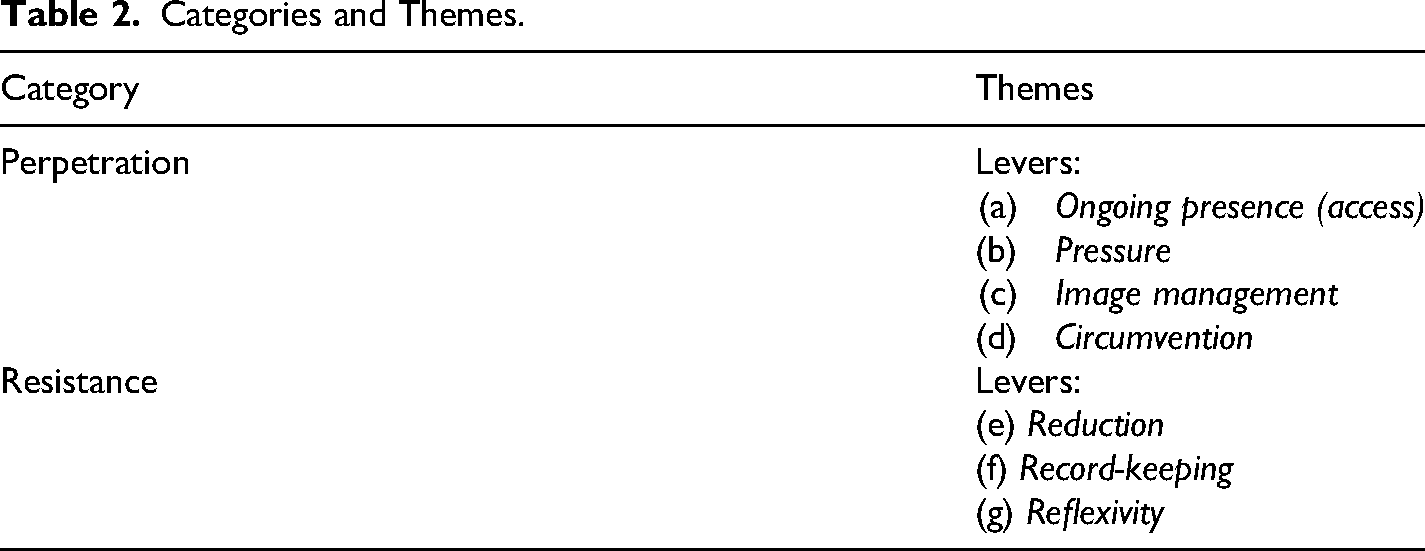
Participants spoke about a range of advantages and challenges that accompanied using a post-separation parenting app. Tactics for perpetration and resistance are explored below through the concept of levers. Levers emerged due to participant descriptions of the perpetrators’ tactics for exploiting and leveraging vulnerabilities in their communication strategies or in the apps. These methods were often resisted by participant's own strategic counter-levers. Findings are organised into the following two overarching categories: 1) Perpetration and 2) Resistance. Each category has its own set of sub-themes (see Table 2).
Categories and Themes.
Perpetration
Throughout the interviews it was reported that the perpetrator's underlying characteristics did not appear to have changed. Perpetrators were not construed as relinquishing control but rather as seeking different ways to pull the available levers to stay front of mind for the victim-survivor – whether that stemmed from: 1) their ready use of the post-separation parenting app to assert their presence, 2) their use of the app to pressure participants regarding coparenting arrangements, 3) the manipulation of communication for image management purposes, or 4) in a small number of cases, complete refusal to communicate through the app.
Importantly, although some of the perpetration levers described below might seem harmless relative to the preceding physical and psychological abuse, many participants conveyed acute distress from having to accept such ongoing, covertly coercive behaviours, particularly with respect to the implications for future court action on the part of the perpetrator (e.g., challenges to parenting arrangements). Seven participants reflected that using a post-separation parenting app had on the whole made their situation worse, while two had mixed experiences wherein some areas improved but others deteriorated.
Ongoing Presence (Access)
Although prosaic, an underlying lever that perpetrators must be able to manoeuvre is that of access to victim-survivors. For most participants, the introduction of a post-separation parenting app was intended to limit this access by ‘funnelling’ all communication through one secure platform. Regardless, numerous participants explained that once the post-separation parenting app was set up, it simply became a new way for the abusive parent to direct their behaviour. This was experienced as particularly egregious for participants who had a post-separation parenting app forced on them. For example, after a difficult separation process that involved seven attempts to leave, Melanie sought and was granted a no-contact protection order that covered both her and her children. The hard-stop on communication was described by Melanie as being instrumental in helping her to resist being re-drawn into the abusive relationship. However during subsequent family law proceedings, while acknowledging the history of violence and granting Melanie full parental custody (allowing her ex-husband limited supervised access), the judge wrote into the court orders that a post-separation parenting app could be used for parenting communication. This order overrode the no-contact conditions of Melanie's protection order and began to undo the work she had put in place restricting her ex-husband's access to her: “And then what it meant was that I had to show compliance with the orders, so I got the app… And that opened a mini floodgate because it was a court ordered app. He then felt that it was open season.” Melanie spoke about feeling unable to challenge the judge's decision, reflecting “you’re in a pretty powerless position”, and subsequently faced a “relentless” barrage of messages that made her distressed and hypervigilant. As she said, “this app thing on your phone [is] like a little time bomb”.
Melanie was among several participants who perceived a post-separation parenting app as facilitating the perpetrator's re-entry into their post-separation lives, providing a new mechanism through which controlling behaviours could be sustained. A number also spoke about the nuances of this access. For example, Freida and Emma noted tactics to do with the timing of messages. Freida found that her ex-husband could use the app's read-receipts to determine some of her daily habits and, with this knowledge, time his messages for maximum impact: “He's realised now that he can send me a message first thing in the morning, and he can figure out what time I get up in the morning [from] what time I open the message.” Emma, who had been separated for over seven years, spoke about her ex-partner's use of timing to deliberately sabotage events, ‘message bombing’ her while she was socialising. It used to be that when he knew that I was at work, or if the kids were at his house and they had said to him, “Oh Mum's got a work function on tonight or a party on tonight”, I would get a million messages. And it would just be [mimicking the sound of her app notifications] “beep, beep, beep, beep, beep”.
Pressure
For many participants a post-separation parenting app was put in place during their engagement with the legal system (see Table 1). This context, and the framing of the apps as immutable record keepers, may have endowed them with an inferred legitimacy as a source of evidence. In some cases, this appears to have inflated a perpetrator's perceived right to response or acquiescence from participants, over and above what was experienced through earlier communication formats (e.g., email and SMS). This was especially evident where the request for an app had not come from the victim-survivor, such as was the case for Naomi. She and her three children had been subjected to extensive pre- and post-separation violence from her ex-husband, and she had a protection order in place covering both herself and them. The family court granted her full-time care of the children, with no in-person father–child contact. Naomi's view was that a post-separation parenting app was suggested by the magistrate at the last minute to appease her ex-. She was directed to provide him with updates about the children at regular intervals through the year. Although her former partner often failed to respond to these court-directed messages when she sent them through the app, when he initiated a message to her, he demanded an immediate response: “…but it's always questions, “what are they doing?” And he’ll send the same message, copy and pasted three, four times if I don't respond.”
Emma also experienced this kind of pressure from her ex-husband. He went further, trying to use her lack of an immediate response to his messages to support his efforts to create a false narrative where he was a victim of DFV perpetrated by her. And if I don’t answer a question that's not child related, he will take a photo of it going, “You haven’t answered my question” and then put it under a family violence heading [a folder in the app] and say, “she is not answering me. This is family violence” or stuff like that.
Image Management
Although the impetus for app use was often related to safeguarding communication and creating a record for accountability, many participants observed that the perpetrator was unlikely to implicate themselves through obvious or explicit abusive behaviours, such as threatening her or name-calling. As Ingrid, who had been separated for seven years, put it: “He wouldn’t write a text message saying, “Why would you say that? You’re so stupid. You’re the worst mother in the world”, because he's clever. He knows that if he puts that in writing, I then have a record of it.”
While experiencing ongoing coercion through the apps, participants like Debbie shared insights about her perpetrator's ability to shift the way he communicated to appear benign and reasonable. If you do a thematic analysis of the words that are used between him and I, you will see that he, without any background or context, he looks like he is this very polite, very considered, very like, you know, “Hi, how you doing? Hope you're feeling better.” … [whereas] I provide no detail, no context. I give an answer. It is so curt. If you were to view this without any contextual background …. If we go back to court again, I will look bad.
In most instances, image-sabotage was thought to be for use in future legal scenarios. Although he wasn’t baiting her, Peggy felt that her ex-husband had been trying to leverage communication in the app to find out more about her life to make her look bad and to prepare for future court action. I don’t want to give him more information on our lives than I need to because that's what he wants more than anything is more ammunition, more material, more opportunities to prepare, like to present things a certain way….And yeah, I guess the coparenting apps maybe were also an avenue, maybe he was trying to also find ways to get extra things.
All such behaviours, and the fears they engender regarding future legal proceedings (even if never realised) resulted in high levels of anxiety with participants describing the need to maintain a state of vigilance.
Circumvention
While the majority of participants described the perpetrator as engaging with post-separation parenting apps as a way of continuing to perpetrate control, in a small number of instances it was their refusal to use these apps that was experienced as abusive and controlling. Rather than downloading the app or responding to messages in the app, these perpetrators would instead find ways to work outside of it, such as using the children as a go-between to communicate, or continuing to use other media. Louise had wanted to use a post-separation parenting app on the advice of her lawyer, but she found that although her ex-husband of over 18 years downloaded it, he refused to communicate in it. So, he just doesn’t use the app and it's very frustrating because I think anything that can be used against him, or that he feels like can be tracked or filed, he just won't use. So, he’ll just use verbal communication through the kids and the kids communicate to me using their text messages. You’re trying to provide for your kids in the way that they are used to being provided for. And someone who does not communicate at all, you’re left to the crevices of your own mind as to what the fuck is going on. So, the fact that he's gone quiet now actually unnerves me quite a bit because I don’t know if he's just going to come out of the woodworks suddenly and do something again, or if he's gone. Like, I can’t relax.
Resistance
Significantly, half of participants (n = 9) were positive about their experience with a post-separation parenting app – even in the face of ongoing coercion. The apps were spoken about as being instrumental to these participants’ abilities to, over time, introduce their own counter-levers to resist perpetrator harms, seek out justice, and recover. In all cases, successful use of a post-separation parenting app was accompanied by the participants’ deliberate and persistent use of the app features, and at times the use of third parties (e.g., lawyers) as support. The key counter-levers for resistance were the three ‘Rs’: 1) Reduction; 2) Recording; and 3) Reflexivity.
Reduction
While some perpetrators sought to perpetuate contact with victim-survivors through the post-separation parenting app, a key goal for many participants in this study was to minimise or eliminate all unnecessary contact and any excuses for engagement. Supporting one of the hypothetical app benefits noted in previous research – that of containment (Heard et al., 2023) – post-separation parenting apps were perceived to help on this front because of their multi-functionality. Having all or most child-related information and communication located in one place successfully met many participants’ goals for streamlining parenting communication and restricting the perpetrators’ pathways to engagement. This is reflected in Amy's reflections on how the app had improved things for her: “…It's just a standard process now and it has reduced the conflict and the amount of contact that I have to have with him, and if he says something's not there [on the app], I can just say “it is” – and it's just left at that.”
While the messaging component of the app was described by participants as being the main reason for this reduction, in varying ways participants also used additional app features, such as contact lists, shared calendars, and document uploads, to eliminate any justification that the perpetrator might use for contacting them, or for not fulfilling a parenting responsibility. For example, Olive, who had app use written into both protection and parenting orders, noted that being able to put her child's sporting and school schedule in the calendar stopped her ex-partner from having a reason to ask her questions about these events – something he had been using as a pretence to engage with her more broadly.
The success of this aspect of the apps was generally made possible through diligent boundary keeping and administrative management on the part of participants, who invariably had the responsibility of uploading this information and updating it as required. On the former point, several reflected that considerable initial work was required to enforce their expectations with their ex-partner about how the app would be used, and the nature of correspondence between them. More than one participant used a template-like response to re-direct the nature of communication to child-related topics, such as that used by Amy. When he gets really angry about something that's not even in the realm of the app, but obviously I’ve triggered him in some way, he will just come forward with, I don’t have a better description other than ‘verbal diarrhoea’…. I just continually shut it down and say “you don’t get to talk to me like that. This has been recorded. Only communicate to me relevant parenting issues”.
Record Keeping
Regardless of whether evidence from post-separation parenting apps was actually used in court proceedings, that this information was secure and unalterable was expressed as easing some mothers’ mental burden – helping them to feel more secure and more grounded going forward in their interactions. For Ingrid, knowing the app was capturing all their interactions gave her considerable peace of mind. If he does it in writing then I’ve got a record of it and I can then use that back against him, and I can send that directly to [specific professional] or call him out and go, “just to be clear, that email you just sent me was offensive”. I can call it out because I've got proof of it. …he put in his final affidavit that I don’t inform him on any of the children's medical or psychological appointments. And so we were able to pull out a list… we were able to go: “In three and a half years or so, the mother has sent 75 messages related to the children's medical appointments and blah”. So, it was helpful for the lawyers to just put that correct statistical information in, because so much muddies the water.
Even where the app data were not being used in court, some participants spoke about how in their situation, the record-keeping features diminished the perpetrator's ability to manipulate them. For example, Emma had experienced a history of gaslighting in her relationship. This resulted in doubting her own understanding of the abuse in her relationship and questioning whether perhaps the perpetrator was right and she had imagined things: “He used to do stuff like “I never said that. That never happened”, and so it's a way that I know I’m not going crazy. I know it's all in the app. I know I can refer back and it can’t be deleted and it can't be changed.”
Emma's ex-husband had previously gained access to other digital accounts (e.g., her email) and successfully deleted their communication history outside of the post-separation parenting app. Having a record she could trust was extremely important to her.
Reflexivity
A final theme to emerge from the interviews related to participant reflexivity. Participants frequently shared that having a post-separation parenting app aided them in thinking more clearly about whether and how they engaged with the perpetrator on any given topic. This ability to take pause, described by one participant as “stopping the cycle” (Amy), helped to keep their boundaries for minimal and purposive communication strong – and was particularly effective in instances where a perpetrator sought to goad an emotional response as part of their attempts at image management. The permanency of the app record was a key part of this. Freida spoke about how this feature helped her to keep herself in check and focus on parenting: “It makes me parent better and it makes me, forces me, to not react in an emotional state, but instead take time to calm myself down and then focus on the coparenting.”
Removing emotion from interactions came up in several interviews as a vital strategy. Olive explicitly referred to it as the “grey rock” method, while Ingrid, Laura, Louise and Quinn spoke about pursuing a business-like or flat-and-factual tone with their abusers. A range of creative methods were used to achieve this desired tone, including drafting messages thoughtfully in a separate space on the phone, writing an emotional response to vent but never sending it, having a friend read or draft replies, and in Gayle's case, co-opting AI tools to help formulate responses with a chosen tone. I’m a very emotional person. So, when someone comes at me, I’m going to speak emotionally because obviously that hurts. Words hurt. Whether they’re said to you or you’re reading them, words hurt. Since I started using it [the AI tool], I was like, ‘Why didn't I do this sooner?’. This has helped out so much, especially trying to get out what I'm trying to say without sounding emotional.
This kind of communication mastery was seen as a way of not only thwarting a perpetrator's attempts to bait and engage through the app but, for some victim-survivors, of freeing themselves from what had been a normative way of interacting with their abuser – a conditioning effect of the coercive control that had shaped the relationship. This is reflected below in quotes from Olive, Emma, and Naomi: So, it was learning to take a step back and going “OK well, he's giving me that information. I'm going to sit on it for a while and not let my emotions control my response”. …[because] if I didn’t respond to him or engage with him immediately when we were married, it would upset the apple cart. … I think it took me a long time to learn that I don’t have to explain myself. I don’t have to have him understand. All I’ve got to do is be factual and honest, and keep emotion out of it, yeah. And that's what this helps you do as well. 1 don’t actually have to respond to him at all… So there are a lot of things that I think after years of that relationship, you just don’t realise and you don’t do naturally because you've become really used to certain patterns of behaviour.
For these participants, the permanency and perceived legitimacy of the app record, combined with the ability to take stock before replying to a message, became important counter-levers to help them achieve the optimum result for their own wellbeing and safety – with the added advantage of helping to keep the focus on coparenting.
Discussion
Drawing on interviews with 18 separated mothers, the present study aimed to build on existing knowledge of coparenting communication in a DFV context as well as to amplify the voice of victim-survivors who have been able to proactively harness technology to their benefit. No single dominant narrative emerged: while half the mothers (n = 9) interviewed ultimately found a way to use post-separation parenting apps constructively and protectively, the other half spoke about them as contributing to ongoing experiences of violence (n = 7) or conveyed mixed experiences (n = 2).
A Battleground for Control?
After separation, a perpetrator may seek to maintain their control of a victim-survivor, while that victim-survivor seeks to regain control for themselves. The present empirical study found that post-separation parenting apps can, unintentionally, become a locus for this struggle. Seeing post-separation parenting apps as both a weapon and a shield in the context of DFV is a reminder of technology's dual potential to both enable resistance as well as harm, depending on how it's used and the context of use (discussed next). Arguably, those who design and recommend such apps should bear this inherent tension in mind and consider how to maximise the chances of victim-survivors and children benefitting.
Legal Context
A recurring thread running through most of the themes in this study is a fear that the communication in the app would be misused to further the perpetrator's legal-abuse agenda. This fear is consistent with that expressed in other research on DFV post-separation (e.g., Archer-Kuhn et al., 2024; Dragiewicz et al., 2021b). The legal context for introducing a post-separation parenting app is of significance in this respect. While it has been identified previously as a theoretical risk (Smyth et al., 2023), the present study demonstrates empirically that in some scenarios, such apps can be experienced by victim-survivors as enabling ongoing coercive control and legal abuse through the legal system. The highly-touted record-keeping features (the immutable data and data export) combined with the legal setting in which they are typically introduced (e.g., suggested by lawyers, mandated in courts) can give rise to an inference – by both perpetrators and victim-survivors – that the apps have additional legal clout. Whether they do have extra probative weight in court is not known, but this inference may underpin some perpetrators’ controlling behaviours on the apps and some victim-survivors’ anxieties about the implications of those behaviours. In light of ongoing debates around the criminalisation of coercive control in Australia and internationally (see for example McMahon & McGorrery, 2020; Walklate & Fitz-Gibbon, 2019), the potential for apps such as these to be weaponised against victim-survivors is important to consider.
Harm Resistance
Allowing victim-survivors voice on harm-resistance was a central aim of this study. Consistent with a small body of research exploring women's agency and resistance work within abusive relationships (see for example Boxall, 2023; Goodman et al., 2005), participants in the current study implemented adaptive and creative strategies to mitigate the impacts of the abuse, and close down opportunities for ongoing abuse. One of the most powerful and novel harm-resistance strategies spoken about was in respect to reflexivity. A number of participants spoke compellingly about using the apps to communicate more mindfully and to maintain their own boundaries (not just the perpetrator's) regarding coparenting interactions. This was especially important in situations where participants felt that they were at risk of responding in a heightened emotional state, or were being ‘baited’ by the perpetrator to do so. Emotional reactions were of concern to participants on multiple fronts: as giving more power to the perpetrator (showing that they had the power to cause distress); as potentially resulting in emotional entanglement with the perpetrator (promoting back and forth communications and feeding the perpetrator's desire for connection); and most compellingly for participants, that emotional outbursts would be weaponised against them in future legal proceedings – making them look unstable or as though they were the aggressor. This app-facilitated reflexivity enabled some participants to experience a form of empowerment in their refusal to be goaded, undermining the perpetrator's attempts at image-sabotage. It also allowed for efficacy in keeping their interactions focussed on children, and liberation from the established pattern of response to the perpetrator.
It is important to note that while post-separation parenting apps are potentially powerful aids for resistance, all 18 participants spoke of managing communication through them as requiring significant mental and administrative effort, with one describing it as “like a full-time job” (Bee). The cost of this ‘safety work’ 5 is consistent with that noted in other research on technology facilitated abuse (Dragiewicz et al., 2021a), and similarly raises questions about structural responses that place the onus for safe practices on victim-survivors rather than on perpetrators or systems (e.g., protection orders).
Implications
The findings of this study have important implications for victim-survivors and the practitioners who support them, particularly those who work in a family law context. However, this research also underscores a broader systemic issue wherein victim-survivors are increasingly expected to manage perpetrators through digital tools that, at best, offer only partial protection. As such, the research calls for improved support for victim-survivors who are in this position and more interventions that address the underlying problem: the perpetrator's behaviours.
That said, in the absence of perpetrator interventions that are consistently effective in bringing about desired behaviour change (see for example, Akoensi et al., 2013; Dowling et al., 2018), some women described post-separation parenting apps as a pragmatic tool for mitigating the impacts of the abuse they were experiencing, even if only to provide them with an effective method for recording information that could then be submitted to court as part of future anticipated legal processes. In such cases the role of legal practitioners is not to prescribe or prohibit their use, but to support women to do so safely and with a clear understanding of both the advantages and limitations of the technologies. This is consistent with long-standing arguments that DFV practice involves working with victim-survivors of abuse, rather than for them, the latter being critiqued for paternalism and potentially contributing further to the disempowerment of victim-survivors (Cattaneo et al., 2021; Goodman et al., 2016). Taking this principle one step further, there would be considerable benefit in co-designing post-separation parenting apps with victim-survivors of abuse to improve their safety and utility, and minimising opportunities for weaponisation.
Study Limitations
Three study limitations need to be particularly borne in mind. First, the results are based on a small, non-probability purposive sample. In no way is it assumed that they are generalisable to other DFV populations or to the general population of separated parents in Australia. A larger, diverse random sample is needed to explore whether these findings hold across different demographic groups and settings. Second, the study captures the perspectives of mothers and victim-survivors only and there is, necessarily, conjecture regarding motivations behind the actions of the perpetrator. Finally, this research provides only limited insight into the outcomes for children involved.
Future Research
In addition to the areas for future research already noted above, there would be value in reproducing the present study with a larger sample in other locations, and with greater emphasis on how app use benefits or disadvantages children. Research might also focus on the potential efficacy of these apps as an intervention for safety (physical and psychological) and in respect to deterrence of perpetration. In particular, evaluating the outcomes of app-use in situations where they are mandated in court would be valuable.
Conclusion
This exploratory research has illuminated the complex and somewhat paradoxical role that post-separation parenting apps can play in the lives of victim-survivors navigating post-separation domestic and family violence. While these apps have the potential to mediate harm, enabling perpetrators to exert control through covert tactics, they can also provide spaces for resistance: offering significant opportunities for some victim-survivors to regain agency. The record-keeping functionality emerged as a central feature in both perpetuating harm and enabling resistance – reinforced by the legal context in which most participants were introduced to an app. This study contributes to the growing body of literature on digital technologies in the context of domestic and family violence, and highlights the need for further investigation into how these tools can be more effectively designed and leveraged to support victim-survivors while minimising their potential for misuse.
Footnotes

Funding
The authors received no financial support for the research, authorship, and/or publication of this article.
Declaration of Conflicting Interests
The authors declared no potential conflicts of interest with respect to the research, authorship, and/or publication of this article.