



Abstract
This study explored adult victim-survivors’ experiences of reporting sexual violence to police in Australia, focusing on their suggestions for supporting future victim-survivors. By drawing on feminist standpoint theory, qualitative interviews with 26 victim-survivors indicated a range of experiences, yet strikingly similar concerns and suggestions for improvement. Using reflexive thematic analysis, key themes included the importance of interview room settings; the interviewer's interpersonal care; the presence of support people; and further investigative support when victims felt like investigators. The study offers both short-term and longer-term suggestions for supporting victim-survivors in sexual offence investigations, with a focus on minimising secondary victimisation.
Internationally, it is well-established that sexual violence is under-reported to police, and that reported cases of sexual violence rarely make it past the police investigative stage when interviews with victim-survivors are conducted (Bright et al., 2021; Daly & Bouhours, 2010; Hohl & Stanko, 2015; Murphy-Oikonen et al., 2022a; Venema, 2016). In common law countries such as Canada, the United States, Australia, Scotland, England and Wales, research has found that only about 30% of reported sexual offence cases proceed to prosecution, and from there, approximately 6% are convicted of the original offence charged (Daly & Bouhours, 2010). More recently in the Australian Capital Territory, research indicates that only 7% of reported sexual offences proceeded to charge in 2021 (Burgin & Tassone, 2024). It also highlighted that 42% of sexual offence cases were closed via ‘victim withdrawal’, with a Police Process Review demonstrating that many victim-survivors disengaged due to finding the police process distressing (Burgin & Tassone, 2024).
When victim-survivors report sexual violence to police, they often experience retraumatisation or secondary victimisation (Bond & Davis, 2024; Maier, 2008). Secondary victimisation (also described as the ‘second rape’) involves a second wave of trauma due to the way in which victim-survivors may be treated by police and system personnel (Campbell et al., 2001). Victim-blaming attitudes and behaviours that are dismissive of victim-survivor's accounts are often the hallmarks of responses that contribute to secondary victimisation (Campbell et al., 2001; Patterson, 2011a; Venema, 2016). Victim-survivors may be disbelieved by police and perceived as seeking attention or revenge. Such negative treatment can increase feelings of shame and psychological distress, with victim-survivors rarely given access to legal or emotional support services as part of the criminal justice response (Bond & Davis, 2024; Victims of Crime Commissioner, 2023).
Those from marginalised communities, including lesbian, gay, bisexual, trans, queer (LGBTQ) and culturally and linguistically diverse (CALD) people tend to face additional challenges when reporting sexual violence to police. For example, police may subscribe to stereotypes and rape myths that minimise sexual violence against LGBTQ + people (Mortimer et al., 2019). Normalisation and minimisation of sexual violence in LGBTQ + communities can also act as a barrier for people recognising and labelling their experiences as sexual violence (Hindes et al., 2025). Additionally, fears of reporting to police are often exacerbated for CALD and Aboriginal and Torres Strait Islander victim-survivors due to colonisation and ongoing systemic violence related to racial discrimination (Murphy-Oikonen et al., 2022b; Taylor & Putt, 2007).
The current study draws on feminist standpoint theory, which focuses on the lived experiences of women and marginalised groups—in this case, victim-survivors of sexual violence. Feminist standpoint theory recognises the lived experiences and perspectives of women and marginalised populations as an expert source of knowledge (Harding, 2012). It acknowledges that those who structure and run dominant systems, such as the criminal justice system, are seldom the users of those systems (Edmonds-Cady, 2009). Therefore, it is crucial to gain the standpoints of system-users if we are to meaningfully change policies, practices and overarching systems.
To date, police interview practices in sexual offence cases have tended to be guided by the expertise of cognitive and forensic psychologists and legal professionals (Ali et al., 2019; Fisher & Geiselman, 2010; Gajadhar & Bull, 2023; Ministry of Justice, 2023; Westera et al., 2023). While these perspectives are undoubtedly important for understanding memory-enhancing techniques and the legal quality of interviewee's statements as evidence, prioritising victim-survivors’ voices and experiences is vital for developing supportive interview practices that do not contribute to retraumatisation. As Pollino (2021) explains, while each victim-survivor's perspective is unique, feminist standpoint theory allows us to see the connections between people's experiences, and in turn, the broader barriers to achieving support and justice. It also allows us to see what is missing and imagine what needs to be developed to better support victim-survivors’ needs.
Legally, when people report sexual violence to police, they are referred to as a witness or complainant. In this article, however, we use the term victim-survivor to acknowledge people's lived and living experience. From the outset, this research seeks to validate victim-survivors’ experiences and adopt a victim-centred approach that prioritises the perspectives of interviewees in the investigative process. We also tend to use the term victim-survivor to indicate the spectrum of identities following sexual violence (see Pollino, 2021 and Rosenberg, 2024 for insightful discussions on the terms victim and survivor).
This study is also informed by intersectional feminism, which considers how aspects of social identities, such as race, gender, socio-economic status, ability, and others, intersect to create unique experiences of oppression and/or privilege (Crenshaw, 1989; Tripathi, 2023). Intersectional frameworks emerged in response to traditional feminist paradigms, which typically centred the experiences of white middle-class women, with a failure to consider more diverse experiences of disadvantage, power and injustice. Subsequently, intersectional feminist frameworks tend to encourage more inclusive and nuanced approaches to research and practice (Atewologun, 2018).
Victim-Survivor Experiences
Over the last decade we have started to see increased attention paid to victim-survivors’ experiences of reporting sexual violence, both internationally and in Australia (Greeson et al., 2014; Hohl et al., 2023; KPMG, 2023; Murphy-Oikonen et al., 2022a; Patterson, 2011b; Powell & Cauchi, 2013; Rudolfsson, 2024; Webster & Oxburgh, 2021). In Sweden, for example, Rudolfsson (2024) interviewed 13 victim-survivors to examine their experiences of reporting rape to police. Salient themes were that victims did not feel prioritised by police or that their cases had been investigated thoroughly. When a victim had a more positive experience, they felt it was the luck of the draw, and they felt guilty that other women did not have a similar experience. Likewise, qualitative research with 14 victim-survivors in Canada found that the investigative process was often overwhelming, exhausting, and unsupportive for victim-survivors, with police frequently asking accusatory questions (Murphy-Oikonen et al., 2022c). Both Indigenous and non-Indigenous victims felt responsible for providing evidence to convince police to believe them (Murphy-Oikonen et al., 2022c).
In England and Wales, a recent survey of almost 2000 victim-survivors revealed mostly negative experiences of reporting sexual assault to police (Hohl et al., 2023). Many victim-survivors felt that they were not taken seriously by police, and both their mental and physical health declined as a result. Black and ethnic minority victim-survivors reported significantly worse police experiences than white victim-survivors; for example, they were less likely than white victim-survivors to report that police had looked into all the evidence or made them feel comfortable. Victims who had positive experiences described police responses that were marked by kindness, empathy, and care to undertake a thorough investigation (Hohl et al., 2023). A smaller in-depth study of five victim-survivors in the United Kingdom similarly indicated that victim-survivors valued feeling heard and believed by police, having transparency about investigative processes, and communication from an officer with a genuine commitment to the case (Webster & Oxburgh, 2021). These principles, along with officer behaviour marked by respect and dignity, equity and fairness, safety, and trustworthiness are also integral for victim-survivors’ sense of procedural justice during the investigative process (see Johnson et al., 2025 for an in-depth discussion of a victim-centred procedural justice theory).
In Australia, we have recently seen a string of reports detailing victim-survivors’ experiences of reporting sexual assault to police (Burgin & Tassone, 2024; KPMG, 2023; Victims of Crime Commissioner, 2023). In New South Wales, 34 victim-survivors provided insights into their criminal justice experiences after reporting sexual assault to police (KPMG, 2023). Positive experiences were characterised as feeling validated and informed, having access to specialist detectives, and continuity of an investigator. Negative experiences involved feeling judged, shamed, rushed, being asked intrusive questions without explanation, and having a lack of information following a report (KPMG, 2023). Similar findings were echoed in research in Victoria, with 68% of victims (n = 156) stating they did not receive enough useful information from police to participate in the criminal justice process (Victims of Crime Commissioner, 2023). Albeit the Victorian study looked at victims of crime more generally—not solely sexual offence victim-survivors.
Currently, in Australia, there are multiple ways that a report of sexual violence might be handled by police. Reports are often initially taken by generalist police with basic training who may (or may not) refer the matter on to more specialised investigators, who are part of a child abuse or sexual crime unit. Specialised investigators typically receive more advanced training on the dynamics of sexual offending, how memory works, and best-practice interview techniques (Dowling, 2024; Hamilton & Tidmarsh, 2022; Tidmarsh, 2021), however, this training is not consistently mandated by police agencies (Australian Law Reform Commission [ALRC], 2025). Each state and territory have its own code of practice for the investigation of sexual crime and how interviews are conducted (Dowling, 2024). Police tend to be guided by a cognitive interview framework for victim-survivors (Ali et al., 2019; Hamilton & Gerryts, 2025). We are also starting to see the adoption of the ‘Whole Story’ framework (especially in Victoria), which emphasises a trauma-informed investigative approach that contextualises a victim-survivor's account within the broader pattern of a perpetrator's behaviour, rather than focusing on isolated incidents (Tidmarsh, 2021). However, such an approach may be inconsistently applied. While police are expected to adopt a supportive approach during an investigation, they are also expected to refer victim-survivors to external support services, such as sexual assault counselling (Dowling, 2024).
The Current Study
This qualitative study aimed to explore adult victim-survivors’ experiences of police interviews in sexual offence cases and their suggestions for improvement. While other studies have focused on specific states or territories in Australia (KPMG, 2023; Powell & Cauchi, 2013; Victims of Crime Commissioner, 2023), this nation-wide study invited victim-survivors from across Australia to reflect on their police interview experiences. It also made efforts to include culturally and linguistically diverse victim-survivors. As Lorenz and Jacobsen (2021, p.19) have argued, “we must include and amplify the experiences of survivors in marginalized groups in research that informs decisions of criminal justice reform seeking to improve police-survivor interactions and encourage safe and restorative reporting practices.”
This study also had a focus on suggestions for supporting future victim-survivors in sexual offence interviews. Other studies have tended to consider victim-survivors’ interactions with police and the criminal justice process more broadly (Greeson et al., 2014; KPMG, 2023; Rudolfsson, 2024), whereas there are comparatively few studies that focus on police interview experiences specifically. The victim-centred and feminist standpoint approach of this project is needed to make progress in the field of investigative interviewing—to generate nuanced insights and practical ideas for interviewing victim-survivors in sexual offence cases in a way that minimises retraumatisation. Investigators play an important role and may be the first responders or people with whom a victim-survivor may have contact with following their (often harrowing) experience. How a police officer responds to a report of sexual violence can have a long-lasting impact on victim-survivors, both in terms of their mental health and well-being, and their legal case outcomes (Spohn & Tellis, 2019; Venema, 2016). Interviewing victim-survivors in sexual offence cases has been identified as one of the most challenging aspects of policing (Murphy-Oikonen et al., 2023; Rudolfsson, 2022), therefore, it is important we concentrate on practical recommendations (both short-term and long-term) to guide investigative practices and improve reporting experiences for victim-survivors.
Method
Recruitment
The project was approved by RMIT University′s Human Research Ethics Committee. Victim-survivors were invited to participate in an interview with the lead researcher if they were at least 18 years old and above and had participated in a police interview in Australia in the last five years regarding sexual violence. Recruitment flyers were translated into five languages (English, Arabic, Punjabi, Vietnamese and Simplified Chinese) to reach different communities across Australia. CALD participants were given the option of completing the interview with an interpreter. The recruitment flyers were circulated on social media via project pages on LinkedIn, Facebook, and X. They were also circulated by key organisations and advocacy groups that work with victim-survivors of sexual violence across Australia (e.g., via e-mail and Instagram). Some physical copies of the recruitment flyers were also posted in public spaces like libraries and universities.
Participants
The final sample comprised 25 women and one non-binary person, with ages ranging from 21 to 56 (M = 36, SD = 9.75). Participants identified their sexuality as straight/heterosexual (61.5%), part of the LGBTQ + community (31%), or unsure (7.5%). Participants self-defined their racial backgrounds and identities as Armenian/Irish Australian (1), Indian Australian (2), Pacific Islander (1), Aboriginal (1), Asian (1), Chinese/Asian (2), White Settler Australian/Sri Lankan (1), Irish/Welsh (1), Welsh/English Australian (1), Irish/Australian (1), Caucasian/Slovenian heritage (1), Caucasian/Scottish (1), and White/Caucasian Australian (12). Three participants had migrated to Australia from Asia in the last 10 years.
Victim-survivors had been interviewed by police from across Australia: Tasmania (1), Northern Territory (1), Australian Capital Territory (1), Western Australia (3), Queensland (5) New South Wales (5), and Victoria (9), while one participant had experienced interviews in both Victoria and Western Australia. We respected victim-survivors’ agency in whether they wanted to share details about their victimisation experiences. Most participants organically raised this information when discussing their reporting experiences, indicating that sexual violence had occurred in a range of contexts, including intimate partner sexual violence, historical child sexual abuse, institutional sexual abuse, police-perpetrated sexual violence, and sexual assaults perpetrated by siblings, acquaintances and strangers.
Procedure
The research interviews took place between March and July 2024 and lasted approximately one hour each. With respect to participants’ preferences, twenty of the interviews were conducted online via Microsoft Teams, four via telephone and two in-person. All were one-on-one interviews with the lead researcher, while one also included an interpreter to facilitate communication in the participant's native language.
The semi-structured interviews broadly asked about victim-survivors’ experiences of police interviews, with follow-up questions on what interviewees found helpful during the police interviews, and what they wished the police interviewers had have done differently. Participants were also asked if they had any other suggestions or ideas of how to support future victim-survivors in police interviews. The researcher used victim-centred research guidelines to support participant safety throughout the interview process (e.g., Campbell et al., 2009). This involved giving victim-survivors flexibility and agency to share what they felt comfortable talking about and providing options for follow-up support post interview (either through a debrief with the researcher, or with external support agencies). Participants were also notified they could pause, take breaks, skip any questions, and speak at their own pace, confidentially, with a researcher who was not connected with a policing organisation. They were able to choose their own pseudonym, check interview transcripts, and were compensated with a $100 digital gift voucher for their time and vital insights.
Analysis
With permission from participants, the interviews were audio-recorded, transcribed by a professional agency, and de-identified. The lead researcher followed Braun and Clarke's (2021) approach to reflexive thematic analysis. This involved immersion in the data and inductively combing through the interviews to generate codes and initial themes, while systematically recording key quotes using NVivo software. This process took weeks of careful reading, coding, and synthesising. Final themes were developed, enriched, and refined through editing and discussions with the co-author. For example, initial codes like ‘positive interviewer behaviour’ and ‘negative interviewer comment’ came together to reflect the heart of the theme: ‘interpersonal support and care.’ While victim-survivor participants had unique backgrounds and experiences, the themes represent shared experiences, thoughts and hopes, or as Rudolfsson (2024) has described ‘crystallized conceptualisations’ of people's complex experiences (p. 3167).
In the spirit of reflexivity, the authors identify as cis-gender women with feminist values. Importantly, the co-author is from a CALD background and has experience of reporting sexual violence to police, which adds a layer of lived-experience expertise to the interpretation of the data and framing of the paper. Throughout the paper, however, we are cognisant that each participant's experience of reporting sexual violence to police is unique and nuanced, and we are passionate about including a diverse range of voices in the results (see pseudonyms attached to each quote below).
Results
Overall, the victim-survivor participants had mixed experiences of police interviews, with some ranging from ‘incredible’ to ‘horrible and ‘traumatic.’ A word cloud is used below to depict the varied experiences and descriptions (Figure 1). The victim-survivor participants were keen to offer suggestions for how to support future victim-survivors in investigative interviews. When talking about the policing response to sexual violence, Bec emphasised the importance of listening to victim-survivors: “it's not going to change without the input of victim-survivors”. The following results focus on four key themes: (i) interview room environments, (ii) interpersonal support and care, (iii) support people, and (iv) victim-survivors as investigators.
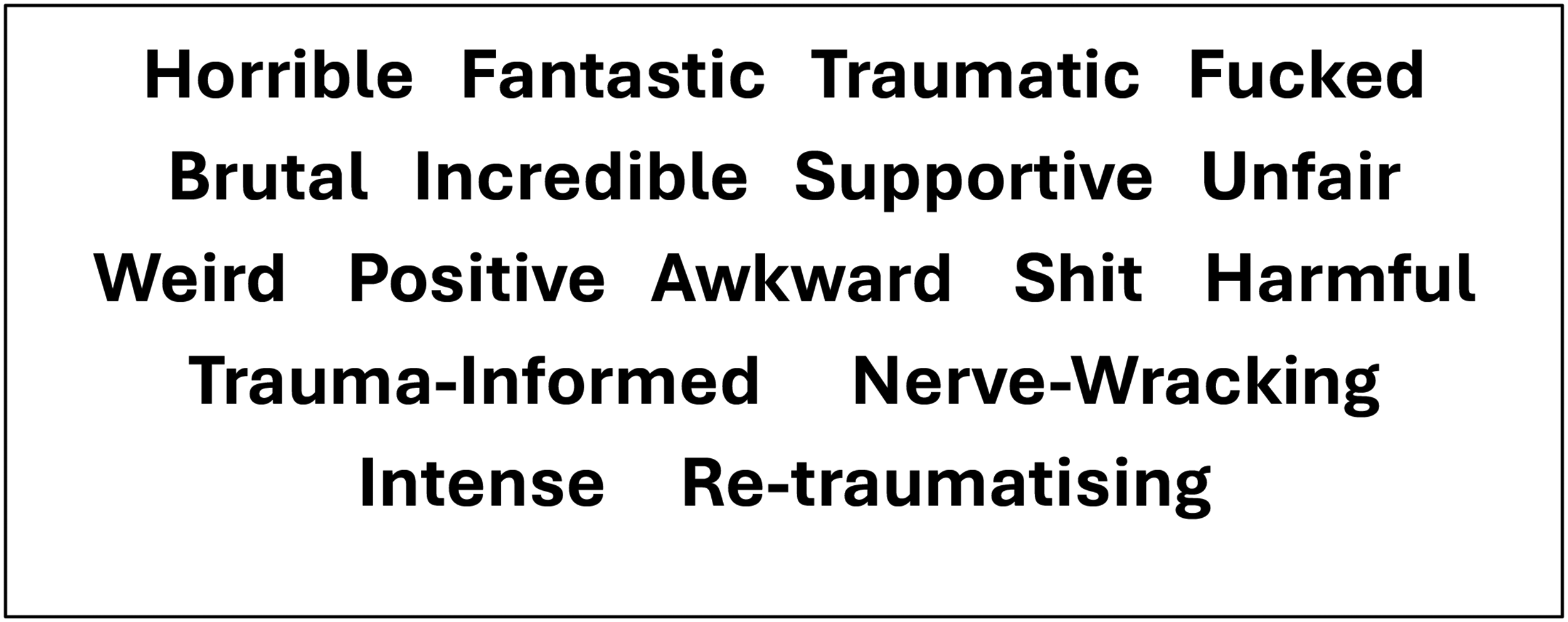
Word cloud of victim-survivor descriptions of police interview experiences.
“Like a Cupboard”: Interview Room Environments
Almost all the victim-survivor participants brought up the rooms and physical spaces in which they were interviewed by police. They used a wide variety of adjectives to describe the interview rooms: clinical, stark, cold, horrible, uninviting, creepy, sterile, daunting, windowless, disgusting, ugly, intimidating, grey, scary and inhospitable, with Karina describing the room, “like a cupboard”. Thena relayed having to sit on a hard uncomfortable chair for six hours while Margaret remembered the harsh “fluorescent lighting” and “smell of pee”. The negative interview room environments within police stations were often not conducive to victim-survivors feeling safe, relaxed, and comfortable speaking about sexual assault. For example, Violet and Lola described, respectively:
“It's almost like an interview room for a perpetrator, but it was in an office. I think it needs to be a more relaxed kind of setting where you feel safe because you feel like you’re going in as a perpetrator, and you’re going in to probably have one of the hardest conversations of your life, and it's a very clinical, cold kind of environment that doesn’t help”.
Walking into a police station is already quite daunting. Then you walk into the office that is not very comfy or homey, very stark and clinical. It doesn't set you up in the right headframe to want to disclose things. It kept me very anxious and on edge. I felt like if the room itself was more inviting that maybe I would have felt a little bit more comfortable physically, then that would have made me more comfortable disclosing information as well.
Some emphasised the disjuncture between trauma-informed interviewing techniques and the unwelcoming interview room environments. For example, interview protocols in Australia and abroad often guide interviewers to communicate, “you are safe here and in control” (Hamilton & Gerryts, 2025) or “I want you to feel comfortable” (e.g., Ali et al., 2019), but these prompts are rendered futile if the physical interview environments do not feel safe or comfortable for victim-survivors.
While the interview environments were largely problematic, two participants reflected on more positive experiences. For example, Bec and Drew mentioned how sitting on couches made a helpful difference to the reporting process. Drew also described a more welcoming environment with artwork, a TV, and a fridge with food and water. Several neurodiverse participants also suggested that the addition of sensory tools like fidget spinners or playdough would be an excellent way for interviewees to keep their hands occupied and relieve some anxiety while talking about triggering details. They emphasised that such tools would be helpful for both neurodiverse and neurotypical interviewees, as it was recognised that most interviewees would likely be feeling traumatised and anxious during police interviews. Other suggestions included warmer lighting, plants, heat packs, weighted blankets, cushions, and diffusers with pleasant smells to help create a more comfortable and sensory-friendly interview environment.
Interpersonal Support and Care
When reflecting on their police interview experiences, the majority of the victim-survivor participants raised the interviewer's interpersonal skills and demeanour as a key marker of whether they felt supported. For those who had positive experiences, they described their interviewer as kind, compassionate, reassuring, warm, genuine, non-judgemental, friendly, empathetic, sensitive, and understanding. Importantly, victim-survivors valued when interviewers were validating and expressed belief in their accounts. This was either through direct expressions of affirmation (e.g., “we believe you”; “it's not your fault that this happened”) or indirect expressions to show the investigator was on the victim-survivor's side and invested in their case. For example, Eloise mentioned how investigators called her perpetrator an “arsehole”, describing, “that made it feel that they were listening to me and that I wasn’t the problem”. Similarly, Yasmin appreciated that the investigator scoffed and shook their head after she described the perpetrator's actions. She said, “it made me feel like he really was listening and understood where I was coming from”. Rose also described the positive interpersonal attributes of her interviewer: I could just tell that she cared…I could tell that she hated the person that had done it, and that she was really invested in our justice. I could just tell in every interaction that I had with her that she cared and that she was really invested in our wellbeing and more than is required of her. She was so good at checking in. She was very available. I felt that I could call her anytime. She never made me feel like I was a burden or that I was taking up her time or anything like that. She was just fantastic.
Some of the victim-survivor participants explained how the interviewer's interpersonal responses often impacted how much information they disclosed during investigative interviews. At times, victim-survivors tested the waters to see what would be safe to share. For instance, Scarlette explained how investigators “showed signals of cultural safety” and “safe sentences that didn’t show signs of victim-blaming” which allowed them to feel more comfortable disclosing intimate details. Likewise, Shema (a migrant woman) explained that sexual violence is a taboo subject in her South Asian culture, and she felt very uncomfortable reporting it to the white male investigator, who made little effort to facilitate the process. She articulated: When I went to the police station, I didn’t feel comfortable. I didn’t feel like they were going to believe me. I didn’t feel supported. I was shy and I didn’t feel comfortable to discuss what I wanted to…They don’t give me an environment to discuss. And then I just ended up saying, “Oh, okay” I didn’t report that much. I mean, I didn’t report anything about sexual assault that happened during that relationship. I didn’t tell at all. Even when she's done things that are problematic, she's been brilliant at being accountable to that and focussing on the impact of what's happened and trying to be curious about what's happening and open up that next bit… because I come in expecting it's going to be a million mistakes and problematics that happen, but how does someone respond to those ruptures—it's really key.
“I Felt Less Alone”: Support People During Investigative Interviews
The presence or absence of support people was a key topic raised among the victim-survivor participants, with many recounting varied experiences during police interviews. Some victim-survivors had been offered social workers, while others were able to choose their own support people. Many were not notified of the option for a support person and described the investigative interview experience as “isolating” (Sarah) and “lonely” (Eloise and Scarlette). Shema relayed how police had been discriminatory in failing to offer a support person: “I’m a migrant woman. Even if available, even if they should offer me, even it's my right, but I didn’t get one. Because I’m multicultural, so that facility is not for me. That was for the other women who were born in here…Colour is a factor to get the help”.
For those given the option to bring their own support person, this choice was often challenging, and laden with restrictions and difficult considerations. For example, many were not able to bring their closest support people as these people would also be witnesses in the case. Pat felt like she would be burdening friends and family by involving them in the interview and spoke about not being able to afford a private therapist to bring instead. Similarly, June (an international student) had no family in Australia, and did not feel comfortable disclosing to friends. She expressed, “I have to take care of myself. I'm a girl here studying alone in Australia and they [my family] will be not happy… if I let them know they will worry about my situation. So that's why I just try to figure it out by myself”.
Many of the participants recommended that independent support people could help to substantially improve investigative interview experiences for victim-survivors. Some envisaged this would involve a professional advocate (like a social worker) connected to the system who could “help walk you through the process” and “navigate any tricky moments or language problems that come up in the interview” (Karina). Others spoke about the benefits of having a peer-based advocacy service where people with lived experience could support each other. For example, Violet explained: “There's a connectedness to these people that also have a lived experience that's different from a worker, because as soon as you put a worker in that space, there's an imbalance of power, so you really need to have those trained, lived experience people there”.
Likewise, Erin imagined a peer-based service as, “an army of volunteer women who sit down with a cuppa and Tim Tam.” She commented, “I’m happy to big sister anyone through this and I’m sure there is a lot more of us, very angry women”. Two CALD participants, Shema and Shulan, also expressed a preference for having a support person who is of the same gender and cultural background as them, explaining it would help them to feel more comfortable talking to police about sexual assault.
The positive impacts of having a support person during an investigative interview were clear from several of the victim-survivor accounts. For instance, Drew said having a support person helped her to feel “less alone” and “supported enough to completely disclose everything”. Lola also articulated: I hadn't gone through anything like this previously, so it was all brand new. It was all extremely nerve wracking but because I was allowed to have a support person with me, I felt like I was in good hands. I felt like if I didn't have that support person with me, I would have broken down way sooner. I don't think I would have coped very well with the questioning and the intenseness of it all if I didn't have someone with me.
Victim-Survivors as Investigators
When reflecting on their police interview experiences, many of the victim-survivor participants wished they had been provided with further investigative support. Most of the victim-survivors relayed having to collect evidence or undertake investigative work in their own case. For example, victim-survivors found themselves having to prompt police to obtain CCTV footage, speak to potential witnesses, have samples tested, secure a crime scene before it was cleaned, take photos of injuries, listen to phone recordings, read diary entries, and preserve forensic evidence. Many also ended up educating police about memory, trauma and the impacts of drink spiking, and guiding lines of questioning during investigative interviews. The participants often felt that police were not being proactive with the investigation, and that victim-survivors had to do parts of their job. For instance, Rachael remarked, “I had to do my own investigation” and Bec, “I did a fair bit of their job. I feel like I was doing a lot of the actual work across the whole investigation”. Eloise also summarised the many roles that victim-survivors had to play during the case: “You have to be everything. You have to be the police. You’re the victim. You’re the survivor. Then you’re also the investigator. You’re the evidence collector”.
For Shulan, she felt that she needed to collect her own evidence to show the perpetrator's pattern of offending, and to demonstrate that she was not the perpetrator. She perceived that police had given up on her case before they had even started, commenting, “because of insufficient evidence they are not proceeding, but they actually never require for the evidence to be obtained”. In Margaret's case, police requested that she searched for the identities of the offenders on social media and organise pre-text calls (which police later failed to adequately record). The lack of police investment in the case placed an additional burden on Margaret and meant that she had to stay wary about the evidence-gathering process. She described: From the moment that I arrived in the police station I wasn’t completely sure that she was aware about preserving forensic evidence. I kind of felt like I have to be really on my guard with the police and make sure they’re doing their jobs. I haven’t trusted them. I haven’t trusted them to care enough. I haven’t trusted them to be professional enough. I had to make sure that I preserved evidence myself and did everything that I could as well as I could. “It's really good to not have to put workload burden on victims of crime because they are already dealing with so much exhaustion, brain fog, distress, and everything that comes along with these processes”.
For many of the victim-survivor participants, one of the main reasons they had reported to police in the first place was to relieve some of the responsibility and pressure of thinking about the case. As Goldie stated, “the biggest weight off my chest was I don’t have to be the detective anymore”. While there are a range of therapeutic support options for victim-survivors, there are a lack of investigative support options (aside from the police). This makes it difficult for victim-survivors when police are not able to provide adequate investigative support and victim-survivors end up doing this work themselves. Implications for investigative work in sexual offence cases will be discussed in turn.
Discussion
This qualitative study sheds light on a range of police interview experiences from the perspective of adult victim-survivors of sexual violence in Australia. The study builds on emerging international research that has recently explored victim-survivors’ experiences of police interactions in sexual assault investigations (e.g., Hohl et al. 2023; KPMG, 2023; Murphy-Oikonen et al., 2022c; Rudolfsson, 2024). Importantly, this study gathered a diverse range of perspectives and used an intersectional feminist lens to examine both positive and negative experiences, with a focus on suggestions for supporting future victim-survivors in investigative interview contexts. The most salient reflections and suggestions focused on interview room environments; interpersonal support and care; the inclusion of support people; and further investigative support. These will be contextualised further with reference to existing literature and steps to operationalise recommendations.
Victim-survivors in our study commonly raised that police interview room environments are problematic and not conducive to feeling safe or comfortable speaking about sexual assault. Similar concerns have been raised in previous research, both in Australia and abroad (Burgin & Tassone, 2024; KPMG, 2023; Rudolfsson, 2024, Victims of Crime Commissioner, 2023). For example, in New South Wales, police have acknowledged that waiting areas and interview rooms are often cold, confronting and intimidating for victim-survivors reporting sexual offences (KPMG, 2023). Likewise, victim-survivors of sexual assault in Sweden spoke about being interviewed in uncomfortable rooms, with one participant comparing the room to a “morgue” (Rudolfsson, 2024, p. 3180). A resounding message is that enhancing interview room environments is a vital step in improving interview experiences for victim-survivors. As our participants emphasised, any attempts to engage in trauma-informed interviewing techniques will be rendered futile if the victim-survivor is being interviewed in a cold, windowless room that ‘smells like piss’. Policing agencies, and other organisations that engage in investigative interviewing, must urgently enhance the design of interview rooms for victim-survivors and improve the interview environment with tools for reducing anxiety. These are neither difficult nor expensive measures to implement. For example, victim-survivors in our study recommended the addition of cushions, couches, artwork, snacks, water, playdough, fidget-spinners, plants, warmer lighting and blankets. They suggested that little things can make a huge difference to their comfort and well-being during the investigative interview.
Victim-survivors in the current study also emphasised the importance of the interviewer demonstrating interpersonal support and care, primarily marked by a warm, empathetic and non-judgemental approach. This echoes previous research which encourages investigative interviewers to adopt a sensitive approach and help victim-survivors to feel believed (Hohl et al., 2023; Patterson, 2011b; Powell & Cauchi, 2013; Rich, 2019; Webster & Oxburgh, 2021). Indigenous women in Canada, for example, have expressed that a compassionate and ‘human element’ from interviewers is vital for helping victim-survivors to feel safe and comfortable when reporting sexual violence (Murphy-Oikonen et al., 2022b). Importantly, this kind and empathetic approach must come from a genuine place. If an interviewer lacks compassion, or is desensitised, they are not the correct person to be conducting a sexual offence interview with a victim-survivor (see Hamilton & Gerryts, 2025 for further discussion on insincere rapport). Ensuring that the interviewer does not hold racist, homophobic, or sexist views that endorse rape myths will be critical for promoting a compassionate approach (Mortimer et al., 2019; Murphy-Oikonen et al., 2022b). Moreover, a compassionate interpersonal approach does not compromise a fair and impartial investigation. Rather, a compassionate approach is likely to yield more information from victim-survivors, which will in turn prompt stronger evidence to either substantiate or unsubstantiate a case (Patterson, 2011b; Webster & Oxburgh, 2021; Westera et al., 2023). A compassionate approach can therefore help to achieve both investigative and support needs.
In demonstrating interpersonal support, interviewers need to strike the right balance of informing victim-survivors about criminal justice processes, without fearmongering and dissuading victims from continuing with their reports. Victim-survivors in this study felt discouraged when police pre-empted negative court processes and outcomes. Similar findings have been reported with other samples of victim-survivors. For instance, in the Australian Capital Territory, victim-survivors stated that a key reason they withdrew from the police investigation was that police engaged in ‘downstream orientation’ and kept pre-empting what decision a jury would make (Burgin & Tassone, 2024). Similarly, victim-survivors in Canada described situations where police gave them warnings about the probability of an unsuccessful case outcome prior to their report being investigated (Murphy-Oikonen et al., 2022a). Well-intentioned or not, these warnings are contributing to negative reporting experiences for victim-survivors and in turn case attrition (Burgin & Tassone, 2024; Murphy-Oikonen et al., 2022a). Instead, investigators can invest time in the investigation and be constructive in how they can prepare and support victim-survivors for the later stages of the case (e.g., connecting victim-survivors with support people and rape victim advocates).
Subsequently, another central recommendation from victim-survivors was the opportunity to have a support person present during the investigative interview. Previous research has shown that the presence of rape victim advocates can improve service delivery by police and reduce victim-survivors’ experiences of secondary victimisation (Campbell, 2006; Hohl et al., 2023; Patterson & Tringali, 2015; Wegrzyn et al., 2023). While there was consensus among our participants that support people helped to make the interview process less isolating, there were differing experiences and views regarding who the support person should be. Future research should seek to gain a larger pool of victim-survivor perspectives (potentially through surveys) to get a better sense of the trends and preferences of victim-survivors regarding support people. Wergryzn and colleagues (2023) also recommend that more victim-centred research is needed, especially with marginalised victim-survivors, to better understand their preferences and needs when it comes to rape victim advocates. Two CALD participants in our study expressed a preference for having a support person who was of the same gender and cultural background as them. Previous research has also indicated that Indigenous victim-survivors might prefer a community elder or Indigenous support person (Murphy & Oikonen, 2022b). The varied experiences with support people also indicates that more clarification is needed regarding the possibility and role of support people, as well as the distinction between informal support people and trained rape victim advocates.
The final theme in this study related to victim-survivors undertaking their own investigative work during their case when police did not. Rudolfsson (2024) similarly found that sexual assault victim-survivors in Sweden often felt responsible for their own police investigation, frequently having to gather and preserve evidence when police failed to do so. Similar experiences have also been echoed by victim-survivors in Canada (Murphy-Oikonen et al., 2022a). These findings from different sides of the world raise important questions about how we provide investigative support to victim-survivors. Within the context of policing, there is clearly room for improvement. As this study and others have raised, when police are invested in the case, it can make a positive difference to victim-survivor's lives (Hohl et al., 2023; Webster & Oxburgh, 2021). A thorough investigation can give victim-survivors a sense of procedural justice and positively impact their future willingness to report to police (Hohl et al., 2023; Lorenz & Jacobsen, 2021). Police officers investigating sexual offences should be supported with sufficient resources (e.g., comfortable interview rooms), as well as specialised training that promotes a victim-centred and trauma-informed approach (Burgin & Tassone, 2024; Rudolfsson, 2022). Embedding trauma-informed practice more effectively requires ongoing, scenario-based training (Dowling, 2024), with intersectional content co-produced with victim-survivors and academics. We also recommend the development of national standards for trauma-informed investigative practice (consistently mandated by police agencies in Australia), as well as formalised oversight mechanisms and performance reviews to promote reflective practice and quality assurance of police interviews (ALRC, 2025).
At the same time, we also need to look at recommendations for supporting victim-survivors outside of policing. As Lorenz and Jacobsen (2021, p. 18) have stated, “researchers and practitioners need to consider the larger picture in searching for solutions to improve sexual assault investigations and the experiences of survivors.” Potentially, this involves equipping rape victim advocates with greater skills to support victim-survivors with investigative work. As most victim-survivors do not report sexual violence to police (Australian Institute of Health & Welfare, 2024; Conroy & Cotter, 2017), there is also a good case for having an alternative service (outside of policing) that could support victim-survivors with investigative needs. For example, one victim-survivor in our study wanted help finding the identity of the perpetrator. Other victim-survivors had their cases closed by police but still wanted to piece together what had happened on the night they had been assaulted, potentially through CCTV footage and witness accounts. This was thought to be important for their healing and recovery, rather than pursuing a criminal justice outcome.
Private investigation models could hold promise in how we support victim-survivors in such instances (e.g., see King, 2020 for the contemporary role of private investigators in Australia); yet further research on their use is sorely needed. Several private investigation agencies in Australia and the U.S. specify online that they can assist with sexual assault investigations, but to our knowledge, there are no studies that have explored the efficacy of such services, especially from the perspective of victim-survivors. A victim-centred and subsidised investigative support service, that is separate from policing, could be a good option to add to the menu of innovative justice and support services for victim-survivors of sexual violence (Daly, 2022), yet we must develop the evidence-base further on this before more concrete recommendations can be made. This research, in addition to research on restorative justice and alternative reporting responses (Daly, 2022; Heydon et al., 2023), indicates that victim-survivors require accessible and informal justice responses to sexual violence that may be outside the scope of (or adjacent to) the current criminal justice system.
Strengths and Limitations
The current study included a diverse sample of victim-survivors in Australia, likely facilitated by the translated recruitment flyers and option to conduct the research interview with an interpreter. While there were distinct themes across the research interviews, we can see that people's experiences of police interviews varied according to different intersecting features of their identities. For example, one migrant victim-survivor highlighted how police made little effort to consider her cultural background and discomfort speaking to a white male investigator about sexual violence. Likewise, she stated that police had been discriminatory in failing to offer her a support person, noting, “colour is a factor to get the help.” Interview guides often recommend that the gender of the interviewer and any cultural or religious considerations should be taken into account before conducting the interview (Ministry of Justice, 2023), however, it is evident that this is not always undertaken in practice. Potentially this is due to staffing issues and how resources are prioritised in policing organisations (Murphy-Oikonen et al., 2023; Rudolfsson, 2022). For other participants, their access to a support person was improved if they had the means of affording a psychologist to be present (although, we emphasise that this should not be an expectation put onto victim-survivors to foot the bill). It is clear here how marginalisation and privilege can influence people's experiences of police interviews and in turn their access to formal justice.
Just over 30% of our sample identified as being part of the LGBTQ + community. Participants in this sample rarely spoke about how their sexual orientation impacted their police interview experiences, although one participant mentioned how the investigator in her case assumed her sexual orientation as straight, which made for awkward rapport-building. Another CALD and gender-diverse participant emphasised that an interviewer's signs of cultural safety (i.e., demonstrating that they were not racist, sexist, or homophobic) was vital for them to engage in the interview process and feel comfortable disclosing information. This study did not specifically ask participants about how features of their identities influenced their police interview experiences. Being more direct with this question could have opened up further reflection and potentially led to richer intersectional understandings.
Similarly, while the study asked for participant's ages, it did not ask how age might have impacted their police interview experiences. Only one participant raised her age and how the ‘Karen’ stereotype (that upper-middle class white women are excessively demanding) worked against her to have her case of intimate partner sexual violence taken seriously by police. Lucine elaborated: “You just get dismissed as another hysterical, middle-aged white woman…and I know that sounds stupid, obviously I’m very privileged and I come from a very privileged world, but I don’t even go to the police anymore because they’re just not going to do anything, and you just run into the wall of the front desk, and they just dismiss you”.
The eldest participant in our sample was 56. In hindsight, the study could have gone to greater efforts to include more older people. As there is an increasing body of research dedicated to understanding sexual violence in older populations (e.g., Bows, 2018; Nobels et al., 2020), it is vital to understand their experiences of police interviews and support needs.
Finally, the current study did not ask participants if they had a disability, however, some participants organically raised that they were neurodiverse. This mostly came up when participants were speaking about the problematic interview environments and need for more resources (such as warmer lighting, fidget spinners and playdough) to improve the sensory environment and help interviewees deal with heightened anxiety during the investigative interview. Much of the research to date has examined professional stakeholders’ perspectives and practices when interviewing victim-survivors with a disability (Antaki et al., 2015; Keilty & Connelly, 2001; Gudjonsson & Joyce, 2011). There is a lack of research that has directly spoken to victim-survivors with disabilities about their police interview experiences. More disability-inclusive research is needed to address this lacuna.
Conclusion
By drawing on victim-survivors’ experiences of reporting sexual violence, this study offers a range of short-term and longer-term suggestions for supporting victim-survivors in investigative interviews. In the short term, urgent changes to interview rooms need to be made to make them more welcoming and less daunting for victim-survivors. Greater attention also needs to be paid to the recruitment, selection, and training of police in sexual offence teams. It is vital that police interviewers demonstrate interpersonal support and care to victim-survivors reporting sexual violence. If an interviewer makes a mistake, victim-survivors valued an accountable approach where officers apologised and made attempts to do better. Another relatively straightforward recommendation is the consistent opportunity to have a support person present during the interview. While more research is needed to understand preferences for support people and the role that they play, we need to make sure that victim-survivors know about this right, and that police are consistently notifying victims of this right and discussing support person options before the interview commences.
Longer-term suggestions, that are independent of policing, include the development of a peer-based advocacy service where victim-survivors with lived experience can support fellow victim-survivors in investigative interviews, or as one participant put it, “an army of volunteer women.” Victim-survivors are already developing such services from the ground up (e.g., see Roberts, 2024), so it is important we listen to how these can be supported further. Such initiatives could be bolstered by further resourcing and awareness-raising. Researchers could also support such initiatives through information-sharing and evaluation efforts. Another longer-term possibility is the development of an alternative investigative support service that could be helpful for victim-survivors who do not want to report sexual violence to police. Such a service could also be helpful in situations where victim-survivors’ cases are closed by police, where victims need to gather evidence to prove they are not the offender, or where victims want to gather and preserve evidence in case they change their mind about reporting to police later down the track. While this idea is still in the ‘imaginative’ stage (Daly, 2022), the victim-survivors in the current study frequently spoke about undertaking investigative work on their own and emphasised the need for greater investigative support (both within and outside of policing). We encourage other researchers and practitioners to consider and develop the idea of alternative investigative support further, particularly in relation to sexual and other forms of gender-based violence.
Overall, we hope that the victim-centred insights from this research help to improve investigative interview practices and experiences for people who choose to report sexual violence. We also hope the research helps to generate support options beyond policing to help serve victim-survivors’ needs. Victim-survivors in this study reflected on their police interview experiences and offered suggestions for how to support future victim-survivors. If implemented, such suggestions should help to make investigative interviews less traumatising and may enable victim-survivors to feel more comfortable disclosing information, which could in turn strengthen the evidence in their case (Westera et al., 2023). The findings are relevant not just for policing organisations, but also for other organisations that engage in investigative interviewing (e.g., workplace and university investigations). Ultimately, what investigators say to victim-survivors during the reporting process has a significant impact on the healing journey, where words and actions will be remembered for many years to come. By showing compassion, expressing validation and being invested in their case, police officers and associated practitioners have the power to make a positive difference to someone's life.
Footnotes
Acknowledgements
The authors would like to sincerely thank the victim-survivor participants for generously volunteering their time and providing their vital insights in this study. In solidarity.

Ethical Considerations
The project was approved by RMIT University's Human Research Ethics Committee [project ID No. 27323).
Consent to Participate and Publish
All participants provided written informed consent prior to participating. Informed consent for publication was also provided by the participants.
Funding
The authors disclosed receipt of the following financial support for the research, authorship, and/or publication of this article: This work was supported by the Australian Research Council under Grant [DE240100109].
Declaration of Conflicting Interests
The authors declared no potential conflicts of interest with respect to the research, authorship, and/or publication of this article.
Data Availability Statement
The participants of this study did not give written consent for their data to be shared publicly, so due to the sensitive nature of the research supporting data is not available.