




Abstract
Research on women survivors of attempted intimate partner homicide and their postattack experiences, including the response from family, friends, and institutions like police and welfare agencies, is limited. Using the disenfranchized grief framework, this study explores survivors’ perceptions of the social response to their experiences. Thirteen participants were interviewed using interpretative phenomenological analysis, yielding four themes: (a) detachment and disregard; (b) disbelief and victim blame; (c) lack of institutional support, and (d) marginality in the legal process. The study findings suggest that both individuals and institutions failed to acknowledge and validate the participants’ experiences and thereby hindered their healing process.
Keywords
Recognized as the leading cause of female homicide victims (UNODC, 2019), intimate partner homicide (IPH) comprises roughly 20% of annual global homicide deaths (McPhedran et al., 2018). In recent years, there has been a growing academic interest in survivors of IPH attempts (Evans et al., 2018; McPhedran et al., 2018; Weil, 2017), referring to individuals who have survived an intimate partner's attempt to kill them (Nicolaidis et al., 2003). Despite the increased attention given to this specific group, significant variations exist in the literature regarding the terms employed to characterize the phenomenon and the people affected by it, including: “attempted IPH survivors,” “failed femicide,” and “near-lethal violence” (Johnson & Zitzmann, 2020; Vatnar & Bjørkly, 2013; Weil, 2016). Similarly, studies have adopted different definitions of the phenomenon, such as subjective definitions based on the victim's perception of the threat (Vatnar & Bjørkly, 2013), legal definitions drawn from police records, which categorize the event as an “attempted homicide” (Farr, 2002; Nicolaidis et al., 2003), and medical definitions that rely on the victim's health records documenting life-threatening injuries sustained (Weil, 2016).
The diversity in terminology and definitions in the field of attempted IPH survivors has led to different avenues of scholarship. However, within this body of research, the knowledge about the aftermath of such attacks is limited, particularly on how women survivors of attempted IPH experience the social response to their ordeal. While social responses to interpersonal violence and intimate partner violence (IPV) have been studied, research is conspicuously lacking on the distinctive social response as perceived by survivors of attempted IPH. Therefore, the objective of this study was to bridge this gap by exploring how IPH survivors perceived the social response to their experiences following the attack. The insights into survivors’ needs may shed light on what it means to be a victim of severe, near-lethal violence.
Attempted IPH Survivors
The current body of literature offers valuable yet somewhat constrained insights into the experiences of IPH survivors. Most of these insights pertain to the circumstances leading up to the violent incident and to the incident itself. These studies unveiled typical warning signs, including psychological abuse, jealousy, threats, stalking, controlling behaviors, the normalization of violence within the relationship, and hesitancy to seek help (Evans et al., 2018; Farr, 2002; Harden et al., 2019; Nicolaidis et al., 2003; Santucci, 2021; Weil, 2016). Only a paucity of studies extended beyond the violent incident itself and delved into various aspects of the aftermath for individuals surviving IPH. These studies refer to emotional experiences of entrapment, fear, and altered behaviors (Thomas et al., 2014), as well as financial, occupational, and residential instability (Farr, 2002). Nevertheless, the comprehension of the victim's experience in cases of attempted IPH remains limited. McPhedran et al. (2018) highlighted this lack, emphasizing that existing research has focused primarily on the perpetrators of IPH rather than on the victims. Similarly, Weil (2017) identified a research gap in understanding the victims of IPH, highlighting a scarcity of studies that focus specifically on this demographic. Thus, little is known about the aftermath of the violent incident, including the social response, as perceived by women who have survived an attempted homicide by their intimate partner.
Perceived Social Response to Victims of Violence
The violence and trauma literature differentiated between the perceptions of social response and the actual support or lack of support received (Dworkin et al., 2019). While the received response to interpersonal violence includes objectively observable interactions with others regarding victimization (both positive and negative), the perceived social response refers to an individual's subjective interpretation or understanding of how informal social responders—such as friends, family, peers, and acquaintances—and formal responders, such as institutions, police, welfare agencies, and the criminal justice system (Dworkin et al., 2019; Klein, 2015), respond to their actions, behaviors, or circumstances (Ahrens et al., 2021; Dworkin et al., 2019). The objective social responses to interpersonal violence and the perceived responses correlate only moderately (Haber et al., 2007), and it is suggested that perceiving social responses as positive is more important to mental health than the degree to which social support is actually received (Dworkin et al., 2019). Thus, some studies focused on mapping the social response to interpersonal violence as viewed by the victims. In this context, Ullman (2000) addressed seven common social reactions as perceived by sexual abuse survivors: providing validation and empathy, offering information or direct assistance, accusing survivors of responsibility, making decisions for the survivor, distancing or perceiving survivors as changed, encouraging survivors to avoid discussing the assault, and focusing more on the distress of the support provider than the distress of the survivor. While these constructs were shown to be relevant in various situations of victimization and interpersonal violence, including IPV (Bonnan-White et al., 2018; DePrince et al., 2014; Schackner et al., 2021), some studies attempted to add to the social response and victimization knowledge by addressing perceived social responses as experienced specifically by IPV victims (Yndo et al., 2019). Thus, researchers identified additional perceived social reactions, including direct interventions such as calling the police or intervening during an assault, receiving advice from support providers, telling survivors to break up with their partner, providing a neutral perspective, and explaining the partner's behavior and indifference (Ahrens et al., 2021; Edwards et al., 2012; Trotter & Allen, 2009). These studies shed light on how people perceive societal reactions to violence, yet they do not examine specifically how survivors perceive the social responses following an attempted IPH.
The Social Response to Survivors of Attempted IPH
While the perceived social responses to sexual violence, IPV, and various other forms of interpersonal violence have been examined, there has been relatively limited scholarly focus on how survivors of attempted IPH perceive the societal reactions to their experiences. In a study by Boira and Nudelman (2018), participants highlighted numerous legal and financial obstacles following the attempted IPH. They also described a lack of psychological support and some informal social responses, including harassment, bullying, and exclusion.
In another study focusing on the experience of attempted IPH survivors who were immigrants, the participants’ narratives revealed a sense of isolation stemming from a lack of social networks and minimal institutional support and legal rights, given their status as foreigners (Nudelman et al., 2017).
Similarly, in a study by Farr (2002), participants expressed the feeling that even other IPV victims could not fully comprehend what they had been through as survivors of attempted IPH. Furthermore, even in cases where participants initially felt supported following the near-fatal attack, they often found themselves grappling alone with the ensuing emotional, physical, and material challenges.
While these findings provide significant insights into the experiences of attempted IPH survivors, it is important to note these studies did not primarily aim to capture the participants’ experiences following the violent incident, thus, most of the information regarding the social response to survivors is anecdotal.
Disenfranchized Grief as a Theoretical Framework for Understanding the Experiences of Attempted IPH Survivors
Disenfranchized grief occurs when a person experiences a significant loss and the resultant grief is not openly acknowledged, socially validated, or publicly mourned (Doka, 2008). It results from a contradiction between the inner experiences of loss and the external social frames applied to those experiences, characterized by the denial of legitimacy to grieve (Harris, 2010; Sawicka, 2017). Thus, disenfranchized grief poses a problem, as the griever may not feel that they have a socially accepted right or even an ability to grieve, leading to difficulties in mourning these losses and receiving social support (Doka, 2002).
While disenfranchized grief typically refers to the loss of a person, some studies refer to more symbolic losses, such as the loss of dreams, self, and identity (Landau & Hissett, 2008; Mitchell, 2016; Williams-Wengerd & Solheim, 2021). In this context, Bordere (2017) extends the concept of disenfranchized grief to include the loss of independence, freedom, and a sense of safety in cases of interpersonal violence victimization, specifically sexual abuse. In such cases, victims may mourn the relationship with the abusive partner (Yndo et al., 2019) as well as their former sense of self (Turner & Stauffer, 2024).
While Scott and Weisz (2002) noted, more than 20 years ago, that many domestic violence survivors experience disenfranchized grief, this concept remains an underexplored response to domestic violence (Woodlock et al., 2023). Survivors of attempted IPH suffer from multiple tangible and intangible losses (Azevedo & Dutra, 2015; Farr, 2002; Thomas et al., 2014). However, since they managed to survive the attack, these losses may be considered less severe. Thus, disenfranchized grief may be a relevant theoretical framework for exploring their experiences.
The aim of the current study was to explore how attempted IPH survivors perceived the social response to their experiences following the attack. The research question was as follows: How do attempted IPH survivors understand the formal and informal social response to their experience following the violent incident?
Method
Since IPH has, primarily, been investigated quantitatively, qualitative studies on the topic may produce some meaningful insights into survivors’ motives and relationships (Weil, 2017). In this study, therefore, interpretative phenomenological analysis (IPA; Smith et al., 2009) was chosen as a qualitative methodology. IPA is devoted to exploring participants’ lived experiences, understandings, and perceptions. Therefore, it is suitable for studying frequently silenced and marginalized populations, as in the case of the current study (Miner-Romanoff, 2015). This study is part of a larger research project investigating the aftermath of IPH.
Participants and Sample
The research sample included 13 Israeli women, all aged between 29 and 55 (M = 38.5). The participants were purposefully selected (Patton, 2015): the inclusion criteria were women who had experienced violent attacks by their partner (a husband or a boyfriend) and the attacks were carried out with the intention of either ending their lives or causing life-threatening injuries. Another criterion was that the participants had obtained and shared with the researcher documents classifying them as victims of attempted homicide (either police documents, court documents, or hospital documents). In addition, all the participants identified themselves as attempted IPH survivors.
The participants’ sociodemographic information is presented in a grouped format to ensure anonymity (Morse & Coulehan, 2015). Please refer to Appendix A for this information.
Data Collection
Data collection involved conducting in-depth, semistructured, phenomenological interviews based on an interview guide (Roulston & Myungweon, 2018). The interviews explored the following categories: The participant's life prior to the violent incident, her relationships, and the homicide attempt (e.g., Describe your life before the attempted IPH. Describe your relationships with your family and friends.); the events that followed the attack (e.g., Who was with you right after the attack in the hospital? How did your family react to what had happened?); a retrospective view on the perceived support (e.g., Looking back, what or who do you think helped you most and why?).
Procedure
Participant recruitment and interviews were conducted following the guidelines for sensitive research proposed by Corbin and Morse (2003) and Melville (2016).
Given the highly sensitive nature of the topic, the researcher—a social worker and criminologist experienced in interviewing survivors of trauma and abuse—exclusively contacted women who had already shared their stories in the media. That is, after the university ethics committee (IRB) approved the study, the researcher reached out to women who had appeared on social networks, on television, and in newspaper articles as attempted IPH survivors. These women were asked if they would be willing to participate in the study. The researcher had a preliminary telephone conversation with 15 women who expressed an interest. During this initial discussion, she introduced the study, addressed participants’ concerns, ensured their sense of safety, and assessed whether these women met the study's sampling criteria. Thirteen face-to-face interviews were scheduled following these conversations. The interviews took place at the participants’ chosen locations, typically their homes. The duration of each interview varied based on the women's individual needs and abilities, generally lasting between 1.5 and 2.5 hr. Each interviewee provided written consent, which included guarantees of confidentiality and the freedom to halt the interview at any time without consequences. The interviewer carefully observed participants’ emotions, particularly noting any erratic or uneasy reactions, and consistently sought ongoing consent throughout the interview process (Kavanaugh & Ayres, 1998). The interviews were audiorecorded and transcribed verbatim. To safeguard participants’ anonymity and confidentiality, additional measures were taken, including altering all participants’ identifying details and securely storing all collected data on a password-protected computer.
The ultimate sample size was established in accordance with More's (2000) theoretical saturation principle. This principle recommends concluding interviews when data repetition is observed, and no novel meaningful information emerges.
Data Analysis and Trustworthiness
Data analysis was performed in accordance with IPA following the guidelines proposed by Smith et al. (2009). Inductive coding was applied after the researcher thoroughly read the transcripts multiple times to enhance familiarity with the text. Then the text was categorized according to significant statements made by participants, for example, referring to their wide range of relationship patterns with family, friends, and institutions before, during, and after the violent attack. In the next step, quotes that encapsulated the essence of participants’ experiences were grouped into subthemes, for example, quotes pertaining to the central thoughts, feelings, and emotions accompanying participants in their day-to-day struggle with survivorship. The subsequent phase involved connecting, clustering, and conceptualizing the quotes. In this step, deductive analysis was employed, guided by disenfranchized loss theory, to achieve a more comprehensive understanding of the findings and to deepen the researcher's awareness of the intricate experience of a survivor of an IPH attempt (Smith et al., 2009). Throughout the analysis, the researcher discerned both commonalities and distinctions within the participants’ narratives. For example, some women perceived the hesitancy and blame in others’ reactions, including institutional responses, as reasonable. In contrast, others experienced anger and a sense of despair in the face of these reactions. Subsequently, the author engaged in discussions with a group of qualitative researchers, exploring the differences both between and within each interview. This collaborative process led to the identification of four overarching themes that encapsulated the participants’ perceptions of the primary social reactions to the IPH experience (Smith et al., 2009).
Trustworthiness was established through the following methods: initially, audiorecorded interviews and their verbatim transcriptions allowed verification with the original, ensuring referential adequacy (Lincoln & Guba, 2013). The researcher employed bracketing to minimize preconceptions as much as possible (Chan et al., 2015). Additionally, the researcher engaged in repeated rounds of reflection on any preconceptions or prejudgments until an “internal sense of closure” was achieved, according to Moustakas’ (1994) guidelines.
Findings
The participants in the current study reflected on four major social reactions to the attempted IPH, as revealed through the following themes:
(a) Detachment and disregard: “They just slowly disappeared until I never heard from them again”; (b) disbelief and victim blame: “My mom just said I should never have hooked up with him”; (c) lack of institutional support: I don't think an hour of therapy a week will get me back to life”; and (d) marginality in the legal process: “My life was worthless to them.”
Theme 1. Detachment and Disregard: “They Just Slowly Disappeared Until I Never Heard From Them Again”
Some of the participants disclosed feelings of extreme loneliness after many of the people in their social and familial circle had gradually turned away from them either by ignoring the violent incident or by disappearing from their lives altogether, as illustrated by the following quote: So, at first, during the first months or so, people treated me like I was sick. I was covered in bandages, and I guess it was easy to relate and, like, feel sorry for me … but all these friends, they just slowly disappeared until I never heard from them again. It happened really slowly; started calling less, texting less, until they kind of went back to their lives and forgot all about me … it's not a surprise, I guess. I felt like I was boring, and they grew tired of my problems that were always the same. I was always stuck in one place, and they wanted some fun…. (Linda, 31)
Another participant reflected on her feelings of loneliness caused by her family's wish to ignore what had happened to her: As a rule, we don't talk about it. Not about him, not about our relationship, or about what happened when he stabbed me … I think my mother and sister think it's better for me to forget all about it; and my Dad, I think he doesn’t know how to talk to me, even … it's not that they are not supportive, because they are. When I'm awake at night, they also get up and ask me if I need anything, and my Dad, he would drive me to work every day, just so I would turn up and not lose another job … but they really want me to move forward and not live in the past, so they kind of tiptoe around this black hole…. (Sally, 27)
Theme 2. Disbelief and Victim Blame: “My Mom Just Said I Should Never Have Hooked up With Him”
One of the most distressing responses, as perceived by the participants, was a dismissive reaction to their experience and the suggestion that they were to blame for the attempted IPH, as illustrated by the following quote: In the beginning, they didn't say anything. I just moved back home. We hardly talked about anything. I was in very bad shape; I was broken physically and needed help walking and bathing … after a while, I started to notice my brother and my mother exchanging looks, even rolling their eyes every time I asked for something … and then they couldn't keep it bottled up anymore. My dad said he told me not to be with him, my sister said I have a history of making poor choices, and my brother asked me bluntly: ‘Who do you think is to blame for the way you are now?’ That's when I started looking for a new place to live … My mom just said I should never have hooked up with him. Their harsh words pierced me like a sword. I was shocked…. (Anna, 30)
Another participant adds: Some people, even those who are close to me, say that I should get my act together, that shit happens and I'm just making a fuss … One of my friends even told me she loves me and only wants the best for me and that I should let it go. She thinks I got addicted to the drama around me. ‘There are a lot of bad relationships,’ she said, ‘and you happened to be in one of those and got out in time. You should be happy that you are lucky.’ (Emma, 43)
Theme 3. Lack of Institutional Support: “I Don't Think an Hour of Therapy a Week Will Get Me Back to Life”
While the first and second themes addressed predominantly individualized reactions to attempted IPH survivors, the current theme addresses the institutional reaction. In this context, all the study participants noted that the support offered by the government (i.e., not by NGOs or private therapy), did not meet their needs, as illustrated by the following quote: They treat me like every other IPV victim, just like I've been yelled at or abused … and don't get me wrong, I don't underestimate their (other IPV victims’) struggle, but let me tell you, this is nothing like being hit in the head repeatedly in a frenzy … what I've been through is not just IPV, it's a murder attempt and it is damn different! At some point after it happened, they offered me evacuation to a battered women's shelter; that was their only solution. It was ridiculous; the women there were afraid of what had already happened to me. I needed to be in a witness protection program with a new life and a new name, not in a lame shelter that is hardly protected…. (Susan, 39)
She rejected the comparisons drawn between her and other IPV survivors and refused to accept being grouped with survivors of different forms of violence. In her city of residence, she was offered temporary accommodation in an IPV shelter, a solution deemed suboptimal due to a lack of alternatives. This offer left her feeling frustrated and even more isolated, as it exacerbated her sense of being misunderstood.
While Susan asked the authorities to adopt a different perspective on attempted IPH, Julie addressed the scope of her therapeutic help from the welfare services: When I first met the social worker and she told me they are going to be with me every step of the way, I felt relieved, like I'm in good, competent hands that will take care of me … and then it blew up in my face. There is a lot of talk about community support but at the end of the day, all they can offer me is what they offer other victims of violence—a 50-min session with a social worker once a week and a psychiatrist who sees me for 20 min once a month. I don't think an hour of therapy a week will get me back to life. I need so much more. I have PTSD, I suffer from depression and panic attacks. I don't even have the energy to be upset with the authorities … I think a minimum course of therapy for me at this point would be multiple hours of psychotherapy every week, one-on-one and group sessions. Of course, I can get additional therapy and pay for it, but I can't work so I don't really have the money, and I kind of expected it to be the “every step of the way” I was promised…. (Julie, 45)
Theme 4. Marginality in the Legal Process: “My Life Was Worthless to Them”
The final theme addresses the participants’ view of the justice system's response to their experience. The participants reported feeling marginalized throughout the process by various players in the criminal justice system, starting from filing the initial complaint with the police up to their relationship with the prison system that authorizes prison leaves. The policewoman sat in front of me with a sandwich in her mouth; she kept on chewing while I was talking and crying … I came to the police station straight from the apartment with injuries and broken ribs. I wanted them to see it all before I went to the hospital, so I insisted on that … and then she told me he said I was the one who attacked him. I started shivering, and I yelled at her: ‘Look at me! I'm injured, does it look like I was the attacker?’ She just stared at me and said they had to investigate his charge, not just mine … I fainted in the police station bathroom twice that night and was finally taken away from there in an ambulance. That didn't stop people there from looking at me like I was disturbing them…. (Mary, 34)
While Mary noted the response by the police, Eva was left shocked and hurt by the legal system's response to her experience: With all I've been through, what really gets me down, like, can't-get-out-of-bed kind of down, is how he (the attacker) was treated by the court. He was granted parole the first time he applied. His incarceration was cut down by years, and it wasn't that long to begin with … I wanted to speak at the parole board hearing, and they told me victims are not invited. My lawyer was there, but they didn't want to hear me out … When he got out, I was notified only 48 hr later because of some mix-up. I was shocked. My life was worthless to them; they didn't even bother to tell me that the man who tried to kill me was free…. (Eve, 31)
Summary of Social Reactions to the Attempted IPH.
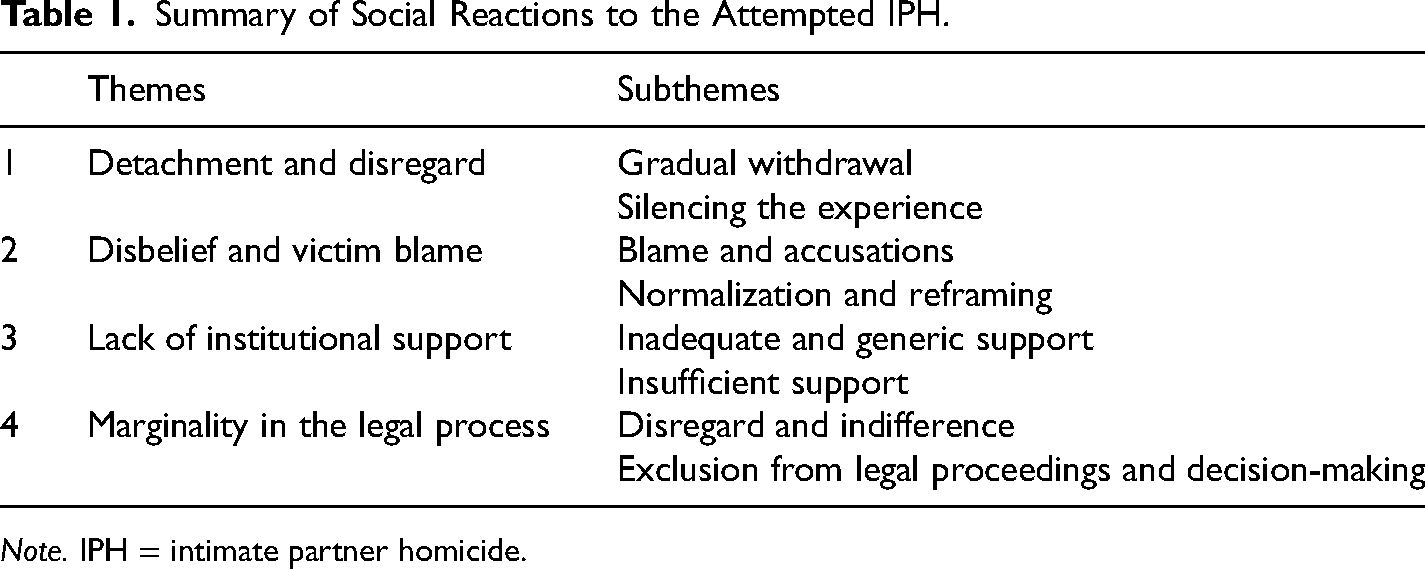
Note. IPH = intimate partner homicide.
Discussion
The themes that emerged from the analysis illuminate different dimensions of both formal and informal social responses to attempted IPH survivorship. These collective reactions offer insight into the experience of being an attempted IPH survivor. Based on the findings of the current study, this experience is complex and involves multiple layers. These layers encompass feelings of loneliness (Theme 1—Detachment and disregard), guilt, and blame (Theme 2—Disbelief and victim blame), as well as feeling not cared for (Theme 3—Lack of institutional support), and excluded (Theme 4—Marginality in the legal process).
Disenfranchized grief serves as a valid conceptual framework for examining the participants’ narratives, as it embodies diverse aspects of loss that can illuminate the experiences of the individuals involved.
Across the themes, the participants reflected on various experiences of isolation (Theme 1), disparagement (Theme 2), minimization (Theme 3), and marginalization (Theme 4). In this context, Attig (2004) discussed the way disenfranchizing practices may impact individuals affected by loss, when people who surround them “actively discount, dismiss, disapprove, discourage, invalidate, and delegitimize” their emotional experiences, thereby “disallowing, constraining, hindering, and even prohibiting the survivor's mourning” (Attig, 2004, p. 198). The findings of the current study concerning disenfranchizing practices are in line with some previous studies that explored the experiences of attempted IPH survivors. For example, the participants in a study by Farr (2002) reflected on feeling of being supported in the immediate aftermath of the violent incident, but this feeling had diminished, leaving them convinced that they must rely on their own strength to continue with their lives. Half of the women in Santucci's (2021) sample did not involve the police, having been previously ridiculed and ignored by them. Other studies reported that police dismissed and belittled survivors’ complaints (Thomas et al., 2014) and treated them with disbelief and reluctance to offer help (Evans et al., 2018).
According to Sawicka (2017), such disenfranchizing practices can become apparent in an atmosphere of a “cultural void"—a situation of a lack of coherently organized cultural resources through which grief can be experienced and expressed, including clear definitions of its social components. In the case of the current study, the situation of surviving an attempted IPH is indeed so singular and socially unfamiliar that it may fit the description of a cultural void. Therefore, it is possible that the disenfranchizing practices reported by the participants are also a result of a personal and institutional vacuum when it comes to survivors of attempted IPH.
Another issue that was reflected throughout the themes was a sense of dichotomy between the participants’ inner experience of hurt, loss, and suffering and the perceived social reaction to their experiences. These reactions minimized and trivialized the participants’ experience as well as their feelings of loss following the attempted IPH. The dichotomy was reflected strongly in the words spoken to one of the participants, that she should “get her act together, that shit happens,” and that she was “just making a fuss” (second theme). Actions such as ignoring the violent incident (as described in the first theme), offering minimal counseling (as described in the third theme), and failing to notify the woman when her attacker was released from prison (as described in the fourth theme) also contributed to the participants’ overall feeling of a clash between the inner and outer realities. This echoes the notion that the disenfranchizement of grief arises from a conflict between the deeply personal experiences of loss and the external social frameworks imposed on those experiences, marked by the refusal to acknowledge their legitimacy (Harris, 2010; Sawicka, 2017).
Consequently, symbolic resources, such as sets of feeling and display rules, as well as beliefs about such grief—that are typically essential for guiding and structuring emotional experiences—become disorganized, contradictory, or even absent (Sawicka, 2017).
Finally, the third and fourth themes described participants’ perceptions of how institutions such as the police, the justice system, and the welfare agencies reacted to their experience as attempted IPH survivors. Shaped by social structures, social policy can be enfranchizing in validating and supporting individuals adjusting to loss (Reynolds, 2002), or disenfranchizing to varying degrees (Robson & Walter, 2013). The participants in the current study highlighted the lack of institutional support and the institutions’ inability to understand their unique experience and to provide a specific tailored response that captures their particular needs. These findings correspond with additional studies, which demonstrated how police and social services failed to help attempted IPH survivors. For example, Boira and Nudelman (2018) described the institutional support provided to survivors as passive, limited, and lacking in resources. Likewise, the participants in Farr's study (2002) experienced therapeutic services as ending abruptly, leaving them feeling alone and without support. In another study, the police had not pursued charges against the partner even though the IPH survivor had lodged a complaint about the violent incident (Evans et al., 2018). Some authors explored the institutional response in cases of disenfranchized grief using the concept of structural vulnerability (Lawson, 2014). Structural vulnerability refers to ways in which disparities of class, culture, gender, sex, and race impact individuals, families, and communities (Team & Manderson, 2020). That is to say, individuals who are positioned as structurally vulnerable due to their socially diverse personal characteristics and cultural values (Quesada et al., 2011) may be marginalized by government policy and resource allocation (Reimer-Kirkham et al., 2016). A study by Bindley et al. (2019) identified the connections between this concept and the disenfranchized grief framework. They claimed that disenfranchizing practices are situated within systems and networks underpinned by norms and values with the potential to shape experiences of structural vulnerability and disadvantage. In their review, these authors highlighted disenfranchized grief related to structural inequity, including gender, class, sexuality, ethnicity, and age, experienced in interactions with institutions and social networks, and emphasized that the experience of loss itself may be accompanied by exposure to disenfranchizing systems and processes (Bindley et al., 2019). Thus, it is possible that the participants’ experience of disenfranchizing practices by institutional agencies (e.g., marginalization and exclusion as primary social reactions) is connected to their structural vulnerability as women who are victims of violence, as well.
Practical Implications
The participants in the current study felt, for the most part, that people and institutions around them had failed to provide responses that met their needs. In this context, Scott and Weisz (2002) noted that failure to acknowledge an individual's grief restricts survivors’ healing. Thus, it is important for both individuals and institutions to validate survivors’ experiences and listen to their stories. Family members and professionals working with families and friends of attempted IPH survivors can contribute to their healing by acknowledging their experience and fostering a sense of legitimacy for their grief.
Furthermore, justice systems, including the police, need to recognize their pivotal role in the way they interact with survivors, extending their awareness beyond the immediate aftermath of a violent incident.
It seems also that the treatment protocol typically offered to IPV survivors by the welfare agencies in charge of the therapeutic response to survivors does not sufficiently meet the needs of attempted IPH survivors. Thus, policy concerning specialized treatment for survivors of severe victimization or a homicide attempt is needed to address feelings of acute distress experienced by this specific group of survivors.
Finally, allowing professionals to hear the narratives directly from the participants may facilitate a deeper understanding of the subjective experiences in the aftermath of an attempted IPH, particularly within this understudied group.
Limitations and Recommendations for Further Study
This study focused on the social reactions to attempted IPH survivors, from their perspective. To complete this subjective perspective, additional studies could explore the services received by survivors (e.g., received social response) and the perceptions of family members and friends of survivors’ experiences and needs.
The generalizability of this study is constrained by its small sample size and qualitative design. Moreover, because of the sensitive nature of the research, participants were contacted only after they had voluntarily shared their personal stories. Consequently, the findings may not encompass the complete spectrum of experiences pertinent to attempted IPH survivors. Sharing necessitates proficient cognitive and verbal abilities, along with emotional readiness and the capacity to discuss the traumatic experience, thereby excluding individuals who were less suitable or willing and who were perhaps too depressed to be interviewed. One strategy to address these limitations could be the utilization of alternative research methods that demand less faith and cooperation from participants, thereby fostering inclusivity for individuals facing challenges in participating in interviews.
Finally, this study did not investigate participants’ experiences regarding the type of relationship or the severity of the violent incident. It aggregated the experiences of individuals in both long- and short-term relationships, as well as those who were hospitalized for extended periods due to severe injuries and others who were discharged after a few hours. It is conceivable that participants’ experiences might vary based on these factors. Therefore, future research that examines distinct subcategories within the population of attempted IPH survivors is recommended.
Footnotes
Declaration of Conflicting Interests
The author declared no potential conflicts of interest with respect to the research, authorship, and/or publication of this article.
Funding
The author received no financial support for the research, authorship, and/or publication of this article.
