




Abstract
This study examines how involuntarily celibate (“incels”) men justify gender-based and sexualized violence against women. Based on an analysis of 22,060 discussion board comments, we argue that: (1) incel justifications of sexualized violence are tied to their perception of gender relations, (2) incels justify sexual assault as a form of revenge for their incel status, and (3) incels misuse science to argue that women enjoy sexual assault. Adapting the concept of “stochastic terrorism,” we argue that incels and similar communities produce stochastic gender-based violence, wherein communities justify and encourage acts of violence. Findings are discussed in relation to gender-based violence, rape culture, masculinities theory, and policy.
Introduction
In New York City, in 2024, there were multiple reports of a man randomly punching women (Looker, 2024). In Sydney in 2024, a man who committed a mass stabbing attack appeared to have specifically targeted women (Turnbull, 2024). In Toronto, in 2020, a man murdered one woman and attacked another while using a sword covered in slogans from the incel community and shouting misogynistic phrases from that same community (Davies, 2023). How might we explain these seemingly random yet targeted attacks of women? In this article, we conceptualize and forward one potential explanation, as we argue that incels (and similar online communities) encourage, celebrate, and facilitate violence against women. We will refer to this encouragement of violence as stochastic gender-based violence.
There are many online communities that celebrate violence against women (e.g., Jane, 2018; Marwick & Caplan, 2018). By violence, we mean a broad spectrum of behaviors, including physical violence, sexualized violence, online threats of violence, celebration of violence, and the use of aggressive or “violent” language online. Incels (short for “involuntarily celibate”) are one of these communities, and they have been linked to the harassment, assault, and murder of women (e.g., Baele et al., 2019; Chan, 2023; Halpin et al., 2024).
The term “incel” was coined in 1997 by a Canadian woman who wanted to create a community for people struggling to establish romantic and sexual relationships (Byerly, 2020). The incel community has since become tied to heterosexual men, many of whom believe inceldom reflects social biases against men and that only men could truly become incels (Byerly, 2020). Incels are not a monolith and not all incels or communities promote violence and misogyny (DeCook & Kelly, 2022; Halpin & Richard, 2021). However, many incel communities argue that they are entitled to heterosexual sex, and are characterized by misogynistic attitudes and actions toward women (Baele et al., 2019; Gotell & Dutton, 2016; O’Donnell & Shor, 2022). These misogynistic incel communities are also fairly diverse, with roughly 50% of incels identifying as men of color, and members similarly reporting varied levels of age, educational attainment, and income (Halpin & Richard, 2021; Incels.is, 2024).
This study focuses on gender-based violence, which is violence directed at someone because of their gender. In this paper, we advance the literature on gender-based violence by developing the concept of stochastic gender-based violence, which focuses on how communities can promote or justify gender-based violence. Specifically, we examine how members of the most popular incel community (incels.is) perform stochastic gender-based violence by encouraging, normalizing, and legitimating violence against women. Although we position our argument as broadly useful to the study of gender-based violence, in this paper we focus on sexualized violence as a form of gender-based violence. Our findings are based on qualitative analyses of 22,060 comments made on incels.is. First, we argue that incels’ justification of gender-based violence and sexualized violence is tied to their perceptions of gender relations, wherein women are explicitly dehumanized. Second, we show how incels justify sexualized violence as a form of revenge against women. Third, we argue that incels appropriate scientific studies in genetics and evolutionary psychology to argue that women enjoy sexualized violence and that such violence is “natural.”
Our argument adapts the term stochastic terrorism (e.g., Amman & Meloy, 2022; Hamm & Spaaij, 2017; Keyyam, 2019), which refers to how individuals or communities might demonize specific groups in a manner that facilitates or incites violence, while nonetheless avoiding direct calls for violence against specific groups of people. Stochastic terrorism is also used to connect seemingly “lone wolf” terrorists—those who commit acts of violence without direct support from an organized terrorist group (see Hamm & Spaaij, 2017)—to communities that incite violence. Stochastic terrorism can involve an exchange among a public figure, various amplifying platforms (such as social media), and multiple receivers (Amman & Meloy, 2022). Both community members and a recognized leader can propagate hostility toward individuals/groups. These messages can be dehumanizing, excuse or justify violence, but often stop short of making explicit calls for specific acts of violence against specific people (Amman & Meloy, 2022). In this sense, stochastic terrorism can be difficult to police, and it can also be difficult to causally connect specific acts of violence to the atmosphere of encouragement.
While many studies connect incels to terrorism (e.g., Lockyer et al., 2024; O’Donnell & Shor, 2022), our concept of stochastic gender-based violence details how incels and similar communities might facilitate terrorism as they rationalize, encourage, and celebrate violence against women. In contrast to arguments that specific incels are best labeled as “lone wolf” terrorists (e.g., Miller, 2023), we demonstrate how the incel community—and similarly misogynistic communities—might facilitate violence. In this sense, we show how “lone wolf” incels in fact have considerable company and admirers, as they have a community that roots for them and their violence against women.
We likewise contribute to the literature by adapting and broadening the concept of stochastic terrorism. Specifically, our concept of stochastic gender-based violence results from applying a gender lens to stochastic terrorism, and we likewise focus on all acts of violence rather than just murder. In further contrast to work on stochastic terrorism, we observe a community with no clear leader, which contains both implicit and explicit (e.g., directed at specific individuals) calls for violence. In the case of stochastic terrorism, members and leaders call for violence and murder, while in the case of stochastic gender-based violence, members call for numerous forms of violence to be committed for the purposes of punishing or terrorizing women.
While there are many forms of gender-based violence, we primarily focus on sexualized violence in this paper. We focus on sexualized violence because it is common in the incel community (see Table 1), while this is a type of violence is often omitted from discussions of stochastic terrorism. We argue that incels dehumanize women, normalize rape and other forms of sexualized violence, and that the incel community broadly works to facilitate violence against women. We further argue that incels view murder and other forms of physical violence through the lens of sexualized violence, such that gender-based violence is often sexualized, and participating in gender-based violence (e.g., assault, murder) is also seen as performing sexualized violence. Indeed, the attack in Toronto referenced above shows how murder can be sexualized in these communities, as the perpetrator targeted sex workers while yelling out sex-shaming slurs during the assault. We discuss our findings in relation to work on rape culture, gender-based violence, masculinities theory, and policy.
Networked Misogyny and Incels
Many online communities promote misogyny, anti-feminist beliefs, and hostility toward women (Fowler, 2022; Ging, 2019; Marwick & Caplan, 2018; Van Valkenburgh, 2021). While we focus on incels, other misogynistic communities include Men's Rights Activists (MRAs), Pick Up Artists (PUA), and Men Going Their Own Way (MGTOW). Although there are many differences between these communities, many share a “red pill” ideology, which asserts that women, feminists, and society are waging a war against men and boys, that men are victims of systemic misandry, and that traditional and patriarchal gender roles are beneficial for both men and women (Van Valkenburgh, 2021). The “red pill” can also emphasize self-improvement, certain performances of masculinity, reifying of gender differences, and tends to encourage men to take control of their lives and relationships (Van Valkenburgh, 2021). In addition to a “red pill” ideology, incels endorse a “black pill” ideology (e.g., Halpin, 2022; Solea & Sugiura, 2023), which asserts that women's mating preferences are biologically fixed, that women pursue the most physically attractive men, and that average-looking and unattractive men have no hope of establishing a heterosexual relationship. In contrast to the red pill, the “black pill” is fatalistic, with incels often seeing “no hope” of ever changing their life circumstances.
Research on incel communities indicates that they believe feminism and women's rights movements have led to a loss of male dominance and have “unfairly” prevented men from their “entitled” access to women's bodies (Baele et al., 2019; Halpin, 2022; Halpin et al., 2023; O’Donnell & Shor, 2022). In their critiques and complaints, incels largely focus on a distorted view of second-wave feminism, which they perceive as being culturally dominant and harmful to men. For example, O’Malley et al.'s (2022) analysis of two online incel communities finds that incels claim that women control the “sexual marketplace” and women are naturally evil. Such beliefs forward a worldview wherein men are oppressed, and women are the powerful and malevolent oppressors. In some senses, this dissatisfaction resembles “aggrieved entitlement” (Kimmel, 2013), which details white men's hostile reactions to their eroding privileges. However, in contrast to the aggrieved entitlement of “angry white men” described by Kimmel (2013), we and other researchers observe such feelings of gendered resentment in racially diverse groups of men (Halpin & Richard, 2021; Liu, 2021).
Incel communities contain numerous discussions of violent fantasies that target both women and society (e.g., Lockyer et al., 2024; Vallerga & Zurbriggen, 2022). Several completed and attempted mass murders have been tied to incels, men who are celebrated by incels, or men who endorse beliefs that are similar to those of incels (e.g., Halpin et al., 2024). For instance, the perpetrator of a mass murder in Isla Vista, California released a manifesto that situated his attack as revenge for his perceived rejection by women (e.g., Baele et al., 2019; Fowler, 2022), while the perpetrator of a mass murder in Toronto, Canada, positioned it as the start of an “incel rebellion” (O’Donnell & Shor, 2022). Also in Canada, the massage parlor attack referenced above has been connected to the incel community and subsequently labeled and prosecuted as an act of terrorism (Davies, 2023). This paper expands on previous research by describing how incels both celebrate and justify gender-based violence.
Gender-Based Violence, Rape Culture, and Technology-Facilitated Sexual Violence
Gender-based violence consists of words, actions, or attempts to inflict physical, sexual, and psychological harm onto someone based on their gender identity (Chan, 2023). International statistics reveal that approximately one in three women have experienced some form of gender-based violence (World Health Organization, 2021). Gender-based violence has substantial consequences on victim–survivor's physical, mental, emotional, spiritual, and economic well-being (Stoleru & Costescu, 2014). In this paper, we focus on gender-based violence directed at women. When we use the term gender-based violence, we encompass not only physical violence, sexualized violence, economic vandalism (Jane, 2018), and emotional abuse, but also violent, sexist, and misogynistic discourse and rhetoric. That said, in this paper, we predominately focus on sexualized violence as a form of gender-based violence, while arguing that incels and similar communities often see gender-based violence through the lens of sexualized violence.
Both rape culture and sexualized violence are part of gender-based violence. Rape culture is broadly defined as an environment whereby beliefs about women's sexuality and behaviors are used to normalize and excuse sexualized violence against them (Dodge, 2016; Harding, 2015; Keller et al., 2018). Rape culture involves many actions, including sexual objectification, sexual assault and harassment, slut-shaming, rape “jokes,” and victim blaming (Fasoli et al., 2018; Gosse, 2022; Keller et al., 2018; Ringrose & Renold, 2012). Rape culture also situates sexualized violence as unavoidable and excusable in some situations (Keller et al., 2018), with women portrayed as enjoying being sexually dominated by men or deserving sexualized violence due to their perceived actions (e.g., how they dress, Keller et al., 2018).
Gender-based violence, sexualized violence, and rape culture have flourished in online communities, a phenomenon which has been labeled as technology-facilitated violence and abuse (TFVA). The TFVA occurs through computers, mobile devices, smart home devices, on social media, in online forums, and with the help of artificial intelligence (e.g., creating deep fakes). TFVA includes actions ranging from inappropriate comments to the release of personal and private information (doxing) to the non-consensual distribution of intimate images to threats and cyberstalking. While women are the primary targets of gender-based violence offline, they are also disproportionally the targets of violence and abuse online (Henry & Powell, 2018; Kavanagh et al., 2019), with McCaughey and Cermele (2022) suggesting that TFSV “extends the analog-era rape culture” (p. 3955).
Some of the adverse impacts of TFSV include emotional and psychological distress, including lower self-image, higher anxiety and depression, and feelings of humiliation (West, 2014). Research suggests that women, especially women who identify as Indigenous, Black, or as a person of color (IBPOC), and members of the 2SLGBTQIA + community are disproportionately targeted by TFVA, and that the types of harms they experience are often more severe and the consequences more substantial (e.g., Duggan, 2017). There are also social and economic impacts of these types of violence and abuse, including withdrawing from social groups, family, and friends, and limiting one's online presence, as well as job loss and loss of income (West, 2014). As such, although TFVA occurs online, it results in tangible harm to women.
In this paper, we examine how incels participate in TFSV, specifically detailing how they celebrate, promote, and justify sexualized violence. Building on Chan (2023), we suggest that incels’ participation in TFSV is underacknowledged as a form of extremism and violence directed toward women. More specifically, we argue that the incel community produces stochastic gender-based violence because they broadly dehumanize women and celebrate rape in a manner that encourages acts of violence against women.
Masculinity and Incels
In this paper, we use Connell's (1995, 2000) theorizations of the gender order and masculinities to examine incels’ discussions of violence against women. Connell (1995) argues that gender relations are characterized by men's subjugation of women, unearned benefits tied to masculinity, and multiple forms of masculinity. More specifically, Connell (1995) suggests that both gender relations and masculinity are positioned in relation to hegemonic masculinity, a form of masculinity that both benefits from and maintains gender inequality, while also occupying a privileged position in relation to other forms of masculinity. These other forms of masculinity include: (1) complicit masculinity, which passively benefits from gender inequalities, (2) marginalized masculinity, which refers to masculinity tied to forms of social marginalization (e.g., race and class), and (3) subordinate masculinity, which are defined as masculine performances not seen as masculine or are “exiled” from masculinity.
Numerous studies have leveraged masculinity theory to examine incels (e.g., Glace et al., 2021; Menzie, 2022). For instance, Vallerga and Zurbriggen (2022) argue that incels support hegemonic masculinity by advocating for men's sexual domination of women, while Daly and Reed (2022) argue that incels struggle to demonstrate their manhood because they perceive themselves to be physically unattractive, lacking personality, and sexually unsuccessful, framing these “masculinity challenges” as a form of marginalized masculinity. Likewise, in our previous work (Halpin, 2022), we argue that incels weaponize subordinate masculinity by positioning themselves as victims and “failed men” to justify both interpersonal and systemic violence against women. In this paper, we focus on incels’ discussions of gender-based violence, arguing that incels perceive sexual violence as a means of maintaining men's domination of women. We further argue that incels’ perceptions of sexualized violence are tied to a perceived masculine hierarchy, wherein women want to be sexually assaulted by dominant men. That is, we will demonstrate that incels view sexualized violence as a means to maintain a patriarchal gender order, even if incels themselves are relegated to occupying a subordinate position within that order (Halpin, 2022). As we suggest, incels view sexualized violence as a key component of gender relations, while also viewing gender-based violence through the lens of sexuality.
Methods
As demonstrated in previous research, online communities can amplify, support, and encourage violence, misogyny, and other forms of hostility (Banet-Weiser & Miltner, 2016; Halpin et al., 2023; Helm et al., 2022; Kim et al., 2023; Marwick & Caplan, 2018; Snaychuk & O’Neill, 2020; Tranchese & Sugiura, 2021). We argue that examining incels’ online interactions is useful because incels can be difficult to access, hostile to research, or behave differently in other forms of data collection (e.g., interviews) than they do online. Likewise, we observed numerous occasions wherein members talked about hiding or disguising their incel status due to fears of getting doxxed, fired, or expelled.
In this study, we analyzed the largest English language incel forum, incels.is. This forum contains over 25,275 members who have collectively written over 12 million posts (incels.is, 2024a). The site restricts membership to heterosexual men who “[desire] a romantic relationship but [are] unable to enter one” (incels.is, 2023b). Women, non-incel men, and members of the 2SLGBTQIA+ community are banned from the forum.
After receiving research ethics approval, we qualitatively analyzed a total of 22,060 comments from incels.is. Specifically, we selected threads that had the highest number of comments during a 3-month period in 2019 and a 3-month period in 2022, for a total of 107 threads completely analyzed. The number of comments per thread ranged from 100 to 2,000.
We selected a three-month period to keep the amount of data manageable for qualitative analyses and to focus on recent conversations. We focused on the threads with the highest comment activity during the 3-month window to select threads that were popular and/or otherwise engaging to incels. We initially collected data in 2019 and after receiving additional funding, we decided to also collect data in 2022 to upscale our project. This data is part of a larger project on incels, which also involved downloading all comments made on incels.is between 2017 and 2024. The incel community on incels.is was previously deplatformed and the earliest comments we are able to access and analyze appear in 2017. While our focus here is the qualitative analysis of violence, the descriptive data presented in Table 1 are drawn from this larger dataset.
We used NVivoTM 11 to organize and code the data. Members of the project engaged in line-by-line coding, developing a codebook that contains 55 codes. All codes include examples and operational definitions. Project members exchanged and recoded threads to ensure that we were applying codes in a similar manner, in addition to regular coding meetings to discuss both codes and themes. We reviewed our codes iteratively to develop the three themes that form our analysis, attending to both the central components of incels’ discussions of gender-based violence and potential connections to theory.
We used abductive analysis to analyze the data (Halpin & Richard, 2021; Tavory & Timmermans, 2014). Abductive analysis prioritizes how new or unexpected findings could be used to investigate, nuance, or reimagine already established theories. In this paper, we focus on how incels glorify and justify sexualized violence against women. We discuss findings in relation to gender-based violence, rape culture, and theories of masculinity. Connell's (1995) work on masculine hierarchies and the connections between violence and performances of masculinity influenced our abductive analysis. Specifically, we focused on how violence was connected to both gender relations (e.g., between men and women) and the performance of masculinity (e.g., violence and aggression as masculine traits). Likewise, we focus on how our findings extend conceptualizations of stochastic terrorism.
Our study has limitations. We collected data from an online source and did not interview incels. While interviews might be subject to social desirability bias, incels’ accounts of sexualized violence might be framed differently in-depth interviews. Additionally, we focus on only one incel community. Future research could consider how different incel communities orient to sexualized violence. As with similar online analyses, our study is also limited because we cannot verify that all threads and subsequent replies were authored by individuals self-identifying as incels and not some other group (e.g., trolls, researchers).
Findings
In our analysis of 22,060 comments on incels.is, we find that incels legitimate gender-based violence, especially rape and other forms of sexualized violence. First, incels situate sexualized violence within their perception of gender relations. Second, incels appropriate scientific studies in genetics and evolutionary psychology to argue that women enjoy and desire sexual assault. Third, incels justify sexual assault against women as a form of revenge for their incel status.
Violence and Gender Relations
Rape and sexualized violence are frequently mentioned on incels.is. As Table 1 reports, 5,151 (35.6%) users used variations of the term “rape,” while these terms appeared in more than 35,000 threads and 61,000 comments between November 7, 2017 and May 3, 2024. Although we do not know the specific context of term usage, in our qualitative analysis of 22,060 comments, we only recorded one instance where a user explicitly opposed sexual violence. Viewing our descriptive quantitative data in light of our qualitative analysis suggests that the vast majority of these discussions of rape are in fact celebratory. Likewise, viewing our qualitative and quantitative dataset in tandem demonstrates how the incel community facilitates stochastic gender-based violence, as the community frequently discusses sexualized violence, and these discussions predominately dehumanize women and celebrate violence committed against them.
Frequency of Use of Sexualized Violence Terminology on Incels.is.
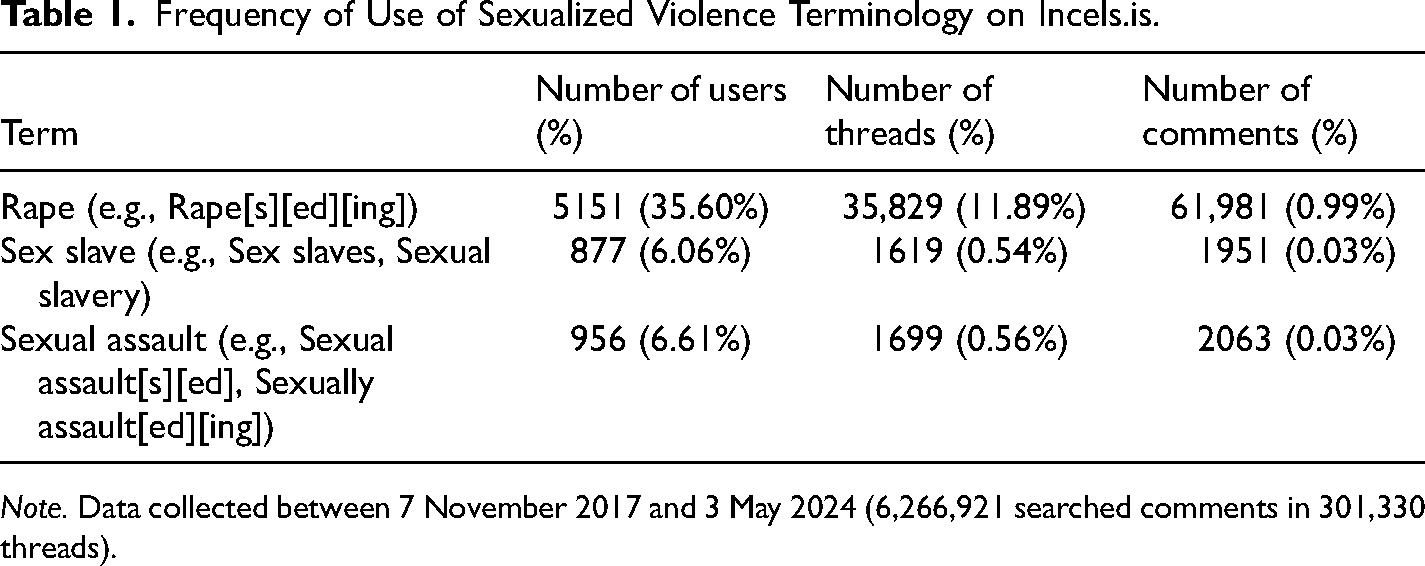
Note. Data collected between 7 November 2017 and 3 May 2024 (6,266,921 searched comments in 301,330 threads).
In this paper, we are not just interested in how frequently incels discuss sexualized violence, we are concerned with how they rationalize sexualized violence. We argue that how incels talk about women, men, and gender relations is intimately tied to their discussions of gender-based violence. First, incels ubiquitously refer to women with degrading, demeaning, and misogynistic terms. We observed numerous instances wherein incels referred to women as “toilets,” “cum buckets,” “holes,” “sluts,” “whores” (see also Halpin et al., 2023). Incels also frequently refer to women as “roasties,” which is a misogynistic slur attached to the false belief that women's labia become elongated in relation to their number of sexual partners. “Foid” is the most popular of the many misogynistic terms that incels deploy against women and is a hallmark of incel discussions. Foid is short for female android and suggests that women are subhuman. As such, incels frequently refer to women with terminology that dehumanizes them and/or marks them as sexual objects.
As we argue, these misogynistic terms demonstrate how gender-based violence is central to incels’ conceptualization of gender relations and that incels often perceive gender-based violence through the lens of sexualized violence (e.g., seeing “roasties” are deserving of harm). That is, incel orientation toward sexualized violence rests upon a broader vocabulary that dehumanizes women and situates them as sexual objects. For instance, one user shares a story of being romantically rejected by a woman. In response, User 1 states, “you deserve [to be rejected] for being naive enough to be led on in the first place, foid[s] are all degenerates and cannot be trusted you shouldn[’]t even acknowledge them as human beings. If you want her, rape her. Otherwise cut contact.” Here, all women are “degenerate foids” who manipulate men, cannot be trusted, and are less than human. Incels perceive gender relations (e.g., Connell, 1995) in a manner that explicitly dehumanizes women, with such dehumanization intimately connected to their discussions of violence. In these accounts, it is “foolish” to have any sort of love or affection for women, and women should only be thought of in hostile and sexualized terms.
Reflecting how multiple sources of oppression intersect (e.g., Collins, 1990), many of the misogynistic terms used by incels are also racialized. Incels call attractive white women “Stacy” or “Becky,” and describe them as “entitled whores” who are incapable of monogamy and pursue the most attractive white men (who incels label “Chads”). In contrast, Women of Color are referred to as “currywhores” (South Asian women), “noodlewhores” (Asian women), or “Big Black Vaginas” (Black women). Incels perceive all Women of Color as sexually accessible to white men. Incels, including those that identify as Men of Color, also label women who date outside their race as “race traitors” and suggest that they should be punished for creating incels in their own racial/ethnic group (see also Halpin & Richard, 2021; Halpin et al., 2023).
The intersections between gender and race relations are also central to how incels discuss sexualized violence. Incels suggest that rape is a part of racial/ethnic relations and conflicts, and that dominant men should rape marginalized women. For example, User 2 argues that rape was a natural and enjoyable part of the Atlantic slave trade: “think about slaves who, after getting whipped so many times, are quick to please their masters. They no longer do it begrudgingly, but are glad to serve their superiors in the social hierarchy. It resembles a serial rape victim who loses all her remaining traces of autonomy and is glad to be Chad’s cumslut. ‘Yes, massa.’ ‘Yes, daddy.’” In this context, enslaved Black women are not victims of white men and rape is not a weapon of racial violence and oppression (e.g., Collins, 1990). Instead, Black women are “glad” to be raped by white men because incels think women enjoy domination and subordination. Incels likewise think contemporary examples of racialized sexual exploitation are natural and desirable. As User 3 claims: TBH [to be honest] I like JB [jail bait, girls who are below the age of consent], but I don’t make threads spamming it all over the site, because there’s no point talking about such an obsession all the time, I'd much rather work towards actually getting it, like I said before age of consent in the Philippines was 12 and its a prime place to escortcel, perfect SEA place for me to move to, all those guys making thread after thread of “muh loli waifu of culture” are trolls, they don’t actually like women of that age group, they are larpers just doing this all the time to “make the site look bad.”
Here, “loli” refers to the sexualization of young girls. As this user states, his plan is to move to the Philippines where he believes he will be able to sexually exploit Philopena children. Furthermore, he emphasizes that, unlike other users, he is not “trolling” and is sincere about his plans. This racialization of sexualized violence also extends to white women, as User 4 states that, “in the rich Gulf Arab countries, Slavic foids make big proportion of rich Chaddams’ harem.” In these accounts, it is natural that privileged Arab men sexually exploit white women, with many incels additionally stating that they admired “harems” and “Sharia law” as useful correctives to Western feminism. In each of these cases, a racialized order overlaps with the gender over, and incels see marginalized women as desiring rape and violence from dominant men.
In addition to tying sexualized violence to the dehumanization of all women, incels position sexualized violence in relation to their fear of feminism—particularly focusing on aspects of second-wave feminism. Similar to other manosphere communities (e.g., Gotell & Dutton, 2016; Marwick & Caplan, 2018; Van Valkenburgh, 2021), incels are hostile toward both feminism and women's agency. Incels argue that feminism is partly to blame for creating incels by inflating women's egos and expectations, and they claim that feminism brainwashes women into viewing themselves as controlling the marriage and dating markets: It is part of modern-day feminism brainwashing to suggest that women have always been the selectors of the species (from a biological standpoint), when it's actually males who have been doing the sexual selection for most of human history. In caveman times men raped women, in patriarchal times, fathers selected husbands for their daughters. For 99.999% of human history women have really had no freedom of choice when it came to finding a mate, mate selection has always been facilitated by men. (User 5)
In this sense, incels perceive feminism as distorting “natural” or “traditional” gender relations, which privilege men and validate rape. Indeed, in these discussions, incels uphold an almost caricatured view of hegemonic masculinity (Connell, 1995), wherein men are violent and completely dominate women, while any minimizing of men's authority over women is perceived as aggressive and misandrist (Kimmel, 2013).
Incels further claim that feminism positions women as victims, allowing women to “unfairly” weaponize their experiences of sexualized violence against men. As User 6 argues, “[i]f you want to believe rape tales, [you] might as well believe that gender is a social construct. Because those are both feminist lies created for propaganda.” Further indicative of the support of rape culture (Fasoli et al., 2018; Gosse, 2022; Keller et al., 2018; Maricourt & Burrell, 2022) in these arguments, women cannot “really” be raped, and claims of rape are just an instrumental means for women to exercise power over men. Similarly, another user references the #MeToo movement (e.g., Durham, 2021) and claims that “everything” is now considered sexual assault: I’ve tried [to get into a relationship] before 2010s and failed. I’m not going to try anymore. When everything is [considered] sexual assault and rape these days [be it] either waving, saying “hi”, or whatever. Oh, and even after that, if I somehow get in a relationship (which would never happen), she can #metoo me down the line if she feels like it. My chances are long gone. (User 7)
While incels see gender relations pre-feminism as reflecting their idealized hegemonic masculine order (Connell, 1995), they see current gender relations as inverting this order and, in so doing, harming men. In the former scenario, rape occurs and is both natural and common, while in the latter scenario, rape is fictive and only used by women to victimize men. In these comments, feminism also inverts incels’ desired gendered power relations, by providing women with agency and targeting men who commit sexualized violence. As such, these discussions of sexualized violence suggest that incels desire gender relations wherein women are objects that have no authority or agency in relation to men.
As suggested above, incels’ views of sexualized violence are not just grounded in how they perceive women and feminism, but also how they perceive men and masculinity. Considerable work on sexualized violence has demonstrated that it is tied to power and misogyny (e.g., Jane, 2018; Matsuzaka & Koch, 2019; Powell & Henry, 2017), and we detail similar arguments among incels. Specifically, incels perceive sexualized violence as conferring manhood. Aligned with work tying heterosexual sex to masculinity (e.g., Connell, 2000), incels argue that raping women turns a man from an incel to a Chad. As introduced above, incels see Chads as archetypical attractive, dominant, white men. In one sense, Chads reflect incels’ perception of hegemonic masculinity (Connell, 1995), which they define by race, looks, and sexual success. For example, User 6 states that incels should “rape women, then, they will love it and you will become a Chad,” while User 8 argues, “real men don’t ask for consent.” User 9 similarly ties sexualized violence to masculine status: Force is a necessity when getting what you want out of life. It is the pinnacle of masculinity to force things to go your way. If you want to be passive and let things naturally happen whilst hoping for the best. That's a very feminine route. However, forcing [emphasis in the original text] stuff to meet your ideals is the more Chad way of doing things, in my opinion. … Women enjoy forced rape. Remember that. And you’re over here saying, you don’t like forcing people to do stuff.
The idea here is that rape provides a means for incels to “ascend”—their term for leaving the inceldom. Despite the fatalism of the blackpill, some incels discuss ascension, although others argue that any member who ascends was never a “real” incel in the first place. Rape is also not the only means for an incel to ascend, as some consider death/suicide a form of ascension (see Daly & Laskovtsov, 2021), while an incel can also ascend through consensual heterosexual sex/relationships. However, we argue here that incels see sexualized violence as a means of conferring something beyond ascension, as they see rape as leading to a complete ascension of the masculine hierarchy, moving them from being masculine “failures” to dominant and hegemonic Chads.
Even though only one user explicitly opposed sexualized violence in our qualitative dataset, incels critiqued men they perceived as being against sexualized violence. Such men were referred to as “white knights,” an insult used to mock “nice guys” who are defending women, and to imply that they only do so for attention or affection. For incels, these “white knights” are not Chads, but betamales and “orbiters” who are only kind to women as an instrumental and covert means for establishing sexual relationships. These men are also called “moral fags,” which is a slur used in many online communities to denigrate people who have a strong moral view on a topic. For instance, in a thread on “dispelling the red pill [and] black pill myth,” User 10 states, “I’m sorry, but if I ever go to war, I’m raping first chance I get, I’m not holding back. I know I will be near moralfags though, so I’ll have to try and ditch them and grab a bitch.” User 11 adds, “Why does this sound like every war movie where the bad guy in the team tr[ies] to ditch them during the assault to rape some bitch and then get busted while raping and is shot by [a] moralfag protagonist.” Agreeing with User 11's movie comment, User 10 adds: Dude, I’m always rooting for that guy. I get pissed when I hear the “evil” music start playing in the background because I know some white knight is going to show up. Imagine being forcefully conscripted to kill random men but people want you to draw the line at raping a woman. […] If a woman is a virgin I’ll leave her alone, but outside of that I’m not sparing anybody.
In these comments, users police masculinity by endorsing sexualized violence and critiquing men who oppose such violence. Although incels position themselves as “failed men,” here they fantasize about a potential and idealized version of themselves, wherein they are “real men” because they are capable of rape.
We argue that incels perception of gender relations and gender-based violence is intimately connected to their endorsement of sexualized violence. Indeed, incels see gender-based violence and gender inequality as a means to facilitate sexualized violence. How incels see women and how they see gender-based violence is sexualized, as they see men's domination of women as demonstrative of heterosexual masculinity. Here, men “naturally” victimize women, and rape and other forms of sexualized violence play an important part in incels view of gender relations, as these acts are seen as conferring manhood. As we suggest, these arguments reflect stochastic gender-based violence because they normalize and encourage violence against women.
Sexualized Violence as Revenge
In this section, we argue that incels participate in stochastic gender-based violence by justifying sexualized violence as a form of revenge against women and feminism. That is, women “deserve” to be harmed for diminishing men and “creating” incels.
Incels legitimate sexualized violence by positioning it as a valid response to their perceived emasculation or subordination by women. As User 12 shared: When the world finally suffers the economic cataclysm [women will] […] taste [their] own medicine for mocking the class of men (several millions of lonely and disaffected virgin/less experienced white males globally) into inceldom. […] We watch you [women] suffer mass rape (and become long term sex slaves if you’re lucky) followed by slaughter as disposable … foids.
Echoing our arguments above, such quotes demonstrate how incels see gender-based violence through the lens of sexualized violence, as User 12 combines fantasies of sexualized violence with those of murder. Likewise, in addition to User 12, another user states, “foids deserve to get ERed and raped for what they are doing to ugly males” (User 13). Incels use “ER” to refer to the Isla Vista perpetrator, and, in this usage, the user is suggesting that women should be both raped and murdered for not having romantic or sexual relationships with “ugly” men. As O’Donnell and Shor (2022) demonstrate, incels often position women as responsible for such attacks, as they could have prevented them by having sexual relationships with incels.
Incels also see racialized sexual violence in terms of revenge. Both white and incels who identify as men of color discuss fantasies of seeing “Stacy,” “Becky,” and feminists being raped by Men of Color, particularly Black men or recent immigrants (referring to the latter as “rapefugees”). For example, in a thread complaining about women, User 14 states, “dumb whores, get raped by some boat migrants.” In these instances, rape is tightly coupled with racism, as, in contrast to being raped by white Chads, rape by minority men is seen as lowering a woman's status and therefore being a more punitive form of rape.
In other threads, incels encourage one another to commit racialized sexual violence. For instance, many white incels are encouraged to travel to South East Asia and sexually exploit Asian women, as a means to get revenge on women and ascend. Likewise, User 15 encourages another incel—who claims to be a Man of Color—to sexually assault European women: “I live in a feminist city, approaching as an ugly ethnic will land me in prison. You should move to Europe, as a brown or black man you can literally rape white women and will get a slap on the wrist. I am being cynical and don’t advocate rape but I am serious, as a non-white you can do anything.” As User 15 argues, feminism has resulted in a scenario where, as a white man, he cannot even approach a woman without legal penalty but that his fellow incel, as a man of color, can rape white European women with little or no consequence. As he argues, the user should rape white women to lose his incel status, to take revenge on the Stacies and Beckies that reject them, and because he will be able to get away with it. In this case, User 15 both exemplifies and complicates Kimmel's (2013) arguments about the aggrieved entitle of white men, as he certainly positions himself as unfairly victimized by feminism, yet argues that his fellow incel should exploit perceived social changes to race relations to rape white women.
As part of framing sexualized violence as revenge, incels argue women “unfairly” reject them due to lookism, a form of prejudice and discrimination that privileges the attractive. While lookism is a real form of discrimination (Monk et al., 2021), incels perceive themselves as victims of lookism and blame women for this perceived lookist discrimination. For instance, in response to a story about an incel being rejected by a woman whom he was attracted to, User 16 suggests the solution was to “rape her fuck her in every hole and punish that vile degenerate whore and teach it a lesson,” while other users agreed, encouraging the poster to “rape the bitch.” Building on our argument in the previous section, the woman referenced is explicitly dehumanized, referred to as “it” rather than “her.” Put simply, for the transgression of women not returning their affection, incels position women as non-human and rape as justifiable.
Incels’ positioning of sexual violence as a form of revenge is evident in these accounts, as the users encourage assault and frame it as a form of punishment that is meant to “teach” the woman a “lesson.”
Incels likewise position sexualized violence as revenge when women are seen as mocking or humiliating men. We observed many threads on incels.is that are framed as “reports” of women humiliating men, which are tagged as “rage fuel” that is intended to make the readers angry. For instance, such posts detail how women, in some public forum, make fun of men for their looks, particularly for being short. One of these threads includes a screenshot of a woman's social media post wherein she questioned why a wedding photographer positioned her beside a short man during wedding-party photos. In response, users produced dozens of comments encouraging men to harm her. As User 17 states, “[t]his tall toilet deserves to be raped by a bunch of subhuman manlets [i.e., short men] in [a] video game.” In this comment, including the phrase “in a video game” is a strategy that incels use to distance themselves and the community from the potential legal consequences of the comment, providing an avenue for the user to claim it was not serious. However, in this and similar comments, incels situate rape as a misogynistic form of restitution, suggesting that women should be assaulted by the very types of men they are perceived as rejecting.
As a form of revenge, incels suggest that sexualized violence is a means to bring women back into line, restore masculine domination, and punish women for perceived transgressions. That is, incels position sexualized violence as a key element of the gender order (Connell, 1995), as it is used to maintain women's subjugation in relation to men. In this context, incels see rape as a form of revenge against women who are creating incels by having “high standards” (see also O’Donnell & Shor, 2022). As User 12 states, “I would love for treasonous foids (for me, of the white race) who are snobby with insanely high standards get their comeuppance, and what happens is they get demolished (e.g., gang-raped to death by the train [a group of men] and forced to endure the sex slave life until expired from being frequently raped without so much as day-off relief)” Likewise, according to incels, women who perceive themselves as “too good,” “too pretty,” and “too intelligent” to date incels should similarly face retribution in the form of sexualized violence: [E]noy your beatings, gang rapings, home invasions and being sold into sexual slavery en masse, which is just around the corner ladies. And remember this is the end result of the world you betrayed men for to help the Jews build. […] You were too good and too pretty and too intelligent and just too, too, whatever to date [ER] and guys like us and make us happy right? Well now you get to date even worse “bad boys” than the usual ones that you’re attracted to. (User 18)
Incels argue that women cause sexualized violence, and further threaten women by stating that the growing number of incels will result in large-scale systematic sexualized violence against women, such as being sold into sexual slavery. As noted above, these accounts demonstrate how incels view gender-based violence through the lens of sexualized violence, as the removal of women's suffrage, civil rights, and violence against women is discussed in sexualized terms (e.g., powerless women are dependent on men and must participate in heterosexual sex). Moreover, women are seen as causing this social transformation through their romantic preferences, as well as endorsing progressive and feminist policies, which incels, as well as many other online communities (e.g., Van Valkenburgh, 2021), situate in antisemitic terms by suggesting these are Jewish conspiracies that undermine Western and/or white nations. As such, sexual assault is positioned by incels as revenge for women creating the social conditions that create incels, for failing to appease and submit to men, and violating a gender order that places men above women.
Incels most directly tie sexualized violence to revenge when they make rape threats and celebrate the assaults of specific women (e.g., the wedding example above). For example, User 19 posted a link to a news report about a man who raped and murdered one of his coworkers. The report highlights that the victim felt uncomfortable around her eventual murderer and had asked management to schedule them on different shifts before the murder. In addition to the story, he shares an “open letter” to the victim's family. The letter initially sounds sympathetic, before suggesting that the women was aroused and orgasmed while she was being raped and murdered. Situating sexualized violence as a form of revenge, the letter states that the victim was narcissistic and deserved to be harmed for feeling “creeped out” by her co-worker/murderer. Several other users compliment the letter by calling it “based,” (which signals agreement and approval), “I love these threads, good job” (User 20), and “jfl” which signals the user found the post funny. Other users further emphasize the connection between the story and revenge, stating that “all [the victim] had to do was give him a chance and date him” (User 21), “you get what you deserve” (User 22), and “every time a man kills a woman for rejecting him, I just see it as karma” (User 23). Despite rules on the thread against harassment and threats, the thread also contains comments from one of the site moderators, signaling that he found the thread “based” and funny. Incels not only see rape as a legitimate tool of revenge against feminism and women in general, but applaud and uphold men who have raped and murdered women, and target particular women as deserving of sexualized violence.
As we have argued, incels view sexualized violence (and murder) as justifiable responses to women rejecting men or women challenging men's authority. Such justifications demonstrate how the community facilitates stochastic gender-based violence, as incels use revenge as a rationale for committing sexualized violence.
Misusing Science to Justify Sexualized Violence
In this section, we argue incels perform stochastic gender-based violence by distorting scientific studies to position sexualized violence as “natural.” In contrast to their argument about revenge, here sexualized violence is justified because science “proves” women “want” to be raped. Incels’ discussions of science and sexualized violence likewise bolster their views of the gender order (Connell, 1995), wherein it is good and natural for men to dominate women. Throughout this section, we refer to incels as “misusing” science because we do not argue that researchers are advocating or celebrating sexualized violence, while incels often quote selectively or make broad generalizations about scientific studies to advance their legitimations of sexualized violence.
Primarily drawing on studies in evolutionary psychology and genetics, incels argue that men are biologically predisposed to rape women. In these arguments, social prohibitions against sexualized violence are both creating incels and violating the “natural order” by disrupting men's entitlement to women's bodies. Distorting arguments from evolutionary psychology that suggest that our present-day cognitions evolved when humans were hunter-gatherers, User 10 argues: For most of human history, life expectancy has been extremely short, around 25 years for our hunter-gatherer ancestors and only 37 years for residents of England in the 1700's. […] As a man in the past you barely had a fucking chance to reproduce at all, only the strongest most dominant men would survive, and after all that competition and struggle, they weren’t getting down on one knee to beg a female to please let them pass on their genes after they worked so hard to survive, they claimed these women as partners through conquest…. These guys were hunting lions and stuff and killing off weaker men who were their competition with no mercy. They basically took women as property and the women who resisted were probably just killed, that's why these whores adapted to have rape fantasies, because the women who never had them were just killed off.
Other users echo these claims, suggesting that it is natural for men to rape, and evolution explains why women are attuned to rape (Vallerga & Zurbriggen, 2022). For instance, User 24 claims, “tall and stronger men probably raped women [in hunter-gatherer times] and then took them in their harem to protect them from potential threat which probably triggered trauma bonding/Stockholm syndrome in women which is why these whores are attracted to abusive guys who happen [to] be tall/good looking/muscular.” While in the previous section, rape was justified in relation to incels perceiving themselves as victimized by women, in this narrative, rape is tied to hegemonic masculinity (Connell, 1995) and incels position sexualized violence as a means to access manhood. In these arguments, it is natural and logical for weak men to be murdered and for men to rape women, while consent and sexual agency are positioned as modern-day aberrations. As will be discussed in more detail below, incels argue that our evolutionary history has shaped women's desires, such that women who did not enjoy rape did not reproduce. That is, incels argue that findings from evolutionary psychology “prove” that women have evolved to accept rape, despite modern feminist distortions.
Incels also refer to studies that suggest that women report having a “fetish” for rape or have rape fantasies, as they conflate desire for consensual role-play with actual assault. Likewise, in discussing sexualized violence and arousal, incels weaponize studies on women's experience with orgasms during acts of sexualized violence. While studies do suggest that people can experience arousal and orgasm during non-consensual sex (Bivona & Critelli, 2009), such studies also emphasize that both arousal and orgasms are involuntary (Levin & van Berlo, 2004). Incels omit this latter point, and instead use such studies to perpetuate the rape myth that women are “asking” for sexualized violence and that arousal and orgasm are proof of consent and enjoyment. As User 25 states. “women orgasm almost all of the time when raped, compared to consensual sex. It's part of their biology to crave being dominated. [W]omen would enjoy the process of getting rape, even though they don’t want to get raped. Not wanting it to happen [does not equal] not enjoying it when it does.” This user misuses scientific studies to suggest that, because some women orgasm during rape, all women enjoy rape, and that rape is more pleasurable than consensual sex. Incels position women as craving masculine domination, which in turns buttresses incel views of a gender order wherein women are subservient to men. In such contexts, misusing science justifies misogyny and violence against women, while also framing women as willing participants rather than victims.
As suggested above, incels also misuse science to support their perceptions of masculinity. In these arguments, women specifically desire sexualized violence when it is being perpetrated by “Chads,” the attractive white men that incels perceive as hegemonic archetypes. While incels can express resentment toward Chads, their commitments to masculine hierarchies mean that they nonetheless envy, applaud, and justify dominant men's entitlement to women's bodies. Here, women “want rape from Chad” (User 25). Distorting ideas about evolution, User 26 argues: [S]o many generations of women were raped over thousands of years that as an adaptation women literally evolved to be attracted to the kinds of men that would BE ALIVE to rape them (dominant, aggressive and physically imposing males). Hence the attraction towards bigger and dominant males (women's obsession with men being 6 ft tall or more with a large frame).
Likewise, User 27 states, “women do not want to be treated good or like a princess. They just want a tall good-looking man to fuck their brains out by force.” Building on incels’ previous justifications of sexualized violence, each of these statements emphasizes that any form of sex with dominant men is desirable to women, and that women “evolved to be raped” by such men. Indeed, incels argue women “enjoy” all rape, but do not “want” to be raped by incels because feminism has convinced women that sex with low status men damages their “power and prestige.” As User 28 explains, “they [women] want rape from Chad, they don’t want rape from subhumans. […] Furthermore, the reason they don’t want rape [from “subhumans”] is to maintain their power and privilege, not because they don’t enjoy it.” As incels argue, even when women do not “want” to be raped, they still enjoy or desire rape. For incels, rape is natural and desirable and rape is only prohibited due to the distorting influence of feminism and lookism, which have disrupted the “natural” gender order.
In these accounts, incels’ misuse of science to normalize sexualized violence are also calls for a return to the “traditional” values and gender roles they perceive as being reflected in such science. Feminism has created incels by corrupting a “natural” order wherein men unequivocally dominate women. Emblematic of these arguments, incels also advocate for sexual slavery. As with other forms of sexualized violence, sexual slavery is positioned as natural and unfairly demonized by feminism. As User 29 argues, “…in the past, sexual slavery was widespread and there wasn’t a social stigma against it. You were not a ‘psychopath’ for owning a sex slave. You are looking at it from a modern feminist perspective yourself, thinking that a man owning a woman and having control over her makes him a ‘psychopath.’” As such, when incels misuse science to celebrate rape, they are also telling us about themselves. They see women having agency, feminism, women's rights, and prohibitions against rape as creating incels. In these accounts, a society that permits rape or sexual slavery has “solved” the incel problem by making women the property of men, which incels suggest is desirable for both men and women as it rights the wrongs of feminism and restores a gender order wherein women are subjugated by men.
As with incels’ discussions of revenge, the misuse of science is tied to the community’s facilitation of stochastic gender-based violence. Here, rape is seen as natural and desirable, as well as beneficial for women, men, and social order. As such, these accounts provide men with justification and motivation for sexualized violence, and go one step farther than narratives of revenge by also stating that women desire harm.
Discussion
Through our analysis of 22,060 comments made on incels.is, we demonstrate that the members of the community facilitate stochastic gender-based violence by supporting, encouraging, and normalizing sexualized violence. We argue that incels see gender-based violence through the lens of sexualized violence, as they view violence in sexualized terms and see harming women as a means of conferring heterosexual manhood. Adapting the concept of stochastic terrorism (e.g., Hamm & Spaaij, 2017), we suggest that incels’ arguments are for an audience; namely, they discuss violence against women in a manner that both encourages and celebrates men who have, or might, commit acts of violence. In this context, we suggest that men who commit acts of sexualized violence and have connections to the incel community are reflecting the incel community's celebration of violence against women. While we have argued that incels are emblematic of stochastic gender-based violence, they are certainly not alone in the practice. For instance, Andrew Tate (Williamson & Wright, 2023) celebrates committing sexual assaults and forcing women into sexual slavery. Given that Tate has a social media audience of several million, we suggest that stochastic gender-based violence is also salient for this and similar communities.
We further suggest that stochastic gender-based violence is a useful concept for analyzing gender-based violence and TFSV (Chan, 2023; Gosse, 2022; Henry & Powell, 2018; Kavanagh et al., 2019; Stoleru & Costescu, 2014), understanding gender-based acts of terrorism (e.g., Halpin et al., 2024; Lockyer et al., 2024; O’Donnell & Shor, 2022), and how men work to marginalize women, particularly within digital culture. If incels and similar communities engage in gender-based acts of terrorism, we suggest that stochastic gender-based violence is one means by which they do so. Returning to the three cases that we introduce at the start of this paper, we suggest that stochastic gender-based violence is a way to understand how men participate in seemingly “random” acts of violence against women, as there are communities and audiences that call for, rationalize, and celebrate such acts of violence.
As we argue, stochastic gender-based violence is reflective of how men participate in violence as a means of performing gender (see also Marganski, 2019). By facilitating stochastic gender-based violence, incels perpetuate and strengthen a gender order (Connell, 1995), that asserts men are the dominators while women are destined to be dominated. Incels likewise bolster masculine hierarchies (Connell, 1995), as they see sexualized violence as tightly coupled to masculine status, such that men who rape are dominant, and dominant men are desired and admired. However, these accounts are not just a view of a gender order, they are also working to manifest a particular gender order. Similar to other groups (e.g., Van Valkenburgh, 2021), incels argue that feminism has disrupted a “good” and “natural” gender order, wherein men lead and women follow. In contrast, incels see our current gender order as deviant and distorted by feminism, which has inflated women's egos, undermined men's entitlement to women's bodies, and victimized men by turning them into incels. Incels’ self-perceived victimization (Halpin, 2022) is a resource in their advocacy for stochastic gender-based violence. They see a world in which men can treat women as property and rape is normalized as a world that has also restored the “natural” gender order, ensuring that no woman has authority over any man.
The concept of hybrid masculinity (Bridges & Pascoe, 2014) characterizes men who strategically distance themselves from hegemony by adopting subordinate or marginalized practices. Glace and colleagues (2021) argue that incels perform hybrid masculinity, as they strategically distance themselves from hegemonic masculinity by positioning themselves as victims of women/feminism, yet they also participate in hegemonic masculinity by framing other men as powerless “beta males.” In an extension of the concept of hybrid masculinity (Bridges & Pascoe, 2014), we suggest that incels avidly participate in the subjugation of women. Building on hybrid masculinity research and our previous work that demonstrates how incels weaponize performances of subordinate masculinity to legitimate male supremacy (Halpin, 2022), we argue that incels position themselves as both victims and aggressors in their discussions of gender-based violence. Incels are victims when they justify rape and violence against women as a means of achieving revenge for their perceived oppression by women and feminists. Incels lose their victim-status when they become perpetrators of violence against women, such as when incels argue that committing a sexual assault proves that they are a hegemonic Chad. We further suggest that embracing subjugation and violence against women might be reflective of men's actions in online communities and in other male preserves (Matthews, 2016), as they participate in the subjugation of women when their actions are more difficult to observe. Accordingly, men's performance of gender might involve both the selective distancing from (Bridges & Pascoe, 2014; Halpin, 2022) and celebration of the subjugation of women, depending on their potential audiences (e.g., women or other men).
Incels placing blame on women and feminism for their hardships is not a novel finding and has been extensively discussed in past research (e.g., Baele et al., 2019; Byerly, 2020; Lindsay, 2022; Menzie, 2022; O’Malley et al., 2022; Prażmo, 2020; Scaptura & Boyle, 2020; Tranchese & Sugiura, 2021). Our data builds on previous research and illustrates how incels justify and rationalize committing violence against women, framing it as a vindictive response for their incel status. As we argue throughout this paper, such claims provide motives and excuses for sexualized violence, which we suggest characterizes the phenomenon of stochastic gender-based violence. Moreover, it sheds light on the strategic positioning of sexualized violence as a valid response to women who are perceived as mocking or humiliating incels specifically, and men more generally. As our study demonstrates, incels argue that sexualized violence offers a solution to their inceldom, enabling them to attain the masculine status they desire. Incels endorse sexualized violence as a weapon to restore male supremacy and work toward a set of gender relations that positions women as objects to be controlled and owned by men.
The connection between sexualized violence and gender relations is also evident in incels’ double logic on sexualized violence. First, as we demonstrated, incels view sexualized violence in explicitly hegemonic terms (Connell, 1995), as sexualized violence is a means to both hurt women and for men to seek revenge against women. Here, sexual assaults are about subjugating women and/or punishing women for violating the gender order. Second, incels position sexualized violence as consensual and desirable for women, with rape inverted from a form of punishment to a form of pleasure. In some of these arguments, incels make rape impossible, as a man dominant enough to rape a woman is dominant enough to be desired. While these are familiar aspects of rape culture (Harding, 2015), they are also tied to the gender order (Connell, 1995), as incels argue women desire subjugation by dominant men, and the ability to dominate a woman likewise confers masculine status. Putting incels’ double logic together, we argue that incels see sexualized violence as a means to harm women, but that such harms are desirable and natural. Moreover, by asserting this double logic, incels can both advance violence against women, while assuaging any sense of guilt by situating assault as natural and pleasurable. This double logic allows incels to cast themselves as victims in their stories of revenge, even when framing themselves and men who harm women as dominant and desirable through their misuses of science. In relation to stochastic gender-based violence, this double logic provides twin motives for violence against women: women should be raped, and women want to be raped.
While the discussions of sexualized violence we analyzed occur online, our online lives are increasingly blended with our offline lives. Research on networked misogyny and TFSV has demonstrated that online harassment and stalking has tangible impacts on women's lives (Marwick & Caplan, 2018; Veletsianos et al., 2018). In this sense, bracketing incels’ celebration of violence as online-only behavior obscures that online harms are harms and the fact that the community provides members with a rationale for committing sexual assaults and, in many ways, is a haven and fan club for men discussing violence against women. There is also evidence to suggest that the incel ideology has led to offline and physical violence, such as the Toronto massage parlor murder, where the perpetrator shouted incel phrases and used a weapon etched with incel slogans, as well as the Toronto van attack, where the perpetrator self-identified as an incel and claimed to commit the attack on behalf of incels. Likewise, a study by Tomkinson et al. (2020) suggests that incels have murdered 53 people and injured another 69. Future research could further examine the causal relationship between incels and acts of violence. In relation to our analysis of stochastic gender-based violence, we suggest that such analyses should look at violence against women broadly, rather than focusing on murder and/or mass murder. As we further argue, incel discussions of sexualized violence are also tightly coupled to their perceptions of masculinity and gender relations, such that they view it as the right of men to sexually assault women, which buttresses prior research demonstrating incels’ commitments to violence and male supremacy (Baele et al., 2019; Halpin, 2022; Halpin et al., 2023; O’Donnell & Shor, 2022; Tranchese & Sugiura, 2021). Such commitments to male supremacy can have many potential offline impacts, including violence against women and support for policies that harm women's lives (e.g., overturning Roe v. Wade).
As we have detailed, incels misuse science to situate sexualized violence as natural or desirable. Incels’ distortion of science occurs in the broader context of misinformation and disinformation, wherein communities misuse or manufacture research findings to support an ideological agenda (Marwick & Caplan, 2018). While we explicitly do not argue that researchers advocate for gender-based violence, we do suggest that scientists in these areas should remain cognizant of how their data might be misused, particularly as research products becoming increasingly accessible to the public. Although we view such open access as a positive, the increasing ease of access to research has the unintended consequence of making data easier to distort, misquote, and mischaracterize. For instance, incels reference several hundred studies to demonstrate that they have been unfairly victimized by women or that women enjoy assault and domination. Such use and interpretation of these studies is likely well outside of the expectations of the original authors. In addition to developing new fact-checking tools, scientists might consider how lay groups could intentionally or unintentionally misinterpret their data. For example, researchers who investigate orgasm in relation to non-consensual sexual activity might consider explicitly stating that orgasms are involuntary and not signs of consent. However, many researchers do engage in such practices and even such explicit claims are unlikely to determine deliberate distortions of research. Consequently, our findings also speak to the need for science education to offset the ability of communities to misuse science to advance anti-social claims.
While the internet provides affordances (boyd, 2011) for communication and connection, this also applies to communities that advance anti-social and hostile actions. As we suggest, the outcome of such connections can have harmful consequences to both online and offline individuals and communities (Gosse, 2022). Here, our findings are relevant to public and policy debates around online content moderation. While there are calls to shut down or “deplatform” controversial forums and websites, this is not a one size fits all approach. For instance, an issue with deplatforming incel websites is that incels may move to a different web address that may be more difficult to locate, which could potentially lead these subcultures to become even more hostile, but also harder to observe. Further, while the internet creates new avenues for hate speech, the regulation of online hate speech is a contentious topic (Chan, 2023). Our study supports the enforcement of hate speech and hate crime laws in online contexts, particularly in relation to our discussion of stochastic gender-based violence and its relevance to hate crimes.
Lastly, both our work and the work of many other scholars (e.g., Halpin et al., 2024; Lockyer et al., 2024; O’Donnell & Shor, 2022) suggest that incels and similar communities facilitate gender-based acts of terrorism. Using such harms as a rationale, several governments (e.g., Canada, Bahdi, 2003) are proposing laws that restrict online speech. Responses to 9/11 and similar acts demonstrate that governments can use crises and acts of terrorism to restrict freedoms and pass legislation that target marginalized groups under the auspices of increasing security and safety (e.g., Peek, 2011). We suggest that scholars need to critically engage with policies that address terrorism in online spaces to ensure that such policies are appropriate responses to the experiences of women and other marginalized groups, and are not an effort to expand government control and surveillance under the guise of supporting women and feminism.
We have argued that incels facilitate stochastic gender-based violence, wherein the community encourages, celebrates, and justifies violence against women. That is, the incel community provides users with narratives and a rationale for engaging in violence against women. While such narratives might be reflected in attacks like the 2020 attack committed in a Toronto massage parlor, we further suggest that incels legitimate broad forms of violence against women, including harassment, stalking, and—most directly in our case—sexualized violence. We have argued that incels view gender-based violence and gender relations through the lens of sexualized violence, such that harming women is seen as a means of performing heterosexual masculinity or of coercing women into heterosexual sex. Although our analysis focuses on incels.is, we suggest that our concept of stochastic gender-based violence will be useful for analyzing many male-oriented communities (e.g., Andrew Tate supporters) and the ways by which they facilitate and support violence against women.
Footnotes
Acknowledgments
We thank Kayla Preston, Yann Guérin, Donald Hill, the Killam Trusts, and the Social Sciences and Humanities Research Council of Canada for the support (430-2022-00585).
Authors’ Note
The first and second authors contributed equally to this article and shared the first authorship.
Declaration of Conflicting Interests
The authors declared no potential conflicts of interest with respect to the research, authorship, and/or publication of this article.
Funding
The authors disclosed receipt of the following financial support for the research, authorship, and/or publication of this article: This work was supported by the Donald Hill, the Killam Trusts, and the Social Sciences and Humanities Research Council of Canada (430-2022-00585, 435-2024-0958).
