




Abstract
It remains unclear if mandatory reporting (MR) of sexual violence (SV) in universities impacts student reports of SV. MR may deter students from disclosing SV under certain circumstances (e.g., alcohol, perpetrator). This study evaluated students’ likelihood of reporting SV under MR policy across perpetrators, violence, and alcohol use. Female students received instructional manipulations describing either confidential or mandatory reporting policies before reading four vignettes describing SV. They rated their likelihood of reporting each vignette. Significant differences arose across vignettes, conditions, and alcohol consumption. This indicates MR can significantly decrease reporting likelihood in some cases, while alcohol consumption may increase the likelihood.
Introduction
Sexual violence (SV), or nonconsensual sexual experiences (NSEs), are widespread occurrences across college campuses in the United States. Approximately 20% of female undergraduates reported experiencing an NSE while in college (CLASE, 2017; Fisher et al., 2000). Previous research indicates alcohol can play a significant role (Fisher et al., 2003; Rennison & Addington, 2014); roughly 50% of college SV and 75% of rapes involve alcohol (Kilpatrick et al., 2007; Mennicke et al., 2021). Despite the fact that SV is so common for female students in particular, disclosure rates remain low, especially for formal sources (e.g., university employee, counselor, police) compared to “informal” sources (e.g., friends) (see Sears-Greer et al., 2022 for a review of undergraduate disclosures). Nationally, approximately 5% of survivors report to formal sources, while 65%–70% disclose to informal sources (Demers et al., 2018; Fisher et al., 2003). Consumption of alcohol additionally impacts these disclosure rates. Research shows alcohol use significantly decreases students’ likelihood of reporting to formal sources, but may actually increase disclosure likelihood to informal sources (Fisher et al., 2003; Kilpatrick et al., 2007). Despite the high rates of SV, very few survivors report NSEs to formal sources, especially if alcohol was involved; as a result, many do not receive the support available to them.
To address the high rates of sexual violence on college campuses, the Department of Education took action under Title IX of the Educations Amendment Act. Title IX is a federal policy that protects students from any gender-based discrimination, sexual violence, or harassment to ensure equal opportunity to education for all students. In compliance with this policy, infrastructure to support survivors, provide resources, and address allegations of sexual violence exists in universities across the country. Title IX aims to eradicate SV and create safe, supportive protocols for survivors to report regardless of the circumstances (DoE; Proposed Changes 2022). As part of this effort, mandatory reporting (MR) policies were implemented across the United States. MR policies require employees of federally funded universities to report any and all information they receive about SV to their university's Title IX office, whether or not the students involved in the incident want to report it.
It was assumed MR policies would increase reports of SV, allowing more students to access resources, support, and accommodations while allowing the university to take disciplinary action against perpetrators, decreasing future SV (Holland et al., 2018). Previous research suggests the majority of universities in the United States interpret MR policy similarly; most identify all their employees as mandatory reporters (Holland et al., 2018). Additionally, research shows that the majority of undergraduates understand these policies and are able to identify formal reporting resources (Newins et al., 2018; Sears-Greer et al., 2022). Despite the consistency across universities, the general understanding of MR and reporting sources, people are still wary of MR policies; in fact, some research indicates MR may do more harm than good (Holland, 2019b; Holland & Cipriano, 2021; Holland et al., 2018; Sears-Greer et al., 2022).
Little to no research on the efficacy or the impact of MR was conducted in university settings before this policy was implemented across the country (Holland et al., 2018). Much of the research that does exist raises concern over MR policies’ impact on survivors and the ethics of MR in adult populations (e.g., Demers et al., 2018; Holland & Cipriano, 2021). Both with and without consuming alcohol, two primary reasons individuals decided not to disclose their NSE(s) at all were because they thought the event was “not serious” or “not a big deal” (12%–27%) or that it was a “private matter” (16%–20%) (Demers et al., 2018; Kilpatrick et al., 2007). Many argue that autonomous adult survivors should be able to decide how to view their experiences and whether or not to informally disclose or formally report their experiences.
In addition to concerns about survivor autonomy, there is much literature outlining risks or consequences survivors may face for reporting sexual violence. Fear was one of the most common deterrents to formal reporting; survivors fear perpetrator retribution, that they will not be believed, poor reactions from others (e.g., minimizing event, shaming survivor), as well as potential interference with other relationships, or unwanted court/police involvement (for review on undergraduate student reporting see Sears-Greer et al., 2022). The formal reports that are filed are significantly more likely to be made when the incidents have what students consider to be more “believable” characteristics like threat of violence, a weapon, stranger perpetrator, or use of force (Fisher et al., 2003; Lorenz & Jacobsen, 2021). Formal reports are lower when alcohol is involved because students fear legal repercussions for underage drinking; survivors also risk being blamed, shamed, or dismissed should they disclose sexual victimization while under the influence (Demers et al., 2018; Fisher et al., 2003). While disclosing sexual violence can be associated with better survivor mental and physical health outcomes, negative responses to a survivor's report can have even more robust, deleterious effects on survivor well-being and likelihood of reporting in the future (Orchowski et al., 2013; Sears-Greer et al., 2022). Survivor autonomy and the risks of reporting were not considered before enacting MR policy.
After the fact, research has evaluated both student and general public perceptions of MR policy. Mancini et al. (2016) found perceptions of MR to be positive in the general public, but university students identified potentially harmful effects. Students worried these policies would negatively impact trust in university employees and that MR might retraumatize student survivors of SV (Holland, 2019b; Holland et al., 2021; Mancini et al., 2016; Newins & White, 2018). In Mancini and colleagues’ study, the large majority of students believed MR could reduce survivors’ likelihood of engaging in help-seeing behaviors (57%), retraumatize survivors (65%), and diminish survivors’ autonomy (76%) (Mancini et al., 2016). Although 56% of students said they believed MR policies could make them more likely to report their own NSEs should they experience SV, 62% also believed it would decrease reporting among their peers, and 15% said they would be less likely to report their own experiences (Mancini et al., 2016).
Research specifically focused on survivors’ perspectives indicated survivors typically perceive MR policy more negatively and they preferred programs with greater flexibility, autonomy, and confidential reporting options (Holland et al., 2021). Many researchers argue it is an adult's right to decide whether or not to share their experience; taking away that autonomy or contradicting an individual's perception of the event (e.g., “not serious”) by mandating a formal report may harm rather than help (Holland et al., 2021; Malecha et al., 2000; NAESV, 2015, 2016; Smith & Winkour, 2004). Taken together, findings on perceptions of MR policies are mixed. Many students believe MR could be positive and increase their likelihood of reporting their own experiences, but they also identify potential negative, harmful impacts of MR, and report concern it may decrease reporting in their peers (Holland, 2019a; Holland et al., 2021; Mancini et al., 2016; Newins & White, 2018). This was not true for student survivors; survivors are more likely to view MR negatively and believe they would be less likely to report under MR (Holland et al., 2021). While students’ perceptions of and predicted likelihood for reporting with MR policy vary, several contextual factors, like the type of sexual violence, the perpetrator, and involvement of alcohol, consistently influence both.
Students perceived MR policies more positively in cases of rape than sexual assault or harassment (i.e., fondling, groping, but no penetration) (Holland et al., 2018; Newins & White, 2018). Newins et al. (2018) found students and faculty members reported higher opinions of, and agreement with, MR policy when the perpetrator of sexual violence was a professor than when the perpetrator was a student. Alcohol consumption has been previously found to impact the likelihood of reporting SV; however, it has yet to be evaluated in the context of MR policy at a university (Fisher et al., 2003; Kilpatrick et al., 2007). Research found that alcohol consumption and intoxication are the greatest rape-risk situations for women and significantly impact both the perception of MR policy and reporting of SV (Demers et al., 2018; Fisher et al., 2003; Kilpatrick et al., 2007). Alcohol consumption also led to more self-blame, fewer reports to formal sources, and greater disclosures to informal sources (Demers et al., 2018; Fisher et al., 2003; Kilpatrick et al., 2007). Alcohol consumption, perpetrator, and violence type are all critical contextual factors to consider when conducting future research. Additionally, while an exorbitant percent of SV among undergraduates involves alcohol, and consumption significantly predicts student reporting likelihood, as of yet, research has not evaluated whether there is a meaningful intersection with MR policy.
In addition to the characteristics of and context within which SV occurs, the way SV is researched and discussed also impacts responses and reporting. Being explicit with SV terms is important when studying SV because labels like “NSE” and “SV,” both umbrella terms for sexual contact without consent, encompass many different behaviors and experiences (e.g., rape, abuse, assault, fondling, etc.) (Fedina et al., 2016, 2018; Fisher et al., 2000). Furthermore, there are varying definitions for each SV behavior (Kilimnik et al., 2018; Littleton et al., 2007). For instance, some studies use very limited definitions of “rape” such as “sexual intercourse with a man when you didn’t want to because he used some degree of physical force,” while other studies used broader definitions like “sex obtained through incapacitation of the victim” or “… through coercion” (Bondurant, 2001; Kahn et al., 1994, 2003; Koss & Oros, 1982; Littleton et al., 2007). The inconsistent definitions of SV terms are a serious limitation in researching and discussing SV. In light of this, using behavioral descriptions of SV (e.g., penetration without consent), rather than terms like “rape” or “assault,” is arguably more effective as it ensures all participants/students are thinking of and responding to the same experience (Kilimnik et al., 2018; Littleton et al., 2007; Peterson & Muehlenhard, 2011).
The current study aims to extend previous research by evaluating SV and MR policy in different contexts, using behavioral descriptions of SV, and by implementing an experimental design. We used instructional manipulations between two groups, a conditional (CR) and MR group, to evaluate whether the presence of MR impacts reporting likelihood. Behavioral descriptions of sexual violence were used throughout the study to ensure all participants were responding to the same acts of violence. Given the previously reported importance of contextual factors in MR, we evaluated the likelihood to report SV with and without the presence of alcohol.
Based on previous findings we predicted (a) the presence of MR would decrease reporting likelihood for students compared to CR policy, (b) the presence of alcohol would decrease student likelihood of reporting SV to a formal source (i.e., trusted professor), (c) reporting likelihood would be significantly impacted by perpetrator and violence type, with all participants being more likely to report when the perpetrator was a professor rather than a student and when the experience was penetrative versus nonpenetrative.
Methods
Participants
Undergraduate students at a public university in a large U.S. city were recruited to participate in the current study. Students were recruited from the university's online participant pool. The posting advertised a study on university policy and sexual experiences. Undergraduate students over the age of 18 who could read and write in English were eligible to participate. Students who received additional, extensive training in Title IX and MR, such as Resident Assistants or other undergraduate Responsible Employees, were excluded from the current study. Responsible Employee students receive training in MR above and beyond the information given to typical undergraduate students; therefore, these students may respond to policies on reporting in ways that are not representative of the general student body. Students received course credit for participating in the study.
Procedure
The study was approved by the Institutional Review Board. Participants completed the study via the Qualtrics survey link. After consenting to participate and completing demographic questionnaires, participants were randomized by Qualtrics into two groups. Each participant was presented with an instructional manipulation based on their randomized group. One group received a statement instructing the participants to imagine their university had mandatory reporting policies for SV for the purposes of this study, while the other group received a statement instructing participants to imagine their university had confidential reporting policies for SV (Appendix A). Every participant was then shown four vignettes describing SV (Appendix B). Vignette order was randomized as well to prevent order effects.
The vignettes, created specifically for this study, were kept as consistent as possible, only alternating the perpetrator and violence type described. To make the vignettes applicable to all participants, they/them pronouns and names not historically gender-specific were used. After each vignette, participants were asked how likely they would be to report the event in the vignette to a trusted professor at their university if they were the survivors in the vignette. At the end of the survey, students were compensated with course credit and were given a list of sexual health and mental health resources on campus and in their area.
Measures
Demographics
Demographic questions included: age, year in university, major, race/ethnicity, previous consensual sexual experiences, current relationship status, and length of current relationship if applicable. Students were also asked if they were a Responsible Employee at the university and, if yes, they were excluded from the study.
Nonconsensual Sexual Experience History
Participant NSE history was evaluated using the Nonconsensual Sexual Experiences Inventory (NSEI). The NSEI is comprised of five behaviorally descriptive questions asking whether participants have experienced certain acts of sexual violence (e.g., “Has anyone ever … against your will?”) (Kilimnik et al., 2018). Questions describe vaginal, oral, and anal penetration, fondling, or unwanted touching of genitals and/or breasts. Answering “yes” to any of the five questions indicates a NSE history; answering “no” to all five questions indicates no NSE history.
Mandatory Reporting Instructions
After completing the demographics questionnaire, participants were randomized into the two groups. One group received a statement instructing them to imagine their university has mandatory reporting policies for SV in place, meaning professors and TAs are not confidential sources for disclosing SV (Appendix A). The other group was asked to imagine that their university had confidential reporting policies for SV in place, meaning professors and TAs were confidential sources for disclosing SV. Statements were kept as similar as possible, only changing language describing the presence or absence of MR or confidentiality.
Vignettes
After randomizing participants into two groups and presenting the university's hypothetical reporting policy, participants read four randomized vignettes. The vignettes (Appendix B) described SV events alternating perpetrator (professor or student) and violence (penetrative or nonpenetrative) types. To clarify, one vignette described a professor perpetrating a penetrative assault, one described a student perpetrating a penetrative assault, another described a professor and a nonpenetrative assault, and one a student and a nonpenetrative assault (Figure 1). After each vignette, students indicated how likely they would be to report the experience in the vignette to a trusted professor at their university if they were the student in the vignette using a Likert scale (1 = definitely would not report, 5 = definitely would report).
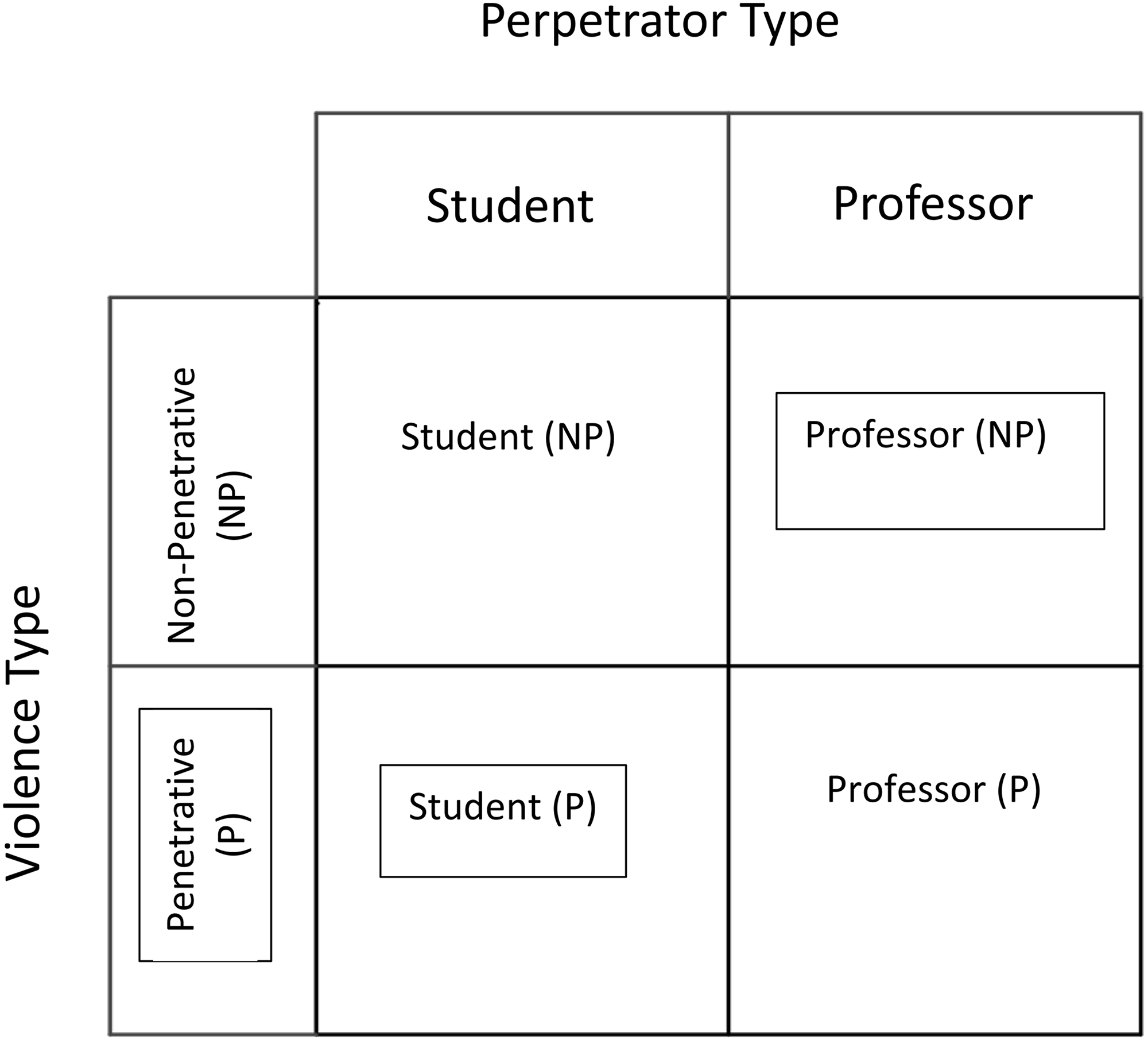
Vignette Diagram.
Presence of Alcohol
Participants were also asked to indicate how likely they would be on a scale from 1 to 5 (1 = definitely would not report, 5 = definitely would report) to report the event in the vignette to a trusted professor if they had been drinking alcohol with the perpetrator before the SV.
Results
Participants
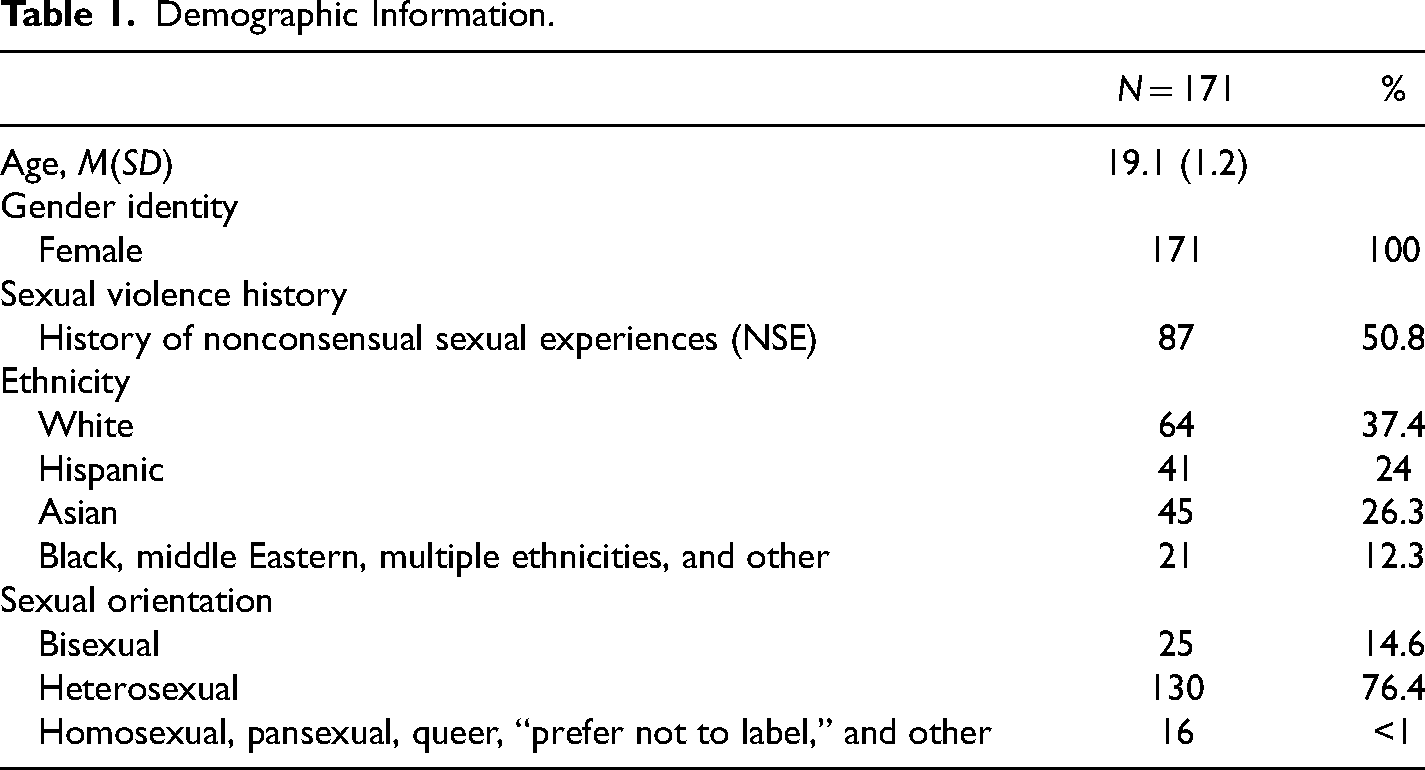
The current study's sample was a subset of data collected to evaluate Title IX MR policy. In the total dataset, there were 344 responses, but some data were excluded from analyses. Data from 19 students were excluded because they were Responsible Employees, six students withdrew consent, and four discontinued after partial completion. Attention checks embedded in the survey excluded 79 students and 52 were missing data necessary for the current study's analyses. The remaining 184 students included 171 females, 11 males, and two nonbinary individuals. As roughly 93% of the sample identified as female, the current study only included female participants. The remaining 171 female participants ranged from 18 to 25 years of age (M(SD) = 19.1 (1.16)). Of the 171 participants, 87 (50.8%) reported an NSE in their past. The large majority identified as heterosexual (76%), 37.4% were White, 26.3% were Asian, and 24% were Hispanic (Table 1).
Demographic Information.
Data Analyses
The current study used a binomial logistic regression to determine if participants in the mandatory reporting group were significantly more likely to report sexual violence than participants in the conditional reporting group. To complete this analysis, participants’ responses were coded as either “would” (1) or “would not” (0) report. The “would not report” group included participants who indicated being “unsure” of whether or not they would report the event in the vignette. Analyses were conducted using Jamovi software (The Jamovi Project, 2023).
Given a substantial number of participants in this sample reported an NSE history we first ran preliminary analyses to determine if any significant differences in reporting existed based on participant NSE history (Tables 2a–d). Binomial logistic regressions were used to determine whether participants’ personal NSE histories significantly impacted reporting likelihood for each vignette. While NSE history is discussed in previous literature, these preliminary results indicated no significant differences in participants’ likelihood to report each vignette based on personal NSE history. As such, NSE history was not included in further analyses.
Likelihood of Students With Different NSE Histories Reporting the Professor, Penetrative (PR) Vignette.
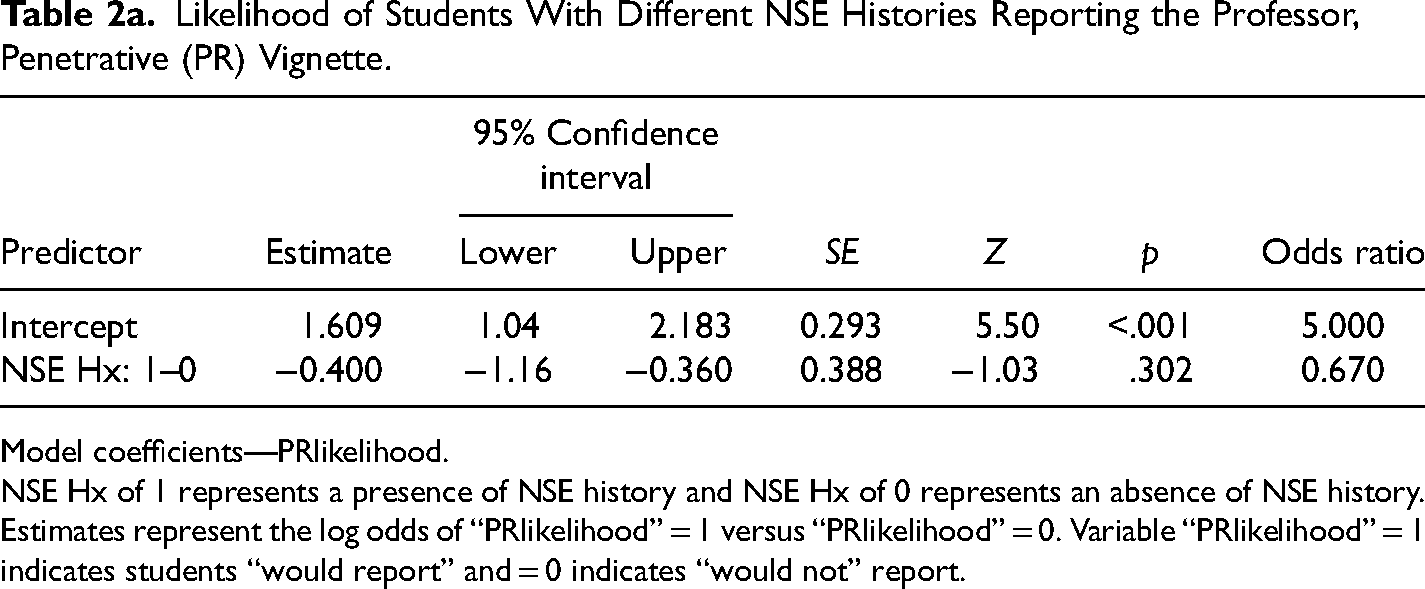
Model coefficients—PRlikelihood.
NSE Hx of 1 represents a presence of NSE history and NSE Hx of 0 represents an absence of NSE history. Estimates represent the log odds of “PRlikelihood” = 1 versus “PRlikelihood” = 0. Variable “PRlikelihood” = 1 indicates students “would report” and = 0 indicates “would not” report.
Likelihood of Students With Different NSE Histories Reporting the Professor, Nonpenetrative (PA) Vignette.
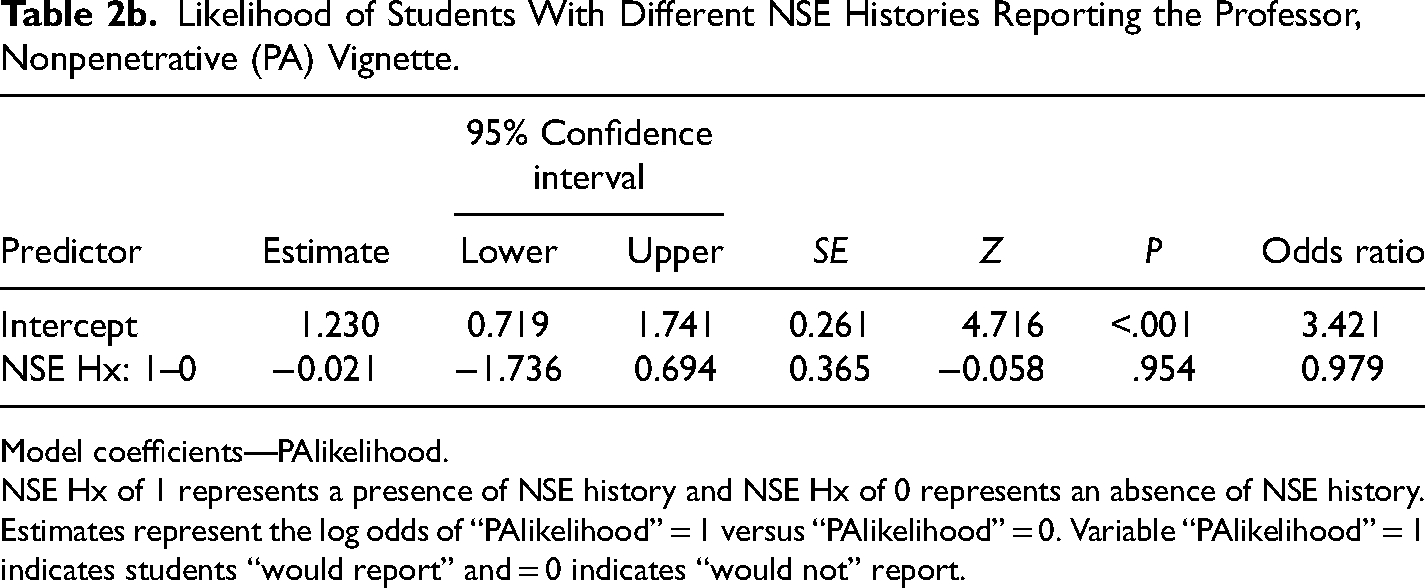
Model coefficients—PAlikelihood.
NSE Hx of 1 represents a presence of NSE history and NSE Hx of 0 represents an absence of NSE history. Estimates represent the log odds of “PAlikelihood” = 1 versus “PAlikelihood” = 0. Variable “PAlikelihood” = 1 indicates students “would report” and = 0 indicates “would not” report.
Likelihood of Students With Different NSE Histories Reporting the Student, Penetrative (SR) Vignette.
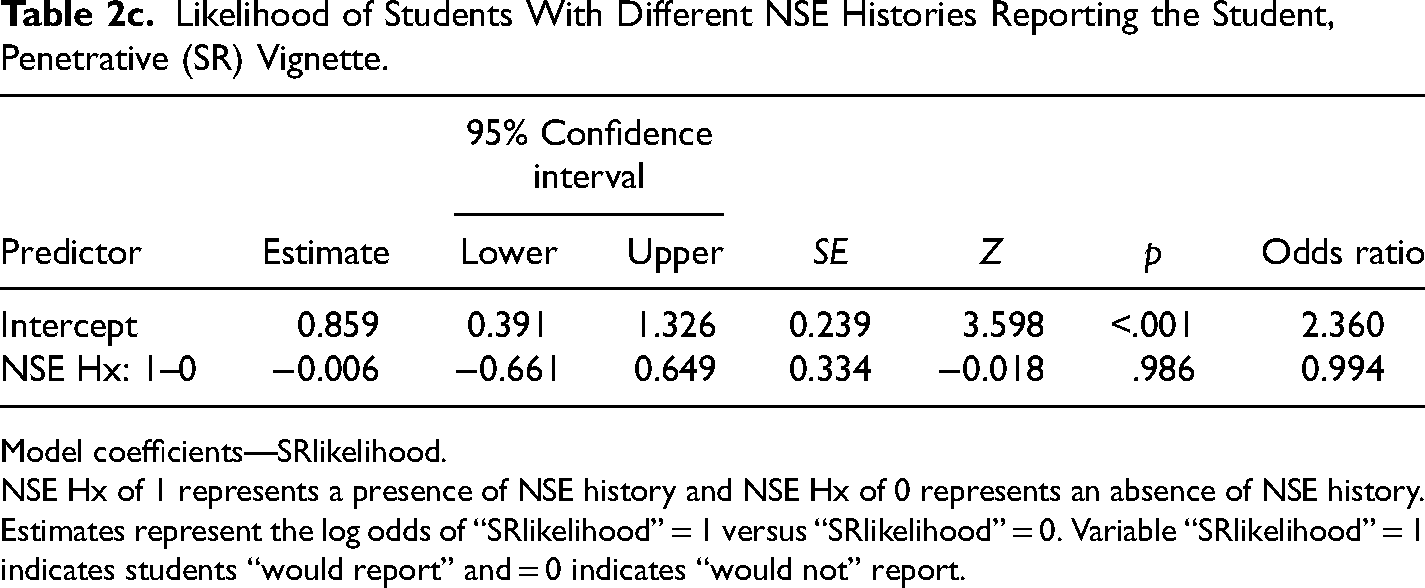
Model coefficients—SRlikelihood.
NSE Hx of 1 represents a presence of NSE history and NSE Hx of 0 represents an absence of NSE history. Estimates represent the log odds of “SRlikelihood” = 1 versus “SRlikelihood” = 0. Variable “SRlikelihood” = 1 indicates students “would report” and = 0 indicates “would not” report.
Likelihood of Students With Different NSE Histories Reporting the Student, Nonpenetrative (SA) Vignette.
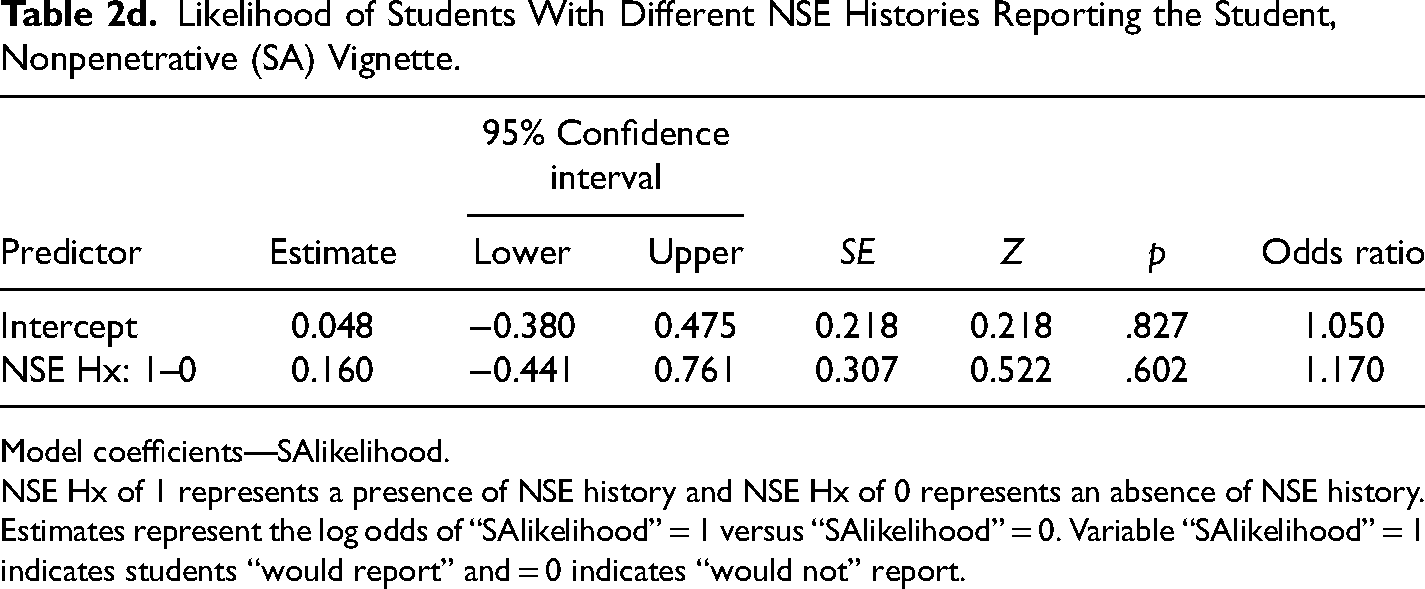
Model coefficients—SAlikelihood.
NSE Hx of 1 represents a presence of NSE history and NSE Hx of 0 represents an absence of NSE history. Estimates represent the log odds of “SAlikelihood” = 1 versus “SAlikelihood” = 0. Variable “SAlikelihood” = 1 indicates students “would report” and = 0 indicates “would not” report.
Additional analyses examined whether alcohol consumption impacted the likelihood of reporting for each vignette. In the current study perpetrator and violence type are combined in different pairs across the vignettes (i.e., professor perpetrating a nonpenetrative assault and professor perpetrating a penetrative assault). This combination of violence and perpetrator type may allow for a more nuanced examination of how these three contextual factors might interact and impact disclosure likelihood.
Evaluating Differences in Disclosure Likelihood of Each Vignette Between Conditions
The binomial logistic regression indicated that there were no significant differences in students’ likelihood to report across vignettes between the CR and MR conditions, except in the case of a professor perpetrating a penetrative assault (PR). The results showed that students in the CR group were significantly more likely to report PR compared to students in the MR group (p = .030) (Table 3a). For the remaining three vignettes (a professor perpetrating nonpenetrative assault and both student perpetrator vignettes), there were no significant differences in students’ likelihood to report between conditions (p = .490, .418, .718, respectively) (Tables 3b–d).
Student Likelihood to Report the Professor, Penetrative (PR) Vignette in the CR Versus MR Group.
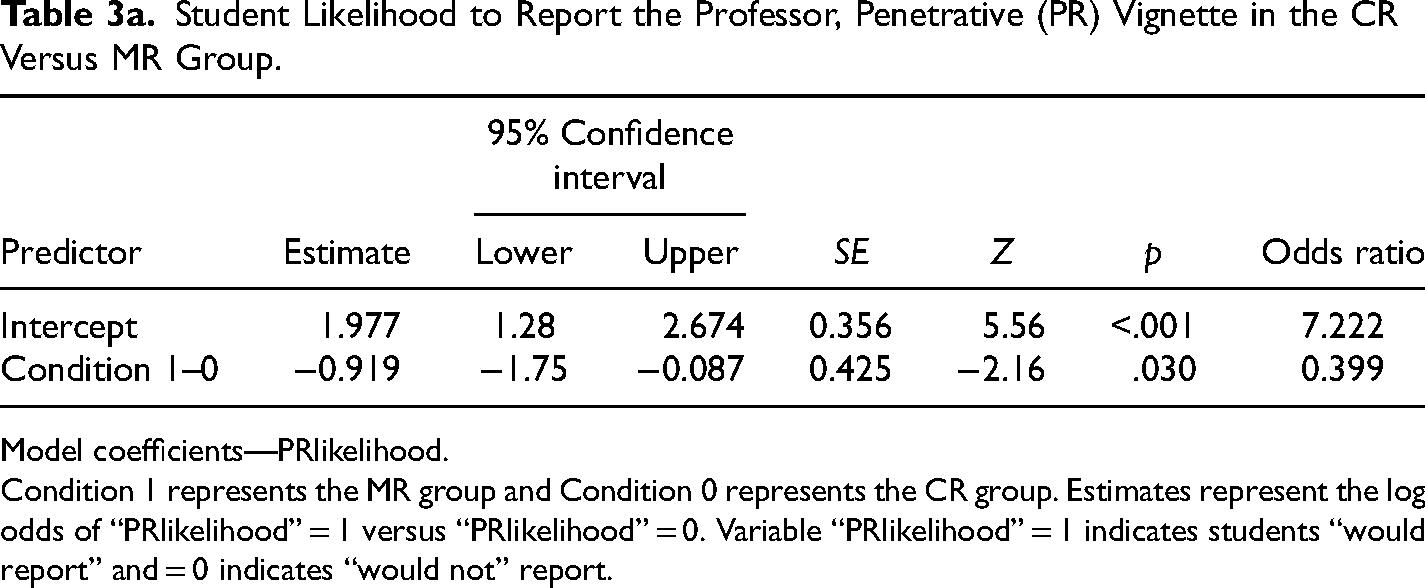
Model coefficients—PRlikelihood.
Condition 1 represents the MR group and Condition 0 represents the CR group. Estimates represent the log odds of “PRlikelihood” = 1 versus “PRlikelihood” = 0. Variable “PRlikelihood” = 1 indicates students “would report” and = 0 indicates “would not” report.
Student Likelihood to Report the Professor, Nonpenetrative (PA) Vignette in the CR Versus MR Group.
Model coefficients—PAlikelihood
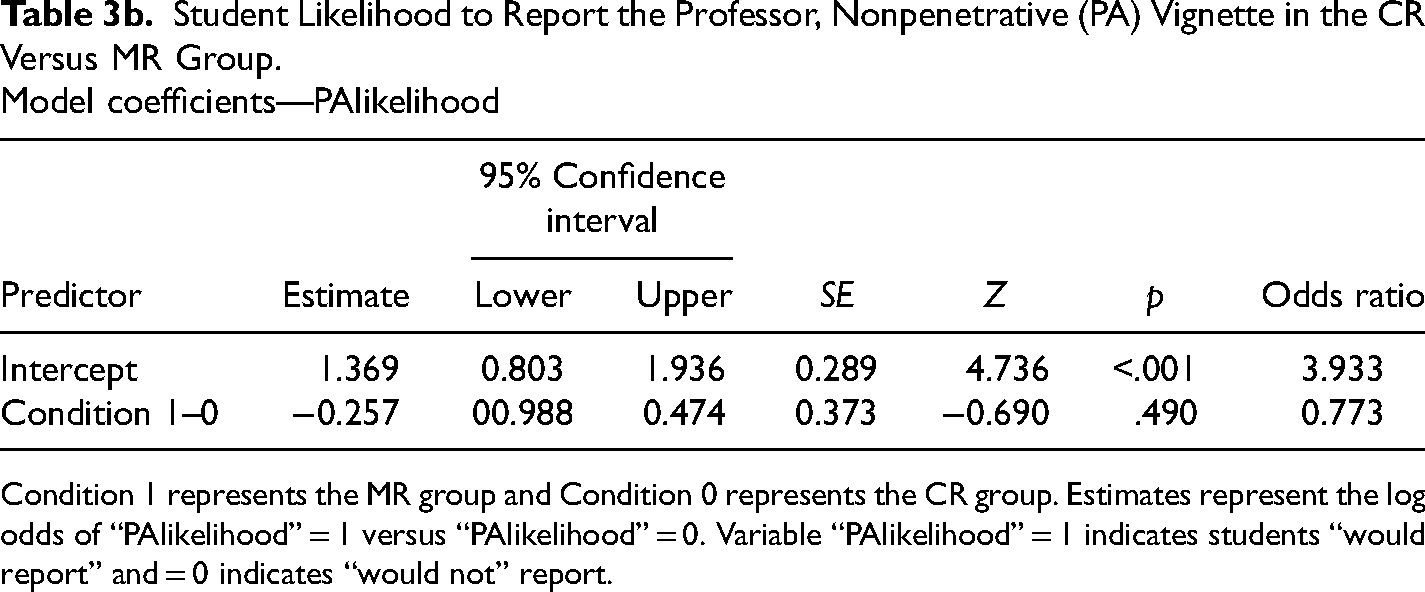
Condition 1 represents the MR group and Condition 0 represents the CR group. Estimates represent the log odds of “PAlikelihood” = 1 versus “PAlikelihood” = 0. Variable “PAlikelihood” = 1 indicates students “would report” and = 0 indicates “would not” report.
Student Likelihood to Report the Student, Nonpenetrative (SA) Vignette in the CR Versus MR Group.
Model coefficients—SAlikelihood.
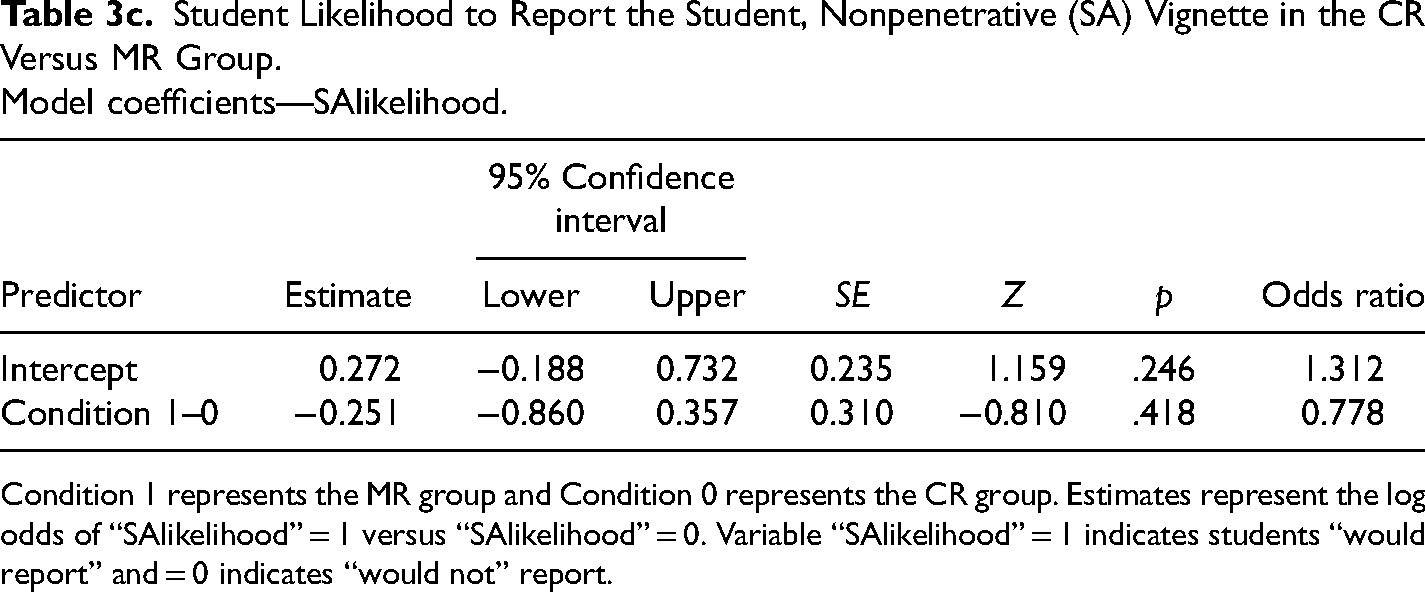
Condition 1 represents the MR group and Condition 0 represents the CR group. Estimates represent the log odds of “SAlikelihood” = 1 versus “SAlikelihood” = 0. Variable “SAlikelihood” = 1 indicates students “would report” and = 0 indicates “would not” report.
Student Likelihood to Report the Student, Penetrative (SR) Vignette in the CR Versus MR Group.
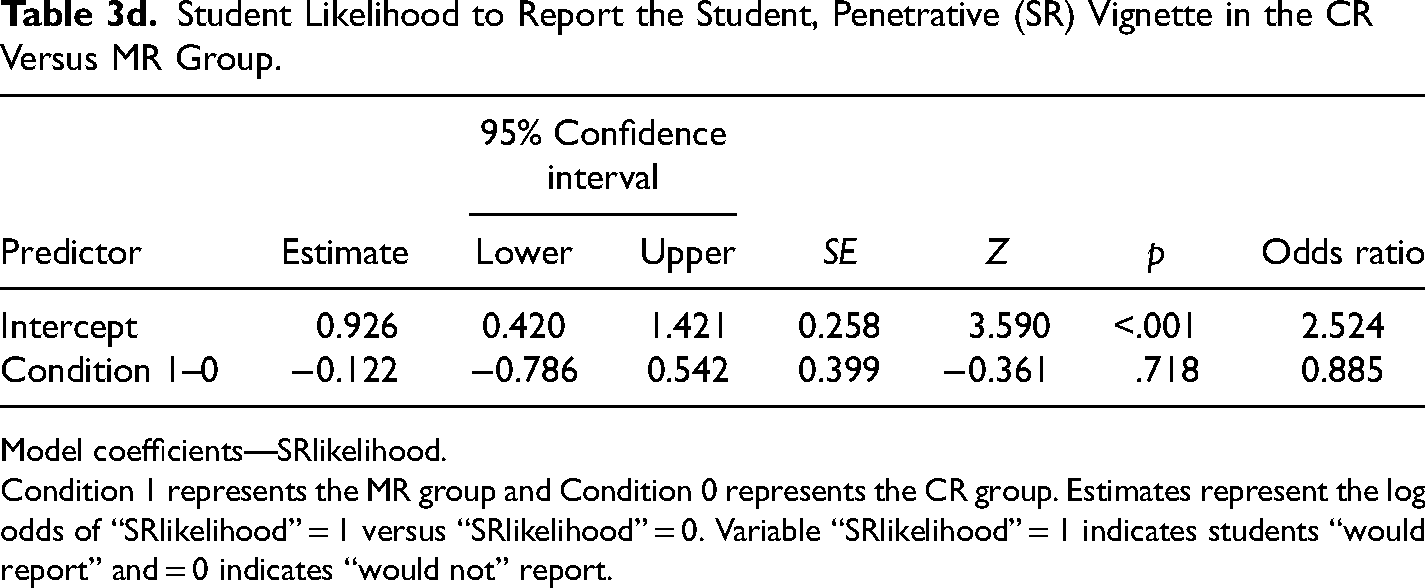
Model coefficients—SRlikelihood.
Condition 1 represents the MR group and Condition 0 represents the CR group. Estimates represent the log odds of “SRlikelihood” = 1 versus “SRlikelihood” = 0. Variable “SRlikelihood” = 1 indicates students “would report” and = 0 indicates “would not” report.
Evaluating the Effects of Alcohol Consumption on Student Disclosure Likelihood
We also evaluated whether students were more or less likely to report the SV in each vignette after consuming alcohol with the perpetrator. Students were asked to indicate both (a) how likely they would be to report the SV in the base vignette, and (b) how likely they would be to report the SV in the vignette if they had consumed alcohol with the perpetrator before. Student responses to each base vignette (a) and to the question introducing alcohol (b) were compared in a binomial logistic regression. Results showed students who indicated they thought they would report after the base vignettes, without alcohol, were significantly more likely to say they would report after consuming alcohol (p < .001) compared to students who said they would not report after the base vignette, without alcohol (Tables 4a–d). This was true across all vignettes. After each of the four vignettes, students who were willing to report the base SV vignette were roughly four times more likely to say they would report even after consuming alcohol with the perpetrator.
Student Likelihood of Reporting the Student, Nonpenetrative (SA) Vignette With and Without Alcohol.
Model coefficients—SAdrink.
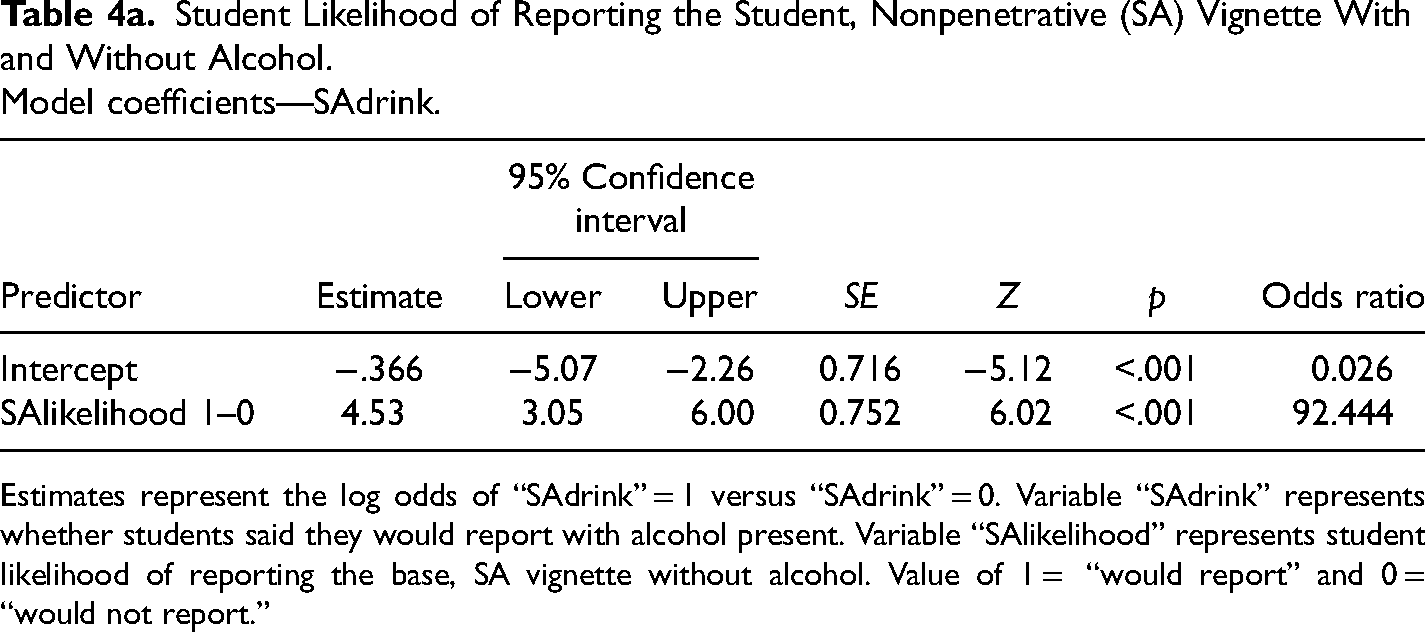
Estimates represent the log odds of “SAdrink” = 1 versus “SAdrink” = 0. Variable “SAdrink” represents whether students said they would report with alcohol present. Variable “SAlikelihood” represents student likelihood of reporting the base, SA vignette without alcohol. Value of 1 = “would report” and 0 = “would not report.”
Student Likelihood of Reporting the Professor, Nonpenetrative (PA) Vignette With and Without Alcohol.
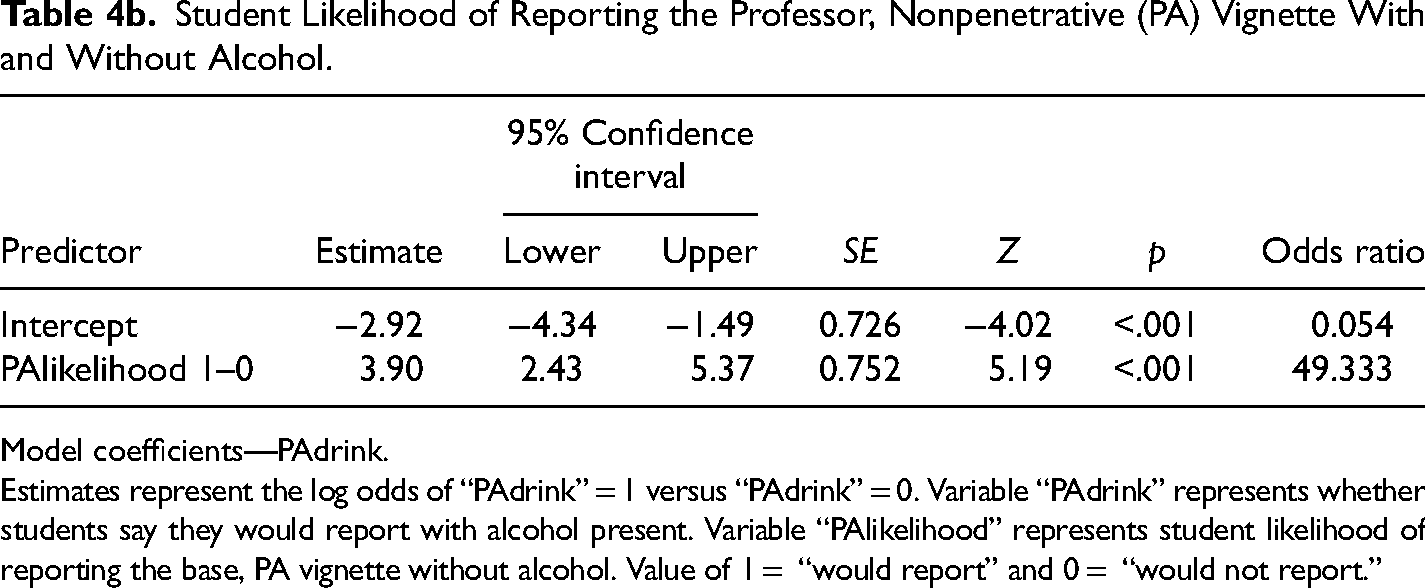
Model coefficients—PAdrink.
Estimates represent the log odds of “PAdrink” = 1 versus “PAdrink” = 0. Variable “PAdrink” represents whether students say they would report with alcohol present. Variable “PAlikelihood” represents student likelihood of reporting the base, PA vignette without alcohol. Value of 1 = “would report” and 0 = “would not report.”
Student Likelihood of Reporting the Student, Penetrative (SR) Vignette With and Without Alcohol.
Model coefficients—SRdrink.
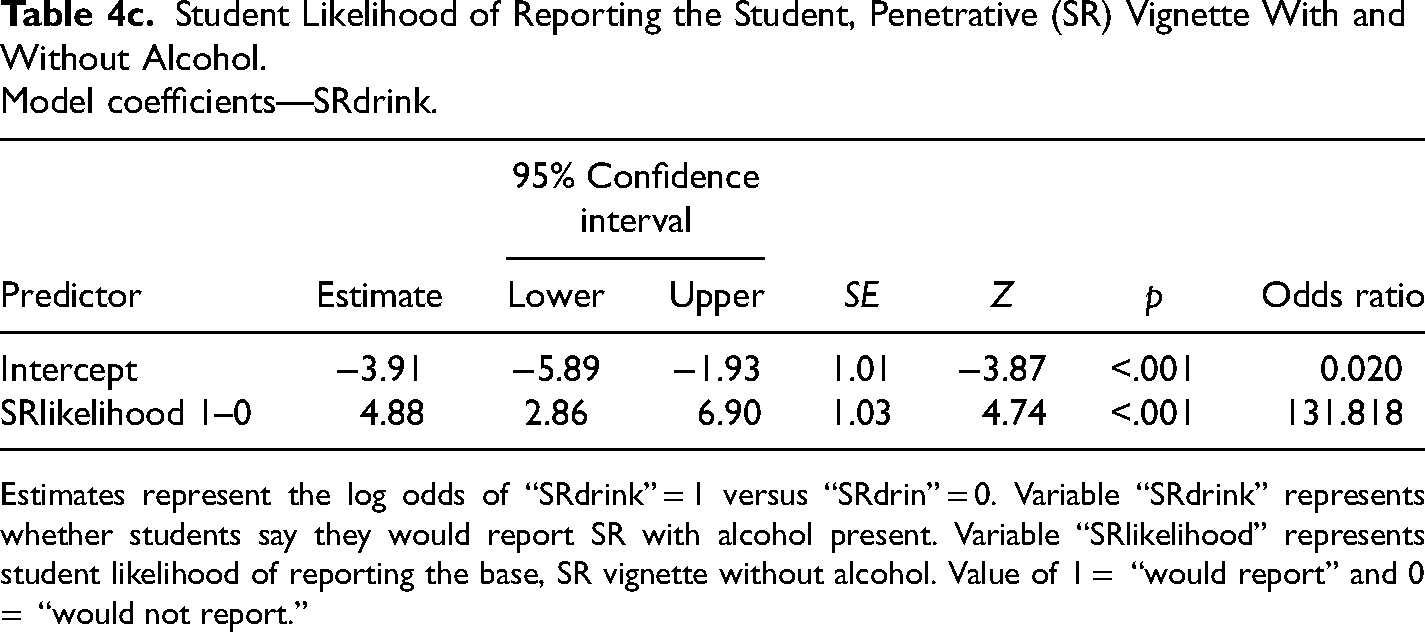
Estimates represent the log odds of “SRdrink” = 1 versus “SRdrin” = 0. Variable “SRdrink” represents whether students say they would report SR with alcohol present. Variable “SRlikelihood” represents student likelihood of reporting the base, SR vignette without alcohol. Value of 1 = “would report” and 0 = “would not report.”
Student Likelihood of Reporting the Professor, Penetrative (PR) Vignette With and Without Alcohol.
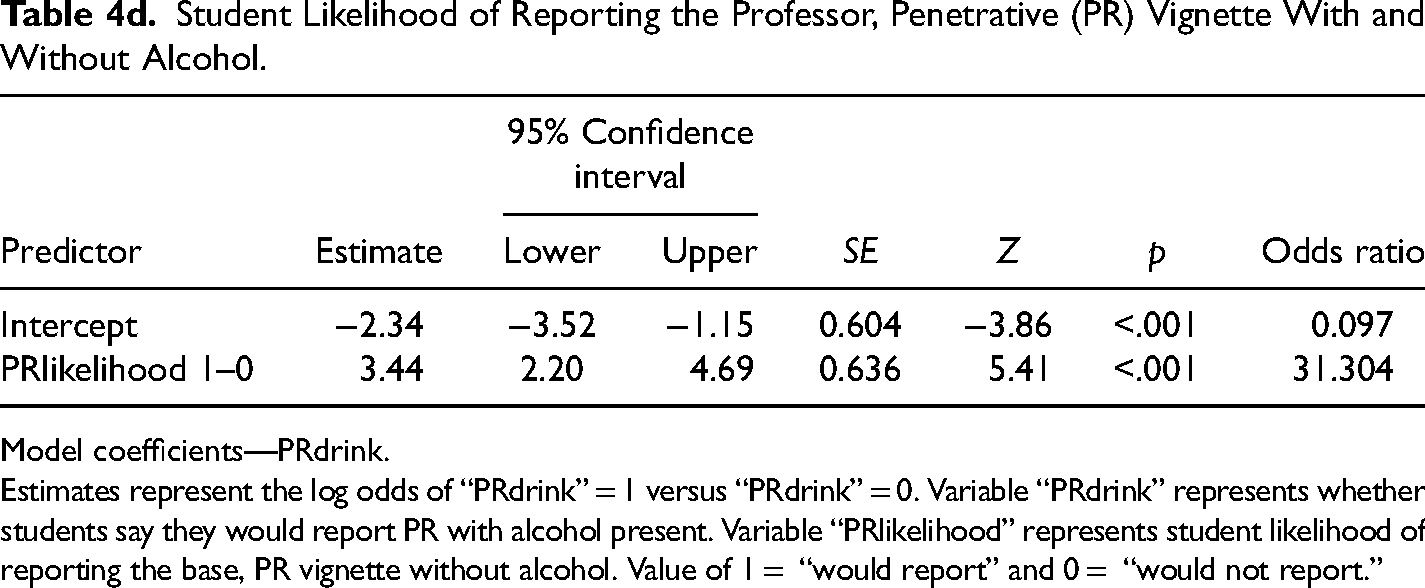
Model coefficients—PRdrink.
Estimates represent the log odds of “PRdrink” = 1 versus “PRdrink” = 0. Variable “PRdrink” represents whether students say they would report PR with alcohol present. Variable “PRlikelihood” represents student likelihood of reporting the base, PR vignette without alcohol. Value of 1 = “would report” and 0 = “would not report.”
Additionally, we used another binomial logistic regression to determine if there was a significant difference in students’ perceived likelihood of reporting each vignette after consuming alcohol between the MR and CR groups. This analysis aimed to determine if MR policy still yielded a significant difference in students’ perceived likelihood to report when alcohol was involved. In line with our original hypotheses, results indicated students in the CR group were significantly more likely to say they would report PR after drinking with the perpetrator compared to students in the MR group (p = .004) (Table 5a). There were no significant differences found between conditions for the vignettes with a student perpetrating penetrative and nonpenetrative SV, or a professor perpetrating nonpenetrative SV (p = .160, .368, .263, respectively) (Tables 5b–d). This is further evidence that MR policy plays some role in students’ decisions to report SV to someone at their university.
Student Likelihood to Report PR Vignette With Alcohol Between CR and MR Groups.
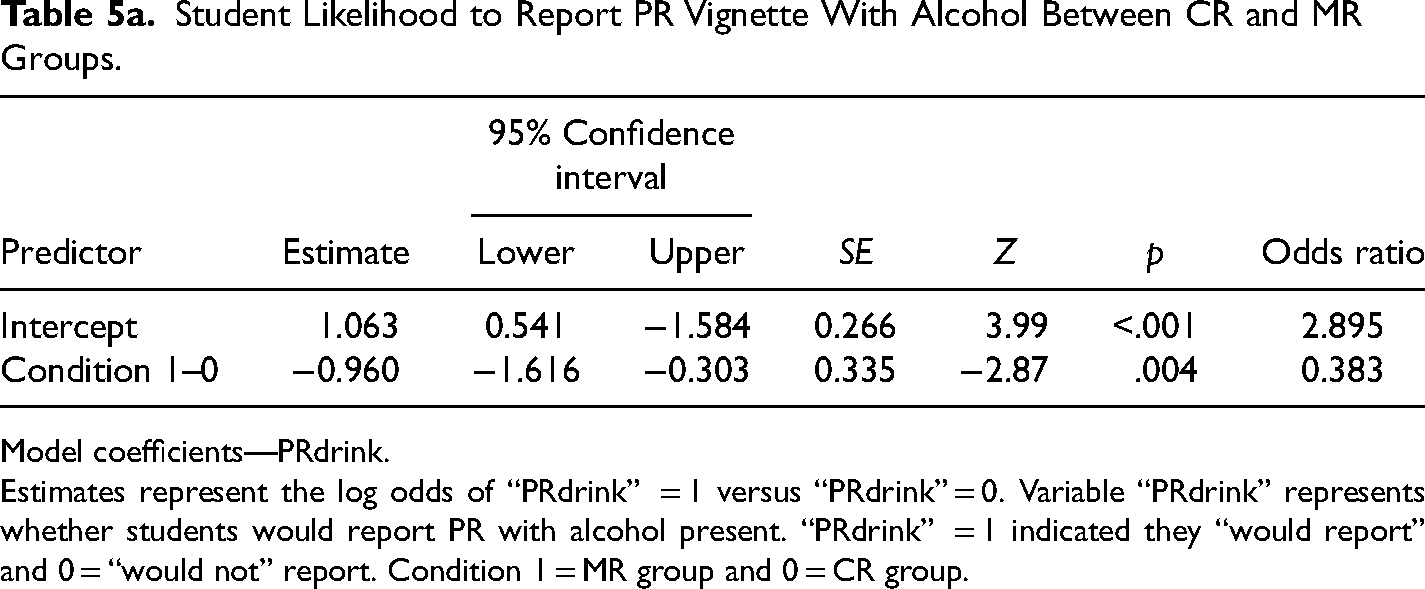
Model coefficients—PRdrink.
Estimates represent the log odds of “PRdrink” = 1 versus “PRdrink” = 0. Variable “PRdrink” represents whether students would report PR with alcohol present. “PRdrink” = 1 indicated they “would report” and 0 = “would not” report. Condition 1 = MR group and 0 = CR group.
Student Likelihood to Report PA Vignette With Alcohol Between CR and MR Groups.
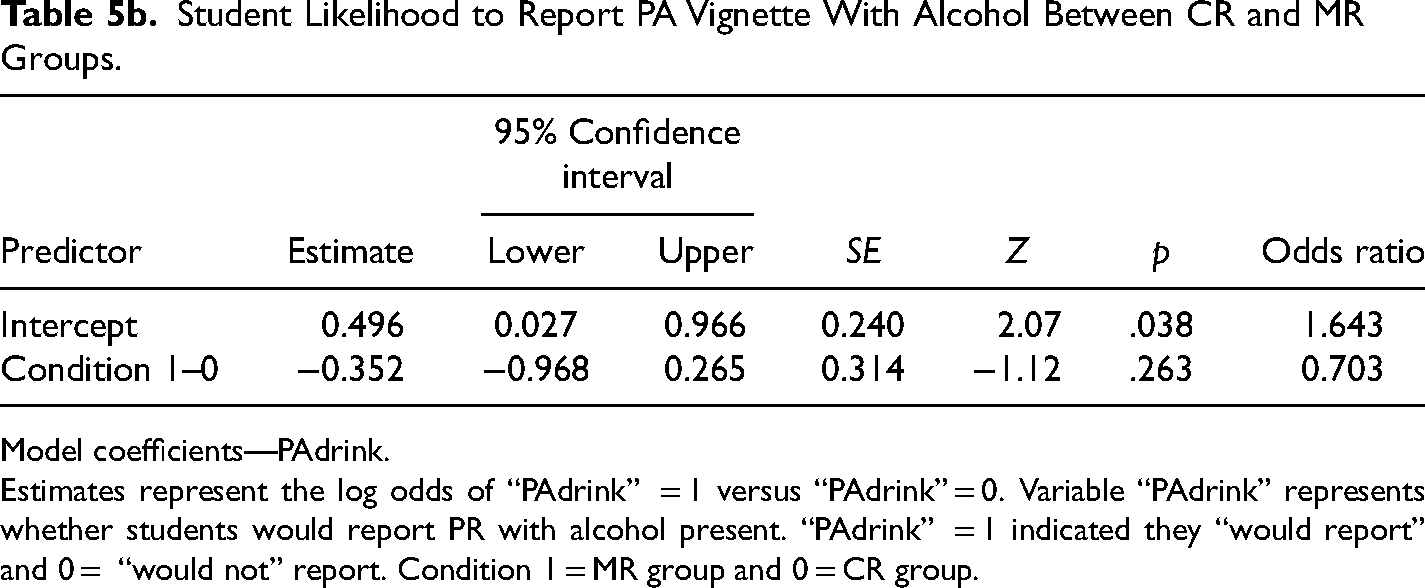
Model coefficients—PAdrink.
Estimates represent the log odds of “PAdrink” = 1 versus “PAdrink” = 0. Variable “PAdrink” represents whether students would report PR with alcohol present. “PAdrink” = 1 indicated they “would report” and 0 = “would not” report. Condition 1 = MR group and 0 = CR group.
Student Likelihood to Report SA Vignette With Alcohol Between CR and MR Groups.
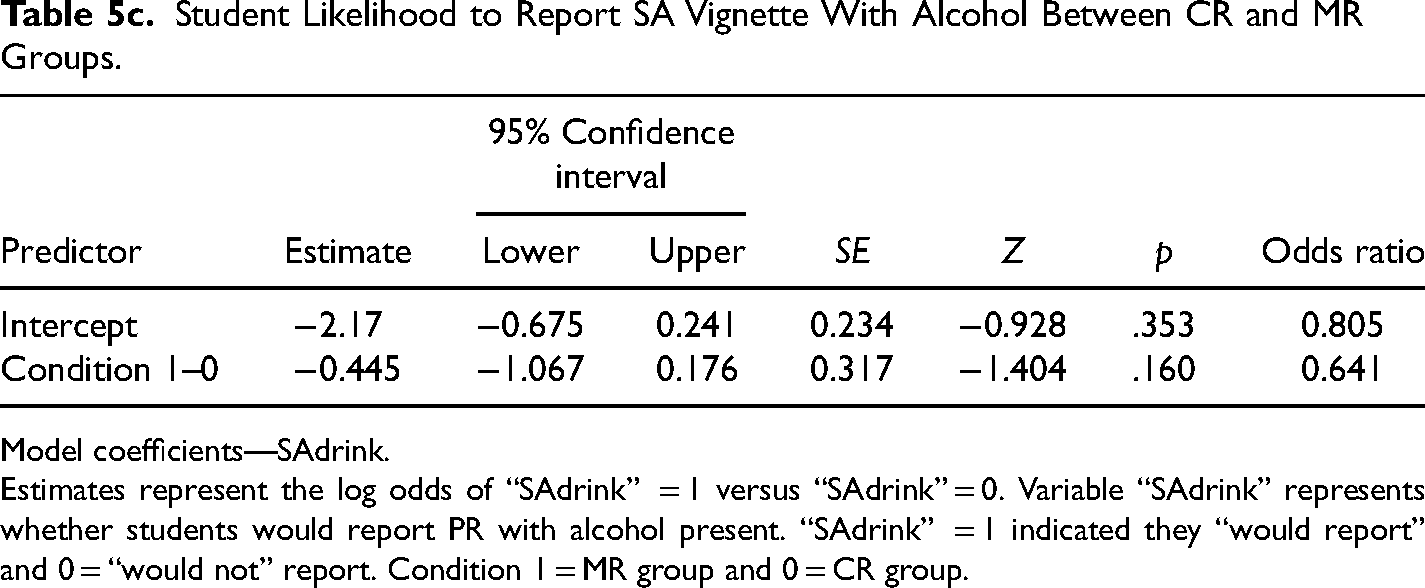
Model coefficients—SAdrink.
Estimates represent the log odds of “SAdrink” = 1 versus “SAdrink” = 0. Variable “SAdrink” represents whether students would report PR with alcohol present. “SAdrink” = 1 indicated they “would report” and 0 = “would not” report. Condition 1 = MR group and 0 = CR group.
Student Likelihood to Report SR Vignette With Alcohol Between CR and MR Groups.
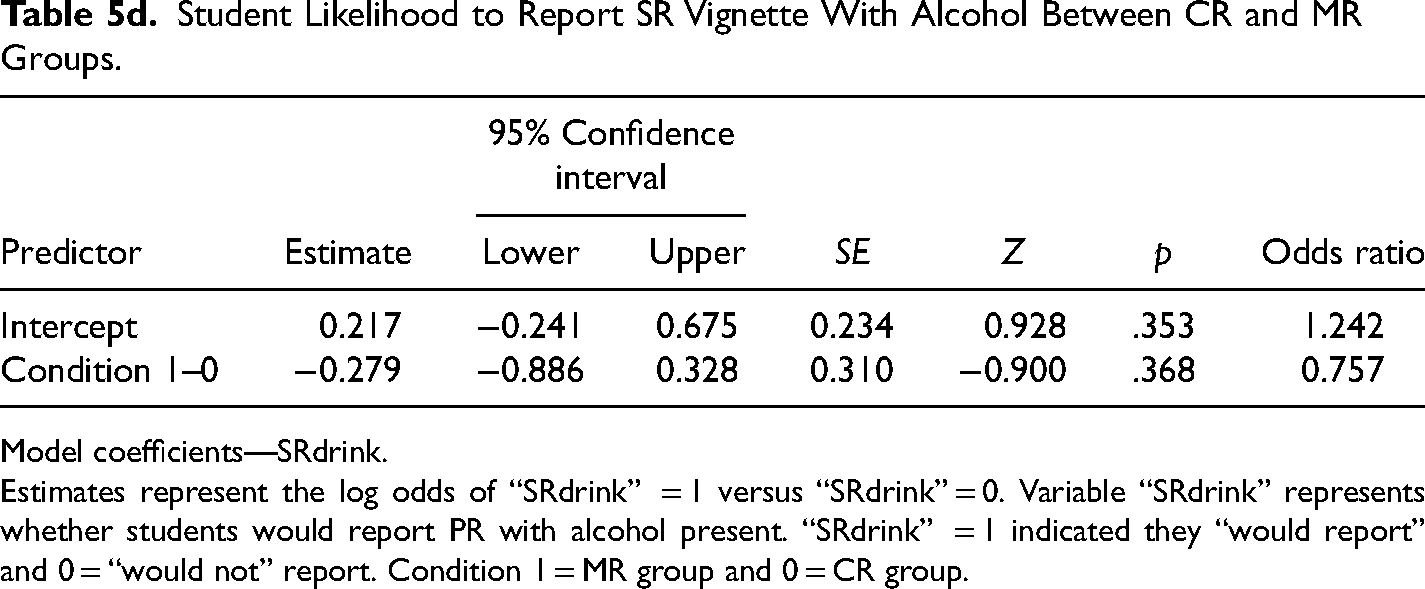
Model coefficients—SRdrink.
Estimates represent the log odds of “SRdrink” = 1 versus “SRdrink” = 0. Variable “SRdrink” represents whether students would report PR with alcohol present. “SRdrink” = 1 indicated they “would report” and 0 = “would not” report. Condition 1 = MR group and 0 = CR group.
Discussion
The current study aimed to build on existing literature in MR and SV among undergraduate populations. More specifically, the current study introduced an experimental manipulation, used behavioral descriptions of SV, and investigated the effects of alcohol consumption during SV under MR policy. As predicted, we found MR policy had a significant, negative effect on students’ perceived likelihood of reporting SV, but only in certain contexts. The presence or absence of MR policy was not significant in three of the four vignettes. In the vignette with a professor perpetrating a penetrative assault (PR), female students in the mandatory reporting group were significantly less likely to report SV compared to female students in the confidential reporting group. In the event of a professor perpetrating a penetrative assault, students believed they would be significantly less likely to report with MR policy present. This lends support to existing concerns that MR policy may inadvertently deter students from reporting some SV cases. Given Title IX's goal of eradicating all sexual violence (DoE; Proposed Changes 2022), these findings, in conjunction with concerns previously raised by researchers in the field, should be seriously considered in future policy, educational efforts, and reporting infrastructure built within universities.
The present study emphasized the importance of event-specific contextual factors, such as perpetrator and violence type, when evaluating reporting policy. While the introduction of a power differential between professors and students appears to be very influential when students consider reporting SV, the type of violence perpetrated matters as well. It is possible this reflects a trend in which students consider the “severity” of an event or how “believable” it is based on stereotypical traits of the event (e.g., weapon, force); this combination of perpetrator and violence type is consistent with a stereotypical depiction of SV, which is more likely to be reported (e.g., force, power differentials, incapacitated by perpetrator, weapon, etc.) (Ahrens et al., 2010; Fisher et al., 2003). Perhaps one of the most important findings from the current study, students indicated they were less likely to report this type of SV under MR policy. In light of this, it is important to consider whether student help-seeking behavior may be negatively impacted by MR policy.
If students are less likely to report or share their SV experience with a university employee or formal reporting source due to policy, they are not going to be given the aid and support they could benefit from. Results of the current study suggest that MR policy may be decreasing students’ options for obtaining support and help after SV. To mitigate the impact on help-seeking behaviors, efforts should continue to focus on improving knowledge and understanding of less stereotypical SV events. Universities should also work to increase alternative confidential reporting options or outlets for survivors to receive support and resources without formally reporting SV. Decreasing dependence on SV stereotypes or measures of “severity” could validate other experiences of SV for students and potentially increase their likelihood of disclosing SV and receiving resources and support. Students often worry that their experience will not be believed; teaching university affiliates how nuanced SV events are could dispel rape myths, validate survivors, and help facilitate positive reporting experiences. Research indicates the response a survivor receives to their report is positively associated with survivor health, well-being, and future reporting likelihood (Lorenz & Jacobsen, 2021; Orchowski et al., 2013; Sears-Greer et al., 2022). In the long term, this could potentially help mitigate reluctance in reporting created by MR policy and ensure all students receive the support and justice they could benefit from.
The current study also found significant effects of alcohol consumption on willingness to report SV events. While the introduction of alcohol decreased reporting likelihood overall, the students who believed they would report the SV described in all base vignettes (compared to students who did not) were approximately four times more likely to say they would still report even after consuming alcohol. These results are particularly interesting as previous research shows alcohol decreases the likelihood to report to formal sources, such as a professor at a university (Ahrens et al., 2010). Finding elements that make students more or less likely to report or engage in help-seeking behaviors can aid in the creation of ways to increase help-seeking behaviors and to build resources to reach other students. Based on these results, it seems students’ decisions about reporting SV events with alcohol use may be more complex under MR. Perhaps the likelihood to disclose even in the case of alcohol is dependent first on students’ willingness to report based on other features of the SV event, like perpetrator and/or violence type, or characteristics outside the SV event, like race, gender identity, or sexual orientation.
This was the first experimental study to provide evidence that MR policies can deter students from reporting sexual violence. These findings have important implications for creating future federal and university policies as well as educational efforts about reporting different types of SV for students. Future educational campaigns and policies need to consider how, and in what circumstances, MR itself may deter students from reporting SV to formal sources. To eradicate SV and provide support and aid to survivors as Title IX and MR policy initially intended, it is important to acknowledge how MR policy itself can play an influential role in students’ decisions to report SV.
In addition to external variables like policy and characteristics of SV events, previous findings indicate that individual-level variables, like NSE history, can impact reporting likelihood in general. Extant research on MR policy indicates students with NSE histories have more negative perceptions of MR policy than students without NSE histories (Holland et al., 2021). This begs the question as to whether NSE history meaningfully impacts student survivors’ reporting likelihood. Although not central to the current study, it is worth noting that there were no differences in reporting likelihood for any vignette between participants with and without NSE histories in this sample.
There were several limitations to the current study that should be considered in future research. First, the generalizability of these results may be limited based on the lack of diversity and the location of this current sample. The sample was comprised of female undergraduates who largely identified as heterosexual. Future studies should assess the likelihood to report with a sample that is more representative of different gender identities and sexual orientations. Individuals who are members of sexual minority groups often experience SV at higher rates, as such this is an important population to include in future research on MR and SV (Sears-Greer et al., 2022). The current study also collected data from undergraduates at one public university in the United States. Exposure and training in Title IX policies may vary at different universities throughout the country, leading to different likelihoods of reporting in different student bodies. Trust in one's university has also been found to impact the likelihood to report under MR in previous research; this may also lead to different results across different universities (Holland et al., 2018). The large majority of undergraduates at this particular university reported having a very high level of trust in the university to resolve issues of sexual violence (CLASE, 2017). Future studies should engage more diverse populations and consider the level of education on MR and Title IX as well as students’ trust in their universities.
The generalizability of this study's findings is limited by the characteristics of the questions asked and the vignettes used. The current study assessed students’ perceived likelihood of reporting under MR policy. These results depend on the degree to which students’ perceptions of their likelihood to report SV are congruent with their actual choices should they experience SV. While this is an important stipulation and limitation of the current study, this design is congruent with other research in this area (Holland, 2019a; Mancini et al., 2016). Additionally, the vignettes in the current study describe reporting to a professor; thus, the findings can only be generalized to U.S. universities where professors are mandatory reporters. While employees who are designated mandatory reporters, or Responsible Employees (RE), can vary from university to university, one national study found the majority of universities across the United States designated all employees, including professors, as REs (Holland et al., 2018). Thus, while it is highly likely that professors would be considered REs at all public universities, it is not guaranteed. In this vein, one of the larger limitations of this study is that it only assessed the perceived likelihood to report to professors at a university. These findings do not assess students’ likelihood to report to other university officials or staff. RE type should be considered and varied in future studies.
This study was also limited to only two types of perpetrators. Future research should try to expand both the “type” of the perpetrator and the degree of closeness the perpetrators have to the students/survivors of SV (e.g., a romantic partner, close friend, or specifically a highly regarded/famous professor). Previous research indicates the degree of closeness and the relationship to the perpetrator of the SV can significantly impact not only survivors’ likelihood to report the SV event but also their likelihood of identifying it as sexual violence at all (Peterson & Muehlenhard, 2011). This variable also relates to the idea of “stereotypical” SV or the severity of SV. Having a close relationship to the perpetrator (e.g., romantic partner) or having a reason not to label the perpetrator as such (e.g., someone well-liked and trusted by all) meaningfully influences survivors’ perception of the event and their choice to report it (Ahrens et al., 2010; Peterson & Muehlenhard, 2011).
Lastly, it is important to consider the data and analyses used. The data in the current study was reduced to binary answers of “would report” and “would not report.” While this binary response most clearly addressed the primary question and purpose of the present study (i.e., identifying whether or not MR policy decreased students’ perceived likelihood of reporting SV as some researchers fear it might), it does reduce and simplify data collected on a complex situation. Future studies should aim to incorporate more nuanced techniques for collecting and analyzing data on this topic. Decisions around reporting SV are very complex and highly dependent on context; as such, researchers should try to find ways to capture this complexity.
In conclusion, the decision to report SV is nuanced and highly dependent on the characteristics of the SV event itself. The current study shows MR policy does have the potential to decrease student reports of SV to formal sources at universities under certain circumstances.
Frequency Tables for Likelihood of Reporting the SA Vignette With and Without Alcohol.
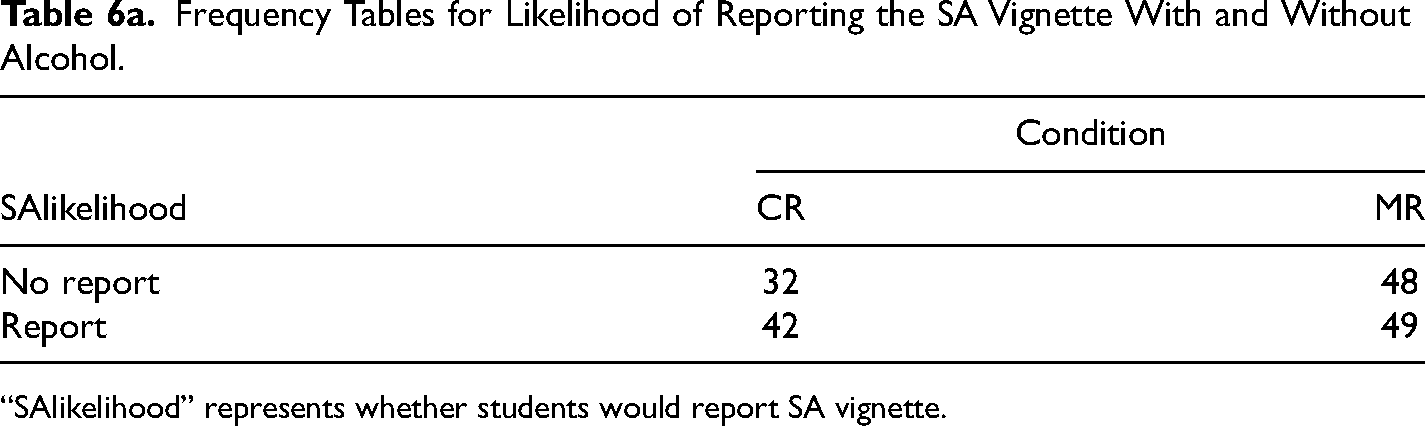
“SAlikelihood” represents whether students would report SA vignette.
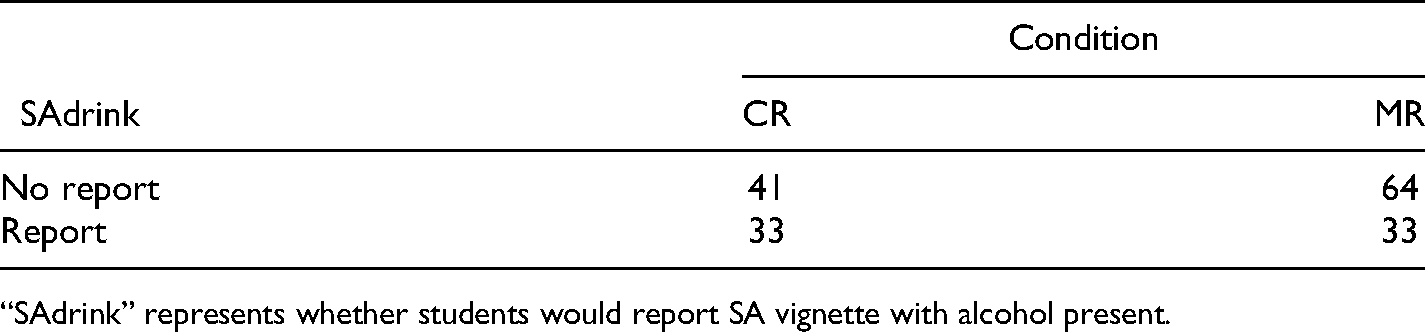
“SAdrink” represents whether students would report SA vignette with alcohol present.
Frequency Tables for Likelihood of Reporting the SR Vignette With and Without Alcohol.
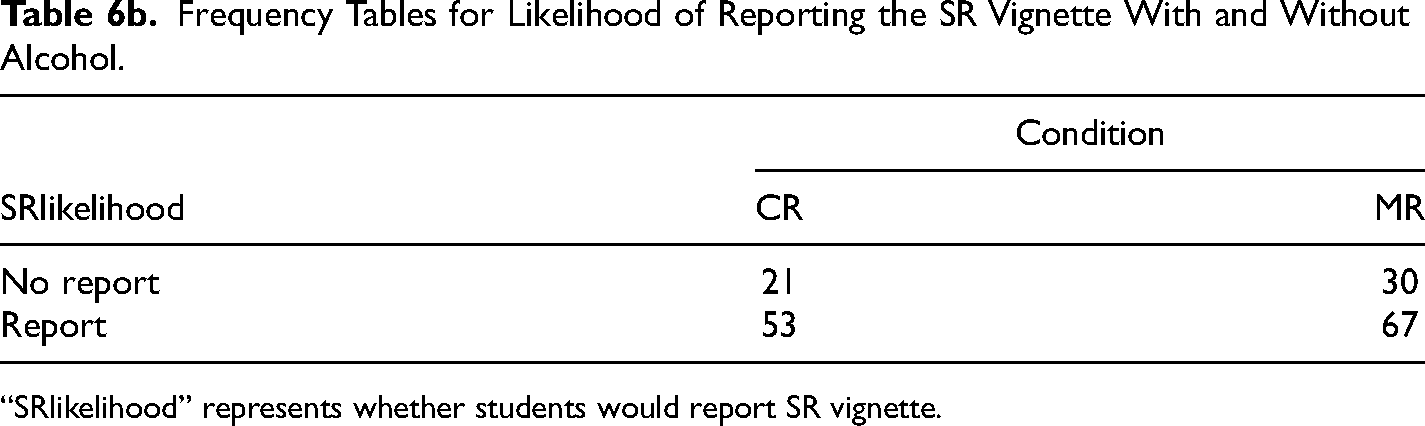
“SRlikelihood” represents whether students would report SR vignette.
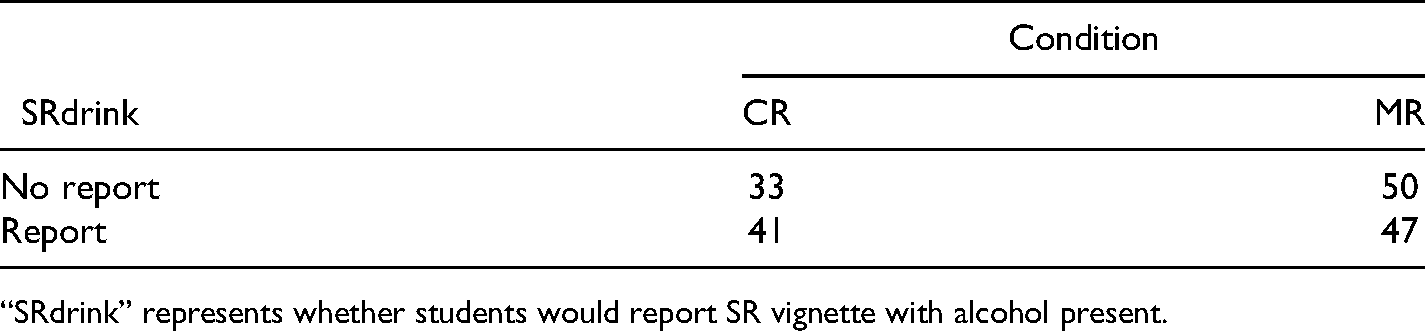
“SRdrink” represents whether students would report SR vignette with alcohol present.
Frequency Tables for Likelihood of Reporting the PA Vignette With and Without Alcohol.
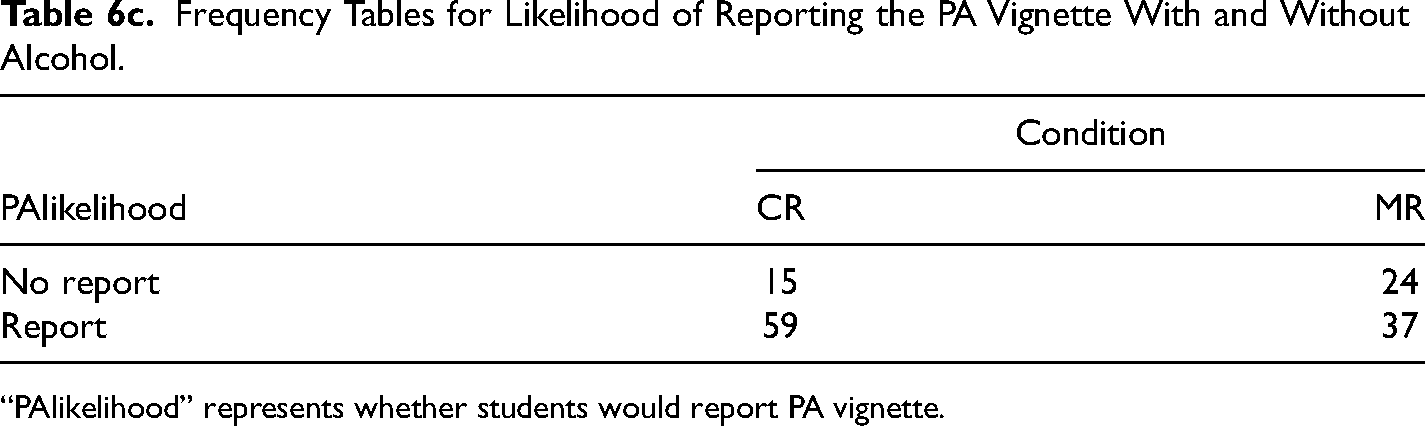
“PAlikelihood” represents whether students would report PA vignette.
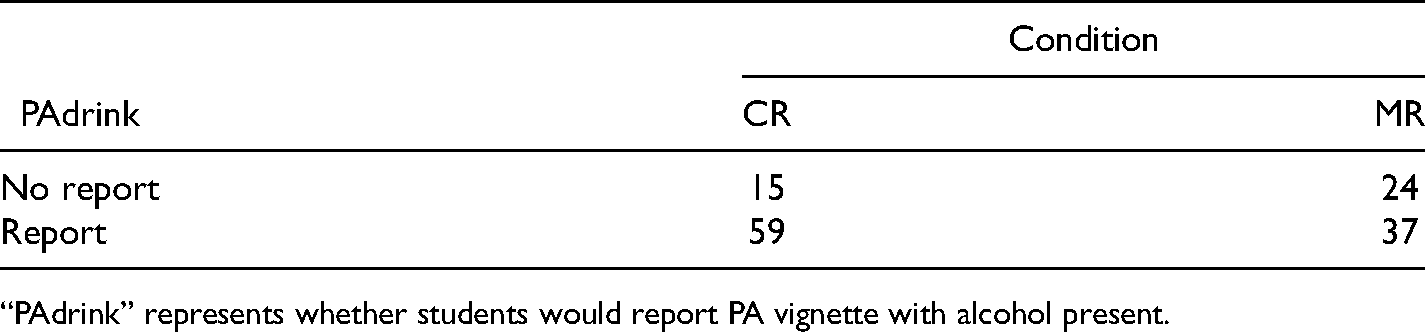
“PAdrink” represents whether students would report PA vignette with alcohol present.
Frequency Tables for Likelihood of Reporting the SA Vignette With and Without Alcohol.
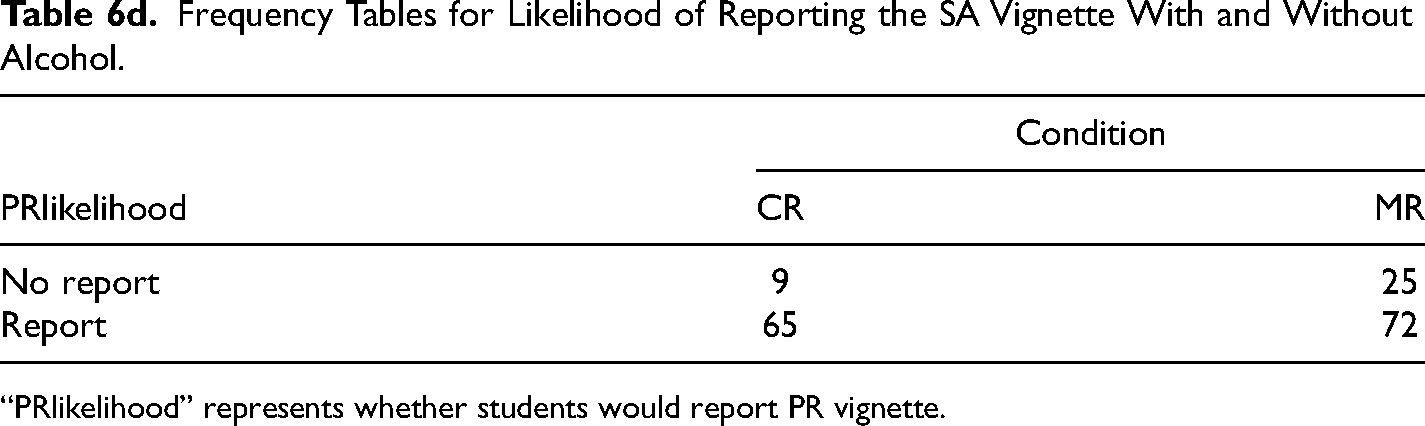
“PRlikelihood” represents whether students would report PR vignette.
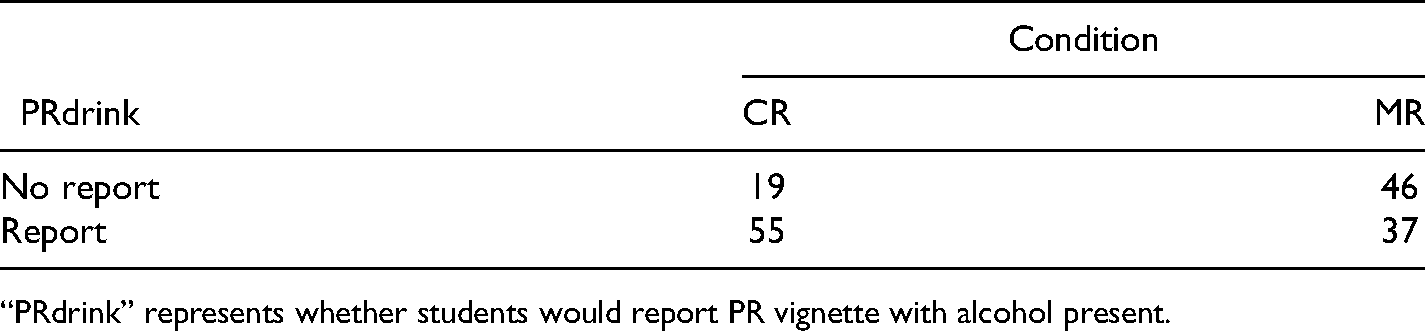
“PRdrink” represents whether students would report PR vignette with alcohol present.
Footnotes
Declaration of Conflicting Interests
The authors declared no potential conflicts of interest with respect to the research, authorship, and/or publication of this article.
Funding
The authors received no financial support for the research, authorship, and/or publication of this article.

Author Biographies
Appendix A. Instructional Manipulation
Appendix B. Vignettes and Instructions
Instructions
Vignette 1: Student perpetrator, nonpenetrative assault
Last weekend, Alex went to a fellow classmate's apartment to study. After studying, the classmate moved closer to Alex and began rubbing the inside of Alex's legs. Alex gently pushed the classmate's hand away. However, a few minutes later, the classmate began rubbing Alex's legs again, this time inserting their hand into Alex's pants. Alex repeatedly moved the classmate's hand away, but in response, the classmate moved closer and kissed Alex. The classmate continued to kiss Alex and began running their hands over the rest of Alex's body despite Alex being uninterested. Alex felt uncomfortable, pushed the classmate away, and left the apartment. Alex has not yet told anyone about this but is considering telling a trusted professor, Dr. Doe, to get advice.
Vignette 2: Professor perpetrator, nonpenetrative assault
Last week, Taylor went to Dr. Smith's office for a meeting. After their meeting, Dr. Smith moved closer to Taylor and began rubbing the inside of Taylor's legs. Taylor gently pushed Dr. Smith's hand away. However, a few minutes later, Dr. Smith began rubbing Taylor's legs again, this time inserting their hand into Taylor's pants. Taylor repeatedly moved Dr. Smith's hand away, but in response, Dr. Smith moved closer and kissed Taylor. Dr. Smith continued to kiss Taylor and began running their hands over the rest of Taylor's body despite Taylor being uninterested. Taylor felt uncomfortable, pushed Dr. Smith away, and left the office. Taylor has not yet told anyone about this but is considering telling a trusted professor, Dr. Doe, to get advice.
Vignette 3: Student perpetrator, penetrative assault
Last weekend, Riley went to a fellow classmate's apartment to study. After studying, the classmate moved closer to Riley and began rubbing the inside of Riley's legs. Riley gently pushed the classmate's hand away. However, a few minutes later, the classmate began rubbing Riley's legs again, this time inserting their hand into Riley's pants. Riley repeatedly moved the classmate's hand away, but in response, the classmate moved closer and kissed Riley. The classmate continued to kiss Riley and began running their hands over the rest of Riley's body. The classmate penetrated Riley with their fingers and despite Riley being uninterested, they proceeded to have sex. Riley felt uncomfortable, pushed the classmate away, and left the apartment. Riley has not yet told anyone about this but is considering telling a trusted professor, Dr. Doe to get advice.
Vignette 4: Professor perpetrator, penetrative assault
Last week, Chandler went to Dr. Jones’ office for a meeting. After their meeting, Dr. Jones moved closer to Chandler and began rubbing the inside of Chandler's legs. Chandler gently pushed Dr. Jones’ hand away. However, a few minutes later, Dr. Jones began rubbing Chandler's legs again, this time inserting their hand into Chandler's pants. Chandler repeatedly moved Dr. Jones’ hand away, but in response, Dr. Jones moved closer and kissed Chandler. Dr. Jones continued to kiss Chandler and began running their hands over the rest of Chandler's body. Dr. Jones penetrated Chandler with their fingers and despite Chandler being uninterested, they proceeded to have sex. Chandler felt uncomfortable, pushed Dr. Jones away, and left the office. Chandler has not yet told anyone about this but is considering telling a trusted professor, Dr. Doe to get advice.