




Abstract
We explore the implications of the concept of territorio cuerpo-tierra for conducting research on women's resilience to trauma and post-COVID-19 pandemic recovery in El Salvador, Central America. Cuerpo-territorio forces a reconceptualization of women's realities as bound to the embodiment of the geo-politics of gender, body, and land as territories, and thus, their realities as bound to the histories and temporality of those as territories. Through a series of despartares decoloniales (decolonial awakenings), we postulate that resilience research reproduces narrowly defined understanding of women's realities and responses to both the symbolic and physical conditions and adversities of their lives.
Introduction
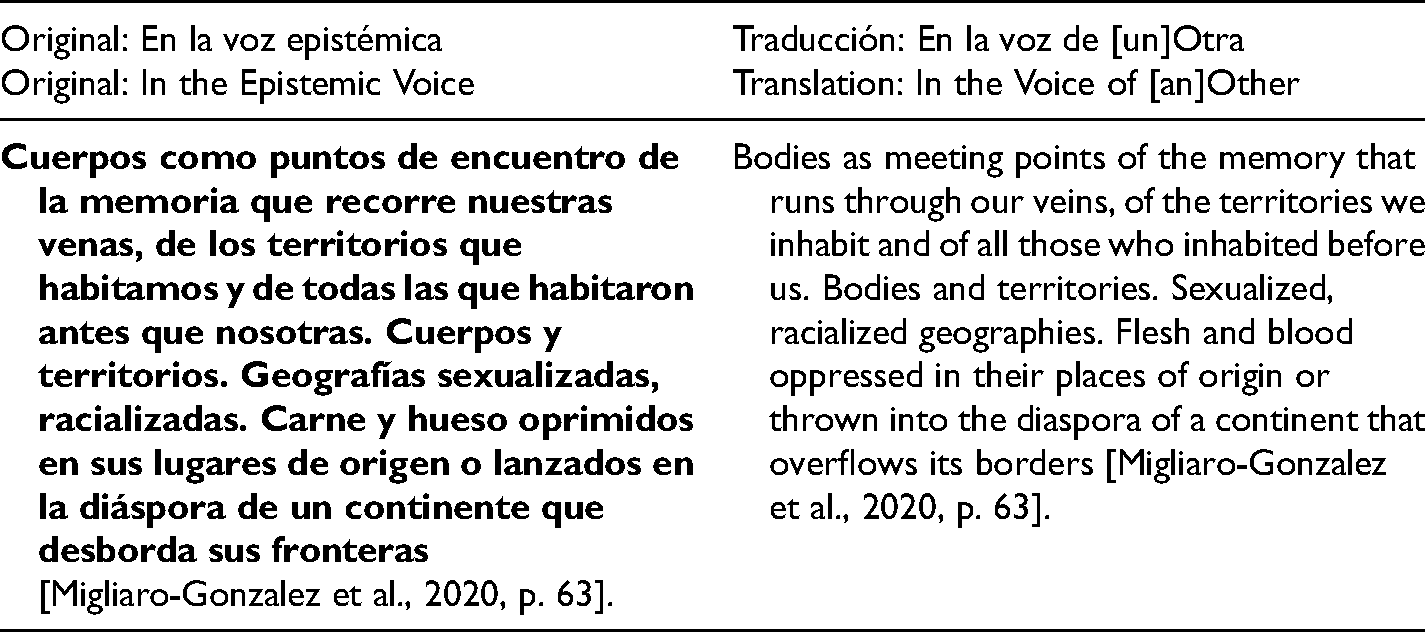
In this paper, we explore the implications of the meso-American, Indigenous, feminist concept of “territorio cuerpo-tierra,” also referred to as “cuerpo-territoro” (Cabnal, 2013; López, 2016; Sweet & Ortiz-Escalante, 2017; Zaragocin & Caretta, 2021) for conducting research on women's resilience to trauma and post-COVID-19 pandemic recovery in El Salvador, Central America. 1 Our research program consisting of an international partnership between academics and community-based nongovernmental organizations is focused on exploring Salvadoran women's resilience to trauma as an organizing framework for addressing violence, gender inequalities, and social and economic development and post-COVID-19 pandemic recovery. It adopts an intergenerational perspective as well as a collective focus in which we move from individual interviews to focus group discussions and community dialogues, where women have an opportunity to describe and discuss with one another what, over the generations, made a difference to their lives in times of adversity and hardship.
Among our main research activities, we are exploring the impacts of two trauma-informed programs for fostering women's resilience. The first program is focused on fostering women's “economic resilience” through entrepreneurial strategies and the implementation of small businesses. The second program is focused on fostering women's “embodied resilience” as practiced through joyful, somatic, and body-work activities offered as a power-lifting program through a community gym. Both programs are offered in communities characterized as marginalized by conditions of poverty, a lack of public works, health, and social services, as well as a lack of social and economic opportunities (Marroquín, 2021).
Conceptually, “territorio cuerpo-tierra” is “defined as the inseparable ontological relationship between body and territory” (Zaragocin & Caretta, 2021, p. 1504). Cuerpo-territorio brings into question Western ontology, in particular the divides between the “body/corporeal,” the “land/territory,” the spatial temporality of past and present that upholds the depoliticization of violence and women's subjugation as extensions of colonial dominance through the occupation body, land, territory, and time (Cabnal, 2013; Chavez-Dueñas et al., 2022; López, 2016; Migliaro-Gonzalez et al., 2020; Sweet & Ortiz-Escalante, 2017; Zaragocin & Caretta, 2021). Ontologically, women's emotional and psychological experiences are not separated from women's bodies and corporealities, and women's bodies and corporealites are not separated from the lands and territories they live. Instead, mind/body is understood as land/territory, and land/territory as mind/body (Migliaro-Gonzalez et al., 2020), and what is experienced by the mind/body is simultaneously experienced by the land/territory (Colectivo Miradas Críticas del Territorio desde de Feminismo, 2017; Zaragocin & Caretta, 2021).
Through a series of critical reflections, we postulate that as imagined through personal and ecological perspectives, resilience research reproduces narrowly defined understandings of women's realities and responses to both the symbolic and physical conditions of their lives. Instead, resilience research represents a flawed epistemology premised on a colonial ontology that separates women's psychologies and bodies from the material conditions, and physical spaces on which they live gendered lives. Territorio cuerpo-tierra challenges the separations between “minds” and “bodies” and between “bodies” and “land,” and instead, asserts that women's minds/bodies are extensions of the physical—extensions of the material conditions, physical spaces, lands, geographies, and territories on which they/we live and on which they/we experience subjugation, domination, and violence (Cabnal, 2013; Dorronson, 2013; López, 2016; Migliaro-Gonzalez et al., 2020; Sweet & Ortiz-Escalante, 2017; Zaragocin & Caretta, 2021).
When referring to “violence against women,” we acknowledge that gendered violence occurs on a continuum from personal and interpersonal to institutional and structural forms (Walsh & Menjívar, 2016). Like many other scholars, we recognize that ending different forms of personal violence (as a range of examples) from harassment in the workplace (Spiliopoulous & Witcomb, 2023; Zelin et al., 2022); microaggressions that send denigrating messages to queer-identified women (Sterzing et al., 2017); intimate partner abuse (Mañas et al., 2023); the psychiatrization of women's experiences of trauma (Burstow, 2003); the deepening feminization of poverty (Aguilar, 2011); and the commercial sexual exploitation of women and girls (Bath et al., 2021; Raffety, 2013) to rape as a tool of war (Farwell, 2004) require institutional and structural change. In other words, the personal is always political and the political is always personal. We intentionally clarify this position because of the ways social issues, including those we are studying (i.e., women's trauma, resilience, and postpandemic recovery) can be depoliticized and de-historicized. The depoliticization and de-historicization occur through research, policy, and practice agendas and initiatives that either (a) ignore women's realities over time and intergenerationally, or (b) make women the targets of public policy, social interventions, and individualized change while leaving institutional conditions unchanged (Walsh & Menjívar, 2016; Yousafzi et al., 2018). As a feature of colonial temporality, women's personal experiences are separated and delinked from the political and collective contexts of their embodied lives and from their historical roots of racial-gendered colonialism (Chavez-Dueñas et al., 2022).
During the COVID-19 pandemic, globally governments were criticized by women's advocacy groups and scholars for being gender-blind and gender-neutral by not adequately accounting for women's realities and the impacts measures, such as those to contain the virus, school and business closures, and vaccine research had on women (Barnes et al., 2021; Donnelly & Farina, 2021; Farrell et al., 2020; Kaag, 2021; Rolland, 2020). Women's mental and physical health, economic and labor force precarities, family caregiving labor, and safety were afterthoughts to health and quarantine measures. For El Salvador, as examples, quarantine and social distancing measures were criticized by both national and international organizations for increasing women's and girls’ isolation, which in turn increased their risk and exposure to interpersonal violence, assaults, and abuse (Instituto Salvadoreño para el Desarrollo de la Mujer, 2020; UN-OCHA, 2021; United Nations, 2020). Postpandemic, the outcome has been a national rise of pregnancy rates among adolescent girls, many of which were the result of abuse (Fondo de Población de las Naciones Unidas (UNFPA), 2023). Additionally, gendered-policy initiatives are criticized by development scholars for offloading social issues like postpandemic recovery onto women, by making them, their immediate families, and communities the target for change, rather than the health, education, legal, or economic institutions that failed to respond to women's realities in the first place (Yousafzi et al., 2018).
When applied to our research program, cuerpo-territorio forces a reconceptualization of women's realities as bound to the embodiment of the geo-politics of gender, body, and territory. In other words, if we understand the assertions to mean that “women/mind/body/territory” are inseparable, then we are challenged to expand feminist intersectional perspectives and analyses to include, not only the social or symbolic dimensions of women's lives and experiences, but also the physical and territorial dimensions (Cruz-Hernández & Bayon-Jiménez, 2020; Martínez & Agüero, 2023). As distinct contributions of the feminisms of Latin America, analyses of the social dimensions of women's lives extend to the compounding, intersecting, and interlocking impacts of their/our class, race, gender, gender identity, sexual orientation, age, disability, geo-political histories, and bodies and territories as inseparable (Chavez-Dueñas & Adames, 2021; Martínez & Agüero, 2023; Miñoso, 2022). When applied again to our research, cuerpo-territorio forces a reconceptualization of resilience as more than psychological and ecological phenomena, but also as embodied phenomena—as the embodied movement through the territorial adversities experienced by women. Such a conceptualization opens understandings of resilience to include the knowledges carried within and upon women's bodies, anchored to collective and community knowledge practices.
It is in working the concepts of cuerpo-territorio that we are confronted to think of territorio cuerpo-tierra as a practice (Dorronson, 2013). In doing so, we are immediately confronted with questions about how cuerpo-territorio matters to the activities of “work,” that is of “women's work” and immediately to our “work of writing this paper.” Writing this paper no longer remains in the realm of the symbolic and conceptual, and instead transforms into an example of the embodiment and embodied actions of our professionalized mind/body/territories. It is no longer a conceptual exchange of knowledge, but an exchange that requires us to interrogate our [inter]actions with one another as embodied experiences of one [an]Other as women, scholars, and social workers geo-politically positioned in the Global South
As a decolonial practice, cuerpo-territorio challenges us to address the ways in which the academy, global productions of knowledge, and writing for publication uphold colonial epistemologies of all women and some women more “as Others” (Cruz-Hernández & Bayón-Jiménez, 2020; Miñoso, 2023). That is, the academy is implicated (and us in it—be it for different reasons connected to our respective geo-political conditions) for continuing to uphold the expansion of Eurocentric and Western epistemologies, ontologies, and practices that produced, and continue to reproduce the symbolic and embodied territories known as “women of the Global South” through the epistemic eyes of “women of the Global North.” From our territories, as “Women” it is exhausting to continually face experiences that promote the separation and disconnection between theory (mind) and reality (body), and the push and pull toward the quantification and extraction of women's knowledge as commodities for global knowledge consumption. From our positions, the work of writing this paper comes to mean more than fulfilling a knowledge production model with standards that compare and measure our capabilities among women from the Global South and Global North.
The paper opens with an introduction to the approach and strategies we adopt for the “work of writing this paper” as a practice of territorio cuerpo-tierra—the practice of moving between symbolic and physical territories. We move through the paper as a territory we each, as readers and authors, occupy and through a series of decolonial awakenings, we share reflections of what, from our different geo-political positionalities, is meant by territorio cuerpo-tierra. Weaving through we discuss the implications of territorio cuerpo-tierra for our research program focused on an international and transcultural study of Salvadoran women's resilience. We close with an awakening of the implications of territorio-cuerpo-tierra to colonial temporality—to our relationship to time as an ontology that upholds violence against women. We conclude with a call to tune into resilience as a reclaiming of public spaces, and a reclaiming of women's collective knowledges, ways of knowing, and practices, not as individual processes, but as the embodiment and intergenerational caretaking and defense of their mind/body/territories.
Decolonial Awakening: Writing in the Epistemic Language of Knowers
Although political colonialism was eliminated in Latin America, Eurocentric and Western epistemologies and ontologies continue to be upheld as normative through the coloniality of the mind, through the “imaginations of the dominated” (Quijano, 2007, p. 169). Referred to as the coloniality of power, colonial domination and subjugation continue to be exerted through knowledge and systems of knowledge (Hernández-Wolfe, 2013; Quijano & Ennis, 2000), including research as a system of knowledge production (Laurie, 2012). It is through colonial systems of governing populations and mapping territories for itself that other knowledge and systems of knowledge are constructed as Other, as being outside the dominant (colonial) normative culture. Those outside the dominant culture are pushed to borderlands, occupying in-between spaces, possessing border epistemologies consisting of both the knowledges, points of view, and practices of the (colonial) dominator, while also holding the knowledges, points of view, and practices of the dominated and subjugated (Hernández-Wolfe, 2013; Laurie, 2012).
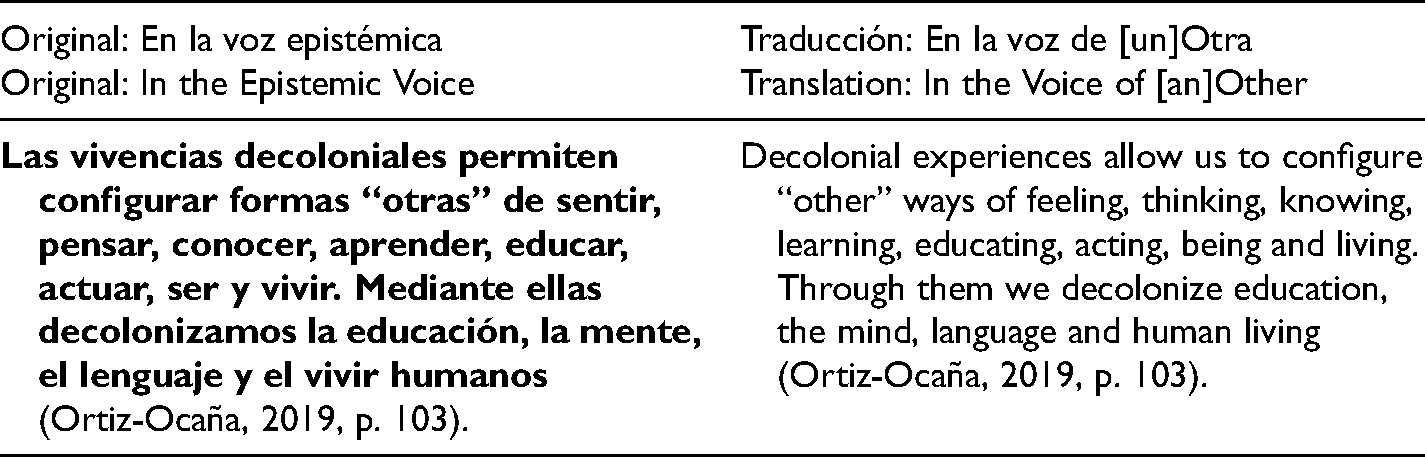
Decolonial or border epistemologies and ontologies, by their very existence, resist, disrupt, rupture, and subvert colonial epistemologies and ontologies—that is subvert coloniality (Ortiz-Ocaña, 2019; Quijano, 2007). It is from within the in-between, borderland, or border epistemologies that decolonial alternatives as Other-possibilities emerge that force a reconfiguration of the colonial territory (e.g., refer to Kolenz, 2021). As an example, our acts and actions of writing this paper represent “[an]Other-possibility” [as voiced by Sandra: [una]Otra-posibilidad] for disrupting and subverting academic processes of colonial complicity to the epistemic domination and subjugation we reproduce in our practices as scholars.
The subjugation is achieved through research and academic agendas and practices that make women of the Global South the objects of curiosity, interrogation, intervention, and writing for women of the Global North (Cruz-Hernández & Bayón-Jiménez, 2020; Espinosa-Miñoso, 2023). The practices we adopt to write this paper express our own embodied resilience as a process for resisting and disrupting the privileging and constant push and pull to center the Knowledges and Knowers of the Global North. In this sense, it becomes an opportunity to disrupt a scientific communication tool into a decolonizing act that seeks to be an ally in the defense of the minds/bodies/territories of women of the Global South. More than just the traditional feminist practice of making transparent our positionalities, we acknowledge the necessity to consider decolonial practices for writing, that is, “creative strategies” (as articulated by Martín-Alcoff, 2019) that intentionally disrupt academic practices that center, and recenter scientific writing and English as the authoritative voice—as the legitimate epistemological and ontological Knower.
The disruption occurs through various strategies: first, the paper is treated as a territory rather than a conceptual product—it is a mind/body/territory in which you as the reader and audience also occupy with us as authors. Together we move through the territory. The second disruption is by not adopting a linear approach to our conceptual work, and instead, we write a series of “awakenings” that conceptually and physically move us in a nonlinear, and (at times) confusing and messy weaving through the mind/body/territory. The third disruption is the use of different font sizes, types, and positions as the tools available to us to create a simultaneous inseparable conceptual mind and visual-embodied experience of the territory paper.
Where to Start? Language Matters
We oscillated for months about how to start this paper, caught between “what we want to say,” and “how we should write.” On one hand, we volleyed the idea of starting by introducing the focus and purpose, moving immediately to use literary phrases, such as “in this conceptual paper, we discuss…” or “first, we explore…then we debate…finally we conclude…” On the other hand, we also thought about starting with “who we are” and “how we come to this work”—locating ourselves along the intersecting and interlocking social dimensions of our lives and experiences: our class, race, gender, gender identity, sexual orientation, age, geo-political histories, and lived experiences. Both are scholarly and literary practices that align well with our theoretical and professional orientations toward critical, feminist, intersectional, and decolonial approaches.
However, a challenge we have faced since the inception and now implementation of our research program has been working across and between cultures as worldviews and knowledges systems, and in two different languages—Spanish [Sandra] and English [Maria]—with English positioned as the language of the lead institutions and ethics boards, funding agencies, and for publications, including this journal. As women, scholars, and social workers from the Global North and the Global South, we are deeply concerned with reproductions of epistemic imperialism and subordination that push and pull us to recenter and uphold, for example, English [Maria] as the language of “Knowers” and translations as the language of “Others” [Sandra] (Laurie, 2012). Our angst draws us to the relational ethics of how to write about and represent issues related to women's/our lives—the violence they/we endure—when one/some of us [Sandra/Salvadoran women] cannot voice and publish our/their experiences in the languages [Spanish] we/they hear in our/their minds, feel in our/their hearts, hold in our/their bodies, and dream in our/their dreams—that is, in our/their embodied and epistemic voices?
Instead, we ask you to move back to the beginning of the article, to the quote that opens the paper, and we ask that you reread it. And, while rereading the quote, we ask that you hold and absorb its meanings in your mind/body; we ask you to note that it is written in Spanish, with an English translation visually presented to its side in a smaller and different font. We ask that you compare the words, and absorb how some words look similar to one another, and while doing so, critically ask yourself: what explains the similarities, what are the histories of the words and languages, what movement between territories explains the similarities, and more importantly, whose knowledges, ways of knowing, and practices do the words and languages represent and misrepresent, whose knowledges and ways of knowing are erased to make these words and languages visible? Here, rather than answering the questions we invite you to be curious and to feel the curiosity as an embodied experience.
Throughout, we practice a strategy in which our respective reflections are presented in the languages of both authors (in Spanish for Sandra and in English for Maria). Our original voice represents the voice we hear in our minds, feel in our hearts, hold in our bodies, and dream in our dreams, while the translation represents the voice of the Other—as a version of ourselves in the epistemic voice that is not our own but is of [an]Other. As an embodied exchange with the readers, the use of different fonts, sizes, and bolds is to ensure that the author's epistemic language is also visually experienced as the epistemic voice. We believe this repositioning is an important strategy for recognizing the differences between our own material conditions, and symbolically resists our own epistemic tendencies to reassert colonial relationships of power as exercised through language and academic writing.
We do so to ground our reflections and theorizing, not as an essentializing or homogenizing practice, but one that is intentional in its efforts to acknowledge the different symbolic and physical spaces, the different mind/body/territories we each occupy. Although a small gesture, we believe this strategy provides some opportunity to subvert in this paper the separations of women's minds, from their/our emotions, from their/our bodies, from their/our physical geographies, and here, from their/our languages. It is from here where we awaken to the implications of the concept of territorio cuerpo-tierra for studying women's resilience, and more specifically Salvadoran women's resilience.
Awakening Territorio Cuerpo-Tierra: From Epistemology to Ontology
As previously mentioned, the purpose of this paper is to explore the implications of the concept of territorio cuerpo-tierra for conducting international research on women's resilience. Broadly, resilience is a concept used to describe how individuals, families, and communities, as well as societies adjust to adversity, and its associated hardships. Resilience studies are focused on understanding why and how some people, families, and communities fare well and have positive outcomes despite the stresses, risks, and traumas they endure (Bowling et al., 2022; Smith-Osborne, 2007; Walsh, 2003). Resilience is conceptualized as the attributes, abilities, or resources held by or available to individuals, families, and communities (for personal resilience refer to: Bowling et al., 2022; Eshel et al., 2018; Masten, 2018; Masten & Cicchetti, 2016; for family resilience refer to: Simon et al., 2005; Ungar, 2010; Walsh, 2003; Walsh, 2016; for community resilience refer to: Hirons et al., 2018; Magis, 2010; Pfefferbaum et al., 2017).
Nuestras Reflexiones/Our Reflections:
Qué se Entiende Por/What is Meant by “Territorio Cuerpo-tierra”?
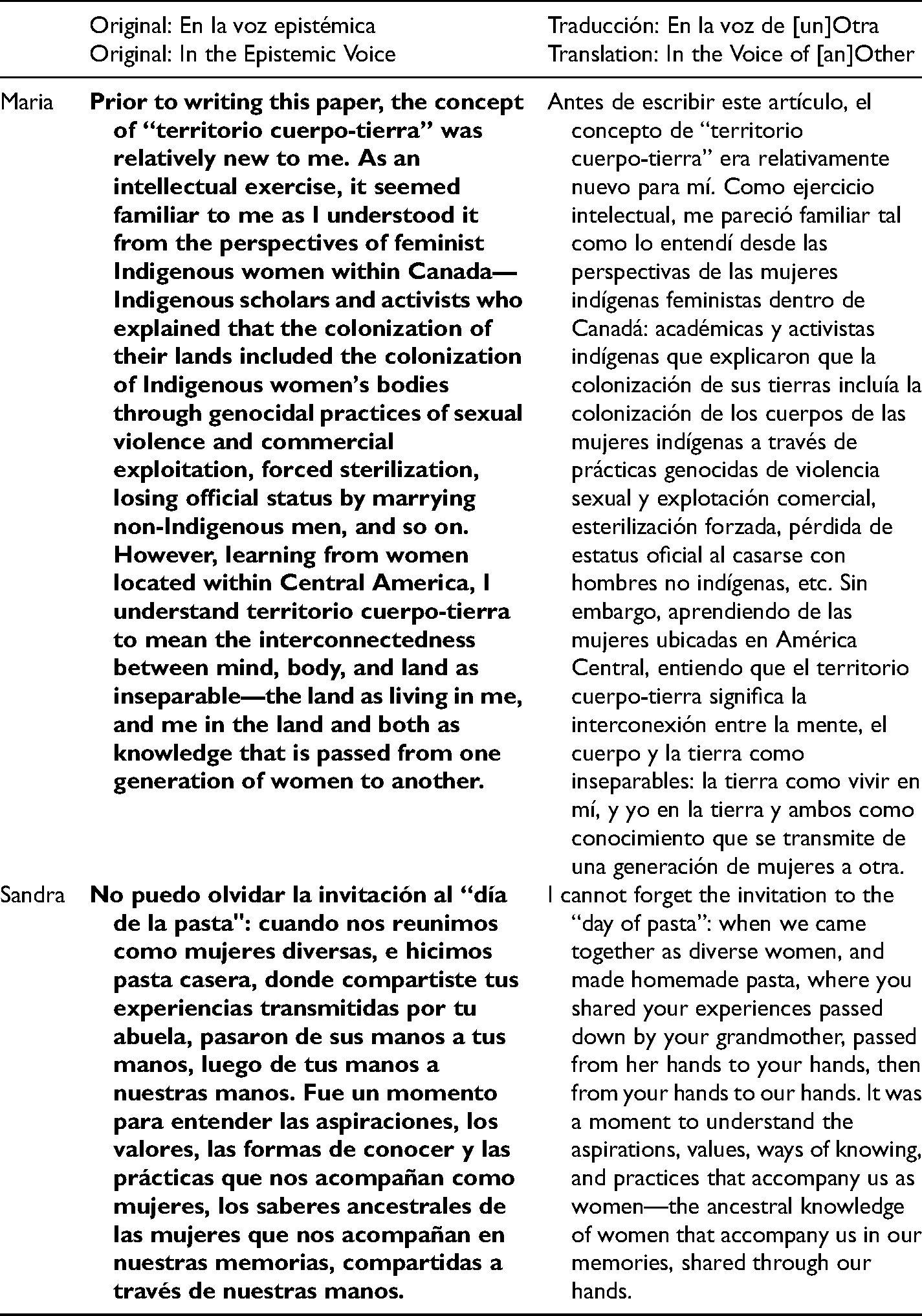
As mentioned, our research program is focused on exploring Salvadoran women's resilience to trauma as an organizing framework for addressing violence, gender inequalities, and social and economic development and post-COVID-19 pandemic recovery. It adopts an intergenerational perspective as well as a collective focus. Our decision to adopt an intergenerational and collective perspective was intentional, and in response to academic critiques of both trauma and resilience theories for reinforcing individualized—psychiatrized and psychologized—understandings of women's lives. Critical mental health scholars critique trauma theories for reinforcing notions that women's responses to violence (that is, trauma responses) are psychological or psychiatric reactions separate from the institutional (sexist and patriarchal) conditions of their lives (Burstow, 2003; Tseris, 2015). Within our research, our position has been to move away from a direct focus on trauma (deficit-based and psychiatrized), and to adopt resilience as an asset-based perspective.
When applied cross-culturally, a major critique of the resilience scholarship is that it is premised on Western and Eurocentric epistemologies, cultures, and practices emerging out of Western industrialized societies (Bennett et al., 2016), and thus, problematic if not appropriately translated for non-Western contexts, cultures, and practices (Ali et al., 2023; Atallah et al., 2021; Bennett et al., 2016; Sims-Schouten & Gilbert, 2022). However, from decolonial perspectives, “epistemology” itself is critiqued for being a method of knowing borne out of the expansion of specific methods of scientific inquiry rooted in colonial histories of domination (Laurie, 2012). Apart from risking that “we will get it culturally wrong,” resilience theories represent a colonial epistemology that if adopted and applied to El Salvador could serve to subjugate the complex realities, experiences, and practices of Salvadoran women. Applied to our research, we intentionally resist adopting, including for this paper, a single and definitive construction of resilience. Instead, we assume a tentative understanding, and the tentativeness is intentional as a way to resist the push and pull toward asserting systems of knowledge or epistemologies that are again born out of the contexts and conditions of the Global North. As a decolonial awakening, cuerpo-territorio moves us away from epistemology to questioning the ontology of resilience theories.
As previously noted, cuerpo-territorio brings into question Western ontology, in particular the divides between the “body/corporeal,” the “land/territory,” the spatial temporality of past and present that upholds the depoliticization of violence and women's subjugation as extensions of colonial dominance through the occupation body, land, territory, and time (Cabnal, 2013; Chavez-Dueñas et al., 2022; López, 2016; Migliaro-Gonzalez et al., 2020; Sweet & Ortiz-Escalante, 2017; Zaragocin & Caretta, 2021). Ontologically the relationship between women's emotional and psychological experiences are not separated from women's bodies and corporealities, and women's bodies and corporealites are not separated from the lands and territories they live. Instead, mind/body are understood as land/territory, and land/territory as mind/body (Migliaro-Gonzalez et al., 2020), and what is experienced by the mind/body is simultaneously experienced by the land/territory (Colectivo Miradas Críticas del Territorio desde de Feminismo, 2017; Zaragocin & Caretta, 2021).
Against the backdrop of El Salvador's histories of European–Spanish colonialism and Western imperialism, cuerpo-territorio is then a political acknowledgment of the legacies of mind/body/territory domination and subjugation, not as historical, but as ongoing forms of coloniality/decoloniality. The smallest and most densely populated country in Central America (Colburn & Cruz, 2016), “El Salvador” as a political territory was born out a legacy of Spanish empire-building and physical occupation dating back to the early 1500s, until its political independence in 1842 (Ching, 2022). The largest groups of “original peoples” [pueblos originarios] are the Nahua-Pipil, Kakawira, and Lenca (Gellman & Bellino, 2019). As a territory, its history is marked with episodes of Indigenous and campesino [peasant] rebellion and armed resistance that continue to be written and represented through a settler-colonial gaze as class struggles that erases, for example, the significance of La Matanza of 1932 (“the Massacre”), and subsequent race laws as genocidal strategies for eliminating Indigenous, and other ethnic and racialized populations, including Afro-Salvadoran peoples (Cuéllar, 2018; Gellman & Bellino, 2019; Lindo-Fuentes, 2020).
Within the context of the Americas (North, Central, and South America), El Salvador has played and continues to play an important role for the United States in Latin America (Lindo-Fuentes, 2020), and thus, the target of Western interventions, including the military and economic backing of the 12-year (1980–1992) civil war, and subsequent attempts to introduce American-style government models of democracy (Cuéllar, 2018). Constructed across political and academic sectors as one of the most violent countries in Latin America (Colburn & Cruz, 2016; Martinez, 2017), the violence has often been attributed to the legacy of the war and to postwar conditions of poverty and a lack of social and economic opportunities, neoliberal restructuring; and repressive postwar (iron-fist) policing (Colburn & Cruz, 2016; Montoya, 2018; Moodie, 2010; Rojas-Flores et al., 2013). Despite this recognition, the violence and threats of violence are often attributed to the activities of criminal gangs—to the maras or pandillas (Peetz, 2011; Steenkamp, 2011)—paving the way for another wave of iron-fist policing with the current State of Exception as the latest example of repressive strategies (Amnesty International Canada, 2021, 2023; Human Rights Watch, 2022; Pitts & Inkpen, 2020; Tucker, 2022).
These conditions continue to contribute to the internal displacement and global migration of the people with Salvadorans comprising one of the largest groups from the region migrating to Canada and the United States (Rojas-Flores et al., 2013). Over generations, forced, crisis-driven migration has led to the fracturing and disintegration of tight-knit families and communities, and to complications of transnational arrangements (Abrego, 2009; Anastario et al., 2015; Hagan et al., 2011). Within this history, Velásquez-Estrada (2014) problematizes the temporality of the civil war and the gangs and historicizes the violence as gendered and racialized, not solely linked to class-based struggles, but as features of El Salvador's colonial/imperial histories.
Cuerpo-territorio challenges colonial temporality which separates historical violence from violence in the present (Hunfield, 2022). Cuerpo-territorio is a border epistemology where in defense of the mind/body/territory, women from time and memorial are conceptualized as caretakers and defenders. It is both a decolonial theory and practice of women's resistance and rejection to domination and subjugation (Dorronson, 2013; Martínez-Eraso & Pulido-Varón, 2022). Ontologically, cuerpo-territorio subverts the public/private divide and colonial conceptions of women as passive and complicit, and as apolitical and relegated to the private (home) spheres of social life (Cabnal, 2013; López, 2018). Thus, reasserting that women's responses to adversities are not only personal and interpersonal, but are also at the same time, political acts of resistance and rejection anchored to public and collective knowledge practices. We conclude with a final awakening to the issue of colonial temporality and the implications for our research studying Salvadoran women's resilience.
Conclusion: Salvadoran Women's Resilience as Anchored in Collective Knowledge Practices
Writing this paper was a practice of territorio cuerpo-tierra—a decolonial awakening of our mind and bodies from global systems of knowledge production that uphold colonial epistemologies and ontologies of all women and some women more as “Others” (Cruz-Hernández & Bayón & Jiménez, 2020). While contending with the implications of cuerpo-territorio, we presented and practiced a method of writing that exemplified a decolonial turn that intentionally disrupted academic practices that center and recenter scientific writing and English as the authoritative voice—as the legitimate epistemological and ontological Knower. Writing this paper was no longer a conceptual exchange of knowledge, but an exchange that required us to interrogate our [inter]actions with one another as embodied experiences of one [an]Other as Women, scholars, and social workers geo-politically in the Global South and Global North.
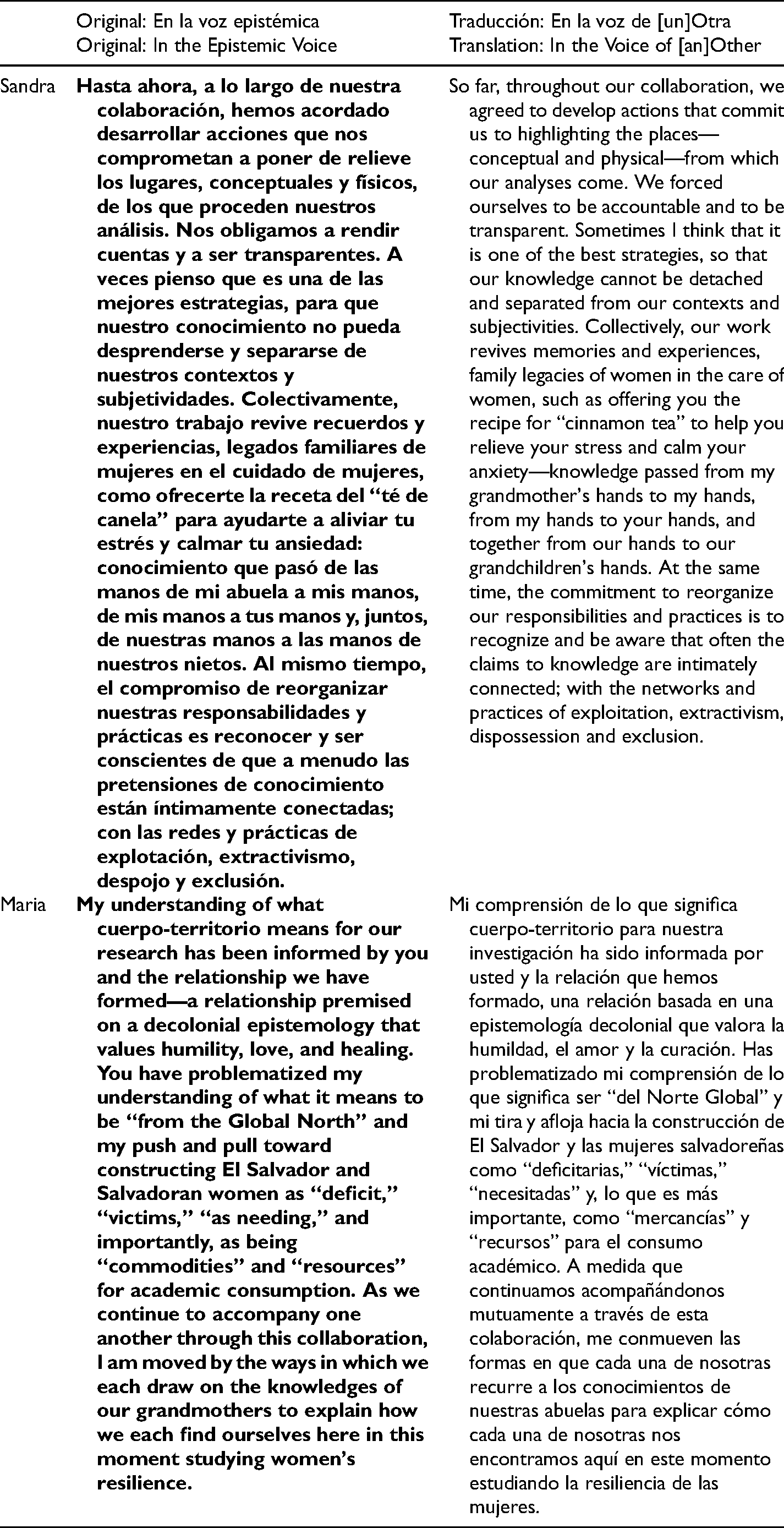
As we move through the territories as [an]Other possibility, we are active in our commitment against reproducing the lateral violence of White-European, women scholars from the Global North [Maria] onto racialized-Latina, women scholars from the Global South [Sandra], and together as socially, educationally, and classed privileged women studying the experiences of marginalized Salvadoran women at the intersections of the mind/body/territorial dimensions of their lives. From critical, feminist, and decolonial scholars, we are challenged to adopt approaches that center marginalized Salvadoran women and their experiences as a method to address their epistemological exclusion (Martínez & Agüero, 2023; Espinosa-Miñoso, 2022; Zerbe-Enns et al., 2021). However, such a call may not be enough of a turn.
We have already argued against adopting current resilience theories as a point of entry because of the “risk of getting it culturally wrong,” but more importantly because of the risks of producing a colonial resilience that could serve to subjugate the complex realities, experiences, and practices of Salvadoran women. The struggle is not about arranging accurate or robust literary and cultural translations, nor altering, adjusting, or expanding current theories to be inclusive of the experiences of marginalized women's resilience. Moving from the work of writing this paper to the work of researching women's experiences of resilience to trauma and postpandemic recovery, we do not want to reproduce relations of power that force colonial epistemologies onto border epistemologies (Hernández-Wolfe, 2013; Laurie, 2012). At this stage in our work, although our study is centered around “resilience” as an asset-based and potentially de-medicalizing concept, we resist concluding with a fully formed definition, and instead, intentionally carry our doubts forward.
In closing, territorio cuerpo-tierra awakens us to the colonial conceptions of time. Referred to as “colonial temporality,” the relationship to time is spatial and linear with the past considered a less developed or primitive period, while the present a time for rapid progress at any cost to secure an advanced future (Hunfield, 2022). The future represents unchartered territories for continued expansion—a perpetuation of the colonial drive for the occupation of minds, bodies, and territories. As a feature of the colonial temporality, the past is separated from the present resulting in the delinking of present violence—“violence against women”—from its historical roots of racial-gendered colonialism (Chavez-Dueñas et al., 2022). The work of writing this paper represented a decolonial strategy and practice for resisting colonial temporality—linking the past, present, and future as inseparable territories.
Ontologically, territorio cuerpo-tierra represents a decolonial turn, one in which temporality, our relationship to time, is understood as intergenerational, relational, and anchored in responsibilities for caretaking and defending the mind/body/territory and all things human and nonhuman (Cabnal, 2013; Migliaro-Gonzalez et al., 2020; López, 2016). As eluded in our reflections, women hold teachings, practices, and responsibilities that from time and memorial are passed through the generations from our grandmother's hands to our mother's hands, from our mother's hands to our hands, from our hands to our children's and grandchildren's hands, and from their hands to their children's and grandchildren's hands. When women come together, as a type of collective memory work, caretaking, defense, and healing become possible (Chavez-Dueñas et al., 2022; Comas-Díaz, 2022; Hunfield, 2022). As a practice, territorio cuerpo tierra represents a reclaiming of women's public spaces, and a [re]membering of our/their embodied knowledge practices as collective experiences (Chavez-Dueñas et al., 2022; Katzer, 2017). Applied to our research program, territorio cuerpo-tierra commits us as researchers and scholars to tune into resilience as a reclaiming of public spaces for women. As a practice, territorio cuerpo-tierra calls us to reclaim collective practices that foster [re]membering the experiences, voices, knowledges, ways of knowing, and practices of Salvadoran women, not simply as individual processes of resilience, but as a collective and intergenerational caretaking and defense of their/our mind/body/territories. Territorio cuerpo-tierra commits us to research as a decolonial turn.
Footnotes
Acknowledgments
Maria's—I express my deepest appreciation to my mother and aunt (Cesidia Liegghio and Dora Fanelli), my sister (Ivana Liegghio), and our grandmothers (Maria Fanelli and Bernadetta Liegghio), as well as all the other women in our lives whose knowledges have guided our ways. Sandra's—To the women in my family, who have shared their legacies of ancestral wisdom, who continue to weave my life and encourage an interest in delving into and facing reality critically. To Fabiola and Emmanuel, because they teach me, from the autonomy of their childhood, the most profound and challenging ways of working in Latin American contexts.
Declaration of Conflicting Interests
The authors declared no potential conflicts of interest with respect to the research, authorship, and/or publication of this article.
Funding
The authors disclosed receipt of the following financial support for the research, authorship, and/or publication of this article: Funding was generously provided by the International Research Development Council of Canada (IDRC) and the Social Sciences and Humanities Research Council (SSHRC) of Canada.