




Abstract
Domestic violence (DV) is a significant concern within China. Currently, there are few standardized measurement tools to gauge Chinese stakeholders’ perceptions and beliefs concerning DV. This research sought to validate tools to be used with such stakeholders. Factor analyses were utilized on cross-sectional, survey data from a purposive sample of 683 Chinese DV professionals working in four institutions in Guangdong. Analyses developed three scales for measuring DV Definitions, DV Attitudes, and DV Policing. The development of these scales is beneficial to advance the already growing research related to DV in China in ways that are relevant to the Chinese context.
The phenomenon of domestic violence (DV), especially that between intimate partners, is a widespread public health concern with high rates globally (Maheu-Giroux et al., 2022). DV among current or former intimate partners encompasses a variety of abusive psychological, physical, and sexual behaviors (García-Moreno et al., 2005), with women frequently experiencing both (a) higher rates of severe violence and (b) worse negative sequelae (Smith et al., 2014). DV affects victims’ and their family members’ physical and mental health and has negative impacts on countries’ gross domestic product, economic output, and healthcare use. Fortunately, there is now strong interest in combatting DV globally.
Likewise, interest in addressing DV, particularly among intimate partners, has gained robust traction in China. Research shows rates of lifetime psychological violence range between 17.4% and 24.5%, physical violence between 2.5% and 5.5%, and sexual violence between 0.3% and 1.7% in the general population (Yang et al., 2018). These prevalence rates demonstrate that DV is a significant problem in China, though they likely under-estimate the true scope of the problem (Yang et al., 2018).
The People's Republic of China Anti-Domestic Violence Law
In the last few decades, China has experienced a period of relative growth toward understanding, preventing, and responding to DV (Zhang & Zhao, 2018). The People's Republic of China Anti-Domestic Violence Law was passed in 2015, which for the first time legally defined DV, condemned DV as a criminal act, and made explicit police DV response protocols (Lin et al., 2021). Thus, there is reason to believe that there are widespread shifts in Chinese DV stakeholders’ attitudes toward DV and perceptions of how DV should be addressed. Such stakeholders primarily include people working in the court and prosecutorial system, police officers, and those in the Women's Federation—a national women's rights organization whose local branches feature on-the-ground providers who interact with women who have experienced DV victimization.
Chinese Stakeholders’ Understanding and Perceptions of DV
Despite increasing attention to DV in China, there remains limited research to guide policy and practice (Li et al., 2020; Zhang et al., 2021; Zhang & Zhao, 2018). There have been calls for increased research examining aspects of DV with key stakeholders (Lin et al., 2018; Zhang et al., 2021). Although several researchers have explored Chinese stakeholders’ attitudes toward DV or violence against women (e.g., Leung, 2014; Li et al., 2021), these studies have generally been qualitative or have not used standardized measurements validated with Chinese participants in Simplified Chinese.
Among the limited number of quantitative studies, two compared public service professionals' perceptions of violence against women and wife abuse in greater China regions (Tam & Tang, 2005; Tang et al., 2002). Specifically, Tam and Tang (2005) compared wife abuse perceptions between 74 police officers and 71 social workers in Hong Kong (Tam & Tang, 2005). Tang and colleagues (2002), meanwhile, explored how Chinese human service professionals defined violence against women using data from a total of 3,540 Chinese agency professionsl (e.g., doctors, police officers, lawyers) and communion professionals (e.g., psychologists, social workers, nurses) in Hong Kong, Taiwan, and mainland China (Tang et al., 2002). In these two studies, four important concepts related to stakeholders’ attitudes toward DV were examined including the following: (a) definitions of wife abuse, (b) attitudes toward wife abuse, (c) attitudes toward gender equality, and (d) attitudes toward women. Definition of wife abuse was measured by the revised 24-item Conflict Tactics Scale (CTS2; Straus et al., 1996), which can be subdivided into verbal and psychological abuse, physical abuse, sexual abuse, as well as neglect and isolation. Respondents were asked to determine whether or not they would classify these behaviors as wife abuse behaviors. Attitudes toward wife abuse or participants’ endorsement of myths and stereotypes about wife abuse were developed based on the Attitudes Toward Wife Abuse Scale (Briere, 1987), and also the researchers’ clinical experiences with wife batterers. The eight-item scale assessed individuals’ endorsement of a variety of attitudes supportive of violence. Attitudes toward gender equality were measured by a 15-item abbreviated version of the Sex-Role Egalitarianism Scale on participants’ beliefs about men and women in their marital, parental, and social roles (King & King, 1993). Similarly, attitudes toward women were measured by a short version of the Spence–Helmreich Attitudes Toward Women scale (AWS) to assess participants’ attitudes toward the rights and roles of women in contemporary society (Spence et al., 1973).
Several other studies have focused specifically on police intervention in DV cases in mainland China (e.g., Lin et al., 2021; Sun et al., 2022; Wang et al., 2020; Wu et al., 2020; Zhao et al., 2018). Sun and colleagues surveyed more than 1,000 police offices in four provinces in China and have published numerous recent research findings related to their study (e.g., Lin et al., 2021; Sun et al., 2022; Wang et al., 2020; Wu et al., 2020). This work was particularly focused on police attitudes toward DV, attitudes toward DV interventions, and patriarchal values. In their work, police attitudes toward DV were measured as tolerant attitudes toward DV which is an additive scale with six items where a higher value of the scale indicated a greater tolerance for DV (Lin et al., 2021; Wang et al., 2020; Wu et al., 2020). Police attitudes toward DV intervention were measured from three aspects related to police responses to DV including attitudes toward minimum police involvement (four items), attitudes toward involvement in DV intervention as an important police task (four items), and pro-arrest attitudes (two items) were also measured (i.e., Lin et al., 2021; Wang et al., 2020). Officers’ attitudes toward DV intervention were also operationalized as general support for intervention in DV (three items) and specific support for arrest (two items; Wu et al., 2020). Finally, patriarchal values were measured by a scale of four items (Wang et al., 2020; Wu et al., 2020). Taken together, these concepts and measures form the backbone of much recent research activity related to understanding stakeholder's attitudes vis-a-vis DV and related constructs in the Chinese context.
Building from this seminal work, a recent article explored factors influencing community and criminal justice professionals’ decision-making in DV cases in mainland China (Zhao et al., 2023). Using data obtained from more than 800 professionals including members of the Women's Federation, police officers, and judicial personnel such as prosecutors and judges, Zhao and colleagues explored police officers’ perceived legal and organizational support and attitudes on the decision to mediate or arrest DV cases in China. In this study, both attitudes toward DV and pro-arrest attitudes were measured following the studies by Sun and his colleagues (Chu & Sun, 2014; Lin et al., 2021; Wang et al., 2020; Wu et al., 2020). Traditional views of criminal justice responses to DV were a scale similar to the minimum police involvement scale in Lin and colleagues’ 2021 study. This measure was constructed by a scale of five items including those such as “In most cases, DV should be handled by a third party, such as social workers and the Women's Federation members” and “Even an upright official finds it hard to settle family disputes” among others (Zhao et al., 2023). Attitudes toward women were measured by a nine-item conservative attitudes scale originated, once again, from Spence and colleagues (1973).
Overall, this recent work has provided initial measurements of the key concepts related to stakeholders’ attitudes toward DV including definitions of wife abuse, attitudes toward DV, attitudes toward gender equality or women, and attitudes toward criminal justice intervention, especially police intervention. They generally have reported acceptable or good internal reliability of the measurement scales of the concepts. Some of the measurement scales, however, were not comprehensive enough to catch the full meaning of the concepts. Nor have they been rigorously validated among Chinese professionals who handle DV cases. Furthermore, several of the studies were conducted among police officers mainly, with other criminal justice and community professionals not included, making the measurements difficult to generalize to non-police stakeholders. Additionally, it should be noted that similar or same concepts were measured differently in some of the studies.
Current Study
Thus, to date, there have been few attempts to promulgate standardized measurements to gauge Chinese stakeholders’ perceptions and beliefs toward DV accurately and fully. This gap in the evidence presents a major obstacle to rigorous scientific research on DV in China as robust studies must rely on valid measurement. There are existing instruments developed in North America to determine individuals’ (a) definitions of DV, (b) attitudes toward DV, and (c) perceptions regarding how best to respond to DV incidents (Briere, 1987; Chu & Sun, 2014; Fincham et al., 2008; Lin et al., 2018; Sun et al., 2011). However, given China's unique context, including its cultural, history, language, and social settings, Western measurements may be inadequate to use with Chinese stakeholders as they would not account for characteristics germane to Chinese peoples and their context (Zhang & Zhao, 2018). The aim of this study is to build on existing measurements to psychometrically validate new instruments for Chinese DV stakeholders using novel data (Zhao et al., 2023).
Methods
Sample
With an estimated population of over 100,000,000 people, Guangdong is one of China's largest administrative units, offering a unique setting for DV research. This study surveyed professionals in Guangdong who have frequent interaction with DV victims (Zhao et al., 2023). These stakeholders were professionals working in (a) the Women's Federation, (b) the local prosecutors’ offices, (c) the court system, and (d) the police force across four major cities in Guangdong. Access to participants was made possible with the assistance of local authorities at the respective institutions. These four groups of professionals were chosen based on their functions in handling DV, in light of the Anti-domestic Violence Law of China (2015), which guides both criminal justice agencies and noncriminal justice organizations to respond to DV.
Concerning the criminal justice agencies, in 2015, the Supreme People's Court, the Supreme People's Procuratorate (i.e., the prosecutions office), the Ministry of Public Security, and the Ministry of Justice jointly published the Opinions on Handling Domestic Violence Cases in Accordance with Law to strengthen timely judicial intervention in DV cases. The Opinions outline clearly delineated responsibilities for criminal justice agencies in handling DV cases and include roles for the police, prosecutors’ offices, and the court system. Accordingly, personnel from the local prosecutors’ offices, the court system, and the police force were invited to participate in the study.
Concerning personnel who are not based in criminal justice organizations, the Women's Federation at local community level is often the first to be informed of a DV incident and is the de facto organization responsible for supporting victims of DV and mediating family conflicts (Sun et al., 2022; Zhao et al., 2023). The Guidelines on Marriage and Family Conflict Mediation Work (2019), jointly released by the All-China Women's Federation and the Ministry of Justice, describe the functions of Women's Federation in family disputes. According to the Guidelines, in addition to providing assistance to DV victims, the Women's Federation can either independently, or jointly with other mediation committees, organize committees to mediate family conflicts and make reports to local judicial administrative authorities (Zhao et al., 2023). Thus, personnel from the Women's Federation were also invited to participate in the study.
Overall, these four groups of stakeholders were a best attempt at gathering a comprehensive sample of those that might be responsive to DV cases in China. Participants were invited to complete a self-report survey with support from trained research assistants. Self-report was chosen for the survey due to (a) its utility in capturing potentially sensitive data and (b) being less invasive and more logistically feasible. Before the survey, participants were asked to provide informed consent. Research assistants distributed the surveys to all available stakeholders at the respective institutions over the course of two consecutive days. The survey took approximately 30–40 min to complete.
The initial study was conducted under the auspices of The University of Macau, with approval being granted by the university’s Research Services and Knowledge Transfer Office (#MYRG2018-00094-FSS; MYRG2019-00104-FSS). The present study was reviewed and considered not human subjects research by The University of North Carolina at Chapel Hill.
Measures
The survey was written in Simplified Chinese and contained a variety of questions designed to gather information about how DV among intimate partners is conceptualized among this population of professionals. Prior to administration, the survey was pretested with a small number of prosecutor participants. The pretest revealed no major issues with the survey, and only minor adjustments were made.
For this analysis, the focus was on three constructs selected a priori as important to the measurement of stakeholders’ perceptions of intimate partner DV: (a) DV Definitions, (b) DV Attitudes, and (c) DV Policing. Selection of constructs and individual items to measure each construct was led by Chinese members of the study team based on their expertise in researching DV in China. Moreover, these constructs were selected in light of the aims of the primary study, which sought to investigate how professionals, who are tasked by China's national policy to respond to DV, define DV, hold attitudes about DV, and believe police should respond to DV. Constructs, measures, and items were also selected based on past usage in research in China (e.g., Lin et al., 2021; Sun et al., 2022; Tam & Tang, 2005; Tang et al., 2002; Wang et al., 2020; Wu et al., 2020; Zhao et al., 2018).
Items were adapted from external sources with some developed internally by the researchers when necessary to address the hypothesized latent constructs. All items for all three scales were unlabeled (i.e., no scale or subscale names) and presented in an order decided upon as appropriate by the researchers. Also, the response options for all items in all three scales were “strongly disagree” (1), “disagree” (2), “uncertain” (3), “agree” (4), and “strongly agree” (5). Finally, all items were positively coded with higher scores indicating more of the construct (i.e., correctness, endorsement, positivity).
DV Definitions
There were 32 items related to DV definitions that were taken from eight distinct sources: (a) all 12 items from the “Physical assault” subscale of the Revised Conflict Tactics Scale (CTS2; Jones et al., 2002; Straus et al., 1996); (b) five of eight items from the CTS2's “Psychological aggression” subscale; (c) two of seven items from the CTS2's “Sexual coercion” subscale; (d) one item from the “Physical violence” subscale of a DV scale developed by Lin and colleagues (2018); (e) three of seven items from the “Psychological violence” subscale of Lin and colleagues’ scale—items themselves taken from a variety of published scales (Ali et al., 2011; Fulu et al., 2013; Hou et al., 2011); (f) four of five items from Lin and colleagues’ “Controlling behaviors” subscale—again sourced from published work; (g) four psychological abuse items used by Tam and Tang (2005)—themselves largely based on the CTS2's similar subscale; and (h) one additional item related specifically to economic abuse (Fulu et al., 2013).
Among these 32 items, only those from the CTS2 seem to have been psychometrically validated in Chinese samples with factor analysis, and seemingly only measuring definitions of victimization among DV victims (Hou et al., 2018; Lin et al., 2018). The CTS2 has recently been widely used in research on DV in Chinese contexts (Chen & Chan, 2021; Wang et al., 2020). There has only been modest use of the items from Lin and colleagues (Hu et al., 2021), Tam and Tang (Zhao et al., 2018), and Fulu and colleagues (Postmus et al., 2022).
Once collated, modifications to the DV definitions items were made in several ways when necessary: (a) to the present tense; (b) to “partner” from “intimate partner;” (c) for parsimony (e.g., “Threw something at intimate partner that could hurt” to “Threw something at intimate partner”); and (d) to not be related to personal experiences (e.g., “Complaining about you” to “Complaining about him/her”). In total, 29 (90.6%) of the items were modified using the research team's expertise to shape the scale to the study aims. The entire set of items was prefaced by asking respondents: “Do you think the following behaviors are domestic violence?”
DV Attitudes
The 17 items related to DV attitudes were all taken from the Intimate Partner Violence Attitude Scale—Revised (IPVAS-R) developed by Fincham et al. (2008), itself a revision to the original IPVAS created by Smith et al. (2005). The EFA and CFA analyses reported by Fincham et al. (2008) were conducted on survey data from college students and established a three-factor model with subscales for (a) “Abuse” (n = 8 items), (b) “Violence” (n = 4 items), and (c) “Control” (n = 5 items). The IPVAS-R items were used verbatim in the survey herein. The set of attitudes items was prefaced with a clarifying question that personalized the items to make the construct more relatable for participants: “What is your attitude towards the following statements about your partner or spouse?” Of note, among the items were both those that expressed (a) approval and (b) disapproval of DV—indicative of likely minimal or negative associations between individual items. Although the IPVAS-R has been widely used in the United States and elsewhere, it has seemingly not been used to-date in China in any English language research publication. The same appears to be true for the original IPVAS measure (Smith et al., 2005).
DV Policing
There were 22 items related to DV policing from seven sources: (a) three “Proactive police response” items promulgated by Sun and colleagues (2011); (b) three “Traditional police response” items from Sun and colleagues (2011); (c) three “Minimum police involvement” items published by Chu and Sun (2014); (d) four “Tolerance for domestic violence” items from Chu and Sun (2014); (e) two “Important police task” items from Chu and Sun (2014); (f) two “Proarrest” items from Chu and Sun (2014); and (g) five newly created items by the research team. Those items taken from other sources were used verbatim. Policing items were prefaced by asking respondents: “What is your attitude towards the following views on police involvement in domestic violence cases?” As with DV Attitudes, among the DV Policing items were those expressing approval and disapproval of certain policing strategies, likely leading to minimal or negative associations among them. Neither the work by Sun and colleagues (2011), nor that by Chu and Sun (2014), appears to have been psychometrically validated yet. Both sources have been used in recent research on DV in China (e.g., Sun et al., 2022; Zhao et al., 2018).
Additional Measures
Two sets of variables were also used in the study. First, the 25-item version of the AWS (Spence et al., 1973)—a validated measure of gender norms including items assessing both (a) behaviors (AWS-B; n = 13; e.g., “Swearing and obscenity are more repulsive in the speech of a woman than of a man;” all items negatively worded and recoded) and (b) rights (AWS-R; n = 12; e.g., “Both husband and wife should be allowed the same grounds for divorce”) that has been widely used in China and elsewhere (e.g., Chia et al., 1997). The response options for both subscales were “strongly disagree” (1), “disagree” (2), “uncertain” (3), “agree” (4), and “strongly agree” (5). Higher scores indicate a greater degree of egalitarian viewpoints likely to be correlated with scores related to DV definitions, attitudes, and policing. The two AWS subscales were analyzed as total mean scores (range: 1.0–5.0) with those observations set completely to missing which had >50.0% of items missing. Second, nine selected variables related to (a) professional characteristics (i.e., institution, ever dealt with a DV case, total years worked, total years worked at current position) and (b) demographic characteristics (i.e., city, age, gender, education level, marital status). Both sets of measures were used in construct validity analyses, while the professional and demographic measures were also used to characterize the sample.
Analyses
Factor analysis consisting of sequential (a) exploratory factor analysis (EFA) and (b) confirmatory factor analysis (CFA) steps under a Classical Test Theory approach was chosen to validate the scales psychometrically given the hypothetical latent variables underlying the survey items and to derive easy-to-interpret estimates (e.g., model fit, individual parameter estimates) congruent with previous psychometric research in the area. All factor analyses were conducted using Mplus 7.3 (Muthén & Muthén, Los Angeles, CA, USA) with all other analytic work being conducted in Stata 16.1 (StataCorp, College Station, TX). Statistical significance was set at p < .05 throughout (two-tailed). The analytic plan comprised five sequential steps leading up to, and including, the EFA and CFA models as per previous approaches to DV-related measurement analyses (e.g., Wretman et al., 2022). Prior to the analyses, nine select individual characteristics (see above) were summarized using univariate statistics (e.g., frequency [n], proportion [%], mean [M], standard deviation [SD]) to describe the sample of stakeholders.
Item Diagnostics
First, diagnostic checks were conducted on all individual items (k) for all putative scales (“DV Definitions”: k = 32; “DV Attitudes”: k = 17; “DV Policing”: k = 22) to determine their scale-related characteristics. The goal of calculating these characteristics was to reduce, if necessary, the starting item pools to parsimonious sets. Two characteristics were calculated with specified target values sought per prior work and expert consensus: (a) communalities (h2 ≥ .32; e.g., Tabachnick & Fidell, 2001) to check the total amount of variance explained by the hypothesized latent variables and (b) Kaiser–Meyer–Olkin (KMO ≥ .80; e.g., Kaiser, 1974; Wretman et al., 2022) values to check sampling adequacy for suitability to factor analysis. Also, to inform estimation items, (a) missing data patterns and randomness were checked with univariate statistics, Little's tests, and logistic regressions, and (b) intraclass correlation coefficients (ICCs) by institution were also calculated.
Factor Diagnostics
Next, there were two omnibus tests on the factors at a holistic level prior to testing for specific scale structure. First, Bartlett's test of sphericity was calculated for all three scales with a statistically significant χ2 value sought to reject the null hypothesis that the correlation matrix is an identity matrix and thus indicates an underlying latent structure to the set of items. Second, overall KMO tests of sampling adequacy were specified, once again with values ≥.80.
Exploratory Factor Analyses
Prior to the EFA phase, the sample was split using a custom algorithm to generate two random analytic half samples of stakeholders with non-significant (p ≥ .15) differences between them on the following variables: (a) having ever dealt with a DV case, (b) total years worked, (c) total years worked at current position, (d) age, and (e) gender. With three measures and two analytic approaches, there were 3 × 2 = 6 unique random half samples.
All three potential scales were considered to be multidimensional. To determine the potential optimal number of subfactors that might be modeled, preliminary checks using both Horn's parallel analysis and Velicer's minimum average partial test were used in combination to identify a target number of extracted solutions for each scale. The results were somewhat indeterminate, suggesting a range of 1–3 factors could be extracted for any of the three scales. As such, it was decided to conduct a sensitivity analysis of the scales’ structure by beginning with a one-factor solution for each and then proceeding through two- and three-factor solutions to compare the models. With three scales and three identified solution types, nine total models were estimated.
All models were estimated using principal axis factoring with an oblique geomin rotation and Mplus’ weighted least squares (WLSMV) estimator to estimate a polychoric correlation matrix as appropriate for the ordinal nature of the items. Also, due to respondents being nested within institutions, clustering was accounted for in Mplus to consider potential non-independence between observations which might be autocorrelated. Missing data were handled through the pairwise deletion as is the default with the WLSMV estimator. It was decided that no item error terms would be correlated for any scale or model.
The scale intra-solution derivation process relied first on examining the individual Mplus’ “StdYX” standardized item factor loadings (λ). Two hierarchical rules were established to evaluate the λs with the goal of achieving a simple structure as recommended by experts and as similar to previous work (Bowen & Guo, 2012; Wretman et al., 2022). First, each item must have had at least one λ ≥ .40 on at least one factor. Second, for multidimensional models, each item must not have had a difference (λdiff) between any two λs of λdiff ≤ .20. Items not meeting these two criteria were deleted iteratively starting with the smallest maximum λ or largest λdiff, respectively, until all items were acceptable. Subsequent to deciding upon final scales, the intra-measure models were evaluated using one absolute and two relative fit indices with appropriate cutoff criteria based on expert reviews and previous work (Hu & Bentler, 1999; West et al., 2012): (a) root mean square error of approximation (RMSEA; type = absolute; point estimate and 90% confidence interval [CI] ≤ .080), (b) comparative fit index (CFI; type = relative; ≥ .950), and (c) Tucker–Lewis index (TLI; type = relative; ≥ .950). Of note, the model χ2 statistic was reported for model comparison but was not used as a criterion for model selection given the statistic's sensitivity to sample size vis-à-vis statistical significance. The final model solution for each measure was chosen based on a combination of (a) overall superior model fit and (b) having ≥3 items at λ ≥ .40 on each factor as per prior measurement work in similar areas (e.g., Lu et al., 2021).
Confirmatory Factor Analyses
The next analytic step was a series of CFA models using the final derived EFA model results for each construct to test and confirm the scales’ structures and scores on the remaining random half samples of data. Building from the preliminary results of an EFA step, the null hypothesis in CFA is that the hypothesized matrix imposed upon the data is the same as the observed matrix (Bowen & Guo, 2012). The estimation process once again used the WLSMV estimator, a clustering specification for institutions, and handled missing data by pairwise deletion. Again, no item error terms would be correlated. Mplus fixes the first loading in each factor to 1.0. All inter-factor correlations (r) were allowed to freely estimate among multi-dimensional models. The CFA model derivation process was specified to have two numerical criteria. First, if model fit was not acceptable using an identical specification as per the EFA results, all items with a λ < 0.20 were deleted. Second, if fit remained unacceptable all items considered to have ≥2 intrascale correlations r < .10 were deleted. For final model evaluation and selection, the CFAs used identical fit indices and criteria as per the EFA process.
Construct Validity Analyses
Proceeding from the selection of final models, the three scales were finalized and their factors were given names. Also, Flesch’s (1948) reading ease scores were calculated to determine if the final scales had readability levels in English appropriate for individuals with an approximately “college” educational level or lower (>30.0), as appropriate for the sample.
Composite scores using the entire sample were calculated to facilitate (a) characterization of the latent constructs in the sample and (b) subsequent construct validity analyses. Composites were created by calculating both the unweighted (a) total and (b) mean scores using all items for factor. For total scores, listwise deletion set observations to missing if they had ≥1 factor item missing while for mean scores, observations were set to missing only if they had >50.0% of factor items missing. Within scales, factors’ (a) total and (b) mean scores were tested against each other using two-sample unpaired t-tests with the equal variances assumption relaxed (n = 10 comparisons). Mean inter-item correlations (rMean) were calculated on the set of all items in each factor, and Guttman's λ2 internal consistency reliability estimates were calculated with a target level of ≥0.70—equivalent to at least “acceptable” (Nunnally, 1978).
For the final step, construct validity analyses were conducted, including an examination of (a) convergent and (b) discriminant validity using two processes. First, pairwise Spearman's rank-order correlations (r) were conducted among mean composites (1.0–5.0) for all final DV scale factors plus the two AWS factors. Depending on the nature of the underlying latent construct, values were sought that were either positive (e.g., disapproval of DV with progressive DV policing) or negative (e.g., approval of DV with tolerant DV policing). Estimates were sought that were generally (a) approximately medium (≥0.30) and (b) significant. Second, subsample total mean composite scores based on the nine stakeholder characteristics were calculated to determine whether the factors differentiated among different types of participants. Continuous stakeholder characteristics variables were dichotomized at the median. For characteristics with ≥3 categories (e.g., institution), a Kruskal–Wallis test with ties was used to test whether there was a difference at the omnibus level. For characteristics with two categories (e.g., ever dealt with a DV case), the difference was tested with a two-sided Wilcoxon rank-sum test.
Results
Sample Characteristics
There were 683 stakeholders in the sample. Of these, 37% were from the prosecutors’ offices, 32% were from the Women's federation, 26% were part of the police force, and 6% were from the court system (Appendix Table A1). About 34% had ever dealt directly with a DV case professionally. The mean years of working was 13.42 with the mean years at their current position being 7.95. The sample was approximately representative of such stakeholder professionals in southern China with a mean age of 36.22 years, being 61% female, and with 82% having an undergraduate or graduate degree. Over three-fourths (77%) were married, and 71% had children.
Item Characteristics
The 32 DV Definitions items evidenced strong homogeneity indicative of representing manifestations of an underlying latent construct, as well as suitability for factor analysis, with h2 values ranging from .54 to .91, and KMO values ranging from .93 to .98. The 17 DV Attitudes items demonstrated somewhat less acceptable characteristics suitable for subsequent EFA and CFA analyses with h2 values ranging from .27 to .83 (13 of 17 ≥ .32 [76.5%]), and KMO values ranging from .77 to .90 (16 of 17 ≥ .80 [94.1%]). The 22 DV Policing items evidenced good characteristics with h2 values ranging from .30 to .70 (21 of 22 ≥ .32 [95.5%]), and KMO values ranging from .83 to .92. Given the good h2 and KMO values, all items were retained.
Of the 32 DV Definitions items, item-level missingness ranged from 6.3% to 7.6%. At the participant-level, 88.0% of participants completed all 32 DV Definitions items, with 6.3% having not completed any of them. For the 17 DV Attitudes items, item-level missingness ranged from 1.2% to 2.1%. At the participant level, 92.1% completed all 17 DV Attitudes items and 0.9% did not complete any. Finally, of the 22 DV Policing items, item-level missingness ranged from 4.4% to 5.7%. At the participant level, 89.0% completed all 22 DV Policing items while 4.2% did not complete any. Little's test found that the DV Definitions items were likely to be “missing completely at random” (p = .12) but that the DV Attitudes items (p < .001) and DV Policing items (p < .001) were likely “missing at random.” Logistic regressions of participants with any missing data (1 = Yes) on the nine professional and demographic variables found that only membership in the Women's Federation was consistently associated with having not responded to the items (p ≤ .044). Overall, missingness was considered to be either random/unconditional or conditional on observed data and thus ignorable. No missing data were imputed for any items in subsequent analyses. The ranges of ICC estimates for the items in the three scales were ≤.05 (MICC = .02), ≤.05 (MICC = .02), and ≤.08 (MICC = .02), respectively, indicating that a relatively small proportion (i.e., ≤8.0%) of the variance of individuals’ responses was due to institution membership.
Factor Characteristics
The two omnibus tests found that the three putative scales demonstrated suitable characteristics for subsequent factor analyses. For DV Definitions, Bartlett's test was significant (p < .001), and the overall KMO value was .95. For DV Attitudes, Bartlett's test was significant (p < .001), and the overall KMO value was .87. For DV Policing, Bartlett's test was significant (p < .001), and the overall KMO value was .88.
Exploratory Factor Analyses
All EFA and CFA model results are presented in Table 1. The one-factor/unidimensional EFA solution for DV Definitions resulted in all 32 items meeting the λ ≥ .40 criterion but demonstrated poor fit. Both multidimensional models performed much better with the two-factor solution ultimately being chosen due to meeting all specified fit criteria: RMSEA = .071 (90% CI = .065, .077); CFI = .975; TLI = .971. After applying the λdiff ≤ .20 criterion, a total of 16 items were loaded onto one factor and 12 on the other thus retaining 28 (87.5%) of the original 32 items. Primary factors’ λs ranged from .57 to .97. The three-factor model had a marginally better fit (RMSEA: −.022; CFI: +.014; TLI: +.014) but had zero items loading onto a specified third factor.
Model Characteristics for Three Scales of Domestic Violence Definitions, Attitudes, and Policing Among Chinese Stakeholders, by the Analytic Modeling Approach & Measure.
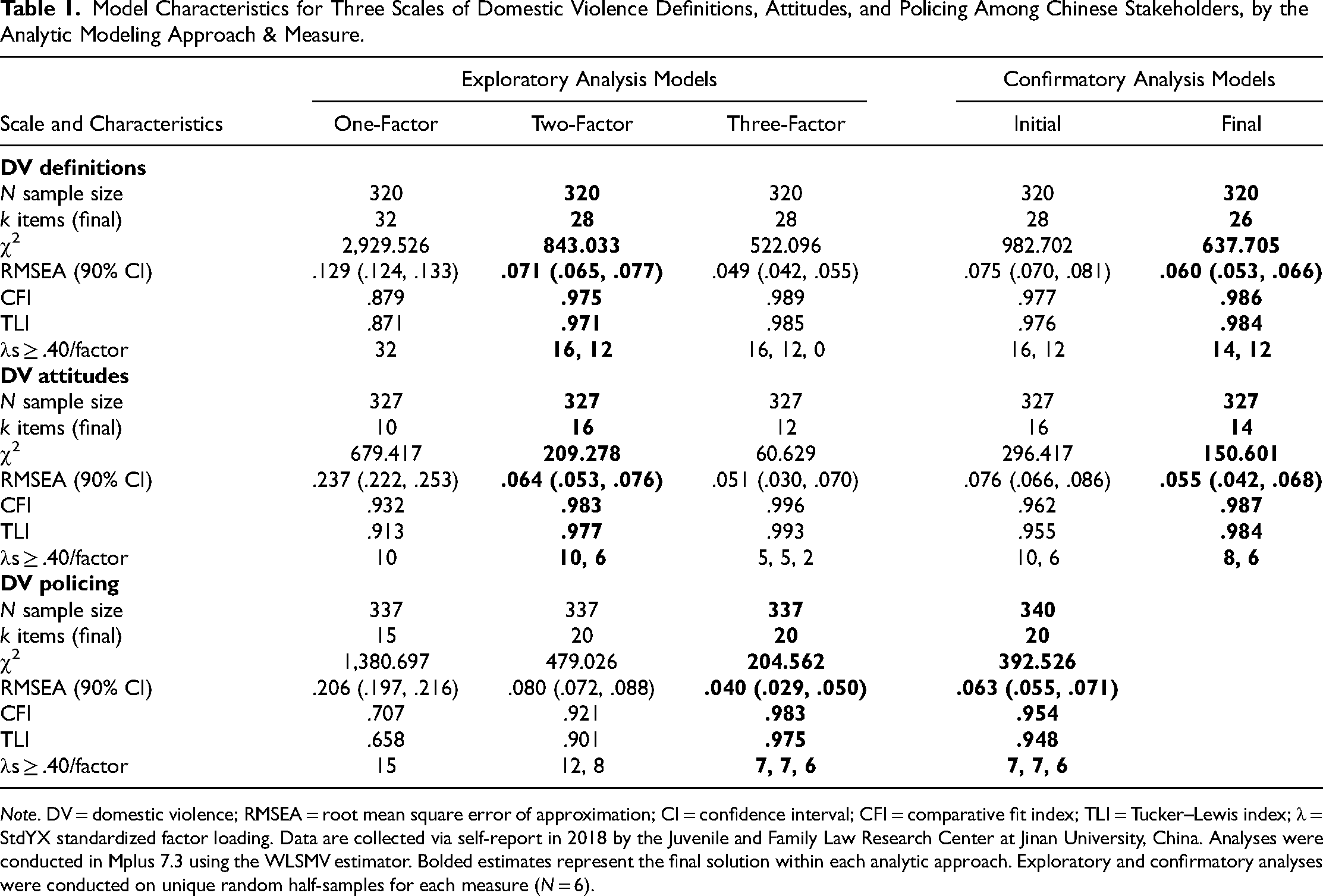
Note. DV = domestic violence; RMSEA = root mean square error of approximation; CI = confidence interval; CFI = comparative fit index; TLI = Tucker–Lewis index; λ = StdYX standardized factor loading. Data are collected via self-report in 2018 by the Juvenile and Family Law Research Center at Jinan University, China. Analyses were conducted in Mplus 7.3 using the WLSMV estimator. Bolded estimates represent the final solution within each analytic approach. Exploratory and confirmatory analyses were conducted on unique random half-samples for each measure (N = 6).
The EFA results for the DV Attitudes scale were generally similar, with the unidimensional model fitting poorly to the data and the two-factor solution being most preferred and having demonstrated acceptable fit: RMSEA = .064 (90% CI = .053, .076); CFI = .983; TLI = .977. Ten items loaded onto one factor and six on the other thus retaining 16 (94.1%) of the starting 17 items. Primary factors’ λs ranged from .43 to .93. Again, the three-factor model had a marginally better fit (RMSEA: −.013; CFI: +.013; TLI: +.016) but did not have ≥3 items at λ ≥ .40 on each factor.
For DV policing, the results pattern changed with both the one- and two-factor solutions being unacceptable and only the three-factor solution demonstrating acceptable fit: RMSEA = .040 (90% CI = .029, .050); CFI = .983; TLI = .975. Seven items loaded onto two factors and six on the remaining factor, thus keeping 20 (90.9%) of the initial 22 items. Primary factors’ λs ranged from .44 to .90.
Confirmatory Factor Analyses
The initial CFA model for DV Definitions featuring a two-factor solution did not meet pre-specified fit criteria (RMSEA 90% CI = .070, .081). As all λs were >.20, the second criterion was applied by removing two items with low (r < .10) intrascale correlations both related to psychological DV: (a) “Complaining about her/him” (n = 5 correlations) and (b) “Talking ill about her/him” (n = 3). No other items had any other r < .10. Removing those two items resulted in a 26-item final scale with 14 items on one factor, 12 items on the other, and acceptable overall model fit: RMSEA = .060 (90% CI = .053, .066); CFI = .986; TLI = .984. The λs (not pictured) ranged from .73 to .96 across all 26 items (p < .001) and the inter-factor r was .52 (p < .001). The variances (not pictured) of the two latent factors were .53 (p < .001) and .74 (p < .001)—indicative that these variables captured significant differences in their constructs across individual respondents.
The initial CFA for DV Attitudes (Table 1) did not meet all fit criteria (RMSEA 90% CI = .070, .086), and so two items with λs < .20 were removed both related to approval of DV: (a) “I don’t mind my partner doing something just to make me jealous” (λ = .16) and (b) “It is okay for me to accept blame for my partner doing bad things” (λ = .18). Removing those items resulted in a well-fitting final 14-item final scale with eight items on one factor and six items on the other: RMSEA = .055 (90% CI = .042, .068); CFI = .987; TLI = .984. The λs ranged from .42 to .93 across all items (p < .001) and the inter-factor r was −.36 (p < .001). The variances of the two latent factors were .42 (p < .001) and .18 (p < .001).
The initial 20-item CFA model for DV Policing (Table 1) did meet all criteria for fit and was considered final: RMSEA = .063 (90% CI = .055, .071); CFI = .954; TLI = .948. Note that as (a) no λs < .20 were estimated and (b) many (n > 10) items had rs < .10, the borderline TLI value was considered acceptable especially given the acceptable fit demonstrated in the EFA in the other random half sample, and no further edits were made. The three-factor solution had seven items on two factors and six on the remaining factor. The λs ranged from .55 to .995 across all 20 items (p < .001). The inter-factor rs were .57 (p < .001), −.13 (p < .001), and .04 (p = .59). The variances of the three latent factors were .58 (p < .001), .45 (p < .001), and .50 (p < .001).
Measure Finalization
The final three scales are presented in Tables 2–4, respectively, with items listed in both English and Simplified Chinese. Note that factors are listed arbitrarily with items sorted alphabetically by English. For DV Definitions, the two factors were named “Physical” and “Psychological,” and the Flesch reading ease scores for the total scale and factors were 47.2, 48.3, and 38.0, respectively. For DV Attitudes, the two factors were named “Approval” and “Disapproval,” and the Flesch reading ease scores for the total scale and factors were 71.7, 71.2, and 63.9, respectively. For DV Policing, the three factors were named “Tolerant,” “Conservative,” and “Progressive,” and the Flesch reading ease scores for the total scale and factors were 49.5, 57.5, 39.6, and 43.1, respectively.
A Domestic Violence Definitions Scale for use Among Chinese Stakeholders.
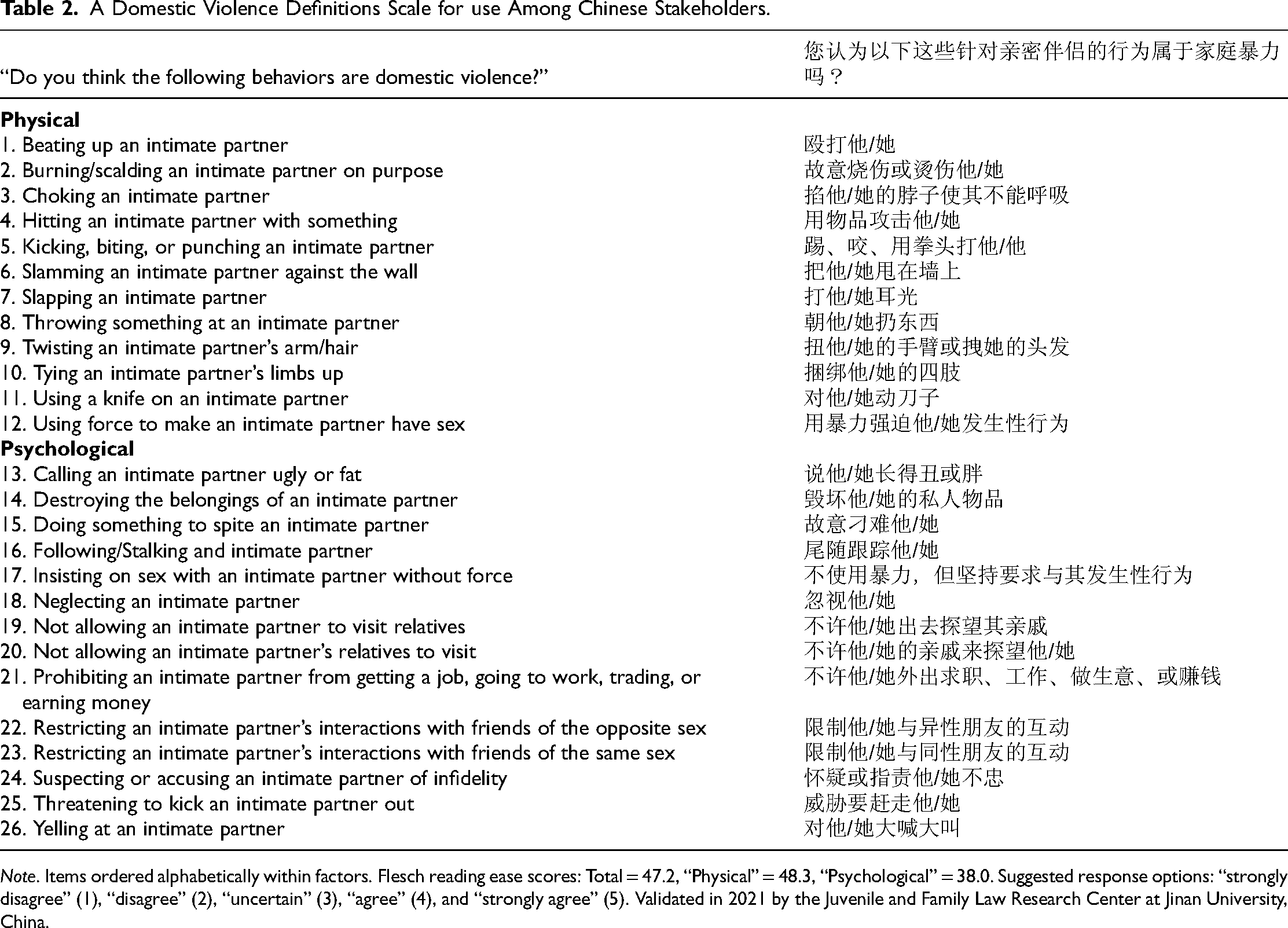
Note. Items ordered alphabetically within factors. Flesch reading ease scores: Total = 47.2, “Physical” = 48.3, “Psychological” = 38.0. Suggested response options: “strongly disagree” (1), “disagree” (2), “uncertain” (3), “agree” (4), and “strongly agree” (5). Validated in 2021 by the Juvenile and Family Law Research Center at Jinan University, China.
A Domestic Violence Attitudes Scale for Use Among Chinese Stakeholders.
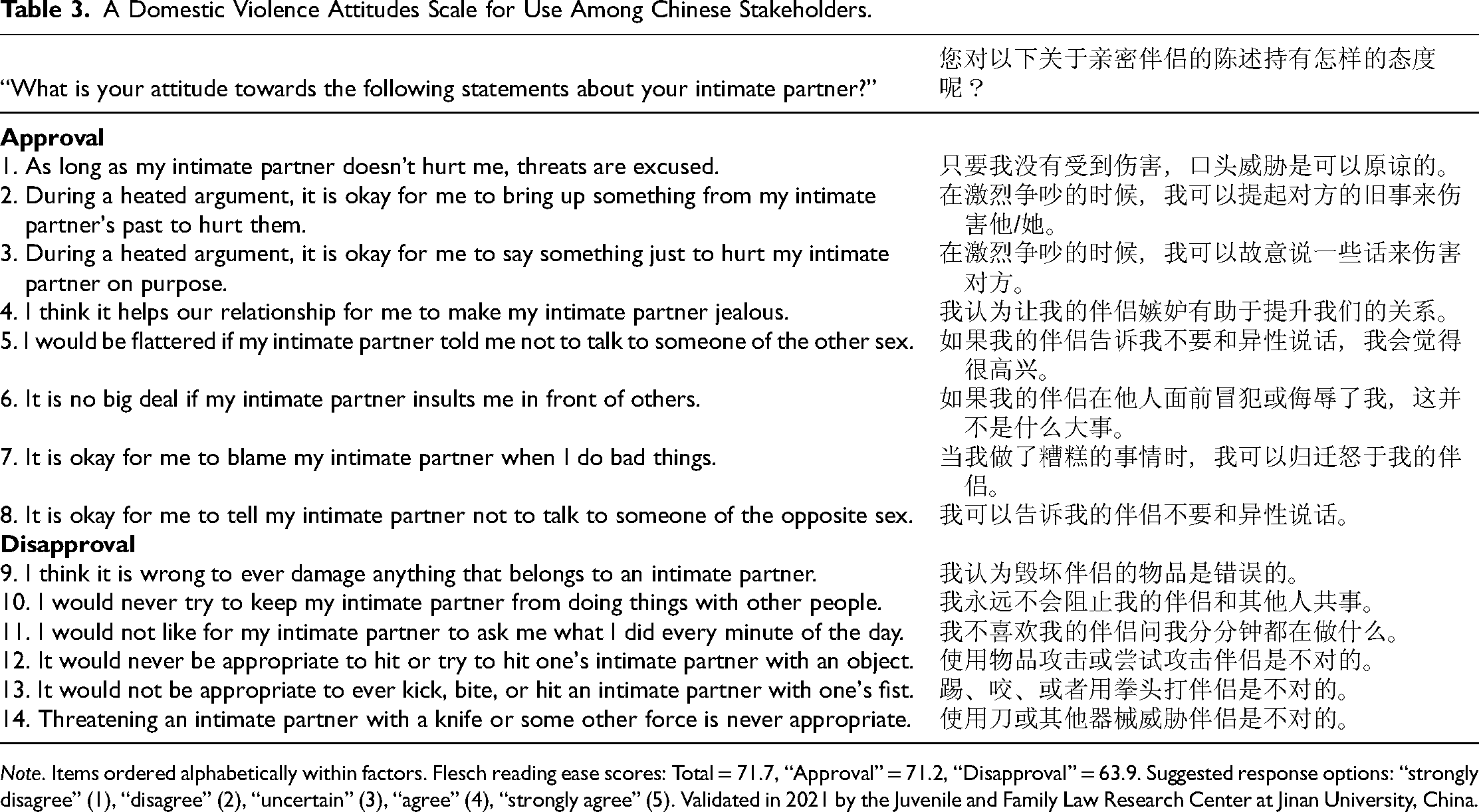
Note. Items ordered alphabetically within factors. Flesch reading ease scores: Total = 71.7, “Approval” = 71.2, “Disapproval” = 63.9. Suggested response options: “strongly disagree” (1), “disagree” (2), “uncertain” (3), “agree” (4), “strongly agree” (5). Validated in 2021 by the Juvenile and Family Law Research Center at Jinan University, China.
A Domestic Violence Policing Scale for Use Among Chinese Stakeholders.
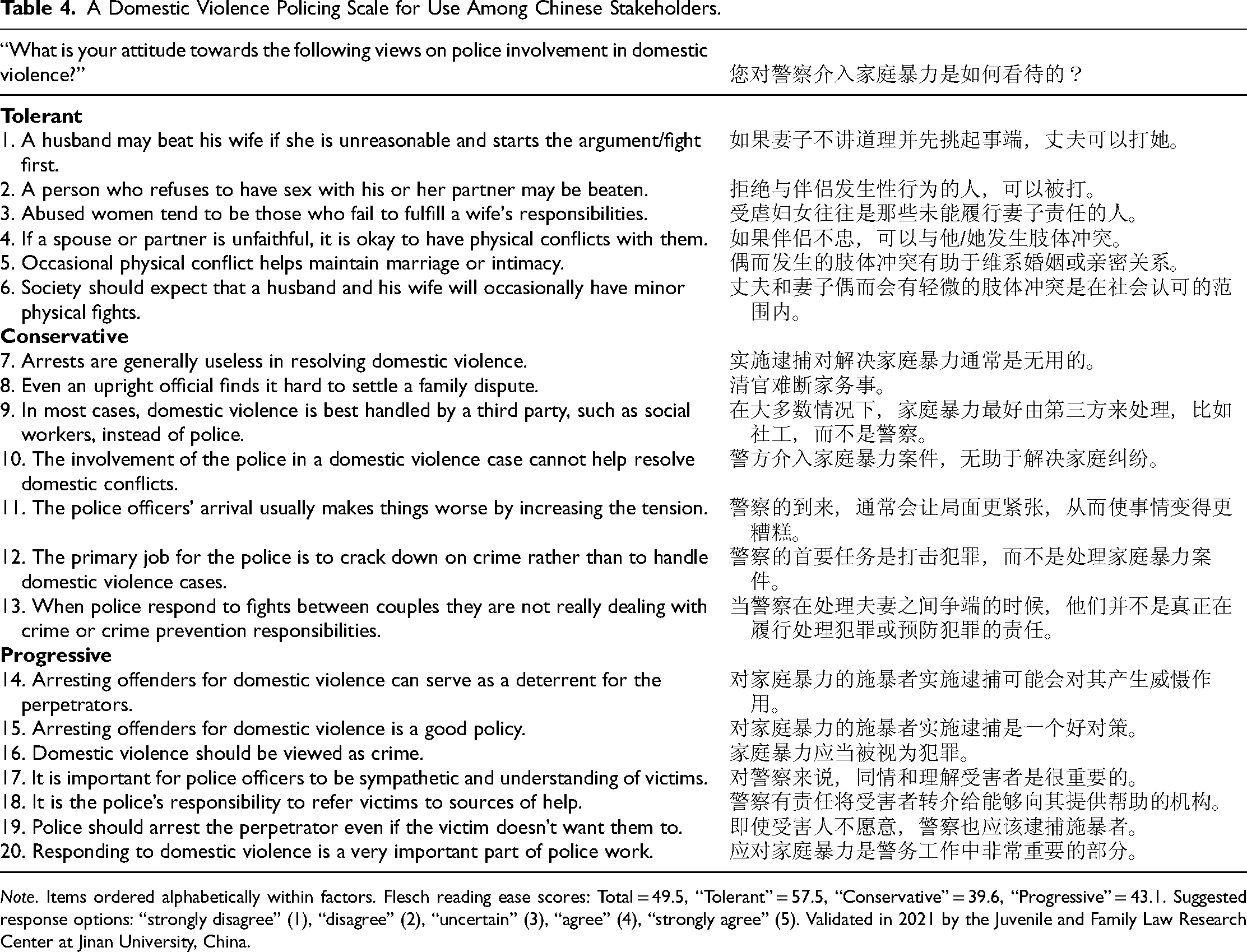
Note. Items ordered alphabetically within factors. Flesch reading ease scores: Total = 49.5, “Tolerant” = 57.5, “Conservative” = 39.6, “Progressive” = 43.1. Suggested response options: “strongly disagree” (1), “disagree” (2), “uncertain” (3), “agree” (4), “strongly agree” (5). Validated in 2021 by the Juvenile and Family Law Research Center at Jinan University, China.
Observed characteristics for each factor within each scale using the entire analytic sample are presented in Table 5. For all seven factors, the actual score ranges matched their hypothetical ranges. Five of seven factors were found to be negatively skewed. All intra-scale unpaired score comparisons were found to be significant (p < .001). For example, within DV Definitions the composite scores indicated a greater correctness in defining physical DV (MTotal = 50.42, MMean = 4.19) compared with psychological DV (MTotal = 45.94, MMean = 3.27). Within DV Attitudes, there was less positivity toward approving of DV (MTotal = 17.59, MMean = 2.21) compared with disapproving of DV (MTotal = 23.16, MMean = 3.85). Lastly, within DV Policing there was less endorsement of tolerant DV policing (MTotal = 12.69, MMean = 2.12) relative to both conservative DV policing (MTotal = 19.50, MMean = 2.79) and progressive DV policing (MTotal = 23.67, MMean = 3.38). Overall, respondents scored the strongest in their (a) ability to correctly define physical DV and (b) disapproval of DV. The mean inter-item correlations for all factors were high (rMean = .38–.65), as were the internal consistency reliability coefficients (λ2 = .83–.96).
Observed Characteristics of Three Scales for Domestic Violence Definitions, Attitudes, and Policing for use Among Chinese Stakeholders (N = 683).
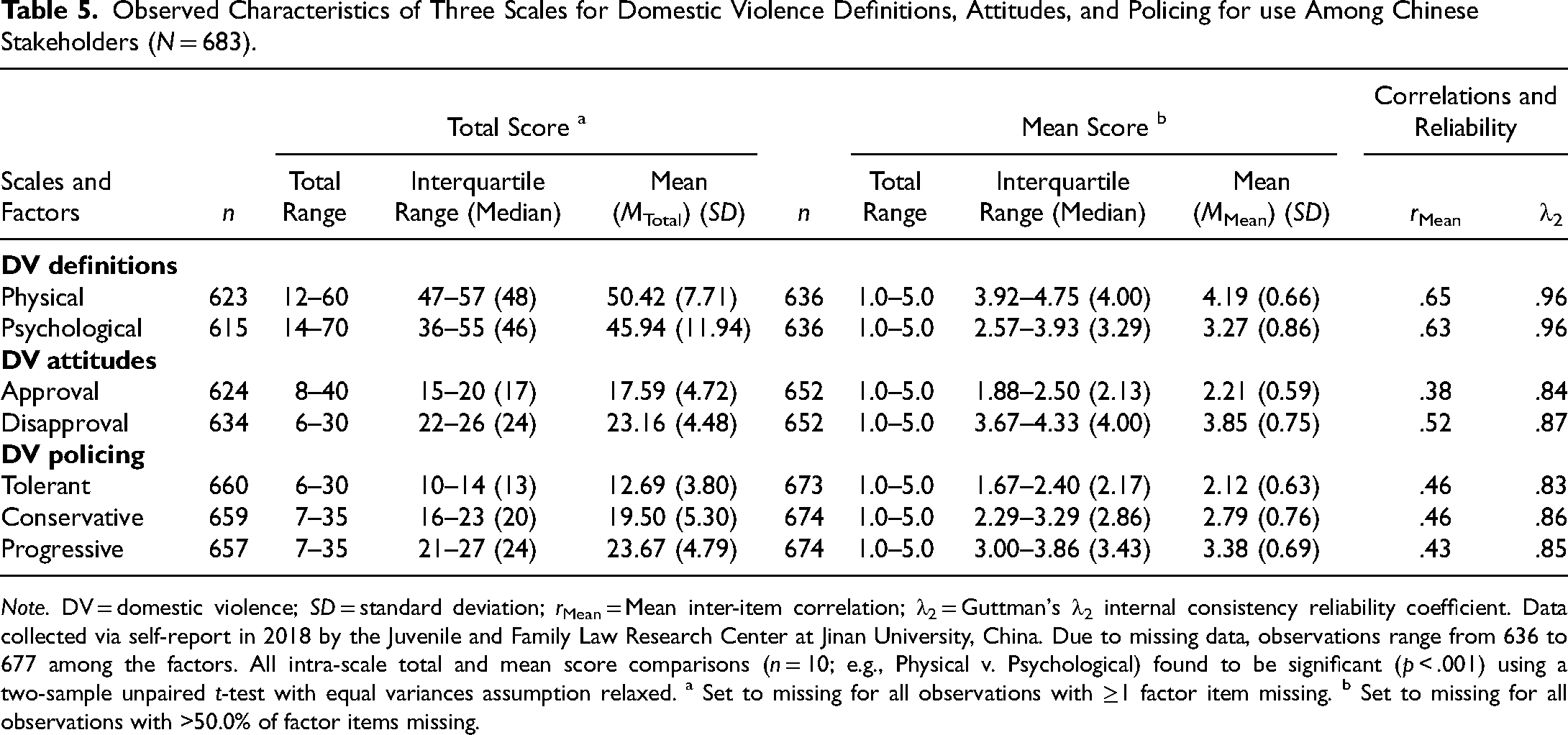
Note. DV = domestic violence; SD = standard deviation; rMean = Mean inter-item correlation; λ2 = Guttman's λ2 internal consistency reliability coefficient. Data collected via self-report in 2018 by the Juvenile and Family Law Research Center at Jinan University, China. Due to missing data, observations range from 636 to 677 among the factors. All intra-scale total and mean score comparisons (n = 10; e.g., Physical v. Psychological) found to be significant (p < .001) using a two-sample unpaired t-test with equal variances assumption relaxed. a Set to missing for all observations with ≥1 factor item missing. b Set to missing for all observations with >50.0% of factor items missing.
Construct Validity
Results from the pairwise Spearman's rank-order correlation estimates (Appendix Table A2) were largely confirming of convergent and discriminant validity with estimates varying positive and negative as expected based on the nature of the latent factors/constructs (n = 9). For example, the strongest positive correlation was the relationship between approving DV attitudes and tolerant DV policing (r = .47, p < .001). The strongest negative correlations (r = −.38, p < .001) were between (a) endorsement of tolerant DV policing and correct definition of physical DV and (b) endorsement of tolerant DV policing and the AWS-B. Among all pairwise correlations, only one was non-significant: conservative DV policing with progressive DV policing (r = −.04, p = .34).
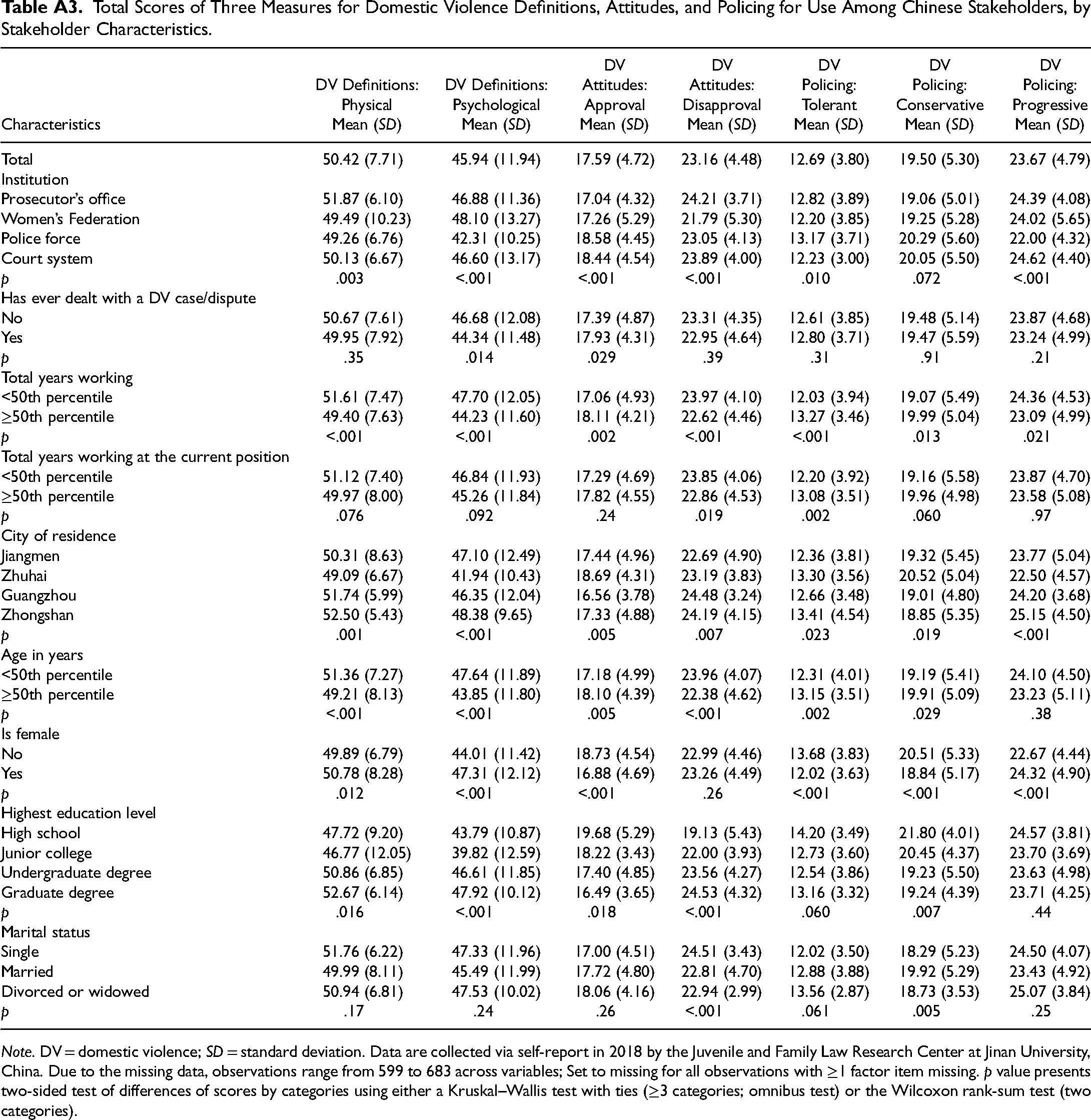
Likewise, the tests of the differences in the total mean composites by stakeholder characteristics (Appendix Table A3) also found numerous significantly different scores—suggestive of the final factors’ ability to differentiate across the sample and thus indicative of construct validity. The omnibus tests by institution found that all but one of the seven factors were significant. The largest difference was related to the correct definition of psychological DV where members of the Women's Federation scored markedly higher than those in the police force (48.10 v. 42.31; +13.68% relative difference). Significant differences were consistently (i.e., on ≥4 of 7 factors) found for these six stakeholder characteristics: (a) institution, (b) total years working, (c) city of residence, (d) age in years, (e) gender, and (f) highest education level. Despite the large number of statistical tests in this analysis, no adjustment was made for multiple testing and, as such, significant p values are only presented to glean a general sense of likely differences.
Discussion
Using novel data from leading-edge research, this study presents a measurement analysis based on cross-sectional data from stakeholders working in the Women's Federation, prosecutors’ offices, and the court system (Zhao et al., 2023). The refinement and validation of three measures that correspond to the constructs of DV Definitions, DV Attitudes, and DV Policing represent an important initial step toward promulgating helpful tools to inform efforts to address DV in China. The EFA and CFA results derived three multidimensional scales with excellent psychometric properties, appropriate readability, and a demonstrated ability to differentiate among stakeholders. Regardless of substantive focus, this effort may be one of the most comprehensive psychometric analyses conducted to date on a relatively large sample in China.
Nature of Measures
Results demonstrated that all underlying latent constructs were likely multidimensional resulting in multi-factor scales. First, the final 26-item DV Definitions scale resulted in two factors related to defining (a) physical DV and (b) psychological DV. Second, the final DV Attitudes scale consisted of 14 items and two factors comprising both (a) approval and (b) disapproval of DV. Third, the final 20-item DV Policing scale was found to include three factors describing respondents’ attitudes toward police involvement in DV, namely (a) tolerant attitudes, (b) conservative attitudes, and (c) progressive attitudes.
In addition to determining factor structure, this study found the three scales demonstrated acceptable reliability and validity. Internal consistency was ≥.80 for all the resulting subscales. Convergent and discriminant validity estimates were largely significant and varied as expected based on key stakeholders’ characteristics. Such findings help to establish construct validity. These findings are also congruent with research suggesting that understandings of DV and related attitudes do vary meaningfully by stakeholder characteristics (Li et al., 2021; Lin et al., 2021; Sun et al., 2022; Tang et al., 2002; Wang et al., 2020; Zhao et al., 2018).
Application of Measures
A measurement tool with validated scales developed for DV stakeholders in China would provide many benefits for advancing practice and research. Such a tool could enhance understanding of DV stakeholders overall by being tailored to the population and context. Notably, the scales for measuring DV Definitions, DV Attitudes, and DV Policing could be used by relevant organizations to ultimately improve service delivery by ensuring employees accurately understand DV and hold DV attitudes consistent with the organization's aim and mission. These measures could also be used to examine the perceptions of stakeholders responsible for implementing DV-related policies, as stakeholders’ perceptions may facilitate or obstruct the dissemination and implementation of policies and their likely impact. Given research indicating that DV attitudes and beliefs can be changed (Hayes et al., 2022), understanding the perceptions of key Chinese professionals could be used to inform targeted intervention efforts aimed at correcting misperceptions and ensuring attitudes align with existing policy and organizational practices.
This study addresses calls from prior researchers. For instance, Wang and colleagues’ (2020) work on Chinese police officers’ decision-making in DV cases noted a gap in research that specifically measures attitudes and beliefs, a focal point of the present scales. Another group emphasized the importance of longitudinal research exploring attitudes of Chinese DV stakeholders (i.e., Chinese police cadets; Hayes et al., 2022). Longitudinal research and multisite studies in China would see the benefits of having standardized tools to utilize across studies. Ultimately, having accessible and reliable measurements has potential to increase the empirical DV research conducted in China generally, and specifically research with Chinese stakeholders.
The scales presented herein can be completed by self-report and are available for use by any interested party. The high proportion of original items from preexisting measures retained in the final scales along with the lack of need to correlate item error terms indicate the original pools of items were largely satisfactory starting points from which to create the three scales. Although presented together, none of the scales are conceptualized to be summed into totals incorporating all factors. Moreover, it is not recommended that the individual factors within scales be added to create a scale composite score given the substantive differences among intra-scale factors and the low inter-factor correlations. The three scales can be used independently from one another or together to garner a well-rounded picture of individuals’ understandings and attitudes toward DV.
Limitations
This study is an initial step to validate scales for researching stakeholders’ attitudes toward DV in China. Although the measurement scales validated in the current study are rather comprehensive, they may not fully capture the unique contexts behind stakeholders’ attitudes toward DV in China as many of the items and measures have their origins in Western research. Researchers are encouraged in conduct qualitative studies in China to investigate unique aspects of DV in China. Future work in China should also aim to incorporate enhanced cultural components into the measurement scales taken from North America and other Western contexts. In addition, the study was unable to examine measurement invariance across stakeholder groups (i.e., Women's Federation, prosecutor's office, court system, or police force) or other important demographic characteristics (e.g., gender) given small, group-specific sample sizes (Bowen & Masa, 2015). Future research is needed to examine measurement invariance across different types of DV stakeholders and stakeholder characteristics. This study was also unable to test the criterion validity of the scales and their association with professional performance (e.g., predictive validity). Future studies can examine whether and how the scales are associated with stakeholders’ DV-related work (e.g., interactions with victims, service delivery approach) and victim outcomes.
Conclusion
This study contributes to the growing literature on intimate partner DV in China and represents an important step to advancing research focused on examining and understanding DV from the perspective of Chinese stakeholders. By refining and validating scales for measuring DV Definitions, DV Attitudes, and DV Policing in Simplified Chinese with a sample of Chinese stakeholders, the study addresses gaps regarding the availability of psychometrically valid measures that are appropriate and relevant for the Chinese context. The current study is timely given the relatively recent enactment of the People's Republic of China Anti-Domestic Violence Law. Thus, the validated scales have the potential to evaluate this new policy, as well as inform efforts to ensure the policy is implemented as intended.
Footnotes
Declaration of Conflicting Interest
The authors declared no potential conflicts of interest with respect to the research, authorship, and/or publication of this article.
Funding
The authors disclosed receipt of the following financial support for the research, authorship, and/or publication of this article: This work was supported by the University of Macau (grant numbers MYRG2019-00104-FSS, MYRG2018-00094-FSS).

Author Biographies
Appendix
Total Scores of Three Measures for Domestic Violence Definitions, Attitudes, and Policing for Use Among Chinese Stakeholders, by Stakeholder Characteristics.
| Characteristics | DV Definitions: |
DV Definitions: |
DV |
DV |
DV |
DV |
DV |
|---|---|---|---|---|---|---|---|
| Total | 50.42 (7.71) | 45.94 (11.94) | 17.59 (4.72) | 23.16 (4.48) | 12.69 (3.80) | 19.50 (5.30) | 23.67 (4.79) |
| Institution | |||||||
| Prosecutor’s office | 51.87 (6.10) | 46.88 (11.36) | 17.04 (4.32) | 24.21 (3.71) | 12.82 (3.89) | 19.06 (5.01) | 24.39 (4.08) |
| Women’s Federation | 49.49 (10.23) | 48.10 (13.27) | 17.26 (5.29) | 21.79 (5.30) | 12.20 (3.85) | 19.25 (5.28) | 24.02 (5.65) |
| Police force | 49.26 (6.76) | 42.31 (10.25) | 18.58 (4.45) | 23.05 (4.13) | 13.17 (3.71) | 20.29 (5.60) | 22.00 (4.32) |
| Court system | 50.13 (6.67) | 46.60 (13.17) | 18.44 (4.54) | 23.89 (4.00) | 12.23 (3.00) | 20.05 (5.50) | 24.62 (4.40) |
| p | .003 | <.001 | <.001 | <.001 | .010 | .072 | <.001 |
| Has ever dealt with a DV case/dispute | |||||||
| No | 50.67 (7.61) | 46.68 (12.08) | 17.39 (4.87) | 23.31 (4.35) | 12.61 (3.85) | 19.48 (5.14) | 23.87 (4.68) |
| Yes | 49.95 (7.92) | 44.34 (11.48) | 17.93 (4.31) | 22.95 (4.64) | 12.80 (3.71) | 19.47 (5.59) | 23.24 (4.99) |
| p | .35 | .014 | .029 | .39 | .31 | .91 | .21 |
| Total years working | |||||||
| <50th percentile | 51.61 (7.47) | 47.70 (12.05) | 17.06 (4.93) | 23.97 (4.10) | 12.03 (3.94) | 19.07 (5.49) | 24.36 (4.53) |
| ≥50th percentile | 49.40 (7.63) | 44.23 (11.60) | 18.11 (4.21) | 22.62 (4.46) | 13.27 (3.46) | 19.99 (5.04) | 23.09 (4.99) |
| p | <.001 | <.001 | .002 | <.001 | <.001 | .013 | .021 |
| Total years working at the current position | |||||||
| <50th percentile | 51.12 (7.40) | 46.84 (11.93) | 17.29 (4.69) | 23.85 (4.06) | 12.20 (3.92) | 19.16 (5.58) | 23.87 (4.70) |
| ≥50th percentile | 49.97 (8.00) | 45.26 (11.84) | 17.82 (4.55) | 22.86 (4.53) | 13.08 (3.51) | 19.96 (4.98) | 23.58 (5.08) |
| p | .076 | .092 | .24 | .019 | .002 | .060 | .97 |
| City of residence | |||||||
| Jiangmen | 50.31 (8.63) | 47.10 (12.49) | 17.44 (4.96) | 22.69 (4.90) | 12.36 (3.81) | 19.32 (5.45) | 23.77 (5.04) |
| Zhuhai | 49.09 (6.67) | 41.94 (10.43) | 18.69 (4.31) | 23.19 (3.83) | 13.30 (3.56) | 20.52 (5.04) | 22.50 (4.57) |
| Guangzhou | 51.74 (5.99) | 46.35 (12.04) | 16.56 (3.78) | 24.48 (3.24) | 12.66 (3.48) | 19.01 (4.80) | 24.20 (3.68) |
| Zhongshan | 52.50 (5.43) | 48.38 (9.65) | 17.33 (4.88) | 24.19 (4.15) | 13.41 (4.54) | 18.85 (5.35) | 25.15 (4.50) |
| p | .001 | <.001 | .005 | .007 | .023 | .019 | <.001 |
| Age in years | |||||||
| <50th percentile | 51.36 (7.27) | 47.64 (11.89) | 17.18 (4.99) | 23.96 (4.07) | 12.31 (4.01) | 19.19 (5.41) | 24.10 (4.50) |
| ≥50th percentile | 49.21 (8.13) | 43.85 (11.80) | 18.10 (4.39) | 22.38 (4.62) | 13.15 (3.51) | 19.91 (5.09) | 23.23 (5.11) |
| p | <.001 | <.001 | .005 | <.001 | .002 | .029 | .38 |
| Is female | |||||||
| No | 49.89 (6.79) | 44.01 (11.42) | 18.73 (4.54) | 22.99 (4.46) | 13.68 (3.83) | 20.51 (5.33) | 22.67 (4.44) |
| Yes | 50.78 (8.28) | 47.31 (12.12) | 16.88 (4.69) | 23.26 (4.49) | 12.02 (3.63) | 18.84 (5.17) | 24.32 (4.90) |
| p | .012 | <.001 | <.001 | .26 | <.001 | <.001 | <.001 |
| Highest education level | |||||||
| High school | 47.72 (9.20) | 43.79 (10.87) | 19.68 (5.29) | 19.13 (5.43) | 14.20 (3.49) | 21.80 (4.01) | 24.57 (3.81) |
| Junior college | 46.77 (12.05) | 39.82 (12.59) | 18.22 (3.43) | 22.00 (3.93) | 12.73 (3.60) | 20.45 (4.37) | 23.70 (3.69) |
| Undergraduate degree | 50.86 (6.85) | 46.61 (11.85) | 17.40 (4.85) | 23.56 (4.27) | 12.54 (3.86) | 19.23 (5.50) | 23.63 (4.98) |
| Graduate degree | 52.67 (6.14) | 47.92 (10.12) | 16.49 (3.65) | 24.53 (4.32) | 13.16 (3.32) | 19.24 (4.39) | 23.71 (4.25) |
| p | .016 | <.001 | .018 | <.001 | .060 | .007 | .44 |
| Marital status | |||||||
| Single | 51.76 (6.22) | 47.33 (11.96) | 17.00 (4.51) | 24.51 (3.43) | 12.02 (3.50) | 18.29 (5.23) | 24.50 (4.07) |
| Married | 49.99 (8.11) | 45.49 (11.99) | 17.72 (4.80) | 22.81 (4.70) | 12.88 (3.88) | 19.92 (5.29) | 23.43 (4.92) |
| Divorced or widowed | 50.94 (6.81) | 47.53 (10.02) | 18.06 (4.16) | 22.94 (2.99) | 13.56 (2.87) | 18.73 (3.53) | 25.07 (3.84) |
| p | .17 | .24 | .26 | <.001 | .061 | .005 | .25 |
Note. DV = domestic violence; SD = standard deviation. Data are collected via self-report in 2018 by the Juvenile and Family Law Research Center at Jinan University, China. Due to the missing data, observations range from 599 to 683 across variables; Set to missing for all observations with ≥1 factor item missing. p value presents two-sided test of differences of scores by categories using either a Kruskal–Wallis test with ties (≥3 categories; omnibus test) or the Wilcoxon rank-sum test (two categories).