




Abstract
We investigate the determinants and over time patterns of perceptions toward wife beating from 2012 to 2018 in Pakistan. We use two waves of the Pakistan Demographic and Health Survey that include ever-married women and men aged 15 to 49 (12,607 women and 3052 men in 2012 and 11,543 women and 3055 men in 2018). Education, employment, wealth, and region influence attitudes toward wife beating. While women are generally more tolerant toward wife beating than men, the presence of a family member during the interview further increased their tolerance toward wife beating. Wife beating support has increased over time among women whose interviews were overheard and men. Additionally, households with joint decision-making have a lower tolerance toward wife beating, even lower than households where the wife is the main decision-maker.
Introduction
Pakistan is home to 220 million people, out of which women constitute 49% of the population. But, according to the Global Gender Gap Index 2023, Pakistan ranks 142 out of 146 countries in terms of gender equality (World Economic Forum, 2023). The country is doing poorly on gender equality and yet little scholarship addresses this issue in the context of the country. Addressing the issues of gender (in)equality gives sociological insight and is likely to help improve the economic conditions of the country as well. Women's empowerment is posited to have a multiplier effect across many different aspects of the economy, allowing the country to achieve its development goals at a relatively quicker pace (Stevens, 2010). This is one of the major reasons why gender equality has been listed as one of the seventeen primary goals that constitute the 2030 agenda for sustainable development (UN DESA, 2019).
The prevalence of gender violence—the percentage of ever-partnered women who ever suffered intimate partner physical and/or sexual violence—is one of the measures used by the Global Gender Gap Index. In Pakistan, 85% of ever-partnered women have experienced such gender violence (World Economic Forum, 2023). This percentage is frightfully high even compared to rates in other countries in the region, such as Bangladesh (53%) and India (29%) (World Economic Forum, 2023).
In this article, we focus on the attitudes of men and women toward wife beating. According to the Pakistan Demographic and Health Survey (PDHS) 2012–2013, 47% of the respondents believed that it is justifiable for men to beat their wives and not much changed after 5 years, with the next round of data reporting the figure around 43% (PDHS 2017–2018).
Most prior research on wife beating in Pakistan focused on a single round of data, whereas we are able to compare the attitudes over time by using last two waves of PDHS data. Eight journal articles have addressed the issue of wife beating in Pakistan using PDHS 2013 data (Amir-ud-Din et al., 2021; Aslam et al., 2015; Bari et al., 2021; Hussain et al., 2017; Khalid & Choudhry, 2021; Nasrullah et al., 2014, 2017; Saud et al., 2021; Tayyab et al., 2017). To our knowledge, three current articles have used the 2018 data to look at attitudes toward wife beating (Ali & Tariq, 2022; Khan et al., 2021; Lassi et al., 2021). Similarly, most of the prior studies focus on women, whereas we add the comparison of attitudes between men and women. We attempt to shed light on possible reasons why the higher trends regarding intimate partner violence (IPV) and specifically wife beating persist in the country. We review social, political, religious, and cultural events in this period that might contribute to the change in the perceptions regarding wife beating. We also analyze the effect of demographic characteristics on attitudes toward wife beating and consider how decision-making in the household affects attitudes toward wife beating.
Literature Review
IPV is a global phenomenon still prevalent in both developed and developing countries (Krug et al., 2002; WHO, 2010). WHO's landmark study about IPV, including more than 24,000 women in 10 countries, found between 15% and 71% of women experience physical and/or sexual violence by their intimate partner at some point in their lives (WHO, 2005). Wife beating is the dominant form of physical violence in IPV. Wife beating impacts a woman on a physical level and has lasting effects on mental and emotional health. This study focuses on wife beating, a term more specific than IPV and more commonly used in the context of South Asian gender violence studies.
There is a growing literature on wife beating and IPV in developing countries (Rani & Bonu, 2009), and in South Asia specifically. It studies the determinants of wife beating (Jesmin, 2017), why women continue to live in abusive relationships (Ahmad et al., 2009), the physical and mental impact on victim's health (Jejeebhoy, 1998; Tareque et al., 2020) and the measures taken by state and legal authorities to combat the violence and provide support to the victims (Tripathi & Azhar, 2022). In addition, emerging literature is also focusing on the perceptions toward IPV in the South Asian region (Jesmin, 2015), with a few of them focusing on the South Asian diaspora community (Dalal et al., 2012; Mahapatra, 2012).
Studying the perceptions and attitudes toward IPV and wife beating are of crucial importance as such perceptions may predict both being a victim and the perpetrator of IPV. Prior research has indicated that females with higher tolerance toward IPV may be at a greater risk of constant abuse (Gage, 2005). For men, the existing norms of gender inequality coupled with high societal tolerance of wife beating increase one's likelihood of being involved in IPV (Sambisa et al., 2010).
The case of Pakistan is no different when it comes to studying the issue of IPV. Literature on gendered violence in Pakistan has mainly focused on the socio-economic determinants of wife beating and IPV, such as educational attainment (Zakar et al., 2016), number of children, socio-economic status, age (Ali et al., 2013), area of residence, exposure to media, and an individual's experience to witnessing intergenerational violence (Farid et al., 2008; Fikree et al., 2005, 2006). IPV has also been studied in relation to women's empowerment measured via women's role in the household decision-making process (Murshid & Critelli, 2020) and social norms (Nadeem & Malik, 2021). However, to date, only a single quantitative study focuses on attitudes and perceptions of both men and women toward wife beating in Pakistan (Tayyab et al., 2017).
Our study is unique in its approach since it studies the change of tolerance toward wife beating over time by both men and women. The change in attitudes can be driven by a combination of social, political, economic, cultural, and demographic reasons as suggested by demographic transition theory (DTT). We try to understand that change, but also focus on the determinants of attitudes toward wife beating for both men and women in Pakistan.
For the purpose of this paper, we use the term wife beating as opposed to IPV. The reason for doing so is twofold. First, IPV is a broader term and may include physical, sexual, psychological, or emotional violence. However, our paper centers solely on attitudes toward physical violence. Our measurement focuses exclusively on wife beating and not on other types of IPV. Second, while the term IPV is largely popular in the context of Western countries, wife beating is still a commonly used term for scholarship in South Asia and also specifically in Pakistan (Murshid & Critelli, 2020; Nasrullah et al., 2017; Saud et al., 2021; Tayyab et al., 2017). Furthermore, the term wife beating is also commonly used in the social discourse in Pakistan.
Theory
To understand changes in attitudes over time, we first turn to DTT. DTT was developed by Thompson (1929) and Notestein (1945). To date, DTT is considered the foundation of demography. The theory explains the stages of a country's population growth rate as a country experiences economic development and changes in social, cultural, political norms and traditional values. In this paper, we use DTT to understand the changes in attitudes toward wife beating in the context of Pakistan. The classic DTT describes four stages of population growth. First is a pre-transition, also known as a pre-modern stage with high death and birth rates and low to moderate population growth. In the second stage, due to the spread of medical technologies, the death rate falls, resulting in higher life expectancy and an overall decline in mortality rates. The birth rates are still high and, therefore, the population growth rate is high too. At this point, the country begins to experience industrialization and urbanization. Over time, couples realize they have a choice between having either a large number of children or maintaining their standard of living (Dyson, 2010). Eventually, having more children becomes expensive and the birth rates also begin to fall. In the last stage, both the birth and death rates are low and the population growth rate is either stationary or falling.
While a country is undergoing demographic transition, the country is not only going through the various stages of population growth rate, rather, it is also experiencing social, political, economic and cultural changes which eventually lead to the completion of the country's demographic transition. DTT helps to explain that the fertility decline in a country is accompanied by an increase in women's empowerment and a reduction in gender-specific roles. Since women are bearing fewer children, they are left with more time to pursue employment opportunities (Davis & Van den Oever, 1982) which decreases their overall dependence on male members of the family. Similarly, it increases the average age at marriage in both developed and developing countries (Dyson, 2010). In addition, having fewer children means that parents are more likely to provide equal education opportunities to their daughters and sons.
Similar to other developing countries, Pakistan is currently undergoing a demographic transition. The mortality rates are already low while the fertility transition is still in process, placing Pakistan in the third stage of the demographic transition. According to the World Bank (2020), in 1950, the country's birth rate was 41.32 births per 1000 people, which has reduced to 27.84 by 2020. The total fertility rate has come down from 6.60 in 1950 to 3.39 in 2020 (Knoema, 2022). As the country is undergoing a fertility transition, it is interesting to see how the change in the proximate determinants of fertility is accompanied by an increase in both male and female education and a rise in female labor force participation. Moreover, the social-political influence of the rise in the feminist movement, both at the global and local level has been a challenge to the centuries-old patriarchal system of society. The DTT would predict an expansion in the movement for women's rights and a decrease in the tolerance toward wife beating in Pakistan over time.
Women's Rights Movement in Pakistan
Indeed, the years 2012–2018 (the years on which our data focus) were crucial with regard to the improvements regarding women's rights, general changes toward gender equality, and women's empowerment in both global and local arenas. In Pakistan, a draft of the women's protection bill was circulated in Punjab Assembly in 2015 (Gabol, 2016)—the most populous and economically developed province, where draft bills have a higher chance of being passed in the National Assembly and becoming law.
The salient features of the bill included: (a) setting up a district-level women's force throughout the province to respond to women's complaints of physical, financial, or psychological abuse; (b) a 24/7 helpline available for women to seek help in case of IPV; (c) allowing female protection officers entry into any premises to rescue victims; (d) proclamation that a husband cannot ask his wife to leave the house, and; (e) a proclamation that, in case of violence, the husband should leave the house for 48 hours and return only when he wears a GPS tracker to ensure he does not get near the victim until settlement has been reached (Khan, 2016). The bill was very progressive and, if passed, would have been a landmark for women's rights in the country. However, in response to the women's protection bill, another bill proposal was circulated in 2016 by the chairman of the Council of Islamic Ideology, Muhammad Khan Sherani, stating, “a man should be allowed to lightly beat his wife under certain circumstances” (Craig, 2016). The bill proposal caused uproar and outrage throughout the country. Both the feminist circles in the society as well as various religious scholars in the majority and minority sects strongly condemned the bill both on the account of violation of human rights as well as the rights granted to women by Islam. However, regardless of this progressive opposition, a recommendation from such a high-ranking leader of Islamic society in Pakistan could plausibly increase the social acceptance of wife beating.
The following year, 2017, saw an uprise in the global feminist movement. The movement gained popularity when Hollywood actress Alyssa Milano encouraged survivors of sexual assault and harassment to post the hashtag #MeToo as a status update to spread awareness regarding the magnitude of the problem in the wake of allegations against film producer Harvey Weinstein (Keller et al., 2018). Within 24 hours, #MeToo was used 12 million times on social media, primarily on Facebook and Twitter posts (CBS, 2017). Following this, the use of #MeToo became a global phenomenon and within a few days, the movement spread to other countries with more and more women sharing their personal stories of harassment, especially the ones that happened at the workplace on social media.
Like elsewhere, Pakistani women also extended great support to the #MeToo movement. In April 2018, a renowned female Pakistani singer, actress, and model Meesha Shafi shared a post on Twitter in which she accused her male colleague, musician, and actor, Ali Zafar of sexual harassment. The case is still pending in court. Another high-profile case directly referred to the issue of IPV and influenced the #MeToo movement in Pakistan: a famous actor, singer, and host Mohsin Abbas Haider was accused of IPV by his wife. She filed for divorce and the court ruled in favor of the wife (Dawn Images, 2019).
Additionally, the rise in awareness created by the #MeToo movement encouraged the feminist movement in Pakistan to start organizing “Aurat March” (Women's March) annually on International Women's Day. The first Aurat March in 2018 was conducted in three major cities and it has now become an annual event in multiple cities. Whether the march has been able to penetrate at the grassroots level or not is not the topic of our discussion here but certainly, the high-profile cases of the #MeToo movement, combined with the Aurat March have initiated societal debates regarding women's rights and IPV.
Hypotheses
Both the DTT and the reach of the #MeToo movement in Pakistan would predict that the value system in Pakistan is moving toward higher gender equality over time. For example, the literacy rate in Pakistan has increased for both men (69%–71%) and women (41%–45%) throughout our research study from 2012 to 2018 (UNESCO Institute of Statistics, 2020). The increase in education, especially for women, has also resulted in a rise in female workforce participation. Additionally, the increase in global awareness for the protection of female rights along with an upsurge of feminist movements such as #MeToo leads us toward the development of our first hypothesis stated as follows: The acceptability of wife beating has decreased both among men and women from 2012 to 2018 in Pakistan. The acceptability of wife beating has increased from 2012 to 2018 in Pakistan, especially among the male population.
Most prior studies reveal an inverse relationship between the increased role of women in household decision-making process and a decrease in justification toward wife beating (Alam et al., 2021; Islam et al., 2015; Linos et al., 2010). However, a study from the Philippines shows that an increase in the wife's involvement in household decision-making may also result in higher incidents of IPV as opposed to when decision-making is done jointly (Hindin & Adair, 2002). In this particular case, the authors explained that in Philippines the joint decision-making is “normative” and therefore, is associated with lowest level of IPV. In patriarchal Pakistan, joint decision-making is not a norm. Hence, we predict that the more autonomy a woman has in the relationship, the less wife beating is accepted.
The higher the women's involvement in household decision making, the lower the acceptability of wife beating among both men and women.
Data and Method
We use the latest two rounds (2012–2013 and 2017–2018) of the PDHS—the second round was conducted between November 2017 and April 2018. This is a nationally representative two-stage stratified cluster sample of ever-married women and men in ages of 15 to 49. While the 2018 DHS included also Azad Jammu and Kashmir (AJK) regions and the Federally Administered Tribal Areas (FATA), those observations were dropped since the 2013 wave did not include these regions. To correct for the non-proportional sample allocation in regions and between urban and rural areas, we use the weights provided in the DHS data (National Institute of Population Studies, 2019, p. 352). The overall sample consists of 25,894 women and 6267 men. After listwise deletion, our valid sample includes 24,150 women and 6107 men. The considerably higher proportion of women is due to DHS's aim to collect data primarily on reproductive health and fertility behavior, targeting the female population.
Tolerance Toward Wife Beating
We measure tolerance toward wife beating as a combination of five dichotomous questions asked from both men and women. We code respondents as tolerant toward wife beating if they indicated that husband is justified in beating wife if wife does any of the following: (a) goes out without telling the husband; (b) neglects the children; (c) argues with husband; (d) refuses to have sex with husband; or (e) burns the food. Only those who answered “No” to all of the above questions are coded as not tolerant toward wife beating. If a respondent stated “Don’t know” to any of these questions and did not indicate any “Yes” answers, the observation has been treated as missing (781 observations). A total of 38% of men and 47% of women are tolerant toward wife beating for at least one reason (Table 1). Burning food (16%) is the least justified reason according to both men and women. All the other reasons have been marked as justified by about a third of the sample, though going out without telling the husband (33%) and arguing with the husband (34%) are the most highly rated justifications for wife beating (significant at p < .001 level according to paired t-test).
Percent of Tolerance Toward Wife Beating by Gender.
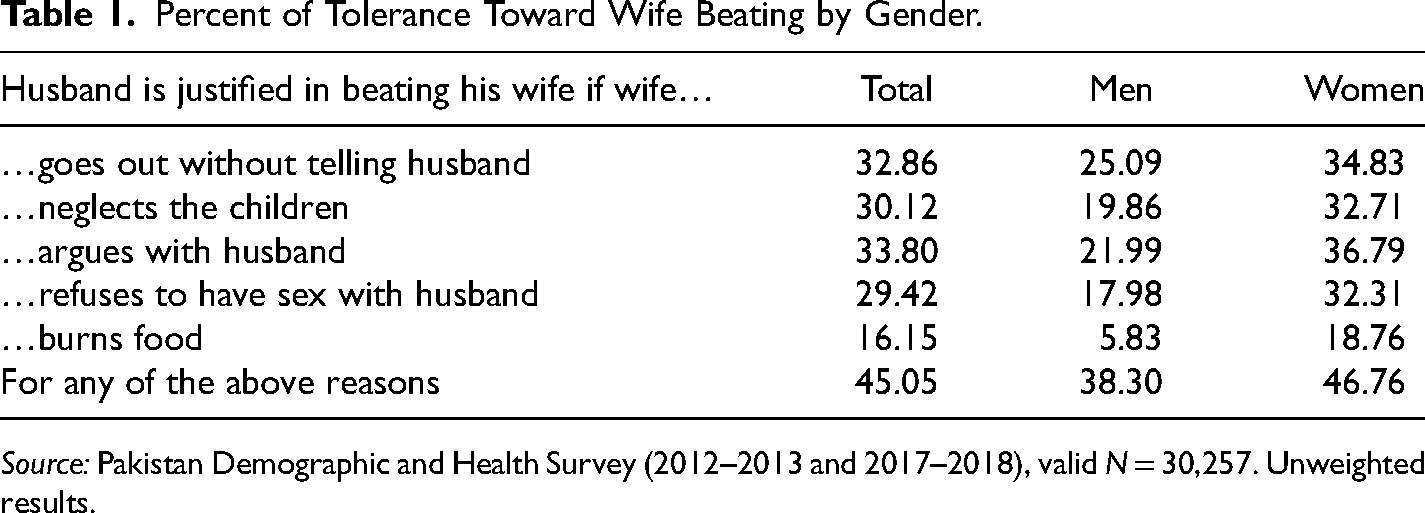
Source: Pakistan Demographic and Health Survey (2012–2013 and 2017–2018), valid N = 30,257. Unweighted results.
For gender, we use both a traditional dichotomous variable and a more detailed set of dummy variables that divide females into two groups: (a) those who were overheard by their family during the interview; and (b) those who were not overheard. About 14% of the women were overheard by a family member. Table 2 lists the descriptive statistics of our sample using the three-category gender variable.
Basic Descriptive Analysis of the Sample.
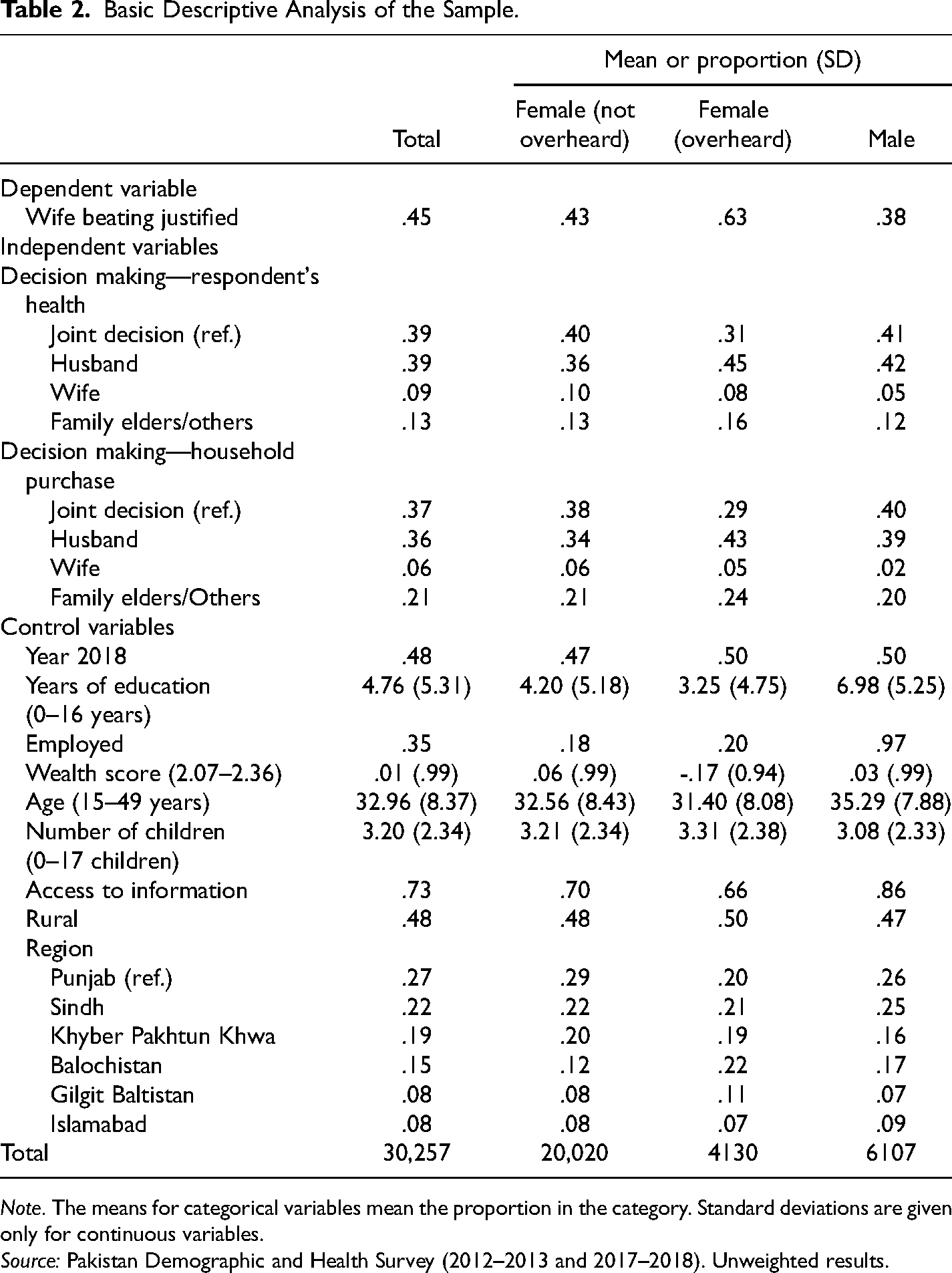
Note. The means for categorical variables mean the proportion in the category. Standard deviations are given only for continuous variables.
Source: Pakistan Demographic and Health Survey (2012–2013 and 2017–2018). Unweighted results.
We measure household decision-making (see H2) with questions about large household purchases and respondents’ health decisions. While the survey asks about other types of decisions, such as who decides on visits to family or relatives, who decides on what to do with the money earned by the husband, or who decides about contraception—these questions were only asked in the survey for women and are thus not included in our study. Both household decision variables are measured with four categories: only the husband decides, joint decision making, only the wife decides, and family elders decide. For both decision-making variables, joint decision and husband-only decision are the most popular choices, while the wife-only decision-making is the least popular choice. Additionally, the gap between family elders deciding as opposed to wife-only deciding is larger in the case of household purchases as compared to health decisions.
We control for study year, years of education, whether or not a respondent is working, wealth status, age, number of children, access to information, urban-rural difference, and region. On average, respondents in our sample have less than 5 years of education (close to 4 years for women, and close to 7 years for men). About 97% of the men are working or have worked in the past 12 months while only 19% of women are in this category.
Socio-economic status of the household is represented by the household's wealth index score which is calculated by performing the principal component analysis (PCA) on the list of assets being owned by a household, source of drinking water, type of toilet and toilet sharing, type of floor, wall, and roof materials—construction material of the house and whether the house is owned or rented (this index is calculated by DHS and directly available in DHS data). We are using wealth score as a continuous variable here, the higher the wealth score, the richer is the household, and vice versa. As a factor score, it has a standard deviation of 1 which means that 1 unit change can be interpreted as a one standard deviation change.
On average, respondents in our sample are 33 years old—women are slightly younger (32) than men (35 years)—and have 3 children. We measure access to information with three questions regarding the frequency of use of newspaper, TV, and radio. If the respondent has access to at least one source of information, they are coded as having access to information: 73% of the whole sample has access to at least one information source. However, we see a clear gender disparity in access to information: only 70% of the women have access to at least one source of information, while 86% of the men have this access. About half (48%) of our sample lives in rural areas. The region is measured as a series of dummy variables representing five provinces (Punjab, Sindh, Khyber Pakhtunkhwa, Balochistan, and Gilgit Baltistan) and the federal capital (Islamabad). We use the Punjab region as the reference category. We test for multicollinearity and all variance inflation factors are below 2 except for wealth (2.08), which is still in the acceptable range.
We are not using religion as a control variable due to the lack of variation. About 97% of Pakistan's population is Muslim. Moreover, the DHS data in Pakistan does not ask about religion. This could be due to two reasons. First, since the majority of the country's population follows Islam this question would not add much to the analysis. Second, the people belonging to minority groups may be reluctant to report their religion due to political or cultural reasons.
To test our hypotheses, we use weighted binary logistic regression models to predict the tolerance toward wife beating. For ease of interpretation, our tables present odds ratios. To test whether the pattern of tolerance toward wife beating is the same in both years, we use interaction effects between gender and year. To test whether the women's autonomy in household decision-making affects the tolerance toward wife beating differently for men and women, we use interaction effects between household decision-making and gender. To help interpret the results from interaction effect analysis, we calculate predicted probabilities for tolerance toward wife beating from the models with significant interaction effects.
Results
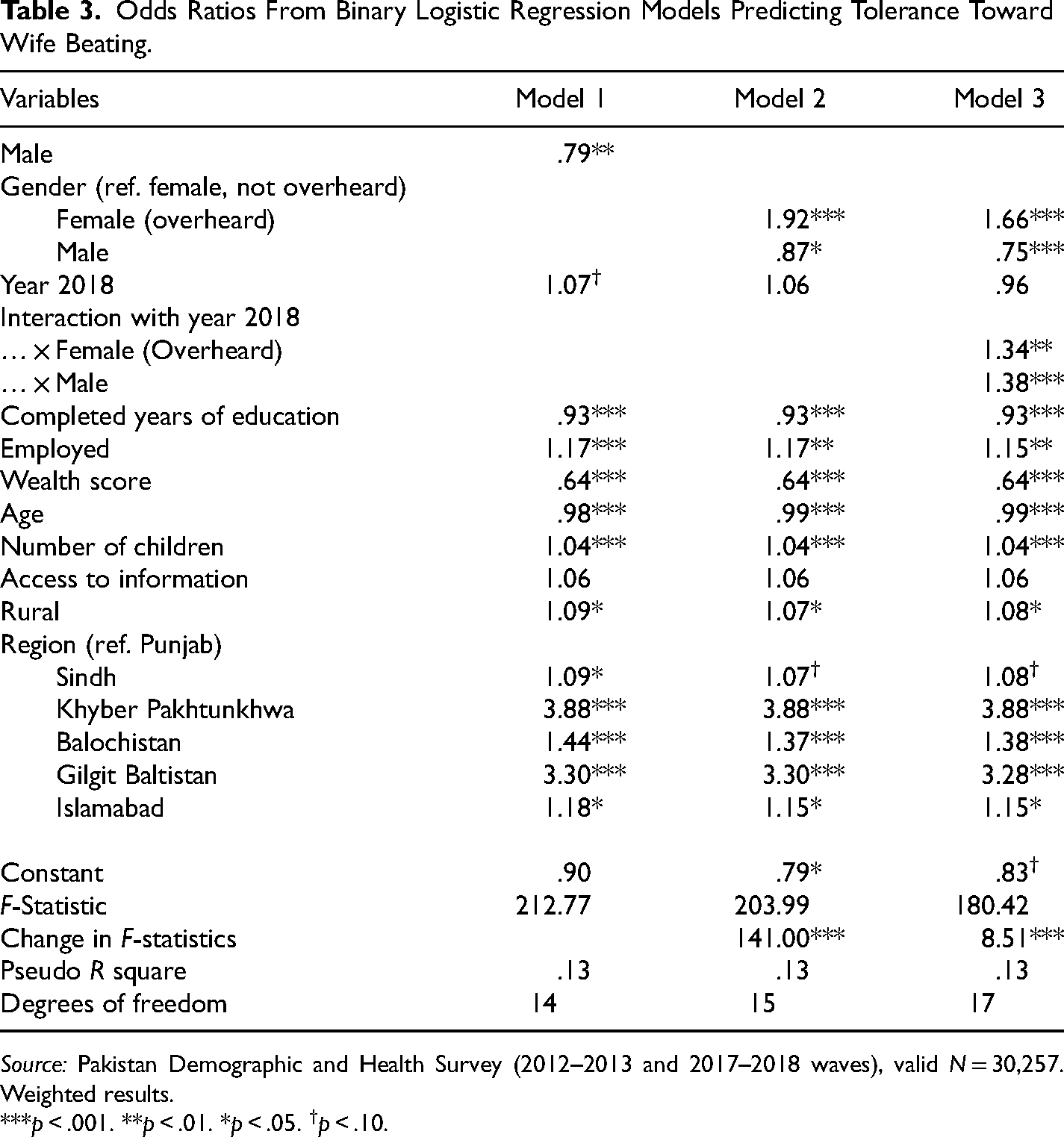
Table 3 presents the odds ratios from binary logistic regression models predicting tolerance toward wife beating. Model 1 shows the impact of gender on attitudes toward wife beating while controlling for other factors. Compared to women, men have 21% (1.00 - 0.79 = 0.21) lower odds of tolerance toward wife beating (p < .01). Model 1 shows a surprising gender divide with women being much more likely to support wife beating than men. One possible reason is the nature of surveillance of women in a patriarchal society. To address this, we take into account the presence of others during the interview. In model 2, women have been divided into two categories: (a) women for whom either no one was present or even if present was not listening to their answers at the time of the interview; and (b) women for whom some other family member (husband, child, another female member) was present and listening—women who were overheard (this information was not collected from the men's survey).
Odds Ratios From Binary Logistic Regression Models Predicting Tolerance Toward Wife Beating.
Source: Pakistan Demographic and Health Survey (2012–2013 and 2017–2018 waves), valid N = 30,257. Weighted results.
***p < .001. **p < .01. *p < .05. †p < .10.
Model 2 shows that, compared to women who were not overheard, men have 13% lower odds of being tolerant toward wife beating (p < .05), whereas, the women who were overheard have 92% higher odds of being tolerant toward wife beating than women who were not overheard (p < .001). It is important to note how in the first model, the gap between men and women was much larger (21%). Model 2 explains that a large portion of that gap is due to women who were overheard—they exhibit much more pro-wife beating attitudes than women who are not overheard and men. Once we separate the women who were overheard and women who were not, the gap between men's and women's attitudes diminishes to 13%. Also, a non-significant coefficient for year indicates that overall, there is no change in tolerance toward wife beating across these 5 years.
Model 3 adds interaction effects between gender and year to estimate whether the change over time has been similar for gender groups. The over-time trend, indeed, is different for men and women (and for women whose interviews were overheard). There is no change in tolerance toward wife beating for women who were not overheard (see the main effect for the year). For men, the odds of being tolerant toward wife beating have increased over time by 32% (0.96 × 1.38 = 1.32; p < .001). Women who were overheard saw a similar increase in tolerance toward wife beating from 2012 to 2018: their odds of being tolerant of wife beating have increased by 29% (0.96 × 1.34 = 1.29; p < .011).
Figure 1 shows the predicted probabilities of tolerance toward wife beating based on the interaction effect between gender and year in Model 3 of Table 3. We can see that women's tolerance of wife beating has remained the same over time, while it has increased for both men and women who were overheard during the interview. The increase for men could be explained by the ruling of the Chairman of the Council of Islamic Ideology. The increase for women who were overheard is similar—because they were overheard during the interview, they had to perform for the patriarchal values of the society and, thus, their overtime pattern aligns with that of the men. The overall level of tolerance toward wife beating is the highest among women who were overheard. Men had lower tolerance toward wife beating than women who were not overheard in 2012. But because men increased their tolerance over time and women did not, men's and women's levels of tolerance have converged in 2018 while women who were overheard still exhibit higher tolerance toward wife beating.
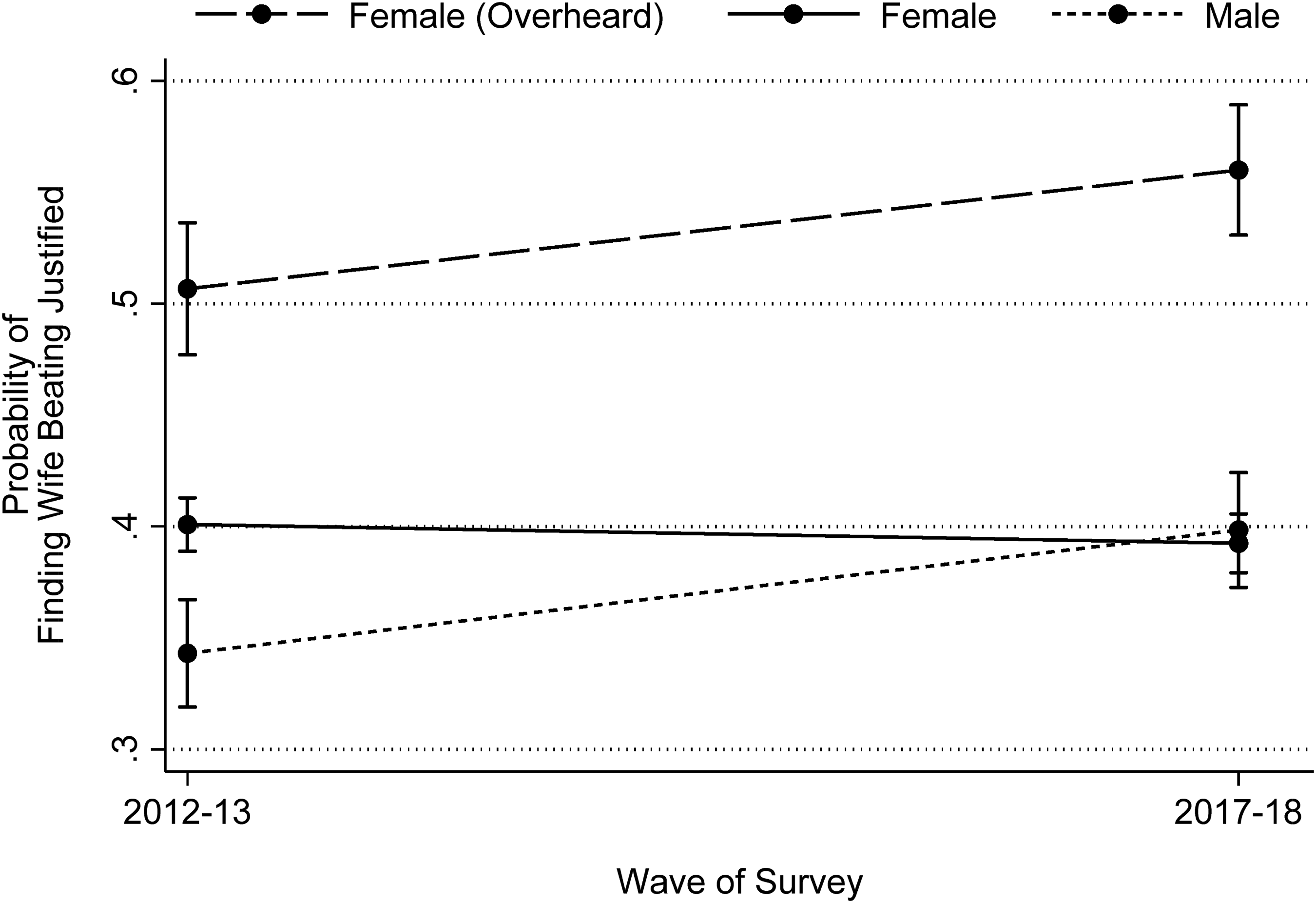
Predicted probabilities of tolerance toward wife beating based on model 3 in Table 3. Source: Pakistan Demographic and Health Survey (2012–2013 and 2017–2018 waves; valid N = 30,257).
Each additional year of education reduces the odds of tolerance toward wife beating by 7% (p < .001; Model 3 in Table 3). A person who is employed has 15% higher odds of being tolerant toward wife beating than a person who is not employed. This result is counterintuitive. Dividing the employed population by their occupation might reveal the pattern better, showing which occupation might have lower tolerance toward wife beating. However, due to a wide disparity in the employment patterns between men and women (97% of men as opposed to only 19% of women are employed) we cannot take occupation into account. A standard deviation increase in the wealth index score of the household decreases the odds of being tolerant toward wife beating by 36%.
Each additional year of age reduces the odds of tolerance toward wife beating by 1% (p < .001). Older people have lower odds of being tolerant toward wife beating than younger people. As part of the sensitivity analysis, we have estimated a similar regression analysis using age as a set of dummy variables to see whether the division of age into various categories may reveal a non-linear relationship. However, the results remained the same: as the person's age increased their level of tolerance toward wife beating decreased.
Each additional child increases the odds of tolerance toward wife beating by 4% (p < .001). These findings corroborate the results of previous studies (Tayyab et al., 2017). Access to information does not have any impact on increasing or reducing the tolerance toward wife beating when controlling for other factors. This may seem counterintuitive but one has to bear in mind that we are unable to measure what type of information respondents have access to (i.e., is this information that is supporting the patriarchal society or not).
As expected, those living in rural areas have 8% higher odds of tolerance toward wife beating, as compared to their counterparts residing in urban areas (p < .05). There is a wide variation of results regarding region. We use Punjab, the most populous and economically developed province, as the reference category. Punjab is the least tolerant toward wife beating, followed by Sindh (8% higher, p < .10), Islamabad (15% higher, p < .05), and Balochistan regions (38% higher odds of tolerance toward wife beating, p < .001). Khyber Pakhtunkhwa (KPK) and Gilgit Baltistan (GB) are relatively more conservative regions with higher levels of gender inequality, hence, it comes as no surprise that they have much higher odds of tolerance toward wife beating, amounting to 288% (p < .001) for KPK and 228% (p < .001) higher odds for GB.
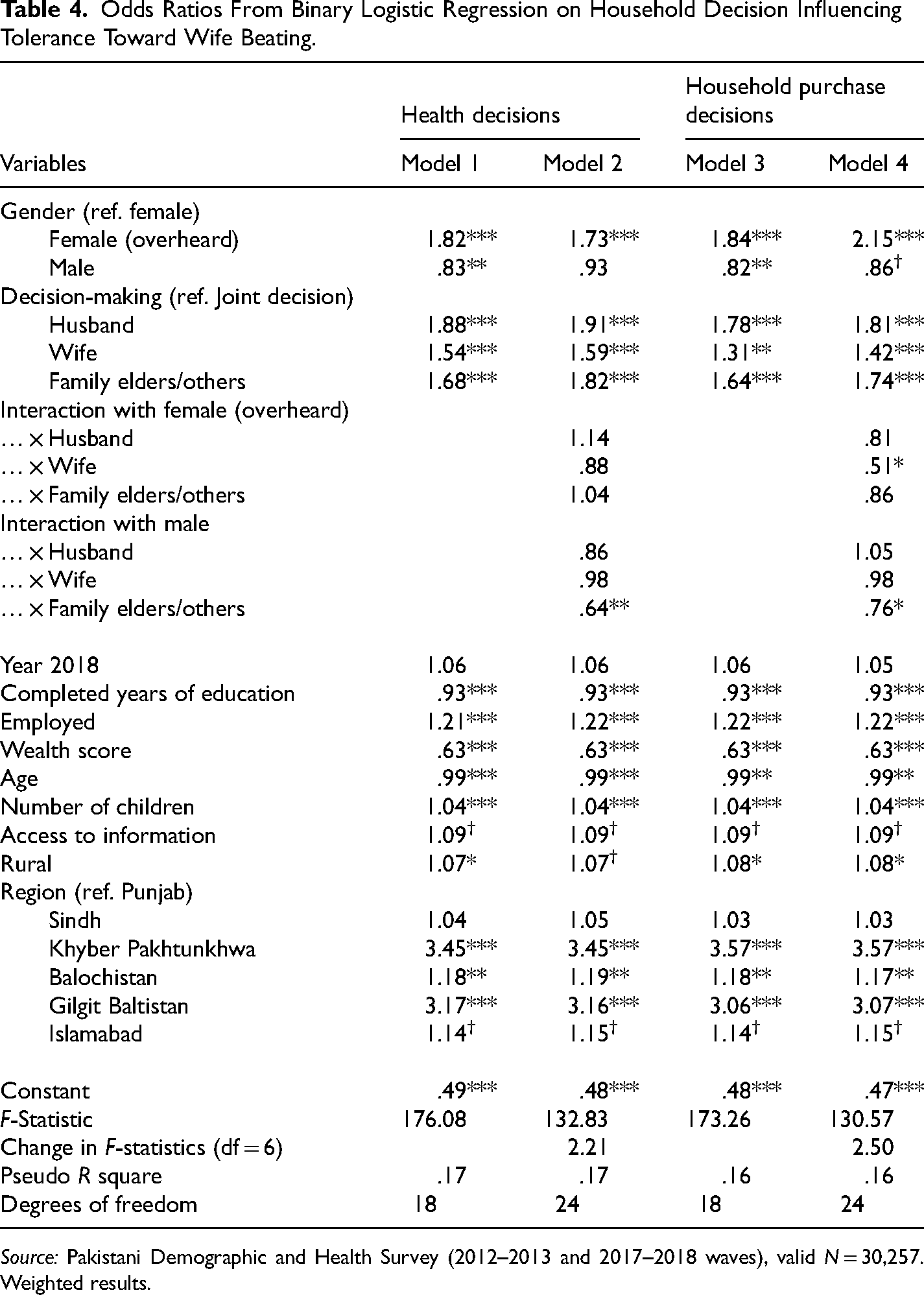
We hypothesized that the more autonomy a woman has in the household decision making, the less tolerance we should see toward wife beating. Table 4 tests this hypothesis. Models 1 and 2 estimate the effect of health decisions and models 3 and 4 focus on household purchase decisions. Clearly, who makes the decisions in the household matters a lot for one's tolerance toward wife beating. Both in the case of health and household purchase decisions, having the wife making the decisions yields lower tolerance toward wife beating than the husband-only making the decision (p < .005 for health decisions, p < .001 for household purchases). However, opposite to what we hypothesized, we see that joint decision-making as opposed to any other decision-making possibility, even wife-only making decisions, leads to the lowest levels of tolerance toward wife beating (see model 1 and model 3 in Table 4). The overall patterns are the same for health and household purchase decisions. Compared to a joint decision, the wife making the health and household purchase decision yields 54% and 31% higher odds of tolerance toward wife beating, respectively. This is followed by family elders making the decision (68% and 64% higher odds) and husband-only making the decisions (88% and 78% higher odds of tolerance than joint decision).
Odds Ratios From Binary Logistic Regression on Household Decision Influencing Tolerance Toward Wife Beating.
Source: Pakistani Demographic and Health Survey (2012–2013 and 2017–2018 waves), valid N = 30,257. Weighted results.
Using interaction terms with gender, models 2 and 4 test whether the decision-making pattern in the household affects men's and women's attitudes toward wife beating in a similar way. For all gender groups (men, women, and women who were overheard) the joint decision-making both in terms of health and household purchase decisions leads to the lowest tolerance toward wife beating. The only differences in the effect of who makes decisions is between women and men for the family elders making decisions, and wife-only making household purchase decisions for women who were and were not overheard.
For women, joint decision making in health decisions reduces the tolerance toward wife beating the most, followed by wife-only decision making (59% higher odds of tolerance toward wife beating), family elders/others (82% higher odds), and finally the husband-only decision making (91% higher odds of tolerance toward wife beating).
For men, the pattern is similar, except for family elders making decisions is less detrimental than for women. While the odds of women's tolerance were increased by 82% when family elders made health-related decisions, compared to joint decision making between spouses, men's odds of tolerance are increased only by 16% (1.82 × 0.64 = 1.16; p < .001). Similarly, while women's odds of tolerance were increased by 74% when family elders made household purchase decisions, men's odds of tolerance are increased only by 32% (1.74 × 0.76 = 1.32; p < .001). This indicates that households where family elders make these decisions are likely more patriarchal households, where women are accustomed to supporting patriarchy.
The only difference between women overheard as compared to those not overheard is in the effect of wives only making household purchase decisions. Wives only making household purchase decisions for women who were overheard leads to lower odds of tolerance than joint decision making by 28% (1.42 × 0.51 = 0.72), however, this effect is no longer significant. Only 216 women overheard reported being the only decision-makers regarding large household purchases compared to 1330 women not overheard thus making this result less reliable.
Supplemental Analyses
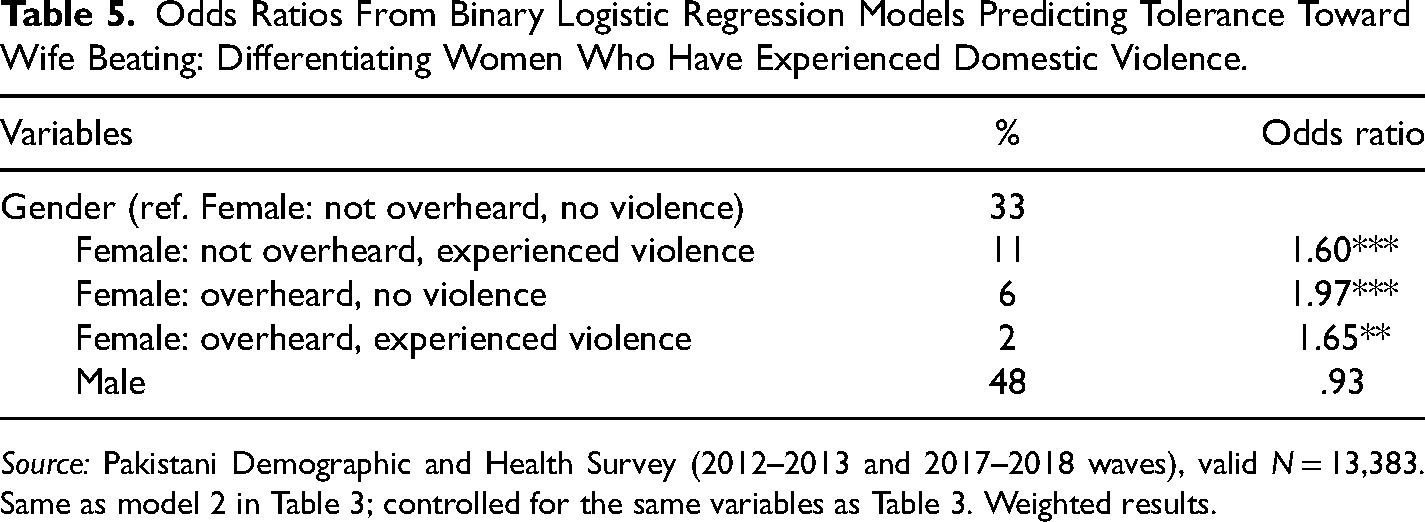
Our analysis thus far has not considered whether a woman has actually experienced IPV. Unfortunately, we are unable to include such a measure in our main analysis as the IPV questions in PDHS are asked only from a subset of 7003 women (the whole sample includes almost 26,000 women). The Domestic Violence Module includes 10 questions about physical and sexual violence asking whether the woman has been ever: (a) pushed, shook or had something thrown at them; (b) slapped; (c) punched with fist or hit by something harmful; (d) kicked or dragged; (e) strangled or burnt; (f) threatened with knife/gun or other weapon; (g) had arm twisted or hair pulled; (h) physically forced into unwanted sex; or (i) into unwanted sexual acts; or (j) to perform sexual acts respondent didn't want to by husband/partner. We created a dichotomous measure of ever experiencing any physical or sexual violence by a husband (including a previous husband). About one-fourth of women report having experienced IPV (27%; 1863 women). To understand how the experience of IPV affects attitudes toward wife beating we included the experience of IPV in our gender measure creating five categories (see Table 5): (a) women who were not overheard and have not experienced IPV (33%); (b) women who were not overheard and have experienced violence (11%); (c) women who were overheard and had not experienced IPV (6%); (d) women who were overheard and had experienced IPV (2%); and (e) men (48%). We replicated model 2 in Table 3 using these new gender categories (see Table 5). Note, however, that the sample size has considerably reduced in this supplemental analysis. Our main analysis used the valid sample of 30,257; while this analysis only includes 13,383 respondents because those women who were not asked the questions about domestic violence are not included.
Odds Ratios From Binary Logistic Regression Models Predicting Tolerance Toward Wife Beating: Differentiating Women Who Have Experienced Domestic Violence.
Source: Pakistani Demographic and Health Survey (2012–2013 and 2017–2018 waves), valid N = 13,383. Same as model 2 in Table 3; controlled for the same variables as Table 3. Weighted results.
Table 5 indicates that experiencing violence, similar to being overheard, increases one's support for wife beating. Among women who were not overheard, those who had experienced IPV have 60% higher odds of finding wife beating justified than those who have not experienced IPV. There is no statistical difference between the other female categories—that is, they all differ from our base category in a similar manner. It is interesting though that, once we take into account both whether a woman was overheard and whether she has experienced IPV, those who were not overheard and have not experienced IPV show similar support to wife beating as men.
Discussion
Our results reveal several interesting patterns. If women are not separated into two categories—the ones who are overheard and those who are not—then the gendered tolerance levels toward wife beating can be misleading. It is only after we divide women into these two categories, we see that women's (not overheard) tolerance toward wife beating has remained the same over time; while both men's tolerance and tolerance of women who are overheard increased over time. It is important to note that there is a remarkable difference in the tolerance toward wife beating between women who were overheard and those who were not. The women who were overheard showed much higher level of tolerance toward wife beating than women who were not overheard and also considerably higher tolerance than men. We conclude that in patriarchal and conservative societies, it is important to consider the surrounding situation, especially if the interview being conducted relates to sensitive issues as it may have an impact on the data collected. Kazenin and Kozlov (2020) conceptualize this phenomenon as “community bias” and contend that such community bias from third party presence in patriarchal societies affects primarily women and not men. The presence of a third party creates social desirability to express more commonly valued views (Malik & Siddiqui, 2023). Had we not been able to separate women into overheard and not overheard categories, we would have seen an increase in women's tolerance toward wife beating over time which would not have been the true depiction of women's views. Our supplemental analysis showed that having been a victim of IPV acts similarly to being overheard—it increased women's support for wife beating. Thus, both being overheard and being a victim of IPV act as a mechanism of social pressure from the patriarchal system to support violence against women. And once we are able to separate out women who were neither overheard nor victims of IPV, their attitudes toward wife beating overall are similar to men's attitudes.
Additionally, increased education, higher socio-economic status, and urban residence are negatively associated with tolerance toward wife beating. This finding has been supported by previous studies as well (Fikree et al., 2005; Lassi et al., 2021; Saud et al., 2021). The negative correlation between education and acceptability toward wife beating means that an investment in education, especially women's education, is likely to reduce the number of IPV cases (Akram, 2021; Fikree et al., 2005; Nadeem & Malik, 2021). Similarly, respondents belonging to households with higher socio-economic status and residing in urban areas had lower acceptability toward wife beating than their counterparts, again echoing the findings of previous research studies (Lassi et al., 2021; Nadeem & Malik, 2021). Moreover, contrary to our hypothesis, we find that instead of wife-only decision making, joint decision making is optimal for decreasing the tolerance toward wife beating amongst both men and women. Some previous studies did not consider joint decision-making, and therefore, are only able to test whether women participating in decision-making is better than not participating (Alam et al., 2021; Islam et al., 2015). Underwood et al. (2023), when focusing on women in six different countries, found that shared power reduces gender-based violence. Hindin (2003) in a study in the Philippines found a similar result, but explained it by joint decision-making being normative in Philippines. However, joint decision-making is not yet normative in Pakistan (in our sample about 40% of the respondents reported joint decision-making, about the same proportion as those who reported husband as the sole decision-maker). In households where women are solely responsible for the decision-making regarding major household purchases and health-related matters the average tolerance toward wife beating is higher than in households where both husband and wife are equally involved. This shows that cooperation between spouses on routine matters may have an overall positive impact on their relationship and respect toward each other.
We show that elders only making decisions affect men's and women's attitudes toward wife beating differently: it increases women's tolerance toward wife beating more than men's. The presence of husband's parents (most common family elders in Pakistan) acts similarly to the presence of household members at the interview—it places an additional pressure from patriarchal society on women, urging them to show more support for traditionally patriarchal values.
Limitations
We would like to acknowledge a few data limitations that might have influenced the overall results of the study. To begin with, two regions (Federally Administered Tribal Area and Azad Jammu and Kashmir) have been removed from the sample since data was not collected from these regions in 2012 to 2013. These regions are traditionally more conservative and their inclusion might change the results further in favor of increasing support for wife beating. Additionally, because the primary focus of PDHS is to collect reproductive health data the target audience in this data was ever-married women. Therefore, the current sample had an over-representation of women and an underrepresentation of men. Furthermore, we do not have data on whether the men were being overheard at the time of the interview. Though it is likely that being overheard does not affect men's reports about their attitudes as much as it does for women since Pakistan is a patriarchal and not matriarchal society.
Lastly, as mentioned, the sample consists of ever-married respondents, however, the results may change if unmarried people in all age groups were also included. Those who marry early are likely to have different socio-economic characteristics and belief systems compared to men and especially women who marry at a later age. This limitation may have also explained why in our sample the younger women show more support for wife beating than older women as women who marry very young tend to be more traditional.
Conclusion
This study is unique in its approach in being the first study to analyze the perceptions and attitudes of tolerance toward wife beating for both men and women in Pakistan over time. Pakistan still has a lot of societal support for wife beating as almost half of our sample finds it justifiable under some circumstances. However, any survey data about this type of attitude needs to be interpreted with caution because the interview situation itself can have a large influence on women's responses in such a patriarchal society. Our study shows that the strong patriarchal norms of the family and society as a whole may dictate the answers of the women living in such households and they might not be the reflection of the real attitudes of these women.
Nonetheless, the high levels of acceptability toward wife beating among both men and women are alarming. The government and policymakers need to take effective measures that would reverse these trends. The implementation of the Punjab Women Bill may serve as a good starting point. However, there is a dire need to change the overall perception toward wife beating. Our results suggest that discussions in society, especially among revered religious leaders, do affect the attitudes of this highly religious patriarchal society. This is evidenced by the increase in tolerance toward wife beating over time for men and women overheard at the time of general movement toward higher recognition of gender equality. The counter-proposal of a bill that allows light wife beating has normalized wife beating even further.
Media can play an important role in changing the trends in these types of attitudes. Pakistani dramas have a wide audience of both men and women, rural as well as urban viewers, and people from all sections of socio-economic status. Instead of showing women as victims of IPV, portraying the female protagonist as a strong woman who knows her rights and stands up for herself may help change the overall narrative toward wife beating. Furthermore, our results suggest that mutual respect—joint decision-making between men and women—lead to the lowest tolerance toward wife beating. Hence, media depictions of family units where women are equal partners to men might yield the best results in lowering the tolerance toward wife beating.
Footnotes
Declaration of Conflicting Interests
The authors declared no potential conflicts of interest with respect to the research, authorship, and/or publication of this article.
Funding
The authors received no financial support for the research, authorship, and/or publication of this article.
