




Abstract
Since the 1990s, the international humanitarian system has developed approaches, tools, and standards for addressing gender-based violence (GBV) in emergencies premised on the survivor-centered approach (SCA). Utilizing critical discourse analysis, we explore how articulation of SCA within humanitarian discourse aligns with its stated intent to return control to survivors. The analysis reveals that humanitarian system power dynamics distort the application of SCA, leaving humanitarian service providers in charge of assessing the best course of action or severely limiting survivors’ choices. We propose a survivor led approach as more aligned with the feminist and transformative goals of humanitarian action against GBV.
Introduction
Gender-based violence (GBV) including sexual violence and intimate partner violence (IPV), is a feature of conflicts and other crises around the world. While anyone can experience GBV, the vast majority of victims are women and girls. GBV in emergencies can be perpetrated by intimate partners, combatants, community members, humanitarian actors, and authority figures. It is part of a continuum of violence that occurs before, during, and after crises. Due to barriers to reporting, data on the prevalence of GBV in emergencies are likely underestimated (Palermo et al., 2014). Systematic reviews of the evidence suggest that some 1 in 5 women report experiencing sexual violence during humanitarian crises (Vu et al., 2014), and that intimate partner violence is the most commonly occurring form of GBV in emergencies across the globe, significantly higher than occurrences of wartime rape or GBV committed by non-intimate partners (Stark and Ager, 2011).
Women and girls are at high risk of sexual violence while fleeing conflict, and even in places of refuge such as refugee camps. Displacement is currently at a global all-time high (UNHCR, 2022), and numbers are likely to keep rising due to conflict and the impacts of climate change. Displaced women and girls face higher risks of IPV and sexual violence, a risk that persists in conflict-affected settings (Kelly et al., 2021). GBV affects physical and mental health as well as the social well-being of victims (World Health Organization, 2014). A survivor of sexual violence may also face stigma and rejection from her community and family.
Since the 1990s, the international humanitarian system has developed approaches, tools, standards, and mechanisms for the prevention of and response to GBV in emergencies, which are premised on what is termed the “survivor-centered approach” (SCA). SCA is rooted in Western feminist theory and practice which establish survivors of GBV as experts on the violence they have experienced and their own journey towards safety, healing, and recovery. Since its introduction as an approach within the humanitarian system, SCA has been taken up by an increasing number and range of humanitarian actors across the GBV, protection, and, more recently, sexual exploitation, abuse, and harassment (SEAH) sectors. In this article, we utilize critical discourse analysis to analyze the ways in which SCA has been translated into humanitarian discourse and practice through guidance documents and training materials. We argue that the current state of implementation of SCA in humanitarian GBV programming falls short of its stated intentions to place survivors in control. Rather, through its reliance on a limiting multisectoral model, the prioritization of externally defined notions of safety, and the overemphasizing of individual solutions to GBV, it reinforces the paternalistic and colonial underpinnings of humanitarian protection.
Our intention is not to criticize or undermine the life-saving work performed by humanitarian GBV practitioners nor to chastise the GBV experts who write the guidance documents we analyze here. Their actions, like our thinking, are constrained by the discursive and material realities of a humanitarian system that operates within imperialist, capitalist, sexist, and white supremacist global networks of power (Duffield and Hewitt, 2009; Fassin, 2010; Heron, 2007; Kothari, 2006; Wilson, 2012). Our contribution situates itself in the ongoing conversations that GBV humanitarian workers and actors are having about feminist approaches to GBV response in emergencies, as well as the need to decolonize and localize humanitarian action. By revealing the gap between the stated intentions and the current application of SCA in humanitarian response, we hope to generate further discussion and, crucially, action toward a survivor-led approach and the feminist and transformative goals of humanitarian action against GBV.
Methodology, Sampling, and Methods
A key concern of this study is how the articulation of the survivor-centered approach interacts with pre-existing power structures to attract and shift attention to issues, influence resource allocation, and dictate policy solutions (Arnfred, 2014). To explore such interactions, we utilize critical discourse analysis (CDA), a methodology employed effectively in previous research to interrogate the discourse on gender, GBV, sexual violence, and international relations (e.g., Baaz and Stern, 2013; Milliken, 1999; Shepherd, 2010).
Discourse, defined as “the imbrication of speaking and writing in the exercise, reproduction and negotiation of power relations” (Fairclough, 1995, p. 94), does not simply reflect the order of things; rather, it is a situated meaning specific to a particular time and place and susceptible to challenge and transformation (Gee, 2014). Discourse is a site both of power and of potential resistance, an arena where conflict between the dominant and the dominated can occur, but also where challenges to oppressive systems can be subsumed and appropriated in order to preserve current structures (Foucault, 1979). This understanding of discourse underpins our efforts to explore how SCA is understood and operationalized within the humanitarian GBV sector.
By analyzing guidance, policy, and reference documents used by GBV practitioners, this study traces the use and meanings of SCA and identifies the “grids of intelligibility” that these texts construct to shape how SCA is discussed and subsequently turned into practice (Fairclough, 1995; Milliken, 1999; Naples, 2003). We explore how the language and intertextual connections used for SCA reveal the shift in perspective from the survivor as the centered agent to the service provider as the main actor in the interaction. Thus, CDA as a method allows us to trace the movements of power within the humanitarian GBV system and how survivors are imagined and “placed” within this system.
We selected documents based on our professional knowledge of the most common guidelines and reference documents used by humanitarian GBV practitioners, alongside a search of key databases and a web search. Figure 1 details the sources and combinations of search terms used. The aim of the search was to identify additional humanitarian guidance on SCA and identify any descriptions or evaluations of its implementation in humanitarian settings.
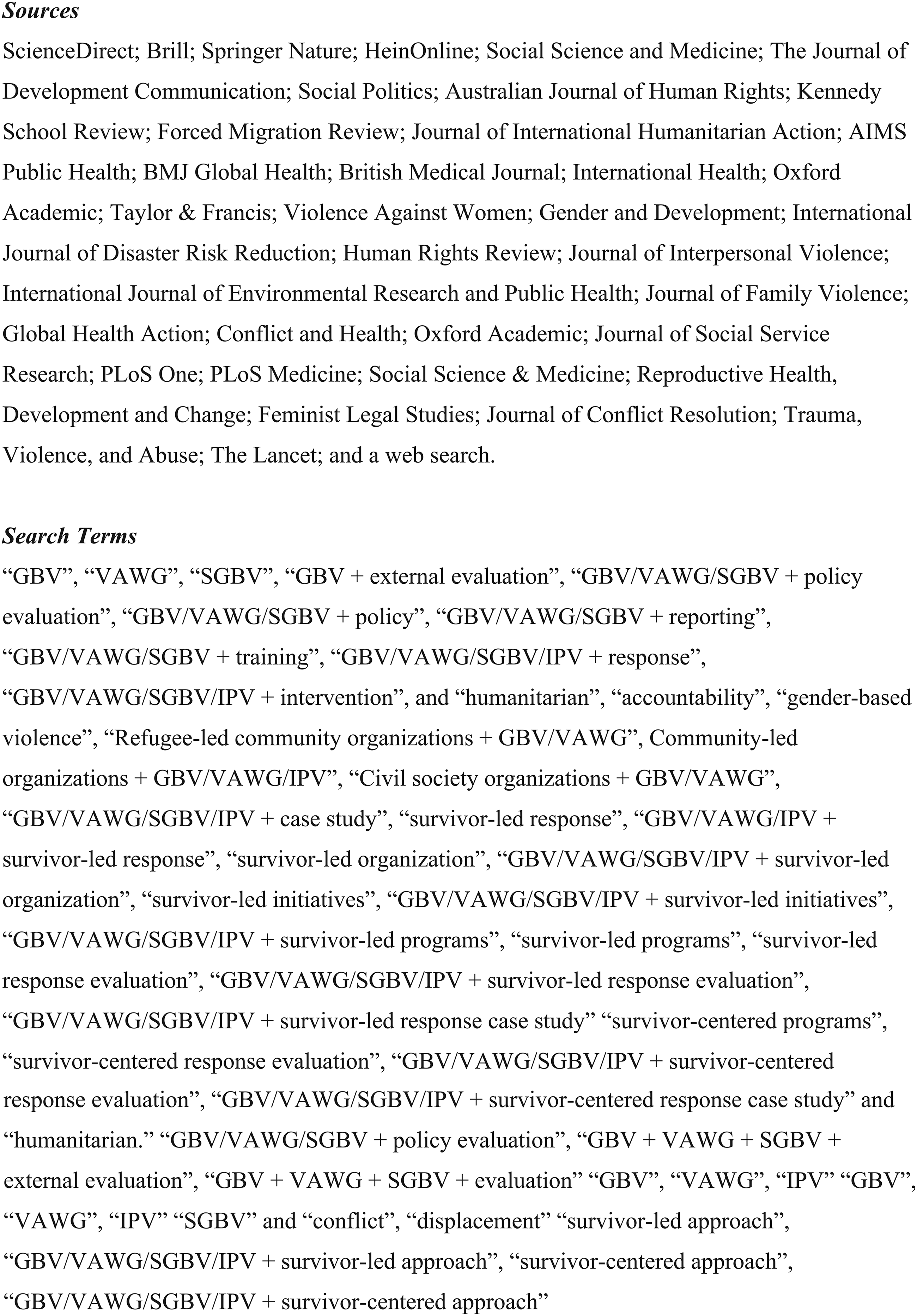
Literature search details.
These searches were restricted to English language articles published between 2010–2022, yielding 27 peer-reviewed articles that went beyond a mention of SCA and none that described its implementation in detail or evaluated its outcomes. A further 68 documents, including advocacy and research reports, organizational policies, programmatic guidelines, and training materials, were added based on the authors’ professional knowledge of existing resources. The latter were selected due to their relevance in tracing the emergence of and current discourse about SCA in the humanitarian system. Our data gathering, analysis, and reporting are aligned with the Standards for Reporting Qualitative Research advanced by O’Brien et al. (2014).
Ethical Considerations
CDA (particularly feminist CDA) recognizes the inevitable positioning of the researcher within discourse, so any attempt to interrogate discourse is regarded as a contribution to its replication or transformation (Shepherd, 2010). Two of the authors (IM and CR) have extensive experience working as humanitarian practitioners in the realm of GBV prevention and response. IM has worked on GBV in humanitarian settings for 15 years, first as an employee of UN agencies and international NGOs and more recently as an independent consultant and researcher. In these capacities, she has designed, managed, and advised programs supporting survivors of GBV and seeking to prevent violence and sexual exploitation and abuse (SEA) across East and Central Africa, the Middle East, and Eastern Europe. She has also conducted research on GBV trends and intersectional feminist responses to violence. CR has worked for over 20 years on GBV in humanitarian settings with the UN and NGOs, in academia, and as a consultant. She has conducted research on the nature and prevalence of GBV in emergencies, developed international guidance, provided technical and capacity support to country-level programs, conducted program evaluations, and worked on strategic planning and accountability processes for international consortia focused on GBV in humanitarian settings. JM has 3 years of experience supporting GBV research in humanitarian and development contexts for international NGOs and in academia. She has conducted reviews of GBV programming and developed gap analyses, conducted data collection, vetting, and cleaning for GBV in emergencies research, and conducted desk research to support integrating GBV response and prevention activities into healthcare programs.
As intersectional feminist humanitarian practitioners, we have consciously and unconsciously contributed to the formation, dissemination, and transformation of humanitarian discourses on GBV including the survivor-centered approach over the last two decades. Over time, we have engaged in, perpetuated, and critiqued the practices that we are analyzing in this article through designing and delivering training, contributing to global guidance documents, implementing services, and conducting research on GBV. We approach this study as a more deliberate and critical extension of these processes, recognizing that our analysis has been influenced by our positionalities and experiences as GBV humanitarian practitioners and researchers (Lykke, 2010; McCorkel and Myers, 2003). We consider this a strength, rather than a limitation, of the study and of feminist research methods (Lykke, 2010). This study did not involve human subjects and did not require IRB review.
Context and Background
The Survivor-Centered Approach
The survivor-centered approach (SCA) originated in work on domestic violence (DV) in the USA and the UK in the 1970s, which was rooted in the broader feminist liberation struggles of that period and considered violence against women to be a political and social issue, rather than a private one (Wies, 2008). In addition to providing immediate safety and support for women fleeing abuse, the movement focused on disrupting patriarchal norms and creating new social structures based on equality and women's self-determination. From this emerged the core belief in survivors as the “best experts” on their own experience, safety, and needs, which still animates most GBV service providers today (Davies and Lyon, 2014). The respect for survivors’ experiences also extended to considering survivors of violence as best placed to support other women in similar situations, with some shelters originally having quotas and policies to ensure that their workforce would include survivors (MacFarquhar, 2019; Wies, 2008).
Although definitions vary, there is consensus that SCA prioritizes the needs and desires of the survivor rather than of those involved in the management of the survivor's case (Gardsbane et al., 2021; GBVIMS Steering Committee, 2017; UNFPA, 2019). Grounded in respect and autonomy, SCA recognizes that the survivor is best positioned to consider their own situation and make their own decisions based on their unique circumstances, wishes, and resources. SCA places the survivor in a position to be in control and make decisions that follow the disclosure of violence to the extent possible (Gardsbane et al., 2021). While its origins lie in service provision for DV, SCA has since also been applied to advocacy, nursing practice (Office of Justice Programs, 2010), protection from sexual exploitation and abuse (BOND, 2021; Heaven Taylor and Brostrom, 2023), teaching (Bedera, 2021), and justice processes (Soueid et al., 2018).
The first mention of the survivor-centered approach for humanitarian settings is in a humanitarian programmatic guide published by UNHCR in 2001, which documented how GBV programs were implemented in Liberia. It describes a survivor-centered approach as one that “begin[s] with the experiences of the survivor. These experiences determine the need, the needs determine the services required, the services determine the sectors, the structures and the systems to be involved, strengthened and established” (UNHCR, 2001, p. 4).
The humanitarian survivor-centered approach, in turn, emerged from the elaboration of UNHCR's multisectoral approach to responses to violence against women. The multisectoral approach developed starting in the mid-1990s (UNHCR, 1999, 1995) focused on coordination between relevant sectors. Graphic representations of the multisectoral model place the survivor and community at the center to highlight their importance, with each survivor being able to chart their own route towards safety and healing by choosing the forms of support they want or do not want (UN Women, 2013; UNHCR, 2001, p. 3). Around the survivor, four response sectors are consistently highlighted: health services, safety, and security (to include police protection and safe shelters, though in reality the latter are much rarer), legal and justice interventions to hold perpetrators accountable, and psychosocial support services. At times, psychosocial support includes social reintegration and economic livelihood activities in the image or in a footnote (UN Women, 2013).
The multisectoral approach remains the dominant one in humanitarian responses to GBV and is embedded in key humanitarian GBV guidance, including the 2019 Inter-Agency Minimum Standards for Gender-Based Violence in Emergencies Programming (Minimum Standards). The Minimum Standards guide reiterates that the multisectoral approach includes “health care, psychosocial services, safety and security mechanisms, and legal assistance” (UNFPA, 2019, p. 33).
Alongside the multisectoral approach, survivor-centeredness is consistently present across GBV guidance, advocacy documents, and even high-level commitments as a fundamental principle guiding humanitarian GBV actors. Despite lacking an agreed-upon definition, humanitarian documents are surprisingly consistent in their interpretation and presentation of SCA, as we elaborate further in our findings. In light of such consistency and pervasiveness, it is remarkable that, as noted above, there is a dearth of studies focused on SCA in humanitarian settings. While a number of researchers have documented the needs and desires of GBV survivors and advocated for the adoption of SCA in a range of settings and situations (Di Eugenio and Baines, 2021; Murphy et al., 2018; Wild et al., 2022), our extensive search found no peer-reviewed studies that described how survivor-centered principles are implemented in practice during emergencies or evaluated their effectiveness. Lilleston et al. (2018), for example, used SCA as a quality criterion in the evaluation of GBV mobile services in Lebanon, but they did not describe the mechanisms through which the approach is implemented beyond hiring open-minded, nonjudgmental staff and stressing informed consent. It therefore appears as if the benefits of SCA have been considered self-evident when contrasted with previous approaches to dealing with GBV, thus obviating the need to critically assess its uses and effectiveness (Clark, 2021).
Limited Progress in the Inclusion of Local Actors and Survivors From the Humanitarian System
The analysis of SCA presented in this study is situated within ongoing efforts to shift resources and power from international donors and humanitarian actors, predominantly based in Europe and the USA, toward organizations and activists originating from and working within crisis-affected communities (Bennett and Foley, 2016; Frennesson et al., 2022; Pincock et al., 2021; Robillard et al., 2021). Within the humanitarian GBV sector, coordination with local actors is a crucial element of promoting sustainability, accountability, and survivors’ participation and of developing context-specific and culturally relevant responses to violence (Raftery et al., 2022). During the COVID-19 pandemic, women's rights organizations rapidly adapted and expanded the services available for survivors of GBV and the wider community, responding to emerging issues such as early pregnancies and the increased need for mental health support at a time when international organizations struggled to maintain a presence on the ground (Njeri and Daigle, 2022). One study in Myanmar found that local, women-led organizations increased the use of available services, improved mental health outlooks, and better-prepared women to navigate society (Oo and Davies, 2021).
Despite the known and recognized benefits of local organizations leading and dictating responses based on their contextual needs and the stated humanitarian commitment to localization, these actors are chronically overlooked in humanitarian responses (Njeri and Daigle, 2022; Robillard et al., 2021). In a 2019 GBV localization mapping study, local actors unanimously responded that access to funding and opportunity is unfair and opaque and that goals are developed from the top down and generally inflexible. The same study found that only 3–4% of GBV funding goes to local actors and that UN agencies tend to choose one or two local partners to work with and stick with them exclusively for years (Bennett, 2019). As the primary humanitarian funding sources, international donors and aid institutions are able to control and distribute resources in ways not always aligned with local actors and survivors’ priorities (Barbelet, 2019; Njeri and Daigle, 2022). While local actors are more concerned with direct service delivery to survivors, funders focus on the institutional capacity of a local partner to respond to their donor and organizational requirements. This difference in approaches contributes to the concentration of funding into larger local partners that already have the capacity and experience to meet strict and demanding international requirements and INGOS and partners that can adhere to achieving internationally agreed-upon goals (Barbelet, 2019). In addition to maintaining focus on internationally set priorities, international funding for larger local organizations reinforces systems of hierarchy and power at the local level and marginalizes organizations that may be smaller, community-based, and more aligned with the priorities of survivors.
Local organizations surveyed in 2019 noted that the international community is not making progress in shifting power, addressing imbalances, or allowing community-based actors to build their capacities and funding access (Goldberg, 2015). This survey also found that it is difficult for local organizations to operate based on international strategies when they are not included in high-level decision-making and communications, as expatriate staff of international organizations have high turnover rates. An international system where power is consolidated among a relatively small number of actors naturally lends itself to standardization, which survivors and implementers have indicated does not serve them best (Haddad and BouChabke, 2022). National and local organizations feel excluded and unable to do their jobs effectively in humanitarian contexts with international system responses. In Lebanon, local organizations reported that when collaborating with the UN, they lost information, resources were misallocated, and specific contextual factors that applied to Lebanese aid recipients and providers were not considered in program development (Haddad and BouChabke, 2022).
Even efforts to be more inclusive lack clarity. For example, UNHCR's approach to preventing, mitigating, and responding to GBV includes a focus on strengthening national systems to address GBV. This includes a strong emphasis on the importance of partnerships with local civil society and community groups, refugee, and internally displaced people-led and women's groups as well as local and national women-led and women-focused organizations (UNHCR, 2020). There is, however, no specific guidance on how to engage with these organizations and how to shift operating procedures to allow them into leadership roles. The guidance also overlooks the diversity and complexity of local civil society and women's movements, which are in themselves sites of power struggle and potential abuse and might, for instance, prioritize elite women's agendas over marginalized survivors’ needs.
The power structures inherent to the humanitarian system, largely facilitated through funding control and exclusion of local objectives and ideas, limit the level of participation that local partners, including survivors, are able to contribute to their respective GBV response landscapes.
Findings
In our analysis and interrogation of SCA, we draw from humanitarian guidance and discourse and our own experience of working in the humanitarian GBV sector, as described in the Ethical Considerations section above. We reflect on how the articulation of SCA through standardized but disconnected guiding principles results in some core principles being prioritized over others—effectively negating survivors’ self-determination. We consider how the strict adoption of the multisectoral approach to GBV might limit survivors’ choices and result in service-driven rather than survivor-driven support. Finally, we argue that the limited framing and implementation of SCA within humanitarian GBV response might reinforce individualistic understandings of GBV as disconnected from social forces and deny survivors the opportunity to engage in social and political work to eradicate violence in their communities.
Some Principles Are More Guiding Than Others
The majority of humanitarian GBV guidance documents explain SCA by resorting to the four GBV guiding principles (IASC, 2015; Martin and Rocca, 2021; O'Connor, 2022). Each principle is supposed to have equal weight with none being prioritized over the other. During training and orientation sessions, GBV caseworkers are urged to “(1) ensure the safety of survivors, including preventing and mitigating further violence; (2) protect the confidentiality of survivors, including their right for information about them to be shared only with their informed consent and their right to choose whether and to whom to tell their experiences; (3) demonstrate respect for survivors’ needs and wishes and their right to make their own choices, including those that service providers may find hard to understand or disagree with; and (4) practice nondiscrimination, ensuring that survivors, in all their diversity, are able to access and receive appropriate services and meaningful support” (Gardsbane et al., 2021, pp. 2–3). On paper, these principles underpin SCA's focus on the right of survivors to make their own choices and to be supported regardless of a service provider's opinion.
As SCA is broken down into four separate principles, hierarchies begin to appear, with safety often prioritized over self-determination, confidentiality, and nondiscrimination. For instance, training materials adapted from global guidelines forefront safety as “the number one priority for all actors” (UNFPA, International Rescue Committee 2020, p. 18), ahead of confidentiality, respect, and nondiscrimination. Further, when the notion of safety is delinked from that of self-determination, it becomes a factor that can be assessed objectively by a service provider using standardized tools, such as the IPV Risk Assessment tool included in the Interagency GBV Case Management Guidelines (p. 100). When this happens, the service provider, not the survivor, is in control.
While most GBV workers would refrain from taking any action a survivor has explicitly rejected, it is not uncommon for them to refuse to support a survivor in pursuing avenues they consider to be inappropriate or potentially harmful. For example, when GBV survivors across different humanitarian contexts ask caseworkers to intercede with their abusive partners or unsupportive family members or to support them through community-level, the so-called informal justice or mediation processes, they are often denied by GBV caseworkers. These refusals are supported by best practice guidance, such as the Minimum Standards which state, under Standard 6–Case Management: “Caseworkers should never mediate between a survivor and a perpetrator, even if a survivor requests this type of intervention, because meditation [sic] is unlikely to stop violence in the long term, and has the potential to escalate violence and cause more harm to the survivor” (UNFPA, 2019, p. 47).
In this statement, the principle of safety is explicitly prioritized over that of respect, as it stipulates a generalized interdiction from engaging in mediation regardless of survivors’ demands. While this recommendation is rooted in evidence of the risks involved in mediation processes for women and girls affected by intimate partner violence (Dunnigan, 2003; Thomas et al., 2011), it also undermines the foundational idea of SCA that “the survivor knows best,” instead claiming superior expertise based on a decontextualized risk assessment which, through tools like the GBV Minimum Standards, is applied universally.
We acknowledge that caseworkers need to consider exposure to violence and other risks when considering survivor requests, but we want to encourage GBV practitioners to consider whether they can confidently claim to be adopting SCA when they make decisions for survivors in the name of the survivor's safety. We suggest that stated concerns about a survivor's safety might be masking an underlying or implicit belief that survivors are too vulnerable, affected by trauma, or confused to be able to make their own choices or assess their own risk levels. We note that this belief might be mediated by differences in the survivor's and caseworker's educational backgrounds, race or ethnicity, disability status, displacement status, and other factors.
Who Is Centered?
Reframing a survivor's self-determination in respect of their wishes shifts the focus from the survivor as a decision-maker to the service provider as option determiner. As an example, a presentation explaining the survivor-centered approach states: “Survivor-centered approach […] requires the consideration of the multiple needs of survivors, the various risks and vulnerabilities, the impact of decisions and actions taken, and ensures services are tailored to the unique requirements of each woman and girl. Ultimately, services should prioritize and respond to the survivor's wishes” (Chaban, 2021, p. 7).
In this quote, we see SCA being framed explicitly as an approach used by service providers to tailor their offerings to the needs and vulnerabilities of survivors. The survivor is no longer the main subject, the services are. Women and girls are not depicted as those who guide the process, but simply those whose needs, vulnerabilities, and wishes should be considered by service providers (BOND, 2021).
Limited Choices
In the Interagency Minimum Standards, a referral pathway is defined as “a flexible mechanism that safely links survivors to services such as health, psychosocial support, case management, safety/security, and justice and legal aid” (UNFPA, 2019, p. 52). While in other sections, other forms of support that a survivor might wish to access, including education and economic empowerment activities, are mentioned, the four original sectors of the model are prioritized in the recommended steps for establishing an effective network of services.
Such a standardized approach limits the set of choices for a diverse group of survivors who experienced varied forms of GBV and who live in a range of contexts with different personal and family histories, forms of marginalization, and individual and community resources. The focus on four standard services may not be responsive to the needs and desires of the survivors they seek to serve. Similar models in the West have long been critiqued by Black feminists and other women from marginalized communities for ignoring the intersectional experiences of women experiencing multiple forms of oppression (Bograd, 1999; Crenshaw, 1991; Sokoloff and Dupont, 2005). As with domestic violence services in Western contexts, the multisectoral GBV response model seems to be based on the perceived needs of an idealized survivor whose experience is assumed to be universal: a survivor who can and might want to request police intervention to stop the violence she is experiencing, who has the resources to engage in legal proceedings against her abuser, and who prioritizes her own well-being over that of her children, family, or community (Clark, 2021).
We emphasize that services provided by humanitarian actors who follow the multisectoral response model provide essential help to GBV survivors and that despite their life-saving nature, they are not sufficiently available, are underfunded, and are insufficiently prioritized (Marsh and Blake, 2020; Raftery et al., 2022). However, we question whether humanitarian GBV actors can truly claim to be adopting SCA when they flatten the complexity of GBV experiences to a limited set of predetermined responses. We agree that in every humanitarian response, a minimum set of services should be in place and appropriately resourced to ensure that GBV survivors are able to seek help and safety, from the initial phases of a humanitarian crisis and that international actors may need to fill in gaps (IAWG, 2018). In our experience of managing or providing technical support to GBV programs across more than 15 countries, however, this standardized approach often results in these four service areas being the only options offered to survivors in crisis-affected settings regardless of survivor needs and wishes.
This dynamic is reinforced by global tools which only name the four main services within the multisectoral model. For example, the Case Follow-Up form in the 2017 Interagency GBV Case Management Guidelines asks caseworkers to evaluate progress made toward agreed actions under the four standard sectors: safety, health care, psychosocial support, and access to justice. The final assessment section of the same form is again divided into five rows for caseworkers (not survivors) to assess current survivor's needs and their situation as it relates to safety, health, psychosocial well-being, access to justice, and generic “other intervention” (GBVIMS Steering Committee, 2017, p. 181). Caseworkers, feeling the pressure to document their work in accordance with these tools, risk becoming “sales-women for a particular strategy” (Davies and Lyon, 2014, p. 285), in this case, referrals to each of the standard four multisectoral model sectors. Survivor-centered principles are thus subtly eroded by service-defined approaches.
Community or personal strategies to process trauma and individuals’ existing coping mechanisms may be undermined if caseworkers are focused on the limited services that can be provided by humanitarian actors. Survivors’ self-esteem and sense of self-efficacy may be negatively impacted when they have exhausted the prescribed service options and found insufficient relief (Dyantyi and Sidzumo, 2019). Survivors, individually and collectively, should be encouraged to visualize their own pathway (s) out of (or through) violence.
Individual, Not Political
These shortcomings can also have a systemic impact on the broader struggle to eradicate VAWG. When SCA is understood and applied exclusively in terms of service delivery, it remains anchored to an individualistic notion of GBV as something that needs to be addressed through tailored individual services rather than through the transformation of structural and systemic inequality (Arnold and Ake, 2013). Within humanitarian GBV response, SCA is defined, explained, and implemented almost exclusively in reference to an individual survivors’ journey and, more specifically, to the services that she might choose to access. Little to no attention is dedicated, in GBV guidance documents, to survivors’ self-determination, or even involvement, as it pertains to other areas of GBV programming including community and society-level interventions to challenge gender inequality and address the root causes of GBV.
For instance, while the USAID Note titled “How to Implement a Survivor-Centered Approach in GBV Programming” initially states that a survivor-centered approach “is important to all organizations that work on GBV—whether they provide direct services or work on prevention” (Gardsbane et al., 2021, p. 2. Emphasis in the original), the rest of the document does not provide any guidance as to how to ensure that survivors’ wishes are at the basis of community engagement and GBV prevention activities. Equally, the Interagency Minimum Standard No. 13 on Transforming Systems and Social Norms does not mention a survivor-centered approach, although it references accountability to women and girls (GBVIMS Steering Committee, 2017), thus creating a false distinction between survivors and other women and girls in the community who might take part in prevention actions.
The safety of survivors and protection from stigma are invoked to justify their exclusion from community conversations or other prevention efforts, prioritizing the humanitarian caseworker's understanding of what is safe over the survivor's self-determination. Practitioners’ beliefs that most survivors are not ready or too vulnerable to engage in public-facing activities (MacFarquhar, 2019; Wilson and Goodman, 2021; Wood, 2017) become barriers to survivors’ autonomy. This includes when survivors’ desires go beyond the utilization of preapproved service options and into the territory of GBV advocacy or political activism against VAWG or other forms of violence and oppression.
The only guidance which explicitly deals with the participation of survivors in advocacy activities relates to media reporting on GBV in humanitarian crises and media interviews of survivors (Global Protection Cluster, 2013; UNFPA, International Rescue Committee, 2020; UNICEF GBViE Helpdesk, 2019). In this context, survivors’ safety is immediately foregrounded, for instance, in the Global Protection Cluster Media Guidelines for Reporting on GBV in Humanitarian Contexts which state that “any efforts to document GBV for the purposes of media reporting must first prioritize survivors’ safety and best interests. Survivor's best interest must take precedence over other objectives” (Global Protection Cluster, 2013, p. 1). While the risks of unscrupulous media representations for GBV survivors are indeed serious and should not be underestimated, claims to be acting in someone else's best interest are infantilizing and reminiscent of patriarchal and paternalistic notions of protection of women and children, which are embedded in the concepts, categories, and practices of humanitarian protection (Sahraoui and Tyszler, 2021; Sparling, 2012).
Research shows that survivors greatly value their involvement in actions (including public actions) to combat GBV within their community and society as part of their trauma and healing process and in order to regain a sense of control over their lives (Crann and Barata, 2021; Herman, 1992; Wilson and Goodman, 2021; Wood, 2017). In our own research and professional interactions, survivors often voiced a desire to become more involved in the activities of the organizations that were supporting them, either by becoming caseworkers themselves or by engaging in community mobilization and advocacy. They were, however, rarely supported to do so.
Caseworkers and the GBV sector more broadly may need to heed Brittney Cooper's call to distinguish the neoliberal conception of individual empowerment from the power to effect changes to the very systems (Cooper, 2018; Dyantyi and Sidzumo, 2019). A truly intersectional survivor-led approach does not simply hope to empower survivors to visit a health clinic or start a business. Rather, it aims at restoring power to survivors so that they can fight against VAWG or choose not to.
Discussion
As the domestic violence and sexual violence movements in the US and other Western contexts have shifted from social justice to a social service approach (Wilson and Goodman, 2021), the humanitarian system has followed through by nominally embracing SCA but effectively maintaining a service-led approach where power is retained by humanitarian agencies. As described above, this approach starts from a predetermined service model, centers the service provider, and provides minimal space for survivors’ choices. The reasons behind the discrepancy between terminology and practice are multiple, located in global neoliberal austerity politics which construct social exclusion and violence as individual failures (May, 2015; Wilson, 2012) and in the technocratic and depoliticized nature of the humanitarian and development industries (Veit, 2019). SCA and GBV response more broadly have gained ground within a racist and patriarchal humanitarian system thanks to the tireless efforts of feminist activists operating within and around these systems, especially in the Global South (Mukhopadhyay, 2004; Wilson, 2015). In the process of translation from feminist practice to humanitarian program implementation, however, SCA has been diluted and adapted to hierarchical ways of working which place communities affected by crises, and especially their more vulnerable members, in the position of passive recipients of assistance rather than conscious political actors (Malkki, 1996).
Survivors of GBV living in humanitarian crises benefit enormously from what the humanitarian system currently offers, and the majority of GBV humanitarian professionals are committed to a truly survivor-centered approach in their work within the limits described above. We reiterate that it is not our intention to critique the actions and efforts of individual practitioners, nor to damn the GBV sector as a whole. Rather, our analysis reveals how the feminist analysis and principles underpinning action to respond to and prevent GBV are severely constrained by the systemic devaluation (through, among other things, discourse) of women’s and beneficiaries’ agency and capacities. With these reflections, we encourage GBV practitioners to (re)commit to a practice of trusting survivors and their expertise, to letting go of their power and respecting the power of survivors, and, ultimately, of seeing SCA as merely a pathway towards a more just, and more effective, survivor-led approach. In suggesting this approach, we, as practitioners and scholars in the Global North, do not detail what it should look like as this would be at odds with the notion of shifting power to survivors and their movements to determine what they want. Examples are offered as evidence that survivor-led approaches to address GBV are possible and effective in humanitarian settings.
The distinction between a survivor-centered and a survivor-led approach has recently been made explicit, in line with our analysis, in a tip sheet issued by the Safeguarding Research and Support Hub: Survivor-centred approach: Ensuring that prevention and response are non-discriminatory and respect and prioritise the rights, and needs and wishes of survivors, including groups that are particularly at risk or may be specifically targeted for SEAH. Survivor-led approach: An approach that equips and empowers survivors to take a leadership role in their own life and in the larger movement against the form of abuse and/or exploitation they have endured and overcome. (RSH, 2020, p. 1)
The effectiveness and feasibility of survivor-led approaches in addressing GBV and other issues have been shown across multiple studies in different contexts, including during humanitarian crises (Corbett et al., 2021; Crann and Barata, 2021; Murphy et al., 2018; Robinette, 2020; Wood, 2017). We recognize our own limitations, as humanitarian practitioners and researchers located in the Global North, in imaging alternative ways of responding to crises. While our imagination is constrained by our engagement with and experience within the humanitarian system as it exists today, we think it is important to go beyond these boundaries. We picture survivor-led networks (geographically focused or based on affinities or marginalized identities) in humanitarian settings where survivors’ experiences, in all of their diversity and complexity, are acknowledged and where survivors feel supported when dealing with the aftermath of their own trauma. The role of international humanitarian GBV actors in this vision shifts from the center to a supporting role. They can be called upon to provide needed and desired support, but only as requested by survivors and their networks.
Our own experience as international humanitarian actors has also shown us the potential of letting go of our control and our international standards and guidance. In a project IM supported in the Democratic Republic of Congo, for example, groups of survivors of sexual violence came together in their villages well before the arrival of international humanitarian actors. External support enabled them to build permanent structures and acquire agricultural and other inputs to initiate cooperative economic activities whose profits were shared amongst members and re-invested in survivors’ care (for instance to pay for transportation or health care). After the withdrawal of foreign funding, these groups have continued to operate in their communities in supporting survivors of all forms of GBV, even though they might not do so according to the GBV multisectoral approach described above. As noted above, we are not citing this example as an indication of how to design a survivor-led GBV response. To do so would undermine the very idea of survivors setting their own priorities and ways of working in consideration of the specific forms of violence and oppression that affect them. Rather, we wish to share our own learning about the transformative possibilities of survivor-led response as a more ethical, sustainable, and feminist practice.
Within broader discussions about localization and refugee-led humanitarian responses, feminist practitioners are ideally placed to restore their belief in survivors as those who know best and hand over power and control not just within one-to-one service delivery interactions, but in the design, management, and implementation of all parts of humanitarian GBV programming. While we use the term survivors here to highlight the value of lived experience in driving decisions about how support for those who experience violence should be organized, we do not support the fetishization of “survivorhood.” Nor do we suggest it as a strict membership (or employment) criterion.
Conclusion
We hope to encourage GBV practitioners to reflect on the frequent misalignment between their genuine commitment to centering survivors and how this is translated into guidance, policy, and practice as analyzed above. While the humanitarian GBV sector provides life-saving services, it does so in a way that centers the provider, constrains survivors’ choices, and works against their empowerment and independence. The disjuncture we highlight in this article is not unique to GBV programming, but it is rather a symptom of the colonial origins of the humanitarian system as a whole, and the paternalism inherent in the humanitarian protection sector. Humanitarian GBV workers, and all service providers, including those working in local NGOs or women's organizations, cannot ignore their own position of power vis-à-vis survivors. They must become alert to the tensions we have described here between respect for survivors’ wishes and external assessments of their safety, between the ideal of self-determination and the reality of very limited options amongst which a survivor can choose, between their desire to help and their power to restrict and direct.
Shifting how GBV support for survivors is structured in practice depends primarily on returning to the fundamental precept that is meant to underpin a survivor-centered approach: trust survivors. Trust that survivors know what they need, what is best for them, and what is going to keep them safe, or at least safer. Trust that survivors, once given the safety and opportunity to do so, will ask for what they want and reject what they do not, seek those who are helpful, and dismiss those who are harmful. Trust that once they have embarked on a path to healing, survivors are able to support other survivors and gain much personal strength from doing so (Crann and Barata, 2021; Delker et al., 2020; Wood, 2017). Trust that placing survivors in charge will result in better, more sustainable services that evolve as needs change and forms of violence shift (Davies and Lyon, 2014; Wilson and Goodman, 2021). Trust that survivors will lead the humanitarian GBV sector towards the goals of localization and decolonizing aid.
We see the survivor-led approach to addressing GBV as the logical consequence of fully embracing an intersectional feminist position that centers survivors as experts not only on their own situation but on the complexities and contradictions inherent in GBV response and prevention (Davies and Lyon, 2014). We consider a survivor-led response as a radical and necessary departure from the way the humanitarian system currently addresses GBV. A departure that disrupts the dominant thinking, organizing, and decision-making in the humanitarian system and fundamentally shifts the way power is distributed within that system.
Footnotes
Declaration of Conflicting Interests
The author(s) declared no potential conflicts of interest with respect to the research, authorship, and/or publication of this article.
Funding
The author(s) disclosed receipt of the following financial support for the research, authorship, and/or publication of this article: This research was partially supported by the Gates Cambridge Trust (grant number OPP1144).
