




Abstract
The #MeToo movement has brought greater visibility to the topic of sexual assault in public discourse. We analyzed a dataset of 1,070 Twitter #MeToo self-disclosures to examine the relationship between online visibility (retweets and favorites) and the content of victim-survivors’ self-disclosures such as victim's gender, relationship to the perpetrator, and the emotions expressed in the tweet. The visibility of sexual assault self-disclosures was shaped by the extent to which they align with stereotypical misconceptions of victimization. These findings carry significant implications for understanding patterns of victimization, and for identifying whose voices are being amplified or not on Twitter.
Introduction
Sexual assault remains a pressing social issue, as one in five women experience completed or attempted rape during their lifetime (Smith et al., 2018). However, public reactions to sexual assault often reflect common misconceptions. In turn, these misconceptions can hinder victim-survivors from coming forward to disclose and report their experiences. For example, sexual assaults by strangers are far less frequent than assaults by friends or family members, but stranger assaults are far more likely to be reported in ways that show up in public discourse. These misconceptions reflect “stereotypes and myths – defined as prejudicial, stereotyped, or false beliefs about rape, rape victims, and rapists – creating a climate hostile to rape victims” (Burt, 1980, p. 217). For example, rape is often depicted as a woman being violently raped by a stranger in a deserted public place (Du Mont et al., 2003; Maier, 2008). This leads to victim-survivors of acquaintance rape being perceived as less genuine (Lonsway & Fitzgerald, 1994) and being blamed more for the assault than those sexually assaulted by a stranger (Abrams et al., 2003; Schuller et al., 2010). The persistence of rape myths is troubling given that these beliefs are at odds with the extant research showing the patterns of sexual assault. Thus, in the absence of alternative public accounts that might broaden understanding of sexual assault, public discourse reflects specific but inaccurate stereotypes about victim-survivors, perpetrators, and circumstances.
Sexual assault victim-survivors disclosing their experiences online offer opportunities for social media users to be exposed to a wider range of narratives that could potentially dispel stereotypical beliefs about what constitutes “real rape” (Du Mont et al., 2003). Scholarship has documented how digital platforms provide social spaces where the public can learn about rape culture and change attitudes toward it (Phipps et al., 2018; Rentschler, 2015).
Online spaces such as Twitter also provide an outlet for victim-survivors to speak out and share their experiences, often by using “hashtags” that allow users to engage in shared discourse. Since its origins in 2006 as the “MeToo” movement on the MySpace social media platform, the social movement has increased public awareness of sexual violence and harassment of both men and women (Graf, 2018). Many thousands of sexual assault and harassment victim-survivors have publicly disclosed their own experiences on various social media platforms, using the hashtag #MeToo to indicate to other survivors that they are not alone. These disclosures ranged from accounts of workplace sexual harassment to instances of sexual assault and rape.
By providing a social space for women and men to come forward about their own experiences as victim-survivors, the #MeToo movement has encouraged an alternative pathway for public disclosure via social media that could, in theory, provide the information necessary to reshape public misconceptions about victim-survivors and perpetrators of sexual assault. A study on #NotOkay tweets uncovered that positive reactions from Twitter users outweighed negative responses. These positive reactions often manifested as advocacy such as correcting rape myths, critiquing cultural acceptance of violence, and directly confronting other users who were perceived as defending perpetrators (Bogen et al., 2019).
But how do people actually respond to #MeToo disclosures? In addition to analysis of public statistics and victim-survivor reports in the academic literature, social media platforms offer a novel opportunity for understanding the content of sexual assault disclosure and experiences. A growing body of scholarship has investigated the use of hashtags in sexual assault disclosures (Barta, 2021; Bogen et al., 2018, 2020; Maas et al., 2018), but much less attention has been paid to how online communities respond to victim-survivors’ disclosures on social media based on the emotions displayed in tweets. Particularly in the context of sexual assault as a social problem, examining the content of #MeToo tweets and other users’ social responses to these self-disclosures carries important implications for understanding and demystifying the misconceptions that many victim-survivors face. But the utility of social sharing often depends on how others respond to the disclosure of traumatic experiences (Borja et al., 2006; Brown & Testa, 2008; Orchowski et al., 2013). In this way, #MeToo self-disclosures and the visibility they receive reflect discourses and tensions between victimization and agency (Creek & Dunn, 2011) and broader cultural attitudes including rape culture.
In this article, we analyzed thousands of #MeToo tweets asking a straightforward question: Why do certain self-disclosures achieve greater online visibility, while others do not? By comparing disclosures that are amplified through more retweets and favorites to disclosures that are not amplified, and controlling for a variety of possible confounding factors, we find that the visibility of sexual assault self-disclosures on Twitter is shaped by the extent to which those disclosures align with stereotypical misconceptions of victimization related to gender, emotion, and type of perpetrator.
We identify three main connections between common misconceptions of sexual assault and the visibility of sexual assault disclosures on Twitter. First, #MeToo self-disclosures from perceived male Twitter accounts received fewer retweets and favorites than female accounts. Second, sexual assault self-disclosures that referenced emotional themes, such as fear, sadness, self-blame, or hopelessness, gained greater visibility through the number of retweets than the self-disclosures not containing these emotions. Finally, victim-survivors whose self-disclosures involved being assaulted by a family member or intimate partner tended to be less visible than self-disclosures involving a stranger perpetrator.
In short, the more a disclosure fits common misconceptions about sexual assault, the more likely it is to be favorited or retweeted on Twitter. Even though #MeToo disclosures represent a wide array of victim-survivors, perpetrators, and circumstances, in practice people tend to respond by amplifying the disclosures that fit existing stereotypes about sexual assault, making those disclosures far more visible on the platform than less stereotypical disclosures that might broaden public understanding. Given these challenging findings, we conclude by considering the limitations of the current study and suggesting future directions for research into public misconceptions about sexual assault. Our results suggest that social media datasets provide an entry point into discussions about sexual assault that are not accessible through more traditional research data and methods.
Background
The study of sexual assault is seriously limited by low disclosure rates and underreporting. Victim-survivors face a number of individual, interpersonal, cultural, and systemic barriers to disclosing and reporting sexual assault, especially when these abuses are committed within families (Azzopardi et al., 2019; Easton, 2013). Common barriers to formal disclosure of sexual assault include feelings of shame and embarrassment, fear of reprisal from the perpetrator (Spencer et al., 2017), and perceptions that institutions adhere to rape myths and victim-blaming attitudes (Stoner & Cramer, 2019).
Given the various barriers victim-survivors face when disclosing their assault, victimization self-disclosures made over social media may capture data on sexual assaults from individuals unlikely to make formal reports (Andalibi et al., 2016). Current research shows that individuals are often more comfortable disclosing online (Carretta et al., 2015), especially for sensitive topics such as sexual assault disclosures. Women feel safer sharing their experiences anonymously online (Mendes et al., 2019).
Social networking sites such as Twitter and Reddit have already been recognized as social spaces that allow victim-survivors to disclose their experiences of interpersonal violence and sexual assault (Alaggia & Wang, 2020; Bogen et al., 2021). For example, on Twitter users can post comments under 280 characters in length, called “tweets,” and assign a clickable “hashtag” designated by a hash symbol (#) to connect their tweet to tweets by other users on the same topic.
Twitter specifically has been used as a platform and outlet for victim-survivors to disclose their own experiences (Perez, 2018) using the hashtag #MeToo (Kearl, 2018; Sayej, 2017). The #MeToo movement was started by Tarana Burke in 2006 through a nonprofit organization to provide social support to survivors of sexual violence (Guerra, 2017). Burke first shared the #MeToo message on the social networking site MySpace, although the need quickly outgrew the platform (Ohlheiser, 2017). In 2017, actress Alyssa Milano showcased the movement on Twitter by encouraging survivors who experienced sexual harassment to join (Brockes, 2018). As a result, survivors of sexual assault and harassment began to share their own stories using the #MeToo hashtag on several different social media platforms (CBS, 2017).
Victim-survivors may hold varying motivations for disclosing their experiences online. Gorissen et al. (2023) provide a systematic literature review of the motivations for and effects of online disclosure and show that victims of sexual violence disclose their victimization online to seek support for clarification and validation, unburdening, documenting, seeking justice, informing others, to provide support, educate, and as a form of activism (other-oriented disclosure). Social media platforms offer users an opportunity to connect with others who have similar experiences (Andalibi et al., 2016). Prior scholarship has shown that survivors often express motivations such as giving visibility to sexual and gender-based violence, supporting and contributing to the #MeToo movement, talking about sexual and gender-based violence at work, changing the public perceptions of sexual and gender-based violence, denouncing the difficulty of filing a complaint, and overcoming the victim blaming (Masciantonio et al., 2021). Other scholars have highlighted the potential of online disclosure to challenge the victim-blaming narrative, enabling the emergence of new narratives (Loney-Howes, 2018). Hosterman et al. (2018) examined the types of social support expressed by men and women in a sample of tweets during the first 6 months of #MeToo with informational support being the most common.
The #MeToo movement has the power to raise awareness of historically underreported topics such as sexual assault. But self-disclosures on social media do not occur in a vacuum. They must contend with various existing cultural misconceptions and stereotypes of sexual violence from their audience. Three common misconceptions about sexual assault involve the gender of the victim-survivor, another about the relationship between victim and perpetrator, and the third regarding the victim-survivor's emotional response.
Gender of the Victim-Survivor
Studies show a clear gender difference in reporting rates of sexual assault, with women reporting their sexual assault to formal authorities more often than men (Cohen, 2014; Goodman-Brown et al., 2003), and men victim-survivors of sexual assault consistently disclosing less often than women victim-survivors (Easton et al., 2014; Gagnier & Collin-Vézina, 2016; Hershkowitz et al., 2005; Lippert et al., 2009; Priebe & Svedin, 2008). Male victim-survivors of sexual assault often wait years to disclose their abuse, especially when the perpetrator is male (Romano & De Luca, 2001) or involved in incidents of familial sexual abuse (Azzopardi et al., 2019; Easton, 2013). Online, men victim-survivors are less likely to disclose their sexual assault on Twitter than women, often due to fear of not receiving support (Bogen et al., 2020).
Differences in rates of disclosure between men and women are typically attributed to normative expectations of masculinity. Gendered expectations of “what it means to be a real man” cast masculinity as being incompatible with victimhood (Connell & Messerschmidt, 2005; Javaid, 2015). Men may avoid disclosing their sexual assault experiences out of fear of being ridiculed as weak, labeled as homosexual, or stigmatized for breaching sex-role stereotypes (Hlavka, 2017; Scarce, 1997; Sorsoli et al., 2008; West, 2000). So, while all victim-survivors may experience fear and shame about disclosing their experiences, men face gender-specific challenges regarding the validity of their victimhood (Cook & Ellis, 2020; Easton, 2014; Houry et al., 2008; Javaid, 2018; Ullman & Filipas, 2005). Victimization breaches traditional gender norms of masculinity that emphasize strength and dominance (Connell, 1995; Easton, 2014; Stemple & Meyer, 2014).
There is a clear gender difference in rates of disclosure both online and offline, but it is less clear how others might respond to disclosures when they happen. Not all victim-survivors may receive the same level of support, and some may even experience a negative reaction from others (Bogen et al., 2020). Certainly, the #MeToo movement has been relatively female-focused, with male victim-survivors often feeling left out of the conversation (MacKinnon, 2019), but current research also suggests that men who are victim-survivors often receive less support than women even when they disclose their assaults (Goodley, 2019).
Relationship Between the Victim-Survivor and Perpetrator
Both men and women often struggle to report physical violence and controlling behaviors within their romantic relationships (Johnson & Ferraro, 2000). While individuals are more likely to be assaulted by an intimate partner or family member, victim-survivors are more likely to report assaults by strangers than most other perpetrator-type assaults (Logan et al., 2007). Studies suggest that one reason for this underreporting is that abuse or assaults from family members and acquaintances do not align with the cultural rhetoric of victimization (Kogan, 2004; Nasjleti, 1980).
Studies of responses to disclosures have shown that the cultural rhetoric of victimization also affects how other people respond to disclosures of sexual assault. For example, sexual assault by a stranger is viewed as “real rape” while assaults by an intimate partner are evaluated differently (Jones et al., 2004). More broadly, the cultural stereotype of assault assumes an unknown assailant rather than a friend or family member (Fraser, 2015; Koss et al., 1988; Ullman et al., 2006).
Emotions
Beyond stereotypical beliefs about “real rape” reflecting a woman victim attacked by a stranger, cultural expectations exist of a victim's appropriate emotional response. These too, are influenced by social stereotypes. Perceptions of the emotional response that sexual assault victim-survivors “should” have been influenced by cultural depictions of rape victim-survivors as hysterical or crying, or more generally by the gender-role stereotype that women are emotional (Winkel & Koppelaar, 1991; Wrede & Ask, 2015). In courtroom situations, for example, victim-survivors of sexual assault often feel pressure either to avoid expressing hostility or anger, in order to meet jurors’ cultural expectations of victimhood (Konradi, 1999). The stereotype of a “real rape victim” also influences how victim-survivors are created in other institutions. For instance, medical students were more likely to attribute blame to a hypothetical rape victim who did not fit the cultural stereotype of being raped by a stranger and being emotionally distressed on arrival at the emergency room (Best et al., 1992).
The emotionality of a victim's demeanor has been shown to affect perceptions of their credibility (Ask, 2010; Baldry et al., 1997; Vrij & Fischer, 1997; Wessel et al., 2006). Broadly speaking, victims who express less emotion are perceived as less deserving of sympathy, with the consequence that they receive less sympathy from others (Rose et al., 2006). But research also shows that rape victim-survivors who are highly emotive and appear visibly distressed are perceived as more credible than a victim-survivor who appears calm or emotionally inexpressive (Hackett et al., 2008; Kaufmann et al., 2003). In situations where people are responding to disclosures of sexual assault, displaying the expected emotions may elicit more positive emotional responses (Ask & Landström, 2010).
Research Question
Public understanding of sexual assault is constrained by patterns of disclosure and reporting. Social media platforms provide potential avenues for broadening the range of public disclosures. As a result of the #MeToo movement, disclosures of sexual assault are now more widely available than ever before on social media platforms such as Twitter. People respond to similar disclosures in other circumstances by referring to cultural stereotypes of victim-survivors, such as their gender, type of perpetrator, and emotional expression. But little attention has been paid to how people respond to the emotional tone of disclosures in the expanded environment of #MeToo and social media.
In this article, we examine how people respond to #MeToo disclosures on Twitter. More specifically, do people respond to disclosures on Twitter using the same stereotypes of victim-survivors that they apply to disclosures in other contexts? While existing literature expresses hope that the expanded disclosure environment of social media could counter misconceptions by providing additional information about different kinds of sexual assault, empirical studies suggest that such cultural stereotypes are difficult to overcome. Based on these studies, our overall expectation is that people will apply stereotypes in their responses to #MeToo disclosures on Twitter.
To translate the research question into something that can be measured using Twitter data, we focus on “visibility.” By “visibility” we mean the extent to which a given disclosure is favorited or retweeted on Twitter. Our underlying assumption is that when a Twitter user marks a disclosure as a favorite, or when they retweet a disclosure so that it is shown directly to their own followers, they are expressing the opinion that a particular disclosure deserves more attention.
We expect that existing misconceptions will affect visibility in three ways. First, we expect that #MeToo Twitter self-disclosures from women will receive greater visibility in terms of retweets and favorites than sexual assault disclosures from men (Hypothesis 1). Second, we expect that self-disclosures that reference being raped or sexually assaulted by a stranger will receive more favorites and retweets than self-disclosures that reference being assaulted by a family member or current or exintimate partner (Hypothesis 2). Third, we expect that Twitter #MeToo disclosures displaying emotions associated with distress, such as fear and sadness, will receive more favorites and retweets than self-disclosures that either display no emotion, or display anger and frustration (Hypothesis 3).
Data and Method
Sample
We started the sampling process by obtaining a collection of approximately 35,000 #MeToo tweets using the Twitter API. This sample was not meant to be representative of any given population, and the sampling method was dependent on Twitter's internal processes. For each Twitter account identified in the sample, we used a selenium package in Python to collect tweet IDs and gather data on the timeline tweets. We filtered for tweets written in English, each containing the #MeToo hashtag and posted between the period of October 15, 2017 and January 4, 2020.
Some Twitter accounts are automated bots that do not reflect human responses, and we removed accounts that were potentially bots from the sample by using the Botometer API. Botometer is a service that checks various attributes of a Twitter account, such as posting patterns, the account's user community network, and identifiable shared information, then generates a score that indicates whether the account is a bot or a real user. Following conventions in social media research, we used a threshold of 0.43 for filtering out Twitter accounts suspected of being bots and removed all suspected bot accounts from the sample.
From the sample of tweets containing a #MeToo hashtag posted from a human-operated account, we further refined the sample by selecting tweets containing key terms or phrases that we deemed likely to indicate incidents of sexual assault and rape. These phrases include “rape, I was assaulted, assaulted me, he touched my, abused me, abused for, lure, attached, harassed, exposed himself, exposed herself, called, was called, he touched me.” This subsample of approximately 2,000 tweets was then qualitatively coded to verify that each tweet was a self-disclosure regarding an instance of sexual assault. Tweets were classified as nondisclosures when the tweet involved a news story rather than a personal experience, or when the hashtag had been coopted by individuals spreading rape myths or making sarcastic comments about victim-survivors of sexual assault or harassment. We classified tweets as self-disclosures when the content reflected the user's own personal experience, or the tweet included language self-identifying as a victim-survivor of sexual assault or harassment.
After removing nondisclosures, the resulting dataset for this study consisted of 1,231 #MeToo self-disclosure tweets. The dataset was then further refined to self-disclosures that referenced sexual assault or rape. Along with the text of the self-disclosures the dataset had information associated with the Twitter accounts that posted those disclosures. This dataset encompassed characteristics of the Twitter account such as follower count, account age, and information on whether or not the disclosure tweets were favorited or retweeted. This is all publicly available information on the Twitter user profile. Additionally, our team conducted a qualitative coding process to analyze the content of each tweet, providing valuable insights into the nature and content of the self-disclosures.
To qualitatively code the #MeToo tweets, researchers independently read 30 tweets each and initially developed a set of coding categories to capture emergent themes related to the victim-survivors’ experiences. Subsequently, the researchers convened to discuss these initial codes and collaboratively refine them, arriving at an agreed-upon set of qualitative codes. With this codebook, the dataset was divided into segments of 100 tweets, with each segment assigned to a specific coder. To ensure intercoder reliability, 20 tweets within each coder's assigned set overlapped with another coder's segment, allowing for a comparison of coding results. This process was repeated until the entire dataset was coded.
This comprehensive coding process spanned over 2 weeks, during which time the research team held check-ins every other day. These check-ins served as opportunities to review progress made, share new observations, suggest potential codes, highlight differences in coding that needed to be addressed, and provide a space for anyone to raise concerns about the coding process. This iterative approach helped to maintain consistency in the qualitative coding of the #MeToo tweets. Issues raised in the research team's check-ins are discussed as an ethical concern later in the article that researchers should consider in the future.
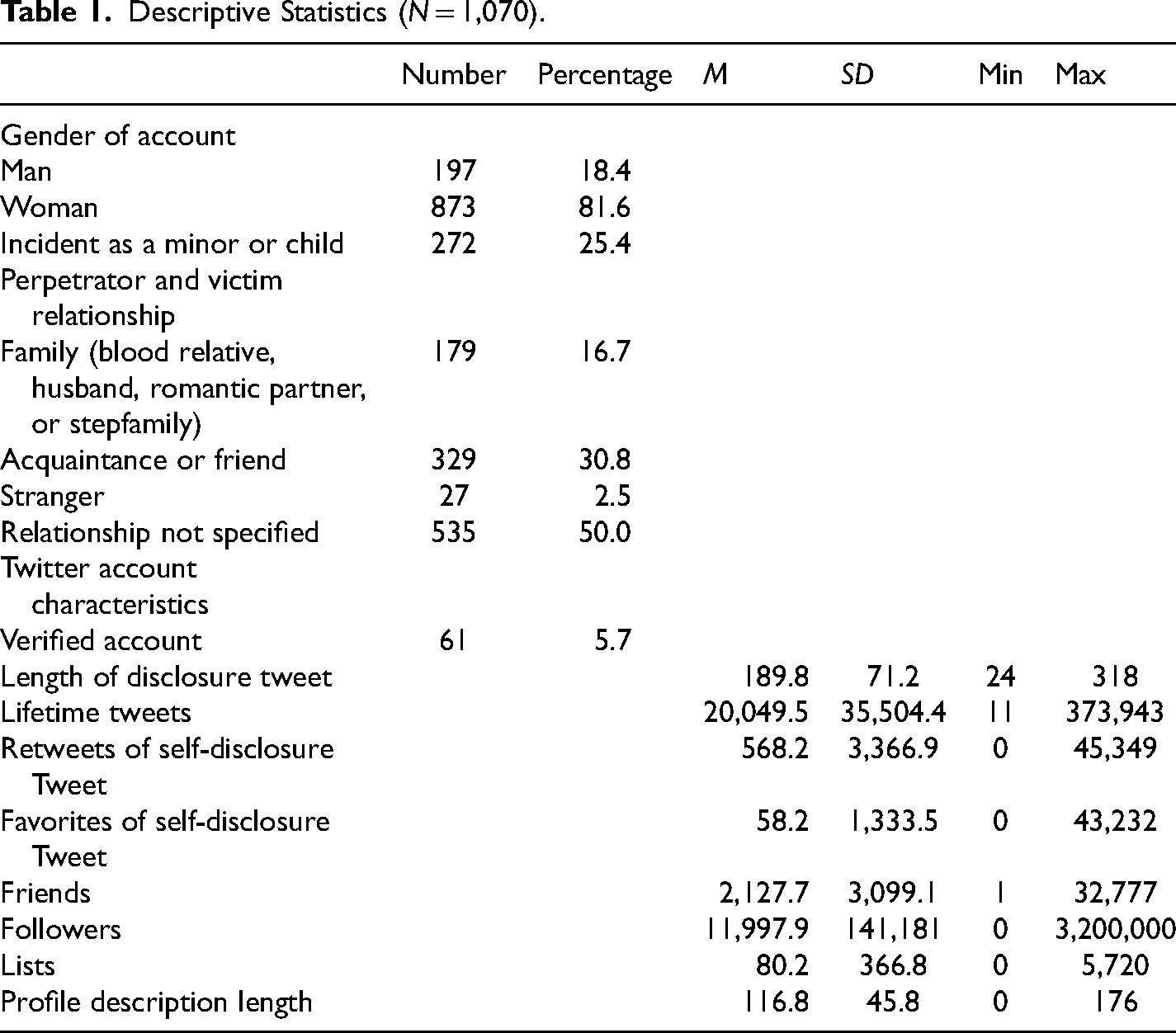
Table 1 reports descriptive statistics about our sample. Table 1 shows about 81% of our sample was classified as self-disclosure from women. The average length of the #MeToo self-disclosures was approximately 190 characters. While Twitter accounts within our sample had an average of 568 retweets, only 43.5% of the sample had their #MeToo disclosure retweeted or, put another way, 56.5% of disclosures were not retweeted at all. A similar picture emerged for favorites. In our sample, Twitter accounts had an average of approximately 58 favorites. But well over half of the disclosures (57%) in the sample did not receive a single favorite. Additionally, the most common perpetrator among #MeToo disclosures was a familiar person, such as an acquaintance or friend. Of the self-disclosures who referenced their perpetrator identity, about 31% of them referenced being assaulted by a friend or acquaintance, making this the most likely perpetrator to be disclosed publicly by victim-survivors. However, about half the time sexual assault self-disclosure within our sample was likely to not disclose their relationship to their perpetrator.
Descriptive Statistics (N = 1,070).
Statistical Models
In this article, we used negative binomial regression models because of the skewed distribution of our outcome variables of visibility. Since the age of the accounts, length of a user's profile description, number of tweets, and other user activity variables can also affect Twitter visibility, we use such factors as control variables. Below, we explain our dependent, independent, and control variables in detail. To more fully examine Hypothesis 3, we used the comparisons of predicted marginal estimates of visibility measures employing the mlincom command in the spost13 package of Stata 14 (Long & Freese, 2006).
Dependent Variables
Prior scholarship has viewed retweets and favorites as basic proxies of visibility and online engagement (ElSherief et al., 2017; Nilizadeh et al., 2016; Zaman et al., 2010). We selected two dependent variables: the “retweeted count of the self-disclosure tweet” and the “favorites count of the self-disclosure tweet.” Each represents a different aspect of visibility. A retweet is a reposting of a Tweet which allows other Twitter users to quickly share the post with their followers, displayed as a new tweet. A favorite is a status on a tweet that is marked by other users, with more favorites on a tweet indicating that more users clicked “favorite” on that tweet. Unlike a retweet, a favorite does not get explicitly shared with the followers of the account that marked the tweet as a favorite. In simple terms, retweets show tweets to more people, while favorites confirm that a given number of users have explicitly taken notice of a tweet.
Independent Variables
Our independent variables were the characteristics of the self-disclosure. Specifically, whether the self-disclosure was perceived as being made by a man or woman. The victim-survivor's relationship to the perpetrator, the emotions displayed in the MeToo self-disclosures, and whether the disclosure indicated the Twitter user was a child at the time of the assault.
To estimate the perceived gender of the Twitter account, we employed a methodology utilized by other scholars for identifying perceived gender using the Face++ API (https://www.faceplusplus.com), unique first names, and their gender profiles in the United States from 1990 to 2013 (Mislove et al., 2011). As additional confirmation, we searched for gender-identifiable terms, such as “he/his,” “she/her,” “they,” etc., in the profile description of the users and within the tweet of the self-disclosure. Tweets including a reference to the victim-survivor's gender as being posted by a woman were coded as “1” and those referring to their gender as a man were coded as “0.”
We created a categorical variable for the relationship between the victim-survivor and the perpetrator, with a blood relative or intimate partner as the reference category (0). The other categories were acquaintances/friends (1), stranger (2), and no relationship specified (3). The reference category of family member or intimate partner violence included blood relatives, step-relatives, parents’ romantic partners (e.g., mom's ex-boyfriend, husband), and romantic partners. Additionally, the relationship category of acquaintances/friends included individuals known to the victim-survivor, such as coworkers, bosses, physicians, or neighbors. These distinctions within each category were collapsed into a single category because of small cell sizes. Fifty percent of self-disclosures within our sample did not specifically reference their relationship to their perpetrator. Approximately 17% of self-disclosures (179) referenced sexual abuse by a family member.
A categorical variable was constructed for the emotions displayed in the self-disclosure with no emotions displayed as the reference category with the other remaining categories being stereotypical victim emotions, and anger or frustration. Self-disclosures with no discernable emotions were assigned a value of “0,” self-disclosures with stereotypical emotions were assigned a value of “1,” and self-disclosures displaying anger or frustration were assigned a value of “2.” Sadness, fear, self-blame, and hopelessness were all categorized together as stereotypical or expected emotions for victim-survivors. In contrast, A second binary variable for “anger emotions” was created to reflect emotions or emotional displays that did not adhere to stereotypical beliefs. The vast majority (84%) of the sample of #MeToo tweets contained no discernible emotions at all, which is not surprising given the length constraints of tweets.
Finally, we created a binary variable for a child victim-survivor. Self-disclosures that included a reference to being sexually assaulted as a minor or as a child (or under the age of 16) were assigned a value of “1,” and cases that included no reference to age being assaulted as a minor were assigned a value of “0.” Twenty-three percent of our self-disclosures referenced being victimized as children.
Control Variables
Since social media activity is a key driving force for visibility, we controlled for a number of Twitter account characteristics. Our models include control for the Twitter account's number of lifetime tweets (total amount of tweets posted by account), the age of the Twitter account (length of time since the account had been created), and the length of the #MeToo disclosure tweet (number of characters). We also controlled for other factors that could affect visibility, such as their number of followers, friends (the number of followers that the account follows back), and the number of lists they appear on. To create a Twitter List, a user provides a name and can also potentially provide a description for the list; these lists are used to group sets of other Twitter users into topical categories (Wu et al., 2011). The more lists an account is attached to, the higher the potential for more visibility. We also created a control variable for whether the Twitter account has a verified status. A verified user is an account for which Twitter manually authenticates their identity. Typically, these users are celebrities, including musicians, actors, politicians, and journalists (Twitter, 2013) who often have a larger following than a nonverified account.
Results
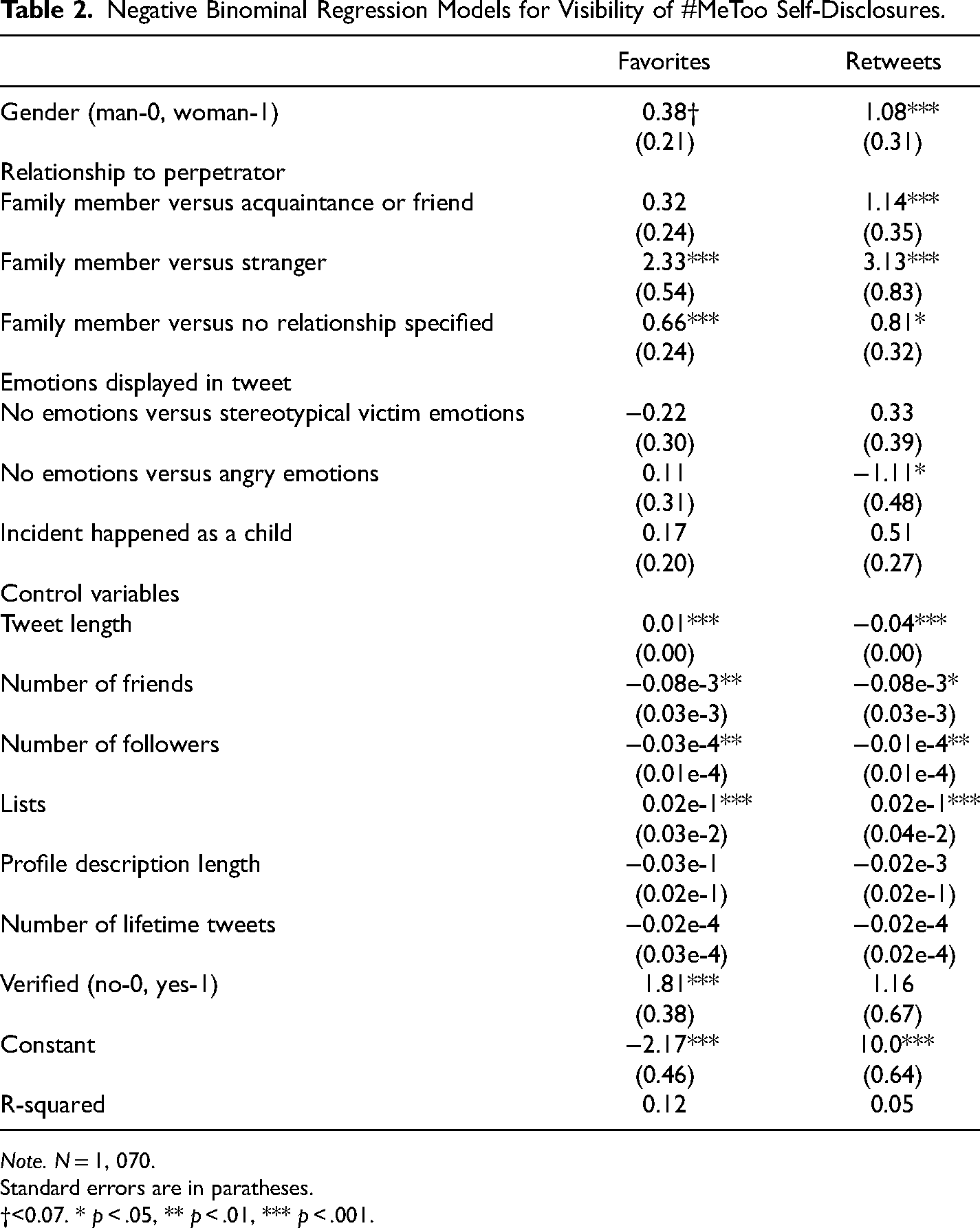
Our results focus on the visibility of self-disclosures by the perceived gender of the Twitter account, perpetrator type, and emotions expressed within MeToo self-disclosure tweets. Table 2 displays the results for the number of favorites and retweets that #MeToo self-disclosures received when controlling for various Twitter account characteristics.
Negative Binominal Regression Models for Visibility of #MeToo Self-Disclosures.
Note. N = 1, 070.
Standard errors are in paratheses.
†<0.07. * p < .05, ** p < .01, *** p < .001.
Gender and Visibility
We find that sexual assault self-disclosures from women received more favorites for their #MeToo tweets than accounts from men, holding other variables constant (b = 0.38, SE = 0.21). However, this gender difference for favorites only reached marginal significance. Likewise, self-disclosures from Twitter accounts perceived to be women also received significantly more retweets than self-disclosures from men (b = 1.08, SE = 0.31, p < .001). Our findings align with previous scholarship noting that women victim-survivors are more likely to receive support and men victim-survivors are culturally viewed as not capable of having a victim status (Goodley, 2019). Thus, we find support for Hypothesis 1. Twitter #MeToo self-disclosures from women receive greater visibility in terms of retweets and favorites than sexual assault disclosures from men.
Victimization and Visibility
One broad pattern emerges when we consider the effect of the relationship between victim and perpetrator. Individuals who tweeted about being assaulted by an acquaintance or friend, by a stranger, or by an unspecified assailant, received greater visibility than #MeToo tweets involving sexual assault by a family member or romantic partner. This contrast was starkest when comparing the visibility of those assaulted by strangers to #MeToo self-disclosures that referenced being assaulted by a blood relative, a stepfamily member, or a current or previous romantic partner. Table 2 shows that when self-disclosures referenced being assaulted by a stranger, they received significantly more favorites compared to when the perpetrator was a family member or intimate partner (b = 2.33, SE = 0.54, p < .001).
A similar pattern emerged for retweets. The second model in Table 2 shows that #MeToo self-disclosures that referenced being assaulted by a stranger received significantly more retweets compared to when the assailant was described as a family member or intimate partner (b = 3.13, SE = 0.83, p < .001). This visibility of the stranger assault within our sample is notable given that it made up only a small fraction of our sample, with less than 3% of the self-disclosures referenced being assaulted by a stranger. Our sample is consistent with previous scholarship showing that most victim-survivors are assaulted by familiar assailants rather than strangers (Logan et al., 2007). However, this stranger narrative appears to receive the greatest attention on Twitter within our sample. Therefore, we find support for Hypothesis 2 with sexual assault self-disclosures that reference being assaulted by a stranger receiving more favorites and tweets than self-disclosures that reference being assaulted by a family member.
Emotions and Visibility
We hypothesized that Twitter #MeToo disclosures that displayed emotions associated with distress, such as fear, sadness, self-blame, and hopelessness would receive more favorites and retweets than self-disclosures without these displays of emotions. Table 2 shows that the emotion expressed in the sexual assault self-disclosures had no significant effect on the number of times the tweet was favorited. However, we do find a significant effect of the emotions displayed in the #MeToo disclosures and online visibility when examining the measure of retweets. Within our sample, people whose sexual assault self-disclosures were coded as expressing anger or frustration received fewer retweets than tweets with no discernable emotion present (p < .05).
Additional postestimation analysis using the margins command in Stata allowed for comparisons of retweets across all three categories of emotions. We find that the predicted retweet count for #MeToo self-disclosures was 16.5 while disclosures with no emotions coded for had a predicted retweet count of 50.4 (p < .001). Figure 1 also shows the predicted retweet count for the sexual assault self-disclosure by emotions. We find that the predicted retweet count for self-disclosures that had stereotypical emotions such as sadness, fear, self-blame, and hopelessness was significantly higher than disclosures with anger and frustration (70 vs. 16.5, p < .05). Thus, we only find partial support for Hypothesis 3. Our results suggest that victim-survivors’ presentation of self through the emotional demeanor they express significantly affected their visibility through retweets. Specifically, victim-survivors who expressed anger or frustration in the self-disclosures had significantly lower retweet counts compared to self-disclosures that displayed stereotypical emotions or no emotions.
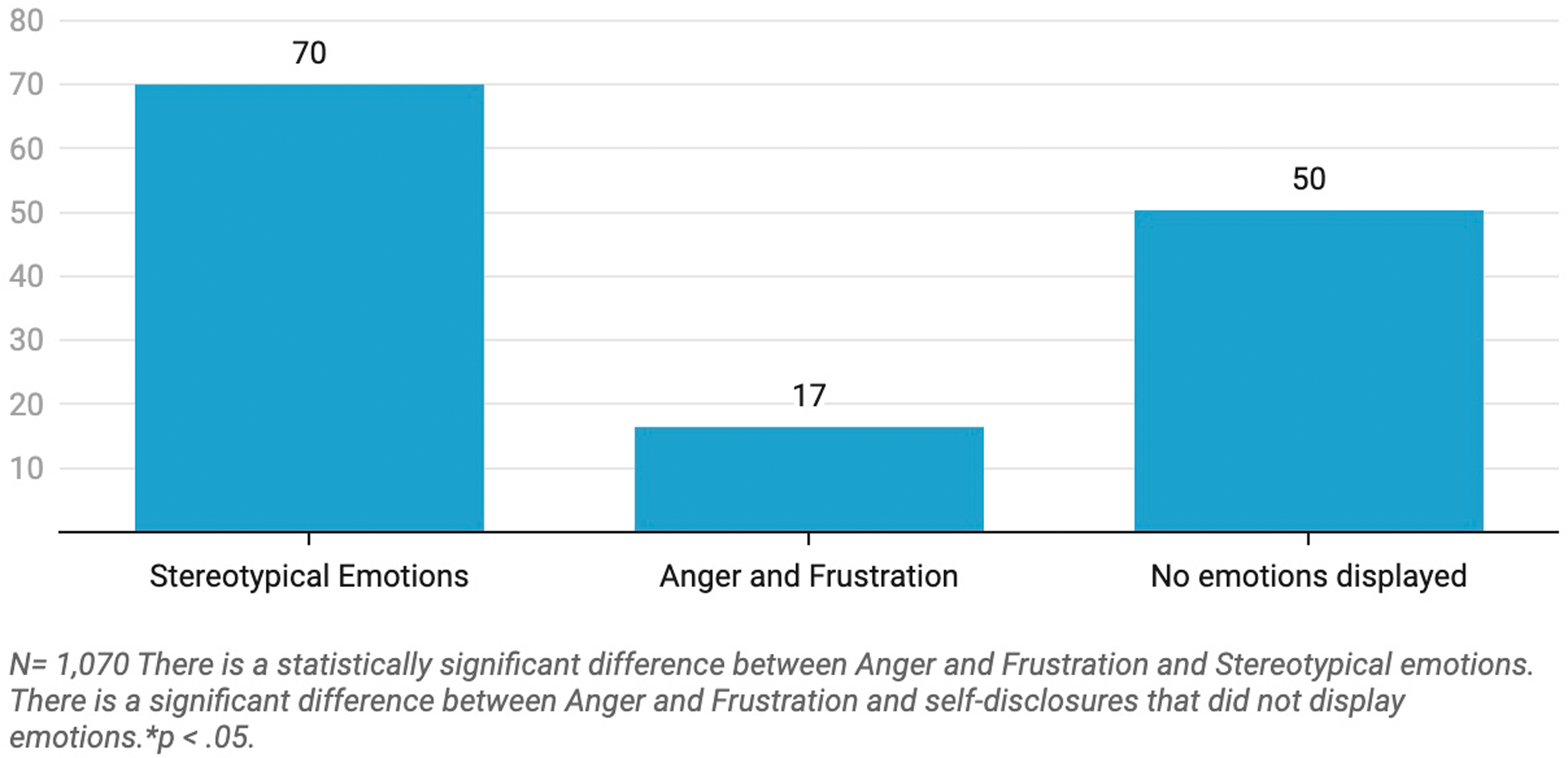
Predicted retweet count for #MeToo sexual assault self-disclosures by emotions.
Discussion
In this study, we used a sample of #MeToo sexual assault disclosures to test hypotheses grounded in the observation that common misconceptions about sexual assault affect the social response to these self-disclosures. Our results suggest that the visibility of sexual assault self-disclosures, as measured through Twitter retweets and favorites, is shaped by their conformance to cultural stereotypes of victim-survivors. Men, people assaulted by a family member, and those who displayed emotions of anger or frustration in the disclosure achieved less visibility. Thus, #MeToo sexual assault disclosures and the social characteristics of those users who do not align with the narrow cultural conceptions of rape achieve less visibility.
While this work focused on stereotyped beliefs about sexual assault related to gender, emotion, and type of perpetrator, we easily imagine how other factors such as race or sexual orientation could also affect the visibility of #MeToo self-disclosures. This may be compounded by Twitter algorithms which often restrict the visibility of users by gender (Nilizadeh et al., 2016) and race with White users having an advantage in comparison with those identified as Black and Asian (Messias et al., 2017).
Ethical Considerations
In our study, we relied on self-reported disclosures of sexual violence shared online. We obtained approval from the Institutional Review Board for this study to ensure ethical compliance. It is worth noting that online data has been likened to naturalistic observation (Orth et al., 2020; Zaleski et al., 2016). However, when dealing with social media data, especially disclosures of sensitive issues like sexual assault, ethical considerations come into play (Cook & O’Halloran, 2023).
Anonymity, confidentiality, consent, and privacy of participants who contribute online content are crucial concerns that researchers must consider (Gupta, 2017; Williams et al., 2017). In addition, people may have been posting tweets while in a vulnerable state of mind such as during a disaster or disclosing a sexual assault (Ahmed et al., 2017). To address these ethical concerns, the present study analyzed tweets at an aggregate level. We did not report on specific users or directly quote any #MeToo self-disclosure tweets to protect their confidentiality (Ayers et al., 2018). By taking this approach, we aimed to ensure that our research respects the rights of survivors while providing valuable insights into the broader patterns related to sexual assault disclosures on Twitter.
Another significant ethical consideration in this study was the well-being of the researchers responsible for coding the #MeToo tweets which can be traumatic in nature. As mentioned earlier, the research team held check-in meetings every other day during the 2-week coding phase. Originally, the plan was to code a much larger dataset, but during these meetings, the principal investigator noticed signs of burnout and distress among the undergraduate research assistants.
Researchers working with sensitive data and encountering accounts of traumatizing experiences often face emotional distress (Dickson-Swift et al., 2009; Hanna, 2019). In some cases, researchers may even develop symptoms similar to posttraumatic stress disorder (Moran & Asquith, 2020). For example, studies have examined the distress of researchers investigating topics such as gender-based violence and suicide (Coles et al., 2014; Smith et al., 2021). This aligns with existing scholarship that emphasizes the importance of understanding how trauma can be transmitted to workers who assist victims of intimate partner violence. Groggel (2023), in interviews with workers providing legal services to victims, found that these workers described experiencing symptoms of secondary traumatic stress. Similarly, other research has shown that participants exposed to a court document detailing a case of intimate partner violence may experience burnout due to increased role-taking as measured through perspective-taking and empathy (Groggel et al., 2022).
Studying sexual violence can be an emotionally challenging experience for researchers, as it involves encountering distressing accounts of experiences of sexual assault and abuse (Dickson-Swift et al., 2008). Qualitative research on sensitive topics requires emotional labor, which can be addressed through coping techniques like reflexivity (Reed & Towers, 2023). To mitigate the impact of processing traumatic sexual assault self-disclosures, regular check-ins with the research team were essential in this study. Originally, the research team intended to code a larger dataset, but due to the distress caused by exposure to traumatic sexual assault disclosures, this goal was reconsidered. In this way, ethical concerns were diligently addressed, yet it is important to acknowledge the limitations associated with using the #MeToo hashtag.
Limitations
As with all studies, the present work has a number of limitations. While these limits suggest some interpretive caution, they also indicate new directions for future scholarship. Tweets in our study were restricted to those in English, and our analysis does not examine the visibility of #MeToo tweets based on the emotions or relationship between perpetrators and victim-survivors described in other languages. Future research could usefully apply the methodology of this article to similar samples in other languages to see if stereotypes applied in this context are also applied in other cultural contexts.
One significant limitation is the potential presence of recall bias in people's sexual assault disclosures. Since individuals may share their experiences of sexual assault at a later time, the accuracy and completeness of the details provided could be influenced by memory biases. Additionally, self-disclosures on Twitter are limited in the number of characters that they can use to describe their experience. The restrictions on the character length of tweets may consequently affect the details provided in their self-disclosures. The variability in the level of detail shared in the tweets is another limitation. Within this dataset, some #MeToo tweets contained extensive details such as noting their relationship to the perpetrator and location of the assault, while others provided only minimal information, referencing that they had been raped. The range of details could affect the comprehensiveness and depth of the data analyzed, making it necessary to interpret the study's findings with caution. This also means that the findings from this study cannot be generalized to other social media platforms, where users are not restricted to a specific character count. As a result, the findings discussed here may not be generalized to other social media platforms.
The disclosures shared on Twitter are not necessarily representative of other victim-survivors’ experiences. The select victim-survivors who post their stories online may represent a particular subgroup of survivors. Moreover, since we only examine the visibility of #MeToo tweets, our results only speak to one dimension of social responses to victim-survivors’ self-disclosures and do not capture other facets such as ongoing Twitter conversations or the sentiment of the replies the tweet receives. Future research using alternative methodologies might well discover important effects of #MeToo disclosures that only emerge through extended engagement, or through engagement across multiple platforms, hashtags, and lists.
The emotional content of self-disclosures was classified for the emotions that we as external readers perceived in the tweets, rather than what the individual was intending to express. While our qualitative coding reflects our best efforts, it is possible that other people viewing the same disclosures would characterize the same expressions differently. Even in our coding, we found that some disclosures referenced a range of emotions, so there is some overlap within the dataset of these qualitative variables, and it is possible that these could be categorized or analyzed differently to useful effect.
Another potential limitation is our quantification of online visibility. While Twitter data provides several quantifiable measures of visibility, it is impossible for researchers to ascertain the true number of users who are exposed to MeToo tweets. Metrics of visibility are often associated with a number of issues such as bots so that a reference to followers should be understood as potential viewers rather than actual Twitter users (Davis et al., 2016). Another limitation is that this study does not include a variable for the other hashtags included in the self-disclosure which may also have impacted the visibility of content. Our study focuses on “visibility” and does not investigate other facets of online interactions with #MeToo sexual assault self-disclosure. Despite these limitations, within the context of this study, we used two well-known measures of visibility in terms of likes and retweets. However, these activity-based measures neglect to include lurkers (Bernstein et al., 2013), as users may see the self-disclosure but not actively engage with it through behaviors such as posting their own tweets or retweeting (Gong et al., 2015).
Lastly, this study neglects to examine the potential benefits to victim-survivors who may have posted their stories as a way to seek emotional and psychological support and advice on how to cope. Victim-survivors who choose to discuss their assault often feel their experiences are validated, and they gain emotional support from other victim-survivors and allies (Ahrens & Aldana, 2012). Participating in the #MeToo movement by sharing their experience on Twitter is intended to render sexual and gender-based violence more visible and to support the movement (Masciantonio et al., 2021).
Victim-survivors may feel a sense of healing or justice when they talk about their assault rather than keeping their experiences to themselves (Gueta et al., 2020). For instance, a prevalent theme among disclosure discourse as it relates to sexual assault is the role of social support as a communicative tactic (DeLoveh & Cattaneo, 2017; Demers et al., 2017). This study cannot address the benefits of disclosing sexual assault online, which is critical given that other work has found that victim-survivors of sexual assault utilize platforms such as Reddit (Andalibi et al., 2016), blogging (Fawcett & Shrestha, 2016), or even Yahoo! Answers forum (Moors & Webber, 2013) to recount their stories, seek information, or educate and support others with similar traumatic experiences. Notably, prior research, such as the study conducted by Gallagher et al. (2019) analyzing over 1.8 million #MeToo tweets, discovered evidence of network-related reciprocal disclosure: when a survivor self-disclosed, there were subsequently more disclosures from their followers.
Future research should build upon our findings by examining both the sexual assault self-disclosures that were retweeted and favorited and which accounts responded to the accounts. Other research has shown positive longitudinal effects of the #MeToo movement on public opinion. For instance, research conducted by Szekeres et al. (2020) revealed a decline in the dismissal of sexual assault allegations. This included a reduction in beliefs such as attributing reports of sexual assault to false allegations or the notion that women make allegations to harm men. Rather than my results standing in contrast to these findings, it is possible for the most visible #MeToo sexual self-disclosure tweets to align with stereotypical conceptions of victims while the movement still had a broader positive ripple effect. Results here do not devalue the immense value of victim-survivors discussing and or disclosing their personal experience regarding sexual assault and support and the possibility for survivors to rebuild on their experiences (Masciantonio et al., 2021).
Conclusion
In this article, we found effects related to misconceptions about gender, the relationship between victim-survivor and perpetrator, and emotional expression on online visibility of sexual assault self-disclosures. Sexual assault self-disclosures from Twitter accounts of men received less visibility than disclosures made by women. Sexual assault disclosures that referenced being sexually assaulted by a romantic partner or family member, rather than a stranger, achieved less visibility. #MeToo sexual assault disclosures that breached expectations of emotional displays by displaying anger or frustration received less retweets than self-disclosures displayed stereotypical emotions such as fear, sadness, self-blame, and hopelessness or did not display any emotions. In this way, stereotypical beliefs about rape create the cultural background influencing the visibility of certain victims over others.
So, while there is no doubt that social media disclosures expand the possible range of public understanding of sexual assault, we find that people tend to respond to such disclosures by favoriting and retweeting disclosures that fit existing misconceptions, making those disclosures more likely to be seen by other users on the platform. These findings do not in any way negate the value of social media disclosure for victim-survivors and survivors, nor do these findings devalue the potential for disclosures to inform individuals who encounter them. But it is clear that social media disclosure is not sufficient on its own to combat the stereotypes that govern public understanding of sexual assault, and may at a broader level, reinforce the misconceptions that interfere with effective responses to sexual assault as a social problem. While this study cannot address the benefits of victim-survivors disclosing their own experiences online and connecting with a community of people with similar experiences, it does call for greater attention to be paid to which victim narratives achieve the greatest visibility and why.
Footnotes
Declaration of Conflicting Interests
The author(s) declared no potential conflicts of interest with respect to the research, authorship, and/or publication of this article.
Funding
The author(s) disclosed receipt of the following financial support for the research, authorship, and/or publication of this article: This study was made possible by the funding from the Summer Undergraduate Research Program at North Central College. This work was supported by the North Central Faculty Development and Recognition Committee Grant.
