




Abstract
Transmission of rape myths is expected in every culture, yet limited research exists on rape myth acceptance (RMA) within global South Asian (SA) diasporas. We examined whether gender, attitudes toward gender roles, and patriarchal beliefs contributed to RMA among young SA adults in Canada. An ethnically diverse sample of 116 (ages 17–25) students, comprising equal numbers of men and women and domestic and international students, completed an online survey. SA students were generally egalitarian with low RMA similar to the majority of North American samples. As predicted, male gender, traditional attitudes towards SA women, and patriarchal beliefs were strong predictors of RMA.
Rape myths, “attitudes and beliefs that are generally false but are widely and persistently held, and that serve to deny and justify male sexual aggression against women” (Lonsway & Fitzgerald, 1994, p. 134), are widespread. Such myths are believed to be passed on as truths through cultural scripts and further propagated by society (Brownmiller, 1975; Burt, 1980; Edwards et al., 2011; Mori et al., 1995). They assign shame and blame to survivors of sexual violence while justifying the actions of perpetrators (Edwards et al., 2022; Payne et al., 1999). These myths reflect society's typical response toward survivors, which have been sustained over time, and lead to harmful reactions such as victim blaming (Anderson & Overby, 2021). For these reasons, rape myths are also cited as a barrier for survivors of sexual violence to seek required support services, triggering secondary victimization at the hands of medical and legal institutions through victim blaming (Ullman & Townsend, 2007). Survivors are reluctant to report to authorities about acts of sexual violence in fear of not being believed, being blamed, and experiencing mistreatment and ostracization (Benoit et al., 2015; WHO & PAHO, 2012), which are practices driven by rape myth acceptance. These also cause sexual violence to remain one of the most underreported and less researched forms of violence against women in general (Benoit et al., 2015; WHO & PAHO, 2012). This creates a stigma toward survivors of sexual violence, silencing their experiences (Ullman, 2010) and reducing opportunities to report or seek help (Anderson & Overby, 2021).
While transmission of rape myths is expected in every culture, variations exist (Lonsway & Fitzgerald, 1994; Tummala-Narra et al., 2017). Yet there is limited knowledge on the extent to which rape myths impact the lives of women in South Asian diasporas, even in countries such as Canada, which is home to one of the largest South Asian communities. Furthermore, most studies on rape myths focus on levels of rape myth acceptance among various cultural groups and do not examine factors influencing such beliefs within cultures. Studies have shown that gender (e.g., Jamshed & Kamal, 2021) and traditional attitudes toward gender roles (e.g., Viki & Abrams, 2002) could influence rape myth acceptance, while the influence of patriarchal beliefs on rape myths, though strongly implicated in theory (Brinson, 1992; Ryan, 2011), have not yet been examined. To address these gaps, we focused on assessing the attitudes and beliefs of young adult South Asians in Canada, during the developmental period when the risk of sexual assault is highest (Burczycka, 2019). We examined the influence of gender, traditional attitudes toward gender roles (specific to the South Asian context), and patriarchal beliefs in shaping rape myth acceptance among a group of South Asian students in Canada.
Sexual Violence in South Asian Communities
The prevalence of sexual violence in South Asian diasporic communities, an ethnocultural group whose ancestry is traced to the South Asian subcontinent (i.e., Bangladesh, Bhutan, India, Maldives, Nepal, Pakistan, and Sri Lanka) (Ghosh, 2013; Preisser, 1999), is comparatively lesser known than for other groups, with limited research focusing on sexual violence within these communities compared to other forms of VAW such as domestic violence (Gill & Harrison, 2019; Madden et al., 2016). In Canada, sexual violence is considered an issue of grave concern, with one in three women experiencing sexual assault at some point in their lives (Benoit et al., 2015). South Asian women in Canada are not at higher risk of experiencing sexual violence compared to the general Canadian population (Cotter & Savage, 2019), though immigrant women have specifically been identified as vulnerable to inequities in outcomes such as lack of access to resources and being less likely to seek support services (Benoit et al., 2015; Brownridge, 2009).
It is important to examine rape myth acceptance within this community for several reasons. Firstly, as a multicultural country, Canada is home to a large South Asian community; South Asians are the largest visible minority, comprising 7.1% of the Canadian population (Statistics Canada, 2022). This community hosts many South Asians as immigrants and as native-born Canadians with South Asian ancestry (Buchignani, 2010). It is also one of the fastest-growing communities compared to the overall population (Statistics Canada, 2007), due to increasing migration from the subcontinent, based on Canadian labor needs (Handa, 2003). Therefore, it is worthwhile investigating the attitudes and beliefs that can impact the well-being of a large proportion of visible minority women in Canada.
Secondly, within South Asian communities a strong social stigma exists toward women who are survivors of sexual assault, which prevents the disclosure of even extreme cases of sexual violence (Gill & Harrison, 2019). For South Asian women, disclosing sexual violence typically not only means a loss of status for themselves but also for their family and community. Survivors of such violence are often silenced by family members to prevent the publicizing of such incidents (Gill & Harrison, 2019; Tummala-Narra et al., 2017). As a result, survivors often regard themselves as being devalued persons of their respective communities (Ahmed et al., 2009). This social stigma toward sexual violence is related to the concept of chastity specific to the South Asian community.
Though conversations on sex and sexual violence are often considered taboo (Abraham, 1999; Gravel et al., 2016), significant emphasis is placed on the importance of preserving a woman's chastity. Chastity is required to be intact until marriage, and the responsibility for protecting it is the woman's own (Papp, 2010). The repercussions of violating this norm extend beyond the individual by negatively impacting the family and community one belongs to. Incidents of sexual assault are regarded as acts that defile a woman's honor causing dishonor to one's family and community (Bacchus, 2017; Gravel et al., 2016; Papp, 2010), even though they are acts of violence founded on the absence of consent (Ahmad, 2016; Gill & Harrison, 2019). The social stigma attached to sexual violence within the South Asian community shapes a narrative of victim blaming, which is at the core of rape myths.
Thirdly, there is a dearth of information on rape myth acceptance within the South Asian context in Canada. Limited research on South Asians and rape myth acceptance exists which focused on: comparisons between samples of non-South Asians and South Asians, for example, British and Indian students (Barn & Powers, 2021; Hill & Marshall, 2018), and samples solely from the South Asian subcontinent, such as from India (Jayalakshmi et al., 2016; Qureshi et al., 2021) and Pakistan (Jamshed & Kamal, 2021; Kamdar et al., 2017; Nadeem & Shahed, 2017). Studies focused on the South Asian diaspora in North America are few and based on those living in the United States (Devdas & Rubin, 2007; Tummala-Narra et al., 2017). Despite being from different South Asian communities, whether from the subcontinent or diaspora there appear to be similarities in how rape myth acceptance is perceived based on these limited examples. Therefore, it is worthwhile investigating how it persists within the South Asian diasporic community in Canada.
When making inferences from the existing yet limited body of literature on rape myth acceptance and South Asians, it is also important to note that some studies tend to project stereotypical characterizations of South Asian men as being inherently violent, that is, more prone to be abusive to their female partners and South Asian women as submissive in relation to their male partners and experiences of violence (Ahmed et al., 2009; Gill & Harrison, 2019). Scholars critical of these assumptions point out that these studies insinuate that South Asian cultures are outdated and inferior to liberal Western cultures (Ahmed et al., 2009; Gill & Harrison, 2019; Jiwani, 2005). Such narratives are harmful as they downplay the presence of sexual violence in other cultures and exaggerate its presence in South Asian communities. For example, studies that compared British and Indian student samples (Barn & Powers, 2021; Hill & Marshall, 2018) claimed that Indian students hold higher levels of rape myth acceptance since they belong to a ‘less egalitarian’ culture. Barn and Powers (2021) also suggested that belonging to a scheduled caste can predict rape myth acceptance, even though only 12% of participants identified as such. Such narratives are problematic since they feed into Eurocentric and stereotypical ideologies which insinuate that race and caste are determinants of rape myth acceptance.
However, research does suggest that tendencies toward upholding traditional patriarchal values and rigid gender role stereotypes are higher in most immigrant minority communities, likely as a result of attempts to maintain cultural continuity (Papp, 2010) in the face of racism, acculturation, migration (Brownridge, 2009; Rajiva, 2013) and socioeconomic disparities. Moreover, South Asian women in this context are held responsible for upholding South Asian values, especially when residing in non-South Asian countries (Bacchus, 2017; Zaidi et al., 2014). These beliefs are often upheld by South Asian families that have recently immigrated as well as those who have resided in Canada for many decades (Thandi & Lloyd, 2011). Women of South Asian descent living in countries such as Canada are ultimately impacted by cultural scripts in both the dominant culture and their inherited culture which reinforce patriarchal values (Jiwani, 2005). Though culture is now considered as a dynamic and flexible system of values and worldviews as opposed to a static entity (Fernando, 2004), and the status of South Asian women is continually evolving, it is important to investigate how communal expectations can impact and shape rape myth acceptance.
Previous studies on rape myth acceptance and South Asians have mostly focused on levels of rape myth acceptance (e.g., Nadeem & Shahed, 2017) and have not investigated possible factors that could shape rape myth acceptance among South Asian individuals. Though it is important to assess levels of rape myth acceptance among South Asians in Canada, it is worthwhile examining which predominant attitudes and beliefs held within the South Asian community have the potential to increase or decrease levels of rape myth acceptance. This was the focus of the current study.
Possible Predictors of Rape Myth Acceptance Among South Asians
Victim-blaming narratives embedded into cultural scripts of South Asian communities in South Asia and South Asian diasporas could promote rape myth acceptance among South Asian individuals. Even though there is considerable heterogeneity within South Asians in terms of ethnicity or religion, there seem to be cultural similarities (Ahmed & Lemkau, 2000) in terms of predominant attitudes and beliefs. According to the ecological systems theory (Bronfenbrenner, 1979) interactions with the broader macrosystem or the socio-cultural blueprint of a culture (consisting of societal norms, expectations, and beliefs that are specific to the culture), can shape behaviors of cultural members. These behaviors would be displayed as long as an individual's social environment is connected to their cultural background (Bronfenbrenner, 1979), explaining the possibility of shared values among South Asians living in South Asia or the South Asian diaspora. Using this framework, it could be assumed that overarching victim-blaming narratives would be present and enforce gender differences, traditional gender roles and patriarchal beliefs. These attitudes and beliefs, in turn, could influence South Asian individuals to perceive rape myths as truths.
Feminist theories on rape myth acceptance also explain how rape myths are used “to perpetuate cultural beliefs and identity alongside prescribing behaviours and ways of thinking” (Persson & Dhingra, 2022, p. 15). According to Lonsway and Fitzgerald's (1994) foundational work in the United States, there are three key aspects of rape myths, (a) they are widespread (false) beliefs that (b) aid in explaining cultural practices (c) to help sustain the existing social order (Persson & Dhingra, 2022). Based on this explanation, South Asian communities across the globe could potentially engage in the spreading of rape myths to justify the presence of gender differences, gender roles, and patriarchal norms as protective measures for women against rape, enabling the continuation of its patriarchal cultural structure.
Previous studies have shown that men hold higher levels of rape myth acceptance compared to women (e.g., Suarez & Gadalla, 2010). These gender differences in rape myth acceptance are likely due to the different functions it serves for men and women, such that it helps men to justify male sexual violence, whereas women reject the attribution of sexual violence to women's personal vulnerabilities (Lonsway & Fitzgerald, 1995). This sentiment has been found in studies on rape myth acceptance conducted in South Asian countries (such as India and Pakistan) using South Asian study samples. Two studies using Pakistani undergraduates found that men were more likely than women to believe that women's willingness is present in rape, women of good character can prevent rape, and women's attitude, behavior, and attire attracted rapists (Jamshed & Kamal, 2021; Nadeem & Shahed, 2017). The comparative study by Barn and Powers (2021) also showed that among the Indian students in their sample, men endorsed rape myths more than women, with men's uncontrollable sex drive aroused by women's willingness cited as a primary cause of sexual violence. Therefore, a South Asian person's gender could affect their rape myth acceptance.
Traditional gender roles postulate that women and men have different roles in society, with women strictly engaging in domestic responsibilities whereas men engage in nondomestic roles (Best & Williams, 1997). Gendered behaviors are an integral aspect of South Asian traditions and hold particular relevance for sexuality and sexual behavior. These are based on South Asian ideals of femininity and masculinity (Abraham, 1999; Bacchus, 2017). Femininity is expected to be displayed by being docile, self-sacrificial, demonstrating good moral values and remaining chaste until marriage, while masculinity is displayed through dominance over women and sexual virility (Abraham, 1999). For South Asian women, these ideals of femininity and sexuality are imposed through gender role expectations such as adhering to appropriate dress codes that are not body-revealing, not traveling at night and not associating with the opposite gender, to name a few (Dasgupta, 1998; Talbani & Hasanali, 2000). However, South Asian men can engage in activities to increase their sexual virility such as watching pornography and engaging in sexual interactions (Abraham, 1999). Such traditional expectations imposed upon South Asian women are believed to be protective measures to avoid sexual assault and overstepping these boundaries is believed to trigger sexual violence, which perpetuates victim blaming (Hill & Marshall, 2018; Viki & Abrams, 2002). Hence, rape myth acceptance among South Asian individuals could be shaped by traditional gender roles.
Beliefs related to the hierarchical power structure of male domination and female subordination are known as patriarchal beliefs (Yoon et al., 2015). Within the South Asian community patriarchal values represent wide disparities between men and women, further validated by placing men in controlling positions over the lives of women (Ahmad et al., 2004; Papp, 2010; Tummala-Narra et al., 2017). This extends to sexual behaviors, with male sexual prowess and dominance over females regarded as the norm (Raj & Silverman, 2002) and female sexuality is rigidly controlled since family honor and the chastity of women are linked together (Papp, 2010). Studies on marital rape and South Asian immigrant women have highlighted that sexual coercion is often considered the marital right of men and the sexual needs of women are disregarded (Abraham, 1999; Gill & Harrison, 2019). The sexuality of South Asian women is also used as a tool for subordination of those who challenge patriarchal notions (Dutt, 2018). For example, the infamous Delhi gang rape was justified by the perpetrators as teaching the victim a lesson for daring to remain outdoors during the night (Dutt, 2018). Women's actions are constantly subjected to men's surveillance to ensure that women's sexuality and identities are in accordance with South Asian patriarchal ideals, and sexual violence is seen as an appropriate reaction if these are violated (Begum & Barn, 2019; Dutt, 2018). Hence, the patriarchal structure within the South Asian context carries ideologies related to victim blaming, which could shape rape myth acceptance among South Asian individuals.
Some recent studies on non-South Asian study samples (Fansher & Zedaker, 2022 [majority White sample in the United States]; Xue & Lin, 2022 [students in China]) have shown the relevance of gender and traditional gender roles (referred to as stereotypical/traditional gender beliefs) as strong predictors of rape myth acceptance. These studies (Fansher & Zedaker, 2022; Xue & Lin, 2022) also included ‘adversarial sexual/heterosexual beliefs’ as a strong predictor of rape myth acceptance. Adversarial sexual beliefs are defined as the “expectation that sexual relationships are fundamentally exploitative, that each party to them is manipulative, sly, cheating, opaque to the other's understanding, and not to be trusted” (Burt, 1980, p. 218) and according to Lonsway and Fitzgerald (1995) is “tapping [into] multidimensional misogyny” inclusive of “acceptance of violence toward women; beliefs in traditional and restrictive roles for women” (p. 709). This construct alludes to beliefs regarding the subordinate position of women compared to men, similar to those in patriarchal beliefs (Yoon et al., 2015).
Therefore, given the evident gap in the literature, this study aimed to gain insight into how rape myth acceptance is shaped among South Asian youth in Canada and more specifically to examine if gender, attitudes toward traditional gender roles, and patriarchal beliefs contributed to levels of rape myth acceptance. It was hypothesized that participants’ gender, attitudes toward gender roles and patriarchal beliefs would, in combination, predict acceptance of rape myths.
Method
Sample
One hundred and sixteen undergraduate and graduate students (between ages 17–25 years) were recruited from a university in Southwestern Ontario. Five additional students volunteered but did not meet the eligibility criteria of being South Asian (i.e., they identified as South-East Asian [e.g., Philippines] or Middle Eastern [e.g., Syrian]). The sample was approximately evenly divided between men (51.72%, n = 60) and women (48.28%, n = 56) and between domestic students/those born and raised in Canada (49.14%, n = 57) and international students/those born and raised outside Canada (50.86%, n = 59). Most of the sample identified as heterosexual (90.52%, n = 105) while some students identified as LGBTQ+; gay/lesbian (0.86%, n = 1), bisexual (3.45%, n = 4), asexual (4.31%, n = 5), and not sure (0.86%, n = 1). The South Asian ancestries represented were Bangladesh (6.89%, n = 8), India (67.24%, n = 78), Maldives (0.86%, n = 1), Nepal (1.72%, n = 2), Pakistan (20.68%, n = 24), and Sri Lanka (2.58%, n = 3). The ethnicities reported were diverse, most identified as Gujarati (24.14%, n = 28) and Pakistani (18.97%, n = 22), while others identified as South Asian (11.21%, n = 13), Bangladeshi (6.89%, n = 8), Bengali (0.86%, n = 1), Goan (0.86%, n = 1), Kashmiri (0.86%, n = 1), Keralite (2.58%, n = 3), Malayali (0.86%, n = 1), Mangalorian (1.72%, n = 2), Nepali (1.72%, n = 2), North Indian (1.72%, n = 2), Punjabi (11.20%, n = 13), Sinhalese (1.72%, n = 2), Sri Lankan (1.72%, n = 2), Tamil (5.17%, n = 6), and Telugu (6.05%, n = 7).
Procedure
Data for this study was collected through a series of questionnaires in English hosted online on Qualtrics. Ethical clearance was received from the Research Ethics Board at a university in Southwestern Ontario (REB# 20–259). Participants were recruited through the Psychology Department Participant Pool, emails sent through the Faculties of Engineering and Science, and an advertisement placed in the International Student Center newsletter targeting South Asian men and women with links to the online Qualtrics questionnaires during the Spring and Summer terms in 2021.
Upon clicking on the Qualtrics link students received a consent form after which questions related to eligibility criteria for age range (17–25 years), ethnicity (South Asian), and student status were presented. Individuals who met the eligibility criteria proceeded to the survey beginning with the demographic questionnaire. The four measures were then presented in random order. A poststudy information summary was presented followed by a resource page. Students were taken to a new landing page, separate from the survey responses, to enter their contact information to either receive 0.5 bonus points toward a Psychology credit course if the study link was received through the participant pool or a $10 Amazon gift card if the study link was received through email advertising. A reCAPTCHA feature on this final page allowed us to confirm that the number of survey responses matched the number of verified participants.
Measures
Demographic Information
A demographics questionnaire obtained background information related to South Asian ancestry, gender identity, ethnicity, place of birth, citizenship status in Canada and area of study.
Attitudes Toward Gender Roles
Attitudes Toward Women Scale Simplified Version (AWS-S)
The AWS-S (Nelson, 1988) is a 22-item scale (e.g., “There should be more women leaders in important jobs in public life, such as politics”) which is a modification of the AWS-B or Attitudes Toward Women British Scale (Parry, 1983). Attitudes toward women are rated on a 5-point Likert scale ranging from 1 (disagree strongly) to 5 (agree strongly), with a higher score indicating more egalitarian and liberal attitudes and a lower score reflecting more traditional and conservative attitudes. In the original research, the scale demonstrated high internal consistency (α = .84).
Traditional Attitudes Toward Indian Women scale (TAIW)
The TAIW (Singh & Aggarwal, 2020) is a 16-item scale developed to measure cultural ideals and social processes that reflect strong traditional beliefs toward women in India, which are not captured in other measures used to assess attitudes toward women (e.g., “Educated girls become undisciplined and don’t listen to their parents”). Items are rated across a 7-point scale, with responses ranging from 1 (strongly disagree) to 7 (strongly agree). The TAIW scale consists of four subscales: Perceived Feminine Frivolity and Selfishness, Extra-Familial Patriarchal Attitudes, Within-Family Patriarchal Attitudes, and Perceived Feminine Weakness. Higher scores indicate a stronger endorsement of traditional/conservative negative attitudes toward women while lower scores indicate a stronger endorsement of modern/liberal attitudes toward women. The composite reliability for each subscale was reported by the developers as follows: Perceived Feminine Frivolity and Selfishness (.86), Extra-Familial Patriarchal Attitudes (.79), Within-Family Patriarchal Attitudes (.82), and Perceived Feminine Weakness (.81).
Patriarchal Beliefs
Patriarchal beliefs were measured by the Patriarchal Beliefs Scale (Yoon et al., 2015), a 35-item scale of beliefs at the micro, meso, and macro levels of social systems (e.g., “Women should be paid less than a man for doing the same job”). Responses are provided on a 7-point Likert scale anchored from 1 (strongly disagree) to 7 (strongly agree), with a higher score reflecting greater endorsement of patriarchal beliefs. In the original article, the scale demonstrated high internal consistency (.97).
Rape Myth Beliefs
Rape myth beliefs were measured by the Updated Illinois Rape Myth Acceptance scale (McMahon & Farmer, 2011), based on Payne et al.'s measure (1999). The updated version is a 19-item measure designed to measure rape myth acceptance levels (e.g., “Rape happens when a guy's sex drive goes out of control”). Scores range on a 5-point scale, from 1 (strongly disagree) to 5 (strongly agree), with higher scores denoting higher acceptance of rape myths (McMahon, 2010). In the original study, the scale demonstrated high internal consistency (.87).
Results
Preliminary Analyses
Reliability
Reliability analyses of the AWS-S and subscales of the TAIW were conducted separately and together for domestic and international students to ensure internal consistency was adequate for both groups. Internal reliabilities of the subscale Extra-Familial Patriarchal Attitudes of the TAIW were low for international students (α = .53) and all students (domestic and international) as a whole (α = .63), therefore it was eliminated from the analyses. The reliability for the subscale Perceived Feminine Weakness among international students was also low (α = .55) while high among domestic students (α = .84). Due to this conflict in reliabilities and the subscale only consisting of four items, it was merged with the subscale Perceived Feminine Frivolity and Selfishness to create a new subscale (Perceived Feminine Frivolity, Selfishness and Weakness, hereafter referred to as Perceived FFSW subscale) and together demonstrated high internal consistency for domestic students (α = .89), international students (α = .83), and all students (α = .86). The subscale Within-Family Patriarchal Attitudes was retained for the analyses since it demonstrated satisfactory reliabilities for all students (α = .78), domestic students (α = .86), and international students (α = .71). Reliabilities of the AWS-S were high for all students (α = .89), domestic students (α = .91), and international students (α = .88) as well. Reliabilities of the Patriarchal Beliefs Scale (PBS), α = .96, and Updated Illinois Rape Myth Acceptance Scale (Updated IRMA), α = .94, were high.
Relationships With Measures
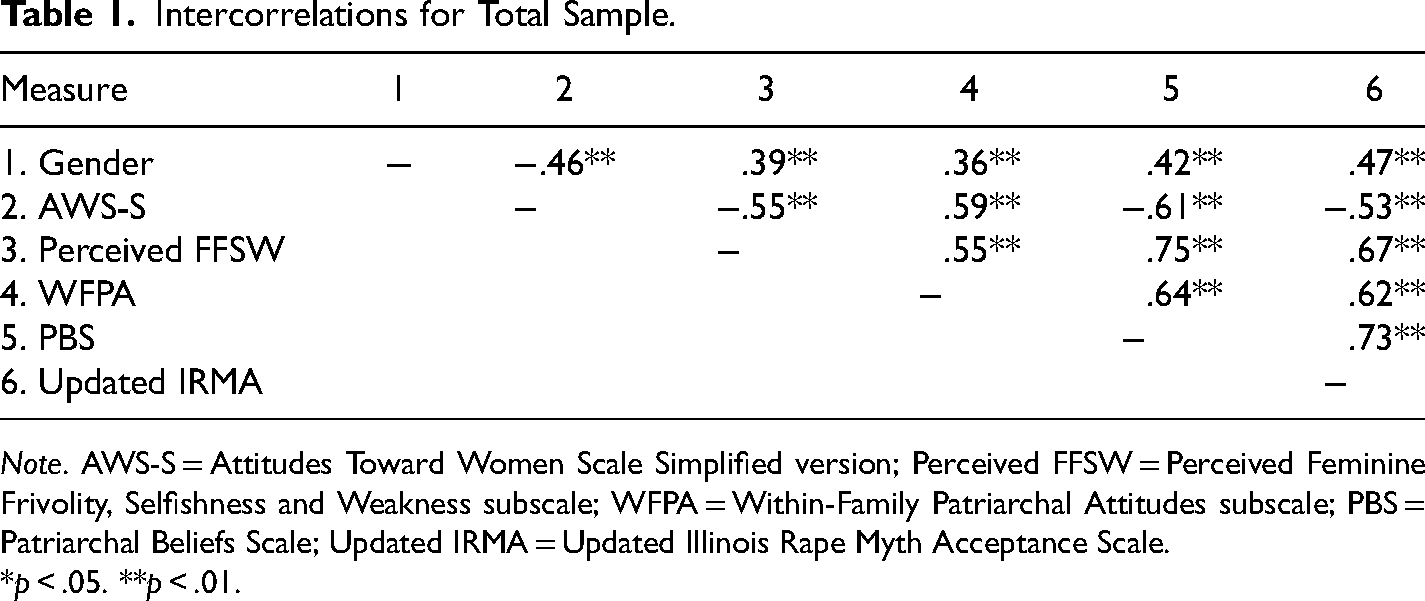
Intercorrelations between the main variables/measures to be used for hypothesis testing indicated that gender, attitudes towards gender roles and patriarchal norms were significantly related to rape myth acceptance (see Table 1).
Intercorrelations for Total Sample.
Note. AWS-S = Attitudes Toward Women Scale Simplified version; Perceived FFSW = Perceived Feminine Frivolity, Selfishness and Weakness subscale; WFPA = Within-Family Patriarchal Attitudes subscale; PBS = Patriarchal Beliefs Scale; Updated IRMA = Updated Illinois Rape Myth Acceptance Scale.
*p < .05. **p < .01.
Mean Scores
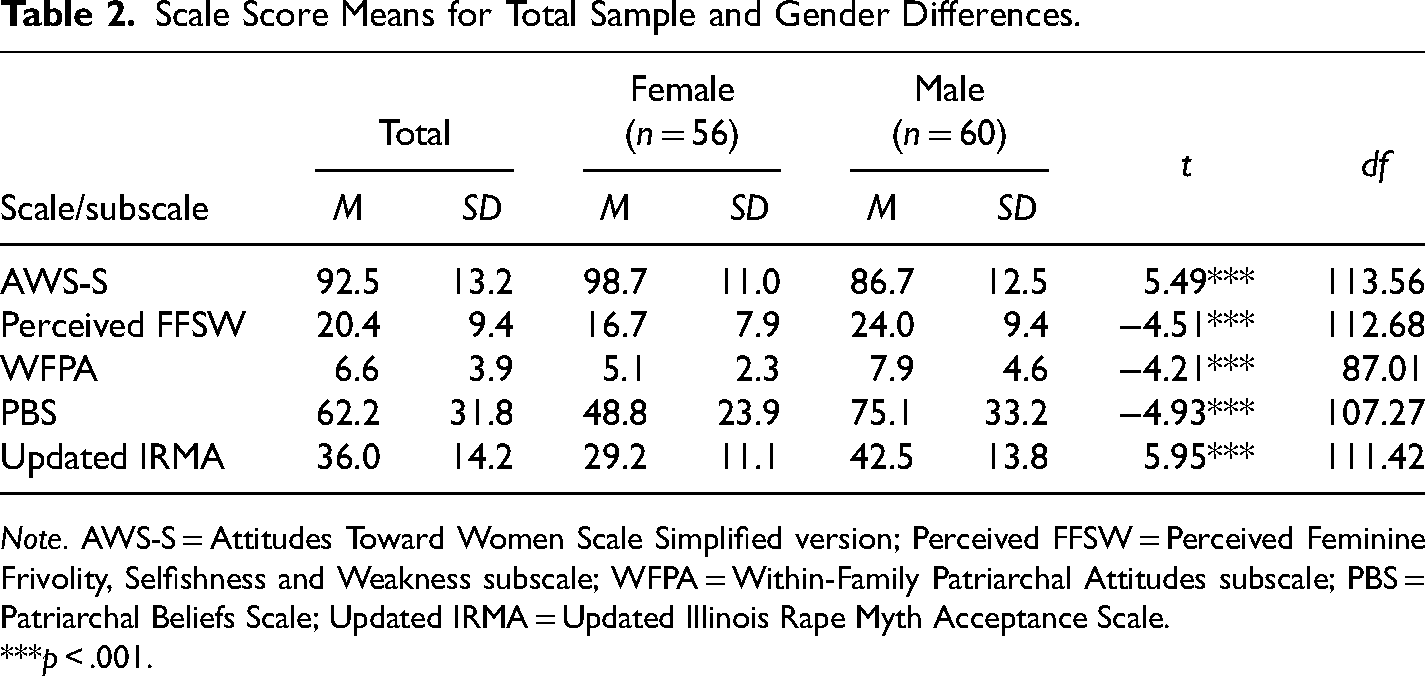
Overall, students reported having egalitarian attitudes toward gender roles (as shown by scores on Attitudes towards Women Simplified Scale [M = 92.5, SD = 13.2], scores on the Traditional Attitudes towards Indian Women scale, Perceived Feminine Frivolity Selfishness and Weakness subscale [M = 20.4, SD = 9.4] and Within-Family Patriarchal Attitudes subscale [M = 6.6, SD = 3.9]), and a low endorsement of patriarchal norms (M = 62.2, SD = 31.8) and rape myth acceptance (M = 36.0, SD = 14.2). Significant differences were reported between men and women for these attitudes and beliefs, with women displaying more egalitarian attitudes than men (see Table 2).
Scale Score Means for Total Sample and Gender Differences.
Note. AWS-S = Attitudes Toward Women Scale Simplified version; Perceived FFSW = Perceived Feminine Frivolity, Selfishness and Weakness subscale; WFPA = Within-Family Patriarchal Attitudes subscale; PBS = Patriarchal Beliefs Scale; Updated IRMA = Updated Illinois Rape Myth Acceptance Scale.
p < .001.
To facilitate comparisons with previous research using these scales we present more detail. Mean scores on patriarchal beliefs in the current study (M = 1.78, SD = 0.91) were similar to those found by Yoon et al. (2015), whose community sample mostly comprised European American women (M = 1.84, SD = 0.95). Mean scores on rape myth acceptance also showed similar patterns (M = 1.86, SD = 0.72) but were in fact lower by 1 point compared to those found by McMahon (2010) whose diverse student sample comprised of Caucasian, Asian, Black, Hispanic, and Middle Eastern men and women (M = 2.51, SD = 0.56). Mean scores on attitudes toward women in the current study were considerably more egalitarian (higher by 10 points) compared to those reported by a predominantly Caucasian community sample (M = 80, SD = 0.84) in the study by Nelson (1988) 30 years ago. See Yoon et al. (2015), McMahon (2010), and Nelson (1988) for more details.
Predictors of Rape Myth Acceptance
A three-step hierarchical multiple linear regression analysis was conducted to assess predictors of rape myth acceptance. Gender was entered at step one, since experiences based on gender begin in childhood. Attitudes towards gender roles were entered at step two since such attitudes were expected to be built and reinforced on the foundation of one's gendered experiences. Lastly, patriarchal beliefs were entered at step three to explore if it contributed uniquely to the prediction of rape myth acceptance above the more commonly measured gender role attitudes.
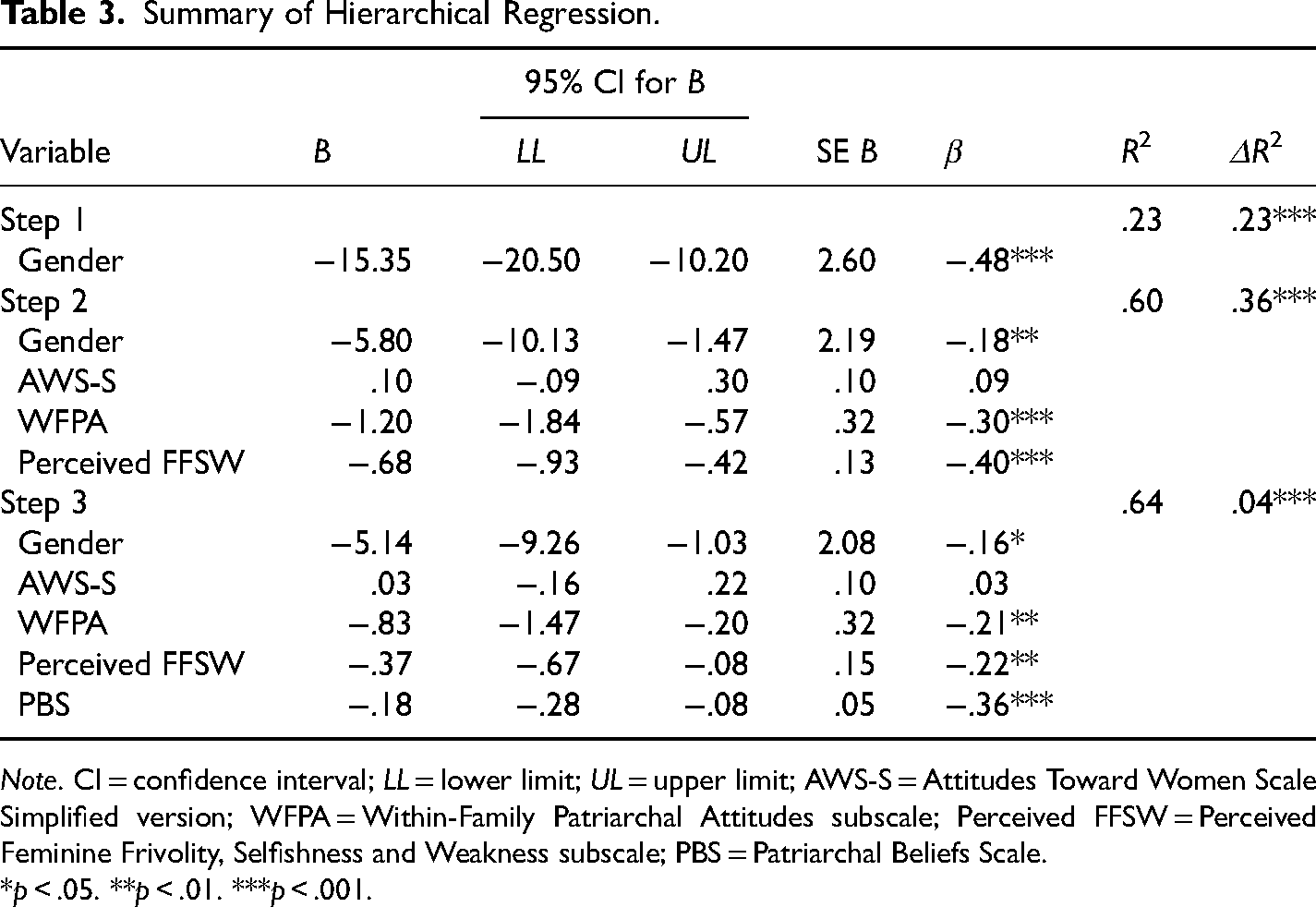
The complete results of the hierarchical regression analysis are shown in Table 3. At step 1 gender was significant, R2 = 0.23, F(1, 114) = 34.88, p < .001, accounting for 23% of the variation in rape myth acceptance. Scores on attitudes toward gender roles (AWS-S, Perceived FFSW subscale and Within-Family Patriarchal Attitudes subscale) at step two increased the prediction of variation in rape myth acceptance to 60%, ΔR2 = 0.36, F(3, 111) = 33.53, p < .001. Inclusion of scores on PBS in step three contributed an additional 4% to the prediction of rape myth acceptance, ΔR2 = 0.04, F(1, 110) = 13.87, p < .001. The final model (at step three) predicted 64% of variance in rape myth acceptance, in which gender, t(110) = −2.48, p = .02, within-family patriarchal attitudes, t(110) = −2.62, p = .01, perceived feminine frivolity, selfishness and weakness, t(110) = −2.50, p = .01, and patriarchal beliefs; t(110) = −3.72, p < .001, were significant predictors. Attitudes toward women (as measured by the AWS-S) was not a significant predictor in this model (p = .75) since the subscales of the TAIW were stronger predictors, when AWS-S scores were controlled. The study hypothesis was supported since the final model of the hierarchical regression (including all five variables) indicated that gender, attitudes toward gender roles and patriarchal beliefs in combination, were strong predictors of rape myth acceptance.
Summary of Hierarchical Regression.
Note. CI = confidence interval; LL = lower limit; UL = upper limit; AWS-S = Attitudes Toward Women Scale Simplified version; WFPA = Within-Family Patriarchal Attitudes subscale; Perceived FFSW = Perceived Feminine Frivolity, Selfishness and Weakness subscale; PBS = Patriarchal Beliefs Scale.
*p < .05. **p < .01. ***p < .001.
Discussion
This study examined predictors of rape myth acceptance among students who are members of the South Asian diaspora in a Western country, Canada. The findings indicated that gender and attitudes toward gender roles and patriarchal norms, when combined, were strong predictors of rape myth acceptance among South Asian students, accounting for more than 60% of the variation in these attitudes. The ethnically diverse sample of South Asian students in this study, comprised of both domestic and international student groups, held generally egalitarian attitudes, with similarities between mean scores reported in this study and previous studies of South Asian and other students (e.g., Yoon et al., 2015). These similarities in attitudes towards gender roles, patriarchal beliefs and rape myth acceptance counter Eurocentric perceptions of South Asian communities as being comparatively less egalitarian.
Though students reported low endorsement of rape myth beliefs overall, South Asian men had a greater tendency to believe in these rape myths compared to South Asian women. This aligns with previous studies using South Asian students (e.g., Jamshed & Kamal, 2021; Nadeem & Shahed, 2017) that highlight gender as a predictor of rape myth acceptance, where men deflected responsibility for sexual violence by focusing more on the victim's attire, personality and character, compared to women. Men from all cultural groups studied in North America have higher levels of rape myth acceptance compared to women, as reflected in a meta-analysis of 37 studies on rape myth acceptance conducted within North America, which reported an overall mean effect size of 0.58 (ES = 0.07, p < .001) indicating a strong the relationship between rape myth acceptance and gender in all 37 studies (Suarez & Gadalla, 2010).
Differences between men and women in gender-role attitudes and beliefs are consistent with previous studies in both North American samples (Berkel et al., 2004; McMahon, 2010; Yoon et al., 2015) and South Asian samples (Jamshed & Kamal, 2021; Tummala-Narra et al., 2017; Yoon et al., 2019). These studies and our findings show that across race and ethnicity, women endorse more egalitarian attitudes than men, perhaps explained by the reality that those who belong to oppressed social groups are more likely to see value in having egalitarian systems than those who benefit from the existing system (Berkel et al., 2004; Yoon et al., 2015). Furthermore, it challenges Eurocentric perceptions of South Asians as being nonegalitarian (e.g., men inherently violent, women submissive) compared to other racial or ethnic groups.
As expected, even with students’ gender taken into account, their attitudes toward gender roles uniquely contributed to the prediction of rape myth acceptance, with more traditional attitudes related to higher rape myth acceptance. Previous studies using majority students in North America (King & Roberts, 2011; White & Kurpius, 2002) and South Asian students in India (Hill & Marshall, 2018) have similarly highlighted the role of traditional gender roles as a predictor of rape myth acceptance. A study on rape myth acceptance between first- and second-generation South Asians in the United States (Devdas & Rubin, 2007) showed that first-generation South Asian women were more likely to believe that traditional attitudes ‘protect’ women and that disregarding traditional gender role scripts may potentially reduce women's safety from violence or indicate sexual willingness, holding women responsible for experiencing sexual violence.
This study also demonstrated that, of the two measures used to assess attitudes toward gender roles, the TAIW, a measure created to assess traditional negative attitudes toward Indian women (Singh & Aggarwal, 2020), was a better predictor than the AWS-S (Nelson, 1988), which was developed with mostly Caucasian samples to measure attitudes toward gender roles. These findings are supported by a recent study by Singh and Aggarwal (2020). Significant positive correlations were found between the TAIW subscales and an adapted version of the Violent Attitudes Women Scale, which showed that perceptions of (Indian) women as frivolous, selfish, and weak by nature and endorsement of within-family patriarchal structures were both related to the justification of various forms of violence against women, including sexual violence (Singh & Aggarwal, 2020). Such negative traditional attitudes focus on narratives that South Asian women deserve an inferior status in society due to their negative attributes (e.g., self-centeredness, physical weakness) which could provide a basis for justifying experiences of sexual violence as caused by lapses on their (women's) part. This suggests that prominent traditional negative attitudes toward women within the South Asian context are more meaningful in predicting rape myth acceptance compared to gender role measures developed in non-South Asian contexts since they are able to capture community-specific attitudes toward South Asian women.
Patriarchal norms were an important contributor to rape myth acceptance beyond gender and attitudes toward gender roles, indicating that higher endorsement of patriarchal norms contributes to higher levels of rape myth acceptance above other factors studied more often. Previous studies using North American populations have alluded to the influence of patriarchal norms on RMA (Brinson, 1992; Ryan, 2011) though none have empirically tested the role of these beliefs in predicting RMA. This finding suggests that ideologies of male dominance and female submissiveness in society underlie the acceptance of rape myths since they justify acts of aggression by men to maintain such power structures (Burt, 1991/1998) and suggest that women who challenge their status in society can be rightfully punished with sexual violence. These claims are supported by a recent qualitative study focusing on perceptions toward rape held by young men from Kerala, India (Reshma et al., 2022). In the study participants discussed the patriarchal nature of the Indian culture, where women are treated as being subordinate to men and that sexual coercion of women was a way to uphold and exert patriarchal authority (Reshma et al., 2022). Studies with immigrant South Asian women (Abraham, 1999; Shankar et al., 2013; Shirwadkar, 2004), have also highlighted the influence of patriarchal beliefs in justifying forms of violence against women such as domestic violence and marital rape. In line with these studies, the current study demonstrated that accepting male dominance in society as the default status can contribute to higher levels of rape myth acceptance among South Asian individuals.
The current study's findings are also supported by recent studies by Fansher and Zedaker (2022) and Xue and Lin (2022) that demonstrated the predictive relevance of gender, gender roles, and adversarial heterosexual/sexual beliefs in levels of rape myth acceptance. However, it should be noted that the patriarchal beliefs scale (Yoon et al., 2015) used in our study captures beliefs related to the structural subordinate position of women across social systems, which is not found in measures of adversarial heterosexual/sexual beliefs (Burt, 1980; Lonsway & Fitzgerald, 1995). Therefore, the current study replicates findings related to predictive factors of rape myth acceptance found in non-South Asian samples, while meaningfully illustrating the unique contribution of beliefs supporting male domination at the micro-, meso-, and macro-level systems on rape myth acceptance.
Limitations
Study participants represent an educated young adult group of South Asians proficient in English whose attitudes/beliefs likely do not represent the broader community of young South Asian adults in Canada. Due to an oversight, the study did not ask for the students’ specific age, although the eligibility screen for the study ensured that students belonged to the 17–25 age category. As a result, mean age could not be calculated, and any other age-related tests or inferences could not be made.
The study did not focus on factors other than gender and domestic versus international student status that could be important to the development or maintenance of rape myth acceptance. For example, the study did not ask about previous experiences of sexual violence faced by participants or someone known to them, which could impact levels of rape myth acceptance (e.g., Lathan et al., 2023). There is some suggestion in the literature that queer-identified students in North America have lower rape myth acceptance than their gay or straight counterparts (e.g., Schulze & Koon-Magnin, 2017). While the sample did include a small number of lesbian/gay students, we do not know if the rape myth acceptance of South Asian students with marginalized sexual (or gender) identities shows a similar pattern.
Study Strengths and Implications
Compared to previous studies on rape myth acceptance among South Asians which comprised higher numbers of women than men (e.g., Tummala-Narra et al., 2017 [73% women]; Das & Bhattacharjee, 2021 [68% women]), the gender composition of the current study was balanced. This allowed for a more nuanced exploration of South Asian men’s and women's attitudes and perceptions of rape myth acceptance. The study recruited roughly equal numbers of domestic students and international students of South Asian ancestry. Research on South Asian students and RMA usually excludes international students (e.g., Tummala-Narra et al., 2017) or focuses entirely on students living in the South Asian subcontinent (e.g.,: Jamshed & Kamal, 2021); therefore, this approach of ensuring both student groups were represented is a strength of the present study. The ethnic diversity of the sample is an added strength of the study since participants represented most ethnic groups of South Asian ancestry found in Canada (Statistics Canada, 2017) and additional Dravidian (e.g., Telugu, Mangalorian) and North Indian (e.g., Haryanvi) ethnicities. The inclusion of the Traditional Attitudes Toward Indian Women Scale, a scale originally developed for Indian samples, helped capture culturally specific sentiments related to gender roles in this study, demonstrating its relevance for South Asian samples outside India. The use of the Patriarchal Beliefs Scale highlighted the unique contribution of patriarchal beliefs in shaping rape myth acceptance and distinguished these from attitudes toward gender roles as shown by the moderate correlation between them and their independent influence on rape myth acceptance in the regression model.
This study went beyond past research measuring RMA levels (e.g., Devdas & Rubin, 2007; Jamshed & Kamal, 2021) to focus on the influence of theoretically relevant factors on RMA. This is an important contribution to the understanding of RMA for South Asians and adds to the growing literature examining factors predicting RMA (e.g., Navarro & Ratajczak, 2022) across all cultural groups. Moreover, study findings contradict Eurocentric views of South Asians and sexual violence by focusing solely on a South Asian sample instead of conducting comparative analyses, while highlighting similarities in mean scores with previous studies’ North American samples.
The findings have implications for prevention, resources, and support for South Asian university students. The literature that supports content for sexual violence interventions in universities mostly focuses on factors that impact students from the dominant culture such as ‘drinking culture’ (Relyea & Ullman, 2015) which may not be as relevant for minority or international students. A recent study by McMahon and Seabrook (2020) revealed that minority students, mainly Black and Asian women, face additional barriers to disclosing experiences of sexual violence such as having to be ‘cultural protectors,’ with fears of disclosures reflecting poorly on their communities. As discussed previously, this finding is consistent with the emphasis placed on South Asian women to protect their honor and the honor of the community they belong to by not disclosing sexual violence. These perceptions are somewhat different from those of their Caucasian counterparts, which is why a ‘one-size-fits-all’ approach to support and interventions may not be helpful for minority students in universities (McMahon & Seabrook, 2020). Targeting attitudes and beliefs related to gender roles and patriarchal norms could be more effective in reducing rape myth acceptance among South Asian students than focusing education on facts about rape since these were shown to be strong predictors of rape myth acceptance. When paired with social norm information obtained from the study (e.g., the average South Asian student holds egalitarian views and does not support rape myths), this information could be useful for those developing prevention based on social norms theory (e.g., Dardis et al., 2016) to consider context-specific factors when targeting South Asian university students. This would also be in line with efforts within the broader community in Canada, where culturally specific interventions for South Asians have been a long-standing tradition by South Asian women's activist groups against gendered violence. Examples include the India Mahila Association based in Vancouver, the South Asian Women Center based in Toronto (began in the 1970s; Kang, 2006) with newer nonprofit organizations such as Laadliyan based in the Peel Region of Ontario (Laadliyan, 2023) joining the movement to advocate and empower South Asian women. University educators collaborating with such organizations could benefit from the best practices they have developed which would support new or adapted empirically supported programs catering to South Asian university students.
Footnotes
Declaration of Conflicting Interests
The authors declared no potential conflicts of interest with respect to the research, authorship, and/or publication of this article.
Funding
The authors received no financial support for the research, authorship, and/or publication of this article.
