




Abstract
This article examines the relationship between maternal exposure to adverse childhood experiences (ACEs), intimate partner violence (IPV), and two aspects of maternal mental well-being—stress and depressive symptoms in the context of Tirana, Albania. Data were obtained from a representative sample of 328 mothers of 2–3-year-old children, who were registered in Tirana's public nurseries. Findings show that maternal ACEs are positively associated with stress levels (β = .210, z = 4.03, p < .001) and depressive symptoms (β = .129, z = 2.62, p < .01). In addition, IPV partially mediates the effect of ACEs on maternal stress (β = .081, z = 3.75, p < .001) and fully mediates the effect of ACEs on depressive symptoms (β = .054, z = 2.87, p < .01). These results suggest that among mothers of toddlers in Tirana, ACEs influence stress levels both directly and via IPV, while they influence depressive symptoms only via IPV. The findings demonstrate long-term effects of maternal exposure to interpersonal violence on mental well-being.
Introduction
The impact of interpersonal violence on a woman's mental well-being is well-documented, with experiences of victimization and interpersonal trauma rendering women vulnerable to a range of psychological disorders, such as anxiety, depression, and post-traumatic stress disorders (Pico-Alfonso et al., 2006; Satyanarayana et al., 2015). While compromised mental well-being is detrimental for women themselves, psychological depletion among women who are mothers has been further linked to poor parenting, including a detached mother–child interaction, a lack of affection/warmth, neglect, and the use of harsh, abusive, or otherwise ineffective discipline (Bornstein, 2015; Kim et al., 2010; Prendergast & MacPhee, 2020). Poor mental health in mothers has been demonstrated to have adverse consequences on their children's health and development (Liu et al., 2017; Maggi et al., 2010). While rates of maternal mental disorders in low- and middle-income countries (LMICs) are estimated to be higher than in high-income countries (HICs) (Hussain et al., 2020; Walker et al., 2007), prevalence rates on parental mental health in Albania specifically are currently lacking (UNICEF & Countdown to 2030 Women's, Children's and Adolescent's Health, 2021). Maternal care in Albania is mainly focused on medical care, and little has been done to address the psychosocial needs of mothers (Gori et al., 2010; Meçe, 2021).
Experiences of intimate partner violence (IPV) (DeVries et al., 2013; Gustafsson & Cox, 2012) and a history of childhood abuse and neglect (Guedes et al., 2016; Heidinger & Willson, 2019) have individually been identified as sources of poor mental well-being among mothers, including experiences of psychological stress and depressive symptoms. Nevertheless, the cumulative effects of different forms of interpersonal violence across the mother's lifespan on her mental well-being have been rarely investigated (Guedes et al., 2016; Kennedy et al., 2014). Researchers have been continuously calling for more efforts to bridge this divide, arguing that studies focused on one form of violence in isolation from others may overlook important risks, vulnerabilities, and consequences of multiple forms of violence within the family and across the lifespan (Lessar & Alvarez-Lizotte, 2015; Mercy et al., 2013). Moreover, while previous studies have found that women who experience adverse childhood experiences (ACEs) are more likely to encounter IPV during adulthood (Patel et al., 2012) and that health risks are particularly high among women who have experienced both ACEs and IPV (Becker et al., 2010), the underlying mechanisms between violence exposure during the life course and mental well-being outcomes remain rather unexplored (see Seon et al., 2022).
This article aims to address three issues. First, it presents novel data on maternal mental well-being and maternal exposure to interpersonal violence within the context of Tirana, Albania. Second, it examines the links between maternal ACEs and mental well-being, as measured by stress and depressive symptoms. Third, it examines IPV as a mediator of the effect of ACEs on stress and depressive symptoms among mothers of 2–3-year-old children in Tirana. The current study was guided by the following research questions: (a) How are ACEs associated with maternal levels of stress and depressive symptoms?; and (b) How does IPV mediate the relationship between ACEs and maternal levels of stress and depressive symptoms? The study hypothesized that: (a) ACEs will be positively associated with levels of maternal stress and depressive symptoms, and (b) IPV will mediate the relationship between ACEs and stress and depressive symptoms. Presenting novel evidence on the link between maternal exposure to interpersonal violence and maternal mental well-being in Albania's capital, Tirana, will help address the current gap in knowledge and has the potential to contribute to shaping policies that favor maternal, child, and family well-being in Albania. The article further contributes to the growing literature that attempts to increase international perspectives in the study of violence against women in LMICs.
Methods
Study Design and Sample
The questionnaire design of this study has been partly informed by the Evidence for Better Lives Study (EBLS), a comparative birth-cohort study led by the Violence Research Centre at the University of Cambridge (see Valdebenito et al., 2020). However, the present study is focused on mothers of toddlers rather than the period of pregnancy, as is the case in EBLS. This is a cross-sectional study that took place in Tirana, the capital and most populous city in Albania (INSTAT, 2018). With an area of 41.8 square kilometers, it is located in the center of the country, and it is the leading economic and political center in Albania. Its population in 2020 amounted to 850,530 inhabitants (Bashkia Tiranë, 2020). Tirana has 11 administrative units, which Dumani et al. (2018) have grouped into four main clusters based on these units’ socio-economic development, and 34 public nurseries. Public nurseries were the location of participant recruitment. Eight out of the 34 public nurseries in Tirana were selected to participate in the study. The sample consists of a representative sample of 328 mothers of 2–3-year-old toddlers, who were registered in Tirana's public nurseries.
The nurseries were the unit of randomization, and they were randomly selected based on the socio-economic status of the geographical area in which they were located. Three main steps were followed to select the final target sample of eight nurseries. First, all the 34 public nurseries in Tirana were grouped by administrative units. Second, the nurseries were allocated the cluster score of the unit they were located in. Each developmental cluster was given a number from one to four. Third, two nurseries per cluster were selected through systematic random sampling, with the sampling fraction per cluster being calculated by dividing two with the total number of nurseries in each respective cluster. Mothers of 2–3-year-old children were contacted in each of the chosen nurseries based on convenience and availability, with the number of participants per nursery ranging from 38 to 45. Four inclusion criteria guided the recruitment of mothers: (a) They had to live in the same administrative unit as the nursery at hand; (b) They had to have at least one child aged 2–3 years old; (c) Their toddler had to be registered in the nursery at hand; (d) The mother had to be older than 18 years of age. The overall participation rate was 84%.
Instruments and Measures
Dependent Variables
Independent Variables
Control Variables
Control variables included in the mediation models involved the following: mother's age (open answer, continuous), mother's educational level (0 = below undergraduate degree; 1 = undergraduate degree or above), mother's birthplace by Albanian prefectures (0 = all prefectures other than Tirana; 1 = Tirana), mother's employment status (0 = not employed; 1 = employed), mother's marital status (0 = not married; 1 = married), whether the mother had suffered from postnatal depression (0 = no; 1 = yes), mother's ethnicity (0 = not Albanian; 1 = Albanian), mother's number of children (ordinal, but treated as continuous), household income (ordinal, but treated as continuous), whether the biological father of the target toddler ever abused with alcohol or drugs (0 = no; 1 = yes), whether the biological father of the target toddler was ever criminally convicted (0 = no; 1 = yes), and the mode of questionnaire delivery (measured by two dummy variables: the first variable was coded as 0 = self-completed, 1 = face-to-face interview; the second variable was coded as 0 = self-completed, 1 = online interview).
Translation and Data Collection
The instruments were translated in whole by four individuals, who were native Albanian speakers, proficient in English, and who were familiar with psychometrics as well as the health sector. Three modes of questionnaire delivery were employed to collect the data: face-to-face interview (N = 170), self-completed (N = 116), and online interview (N = 42). 1 While the initial plan was to only conduct face-to-face interviews, adaptations had to be made due to the COVID-19 pandemic as well as the participants’ availability. The data collection process was carried out single-handedly by the first author and lasted from September 2020 to May 2021.
The influence that the delivery mode of the questionnaires (face-to-face vs. self-completed vs. online interview) could have had on the validity of the collected data was explored for the following constructs: maternal depression, perceived stress, ACEs, IPV, developmental level of the neighborhood in which the mother resides, mother's age, mother's birthplace (as coded by Albanian regions), mother's education, and her employment status. For the purposes of these analyses, the coding of the “mode” variable was done as follows: Face-to-face interview = 1; Self-completed = 2; Online interview (phone and WhatsApp) = 3.
One-way ANOVAs were conducted to determine if the means of the continuous constructs differed depending on the modes of administration. Statistically significant differences between groups at the 1% and 0.1% level were found for stress [F(2, 322) = 4.74; p < .01], depressive symptoms [F(2, 324) = 31.56; p < .001], ACEs [F(2, 324) = 7.08; p < .01], and IPV [F(2, 319) = 4.70; p < .01]. Tukey post-hoc tests revealed that all continuous constructs were in general significantly higher in the “Face-to-face interview” group and the “Online interview” group when compared to the “Self-completed” group (see Table 1). These results suggest that mothers were less likely to disclose undesirable outcomes such as exposure to violence and poor mental well-being when the mode of administration of the questionnaire was self-completed.
Means, Standard Deviations, and One-Way Analyses of Variance of Key Continuous Constructs According to the Mode of Delivery.
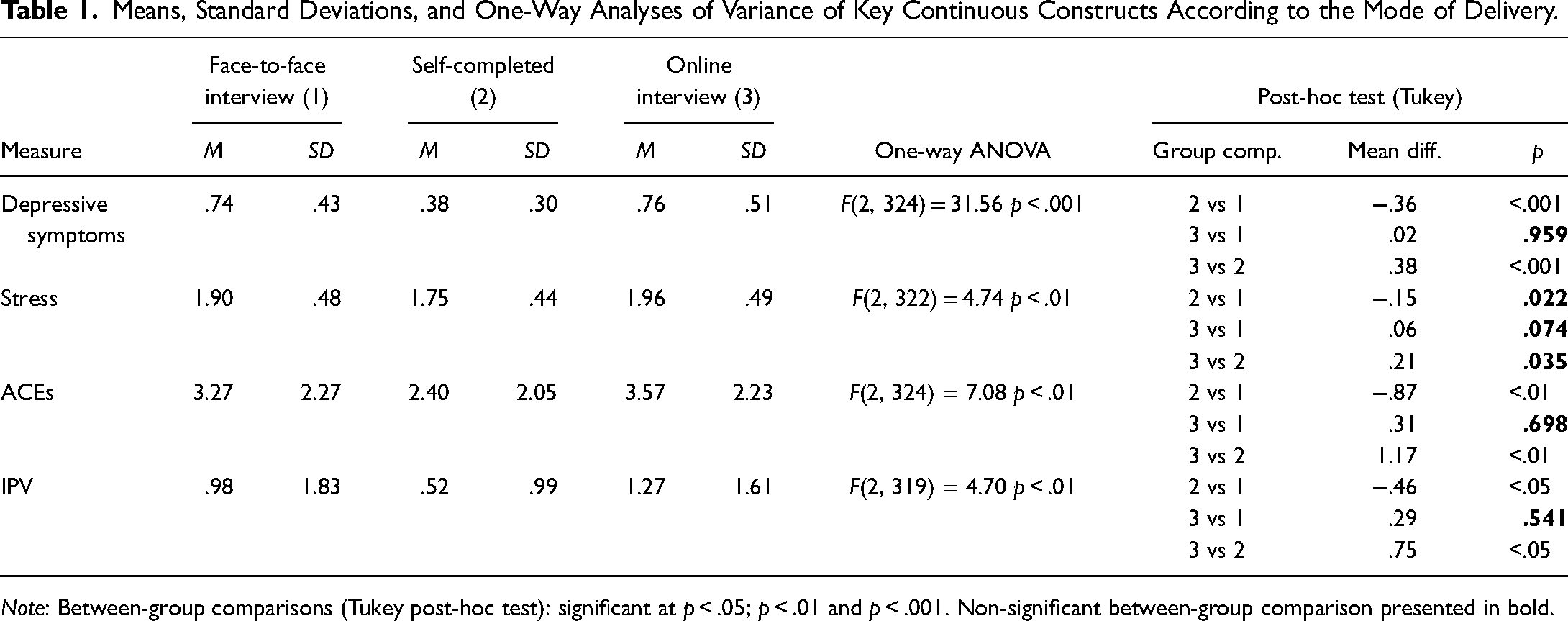
Note: Between-group comparisons (Tukey post-hoc test): significant at p < .05; p < .01 and p < .001. Non-significant between-group comparison presented in bold.
Chi-square tests of independence were run to check if the counts and percentages of the categorical constructs differed depending on the different modes of administration. Significant associations at the 1% and 0.1% level were found between the mode of delivery and neighborhood socio-economics status [χ2 (6, N = 328) = 17.37, p < .01] and between the mode of delivery and mothers’ employment status [χ2 (2, N = 328) = 16.19, p < .001]. Mothers from a high SES neighborhood were more likely to be interviewed face-to-face, while mothers from a low and medium (1) SES neighborhood were more likely to opt out for self-completion. Mothers who were unemployed were more likely to be interviewed face-to-face (83.33%) as compared to mothers who were working (47.95%). This might be explained by the fact that mothers who were unemployed were more available and had less commitments than employed mothers.
The face-to-face interviews were carried out in the form of structured paper-and-pen interviews (PAPI). Despite the advantages of Computer-Assisted Personal Interviews (CAPI), the use of PAPI still persist in developing countries given the limitations in technology and internet access (Campbell et al., 2014). Even on its own, PAPI has several advantages, such as being less costly and/or allowing for a shorter period of data collection when compared to CAPI (Caeyers et al., 2010; Lavrakas, 2008).
Data Analysis
Characteristics of the study population were described using counts and percentages for categorical variables, and means (SD) for continuous variables. Two path analyses models were conducted to examine whether IPV mediated the effect of ACEs on stress and depressive symptoms, respectively. The effects that these three main constructs have on each other should be interpreted with caution given that the data are cross-sectional. The estimation method of the path analyses in this study was done with maximum likelihood parameters. Full information maximum likelihood estimation was used to handle missing data by preserving all available data that would most likely produce the estimates from the study sample (Acock, 2005). All analyses were conducted using STATA IC Release16. Materials and analysis code for this study are available by emailing the corresponding author.
Ethical Considerations
Ethical approval and institutional access were obtained from the Institute of Criminology, University of Cambridge and the General Directory of Nurseries and Kindergartens at the Municipality of Tirana. Permission to conduct the study was also obtained by each director of the eight nurseries selected to participate in the study. Before starting the data collection process, all participating mothers were given information sheets and asked to sign an informed consent form.
Results
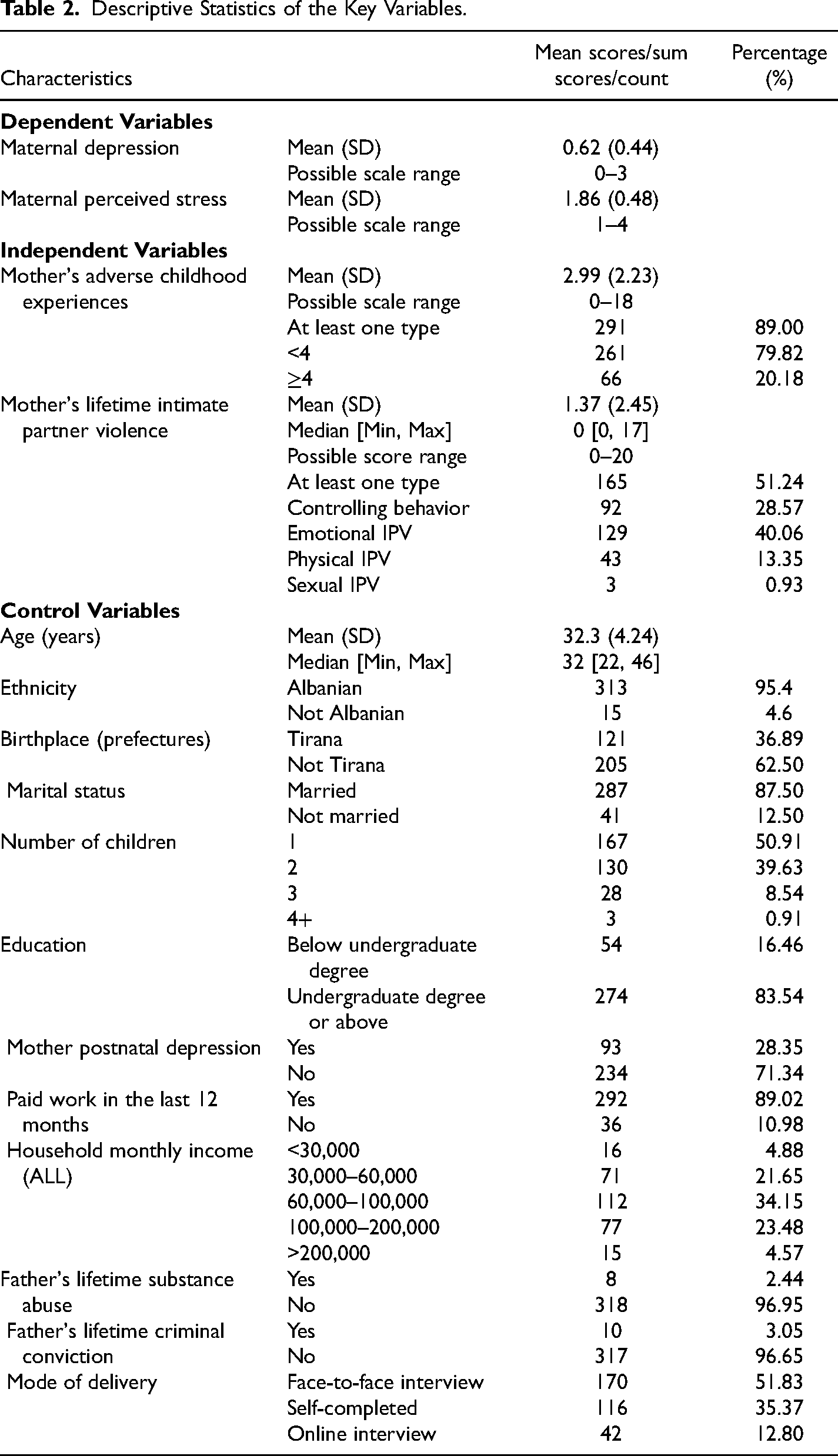
Table 2 presents the characteristics of the study population, based on the constructs that are included in the mediation models. The mothers’ mean age was 32.3 years (SD = 4.24), with a range between 22 and 46 years. Most mothers were Albanian (95.4%), were married (87.50%), had one child (50.91%), had worked in the last 12 months (89.02), had not suffered from postnatal depression (71.34%), and had finished undergraduate studies or above (83.54%). The majority of mothers had a monthly household income of 60,000–100,000 ALL 2 (34.15%). Concerning fathers’ characteristics, most had never been criminally convicted (96.65%) and had never abused with substances (96.95%). The majority of mothers had experienced at least one type of ACE (89%), with 20.18% of mothers having experienced four ACEs or more. In total, 51.24% had experienced at least one type of IPV (controlling behavior, emotional, physical, or sexual violence) in their lifetime, with 28.57% of mothers enduring controlling behavior from their partners, 40.06% having experienced emotional IPV, 13.35% physical abuse, and 0.93% sexual abuse.
Descriptive Statistics of the Key Variables.
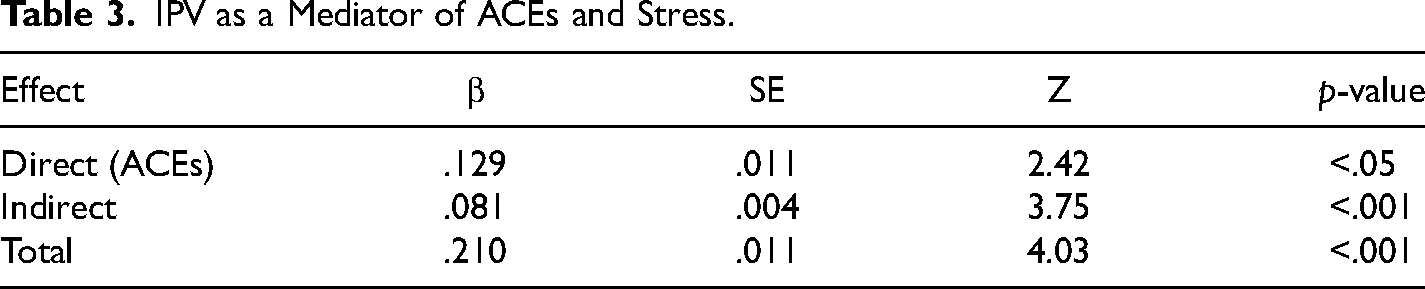
A path analysis was estimated to test the mediating effect of IPV in the relationship between maternal ACEs and stress, while holding the control variables constant (see Table 3). The fitted model (χ² = 227, p < .001; CFI = 1.0; RMSEA = .00, p = 1.0; CD = .455) used all 328 observations. The results show that maternal ACEs are positively associated with stress levels (β = .210, z = 4.03, p < .001). Analyzing the indirect effects, results reveal that IPV significantly mediates the relationship between ACEs and stress (β = .081, z = 3.75, p < .001). Nevertheless, the results also suggest that even after accounting for the mediating role of IPV, ACEs still have an effect on stress (β = .129, z = 2.42, p < .05). Results indicate that the proportion of total effect mediated by IPV is 38.6%, thus suggesting that IPV partially mediates the effect of ACEs on stress, while holding the control variables constant. It is assumed that ACEs temporally precede current stress and/ or IPV by the retrospectively reported adverse experiences before 18 years of age. While this directionality is less clear when it comes to IPV and stress, the temporal directionality from IPV to stress is assumed by the fact that IPV was measured during the mothers’ lifetime, while stress was captured only for the past month. Nevertheless, the fact that the data were gathered cross-sectionally should be kept in mind when interpreting the path analyses.
IPV as a Mediator of ACEs and Stress.
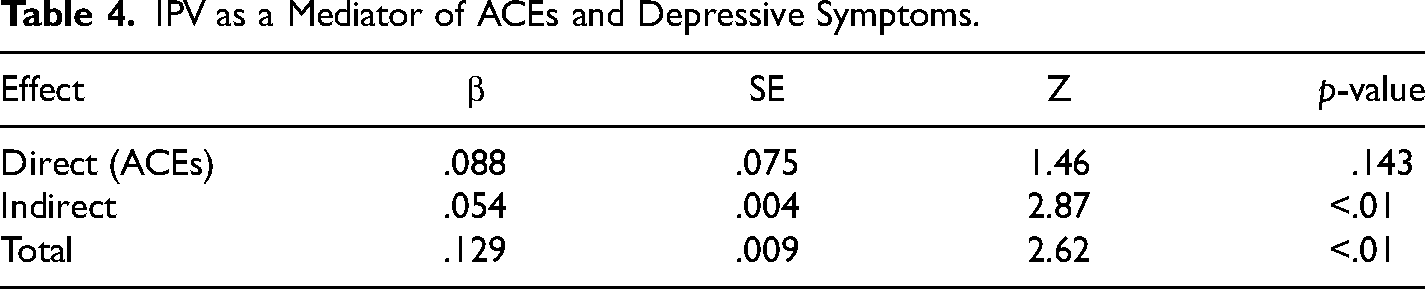
A further path analysis was estimated to test the mediating effect of IPV in the relationship between ACEs and depressive symptoms, while holding the control variables constant (see Table 4). The fitted model (χ² = 254, p < .001; CFI = 1.0; RMSEA = .00, p = 1.0; CD = .514) used all 328 observations. The results show that ACEs are positively associated with depressive symptoms (β = .129, z = 2.62, p < .01). Analyzing the indirect effects, results reveal that IPV significantly mediates the relationship between ACEs and depressive symptoms (β = .054, z = 2.87, p < .01). The results also suggest that after accounting for the mediating role of IPV, ACEs does not have an effect on depressive symptoms, thus suggesting that IPV fully mediates the effect of ACEs on depressive symptoms, while holding the control variables constant. It is assumed that ACEs temporally precede depressive symptoms and/or IPV by the retrospectively reported adverse experiences before 18 years of age. While this directionality is less clear when it comes to IPV and depressive symptoms, the temporal directionality from IPV to depressive symptoms is assumed by the fact that IPV was measured during the mothers’ lifetime, while stress was captured only for the past month. Nevertheless, the fact that the data were gathered cross-sectionally should be kept in mind when interpreting the path analyses.
IPV as a Mediator of ACEs and Depressive Symptoms.
Discussion
This study revealed that almost 90% of the mothers of 2–3-year-old children in Tirana had been exposed to at least one type of ACE (89%). This percentage is higher than the existing studies on adults’ ACEs in Albania. For example, a study conducted by Qirjako et al. (2013) on the prevalence of ACEs found that 72.4% of Albanian young adults—representatively selected from public universities in major cities (N = 1,437)—had experienced at least one ACE. Compared to other countries in the region, the findings of the current study also report a higher prevalence of adults’ exposure to ACEs, with 70% of adults having experienced at least one form of ACE in Serbia (Kostić et al., 2019) and 64.5% of young adults having experienced at least one form of ACE in Romania (Baban et al., 2013). The disparities in percentages of ACEs across these studies might be attributed to the different target populations, with the participants of the current study being women only and generally born during a period of socio-economic and political turmoil in Albania.
The prevalence of lifetime IPV among mothers of toddlers in Tirana (51.24%) however seems to be similar to the ones reported in previous studies on violence against women by intimate partners conducted in Albania (one in two women; UNDP, 2018) and in Kosovo (54% of women; OSCE, 2019a), but higher than the percentages reported in Bulgaria (28%; Gender Equality Index, 2017) and Bosnia and Hercegovina (36%; OSCE, 2019b). It is of worth to note however that the lifetime IPV composite measure in the current study includes “controlling behavior” in addition to physical, emotional, and sexual violence, while that is not always the case for other similar studies. Another interesting finding was the fact that the majority of mothers in the current study (83.54%) held an undergraduate degree, while the OECD estimate of 25–34-year-olds with tertiary education is 45.6% (OECD, 2022). This might be related to the fact that the study took place in the capital, to the low quality and increased access to higher education in Albania (Latifi, 2010; Mora et al., 2015), or to the potential reluctance of mothers with lower levels of education to participate in the study.
Regarding maternal ACEs, we see that it is significantly associated with both stress and depressive symptoms while holding the control variables constant, which supports the study hypothesis (a). This finding is in line with previous studies that have found a link between ACEs and adult mental health issues (Hughes et al., 2017; Karatekin, 2018; Watt et al., 2020). The standardized coefficient of total effects of ACEs on stress levels was higher than on depressive symptoms. One of the reasons that might explain these results can be the notion that it is stress and its biological implications that lead to depressive symptoms. Previous studies have found that consistent experiences of stress, such as the long-lasting effects of stressful experiences during childhood, can lead to neurobiological disturbances underlying depression or particular depressive symptoms (Chrousos, 2009; Guilliams & Edwards, 2010; Tafet & Nemeroff, 2016; van Praag, 2004). The finding that maternal ACEs are associated with maternal stress levels and depressive symptoms suggests the need for initiatives that take into consideration the long-term effects of ACEs on adult mental well-being. Early prevention and intervention strategies, such as parent training programs, home visitations, or building safe communities, would help ensure a healthy start for children by alleviating or preventing future harm from ACEs, including compromised mental well-being or the potential transmission of intergenerational abuse. Previous research has indeed found that the effects of ACEs, such as mental health issues, function as mediating factors for the intergenerational transmission of child maltreatment (Chang et al., 2020; Frias-Armenta, 2002; Jaffee et al., 2013).
Additionally, the results showed that IPV fully mediated the effect that ACEs had on depressive symptoms and partially mediated the effect that ACEs had on stress levels, while holding all the control variables constant. This supports the study hypothesis (b). A similar conclusion was reported by Seon et al. (2022), who found that IPV partially mediated the effect that ACEs had on perceived physical health, mental health, and depression among a sample of college students in the United States. Nevertheless, contrary to the results reported by Seon et al. (2022), the current study found partial mediation only for stress and a full mediation for depressive symptoms. It can be argued that the effect of ACEs on depressive symptoms among mothers diminishes when compared to the effect of IPV, given the threat and abuse from the partner is present, on-going, and has several current implications on an emotional, physical, and financial level both for the mother and for the child. Future research needs to look at specific developmental processes that are disrupted by ACEs and how those negative experiences are particularly related to stress levels and depressive symptoms. Overall, the result from the current study, which shows that exposure to ACEs influences mental well-being outcomes via IPV among mothers of toddlers in Tirana, suggests a pathway of cumulative effects on maternal mental well-being from a series of lifetime interpersonal violence victimizations.
Strengths and Limitations
The main strengths of this study are related to the fact that it makes use of a probabilistic rather than a convenience sampling method, to the relatively high overall participation rate (84%), to all the data being collected by the first author, and to it presenting novel data on maternal mental well-being in Albania. The limitations are concerned with the limited sample size, the delivery of the questionnaire through three different modes of data collection, the restricted possibility of generalizing the findings to all Albanian mothers, the study outcomes being self-reported, as well as with the fact that this is a cross-sectional rather than a longitudinal study, which thus prevents one from drawing causal conclusions about the data. The limitation of using cross-sectional data is particularly relevant for the interpretation of the results from the mediation analyses (see Fairchild & McDaniel, 2017; Maxwell et al., 2011; Maxwell & Cole, 2007). Even though it can be argued that temporal order is established in the collected data due to the fact that ACEs took place before IPV, the participants’ recall of ACEs could have been influenced by their current psycho-emotional state. The use of PAPI instead of CAPI could also be considered a possible limitation.
Conclusions
This study was an initial attempt at uncovering the unexplored patterns of associations between exposure to interpersonal violence and mental well-being among mothers of 2–3-year-old children in Tirana, Albania. The results showed that ACEs were positively associated both with maternal stress levels and depressive symptoms. Path analyses also found that IPV partially mediated the effect that ACEs had on maternal stress and fully mediated the effect of ACEs on depressive symptoms. Both hypotheses of the current study were confirmed. The findings suggest the promotion of initiatives in favor of maternal support, maternal psychological well-being, and gender equality, as well as the elimination of violence against women and children. Future studies should consider increasing the sample size, taking a longitudinal approach to data collection, and employing a single mode of questionnaire delivery.
Footnotes
Acknowledgments
The authors would like to thank all the mothers who participated in the study, as well as the General Directory of Nurseries and Kindergartens at the Municipality of Tirana for the great collaboration.
Declaration of Conflicting Interests
The authors declared no potential conflicts of interest with respect to the research, authorship, and/or publication of this article.
Funding
The authors disclosed receipt of the following financial support for the research, authorship, and/or publication of this article: This study was funded by Newnham College and Cambridge Trust.

Author Contributions
Klea Ramaj conducted the majority of the work for this manuscript. She planned the study, collected the data, ran the analyses, and wrote the manuscript. Manuel Eisner supervised the research process and made comments on iterative drafts of the manuscript.