




Abstract
The invisible nature of economic abuse contributes to its pervasiveness. Through interviews with 14 women survivors in Canada, this study identifies the ways in which economic abuse is (in)visible to survivors. There were three major themes: “Constructing and maintaining the fairy-tale” describes how gender roles and ideas of love concealed abuse. “The normalization of financial problems in heterosexual relationships” examines how disagreements about money were normalized in ways that masked abuse. “Recognizing economic abuse” describes how breaking away from expectations was critical to recognition. These findings can aid in improving support to help survivors identify, avoid, and escape economic abuse.
Literature Review
Over the last century, women have conquered many of the most overt practices restricting their financial independence and economic opportunity, but the legacy of their historical relegation to the domestic sphere lingers. In North America, women still earn less than men on average (Gupta et al., 2022), are more likely to fall into poverty following a divorce (Leopold, 2018), and perform a wider share of unpaid household work and caretaking (Lachance-Grzela & Bouchard, 2010). If abuse is made possible by the existence of an unequal power dynamic (Messing, 2011), then women's economic vulnerability in their relationships could enable abusive strategies that are economic in nature. This is now recognized, and “economic abuse involves behaviors that control a woman's ability to acquire, use, and maintain economic resources, thus threatening her economic security and potential for self-sufficiency” (Adams et al., 2008, p. 564). 1
Overview of Economic Abuse
Researchers and advocates have long recognized the connection between access to economic resources and intimate partner violence (IPV; Pence & Paymar, 1993; e.g., “using economic abuse” is one of the spokes in the “Power and Control Wheel”). However, economic abuse has only recently received sustained research attention as its own dimension of IPV (Adams et al., 2008; Postmus et al., 2012; Sanders, 2015; Sharp, 2008). The emerging literature on economic abuse identifies it as a form of coercive controlling violence/intimate terrorism that exists within a wider pattern of power and control within an abusive relationship (Kelly & Johnson, 2008; Leone et al., 2007). Given that coercive controlling violence is more often perpetrated by men against women (Dutton & Goodman, 2005; Graham-Kevan & Archer, 2003; Johnson, 2006), it is likely that economic abuse is also more likely perpetrated by men against women. Although economic abuse has not been examined comprehensively in national surveys, the few items that are included show large gender disparities in lifetime prevalence, with women reporting twice or more that amount of economic abuse compared to men (Cotter, 2021; Leemis et al., 2022). The literature breaks down economic abuse into three main components: (a) financial control, where the abuser takes full control of the household's finances including money, good, and assets; (b) economic exploitation, where the abuser takes the victim's resources and/or creates debt under the victim's name worsening economic vulnerability and making it more difficult for the victim to remove themselves from the abusive relationship due to financial dependency; and (c) economic sabotage, where the abuser works to prevent the victim's independence such as their attempts to work or become educated by attending school (Anitha, 2019; Eriksson & Ulmestig, 2021; Kutin et al., 2017). Economic abuse often occurs concurrently with other forms of abuse. Among a group of women accessing IPV services in the US (N = 457; Stylianou et al., 2013), only 1.3% of the women reported experiencing economic abuse in isolation, with 16.3% reporting economic abuse happening together with psychological abuse. Far more common was the experience of economic, psychological, and physical abuse altogether with 75.8% of women reporting this combination of abusive behaviors in the past 12 months.
Although economic abuse has only recently received careful attention in the literature, there is evidence that it negatively impacts women's mental and physical health (Johnson et al., 2022) and is common among women experiencing IPV. In the US, studies with women accessing IPV services indicate that anywhere from 92% (Adams et al., 2008) to 99% (Postmus et al., 2012) of women in abusive relationships report experiencing some form of economic abuse from a current or former partner. Population-based prevalence statistics are more difficult to obtain, particularly when economic abuse is not yet well understood by the public. Corrie et al. (2013) have suggested that such estimates are likely to understate the prevalence of economic abuse because women may have difficulty distinguishing abusive behavior from their general economic insecurity. This is suggestive of a possible mechanism that keeps economic abuse hidden and difficult to recognize, thus underreported.
The creation of the Scale of Economic Abuse (Adams et al., 2008) provides a solid foundation for understanding the phenomenon, but qualitative research is needed to more thoroughly understand women's experiences of economic abuse and uncover possible mechanisms that keep this form of abuse hidden. Few in-depth qualitative studies designed to examine economic abuse have been completed in the Western context. One mixed-method study in the UK (Sharp, 2008) used both a questionnaire and interviews and they found that in the qualitative interview portion, women tended to disclose experiencing more forms of economic abuse than had been described in their questionnaire. A more in-depth qualitative study was completed in the US with women in an economic action program, which was designed to promote economic security and long-term economic development among low-income survivors of IPV through financial education, a savings program, and support services (Sanders, 2015). The author provided a detailed account of how abusers enacted economic abuse (e.g., monetary control and lack of access to financial documents; stealing and destruction of property) and how the abuse impacted women (e.g., impact on debit and credit; dealing with the aftermath; Sanders, 2015). A recent study by Eriksson and Ulmestig (2021), interviewed 19 women and found that economic abuse was intertwined with other forms of abuse yet was still its own distinct form of abuse with severe consequences (Eriksson & Ulmestig, 2021). In-depth qualitative research with women who are not already in an economic action program is needed.
Recognizing and Identifying Economic Abuse
Economic abuse is regularly referred to as a hidden or invisible form of abuse (Antai et al., 2014; Bond et al., n.d.; Corrie et al., 2013; Kutin et al., 2017; Postmus et al., 2020), being hidden to the women experiencing it and the general society (Corrie et al., 2013). Therefore, it is important to understand the mechanism that keeps this form of abuse invisible. Through a literature and policy review as well as data collected during workshops with key stakeholders, Corrie et al. (2013) identified that the hidden nature of economic abuse operated at the community level through cultural norms that make discussions about money and family violence private, and at the individual level through economic dependence that masks economically abusive strategies. They also identified women's perception of gender roles and feeling a lack of entitlement to financial decision-making as factors that contributed to the hidden nature of economic abuse (Corrie et al., 2013).
Furthermore, as a “relatively unseen” (Antai et al., 2014, p. 823) form of abuse, economic abuse may be harder to recognize as IPV. Attitudes toward and perceptions of IPV can be influenced in part by the structure of gender roles between a couple, which in turn can be shaped by their environment and culture (Flood & Pease, 2009). When Adams et al. (2008) asked a diverse sample of women using IPV services in the US (N = 103) about their awareness of economic abuse as a form of IPV, few had made the connection between their financial difficulties and their partners’ actions, and these women were in an economic action program that may have made it easier for them see the connection. Another study in the UK found that over half of the women they interviewed had not been aware that they were experiencing economic abuse before coming into contact with IPV services (Sharp, 2008). The hidden nature of economic abuse requires further in-depth exploration to understand how it stays unseen and how it eventually comes to light.
Current Study
Overall, the existing literature on economic abuse has helped to elucidate the forms that it takes, how it can be measured, and the broad effects that it can have on women, such as accumulation of debt, economic dependency, and mental health issues (Howard & Skipp, 2015; Stylianou, 2018). However, the hidden nature of this form of abuse has not been thoroughly explored. The few studies on economic abuse that have qualitatively examined survivors’ experiences have focused on how economic abuse is perpetrated and how it relates to other forms of IPV, but they have not examined why survivors find it difficult to recognize compared to other forms of abuse. Additionally, studies that have noted the hidden nature of economic abuse have not examined the mechanisms that keep it hidden. The purpose of the current work is to understand the mechanisms that make economic abuse difficult for survivors to label as IPV and how some ultimately come to understand their experiences as abuse.
Method
This study was developed in collaboration with the Woman Abuse Council of Toronto (WomanAct). WomanAct is a policy development and planning body that works to coordinate an approach to service provision for women who have experienced violence. The interviews conducted for this study were a part of a larger study on economic abuse in the Toronto (Ontario, Canada) area. The larger study contained three components: interviews, focus groups, and surveys. The interviews were conducted with survivors of economic abuse and the focus groups and surveys were conducted with service providers to gain a broader perspective on economic abuse and how it is addressed. All three components were analyzed and discussed in a public-facing report written in collaboration with the community partner (Docherty et al., n.d). This report broadly described what economic abuse is, its impacts on survivors, and how it can be addressed. This paper focuses specifically on the interviews with survivors, rather than the focus groups or surveys with the service providers, to gain a deeper understanding of first-hand experiences.
Participants
Self-identified women (of any sexual orientation) were recruited for interviews through service providers in the Toronto area, as well as through our partner organization's website and social media. Flyers advertising the study were posted in areas that women survivors may visit, such as organizations related to violence against women, and advertised online (e.g., Kijiji). The organizations that women were recruited from offered various services and were not specific to economic abuse. Flyers and advertisements linked interested individuals to the partner organization's website which included recruitment information and invited them to contact the research team over the phone. Interested individuals were prescreened over the phone to inform them about the purpose of the study and ensure they were comfortable speaking about their experiences. Interested participants self-identified as having experienced economic abuse and were told the following during the screening: We are looking for women who have experienced financial abuse and who are willing to tell us about their experiences. What we mean by financial abuse
2
is: behaviour that involves controlling or trying to control your money, exploiting your income or time, and sabotaging your efforts to support yourself like through paid work. We are looking to interview women who have experienced financial abuse from a partner in the last 5 years. Does this describe you?
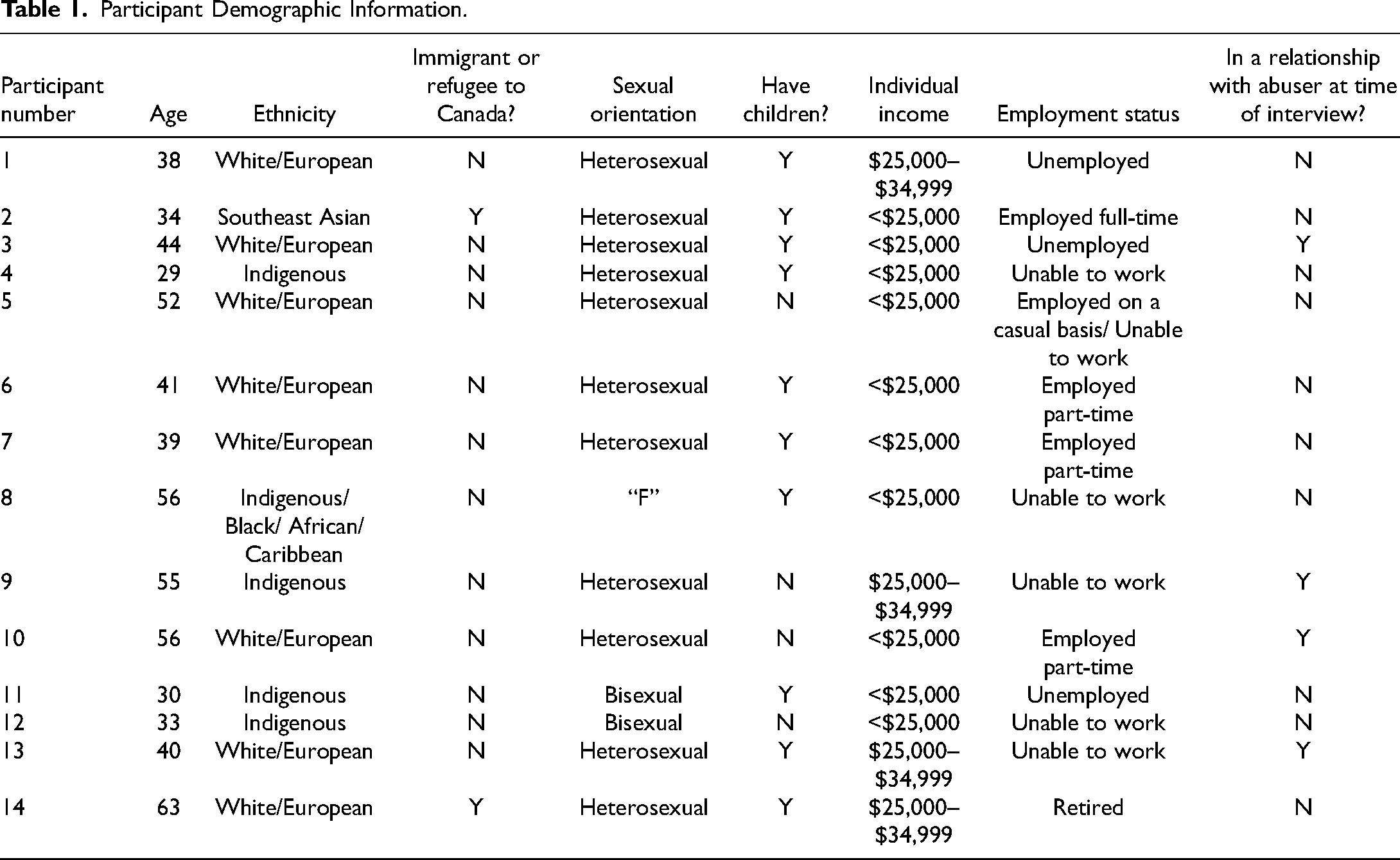
In total, 14 women participated in interviews. The average age of participants was 43.5, with the youngest being 29 and the oldest being 63. Over half of the participants were White/European, followed by Indigenous, Black/African/Caribbean, and Southeast Asian. Most participants were heterosexual and two were bisexual. Regarding income, most participants reported their current individual income as less than $25,000. Participants held a variety of employment statuses at the time of the interview, such as being unable to work, unemployed, or employed part-time. Most participants were not in a relationship with their abusive partner at the time of the interview. Of those no longer in a relationship with their abusive partner, the lengths of the relationships varied from one year to 21 years. Additionally, although the research team did not specify that the economic abuse had to have been perpetrated by a man, all participants disclosed their abuser to be a man. See Table 1 for participant demographic information.
Participant Demographic Information.
Procedures
Interviews were conducted by one female member of the research team and each interview lasted approximately 1 hr. The interview guide was generated collaboratively between the academic research team and partner organization based on the existing literature on economic abuse and gaps therein, as well as areas of interest. Interviews took a semistructured format and questions surrounded three main areas: (a) the women's experiences of economic abuse, (b) the impacts of the abuse, and (c) what the violence prevention sector can do to better address economic abuse. All interviews were audio recorded and transcribed for analysis. Participants received $50 for their participation. Counseling was available to all study participants upon request during the interview, and they were provided with service provision contact information that they could take with them after the interview. The study was reviewed and approved by a university research ethics board.
Data Analysis
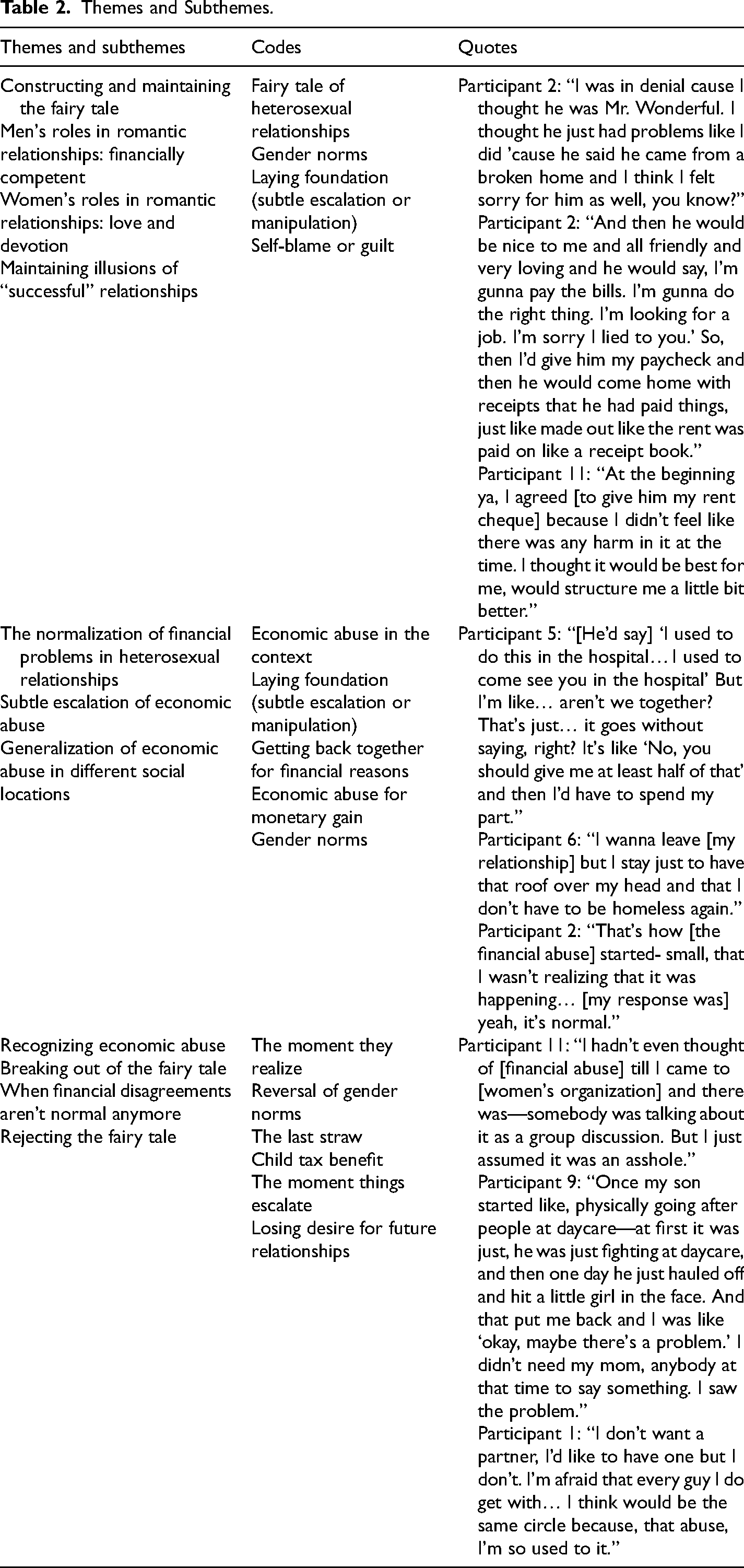
All the authors contributed to the data analysis. Three authors (BW, SZ, and LD) worked closely with the data from all three components of the larger project (noted above) and wrote a community report that largely focused on the experience and impact of economic abuse. One of the six key findings of the report was that economic abuse is difficult to identify for both survivors and service providers. As such, we decided to explore the invisibility of economic abuse more fully in the interviews. For this paper, a thematic analysis (Braun & Clarke, 2006, 2012) was conducted on the data. Three members of the research team (BW, SW, and PB) began the analysis by reading through the transcripts on their own, noting common patterns, and then meeting to discuss their thoughts and what stood out to them. After several meetings going through the data, the team decided on an area of interest to investigate further in the data: how does economic abuse stay hidden? This area of interest was decided based on the team's understanding of economic abuse and the current gaps in the literature, and the stand-out patterns found within the transcripts. Once this guiding question was generated, the data (almost 200 pages of transcripts) was entered into NVIVO software and the research team went back through the transcripts and coded areas that could provide an answer to this question. In total, 30 codes were generated inductively, such as “acquiescence,” “losing desire for future relationships,” “the last straw,” and “addiction.” Some codes were also grouped together in categories such as “gender norms,” “mothering,” “other vulnerabilities,” and “pivot point.” The research team then found commonalities among these codes and generated themes that provided insight into why economic abuse stays hidden. The final themes included “Constructing and Maintaining the Fairy Tale,” “The Normalization of Financial Issues in Heterosexual Relationships,” and “Recognizing Economic Abuse.” An overview of the analysis, which includes themes, subthemes, codes, and illustrative quotes (different than those in the text) can be found in Table 2.
Themes and Subthemes.
Results
Theme One: Constructing and Maintaining the Fairy Tale
A common mechanism that kept economic abuse hidden among the women in our study was societal norms about heterosexual relationships that worked to construct the relationship, and some of the abusive behaviors, as perfectly normal and even romanticized as a fairy tale, especially early on. Exemplifying this, participant 5 described her early relationship as a “Cinderella story” and as such she “never would’ve dreamed that he would economically abuse [her] because he wasn’t your typical gold digger.” Because this participant saw her relationship as a fairy tale early on, she did not view her abuser as fitting in with the stereotype of someone who is just in the relationship to profit financially (i.e., a “gold digger”).
Within this theme, we identified three subthemes describing how men and women should act within relationships and what a successful heterosexual relationship should look like that helped to keep the abuse hidden from the woman's recognition, as well as her friends and family.
Men's roles in romantic relationships: Financially competent
Some participants expected their male partner to take control of the finances as part of their gender role and therefore did not see the behavior as controlling. For example: I didn’t really know that it was controlling or anything like that. I just thought that he was trying to be like the man of the house and take care of the finances and the money aspect. …a month after we started seeing each other, or two months after we started seeing each other he turned 30. So he had a little more experience on me, and he was very manipulative. So he was always “Oh I’ll take care of,” “I can write a budget.” “I’ll make sure all our bills are paid and you don’t worry about them,” and then all the money is gone, but the money's all gone because of him. I get blamed. (when asked what her initial response to the economic abuse was): Well he was gonna go pay the bills, like go buy some groceries. That's what he always did, so that's what I thought he was doing.
Specifically, the women asserted that they did not think that their partner's control of the money was abusive especially early on in their relationship, because they aligned their behavior with traditional gender norms. Importantly, all of these women went on to identify clear economic abuse that was made possible because of their partner's obtaining control of the finances in these various (and initially unquestioned) ways. We can see in these examples that holding these gendered roles in relationships can be used as an abusive tactic and economic abuse is normalized as a man taking care of the household. In Participant 14's quote, she notes that because her abuser was older, had more experience, and offered to take care of the budget, there was seemingly nothing wrong with allowing him to take control of that aspect of their relationship, but her quote above carries on immediately with the following: It was always all about money and like he would punch holes next to my head in the halls and right in my face when I was pregnant with my second daughter ____, we had an argument over something to do with money.
The fuller context clearly reveals that this is not simply a division of labor where both agree that he will take care of the bills. Instead, he is in clear control of the money, and her objections to how it is spent result in physical intimidation and abuse. In other words, the control of the finances is established through gender norms, and the abuse is evident in the inability of her partner to relinquish control.
Women's roles in romantic relationships: Love and devotion
Preconceived ideas of what love looks like and how women are supposed to behave when they are in love also served to hide the economic abuse. Multiple women mentioned being “blinded by love,” therefore ignoring many potential red flags that signaled that their partner's behaviors were abusive: And we all fall prey to the love bug… Because it is like we are on cocaine, it is like we are on drugs, you know? I mean it's interesting so now I’m in a new relationship… And I’m very aware but in certain ways I’m already being hit by the love bug. I guess in the beginning I was more blinded by love. It was like that lust you know, and your—it's in that honeymoon phase right?
These women likened the feeling of being newly in love to being on a drug, unable to see straight and unable to control their actions. Participant 7 mentions being aware of this phenomenon taking place in her newest relationship but being unable to control being “hit by the lovebug.” Relating being in love to being “blind” or on a drug contributes to the hidden nature of economic abuse because the women dismissed the signs of abuse and accepted that the process of falling in love inevitably means being out of their control. For instance, when Participant 7 was asked if she would have done anything differently if she had been made aware of her abuser's manipulative tactics at the time, she responds that she would not: You know what that's a very good question, I think it might’ve happened anyway. I think I really trusted him, you know, I really trusted him and like I’d like to think “Oh if I knew about it,” you know. But love is blind…
Given that passionate or romantic love is highly valued in Western heterosexual relationships (Feybesse & Hatfield, 2018), constructing love in this way left little room to challenge early signs of economic abuse or even recognize problematic behaviors.
The women we spoke with expressed ideals about how women behave when in love and in heterosexual romantic relationships. Specifically, societal norms and pressures push women to take on the role of being devoted, loving, caring, and submissive to their male partners (Wood, 2001). We can see this take place with Participant 7, who felt the need to be a caregiver to her husband: And of course [he] gave me the sad sorry about how [his ex-wife] tried to take him for his money and all this kind of stuff right? … And I fell for it. And it was actually the reverse as we were gunna find out, he took her for a lot of money, then he took me for a lot of money but anyway. So the victim in him came out … and the caregiver in me went “aw poor baby, I’m gunna be different.” You know?
When Participant 7 heard of her husband's past relationship struggles, this elicited a caring and devoted response. She thought that she would be “different” than his ex-wife who hurt him, and she would fit into the role of the “good” wife. By taking on this role, it set a precedent for how a “good” wife should react when faced with relationship problems in the future, contributing to the hidden nature of economic abuse.
Maintaining illusions of “successful” relationships
Another common mechanism that kept the economic abuse hidden was the women's attempts to maintain the appearance of a “successful” relationship when they did begin to recognize problems. Particularly, the women did not want to confide in their friends or family about the abuse because they wanted to uphold the presentation that their relationship fit the ideal fairy tale so that they did not appear as a “failure”: I hid it because I didn’t want—because I thought I finally found somebody that really loved me and I didn’t want to fail, you know what I mean? … I couldn’t really tell my friends because they thought he was Mr. Wonderful and I didn’t want to seem like a failure so it was hard … at the time I had girlfriends but they all had great boyfriends, you know? And I didn’t want to be below them. My mom hated him, my family hated him. I had a big family but, I never really told them what went on so, I just made it look like everything was good … Because like, my mom was such a Christian woman … I just didn’t want her to think that I did any wrong. Like, I lied to like everybody, my own kids I’ve lied to.
These quotes suggest women understood their relationships were problematic, but that admitting this would be a failure and shameful. Indeed, some women used that language: So back then I wasn’t very keen on talking about the abuse that I went through because I was ashamed of it.
This concept of what constitutes a successful relationship also relates to the idea of “Mr. Wonderful” within the fairy tale relationship. Specifically, the women strived to see the good in their partners, despite the abuse they also experienced, because of their desire for a successful relationship. Their abuser was not always abusive, so the woman focused on the positive behaviors he exhibited to align the relationship with her expectations: And… did you kind of understand his behaviour as controlling and abusive initially? No. No? Did you think it was normal or did you just kind of deny it? I was in denial [Laughing] in hindsight. And why do you think you were in denial? Because I wanted it to work. Did you feel like you couldn’t tell other people, or did you just not want to? I just didn’t want to. Yeah… I just didn’t want to hear other opinions.
Overall, the societal norms around what a successful heterosexual relationship looks like and the roles of men and women in these relationships contributed to the hidden nature of economic abuse. The women we spoke to sometimes recognized that the abuse was happening and decided to intentionally hide their experience from friends and family to avoid falling short of the fairy tale, and sometimes they did not recognize the abuse because they aligned the abusive behaviors with traditional gender norms and focussed on the abuser's nice behaviors to fit their “fairy tale” expectations.
Theme Two: The Normalization of Financial Problems in Heterosexual Relationships
Disagreements about finances have been found to be one of the most common topics of conflict among spouses (Oggins, 2003). Because money troubles are so pervasive within relationships, when financial issues become abusive, they can sometimes go unnoticed by the woman and others in her life, with money problems simply being brushed off as “normal” or inherent within romantic partnerships. In this study, this pattern was accentuated by a subtle escalation of economic abuse that provided no clear boundary between what was normal and what was abuse. Additionally, the nature of couples’ financial problems created a situation in which individual acts may or may not appear (or even be) abusive depending on the broader relational context in which they are taking place, as illustrated below: … when I came into a lot of money at one point they’d be like “Ok let's go on a vacation, we need a vacation” and I’m like “But I really need to save this money, I really need it.” “No, we’ll go on a vacation.” And then it's like—it sounds really nice and you think “Ok well maybe we’ll get closer” and he tells you all this stuff you wanna hear and the next thing you know, your money's gone and you had a vacation but it wasn’t that great cause he was controlling you the whole time on the vacation.
In a healthy relationship, a couple deciding to go on vacation together would not be an abusive act. However, in this instance, Participant 3 was manipulated and coerced into using her money to do something she did not want to do. Here, knowledge of the greater context of the relationship brings the abuse into focus.
Subtle escalation of economic abuse
Among the women we spoke to, it was common for the money issues in the relationship to start off small and seemingly unproblematic, but then gradually escalate to economic abuse: He was alright at first and then he decided he wanted to get controlling and asking, gradually, “do you have 20 bucks? Do you have 30? I’ll pay you back” and it didn’t end up being like that. It ended up getting more worse than that and I didn’t have control over my own money and he would literally take all my money… That's how [my economic abuse] started- small, that I wasn’t realizing that it was happening.
This gradual escalation was compounded by the notion that a man's role is to take care of the finances, which was discussed in the Constructing and Maintaining the Fairy Tale theme. Furthermore, because the abuse started off small and went unnoticed by some women, it was easy for the abusive behaviors to stay hidden until it had escalated to a point where the woman did not feel that she had control over the situation. In turn, money problems may also hold a woman in a relationship or return her to it due to a lack of resources: Once [the abusers] have your money and they stop you from trying to get any other income, every cent goes to them… They’re gunna provide you with the food, they’re gunna provide you with a place to live, so you have to pretty much either go into a shelter and start all over again or live with that…it isn’t fair.
Generalization of economic abuse in different social locations
The women we spoke with experienced economic abuse in different social locations and therefore the issues that arose were different, but the abuse itself progressed and functioned in very similar ways. Participant 7 had a stable income and a few assets in her name prior to meeting her abuser. After they got married, he encouraged her to split many of the assets with him. In a healthy relationship, this division might appear normal and the next step in developing a life together. However, in this case, his encouragement was laying the foundation for future economic abuse: And so then the following year I put him on the title to the home which would unbeknownst to me at the time would then be considered the matrimonial home and that's where the abuse really took place right? So, but you know we were married so no red flags came up… So it's all very well planned but he was already laying the foundation for in case things didn’t work out because he had had two previous marriages.
In Participant 7's relationship, the abuser also encouraged splitting the cost of purchases between the two of them. Again, without prior knowledge of the relationship context, splitting purchases does not seem inherently abusive. However, Participant 7 goes on to explain how this request was used as a tool to take advantage of her financially: [He said] from now on you pay everything, we pay everything half… So that's when the financial abuse started coming in because I had a secretary's pension and he had a principal's pension… Be very unfair to pay everything half, I really couldn’t afford it.
We can also see gender play a role in Participant 7's experiences. She had a lower income than her abuser and held a position in a woman-dominated sector. Her abuser took advantage of this power dynamic and their differing income levels to further exploit her financially.
In a very different socioeconomic context, Participant 9 received financial assistance from the provincial government, and although her abuser was employed, he tracked and controlled her financial assistance cheque: …I only got money at certain times of the month. And he would know that. So once a cheque came out, like it wasn’t coming to my address, it would go to my mom's address, he would make sure that he called or text to make sure the cheque was there. Like that's not your responsibility, it's my cheque, why do you care about my money, right?
It is common for couples to share finances (Pepin & Cohen, 2020), and, as previously discussed in the Constructing and Maintaining the Fairy Tale theme, it is also normative for the man to take charge of and keep track of the money in a relationship. Therefore, Participant 9's abuser ensuring she received her cheque might not appear abusive, but in this case, the purpose of ensuring she received her cheque was so he could control the money as soon as it became available. Although the economic abuse situations differed for Participants 7 and 9, the long-term impact of the abuse was similarly negative for both women because they both lost agency over their finances: …in the Spring like I paid him like I dunno four thousand dollars or something for a dock that if things had been okay he would’ve paid for it…you know I had to go into my RRSPs which I was saving for retirement… I would get cell phones in my name and then he would never pay the bill. Um, because he would take control of my money, so I would expect him to pay. Like he worked plus he took control of my money. So I expected him to pay the bill. And that just messed up my credit. To this day I still have bad credit.
Differing contexts led to variations in exactly how the economic abuse manifested itself, but the similar gendered context of a heterosexual relationship served to normalize the economic abuse and make it difficult to recognize. The long-term impact also suggests that a survivor's future economic security can remain compromised long after a relationship ends.
Theme Three: Recognizing Economic Abuse
When discussing their experiences with economic abuse, almost all of the women we spoke with were able to point to moments where they recognized that their relationship was not the fairy tale that they had hoped it was, or that their financial disagreements surpassed what might be considered “normal.” Often, it was in these moments that the women recognized the economic abuse in their relationship and began to take steps to address it.
Breaking out of the fairy tale
As discussed in theme one, a common mechanism that kept economic abuse hidden among the women in our study was the societal norms around heterosexual relationships that worked to construct the relationship as a fairy tale. Importantly, many of the women in our study came to recognize that the traditional gender roles in their relationship were actually being used by their abuser to facilitate economic abuse and could no longer be dismissed as him being “the man of the house.” For Participant 9, it was the presence of various types of abuse that helped signal to her that his control of the money was not healthy: It took me quite some time to actually realize that there was like- the physical abuse, I saw that, of course I felt that. The emotional abuse, I just thought that he um, was, you know, just expressing himself out of anger. And then the money I thought he was just taking care of the household. But, everybody was like, with all three things, there was a problem. It wasn’t just one thing. Like, if it was just one thing, they could overlook it, but all three of them, that's when they really started saying “Okay you gotta see what's going on.”
Furthermore, as discussed in theme one, another mechanism that kept economic abuse hidden was women's expectations around “successful” heterosexual relationships and wanting to uphold the appearance of a fairy tale to their friends and family. Participant 2 spoke of this expectation and not wanting to fail in her relationship, but she eventually came to realize that it was not actually her who failed, it was her abuser: I just didn’t want to—for them to know that I thought I had failed. But meanwhile, he failed me—which I found out later. And how did you find that out? I just realized it, you know what I’m saying? Like, “What the hell am I doing? Why am I putting myself through abuse when I can just live alone?” You know, and not have all this bullshit going on.
Within this quote, we can also see how Participant 2 broke away from the need to fit into the expectations of heterosexual relationships by recognizing that she can live alone and physically separate herself from her abuser.
Alongside these methods of recognizing economic abuse, some women noticed the abuse in their relationships because of a reversal of gender norms. Specifically, the women took note when the man in the relationship was not taking on any responsibilities or “taking care of the house” in any way: I’m the one stuck paying the rent, I’m the one still paying the hydro, and when his money runs out, he looks at my money and there goes… he's bad, he's bad. And it was more at the point I guess in my life I had more—I felt better about myself so I could leave and I had more self-worth so it was just like—I said “Forget it.” I said ‘I’m not paying any more.” I said “This money is—and you’re not…”—it’d be different if he was like maybe making dinner, cleaning the house… contributing somehow but just sitting on the couch watching TV all day just doesn’t cut it.
Participants 6 and 3 both recognized that their relationship was not fitting with typical gender roles, leading them to identify the economic abuse behaviors. Though, this recognition manifested differently across these participants. In Participant 6's quote, we can see an expectation for the man and the woman in the relationship to take on certain roles—she was “stuck” paying the bills, which is a man's role, signaling to her that something in the relationship was off. In Participant 3's case, she identified economic abuse in her relationship because she was taking on the role of the breadwinner while her abuser “[sat] on the couch watching TV all day.” She recognized that an ideal relationship should be reciprocal, even if gender roles were reversed, and hers was not fitting that mold.
When financial disagreements aren’t normal anymore
Some women came to recognize economic abuse in situations that they had previously dismissed as normal financial disagreements between a couple. In particular, we saw two mechanisms in which this took place: (a) the women became worn down by continuous financial disagreements and (b) an incident occurred which was the last straw. We can see both of these mechanisms in Participant 14's experience. She grew tired of always allowing her abuser to control the finances and began to recognize the selfishness in his actions, which were affecting her children: …I just got tired of everything being his decision. Like no, no, no, no, put my foot down, I want this for my kids, it's not fair to them to have to go to school with used shoes from [a thrift store] when everyone else is affording the new stuff, ‘cause daddy needs to spend [all of] mommy's money on himself. I was like no its too selfish, and I just wanted better for my kids. I left.
In another example, Participant 11 spoke about how she previously thought that it was healthy that her and her abuser split their finances: “…my intention used to be that if I gave him a cheque, half and half we’d always split things you know down the middle…” However, she eventually recognized his actions as abusive and that's where she drew the line: “I understood this was abuse because of the fact that he was saying no, he was denying me what rightfully [was mine]…”
Participant 10's experience exemplifies the “last straw” mechanism. She was attending school when an incident took place with her abuser, prompting her teacher to intervene: It was just nerve-wracking and very hard to focus sometimes [at school]—having your phone ringing every second… One day I went to school and I had, of course, a distraught look on my face and my teacher knew something was wrong…. So I get a phone call from my ex and he was threatening me on the phone about money and about needing to do stuff and… my teacher came into the classroom and… he heard him over the phone and he ended up going upstairs to the office and telling the administrator to phone the police… the police came and they took me to the station and they wanted me to take a statement and it took me almost an hour for that. But then I had to put a close to it and I finally said what I needed to say to them and that was that…
After this incident took place, Participant 10's relationship with her abuser ended: “…that's when I didn’t have to worry about him draining me anymore.”
Rejecting the fairy tale
For some women, the recognition of economic abuse in their previous relationship impacted their belief in future relationships, seemingly rejecting not only the fairy tale, but any hope for a healthy relationship. It was common for the women to say that they lost a desire for future relationships: And I’m on a total different path, I never want another man in my life because I’ve had like, like my mother used to say, “I sure know how to pick ‘em.” You know what I mean? And I’m just very content of where I live. …now it seems like I can’t move onto somebody that would treat me good. I don’t even want to look around for nobody. I just think they’re going to do the same thing- beat me up, take my money…
Some women remained open to future relationships, but with an increased awareness for signs of abuse: Now I’m just so aware that I’ve told this guy “I never wanna get married” I said “I was screwed royally by the other one, if you do move into this home—well first we’re not getting married, it’ll be common law, he won’t get you know. And you’ll sign a contract.” So at least I’m aware of that… So I don’t think the love bug will—I hope not—will make me give him again a house.
Participant 7 was in another serious relationship, but in her rejection of marriage, she makes clear that she does not aspire to a fairy tale fantasy. She remains open to love but has plans in place to avoid economic abuse.
Discussion
The aim of this study was to examine the mechanisms through which economic abuse remains hidden and becomes visible. The qualitative data from these interviews provide support and expand on the existing literature that has up until now been largely quantitative. The existing literature has explored and defined economic abuse within heterosexual relationships where women are predisposed to economic vulnerabilities (Anitha, 2019; Bond et al., n.d.; Kutin et al., 2017). As noted in the introduction, the most common tactics used by perpetrators of economic abuse are financial control (i.e., taking control of the household finances including assets and goods), economic exploitation (i.e., taking resources through force or manipulation including creating debt under the victim's name), and economic sabotage (i.e., interfering with the victim's ability to acquire resources through employment or education; Anitha, 2019; Eriksson & Ulmestig, 2021; Kutin et al., 2017). All three of these tactics were identified by the survivors in this study, and what our findings contribute is an understanding of how these tactics, which seem clearly abusive in their descriptions, are enacted in ways that make the abuse difficult to recognize. As noted in the first theme, one of the ways that the fairy tale was maintained despite the economic abuse was because men are often expected to control the finances, which left survivors unsure of whether their experiences of being “economic controlled” was normal or abusive. Similarly, exploitation was difficult for survivors to recognize because financial disagreements within couples are often normalized, so while the survivor might be unhappy with how the money was spent, it was difficult to label that as “economic exploitation.” In contrast to this, “economic sabotage” was more readily identified as abuse and served as the last straw that made all the economic abuse in the relationship visible to the survivor as noted in our theme on how economic abuse is recognized. It may be that economic control and exploitation are more likely to escalate slowly as demonstrated in our results, whereas sabotage is necessarily more abrupt and clearly disruptive. However, our data did not have a lot of examples of economic sabotage, so this conclusion requires more exploration. For example, it is conceivable that sabotage might be concealed within heterosexual norms and escalate slowly if the abuser convinces the survivor there is no need for her to work or finish a degree because his salary is sufficient to support the family.
Our results also make clear that individual acts in isolation cannot easily be labeled as economic abuse. One partner's management of the household expenses may or may not be abuse depending on the context of the relationship. Questions such as “Is the control of the finances agreed upon by both parties?” “If one person requests more control, is control relinquished?” and so on are needed to understand the relationship dynamics. Similarly, how do we draw the line between disagreements on how money should be spent and the exploitation of one person when couples choose to pool their resources? These questions have implications for the quantitative measurements of economic abuse, which are still in their infancy (Yau et al., 2021). Just as we have increasingly paid attention to the differences in how physical and emotional IPV manifest (e.g., coercive control vs. situational couple violence), and the impact that can have on our understanding of gender parity in IPV (Johnson, 2006), we need to be attuned to the nuances of economic abuse. For example, given that women remain more economically vulnerable in society overall, the impact of experiencing economic abuse is likely to be compounded for them.
Our findings suggest that women are still exposed to and impacted by notions of idyllic relationships and stereotypes of passionate love that leave them “blind” to abuse. This is not surprising given the proliferation of unrealistic love themes in the media (Tanner et al., 2003). While survivors of abuse have long cited “love” as a reason why they remained in an abusive relationship (Dziegielewski et al., 2005), we found that love was cited as a reason why the abuse itself remained hidden. More recent research has also demonstrated a relationship between adherence to notions of romantic love and victim blame as well as perpetrator exoneration (Lelaurain et al., 2021). Together these findings provide strong support for the need to deconstruct notions of passionate love.
This work has been focused on economic abuse, but similar ideas have been examined in the broader IPV literature. This is not surprising given that, as noted in the introduction, economic abuse often occurs in conjunction with other forms of abuse such as emotional and physical abuse (Stylianou et al., 2013). Of note, Wood (2001) found both a “fairy tale” narrative and a “dark romance” narrative in interviews with women who had experienced physical abuse. The “fairy tale” narrative in Wood's study legitimized physical violence through gender norms that portrayed appropriate male behavior as dominating and controlling, which is similar to how women in the current study justified their partner's control of the finances as appropriate male behavior. Wood's “dark romance” narrative normalized conflict and violence as inevitable in intimate relationships the way women in the current study normalized economic abuse as typical partner disagreements about finances. Others have also examined how culture, social roles, and gender expectation impact men's physical abuse (e.g., Vandello & Cohen, 2008). Despite the similarities, physical abuse is now rarely described as invisible, but as recently as 50 years ago, shelters did not exist and physical abuse was largely a hidden problem that was understood as a relational conflict between a couple, but not a societal problem that required outside intervention (Dobash & Dobash, 1992). With sustained attention through research and activism, our understanding of physical abuse has grown. This has allowed survivors and society more broadly to recognize and label physical abuse as IPV, which is an important first step in stopping it. It is time that economic abuse also comes out of the shadows.
Strengths and Limitations
Recruitment was open and participants were not all receiving services from a particular organization, which was especially important in understanding how economic abuse becomes visible in different contexts. Nevertheless, the women recruited had somewhat similar backgrounds and characteristics, which limits some of the conclusions we make. Most of the women were from low socioeconmic status (SES) households, all identified their abusive relationships as heterosexual, and almost all were middle age or older. Although we were able to make some comparisons between women of lower and higher SES households, the mechanisms for keeping economic abuse hidden between more affluent couples may not have been fully identified in this study. The dominance of heterosexual norms in our data is almost certainly a reflection of the types of abusive relationships that the participants were exposed to. Whether or not heterosexual norms also mask economic abuse in other relationships should be explored. Nevertheless, the themes identified were robust within the data and more interviews with similar women would have likely produced similar results.
Implications
The findings of this study help to guide the understanding of the mechanisms that contribute to concealing economic abuse. It is important that we consider ways to create and improve support and resources for current survivors of economic abuse to help ensure they are educated on not only what economic abuse is, but also on the mechanisms that make it difficult to identify. Improving educational resources will help women to analyze their current relationships and look for abusive behaviors that were previously not seen. Education can also have a preventative effect by allowing women to enter new relationships with increased awareness and an improved understanding of the importance of financial literacy. School curricula as well as organizations dedicated to supporting women should work to promote this awareness and offer programs that help women develop financial literacy and support their independence. With the onset of the COVID-19 pandemic, domestic abuse and violence may have dramatically increased (Boxall et al., 2020; Piquero et al., 2021; Rauhaus et al., 2020). While the current literature focuses on more overt forms of abuse, such as physical and verbal, economic abuse is known to occur alongside these other forms of IPV and has likely also increased in prevalence during the pandemic (Eriksson & Ulmestig, 2021). Currently, there is no existing literature on economic abuse and its relationship to the negative economic impacts of COVID-19. This further supports the hidden nature of economic abuse and suggests even more urgency for increasing education and resources to help current survivors and to act preventatively to help women develop financial independence and notice economically abusive tactics before they develop a dependency on their abuser.
Conclusion
Economic abuse disproportionately affects women and has a detrimental effect on their independence and well-being (Bond et al., n.d.; Kutin et al., 2017; Postmus et al., 2020). This form of abuse often remains hidden causing it to be understudied (Antai et al., 2014; Corrie et al., 2013; Kutin et al., 2017; Postmus et al., 2020; 2012; Sanders, 2015). As a result, there is less awareness of this form of abuse and fewer resources available for its survivors (Anitha, 2019; Bond et al., n.d.; Kutin et al., 2017). The results of this study supported the existing characterization of economic abuse within the literature and also demonstrated mechanisms for how these tactics keep this form of abuse concealed. The norms of heterosexual relationships contributed toward concealing the abuser's tactics to gain economic control and financially exploit the survivor. No matter the mechanism of abuse, once a certain threshold of severity was met, the abuse became more visible suggesting norms of heterosexual relationships tend to contribute toward the concealment of early forms of economic abuse when the methods were still minimal, and escalation was subtle. This understanding of how economic abuse remains hidden holds significance in promoting the need to improve educational support to help women identify abusive behaviors within a society of gender and cultural norms that often contribute toward the concealment of this form of abuse.
Footnotes
Acknowledgements
The authors wish to acknowledge the financial support of the City of Toronto who provided research funds through a grant to WomanAct. Our thanks also go to Harmy Mendoza and Emma Currie for assistance at various stages of the project. Finally, we wish to thank the 14 women who participated in the interviews. It is their voices that make economic abuse visible in this work.
Declaration of Conflicting Interests
The author(s) declared no potential conflicts of interest with respect to the research, authorship, and/or publication of this article.
Funding
The author(s) disclosed receipt of the following financial support for the research, authorship, and/or publication of this article: This work was supported by the City of Toronto through a grant to WomanAct.
