




Abstract
Few victims of sexual assault (SA) report to the police. Research on the role of support persons in victims’ reporting is sparse. We address this gap by examining the association of victim, assailant, victimization incident, and support characteristics with reporting rates among victims attending sexual assault care centers (SACCs). Logistic regression results show that type of SA, delay between SA and presentation at SACC, and presence of an informal support person at SACC and SACC site are significantly associated with police reporting. These findings reveal the importance of targeting victims’ support persons to alter reporting behavior among SA victims.
Sexual Assault and Police Reporting
Sexual assault (SA) is common in Europe, with approximately one-in-five women and one-in-ten men having experienced an event of physical sexual victimization in their lifetime (Abrahams et al., 2014; Garcia Moreno et al., 2013; Krahe et al., 2015). A first representative study in Belgium suggests true prevalence rates may even be higher, as they estimate that 64% of Belgian men and women already fell victim to some form of SA in their lives, ranging from hands-off to hands-on forms (Schapansky et al., 2021).
A victim's decision to report the SA to the police is the first and essential step for the case to proceed in the criminal justice system. While reporting does not necessarily lead to personal redress for the victim such as psychological recovery, and may even lead to secondary victimization (Brooks-Hay, 2020; Kaukinen & Demaris, 2009; Maier, 2012; McQueen et al., 2021), it can have an important societal impact. Police reporting allows the society to deal with the assailant either through punitive or reintegrative strategies, it informs policymakers about the prevalence of SA and facilitates the elaboration of adapted policies for crime prevention (Bosick et al., 2012). Moreover, reporting can increase the potential deterrent value of the legal system in preventing SA (Bachman, 1998).
Nevertheless, few victims of SA report to the police (Campbell, 2008), often referred to as the “reporting gap” (Keller & Miller, 2015). European reporting rates of SA are notoriously low, and estimates vary from one-in-five rape victims reporting to the police in Scotland (Brooks-Hay, 2020) to less than one-in-ten in Belgium (Depraetere et al., 2022), echoing findings from the US and Australia.
Factors Associated With Police Reporting After SA
A multitude of quantitative studies have identified victim, assailant, and victimization incident factors associated with police reporting of SA (Sabina & Ho, 2014), though many of these predominantly US national surveys date from 20 to 30 years ago (Ceelen et al., 2019).
First, several victim-related factors are found to be associated with reporting, however, study findings tend to contradict. With regard to age, one study observed that reporting of SA varied across age groups and was especially high among young adolescents (Bosick et al., 2012), while another study concluded that the likelihood to report to the police increased with age (Chen & Ullman, 2010). In contrast, other studies did not find a significant association between police reporting and age (Bachman, 1998; Wolitzky-Taylor, Resnick, Amstadter et al., 2011). Conflicting findings also exist for ethnicity, whereby one study showed that African American college students had a higher likelihood to report SA to the police (Fisher et al., 2003), while another study identified Caucasian women as more likely to report (Wolitzky-Taylor, Resnick, Amstadter et al., 2011). As for prior sexual victimization, one study did not find a significant association, while another study observed that those who were previously victimized had a lower likelihood to report (Sabina & Ho, 2014; Wolitzky-Taylor, Resnick, McCauley et al., 2011). One study identified educational attainment as a significant predictor of rape reporting, while marital status and income were not (Wolitzky-Taylor, Resnick, McCauley et al., 2011). Sexual orientation was not found to be associated with police reporting (Langenderfer-Magruder et al., 2016). Another study noted an association between victims’ mental health status and reporting (Walsh & Bruce, 2014): victims that suffered severe reexperiencing and hyperarousal, both symptoms of posttraumatic stress disorder, had a higher likelihood to report to the police, while victims showing avoidance had a lower likelihood to report. Depressive symptoms after the assault were not associated with reporting. As most research focuses on female SA victims, literature on the predictive value of gender on reporting is sparse but one study suggests men are less likely to report than women (Weiss, 2010).
Second, several characteristics of the assailant are clearly associated with reporting. The more intimate the victim–assailant relationship, the lower the probability of reporting rape or SA (Bachman, 1998; Ceelen et al., 2019; Felson & Pare, 2005; Fisher et al., 2003; Gartner & Macmillan, 1995; Paul et al., 2014; Wolitzky-Taylor, Resnick, McCauley et al., 2011). Multiple assailants were also found to be related to increased reporting, as well as different ethnicity of the victim and the assailant (Fisher et al., 2003).
A third group of factors influencing reporting relates to the context of the victimization incident. Research consistently shows that victims who used alcohol and/or drugs at the time of the SA were less likely to report (Ceelen et al., 2019; Clay-Warner & Burt, 2005; Fisher et al., 2003; Kilpatrick et al., 2007; Wolitzky-Taylor, Resnick, McCauley et al., 2011). The severity of the crime as illustrated by sustained physical injuries, the use of a weapon, or victims expressing extreme fear during the rape, were associated with higher chances of reporting (Bachman, 1998; Ceelen et al., 2019; Fisher et al., 2003; Kilpatrick et al., 2007; Paul et al., 2014; Wolitzky-Taylor, Resnick, McCauley et al., 2011). The type of victimization also plays a role: rape is more likely to become known to the police, than touching intimate body parts against the victim's will (Ceelen et al., 2019; Fisher et al., 2003; Gartner & Macmillan, 1995; Kilpatrick et al., 2007).
A fourth group of factors associated with reporting relate to victims’ support persons, usually categorized into formal and informal support persons. Formal support persons such as healthcare workers, social workers or hotline staff, operate within official services that function under bureaucratic structures, as opposed to informal support persons such as friends or family who stem from within a person's individual social network (Baig & Chang, 2020). The relationship between police reporting of SA and previous contact with support persons received little attention so far in quantitative studies. To our knowledge, only one study showed that consulting with an informal support person about whether to report positively increased the likelihood of reporting (Paul et al., 2014), and none examined the association between police reporting of SA and consultation of formal support persons.
Victims’ Motivations to Report SA to the Police
While there is a wealth of quantitative research on reporting SA to the police, only a few qualitative research studies tried to gain insight into victims' motivations to report SA to the police (Brooks-Hay, 2020; Taylor & Norma, 2012). These studies identify individual and therapeutic reasons, assailant-orientated motivations, and the sense of a social and moral responsibility to report as important motivations to report. In addition, and in contrast to many quantitative studies, qualitative research clearly acknowledges third-party influences as key in reporting SA to the police, with especially informal support persons encouraging or even coercing victims to report (Brooks-Hay, 2020). Additionally, other qualitative studies have revealed the importance of family and friends in motivating victims to seek help at formal support services after SA, including the police (Campbell et al., 2015; Dworkin & Allen, 2018).
Theoretical Models on Police Reporting of SA
Crime reporting in general has long-time been theorized as a cost–benefit calculation whereby the victim outweighs the benefits of reporting such as punishment of the assailant, with potential costs such as stress and embarrassment (Skogan, 1984). This cost–benefit metaphor explains why serious crimes with durable harm to the victim are more likely to be reported than those where minor injury or loss is involved (Skogan, 1984). Such a cost–benefit model, however, disregards the social context and normative considerations in victims’ reporting decisions and scholars have argued to embed the cost–benefit calculation of reporting within a socioecological framework (Goudriaan et al., 2004). More specifically for sexual victimization, previous research has already indicated the importance of social norms and rape myths by suggesting that rape reporting is most influenced by a combination of stereotypical rape characteristics defined as “the classic rape,” such as having injuries, the use of a weapon and rape by a male stranger (Brooks-Hay, 2020; Fisher et al., 2003; Williams, 1984). Researchers have thus increasingly applied Bronfenbrenner's ecological theory (Bronfenbrenner, 1979) to the reporting of sexual victimization (Campbell et al., 2009; Kubiak et al., 2018; Ménard, 2005; Tillman et al., 2010), revealing the complex interaction between individual- and system-level factors in police reporting decisions.
Within the ecological model, informal and formal support persons are seen as part of a victim's micro- and mesosystem, respectively (Kubiak et al., 2018). The process of seeking formal help has previously been theorized around three key questions: do I need help, what can I do, and what will I do (DeLoveh & Cattaneo, 2017). Support persons can potentially influence these three key phases in a victim's help-seeking process (DeLoveh & Cattaneo, 2017), and hence shape victims’ perceptions of SA as a crime to be reported or not to the police, explore options for (non)reporting, and support or hamper victims throughout the actual reporting process, this way promoting or inhibiting a victim's reporting behavior. Taking the above into account, there is a clear argument for quantitative studies to consider factors of the micro- and mesosystem, and more specifically the role of formal and informal support persons when studying police reporting of SA.
Police Reporting Among Victims Seeking Help at Specialized SA Services
Over the last decade, research has increasingly examined police reporting among the subpopulation of SA victims who sought formal support at specialized SA centers (SACs), as opposed to the above studies that were performed among the general population including both people who did or did not seek help at SACs. Care providers at the SACs can be considered as formal support persons in a victim's decisional process to report to the police. Previous research has shown the added value of SACs in reporting SA by helping victims to make an informed decision on reporting, improving victims’ confidence in their emotional ability to engage with the criminal justice process, providing practical support to report, and increasing victims’ beliefs in higher conviction chances because of the availability of forensic samples (Brooks & Burman, 2017; Fehler-Cabral et al., 2011; Patterson & Campbell, 2010). Apart from the role of SAC personnel as formal support persons, research among victims attending SACs confirmed the above-mentioned influence of informal support persons such as friends and family in encouraging, coercing, or even overruling the victim in their decision to report to the police (Patterson & Campbell, 2010). Additionally, the creation of SACs has led to reduced delays in reporting to the police (Greeson & Campbell, 2013) and high police reporting rates among victims attending SACs (Downing et al., 2022; Hiddink-Til et al., 2021; Larsen et al., 2015; Schei et al., 2003; Zijlstra et al., 2017).
Among the subpopulation of victims attending SACs, several factors influencing police reporting were identified, although study findings are inconclusive. Age was significantly associated with police reporting, with adolescents often being more likely to report in comparison to older victims (Larsen et al., 2015; Mulder et al., 2021; Stokbaek et al., 2021), though results are hard to compare due to the use of different age categories; and one study did not find a significant association with age (Zijlstra et al., 2017). In three studies, women were more likely to report SA to the police when assaulted by a stranger (Larsen et al., 2015; Stokbaek et al., 2021; Zijlstra et al., 2017), while this victim–assailant relationship was nonsignificant in another study (Downing et al., 2022). Having injuries commonly increased the likelihood to report (Downing et al., 2022; Larsen et al., 2015; Mulder et al., 2021), except for one study where no association was observed (Stokbaek et al., 2021). Alcohol consumption was associated with a lower likelihood to report (Downing et al., 2022; Larsen et al., 2015), though this association was not observed in other studies (Stokbaek et al., 2021; Zijlstra et al., 2017). One study concluded there was a higher risk of nonreporting among those victims that experienced amnesia (Stokbaek et al., 2021). Victims of penetration were more likely to report than those that were not penetrated (Downing et al., 2022). Victims who did not immediately attend SAC after the assault had a lower likelihood to report (Downing et al., 2022; Stokbaek et al., 2021), though this was not observed in another study (Mulder et al., 2021).
Study Aim
This present study aims to assess the association of victim, assailant, victimization incident, and support characteristics with police reporting of SA among victims that received care at the newly installed Sexual Assault Care Centers (SACCs) in Belgium. Through this research, we aim to broaden the understanding of reporting to the police by moving beyond the regular research focus and also explore the relationship with system-level factors such as informal and formal support persons, who so far received little attention in quantitative studies on police reporting of SA. More specifically, we intend to examine if the presence of a confidant as an informal support person at the SACC and the SACC personnel as formal support persons are associated with reporting to the police.
Methods
Study Setting
The study was conducted in Belgium in three SACC sites namely the Ghent University Hospital, the University Hospital Saint-Pierre in Brussels, and the Liège University Hospital. The Belgian SACCs were, amongst other reasons, created out of concerns about the criminal justice response to SA and aim to reduce barriers to reporting. The SACC intervention has been described previously (Baert et al., 2021). Apart from the medical and psychological care offered at the SACC, we want to highlight the specific measures put in place to reduce barriers to reporting and avoid secondary victimization by the police. Victims of recent SA (<7 days) who presented at the police were directly referred and escorted to the SACC. Victims could bring a confidant to the SACC for support. Upon arrival at the SACC, victims had a discussion with a forensic nurse on the pros and cons of police reporting and they were offered the possibility 24/7 to report through an interview by trained SA police officers at the SACC. A forensic examination was performed regardless of a victim's decision to report to the police whereby forensic samples are stored for up to 12 months which can be claimed by the prosecutor in case of a victim's delayed reporting. Nonreporters were contacted by the forensic nurse seven and one month before forensic samples would be destroyed. All sites applied these same standard operating procedures for reporting and all SACC personnel received the same training on reporting and criminal justice proceedings. During the pilot year, 68.7% of the 931 victims reported to the police, of which 64.1% first presented to the police, 20.6% were immediately willing to report to the police upon their arrival at the SACC, 8.9% decided after a discussion with the SACC personnel and 6.4% reported during follow-up care (Baert et al., 2021).
Study Participants and Data Collection
All victims of SA, regardless of age, who attended one of the three SACC sites at least once in person between October 25, 2017, and October 31, 2018 (during the pilot year), were included in the study. Data were prospectively and routinely collected from the hospital's electronic patient file by the SACC personnel. Hence, no informed consent was obtained. All data collected within 12 months of the victim's first presentation to the SACC were included in the study (Baert et al., 2021).
Measurement and Definitions
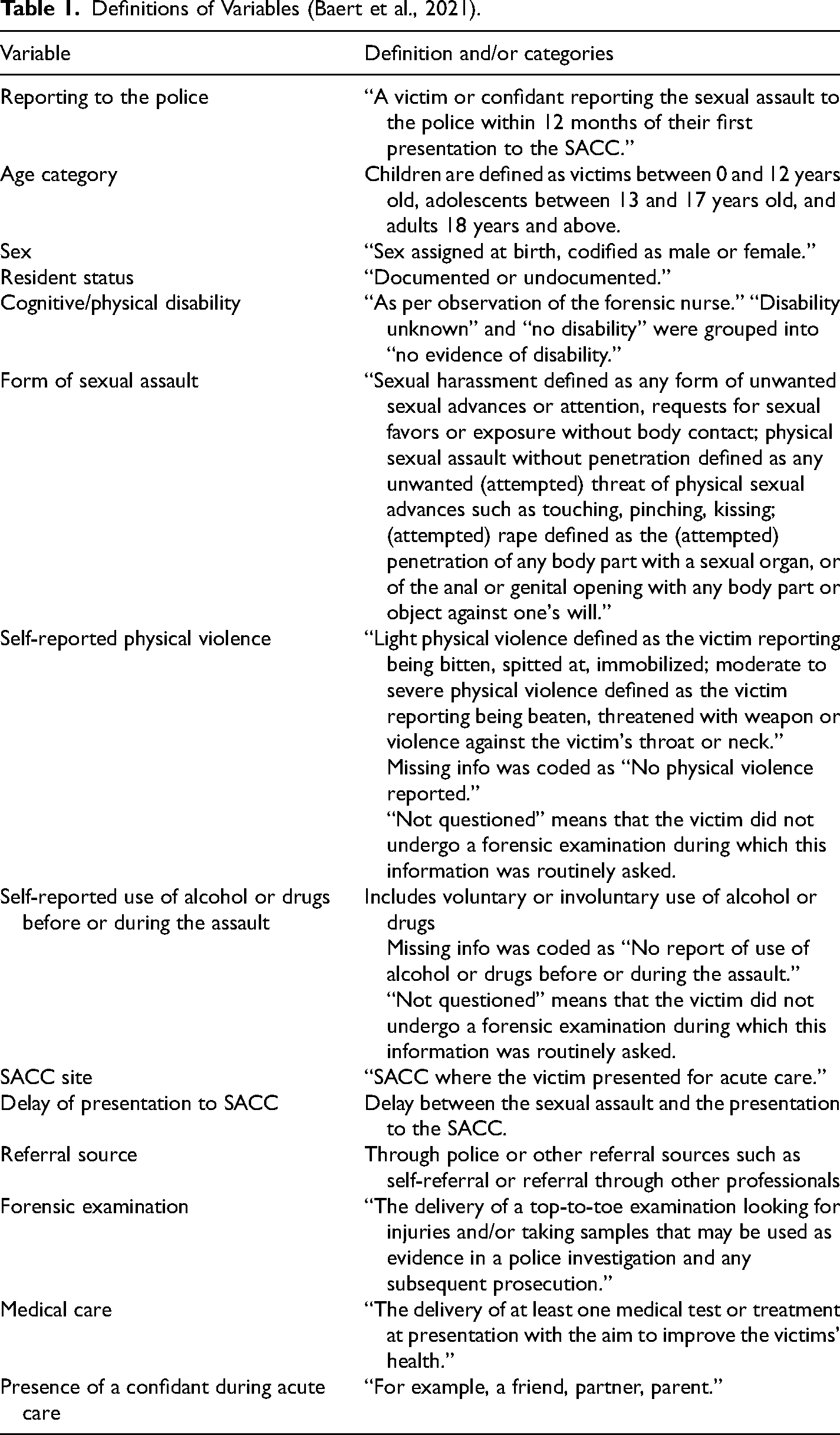
Variables and their definitions have been previously described (Baert et al., 2021) and are summarized in Table 1. The outcome variable used was reporting to the police. Victim, assailant, victimization incident, and support characteristics served as explanatory factors. Victim characteristics included age, sex, resident status, cognitive/physical disability, and prior SA. Assailant characteristics encompassed victim–assailant relationship and number of assailants. Victimization incident characteristics were form of SA, reported physical violence, and self-reported use of alcohol or drugs before or during the assault. Support characteristics included SACC site, delay of presentation to SACC, referral source, forensic examination, medical care, and presence of a confidant during acute care.
Definitions of Variables (Baert et al., 2021).
Data Analysis
Pseudonymized data were exported from the hospitals' electronic patient files and subsequently merged into a central dataset. Statistical analyses were conducted using R version 4.1.1 (10-08-2021). First, simple (unadjusted) generalized linear regression models for a binomial family with a logit link were fitted for reporting to the police. The explanatory factors were prespecified based on the above literature research and the authors’ expert knowledge. Second, a multiple linear regression model was fitted for reporting to the police, including the main effects of most prespecified variables. Medical care and forensic examination were not included in the adjusted model because we a priori expected a strong correlation with a delay of presentation and form of SA, as both are only performed within a limited time frame postassault for hands-on forms of SA only. Reported physical violence and self-reported use of alcohol/drug before/during the assault were neither included in the adjusted model for the complete sample because this information was only known for victims with a forensic examination. To explore the relationship of the latter excluded characteristics with reporting, a subgroup analysis was performed on victims who presented for (attempted) rape within 1 week with forensic examination and where the relationship to the perpetrator was known. To identify potential effect modifications of characteristics by referral source, a second subgroup analysis included only victims who were referred through another source than the police. The estimated odds ratios (ORs) with 95% profile likelihood confidence intervals (CIs) and p values from Wald tests are reported. All hypothesis testing was performed two-sided at the 5% significance level.
Ethical Considerations
Ethical approvals were granted by the Medical Ethics Committees of Ghent University Hospital (EC/2017/1011), University Hospital Saint-Pierre in Brussels, and Liège University Hospital. The study is compliant with the European General Data Protection Regulation and uses secondary pseudonymized data that was primarily gathered for routine monitoring and evaluation of the SACC services by the SACCs and the Belgian Institute for Equality of Women and Men. The legal ground for the processing of the data is public interest. Victims were informed of the transfer of their pseudonymized data through the privacy statements of the hospitals (Baert et al., 2021).
Results
Police Reporting Rates
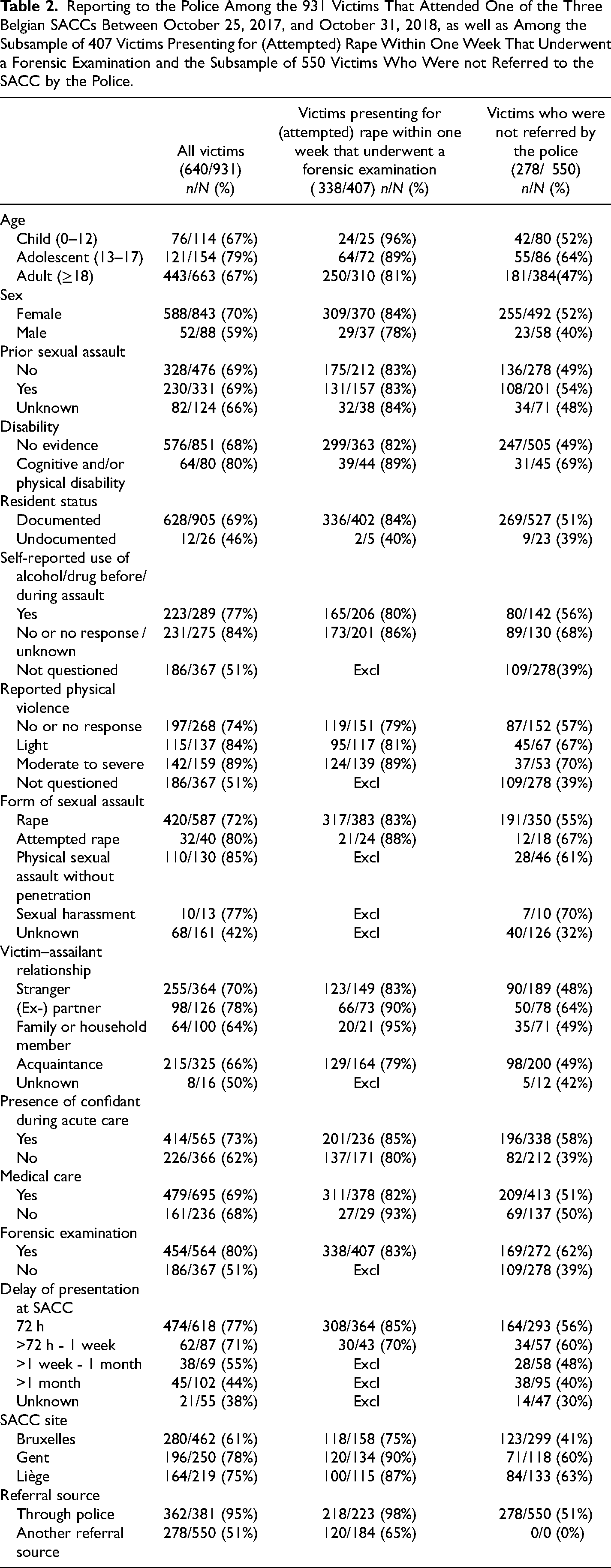
Table 2 describes the rates of reporting SA to the police among the 931 victims attending one of the three Belgian SACCs during the pilot year, as well as the subsample of 407 victims (43.7% of 931) presenting for (attempted) rape within one week that underwent a forensic examination, as for the subsample of 550 victims (59% of 931) who were not referred by the police. The majority of all 931 victims (68.7%) reported to the police. In the subsample of victims presenting for (attempted) rape within one week that underwent a forensic examination the reporting rate was even higher (83%), while only half of those who self-referred or were referred through another source than the police (50.5%) decided to report.
Reporting to the Police Among the 931 Victims That Attended One of the Three Belgian SACCs Between October 25, 2017, and October 31, 2018, as well as Among the Subsample of 407 Victims Presenting for (Attempted) Rape Within One Week That Underwent a Forensic Examination and the Subsample of 550 Victims Who Were not Referred to the SACC by the Police.
Unadjusted Logistic Regression Analyses for Police Reporting of SA
The unadjusted logistic regression analyses for reporting to the police among SA victims attending the Belgian SACCs (Table 3) show that strongly significant associations (p < .001) were observed with reported physical violence, form of SA, presence of a confidant, forensic examination, delay of presentation, and SACC site. Other variables that were significantly associated with reporting to the police at the 5% significance level were age, legal gender, disability, resident status, and self-reported use of alcohol or drugs before or during the assault. In the subsample of victims that attended for (attempted) rape within one week that underwent a forensic examination, only the SACC site was significantly associated with reporting to the police. Also, within that subsample, victims who did not report physical violence showed lower odds to report (OR 0.45; CI 0.23–0.86; p = 0.018) than those who said to have experienced moderate to severe physical violence. Self-reported use of alcohol or drugs was not significantly associated with reporting to the police in this subgroup.
Relation Between Victim, Assailant, Victimization Incident, Support Characteristics, and Reporting to the Police Among Victims Attending One of the Three Belgian SACCs Between October 25, 2017 and October 31, 2018 (Unadjusted Logistic Regression Analyses).
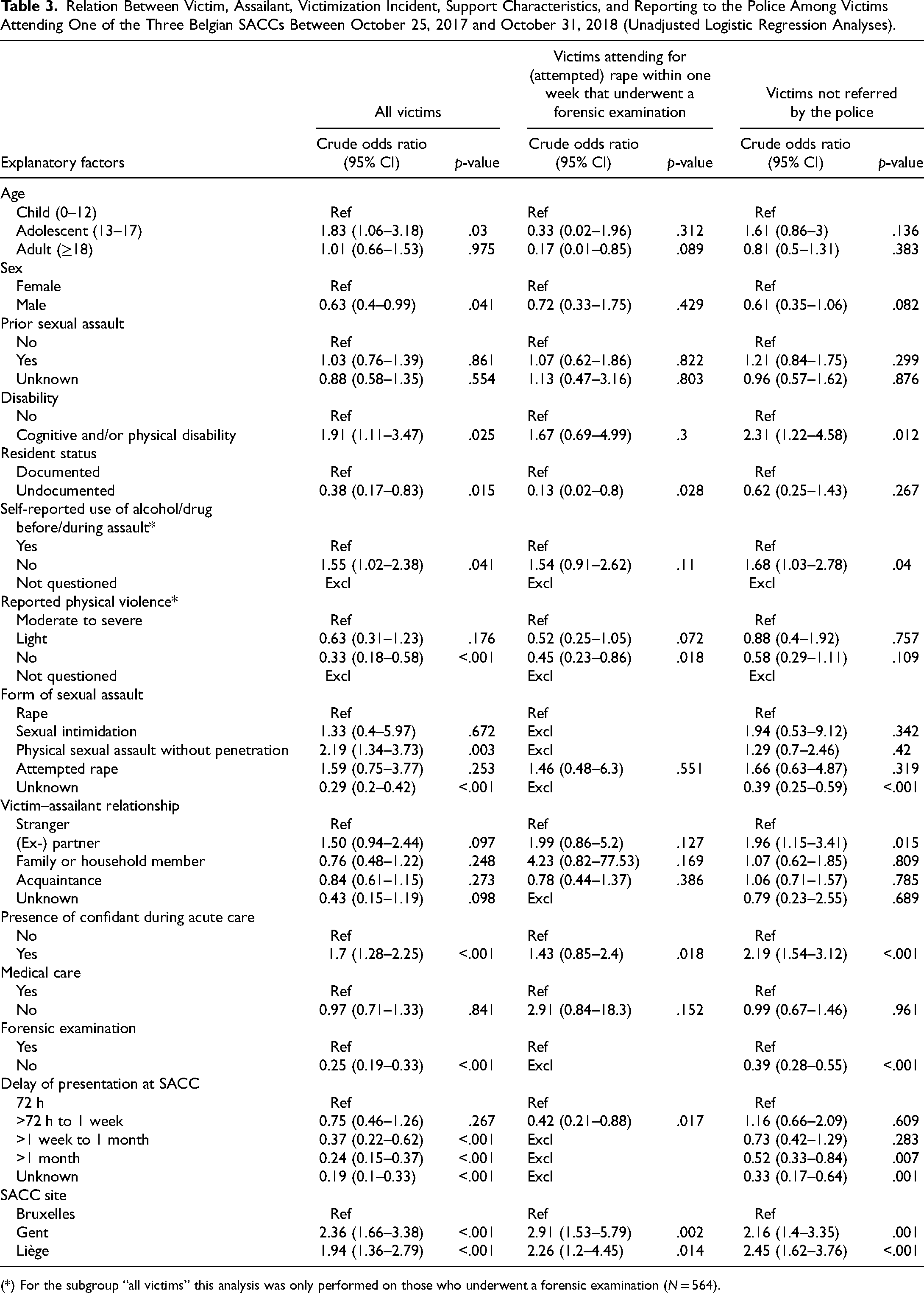
(*) For the subgroup “all victims” this analysis was only performed on those who underwent a forensic examination (N = 564).
Adjusted Logistic Regression Analyses for Police Reporting of SA
Many significant associations from the unadjusted logistic regression analyses for reporting to the police were no longer found with the adjusted logistic regression model. Table 4 shows that only form of SA, presence of a confidant, delay of presentation, and SACC site were independently associated with reporting to the police. The adjusted odds of reporting were higher for physical SA without penetration (adjusted OR [aOR] 1.98, CI 1.16–3.52; p = .015), but lower for an unknown form of SA (aOR 0.27; CI 0.18–0.42; p < .001) in comparison to rape. Compared to victims who presented to the SACC within 72 h, those who presented to the SACC later than 72 h but still within one week after the SA did not significantly differ in reporting. However, the adjusted odds to report were lower for those presenting between one week and one month (aOR 0.35; CI 0.2–0.62; p < .001), those presenting later than one month (aOR 0.21; CI 0.13–0.35; p < .001), and those for whom the delay between the SA and presentation to the SACC was unknown (aOR 0.17; CI 0.08–0.35; p < .001). Victims that were accompanied by a confidant during acute care at the SACC had higher odds to report than victims presenting alone (aOR 1.68; CI 1.18–2.41, p = .004). In the adjusted model, the SACC site remained significantly associated with reporting to the police (aOR 1.92; CI 1.28–2.91; p = .002 and aOR 1.89; CI 1.25–2.87, p = .003).
Relation Between Victim, Assailant, Victimization Incident, Support Characteristics, and Reporting to the Police Among Victims Attending One of the Three Belgian SACCs Between October 25, 2017, and October 31, 2018 (Adjusted Logistic Regression Analyses).
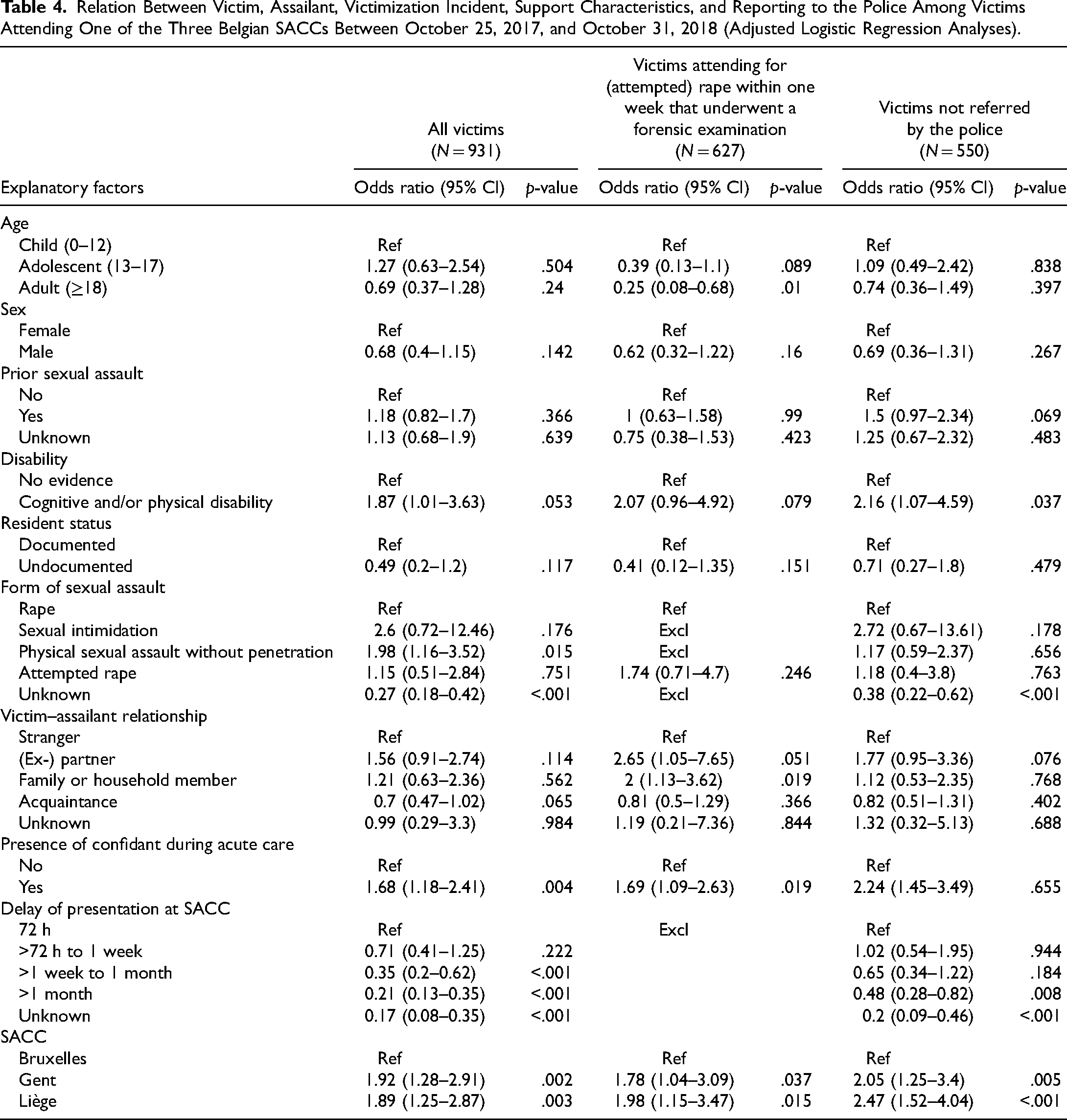
The significant associations between reporting to the police on the one hand, and the presence of a confidant and SACC site on the other hand, were also observed in the subgroup of victims that presented for (attempted) rape within one week and underwent a forensic examination. The victim–assailant relationship also played in this subsample with victims that were assaulted by a family or household member showing higher odds to report (aOR 2; CI 1.13–3.62; p = .019) in comparison to those assaulted by a stranger. In the subsample of victims that self-referred or were referred by another source than the police, like in the complete sample, form of SA, delay of presentation to the police, and SACC site were significantly independently associated with reporting to the police, but not the presence of a confidant.
Discussion
Summary of Findings
This present study used program data from 931 victims attending the newly installed Belgian SACCs to assess not only the association of victim, assailant, and victimization incident characteristics with police reporting of SA, but also the understudied relationship between support characteristics and police reporting. Our findings show that the form of SA, the delay between presentation to the SACC and the assault, the presence of a confidant during acute care at the SACC, as well as the SACC site are factors that are associated with the likelihood to report sexual victimization to the police among SACC victims.
First, with regard to the form of SA, victims of physical SA without penetration had a higher likelihood to report in comparison to victims of rape. This stands in contrast with other studies where rape was more likely to be reported to the police than other forms of SA (Ceelen et al., 2019; Downing et al., 2022; Fisher et al., 2003; Gartner & Macmillan, 1995; Kilpatrick et al., 2007). However, in our study, victims for whom the form of SA was not known had a lower likelihood to report than those who were raped. We assume that a majority of victims of whom the form of SA was not known to the SACC personnel, had experienced some form of amnesia, though our program data did not allow us to clearly identify these cases. In that way, this finding corresponds with a study among SAC victims in Denmark that observed a higher risk for nonreporting among those victims that experienced amnesia (Stokbaek et al., 2021).
Second, victims that attended later than one week since the SA to the SACC had a lower probability to report than those that presented within 72 h. This is similar to other studies among victims attending specific SA services (Downing et al., 2022; Stokbaek et al., 2021), and a study among the general population showing that of the few SA victims that do report to the police, the majority does so within the first week after the assault (Walsh & Bruce, 2014).
Third, victims who came accompanied by a confidant like a partner, parent, or friend were more likely to report to the police than those who presented alone. A similar observation was done in one study within the general population, whereby victims that consulted with an informal support person had a higher likelihood to report the SA to the police (Paul et al., 2014).
Fourth, the SACC personnel as formal support providers also played an important role, as the likelihood to report was significantly different among SACC sites despite the same standard operating procedures and training of personnel. To our knowledge, no study has ever looked into this factor related to police reporting.
Interpretation of the Role of Formal and Informal Support Persons
In contrast to other studies on reporting of SA that merely focus on victim, assailant, and victimization incident characteristics; this study highlights the importance of the victims’ support persons, both formal and informal, in their decision to report SA to the police. Prudence is warranted when interpreting the role of support persons in victims’ reporting decisions. There is a risk of attributing a solely positive effect of support persons in motivating the victim to report. However, previous research has shown that such third parties could also coerce the victim to report or even decide to report to the police instead of the victim (Brooks-Hay, 2020; Patterson & Campbell, 2010), which may in turn have a negative impact on the victim's recovery after the assault (Kaukinen & Demaris, 2009; Patterson & Campbell, 2010).
First, concerning the victim's informal support persons, our hypothesis is that confidants who accompany the victims at the SACC may feel disempowered faced with victims’ distress, and might perceive that motivating or urging the victim to report is the only thing that is within their power to alleviate the negative consequences of the assault and support the victim, or to deal with the injustice of the SA. Other scholars have also acknowledged the role of informal support persons in seeking formal support (Campbell et al., 2015; Dworkin & Allen, 2018), implying that these confidants may as such not only have played a role in victims’ decisions to report, but also in seeking help at the SACC.
Second, regarding the role of the formal support persons, we assume SACC personnel may have certain beliefs and attitudes that make them either motivate or demotivate victims to report. In our study, we assume such beliefs and attitudes were shared by SACC personnel working at the same SACC, as we observed significant differences in reporting at the level of SACC sites. It is possible that, by experience, SACC personnel have seen the positive impact of the conviction of an assailant on a victim, but they may also take into account the possible adverse psychological impact of reporting (Brooks-Hay, 2020; Kaukinen & Demaris, 2009; Maier, 2012; McQueen et al., 2021), or anticipate the gap between the victim's aspired consequences of reporting and the reality of the criminal justice system's limited capacity to meet these aspirations (Brooks-Hay, 2020). While forensic nurses in the US emphasized victims’ choice and empowerment as guiding principles in their work (Campbell et al., 2011), it remains possible that the information forensic nurses provide to victims is influenced by their beliefs, attitudes, and previous experiences with the police in both their professional and private life.
Interpretation of the Results Within the Context of Specialized SA Services
It is important to point out that our study findings should be interpreted within the context of the SACs, and that our study population thus differs in a number of ways from the general population. First, the majority of SA victims at the Belgian SACCs report to the police, which stand in sharp contrast to the extremely low reporting rates of the general Belgian population (Depraetere et al., 2022). Second, victims presenting at a SACC actually sought some type of formal help at the SACC, may it be for medical care, a forensic examination, psychological care, or reporting to the police. Applying the key phases in the victim's help-seeking process (do I need help, what can I do, and what will I do; DeLoveh & Cattaneo, 2017), this means that before attending one of the Belgian SACCs, victims must have decided that the SA was impactful enough to seek formal help, they found information about the SACC and they overcame negative feelings such as fear of rejection, shame, and guilt, previously identified as major obstacles to help-seeking (Patterson et al., 2009). Their likelihood to report is for the above reasons most probably different from those who did not seek any formal support.
The care context of this study could also explain why certain study findings are different from other research examining reporting of SA among the general population. Concretely, this may clarify why in our study assailant characteristics played differently. Generally, victims are less likely to report when they know the assailant (Bachman, 1998; Ceelen et al., 2019; Felson & Pare, 2005; Fisher et al., 2003; Gartner & Macmillan, 1995; Paul et al., 2014; Wolitzky-Taylor, Resnick, McCauley et al., 2011), what was confirmed by some studies among victims that sought help with specialized SA services (Larsen et al., 2015; Stokbaek et al., 2021; Zijlstra et al., 2017) though not by others (Downing et al., 2022). In our complete study sample, we did not find a significant association between victim–assailant relationship and police reporting, while in the subgroup of those victims that reported for (attempted) rape within one week, we observed that when the assailant was a family or household member, victims were more likely to report than when the assailant was a stranger. A hypothesis to explain this phenomenon at the Belgian SACCs is that victims of domestic violence who are generally known to be reluctant to seek help (Wright et al., 2021) may have experienced multiple SA events before the event for which they eventually sought help at the SACC. When these victims finally do overcome these barriers and seek help early at the SACC, it is plausible that they go for the full package of holistic care, including reporting the SA to the police.
Study Limitations
A first limitation of this study is the fact that no distinction was made in our dataset between a victim or a confidant reporting the SA or a victim being coerced to report, as other researchers have already pointed out that reported rapes are not the same as reports that victims of rape freely chose to make (Brooks-Hay, 2020). This has been adapted in the new monitoring and evaluation system of the Belgian SACCs and will allow us to study this nuance better in the future.
Another study limitation relates to its cross-sectional study design. Such a study design does not allow to derive any causal relationships (Setia, 2016) between the victim, assailant, victimization incident, and support characteristics with police reporting of the SA.
One more limitation of the present study was the inability to examine associations with victimization incident-related characteristics such as physical violence, use of alcohol and drugs, and injuries on victims’ reporting behavior, that have commonly been identified as factors associated with reporting to the police within the general population (Bachman, 1993; Ceelen et al., 2019; Clay-Warner & Burt, 2005; Fisher et al., 2003; Kilpatrick et al., 2007; Paul et al., 2014; Wolitzky-Taylor, Resnick, McCauley et al., 2011), and in the majority of studies on victims attending specialized SA services (Downing et al., 2022; Larsen et al., 2015; Mulder et al., 2021; Stokbaek et al., 2021; Zijlstra et al., 2017). Due to the use of program data for our study, this information was only available for the subsample of victims that underwent a forensic examination and the size of the subsample did not allow us to perform an adjusted logistic regression model including those variables. However, unadjusted analyses revealed that victims who did experience moderate to severe physical violence had a higher likelihood to report than those who did not experience physical violence, and no significant association was found with the use of alcohol. Routine questioning on the circumstances of the assault for all victims presenting at the SACC may allow us to clarify the influence of these victimization incident characteristics in the future.
Study Strengths
The first strength of this study includes the fact that we applied a socioecological perspective to police reporting of SA (Kubiak et al., 2018; Ménard, 2005) and also examined support-related factors with regard to reporting to the police, as only a few quantitative studies investigated this (Paul et al., 2014). Secondly, in contrast to many other studies regarding reporting of SA among victims attending SA services (Downing et al., 2022; Larsen et al., 2015; Stokbaek et al., 2021; Zijlstra et al., 2017), we took a gender-sensitive approach in our research, including male and female victims of SA.
Implications for Research
Future research should increasingly use a socioecological perspective when studying police reporting of SA and move beyond the traditional victim, assailant, and victimization incident characteristics lens. By including the rarely studied support characteristics in future research, our findings may be corroborated or refuted, this way continuously improving our understanding of victims' decisions to report SA to the police. Additionally, there is a need to study healthcare workers' beliefs and attitudes regarding reporting SA and its impact on victims’ reporting decisions. Last, closing the “reporting gap” requires an in-depth understanding of victim's motivations to report SA to the police. Further qualitative research is ongoing to better understand these dynamics among victims attending the Belgian SACCs.
Implications for Policy and Practice
Our findings suggest that both formal and informal support persons as part of a victim's micro- and mesosystem may shape SA victims’ reporting decisions. Hence, the importance to involve confidants who accompany victim's at specialized SA services in the decision-making process regarding reporting at SA services. Information for confidants should highlight their potential motivational and supportive role, while stressing the importance of letting control over the reporting decision with the victim. The same counts for healthcare workers who should be trained and supported regarding their own beliefs with regard to victims’ reporting decisions and their potential role in that process.
This study points out that reporting among SACC victims is interrelated with the victim's overall help-seeking behavior and SACCs holistic care offer, of which facilitation of access to reporting is only one aspect. Hence, the importance to include facilitation of reporting to the police in the care package of SA services, as from a socioecological perspective altering this factor in a victim’ mesosystem may be one of the ways to increase reporting to the police among SA victims.
Promoting victims to seek care early at SA services is not only beneficial for victims’ health and well-being; our study shows that early help-seeking also creates a window of opportunity to open a discussion on reporting SA to the police and perform a forensic examination regardless of a victim's decision to report, with victims who may be more open to report than those that arrive later. Communication campaigns are needed to encourage this early help-seeking after SA, directly at specialized SA services.
Conclusion
This study shed light on not only the form of SA and delay of presentation to a SACC as factors associated with police reporting of SA among victims that presented at specialized SA services in Belgium, but also on the understudied relationship between support persons and police reporting. This improved understanding of the role of formal and informal support persons in victim's reporting decisions may support policymakers and practitioners in the development of effective interventions to alter reporting behavior among victims of SA.
Footnotes
Acknowledgments
We would like to thank all SACC personnel and their coordinators who have rigorously collected or supported the collection of the data and are assisting victims of sexual violence on a daily basis.
Declaration of Conflicting Interests
The author(s) declared no potential conflicts of interest with respect to the research, authorship, and/or publication of this article.
Funding
The author(s) disclosed receipt of the following financial support for the research, authorship, and/or publication of this article: Financial support from the Belgian Institute for the Equality of Women and Men under grant numbers IGVM/MW/SCAB/2017 and IGVM/MW/S/Cab/bis/19-01.
