




Abstract
Relatively little research has examined men's use of coercive controlling tactics against female partners after separation. This mixed-methods secondary analysis of 346 Canadian women documented coercive controlling tactics used by their ex-partners (86.4% identified at least one). The composite abuse scale emotional abuse subscale and women being older were associated with men using coercive control tactics post-separation. A secondary qualitative analysis of in-depth interviews with a sub-sample of 34 women provided additional examples. Abusive partners used numerous strategies to coercively control their ex-partners by stalking/harassing them, using financial abuse and discrediting the women to various authorities. Considerations for future research are presented.
Introduction
Intimate partner violence against women (IPV) is globally acknowledged as a significant and concerning issue (García-Moreno et al., 2013). The abuse that women endure while living with intimate partners encompasses emotional/psychological abuse, coercive control such as threats and intimidation (Hamberger et al., 2017), sexual assaults (Bagwell-Gray et al., 2015; Tutty & Nixon, 2022), and physical abuse that may be life-threatening (Johnson et al., 2019; Tutty, 2015). Women often have their mothering capabilities denigrated as one form of coercive control (Heward-Belle, 2017). Their partner's abusive behaviors can result in long-term trauma and mental health problems as well as physical and mental disabilities (Ferrari et al., 2016; Goodman et al., 2016; Tutty et al., 2021a).
While the general public often naively hopes that separating from an abusive partner ameliorates these significant concerns, IPV commonly continues after women leave (Hardesty & Chung, 2006) either through continued physical assaults (Brownridge et al., 2008; Fleury et al., 2000; Humphreys & Thiara, 2003; Rezey, 2020), or sexual assaults (DeKeseredy et al., 2004). Importantly, women with children who leave abusive partners are often faced with bitter, high-conflict divorce and child custody and access disputes, the focus of considerable study (Ellis et al., 2021; Feresin et al., 2019; Jaffe et al., 2008; Khaw et al., 2021; Miller & Manzer, 2021; Saunders & Oglesby, 2016; Varcoe & Irwin, 2004).
Post-Separation Coercive Control Beyond Child Custody Issues
Abusive behaviors not connected to child custody disputes per se also occur, commonly within the realm of coercive control tactics such as stalking and emotional threats (Hardesty & Ganong, 2006; Hay et al., 2021; Spearman et al., 2022). Broughton and Ford-Gilboe (2017) noted that in their quantitative secondary analysis of 157 Canadian mothers, “Although women had been separated from their abusive partners for an average of 2.5 years, the majority continued to experience coercive control” (p. 2468), a trend also noted by Davies et al. (2009). Hayes’ research (2012) documented a decline in physical abuse after separation but not in controlling behaviors such as lying to the children.
Other empirical research has yielded results consistent with the conclusion that many women who leave abusive relationships continue to experience emotional abuse from their former partner. Sharp-Jeffs et al. (2018) conducted a longitudinal study, in which nearly 90% of the women interviewed in the third wave (N = 72) reported different forms of post-separation abuse, including their abuser's manipulation of social institutions, for example, by bad-mouthing her to social services. Similarly, Crossman et al. (2016) reported that the majority of the eight separated women in their qualitative study experienced coercive control tactics that included personal threats during child visitation, often the only contact between the ex-partners.
Research has documented numerous controlling tactics used by former partners. Toews and Bermea's (2017) qualitative interviews with 24 women indicated that, while using the children (including study court filings and threats to kidnap them) was a major theme, former partners also made threats, excessive phone-calls, and denigrating comments in addition to stalking and using economic abuse, factors that were negatively associated with the women's mental health. A qualitative study with 19 women (Rivera et al., 2018) similarly highlighted abusive partners continuing to inflict emotional distress by threatening to harm or abduct the children or trying to destroy the mother–child bond. Further, a qualitative study by Katz et al. (2020) with 29 children confirmed ongoing coercive control by fathers that the children said directly affected them.
Abusive partners may use legal systems to continue controlling their ex-partners (Douglas, 2018; Ellis et al., 2021). As well as difficulties with the family law process, Douglas’ interviews with 65 Australian women identified conflict with respect to civil protection orders, court appearances, calling inappropriate witnesses and contacting Child Protective Services. This subset of legal post-separation coercive tactics includes what Miller and Smolter (2011) labelled “paper abuse” or “procedural stalking” in their qualitative study with ten women. These actions include making false reports to child welfare authorities, frivolous lawsuits, and strategies to extend court proceedings.
A handful of studies have researched economic abuse post-separation. Based on interviews with 33 women, Krigel and Benjamin (2021) described economic abuse post-separation tactics as including withholding alimony or child-support payments or transferring debt from the ex-partner. Zeoli et al. (2013) suggested that economic abuse is one of the most common manifestations of post-separation abuse based on their qualitative study with 19 women.
Theoretical Orientation and Rationale for the Study
Intersectionality is “a theoretical or analytical approach that simultaneously considers multiple categories of identity, difference, and inequality (such as gender, race, class, sexual orientation, disability, as well as others)” (Else-Quest & Shibley Hyde, 2016, p. 155). An intersectional approach to studying IPV is recommended because women's lives are complex and health and mental health are affected by more than just violence (Sokoloff & Dupont, 2005). Ethnic background has been linked to the risk of IPV. In Canada, indigenous women (First Nations, Métis, and Inuit) are significantly more likely to experience IPV (Brennan, 2011).
In summary, although abuse with respect to custody issues after separation from an abusive partner has been widely studied, relatively little research has examined post-separation abuse beyond child custody, and these have mostly consisted of qualitative studies with relatively small sample sizes (i.e. Crossman et al., 2016; Krigel & Benjamin, 2021; Miller & Smolter, 2011; Rivera et al., 2018; Toews & Bermea, 2017; Zeoli et al., 2013). Nevertheless, the consistency between the various qualitative studies confirms the importance of further study on post-separation abuse, supported by the results of several quantitative studies (Broughton & Ford-Gilboe, 2017; Davies et al., 2009). Clearly, additional research with expanded sample sizes that also includes more women from diverse backgrounds is warranted.
With unique access to a large study of Canadian women from three Western Canadian provinces who were abused by intimate partners, the goal of the current mixed methods secondary data analysis was to examine the ex-partner's use of coercive controlling tactics experienced by 346 women post-separation, who they were in terms of their demographic locations, and the post-separation tactics beyond custody arrangements that they encountered including actions such as lying to the women's employers, friends and family, and teachers. Further, there is a paucity of studies on post-separation abuse in indigenous communities, an exception being Pederson et al.'s Canadian study (2013), which was specific to physical violence and that reported significantly higher physical assaults for indigenous women. Given that over half of the women in the current study were indigenous, we considered this an important opportunity to learn about coercive controlling tactics not only for them, but for the small sample of woman of visible minority backgrounds as well.
Method
The data for this mixed-methods secondary data analysis was obtained from the “The Healing Journey,” a longitudinal, Canadian study with a convenience sample of 665 women who had experienced IPV and sought shelter and/or counseling in the three prairie provinces of Alberta, Saskatchewan, and Manitoba. The primary aim of the original study was to assess the mental health and general wellbeing (Tutty et al., 2021a) and experiences of mothering (Ateah et al., 2019; Nixon et al., 2017) over a 4-year period of women abused by intimate partners (Tutty et al., 2021b). Both academics and community agency members of the research team assisted in designing the research, recruiting participants, and interpreting the results. Data for the study were collected in seven waves between 2005 and 2009, with one wave specific to an economic analysis (DeRiviere, 2014).
The research protocols were approved by the Ethical Review Boards of the six associated universities (Universities of Calgary, Manitoba, Regina, Brandon, Lethbridge, Winnipeg). Each province conducted an environmental scan of agencies (i.e., women's shelters and counselling agencies) to cover urban, rural, and northern sites from which to recruit. Potential participants attended information sessions at agencies or were provided with sealed envelopes containing information about the study by agency staff. The criteria for inclusion were: a minimum 18 years of age; the most recent incident of IPV no sooner than 3 months and no longer than 5 years prior; commitment to stay in the study for the full 4 years; and no debilitating mental health issues. Honoraria of $50 CAN were provided to participants at each wave.
Research Measures
Data in the original Healing Journey study were collected with respect to four major areas: demographic background and history of abuse; general functioning and service utilization, health, and mothering over 4 years. The surveys included standardized measures as well as open- and closed-ended questions developed specifically for the study (all administered verbally by trained research assistants). The current mixed-methods secondary analysis used data from the first two waves: The core demographics, including the severity of IPV of the total sample when the couple were together, were obtained in Wave 1; and the partner's post-separation abusive tactics were assessed in Wave 2.
Intimate partner violence
The nature of the IPV was assessed by the composite abuse scale (CAS) (Hegarty et al., 2005). This screening measure consists of 30 items rated for frequency in the past 12 months on a six-point scale from never to daily, with a possible total of 150. The four subscales are: severe combined abuse (8 items; range of scores 0–40; suggested cut-off of 1), physical abuse (7 items; range of scores 0–35; cut-off of 1), emotional abuse (11 items; range of scores 0–55; cut-off of 3), and harassment (4 items; range of scores 0–20; cut-off of 2). The suggested clinical cut-off for the total CAS score is 3 or 7 to minimize false positives. The scale has demonstrated convergent and discriminant validity (Hegarty et al., 2005). Cronbach's alpha for the CAS in the current study is .93.
The post-separation abusive tactics checklist was created on the suggestion of one of our community partners, the Alberta Association of Women's Shelters, based on their extensive experience with women who were separated from abusive partners. It includes 11 questions about the abusive partner's actions that could discredit her reputation and individuals/institutions to whom the partner has lied about her such as the police or her employer. After completing this checklist, the women were invited to provide details or further information about other ways that their partners had abused them post-separation, which were analyzed qualitatively.
Research Procedures: Qualitative Component
While the primary study used quantitative methodology, including standardized measures and surveys developed specifically for the project, the researchers included a qualitative component to allow the women to tell their stories from their own perspectives. The semi-structured interviews were designed by a subset of the Healing Journey team members, with the intention of gaining depth and context to the respondents’ experiences of intimate partner abuse. Each woman was asked to begin where they thought their journey/story of intimate partner abuse began, where that journey/story is at today and where they think it is taking them in the future. In total, 89 interviews were completed (30 women from Manitoba, 30 from Saskatchewan, 29 from Alberta). Nine interviews (10%) were excluded because the women still resided with their abusive partners. Notably, no interview questions were specific to IPV after separation.
The interviews took approximately 2 to 2½ hours, scheduled at times and locations convenient to the participants. The research assistants who had administered the quantitative component at each wave were trained to conduct these qualitative interviews. The interviews were audiotaped and transcribed verbatim (pseudonyms were used to maintain the participants’ anonymity).
Data Analysis
The demographic characteristics of the women and their scores on the CAS are presented comparing those that reported any coercive control tactics compared to those that reported none. Responses to the post-separation abusive tactics checklist are compared statistically using Pearson's chi-square analysis based on the racial or ethnic background of the ex-partner (since the abusive strategies were enacted by the men) with effect sizes calculated with Phi or Cramer's V. Standardized residuals were calculated to identify the category differences responsible for the statistically significant chi-square analysis (Field, 2009). Effect sizes were interpreted using Rea and Parker's (2002) suggested benchmarks of under .10 as a “negligible” association; between .10 and under .20 as a “weak”; between .20 and under .40 as a “moderate,” and between .40 and under .60 as a relatively “strong” association (p. 203).
The mean scores on variables of age, income, and scores on the CAS subscales when the partners were together were compared with independent t-tests based on whether they reported coercive control tactics or not. Cohen's d (Cohen, 1988) was used to interpret statistically significant t-tests with a d between 0.2 and 0.3 be considered a ‘small’ effect size, 0.3 to 0.5 represents a ‘medium’ effect size and 0.8 a ‘large’ effect size. Finally, logistic regression (Field (2009) examined the relative significance of the variables that distinguished coercive control from no coercive control.
Secondary qualitative analysis, which entails a re-analysis of already-available narratives, was used to examine the comments and interviews with respect to post-separation abuses. Secondary qualitative analysis has been deemed especially appropriate for dealing with vulnerable populations and sensitive issues (Long-Sutehall et al., 2010). The first author conducted the secondary analysis of the transcripts following established mainstream qualitative research processes, identifying the major themes, sub-themes, and categories (Graneheim & Lundman, 2004; ). First-level coding entailed word-by-word scrutiny of the interviews to identify prominent themes and sub-themes (Braun & Clarke, 2006). Second-level coding involved looking within the themes and subthemes to identify similarities, differences, and gaps using the constant comparative method (Miles et al., 2014; Thorne, 2000).
Results
Research Participants
The current secondary analysis focused on 346 women who had completed the post-separation abusive tactics checklist in Wave 2 of the study (see Table 1). Older women reported that their partners used more coercive controlling tactics (34.5 compared to 31 years; a medium effect size) while their ex-partner's ages also differed, with older men reportedly using coercive tactics (37.2 compared to 34.6 years, a small effect size). The women's racial or ethnic backgrounds were 49.4% indigenous, 43.6% White, and 7% visible minority; while the ex-partners were White (48.2%), indigenous (42.6%), and 9.1% visible minority. Men of indigenous backgrounds used statistically fewer coercive tactics, however this represented only a “negligible” effect. Every one of the women in this analysis had children; 84.3% had at least some children under age 18.
Demographics of Women Comparing Coercive Control Versus Not (N = 346).
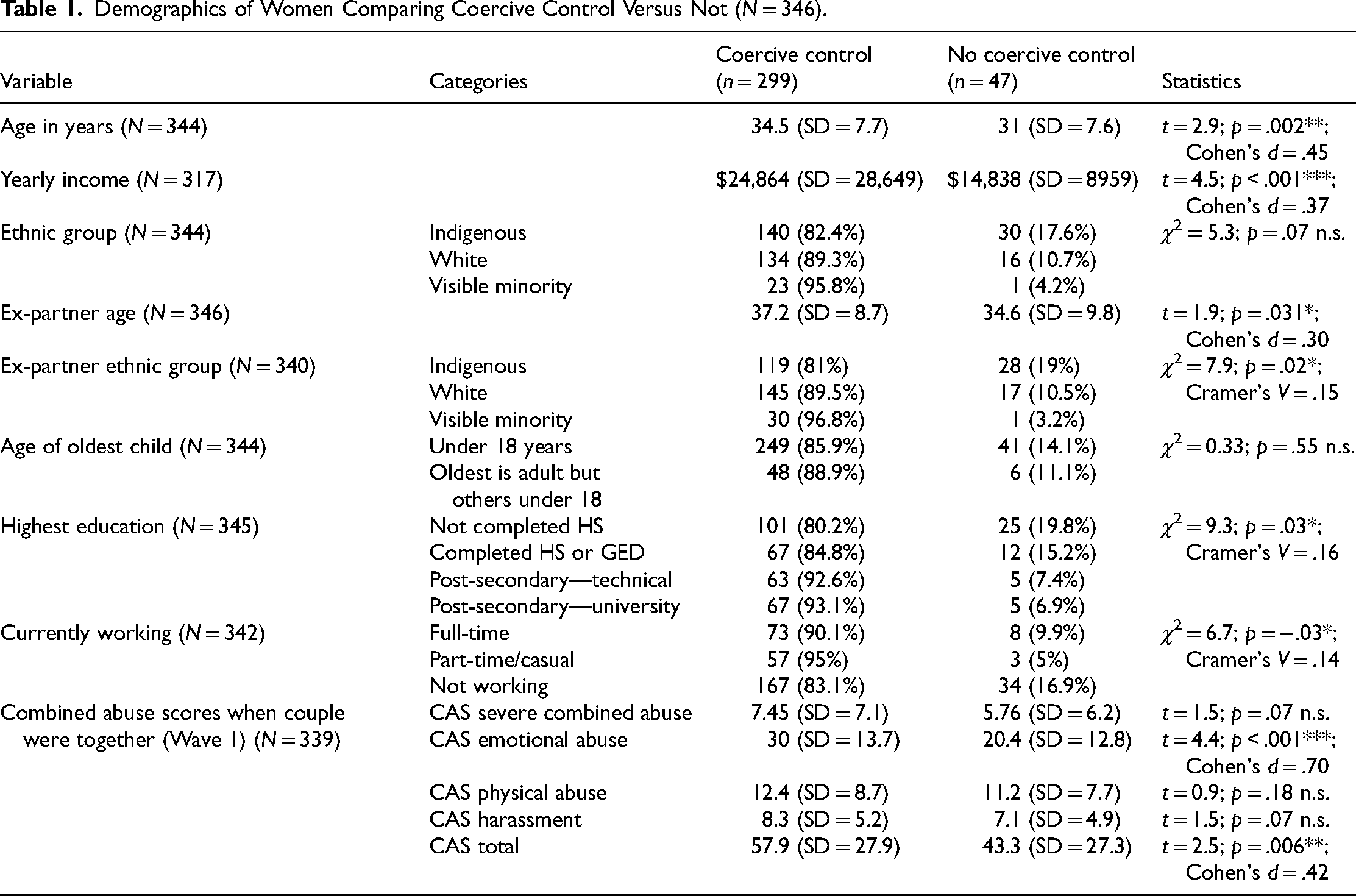
The women's highest level of education included 46.5% who had not completed high school, 22.9% had completed high school, while 40.6 had some post-secondary education, either in technical institutes (19.7%) or universities (20.9%). This variable differentiated those whose partners used coercive tactics, such that those with higher education had more coercive tactics used against them, although a “negligible” effect. The women's average total income in the past year differentiated their ex-partner's use of coercive control tactics such that women with higher incomes were recipients more often (CA$24,864 compared to CA$14,838; a medium effect size). The majority or women (58.8%) were not working, another 17.5% worked casually or part-time and 23.7% worked full-time. Women not working had fewer coercive control tactics used against them (a negligible effect). Scores on the CAS subscales and Total CAS when the couple were together were well above the suggested clinical cut-off scores for abusive behaviors. Women whose partners used coercive tactics had significantly more serious scores on the CAS Emotional Abuse subscale (a large effect) and the CAS Total IPV scale (a moderate effect).
A logistic regression analysis was constructed with coercive controlling tactics (yes/no) as the dependent variable and the significant variables that distinguished the use of coercive tactics compared to no-coercive tactics entered as independent variable or covariates: woman's age, ex-partner's age, ex-partner's ethnic background, woman's income, highest education, woman's work status; CAS Emotional Abuse subscale and CAS Total score. Of these, only the contributions of the CAS Emotional Abuse subscale (p = .004) and the women's age (p = .02) remained significantly associated with the ex-partner's use of coercive control.
Post-Separation Abusive Tactics Checklist Items
The information in Table 2 documents 250 women's reports of their partners’ actions with respect to themselves as mothers or their children (the post-separation abusive tactics checklist), each of which constitutes an extension of the intimate partner abuse that occurred when they lived together. Since the initial statistical comparison of demographic characteristics indicated differences based on the racial/ethnic background of the partners, the data on these items were also compared based on this variable. The most endorsed item was that 91 of 213 (42.7%) of the ex-partners had told others that “I am a bad mother” often or always, with indigenous ex-partners significantly less likely to demean the women's mothering (χ2 = 15.1; p = .004; Cramer's V = .19; a weak effect).” One mother commented, “He plays on the children by bad mouthing me; he shouldn’t do that.”
Post-Separation Abusive Tactics Checklist by Ex-Partner Ethnicity (N = 250).
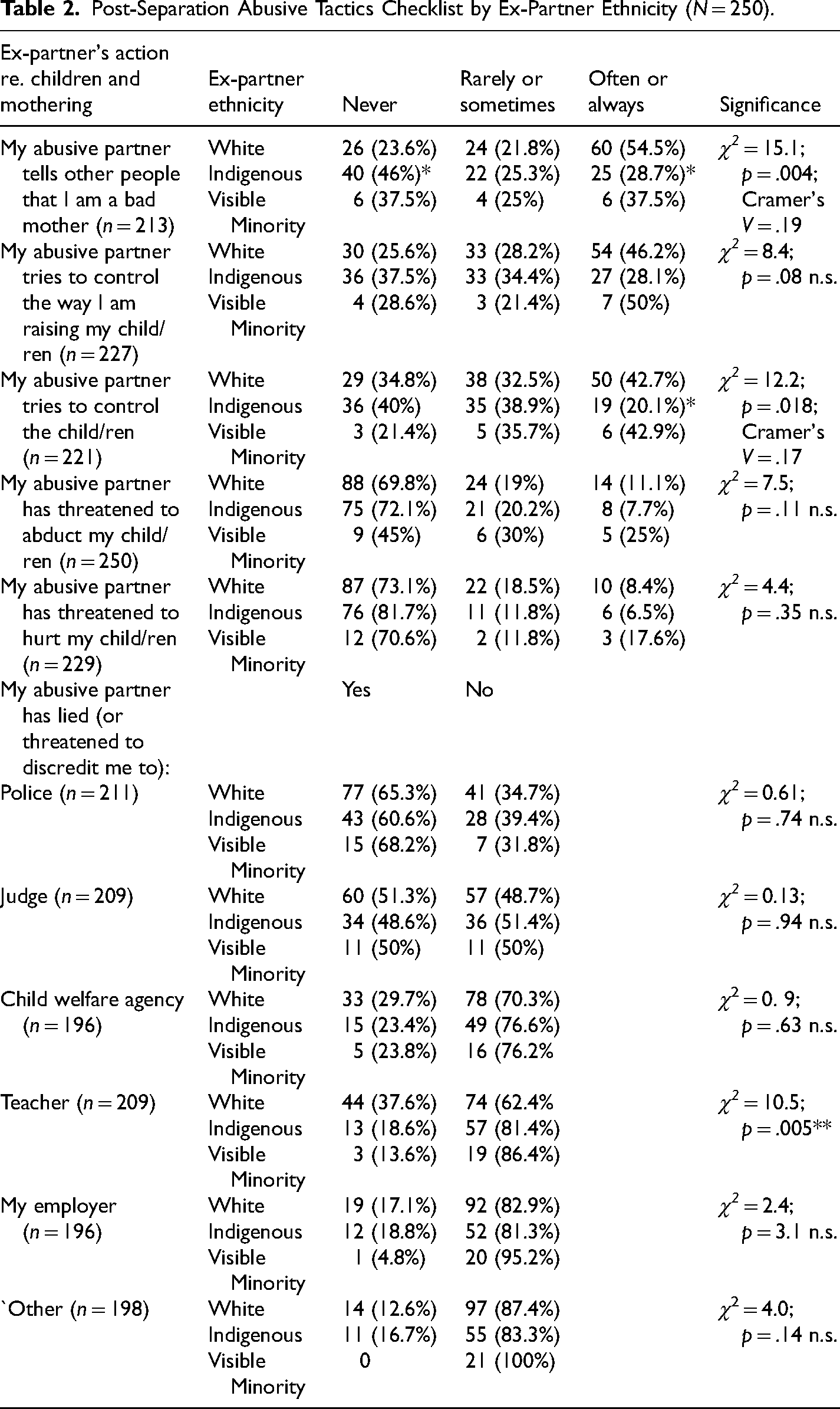
Eighty-eight mothers (of 227 or 38.8%) commented that their abusive partners “often” or “always” tried to control the way they were raising their children with no differences based on the racial or ethnic backgrounds of their ex-partners. A further 75 women (of 221 or 33.9%) noted that their abusive partners “often” or “always” try to control the children. Indigenous ex-partners were significantly less likely to do so (χ2 = 12.2; p = .018; Cramer's V = .17, a weak effect). A smaller proportion (19 of 229 or 8.3%) claimed that their partners “often” or “always” threatened to hurt their children, with no differences based on the ex-partner's racial or ethnic group. A total of 27 mothers (of 229 or 10.8%) noted that their abusive partners had “often” or “always” threatened to abduct their children (no racial or ethnic difference for ex-partners).
Another set of six questions was about whether the ex-partners had lied to or had threatened to lie to others, including authorities, to discredit the women. Notably, there were no significant differences based on the racial or ethnic backgrounds of the ex-partners. However, 53 women (of 196 or 27%) endorsed the post-separation abusive tactics checklist item stating that that their ex-partners told lies to child protective services or social services authorities. One woman disclosed that, “He tells people that I am going to kill my children; Child Welfare, neighbors, the police.” Another disclosed, “He left messages with Child Welfare saying I abused substances—basically tried to discredit everything I’ve been doing over past eight months.” A third woman lamented that, “Even though he said he let my girl touch his penis in court and lied about me, the court gave him custody. It took me months to get them back.”
More than half of the women described their ex-partners as having lied to the police (135 of 211 or 64%) and the courts (105 of 209 or 50.2%). One woman commented that her ex-partner, “told police that I was in a lesbian love affair—that never happened. He swore this on an affidavit. That is how he was able to get custody.” Another woman stated that, “He lied to the police and judge that he never physically abused against me or my children.” A final comment was as follows, “he told the police that he had to give me some forms. He lied. It was an excuse to see me. He lied to a judge about marital problems and material items.”
Thirty-two women (of 198 or 16.3%) endorsed the post-separation abusive tactics checklist item stating that their partners had lied to their employers. According to one woman, her partner, “Called my boss and tried to get me fired, made me sound like an unfit parent to authorities.” Another noted that her ex-partner, “Threatened to inform my employer and [social service agency] that I am unstable and drink too much alcohol.” Another commented, “He knew I was applying for a position. He discredited my name.”
A little over one-quarter of the women (60 of 209 or 28.7%) noted that their partners had lied to the schools. Comments included that their ex-partner had “lied to the principal,” “charmed the teachers and discredited what I told them”, and “lied to son's teacher saying he had full custody.” Finally, 25 women (of 198 or 12.6%) endorsed the item that their partners had lied to “others.” In the comments regarding “others”, the most frequently mentioned actions were with respect to lying to family and friends (43 comments). One woman mentioned that “When he is drinking, he complains about me to his relatives to make it look like I am the bad person.” Another woman noted that her ex-partner had “lied and threatened my parents, neighbors, close friends and church group.” Additional comments included: “My husband told my friend he left because I was cheating on him” and “Family and friends—he told them that he didn’t abuse me, and I was the cause of the trouble.”
In summary, the women reported that their ex-partners had used a range of tactics post-separation, including threats, denigrating their mothering and lying to authorities, all of which are used to enact coercive control. These actions affected almost every area of their lives including their jobs, their children's schooling, and their mothering.
Post-Separation Abuse From the In-Depth Interview Themes
Of the in-depth interviews with 79 separated women, 34 (45.3%) identified abuse post-separation abusive tactics. Of these 34, 17 (50%) were White, 14 (41.2%) were indigenous and three (8.8%) were of visible-minority backgrounds, similar to the proportions of this variable in the larger sample of women who completed the post-separation abusive tactics checklist. Their average age was 41.2 years (SD = 10.5; range of 27–78), older than the post-separation abusive tactics checklist sample, whose mean age was about 34 years.
The women disclosed six major forms of post-separation abuse including: physical assaults and thefts (5); stalking/harassment (10); financial abuse (9); threats (7); lying to children (5) and abducting or threatening to abduct children (5). A discussion of each is provided below.
Physical assaults and thefts post-separation
While the major focus of this analysis is not on violent assaults or other criminal activities post-separation, it is important to acknowledge that these occurred for several women. Additional contextual information about age, ethnic background and ex-partner's ethnic background is provided in the quotes from the women's in-depth interviews. Four interviewees documented physical assaults from ex-partners: He takes the keys from my ignition and starts beating me up. I’ve got deep bruises that took a month to disappear. He tried to choke me. I was fighting too; I grab and twisted his ear. It was brutal. He tried to pull me out of the truck. I thought “I can’t let him get me on the ground, ‘cause he’ll kill me.” By the time he's done, he's like, “If you don’t go to the police, I won’t bother you anymore.” (46 yr. old White woman; White partner)
The very worst was when I had just got out of the relationship, but he found out I was pregnant. He broke into the place; he was drunk. He threw (son) who was just walking, starting to talk, tried to protect me. He hit (son), flying and I caught him. But he lost his teeth, and I broke my neck. (30 yr. old indigenous women; indigenous partner)
Two additional women described thefts or break-ins by their ex-partners. According to one, “He’d come over to pick up [daughter] and my purse would be gone. I had to get ID so many times because he's taken it” (27 yr. old indigenous women; White partner). The other woman disclosed: He broke into my apartment. He said I went to his apartment to have sex with his friend, and he had videotaped the whole thing. I had been sleeping that day. The movie was fuzzy. He's pointing out “me” and who I was with and I’m thinking, “I’m gonna die today.” I’d never been so terrified. (32 yr. old White women; Middle Eastern partner)
To summarize, while only three women described physical assaults post-separation and two described thefts, the threats and actual assaults were violent and potentially life-threatening.
Post-Separation coercive control
The most mentioned and serious form of coercive control was the ex-partner's stalking and harassment documented by ten women. As one interviewee commented, “He started to stalk me, and it was very scary. It was 24/7. He would go as far as having a buddy find out where I am. The phone calls never stopped” (28 yr. old indigenous woman; White partner). Another disclosed, “The last three years I’ve spent battling my ex. He keeps trying to get my phone numbers. It's harassment, sending me verbally abusive emails, calling me, leaving verbally abusive messages on a line that's supposed to be for the children” (32 yr. old White woman, indigenous partner). Other comments regarding harassment and stalking behaviors included the following: He stalked me. Anytime I left him he went to every one of our friend's and just bangs on the door, “Where's Stella? Where's Stella? She's here ‘cause I see my kid's jacket.” I had no place to turn. What am I gonna do with the kids? Every place I went, he followed me. (70 yr. old White women; White partner)
He was constantly following me. He would show up at the house, “I want the kids for visitation.” He used visitation. Never gave me notice just showed up on my doorstep. Then the yelling and the running me down. It was constant stress. I couldn’t get through school ‘cause I couldn’t concentrate. (34 yr. old Indigenous women; White partner)
How he knew I’d gone to an Al-Anon meeting, I don’t know. He was watching windows, expecting me to walk around. He stalked me since the day we were married. Always. Everywhere. (78 yr. old Indigenous woman, White partner)
The second-most frequently commented-upon issue was financial or economic abuse, identified by nine women. These were serious infringements that often left the women in dire financial difficulties. Somehow the ex was getting into my bank account. He had my Child Tax Benefit cancelled and switched to him. A girl posed as me, and he knows all my information, my Social Insurance Number. (28 yr. old Indigenous woman; White partner)
The words that stuck the most, “If I can’t have you and the kids then nobody can. I’m gonna make your life hell.” That is exactly what he did. He kept me from getting any finances through the maintenance enforcement program. Two hundred dollars a month. He quit his job so that he wouldn’t have to pay. He worked under the table. Through Unemployment Insurance, I was getting $198.00 a month. (34 yr. old Indigenous women; White partner)
My husband neglected to pay the mortgage and the taxes on the house, so I got notice from the bank that I’ve got 14 days to come up with $4,000, or they start foreclosure. He won’t have $4,000, and I don’t have $4,000. So now I’m forced to sell the house. (44 yr. old White woman; White partner)
In addition to post-separation stalking/harassment and financial abuse, seven interview respondents disclosed that their ex-partners had threatened to hurt or to kill them. According to one woman, “He told me he was going to take me apart and I would never be able to work again” (50 yr. old Latina woman, White partner). Another mentioned, “He would say he was going to haul me off into the hills, because corpses don’t talk. He was threatening to kill me” (46 yr. old White women; White partner). A third respondent commented, “He has threatened my life so many times. Just a couple of months ago he said, “Someone's going to die. I’m going to kill someone.” He didn’t say, but I know it's me. (27 yr. old indigenous woman; White partner).
Five interviewees described their ex-partners as having lied to their children: They were old enough to make up their own minds, so I allowed them to go back with their dad. After he had them, he started brainwashing them. Telling them stuff like, “Mom tried to kill you guys when you were small. Mom was in the psych ward, Mom is sick.” Stuff that the boys believed. (38 yr. old Indigenous woman; Indigenous partner)
My youngest said, “Mom, I don’t like being around my dad, ‘cause he says some really bad things about you. He said, he can’t wait for the day you die, and you’re a b-i-t-c-h.” (42 yr. old Indigenous woman; Indigenous partner)
Four women described their ex-partners either threatening to (1) or actually abducting the children (3), consistent with the item from the post-separation abusive tactics checklist. In one case, “He didn’t return her (daughter aged 9), my son waited at the airport. He purposefully missed the flight” (35 yr. old White women; White partner). He threatened to take the kids away again. He had done it previously. At one point at Christmas, he held my baby hostage in order to gain entry and give me a hard time. He took off with the kids twice on me. (34 yr. old Indigenous women; White partner)
He said, “I’ve got a lawyer, I’m probably getting custody of the kids, they’re in my control now, ha ha ha.” So, he took the kids. I had no idea where they were. He kidnapped them. (34 yr. old White women; White partner).
Four women described their ex-partners contacting child protective services congruent with the previously noted post-separation abusive tactics checklist item: The garbage can is outside. I go to drop off the garbage and I tell her, “Don’t open the door.” He called Child Welfare saying that I leave her unattended. I explain and they say, “You have to be very careful. With this kind of call they’re going to come again.” (33 yr. old Latina woman; Latino partner)
He wrecked my relationship with my children by telling them that it was all my fault, it was me, why the family broke up. They believed him because Child and Family wouldn’t allow me to see my kids, but next thing, they were allowing him to see them. (44 yr. old Indigenous women; Indigenous partner)
In summary, the details from the women's interviews provide explicit examples of the ways in which their ex-partners continued to abuse them through harassment/stalking and emotional and economic abuse.
Discussion
The coercive control tactics used against women by their ex-partners in both the quantitative and qualitative analyses in the current study are consistent with the previously published, largely qualitative research on this topic (Broughton & Ford-Gilboe, 2017; Crossman et al., 2016; Douglas, 2018; Hardesty & Ganong, 2006; Hayes, 2012; Krigel & Benjamin, 2021; Sharp-Jeffs et al., 2018; Toews & Bermea, 2017; Zeoli et al., 2013). That these were used against not only White women, but also indigenous Canadian and women of visible-minority status adds to our understanding of the wide-spread nature of these acts, albeit that several differences were identified based on the ethnic/racial background of the ex-partners.
The statistical comparisons of factors related to whether the ex-partners used coercive controlling tactics using the post-separation abusive tactics checklist is novel. Although the common adage that “past behavior predicts future behavior” is not necessarily true (Surowiec, 2010), in the current analysis, the use of emotionally abusive tactics documented on the CAS scale when the couple cohabited was the strongest predictor of the use of coercive controlling tactics post-separation. The 11-item CAS subscale addresses issues that reflect coercive control, including, for example, “Tried to convince my family, friends and children that I was crazy,” Tried to turn my family, friends and children against me,” and, “Told me no one would ever want me.”
The women being older were also associated with the ex-partner's use of coercive controlling tactics. Sharp-Jeffs et al. (2018) did not find that the women's age correlated with coercive control tactics and neither of the other two quantitative studies of coercive control found the age of the women as a predictive factor for coercive controlling tactics (Broughton & Ford-Gilboe, 2017; Davies et al., 2009). Further, that the 344 women who completed the checklist all had some children under age 18, reinforced the previously mentioned comment that allowing access to children is a major reason that ex-partners have the opportunity to continue abusing women (Crossman et al., 2016).
The current focus on issues beyond post-separation physical and sexual assaults and child custody is not meant to imply that these were not significant concerns for the women in the Healing Journey study. The post-separation physical assaults experienced by four women in the current study were serious, but one-time events. Physical and sexual assaults after partners separate have been studied extensively (i.e., Brownridge et al., 2008; DeKeseredy et al., 2004; Feresin et al., 2019; Fleury et al., 2000; Khaw et al., 2021; Miller & Manzer, 2021; Rezey, 2020; Saunders & Oglesby, 2016) and, while the current study focus was not on physical assaults post-separation, as questions specific to any physical assaults were not asked in either the post-separation abusive tactics checklist nor the in-depth interviews, it made sense to note that violence occurred for some women, albeit not often. That relatively few women were physically abused post-separation is consistent with Hayes (2012) even though, the scores on the CAS (Hegarty et al., 2005) illustrated significant IPV when the women co-habited with their partners; in the clinical ranges on all CAS subscales and the Total score.
Items on the post-separation abusive tactics checklist were with respect to intrusive issues such as lying to authorities, trying to control or hurt the children and discrediting the woman's mothering, all of which have been noted in previous research on post-separation coercive control tactics (Hardesty & Ganong, 2006; Hay et al., 2021; Heward-Belle, 2017; Spearman et al., 2022). Threatening to abduct children is a serious concern that has also been documented previously (Rivera et al., 2018). Having a structured questionnaire such as the post-separation abusive tactics checklist to more easily capture these occurrences would assist women in presenting their experiences of some rather subtle forms of coercive tactics; and provide counsellors with a more streamlined method of documenting such acts and addressing them in treatment.
A number of the women mentioned that their ex-partners had initiated contact with Child Welfare, as has previously been noted in research by Douglas (2018) and Miller and Smolter (2011). The women in the current study also described their ex-partners as attempting to ruin their important relationships with close family and friends by lying about the circumstances of the abuse and denigating the women, similar to incidents reported in qualitative research conducted by Toews and Bermea (2017) and Crossman et al. (2016).
While the post-separation abusive tactics checklist captured the quantitative aspects of the partner's post-separation tactics, few specific examples were added in the comments. In contrast, the interviews captured serious post-separation abuse such as physical violence and criminal behaviors such as thefts, harassment, and threats to kill, but few stories emerged about the day-to-day troubles mentioned in the checklist. We argue that both aspects are important in developing an accurate picture of post-separation issues. Given the relative ease with which a quantitative checklist can be administered, improving this assessment tool is arguably a relatively simple solution to better capture post-separation abuse. The post-separation abusive tactics checklist could be expanded to include items about physical assaults, harassment, and economic abuse, to better reflect the realities of many women. In addition, researchers could also add a measure developed by Postmus et al. (2012), the Economic Exploitation scale, as it includes several factors mentioned by the women in the current study.
It is noteworthy that, according to the women, indigenous partners were less likely to use two of the post-separation abusive tactics—bad-mouthing the women's mothering and trying to control the children. There is a paucity of research comparing perpetrators’ actions in relation to their racial and ethnic backgrounds. Even the national Canadian studies used by several authors cited in the current study that focused on post-separation abuse (Brownridge et al., 2008; Pederson et al., 2013) did not collect or make public the racial or ethnic backgrounds of the male abusers. This seems a potential focus of interest in future research.
Although factors such as income and housing commonly become problematic after marital separation for women in general, those whose ex-partners were abusive are at increased risk. Ford-Gilboe et al. (2009) noted that, “more severe past IPV was associated with lower health and women's personal, social, and economic resources, when combined, mediated the relationship between IPV and health” (p. 1021). The coercive controlling strategies described in the current study are serious and have the potential to impact women's access to basic needs such as housing, which might result in homelessness (Ponic et al., 2011; Tutty et al., 2013) and lower income (Duffy, 2015), conditions that Ford-Gilboe et al. (2015) concluded were related to using fewer supportive services.
Study Limitations and Strengths
When conducting secondary analyses, one is limited by the nature of the original study, which, in this case, relied on a convenience sample of women from VAW shelters or counselling agencies. As such, the current results are likely not generalizable to other women abused by intimate partners from Canada's prairie provinces, particularly those who have not sought assistance for partner violence. It must be noted that the data were collected in 2004 to 2006. While it is possible that abusive partner's post-separation abusive tactics have changed since then, the available quantitative studies and qualitative studies with larger sample sizes do not document any such significant changes, thus supporting the use of secondary analysis with this substantial body of data.
A total of 346 women completed the post-separation abusive tactics checklist items, at least half of these noting their partner's use of these strategies, supporting the hypothesis that post-abuse strategies are frequently being used against them. In retrospect, it would have been invaluable to ask for details each time the women endorsed an item on the checklist, rather than simply asking one question at the end eliciting examples. The extent to which these issues occurred suggests the need for additional research. Other examples of post-separation tactics such as technology-assisted abuse might have been added. As mentioned earlier, the post-separation abusive tactics checklist could be expanded to include items about physical assaults, harassment, and economic abuse, for example, including items from the Economic Exploitation Scale (Postmus et al. (2012), not available when the current study was designed.
As well, the interview guide did not include specific questions about abuse post-separation. These occurrences came to light in the women's narratives about having been abused by intimate partners and their journeys after leaving. Many may not have considered some coercive controlling tactics as important enough to mention, especially in the context of the immensity of the tasks involved in acquiring basic needs and the stability necessary to establish lives independent of their ex-partners. Some simply had no contact with ex-partners.
A strength of the current study is that the women constitute a large sample of IPV survivors from the Canadian prairies with almost half of the women (49.4%) and 42.6% of the ex-partners being of indigenous background, a group whose well-being is particularly important in Canada but who are often not included in research. The analysis of differences in the use of post-separation abusive tactics in relation to the ex-partner's racial or ethnic background is unique and relevant, as about half the men were White. This speaks to possible additional important differences in IPV and its effects on women based on the men's cultural backgrounds.
Conclusions
Dissolving a marital/common-law relationship is often fraught with power dynamics and controlling tactics from either side (Symoens et al., 2014; Visser et al., 2017) and child custody disputes commonly become harrowing, prolonged battles (Watson & Ancis, 2013). However, as this study demonstrates, when IPV is a factor during the couple's relationship, the abusive partner often has an extensive repetoire of means, both significant and seemingly miniscule, by which to continue interfering in the women's and their children's lives post-separation. These multiple intrusions are akin to “death-by-a-thousand-cuts” and keep women on the alert, fearing additional strikes, especially when the couple share custody of children.
Since the abuse of women by intimate partners first became widely acknowledged, the knee-jerk response has been “why doesn’t she just leave?” (Barnett, 2000). Knowing their partners’ inclinations and the sheer number of strategies that an ex-partner who is abusive could use post-separation provides an additional explanation for why some women may choose to stay. While these coercive controlling tactics have been noted in previous research, they have tended not to be the primary focus of the discussion, exceptions being Broughton and Ford-Gilboe (2017), Crossman et al. (2016), Douglas (2018), Hardesty and Ganong (2006), Hayes (2012), Krigel and Benjamin (2021), Sharp-Jeffs et al. (2018), Toews and Bermea (2017) and Zeoli et al. (2013), all with smaller sample sizes than the current study. This is a relatively small collection of studies on post-separation abuse, given the serious and widespread nature of its occurrence, and our study contributes additional corroborating evidence as well as extending what we know about coercive control post-separation.
Considering this, it is vital that agencies and social services personnel become aware of the potential threats that affect their clients, often years after having separated from abusive partners. Sharp-Jeffs et al. (2018) noted that social agency staff are often unaware of these debilitating circumstances, however, it is critical that social services personnel become aware of these intrusions that may unfairly place their clients at continued risk. Administering an updated and expanded post-separation abusive tactics checklist to women when staff are aware that ex-partners were abusive during their relationships would be relatively simple and would provide essential context for providing the most appropriate interventions and understanding women's ability to comply.
Footnotes
Acknowledgments
The CURA team: Dr. E. Jane Ursel and Marlene Bertrand (Manitoba Department of Family Services and Housing, MB) are the Co-Principal Investigators. Other investigators inclue: Dr. Kendra, L. Nixon; Dr. Christine Ateah; Dr. Janice Ristock; Dr. Lori Wilkinson; Colin Bonnycastle; Dr. Jocelyn Proulx (University of Manitoba); Dr. Johanna Leseho; Dr. Roberta Graham (Brandon University); Dr. Linda DeRiviere; Dr. Michelle Owen (University of Winnipeg); Anna Pazdzierski (Nova House, Selkirk, MB); Karen Peto (YWCA Brandon); Margaret Marin & Darlene Sutherland (Osborne House, Winnipeg); Dr. Mary R. Hampton; Dr. Bonnie Jeffery; Dr. Darlene Juschka; Dr. Wendee Kubik (University of Regina); Dr. Stephanie Martin (University of Saskatchewan); Carol Soles (Prince Albert Emergency Shelter for Women); Debra George (Family Services Regina); Dr. Karen Wood (Tamara's House, Saskatoon); Maria Hendrika (Provincial Association of Transition Houses Saskatchewan); Angela Wells (Family Support Centre, Saskatchewan); Dr. Leslie M. Tutty; Dr. H. L. Radtke; Dr. Wilfreda Thurston; Dr. Erin Gibbs Van Brunschot (University of Calgary); Dr. Caroline McDonald-Harker (University of Alberta); Dr. Ruth Grant Kalischuk (University of Lethbridge); Jan Reiner & Carolyn Goard (Alberta Council of Women's Shelters); Brenda Brochu (Peace River Regional Women's Shelter); Kristine Cassie (YWCA Lethbridge); Pat Garrett (WINGS of Providence, Edmonton).
Declaration of Conflicting Interests
The author(s) declared no potential conflicts of interest with respect to the research, authorship, and/or publication of this article.
Funding
The author(s) disclosed receipt of the following financial support for the research, authorship, and/or publication of this article: Social Sciences and Humanities Research Council (SSHRC) Community University Research Alliance (CURA); Alberta Centre for Child, Family, & Community Research; Alberta Heritage Fund for Medical Research; the Prairieaction Foundation; and TransCanada Pipelines.
