




Abstract
Newspaper media plays a significant role in forming a public understanding of domestic violence. This article analyses 554 articles from 24 newspapers across Australian states and territories published between 2000 and 2020 that describe specific instances of domestic violence. It examines whether such violence is framed as a systemic issue or as a collection of individual events, as well as how such representations of perpetrators and victims displace both “blame” and “victimhood.” Although positive aspects of reporting can be observed, the tendency within newspaper articles to blur distinctions between perpetrators and victims distorts the true scale of domestic violence in Australia.
Introduction
Australian print and online newspaper media are recognized as a “key institution in the production of public knowledge,” particularly in the public representation of violence against women (Morgan & Politoff, 2012). The representation of domestic violence against women in newspaper reporting aids in establishing the terms and parameters of public discourse on the issue, as well as the extent to which society demands action from political leaders (Bullock, 2007; Hawley et al., 2018). The “framing” of family, domestic and gender-based violence within the media is therefore crucial to their public conceptualization (Chong & Druckman, 2007, p. 3). Framing theory—which analyzes the methods by which the media represents or assigns meaning to particular social issues—is particularly valuable to the study of media depictions of violence (D’Angelo, 2019; Entman, 1993). If the media frames gender-based violence as an act usually performed by an “abnormal” stranger, who has experienced extenuating circumstances that lead them to act violently, rather than a widespread issue perpetrated by “normal” individuals, then readers are more likely to view such violence as episodic and unavoidable (Bullock, 2007; Hawley et al., 2018).
Family and domestic violence is a major social issue within Australian society, which is estimated to cost the Australian economy $26 billion per year, with victims and survivors assuming around half of that cost (Department of the Prime Minister and Cabinet, 2020). In 2019, one in six women and one in 16 men experienced physical or sexual violence by a current or former partner (Australian Institute of Health and Welfare, 2019, p. 3). In Australia, protests and communal grieving over the murders of Jill Meagher in 2012 and Eurydice Dixon in 2018, both attacked by men while walking in public in the inner suburbs of Melbourne, Victoria, reflect increasing community sentiment about gender-based violence (Hall & Cooper, 2019). However, cases of singular but fatal gender-based stranger violence events perpetuated against young women outside the home frequently receive significantly more attention in news media and cultural memory than long-term domestic violence cases with similar outcomes (Hart & Gilbertson, 2018; Lindsay-Brisbin et al., 2014). The media coverage of the Meagher and Dixon tragedies, among others, reflects the disproportionate focus on negative outcomes of stranger violence, even though violence perpetrated by men known to women inside domestic spaces is statistically a greater threat than strangers in public spaces (Morgan & Politoff, 2012; Sutherland et al., 2016). This “stranger danger” theme and the resultant misperception that gender-based violence is mainly perpetrated by a few “exceptional” men that prey on random women in public places is merely one myth perpetuated by media publications in Australia and internationally (Cullen et al., 2019; Taylor, 2009; Wozniak & McCloskey, 2010).
Individual and Systemic Framing
Media reporting of domestic violence is traditionally framed in one of two fundamental ways—either by positioning violent acts as individualized events or as part of a systemic issue within society (Carlyle et al., 2008; Cullen et al., 2019; Hart & Gilbertson, 2018; Lindsay-Brisbin et al., 2014). Iyengar (1991, p. 2, 14) initially used the terms “episodic” or “thematic” to categorize crime reporting on television, finding that crime coverage generally presented individualized cases and focused on the particular details of each crime. Within these two primary categories—individualized or systemic—there are a variety of ways that both perpetrator and victim can be framed, each of which communicates a different message about their role in and responsibility for the violence. Reporters frequently distance male perpetrators from their violence by presenting a range of circumstances that are interpreted as relating to or having caused their violence, including mental illness, substance abuse, financial difficulties, and criminal reputation (Fairbairn & Dawson, 2013; Little, 2015; Morgan & Politoff, 2012; Pepin, 2016). Recent research by Easteal et al. (2021) has noted that violence against women is being increasingly linked by journalists to the surrounding social context, including references to the intersectional nature of domestic violence.
Victim-Blaming
Victims are frequently blamed for the violence enacted against them, by suggestions or claims that they provoked the perpetrator through their words or actions, or by the implication that the nature of the relationship itself was to blame for the violence (Hawley et al., 2018; Kozol, 1995; Maxwell et al., 2000; Sutherland et al., 2019), although evidence exists that this is decreasing within the Australian news media (Easteal et al., 2021). The high incidence of male violence and the tendency to blame female victims for the violence enacted against them can “reinforce patriarchal gender norms,” which minimizes the essential role that legislative shifts in power must play (Easteal et al., 2015). Victim-blaming, combined with individualized framing of the violent event, thus shifts the blame away from those responsible for both the specific violent event and the authorities who are responsible for the management of violence in society (Meyers, 1997).
It is necessary to acknowledge that male perpetrators do not all receive equal treatment in news media, with white men benefiting from their racial privilege in media assessments of blame (Pepin, 2016). This conversely increases the level of blame placed on victims who are Black, Indigenous, or women of color, although it has been observed that violence against Indigenous women less frequently makes the news despite the high incidence of abuse they experience (Gilmore, 2019; Hart & Gilbertson, 2018; Pepin, 2016). White victims are more likely to be portrayed as examples of “ideal womanhood” or “innocent victims,” more deserving of sympathy than those who do not conform to this feminine ideal by virtue of their race, class, or lifestyle and who, as a result, are held more responsible for the violence inflicted against them (Benedict, 1992, pp. 18–19; Serisier, 2005, pp. 133–134). This point has been interrogated in Hart and Gilbertson's (2018, p. 3) critical discourse analysis of violence against women in Australian news; in relation to their chosen case studies the authors write “these three cases together reveal how classed, racialised and gendered narratives intersect to distance violence against women from normative White middle-class society and masculinity.”
Displaced Responsibility
Previous scholarship has highlighted the tendency of media articles to not only displace victimhood, but also displace responsibility for the violence by focusing on women's actions before the violence took place, thus implying that victims are ultimately responsible for ending violence against women (Morgan & Politoff, 2012; Pepin, 2016). This tendency is frequently combined with the individualization of perpetrator crimes, as discussed above, thus compounding the vindication of the perpetrator, and reducing the possibility of justice for the victim. Easteal et al. (2015) argue that the tendency to distance violent acts against women from their systemic nature and misrepresent both perpetrator and victim roles within the violence is evidence that the media is essentially a “perpetrator of the patriarchy.” This article focuses on four common representations of perpetrators in Australian media of the last 20 years: the “man of good character,” “any other name,” “a few bad apples,” and “one of many.”
Man of good character
The prevalence of these types of portrayals is well documented in the scholarship. Some scholars write that men were branded “tragic heroes” overcome by their love for the victim; “mercy killers,” whose act of femicide was prompted by the illness of the victim; or “nice guys” with positive family relationships whose violence was a response to an unreasonable or “overbearing” partner (Geyerman, 2016, p. 109; Morgan & Politoff, 2012, p. 70; Taylor, 2009, p. 25, 41; Wozniak & McCloskey, 2010, p. 936). Perpetrators are often viewed as the victim of a family struggle or character flaw, which similarly displaces blame for the crime, exonerating the perpetrator (Patrikios, 2016).
Any other name
Some men who commit violence against women are also tried and convicted of other crimes, including fraud, perjury, arson, theft, substance abuse, or property damage—whether in conjunction with the violence, or have occurred in the past. Media representations will frequently decenter the domestic violence committed by these types of men and replace it with another crime, thus reducing the perceived importance of domestic violence offenses. The literature has repeatedly found evidence of alcohol or other substance abuse being centered on the representation of violence rather than the violence itself, a scenario also observed within this study (Morgan & Politoff, 2012; Sutherland et al., 2019). Very little scholarly attention has been paid to deflection strategies that criminalize the perpetrator for reasons other than their violence toward women.
A few bad apples
The tendency to dehumanize abusers by turning them into “monsters” is well documented in the literature, and has been labeled a technique used by patriarchal structures to deny the complicity of men as a collective group in the reality of male supremacy (Caputi, 1993). In other words, the media focuses on the “tragedy of circumstance” to explain violent events, shifting attention from systemic reasons or male responsibility for domestic violence (Richards et al., 2014, p. 28). In this way, men are not presented as responsible for domestic violence, it is pathological “evil” or, otherwise, weakness in the face of drugs or alcohol, that causes them to commit violent acts (Morgan & Politoff, 2012). Mental illness is also used as a “sense-making mechanism” by the media, to allow the public to make sense of the crime as caused by the “problem” of mental illness rather than any societal issue related to domestic violence (Little, 2015, p. 609).
One of Many
The final categorization observed in the examined newspaper articles, “one of many,” is the only one that critically analyses and understands the perpetrator and violence as part of a larger system of domestic or gender-based violence. From our observations, this framing appears to be used far less than the aforementioned categories. This framing, discussed above as “systemic” or “thematic,” more often results when journalists expand on the wider context of each individual case and is more likely to cite advocacy groups or experts in family or domestic violence. As a result, drawing public attention to the context of widespread domestic violence is also more likely to present domestic violence as a social issue in need of political attention.
This article focuses on representations of male-perpetrated domestic violence in Australian newspapers, emphasizing the socio-cultural basis of gender-based violence and the need for increased understanding of its public representation, which “not only creates, maintains and reproduces power relations, but it also reflects them” (Sutherland et al., 2016, p. 33). Changing the way domestic violence is portrayed in the media has the potential to shift socio-cultural attitudes about such violence, and subsequently transform it into a priority issue within society (Easteal et al., 2015).
Methodology
The study uses a combination of quantitative content analysis and discourse analysis, which has been informed by media framing theory. We understand the disproportionate rate of male domestic violence toward women as a product of gender inequity, and more specifically the desire of male partners to dominate their female partners or ex-partners (Fitzgibbon, 2021) and believe that any study into media representations of such violence needs to be underpinned by feminist considerations (Easteal et al., 2015; Fairbairn & Dawson, 2013; Hart & Gilbertson, 2018; Kozol, 1995).
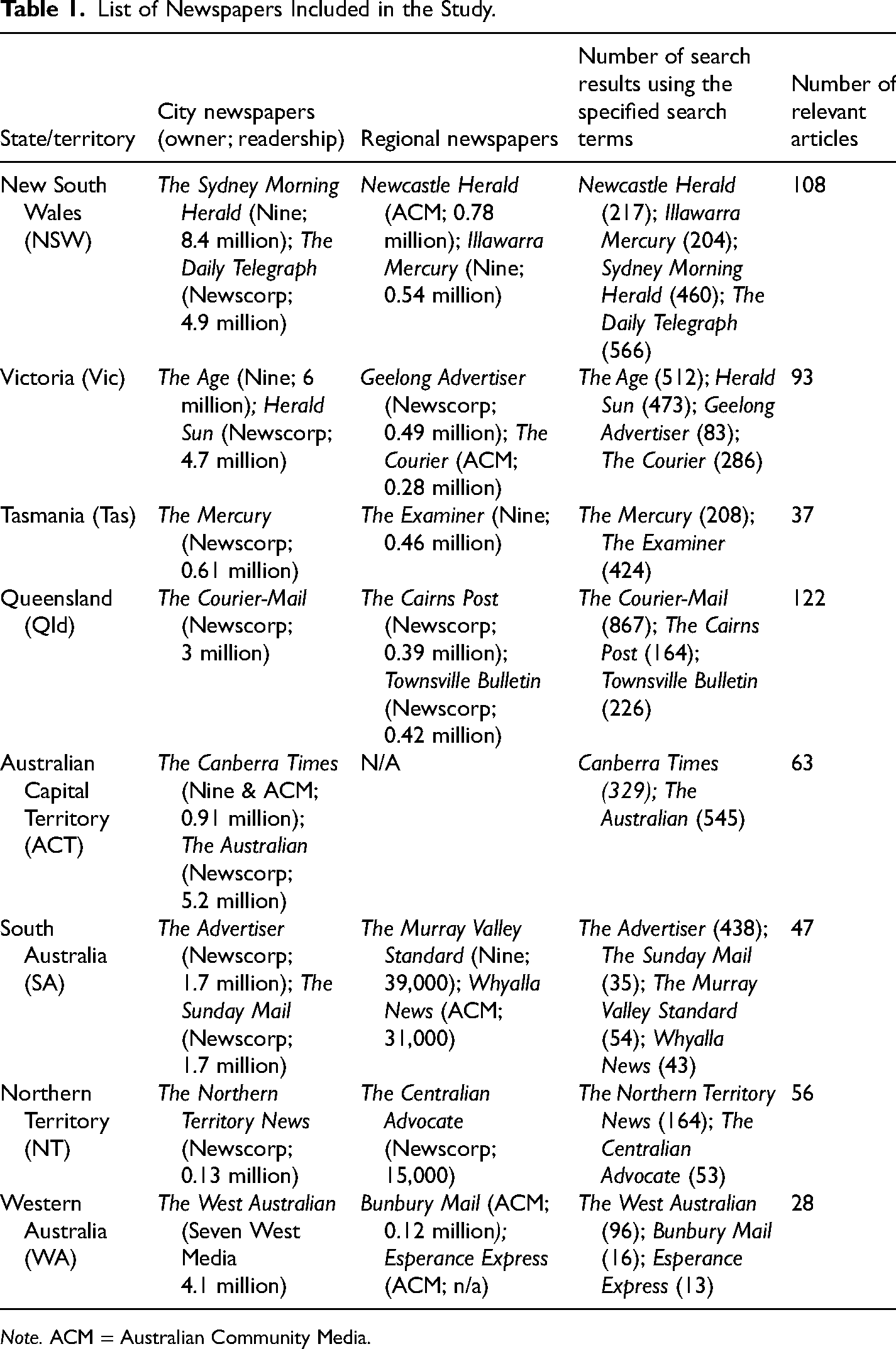
Twelve capital cities and twelve regional newspapers from across Australia were analyzed, comprising 1–2 cities and 1–2 regional newspapers from each state or territory. These were chosen with preference given to newspapers from cities or towns with larger populations, which were found to report on issues of domestic violence in their communities. The domination of Rupert Murdoch's Newscorp across the country has recently raised questions about media diversity in Australia. In response, former Prime Minister Kevin Rudd initiated a petition in early 2020 calling for a Royal Commission into Australian media ownership, which has since led to a Senate inquiry into media diversity (Williams, 2020). As a result, an effort was made to also source prominent newspapers that were not owned by Newscorp. The newspapers chosen are owned by a variety of conglomerates, including twelve owned by Newscorp, five by Nine (which subsumed Fairfax in 2018), five by Australian Community Media (ACM) which was owned by Fairfax until 2018 and Nine until 2019, one by both Nine and ACM, and one by Seven West Media (see Table 1). Most Australian newspapers can be described as a center to center-right on the political spectrum.
List of Newspapers Included in the Study.
Note. ACM = Australian Community Media.
The empirical research was guided by the following research questions:
Newspaper articles were found through the Proquest Database search using “domestic violence AND convict*, “domestic assault AND convict*,” “domestic abuse AND convict*,” “domestic dispute AND convict*,” as well as “family violence AND convict*.” Each individual newspaper used within the study was searched separately for these terms through Proquest for the years 2000 to 2020. These terms appear to be used interchangeably, leading to substantial overlap in search results. This reinforced an early finding that “domestic violence” is frequently used as a shorthand term for gender-based or family violence, as opposed to terms such as “intimate partner violence,” “spousal violence,” and “partner violence.” As such, this article focuses specifically on “domestic violence” as the term most used by newspaper reporting and that describes “violent behaviour between current or previous intimate partners” (AIHW, 2019, p. 2). This article predominantly addresses physical violence, which is disproportionately represented in newspaper reports about domestic violence. Since the 2020 murder of Queensland woman Hannah Clarke by Rowan Baxter, there have been significant calls to establish a national definition of domestic violence that includes coercive control. New South Wales has recently moved toward criminalizing coercive control, leading to significant debate about the benefits of these types of definitions to all women in the country (Fitzgibbon, 2021; Haydar, 2021; Watego et al., 2021). It is hoped that this will also cause more of a shift in the types of domestic violence addressed in commercial newspaper reports.
Exclusions were made to avoid speculative reports, policy-related discussions, and violence that occurred outside Australia. The decision to focus on convictions was made following the initial investigation of newspaper articles. When a conviction had not yet been recorded, newspapers limited the amount of information in the article, revealing only that a woman or other person had been killed or assaulted and that somebody was in police custody. This was not only due to the reporter's lack of insight, but also because legally an Australian media representative cannot speak or speculate about a case publicly before it is seen in court without risking prejudice to the case. For example, the Supreme Court of New South Wales (2016) media guidelines specify that “in active legal proceedings, it is a criminal offence (contempt) for media organizations to publish or broadcast material that has, as a matter of practical reality, a tendency to interfere with, or prejudice, the due course of justice in the particular case.” Therefore after conviction, it was possible to access details of each case that allowed us to address this article's specific research questions.
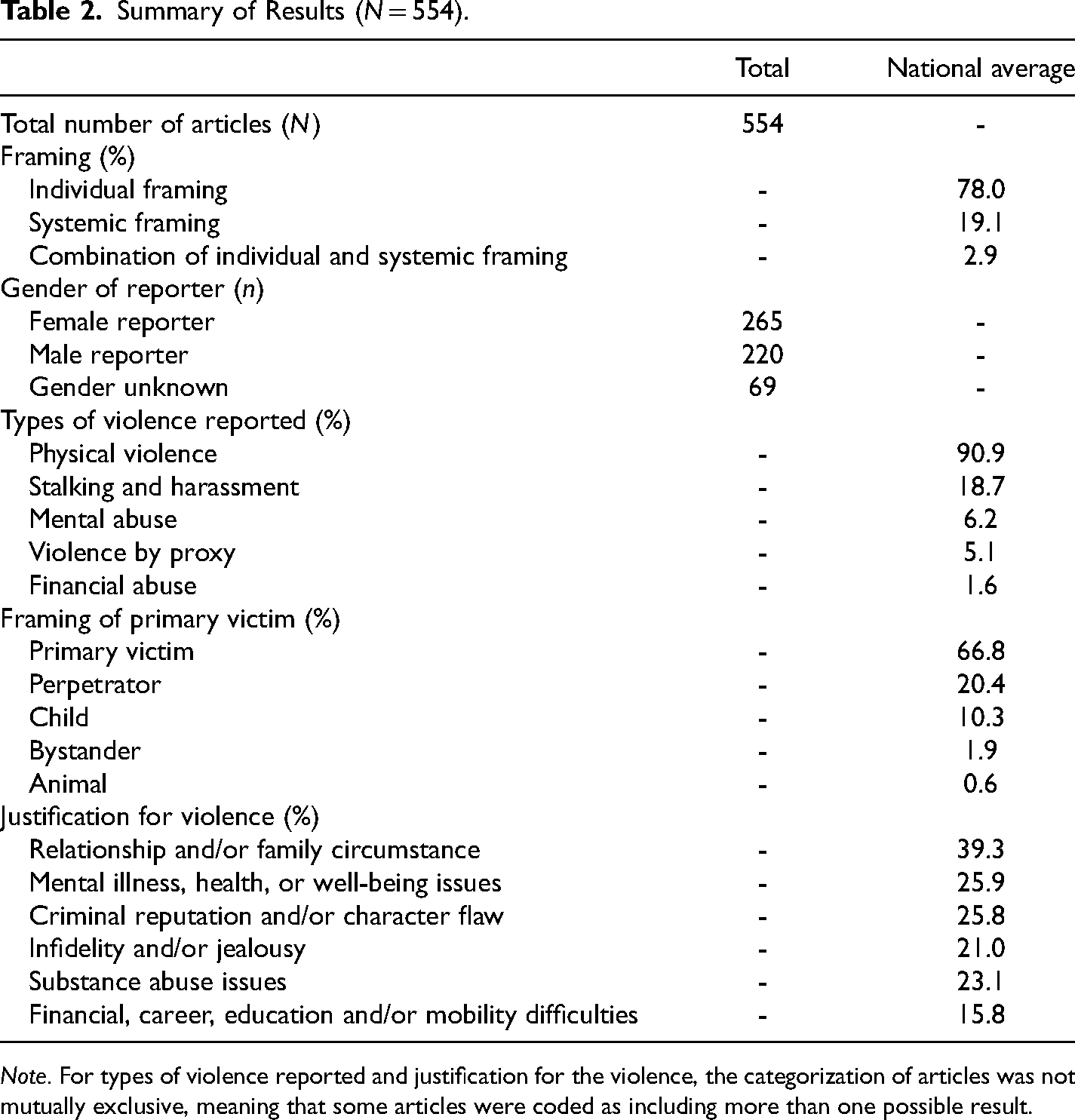
In total, 6,476 articles were screened across all Australian states and territories (Table 1 specifies search results for each newspaper), but only those that focused on, or made prominent mention of, a specific case or male perpetrator that had been convicted of domestic violence, homicide, assault, or abuse were cataloged. The 554 selected articles were then analyzed and quantitatively coded for a range of prominent themes and discourses including (1) whether the article used systemic or individual framing; (2) the type of domestic violence reported (e.g., physical violence; stalking, and harassment; mental abuse; violence by proxy; and financial abuse); (3) the target of violence (including the primary victim; the perpetrator; a child; a bystander; and a pet or animal; (4) who was framed as the victim of the incident, or whether victimhood was displaced away from the primary victim; and (5) explanations or justifications made for violence (which included relationship and/or family circumstances; mental illness, health and/or well-being issues; criminal reputation and/or a character flaw; jealousy and/or infidelity; substance abuse issues; or financial, career, education and/or mobility difficulties). In this study, articles that provided no wider context beyond each individual case or perpetrator were cataloged as using “individual” framing. On the other hand, reports that used “systemic” framing compared the case to other similar instances of violence or situated the case and perpetrator within the context of the broader social or cultural problem of domestic violence.
Each article was coded separately, meaning that some groups of articles reported on the same case or instance of violence. One coder was primarily responsible for analyzing and collating the newspaper articles, and analyzed the full dataset. A second coder analyzed a random sample of the articles (n = 28) to verify the consistency of the first coder's application of the coding scheme. High inter-rater reliability was found within this sample of articles, with the coders agreeing fully on the coding of the sample. This level of consensus is likely attributable to the collaborative development of the coding scheme. Coding took place over approximately 10 months, during which the first coder met with the second coder several times to discuss the findings in relation to the article.
Results
Although the 24 newspapers chosen are owned by only four media conglomerates, differences exist in domestic violence coverage at the state level, which are summarized in Table 2. This means that Australians living in different parts of the country are receiving different messages about the causes and consequences of domestic violence. As will be demonstrated below, articles focused disproportionately on physical violence over psychological violence and on homicide over nonlethal violence. Articles that come from metropolitan areas, particularly capital cities, included the most detail. This can be attributed to the higher budgets allocated to newspapers that service larger populations, meaning newspapers include more articles, and the articles themselves have higher word counts. It should be noted that this article does not aim to identify any specific Australian state, publication, or journalist reporting domestic violence in a counterproductive way, but instead to demonstrate general patterns within newspaper reporting across the country.
Summary of Results (N = 554).
Note. For types of violence reported and justification for the violence, the categorization of articles was not mutually exclusive, meaning that some articles were coded as including more than one possible result.
There is no doubt that men are also affected by domestic violence, but statistics consistently reveal that violence is disproportionately perpetrated by men and directed toward women. From 2019 to 2020, for example, 81% of family and domestic violence perpetrators were men (Australian Bureau of Statistics, 2020). Of the examined articles within this study, 2–5% across the states reported a specific case of domestic violence perpetrated by women. When female-perpetrated violence was described by journalists, there were differences in the framing and narratives used, which accords with past studies that have highlighted “battered wife syndrome” or similar frames used in such cases to portray women as “psychologically vulnerable” humans rather than “rational actors” (Morgan & Politoff, 2012; Wozniak & McCloskey, 2010). Female-perpetrated violence lies outside the scope of this article, however, it is important to note its differing incidence and appearance in newspapers compared to male-perpetrated violence.
To move out of the gender binary, it is important to note that people who identify as transgender, intersex, and gender-queer experience domestic violence at similar rates to cisgender women (Campo & Tayton, 2015). Official figures and newspaper reports rarely provide figures or details about people who exist outside the gender binary, however, the authors would like to acknowledge the existence of transgender and gender-diverse victims of domestic violence who are underrepresented within newspaper reports.
Individual and systemic framing
Domestic violence is framed in the media in one of two ways—by individualizing its incidence or by presenting it as a systemic societal issue (Carlyle et al., 2008; Cullen et al., 2019; Hart & Gilbertson, 2018; Lindsay-Brisbin et al., 2014). Systemic framing of domestic violence is important because it demonstrates to readers that such violence is a social issue, and consequently, those viewers are more likely to pressure political authorities for action on that issue (Easteal et al., 2015; Velásquez et al., 2020). Framing violence as an individual act, on the other hand, allows the reader to distance themselves, their community, and their political leaders from the event, meaning that change is less likely to occur. Past Australian scholarship has found that thematic or systemic framing was less likely to appear in the media (Easteal et al., 2015; Hart & Gilbertson, 2018; Morgan & Politoff, 2012; Sutherland et al., 2019).
The newspapers examined across all Australian states saw domestic violence incidents predominantly framed as individual, or episodic, events (see Figure 1). However, this was not consistent between states. For example, the examined newspapers in the Northern Territory framed 85.7% of articles about domestic violence as individual events; the Australian Capital Territory figure was 82.5%, whereas Victoria and South Australia were 69.9% and 59.6%, respectively. These findings are consistent with the literature. Sutherland et al. (2019) found that in New South Wales, South Australia, and Queensland between February 22 and June 22, 2015, 61% of radio broadcasts, newspaper, and online articles framed violence against women as solely individual events, 18% presented such violence with a combination of individual and systemic framing, and only 21% communicated an understanding of it as a systemic issue (See also Carlyle et al., 2008; Hawley et al., 2018; Morgan & Politoff, 2012).
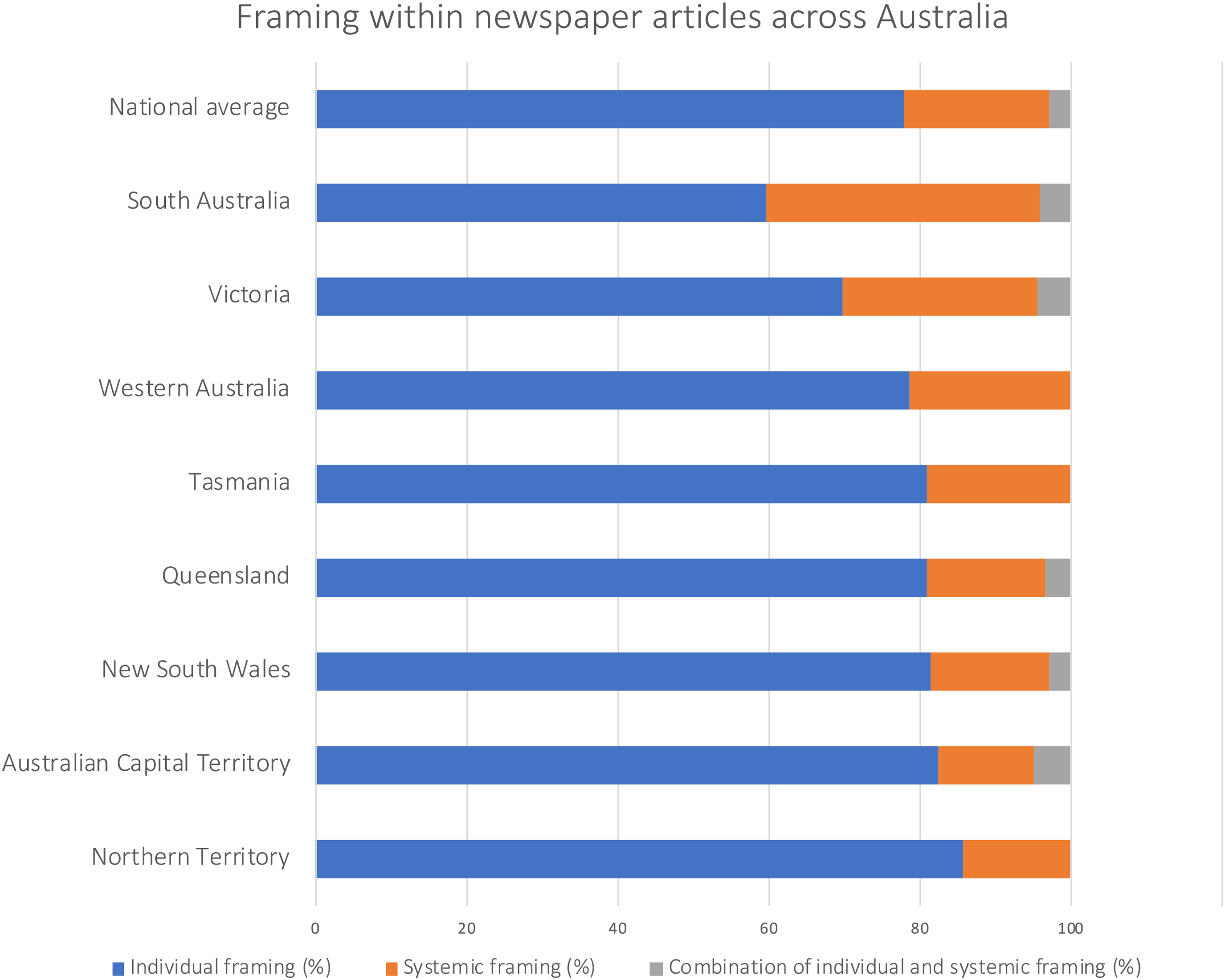
Individual Versus Systemic Framing.
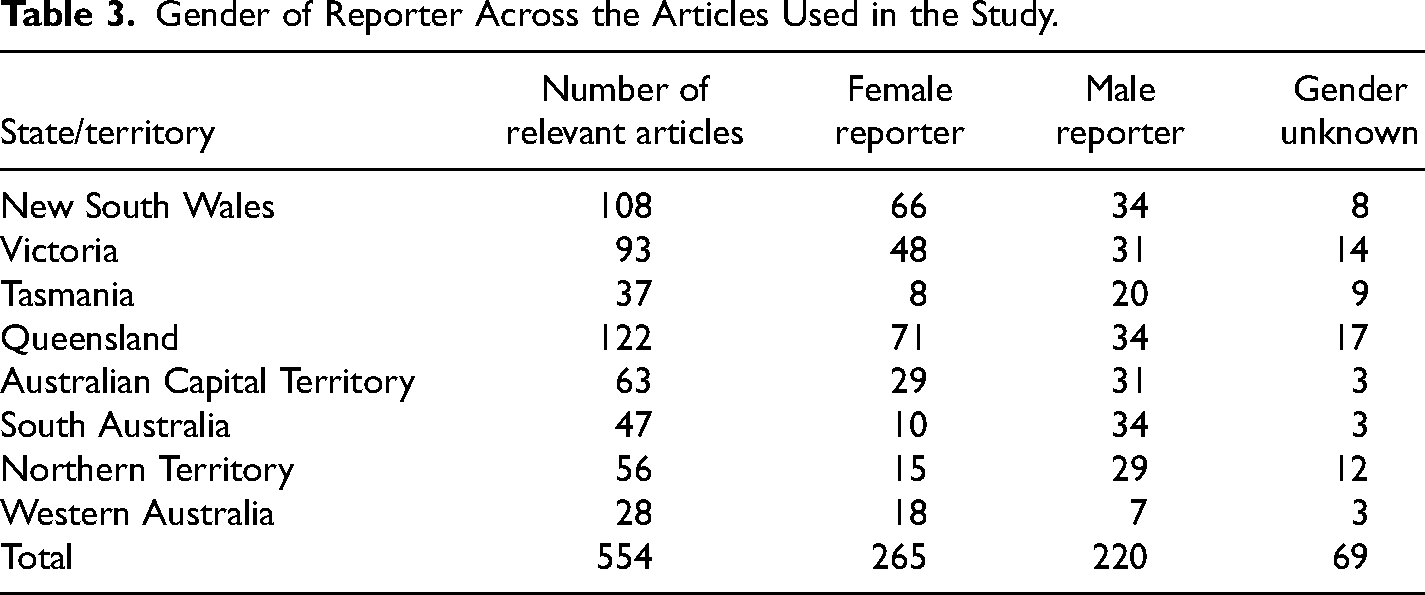
Cataloged articles were sampled for discernible gender of the reporter to see if gender influenced reporting of male perpetrated-domestic violence. Gender was initially cross-checked with reporter characterization of domestic violence, male perpetrators, and victims to determine if any patterns existed between articles that presented violence as individual or systemic and gender of the reporter. We found that there was no significant relationship between the gender of the reporter and the use of individual or systemic reporting, and that the tendency to explain or justify male violence and displace victimhood was relatively common among reporters across the states, and regardless of gender. Table 3 lays out the gender of individual reporters across the sample, demonstrating that the ratio of male to female reporters was not consistent between the states, meaning that it is impossible to make any conclusion about the tendency of either gender to report domestic violence in a particular way. The figures in Table 3 may suggest more about the nature of editors and newsroom culture, which remains overwhelmingly male into the 21st century, rather than the individual journalist reporting each case of violence (Cullen et al., 2019; Gilmore, 2019).
Gender of Reporter Across the Articles Used in the Study.
The large number of articles that used individual framing cannot be blamed solely on poor journalistic practice. Limitations impact the reporting of such domestic criminal events, including lack of training or support, editorial pressure, including deadlines and word limits, as well as legal concerns or the lack of access to data (Coleman & Thorson, 2002; Cullen et al., 2019; Wozniak & McCloskey, 2010). This can mean that journalists are impelled to use sources that merely state the facts of the case without providing any wider context which, combined with the lack of training in domestic violence issues, means that articles do not adequately explore the topic. There is much work to be done. Linking individual instances of violence within the media to the broader issue of domestic violence could be easily achieved by including the views of advocacy groups or other experts rather than just law enforcement authorities, whose goals may not be in line with those of the victim or their families (Bullock & Cubert, 2002; Morgan & Politoff, 2012; Richards et al., 2014; Simons & Morgan, 2018).
What Type of Domestic Violence is Reported on?
One issue identified in the literature is the tendency of media reporting on domestic violence to focus disproportionately on physical violence, and particularly homicides, which are crimes that attract more readers (Cullen et al., 2019; Hart & Gilbertson, 2018; Morgan & Politoff, 2012; Taylor, 2009). The newspaper articles we examined were similarly focused on physical forms of violence, although some articles did discuss sexual or psychological violence, including coercive control, either alone or alongside physical violence (Table 4).
Types of Violence Included in Newspaper Reports (N = 554).
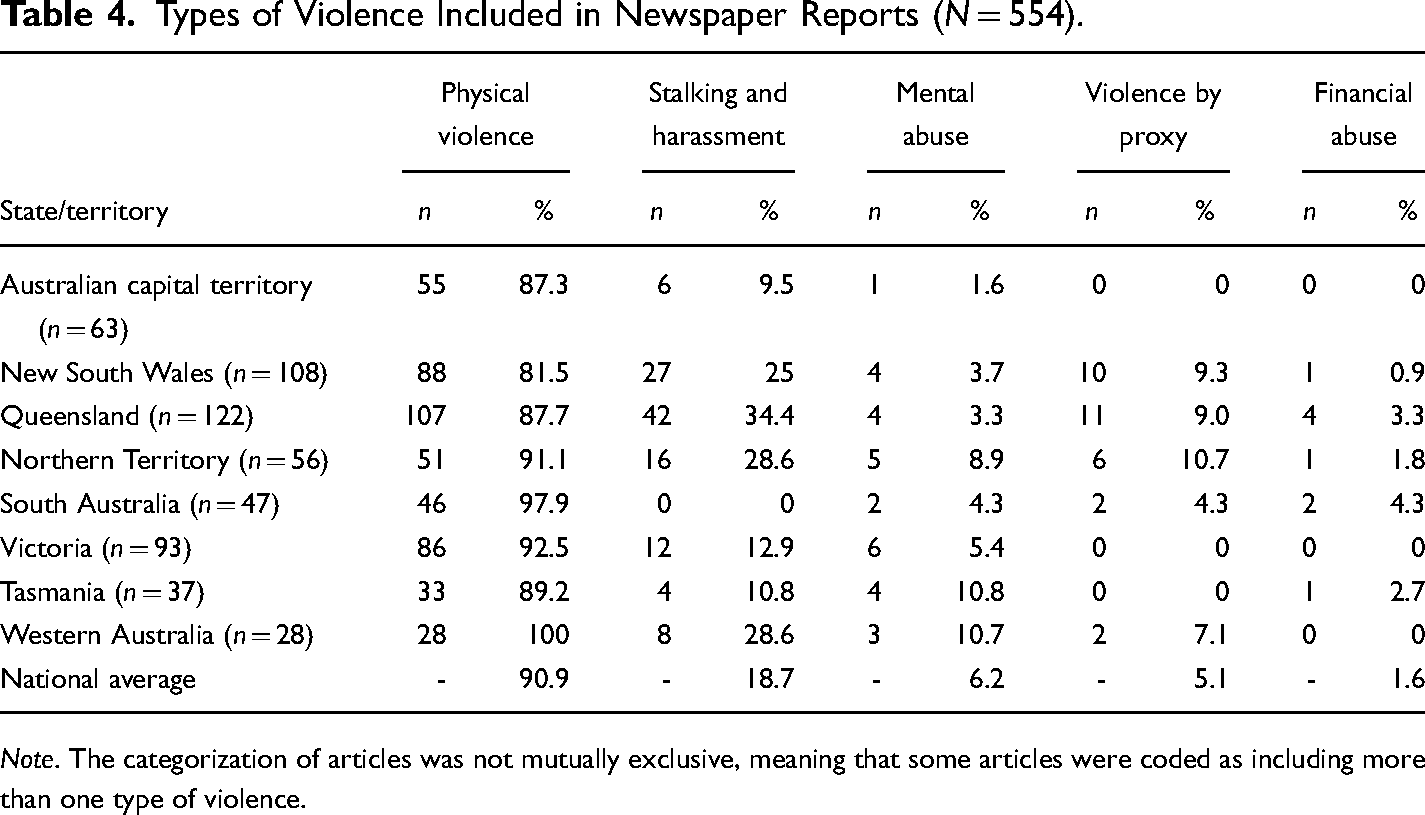
Note. The categorization of articles was not mutually exclusive, meaning that some articles were coded as including more than one type of violence.
As outlined in the methodology section, this study considered articles that mentioned conviction due to the legal requirements related to reporting crime prior to conviction (which results in little detail on the case and precludes the type of analysis that we are conducting). Due to this necessary methodological approach, the prevalence of discussion of physical violence is perhaps unsurprising. However, as many researchers and advocates have recently highlighted, physical domestic violence is often accompanied by other forms of violence (e.g., psychological) meaning that the heavy focus on physical violence is nevertheless significant. This is because it represents the limited knowledge within society and among journalists about the multifaceted nature of domestic violence, and emerging knowledge of coercive control.
Importantly, a national average of 31.7% of articles covered domestic violence-related homicides, which ranged from 17.9% in Western Australia to 55.3% in South Australia, with all other states at 20–40%. Consistent state figures on domestic violence-related homicide are difficult to find, however, the available 2020 crime figures illustrate the average number of homicides is far lower than other types of assault. For example, in New South Wales there were 38 family and domestic violence-related homicides reported, compared with 4,228 sexual assaults, and in South Australia, 14 homicides compared with 6,421 assaults (ABS, 2021). The disproportionate focus on physical violence and homicide typically excludes acts such as coercive control, financial abuse, or stalking that frequently precede these crimes, and contributes to limited social understandings of domestic violence.
Who Was Depicted as Most Affected by the Incident of Domestic Violence?
The examined newspaper articles revealed that media reporting across Australia in the last 20 years has frequently blurred the perpetrator–victim binary and does not always frame the direct victim of the violence as the person most affected by it. The status, experience, and impact of victimhood are frequently displaced from the primary victim of the violence, who is usually a female partner or ex-partner of the perpetrator, and onto a secondary direct or indirect victim, including children, bystanders, or animals (Hawley et al., 2018; Kozol, 1995; Maxwell et al., 2000; Sutherland et al., 2019). For example, in the article “Man jailed for domestic violence at its worst” published in The Canberra Times on October 17, 2019, the perpetrator threatened his partner with an axe if she did not enter his car, however, the emphasis in the article was largely on the associated threats to his children. In fact, his partner was not mentioned until almost halfway through the article (Williams, 2019). Despite this tendency, in 2020 65–79% of family and domestic violence victims across the Australian states were women (ABS, 2021).
Racial impacts on reporting of domestic violence are not the central focus of this specific article, however, newspaper articles involving Aboriginal perpetrators specifically framed domestic violence as a problem specific to Aboriginal communities, citing causes such as substance abuse, poverty, and criminality. The article “Jail won’t stop cycle of violence,” published in The Cairns Post on May 18, 2007, for example, reports on an Aboriginal perpetrator punching his female partner and stabbing her with a pair of scissors. Rather than attributing the violence to the actions of a perpetrator, the article reports on the fact that within their Aboriginal community “the young couple had both witnessed domestic violence during their childhood and it became part of life” (Laurel-Lee, 2007). Similarly, articles that described African or Middle Eastern perpetrators also linked violence and culture, or specifically noted their cultural backgrounds (Clarke, 2015; Dornin, 2012; Rudra, 2012). Moreton-Robinson (2015) views the attribution of poverty or poor living conditions to Indigenous individuals and Indigeneity in general as a specific tactic of the neoliberal colonialist state, with its aim of the continued subjugation or control of Aboriginal populations. The dependence of media organizations on political support, as well as the power of media conglomerates in setting public agendas, means that political aims are often reflected in the media (Herman & Chomsky, 1988). Importantly, however, non-white perpetrators were also occasionally portrayed in a sympathetic light, sometimes with blame placed both directly or indirectly on their female victims, demonstrating the power of male privilege even in the absence of whiteness (Sheehan, 2015). For example, the article “Man jailed for domestic knife attack in Mount Pleasant street” in Ballarat's The Courier speaks of “a well-respected man in Ballarat's Aboriginal community” who slashed a woman's throat with a knife (Williams, 2018).
Victim-blaming
The phenomenon of victim-blaming—even when a convicted perpetrator has been identified—has been widely recognized in the scholarship. Victim-blaming is more likely to occur when journalists rely on law enforcement or other groups as a primary source of information even if they do not possess specific expertise in domestic violence (Bullock & Cubert, 2002; Morgan & Politoff, 2012). Taylor (2009) analyzed media articles about homicide to demonstrate that victim-blaming tactics can be both direct, by depicting the actions of the victim as contributing to their murder, and indirect, through sympathetic descriptions of perpetrators and any problems they may have faced.
The Australian newspapers studied displaced primary victimhood onto four specific groups external to the actual primary victim: perpetrators; children present or proximate to the violence; bystanders or victims external to the direct violence, including relatives, members of the public or police officers; and animals that were intentionally or unintentionally harmed in the course of the violence. Although the trauma of children, pets, and other victims of violence must be treated seriously, it is important to be aware that giving secondary or unrelated victims disproportionately more focus than the primary female victim of domestic violence can normalize violence against primary victim groups. In addition to the example mentioned above, the article “Court hears man bashed pup in car” published in the Newcastle Herald on June 17, 2006 also exemplifies the displacement of primary victimhood in the analyzed newspaper articles. Most of the article describes a violent attack by a perpetrator on a puppy, before revealing near the end of the article that the man in question was convicted of “contravening an apprehended violence order, assault, stalking and intimidating” his former girlfriend (McCarthy, 2006; Table 5).
Who Was Framed as Primary Victim in Newspaper Articles (N = 554).
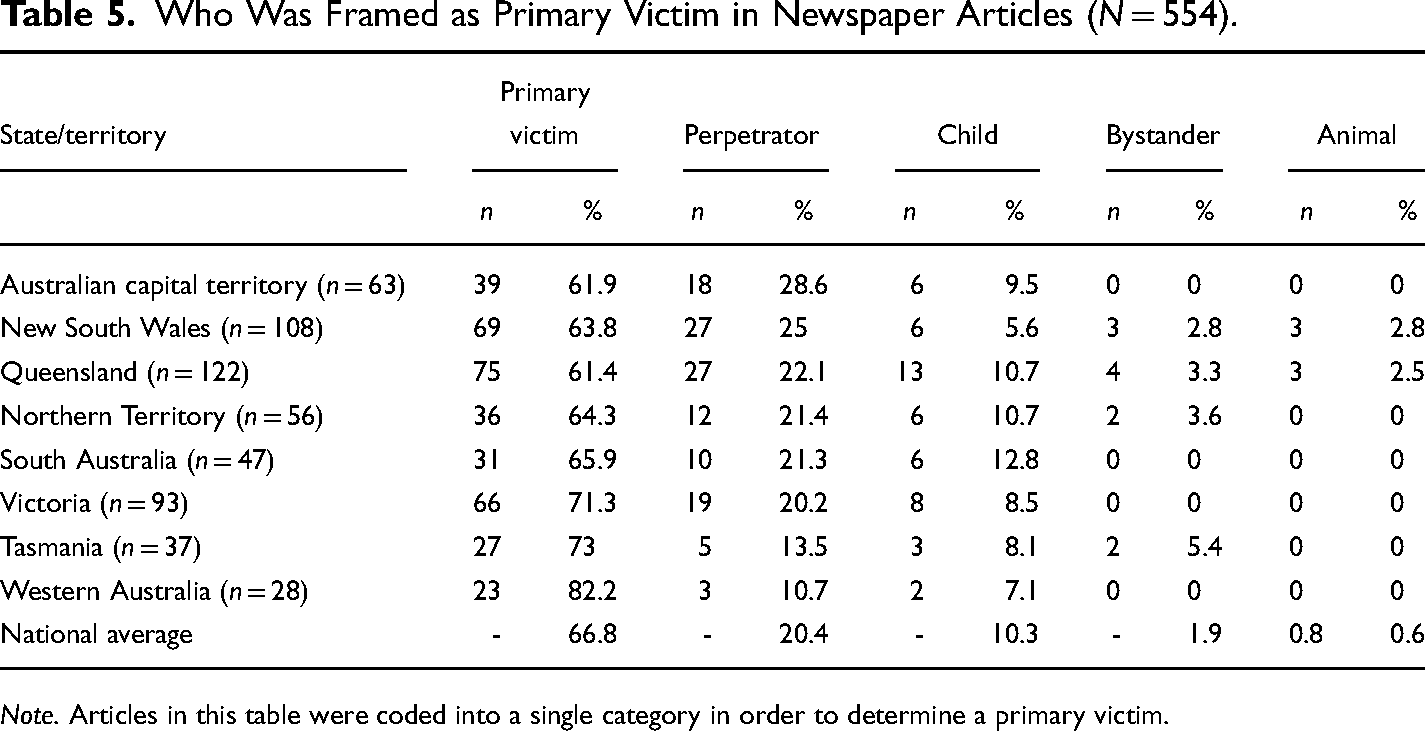
Note. Articles in this table were coded into a single category in order to determine a primary victim.
Although external parties to the violence were frequently portrayed as a sole or joint victim of the domestic violence incident, in an average of 20.35% of the examined articles across the Australian states the perpetrator of the violence was framed as the primary victim. This aligns with findings by Easteal et al. (2015), as well as Meyers (1997), Gillespie et al. (2013), and Lee and Wong (2020) concerning the tendency of the media to displace responsibility for violence to parties other than the perpetrator.
Framing the Perpetrator
Male perpetrators are the second most likely group to be framed as victims within media representations of domestic violence. The examined newspaper articles outlined four specific categories of the perpetrator, which we have labeled “a man of good character”; “any other name”; “a few bad apples”; and “one of many.” Only one of these categories, “one of many,” attributes perpetrator violence to a systemic issue. Below is an analysis of the specific forms that individualized descriptions of perpetrators and perpetrator violence took in the examined articles.
A man of good character
A significant number of examined articles established the perpetrator as a “man of good character” by describing his current or former position within the community, future career potential or aspirations, or positive role within his family, thus eliciting public sympathy for his situation (Tonkin, 2017). In her study of the media and men's violence against women, Fixed It, Gilmore (2019, pp. 111, 115–116) labels this a “Good Guy” narrative, partially resulting from the tendency of violent perpetrators and their legal representatives to publicly portray themselves as “good,” which is then communicated through media reports that discuss the case. A 2013 article entitled “Jail for Sam despite being ‘changed’ man” in the Townsville Bulletin illustrates this narrative. Despite the perpetrator having an extensive criminal history which includes numerous domestic violence order breaches, the article focuses on his “changed” personality since the birth of his seriously ill baby daughter. It is notable that this narrative has been lifted directly from an interview with the perpetrator's defense lawyer, which meant that the article was framed in favor of the perpetrator and the violent event was individualized (Channon, 2013). It is important to note that this type of perpetrator representation also appears in articles examined within this study that frame domestic violence as a systemic issue, and that describe the influence of workplace culture, nationality, or religion as a determining factor.
Any other name
The tendency of the media to focus on crimes other than domestic violence in their representations of perpetrators’ actions, such as fraud, arson, or substance abuse was observed in this study (Morgan & Politoff, 2012; Sutherland et al., 2019). In November 2001, Wollongong's Illawarra Mercury reported on the 17-hour siege between two police officers and Gary George Denford after a “domestic dispute” between Denford and his wife Maria, following a period during which his “marriage had soured.” Although the article eventually reveals that “a two-year apprehended violence order was taken out against Denford to protect his wife” in February, the primary victims in this article are the two police officers who Denford repeatedly shot at during the siege (Duffy, 2001, p. 5). The minimization of Maria's trauma, as well as its replacement by not only the experiences of the police officers, but also the anguish of Denford himself, who suicided on the eve of his trial, clearly represent the perpetuation of patriarchal structures that view men and women's experiences as unequal (Easteal et al., 2015). Women's experiences of violence are occasionally presented as even secondary to property, as seen in Gympie in October 2020, when Brisbane's Courier Mail reported that an “arsonist” set a fire in his ex-partner's backyard, focusing on the home, the state's bushfire crisis, and outdoor furniture destroyed in the blaze before mentioning that the man had previously threatened to shoot everyone in his ex-partner's home and was under a domestic violence order (Preston, 2020).
A few bad apples
A major obstacle to public demands for political action on domestic violence is the tendency of the media to “exceptionalise” perpetrators (Caputi, 1993; Richards et al., 2014). A group of the examined articles framed the perpetrator as “evil” or a “monster,” usually when there were no factors within the case that allowed him to be exonerated in line with the “man of good character” or “any other name” categories described above. In these articles, perpetrators, and domestic violence more generally, are framed as part of wider criminality or perversion. They highlight a perceived “abnormality” in the perpetrator in order to explain his actions, including narcissism, sociopathy, psychopathy, or lack of emotion. This is labeled “a few bad apples” in line with findings within the literature about common responses by religious organizations when confronted with sexual perpetrators (Death, 2015).
A 2019 article in the Townsville Bulletin entitled “Wife-killer's evil depths of deception” demonstrates the dehumanization of a “cold, calculating and manipulative” man who was, according to a former colleague, “the strongest man he had ever met, capable of snapping hard bolts while working on heavy machinery” (Bidey, 2019, p. 4). Melbourne's Herald Sun similarly told of a “monster” who shot his partner while under the influence of ice, illustrating the tendency to exceptionalize men's crimes through reference to substances that impaired their judgment (Deery & Argoon, 2015, p. 14).
Some perpetrators who fall into the category of “a few bad apples” have been labeled “ideal criminals.” They are “typically men who are poor, psychotic, uneducated or, more recently, immigrants … or a combination of these” (Custers & Bulck, 2013, p. 98). In the Australian context, migrants are often subject to this framing within media articles about domestic violence, however, this framing is more blatantly seen in portrayals of Indigenous perpetrators not only as individual “monsters” but as one of a group of “monsters” for whom domestic violence is framed as a community-wide problem. A clear example of this framing appeared in the Sydney Morning Herald with the uncharacteristically graphic headline “Girl, 11, easy meat for rapist,” which attributed the continued rape of a young girl to Indigenous cultural practices (Murdoch, 2006, p. 12).
Domestic violence is also frequently related to other issues, such as alcoholism, that are similarly framed as specific to Indigenous communities (Sexton & Wilson, 2006). This framing is used to extend responsibility to both Indigenous perpetrators and victims by making them responsible for either their actions or the violence enacted against them (Hart & Gilbertson, 2018). Such attitudes toward Indigenous perpetrators echo legal perspectives that attribute broad “dysfunctionality” to Indigenous communities as homogeneous collectives with little hope of rehabilitation. This view treats Indigenous culture as a whole as a crime problem, which serves to reinforce white colonialist narratives and structures (Anthony, 2013).
Explaining the Violence
The need for journalists to “explain” violence may be the consequence of their over-reliance on law enforcement sources, whose role with respect to each case is to establish a motive to prosecute or rationalize violence for the defendant (Bullock & Cubert, 2002; Morgan & Politoff, 2012). Although a contextualized portrayal is necessary for socio-cultural change, especially as domestic violence is a socio-cultural issue, a sentimental portrayal of such violence, including ways in which it is rationalized, may serve to normalize or justify such violence and exonerate the perpetrator by externalizing responsibility to the victim, or other persons or factors. Within the four perpetrator categories found in the examined newspaper articles, six common justifications that served to contextualize domestic violence were identified. These are relationship and/or family circumstances; mental illness, health and/or wellbeing issues; criminal reputation and/or character flaw; jealousy and/or infidelity; substance abuse issues; or financial, career, education, and/or mobility difficulties. Every article examined described or explained the violence using at least one of these justifications (Table 6).
How Violence Was Explained or Justified in Newspaper Articles (N = 554).
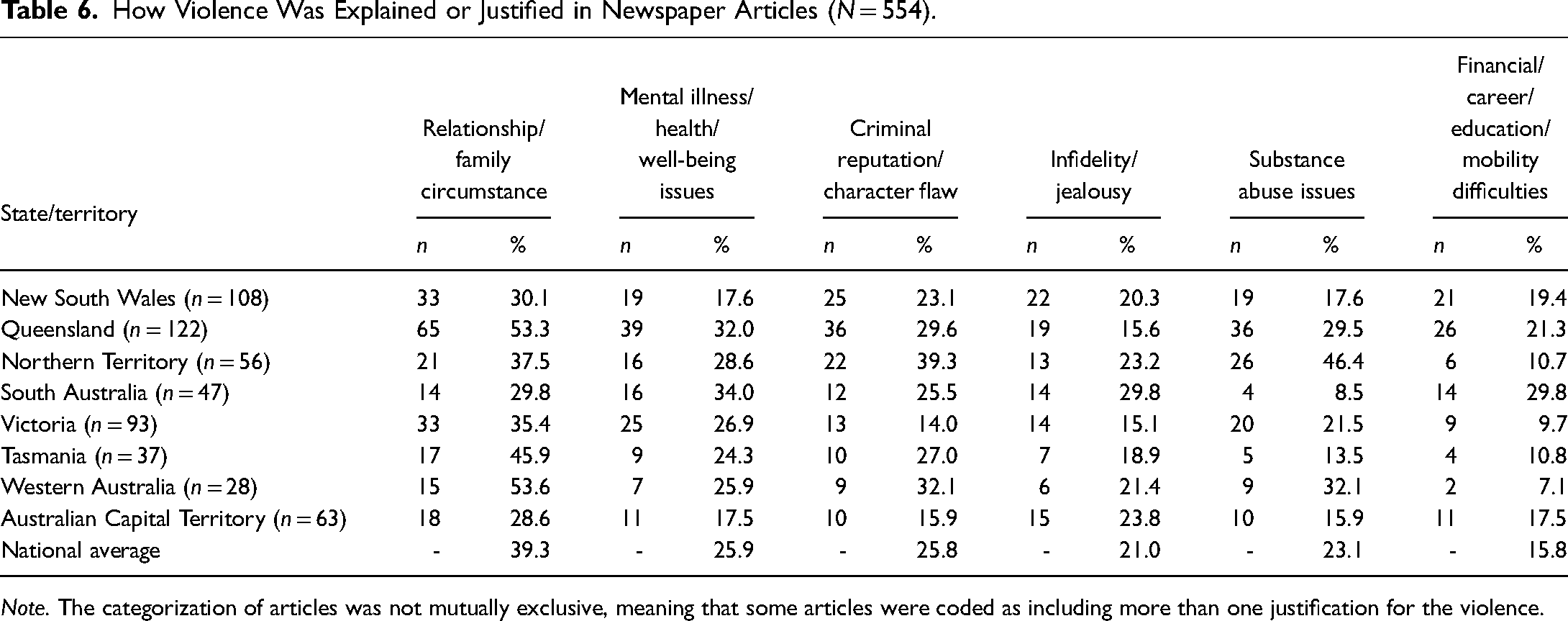
Note. The categorization of articles was not mutually exclusive, meaning that some articles were coded as including more than one justification for the violence.
Removing the responsibility for violence from male perpetrators perpetuates the idea that there is no wider societal issue underpinning domestic violence in the country and, moreover, tells readers that domestic violence is caused by external circumstances rather than the perpetrator himself (Fitzgibbon, 2021; Gilmore, 2019). This is a dangerous message to be communicating, particularly given the high numbers of women who are emotionally, physically, or sexually abused, and killed by partners or ex-partners each week, and the urgent need for political action on the issue. As Easteal et al. (2015) have written, such “othering” of victim works in opposition to the goal of increasing the safety of women in society. The implications of this tendency will be expanded upon in the subsequent discussion.
Discussion
Journalists and editors play a decisive role in the conceptualization of domestic violence in society, and can take real action to impact public attitudes. Past studies focusing on a single Australian case, or one or a collection of states, have established that national media reporting of domestic violence follows patterns observed internationally, and have placed these patterns within local contexts (Hart & Gilbertson, 2018; Hawley et al., 2018; Hill & Fuller, 2018; Little, 2015; Morgan & Politoff, 2012; Sutherland et al., 2016). This article contributes to the impressive range of past scholarship by charting media representations of domestic violence across contemporary Australian newspapers published in the last 20 years. It examines the framing of domestic violence reporting within newspapers, surveying whether newspapers are more likely to convey its systemic or individual nature, assessing the types of violence that are represented and how they are contextualized, in addition to ways that perpetrators and victims are represented. The findings of this study reveal that newspaper reports frequently blur the perpetrator–victim binary in portraying narratives of domestic violence. They did so by distorting both “blame” and “victimhood” in their representations of perpetrators and victims by either extending blame to the victim or displacing victimhood to the perpetrator or others present at the time of the incident.
While no single Australian state or newspaper contributes to public discourse on domestic violence in a purely progressive way, there are positive aspects of reporting emerging from all parts of the country. It is encouraging to see that journalists and newspapers in some states are using their platform to communicate the systemic nature of domestic violence within their communities, by including expert testimony by representatives of domestic violence advocacy organizations or academic experts in domestic violence, but these are far outweighed by reports that frame domestic violence as individualized events. Similarly, while newspapers across all states clearly identify the primary victim of domestic violence within their reports, it is disappointing that primary victimhood is frequently displaced onto the perpetrator, or another person or animal who was present at or affected by the violent event.
In the analyzed sample of newspaper articles, male perpetrators were categorized in four specific ways: as a man of “good character”; “any other name”; “a few bad apples”; or “one of many.” The first three of these categories portrayed perpetrators as blameless for the violence they inflicted, due to reasons that included their innate “good” nature, life struggles, substance abuse issues, or actions of the victim which supposedly “provoked” violent acts. In some cases, perpetrators were presented within newspaper reports as “monsters” whose actions are markedly divorced from the vast majority of Australian men, to illustrate the “exceptional” nature of such violence. Framing perpetrator roles within domestic violence in these ways shifts the blame for the violence from the literal enactor of the violence onto another person or circumstance and tells the reader that domestic violence is not a problem specific to Australian masculinity. These categorizations changed, for both the perpetrator and the victim, when the cultural difference was also a factor, and blame was frequently placed wherever whiteness was not.
While these observations represent overall patterns within the examined articles, each state revealed its own specific character, in keeping with the distinct culture and identity of each state and territory. For example, South Australia appeared progressive when considering individual framing in the sample, at a relatively low 59.6% of all articles. However, the sample from South Australia also had the highest proportion of reports about homicides, which can skew public awareness of the varied nature of domestic violence and may contribute to the state's systemic framing and the tendency of media reports not to sympathize with perpetrators as individuals. Conversely, while reporting from Queensland within the sample appears regressive at 81.1% individual framing, the reports emerging from the state were significantly less focused on homicides and were committed to describing a larger variety of domestic violence crimes. Tasmanian articles within the sample predominantly reported on physical violence, but also gave more attention to emotional or psychological abuse than other states, which is frequently invisible within domestic violence reporting (Sutherland et al., 2016). These comparisons demonstrate that no one state is reporting domestic violence in a wholly effective way; there are possibilities for improvement across the country.
Conclusion
Australian newspaper articles written between 2000 and 2020 predominantly portray instances of domestic violence as individual events with little reference to such violence as a systemic issue. In addition, they focus on physical violence over psychological violence, and disproportionately report on homicides over nonlethal violence. Although an improvement over more recent years has been noted in the literature (Easteal et al., 2021), more attention must be paid by journalists to ensure they do not represent the social problem of domestic violence as a series of individualized, isolated events.
This research raises the necessity of further research specifically focusing on differences in state domestic violence laws, as well as state press laws in relation to domestic violence or other crimes, and how these influence state-based newspaper reporting. This could take place by comparing the reporting of major national domestic violence cases through a variety of newspapers across the country, and possibly including any commentary by members of the public in response to exploring the impact of such reporting. It is also necessary to acknowledge limitations to this and further research, however. Focusing merely on newspaper reports means that popular avenues for journalistic and public responses to domestic violence such as social media, the internet, television, or radio are not considered. It is also important to examine more comprehensively the impact of race and class of both perpetrators and victims on how they are portrayed within newspapers, which fell outside the scope of this article. This study has also focused on instances of domestic violence which occurred before the COVID pandemic, which has increased reliance on domestic violence support services across the nation, and globally. A future study which compares the reporting of domestic violence before and after the pandemic would be beneficial.
Despite these limitations, this article has emphasized the importance of increased effectiveness within newspaper reporting on domestic violence by Australian journalists and editors. Dedicating space within articles to place individual cases of domestic violence within the broader social context is crucial in communicating the systemic nature of such violence to the general public. Although the conviction process for domestic violence perpetrators takes place within a legal system that understandably requires reasoning for acts of violence, those reporting these cases should try to avoid framing instances of violence as cause-and-effect events that are provoked by victims’ actions or other circumstances. Doing so tells readers that responsibility for violent acts can be attributed away from the perpetrator.
One effective way to present a balanced and truthful representation of domestic violence is to ensure that law enforcement authorities are not the only sources used to inform domestic violence reporting, and that advocacy groups or other domestic violence experts are sought out to provide the broader context of this issue. Editors can help in this regard, by providing space, time, and word counts that will allow for more effective representation of this key social issue. Australia has a deep and concerning problem with male-perpetrated domestic violence, rooted in historic conceptions of gender inequality. Appropriate media coverage of this issue is one step toward greater public recognition of its causes, impacts, and costs across society.
Footnotes
Acknowledgements
We would like to thank Fiona Whitton and Kathleen McPhillips for their excellent assistance in preparing this article. We would also like to thank the Gender Research Network at the University of Newcastle.
Declaration of Conflicting Interests
The author(s) declared no potential conflicts of interest with respect to the research, authorship, and/or publication of this article.
Funding
The author(s) received no financial support for the research, authorship, and/or publication of this article.
