




Abstract
We conducted two framing experiments to test how downplaying femicide frames affect readers’ reactions. Results of Study 1 (Germany, N = 158) indicate that emotional reactions were increased when a femicide was labeled as “murder” compared to “domestic drama.” This effect was strongest among individuals with high hostile sexism. Study 2 (U.S., N = 207), revealed that male compared to female readers perceived a male perpetrator more as a loving person when the crime was labeled as “love killing” compared to “murder.” This tendency was linked to higher victim blaming. We recommend reporting guidelines to overcome the trivialization of femicides.
Introduction
According to the World Health Organization, about one-third of women worldwide experience physical and/or sexual violence at least once in their lifetime (2017). The majority of murders of women are committed by their intimate partners or ex-partners (Small Arms Survey, 2012). In the newspapers, killings of women by intimate partners are often labeled as “domestic crimes,” “family tragedies,” “crimes of passion,” or even “love killings” (Exner & Thurston, 2009). Such terms represent crimes against women as individual cases and shed light on the personal relationship between perpetrator and victim. As a consequence, media coverage often ignores that misogynist violence in heterosexual partnerships is a global rather than an individual problem (Gillespie et al., 2013; Isaacs, 2016). Over the past decades, research has established a specific term for the structural phenomenon of murders of women: femicide (Russell & Van de Ven, 1976; Russell, 2011). After women's rights activists strongly criticized the media's trivialization of structural sexual and partnership violence against women, some daily newspapers have changed their reporting policies with regard to the labeling of misogynist crimes (e.g., dpa in Germany, see Borgers, 2019). However, this has not yet become common practice, neither in media coverage nor in everyday language (see Bouzerdan & Whitten-Woodring, 2018 for newspaper coverage).
It is not yet clear how these different frames of deadly male violence against women affect information processing, emotional reactions, and crime evaluations of media recipients. To test whether conceptual framing affects these variables, we conducted two newspaper framing experiments in Germany and the U.S. in which the same crime was either labeled with a downplaying femicide frame (e.g., “domestic drama”) or an adequate criminalistic label (e.g., “murder”).
Theoretical Perspectives on Femicide Framing
Media framing plays a pivotal role in the social construction of reality (Scheufele, 2004). By using a very particular concept or metaphor to describe an event, situation, or recommended policy, journalists have the power to influence the way media recipients represent the information to which they have been exposed. The criminality of a city, for example, can be described in terms of a “virus” or a “beast” (Thibodeau & Boroditsky, 2011, 2013), fighting cancer can be portrayed as a “journey” or a “battle” (Hendricks et al., 2018), and an interpersonal relationship may be framed as a “war” or a “two-way street” (Robins & Mayer, 2000, experiment 2). All these examples illustrate how different labels for one and the same subject matter can work as a frame and lead to different perceptions and interpretations.
Following Entman (1993, p. 52), framing means to “select some aspects of a perceived reality and make them more salient in a communicating context, in such a way to promote a particular problem definition, causal interpretation, moral evaluation, and/or treatment recommendation.” According to psychological models of information processing (Anderson, 1996; Fiske, 1982), linguistic frames are able to activate or transform existing schemata, which contain general information about the object of interest as well as on the relations of its subordinate attributes (Brewer & Nakamura, 1984; Crocker et al., 1984; Fiske, 2018). Such attributes are described as slots, which are assumed to be typically filled with default values (Scheufele, 2004).
Previous research has shown that even minor linguistic frames such as single concepts or metaphors have a remarkable impact on cognitive (Elmore & Luna-Lucero, 2017; Hendricks et al., 2018; Thibodeau & Boroditsky, 2011, 2013), emotional (Cho & Boster, 2008; Kalmoe, 2014; Kim & Cameron, 2011; Lee & Schwarz, 2014), and behavioral (Barry et al., 2009; Flusberg et al., 2017; Iyengar & Simon, 1993) responses of readers. For instance, participants who read a short vignette in which an interpersonal relationship was framed as a “war,” reported higher support for guarded communication within romantic relationships than did participants who read the same information labeled as a “two-way street” (Robins & Mayer, 2000, Experiment 2). In a similar vein, recalling conflicts with one's intimate partner decreased relationship satisfaction when the relationship was previously framed as a “unity” compared to “journey” (Lee & Schwarz, 2014, Experiment 1).
Framing is a presentation tool that is often used in media coverage (Entman, 1993; Pan & Kosicki, 1993). Various dominant frames have been established for the reporting of misogynist crimes and femicides during the past decades or even centuries (Meyers, 1996). A qualitative analysis of community and daily newspapers reporting deaths related to domestic violence in Washington State in 1998 by Bullock and Cubert (2002) revealed that domestic murders are often reported with a stronger focus on the male perpetrator's motives than on the female victim's experience and suffering. Especially articles on smaller cases were identified to contain large information gaps about the circumstances of the crime but at the same time often report exculpatory attributions of the offender. In some articles, the perpetrator was even portrayed as a victim in the same case (Bullock & Cubert, 2002, p. 485). A mixed methods study by Anastasio and Costa (2004, Study 1) confirms the finding that female victims of violence are less precisely personalized than males.
In addition, experimental data indicate that adding personal information about the victim increases empathy for female victims and decreases victim blaming (Anastasio & Costa, 2004, Study 1). In a similar vein, a content analysis of femicide portrayal of 292 domestic homicide reports by a Florida metropolitan newspaper between 1995 and 2000 showed that female victims are often blamed by the use of negative language, accentuating their relations to other men and highlighting their choices of not reporting former incidents (Lloyd & Ramon, 2017; Taylor, 2009). More recent framing analyses of newspaper reports on deadly domestic violence against women have shown that a high proportion of newspaper articles in the U.S. normalizes misogynist crimes as commonplace, isolated incidents or as individual loss of control by the perpetrator (Gillespie et al., 2013; Richards et al., 2011). Such evaluations of misogynist crimes and murders are corroborated by the use of headlines like “domestic drama,” “crime of passion,” or “love killing” (Exner & Thurston, 2009).
Following cognitive models of text comprehension and recall, headlines serve as initial cues, which help to organize and structure incoming information (Bransford & Johnson, 2004; see Lorch, 1989 for an overview). Titles and headlines thus help readers to focus their attention selectively to frame consistent information (Lorch et al., 1993). Accordingly, framing deadly domestic violence initially as a “domestic drama” or “crime of passion” animates readers to focus more strongly on the shared guilt between perpetrator and victim compared to a neutral or criminological term of the crime, such as “murder” or “homicide.” Such framing is a very important aspect with regard to the social manifestation and downplaying of violence against women. Blaming victims for being responsible for the crimes they experience has been found to notably decrease empathy for them (Sinclair & Bourne, 1998; Sprankle et al., 2018). We, therefore, expect that the use of downplaying frames of deadly domestic violence against women will affect readers’ perceptions of and emotional reactions toward the crime.
Moderating Factors
Media recipients are no “blank slates.” Usually, we have certain political attitudes and personal preferences that influence the way we process information (Boyer et al., 2022; Leeper & Slothuus, 2014). In the context of misogynist violence, especially participants’ sexism has been repeatedly confirmed to play an important role (Abrams et al., 2003; Chapleau et al., 2007; Masser et al., 2006; Valor-Segura et al., 2011). According to Glick and Fiske's (1996) model of ambivalent sexism, sexist attitudes can be classified into two different but complementary forms of sexism: Benevolent and hostile. While support for traditional gender roles and emphasis on women's warmth and worthiness of protection are expressions of benevolent sexism, hostility, and antipathy—especially toward norm-violating women—are described as hostile sexism (HS). Both forms of sexism have been found to be positively correlated (Glick & Fiske, 1996; Glick et al., 2000). Former research in the field of violence against women has demonstrated that hostile—but not benevolent—sexism is strongly related to an increased acceptance of rape myths (Chapleau et al., 2007; Masser et al., 2006) and victim blaming (Valor-Segura et al., 2011) as well as higher proclivity of acquaintance rape (Abrams et al., 2003). Likewise, social dominance orientation (SDO, i.e., a personal preference for unequal, hierarchical power relations between social groups) has been found to be similarly strongly related to the endorsement of violence against women (Berke & Zeichner, 2016; Rollero et al., 2021). More precisely, Berke and Zeichner (2016) found that men's SDO was significantly associated with a higher number and intensity of electric shocks given to a female competitor in a fictitious reaction time task. We therefore aim to explore the moderating role of HS and SDO on the framing misogynist crimes within both male and female participants in Study 1.
Study 1
Study 1 was embedded in the German media context. In autumn 2019, a heated debate arose in Germany about stopping the trivialization of femicides through the use of misleading labels (Borgers, 2019). After women's rights organizations and popular feminists in Germany had strongly criticized the use of mitigating labels of femicides, such as “domestic drama,” the German Press Agency's chair, Froben Homburger, agreed with this movement as follows: “Drama and tragedy bring murder and homicide close to a fateful event in which the roles of victim and perpetrator seem to blur: Isn’t the perpetrator a victim (of a broken relationship, for example)—and therefore: Does the victim not also have a share in the crime?” (Homburger on November 14, 2019). This tweet was followed by his decision that the German Press Agency (dpa) will in future refrain from using terms such as “family tragedy” or “domestic drama.”
However, both police authorities and smaller-to-larger daily newspapers continued to make use of these terms. A LexisNexis search for the term “domestic drama” in German newspaper outlets and press releases yielded more than 100 hits in about a half year between November 14, 2019 and July 1, 2020. Furthermore, they are (still) part of the everyday language. In accordance with linguistic framing theory (Entman, 1993; Scheufele, 2004), we expect that framing a typical case of male-perpetrated deadly domestic violence against a female victim as a “domestic drama” compared to a “murder” decreases emotional reactions to the crime (Hypothesis 1a), leads to exculpatory attributions of the perpetrator (Hypothesis 1b) and to lower levels of suggested penalty for the perpetrator (Hypothesis 1c). In order to test our three-part hypothesis, we conducted a newspaper framing experiment in which a typical case of homicide was either labeled as “domestic drama” (German: “Beziehungsdrama”) or as “murder” (“Mord”) more than one month after Froben Homburger's tweet. In addition to the directional main effect hypotheses, we also explored the moderating effects of HS and SDO in Study 1.
Method
Participants
Based on an a priori sample prediction for medium framing effects (d = .50, 1−β = .80, α < .05, npredicted = 128) using G*Power (Version 3.1 by Faul et al., 2007), we conducted an online experiment with a planned sample size of 150 participants to account for potential dropout. The design of the study, all measurements, as well as the envisaged sample size have been preregistered at the open science forum (OSF, see https://osf.io/ef7u8). Data were collected from 26 to 27 December 2019 using a German crowd-sourcing platform (www.clickworker.de) and has been published on the OSF for reasons of data transparency (https://osf.io/4dkrh/). Overall, 241 persons visited the survey link. Seventy-six participants (42 male; 29 female; 5 diverse; Mage = 31.60, SD = 11.78, range = 18–72 years) did not correctly answer the attention check on the first survey page and were then dismissed from further interviewing. Seven participants (3 male, 4 female; Mage = 31.14, SD = 13.80, range = 19–59) stopped the interview before the end. The remaining sample includes 158 participants (86 male; 64 female; 8 diverse; Mage = 34.06, SD = 12.02, range = 18–74 years). On average, participants had higher school certificates than the German standard population (29.75% secondary school certification; 13.3% vocational baccalaureate diploma; 26.6% high school certificate; 25.3% university degree). Study participation was rewarded with USD 0.60 for a maximum duration of 5 min.
Procedure, materials, and measures
The study was designated as a media perception survey in which participants read and evaluated a short newspaper clipping. Data collection was conducted in accordance with the ethical standards of the German Association of Psychology (DGPS) and with the 1964 Helsinki Declaration, and the study was approved by the local ethics committee (application number LEK-233). Participants first agreed with the privacy statement and the informed consent of the study. Then, age, gender, and educational attainment were assessed. Thereafter, participants were randomly assigned to one of the two experimental conditions differentiated by the framing of the crime as “Domestic drama” [German: “Beziehungsdrama,” hereinafter referred to as drama condition] or “Murder of wife” [German: “Mord an Ehefrau,” hereinafter referred to as murder condition]. The full newspaper clipping read: Domestic drama [Murder of wife]
Women stabbed to death by her husband
Now there is certainty. Karin S. from Lohhausen, missing since Saturday, November 23, is dead. The 48-year-old husband of Karin S. was arrested on Monday. He is accused of having killed [murdered] his wife in the night from Saturday to Sunday. For technical reasons, the police are not giving any details about the exact course of events. However, it is clear that the wife was so severely injured by her husband with a knife that she died at the crime scene immediately after the crime. A friend of the killed woman stated that she had already told of assaults by her husband in the past. The investigators are trying to clarify the closer circumstances of this crime. The husband is now in custody for clarification of the exact circumstances. In the meantime, the examining judge has issued an arrest warrant.
Each article was accompanied by the same photo of a flagged, empty crime scene. The image was royalty free and in the public domain on pixaby (www.pixabay.com/de/). (Both original “news” reports are available in Figure S1 in the online supplement materials.) The content and design of the fictitious articles were based on existing reports of average homicides of women. With the information given, the crime could not be clearly classified as an act of passion or planned action. After the treatment, participants were asked about their emotional reactions and evaluated the circumstances of the crime as well as their recommendation of imprisonment. Subsequently, scales of HS and SDO were completed. At the end of the study, participants were debriefed and thanked for their participation.
As dependent variables, emotional reactions, evaluations of the crime circumstances as well as penalty suggestions for the perpetrator were assessed. Emotional reactions to the crime were measured immediately after the treatment. Participants were asked how they feel about the crime, which was described in the newspaper article. Answers were given on four 9-point Likert-type scales with the stem: “The described crime…” 1 (does not go under my skin) to 9 (goes very much under my skin); 1 (does not make me angry at all) to 9 (makes me very angry); 1 (does not touch me at all) to 9 (touches me very deeply); and 1 (does not concern me at all) to 9 (makes me very concerned) (α = .92).
Then, participants evaluated the circumstances of the crime on four separate items. The items represent independent aspects of the German Criminal Code that are relevant for the assessment of a crime. Following the German principles of sentencing, the severity of a crime is assessed according to the circumstances in which the crime took place (see Section 46, Paragraph 2, German Criminal Code). These include the questions of whether an act was planned or not (“The crime was probably planned”), whether the act was committed under the influence of emotions (“The crime was probably an emotional act”), the presence of mitigating circumstances such as alcohol or drug abuse (“There are probably mitigating circumstances which exonerate the husband”), and aspects of the perpetrator-victim interactions such as deliberate provocations of the perpetrator (“The responsibility for the crime probably lies not only on the side of the husband”). Answers were given on a 7-point Likert scale ranging from 1 (completely disagree) to 7 (completely agree). In addition, participants were able to indicate the motive for the crime as an open answer. Answers were coded into 7 categories (1 = jealousy, 2 = infidelity of the wife, 3 = dispute and loss of control, 4 = mental disorder, 5 = misogyny, 6 = alcohol/drug abuse, 7 = other).
The suggested penalty level for the perpetrator was measured by asking participants to indicate how many years they would sentence the perpetrator into prison. Responses ranged from 0 to 100 years (M = 23.09, SD = 21.41, mdn = 15). If someone did not approve of jail time or wanted to make additional recommendations, he/she had the possibility to enter another measure (n = 21, 13.29%).
Finally, a German 11-item version of the HS scale (Eckes & Six-Materna, 1999) was assessed as a potential moderator (e.g., “What feminists really want is for women to have more power than men”) using ratings from 1 (completely disagree) to 7 = (completely agree). Scores were averaged across items such that a higher score indicated a stronger endorsement of HS (α = .93).
In addition, SDO was measured with a German translation of the 16-item version of the SDO scale (Pratto et al., 1994, translated by Six et al., 2001, e.g., “To get ahead in life, it is sometimes necessary to stand on others”). Responses were given on a 5-point Likert scale from 1 (completely disagree) to 5 (completely agree). Scores were averaged across items so that a higher overall score indicates a greater endorsement of social dominance (α = .88).
Results
Framing effects were tested by a one-way MANOVA (using SPSS 25) with framing condition (drama vs. murder) as the independent factor and emotional reactions, the four evaluations of the circumstances of the crime, and suggested penalty level as the dependent variables. The one-way MANOVA found no significant differences between the framing conditions on the combined dependent variables, F(6, 146) = 1.11 p = .359, ηp2 = .04, Wilk's λ = .956, indicating the absence of a global treatment effect on the majority of dependent variables. However, looking at the univariate tests and in line with Hypothesis 1a, readers’ emotional reactions toward the crime were stronger when the crime was labeled as murder compared to domestic drama (see Table 1). But, the results of the univariate tests do not confirm Hypothesis 1b. There were no significant framing effects on participants’ evaluations of the circumstances of the crime. Nor was there confirmation of Hypothesis 1c. Results indicate no meaningful difference between the framing conditions on suggested penalty levels.
One-Way MANOVA Comparing Framing Conditions Across the Dependent Variables (Study 1).
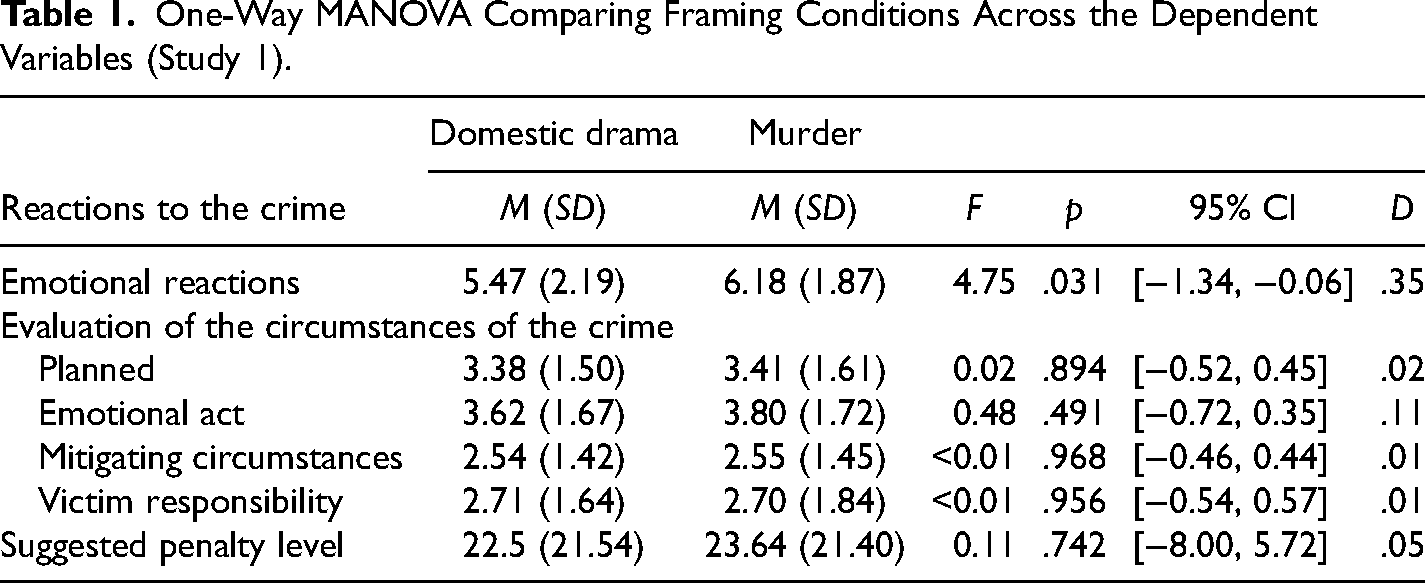
We conducted additional exploratory mediation models to test whether penalty levels were mediated by participants’ emotional reactions, but this was not the case (see Figure S2 in the online supplement materials). The statements on possible motives for the crime were also unaffected by treatment, χ2(6, n = 151) = 10.62, p = .101. In both conditions, jealousy (53.6% of the time) was mentioned as the most common motive for the crime.
Moderating effects of hostile sexism and social dominance orientation
We used the SPSS PROCESS macro (Version 3.2.01 by Hayes, 2018, Model 1) to explore the potential moderation effects of HS and SDO on the relationship between framing and emotional reactions. HS and SDO were measured after the framing treatment but were both unaffected by it: HS: Mmurder = 3.16, SD = 1.18, Mdrama = 3.08, SD = 1.13, t(1, 154) = .45, p = .654; SDO: Mmurder = 2.28, SD = .67, Mdrama = 2.18, SD = .66, t(1, 153) = .82, p = .415.
We separately tested both moderators using Model 1, respectively. The experimental framing was included as an effect-coded categorical variable (−1 = drama, +1 = murder). Participants’ age, gender (−1 = male, +1 = female), and education level (as ordinal variable) were included as covariates. HS and SDO were added as mean-centered moderators, respectively. Table 2 presents the moderation model for HS. As there was no moderating effect of SDO on the effect of framing on participants’ emotional reactions, results of this moderation model are presented in Table S1 in the online supplement materials.
Participants’ Hostile Sexism as a Moderator of the Relationship Between Framing and Emotional Reactions.
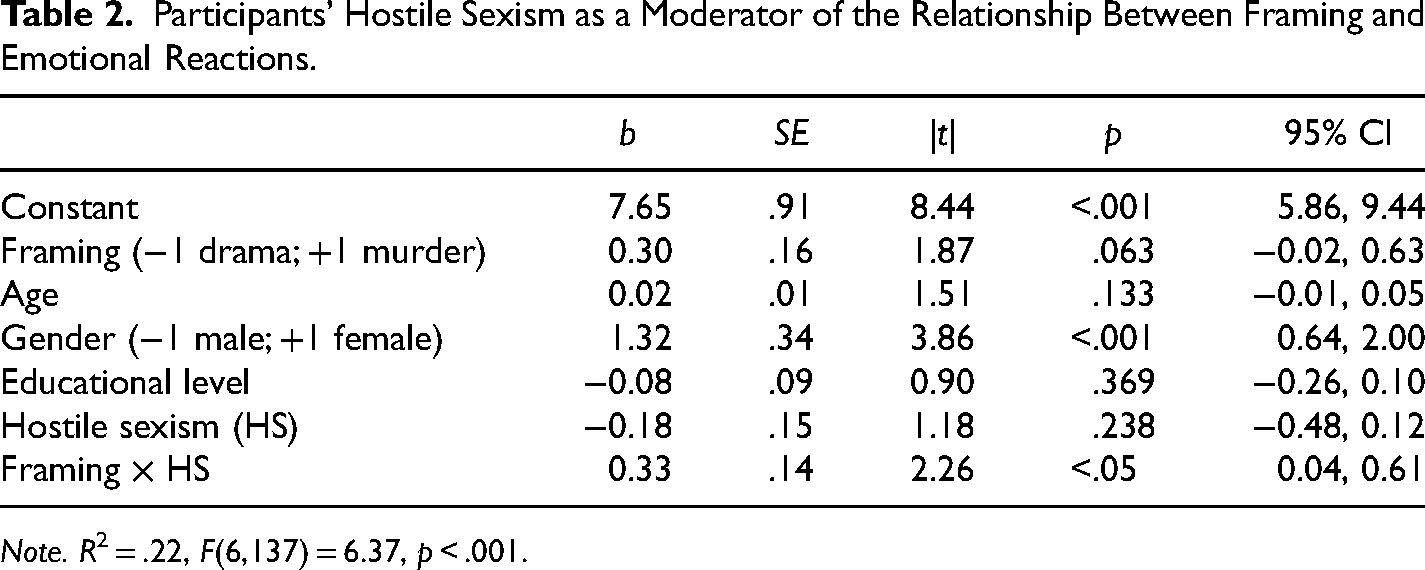
Note. R2 = .22, F(6,137) = 6.37, p < .001.
As shown in Table 2 and Figure 1, the framing effect was especially pronounced among participants with high compared to low HS. Participants with high HS reported stronger emotional reactions toward the crime when it was labeled as “murder” compared to “domestic drama.” In this vein, results of an analysis of the conditional effects reported in Table 3 revealed that the treatment effect was strongest in this group, whereas there was no significant treatment effect among participants with low or medium HS levels. In addition, results of the regression model indicate a significant effect of participants’ gender on the emotional reactions toward the crime with women reporting stronger emotional reactions than men.
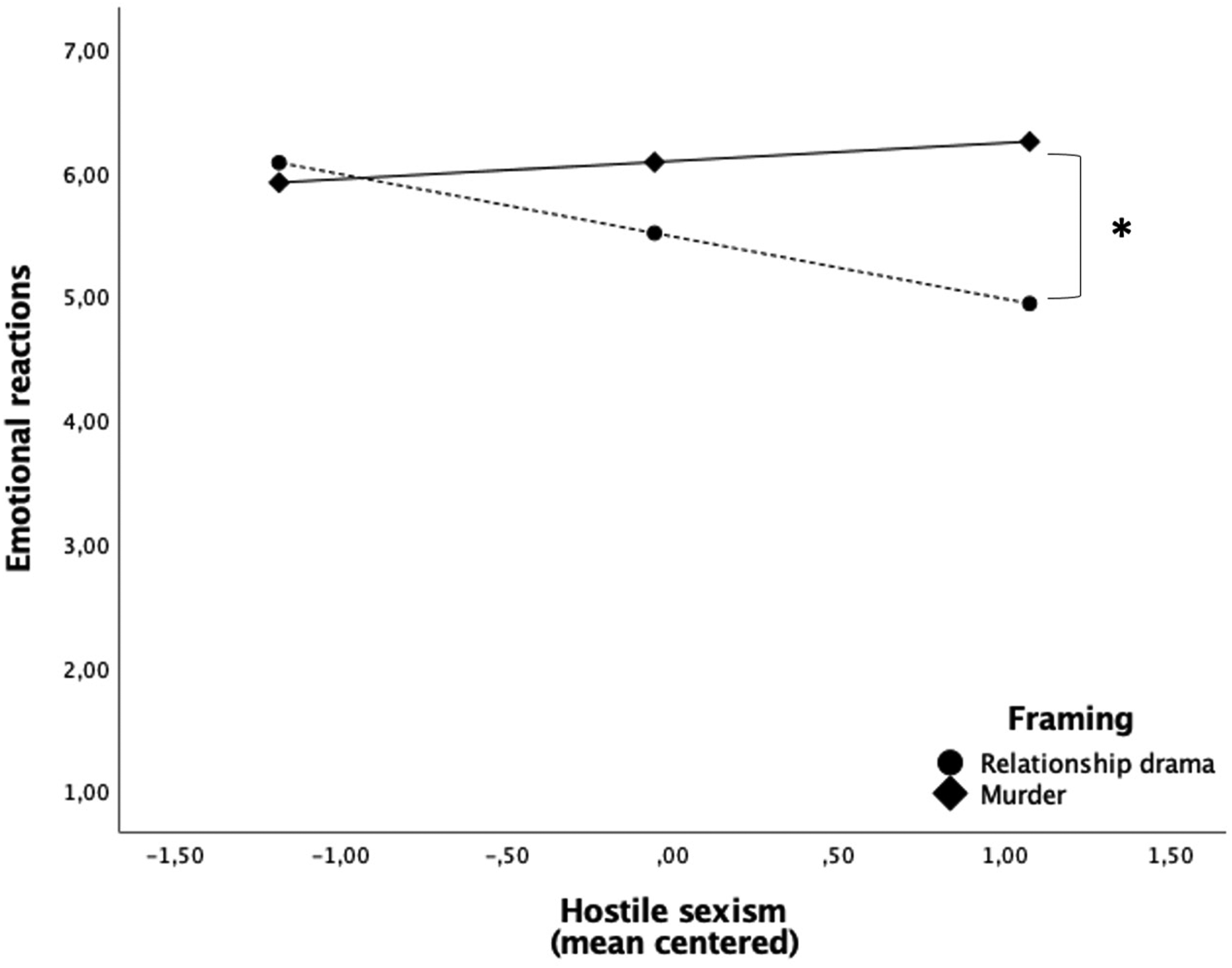
Moderating Effect of Hostile Sexism on the Relationship Between Framing and Emotional Reactions.
Conditional Effects of Article Framing at Different Moderator Levels.
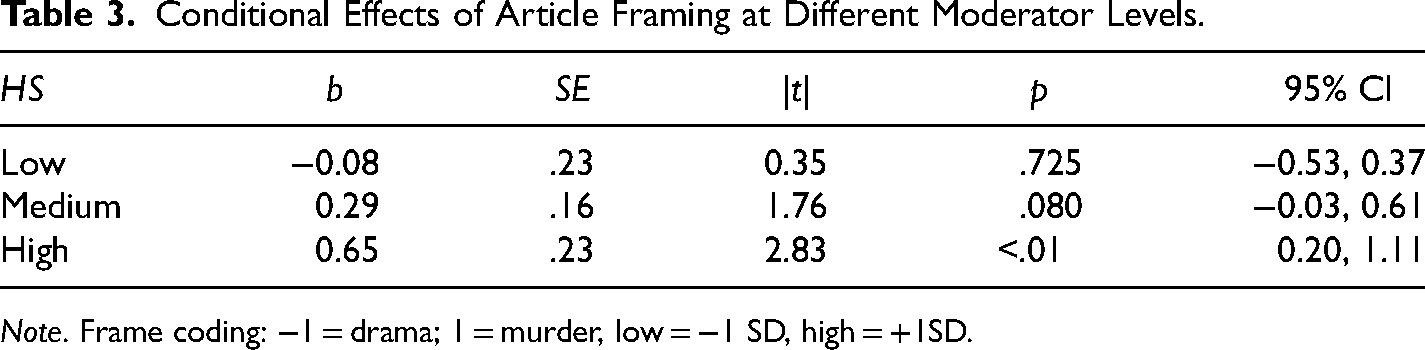
Note. Frame coding: −1 = drama; 1 = murder, low = −1 SD, high = +1SD.
Discussion
In Study 1, we aimed to test whether using a downplaying femicide frame (i.e., domestic drama) compared to an adequate crime label (i.e., murder) when reporting a typical case of deadly domestic violence negatively influences recipients’ emotional reactions toward women, perceived circumstances of the crime, and support for strict penalties for the perpetrator. In addition, we exploratively tested the moderating influence of participants’ HS and SDO on the effect of framing. In general, the results of Study 1 indicate limited evidence for an effect of framing on the variables under research. We found that participants’ emotional reactions toward the crime could be increased by the use of the adequate crime label compared to the downplaying frame. But no effect of framing on the perception of the crime circumstances or the suggested penalty levels was found. Nevertheless, the exploratory moderation analyses indicated that framing effects may be conditioned by recipient characteristics, as we found that especially participants with high HS levels were positively affected in their emotional reactions by the use of the adequate crime label compared to the downplaying frame. This was not the case for participants with high SDO levels. The study provides some first insights into how downplaying frames of misogynist crimes can affect readers’ reactions to the crime. However, the study is accompanied by some limitations. First, the expected effect size which was chosen for the a priori power analysis might have been too large (see Amsalem & Zoizner, 2022 for a meta-analytic view on framing effects). Following studies should therefore rather calculate with small effect sizes. In addition, Study 1 aimed to address too many questions at once by focusing on too many variables. A central variable in the field of research on violence against women is victim blaming. This variable is particularly associated with a positive evaluation of misogynistic violence (Sinclair & Bourne, 1998; Sprankle et al., 2018; Valor-Segura et al., 2011). Therefore, it would be interesting for further research to examine the effects of framing on victim blaming in more detail. Another weakness is, that due to the unequal representation of men and women in the sample, it was not possible to test for systematic gender effects on framing. As HS has been identified as a relevant moderator for the framing effect, it is reasonable that participant gender, as a prior variable, also has an impact on framing. A last concern is that we only tested our expectations in one country context. Femicides and the media framing of femicides is a global problem (Gillespie et al., 2013; Isaacs, 2016), so embedding a similar study design in another country context would help to generalize the findings. This is why we aimed for a second study in which we reduced our set of dependent variables, systematically tested the moderating effect of participant gender on the impact of different femicide frames, and moved to another country and language context.
Testing Participants’ Gender as A Moderating Factor
Previous studies have shown a consistent gender effect in the evaluation of violence with men evaluating violence more positively than women (Anastasio & Costa, 2004, Study 1; Chapleau et al., 2007; Romero-Sánchez et al., 2017). In the context of gender-based violence, this begins with the enjoyment of sexist humor (Greenwood & Gautam, 2020; Romero-Sánchez et al., 2017; Ryan & Kanjorski, 1998), a higher victim-blaming tendency (Black & Gold, 2008; Furnham & Boston, 1996; Sims et al., 2007; Ståhl et al., 2010), and ends with the endorsement of actual violence against women (e.g., Furnham & Boston, 1996; Rickert & Wiemann, 1998; World Health Organization, 2017). This is largely due to the different socialization of boys and girls, which typically goes hand in hand with a more positive appraisal of violence among boys (e.g., Simons et al., 1998). In addition, gender differences in the evaluation of violence against women have been also found to be grounded in a lower identification with female victims among men (see van der Bruggen & Grubb, 2014 for a discussion). Women, in contrast, identify more strongly with victims of misogynistic violence (Davies et al., 2009; Donovan, 2007), thus they are expected to evaluate violence against women, in general, more negatively than men and should be less susceptible to subtle cues such as the linguistic framing. Men, on the other hand, have a higher psychological distance from female victims. Therefore, it can be assumed that they are more likely to be stimulated to change their reactions toward misogynist violence via subtle cues such as framing. To systematically test the effect of participants’ gender on femicide framing, a second study was conducted, in which participants’ gender was varied as a quasi-experimental factor.
Study 2
The aim of Study 2 was to conduct a similar framing experiment as in Study 1 but in another country context and to examine participants’ gender as a potential moderating factor of the framing effect. In addition, this study focused on only two central variables of interest: individuals’ perception of the perpetrator and victim blaming. The design of Study 2 was mainly adapted from Study 1. One big deviation from Study 1 was that we presented participants with different conceptual frames, as we moved to another language context. This time, participants read the same information about a typical case of femicide either labeled as “love killing” or “murder.” In line with Hypothesis 1c of Study 1, we expected that participants’ perceptions of the perpetrator are increased and that their victim blaming becomes stronger if the crime is labeled as “love killing” compared to “murder.” In addition, regarding the moderating effect of participants’ gender, we expect this effect of framing to be pronounced among men compared to women (Hypothesis 2).
Method
Participants
Based on the results of Study 1, we calculated with a smaller effect size in our a priori power analysis (d = .30, 1−β = .80, α < .05, using G*Power, Version 3.1 by Faul et al., 2007). Results recommended sample size of Npredicted = 202 participants to identify rather small framing effects and interactions in 2 × 2 MANOVA with two response variables. To allow for potential dropout, we aimed to collect data from 250 individuals. Participants took part via Amazon MTurk (https://www.mturk.com). Invitation mails were weighted by participants’ gender to guarantee a balanced representation of male and female participants across both framing conditions. Overall, 264 participants began the study (138 male; 122 female; 4 diverse; Mage = 39.80, SD = 13.27, range = 19–77 years). However, 57 participants (34 male; 22 female; 1 diverse; Mage = 36.84, SD = 11.41, range = 23–67 years) were not forwarded to the treatment page as they failed the previous attention check. The final sample consisted of 207 participants (104 male; 100 female; 3 diverse; Mage = 40.61, SD = 13.65, range = 19–77 years). On average, participants had higher school certificates than the German standard population (14.9% high school certificate; 12.6% vocational secondary certification; 4.3% other secondary school-leaving certificate; 60.41% university degree). Study participation was rewarded with USD 0.50 for a maximum duration of 4 min. The data from Study 2 has been made publicly available on the OSF (https://osf.io/g6yht).
Procedure, materials, and measures
Participants first agreed with the informed consent of the study and were then asked to answer on questions about sociodemographic information. In this context, we used the same attention check variable as in Study 1. Then, participants were asked to carefully read a small text on the next survey page. The treatment text read as follows: Love killing [Murder]: Woman killed [murdered] by husband
A woman was allegedly killed [murdered] by her husband in her house after both had a violent argument. Before the incident she told him that she wanted to separate. Susan Watson, 42, was found on her kitchen floor in Suffiled after the police were called by a concerned neighbor at 12:10 p.m. on Saturday and she was having difficulty breathing. She died on the spot.
This time, we added no photo to the text. On the following two pages, participants were asked two questions about the crime. The first question was directly related to the mental representation of the perpetrator and measured participants’ perception of “how much the perpetrator has loved his wife” (loving perpetrator). Answers were given on a 7-point Likert scale from 1 (not at all) to 7 (very much). The next item was adapted from Anastasio and Costa (2004, Study 2) and assessed participants’ victim blaming by asking “how much (they) think the victim was responsible for the incident,” measured on a 7-point Likert scale reaching from “not at all responsible” to “mainly responsible.”
Results
A 2 × 2 factorial MANOVA with frame (love killing vs. murder) and participant gender (male vs. female) as independent factors was conducted. Contrary to Hypothesis 1c, we found no significant differences between the framing conditions on the combined dependent variable score, F(2, 198) = 0.23, p = .790, ηp2 = .002, Wilk's λ = .998, indicating the absence of a global framing effect on participants’ perceptions of the perpetrator and victim blaming. However, there was a significant main effect of participant gender, F(2, 198) = 6.80, p = .001, ηp2 = .064, Wilk's λ = .936, and an interaction effect between participants’ gender and framing, F(2, 198) = 5.54, p < .01, ηp2 = .053, Wilk's λ = .947. As reported in Table 4, male participants reported to a higher degree that the perpetrator loved the victim and showed a generally stronger victim-blaming tendency than female participants. Supporting Hypothesis 2, the interaction between participant gender and framing revealed that male participants were more likely to indicate that they perceived the perpetrator has loved the victim when they were presented with the “love killing” compared to the “murder” frame, whereas this was not the case among female participants. However, the interaction effect between participant gender and framing was non-significant with regard to participants’ degree of victim blaming.
One-Way MANOVA Comparing Framing Conditions Across the Dependent Variables (Study 2).
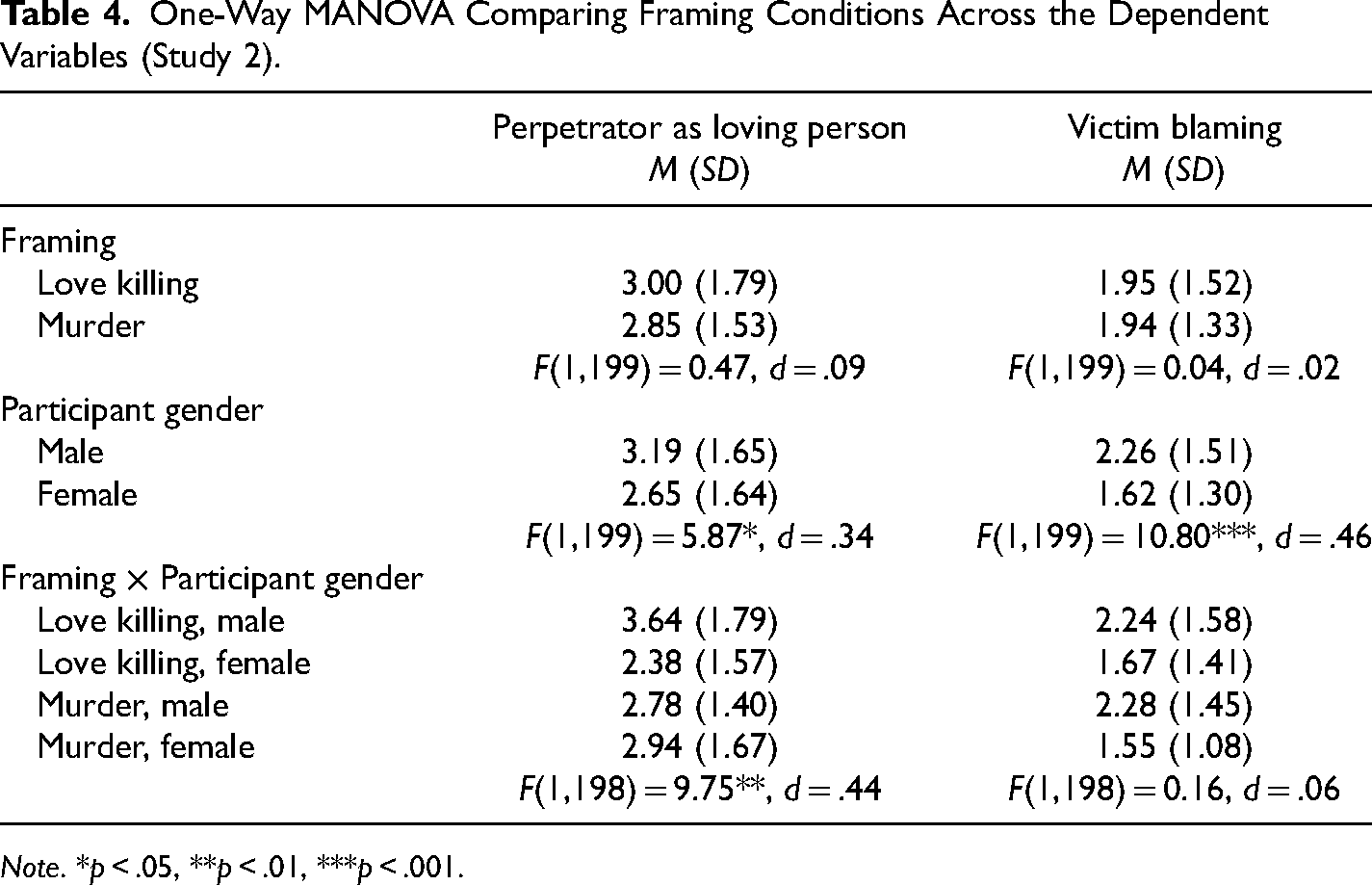
Note. *p < .05, **p < .01, ***p < .001.
An explorative test of a moderated mediation
As we found that the framing significantly affected male participants’ perceptions of the perpetrator, we exploratively tested whether the framing of the crime had an indirect effect on participants’ victim-blaming tendency via perceiving the perpetrator as a loving person conditioned by participants’ gender. Therefore, we exploratively conducted a moderated mediation model using SPSS PROCESS (Version 3.2.01 by Hayes, 2018, Model 7). The experimental framing was included as an effect-coded categorical predictor (−1 = love killing, +1 = murder). Participant gender was added as effect-coded moderator (−1 = male, +1 = female), and similar to Study 1, participants’ age and education level (as ordinal variable) were included as covariates. Perceiving the perpetrator as a loving person was treated as a mediator, and victim blaming served as a dependent variable. Results of the moderated mediation model are reported in Tables 5 and 6. There was indeed a significant mediational link between the framing of the crime, participants’ perpetrator perceptions, and victim blaming, which was moderated by participants’ gender. In line with the findings of the MANOVA, there was no direct effect of the treatment on victim blaming c’ = −0.001, SE = .09, |t| = 0.01, p = .991, 95% CI [−0.19, 0.19]. But with regard to the first path of the mediational link (see Table 5), we found a significant interaction between participant gender and framing on their perceptions of the perpetrator, which was in the second path model positively associated with victim blaming (see Table 6), b = 0.22, SE = .06, |t| = 3.92, p < .001, 95% CI [0.11, 0.34]. A test of conditional indirect effects supported the assumption that the effect of framing on victim blaming was mediated via perceiving the perpetrator as a loving person among male participants, abmales = −0.10, BootSE = .04, BootCI [−0.20, −0.02], but not among female participants, abfemales = 0.06, BootSE = .04, BootCI [−0.01, 0.14]. The index of the moderated mediation was also significant, MM = .16, BootSE = .06, BootCI [0.05, 0.29].
First Stage Path of the Moderated Mediation Model of Study 2 Predicting Participants’ Perceptions of the Perpetrator as a Loving Person.
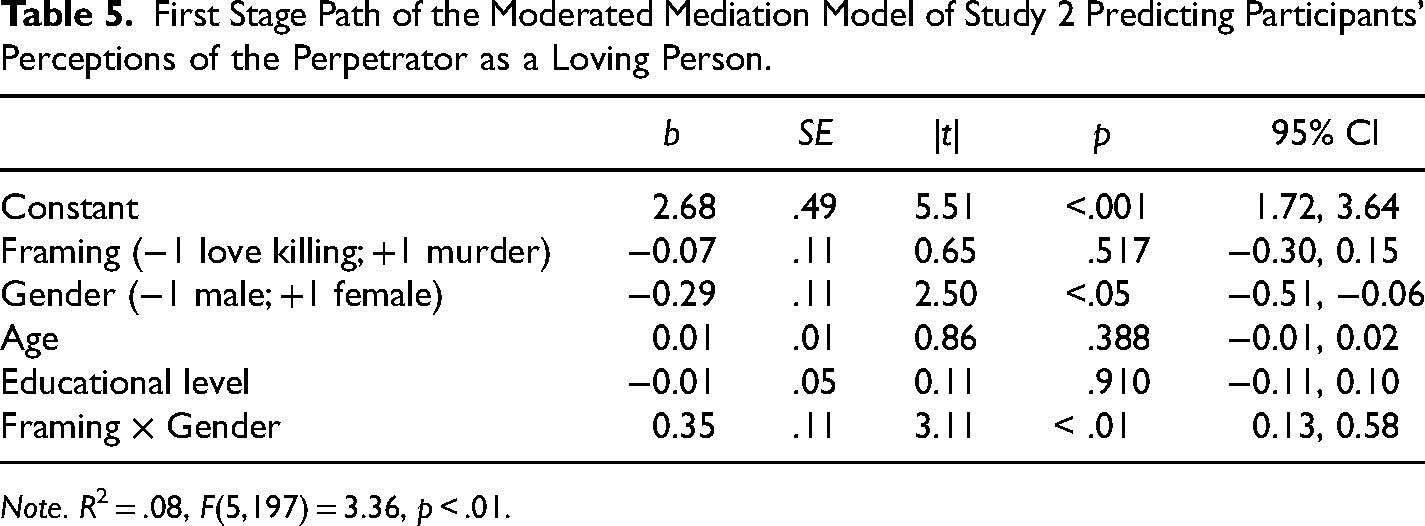
Note. R2 = .08, F(5,197) = 3.36, p < .01.
Second Stage Path of the Moderated Mediation Model of Study 2 Predicting Participants’ Victim Blaming Tendency.
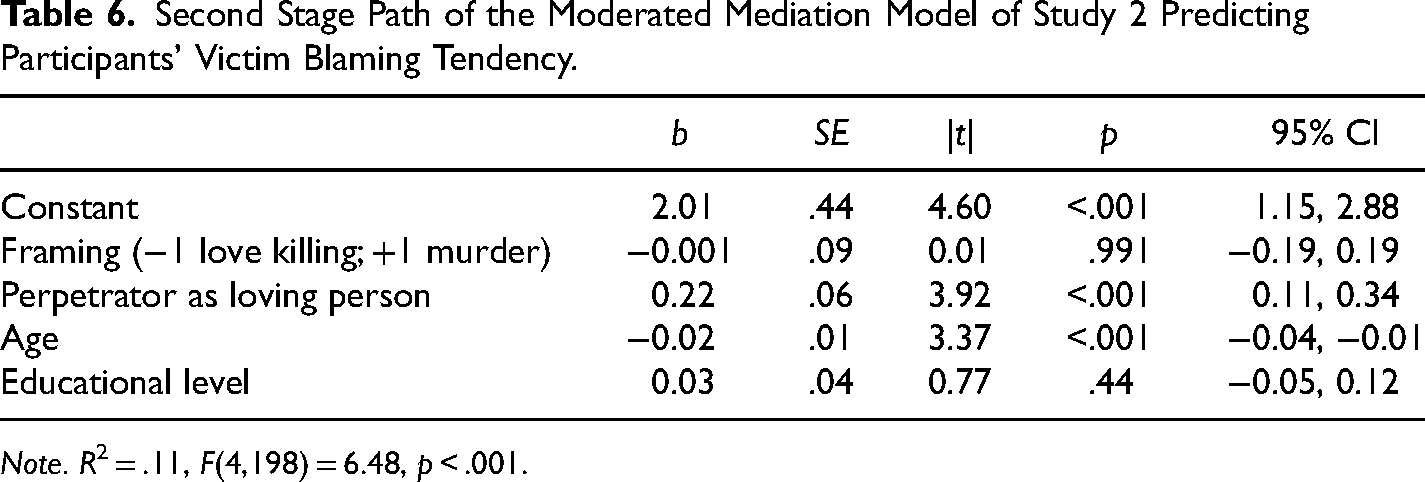
Note. R2 = .11, F(4,198) = 6.48, p < .001.
Discussion
The results of Study 2 were to some extent similar to those of Study 1, as we found limited evidence for a global effect of framing on the dependent variables. However, in Study 2, we also aimed to systematically test the moderating effect of participant gender on the impact of framing. In doing so, we found support for our assumption that especially male participants—similarly to those with high HS—were more strongly affected by the framing. More precisely, we found that male participants indicated to a higher extent that the perpetrator must have loved the victim when the crime was labeled as “love killing” compared to “murder.” However, no direct effect of the treatment or the interaction between treatment and participant gender was found on victim blaming. But, results of the moderated mediation analysis showed that the downplaying femicide frame increased male participants’ perception that the perpetrator had loved the victim (compared to the adequate crime label) and thereby also amplified their likelihood of victim blaming, whereas women were unaffected by the framing. Taken together, the results of Study 2 echo those of Study 1 and indicate rather limited main effects of framing on media recipients’ perceptions of and reactions toward deadly domestic violence. However, a closer look shows that certain target groups that are of great importance for overcoming violence against women (i.e., men and people with hostile sexist attitudes) can be positively influenced by an adequate media framing of femicides. Therefore, the effects of framing should not be underestimated.
General Discussion
We conducted two media framing experiments to test whether framing a typical case of deadly domestic violence against a female victim with either a downplaying frame (e.g., “domestic drama”) or an adequate crime label (e.g., “murder”) affects readers’ emotional reactions toward the crime, perceptions of the perpetrator and the circumstances, suggested penalty levels, and victim blaming. Supporting former speculations on the use of downplaying femicide frames (Gillespie et al., 2013; Richards et al., 2011; Taylor, 2009), emotional reactions to the crime were increased (Study 1) and male participants’ perceptions of the perpetrator as a “loving person” could be decreased (Study 2) when the crime was labeled with an adequate crime label compared to a downplaying frame. However, we did not find support for our hypothesis that framing influences individual perceptions of the crime circumstances, the perpetrator's motives, or the suggested quantum of penalty. These results are contradictory to our expectations, but they are in line with previous research indicating that media framing and headlining predominantly affect emotion-based routes of information processing (Berry et al., 2007; Cho et al., 2003). In addition, framing effects are in general lower with regard to behavior- or policy-related variables compared to emotional and attitudinal variables (Amsalem & Zoizner, 2022; Reijnierse et al., 2015).
An important finding of both studies is that especially target groups which are rather known for increased support of gender-based violence, that is, participants with high HS (Chapleau et al., 2007; Masser et al., 2006; Valor-Segura et al., 2011) and/or men (Abrams et al., 2003; Anastasio & Costa, 2004, Study 1; Chapleau et al., 2007; Masser et al., 2006; Romero-Sánchez et al., 2017), were positively affected by the use of adequate crime labels instead of downplaying frames. We think that this finding is supported by evidence on the heuristic-systematic model of information processing (HSM, e.g., Chaiken & Ledgerwood, 2011). According to the HSM, a central variable that is relevant to the persuasive power of a message is personal involvement (Axsom et al., 1987; Chaiken, 1980; Ryu & Kim, 2015). Chaiken (1980, Study 1) found that recipients with high personal involvement in a topic were more strongly convinced by strong than by weak messages and had a lower susceptibility to heuristic cues such as communicator likeability. In a similar vein, Axsom et al. (1987) showed that heuristic acoustic cues (e.g., enthusiastic audience) affected message persuasion of participants with low personal involvement but not of those with high involvement. With regard to the topic of misogynist violence, it is likely that especially non-sexist egalitarian women and men have a higher personal involvement in the issue than sexist people (see also Anastasio & Costa, 2004, Study 2 for general gender effects) and would be thus less affected by heuristic cues such as headline frames. The fact that men and hostile sexists can be positively affected by headline framing makes clear how important adequate crime labeling is in everyday life—especially when a culture of “Machismo” is present (Castillo Rojas, 2019; Yodanis, 2004).
Limitations and Future Research Directions
Even though our studies provide first insights into framing effects of different crime labels in the field of misogynist violence, there are some limitations of the present research. First, both studies should be seen as initial attempts to investigate conceptual framing effects on the evaluation of femicides. In Study 1, we used a broad set of dependent variables and in Study 2 a very reduced one. Further research should therefore aim for a stepwise test of different femicide frames on different variables with a previously precisely planned test of moderating variables. A second concern of the present study is that we used a rather weak experimental manipulation in which the variation of the frame was mainly manipulated by the variation of a single word. From a strict methodological position this can be seen as a proper experimental manipulation, but with regard to the everyday confrontation with newspaper articles, the question arises whether this practice is ecologically valid. As downplaying frames of misogynist violence in real life may be associated with other text features such as information gaps (Anastasio & Costa, 2004), it would be also interesting to test the interaction effect between frame and the degree of context information given in the newspaper article.
Practice Implications
The results of the present research support earlier call for the introduction of adequate standards and guidelines for reporting violence against women and femicides (Richards et al., 2014; Castillo Rojas, 2019). Mitigating and downplaying violence against women by the use of misleading crime labels and direct or indirect victim blaming (Lloyd & Ramon, 2017; Taylor, 2009) creates a vicious circle of violence in which patterns of gender discrimination and inequality are perpetuated. Particularly against the background that crime reports in newspaper articles often contain large information gaps (Bullock & Cubert, 2002), it is imperative to prevent readers from a rash trivialization of misogynist crimes. Crime reports should also avoid perpetrator-victim asymmetries in the favor of typically male perpetrators (Anastasio & Costa, 2004), but therefore should facilitate perspective taking with the typically female victim.
Conclusion
Even today, physical violence against women is still a relevant aspect of gender inequality (Gillespie et al., 2013; Isaacs, 2016). Media reporting is a decisive factor in overcoming the downplaying of structural and personal violence against women (Anastasio & Costa, 2004; Bullock & Cubert, 2002; Taylor, 2009). Media reports on extreme forms of misogynist violence such as femicides can help to highlight the seriousness of violence against women in everyday life when appropriate frames are used. Already with the choice of certain headlines and crime labels, different emotional reactions can be triggered. Adequate criminological crime labels and critical reporting styles are essential for a change in the social awareness of deadly violence against women.
Supplemental Material
sj-docx-1-vaw-10.1177_10778012231158103 - Supplemental material for “Domestic Drama,” “Love Killing,” or “Murder”: Does the Framing of
Supplemental material, sj-docx-1-vaw-10.1177_10778012231158103 for “Domestic Drama,” “Love Killing,” or “Murder”: Does the Framing of by Julia Schnepf and Ursula Christmann in Violence Against Women
Footnotes
Author’s Note
Julia Schnepf is currently affiliated with Department of Media Psychology, FernUniversität in Hagen, Hagen, Germany.
Commitment to Open Science Practices
Study 1 was registered on the Open Science Forum before data collection (OSF, https://osf.io/ef7u8). All data are published on the OSF for reasons of data transparency ( ).
).
Declaration of Conflicting Interests
The author(s) declared no potential conflicts of interest with respect to the research, authorship, and/or publication of this article.
Funding
The author(s) received no financial support for the research, authorship, and/or publication of this article.
Supplemental Material
Supplemental material for this article is available online.
Author Biographies
References
Supplementary Material
Please find the following supplemental material available below.
For Open Access articles published under a Creative Commons License, all supplemental material carries the same license as the article it is associated with.
For non-Open Access articles published, all supplemental material carries a non-exclusive license, and permission requests for re-use of supplemental material or any part of supplemental material shall be sent directly to the copyright owner as specified in the copyright notice associated with the article.
