




Abstract
Partner violence resulting in physical injury is more often blamed on men than women for perpetrating the same offence, as men are often perceived to be more capable of inflicting injury. The current study used vignettes in a mixed-model design to examine the influence of perpetrator and observer gender, and weapon presence on observer blame. A split-plot analysis of variance produced a significant effect of perpetrator gender and an interaction effect of perpetrator gender and weapon presence. These findings suggest that perpetrator gender may be more important than weapon presence when examining observer perceptions.
Introduction
Intimate partner violence (IPV) is a complex and serious occurrence characterized by acts of abuse committed by a current or former romantic partner (World Health Organization [WHO], 2012). The definition of IPV has evolved over the years beginning with early conceptions focusing on physical abuse committed within a marriage where the husband was always the perpetrator, and the wife was always the victim. Today, it is more commonly agreed that IPV occurs outside of historical gender confines (Sorenson & Thomas, 2009) and includes abusive behaviors that extend beyond physical abuse (WHO, 2012). Despite this shift in awareness, traditional perceptions of IPV persist. How interpersonal violence is conceptualized is thus subjective, with the status of “victim” and “perpetrator” determined by individuals, and the society in which they live (Kuijpers et al., 2017). Understanding perceptions of individuals who may not have direct experience with IPV is important and underlies, along with research, the basis of policy work and education which draws on social constructions of partner violence in the community to form services and programs that prevent future violence (Eigenberg & Policastro, 2015). Victim provocation (Esqueda & Harrison, 2005; Rhatigan et al., 2011; Stewart et al., 2012), substance use (Harrison & Esqueda, 2000), victim aggression (Witte et al., 2006), victim traditionality (Capezza & Arriaga, 2008a), and type of violence (Taylor & Sorenson, 2005) are some of the characteristics that can shape a third-party observer's perceptions of an IPV scenario. However, recent research has focused on the gender dynamics associated with public IPV perceptions. Gender serves as a lens through which individuals view their environment. Although interchangeably used with sex, gender refers to the socially constructed ideas about how men and women should act (Russell et al., 2016). Thus, responses to IPV are shaped by the dynamic of the genders involved in the violence as well as the observer's gender (Allen & Bradley, 2017).
In the field of IPV, a debate persists that focuses on the real or perceived gender asymmetry of violence. One school of thought relies on the feminist perspective which maintains that IPV is predominantly perpetrated by men to control women (Dobash et al., 1992). This is supported by the U.S. National Crime Victimization Survey as well as police reports that maintain 80% to 99% of IPV is perpetrated by men against women (Straus, 2011). On the other hand, the gender symmetry approach supports the idea that both men and women perpetrate IPV at similar rates (Archer, 2000). In terms of victimization, 2019 Canadian police statistics report that, 79% of IPV victims were women. However, rates of physical injury as a result of IPV were marginally higher for men (56%) than women (53%; Government of Canada, S. C., 2021a).
This inconsistency in the rates of violence is in part due to several reasons, such as how abuse is defined, the type of violence committed, and whether the violence is done in self-defence (Hamby, 2009). While there are conflicting reports about the general incidences of IPV, women who are victimized tend to be affected more than men. This notion is supported by female IPV victims having more severe injuries, requiring more time off work, and greater use of health and justice services (Tjaden & Thoennes, 2000; as cited in Flynn & Graham, 2010).
Social attitudes surrounding IPV are partially constructed via gender norms and beliefs; stereotypical views of women as weak and fragile, and men as aggressive and strong are inherently tied to how perpetration and victimization are also conceived (Scarduzio et al., 2017). Within the context of a heterosexual relationship, this could lead to hesitation when ascribing the role of “victim” to a man and “perpetrator” to a woman (Hine et al., 2020; Scarduzio et al., 2017).
Male rather than female perpetrators are often attributed more blame in IPV scenarios by third-party observers when committing the same offense (Rhatigan et al., 2011; Russell et al., 2016; Sorenson & Taylor, 2005). One rationale for this judgment is that the level of injury is worse when a man is executing the violence, as men are often thought to be more capable of inflicting serious injury (Rhatigan et al., 2011). Conversely, a female victim is thought to be more susceptible to such injury (Seelau & Seelau, 2005). Further, IPV resulting in injury is recognized as more serious (Katz & Arias, 2001), suggesting that injury or the perceived threat of injury impacts how observers regard perpetrators of IPV. The threat of having a weapon present in an IPV situation, whether it is used or not, is linked to an increased level of injury and overall threat level (Sorenson & Taylor, 2005). Thus, the introduction of weapons to an IPV scenario could negate observer biases associated with a perpetrator or victim's gender (Rhatigan et al., 2011).
The aim of the present study is to explore the impact of gender and the perceived threat of harm or injury on perceptions of perpetrator blame in heterosexual IPV. Observer perceptions of IPV are represented by blame, or how observers attribute responsibility to IPV perpetrators (Malle et al., 2014). The subsequent literature review will provide the foundation for the current study which explores gender and weapon presence as determinants of perpetrator blame attribution in IPV.
Victim Gender
When assessing a situation where a man is the victim of partner violence, perceivers will tend to view the violence as ambiguous and more difficult to interpret (Harris & Cook, 1994). The male victim poses a challenge to society, as individuals have to reassess how they interpret what it means to be a victim. According to Christie (1986), to be considered an “ideal” victim, there must be a clear difference in power between the perpetrator and the victim, the victim must act virtuously and be blameless, and the victim and perpetrator should not be acquainted. As a result, this conceptualization of victimhood has an impact on how one might decide whether an individual fits the status of a “victim.”
Taylor and Sorenson (2005) examined how observers held IPV perpetrators and victims accountable in hypothetical abusive scenarios in a large community sample study. Victim injury, weapon presence, victim rape, physical abuse, and perpetrator substance use decreased the odds of victim blame. Further, the likelihood of assigning fault to the victim was higher if the victim was a male, regardless of sexual orientation. There was also a greater likelihood of assigning equal fault when the victim was in a non-heterosexual relationship. Third-party observers may assume that since the couple is of the same sex they are matched in physical power and thus are not vulnerable to each other (Taylor & Sorenson, 2005).
In support of the notion that IPV toward heterosexual male victims is viewed as less serious, researchers asked undergraduate students to designate the labels of “victim” and “perpetrator” to the characters involved in bidirectional IPV vignettes (Hine et al., 2020). Participants were aware of the bidirectional nature of the abuse scenarios, but evaluations of vignette characters were consistent with the same judgments used in unidirectional IPV. Participants were less likely to assign the label of “victim” to the male in the scenario even when most of the aggression was perpetrated by the female partner. Further, scenarios in which the violence was male-dominated or those where there were equal levels of aggression, were viewed as more serious than female-dominated scenarios. The findings from this study suggest that despite knowing the violence was bidirectional, participants made judgments based on preconceived ideas (Hine et al., 2020).
The social norms that dictate how a victim ought to act also affect women's legitimacy as victims. Social support and empathy are seemingly reserved for female victims who present as innocent and vulnerable, or in other words, as an “ideal victim” (Meyer, 2015). This produces a catch-22 for women who are facing abuse; they are deemed suspicious for not getting out of the situation but are also not provided with full support when they do not fit societal expectations of a victim. As demonstrated, third-party observer views on IPV are greatly shaped by the victim's gender. However, the dynamic of the genders in heterosexual IPV allows for one to also consider the gender of the perpetrator when allocating blame.
Perpetrator Gender
Male violence committed against a female intimate partner is considered the most common type of IPV (Tjaden & Thoennes, 2000). Further, women are more often victims of ongoing abuse and their violence can often be attributed to self-defense (Dasgupta, 2002). These factors reflect past findings that male-perpetrated violence is taken more seriously than female-perpetrated violence (Taylor & Sorenson, 2005). In their multi-study examination of implicit attitudes associated with gender and IPV, Bates et al. (2019) found that situations with a female perpetrator and male victim were less likely to be identified as partner violence. This pattern was also evident in reporting behaviors and explicit observer attitudes. Interestingly, when participants were provided information pertaining to equal rates of IPV between genders, it did not impact either implicit or explicit attitudes. This suggests deeply ingrained associations and stereotypes when considering gender and IPV perpetration. According to Snyder and Ickes (1985), how individuals construe a circumstance can be attributed to the strength of the situation. They describe situations with structure and evident clues to guide behavior as “strong.” Alternatively, “weak” situations are therefore those that appear ambiguous and unstructured to the individual making the appraisal. As a result, strong situations are guided by situational characteristics and weak situations are guided by dispositional characteristics. In the context of the present matter and as a result of gender norms, a situation with a male perpetrator and a female victim is a strong situation, with the observer being able to easily interpret the violence. However, when the roles are reversed and the female is the perpetrator the situation becomes more ambiguous (Witte et al., 2006). One way in which situations are strengthened is through exposure to similar experiences, and IPV is often publicly represented via the media. Scarduzio et al. (2017) qualitatively examined gender stereotypes of undergraduate students when exposed to IPV news stories depicting a heterosexual married couple. Four stereotypes emerged from the analysis: aggression, emotion, power and control, and acceptability of violence. In the aggression stereotype, participants described women as expressing aggression more often through less direct means, and men as expressing aggression physically. In the emotional stereotype, men were depicted as one-dimensional in terms of their emotional range, as the male perpetrator's violence was often attributed to anger. On the other hand, the female perpetrator was viewed as overly emotional. This finding is consistent with Stewart et al.’s (2012) study which identified perceptions that male perpetrators were more in control and behaviorally stable. Scarduzio et al. (2017) also identified views that men were physically strong and women were weak in the power and control stereotype. Participants expressed disbelief when a female perpetrator killed her male partner, and described a women overpowering a man as amusing. Finally, in the acceptability stereotype, participants rated violence as never acceptable regardless of the perpetrator. However, when it came to violence in self-defence, it was acceptable for women but not men (Scarduzio et al., 2017). Individuals will often express patterns in judgment that extend beyond the presented information. Individuals who are unable to conceive a female as a violent perpetrator will thus turn to other factors to explain their aggressive behavior (Saunders, 2002).
In their large community study, Sorenson and Taylor (2005) surveyed adults in California about social norms in IPV. In accordance with past community and university samples (e.g., Sorenson & Thomas, 2009), violence committed by men was viewed as more illegal. Additionally, when a slap, punch, or forced sex was the type of violence in the vignette, it was considered more illegal when committed by a man than a woman. The authors also reported more structured responses from a male perpetrator and a female victim. This provides additional support for male-on-female violence being a “strong” situation as it seems to be more understood. Further, when a male committed violent acts, respondents were more likely to endorse that legal interventions follow (e.g., arrests and protection orders). Minimizing perpetration has implications for women who aggress, such that inappropriate services may be suggested that fail to meet the unique needs of female perpetrators who are trying to change their behavior (Bates et al., 2019).
The real or perceived injury incurred by a victim is thought to be more or less damaging based on the gender of the perpetrator. Further, sex is often confounded with gender identity and the stereotypes associated with the genders (Spence & Helmreich, 1979). A vignette study by Russell et al. (2016) aimed to untangle the effects of sex and gender identity on perpetrator ability to arouse fear and observer blame. Perpetrator ability to arouse fear was positively correlated with blame. Feminine female perpetrators were the least likely to arouse fear and had the lowest blame levels. Moreover, blame levels for feminine female perpetrators were significantly lower than masculine male, feminine male, and masculine female perpetrators. This suggests that gender identity, rather than sex may lead observers to believe that women are not associated with physical aggression (Russell et al., 2016).
Observer Gender
In recent decades there has been an overall shift toward negative attitudes when it comes to partner violence against women and men (Wilchek-avid et al., 2018). However, previous research has supported a sex-of-perceiver effect which determines how victim and perpetrator attributions are made by third-party observers. Using concept mapping, O’Campo et al. (2016) found that both men and women generally agreed that specific physical and sexual acts should be considered IPV. However, when it came to non-physical violent acts (e.g., controlling behaviors), there was less consensus between men and women.
These differences in attitudes also translate to blame attribution, A study conducted with college students found that women held the perpetrator more responsible for violent acts in a male-on-female IPV scenario than did men (Langhinrichsen-Rohling et al., 2004). One explanation for this difference is that men are more likely to support violent attributions than women. In order to account for observer attitudes toward female perpetrators, Wilchek-avid et al. (2018) examined the severity and justification for both male and female perpetrators. Men did not significantly differ in their attributions toward violent men and women. However, women were more tolerant toward female rather than male perpetrators. Further, female participants perceived men's violence as more severe, but for the female perpetrator, the violence was perceived as equally severe for both men and women. These results can be viewed through the Defensive Attribution Theory (Shaver, 1970), whereby women who viewed the scenarios were likely to identify with a female victim, therefore attributing more severity to the violence in those situations (Wilchek-avid et al., 2018). Conflicting these findings, other research supports women having greater rates of IPV justification (Kuijpers et al., 2017).
A recent study by Zapata-Calvente and Megías (2017) found that women may be more sensitive than men to acts of violence. The study examined university students’ attitudes toward hypothetical IPV scenarios. Interestingly, women rated the prevalence of violent acts as higher compared to men. Women also rated the violence as more serious as compared to male participants, for both male and female perpetrators. Additionally, women were shown to place more blame on the perpetrators. One explanation is that women are not socialized to be physically violent but are thought to be more perceptive of other's emotions and well-being (Zapata-Calvente & Megías, 2017).
While there are several studies that support the idea that men and women conceptualize IPV differently, there is no consensus on whether there is a difference in perceptions (Kuijpers et al., 2017; Sorenson & Taylor, 2005). According to Rhatigan et al. (2011), these conflicting findings may be accounted for by prior experience with IPV. Rhatigan et al. (2011) found that perpetrator blame attribution increased when participants had an IPV victimization history, particularly from violence that had caused injury. Kuijpers et al. (2017) examined how university students perceived acceptability when viewing IPV scenarios. Vignettes that depicted more severe violence were rated as less normal by women than men. However, when considering participants’ psychological but not physical IPV history, the gender differences in normality diminished.
Severity of Injury
The use of weapons in IPV is related to more serious injuries to the victim, and having a weapon present in an IPV situation increases the level of threat to the victim (Sorenson & Taylor, 2005). Despite this threat, the use of firearms is not common in IPV cases (Kernsmith & Craun, 2008), and they are most often used in a threatening manner (Sorenson, 2017). According to 2019 Canadian statistics, weapons were present in 15% of IPV cases, and mostly used or present when there was a male victim (24%) versus female victim (13%). In addition, minor physical injuries were far more commonly reported (52%) than serious injuries or death (2%), this was the case for both women and men (Government of Canada, S. C., 2021b). According to Sorenson's (2017) examination of IPV cases from Philadelphia, Pennsylvania, the use of a gun was more common when the assailant was a man. However, general weapon use (e.g., knife, phone, or household objects) was linked to female rather than male perpetrators by Kernsmith and Craun (2008). This increased weapon use by women may be attributed to women needing to have additional protection as a means of self-defence against their physically stronger male partner, or as a way to make up for a lack of physical power when dominating their partner.
In their community study, Taylor and Sorenson (2005) identified that victim risk for injury was related to lower blame scores for victims by observers. Additionally, observers indicated that the conflicting couple should “talk” more often in cases where an assailant grabbed a nearby household object than when the perpetrator pulled out a gun. Moreover, in a separate study with the same sample (Sorenson & Taylor, 2005), respondents were more likely to consider the situation illegal when there were external weapons present in the scenarios. Observers most often reported that guns should be taken away from the perpetrator when they beat the victim and that police should intervene. These considerations were made regardless of whether the assailant was a male or female and demonstrate that situational context may be more important than perpetrator gender to how observers perceive IPV (Sorenson & Taylor, 2005). Situations involving weapons, especially guns, are considered strong rather than weak. Some contextual elements in strong situations are important enough that other circumstances can be ignored (Witte et al., 2006). For example, having a gun in an IPV scenario may supersede any other factors in the vignettes, such as the gender of the perpetrator and victim. The existing literature is limited in its exploration of gender and varying weapons as determinants of observer blame attribution. The present study will extend the findings from previous research by including various forms of a perceived injury threat.
The Current Study
According to Sorenson and Taylor (2005), judgments about aggression are based on three catergories: attributes of the people involved, attributes of the situation, and attributes of the observers making the judgement. The purpose of the present study is to examine the impact of gender and the perceived threat of harm or injury on perceptions of perpetrator blame in IPV. A quasi-experimental design was used with vignettes to examine how perpetrator gender (male/female), weapon presence (no weapon/gun/bottle), and observer gender (male/female) relate to blame attribution. We hypothesized that significantly more perpetrator blame will be assigned by female rather than male participants, that participants will assign significantly more blame to the male rather than female perpetrator, that significantly more blame will be assigned when there is an external weapon present, and finally, that significantly more blame will be assigned in the gun condition compared to the bottle and no weapon conditions.
Method
Power Analysis
The power analysis focused on the hypothesized effects using simple independent mean comparisons for gender of participant and perpetrator, and a dependent sample mean comparison for the weapon presence. An analysis was conducted to determine how many participants would be needed to detect the main effect of observer gender on blame. In Rhatigan et al.'s (2011) study a small effect size was found, therefore a small effect size (d = 0.20), along with α = .05, and a power of 0.80 was used to conduct the analysis. The results indicated that in order to detect the main effect of observer gender on blame attribution a total of 788 participants would be needed. In order to see how many participants would be needed to find the main effect of perpetrator gender, a large effect size (d = 0.80; as determined by Rhatigan et al., 2011), α = .05, and a power of 0.80 was used in the power test. The study would need at least 52 total participants to detect a statistical difference in blame scores for male and female perpetrators. There have not been any previous investigations with reported effect sizes on how the specific weapons used in this study impact blame attributions. For the analysis, a test of difference between two dependent means, a medium effect size of d = 0.50, α = .05, and a power of 0.80 was used. In order to detect the main effect of weapon presence 34 participants would be needed.
Participants
The total number of participants in this study was 335 (76.1% female) with 169 participants in the female perpetrator condition and 166 in the male perpetrator condition. The current sample did not meet the required sample size for a power of 0.80 as determined by an a priori analysis for the observer gender effect. Based on post hoc calculations, the current sample size achieved a power of 0.34. However, with an effect of d = 0.36 the sample would achieve a power of 0.80.
The sample consisted of undergraduate (78%) and graduate students recruited from a Canadian university in southern Ontario through mass-email recruitment and the undergraduate research participant pool. Participants ranged in age from 17 to 59 years (M = 20.98, SD = 5.84). The majority of participants identified as White/Caucasian (57.6%), followed by 19.4% identifying as East or Southeast Asian, 6.6% as South Asian, and 4.2% as West Asian/Arab. According to the participants at the time of data collection, 59.4% reported that they were single, 31.6% reported being in a dating relationship, 5.4% were married, and 3.6% were engaged. A subset of the sample also indicated that they had experienced lifetime IPV victimization (13.1%) and/or perpetration (4%). Participants who indicated IPV perpetration were more often women (64%) than men (35%). Participants that indicated IPV victimization were also more often women (88%) than men (11%). Lifetime IPV experience was assessed by asking participants to self-report using two questions. “In your life, do you feel that you have ever been a victim of IPV?” and “In your life, do you feel that you have ever been a perpetrator of IPV that was not in self-defence?”
Vignettes
The vignettes used to depict an IPV scenario in this study were adapted from a previous study conducted by Rhatigan et al. (2011) on confrontation and blame. The hypothetical vignettes depict a violent situation between cross-sex dyads who are intimate partners. The following is an example of the male perpetrator, no weapon scenario: You are returning home from a full day of classes when you notice your neighbours in their kitchen through the open window. In the past, you have heard a lot of screaming and yelling coming from their house, so you wait and listen. You overhear the boyfriend, Robert, telling his girlfriend, Maria, that some guy called for her and hung up before he could take a message. He then asks who the guy might have been. Maria says, ‘I am not sure. It might have been someone from class today.’ He yells, ‘Drop the attitude! Tell me who the guy on the phone was or you’ll be really sorry.’ You then witness Robert slap his girlfriend. Maria responds by holding her cheek, wincing in pain. Robert then yells, ‘You think that stings …. Next time, it’ll really hurt!’
The control non-confrontational vignettes were adapted for this study to assess how the presence of a weapon would impact observer blame attribution, by inserting a weapon into the vignettes. For the gun condition, two sentences were added, (“You see [perpetrator] reach for a drawer and pull out a gun…”) and (“You witness [perpetrator] press the gun to [victim's] chest and yell…”). Likewise, two additional sentences were added in the bottle condition, (“You see [perpetrator] reach for an empty glass bottle on the counter”) and (“You witness [perpetrator] smash the bottle on the counter and hold it up to [victim's] face and yell…”). The perpetrator gender was manipulated by changing the names of the hypothetical couple and using appropriate gendered pronouns. In the male perpetrator condition Robert was the IPV perpetrator and Maria was the victim, and in the female perpetrator condition, Maria was the perpetrator and Robert was the victim. These vignettes were used in this study as they best depict IPV in a context that is relevant given the sample (university students), also these scenarios allow for manipulations to be easily made.
Measures
Domestic Violence Blame Scale
The Domestic Violence Blame Scale (DVBS) was developed by Petretic-Jackson et al. (1994) for the purpose of assessing individual blame attribution in IPV and covers several domains (societal, situational, perpetrator, and victim). The original 23-item scale conceptualizes IPV as physical violence where the husband is the perpetrator, and the wife is the victim. For the purposes of this study the scale was modified to include gender-neutral terms. For example, “Husbands who physically assault their wives should be locked up” was changed to “Perpetrators who physically assault their partners should be locked up.” The items are scored in Likert-scale format, such that “1” represents strong disagreement and “6” represents strong agreement. The scale has acceptable validity and reliability (as cited in Bryant & Spencer, 2003).
The scale has good internal consistency, as α = .72 with the present sample. The purpose of including this scale was to gather data on participants’ baseline blame attribution before they were presented with the vignettes. The mean score for the scale was used as a covariate in the analyses.
Attributions for Violent Behavior
The Attributions for Violent Behavior (AVB) scale was developed by Rhatigan et al. (2011) to assess observer responsibility, blame, and causality in IPV scenarios. This measure was based on Fincham and Bradbury's (1992) Relationship Attribution Measure and theoretical distinctions of types of attribution related to blame. This scale measures blame attributed to a perpetrator and not a victim in a given situation. Item examples are: “(Perpetrator) is responsible for the violent act(s) portrayed above” and “I believe that (Perpetrator's) behavior was a one-time event and won’t happen again.” The 11-item scale is scored in Likert-type format and ranges from “1” = disagree strongly to “6” = agree strongly, with a higher score indicating more blame being placed on the perpetrator in the scenario. The internal consistency with the present sample is acceptable at α = .67.
Demographic Questionnaire
Preceding the vignettes and blame scales, participants answered questions relating to several demographic variables. Information on gender, race/ethnicity, year of study, relationship status, and length of current relationship was collected. Following the completion of the vignette task, participants answered questions relating to their IPV history. Data on history of victimization (“In your life, do you feel that you have ever been a victim of IPV?”) and history of perpetration (“In your life, do you feel that you have ever been a perpetrator of IPV that was not in self-defence?”) were collected from participants.
Procedure
The University Research Ethics Board was responsible for approving the present study. Recruitment was collected through the university's participant pool and mass-email recruitment service. The participants accessed the link to the study, which was conducted on Qualtrics, and were presented with the letter of information. All participants were then asked to fill out the demographic questionnaire, as well as the DVBS. Next, participants were randomly assigned to either the male or female perpetrator conditions, each containing three vignettes with varying weapons. The no weapon, bottle, and gun conditions were counterbalanced to control for order effects, and after reading each IPV vignette the participant was prompted to complete the AVB scale. The study concluded by asking about the participant's experience of IPV with two yes/no questions. Compensation in the form of course credits was given to participants who were recruited through the participation pool. No other form of compensation was given. The entire study had an expected completion time of 30 minutes.
Results
Data Screening
Participant progress was examined and only participants who completed more than 90% of the study were kept, with 90 cases being deleted. The eliminated cases had not completed a sufficient amount of the study conditions or they ended the study before they got to the vignettes. Prior to the data analysis, the decision was made to include only data from participants who completed two out of three weapon conditions. Mean scores were computed for each of the weapon conditions and the study measures, and descriptive statistics were run. Individuals who did not identify as either male or female (n = 4) were not included in the analysis due to the lack of data for group comparisons.
The mean AVB scale scores for perpetrator blame were examined for normality by viewing the skewness and kurtosis statistics prior to the removal of outliers. In the male perpetrator conditions the data were shown to be non-normally distributed. The data were then assessed for extreme outliers which were defined as 3*IQR (interquartile range) using boxplots in SPSS. Scores for each weapon condition were individually assessed and mean score data points from nine extreme outliers and one participant falling outside of 3*IQR were removed.
A close inspection of the outliers before removal suggested that they were due to careless responding. A second inspection of skewness and kurtosis statistics was conducted after the removal of the extreme outliers showed that the data were normally distributed. The final sample size used in the analysis was n = 335.
Split-Plot ANOVA
Observer Blame
For the purpose of this study, a 2 × 2×3 split-plot design was used and all analyses were conducted in SPSS. Perpetrator gender was one between-subjects factor, participant gender was the second between-subjects factor, and the weapon condition was the within-subjects, repeated-measures factor. The covariates that were added to the model were the mean DVBS scores and participant age. Mauchly's test of Sphericity was significant so a Greenhouse-Geisser epsilon adjustment was used for tests involving the repeated-measure factor vignette. No significant effect of observer gender was found, F(1, 307) = 0.033, p = .856, d = 0.00. In the sample, men's blame scores (M = 5.16, SD = 0.10) did not significantly differ from women's (M = 5.16, SD = 0.08). This finding did not support the hypothesis that men would blame the perpetrator less than women, as there was no significant difference in blame attribution based on observer gender. There were no other significant interactions with participant gender.
Weapon Presence
The gun condition had the highest mean (M = 5.25, SD = 0.49), followed by the bottle (M = 5.16, SD = 0.52), and then the no weapon condition (M = 5.07, SD = 0.54). However, there was no significant effect of weapon presence on blame attribution after adjusting the degrees of freedom with the Greenhouse-Geisser correction, F(2, 590) = 1.58, p = .207, ηp2 = 0.005.
Perpetrator Blame
The model showed a significant effect of perpetrator gender, F(1, 307) = 12.28, p = .001, d = 0.53, 95% CI [0.097, 0.344]. This supports the hypothesis that male perpetrators (M = 5.29, SD = 0.39) would be blamed significantly more than female perpetrators (M = 5.04, SD = 0.53).
Perpetrator Gender and Weapon Presence Interaction
Although not hypothesized, there was a significant 2 × 3 interaction effect between perpetrator gender and weapon presence, F(2, 590) = 5.09, p = .007, ηp2 = 0.016, indicating that participants placed different levels of blame on the perpetrator in the weapon conditions based on whether the perpetrator was male or female.
To explore if each of the weapon conditions were significantly different from one another, holding constant perpetrator gender, three paired-samples t-tests were conducted for the male and female perpetrator conditions with a Bonferroni adjustment. Blame in the male no weapon condition was significantly lower than the male gun condition, t(157) = −5.04, p = .000, d = 0.39, 95% CI [−0.563, −0.238]. Blame in the male bottle and male gun conditions did not differ significantly, t(154) = −2.24, p = .027, d = 0.18, 95% CI [−0.338, −0.021]. Blame in the male bottle and male no weapon conditions also did not differ significantly, t(160) = −2.39, p = .018, d = 0.15, 95% CI [−0.345, −0.033]. Blame scores were significantly higher in the female gun condition than in the female no weapon condition, t(164) = −6.54, p = .000, d = 0.51, 95% CI [−0.671, −0.346]. Blame scores were also significantly higher in the female bottle condition than in the female no weapon condition, t(164) = 4.19, p = .000, d = 0.33, 95% CI [0.170, 0.483]. Finally, blame scores for the female gun condition were significantly higher than those in the female bottle condition, t(160) = 3.96, p = .000, d = 0.30, 95% CI [0.154, 0.470]. There were no other significant effects in this model (Figure 1).
Secondary Analysis
Secondary analyses were conducted to explore the relationship between participant gender and general levels of perpetrator and victim blaming attitudes using the DVBS scale. An independent samples t-test was used to conduct the analysis, with the mean scores of the perpetrator blame subscale of the DVBS as the test variable, and participant gender as the grouping variable. Women (M = 3.83, SD = 0.67) and men (M = 3.87, SD = 0.63) did not differ in their level of IPV perpetrator blame, t(333) = 0.423, p = .673, d = 0.05, 95% CI [−0.132, 0.204]. Gender was also examined with mean scores for the victim blaming subscale of the DVBS, with participant gender as the grouping variable. Men (M = 1.78, SD = 0.63) were more likely to hold victim-blaming attitudes than were women (M = 1.59, SD = 0.54), t(114) = 2.81, p = .006, d = 0.39, 95% CI [0.068, 0.393].
Discussion
The present study examined observer blame attribution as a function of observer gender, perpetrator/victim gender, and weapon presence. Participants read vignettes that depicted a violent scenario between a heterosexual couple and then indicated perpetrator blame attribution using a Likert-type measure. The first hypothesis for this study was that male observers would assign less blame to the perpetrator than female observers would. This finding was not supported by the data, as there was no significant difference found between the amount of blame between men and women. This contrasts with previous literature which suggests that men are more supportive of violent attributions (Langhinrichsen-Rohling et al., 2004; Rhatigan et al., 2011; Zapata-Calvente & Megías, 2017). There seems to be a lack of consensus on whether gender alone can influence observer perceptions of IPV as some previous studies have also not found an effect of participant gender (Kristiansen & Giulietti, 1990; Lehmann & Santilli, 1996). A shift in social norms among young adults could be a reason why this sample did not differ by participant gender when considering perpetrator blame. University students are more frequently reporting positive attitudes toward a more equal playing field for men and women (Wenhold & Harrison, 2020). Specific to IPV, more Canadian men are reportedly getting involved with abuse prevention programs and actively engaging with women to support violence awareness (DeKeserdy et al., 2000).
Previous IPV experience has been shown to affect participant perceptions of hypothetical IPV scenarios (Kuijpers et al., 2017; Rhatigan et al., 2011). While the current study did consider past IPV perpetration and victimization, it did so by asking only two questions. It could be the case where if participant IPV history was more thoroughly examined (e.g., with validated measures), a gender difference would emerge in blame attribution. Another possible reason for these findings is that there were not enough participants to detect an effect. According to the a priori power analysis, additional subjects would have been required to find a difference in blame attribution between male and female participants. Moreover, the men and women in this sample may not have differed significantly in the overall tendency to blame an IPV perpetrator. When contrasting perpetrator blame subscale scores from the DVBS, men and women did not significantly differ. However, there was a difference in the victim blame scores, as men tended to victim blame more than women. The AVB scale, which was used to assess blame after the vignettes, focuses on perpetrator and not victim blame. This may be a contributing factor as to why men and women did not differ significantly in their levels of perpetrator blame.
The second hypothesis indicated that participants would attribute more blame to the male perpetrator than the female perpetrator in each weapon condition. The results from this study support this hypothesis as more blame was placed on the male rather than the female perpetrator. This finding is also consistent with past research which indicates that male perpetrators are judged more harshly than female perpetrators (Allen & Bradley, 2017; Russell et al., 2016; Sorenson & Taylor, 2005; Sorenson & Thomas, 2009; Taylor & Sorenson, 2005). In the no weapon condition, more blame was attributed to the male perpetrator. This can be explained by the tendency for men to be thought of as physically stronger and women as weaker, and therefore the violence is thought to be more serious for the female victim (Rhatigan et al., 2011; Seelau & Seelau, 2005). Partner violence executed by men against women has been shown to be more severe (Tjaden & Thoennes, 2000). In a review by Caldwell et al. (2012), it is reported that women face more detrimental IPV outcomes (i.e., poor mental health, physical health, and relationship satisfaction). In addition, U.S. statistics show that women (63.7%) are more likely than men to be killed by an intimate partner (Cooper & Smith, 2011). It is possible that because the injuries were not stated in the vignettes, individuals conjure their own mental images of the possible injuries and judge men more harshly (Allen & Bradley, 2017). Further, their decisions could be based on real world IPV implications for women and the fact that on average, men tend to be stronger and larger than women, posing a more serious threat.
Another possible reason for why female perpetrators are blamed less than male perpetrators is because of the stereotype that women are considered more emotionally unstable than men (Stewart et al., 2012). This finding was also highlighted in Scarduzio et al.’s study (2017) in which participants attributed women's violence to them having a lack of control over their emotions and in turn, their behavior.
In the bottle condition where the victim was threatened with a broken glass bottle, the male perpetrator was attributed more blame. The smaller effect size may indicate the ability of the perpetrators to do similar damage, despite their gender. However, even with the added threat of perceived injury the male was attributed significantly more blame than the female perpetrator. Finally, when the victim was threatened with a gun, the male perpetrator was blamed more. This finding is interesting as there would be no difference in injury, a gun would be able to do the same damage to the victim regardless of who is using it. One explanation for the higher blame scores for men, despite the elevated threat of the weapon is that no actual injury was inflicted with the weapon. The inclusion of a variable pertaining to victim injury could result in non-significant blame scores between perpetrator genders for the gun condition. This explanation may account for the small effect sizes as well, as the threat of injury is less serious than actual injury. Further, common stereotypes associated with women, such as having a submissive and non-aggressive nature (Scarduzio et al., 2017) may account for lower blame scores. Since men are more socialized to aggression and violence, and since more serious IPV is committed by men (Tjaden & Thoennes, 2000), participants may perceive the male perpetrator as more likely to carry out the threat with the weapon.
The hypothesis that in both perpetrator conditions, more blame would be placed when there is an external weapon present compared to when there is no weapon present was partially supported. The hypothesis that more blame would be assigned to the gun condition compared to the bottle and no weapon conditions was also partially supported. A perpetrator gender and weapon presence interaction was present, whereby the blame was attributed in the weapon conditions differently based on whether the perpetrator was a man or woman. In the female perpetrator condition, blame was highest for the gun condition, followed by the bottle, and then no weapon condition. Further, blame scores for all conditions were significantly different from one another. This is in line with previous research which indicates that the perceived threat of injury is associated with IPV attributions. In the male perpetrator condition a similar pattern was found where the gun condition produced the highest amount of blame, followed by the bottle, and then the no weapon condition. However, the no weapon condition was not significantly different from the bottle condition, and the bottle condition was not significantly different from the gun condition. When considering situational strength, the weapons used to threaten a victim by a female perpetrator may be more important than the fact that the perpetrator is female when determining blame. However, when the male is doing the threatening, the fact that the aggressor is male may be the larger driving force behind the attribution of blame. In addition, since the perceived threat of the weapon and not the use of the weapon was considered, and since victim injury is considered when observers make attributions of blame (Russell et al., 2016), it is possible that if the weapons were used in the scenarios the interaction between perpetrator gender and weapon would be eliminated.
Limitations and Future Research
The current analysis explored how weapons and their perceived harm influence third party observers’ attributions of blame, without introducing the confound of actual injury. Despite some interesting findings, limitations of the study should be taken into consideration. First, the sample was taken from a large Canadian university community, with the majority of participants being female undergraduate students. While there is a higher proportion of female students enrolled in Canadian universities (Turcotte, 2011; as cited in Wilson et al., 2019), the difference in participant genders could have impacted the overall findings. Additionally, academic settings often have education programs focused on violence prevention. This access to resources may differentiate university student attitudes from those outside of academia (Eigenberg & Policastro, 2015); however, the findings in this study are in line with previous community sample studies (e.g., Sorenson & Taylor, 2005). While this study did only focus on young-adult's perceptions of IPV, their conceptualizations are still important to consider. It is around this time that many individuals enter more serious romantic partnerships and develop norms and ideas about dating and relationships. As a result, this time remains ideal for necessary intervention (Kuijpers et al., 2017). Additional research in this area should examine older adult's views on gender and IPV. Langhinrichsen-Rohling et al. (2004) found that traditional sex-role beliefs were predictive of blame attribution. Therefore, it is possible that older adults may hold more traditional views which could produce different results than those presented with the younger sample. The results of this study should be understood given the specific Canadian social context. Partner violence occurs worldwide, and societal conceptions of gender and how IPV is viewed vary in different cultures and religions. For example, in a patriarchal society IPV may be viewed as a legitimate tool for men to control their female partners. Thus, community attitudes may be more accepting towards the violence and thus place less blame on the perpetrator in the scenario. In addition, vignettes depicting only one instance of IPV were shown to participants. However, in reality IPV is an incredibly complex phenomenon and does not always occur in isolation (Stark, 2007). Future research should examine third-party observer attitudes towards more complex and ongoing forms of IPV that include coercive control and non-physical forms of violence. In addition, only a heterosexual couple was depicted in the vignettes. The gender dynamics between non-heterosexual couples are different from heterosexual couples. Therefore, future vignettes should include non-heterosexual couples to explore blame attribution and perceived injury, while also controlling for sexual minority biases (Allen & Bradley, 2017). While the aim of this project was to explore blame attribution in IPV, it would be beneficial to extend this research by examining how IPV attributions translate to real-world helping behavior. The presence of a weapon in a scenario increases the seriousness of the situation; however, a bystander may also take into account their own safety before choosing how to intervene.
Implications
Making attributions about behavior in partner violence based on gender and the threat of injury by a weapon has serious implications. Less injurious violence is often not taken as seriously as violence causing injury. As a result, initial warning signs and psychological abuse patterns may go unnoticed by IPV victims and those around them. Moreover, focusing on the ability to do damage to a victim based on a perpetrator's sex or gender is harmful. Violence done in non-heterosexual partnerships may not be taken as seriously due to existing ideas of IPV being considered more serious when the woman is the victim, and the man is the perpetrator. Assumptions stemming from stereotypes that women are weak, and men are strong and do not need help can have severe consequences for how resources are made available for IPV survivors.
Both men and women do not want to claim victim status, but it seems that both genders must continue to navigate societal expectations of a social issue that is inherently gendered (Durfee, 2011). To ensure that clinical realities match societal perceptions, research that focuses on factors that contribute to IPV observer attitudes should be expanded on. Continuous dialogue focused on IPV is critical, as it allows for the development of broader definitions of victimization and perpetration, while serving to increase awareness of an issue that has historically been considered a private matter.
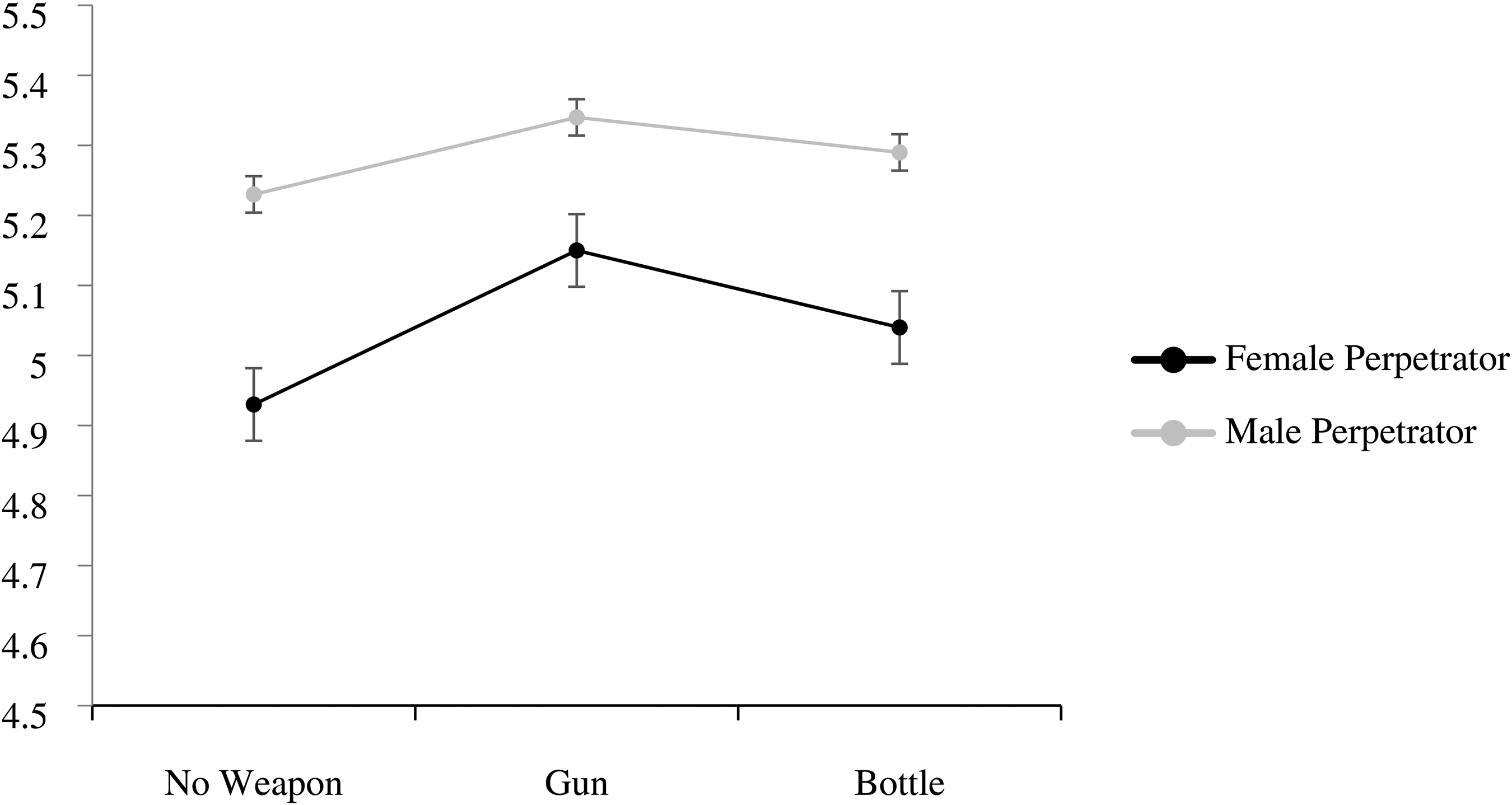
Perpetrator Gender and Weapon Presence Interaction.
Footnotes
Declaration of Conflicting Interests
The author(s) declared no potential conflicts of interest with respect to the research, authorship, and/or publication of this article.
Funding
The author(s) received no financial support for the research, authorship, and/or publication of this article.
